𝗙𝗨𝗟𝗟 𝗦𝗧𝗢𝗥𝗬:The Most Feared Man in New Orleans Had Never Met a Woman Who Refused to Be Afraid of Him
FULL STORY CONTINUATION
I had spent almost a decade becoming invisible.
That sounds sadder than I mean it.
Invisible people are useful.
They hear things.
They see things.
They learn which guest is pretending not to drink and which one needs the wine glass quietly removed before dinner.
They remember that the grandmother of the bride cannot hear the band from the left side.
They know which senator’s wife has panic attacks in crowded bathrooms.
They notice the caterer whose hands shake because he’s short two servers.
They see the florist’s assistant crying on the service stairs ten minutes before the ballroom doors open.
You learn quickly that the people nobody looks at tend to know everything.
My father taught me that.
Daniel Bennett had been deaf since infancy.
He was a carpenter.
Strong hands.
Patient eyes.
Quick smile.
I learned American Sign Language before I could spell my own last name.
Dad also taught me to read lips because he could.
Not perfectly.
Nobody can.
But well enough to understand when people were whispering in front of him because they assumed deaf meant unaware.
“The quietest person in the room,” he used to sign, “usually sees the most.”
Dad died two years before Roman walked into the Marchand.
Weak heart.
In his sleep.
Tuesday morning.
No warning.
My mother had left when I was eleven with one suitcase and an apology she never finished.
So after Dad died, I was what Theo had.
My younger brother was nineteen.
Tall.
Sweet.
Engineering student at Tulane.
Scholarship kid.
The scholarship covered tuition.
Mostly.
It did not cover books, housing, food, lab fees, emergency expenses, or the thousand other things colleges apparently invented after sending the congratulations letter.
Theo believed he was independent.
I protected that belief carefully.
My salary helped.
Double shifts helped more.
I lived in a narrow shotgun house in Bywater with one leaking roof corner and a one-eyed orange cat named Gumbo who considered unpaid bills ideal sleeping surfaces.
It wasn’t glamorous.
It was mine.
The Hotel Marchand was different.
Old brick.
Black iron balconies.
Slow ceiling fans.
A courtyard fountain that never stopped singing.
Every week, wealthy people arrived to celebrate engagements, marriages, promotions, elections, mergers, anniversaries, and sometimes divorces if they were rich enough to make those festive.
I planned all of it.
Floor plans.
Menus.
Wine.
Security.
Flowers.
Music.
Table assignments.
Dietary restrictions.
Contracts.
Staffing.
Everything passed through my hands.
Nobody noticed.
That was fine.
Mostly.
Bridget Okafor noticed.
Bridget was fifty, ran housekeeping like a military campaign, and had decided on my first day that I belonged to her.
She called me baby girl.
Fed me red beans every Monday.
Threatened everyone who made me cry.
And possessed a gossip network more efficient than the federal government.
She was pushing a laundry cart across the lobby the afternoon Roman first arrived.
“Don’t look up.”
Naturally, I looked up.
Bridget sighed.
“Lord, give me patience.”
“What?”
“The devil just walked in wearing a four-thousand-dollar coat.”
That was when I saw Roman.
After I showed him the Tapestry Room, he surprised me again.
He did not ask about flowers.
Or wine.
Or the menu.
He asked:
“Who is working Thursday?”
“Which department?”
“All of them.”
Most coordinators would’ve checked the schedule.
I didn’t need to.
“Marcus and Deline on floor service. Etienne in the cellar. Priya on bar. Thomas and Gwen in the kitchen. Big Ray on security.”
Roman watched me.
“Marcus has a daughter who started kindergarten last month. Deline is saving for a wedding she keeps threatening to cancel. And Big Ray will let nearly anybody through a door if they compliment his mustache, so please don’t test that.”
Something moved in Roman’s eyes.
“You know everyone.”
“Of course.”
“Why?”
“They work in my building.”
“If I replaced them with people I selected?”
“No.”
That stopped him.
I pointed toward the service door.
“Your people don’t know which hinge sticks.”
Then the silver cabinet.
“They don’t know where the good flatware is.”
Then toward the kitchen.
“They won’t know Chef Gwen hates anyone entering through the left side of her pass.”
I lifted my clipboard.
“I know you’re probably used to hearing yes, Mr. Devo.”
“I am.”
“I’m just not convinced yes is always the safest answer.”
He stared at me for a long moment.
Then:
“Thursday.”
And walked out.
My knees became weak after he was gone.
Bridget appeared beside me.
“You told Roman Devo no.”
“Yes.”
“Twice.”
“Yes.”
“Baby girl.”
She touched my forehead.
“Are you feverish?”
Thursday arrived hot and heavy with thunder waiting somewhere beyond the river.
Roman’s guest of honor was Harbor Commissioner Alden Pruitt.
Sixties.
Bad knee.
Quiet personality.
His wife baked pies for St. Anne’s church.
The dinner mattered.
Roman sent three men to inspect the building before seven.
I let them.
There are two kinds of nervous people.
The ones who need reassurance.
And the ones who need to be allowed to check the exits.
At seven-forty, I noticed a waiter carrying Roman’s wine.
Except he wasn’t one of ours.
That was detail one.
His hotel jacket was too dark.
Detail two.
His shoes were brand new.
Detail three.
Etienne, our sommelier, had personally brought important cellar bottles upstairs for twelve years.
Detail four.
My father had trained me to trust the small details when they disagreed with the big picture.
I stepped into the man’s path.
“New?”
He smiled.
“Etienne sent me.”
“Really?”
“Yes, ma’am.”
I looked at the bottle.
“Let me help.”
His hand tightened.
“I’ve got it.”
“I’m sure.”
I took the bottle anyway.
The foil around the neck was loose.
A faint glue line ran underneath.
The cork sat crooked.
The label looked newly printed.
My stomach turned cold.
“Oh, I’m so sorry.”
I used the voice I reserved for mothers of brides having emotional emergencies.
“I think we have a cork issue.”
His eyes changed.
“I’ll get another bottle.”
The stranger glanced toward the service door.
I saw him make the decision.
Run.
He turned.
I handed the bottle to a confused busboy.
Then walked—did not run—into the Tapestry Room.
Twelve people sat around the table.
Roman at the head.
I put one hand on the back of his chair and leaned near his ear like I was confirming dessert.
“The wine isn’t what it should be.”
He went very still.
“The man who brought it is moving toward the kitchen door.”
I smiled brightly at the guests.
“Tiny delay. The Bordeaux needs a little more time.”
Roman lifted two fingers.
One of his men disappeared.
Ninety seconds later, something heavy hit a wall in the service corridor.
Then a man’s voice said:
“Sir, I asked for identification.”
Dinner continued.
No screams.
No scene.
The bottle went to a private laboratory.
By dawn, Roman knew it had been tampered with.
Heart medication.
Enough to stop Alden Pruitt’s heart within an hour.
The commissioner would’ve died at Roman’s table.
Every newspaper would’ve carried the story.
Roman’s name would’ve become poison without anybody touching him.
Someone was trying to destroy him indirectly.
That someone had underestimated the events coordinator who noticed shoes.
Roman returned to the hotel after midnight.
I was alone in the Tapestry Room blowing out candles.
“You could have ignored it.”
I turned.
He stood in the doorway.
No coat.
No bodyguards visible.
Just Roman.
“What?”
“You saw a man you did not recognize.”
“Yes.”
“You could have decided it was not your business.”
I blew out another candle.
“It was my room.”
He frowned slightly.
“If something happens during one of my events, it’s my responsibility.”
“To Commissioner Pruitt?”
“To everybody.”
I turned.
“Commissioner.”
“Busboy.”
I pointed toward him.
“Even you.”
That got the almost-smile.
“Although, honestly, you were the person I worried about least.”
“Why?”
“You look like a man who has contingency plans for his contingency plans.”
Roman crossed the room.
Stopped an arm’s length away.
“Thank you.”
The words sounded strange coming from him.
Stiff.
Unused.
“You don’t owe me anything.”
“That is not how I keep accounts.”
“That sounds exhausting.”
His mouth moved.
Then he insisted on walking me to my car.
I informed him that I had successfully walked to cars without armed escorts for nine years.
He informed me that circumstances had changed.
I rolled my eyes.
Two men followed us anyway.
I didn’t sleep that night.
Afterward, Roman began appearing constantly.
Always with reasons.
He needed to discuss a menu already approved.
Inspect an exit already inspected.
Confirm a seating chart.
Speak to Mr. Howerin, who developed an incredible talent for being absent whenever Roman entered the building.
Somehow Roman’s “business” always ended near my office.
Then came the first text.
Unknown number.
Have you eaten
No greeting.
No name.
No question mark.
I stared.
Typed:
Is this a threat or concern?
Reply:
Yes.
I laughed so hard Marcus checked whether I was choking.
I wrote:
Half a sandwich.
Then:
It was a sad sandwich.
Twenty minutes later, Jonah appeared.
Jonah was Roman’s security man.
Six-foot-six.
Shoulders that required negotiation with doorways.
Expression like a courthouse gargoyle.
He held a paper bag.
“Boss says protein.”
“Boss?”
“Mr. Devo.”
“I know who you mean.”
Inside was a po’boy from a place where sandwiches cost more than my weekly grocery budget.
“Sit.”
Jonah looked alarmed.
“Ma’am?”
“You’ve been standing all day.”
“I’m working.”
“So am I.”
I tore the sandwich in half.
“Eat.”
The giant man stared like I had asked him to commit treason.
Twenty minutes later, I knew his mother lived in Baton Rouge and called him Baby Joe.
He feared pigeons.
Wanted to own a bakery one day.
And was surprisingly sentimental about cinnamon.
Roman’s written instruction to him eventually reached my desk:
WATCH MISS BENNETT. DO NOT ANNOY HER.
Jonah violated the second directive hourly.
Then came the beignets.
Roman somehow discovered I ate lunch on the loading dock at one-fifteen because it was the only place nobody looked for me.
Third Friday.
Door opened.
Roman stepped outside.
Four-thousand-dollar coat.
Paper bag.
Powdered sugar.
“You bought beignets.”
“They are warm.”
“You didn’t buy these.”
His jaw moved.
“Someone else bought them.”
“But you carried them here because you thought that made it personal.”
Silence.
“Oh my God.”
I took the bag.
“That is so much worse.”
“Worse?”
“And sweeter.”
I patted the crate beside me.
“Sit.”
He did.
The most feared man in New Orleans sat on a wooden loading dock crate and got powdered sugar on his coat.
Then on his chin.
“You have sugar here.”
“I do not.”
“You do.”
“I would know.”
“You apparently don’t.”
Without thinking, I reached up.
Brushed it from his jaw.
Everything stopped.
Roman’s eyes dropped to my face.
My fingers were still near his skin.
His breath caught.
Mine did too.
I withdrew my hand.
“Well.”
I grabbed a beignet.
“I have work.”
Cowardice.
Pure cowardice.
Roman let me go.
His grandmother did not.
Celeste Marchand Devo was eighty-two and universally known as Mémère.
She had raised Roman after his parents died.
She used a wheelchair she hated, wore hats she adored, and could humiliate powerful men with one sentence.
I met her at her birthday brunch.
She looked me over.
“You are too thin.”
“Mémère,” Roman said.
“Why is she thin?”
“Mémère.”
“You are feeding her?”
I answered.
“I forget meals.”
The old woman looked horrified.
“Forget?”
“Sometimes.”
“What do you eat at night?”
“Cereal.”
Her entire face changed like I had confessed a felony.
“Roman.”
“Mémère, please.”
“She comes Sundays.”
I blinked.
“I’m sorry?”
“My house.”
She pointed.
“I feed you.”
Then at Roman.
“You stop looking at her like a dog looks at steak.”
Roman’s ears turned red.
Jonah studied the fountain.
Bridget crossed herself.
Mémère leaned toward me.
“My grandson counts everything.”
Roman closed his eyes.
“Pills. Cars. Men. Minutes.”
“Mémère.”
“He counts how long before you enter a room.”
My heart stopped.
“He does it to stay alive.”
Her voice softened.
“I would like him to stop counting and begin living.”
She looked directly at me.
“I think you may help.”
That night, Roman asked me to walk with him.
We ended up on the Marchand roof.
French Quarter below.
River beyond.
Trumpet somewhere far away.
He stared at the water.
“I had a sister.”
His voice was so quiet I nearly missed it.
“Vivien.”
I waited.
“Nineteen.”
He swallowed.
“I was twenty-three.”
Something in my chest tightened.
“Gabriel Castellain’s father wanted to hurt my family.”
Roman did not look at me.
“She was going to church.”
“A car?”
“Yes.”
“I heard it from inside the house.”
His voice never shook.
That made it worse.
“I have heard it every Sunday since.”
I crossed the roof barefoot.
Stood beside him.
Took his hand.
His whole body tightened.
Then slowly, his fingers closed around mine.
“My father was deaf.”
Roman turned slightly.
“He told me the loudest grief is the kind nobody hears.”
I watched our hands.
“I signed for him at the hospital when he died.”
“What did he say?”
“Three words.”
My throat tightened.
“Take care, Sophie.”
I laughed softly.
“I’ve been trying ever since.”
Roman’s thumb moved over my knuckles.
I lifted our hands.
“Want to learn thank you?”
“In sign?”
“Yes.”
I showed him.
Fingers to chin.
Outward.
He did it badly.
“No.”
He frowned.
Again.
“Still wrong.”
Again.
“Roman.”
“I am learning.”
“You’re threatening the sign.”
Fourth try.
Correct.
He looked at me.
The expression on his face was younger than anything I’d seen.
Open.
Unprotected.
I felt my heart tilt.
His hand lifted.
Knuckles brushed my cheek.
Then his phone rang.
The moment shattered.
Roman answered.
Whatever he heard put the armor back instantly.
When he finished, he looked at me.
“I’ll see you tomorrow.”
Not a question.
A fact.
The next major event was Charlotte Bowmont’s engagement party.
Two hundred guests.
Sixteen-piece band.
Five-tier cake.
More champagne than my annual salary.
Roman was invited.
That afternoon, he appeared in my office.
“Will you work tonight?”
I looked at my clipboard.
“I coordinate events.”
“There will be men who ask you to dance.”
I slowly put down my pen.
“Possibly.”
“I would prefer that you decline.”
“Would you?”
“Yes.”
“Interesting.”
His eyes narrowed.
“I would prefer you learn the word please.”
“Sophia.”
“And understand something else.”
I folded my hands.
“If someone asks me to dance and I want to, I say yes.”
His jaw tightened.
“If I don’t, I say no.”
He stared.
“My decision.”
Silence.
“Always.”
Longer silence.
Finally:
“Acceptable.”
He left.
I smiled for ten minutes.
The ballroom that evening was beautiful.
Crystal.
Candlelight.
White hydrangeas.
I wore black because staff wore black.
Roman wore black because apparently intimidation had a dress code.
He stood near the east wall.
Every few minutes, I caught him looking at me.
Then Lucas Whitmore asked me to dance.
Lucas was thirty.
Kind.
Rich in the harmless way that comes from generations of money.
Charlotte encouraged it.
Bridget nearly dislocated her shoulder gesturing for me to go.
I accepted.
One dance.
Then Lucas made me laugh.
Asked for another.
I said yes.
When the second song ended, Roman was already crossing the floor.
People moved without realizing why.
He stopped in front of me.
“You danced twice.”
I raised an eyebrow.
“You counted?”
“I notice things.”
“Apparently.”
His eyes changed.
“Especially when they involve you.”
For once, I had no answer.
Somebody called my name from the service side.
I escaped.
In the corridor, I pressed both palms against my face.
“He is a mafia boss.”
I whispered to myself.
“You own a one-eyed cat.”
Then I heard voices in the stairwell.
Two men.
Low.
Urgent.
I should’ve walked away.
Instead, I listened.
“East terrace.”
One voice.
“After the toast. Lights down for cake.”
Another:
“He always steps outside.”
“Ten o’clock.”
Then:
“What about the girl?”
“The coordinator?”
“Yes.”
“She sees a waiter.”
Pause.
“One shot.”
My blood went cold.
“Castellain wants it clean.”
Another pause.
“When Devo is down, the throne opens.”
Then the phrase that mattered:
“Friend inside.”
I waited until footsteps disappeared.
Then ran.
Roman was speaking to three men.
I walked straight through them.
“Roman.”
First name.
First time.
“I need you.”
He looked at my face.
No questions.
“Excuse us.”
He followed me into the linen room.
I told him everything.
East terrace.
Ten.
Cake.
Gun.
Inside man.
Roman’s expression emptied.
Not fear.
Not anger.
Calculation.
“Jonah.”
He spoke into his cuff radio.
“East terrace. Now.”
Then:
“Find Theo.”
I blinked.
“What?”
“Your brother.”
“He’s at Tulane.”
“Someone stays with him.”
“Why?”
Roman looked at me.
“If someone inside my house knows you overheard that conversation, your brother becomes leverage.”
My stomach dropped.
“I will not allow leverage.”
At ten, the ballroom lights dimmed.
The cake arrived.
Nobody died.
Jonah found the fake waiter outside with a gun taped beneath a tray.
The guests never knew.
Afterward, Roman and I stood alone on the terrace.
“You’ll have security.”
“No.”
“Two men at your house.”
“No.”
“Jonah drives you.”
“No.”
“This isn’t a discussion.”
“Then you’re having it alone.”
He stared.
“I have a life.”
“I know.”
“A brother.”
“Yes.”
“A cat who bites strangers.”
“I’ve been informed.”
“I will not disappear because some idiot wants to shoot you.”
“This is not about your preference.”
“Then what is it about?”
That broke something.
Roman’s voice lost command.
“It is about what I am not willing to lose.”
Silence.
My anger vanished so quickly it left me dizzy.
This wasn’t ownership.
Not completely.
This was a man who had buried his sister because somebody wanted to hurt him.
A man who had taught himself never to love anything he couldn’t guard.
And somehow I had become a problem his rules did not solve.
“Fine.”
His shoulders loosened slightly.
“But I choose the bodyguard.”
“Jonah.”
“Yes.”
“He is already assigned.”
“And if he tells me what to eat, I fire him.”
“You cannot fire Jonah.”
“Watch me.”
Roman almost laughed.
The next week was ridiculous.
Jonah followed me to work.
Carried groceries.
Checked alleys.
Gumbo climbed onto his shoulder and instantly declared him family.
Theo met him.
Theo looked at Roman.
Then me.
Then Jonah.
“So.”
I braced.
“My sister has mafia security.”
“No.”
Jonah raised a hand.
“Yes.”
“Traitor.”
Theo grinned.
“If he hurts you, I have a graphing calculator.”
“Very sharp?”
“Extremely.”
Jonah nodded solemnly.
“Good weapon.”
Meanwhile, Roman hunted the traitor.
At first he refused to involve me.
That lasted four days.
Then he appeared in my office after midnight looking exhausted.
I pushed out a chair.
“Sit.”
“Miss Bennett—”
“Sophia.”
His eyebrows moved.
“Sit.”
He sat.
I unrolled the ballroom floor plan.
“The assassin knew East Terrace.”
“Yes.”
“That was selected after security sweep?”
“Yes.”
“Who knew?”
Roman looked at me.
Five people.
Jonah.
His cousin Dominic.
Accountant Marcel Boudreaux.
Lieutenant Paul Renard.
And Tony Bellamy.
Tony had been Roman’s father’s oldest friend.
Mentor.
Advisor.
The man who taught Roman to shoot.
To negotiate.
To keep ledgers.
The man who stood beside him at Vivien’s grave.
“It isn’t Tony.”
Roman said it before I asked.
Flat.
Final.
I didn’t argue.
Instead, I put my hand over his.
Friday, Roman built a trap.
Five men.
Five false shipping details.
Different warehouse for each.
Whichever location Castellain watched would reveal the leak.
That was the plan.
Then Sunday lunch happened.
Mémère held court at an old Creole restaurant off Esplanade.
Long table.
Checkered cloth.
Family.
Roman’s inner circle.
Me, because Mémère had formally declared that refusing her invitation was “bad breeding.”
Tony sat at the far end.
White hair.
Warm smile.
Gold pocket watch.
He asked about Dad.
Actually listened.
Halfway through lunch, Tony excused himself for a cigar.
I happened to look through the window.
A man in a gray jacket approached him.
They talked.
Thirty feet away.
Behind glass.
No sound.
But I didn’t need sound.
I read Tony’s lips.
Thursday. Warehouse on Poydras.
The other man:
Castellain wants the terminal.
Tony answered:
He will come himself if you have the girl.
My blood stopped.
Then:
He will do anything for her. I’ve seen it.
My fork hit the plate.
Roman looked at me instantly.
I couldn’t speak.
Tony turned back toward the restaurant.
I raised my hands under the table.
Roman didn’t know sign language well enough.
So I fingerspelled:
T-O-N-Y.
Roman watched my face.
He stood.
“Sophia. A word.”
We entered the back hallway.
“Tell me.”
“My dad was deaf.”
He frowned.
“I read lips.”
Roman’s face began to change.
“I’ve done it my whole life.”
“What did he say?”
My throat closed.
“Tony said Thursday. Poydras warehouse.”
Roman didn’t move.
“He said Castellain wants your terminal.”
I swallowed.
“And if they have me, you’ll come.”
Roman looked like somebody had removed the floor beneath him.
“You’re sure?”
“I have never been more sure of anything.”
Then the most important thing happened.
Roman had known Tony for thirty years.
I had known Roman seven weeks.
He believed me.
Immediately.
No interrogation.
No accusation.
No demand for proof.
He took my face in both hands.
“I believe you.”
Tears filled my eyes.
“Roman—”
“I have known him thirty years.”
His thumbs wiped my cheeks.
“And I believe you over him.”
That was the most romantic thing anybody had ever said to me.
In a greasy back hallway.
Tony fled before Roman could confront him.
He had seen my face through the restaurant window.
By six, his house was empty.
At eight-fifteen, I left the hotel.
Jonah beside me.
Pastry bag in my hand.
A white van stopped.
Fast.
Too normal.
Side door opened.
Two masked men jumped out.
One struck Jonah.
He went down hard.
I screamed.
Swung the pastry bag.
Hit somebody with a croissant.
Kicked another man.
A hand covered my mouth.
Arms lifted me from the pavement.
Jonah reached toward me.
Bridget screamed from the hotel entrance.
Then the van door slammed.
Darkness.
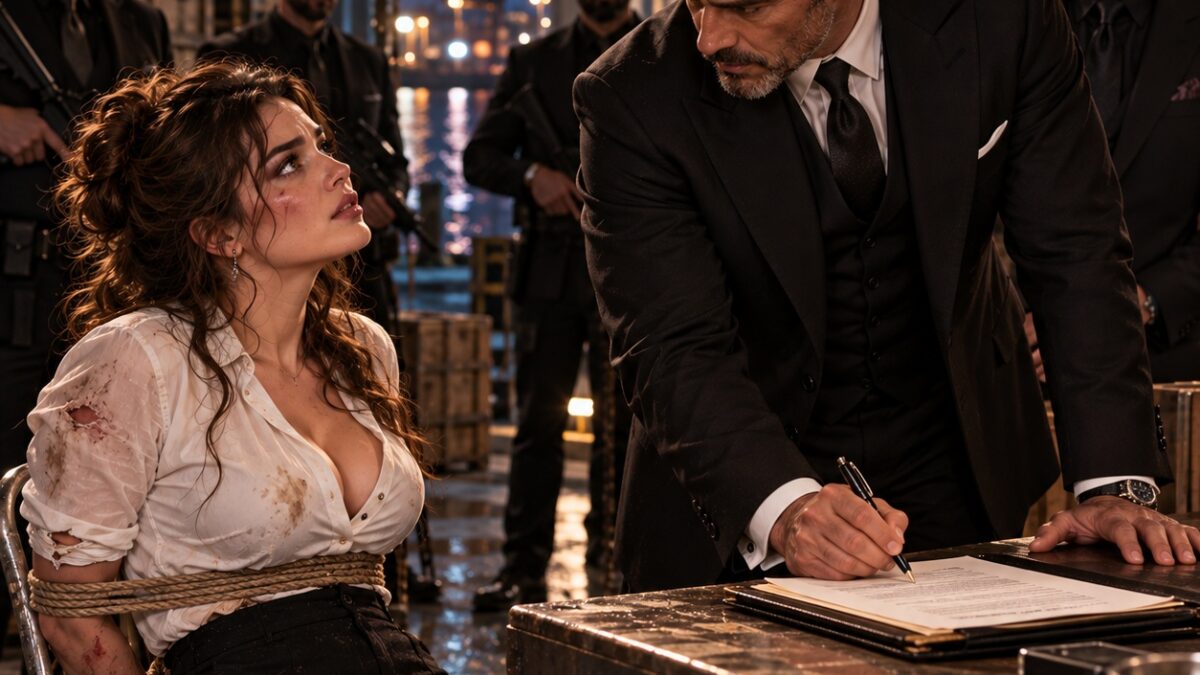
I woke tied to a chair.
Diesel.
River mud.
Cold metal.
My head hurt.
I listened.
Dad’s rule.
First listen.
Ferry horn.
Bridge traffic.
Water close.
Warehouse.
Near the river.
One bulb came on.
Gabriel Castellain stood beneath it.
Sixty-one.
Silver hair.
Beautiful suit.
Priest’s face.
Snake’s eyes.
“Miss Bennett.”
He smiled politely.
“I apologize for the inconvenience.”
“I’ve had worse events.”
That surprised him.
He smiled.
“I understand you have a brother.”
My heart kicked.
“And a cat.”
I stared.
“Remarkable what people discuss when they believe no one important is listening.”
Tony had given him everything.
Gabriel wanted Roman’s port terminal.
The private ledgers.
Control.
And he wanted Roman broken.
Not dead.
Not immediately.
He wanted Roman to choose.
Me or empire.
A young guard stood nearest me.
Maybe twenty-two.
Nervous.
Luke.
I learned his name when Gabriel left the room briefly.
“Luke.”
He looked away.
“Do you have a mother?”
No response.
“Mine left.”
His eyes flicked toward me.
“My dad raised me.”
Silence.
“Your mother?”
He swallowed.
“Hospital.”
“What?”
“She works nights.”
His voice was barely audible.
“She thinks I wash cars.”
“You don’t want her knowing this.”
His face tightened.
“They said nobody would get hurt.”
“They lied.”
His gun lowered slightly.
“They always do.”
I kept my voice soft.
“You still choose what happens next.”
“No.”
“Yes.”
“Not here.”
“Especially here.”
His eyes filled.
“It’s not too late.”
The gun dropped another inch.
Then he reached into his boot.
Small phone.
He moved behind me.
Pressed it into my tied hands.
“It’s on.”
“What?”
“I don’t know who to call.”
I did.
I dialed 911.
Left the line open.
Then waited.
Roman arrived at eleven.
Alone.
Charcoal coat.
Leather case.
Document.
He walked into that warehouse as if he had already accepted death.
Six men stood along the wall.
Tony stood near the shadows.
He couldn’t look at Roman.
Roman saw me.
For one second, the mafia boss disappeared.
I saw the brother who had heard his sister’s car explode.
Then the mask returned.
“Untie her.”
Gabriel smiled.
“Sign first.”
He laid out the contract.
Transfer of Devo Maritime’s terminal.
Everything.
“Then the ledgers.”
Roman opened the case.
Placed the private books on the table.
No hesitation.
Gabriel offered him the pen.
“Read it.”
Roman ignored him.
That’s when I said it.
“You really should.”
My voice shook.
Roman’s eyes came to me.
“I write contracts, remember?”
A cracked laugh escaped me.
“Never sign without reading.”
The room went silent.
He signed anyway.
Gabriel lifted the document.
“Forty years.”
He looked delighted.
“Three generations.”
Roman looked only at me.
“I signed because nothing in that case is worth one hair on her head.”
Gabriel’s smile thinned.
“If that disappoints you, you’ve never loved anything.”
I stopped breathing.
Roman had said it before enemies.
Men with guns.
Tony.
Everyone.
He hadn’t even seemed to realize it was a confession.
Gabriel did.
And decided Roman could not leave alive.
“Bring her.”
His men moved.
Then Tony spoke.
“You said he would live.”
Gabriel turned.
Tony’s face looked twenty years older.
“You said the terminal and the girl.”
His voice broke.
“I did what you asked.”
Roman’s eyes became ice.
“I gave you the terrace.”
Tony’s hands trembled.
“I gave you ledger keys.”
Then the reason finally came out.
Tony’s granddaughter.
Marisol.
Seven years old.
Deaf.
Gabriel had threatened to take her.
Tony had betrayed Roman because he was terrified for the child.
No excuse.
But not greed.
Fear.
Gabriel raised one hand.
His men raised guns.
Then the rear warehouse door opened.
Luke had slipped the bolt.
Jonah came through first.
Blood down one side of his face.
Apparently impossible to kill.
Behind him came Roman’s men.
Then police.
State police.
The 911 dispatcher had heard everything.
Gabriel’s threats.
The contract.
The kidnapping.
Tony’s confession.
All of it.
The fight ended in less than a minute.
Hands.
Shouts.
Metal.
Men on the floor.
Gabriel on his knees.
Then Roman was in front of me.
“Sophia.”
His hands ripped at the rope.
“Sophia.”
“I’m here.”
He pulled me against him.
Hard.
He was shaking.
Roman Devo.
The man New Orleans whispered about.
Shaking.
“I have you.”
“I know.”
“I have you.”
“I know.”
I whispered:
“I told you to read it, you idiot.”
His laugh cracked.
Then almost became a sob.
Police lights filled the warehouse.
Gabriel was arrested.
Luke was protected as a cooperating witness.
Roman carried me toward the ambulance.
I protested.
Weakly.
He ignored me.
Then he went back to Tony.
Everybody watched.
“My boy.”
Tony cried.
“I am sorry.”
Roman’s hands clenched.
Tony explained Marisol.
The threats.
The shame.
How afraid he’d been to tell Roman he couldn’t protect his own granddaughter.
Roman stood silent.
I knew what his world expected.
Betrayal demanded a response.
I climbed down from the ambulance.
Bare feet on concrete.
Walked to him.
Touched his arm.
“He was scared.”
Roman looked down at me.
“That does not excuse it.”
“I know.”
Tony cried silently.
“He isn’t Gabriel.”
Roman said nothing.
“He loved somebody more than he loved his honor.”
My voice shook.
“I think you understand that now.”
Roman’s eyes changed.
“Please.”
I squeezed his arm.
“Don’t let that little girl lose her grandfather in this warehouse.”
Long silence.
Then Roman looked at Tony.
“You put her within reach of the only person I have left.”
Tony bowed his head.
“I let you live because she asked.”
His voice went hard.
“You leave New Orleans tonight.”
Tony’s shoulders collapsed.
“Whatever Marisol needs, you send it through Jonah.”
He paused.
“It will be paid.”
Tony looked up.
“But you never sit at my table again.”
Roman’s voice broke slightly.
“You never say my name.”
Tony sobbed.
“You taught me everything.”
Roman swallowed.
“I hope you understand what it cost you.”
Then he walked away.
With me.
Mémère’s house smelled like gardenias, floor wax, and food.
We arrived around three in the morning.
She opened the door in a lavender robe and curlers.
Saw my wrists.
Burst into tears.
Then immediately became furious.
“Move.”
Everybody moved.
She made roux at three in the morning.
Nobody argued.
By sunrise, I was washed.
Bandaged.
Wrapped in one of Mémère’s enormous nightgowns.
It said BON VOYAGE across the chest.
Jonah sat on the porch steps eating enough food for three men.
Bridget arrived at five and cried into my shoulder.
Theo came in pajamas holding a graphing calculator like a weapon.
He refused to release my hand.
Then Roman appeared in the doorway.
Theo stood.
“I brought this.”
He held up the calculator.
Roman looked at it.
“In case you make her cry.”
Silence.
“It has corners.”
Roman nodded with grave respect.
“I would expect nothing less.”
Theo stared.
Then laughed.
Jonah laughed.
Mémère laughed.
Bridget laughed.
I laughed until tears rolled down my face.
Nothing was funny.
We were alive.
Sometimes that is enough.
Later, everyone went inside.
Roman sat beside me on the porch swing.
No coat.
Sleeves rolled.
Bruise along his jaw.
For a while, neither of us spoke.
“I signed away the terminal.”
“I know.”
“Lawyers say the contract is worthless.”
“Good.”
“Duress. Recording. Kidnapping.”
“Very good.”
He turned.
“But I did not know that when I signed.”
I looked at him.
“Sophia, I believed it was real.”
His voice lowered.
“I thought Devo Maritime was over.”
I reached for his hand.
“It was still easy.”
“I know.”
“No.”
He faced me fully.
“It was the easiest decision I have ever made.”
My throat tightened.
“I spent seventeen years building a wall.”
Roman looked out at the garden.
“I told myself that if I loved nothing, I could lose nothing.”
His fingers closed around mine.
“Then you walked across a hotel lobby with a clipboard and told me no.”
I laughed weakly.
“You needed to hear it.”
“I have not had a peaceful night since.”
“I’m sorry.”
“You are not.”
“Not even slightly.”
That almost made him smile.
Then he became serious.
“I have said something wrong for weeks.”
“What?”
“That I want to keep you safe.”
I waited.
“That is not what I mean.”
His hand tightened.
“I want to keep you.”
My breath caught.
“Not locked away.”
He looked directly at me.
“Not behind guards.”
A pause.
“Beside me.”
The old porch swing creaked.
“In daylight.”
My eyes filled.
“In front of everyone.”
Roman’s voice dropped.
“For as long as you will let me.”
I stared at him.
There had been many moments in the previous weeks where I had imagined him finally saying something like that.
In none of those fantasies was I wearing a giant borrowed nightgown with BON VOYAGE across my chest.
“You know what?”
Roman waited.
“I really wanted an apology.”
“For what?”
“The bodyguard.”
“I apologize.”
“The surveillance.”
A slight pause.
“I apologize for the surveillance.”
“The food deliveries?”
“No.”
I laughed.
“The beignets?”
“Absolutely not.”
“You’re impossible.”
“Yes.”
I put both hands on his face.
Kissed him.
Slow.
Gentle.
His entire body trembled beneath my hands.
When we separated, his forehead rested against mine.
“You belong to no one.”
“I know.”
“I will never say otherwise.”
“Good.”
His eyes opened.
“But every man in a ballroom may borrow your smile for one song.”
I raised an eyebrow.
“Roman.”
“Only one gets the rest of the night.”
“That sounds dangerously possessive.”
“I am learning.”
“Slowly.”
He touched my cheek.
“I will burn this city before I let it take you from me.”
I stared.
“That is an incredibly dramatic sentence.”
“I am a dramatic man.”
“You are the most dramatic man in Louisiana.”
“I accept that.”
I kissed him again.
Six weeks later, the Hotel Marchand held its annual Founders Ball.
Two hundred and fifty guests.
Every chandelier lit.
Every table perfect.
Every glass polished.
For nine years, I had worked that ballroom from the edges.
Clipboard.
Earpiece.
Black dress.
Invisible.
That year, Mr. Howerin insisted I attend.
Bridget demanded it.
Roman quietly made the decision unavoidable.
“You built these nights.”
He said it simply.
“You should experience one.”
Mémère chose my dress.
Emerald silk.
Theo described it as “alarmingly regal.”
Bridget cried before I even left the dressing room.
I stood at the top of the staircase.
No clipboard.
No earpiece.
No list in my hand.
For one long breath, I nearly went back.
Then I descended.
The room became quiet.
Two hundred and fifty people looked at me.
Not through me.
At me.
Bridget openly cried at the bar.
Marcus held a champagne tray like an offering.
Jonah wore a rented tuxedo and looked deeply uncomfortable.
Charlotte Bowmont pointed at me excitedly.
And at the bottom of the stairs stood Roman.
Hand extended.
Waiting.
I reached him.
“You’re late.”
“I was making an entrance.”
“I counted.”
“Of course you did.”
His eyes moved over me.
“You succeeded.”
Then he lifted my hand.
Kissed it.
In front of judges.
Businessmen.
Politicians.
Families who had spent decades pretending not to fear him.
Mémère’s voice floated from the back.
“Finally.”
The band started.
Roman led me onto the floor.
“I should warn you.”
“What?”
“I am not a good dancer.”
I stared.
“Roman Devo admits weakness?”
“One.”
“Historic.”
He counted the steps under his breath.
“One, two, three.”
“Stop.”
“I prefer accuracy.”
“You are dancing, not invading a country.”
“One, two—”
He stepped on my foot.
I gasped.
Roman froze.
“I’m sorry.”
His face was so serious I nearly collapsed laughing.
Lucas Whitmore passed nearby with Mémère.
She was leading.
Naturally.
For a few minutes, I forgot everything.
The warehouse.
The ropes.
The wine.
Tony.
Gabriel.
The river horn.
The gun taped under a tray.
I felt Roman’s hand on my back.
His heartbeat near my cheek.
Later, I stood alone beside a marble column with champagne.
I felt his eyes before I saw him.
That had always been true.
Even when I was invisible to everyone else, I had never been invisible to Roman.
Across the ballroom, he watched me.
Quiet.
Focused.
As if he could stand there for years.
I lifted my glass.
“Still counting?”
He put down his own.
Crossed the ballroom.
People moved aside.
Always.
When he reached me, I could see silver at his temples.
Gold flecks in gray eyes.
“Always.”
For once, I didn’t tease him.
I didn’t make a joke.
I simply opened my hand.
Palm up.
Roman looked at it.
Then at me.
And the most feared man in New Orleans took my hand like it was the one thing in the entire city he had ever truly wanted.
The band began another song.
Candles trembled.
He led me back onto the floor.
Into the light.
Where everyone could see.
For years, I had believed being overlooked made me safe.
Roman had believed loving nothing made him safe.
We had both been wrong.
I had spent my life standing at the edge of rooms, noticing everyone while nobody noticed me.
He had spent his standing at the center of rooms, seen by everyone and known by almost no one.
Then one night, the most feared man in New Orleans walked into my hotel expecting everyone to say yes.
I told him no.
He came back anyway.
Again.
And again.
Until a loading dock became lunch.
A rooftop became confession.
A bodyguard became family.
A deaf carpenter’s daughter saw betrayal through a restaurant window.
A man who counted every threat in his life stopped counting long enough to trust somebody else.
And in the end, when an enemy put everything Roman had built on one side of a table and put me on the other, he did not hesitate.
That wasn’t what made me love him.
It was what happened afterward.
When he understood that choosing me did not mean owning me.
That protecting me did not mean silencing me.
That I could stand beside him without standing behind him.
Roman’s hand settled at my waist as we moved beneath the chandeliers.
“You’re counting again.”
“No.”
“You absolutely are.”
His mouth curved.
“Two hundred forty-eight people.”
“Roman.”
“Four security exits.”
“Stop.”
“Eleven guards.”
“Roman.”
“One woman.”
I looked up.
His expression softened.
“That one is important.”
My chest tightened.
I leaned closer.
“Keep counting that one.”
His hand tightened gently.
“Always.”
And for the first time in my life, being seen did not feel like danger.
It felt like coming home.








