𝗙𝗨𝗟𝗟 𝗦𝗧𝗢𝗥𝗬:The MMA Champion Shoved Me in Front of My Daughter—He Had No Idea Why I’d Spent Years Refusing to Fight
FULL STORY CONTINUATION
Grant laughed.
Not because anything was funny.
Because men like him sometimes use laughter as a way of deciding where everybody stands.
His two training partners stayed behind him.
One smiled automatically.
The other didn’t.
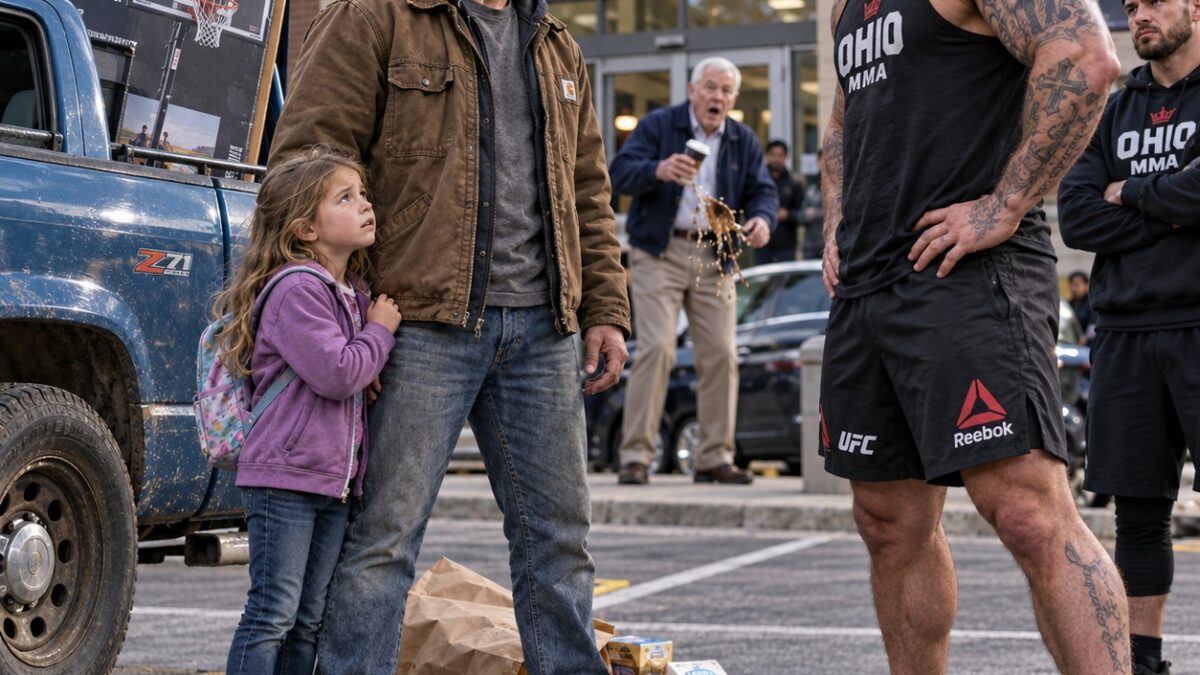
Ruby came closer and grabbed the edge of my jacket.
“Daddy, why did he push you?”
I could feel my pulse in my hands.
Not fear.
Not exactly.
Memory.
There is a very specific sensation that comes when your body knows what to do before your conscience has decided whether it should.
My hands felt light.
My shoulders loose.
Breathing steady.
The old machinery was still there.
That disturbed me more than Grant did.
I crouched beside Ruby.
“Some people forget being strong doesn’t mean they get to push people around.”
Grant heard.
“You calling me weak?”
I looked at him.
“No.”
“Sounded like it.”
“I’m explaining something to my daughter.”
“About me.”
“About strength.”
One of his training partners laughed under his breath.
Grant heard that too.
His face changed.
Pride is dangerous when it thinks it has an audience.
He pointed toward the MMA gym.
“Come inside.”
“No.”
“Couple rounds.”
“No.”
“Unless you’re scared.”
I opened the passenger door for Ruby.
“Callan.”
A voice came from behind us.
Firm.
Older.
I froze for a different reason.
I knew that voice.
Darius Vance stood near the recreation-center entrance.
He was in his early sixties now.
Silver beard.
Left leg still stiff from an old knee injury.
Coffee cup on the pavement beside him.
He had dropped it.
“Grant,” Darius said, “step away from him.”
Grant rolled his eyes.
“Stay out of it.”
“I would if you hadn’t just shoved a father in front of his child.”
“I barely touched him.”
“I watched you.”
Darius started toward us.
Then he looked at me again.
Really looked.
His anger disappeared.
“Callan?”
I gave him a tired smile.
“Hey, Darius.”
He stopped three feet away.
“I haven’t seen you since the retirement ceremony.”
Ruby looked up.
“Daddy, you know Mr. Darius?”
“From a long time ago.”
Darius ignored Grant and hugged me.
Brief.
Strong.
The kind men use when too many years sit between hello and goodbye.
“You never told me you moved back.”
“I wasn’t planning on making an appearance.”
That was true.
Darius had directed the recreation center for nearly thirty years.
Before that, he had worked in military physical-conditioning programs and later helped coordinate specialized training contracts.
Years ago, our paths had crossed often.
After I left that life, I stopped returning calls from most people connected to it.
Grant folded his arms.
“Can somebody explain what’s going on?”
Darius looked toward him.
“No.”
Grant blinked.
Darius continued.
“You shoved a man in front of his daughter. That’s the only part relevant to you.”
Grant’s jaw tightened.
Then one of his training partners said quietly:
“Wait. Brooks?”
That was when I knew the conversation had already gone too far.
I looked at Darius.
“Don’t.”
He understood.
Grant didn’t.
“What?”
Darius sighed.
“You ever hear of the National Combat Training Program?”
Grant shrugged.
“Sure.”
The second training partner looked more interested.
Darius said:
“Callan taught there.”
Grant stared at me.
I hated the shift.
One second I had been an ordinary maintenance guy.
The next, everyone was recalculating.
That was exactly why I never talked about it.
Darius continued anyway.
“He trained military personnel in close-quarters defense, restraint, survival under pressure, and hand-to-hand tactics.”
Grant’s smirk disappeared almost completely.
“Seriously?”
I looked at him.
“I used to have a job that required me to understand violence.”
Darius added:
“He was one of the best instructors I ever saw.”
“Darius.”
He stopped.
The parking lot had grown quiet.
People near the gym were watching.
Someone held up a phone.
That was the last thing I wanted.
Grant looked at my hands.
Scars across my knuckles.
A long pale line near my left thumb.
Old damage.
Nothing dramatic if you didn’t know where to look.
“You’re telling me this guy was some kind of fighter?”
I shook my head.
“No.”
Darius looked surprised.
I continued.
“I’m telling you I knew how to teach people not to freeze when violence started.”
Grant stepped closer.
“If you’re that good, prove it.”
“No.”
“Afraid I’ll beat you?”
“No.”
“Then what?”
I felt Ruby watching.
That answered the question.
“I don’t fight in front of my daughter.”
Grant laughed.
But this time it sounded less certain.
“Convenient.”
I looked at him for several seconds.
Something inside me changed.
Not anger.
Disappointment.
I knew men like Grant.
I had trained them.
Men who were disciplined in structured environments but lost control when the rules disappeared.
Inside a cage, Grant had a referee.
Rounds.
Gloves.
Medical staff.
A bell.
Outside, he was just a man deciding how much of himself to unleash.
That required a different kind of discipline.
“You have a career,” I said.
He stared.
“People look up to you.”
“So?”
“You have sponsors.”
“Yeah.”
“Training partners.”
He glanced behind him.
“Fans.”
“What’s your point?”
“You have a chance right now to be better than the guy you were ten minutes ago.”
His face hardened.
“Don’t talk down to me.”
“I’m not.”
“You think you’re better than me because you’ve got some military story?”
“No.”
“Then stop acting like it.”
“I’m not acting.”
That was what made him angrier.
People used to force him backward with aggression.
I wasn’t moving at all.
Grant stepped closer.
Darius moved between us.
“That’s enough.”
I touched Darius’s shoulder.
“It’s okay.”
“No, it isn’t.”
“He’s not going to hit me.”
Grant sneered.
“You sure?”
“Yes.”
That answer landed.
Not because I threatened him.
Because I sounded certain.
Then Ruby spoke.
“My daddy doesn’t fight people anymore.”
Everybody turned toward her.
She was half-hidden beside the truck door.
Small.
Serious.
Still frightened.
“Ruby,” I said gently.
But she looked at Grant.
“He used to have bad dreams.”
Every muscle in my body tightened.
“Sweetheart.”
“Grandma said it was because of things that happened when he was away.”
I knelt beside her.
“That’s enough.”
“No.”
Her eyes filled.
“I want him to know.”
Grant’s expression changed.
Ruby continued.
“My daddy doesn’t want to be scary.”
She looked at me.
“He wants to be my daddy.”
For several seconds, nobody said anything.
I could hear traffic from the main road.
Wind moving the flag near the recreation center.
Somebody’s phone vibrating.
Grant looked away first.
Something had left his face.
The performance.
Maybe the need to win.
He stared at his hands.
Later, he told me Ruby made him think about his own father.
At the time, I knew none of that.
I only saw a fighter suddenly uncomfortable with what a little girl had seen in him.
Grant’s father had apparently been the kind of man who measured masculinity through intimidation.
Never apologized.
Never admitted weakness.
Grant had spent his whole adult life trying to become stronger than him.
The irony was that he had inherited the same measurement.
People fearing you meant power.
People resisting you meant challenge.
Apology meant defeat.
Then an eight-year-old girl told him her father’s greatest effort was not becoming frightening.
Grant looked at me.
“I’m sorry.”
Nobody moved.
He swallowed.
“I shouldn’t have shoved you.”
His voice was quieter.
“And I shouldn’t have done it in front of your daughter.”
I waited.
“I was already angry.”
He looked toward the gym.
“Manager stuff.”
Then back.
“Sponsors.”
He exhaled.
“None of that had anything to do with you.”
It wasn’t a perfect apology.
Perfect apologies do not exist.
But excuses and explanations are different if a person takes responsibility first.
Grant had.
So I nodded.
“Then don’t make the next person pay for your bad day.”
He nodded.
I stood.
“One more thing.”
“What?”
“Ruby.”
He looked toward her.
I did not need to explain.
Grant crouched.
Not too close.
“I’m sorry I scared you.”
Ruby looked at me.
I nodded.
Grant continued.
“You didn’t do anything wrong.”
She thought about that.
Then said:
“Okay.”
A pause.
“Just don’t do it again.”
His mouth twitched.
“I won’t.”
I collected the apple.
Washed it later.
Ruby refused to eat it because “parking-lot germs are forever.”
Fair.
Then we drove home.
For ten minutes, she said nothing.
That worried me.
Normally Ruby could fill a silent car faster than radio.
Finally:
“Daddy?”
“Yeah?”
“Could you have beat him?”
There it was.
I had known it was coming.
I looked through the windshield.
“Maybe.”
“Darius said you were really good.”
“I used to be good at some things.”
“He’s the champion.”
“Yes.”
“So who would win?”
I almost laughed.
Children love answers that adults spend entire lives learning are not the right questions.
“I don’t know.”
“You really don’t?”
“No.”
I glanced toward her.
“Fights aren’t math.”
“But you weren’t scared.”
“That doesn’t mean I would win.”
She thought.
“Why didn’t you hit him?”
I could have given the simple answer.
Because you were there.
That was true.
Not complete.
I turned onto our street.
“Because hitting somebody isn’t the same thing as solving something.”
“But he hit you.”
“He shoved me.”
“That’s like hitting.”
“Close enough.”
“So he deserved it.”
That word.
Deserved.
I had heard grown men build terrible decisions around it.
“I don’t get to decide that.”
“You could’ve protected yourself.”
“Yes.”
“If he kept going?”
“Yes.”
I parked in our driveway.
Ruby waited.
I turned toward her.
“If somebody is actually trying to hurt you or me and there’s no safe way out, then I’ll protect us.”
She nodded.
“But if I can walk away, walking away is usually better.”
“Even if people think you’re scared?”
“Especially then.”
“Why?”
“Because what somebody thinks about me is not more important than what I do.”
She looked down.
Then:
“Mom would’ve yelled at him.”
I laughed.
“Your mother would have destroyed him verbally.”
That made Ruby smile.
“She was scary.”
“Terrifying.”
We carried the basketball hoop into the garage.
The afternoon became ordinary again.
At least I thought it would.
Sunday morning, Darius called.
“I gave Grant your number.”
“You what?”
“He asked.”
“Darius.”
“He wanted to apologize again.”
“He already did.”
“I know.”
“Then why give him my number?”
Darius paused.
“Because he looked like a man standing at a crossroads.”
“That is dramatic even for you.”
“Answer the phone if he calls.”
He hung up.
Grant didn’t call.
Instead, he came to the recreation center Monday morning.
I was replacing a broken resistance cable on one of the fitness machines.
He stood in the doorway.
No entourage.
No cameras.
No manager.
“Morning.”
I kept working.
“Morning.”
“I talked to Darius.”
“That was your first mistake.”
Grant almost smiled.
“He said the railing got bent.”
“It was already loose.”
“I shoved you into it.”
“It needed repair anyway.”
“I want to pay for it.”
“The center has maintenance funds.”
“I still want to.”
I put the wrench down.
“Why?”
“Because I broke it.”
Simple.
Good answer.
“Talk to accounting.”
He nodded.
Then looked around the old equipment.
Half the machines had been donated.
Some had torn pads.
One treadmill sounded like a helicopter.
“This place needs work.”
“Yes.”
“You need help?”
“No.”
He nodded slowly.
Then stayed.
I looked at him.
“What?”
“You said no really fast.”
“I have experience.”
“I could help.”
“Why?”
He looked embarrassed.
“Because I want to.”
That is how Grant Maddox spent a Monday morning replacing torn bench pads at a community recreation center.
Nobody photographed it.
Nobody posted it.
He did not mention sponsors.
That mattered.
People often perform change when change gives them something.
Attention.
Praise.
Reputation repair.
Grant did not ask for any.
He came back Tuesday.
Then Saturday.
At first, we barely spoke.
He lifted heavy equipment.
I fixed mechanical parts.
Darius watched with visible satisfaction and pretended he had not engineered any of it.
Ruby noticed Grant the following weekend.
She was sitting behind the front desk doing homework.
He walked in carrying replacement cables.
She stared.
Grant stopped.
“Hey.”
Ruby looked at me.
“Is he allowed here?”
Grant actually laughed.
I said:
“Yes.”
She looked suspicious.
“Did you push anybody today?”
“No.”
“Yesterday?”
“No.”
“Okay.”
Then she returned to multiplication.
Grant leaned toward me.
“She terrifying?”
“Yes.”
“Wonder where she gets it.”
“Her mother.”
That answer sobered me.
Grant noticed.
He didn’t ask.
That restraint also mattered.
A week later, he found me alone in the storage room.
“Darius told me your wife died.”
I kept sorting basketballs.
“Darius talks too much.”
“He didn’t tell me details.”
“Good.”
“I’m sorry.”
“Thanks.”
He hesitated.
“Ruby’s tough.”
“She has to be.”
Then he said:
“My dad’s alive.”
I looked at him.
“Okay.”
“He hasn’t spoken to me in two years.”
I waited.
People reveal important things badly.
Best not to interrupt.
Grant continued.
“He thinks fighting is stupid.”
“That seems ironic.”
“Why?”
“You became a fighter because of him, didn’t you?”
He stared.
“How’d you know?”
I shrugged.
“Pattern.”
He sat on a crate.
“My dad used to fight everybody.”
“Professionally?”
“No.”
“Ah.”
“Bars.”
“Neighbors.”
“Me once.”
That changed the room.
“How old?”
“Seventeen.”
I set the basketball down.
Grant looked at his hands.
“He broke my nose.”
I said nothing.
“Next morning he said I needed to learn how to take a punch.”
Grant laughed bitterly.
“So I learned.”
That sentence hurt more than he realized.
“Got good.”
“Apparently.”
“He hated that too.”
“Why?”
“Because once I could actually beat him, he stopped being special.”
There it was.
The inheritance.
Strength defined as domination.
Grant had escaped his father by becoming a better version of his father’s worst value.
“What happened two years ago?”
Grant rubbed his thumb across a scar.
“He came to a fight drunk.”
“Made a scene.”
“I told security to remove him.”
“He said I thought I was better than him.”
“Do you?”
“Yes.”
He said it immediately.
Then:
“But maybe not in the way I thought.”
I understood.
We went back to work.
Grant’s manager eventually came looking for him.
A sharp woman named Lena Foster.
She found him tightening bolts on a rowing machine.
“What are you doing?”
“Maintenance.”
“You have sparring in forty minutes.”
“I know.”
She looked at me.
“You Callan?”
“Yes.”
She studied my face.
Then Grant.
“So this is where you’ve been disappearing.”
Grant stood.
“It’s not a secret.”
“You told me recovery work.”
“This is recovery.”
Lena did not smile.
“You have a title defense in eleven weeks.”
“I know.”
“You also have three sponsors asking whether you’re unstable.”
Grant’s shoulders tightened.
I saw the old reaction.
Jaw.
Chest.
Hands.
Then something different happened.
He breathed.
One breath.
Then another.
“I know.”
Lena noticed too.
Her expression softened almost invisibly.
“Good.”
She looked at me again.
“Whatever you’re doing…”
“I’m not doing anything.”
“Keep not doing it.”
She left.
Grant looked at me.
“I hate when she’s right.”
“Get used to it.”
His training changed.
Not physically.
That part had always been disciplined.
Emotionally.
He stopped arguing with reporters.
Stopped responding to online criticism.
At press events, when opponents tried baiting him, he sometimes smiled.
Lena told Darius.
Darius told me.
Darius told everybody.
I told Darius to stop telling me things.
He ignored me.
Ruby’s basketball hoop eventually went up in our driveway.
That became our Saturday ritual.
She shot.
I rebounded.
She missed ninety percent.
Celebrated the ten.
Grant stopped by once while we were playing.
He stood near the curb.
Ruby saw him.
“You play basketball?”
“Badly.”
“Daddy’s bad too.”
“I am standing right here.”
She threw Grant the ball.
“Show me.”
Grant missed.
Badly.
Ruby laughed so hard she sat down.
The undefeated MMA champion stared at the hoop.
“I want another shot.”
“Strength means accepting failure,” I said.
He glared.
“I hate you.”
Ruby made him shoot twenty more.
He improved.
That afternoon, he asked something I knew was coming eventually.
“Will you train with me?”
“No.”
“Not fight.”
“No.”
“Movement.”
“No.”
“Defense drills.”
“No.”
“Why?”
I sat on the tailgate.
“Because you already have excellent coaches.”
“That’s not what I mean.”
“I know.”
“You know things they don’t.”
“Probably.”
“You see things differently.”
“Yes.”
“Then help me.”
I looked at Ruby.
She was chasing the basketball down the driveway.
“Grant.”
“What?”
“I left that life.”
“Why?”
“Injury.”
“That’s not the real reason.”
He had learned to listen too well.
I rubbed my left shoulder.
Old pain.
Not serious anymore.
“The injury gave me permission.”
“For what?”
“To stop.”
He waited.
I rarely talked about those years.
Even Emily had learned most of it slowly.
“People think teaching combat makes you love fighting.”
“Some do.”
“I didn’t.”
“Why were you good at it?”
“Because I respected what it could do.”
Grant sat beside me.
“Meaning?”
“You know what a punch can do.”
“Yes.”
“No.”
He looked over.
I continued.
“You know what it does in a cage.”
“Gloves.”
“Medical staff.”
“Weight classes.”
“Referees.”
“Rules.”
I looked toward Ruby.
“Outside those rules, violence gets ugly fast.”
His face became serious.
“I trained people for environments where there might be no referee.”
“Yeah.”
“I got tired of people admiring the techniques and ignoring the consequences.”
Grant said nothing.
“I saw injuries that never healed.”
“Men who stopped sleeping.”
“People who came home but didn’t really come back.”
I looked down at my hands.
“I started having nightmares before Ruby was born.”
“About what?”
“I don’t talk about specifics.”
He nodded immediately.
That mattered.
“Emily helped.”
I smiled faintly.
“She never treated me like I was dangerous.”
“What did she do?”
“She told me to get help.”
Grant laughed.
“Romantic.”
“Very.”
“I did.”
“Therapy?”
“Yes.”
“You still go?”
“Sometimes.”
His eyes shifted.
I knew that look too.
“You?”
“No.”
“Why not?”
“I’m not crazy.”
I almost smiled.
“Neither am I.”
He looked embarrassed.
“I didn’t mean—”
“I know.”
I waited.
“Grant, you almost started a fight with a stranger in front of his daughter because your manager criticized you.”
He winced.
“Yeah.”
“That is not a fighting problem.”
“What is it?”
“An anger problem.”
“I control anger for a living.”
“In the cage.”
He stared at me.
Outside was different.
That landed.
A week later, Lena told Darius Grant had started working with a sports psychologist.
Darius told me before I could stop him.
I said nothing to Grant.
If he wanted me to know, he would tell me.
Eventually he did.
“She’s annoying.”
“Good therapists often are.”
“She keeps asking why I need people to respect me.”
“What do you say?”
“That everyone needs respect.”
“And what does she say?”
“She says I didn’t answer the question.”
I smiled.
“Definitely annoying.”
Months passed.
Grant’s title defense approached.
The recreation center became part of his routine.
Not daily.
Enough.
He helped replace equipment.
Paid quietly for new mats in the youth fitness room.
Darius initially wanted to put his name on a plaque.
Grant refused.
“You serious?”
“Yes.”
“Free publicity.”
“I don’t need it.”
That was growth.
Then a local reporter found out Grant volunteered there.
The reporter arrived during one of our Saturday donation drives.
Grant saw the camera.
I saw something close behind his eyes.
Not fear.
Opportunity.
Then he stepped away from the lens.
The reporter followed.
“Grant, can we get a shot of you helping the community?”
“No.”
“Why not?”
“Because they’re unloading boxes.”
“That’s exactly what we want.”
“I’m not doing this for content.”
The reporter laughed.
“Everything’s content.”
Grant picked up another box.
“Not this.”
Later, I asked him why.
He shrugged.
“Didn’t want Ruby thinking I was pretending.”
That mattered more than any plaque.
His fight night came.
Ruby wanted to watch.
I said no.
“Why?”
“Because it starts too late.”
“That is not why.”
She knew me too well.
“You don’t like fighting.”
“I don’t mind sport.”
“You hate it.”
“I hate parts of it.”
“Grant’s different now.”
“Yes.”
“So we should support him.”
That argument was irritatingly strong.
We compromised.
She could watch the replay the next morning if the result wasn’t too graphic.
Grant won by decision.
Not knockout.
Five rounds.
Hard fight.
I watched live after Ruby went to bed.
At one point his opponent taunted him after the bell.
Old Grant might have responded.
New Grant simply walked back to his corner.
Lena looked surprised.
So did I.
He defended the title.
The interviewer entered the cage afterward.
“Grant, that may have been the most disciplined performance of your career.”
Grant laughed.
“Probably.”
“What changed?”
There it was.
The question.
He could have thanked coaches.
Training partners.
Nutrition.
Sports psychology.
He did all of that first.
Then the reporter asked:
“You’ve talked recently about redefining strength. What does that mean?”
Grant looked at the camera.
I expected a polished answer.
Instead he said:
“A few months ago I shoved a guy in a parking lot because I was having a bad day.”
The arena noise shifted.
The interviewer blinked.
Grant continued.
“He could’ve hit me back.”
“He had every reason to.”
“He didn’t.”
The reporter asked:
“Why?”
Grant smiled faintly.
“Because his little girl was watching.”
My chest tightened.
“He taught me something.”
“What?”
“The strongest man I’ve ever met was a guy who had every reason to hurt me and cared more about what his daughter learned from him.”
The interviewer paused.
“Who was he?”
Grant shook his head.
“Doesn’t matter.”
Good.
He kept my name out of it.
I turned off the television before the rest of the interview.
Not because I was angry.
Because I didn’t want to become a symbol.
People turn simple choices into myths.
I did not spare Grant because I was morally perfect.
I spared both of us because Ruby was there and because I had spent years learning what anger costs.
There were days in my past when I had made worse choices.
That was part of why I recognized his.
The next morning, Ruby stood in our driveway shooting baskets.
She missed five straight.
“Bend your knees.”
“I am.”
“No.”
“I am.”
“You look like a flamingo.”
“That’s mean.”
“It’s coaching.”
She shot.
Missed.
Grant’s pickup pulled over.
He got out wearing sunglasses and moving like every joint hurt.
Ruby ran toward him.
“You won!”
He smiled.
“I heard.”
“You heard?”
“I was there.”
She rolled her eyes.
“Daddy says you didn’t get hit too bad.”
I had not said that.
Grant looked at me.
“Thanks for the medical analysis.”
“You’re walking.”
“Barely.”
Ruby threw him the ball.
“Shoot.”
“I have bruised ribs.”
“Excuses.”
Grant looked at me.
“This is your fault.”
“No.”
He took the shot.
Missed.
Ruby cheered anyway.
That became our life for a while.
Not friendship exactly.
Then friendship.
Grant came to barbecues.
Helped with recreation-center events.
Sometimes he talked about his father.
Sometimes I talked about Emily.
Not the military.
Rarely that.
Grief and anger became easier topics.
Grant eventually called his father.
The conversation went badly.
Then slightly better.
Then nowhere.
I told him reconciliation is not mandatory for healing.
That confused him.
“I thought forgiveness was the point.”
“No.”
“What is?”
“Not letting him control what kind of man you become.”
Grant thought about that for a long time.
Ruby grew.
Children do that without permission.
Nine.
Then ten.
Her jump shot improved.
Her questions became harder.
One night, she asked why I never told her more about my military years.
“Because some things are heavy.”
“I’m not a baby.”
“I know.”
“Darius says people respected you.”
“Darius talks too much.”
“What did you do?”
I sat on the edge of her bed.
“I trained people.”
“To fight?”
“To stay alive.”
“That sounds cool.”
“It wasn’t always.”
She studied me.
“Did you hurt people?”
Children eventually ask the question adults carefully avoid.
“Yes.”
Her face changed.
“Bad people?”
I hated that question.
“Sometimes people doing bad things.”
“That’s not the same.”
“No.”
She waited.
“Sometimes I was in situations where everybody thought they were doing what they had to do.”
She looked confused.
“I’ll understand when I’m older?”
“Some parts.”
“Do you regret it?”
I thought about that.
“Some things.”
“Then why did you do it?”
“Because regret afterward doesn’t mean you had a better choice beforehand.”
She nodded slowly.
Then:
“Is that why you didn’t hit Grant?”
Partly.
“Yes.”
She smiled.
“I’m glad.”
“Me too.”
That mattered more than the entire parking lot ever could.
Grant’s career continued.
He eventually lost.
Not to me.
Not dramatically.
In a title fight two years later.
Fourth round.
Clean submission.
He tapped.
People online called him finished.
Weak.
Exposed.
Sports media can turn one loss into a character diagnosis faster than any HOA president.
Grant handled it differently than the man I had first met.
At the press conference, a reporter asked:
“You said strength means more than winning. Is that easy to say now that you’ve lost?”
Grant smiled.
“No.”
The room laughed.
He continued.
“It’s harder.”
“Then what does strength mean tonight?”
“Going home.”
“Resting.”
“Watching tape.”
“Getting better.”
“Not blaming the guy who beat me for making me feel bad.”
That last line was for himself.
I knew it.
He returned to competition.
Won some.
Lost another.
Eventually retired with a record most fighters would have considered extraordinary.
His final fight ended without a championship belt.
He did not care as much as younger Grant would have.
He opened a gym.
Not the upscale place beside the recreation center.
A smaller one on the west side.
Youth programs.
Scholarships.
Strict rules about conduct.
The first rule painted near the entrance said:
CONTROL COMES BEFORE POWER.
I accused him of becoming philosophical.
He blamed me.
Darius took full credit.
Ruby, now twelve, started helping with youth basketball clinics at the recreation center.
One afternoon, I watched Grant teach a group of teenagers basic conditioning.
A boy became frustrated.
Threw his gloves.
Muttered something disrespectful.
Years earlier, Grant might have humiliated him.
Instead, he sat beside the kid.
Talked quietly.
Five minutes later, the boy picked up his gloves.
No shouting.
No dominance.
I smiled.
Darius stood beside me.
“You see that?”
“Yes.”
“You did that.”
“No.”
“He changed because of you.”
I shook my head.
“People change because they decide to.”
“You gave him the moment.”
“No.”
I looked toward Grant.
“Ruby did.”
Darius smiled.
“Fair.”
The truth was Grant changed because humiliation stopped working on him.
That first afternoon, he had expected violence.
If I hit him, one of two things happened.
He beat me.
Then nothing changed.
Or I hurt him.
Then he learned only that there was someone tougher.
That is the wrong lesson.
There is always someone tougher.
Younger.
Faster.
More skilled.
More desperate.
If strength depends on being the most dangerous person present, age eventually defeats you.
So does injury.
So does one unlucky second.
Grant needed another measurement.
Ruby gave it to him.
She showed him what he looked like to a child.
Not champion.
Not celebrity.
Not terrifying alpha male.
Just an angry adult frightening somebody smaller.
That image did what no punch could.
I wish every lesson were that clean.
They aren’t.
Grant could have laughed.
Walked away.
Stayed cruel.
People are not required to become better because someone offers them the opportunity.
He chose to.
That deserves credit.
Years after the parking-lot incident, Grant invited me to speak at his gym.
I refused.
He kept asking.
I kept refusing.
Finally Ruby betrayed me.
“You should.”
I looked at her.
“Whose side are you on?”
“Mine.”
“What does that mean?”
“I want to hear you talk.”
“You hear me every day.”
“You mostly tell me to clean my room.”
Fair.
So I went.
No cameras.
Thirty teenage athletes.
Boxers.
Wrestlers.
MMA kids.
Some already carrying the posture Grant used to have.
I stood in front of them and said:
“I am not here to teach you how to fight.”
One boy looked disappointed.
Good.
“I’m here because all of you are learning things most people don’t know.”
They listened.
“You’re learning how to hurt somebody efficiently.”
The room changed.
Grant stood against the wall.
“That makes you responsible for yourself in a different way.”
I looked around.
“People may challenge you.”
“Insult you.”
“Bump you.”
“Embarrass you.”
“Film you.”
“If every insult becomes an excuse to use what you know, then you were never disciplined.”
A girl in the front asked:
“So when do you fight?”
“When you have to.”
“That’s vague.”
“Yes.”
She smiled.
I continued.
“To protect yourself.”
“Protect another person.”
“Compete inside rules you agreed to.”
“Not because your ego got bruised.”
One boy asked:
“What if somebody shoves you?”
Grant started laughing.
The kids looked at him.
I smiled.
“Depends.”
“On what?”
“Whether you can leave.”
Grant said from the wall:
“He left.”
The boy looked between us.
That was when they realized the story was about us.
Grant stepped forward.
“He could’ve wrecked me.”
I shook my head.
“You do not know that.”
“I know enough now.”
I looked at the kids.
“That sentence is also dangerous.”
Grant laughed.
“Fine.”
He faced them.
“What matters is I shoved him because I felt small.”
The gym became silent.
He continued.
“I thought making him feel smaller would fix it.”
“It didn’t.”
One kid asked:
“What did?”
Grant looked toward me.
Then at Ruby sitting near the wall.
“Getting embarrassed by an eight-year-old.”
Ruby raised her hand.
“I’m twelve now.”
Everybody laughed.
Afterward, one boy approached me.
Maybe sixteen.
Angry-looking.
Not bad.
Just young enough that anger still felt like identity.
“My brother says if somebody disrespects you and you don’t do anything, everybody thinks you’re weak.”
I nodded.
“He might be right.”
The boy looked surprised.
“So you fight?”
“No.”
“Then?”
“Let them think it.”
He frowned.
“That easy?”
“No.”
“That’s why it’s strength.”
He didn’t look convinced.
That was fine.
Some ideas take years.
I know.
Mine did.
The retirement injury Darius had mentioned was not the only reason I left combat instruction.
The deeper reason happened after an advanced training course.
A younger instructor named Reeves.
Talented.
Aggressive.
Always wanted to prove himself.
One night he got into an argument at a bar.
He could have walked away.
Didn’t.
One punch.
The other man fell.
Hit his head.
Survived, but with permanent brain damage.
Reeves went to prison.
Two lives ruined in three seconds.
That incident changed the way I taught.
Technique became secondary.
Avoidance.
Control.
Consequences.
A year later, my shoulder injury ended my service career.
In some ways, I was relieved.
Then came Emily.
Marriage.
Ruby.
Ordinary life.
For a while, the nightmares faded.
Then Emily died.
Grief brought some back.
Loss does not respect categories.
Old fear and new pain mix.
Ruby heard more than I thought.
Children always do.
That was why her words to Grant cut so deeply.
My daddy doesn’t want to be scary.
She knew.
She had seen me wake from sleep with my hands clenched.
Seen me check windows.
Seen moments when a loud sound made my whole body change.
She did not know the history.
She knew the effort.
That made me more determined never to romanticize the past.
Darius sometimes introduced me as “one of the toughest men I ever knew.”
I hated it.
Eventually, I corrected him publicly.
“Don’t say that.”
“What?”
“Toughest.”
He smiled.
“Sensitive now?”
“I’m serious.”
“Fine.”
He thought.
“One of the most disciplined?”
“Better.”
Grant overheard.
Later he said:
“You know people like legends.”
“That’s their problem.”
“Why does it bother you?”
“Because legends simplify choices.”
He waited.
“They make it sound like certain people are built different.”
“Aren’t they?”
“No.”
I looked at him.
“You didn’t become calmer because somebody installed a new personality.”
“You practiced.”
“Therapy.”
“Apologies.”
“Walking away.”
“Showing up.”
“That’s less exciting than a transformation story.”
“Yeah.”
“It’s also more useful.”
Grant smiled.
“That sounded like something Darius would say.”
“Take it back.”
Ruby entered high school.
Grant’s gym grew.
Darius finally retired for real.
Nobody believed him.
He still appeared at the recreation center four times a week.
I became facilities director.
Which mostly meant more paperwork and fewer toilets, although toilets remained spiritually involved.
Life moved.
Then one afternoon, years after the shove, I found the old metal railing behind the storage shed.
The center had renovated the loading area.
They were throwing it away.
One section still had a slight bend.
I stood there looking at it.
Darius came up behind me.
“You keeping that?”
“No.”
“Historic artifact.”
“Scrap metal.”
“Grant might buy it.”
“Why?”
“Mount it in his gym.”
I laughed.
“He would.”
I called Grant.
“Darius wants to sell you a railing.”
Silence.
Then laughter.
“That railing?”
“Yes.”
“How much?”
“You’re not buying it.”
“I absolutely am.”
He did.
A week later, I visited his gym.
The bent section hung near his office.
Small plaque beneath it.
I stared.
Grant looked proud.
“You’re insane.”
“Read it.”
I did.
STRENGTH IS WHAT YOU CONTROL.
No names.
No dramatic story.
Just that.
Ruby approved.
I pretended not to.
Later, alone, I touched the bent metal.
Memory returned.
The shove.
Ruby’s gasp.
The old instinct waking.
My choice not to use it.
For years, people told the story as if the impressive part was that I had secretly been capable of hurting Grant.
That was never the point.
Maybe I could have.
Maybe I couldn’t have.
Grant was a world-class fighter in his prime.
I was a thirty-nine-year-old retired instructor with an old shoulder injury and a daughter beside me.
The fantasy version always assumes the quiet veteran would destroy the champion.
Real life does not owe anybody that scene.
What mattered was simpler.
I knew enough about violence to understand it should not happen merely because someone insulted me.
That was all.
Grant eventually understood the same thing.
Ruby understood it before both of us.
One evening when she was sixteen, she asked me:
“Do you ever wish you’d hit him?”
I laughed.
“No.”
“Never?”
“Not anymore.”
“What does that mean?”
“The first week?”
I thought about it.
“Maybe.”
Her eyes widened.
“You said you weren’t angry.”
“I lied.”
“Dad.”
“I was furious.”
“Why didn’t you tell me?”
“You were eight.”
“So you wanted to?”
“Yes.”
She smiled strangely.
“That makes me feel better.”
“Why?”
“Because I thought you were some kind of perfect peaceful monk.”
I laughed so hard I nearly spilled my coffee.
“No.”
“Not even close.”
“So being strong doesn’t mean you don’t feel like hitting someone.”
“Definitely not.”
“It means you don’t?”
“When you don’t need to.”
She nodded.
“Okay.”
Then:
“I still think Mom would’ve yelled at him.”
“Your mother would have verbally dismantled him in under thirty seconds.”
We sat quietly.
Emily had been gone eleven years by then.
Her absence had softened at the edges but never disappeared.
Ruby barely remembered her voice without recordings.
That hurt me.
But she remembered stories.
The way Emily danced in the kitchen.
How she hated mushrooms.
How she once argued with a parking officer for twenty minutes because a sign was unclear.
Memory survives through repetition.
Maybe that is why I tell this story at all.
Not because Grant became famous for saying I was strong.
Not because Darius revealed some forgotten chapter of my life.
Because Ruby saw something that day I hope she carries.
Strength is not the absence of anger.
Not dominance.
Not a perfect record.
Not making people flinch.
Sometimes strength is checking on your child before checking your pride.
Sometimes it is walking toward the truck while someone laughs behind you.
Sometimes it is apologizing after you realize you became the kind of man you promised yourself you would never become.
Grant and I both made choices that afternoon.
His first one was bad.
Mine was better.
Then he made a better one.
That matters.
People should be accountable for what they do.
They should also be allowed to become more than the worst ten minutes of their life.
Grant paid for the damaged railing.
Apologized.
Changed his conduct.
Asked for help.
Did the work.
That did not erase the shove.
It made the shove no longer prophetic.
That is redemption in the only form I trust.
Not speeches.
Pattern.
Years later, Grant’s gym has trained dozens of young fighters.
Some turn professional.
Most don’t.
He tells every one of them the same thing before their first amateur bout.
“The person across from you is an opponent only while the rules say he is.”
After the bell:
Shake hands.
Control yourself.
Go home.
Ruby is in college now.
Not basketball.
Engineering.
Her jump shot remains terrible.
She claims otherwise.
Grant is forty-something, slower, slightly heavier, and embarrassingly proud of the fact that teenagers at his gym call him Coach instead of Champ.
Darius finally stopped coming to the recreation center every day.
Now he comes three days.
Progress.
As for me, I still work around gyms, courts, broken equipment, and families.
I still have nightmares sometimes.
Less.
I still go to therapy when I need it.
I still miss Emily in ways that surprise me.
And I still remember that apple rolling across the parking lot.
Strange detail.
Not Grant’s size.
Not the crowd.
Not Darius recognizing me.
The apple.
It rolled beneath a sedan while Ruby stood watching her father decide who he wanted to be.
That is the image I keep.
Because choices often arrive disguised as tiny moments.
Nobody announces:
This next five seconds will become part of your child’s definition of adulthood.
You just react.
Or you don’t.
If I had hit Grant that day, maybe people would have cheered.
Maybe somebody would have uploaded a video.
Maybe the story would have become:
SECRET MILITARY INSTRUCTOR HUMILIATES MMA CHAMPION.
It would have spread everywhere.
People love that story.
Power meeting bigger power.
Arrogance crushed.
The bully finally learns who is tougher.
But Grant would have learned exactly the wrong thing.
So would Ruby.
She would have learned that the answer to a stronger bully is simply a stronger father.
I wanted her to learn something harder.
You do not need to become the thing threatening you in order to prove you are not weak.
That lesson took me most of my adult life.
Ruby learned it at eight.
Grant learned it at thirty-something.
And some days, when I see that bent railing hanging inside his gym beneath the words STRENGTH IS WHAT YOU CONTROL, I think maybe I am still learning it too.
Grant once told a reporter that the strongest man he had ever met was someone who had every reason to hit him and chose not to.
He was wrong about one part.
I did not have every reason.
I had the most important reason not to.
My daughter was watching.








