𝗙𝗨𝗟𝗟 𝗦𝗧𝗢𝗥𝗬:The Little Girl With Mismatched Shoes Walked Into a Biker Diner—Then Every Phone in the Room Began to Scream
𝗙𝗨𝗟𝗟 𝗦𝗧𝗢𝗥𝗬…
Touring bikes.
Old cruisers polished until the chrome threw back the desert sky.
Newer machines with travel bags strapped to the back and road dust dried along the fenders.
Inside, the air smelled like coffee, fryer oil, sunscreen, leather, and hot pavement.
Customers kept glancing toward the windows.
I did not blame them.
If you do not know bikers, a large group of us can look like weather moving in.
I sat in a corner booth with my closest friend, Daryl Boone, across from me.
Daryl was sixty, broad across the shoulders, with a gray beard that made him look mean until he smiled. He had spent thirty years as a high school shop teacher before retiring and pretending he was going to “take it easy,” which apparently meant riding ten thousand miles a year and rebuilding engines for widows at cost.
He studied the menu for several minutes as if Desert Willow had somehow changed the laws of food since last year.
Then the waitress came over, pen ready.
“Chicken-fried steak,” he said. “Mashed potatoes. Gravy on both. Iced tea.”
I laughed.
“You know there are other things on that menu, right?”
Daryl folded it and handed it back.
“Why ruin eighteen years of good decisions?”
The waitress grinned and looked at me.
“Same for you, Russell?”
“Burger. No onions. Coffee.”
Daryl looked offended.
“Coffee? It’s ninety-one degrees.”
“I’m emotionally dependent.”
“Clearly.”
I was about to answer when the bell above the café door rang.
At first, I noticed only because nearly everyone notices a doorbell when they are sitting with their back half-turned to a room full of exits. That is an old road habit. Some men learn it in bars. Some in war. Some after enough years traveling with people strangers already misjudge.
A man walked in with a little girl.
Something about them struck me wrong before I knew why.
The man looked about thirty-eight or forty. Average height. Brown hair cut short. Wrinkled gray button-down shirt. Jeans. Dust on his shoes. He was not obviously drunk. Not loud. Not stumbling. Not the kind of man who announces danger by performing it.
But he looked at the parking lot before he looked at the hostess stand.
Then he looked at the side door.
Then the restrooms.
Then the windows.
Not like a tourist looking for a table.
Like someone measuring distance.
The girl stood beside him.
Maybe six.
Small.
Light brown hair unevenly cut around her shoulders, like someone had trimmed it in a hurry with kitchen scissors. She wore an oversized green T-shirt that hung almost to her knees, faded denim shorts, and two sneakers that did not match. One pink with a glitter stripe. One blue with a broken lace tied in a knot.
But none of those things bothered me as much as her eyes.
Kids notice motorcycles.
Even scared kids usually look.
They stare at chrome. Helmets. Patches. The big bearded men who look like characters from a world they have only seen from car windows. They point. Whisper. Hide behind parents while peeking through fingers.
This girl did none of that.
She did not look at the dessert case.
Did not look at the old jukebox.
Did not look at the wall covered in Route 66 license plates.
She kept her chin down and her hands locked together in front of her stomach.
Too still.
Too quiet.
Daryl saw me watching.
“You noticed it too?” he murmured.
I nodded once.
“Something feels off.”
We did nothing.
Not yet.
That matters.
People like dramatic stories where the hero knows instantly, rises from the booth, and changes everything in one motion.
Real life punishes people who mistake instinct for proof.
Years on the road had taught both Daryl and me an important lesson.
Concern should make you observant, not reckless.
So we watched.
The man chose a booth near the front window, facing the parking lot.
That was the second thing.
If you are traveling with a child, you usually choose comfort. Shade. Space. A booth near the bathroom. Somewhere the kid can slide in and out.
He chose a position where he could see the blue SUV parked outside.
I noticed the SUV then.
Dark blue.
Arizona plates.
Backed into a space near the far edge of the lot.
Passenger side facing the diner.
Dust along the rear bumper.
One of the rear windows had a faded sticker shaped like a yellow butterfly.
The man sat with his back against the wall and put the girl on the inside of the booth.
Trapped between him and the window.
The waitress came over.
He ordered fries for the girl, coffee for himself, and two waters.
The girl did not speak.
The waitress, a young woman named Lacey according to her name tag, bent slightly.
“You want ketchup, sweetheart?”
The man answered before the girl could lift her head.
“She’s fine.”
Lacey paused.
Not long.
Long enough for me to know she heard the same wrong note I did.
Then she forced a smile and walked away.
The man checked his phone.
Again.
Again.
Again.
He kept one hand near the girl’s wrist, not holding it exactly, but close enough that she seemed aware of every movement.
Daryl looked at me over his glass of iced tea.
“What do you think?”
“I think we keep eyes on him.”
“Already am.”
At the next table, June had stopped pretending to read the pie menu.
On the other side of the room, Miguel Ramirez, one of our ride captains and a retired paramedic, leaned back just enough to get a clearer angle.
We were not organized in that moment.
Not officially.
But groups that have ridden together for years develop a language made of glances.
A slight nod toward a door.
Two fingers tapping a coffee mug.
A hand resting on a phone.
Small things.
No panic.
No crowding.
No heroics.
Just awareness spreading like current through wire.
The fries came.
The girl looked at them but did not touch them.
The man leaned closer and said something I could not hear.
She picked up one fry and held it in both hands.
Did not eat.
He checked the window again.
Then his phone.
Then the front door.
I saw her flinch when his knee bumped hers under the table.
That was when my chest tightened.
Daryl saw it too.
His jaw set.
“Russ.”
“I know.”
“What’s the play?”
“Bathroom.”
He gave a faint nod.
I waited until the waitress crossed near our booth, then lifted my empty coffee cup.
“Could I trouble you for a refill, ma’am?”
Lacey came over.
Her smile looked normal from a distance.
Up close, it was strained.
“You got it.”
When she leaned in, I said quietly, “You know them?”
Her hand stilled around the pot.
“No.”
“Been here before?”
“No.”
“The girl say anything to you?”
Lacey’s eyes flicked toward the booth.
“No. He answers for her.”
“Can you check if the child needs the restroom?”
Her face changed.
Not fear.
Recognition.
Women who work diners read people all day. Lacey had probably sensed something before any of us.
“I can try.”
“Don’t force it.”
She nodded, topped off my coffee, and walked away.
Daryl muttered, “You think he lets her go?”
“No.”
Lacey approached their booth with a practiced brightness.
“Everything tasting okay?”
The man smiled without warmth.
“Fine.”
She looked at the girl.
“Honey, if you need the restroom, it’s right back there. I can show you.”
The girl’s eyes lifted for half a second.
Not to Lacey.
To the man.
He put his hand over her wrist.
“She doesn’t.”
Lacey’s smile stayed in place.
“All right. Just holler if you need anything.”
When she walked back past me, she did not stop.
She whispered without moving her lips.
“He squeezed her wrist.”
Daryl set down his fork.
Across the room, Miguel pulled out his phone.
Not dialing yet.
Ready.
The man must have felt attention shifting because he looked around.
Not obviously.
But carefully.
He saw us.
Saw the vests.
Saw the room.
Saw the parking lot crowded with bikes.
For the first time, annoyance crossed his face.
Not fear.
Annoyance.
Like the room itself was failing to cooperate.
He leaned close to the girl again.
This time I heard two words.
“Eat. Now.”
She put the fry into her mouth and chewed without tasting it.
That broke something inside me.
Not because I knew.
I still did not know.
But I have seen children who are shy.
Children who are tired.
Children who are hungry.
Children in trouble with parents.
This was different.
This child was not afraid of being scolded.
She was afraid of being noticed.
I looked at Daryl.
He understood.
He slid out of the booth slowly.
Not toward the man.
Toward the counter, where a basket of sugar packets sat beside the register. An ordinary movement. A large man stretching his legs.
As Daryl passed June, he murmured something.
June stood and walked toward the restroom hallway, pausing near the pay phone mounted mostly for decoration.
Miguel moved toward the side exit and pretended to take a call.
Two younger riders, brothers named Caleb and Owen, stepped outside to “check their bikes.” They positioned themselves without being obvious near the blue SUV.
The man watched them through the window.
His hand tightened around the coffee mug.
The girl saw it too.
And then she looked at me.
Straight at me.
For the first time since she had entered the café, her eyes met someone else’s for more than a fraction of a second.
I did not smile big.
I did not wave.
I did not make a face.
I only gave the smallest nod I could.
I see you.
Her lower lip trembled.
The man’s phone buzzed.
He looked down.
Whatever he saw made his face change.
He threw cash onto the table.
“Come on.”
The girl froze.
He slid out first and reached for her.
That was when Lacey accidentally dropped an entire tray of silverware ten feet away.
The crash split the room.
Every head turned.
The man flinched hard.
The girl moved.
Not toward the door.
Not toward the restroom.
Toward us.
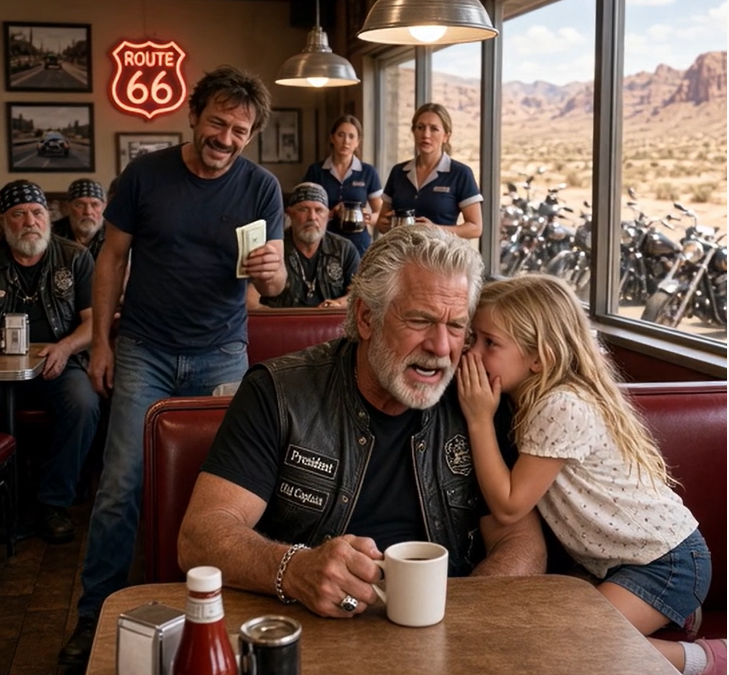
She slipped under his reaching arm, crossed the aisle in three quick steps, and came straight to my table.
Before I could move, she grabbed the edge of my leather vest with both hands.
Her fingers were sticky from the fry she had barely eaten.
She pulled herself close, so close I could feel her shaking.
Then she whispered, barely louder than breath, “That man isn’t my dad.”
Everything inside me went still.
Daryl stopped beside the counter.
June turned from the hallway.
Lacey froze with one hand over her mouth.
The man said, “Emma.”
The girl jerked at the name.
Not toward him.
Away.
That told me something too.
Maybe it was her name.
Maybe it was not.
But his voice held possession, not panic.
I put one hand gently over the child’s hands where they clutched my vest.
I did not pull her behind me.
Not yet.
I did not grab the man.
Not yet.
I looked at him.
“Sir,” I said, calm as I could make myself, “why don’t you sit back down?”
His face flushed.
“She’s confused.”
Daryl’s voice came from near the counter.
“About who her dad is?”
The man shot him a look.
“She has anxiety.”
The girl whispered, “Please.”
One word.
Small.
Destroyed.
And then every phone in the diner went off at once.
Not one.
Not five.
Every phone.
A violent chorus of alarms, vibrating tables, buzzing pockets, shrieking tones.
Amber Alert.
The sound changed the room faster than any shout could have.
People grabbed phones.
Screens lit up.
Mine buzzed so hard against the table that the coffee rippled in my cup.
I looked down.
AMBER ALERT: CHILD ABDUCTION
KINGMAN, AZ / MOHAVE COUNTY
6-YEAR-OLD LILA HARPER
LAST SEEN: BLUE SUV, AZ PLATES…
SUSPECT: ADULT MALE, UNKNOWN IDENTITY
CHILD MAY BE WEARING GREEN SHIRT, MISMATCHED SHOES
There was a photo.
The same light brown hair.
The same solemn eyes.
A school-picture smile from some better day before fear had taught her to stay quiet.
For one second, nobody breathed.
Then everyone turned toward the blue SUV outside.
The man bolted.
He did not lunge at the girl.
He did not argue.
He ran.
That was confession enough for the room.
He shoved past a waitress and sprinted toward the door.
Daryl moved first.
For a big man, he was fast.
He stepped into the aisle and blocked the path with his full body.
The man tried to cut left.
June swung her purse.
It caught him across the chest, not hard enough to injure, but enough to throw off his balance.
He stumbled into a chair.
“Don’t touch me!” he shouted.
Nobody touched him.
That mattered.
We had almost two hundred riders in and around that diner, and every instinct in that room turned red at once.
But anger is dangerous around a child.
Anger gives predators stories to tell later.
So I raised my voice.
“Everybody back up! Nobody hits him!”
My voice carried.
It had to.
“Call 911. Block the exits. Do not touch him unless he tries to grab the child.”
The room obeyed.
Not because I was special.
Because people wanted direction more than chaos.
Miguel, already near the side exit, stood in front of it with his phone to his ear.
Caleb and Owen outside moved near the blue SUV but did not open it.
Other riders stepped away from the man but formed space he could not easily break through.
A waitress locked the back hallway door that led to the kitchen exit.
The man looked around and understood what he was seeing.
Not a mob.
A wall.
He pointed at me.
“She’s my niece.”
Lila whimpered.
I felt her press harder against my vest.
“Then you can explain that to the police,” I said.
“She’s sick. She lies.”
Lacey, still shaking near the counter, said, “She’s six.”
His eyes darted toward the front windows.
Outside, more riders had noticed the alert.
Phones were up.
Not filming for entertainment.
Documenting.
License plate.
Vehicle.
Time.
His face twisted.
“You people don’t know anything.”
Daryl said, “We know enough to wait.”
The man made one desperate move toward the front door.
Daryl shifted but did not swing.
A rider named Coop stuck out one boot just enough that the man tripped over his own momentum and hit the floor hard on his hands.
Nobody cheered.
Nobody piled on.
Miguel shouted into his phone, “Suspect attempted to flee, fell, not restrained yet. Child is safe inside. Send law enforcement now.”
The man pushed himself up, wild-eyed.
“Get away from me!”
A state of emergency existed inside that diner, but the strangest part was how quiet everyone became.
Phones had stopped screaming.
People were breathing hard.
The fryer hissed in the kitchen.
A coffee cup rolled slowly under a booth.
Lila still clutched my vest.
I crouched carefully so I was closer to her height.
“My name is Russell,” I said softly. “You’re safe right here. Nobody’s going to let him take you.”
Her eyes flicked toward the man.
“My mama?”
“We’re going to find her.”
Her face crumpled.
Not crying loud.
Something worse.
She folded inward, like she had been holding herself together with both hands and finally ran out of strength.
I looked at Lacey.
“Can you get a blanket? Something soft?”
Lacey ran.
June came over slowly, hands visible, voice low.
“Honey, I’m June. I’m a grandma. I’m going to sit right here on the floor, okay? I won’t touch you unless you want me to.”
Lila looked at her but did not let go of me.
June sat on the floor anyway, knees popping audibly.
“Lord,” she muttered, “getting down is easier than getting back up.”
For half a second, Lila’s mouth moved like she almost smiled.
That tiny almost-smile nearly broke me.
Sirens came faster than I expected.
Maybe because Amber Alerts make every patrol car in range move differently.
Maybe because half the county had already seen the same message.
Through the window, I saw the first Kingman police cruiser swing into the lot, then another, then a sheriff’s SUV.
The man froze.
The front door opened.
Two officers entered with hands near their weapons but not drawn.
Smart men.
They saw a room full of bikers, a suspect near the aisle, a child beside me, and about eighty people pointing at the same man without a single person touching him.
One officer said, “Everybody stay where you are.”
Daryl lifted both hands.
“Gladly.”
The man started shouting immediately.
“She’s my niece! They attacked me! They trapped me!”
The officer closest to him said, “On your knees.”
“I didn’t do anything!”
“On your knees now.”
The man looked around the room one last time.
No opening.
No ally.
No confusion left to exploit.
He lowered himself.
They cuffed him.
Lila buried her face against my vest when she heard the cuffs click.
I kept my hand over hers.
“Don’t look,” I whispered.
“I don’t want to go with him.”
“You won’t.”
An officer approached us slowly.
She was a woman in her forties with kind eyes and a voice trained to be soft without being weak.
“Hi, sweetheart. My name is Officer Ramirez. Are you Lila?”
The girl nodded against me.
“Can you say it out loud for me?”
A whisper.
“Lila.”
The officer’s face tightened with relief.
“Okay, Lila. You did very, very good.”
Lila looked up.
“My mama?”
“She’s coming,” Officer Ramirez said. “We’re going to call her right now.”
Later, I learned the alert had gone out after Lila’s mother, Hannah Harper, left a gas station restroom and found her daughter gone from the snack aisle where she had been choosing a juice. Security footage showed a man leading Lila out the side door after crouching beside her and saying something investigators were still trying to understand.
It happened in less than one minute.
That is the nightmare every parent knows but cannot live inside all day or they would never breathe.
The blue SUV had been stolen that morning from a motel parking lot outside Flagstaff.
The plates had been switched once.
The butterfly sticker remained because sometimes criminals are stupid in ways God must use for good.
Hannah had described Lila’s clothes in hysterical detail to dispatch.
Green shirt.
Faded shorts.
Mismatched shoes because Lila had dressed herself that morning and Hannah had not argued.
That detail saved her.
When the Amber Alert hit, every person in Desert Willow knew instantly.
Green shirt.
Mismatched shoes.
Blue SUV.
And because Lila had been brave enough to cross the diner before the alert sounded, she was already in my arms when the room understood.
Police took our statements separately.
Nobody complained.
Not even riders eager to get back on the road.
Our charity schedule no longer mattered.
The veterans’ fundraiser could wait.
Everything could wait.
Lila sat in a booth with June and Officer Ramirez. A blanket around her shoulders. A glass of chocolate milk in front of her. She did not drink it, but she held it with both hands like warmth.
I stayed where she could see me.
Not too close.
Not hovering.
She had chosen me in terror. That did not mean I had a right to crowd her after adults with badges arrived.
Daryl sat beside me at the counter.
His hands were shaking.
I had known Daryl Boone eighteen years and seen him ride through desert storms, break up fights, sit beside dying veterans, and carry a burned child from a wrecked car outside Tucson.
I had never seen his hands shake like that.
“You okay?” I asked.
“No.”
“Me neither.”
He looked toward Lila.
“I keep thinking if she hadn’t moved when the tray dropped.”
“I know.”
“If the alert came thirty seconds later.”
“I know.”
“If he got her outside.”
“Stop.”
He nodded.
But we both kept thinking it.
That is the cruelty of near misses.
The mind keeps walking to the edge and looking down.
Outside, Caleb and Owen stood near the blue SUV while officers photographed it.
The back seat had a child’s hair clip on the floor.
A small pink sock.
A roll of duct tape in the cargo area.
When one officer carried that out in an evidence bag, every rider who saw it went silent in a way I cannot fully describe.
Rage can be loud.
Horror is quiet.
News vans arrived before Lila’s mother did.
A local reporter tried to approach the diner door and was stopped by June, who had somehow appointed herself guardian of the threshold.
“You point that camera at that child,” June said, “and I will make you wish you were born as a traffic cone.”
The cameraman lowered the lens.
June was five-foot-four.
Nobody doubted her.
Then Hannah arrived.
I heard her before I saw her.
A sound came from outside that was not a scream and not a sob but something torn out of the deepest part of a human being.
Every conversation in the diner stopped.
Officer Ramirez crouched beside Lila.
“Your mama is here.”
Lila’s face changed.
Fear broke open into hope so fast it hurt to watch.
“Mama?”
Hannah came through the door shaking so hard another officer had one hand near her elbow, not holding her back, just keeping her upright.
She was maybe early thirties.
Blond hair pulled into a messy bun.
One shoe untied.
Mascara streaked across both cheeks.
She saw Lila.
Then she ran.
Lila launched out of the booth.
The blanket fell.
The chocolate milk spilled.
Nobody cared.
They collided in the middle of the diner, Hannah dropping to her knees so hard I heard the impact.
She wrapped herself around her daughter and made that sound again.
“My baby. My baby. My baby.”
Lila cried then.
Really cried.
The kind of crying that comes when safety finally reaches the body.
“I told him,” Lila sobbed. “I told him you’d find me.”
Hannah rocked her.
“I did. I did. I’m here. I’m here.”
Every biker in that diner looked away.
Not because we did not care.
Because some moments are too sacred to stare at directly.
Daryl wiped his face with a napkin and pretended he had allergies.
June cried openly because June had earned the right to do whatever she wanted.
I stood near the counter with my hands hanging uselessly at my sides.
I had not realized how tense I had been until my shoulders started to hurt.
Hannah eventually looked up.
Officer Ramirez said something to her quietly and nodded toward me.
Hannah’s eyes found mine.
She rose unsteadily with Lila still attached to her waist and crossed the room.
I opened my mouth, but no words came.
What do you say to a mother whose child walked out of hell and grabbed your vest?
Hannah solved it by throwing one arm around me while keeping the other around Lila.
“Thank you,” she said into my chest.
I looked down at Lila.
Her cheek was pressed against my vest.
Her little mismatched shoes stood on my boots.
“You did the brave part,” I told her.
She shook her head.
“You looked nice.”
That undid me more than any thank-you could have.
I laughed once, broken.
“Sweetheart, nobody has accused me of that in a long time.”
Lila looked up.
“You had patches.”
“Yeah?”
“My grandpa had patches.”
There it was.
A child’s logic.
Not perfect.
Not explainable.
Maybe some memory of a grandfather in a veterans’ vest. Maybe just the sight of a table full of older men and women who looked like they belonged to each other.
She had chosen a patch because somewhere in her short life, a patch had meant safe.
That thought stayed with me for years.
The police kept the suspect’s name quiet at first.
Later, we learned he was named Calvin Rusk.
No relation to Lila.
No custody claim.
No misunderstanding.
He had a record in another state under a different name, and investigators believed he had been watching families along travel stops.
I will not give him more space than necessary.
Men like that steal enough.
He was charged with kidnapping, unlawful imprisonment, vehicle theft, and other counts that would eventually put him away for a very long time.
Good.
But the part people remember is not him.
It is the diner.
The phones.
The bikers standing.
The blue SUV.
The little girl with mismatched shoes.
By sunset, Desert Willow Café had become something none of us could have planned.
Police tape near the SUV.
News cameras outside.
Motorcycles lined up like a steel wall.
Riders giving statements.
Customers hugging each other even if they had entered as strangers.
Lacey sitting behind the counter with a cup of water, still pale, because she kept replaying the tray drop and wondering if she had done it on purpose or instinct.
I sat beside her for a while.
“You gave her a chance,” I said.
Her eyes filled.
“I was scared.”
“Good.”
She looked at me.
“Good?”
“Fear means you knew it mattered. You moved anyway.”
She covered her face.
“I keep thinking he would’ve taken her if—”
“We’re all thinking that.”
“How do you stop?”
I looked across the diner at Hannah holding Lila in the booth.
“You don’t stop today.”
That was the truth.
Some things have to move through you.
By evening, our charity ride had changed shape.
We were supposed to continue west.
Instead, we stayed in Kingman.
The veterans’ fundraiser told us to come the next day.
The hotel gave discounted rooms after hearing what happened.
Someone from a local church brought food, which was unnecessary because Desert Willow’s owner refused to let any rider pay for dinner.
Daryl tried.
The owner, a woman named Marlene, pointed a spatula at him.
“You put that wallet away or I’ll make June handle you.”
Daryl put it away.
Nobody crossed June twice.
Hannah and Lila went to the hospital for evaluation and then to a safe location with family. Before they left, Lila asked to see “the vest man.”
That was me.
I knelt so I would not tower over her.
She held a small napkin folded into a square.
Inside was the fry she had never eaten.
“I don’t want it,” she said.
“I don’t blame you.”
She looked embarrassed.
Children apologize for the strangest things when adults have made them feel responsible for surviving.
I held out my hand.
She placed the napkin in my palm.
“I’ll throw it away,” I promised.
She nodded solemnly.
Then she touched one patch on my vest. The Canyon Ridge Riders patch. A desert ridge under a rising sun.
“Do you help kids?”
“Whenever we can.”
“Can you help other kids?”
I swallowed.
“We’ll try harder.”
She seemed satisfied with that.
Then Hannah carried her out.
The parking lot was quiet as they left.
Almost two hundred bikers stood beside their machines and said nothing.
No engines.
No cheers.
No spectacle.
Just witness.
The next morning, we gathered outside Desert Willow before sunrise.
Nobody had slept well.
You could tell by the coffee consumption alone.
Daryl stood beside his bike, staring at the road.
“You know this changes the ride,” he said.
“Yeah.”
“We raise money for kids’ programs already.”
“Not enough.”
He looked at me.
“You thinking what I’m thinking?”
“Probably.”
By noon, Canyon Ridge Riders had voted unanimously to create the Lila Harper Road Fund.
Not because her mother asked.
She did not.
Not because we wanted publicity.
We did not.
Because every rider in that diner understood something with absolute clarity.
Vulnerable children are moved along ordinary roads.
Gas stations.
Diners.
Motels.
Rest stops.
Truck stops.
Places we pass every year with our engines loud and our eyes half-trained on weather, traffic, and fuel.
We had been raising money for children from a distance.
Now distance felt like an excuse.
The fund would support Amber Alert education, child-safety training for roadside businesses, emergency phones and camera grants for rural diners and gas stations, and direct support for families recovering after abduction attempts.
Miguel contacted a child advocacy organization he knew from paramedic work.
June called a retired judge.
Daryl called three sponsors before breakfast.
I called Hannah to ask permission to use Lila’s first name.
She cried.
Then said yes, as long as the focus stayed on helping children, not turning her daughter into a symbol she had not chosen.
We honored that.
Lila’s face was never used.
Her full name stayed private in our materials.
But the mismatched shoes became a quiet emblem.
Not in photographs.
In words.
Remember the child who doesn’t look up.
Remember the kid who is too quiet.
Remember that fear sometimes wears mismatched shoes and walks right past you hoping you are paying attention.
The story spread anyway.
Marisol—different Marisol from another story, life has funny repetitions, but this was a traveler in the diner—had filmed the moment after the Amber Alert, not Lila’s face, but the riders standing, the suspect blocked, the blue SUV outside surrounded at a distance.
The clip went everywhere.
The headline writers had a feast.
“Bikers Save Kidnapped Girl on Route 66.”
“Little Girl Whispers to Motorcycle Group, Sparks Dramatic Rescue.”
“Nearly 200 Bikers Surround Suspect After Amber Alert.”
Most stories got things half-right.
We did not surround him like a gang.
We contained the situation.
We did not beat him.
We waited for police.
We were not heroes because we wore leather.
Lila was brave.
Lacey was brave.
Officer Ramirez was steady.
The Amber Alert system worked exactly as it was meant to.
The café staff trusted their instincts.
We happened to be there in numbers large enough to make running difficult.
Still, I understood why people grabbed the biker angle.
America loves being surprised by goodness in people it was taught to fear.
A week later, a man in a grocery store parking lot recognized me.
“You’re that biker from the girl story.”
“I was there.”
“You guys must’ve scared that creep half to death.”
I looked at him.
“I hope what scared him was realizing a six-year-old told the truth and everyone believed her.”
He didn’t know what to say.
That was fine.
I did.
Because that became the message I carried afterward.
Believe the child.
Not blindly.
Not recklessly.
But seriously.
Quickly.
Carefully.
Believe enough to pause the ordinary world and ask the next question.
For months, I replayed the moment Lila grabbed my vest.
I wondered why me.
Why not June?
Why not Lacey?
Why not Daryl, who looked like someone carved a teddy bear out of oak?
Her answer stayed the same.
“You had patches.”
Her grandfather had patches.
That was enough.
Sometimes rescue depends on details so small they feel unbearable.
A patch.
A dropped tray.
A waitress who notices a squeezed wrist.
A diner full of phones not silenced.
A butterfly sticker on an SUV.
Mismatched shoes.
Three months after the rescue, Hannah invited a small group of us to a community safety event in Phoenix.
Lila was there.
She looked different.
Hair trimmed evenly.
Pink dress.
Matching shoes this time, though one lace was still tied badly.
She stayed close to her mother at first.
Then she saw me and ran.
Not with fear.
With joy.
She hit my legs like a tiny cannonball.
“Vest man!”
I laughed for the first time that day without heaviness in it.
“Hey, kiddo.”
“I have a bike.”
My eyebrows went up.
“You do?”
She pointed proudly to a small purple bicycle with training wheels.
“Mom says motorcycles later.”
Hannah looked at me.
“Much later.”
“Good answer,” I said.
Lila showed me the bicycle.
There was a sticker on the front.
A desert sun.
Canyon Ridge had sent it, but I had not known she put it there.
“I go fast,” she said.
“I bet you do.”
“Not on roads.”
“Also good.”
She leaned closer and whispered, “I’m not scared of diners anymore.”
I had to look away for a second.
“That’s good.”
“Sometimes I am.”
“That’s okay too.”
She considered that.
Then nodded.
Kids understand honest answers better than adults think.
Hannah spoke at the event.
Not long.
Not dramatically.
She stood behind a microphone with one hand on Lila’s shoulder and told the room what one minute can do.
One minute in a gas station.
One minute looking at a shelf.
One minute deciding whether to interrupt a stranger.
One minute waiting to call police because you do not want to overreact.
Then she said something that made every person in that room go still.
“My daughter survived because people who looked intimidating were gentle, and people who felt afraid acted anyway.”
I wrote that down later.
Not because I needed to remember it.
Because I knew I would never forget.
The Lila Harper Road Fund grew faster than anything Canyon Ridge had ever done.
Donations came from riders, truckers, parents, cafés, mechanics, veterans’ groups, retired teachers, and people who said they had passed too many quiet children in public and wondered afterward.
We partnered with Amber Alert coordinators to distribute posters teaching roadside workers what to watch for.
Not just screaming kids.
Quiet kids.
Children who do not answer simple questions.
Adults who answer for them.
Mismatched stories.
No luggage.
Avoiding cameras.
Parking backed toward exits.
Cars with switched plates.
We helped pay for camera upgrades at twelve rural stops in the first year.
Then twenty-seven.
Then more.
Daryl designed a training module for motorcycle groups on what to do and not do if they suspect an abduction.
Rule one: call law enforcement.
Rule two: protect the child without escalating into violence.
Rule three: document.
Rule four: do not become the reason a case gets complicated.
Rule five: listen.
June insisted on adding rule six.
Bring snacks.
She was not entirely joking.
Traumatized children need gentle practical things too.
Water.
A blanket.
A safe adult sitting nearby but not grabbing.
A way to choose something, even if it is just chocolate milk or apple juice.
The Canyon Ridge Riders changed after that day.
We had always been about charity.
But charity can become scheduled.
Annual.
Predictable.
A check handed over at an event.
A photograph.
A handshake.
That day reminded us that service is not only what you plan.
Sometimes it is what interrupts your lunch.
Two years later, we returned to Desert Willow Café on the anniversary.
Not all one hundred eighty of us.
Enough.
Marlene had put up a small framed sign behind the counter.
No names.
No faces.
Just words.
PAY ATTENTION. ASK CAREFULLY. ACT QUICKLY.
Below it was a tiny drawing of two mismatched shoes.
I stood in front of that sign longer than I meant to.
Daryl came beside me.
“Still gets you?”
“Every time.”
“Good.”
I looked at him.
“Good?”
“Means it didn’t turn into a story yet.”
I understood.
Stories can become polished with retelling.
The rough edges sand down.
People start remembering themselves as calmer, braver, wiser.
But the truth was messy.
We were scared.
Unsure.
One wrong move from disaster.
I wanted to keep remembering that.
Because fear did not mean failure.
Fear meant we understood the stakes.
Lacey still worked there.
She came around the counter and hugged me.
Then Daryl.
Then June.
She had become a manager.
She also trained every new employee on what she called “the Lila rule.”
If something feels wrong with a child, tell someone immediately.
Do not dismiss it because the adult seems polite.
Do not dismiss it because you are busy.
Do not dismiss it because you might be embarrassed.
Embarrassment is survivable.
Silence may not be.
Lila and Hannah did not attend that anniversary.
Too much.
We understood.
Instead, Hannah sent a letter.
Marlene read it privately to our group after closing.
Lila was doing well.
Therapy helped.
School helped.
Time helped.
She still had hard nights.
She still hated blue SUVs.
She still sometimes wore mismatched shoes on purpose because, in her words, “they helped people know it was me.”
That line made June cry.
Honestly, it got most of us.
At the bottom of the letter, Lila had drawn a picture.
A little girl.
A diner.
A row of motorcycles.
A huge sun overhead.
And one stick figure with a black vest standing beside her.
Above the drawing, in uneven letters, she had written:
I TOLD AND THEY LISTENED.
That is the part I want remembered.
Not the number of bikers.
Not the viral clip.
Not the suspect hitting the floor.
Not the blue SUV.
I want people to remember that a six-year-old told the truth and a room full of strangers listened fast enough.
Years have passed now.
I still ride.
My beard is whiter.
My knees complain more at gas stops.
Daryl still orders chicken-fried steak at every diner that offers it and claims loyalty is a virtue.
June still terrifies rude men twice her size.
The Canyon Ridge Riders still raise money, still plan routes, still argue about fuel stops, still look like trouble to people who judge from a distance.
But whenever we stop at a roadside diner, I watch the door.
I notice children.
Not suspiciously.
Not fearfully.
Carefully.
There is a difference.
I notice whether they look at dessert cases.
Whether they ask questions.
Whether the adult with them lets them speak.
Whether they flinch at a hand too close to their wrist.
Most of the time, everything is fine.
A tired dad with a cranky daughter.
A grandmother with a shy boy.
A family halfway through a road trip and losing patience over French fries.
Normal life.
Thank God for normal life.
But once, in a diner outside Gallup, a boy kept mouthing something toward the cashier while the woman with him argued loudly about a credit card.
The cashier noticed.
Called police.
It turned out to be a custody violation, not stranger abduction, but the child was returned safely.
Another time, one of our riders spotted a teenager crying silently at a rest stop while an older man held her backpack. That situation led to an arrest warrant out of Nevada.
Not every story makes news.
Most shouldn’t.
The goal is not drama.
The goal is getting people home.
People still ask if I think about Calvin Rusk.
I try not to.
When I do, I think about the moment he realized the diner had turned.
The exact second the Amber Alert hit and the lie stopped belonging to him.
Predators depend on isolation.
On speed.
On confusion.
On politeness.
On adults being afraid to interfere.
That day, every one of those protections failed him.
Good.
I hope every person like him learns to fear rooms full of attentive strangers.
Not violent strangers.
Attentive ones.
There is power in attention.
Quiet, disciplined attention.
The kind that notices mismatched shoes.
The kind that asks a waitress if she knows the child.
The kind that drops a tray at exactly the right second.
The kind that blocks a door without throwing a punch.
The kind that calls 911 and gives clear information.
The kind that lets police do their jobs.
The kind that kneels down and tells a shaking child, “You’re safe right here.”
On my vest, near the lower left side, I added one small patch after that day.
It shows two little sneakers.
One pink.
One blue.
No words.
People ask sometimes.
I tell them it is a reminder.
Not of what we did.
Of what she did.
Lila Harper walked across a diner while the man who took her was close enough to grab her.
She crossed a room full of strangers because some brave part of her still believed someone might listen.
That kind of courage deserves a patch.
The last time I saw her, she was nine.
Tall for her age.
Still watchful, but brighter.
She came to a Canyon Ridge fundraiser with Hannah and handed me a drawing of a motorcycle with training wheels.
Daryl laughed so hard he had to sit down.
Lila looked at him seriously and said, “Safety first.”
June said, “That child is smarter than all of you.”
No one argued.
Before leaving, Lila hugged me and whispered, “I don’t call you Vest Man anymore.”
“No?”
She shook her head.
“Mom says your name is Russell.”
“That’s true.”
“But I still like Vest Man.”
“I’ll answer to both.”
She smiled.
A real smile.
Gap-toothed.
Unburdened for that second.
That was justice too.
Not just the courtroom.
Not just the sentence.
Not just the fund.
A child smiling in sunlight beside motorcycles she was no longer afraid of.
People think justice is only punishment.
Punishment matters.
Do not misunderstand me.
Some people need locked doors between them and the innocent.
But healing is justice too.
Safety is justice.
Being believed is justice.
Growing tall enough to joke about training wheels is justice.
A mother sleeping again because her child is in the next room is justice.
A waitress trusting her instincts is justice.
A group of rough-looking riders learning to be even gentler around frightened children is justice.
A diner full of strangers turning together toward a blue SUV because every phone screamed the truth at once—that was justice beginning.
The afternoon at Desert Willow Café did not make us heroes.
It made us responsible for what we now knew.
That is heavier.
Hero stories end when the sirens leave.
Responsibility wakes up the next morning and asks what changes.
For us, everything changed.
Our routes changed.
Our fundraisers changed.
Our training changed.
The way we entered diners changed.
The way we talked to café owners changed.
The way we listened changed.
And every year, when we ride Route 66 through Kingman, I slow down near Desert Willow.
Sometimes we stop.
Sometimes we keep moving.
But I always look toward the window booth where a man sat watching his stolen SUV, believing a room full of strangers would stay strangers.
Then I look toward the corner booth where a little girl grabbed my vest.
I can still feel her hands sometimes.
Small.
Sticky.
Shaking.
I can still hear her whisper.
“That man isn’t my dad.”
And I can still hear every phone in that diner going off at once, like the whole world suddenly refused to let her whisper be ignored.
That sound has never left me.
I hope it never does.








