𝗙𝗨𝗟𝗟 𝗦𝗧𝗢𝗥𝗬:The HOA Queen Blocked the Road on My 80-Acre Ranch—She Didn’t Know What 64 Black Angus Were About to Prove
FULL STORY CONTINUATION
My wife, Ellen, used to say I could tolerate almost anything as long as I understood the mechanism behind it.
A broken tractor was irritating until I knew which part failed.
A sick calf was frightening until the veterinarian explained the cause.
A leaking roof was manageable once I found the source.
Ellen had been gone three years by then.
Cancer.
Fast at the end.
The ranch became the one place that still made sense after I buried her.
Fence breaks.
Fix it.
Pump dies.
Replace it.
Cow gets through a gate.
Bring her back.
Work did not ask me to explain grief.
That was why Brenda’s letters bothered me so much.
Not because they were expensive.
Because they did not fit reality.
My neighbor Richard understood that instinct.
Richard Hale was sixty-eight, retired from the county after nearly four decades as a licensed surveyor.
He owned forty acres along my northern boundary.
We had known each other long enough to borrow machinery without pretending we would return it clean.
One evening he drove over in an old Ford pickup.
Carried a tube of maps under his arm.
“Show me the HOA map.”
I spread Brenda’s copy across my kitchen table.
Richard put on reading glasses.
Looked at it for maybe thirty seconds.
Then said:
“That’s wrong.”
“How wrong?”
He pulled out an original county plat.
Then another.
“This line here.”
He pointed.
“She moved it west.”
“How far?”
“Depends on the section. Thirty feet here. More near the common lawn.”
I leaned over.
The red line on Brenda’s map swallowed land the recorded plat clearly showed as mine.
“Can somebody just commission a new survey and change a boundary?”
“No.”
“That sounded like a stupid question.”
“It was.”
He smiled.
Then became serious.
“Private survey work can identify a disagreement. It can help establish evidence. But property boundaries don’t become different because an HOA president likes another drawing better.”
“Could the subdivision have an easement?”
“Maybe somewhere. Show me the deeds.”
I did.
Richard spent most of the evening reading.
No easement granting the HOA broad enforcement rights over my ranch.
No covenant tying my parcel to Millhaven Commons.
No annexation agreement.
Nothing.
“Have you asked who surveyed their map?”
“Yes.”
“And?”
“Brenda says it’s proprietary association work product.”
Richard laughed.
“Surveyors don’t work by magic.”
He studied the map again.
“Something is wrong here.”
I contacted an attorney named Claire Morgan.
Claire handled property disputes throughout the county.
She reviewed the deeds.
Recorded plats.
HOA letters.
Fine notices.
Then Brenda’s map.
“You have a strong argument.”
“How strong?”
“Strong enough that I don’t think they should be fining you.”
“Then stop them.”
She gave me the look lawyers reserve for people who want law to operate at the speed of irritation.
“Civil litigation takes time.”
“How much?”
“A year. Maybe longer.”
“For a fence?”
“For jurisdiction, unauthorized enforcement, potentially declaratory relief, potentially damages. Depends where this goes.”
I did not like that answer.
But I respected it.
“Can I just stop paying?”
“You can.”
“But?”
“They may keep adding fees. They may attempt collection activity. I would rather control the record.”
So I kept every envelope.
Every notice.
Every certified-mail receipt.
Every check marked PAID UNDER PROTEST.
Then I filed complaints.
County offices.
State consumer channels.
Anyone who might have oversight relevant to HOA practices or recorded property documents.
Mostly I received acknowledgments.
Thank you.
We have received your submission.
We will review.
Nothing moved.
Brenda did.
She added another “standards” provision.
This one concerned agricultural equipment visible from the subdivision.
Then one about livestock odors affecting common-area enjoyment.
I did not know how she planned to regulate wind.
But I assumed the committee was working on it.
The fines continued.
Fence.
Hay.
Tractor.
Utility trailer.
One letter criticized the appearance of a galvanized cattle gate.
That gate had been on the ranch since Bill Clinton’s first term.
Richard started keeping copies.
“Why are you enjoying this?”
“Because she’s making a bigger file.”
“You need hobbies.”
“I had hobbies. Retirement ruined them.”
The real shift came when Richard attended an HOA meeting as a guest of a Millhaven Commons resident.
He came to my house afterward.
“She showed the map.”
“In the meeting?”
“On a presentation board.”
“What did she say?”
“That the HOA had discovered historical boundary inconsistencies and had commissioned updated mapping to clarify the association’s true jurisdiction.”
My jaw tightened.
“True jurisdiction.”
“Her words.”
“Did anybody ask whether it was recorded?”
“Yes.”
“What did she say?”
“It’s under review.”
That was interesting.
“What does that mean?”
“It means she didn’t answer.”
Richard rolled the county plat back into its tube.
“Elias, I don’t think this is just about you.”
He explained that Brenda’s red boundary line also affected two other non-member parcels.
A narrow side yard behind one home.
Part of an access lane near another.
Small pieces.
The sort of discrepancies most people might not challenge because the fight costs more than the land appears worth.
“She’s expanding.”
“That is what it looks like.”
“Why?”
“Control.”
Richard shrugged.
“Maybe convenience. Maybe she genuinely thinks the original subdivision documents were wrong. But if she believed that, she would record a correction through proper channels.”
She hadn’t.
That fact became more important every week.
I filed a formal written request asking the HOA to identify the surveyor.
Survey date.
Legal description.
Basis for its jurisdiction claim.
Recording number.
Brenda responded with three pages of language and none of the information.
Claire read it.
“She’s avoiding the recording question.”
“I noticed.”
“Good.”
“Can we sue now?”
“We can.”
Then she pointed at my file.
“But I would like one more thing.”
“What?”
“Proof they’re actually relying on the map for physical access or control, not just fines.”
I should have been careful what I wished for.
A month later, I drove into town for hydraulic hose fittings.
When I returned, there was a feed truck parked near my ranch entrance.
Driver standing beside it.
Hands on hips.
Ahead of him, two men in reflective vests had placed orange cones across my private road.
MILLHAVEN COMMONS SECURITY printed across their backs.
I stopped my truck.
For several seconds, I just watched.
My road.
Not the subdivision gate.
Not the common lawn.
My gravel road.
The one my grandfather graded before Brenda was born.
I got out.
One guard raised a hand.
“Sir, this route is temporarily restricted.”
I looked behind me.
Then back at him.
“Who are you talking to?”
“You can’t proceed beyond this point.”
“I live beyond this point.”
“We’re enforcing an HOA access restriction.”
“On my ranch?”
He shifted slightly.
“We were instructed that this road lies within association jurisdiction.”
“By Brenda Sterling?”
He didn’t answer.
The feed driver walked toward me.
“They won’t let me deliver.”
“I noticed.”
The second guard held a folder.
He removed a letter.
Brenda’s signature.
According to the document, pending “boundary resolution,” vehicle traffic on the eastern ranch access route was subject to HOA oversight.
I read it.
Folded it.
Put it in my pocket.
The guard said:
“I need that back.”
“No.”
“It belongs to the association.”
“Now it’s evidence.”
His expression changed.
Not much.
Enough.
I called the sheriff.
A deputy arrived twenty minutes later.
Young man.
Professional.
He listened.
Looked at my deed copy.
Looked at Brenda’s map.
Looked at the guards.
“This is private property?” he asked.
“Yes.”
The guard answered:
“Disputed jurisdiction.”
The deputy studied both documents.
You could see the problem.
He was not a surveyor.
Not a judge.
Not going to adjudicate a property boundary on a gravel road.
But he did tell the guards:
“You can’t physically block this road without a clear lawful basis.”
They pointed to Brenda’s letter.
The deputy said:
“An HOA letter isn’t a court order.”
Good sentence.
Still, rather than escalate, he instructed everyone to document the dispute and pursue civil remedies.
The guards removed enough cones to let me through.
The feed driver had already decided he was done.
“I’ll reschedule.”
I watched him turn around.
Something in me went very still.
Not angry.
Past angry.
Arithmetic.
Brenda had fined me.
I documented it.
She cited my hay.
I documented it.
She invented standards.
I challenged them.
Now she had sent people onto my road.
That was different.
I called Richard.
“Bring the plats.”
He asked:
“When?”
“Now.”
Then Claire.
“They blocked the road.”
Silence.
“Physically?”
“Cones. Guards. Feed delivery turned away.”
“Did the deputy make a report?”
“Yes.”
“Get the report number.”
“I have it.”
Another silence.
Then:
“Good.”
Lawyers say good about strange things.
My third call was to David Mercer.
David had worked my ranch nineteen years.
Sixty years old.
Weathered enough to look permanently offended by sunlight.
“We still moving cattle Saturday?”
“Yes.”
“All sixty-four?”
“Yes.”
He laughed once.
“I’ll be there at six.”
That cattle drive had been scheduled two weeks earlier.
Every year, same process.
Move the herd from north pasture to the winter field on the southern portion of the ranch.
The route crossed my internal ranch road.
The same one Brenda had just tried to control.
I was not planning a protest.
That distinction matters.
The cattle needed moving.
I was not going to change legitimate ranch operations because an HOA president had produced a map no county office recognized.
Then Richard told me something interesting.
“Saturday is Brenda’s community standards inspection.”
I looked at him.
“What’s that?”
“Quarterly show.”
He explained.
Brenda set up folding tables on the common lawn near my eastern fence.
Presentation board.
Portable speaker.
Violation updates.
New rule announcements.
Apparently nearly forty homeowners were expected.
Her event sat directly beside the fence line my cattle route paralleled.
I looked toward the eastern pasture.
Richard watched me.
“You’re thinking.”
“No.”
“Yes, you are.”
“I am moving cattle.”
“Correct.”
“On my ranch.”
“Correct.”
“Using my road.”
“Correct.”
He smiled.
I pointed.
“Do not make this dramatic.”
“I would never.”
“You retired because the county was tired of you, didn’t you?”
“Probably.”
Saturday morning dawned clear.
Cool.
Good cattle-moving weather.
David arrived before seven.
Two younger ranch hands joined us.
We checked gates.
ATVs.
Fence.
Water.
Nothing unusual.
At 8:30, cars began arriving at the HOA common area.
From my side of the fence, we could see residents gathering.
Folding chairs.
Coffee.
A presentation easel.
Brenda.
Blazer.
Clipboard.
Of course.
Two security contractors stood near the edge of the common lawn.
Same men from my road.
I recognized the taller one.
He recognized me too.
At 9:05, David asked:
“You ready?”
“Yes.”
Richard was standing near the eastern fence with a rolled plat under one arm.
“What are you doing here?”
“Observing.”
“You don’t live there.”
“I live here.”
Technically true.
“Do not start anything.”
He looked offended.
At 9:15, I opened the north pasture gate.
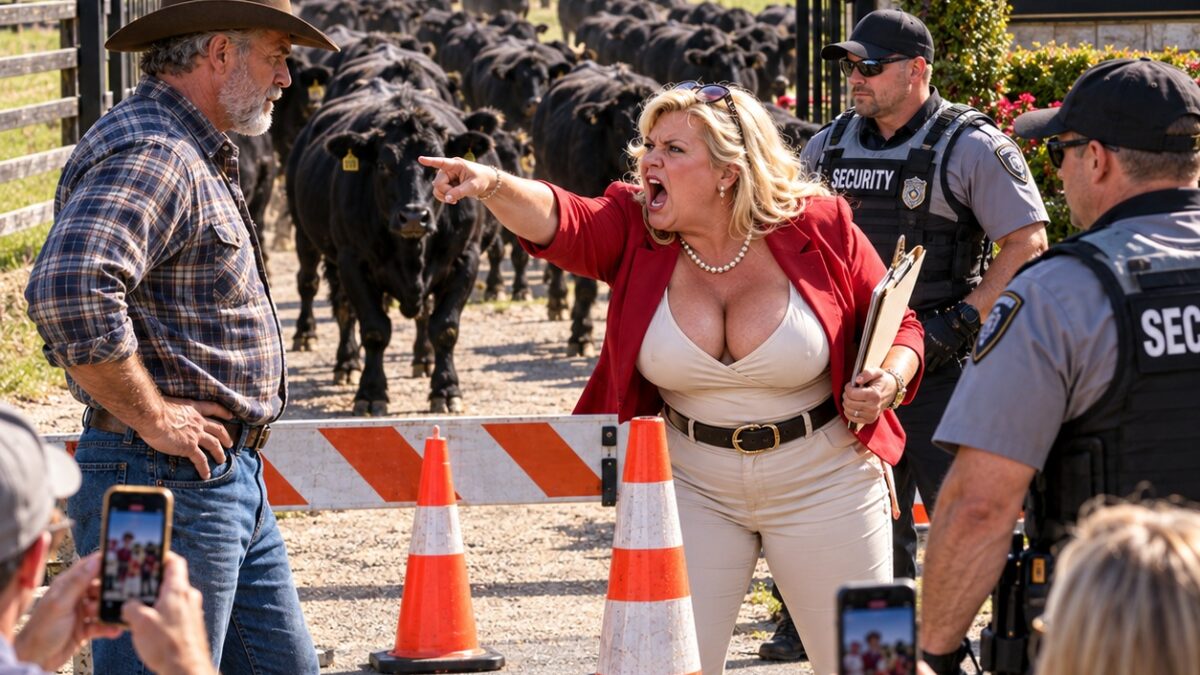
Sixty-four Black Angus cattle do not need amplification.
The first cows entered the lane slowly.
Then more.
Hooves.
Dust.
Lowing.
The road filled with movement.
A herd is not elegant.
It is weight.
Rhythm.
Momentum.
They moved exactly where they had moved for decades.
Inside my fence.
On my land.
Brenda was speaking through a portable microphone.
I could not hear her over the cattle.
Apparently neither could anyone else.
Heads turned.
Residents stood.
Phones came out.
Brenda tried talking louder.
Bad strategy.
You cannot out-volume sixty-four cattle unless you are one yourself.
The security contractors moved toward my fence.
David walked beside the herd on my side.
He held a copy of the county plat.
One guard called:
“Mr. Vance!”
I kept walking.
“Mr. Vance, this activity is in violation of HOA standards.”
That got a laugh from somewhere in the homeowner crowd.
I stopped near the fence.
“Which activity?”
“Livestock movement.”
“On a ranch?”
He looked toward Brenda.
She approached.
Her face had the tight expression she got when reality refused to follow the agenda.
“Elias.”
“Brenda.”
“You knew this inspection was scheduled.”
“I knew my cattle drive was scheduled.”
“This is intentional interference with a community function.”
“The cows do not read your newsletter.”
Another laugh.
Brenda’s cheeks reddened.
Residents moved closer.
The cattle continued behind me.
Dust rising.
One after another.
Calves beside cows.
David watching the rear.
I had brought one document.
The county plat.
Richard carried another.
I unfolded mine.
“Brenda, show me where my ranch road is on your map.”
She stared.
“This is not the appropriate forum.”
“You sent guards onto the road.”
“That road falls within our jurisdiction.”
“Show me.”
Residents began murmuring.
Some had seen her presentation map before.
Brenda turned toward the easel.
Her red boundary line was there.
Big.
Visible.
She pointed.
“There.”
I held up the county plat.
Richard stepped beside me.
He held his copy where nearby homeowners could see.
“That road isn’t there,” someone said.
Another resident moved closer.
“What are we looking at?”
Richard spoke calmly.
“Recorded county plat.”
He pointed.
“Subdivision boundary.”
Then Brenda’s board.
“Private map.”
Someone asked:
“Why are they different?”
Brenda answered immediately.
“The HOA commissioned an updated professional survey to address historical discrepancies.”
I asked:
“Who recorded it?”
Her eyes snapped toward me.
“What?”
“The updated survey. Recording number.”
“This is not—”
“Where is it recorded?”
One homeowner already had a phone up.
Then another.
Brenda looked around.
That was the moment she lost control.
Not when the cattle arrived.
Not when Richard showed the plat.
When she realized forty residents were listening to a question she had avoided answering for months.
“The survey was privately commissioned.”
“I know.”
“It was completed by a qualified professional.”
“Recorded where?”
“Official recording is not necessary for the board’s internal enforcement assessment.”
Richard’s eyebrows went up.
I almost felt sorry for her.
Almost.
A resident named Karen Doyle asked:
“Wait. You’re fining people using a survey that isn’t filed?”
Brenda turned.
“It is not that simple.”
Richard said:
“It actually is fairly simple.”
Brenda rounded on him.
“And who are you?”
“Richard Hale. Retired county surveyor.”
Silence.
Beautiful silence.
Brenda recovered.
Barely.
“Well, Mr. Hale, perhaps you are unfamiliar with modern HOA boundary management.”
Richard smiled.
“I surveyed half this county.”
Someone laughed.
Brenda looked furious.
The cows kept moving.
Number forty-something passed behind me.
One stopped to stare at the crowd.
Then continued.
I asked again:
“Did the county approve your jurisdiction expansion?”
Brenda’s voice rose.
“The board has authority to interpret its governing territory.”
“Not onto my deed.”
“You are oversimplifying.”
“Then explain it.”
She did.
That was her final mistake.
Flustered.
Angry.
Surrounded by residents.
Cameras everywhere.
She said:
“I personally authorized the updated jurisdiction survey because the existing county documents did not reflect the practical boundary needs of the community.”
Richard actually closed his eyes.
Brenda continued.
“The surveyor confirmed the boundaries we are using. It has not yet been submitted for official county recording because that process is unnecessary for internal enforcement.”
Eleven residents recorded some version of that statement.
I know the number because Claire later collected the videos.
Eleven.
Different angles.
Different phones.
Same admission.
Privately commissioned.
Not officially recorded.
Used for enforcement anyway.
I folded my plat.
“Thank you.”
Brenda blinked.
“For what?”
“Clearing that up.”
Then I walked away.
No speech.
No threat.
No dramatic promise.
The remaining cattle passed.
Sixty-four total.
By 10:10, the herd was in the south field.
Gate closed.
Job finished.
Brenda’s community standards inspection ended twenty minutes early.
Richard came to my porch afterward.
“You planned that.”
“I planned to move cattle.”
“You knew she would talk.”
“I hoped.”
He laughed.
Claire called that afternoon.
Richard had already sent her two videos.
“Elias.”
“Yes?”
“Do not contact Brenda.”
“Wasn’t planning to.”
“Do not post anything online.”
“I don’t have social media.”
“Thank God.”
“Is it useful?”
She paused.
“Yes.”
“How useful?”
“She publicly admitted the association is enforcing against your property using a private map that has not been recorded and apparently conflicts with the county plat.”
“So very?”
“Very.”
Monday morning, Richard filed a formal plat discrepancy package with the county surveyor’s office.
Claire filed amended complaints and requests for regulatory review using the videos.
She also sent the HOA a formal demand to cease all enforcement against my parcel pending resolution.
This time, things moved.
Fast.
Maybe it was the evidence.
Maybe the videos.
Maybe the insurer.
Insurance companies have a remarkable ability to make board members suddenly interested in legal limits.
Within a week, Millhaven Commons’ liability carrier sent questions.
Who authorized enforcement on non-member parcels?
What legal opinion supported the expanded boundary?
Was the private survey recorded?
Were guards instructed to access Elias’s private road?
Had any fines been collected from nonmembers?
The board began turning on itself.
I heard most of this through Claire.
One board member claimed Brenda had described the map as “updated county data.”
Another said he thought the survey had already been recorded.
A third admitted he had never seen the underlying document.
Brenda insisted everyone knew.
Everyone else suddenly developed poor memory.
Then the county review came back.
Recorded plats supported my boundary position.
No recorded document transferred jurisdiction over my road, fence, hay fields, or ranch operations to Millhaven Commons.
The private mapping Brenda relied on had no recorded effect on my title.
Claire explained it more carefully than that.
A survey can be evidence.
A survey can identify disputes.
A survey can be important.
But an HOA cannot simply commission a drawing and use it as unilateral authority over land outside its covenants.
Especially not while ignoring conflicting recorded deeds and plats.
That was enough.
Every fine the HOA had issued me based on its claimed expanded jurisdiction was withdrawn.
Fence.
Hay.
Equipment.
Gate.
Everything.
Fees refunded.
Interest and late charges reversed.
The HOA sent a letter.
It did not apologize.
Lawyers rarely let organizations apologize when litigation remains possible.
Instead it said:
After review, the Association has determined that enforcement actions concerning the Vance property should be rescinded.
Should be.
As though the fines had developed spontaneously.
I framed that sentence for a week.
Then decided it annoyed me and put it in the file.
The insurer’s letter was worse for Brenda.
Claire obtained it during negotiations.
The phrase UNAUTHORIZED ENFORCEMENT ACTION appeared multiple times.
Another line warned the board that continued attempts to exercise control beyond recorded association boundaries could create substantial uncovered liability.
That got everyone’s attention.
Because moral arguments sometimes fail.
Financial exposure rarely does.
Emergency board meeting.
Then another.
Then a special homeowner meeting.
Brenda stopped answering my calls.
Not that I made any.
Nine days after the preliminary findings, she resigned as HOA president.
No press conference.
No confrontation at my fence.
An email.
For personal reasons and in the best interests of the community, I am resigning effective immediately.
Richard read it on my porch.
“Personal reasons.”
“Apparently.”
“You think sixty-four personal reasons?”
“Black Angus have feelings.”
He nodded.
“Fair.”
Brenda did not attend the meeting where the board accepted her resignation.
The vote was unanimous.
Including two board members she had personally appointed.
That part amused David.
“Loyal crowd.”
“Rats know water.”
He spat into the grass.
David had never liked Brenda.
He liked her less after the feed truck incident.
The security contractors disappeared from my ranch road.
Millhaven Commons terminated or narrowed the agreement that had placed them there.
The orange cones never returned.
I kept one.
Found it near the ditch after everything ended.
David wanted to paint BRENDA on it.
I told him no.
He did it anyway.
It still sits in the equipment shed.
I eventually settled the remaining dispute with the HOA.
Refunds.
Attorney fees partly resolved.
Written acknowledgment of the boundary.
No admission of intentional wrongdoing.
Standard legal language.
Claire was satisfied.
I wanted a sentence that said:
We were wrong.
She explained that settlements rarely satisfy the emotional part.
“Then what does?”
“Time.”
I didn’t like that either.
She was right.
The strange part was how quickly the neighborhood changed after Brenda left.
Residents came over.
Some apologized.
They had watched the fines.
Heard Brenda describe me as a difficult adjacent landowner.
Assumed there was a legitimate boundary dispute.
A man named Paul said:
“I thought you were fighting over ten feet.”
“No.”
“I didn’t understand she was claiming your road.”
“Most people didn’t.”
“She told us the county maps were outdated.”
“I know.”
He looked toward the pasture.
“Why didn’t you come to an HOA meeting earlier?”
“I’m not in the HOA.”
He laughed.
Then realized that was the entire point.
Karen Doyle—the woman who had challenged Brenda during the cattle drive—brought over a pie.
Apple.
“You don’t have to apologize with food.”
“I’m not apologizing.”
“What is it?”
“Thank-you pie.”
“For?”
“Making that woman explain herself.”
“I moved cattle.”
“Exactly.”
News of the cattle drive spread farther than I expected.
People told the story wrong immediately.
Elias released sixty-four cattle into the HOA meeting.
False.
I never put one hoof on HOA land.
Elias used cattle to chase security guards.
False.
The guards remained on their side.
Elias planned the whole thing as revenge.
Not exactly.
I planned to move cattle.
I knew Brenda would be nearby.
I knew the route would demonstrate something words had failed to demonstrate for fourteen months.
My ranch operated independently of her jurisdiction.
The cattle made that visible.
But revenge?
No.
Revenge would have been driving the herd across her manicured common lawn.
Tempting.
Illegal.
Stupid.
I wanted something better.
Proof.
Richard called it “practical surveying.”
I called it chores.
The first thing I did with the refunded fine money was repair the eastern fence.
The same fence Brenda originally cited.
Several posts had started rotting.
I could have replaced it with something decorative.
Vinyl.
Painted board.
Something the HOA would approve.
Instead, David and I used pressure-treated posts.
Wire.
Same style my father and I had installed in 1987.
It looked almost exactly the same.
Richard drove by.
“You did that intentionally.”
“Did what?”
“Made it ugly.”
“It’s a cattle fence.”
“Exactly.”
He smiled.
I stood with one hand on a post.
My father had taught me how to stretch fence wire correctly.
Tight enough to hold.
Not so tight it breaks when temperature shifts.
There was probably a metaphor in that.
I ignored it.
The ranch was quiet again.
Hay bales visible.
Cattle doing things cattle do.
Tractor parked where I wanted.
Nobody photographed it.
Nobody mailed a fine.
My road returned to being simply a road.
That last part mattered most.
People do not understand how strange it feels to be told you need permission to move across land your family has worked for generations.
Not because inheritance makes a man superior.
Because history creates certainty.
I knew where that road came from.
My grandfather cut it.
My father maintained it.
I had dumped gravel on it.
Dragged snow from it.
Pulled stuck equipment from it.
Watched Ellen drive down it with groceries.
Watched ambulances use it when my father died.
Watched my wife’s funeral procession leave the property on that same route.
Then two men wearing HOA vests placed cones across it because Brenda had drawn a red line on paper.
That was the part I never forgave quickly.
Not the money.
The arrogance.
Richard understood.
One evening after the final county documentation arrived, he came over with beer.
We sat on the porch.
Southern pasture glowed orange.
Cattle spread across the field.
Neither of us said much.
Finally Richard asked:
“Regret paying the first fine?”
“Yes.”
“Why?”
“Made her think I’d comply.”
He shook his head.
“No.”
“What?”
“Made the record cleaner.”
Lawyer logic had infected him.
“I thought you were a surveyor.”
“Worse.”
We sat.
A cow called from the field.
Another answered.
I thought about Brenda.
I did not hate her.
That surprised me.
For months, I expected I would.
But once she was gone, anger lost utility.
She had made a basic mistake that grew because nobody stopped it early enough.
She confused a map with authority.
Then confused authority with ownership.
Then confused nobody fighting back with being right.
Those are dangerous confusions.
The new HOA president was a man named Harold Pierce.
Retired teacher.
Quiet.
He came to my house before his first meeting.
No blazer.
No clipboard.
He carried a folder.
“I want to make sure we understand the line.”
Richard would have loved that.
I brought out the certified plat.
Harold compared it to the corrected HOA records.
“Fence is yours.”
“Yes.”
“Road is yours.”
“Yes.”
“Buffer here belongs to the association.”
“Yes.”
He nodded.
“Good.”
“That easy?”
“I taught middle school thirty-two years.”
He closed the folder.
“I have no desire to argue with cattle.”
I liked him immediately.
Under Harold, the HOA did something radical.
Stayed in its lane.
Literally and figuratively.
The association fixed its common-area irrigation.
Reviewed actual member violations.
Published boundary documents.
Rescinded several enforcement policies Brenda had expanded without clear authority.
The two neighboring nonmember parcels affected by her map were reviewed too.
One property owner received refunded fines.
Another had never paid and had been threatening litigation.
That ended.
Residents began asking more questions at meetings.
Who approved this?
Where is it recorded?
Is that in the bylaws?
What does the deed say?
Brenda probably would have called that obstruction.
Harold called it governance.
I attended one meeting.
Only one.
Karen Doyle invited me.
Harold pointed toward me from the front.
“Mr. Vance is here tonight as our guest.”
I said:
“Don’t fine me.”
Room laughed.
Harold smiled.
“No plans.”
The board presented a revised boundary map.
This one matched recorded documents.
Richard stood in the back.
Arms crossed.
Harold said:
“We have learned that internal maps should reflect legal records, not substitute for them.”
Nobody said Brenda’s name.
Nobody needed to.
Afterward, a younger homeowner approached.
“I bought here last year.”
“Okay.”
“I didn’t know your ranch existed before the development.”
“It would be difficult for eighty acres to sneak in afterward.”
He laughed.
“I mean I thought the HOA owned the land around the common area.”
“Some.”
“Not yours.”
“No.”
He looked toward the eastern fence.
“Brenda made it sound like you were refusing to join.”
“I was never invited.”
“Would you?”
“No.”
He laughed again.
“Fair.”
That conversation told me how narratives create authority too.
If residents believe the HOA surrounds and governs everything they see, a ranch fence becomes an intrusion.
If they know the subdivision was built beside an existing ranch, the same fence becomes history.
Brenda told the first story.
Recorded plats told the second.
One afternoon, months later, I received a letter with no return address.
Inside was a handwritten note.
Mr. Vance,
I live in Millhaven Commons. I am sorry I believed what we were told about your property. I watched the cattle drive with my daughter. She asked why the cows were allowed there. I realized I could not explain because I had never checked whose land it was.
Thank you for forcing us to look.
No name.
I kept that one.
Not because I needed gratitude.
Because the last sentence mattered.
Look.
Most abuse of petty authority survives because people don’t look closely.
Fine is only $50.
Map looks official.
Guard has a vest.
President sounds confident.
Why create trouble?
Why spend hours at county records?
Why hire a lawyer?
Why argue over a fence?
Then a line moves.
Then another.
Then someone blocks your road.
Ellen would have understood why I couldn’t let it go.
She was quieter than me.
But far more stubborn.
Once, a utility company placed a pole six feet inside our pasture without proper notice.
I wanted to ignore it.
She made three calls.
Pole moved.
“You let six feet go,” she told me, “people eventually forget it was ever yours.”
I thought about her constantly during the Brenda dispute.
Not because she would have loved the fight.
She hated conflict.
But she loved clarity.
Her recipe boxes were labeled.
Farm bills filed by month.
Deeds kept in a fireproof cabinet.
She was the reason I still had certified copies of old documents instead of relying on memory.
One night after everything ended, I opened that cabinet.
Found her handwriting on a folder.
EAST BOUNDARY / 1987 FENCE.
Inside were old receipts.
Post supplier.
Wire.
My father’s handwriting.
A photograph of me and Dad standing beside the new fence.
Ellen had dated the back.
June 14, 1987.
Brenda’s first fine called that fence visually incompatible with community standards.
I laughed alone in the kitchen.
Community standards.
The fence had been old enough to drink before the community existed.
I took the photo outside.
Stood beside the fence.
Same line.
Some posts replaced.
Wire repaired.
But same purpose.
Keep cattle in.
Keep boundaries clear.
Nothing about revenge.
Boundaries are not revenge.
That may be the most important thing Brenda never understood.
Saying no is not aggression.
Producing a deed is not hostility.
Refusing jurisdiction that does not exist is not being difficult.
She treated every boundary as opposition because her idea of leadership required expansion.
More standards.
More reach.
More enforcement.
Eventually she reached land that did not belong to her system.
And the land pushed back.
Not magically.
Through documents.
County records.
Witnesses.
Survey lines.
Insurance questions.
A lawyer.
And sixty-four cattle that had absolutely no idea they were part of the argument.
Years passed.
Millhaven Commons grew.
New houses filled remaining lots.
Trees got taller.
Children who watched the cattle drive became teenagers.
People still occasionally stopped near the eastern common lawn to photograph the herd.
I pretended to hate it.
Didn’t.
David retired eventually.
We held a barbecue.
He told the cattle-drive story three times.
Each version became less accurate.
By the third, he claimed Brenda had climbed onto a picnic table.
“She did not.”
“You were busy.”
“She absolutely did not.”
Richard supported him because Richard enjoys lies when they’re funny.
“She may have.”
“You both were there.”
“Memory fades.”
“No.”
Richard laughed.
He passed away two years later.
Heart attack.
Quick.
I miss him.
His family gave me the survey tube he carried that Saturday.
Inside was the county plat.
I mounted a copy in my office.
Not because I needed to prove anything anymore.
Because Richard had been the first person to look at Brenda’s map and say:
That’s wrong.
Sometimes that is the most valuable thing another person can do.
Confirm you are not crazy.
Reality matters.
The ranch remains eighty acres.
No more.
No less.
That became strangely satisfying.
Brenda’s map tried to make it smaller.
Anger made the dispute feel enormous.
But in the end, the actual land never moved.
Paper claims moved.
Authority claims moved.
People’s beliefs moved.
The fence did not.
The road did not.
The deed did not.
The cattle certainly did.
Every fall, we still move the herd south.
Numbers change.
One year fifty-eight.
Another seventy-one.
Weather changes.
Hands change.
But the route stays.
North pasture.
Ranch road.
Past the eastern fence.
Down to winter grazing.
The first cattle drive after Brenda resigned, I expected Millhaven Commons residents to watch.
A few did.
Karen Doyle stood near the common lawn with coffee.
She waved.
I waved back.
No presentation table.
No microphone.
No security guard.
Just cattle moving.
Ordinary.
I realized then that ordinary was the victory.
Not Brenda resigning.
Not fines refunded.
Not the insurer letter.
Watching ranch work become ranch work again.
No one interpreting it as defiance.
No one photographing a hay bale as evidence.
No one telling me where I could drive on my own land.
Ordinary is what bad authority steals first.
It turns routine into permission.
You stop asking:
What am I allowed to do?
And start asking:
Will they punish me if I do it?
Those questions are not the same.
I had spent fourteen months reacting to Brenda.
That was more power than she deserved.
Afterward, I stopped.
I repaired the barn.
Bought a used baler.
Expanded the south watering system.
Started helping my nephew learn cattle work.
Life became bigger than the HOA dispute again.
That was important.
Revenge stories usually end with the enemy losing.
Real life should continue afterward.
Otherwise the enemy still owns the ending.
Brenda did not get mine.
I heard she moved to Nashville eventually.
Maybe true.
Maybe not.
I never searched.
Someone once showed me a social-media post where a woman with her name complained about “toxic community politics.”
I didn’t click.
David wanted to frame it.
I told him to get a hobby.
I had learned something from Richard after all.
Claire Morgan remained my attorney.
Mostly for normal things.
Lease agreements.
Estate planning.
One day she handed me a bill and said:
“See? Much less exciting.”
“Still expensive.”
“That’s how you know it’s legal.”
She asked whether I ever considered suing Brenda personally.
We had discussed it earlier.
Potential claims.
Costs.
Uncertainty.
I declined beyond what was needed to recover losses and establish boundaries.
“Why?” Claire asked.
“Because I got what I needed.”
“What was that?”
“My road.”
She smiled.
“It was always your road.”
“Exactly.”
There was no need to destroy Brenda.
I needed her claim destroyed.
Different goal.
That difference kept me from becoming the thing I disliked.
Power struggles invite escalation.
More punishment.
More humiliation.
More control.
Brenda had lived that way.
I didn’t want to.
I wanted the county plat to say what it said.
The HOA to stay where it belonged.
My cattle to move.
My life to continue.
Enough.
I think Ellen would have approved.
Today I am older than sixty-two.
The ranch takes more out of me.
I hired another full-time hand.
My knees complain when weather changes.
The farmhouse roof needs work again.
Everything on a ranch eventually needs work again.
That is reassuring.
Nothing stays finished.
One evening last fall, I sat on the porch while the herd grazed the southern field.
My nephew asked:
“Is that where the HOA tried to stop you?”
He pointed toward the road.
“Yes.”
“Why?”
“Bad map.”
He laughed.
“No, really.”
“Really.”
“Didn’t they know it was yours?”
“They convinced themselves it wasn’t.”
“How?”
Good question.
I thought about Brenda.
Board meetings.
Fines.
Security vests.
County records.
“Because nobody made them prove it early enough.”
He nodded slowly.
Then:
“And the cows proved it?”
“No.”
“What?”
“The documents proved it.”
He looked disappointed.
“What did the cows do?”
I smiled.
“They got everybody to pay attention.”
That is the honest version.
The cattle did not create my property rights.
They did not invalidate Brenda’s map.
They did not make law.
They made the contradiction impossible to ignore.
Brenda stood beside forty homeowners saying the HOA controlled a road while sixty-four cattle traveled that road exactly as they had for generations.
The moment demanded an explanation.
She gave one.
And the explanation destroyed her claim.
Sometimes evidence needs a stage.
That Saturday morning, my ranch provided one.
I still have the first fine.
Two hundred fifty dollars.
FENCE NONCOMPLIANCE.
I kept it with the photograph from 1987.
My father.
Me.
New fence.
Ellen’s handwriting on the back.
Anyone seeing both documents understands the entire absurdity immediately.
One says the fence violated a community standard.
The other proves the fence was there before the community.
That is the problem with invented authority.
Eventually it meets a date.
A deed.
A survey.
A photograph.
A witness.
Something stubbornly factual.
Then all the confidence in the world cannot move the line.
The eastern fence is still there.
Some posts new.
Some wire replaced.
Looks almost exactly the same.
Millhaven Commons maintains its lawn on one side.
I maintain pasture on the other.
Harold’s board planted native shrubs near part of the common area.
Looks good.
They asked first before doing anything close to the line.
Imagine that.
One phone call.
“Elias, we’re considering planting six feet from the boundary. Any problem?”
“No.”
“Thanks.”
Weeks of conflict avoided by one simple recognition.
Your side.
My side.
Mutual respect.
Boundaries can create peace.
That is what Brenda missed.
She believed boundaries limited leadership.
Actually, boundaries make cooperation possible.
Without them, every interaction becomes a contest.
I don’t know whether people in Millhaven Commons remember the details now.
New homeowners probably hear some exaggerated version.
Crazy rancher.
HOA Karen.
Cattle showdown.
Fine.
Stories simplify.
I know what happened.
A woman used an unrecorded private map as if it could rewrite a deed.
I challenged it.
For months, the system moved slowly.
Then she sent guards onto my private road.
I kept doing lawful ranch work.
In front of witnesses, I asked one question.
Where is your map recorded?
She answered.
Not anywhere.
Everything after that was paperwork catching up to reality.
The fines disappeared.
The claim disappeared.
The presidency disappeared.
The ranch remained.
That ending matters to me.
Not because my family has been here seventy years and therefore deserves special treatment.
Because ownership is a legal fact, not an HOA opinion.
A private organization can govern what its covenants lawfully govern.
It cannot simply color outside those lines because the president dislikes what she sees from the common lawn.
The same principle applies beyond ranches.
HOAs.
Businesses.
Government.
People.
Authority needs a source.
A limit.
A record.
If somebody cannot show you where their power comes from, asking questions is not rebellion.
It is maintenance.
Like checking a fence.
Most failures start small.
One loose staple.
One leaning post.
Ignore enough of them and cattle find the gap.
Brenda’s first loose staple was a fence letter.
I almost ignored it.
Then a fine.
Then another.
Then a map.
Then guards.
By the time she blocked the road, the fence around her own authority had already failed.
She just had not noticed.
Sixty-four Black Angus made sure everyone else did.
Last October, we moved the herd again.
Cool morning.
Dust low.
Sun coming through the trees.
My nephew rode the ATV ahead.
I walked near the center.
As we passed the eastern common lawn, a little boy stood with his father watching.
The boy waved.
I waved.
One cow stopped.
Looked at him.
The boy laughed.
His father said:
“Keep going, buddy.”
The cow did.
No confrontation.
No cameras.
No HOA president with a microphone.
Just livestock moving from one pasture to another.
The road belonged to the ranch.
The common lawn belonged to Millhaven Commons.
The fence stood between them doing exactly what fences are meant to do.
Not create enemies.
Clarify where one thing ends and another begins.
I wish Brenda had understood that before she drew her red line.
Would have saved all of us a great deal of trouble.
But she didn’t.
So Richard brought the plats.
Claire brought the law.
Residents brought their cameras.
And I brought the cattle.
Not because I needed revenge.
Because they needed moving.
Sometimes the strongest argument is simply continuing to live your life inside the boundaries that were yours all along.
Brenda tried for fourteen months to make my land part of her system.
In the end, I never had to take anything from her.
I only had to prove what she could not take from me.
My fence.
My road.
My ranch.
And the right to move sixty-four Black Angus across all three without asking an HOA president for permission.








