𝗙𝗨𝗟𝗟 𝗦𝗧𝗢𝗥𝗬:The HOA President Tried to Burn Me Off My Land—She Forgot Ashes Still Leave Evidence
𝗙𝗨𝗟𝗟 𝗦𝗧𝗢𝗥𝗬….
Because I had never joined Brier Glenn.
Never signed the covenants.
Never paid dues.
Never used the clubhouse.
Never asked for access through their gate.
My property sat outside the association boundaries and always had.
That should have ended every argument.
It didn’t.
The letters kept coming.
Repaint the barn.
Remove the business sign.
Relocate visible machinery.
Replace the fence with an HOA-approved design.
Pay a commercial impact fee.
That one was my favorite because Delilah had invented it entirely.
Every time, I sent back my deed and the same message.
Not HOA property.
No authority.
No signature.
She hated being reminded of that.
My barn stood near the back road behind Brier Glenn.
It wasn’t beautiful.
Plain wood.
Old tin roof.
Wide sliding doors.
Concrete floor at one end where I had built a proper restoration shop.
But to me, that barn was more than lumber.
My father had raised it nail by nail decades earlier when the entire stretch behind Brier Glenn was pasture and gravel.
Inside, I kept restored farm machinery, welding equipment, lifting gear, rare parts, active customer projects, business records, and tools that had passed through three generations of Grangers.
Later, after the fire, the replacement value of what I lost would climb past seven hundred thousand dollars before anyone even started counting business interruption.
Delilah saw none of that.
She saw an eyesore between her development and the expansion she had been quietly promising investors for more than a year.
She offered to buy my land for $610,000.
I had it appraised months earlier.
The land alone was worth $1,360,000.
I tore up the letter.
But for some reason I saved the envelope.
That small decision mattered more than I could have imagined.
Because after Delilah raised the offer and I refused again, after she warned me I should hope I still had something worth protecting by the end of the weekend, after two of my cameras mysteriously went dark on consecutive nights, I woke to orange light in my living room window.
By the time I reached the yard, the east wall of my barn was already roaring.
[End Facebook Caption — full story continues below]
Fire changes sound before it changes shape.
People think the first thing you notice is the light.
It wasn’t for me.
It was the crack.
A sharp, ugly report from somewhere deep inside the barn, like timber splitting under pressure.
Then another.
Then the roar.
I came out of the farmhouse half-dressed, boots unlaced, phone already in my hand, and the heat hit me when I was still thirty feet away.
Not warmth.
A wall.
The kind that shoves you backward before your mind accepts that you cannot keep moving forward.
The eastern wall was burning so hard the night sky above it looked alive.
Black smoke poured upward through sparks.
The tin roof glowed along one edge.
Inside that barn were three customer restoration projects.
A 1949 Farmall.
A rare Minneapolis-Moline my customer had spent twelve years finding.
A John Deere crawler with parts I had sourced from four states.
My father’s tools.
My grandfather’s vise.
Two shelves of original manuals.
Business files.
Engine blocks.
Welding gear.
Everything.
I screamed at the fire like it was a person.
Like it could hear me.
Like it might reconsider.
Then something inside the barn exploded and sent a spray of sparks through the roofline.
That snapped me back.
I called 911.
Then ran for the old truck parked nearest the barn and managed to get it started and backed away before the flames reached the lean-to.
After that, there was nothing to do but watch.
I hated that most.
Standing there while a life’s work burned does something to a man.
You keep bargaining with physics.
Maybe if I get closer.
Maybe if I pull that door.
Maybe if I drag one machine out.
But fire doesn’t care how much history you have in a building.
The roof buckled.
Then caved.
One section at a time.
The sound was enormous.
Then strangely quiet beneath the flames.
By sunrise, the barn was gone.
Not damaged.
Gone.
Twisted steel columns.
Collapsed roofing.
Burnt lumber.
Warped machinery.
A foundation blackened so badly the concrete looked bruised.
The air smelled like wet ash, melted rubber, and old oil.
I stood at the edge of the wreckage wearing boots I didn’t remember tying.
Firefighters moved through slowly.
Carefully.
Calling sections unsafe.
Marking spots.
Spraying what still smoked.
I kept staring at the place where my father had once shown me how to square a wall with nothing but string, a level, and patience.
That corner no longer existed.
Nathan Brooks, the fire investigator, arrived before the smoke had fully thinned.
He didn’t talk much at first.
I respected that.
He walked the perimeter twice.
Looked at the eastern wall.
Studied the debris.
Took photographs.
Put numbered flags into the wet ground.
Asked me about the electrical panel.
Last inspection.
Who had keys.
Who had been inside.
Whether I had enemies.
That last question almost made me laugh.
“Does an HOA president count?”
Nathan didn’t smile.
“Tell me.”
So I told him everything.
The letters.
The fake fees.
The low offers.
The development pressure I suspected but could not prove yet.
The camera outages.
Delilah standing at my fence telling me my cameras wouldn’t make the barn any prettier.
Her saying eventually it wouldn’t be there at all.
The last offer.
Her warning that I should hope I still had something worth protecting by the end of the weekend.
Nathan listened.
Wrote.
Asked precise follow-ups.
Then said:
“A conflict doesn’t make a fire arson.”
“I know.”
“Threats don’t prove cause.”
“I know.”
“People say ugly things during property disputes.”
“I know.”
His eyes moved back toward the eastern wall.
“But we’ll let the scene tell us what happened.”
That was the first honest sentence I heard that morning.
Then Delilah arrived.
She drove up in a white SUV, got out wearing cream slacks and a pale blue blouse, and walked toward the fence line like she had rehearsed sympathy in the mirror.
“Wyatt.”
I turned.
She put one hand lightly against her chest.
“I am so sorry. What a tragic accident.”
Nathan, crouched near the foundation, looked up.
Just slightly.
Not enough for most people to notice.
I noticed.
Because nobody had said accident yet.
Not officially.
Not him.
Not the firefighters.
Not anyone qualified to say it.
I looked at Delilah.
“Why are you here?”
She sighed.
“Despite our disagreements, I am still your neighbor.”
“No, you’re not.”
Her sympathy mask tightened.
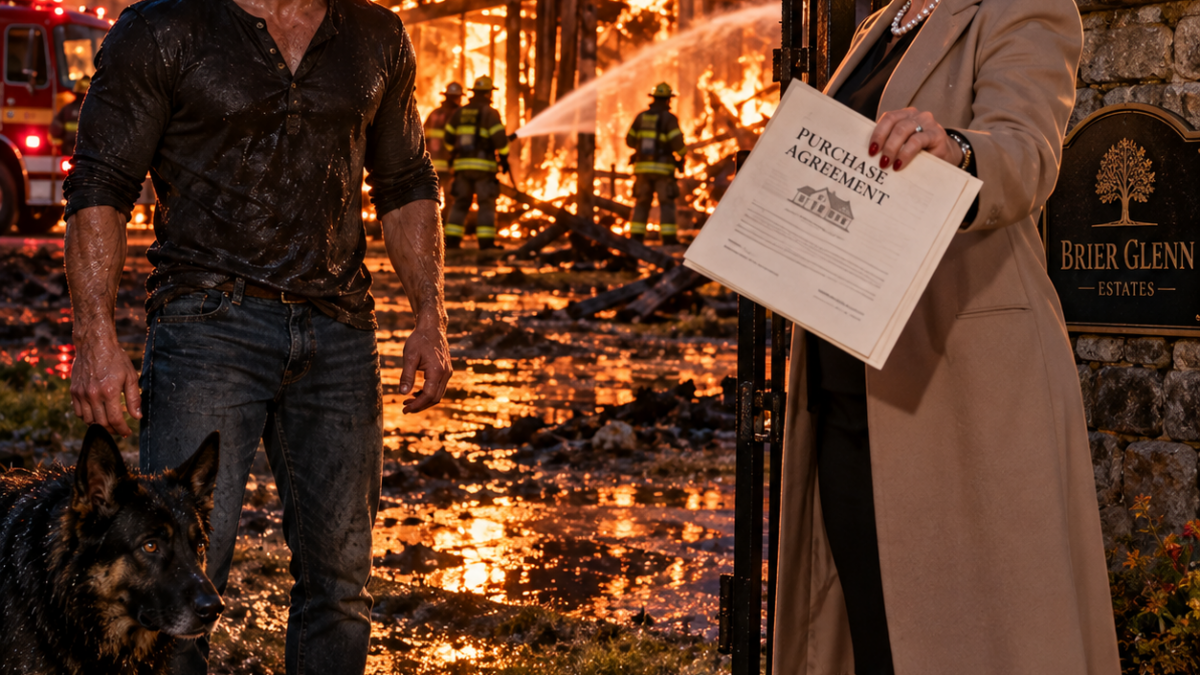
Then she held up a folder.
“I also thought perhaps this would be the humane time to revisit our previous discussions.”
I stared at the folder.
“What discussions?”
“Selling.”
The barn was still smoking behind me.
She opened the folder and pulled out a contract.
Purchase price:
$690,000.
Less than her previous offer.
Less than half the appraisal.
I looked at the number.
Then at the smoke.
“You brought a purchase agreement to a fire scene?”
She looked almost offended.
“With the structure gone, the property’s value has changed.”
Something moved in my chest.
Not anger exactly.
Something colder.
“When did you print that?”
For the first time since I had known Delilah Crowley, she had no answer.
Nathan stood slowly.
“Mrs. Crowley.”
She turned.
“Yes?”
“I’m Nathan Brooks. Fire investigator.”
“Oh.”
His eyes went to the folder.
Then back to her face.
“Do not disturb the scene.”
“I’m outside the fence.”
“Stay there.”
She closed the folder.
“Of course.”
But the damage was done.
Not to the scene.
To her timeline.
I didn’t understand it yet.
Nathan did.
He saw the same thing I did.
She had arrived too early.
She had named the cause too early.
She had brought a contract too early.
People who arrive before questions are answered usually have a reason.
Not always criminal.
But always worth writing down.
Days later, Nathan called me.
His voice had none of the softness people use for sympathy.
“The burn pattern doesn’t match accidental electrical failure.”
I sat down.
“What does that mean?”
“It means I’m not calling this accidental.”
“Arson?”
“I’m treating it as deliberately set until evidence tells me otherwise.”
I closed my eyes.
I thought I wanted to hear that.
I didn’t.
Suspicion is easier than confirmation.
Once somebody says deliberately set, your loss changes shape.
The barn didn’t just burn.
Someone chose fire.
The electrical story collapsed quickly.
Delilah had already begun telling people around Brier Glenn that the barn was an old unsafe structure, probably faulty wiring, exactly the kind of danger she had been warning everyone about.
The problem was my wiring had been inspected by a licensed electrician less than three months earlier.
No significant defects.
No unsafe panel.
No report supporting her story.
My cameras were another problem.
Two nights before the fire, one system had dropped offline for several minutes.
The next night, a different camera did the same.
I had called a technician.
He found nothing wrong.
At the time, we both treated it like a strange glitch.
After the fire, it looked different.
Then a neighbor came forward.
He lived far enough away that he had no reason to know about my fight with Delilah.
He told investigators he had seen an HOA service vehicle on the back road the night of the fire.
Not a personal car.
Not a contractor truck.
An HOA vehicle.
A traffic camera near a distant intersection captured a vehicle matching that description heading toward the back road shortly before the fire started.
Later footage showed it returning toward Brier Glenn after the blaze had begun.
The image wasn’t enough to identify the driver.
But enough to make the association produce vehicle logs.
Delilah insisted no one had been authorized to use the truck that night.
Fuel and mileage records disagreed.
Then Trent Hollis called me.
I knew the name.
He had done contract work around Brier Glenn for years.
Landscaping.
Clubhouse repairs.
Small jobs.
He asked if we could meet somewhere quiet.
I met him at a diner two towns over.
He looked like a man who hadn’t slept well.
“I should’ve called sooner.”
“About what?”
“Delilah.”
I waited.
He wrapped both hands around his coffee.
“A week before the fire, she asked if I could quietly remove an abandoned agricultural structure near Brier Glenn.”
My throat tightened.
“What structure?”
“She wouldn’t say at first. Just kept saying it was an eyesore. Needed to be handled before the weekend.”
“Before the weekend.”
He nodded.
“I asked if the HOA owned it.”
“What did she say?”
“She avoided answering.”
“Then?”
“I drove past the address.”
His face changed.
“I recognized your barn.”
He had delivered supplies there years earlier for a different contractor.
He remembered the structure because it was built better than most old barns he had seen.
“When I realized it was yours, I told her no.”
“Exactly what did she say?”
He looked down at his coffee.
“That she’d find someone less difficult to work with.”
I sat back.
Trent swallowed.
“I’m sorry.”
“You didn’t burn it.”
“No.”
“But I should’ve reported the conversation.”
“Yes.”
He nodded.
No defense.
That mattered.
My attorney, Abigail Hartley, took his signed statement that same afternoon.
Abigail had been a friend from local business circles before she became my lawyer.
She was one of those people who became calmer when everyone else got loud.
The first thing she told me after the fire was:
“Do not fight Delilah in public.”
“She’s emailing the entire neighborhood calling it an accident.”
“Good.”
“Good?”
“Every email creates a timestamp.”
“She’s lying.”
“Then let her lie in writing.”
That was hard advice to follow.
Delilah sent one message after another to Brier Glenn.
She described the fire as tragic but unsurprising.
Called my property unsafe.
Said strict standards existed to prevent exactly this kind of danger.
Suggested the barn’s destruction showed why resistant landowners should not be allowed to ignore community welfare.
Residents believed her.
At first.
Why wouldn’t they?
She was their president.
I was the stubborn man outside the gate who refused to sell.
Then the insurance company opened its own investigation.
The numbers were too high for a quick check.
Structure.
Equipment.
Customer property.
Rare machinery.
Restoration work.
Lost contracts.
Business interruption.
Cleanup.
The total climbed past one million dollars.
No insurer was going to write a check that size based on Delilah’s neighborhood gossip.
That is when pressure inside Brier Glenn began shifting.
Monica Fairmont, the HOA treasurer, contacted Abigail.
She said she wasn’t doing it out of loyalty to me.
I respected that more than a fake speech would have.
She was scared.
Scared the board’s silence would make every member look complicit.
Scared the association was being dragged into something bigger than rule enforcement.
Scared because she had watched Delilah become more reckless for months and had said nothing.
Monica handed over emails and minutes.
The first document made my hands shake.
A legal opinion from the HOA’s own attorney.
Months old.
It stated clearly that the Granger parcel sat outside Brier Glenn boundaries and that the association had no authority to enforce its rules against my property.
Delilah had received that opinion before many of her threats.
Before several violation notices.
Before telling people my barn violated standards.
Before the fire.
She knew.
The second document was an email Delilah sent to the board.
The Granger parcel must be resolved before developer review.
The third exchange was worse.
A board member asked what happened if Wyatt simply never agreed to sell.
Delilah wrote:
Then we make ownership more expensive for him than selling would ever be.
I read that sentence ten times.
Then Abigail showed me the one that changed her face.
Three days before the fire, Delilah wrote that the barn could not still be standing when the developer returned that Friday.
Not:
He may need to remove the barn.
Not:
We should pursue legal options.
The barn could not still be standing.
Maybe a lawyer could try to explain it as frustration.
Maybe Delilah believed that.
But once the fire happened, that sentence stopped being ordinary.
Abigail started pulling corporate registrations and county filings.
The limited liability company that had sent one of the purchase offers was tied to a consulting firm.
The consulting firm connected back through a management company partly controlled by a family trust linked to Delilah.
Not clean ownership.
Not simple.
But enough.
Follow the documents long enough and people’s names start appearing where they hoped only company initials would stand.
Delilah stood to benefit personally if the Brier Glenn West expansion moved forward.
The development deal included consulting compensation once the project was completed.
Her crusade against my barn had never been about paint.
Never about safety.
Never about the fence.
The barn was the visible symbol of my no.
As long as it stood on land I refused to sell, her payday remained uncertain.
Once the evidence began circling, Delilah hired a personal attorney.
Publicly, she blamed Monica for stealing confidential HOA documents.
Then hinted that an unnamed maintenance worker might have acted improperly on the night of the fire.
Then insisted she had never ordered anyone to burn anything.
Then filed a request demanding the HOA pay her legal defense because everything she had done had supposedly been official board business.
Abigail almost smiled when she read that filing.
“She’s stepping into a trap.”
“How?”
“If it was official HOA business, we get broad access to the records.”
“And if it wasn’t?”
“Then insurance may not cover her.”
Delilah needed both stories.
Official when she wanted protection.
Personal when she wanted distance.
That kind of contradiction can survive casual conversation.
It struggles under oath.
Meanwhile, Brier Glenn residents began panicking.
Delilah told them I was coming after their homes.
Their savings.
Their dues.
Their future assessments.
She framed me as a man trying to punish four hundred innocent homeowners because I hated an HOA president.
Abigail structured the civil lawsuit carefully.
Delilah Crowley individually for conduct outside any legitimate authority.
The association only where actual institutional responsibility could be shown.
That mattered.
I wasn’t trying to bankrupt ordinary residents.
I wanted accountability from the person who had used their association as a weapon and from the institution only where it had actually enabled her.
Delilah tried to transfer her luxury home into a separate company under her control.
“Estate planning,” she called it.
The timing made that difficult to swallow.
The transfer was prepared shortly after I formally submitted my demand for damages.
Abigail brought it to the court’s attention.
The judge placed a temporary hold on the transfer.
Delilah’s attorney argued the freeze was premature and punitive.
The judge observed that estate planning rarely follows the schedule of a pending creditor claim.
That line spread through Brier Glenn faster than any official order.
Discovery produced what Delilah apparently believed was gone forever.
An exchange confirming she had personally requested that the structure be removed before Friday and specifically avoided routing the related cost through normal HOA meeting records.
During deposition, Abigail asked:
“Did you request that any person remove Mr. Granger’s barn?”
“No.”
Abigail placed the document in front of her.
The room went silent.
Delilah read.
Then said:
“That is not what I meant.”
“What did you mean?”
“I meant the issue needed to be addressed.”
“By removing the structure?”
“No.”
Abigail tapped the page.
“Your words were ‘removed before Friday.’”
Delilah looked at her lawyer.
Her lawyer looked at the table.
The civil trial began nearly a year after the fire.
The courtroom filled with Brier Glenn residents.
Some came out of curiosity.
Some came because they had defended Delilah and wanted reassurance.
Some came because they had begun to realize they might have been defending the wrong person.
I sat beside Abigail.
Plain shirt.
Old jacket.
Hands folded.
I didn’t trust myself to speak more than necessary.
The defense tried three stories.
First:
The barn was old, poorly maintained, and likely caused its own destruction.
Abigail dismantled that with permits, inspection reports, maintenance records, and photographs showing exactly what condition the structure had been in before the fire.
Second:
The HOA had legitimate authority to intervene because my property affected the community.
Abigail produced the legal opinion Delilah had received months before, confirming the HOA had no such authority.
Third:
If an HOA vehicle or worker had been near the barn that night, they acted without Delilah’s instruction.
Then Trent testified.
He told the jury she had asked him to quietly remove an “abandoned agricultural structure.”
He told them he asked whether the HOA owned it.
He told them she avoided answering.
He told them he refused.
He repeated the line:
“I’ll find someone less difficult to work with.”
Monica testified about the developer deadline.
The internal emails.
The board’s concerns.
The legal opinion Delilah had ignored.
Nathan testified about the burn patterns and why the fire did not fit the accidental-electrical story Delilah had spread.
The electrician testified about the recent clean inspection.
The neighbor testified about the HOA truck.
Traffic footage placed a matching vehicle near the road.
Fuel and mileage records contradicted Delilah’s claim that no vehicle had been used.
Then Abigail built the timeline.
Not one dramatic bombshell.
A sequence.
Refusal to sell.
Lowball offers.
Violation notices.
Legal opinion ignored.
Development pressure.
Consulting connection.
Threat to make ownership more expensive than selling.
Attempt to hire Trent.
Trent refuses.
“Someone less difficult.”
Camera outages.
HOA vehicle.
Fire.
Delilah at the gate before conclusions were reached.
Purchase agreement in hand.
Lower offer.
Email calling it an accident.
Insurance investigation.
Every piece touched the next.
Jurors took notes.
By the time Abigail reached the final question, the room felt airless.
She asked Delilah:
“If you genuinely believed the fire was a simple accident, why did you already have a purchase agreement prepared for a property that was still actively smoldering?”
Delilah answered:
“I recognized a legitimate business opportunity.”
I heard someone behind me inhale sharply.
That answer told the jury more about her than a confession might have.
A legitimate business opportunity.
My father’s barn.
My customers’ property.
A night of fire.
The tools my grandfather had held.
A legitimate business opportunity.
Then Abigail introduced the financial records showing how much Delilah personally stood to gain if the expansion succeeded.
Motive closed around conduct.
When the jury returned, the verdict was not limited to lumber and machinery.
Damages covered the destroyed structure.
Destroyed equipment.
Lost customer property.
Interrupted business income.
Investigation costs.
Recovery costs.
Statutory damages.
Punitive damages for deliberate misconduct.
The total climbed past two million dollars.
Delilah remained outwardly composed at first.
She still believed insurance would catch her.
Then her attorney received formal notice.
The insurer would not cover conduct determined intentional and personal.
Her face changed.
Not much.
Enough.
Reporters waited outside.
They asked if she had any comment.
For once, she had none.
I should have felt victory.
I didn’t.
I asked Abigail quietly:
“What if she refuses to pay?”
Abigail said:
“The judgment follows assets.”
Delilah’s luxury home became the center of enforcement.
She appealed.
Lost.
She argued the punitive amount was excessive given her community service.
Dismissed.
She tried to claim homestead protection.
The court found the exemption did not protect her from a judgment arising from deliberate intentional conduct as proven at trial.
Each motion cost her more.
Delayed less.
Eventually, she offered to pay part of the judgment if I released the rest.
I thought about her standing at my fence with a contract while smoke still came off my father’s barn.
“No.”
“Wyatt,” Abigail said carefully, “it is a substantial offer.”
“No.”
“This may take longer.”
“I know.”
“Collection is never simple.”
“I know.”
“You’re sure?”
I looked at her.
“She has never admitted what she did.”
Abigail nodded.
“Then we continue.”
The court moved forward.
Her house—the one she used as proof of status, taste, power, and importance—was placed up for sale to satisfy the debt.
People expected me to go watch.
I didn’t.
I had no interest in standing outside while movers carried boxes.
That kind of satisfaction has a cost.
I had already lost too much to let Delilah keep me emotionally tied to every consequence she faced.
Still, I heard about it.
Everyone did.
The home sold.
After obligations attached to the property were settled, the proceeds covered a substantial portion of the judgment.
Not all.
Enough to matter.
Around the same time, Brier Glenn removed Delilah as president after an internal review revealed her undisclosed financial stake in the expansion.
Board members who once defended her now insisted they had known nothing.
Some probably hadn’t.
Some had known enough to ask better questions.
Monica turned over remaining files.
The new board formally withdrew every baseless claim against my land.
Ended the harassment along the back road.
Confirmed in writing that my property had never belonged within Brier Glenn’s boundaries.
The developer withdrew from Brier Glenn West after the dispute became public and reliable access through my land became impossible.
Delilah lost the presidency.
The development deal.
Her reputation.
Her expected payout.
Her home.
Criminal proceedings tied to the fire moved forward separately, based largely on evidence uncovered during the civil case.
People ask whether I celebrated.
No.
The day that mattered most to me came later.
Trucks arrived at my property carrying new steel.
The rebuild started on the same foundation line.
Not the same barn.
That was impossible.
The old one had been wood, memory, and my father’s hands.
The new one would be stronger.
Steel frame.
Advanced security.
Better fire suppression.
Harder access controls.
But I insisted on building in the same spot.
Delilah had tried to erase that place.
I refused to move it.
I hired a crew that had built additions for two of my longtime customers.
I used the same steel supplier my father once favored even though cheaper options existed.
Every evening during construction, I walked the frame.
Checked bolts.
Looked at welds.
Ran my hand along the posts.
Not because the crew needed me hovering.
Because I needed to see it rise.
Piece by piece.
One board from the old barn survived.
Scorched along one edge.
Blackened knots.
A section Nathan allowed me to keep after evidence review.
I had it restored and mounted inside the new building.
No plaque.
No speech.
Just a burned piece of wood on a clean wall.
That was enough.
The first time I walked into the completed barn, I stopped in the doorway.
The concrete was new.
The lighting better.
The air smelled like steel, sawdust, and fresh sealant instead of smoke.
Machinery sat along one wall.
Some new.
Some salvaged.
Customer projects restarted slowly.
I turned on the main lights.
They hummed overhead.
For a moment, I heard my father’s voice.
Not words.
Just the memory of him working.
I stood there until my throat loosened.
Then I started the first machine.
That sound meant more than the judgment.
More than Delilah’s house.
More than any article about the case.
Work again.
After the final recovery notice arrived confirming another amount collected from the sale of Delilah’s property, I read it once.
Folded it.
Put it in the same drawer where I had kept that first envelope.
The envelope from the lowball offer.
The one Delilah never imagined I would save.
The postmark helped establish timing.
The company link helped trace motive.
The physical paper became one more quiet witness.
Evidence doesn’t always look dramatic when you save it.
Sometimes it looks like junk mail.
I walked back outside.
Brier Glenn’s rooftops were still visible beyond the fence.
Same neighborhood.
Different president.
Different board.
Different relationship.
Beside the new barn door, I hung a framed copy of my deed.
Not as decoration.
As a reminder.
The name on that paper had not changed when Delilah mailed violations.
It had not changed when she offered half value.
It had not changed when the barn burned.
It had not changed when she called the fire an accident.
It had never belonged to the HOA.
It had never belonged to Delilah Crowley.
It belonged to me.
The Brier Glenn board sent one last letter months after Delilah was removed.
Formal.
Careful.
Probably written by counsel.
It acknowledged my property stood outside the association boundaries.
It withdrew every prior notice and claim.
It confirmed the HOA had no enforcement authority over my land.
I read it.
Then laughed once.
Not because it was funny.
Because I had written almost the same thing to them for years.
It had taken a fire, a lawsuit, a judgment, the sale of a president’s home, and the collapse of a development deal for them to put it in writing.
Still.
Better late than never.
Monica came to see me once.
She stood outside the new fence holding a folder.
“I brought copies of final board resolutions.”
“Thank you.”
She looked at the barn.
“It looks good.”
“It does.”
“I should have spoken sooner.”
I didn’t answer right away.
She had given Abigail the documents that changed the case.
She had also stayed silent while Delilah escalated for months.
Both were true.
“Probably.”
She nodded.
No defense.
“I was afraid.”
“I know.”
“That isn’t an excuse.”
“No.”
“I’m sorry.”
I accepted that.
Not clean forgiveness.
Not anger.
Something in between.
She turned to leave.
Then stopped.
“Residents were afraid of her too.”
“I know.”
“She made people believe disagreeing meant becoming her next target.”
I looked toward Brier Glenn.
“People with power do that when they don’t deserve power.”
Monica nodded.
The new HOA adopted rules after Delilah.
Conflict disclosures.
Independent legal review before asserting authority over outside property.
No enforcement action against nonmembers without written legal opinion and board vote.
Full disclosure of development-related compensation.
Vendor approval controls.
Records retention.
Boring things.
Necessary things.
I did not attend their meetings.
Didn’t want to.
But I was glad they changed.
An HOA is not evil by existing.
People still needed roads maintained.
Gates repaired.
Common areas managed.
Budgets handled.
The problem was not that Brier Glenn had rules.
The problem was that Delilah used rules as a costume for greed.
The expansion died.
Without my strip, the road became too expensive.
The developer withdrew.
Some residents blamed me at first.
That faded when Delilah’s personal financial stake became public.
It is harder to keep hating the man who said no when you learn your own president was trying to profit from forcing him to say yes.
A few residents organized a petition thanking the new board for restoring fairness.
Others simply stopped saying Delilah’s name.
That is how communities often heal.
Imperfectly.
By pretending the person who ran everything for years was a storm that passed instead of a system they allowed.
I didn’t need to correct every version.
I had work.
The new barn filled slowly.
A replacement lift.
Welders.
Parts cabinets.
Restoration projects.
Some customers returned.
Some did not.
The one who lost the Minneapolis-Moline cried when I told him what insurance could replace and what it couldn’t.
We eventually found another machine.
Not the same.
He understood.
Loss rarely gives exact replacements.
You rebuild with what remains.
I never rebuilt a mansion.
Never retired on the judgment.
Never joined Brier Glenn.
Never tried to buy revenge.
I rebuilt the barn in the place it had always stood.
That was the point.
Every evening after the crew left, I locked up and walked the perimeter.
At first because I was anxious.
Then because I liked seeing the barn at dusk.
Steel lines against the sky.
Lights inside.
Security system armed.
The old scorched board mounted on the wall.
My father’s restored vise installed in the new workshop.
One night, Abigail visited.
She stood inside, hands in coat pockets.
“Better than the old one.”
“Stronger.”
“That’s not what I said.”
“I know.”
She looked at the scorched board.
“You okay?”
“No.”
She nodded.
Then:
“Closer?”
“Yes.”
That was honest.
I was closer.
Justice does not put everything back.
It rearranges the damage so you can stand in it differently.
Delilah lost things.
I rebuilt things.
Those are not identical.
Her loss did not resurrect my father’s barn.
But it did prevent her from profiting from its destruction.
That mattered.
It told everyone watching that status and money could not turn deliberate harm into a development strategy.
That mattered too.
Years later, people still retell the story wrong.
Some say Delilah personally lit the match.
I have never said that.
The civil trial proved enough for the judgment.
Criminal proceedings followed their own rules.
I am careful with language because the entire nightmare began with people treating claims as facts before evidence caught up.
What I know is this:
She had motive.
She had financial interest.
She threatened me.
She tried to hire Trent to remove the barn.
She wrote that the barn could not be standing by Friday.
My cameras went dark.
An HOA vehicle was near the scene.
The fire was determined deliberately set.
She appeared the next morning with a purchase agreement and called it an accident before investigators did.
A jury heard the evidence.
The judgment followed.
That is enough.
Accuracy is not weakness.
It is how you keep from becoming the thing you hate.
The source story makes clear that my twenty-eight acres had never joined Brier Glenn and that Delilah’s conflict with me centered on that fact from the beginning.
It also establishes the barn’s value and importance: it held restored machinery, specialized equipment, rare parts, active customer projects, and records, with the replacement value later estimated at more than $700,000.
Delilah’s pressure campaign was never just about appearance standards. The source ties it to the Brier Glenn West expansion, where the financially reasonable route ran through my land, and without access to that strip the developer faced a much longer, more expensive road that could sink the deal.
That is the part people sometimes miss.
The barn did not burn in a vacuum.
It burned after months of pressure.
After lowball offers.
After invented fines.
After security interference.
After Delilah’s own warning that I should hope I still had something worth protecting by the end of the weekend.
The fire was the violent center of the story.
But the paper trail was the spine.
Abigail once told me:
“People think evidence appears after disaster. Usually, it begins before.”
She was right.
The first offer.
The envelope.
The appraisal.
The legal opinion.
The emails.
The developer deadline.
The camera logs.
The contractor statement.
The vehicle records.
Each piece existed before the courtroom.
The trial simply forced them to sit beside one another where nobody could look at them alone.
Delilah survived by isolating facts.
To the board, she showed my refusal.
Not her financial stake.
To residents, she showed the barn.
Not the legal opinion saying the HOA had no authority.
To me, she showed offers.
Not the development pressure.
To developers, she showed control.
Not my deed.
Once the pieces joined, her control disappeared.
That is why documentation matters.
Not because paper is more important than people.
Because paper can outlast pressure.
People forget.
People fear.
People rationalize.
Paper waits.
Delilah’s own written words—especially the line that she would make ownership more expensive than selling—became far more damaging after the fire.
The civil trial exposed that sequence: the defense first tried to blame the barn’s condition, then tried to claim HOA authority, then tried to distance Delilah from any representative who might have been present that night, before Abigail connected the entire timeline in front of the jury.
The verdict extended beyond a simple rebuild cost. Damages covered the destroyed structure, machinery, customer property, business interruption, investigation and recovery costs, statutory damages, and punitive damages tied to deliberate misconduct, pushing the judgment past $2 million.
Insurance did not rescue Delilah once the conduct was treated as intentional and personal, and enforcement eventually reached her home and personal assets.
That outcome sounded dramatic to outsiders.
For me, the quieter ending mattered more.
The day the new barn opened, I walked inside alone before anyone else arrived.
No reporters.
No neighbors.
No Abigail.
No customers.
Just me.
Fresh concrete.
Steel frame.
Workbenches.
The salvaged board.
A framed deed beside the door.
I ran my hand along the edge of a new workbench and tried to imagine my father standing there.
He would have inspected every joint.
Criticized half the welds.
Approved secretly.
Never admitted it.
The first engine I started in that building coughed twice, then caught.
The sound filled the new space.
Not the same as before.
But alive.
That was when I finally cried.
Not at the courthouse.
Not when I learned about the judgment.
Not when I heard her house was being sold.
There.
With an engine running in a building that existed because I had refused to let fire be the last word.
I don’t know whether Delilah ever understood that.
She thought she was destroying leverage.
She thought without the barn I would be cheaper.
More tired.
More willing.
Maybe she believed a burned structure would make the land feel less like mine.
It did the opposite.
Ash makes boundaries clearer.
The land remained.
The deed remained.
The memory remained.
And eventually, the barn returned.
The new structure is stronger now.
Better security.
Better wiring.
Fire systems.
Cameras that do not rely on one network.
Offsite backups.
Steel where wood used to be.
But it is not invincible.
Nothing is.
That is not the point.
The point is that it stands by my choice.
Not hers.
A few Brier Glenn residents eventually came to apologize.
Some had repeated Delilah’s talking points.
Some had called my barn unsafe.
Some had told suppliers my land would soon be seized.
Most apologies were awkward.
Human.
I accepted the ones that were specific.
“I believed her when she said your property was dangerous.”
“Thank you for saying that.”
“I repeated something about faulty wiring.”
“That wasn’t true.”
“I know.”
Specific apologies matter.
Vague ones usually try to protect the person apologizing from the discomfort of naming harm.
I had learned to listen for that difference.
One resident, an older man named George, stood outside the fence and said:
“I didn’t like your barn.”
I blinked.
“All right.”
“I thought it looked rough from our side.”
“Okay.”
“But I knew it wasn’t ours.”
That made me smile.
“Fair enough.”
He continued:
“Delilah made us think if something affected Brier Glenn’s view, Brier Glenn had a right to control it.”
“That’s not how property works.”
“I know that now.”
He looked at the new barn.
“This one looks better.”
“Thank you, George.”
“But even if it didn’t, still yours.”
Better apology than most.
We laughed.
The restored relationship with Brier Glenn remained limited.
Polite distance.
That was enough.
I didn’t need friendship from the association.
I needed them to stay on their side of the fence.
The new board understood.
They sent no more violation letters.
No more commercial impact fees.
No more fake road signs.
Deliveries came through without harassment.
Customers returned.
Slowly.
One longtime customer told me:
“I didn’t leave because I believed them. I left because I didn’t want my tractor tied up in a legal fight.”
“I know.”
“I’m sorry.”
“I know.”
Business interruption is not only numbers.
It is trust interrupted.
That took longer to rebuild than the steel.
But it did rebuild.
One machine at a time.
The criminal proceedings remained separate.
I testified where needed.
Answered questions.
Provided records.
Then returned to work.
I refused to make Delilah the center of every day.
That was hard at first.
Every sound near the back road made me look up.
Every camera notification tightened my chest.
Every smell of smoke turned my stomach.
Trauma does not respect legal victories.
But routine helps.
Morning coffee.
Open shop.
Check schedule.
Work.
Lock up.
Walk the perimeter.
Repeat.
Over time, the barn became a place of work again rather than the site of a crime.
That was my real recovery.
Abigail once asked whether I regretted not selling at the beginning.
“No.”
“Never?”
“No.”
“Even knowing what happened?”
I thought about that.
Regret is tricky.
Would selling have prevented the fire?
Maybe.
Would it have saved the old barn?
Maybe.
Would it have let Delilah profit from coercion?
Yes.
I said:
“I regret that saying no made her show who she was. I don’t regret saying no.”
Abigail wrote that down.
“Don’t put that in anything.”
She smiled.
“Too late.”
Lawyers.
The old envelope remains in my file.
So do the offers.
The appraisal.
The legal opinion.
The trial exhibits.
The final judgment.
The recovery notices.
The HOA’s written confirmation that my land never belonged to them.
My file is absurd now.
Thick.
Indexed.
Scanned.
Backed up.
My father would laugh.
Then he would approve.
The framed deed beside the barn door is a copy.
The original stays in the fireproof box.
People ask why I framed it.
Not to brag.
Not to threaten.
Because for years, I answered every false notice with that document.
The deed was calm when I wasn’t.
Plain language.
Recorded facts.
Names.
Boundaries.
The source ends where I think it should: with machinery starting again on land that had always belonged to Wyatt Granger.
That is still the ending I choose.
Not Delilah’s house.
Not the judgment.
Not the reporters.
The sound of machinery.
Work returning.
The barn standing.
The land remaining mine.
Some people believe justice means watching the person who hurt you lose everything.
I understand that feeling.
I felt it at times.
But it burns dirty.
My better ending was quieter.
A rebuilt shop.
A customer project on the lift.
My father’s vise bolted down.
A scorched board on the wall.
My deed in a frame.
And outside, beyond the fence, Brier Glenn still sitting where it always sat.
Smaller somehow.
Not physically.
Just in my mind.
For years, Delilah made that neighborhood feel like a force pressing against my land.
After the trial, it became houses again.
Roofs.
Windows.
People.
Some good.
Some cowardly.
Some misled.
Some complicit.
Ordinary human mixture.
Delilah had convinced herself Brier Glenn was an empire and she was its gatekeeper.
In the end, it was just an HOA that needed better bylaws and a president who understood where the boundary ended.
Boundaries.
That word stayed with me.
Land boundary.
Legal boundary.
Moral boundary.
The fence showed one.
The deed proved one.
Delilah crossed all of them.
Then acted surprised when consequences crossed back.
If I could put one sentence on the new barn for every person who ever thinks a title gives them permission to erase someone else, it would be simple.
No project is important enough to burn down another person’s life.
Not a development.
Not a road.
Not property values.
Not a consulting fee hidden behind paperwork.
Not an HOA’s vision of what the neighborhood should become.
If the land is not yours, ask.
If the owner says no, redesign.
That is civilization.
Everything after that is force.
Delilah chose force.
The law answered.
But I do not want to end with her.
She had enough of my life already.
I want to end with the morning I opened the shop after the rebuild.
Sunrise coming over the field.
The new barn casting a long shadow across gravel.
Brier Glenn quiet beyond the fence.
I unlocked the door.
Turned on the lights.
The machinery inside answered with a soft electrical hum.
I crossed to the wall where the scorched board hung and rested one hand beneath it.
Not on it.
Beneath it.
Like I was holding up something older than myself.
Then I started work.
No smoke.
No flames.
No purchase agreement.
No Delilah at the gate.
Only the steady sound of tools coming alive again across twenty-eight acres that had never joined her association, never belonged to her board, and never stopped being mine.








