𝗙𝗨𝗟𝗟 𝗦𝗧𝗢𝗥𝗬:The HOA President Made My Wife’s Body Her Personal Battleground—and Expected the Entire Neighborhood to Help Break Her
PART 2 and FULL ENDING  Thank you

Emily did not notice her at first.
She was standing at the edge of our driveway stretching one calf against the curb, headphones hanging around her neck while the early morning sun cut through the trees.
It was already warm.
The kind of summer morning where the air feels heavy before seven.
I was inside making coffee.
Through the kitchen window, I saw Brenda’s SUV parked near the row of mailboxes.
That was unusual enough to make me stop pouring.
Her house was in the opposite direction.
She had no reason to be sitting there.
Then Emily started jogging.
Brenda’s driver-side door opened immediately.
I put the coffee pot down.
“Jesus.”
I was already walking toward the front door.
Brenda stepped into the street carrying a clipboard.
I still remember that stupid clipboard because she held it against her chest as if she were a police officer approaching a suspect.
Emily slowed.
I could not hear the first words from inside.
By the time I reached the porch, I could.
“—have ignored every single notice.”
Emily pulled one earbud out.
“I haven’t ignored anything. I received them.”
“Then you know the balance is overdue.”
“I know you sent me fines based on a rule that doesn’t exist.”
Brenda laughed.
It was one short sound.
No humor in it.
“You don’t get to decide which community standards apply to you.”
Emily looked around.
Several blinds had already moved.
That neighborhood could detect conflict faster than smoke.
“Brenda, I’m going running.”
“You’re not going anywhere dressed like that.”
I stopped halfway down our front walk.
Emily looked at her.
“What did you just say?”
Brenda stepped closer.
“I said you cannot continue wearing clothing like this through a family neighborhood.”
Emily glanced down at herself.
She wore black leggings.
Gray running shoes.
A dark blue sports bra.
Exactly the kind of clothes people wore every morning on walking paths, in gyms, parks, and suburban streets all over America.
There was nothing illegal.
Nothing unusual.
Nothing even particularly attention-grabbing.
Except Brenda had decided Emily’s body made the clothes offensive.
“There is no rule against this.”
“There doesn’t need to be a rule spelling out every possible form of indecency.”
“Yes,” Emily said. “There does.”
That answer changed Brenda’s face.
Only slightly.
But I had learned her expressions by then.
Her mouth tightened.
“You people move into established communities and think you can redefine standards overnight.”
Emily’s eyebrows rose.
“You people?”
I reached them.
“Brenda.”
She looked at me as if my presence annoyed her.
“This doesn’t concern you.”
“She’s my wife.”
“Exactly. Maybe you should be the one explaining appropriate behavior to her.”
For one second, I genuinely did not know how to answer because the sentence was so absurdly insulting.
Emily did.
“You don’t get to talk to either of us that way.”
A garage door opened across the street.
Mr. Carson, who lived diagonally from us, stepped out carrying a trash bag.
He did not move toward the bin.
He just stood there.
Another neighbor walked onto her porch holding her phone.
Brenda noticed.
And because Brenda was Brenda, an audience did not make her quieter.
It made her perform.
She lifted the clipboard.
“You have accumulated multiple violations totaling eight thousand dollars.”
“Based on what section of the covenants?” I asked.
“You’ve been provided notice.”
“That wasn’t my question.”
“Your refusal to cooperate does not invalidate board authority.”
“Show me the rule.”
Her eyes moved from me to Emily.
“This is not a courtroom.”
“No,” I said. “It’s a sidewalk. Which makes it even stranger that you think you can fine somebody thousands of dollars for gym clothes.”
Emily touched my arm.
“I’m going.”
She put the earbud back in.
Brenda stepped directly in front of her.
Emily stopped.
“Move.”
“No.”
A few more people had emerged.
Nobody said anything.
Later, that silence bothered several of them.
At the time, I understood it.
People had spent years learning that Brenda remembered who embarrassed her.
She remembered who voted against her.
Who complained.
Who asked questions.
Who parked somewhere she disliked.
Who let their hedge grow too tall.
Resistance became expensive in small, irritating ways.
Emily tried to step around her.
Brenda blocked her again.
“Do not walk away from me.”
Emily pulled the earbud out a second time.
“Brenda, I’m asking you once. Get out of my way.”
“I’m speaking to you as president of this association.”
“And I’m speaking to you as an adult woman telling another adult woman to leave me alone.”
I saw something in Brenda’s face break.
Not emotionally.
Structurally.
The mask slipped.
For months she had been able to disguise obsession as enforcement.
Now Emily had reduced the whole thing to what it really was.
One woman harassing another.
No boardroom.
No letterhead.
No policy language.
Just control.
Brenda pointed at Emily’s chest.
“That outfit is prohibited.”
“No, it isn’t.”
“We have confiscation authority for prohibited material.”
I actually thought I had misheard her.
“You have what?”
Brenda ignored me.
She reached toward Emily.
Emily stepped backward.
“Don’t touch me.”
“You were instructed—”
“Do not touch me.”
Every phone on the street seemed to rise at once.
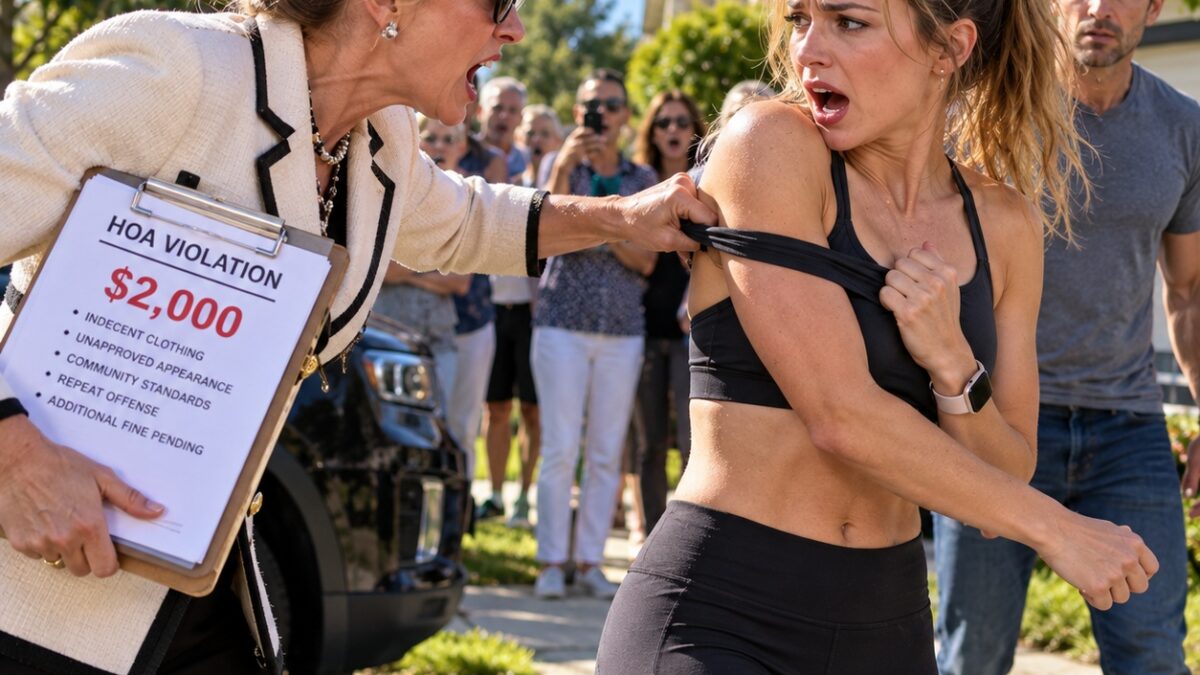
Brenda grabbed the fabric near Emily’s shoulder.
The whole street froze.
Emily shoved Brenda’s arm away and pushed her backward with both hands.
Not violently.
Not enough to knock her down.
Enough to get space.
Brenda stumbled one step.
Her face changed completely.
Humiliation hit her before balance returned.
“How dare you put your hands on me!”
“You grabbed me!”
“I am enforcing—”
“You grabbed my clothes!”
Brenda lunged forward.
This time there was no administrative fiction left.
She swung at Emily.
Wildly.
Emily moved sideways.
The first strike missed.
The second caught Emily high on the shoulder.
I started forward.
Emily shouted, “Stay back!”
I stopped.
Not because I did not want to help.
Because I understood what she was telling me.
There were cameras everywhere.
Brenda had initiated contact.
If I jumped into the middle of two women fighting, I could turn clear evidence into chaos.
Emily had trained for years at a kickboxing gym before we met.
She was not a professional fighter.
But she knew how to protect herself.
Brenda did not.
Brenda swung again.
Emily blocked her forearm.
“Stop.”
Brenda grabbed for her.
“Get away from me.”
Brenda kept coming.
Emily pushed her again.
Brenda’s shoe slipped off the curb.
She nearly went down.
Someone shouted, “Brenda, stop!”
That should have ended it.
It did not.
Rage had replaced judgment.
Brenda rushed her again.
Emily stepped back, redirected her arm, and struck once.
Clean.
Short.
Controlled.
Brenda dropped to the pavement.
The entire confrontation had probably lasted less than thirty seconds.
It felt like five minutes.
For two or three seconds, nobody moved.
Then Brenda screamed.
“She assaulted me!”
Emily immediately backed away.
Hands open.
Breathing hard.
“You attacked me.”
“Call the police!” Brenda yelled.
Someone answered from a porch.
“They’re already being called.”
Brenda sat on the street holding the side of her face.
Her mascara had begun streaking.
She pointed at Emily.
“I will have you arrested.”
Emily said nothing.
“You are finished in this community.”
Still nothing.
“I’ll have your house liened. I’ll have you banned from common property. I’ll—”
“Brenda,” Mr. Carson said from across the street.
She turned.
He was holding his phone.
“You should probably stop talking.”
She stared at him.
Another neighbor, Melissa, stepped off her porch.
“I recorded the whole thing.”
Brenda blinked.
“So did I,” someone else said.
Another voice:
“Me too.”
Something almost visible moved through the street.
For years, Brenda’s control had depended on isolated encounters.
A homeowner alone in an office.
A resident receiving a letter.
A quiet threat at the gate.
A closed board meeting.
One person’s word against hers.
This time, there were witnesses.
Not one.
Half a dozen.
Different angles.
Different phones.
The same facts.
Security arrived first.
Two guards from the neighborhood gate pulled up in a marked cart and looked instantly overwhelmed.
Brenda began shouting instructions before they even stepped out.
“Detain her!”
One guard stared at her.
“Ma’am, we don’t detain residents.”
“She assaulted the HOA president!”
Emily stood ten feet away.
“I want it documented that she grabbed my clothing and struck me first.”
Brenda laughed hysterically.
“That is a lie.”
Melissa held up her phone.
“No, it isn’t.”
Brenda turned toward her.
“You stay out of this.”
“I’m already in it.”
That may have been the moment Brenda began losing more than a fight.
Melissa had lived there eleven years.
She was quiet.
Never came to meetings unless there was a budget vote.
Never publicly criticized anyone.
When people like Melissa stop being afraid of you, power collapses quickly.
One guard asked whether anyone had video.
Six hands went up.
They watched the first recording there on the street.
I watched the guard’s expression as the clip played.
Brenda blocking Emily.
Emily trying to leave.
Brenda reaching.
Emily warning her.
Brenda grabbing the fabric.
The shove.
Brenda’s first swing.
The guard replayed it.
Then another angle.
Then another.
Brenda stood beside him talking constantly.
“You don’t understand the context.”
The guard did not answer.
“There were repeated violations.”
Still nothing.
“She has been hostile toward the association for months.”
The footage continued.
Each replay stripped away another layer of Brenda’s story.
There was no interpretation that made her reach disappear.
No “community standard” that made her first strike vanish.
No bylaws that changed the order of events.
Emily stood beside me.
I could feel tension running through her body.
“You okay?” I whispered.
“Yeah.”
“Shoulder?”
“Hurts.”
“Do you want to go inside?”
“No.”
Brenda looked at her.
That answer seemed to infuriate her all over again.
She wanted Emily shaken.
Crying.
Apologizing.
She wanted physical proof that intimidation had worked.
Instead, Emily stood upright.
Not smiling.
Not celebrating.
Just refusing to collapse.
The police arrived not long afterward.
By then, several neighbors had emailed videos directly to one officer.
Statements were taken.
Emily showed the red mark developing on her shoulder.
Brenda repeated that Emily had assaulted her.
The officer asked, “Did you touch her clothing?”
Brenda paused.
“I was attempting to enforce a legitimate association violation.”
“Did you physically grab her clothing?”
“That is a misleading characterization.”
The officer looked down at his notebook.
“It’s a yes-or-no question.”
Brenda’s voice changed.
“I made contact.”
“With her clothing?”
“Yes, but—”
“And did she tell you not to touch her before you did that?”
No answer.
The officer looked toward Emily.
Emily said, “Twice.”
Melissa said, “I heard it.”
Mr. Carson nodded.
“So did I.”
Brenda’s face flushed.
“This has become a mob.”
Nobody replied.
The officers did not put Emily in handcuffs.
They did not drag Brenda away either.
The immediate situation was documented.
Both women were separated.
Statements and video were collected.
Brenda was told not to approach Emily while the complaint was being reviewed.
That should have humiliated her into silence.
Instead, Brenda went home and declared war by email.
By five that evening, a message had gone to the board.
By six, another had gone to several residents.
By eight, Emily had received a notice accusing her of:
Physical assault.
Threatening an association officer.
Interfering with enforcement duties.
Defamation.
Creating an unsafe environment.
And violating what Brenda described as “standards of moral decency.”
I sat at the dining room table reading it.
Emily had an ice pack on her shoulder.
“She’s completely lost it.”
Emily looked exhausted.
“No.”
I glanced at her.
“What?”
“She hasn’t lost it.”
She moved the ice pack slightly.
“She thinks the same thing she’s always thought.”
“Which is?”
“That if she uses enough official-sounding words, everybody will get tired before she does.”
That was exactly right.
So we did not respond emotionally.
We made folders.
I created one for every fine.
One for emails.
One for meeting notices.
One for witness statements.
One for video.
Our friend Daniel, who practiced civil litigation, had been receiving copies of everything for weeks.
When I called him that night, he listened quietly.
Then he said, “Do not delete anything.”
“We’re not.”
“Do not edit video.”
“We won’t.”
“Do not post clips online.”
Emily looked at me.
“We weren’t planning to.”
“Good. And do not argue with her by email.”
“What should we say?”
“Very little.”
The response he drafted was four paragraphs.
Emily denied violating any valid dress provision.
She disputed all fines.
She documented Brenda’s physical contact.
She reserved all rights.
And she requested that every future communication concerning the matter come in writing.
Brenda hated it.
We knew because her next message was six pages long.
She attached screenshots of bylaws.
None contained a dress code.
She cited broad language about maintaining “community character.”
Daniel laughed when he read it.
“She’s trying to turn landscaping language into clothing authority.”
The larger problem for Brenda was that neighbors had started talking to each other.
That had rarely happened before.
Melissa called.
Then Mr. Carson.
Then a retired teacher named Helen who lived near the clubhouse.
She told us Brenda had once fined her because a visiting granddaughter parked overnight without a dashboard permit.
Another man said Brenda had threatened a lien over a basketball hoop even though older board minutes showed similar hoops had been allowed.
A young couple had received three fines after questioning a landscaping contract at a meeting.
One resident showed us emails where Brenda wrote, “Cooperation now will avoid stronger enforcement later.”
The stories were different.
The structure was identical.
Find a weak or vague rule.
Expand it.
Create urgency.
Escalate consequences.
Make resistance cost more emotionally than surrender.
For years, people had treated their experience as isolated.
Now those experiences were being compared.
Brenda’s greatest mistake was not attacking Emily.
It was forcing everyone else to ask whether Brenda had done something similar to them.
The hearing was scheduled quickly.
Officially, it was supposed to address the physical confrontation, the disputed fines, and Brenda’s complaint against Emily.
Unofficially, it became a referendum on Brenda.
The meeting room filled before we arrived.
I had never seen that many people at an HOA hearing.
Usually residents skipped anything that did not involve dues or pool hours.
That evening there were people standing along the back wall.
Emily wore dark slacks and a simple blouse.
Nothing dramatic.
She did not want to give Brenda any opportunity to make clothing part of the performance again.
I noticed that.
It made me angry.
Even after everything, Emily was still adjusting herself because she knew how aggressively another person might interpret her body.
I touched her hand.
“You don’t have to prove anything to her.”
“I know.”
“You sure?”
She nodded.
“I’m not dressing for Brenda.”
Then she gave me a tired smile.
“I’m dressing for the mediator.”
Fair enough.
Brenda arrived fifteen minutes later.
She was dressed as though she were walking into a press conference.
Dark suit.
Pearls.
Hair perfect.
A thick binder under one arm.
Two board allies followed her.
The room went quiet.
Months earlier, that silence would have looked like respect.
Now it felt different.
People were watching.
Brenda sensed it too.
She sat.
Opened the binder.
Arranged three pens parallel to one another.
Then looked toward Emily.
No smile.
The mediator was a retired attorney the association’s outside counsel had recommended once the situation became too serious for the board to manage internally.
He began by reminding everyone that the hearing would focus on evidence.
Not reputation.
Not rumor.
Not “community sentiment.”
Evidence.
I watched Brenda’s jaw tighten.
She spoke first.
For almost twenty minutes.
She described an escalating campaign against HOA authority.
She said Emily repeatedly violated standards.
She said we had refused “good-faith corrective opportunities.”
She described the confrontation as an unprovoked assault on an elected officer.
Then she made the mistake Daniel had predicted.
She talked too much.
Brenda was good at controlling short exchanges.
A doorway.
A meeting comment.
A violation notice.
A ten-minute phone call.
Give her twenty uninterrupted minutes and she started believing her own improvisation.
She said Emily had approached her.
One board member glanced down.
Brenda said she had never touched Emily before being shoved.
A murmur moved through the room.
She said the running outfit violated a written restriction.
The mediator interrupted.
“Please identify the section.”
Brenda flipped through the binder.
“Article Eight grants the association authority to preserve standards.”
“Does Article Eight mention clothing?”
“It establishes broad enforcement discretion.”
“That wasn’t my question.”
The room became very still.
I thought about the street.
The police officer.
Yes or no.
People like Brenda thrive in ambiguity until somebody insists on precision.
The mediator repeated himself.
“Does Article Eight prohibit the clothing Mrs. — was wearing?”
Brenda looked irritated.
“Not in those exact words.”
“Is there another provision?”
“The governing documents cannot anticipate every form of inappropriate conduct.”
“So no.”
“I would not characterize it that way.”
He wrote something down.
The first video played.
Melissa’s angle.
There was Emily jogging toward the mailboxes.
There was Brenda leaving her SUV.
Blocking the path.
Pointing.
Emily trying to go around.
Brenda moving again.
The room watched silently.
Then the audio became clear.
Move.
I’m speaking to you as president of this association.
And I’m telling you to leave me alone.
Brenda shifted in her chair.
Then her voice on the recording:
We have confiscation authority for prohibited material.
Someone in the back actually whispered, “What?”
The mediator paused.
He looked at Brenda.
“What did you mean by confiscation authority?”
Brenda swallowed.
“It refers to unauthorized items in common areas.”
“Was Mrs. — on common property?”
“She was within the association.”
“That is not the same thing.”
“She was violating standards.”
“Was her clothing association property?”
Brenda’s face reddened.
“No.”
“Then what exactly did you believe you had authority to confiscate?”
She stared at him.
The answer was obvious.
Nothing.
He resumed the video.
Don’t touch me.
Brenda reached.
Do not touch me.
Her hand closed on the fabric.
Emily shoved it away.
The room reacted quietly.
Then came Brenda’s first swing.
The video stopped.
Brenda immediately spoke.
“That footage does not show the months of provocation leading to that moment.”
The mediator looked at her.
“Did any previous dispute authorize you to grab another resident’s clothing?”
“No, but—”
“Did any previous dispute authorize you to strike her?”
“I reacted after she pushed me.”
“You made physical contact with her clothing first.”
“I was performing an enforcement function.”
“What rule allows physical enforcement of clothing restrictions?”
Again, silence.
Brenda looked toward the board.
The people she expected to rescue her suddenly found their papers fascinating.
A second angle played.
Then a third.
One clip showed Emily backing away.
One clearly showed Brenda closing distance again.
Another captured the final seconds when Brenda lunged and Emily struck once.
Brenda had spent days calling it a beating.
The videos showed something far less dramatic.
Brief.
Controlled.
Defensive.
The mediator paused again.
Emily was asked to speak.
She took less than four minutes.
That may have hurt Brenda more than any long argument could have.
Emily did not call her a tyrant.
Did not call her crazy.
Did not list every petty fine.
She said:
“I was repeatedly fined under a dress rule I could not locate in the governing documents. I asked for the rule several times. I did not receive one.”
She paused.
“On Friday morning, Ms. Brenda blocked my path while I was exercising. I told her I was leaving. She prevented me from leaving. I told her twice not to touch me.”
Another pause.
“She grabbed my clothing anyway.”
Emily looked at the mediator.
“I moved her away from me. She struck at me. I defended myself until she stopped advancing. Then I stopped.”
That was it.
Facts.
Sequence.
No performance.
The contrast was devastating.
Daniel presented copies of the fines.
The first $2,000 penalty.
Then the additional fines.
The language changed slightly each time.
“Indecent appearance.”
“Moral disruption.”
“Repeated public exposure.”
No section citation.
No adopted clothing policy.
No board vote establishing one.
Nothing.
Then he produced minutes from the meeting where I asked Brenda for the written rule.
A resident had recorded that too.
My voice:
What written rule are you referring to?
Brenda:
Leadership requires flexibility.
The mediator read the transcript twice.
Daniel said, “That appears to acknowledge no specific written rule existed at the time enforcement began.”
Brenda interrupted.
“That is not what I meant.”
Daniel looked toward the mediator.
“I’m happy to let the statement speak for itself.”
The mediator nodded.
For once, Brenda had to sit quietly while her own words remained in the room without her being allowed to redefine them.
Then came the emails.
Patrol references.
Threats.
Her claim that nonpayment could lead to liens.
Her instruction that security watch our address for repeated dress violations.
The room changed as those documents appeared.
Even people who had disliked Brenda did not seem prepared for the amount of attention she had directed toward Emily.
It was no longer possible to call it ordinary HOA administration.
It was fixation.
One email had been sent at 5:47 a.m.
Brenda wrote:
Resident has again exited property in noncompliant attire. Document repeat offense.
Emily looked at me.
We had never seen that message before.
It had come from discovery of board communications.
Five forty-seven in the morning.
Brenda had been monitoring our house before dawn.
Another email asked security to report when Emily returned from runs.
Another suggested documenting visitors.
One board member had replied:
Is this necessary?
Brenda answered:
Noncompliance spreads when tolerated.
I felt something ugly rise in my chest.
Emily put her hand over mine beneath the table.
That gesture stopped me from saying anything.
She did not need my anger.
She needed me steady.
The mediator questioned board members one at a time.
Had there been a formal vote approving a dress code?
No.
Had the board authorized $2,000 clothing fines?
No.
Had any legal opinion confirmed the HOA could regulate sports bras or leggings?
No.
Had anyone authorized Brenda to physically seize clothing?
Absolutely not.
At that answer, Brenda snapped.
“That is a distortion. Nobody seized anything.”
Melissa spoke from the gallery before she could stop herself.
“We watched you do it.”
The mediator raised a hand.
“Please.”
Melissa sat.
Brenda turned around.
Her eyes moved across the room.
Years of memory seemed to pass through that look.
People she had fined.
Corrected.
Warned.
Embarrassed.
Silenced.
Now they were not looking down.
That was the real collapse.
Not the eventual ruling.
That moment.
Fear had changed direction.
For years, neighbors had worried about what Brenda would do if they crossed her.
Now Brenda was looking at a room full of people and wondering what they might say.
The mediator recessed for twenty minutes.
Nobody left.
Brenda remained at the table with two board members.
One whispered something.
She shook her head sharply.
Another stood and moved three seats away.
When the hearing resumed, the findings were read slowly.
The clothing fines had no valid basis under the governing documents.
They were void.
All of them.
The HOA was instructed to remove any related enforcement history from our account.
The physical incident did not support Brenda’s description of an unprovoked assault.
Video and witness evidence showed that she initiated unwanted physical contact and continued advancing after being told to stop.
Her complaint against Emily was dismissed.
The mediator also found that Brenda’s conduct constituted harassment, abuse of HOA authority, and physical misconduct inconsistent with her position.
The association was advised to compensate Emily for documented costs and damages arising from the improper enforcement campaign.
Brenda was ordered, under the resolution adopted with outside counsel, to attend anger-management counseling.
And pending full ethics review, she was required to step aside from all enforcement duties.
Someone gasped.
Brenda did not move for several seconds.
Then she stood.
“This is a conspiracy.”
Nobody answered.
“You’ve allowed a handful of hostile residents to hijack this association.”
The mediator said, “Ms. Brenda, please sit down.”
“No.”
Her chair scraped backward.
“You people have no idea what I have done to protect this neighborhood.”
A board member said quietly, “Brenda.”
She spun toward him.
“You don’t get to abandon me now.”
He looked exhausted.
“This isn’t helping.”
That sentence landed harder than if he had shouted.
Brenda looked around the room one final time.
The authority she expected to find in people’s faces was gone.
Nobody was laughing.
Nobody celebrated.
Nobody needed to.
She grabbed her binder.
One of her pens fell to the floor.
She left it there.
Her heels struck the hallway tile fast and uneven.
The front door slammed.
For several seconds, nobody spoke.
Then the mediator continued reading procedural recommendations as though the president of the HOA had not just stormed out.
That almost made the moment more final.
Institutions survive people who believe they are the institution.
Brenda had forgotten that.
The ethics review took several weeks.
By then, the outcome was obvious.
Additional residents submitted statements.
Some were minor.
Unnecessary fines.
Hostile emails.
Selective enforcement.
Others were more serious.
Threats involving liens that had never been legally authorized.
Security instructions outside ordinary policy.
Attempts to pressure board members into approving actions retroactively.
The board finally requested Brenda’s resignation.
She fought it for several days.
Then submitted a short letter claiming she was stepping aside to protect her family from “a hostile political environment.”
She never apologized to Emily.
Not privately.
Not publicly.
The HOA did.
The new acting president sent a letter to every household.
It acknowledged that enforcement practices had become inconsistent.
It announced review of all discretionary fines from the previous two years.
It promised that no rule would be enforced unless residents could actually identify the written rule.
That sentence alone changed the neighborhood.
Meetings became different.
People raised their hands.
Asked questions.
Requested citations.
When someone proposed a new restriction, another resident would ask:
“Where is it written?”
And nobody acted offended.
Imagine that.
Emily returned to running three mornings after the hearing.
I woke when she was tying her shoes.
“You want me to come with you?”
She looked up.
“No.”
“You sure?”
“Yes.”
I knew what she meant.
If I came, part of Brenda’s damage would remain.
Emily would be running with protection because another woman had tried to frighten her out of her own neighborhood.
So I stayed home.
That did not mean I was relaxed.
I stood behind the living room curtain like the least subtle spy in America.
Emily came down the driveway.
Same leggings.
Same sports bra.
Same headphones.
For one moment, I wondered whether neighbors would stare.
Then Mr. Carson stepped outside carrying his coffee.
“Morning, Emily.”
She slowed.
“Morning.”
Melissa was walking her dog farther down.
She lifted a hand.
Another neighbor called, “Have a good run.”
Emily smiled.
Then kept going.
Nothing dramatic happened.
That was perfect.
She ran the full route.
Came home sweaty.
Opened the front door.
I was standing in the kitchen pretending not to have spent forty minutes checking the street every ninety seconds.
She looked at me.
“You watched the whole time, didn’t you?”
“No.”
She stared.
“Maybe.”
She laughed.
It was the first relaxed laugh I had heard from her in weeks.
I had not realized how much I missed it.
Later that month, we received the settlement paperwork.
The improper fines were formally erased.
The association covered part of our legal expenses.
Emily received compensation tied to the harassment and physical incident.
I will not pretend money made any of it pleasant.
It did not.
But consequences matter.
For months, Brenda had made every interaction expensive for us.
Time.
Stress.
Legal advice.
Sleep.
The settlement forced the institution that enabled her to absorb some of the cost instead of leaving it all with the person targeted.
More important, policy changed.
Discretionary fines now required a written covenant citation.
Large penalties required board review.
Security could not be used for personal monitoring.
Complaints against residents had to be documented through a standardized process.
Physical “enforcement” was explicitly prohibited, which was a sentence I still cannot believe an HOA had to put in writing.
The gate procedures changed too.
Residents could preregister regular guests.
Guards no longer had to call Brenda—or any individual board officer—for informal approval.
Emily noticed that one immediately.
The first time one of her friends drove through after the changes, the guard waved her in within thirty seconds.
Emily looked at me.
“All those times she made me wait…”
“I know.”
“She could have let me through.”
“I know.”
That realization hurt her more than she expected.
Before, there had always been a tiny possibility that Brenda really was obsessive about security.
Maybe she treated everybody badly.
Maybe protocol actually was complicated.
Once the policy changed, the truth became obvious.
Brenda had used the gate to remind Emily that she was an outsider.
That was the thread connecting everything.
The trash cans were never about trash.
The grass was never about grass.
The wreath was never about seasonal aesthetics.
The sports bra was never about morality.
It was about who got to define belonging.
Brenda believed people belonged when they accepted her authority.
Emily never did.
Not aggressively.
That was what made it worse.
She remained polite.
Calm.
Independent.
She did not fear Brenda enough.
People like Brenda can tolerate anger better than indifference.
If you scream, they can call you unstable.
If you threaten, they can call security.
If you insult them, they can become the victim.
But if you calmly ask, “Show me the rule,” they have nowhere to go except the rule.
And when the rule does not exist, all that remains is them.
Months passed.
The neighborhood settled into something I had not realized it could be.
Normal.
Kids rode bicycles.
People argued over pool hours instead of existential moral collapse.
Board meetings became boring.
That is the highest compliment I can give an HOA meeting.
Boring is healthy.
One evening, I ran into one of Brenda’s former supporters near the mailbox cluster.
His name was Tom.
He had spent years seconding her motions.
He looked uncomfortable.
“Can I ask you something?”
“Sure.”
“Do you hate her?”
The question surprised me.
“No.”
He studied me.
“Really?”
“I don’t want anything to do with her.”
“That sounds different.”
“It is.”
I put my mail under one arm.
“Hating her would mean she still gets a lot of space in my day.”
He nodded.
“She did a lot of damage.”
“Yes.”
“I should’ve said something earlier.”
I could tell he had been carrying that.
I could have made him feel worse.
Part of me wanted to.
Instead I said, “Why didn’t you?”
He stared across the street.
“Because it wasn’t me.”
That answer was ugly.
It was also honest.
He continued.
“Every time somebody complained, I thought, well, maybe there’s more to it. Maybe they really did violate something.”
He gave a bitter smile.
“Then when she went after Emily, it was so obviously personal that I started looking back.”
“That’s what everybody did.”
“Yeah.”
He sighed.
“I’m not proud of it.”
I believed him.
The problem with small abuses of power is that each one looks survivable from the outside.
A $50 fine.
A nasty email.
A delay at the gate.
A ridiculous warning.
Nobody wants to start a war over something small.
So the person targeted handles it privately.
Then the next person does the same.
Power grows in the space between isolated experiences.
Brenda’s collapse happened because she finally committed an abuse too public to isolate.
She grabbed Emily in the street.
In daylight.
With witnesses.
Suddenly everyone could compare what they saw to what Brenda said.
The gap was enormous.
That was why the videos mattered.
Not because cameras are magical.
Because they removed Brenda’s favorite weapon.
Narrative.
Before that Friday, Brenda could always tell the story first.
She was the president.
Her email arrived before yours.
Her violation letter created the official record.
Her version entered meeting minutes.
Her tone sounded calm.
Professional.
Concerned.
By the time you defended yourself, you already looked defensive.
Video changed the order.
People saw the event before Brenda could rename it.
They saw her block Emily.
They heard the warnings.
They watched her reach.
They watched her strike first.
No amount of “community standards” could reverse time.
About six months later, Emily and I attended the annual election meeting.
We almost skipped it.
Then Emily said, “No. I want to vote.”
So we went.
The room was fuller than usual.
Brenda was not there.
Her name appeared nowhere on the ballot.
Pearl-white binders had been replaced by simple printed packets containing each candidate’s statement, budget priorities, and proposed changes.
One candidate said something that made half the room laugh.
“I promise never to regulate athletic wear.”
Emily covered her face.
“Oh my God.”
I leaned toward her.
“You’re a policy category now.”
“Wonderful.”
People laughed with her.
Not at her.
That distinction mattered.
After the election, Melissa came over.
“Can I tell you something?”
Emily nodded.
“My daughter started running again.”
Emily looked surprised.
“What?”
“She stopped last year.”
“Why?”
Melissa glanced toward me.
Then back.
“She was afraid Brenda would say something about her clothes.”
Emily’s face fell.
Melissa continued quickly.
“She’s seventeen. It wasn’t only Brenda. Teenagers are self-conscious anyway. But after Brenda made comments at the pool about girls needing to dress ‘with family values,’ my daughter started wearing huge shirts.”
Emily stared at her.
“I didn’t know that.”
“Neither did I at first.”
Melissa smiled sadly.
“She saw you running the week after the hearing.”
Emily swallowed.
“And?”
“She asked if you thought anyone would care if she wore shorts and a sports bra.”
“What did you tell her?”
“I told her the neighborhood doesn’t get to vote on her body.”
Emily’s eyes filled immediately.
She looked away.
That conversation affected her more deeply than the settlement had.
Later that night, she sat on our bed folding laundry.
“You okay?”
“Yeah.”
“You don’t look okay.”
She held one of her running shirts in both hands.
“I kept thinking this whole thing was stupid.”
“It was.”
“No, I mean…”
She searched for the words.
“I felt guilty because there are real problems in the world. And I’m sitting there with a lawyer because some suburban dictator hates my sports bra.”
I sat beside her.
“That wasn’t the problem.”
“I know that now.”
She looked at me.
“It was the idea that she had the right to decide whether I should be ashamed.”
That was it.
Brenda’s fines hurt.
The stalking frightened us.
The physical confrontation crossed a line.
But the deepest insult was the demand that Emily accept somebody else’s shame.
Cover yourself.
Lower your eyes.
Accept the fine.
Apologize for being difficult.
Let authority reinterpret your body.
Emily refused.
Not loudly.
Not theatrically.
She simply refused to agree that Brenda had the right.
That refusal exposed everything else.
I saw Brenda occasionally after that.
At the grocery store.
Once at a traffic light.
Twice at the entrance to the neighborhood.
We never spoke.
The first time Emily encountered her alone was nearly a year later.
Emily came home from a run and walked into the kitchen.
I noticed immediately that something had happened.
“What?”
“I saw Brenda.”
My stomach tightened.
“Where?”
“Near the east gate.”
“Did she say anything?”
“No.”
“What did you do?”
“Nothing.”
Emily opened the refrigerator.
“I ran past her.”
“That’s it?”
“That’s it.”
She took out water.
Then smiled.
“She moved out of my way.”
There are victories that look like applause.
That one looked like a woman stepping aside on a sidewalk.
Brenda eventually sold her house.
At least that was what we heard.
Nobody threw a party.
Nobody needed to.
Her name remained in old board minutes and probably always will.
For a while, neighbors used “Brenda” almost like a verb.
Someone would propose a ridiculous parking restriction and another person would say, “We’re not Brenda-ing this, right?”
Eventually even that stopped.
People moved on.
That is what accountability is supposed to allow.
Not permanent revenge.
Correction.
Boundaries.
Then ordinary life.
Emily still runs.
Most mornings before work.
Sometimes I join her.
Usually I do not because she is much faster than I am and I have enough humility to admit it.
She owns more running clothes now than she did before the whole mess.
Not as a statement.
Because she likes running clothes.
That may be the ending I appreciate most.
Brenda tried to turn Emily’s clothing into a symbol.
Emily refused to let it remain one.
A sports bra became a sports bra again.
Leggings became leggings.
A morning run became a morning run.
Normalcy reclaimed the thing someone else tried to poison.
People occasionally ask whether Emily regretted hitting Brenda.
The question irritates her.
Not because she is proud of it.
She is not.
She wishes Brenda had never touched her.
She wishes the entire confrontation had never happened.
But regret implies she had another safe option in that second.
Brenda grabbed her after being warned.
Then swung.
Emily defended herself.
Then stopped when the threat stopped.
That distinction was visible in every recording.
And it mattered.
What Emily does regret is how long we both believed patience alone would fix Brenda.
For months, we assumed reasonable behavior would eventually embarrass unreasonable behavior into stopping.
Sometimes it does.
Sometimes unreasonable people interpret patience as available territory.
That does not mean you become aggressive.
It means you document sooner.
Ask for the rule.
Request decisions in writing.
Save emails.
Know the difference between authority someone actually possesses and authority they claim in a confident voice.
Brenda relied heavily on people not checking.
She counted on neighbors assuming that if a letter had an HOA logo, somebody must have verified the power behind it.
She counted on people paying $50 rather than spending three hours researching whether they owed it.
She counted on embarrassment keeping residents quiet.
She counted on each target believing they were alone.
The day those assumptions failed, her power vanished incredibly fast.
That still amazes me.
For years, Brenda seemed untouchable.
Then residents compared emails.
Shared recordings.
Opened governing documents.
Asked questions out loud.
Within weeks, the person who had seemed to control everything could not even control the story of what she had done.
Justice did not arrive dramatically.
There was no movie speech.
No judge pounding a gavel while Brenda collapsed.
It came through timestamps.
Email chains.
Meeting minutes.
Video files.
Witnesses.
Rules read exactly as written.
That may sound boring.
I learned to love boring evidence.
Anger can be dismissed.
Memory can be challenged.
A calm person can still be called emotional by someone determined enough.
But a video showing a hand grabbing fabric is difficult to lecture into becoming something else.
A timestamp does not care who holds office.
Neither does a sentence in a bylaw.
Neither does a recording.
The last major change the association made was one Emily suggested.
Every violation notice now has to include the exact section number of the governing documents allegedly violated.
If they cannot cite a section, they cannot issue the fine.
Simple.
Obvious.
Almost embarrassing that it had to be adopted.
At the meeting where the policy passed, Emily said only one thing.
“People should not have to guess what rule they’re accused of breaking.”
Unanimous vote.
Even Tom raised his hand.
We walked home afterward.
The air was warm.
Sprinklers clicked across lawns.
A teenager rode past on a bicycle.
Emily looked at me.
“That’s all I wanted.”
“What?”
“To not have to argue that reality is real.”
I understood.
Brenda made every dispute exhausting because she forced people to defend obvious boundaries.
No, you cannot invent a clothing rule.
No, you cannot fine someone thousands of dollars without authority.
No, you cannot follow a resident and call it enforcement.
No, you cannot grab another woman’s clothing because she will not obey you.
Those things should not require courage to say.
In our neighborhood, for a while, they did.
Not anymore.
Sometimes I think back to the first afternoon Emily waited at the gate.
I remember driving down angry.
I remember telling her to stay calm.
“Once we’re married, Brenda can’t treat you like an outsider.”
I had imagined marriage would change Emily’s status in Brenda’s eyes.
I misunderstood the problem.
Brenda did not dislike outsiders.
She disliked people she could not subordinate.
Marriage did not protect Emily because legal residency was never the issue.
Control was.
When I finally understood that, a lot of small moments made sense.
The cold looks.
The selective notices.
The way Brenda’s smile disappeared whenever Emily questioned her.
The obsession with “respect.”
People who demand respect constantly often mean obedience.
Real respect can survive disagreement.
Brenda’s version could not.
Emily disagreed.
Calmly.
Repeatedly.
And Brenda escalated until escalation finally revealed her.
The strangest part is that she did not have to lose everything.
At almost any point, she could have stopped.
She could have withdrawn the first fine.
She could have admitted there was no dress rule.
She could have apologized for the gate delays.
She could have walked away from Emily that Friday morning.
She could have kept her hands to herself.
She could have watched the first video, realized how bad it looked, and said:
“I was wrong.”
Two words.
Everything might have ended differently.
But power had become too connected to her identity.
To admit one mistake would mean accepting that residents could question her.
If residents could question her, they could ask what else she had done.
So she doubled down.
Then doubled down again.
Until defending her authority required her to deny things everyone had watched happen.
That is why I do not think Emily defeated Brenda.
Brenda defeated Brenda.
Emily was simply the first person she targeted who kept enough evidence while refusing to bow.
A few weeks ago, I stood outside early in the morning with a coffee.
Emily was stretching near the driveway.
Same place as that Friday.
A woman who had moved into the neighborhood recently jogged past with a stroller.
She waved.
Emily waved back.
Two teenagers ran behind her wearing shorts and sports bras, laughing about something on one of their phones.
Nobody came outside holding a clipboard.
Nobody took photographs.
Nobody sent a violation email.
Nobody declared civilization endangered.
The sun came up.
People went to work.
Dogs barked.
Trash trucks came through.
Ordinary suburban life continued without someone appointed to monitor women’s bodies.
I watched Emily start her run.
She put in her earbuds.
Then turned back.
“What?”
I said, “Nothing.”
“You’re staring.”
“I know.”
She narrowed her eyes.
“You’re being weird.”
“Probably.”
She laughed.
Then ran off.
I stood there another minute.
Watching accountability replace fear never felt like revenge.
It felt like space returning to places where fear had been taking up too much room.
That was all we had wanted from the beginning.
A home where a trash can was just a trash can.
Grass was just grass.
A wreath was just a wreath.
And my wife could walk outside in running clothes without another adult deciding she had the right to shame, fine, follow, threaten, or touch her.
Brenda once believed the HOA presidency made her untouchable.
What she eventually learned—whether she accepted it or not—was simpler.
Authority has limits.
Paper titles have limits.
Neighborhood fear has limits.
And the moment she put her hands on Emily, in front of residents who were finally willing to record instead of look away, every imaginary power she had built started collapsing under the weight of actual evidence.
Emily never needed Brenda to approve of her.
She only needed Brenda to leave her alone.
In the end, the entire neighborhood finally understood the difference.








