𝗙𝗨𝗟𝗟 𝗦𝗧𝗢𝗥𝗬:The HOA President Crowned Herself Queen of My Backyard and Dared Me to Stop Her
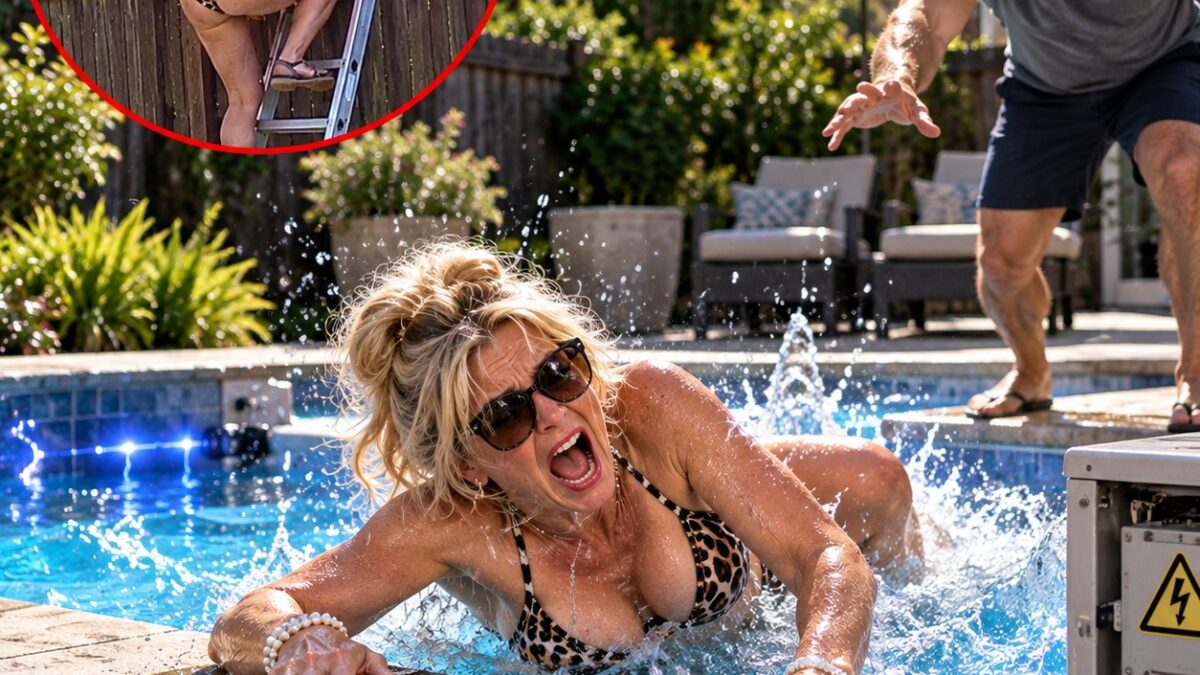
PART 2 and FULL ENDING  Thank you

I watched the footage twice because the first time my brain refused to accept what my eyes were showing me.
The timestamp read 1:14 p.m.
I had left for work at 7:20 that morning.
At 1:12, Beatrice appeared in the camera angle covering the west side of my fence.
She was wearing an enormous sun hat, sunglasses, and a loose white cover-up.
She disappeared for a few seconds.
Then the top of a folding ladder rose above the fence.
Beatrice climbed up.
Straddled the top.
Looked around.
Then dropped down into my yard.
I actually paused the recording.
There are moments when anger arrives so quickly that your body feels colder instead of hotter.
That was one of them.
I sat at my kitchen table staring at the frozen image of our HOA president halfway over my fence.
Not confused about whose yard she was entering.
Not lost.
Not chasing a dog.
Not responding to an emergency.
Trespassing.
Deliberately.
She walked directly to the pool.
Took off the cover-up.
Set her thermos on my patio table.
Then got into the water.
She swam for almost forty minutes.
Forty minutes.
She floated on her back.
Did slow laps.
Drank from the thermos.
At one point she rested both elbows on the side of my pool and looked toward my house with the relaxed expression of a person staying at a resort.
Then she climbed out.
Dried herself with a towel she had brought.
Put the cover-up back on.
And climbed over the fence the same way she came.
I sat there for several minutes after the video ended.
Then I called Samantha.
Not because she had anything to do with it.
Because I wanted to know whether I had somehow missed some bizarre HOA rule everyone else understood.
“Can I ask you a weird question?”
She laughed.
“That sounds promising.”
“Has anybody ever told you my pool is considered community property?”
Silence.
“What?”
“Beatrice said it at the meeting.”
“Daniel, I thought she was just being Beatrice.”
“So did I.”
“What happened?”
I hesitated.
“I caught her swimming in it today.”
Another silence.
Then Samantha said, very carefully, “You mean she asked?”
“No.”
“She just went into your backyard?”
“Climbed the fence.”
“Oh my God.”
“Yeah.”
“You need to call someone.”
“I’m going to talk to her first.”
Samantha groaned.
“Why?”
“Because maybe embarrassment will be enough.”
“You are giving Beatrice way too much credit.”
She was right.
I still tried.
The next morning, before work, I installed large signs on the inside and outside of the fence.
PRIVATE PROPERTY.
NO TRESPASSING.
POOL FOR RESIDENT USE ONLY.
There was no way to misunderstand them.
I also emailed Beatrice.
Short.
Polite.
Direct.
Beatrice,
My security system recorded you entering my fenced backyard yesterday and using my swimming pool without permission.
You do not have permission to enter my property or use the pool.
Please do not do so again.
Daniel.
I stared at the message for almost a minute before hitting send.
Part of me expected outrage.
Part expected denial.
What I did not expect was nothing.
She did not respond at all.
That evening, I checked the camera.
At 12:46 p.m., Beatrice appeared.
She stood beside the NO TRESPASSING sign.
Read it.
Then looked directly toward the security camera.
She smiled.
Climbed the fence.
And went swimming.
That smile changed everything.
The first incident could have been explained by entitlement so extreme she honestly believed she had permission.
The second was different.
Now she knew.
I had told her explicitly.
The sign told her explicitly.
The fence itself had always told her.
And she did it anyway.
Not in spite of the warning.
Because of it.
I saved the footage.
The following day she returned.
Then again Friday.
The routine became almost absurd.
I left for work.
Within a few hours, Beatrice climbed over the fence.
Sometimes she swam twenty minutes.
Sometimes nearly an hour.
Once she brought a magazine.
Another time she brought a floating drink holder.
She was turning trespassing into ritual.
I kept saving the videos.
Every file went into a folder on my computer.
Date.
Time.
Length.
Screenshot.
I printed my email warning her.
I photographed the signs.
By the end of the week, I had enough evidence to prove something I still could not explain.
The woman who chaired meetings about grass being half an inch too high apparently believed property rules stopped applying when she wanted to swim.
Saturday morning, I went to her house.
Beatrice answered wearing gardening gloves.
Her expression changed the second she saw me.
Not surprise.
Annoyance.
“Daniel.”
“We need to talk about the pool.”
She pulled one glove off finger by finger.
“I assumed that was coming.”
“You keep entering my yard.”
“I use the pool.”
“You trespass into my yard.”
Her mouth curved slightly.
“I wouldn’t use such dramatic language.”
“It’s accurate language.”
“Daniel, we already discussed this.”
“No, you announced that my private pool was community property. That didn’t make it true.”
She folded her arms.
“I am president of the association.”
“I know.”
“The neighborhood has broad common-use expectations.”
“My pool is not a common area.”
“We could debate that.”
“No, actually, we can’t.”
She stared at me.
I continued.
“My lot is individually titled property. The pool is inside my fence. I paid for it. I maintain it. I insure it.”
“You are being selfish.”
I laughed once.
“About my backyard?”
“You bought in an HOA community.”
“And?”
“You benefit from collective property values.”
“I pay my dues.”
“You benefit from standards everyone supports.”
“I follow the written covenants.”
She stepped closer.
“That kind of technical attitude is exactly the problem.”
“Technical?”
“You think if a sentence isn’t written word for word somewhere, basic community obligations disappear.”
“This isn’t a philosophical question, Beatrice. Stop entering my yard.”
Her expression hardened.
“Take it up with the board.”
“You are the board president.”
“And you’ll lose.”
There was something about the confidence in her voice that finally convinced me talking was pointless.
She was not arguing facts.
She was testing power.
Would I back down because she said board?
Would I worry about fines?
Would I worry about being labeled difficult?
Would I decide a few unauthorized swims were easier to tolerate than conflict?
For years, Beatrice had apparently trained people to calculate that surrender was cheaper.
I looked at her.
“All right.”
Her eyebrows lifted.
She thought I had given up.
I smiled.
“Have a good weekend.”
Then I walked home.
That afternoon, I called an attorney.
His name was Mark Ellis.
He had handled my home closing years earlier and worked primarily in real estate and civil liability.
I explained everything.
There was a long pause after I finished.
Then he said, “Before you do anything clever, don’t.”
“I wasn’t planning anything.”
“You called me on a Saturday afternoon. You’re planning something.”
I laughed.
“Maybe.”
“Do you have video?”
“A lot.”
“Written notice?”
“Yes.”
“Signs?”
“Yes.”
“Good. Preserve all of it.”
“What about the HOA?”
“Ask them in writing to identify any covenant giving them access.”
“I know there isn’t one.”
“I believe you. Ask anyway.”
So I did.
Sunday evening, I emailed the entire HOA board.
I described the trespassing.
I attached one still photograph showing Beatrice crossing my fence.
I requested any governing document the association believed authorized entry onto my fenced residential lot or recreational use of my private swimming pool.
I copied Mark.
Monday morning, the board secretary responded.
Not Beatrice.
A man named Harold Greene.
His email contained one sentence.
Daniel, I am not aware of any provision authorizing such use and will review.
Twenty minutes later, Beatrice replied to everyone.
This matter is being blown unnecessarily out of proportion and can be resolved neighbor-to-neighbor without legal theatrics.
I almost admired the nerve.
She had told me to take it up with the board.
I took it up with the board.
Now doing exactly what she demanded was “legal theatrics.”
Harold replied again.
Beatrice, were you on Daniel’s property?
No response.
By evening, two other board members had privately asked me for video.
Something shifted.
Beatrice did not swim Tuesday.
Or Wednesday.
I thought maybe that was the end.
Thursday afternoon, the camera alert appeared on my phone while I was at work.
Motion: Backyard West.
I opened the feed.
Beatrice was climbing the fence.
I stared at my phone.
Then looked toward the maintenance shop floor where three technicians were rebuilding a large pump assembly.
One of them, Mike, noticed my face.
“Everything good?”
“My neighbor’s in my pool.”
He laughed.
“Lucky neighbor.”
“She climbed the fence.”
He stopped laughing.
“Again?”
I had apparently complained about this more than I realized.
“Again.”
“Call the cops.”
That would have been the sensible option.
I knew that.
But I also knew how Beatrice operated.
If a police officer knocked on her door after she was already home, she would turn the event into a misunderstanding.
Confusion about rules.
Neighbor dispute.
An unfortunate breakdown in communication.
I wanted something undeniable.
Not dangerous.
Not violent.
Just undeniable.
So instead of trying to trap or hurt her, I arranged something much simpler.
Mark approved it after making me promise twice that I would not improvise anything involving electricity, chemicals, locking gates, or anything else capable of causing injury.
“Your goal,” he said, “is evidence. Not revenge.”
“I know.”
“No, you want revenge.”
“Maybe a little.”
“Evidence first.”
He helped me think through a safer plan.
I already had cameras.
I added another one covering the fence from a second angle.
I installed a loud pool-access alarm designed to activate when the protected zone was entered unexpectedly.
I also connected a harmless motion-triggered sprinkler near the ladder and deck area.
Cold water.
Noise.
Nothing more.
The point was not to hurt Beatrice.
The point was to make it impossible for her to pretend she had wandered into the yard accidentally.
Then I changed my schedule.
Tuesday morning, I left the house at my normal time.
Beatrice’s kitchen window faced the side street.
I had begun to suspect she watched when my truck left.
I drove around the block.
Parked near a friend’s garage half a mile away.
Then walked back using the rear greenway.
I entered my house through the side door.
And waited.
I hated how ridiculous I felt.
A grown man sitting quietly in his own kitchen because the HOA president might climb his fence to use his pool.
At 10:38 a.m., I heard metal scrape wood.
I looked at the camera feed.
There she was.
Big hat.
Sunglasses.
Beach bag.
She set a folding ladder against the fence.
Climbed.
Dropped into my yard.
Paused.
Looked toward my driveway.
Then smiled to herself.
I felt anger rise again.
Not because she wanted to swim.
If Beatrice had knocked on my door months earlier and asked, politely, whether she could use the pool once in a while, I might have said yes.
That was the absurdity.
The violation was not water.
It was the belief that asking was beneath her.
She walked toward the pool.
The alarm activated.
A sharp electronic tone cut through the yard.
Beatrice jumped.
“What the hell?”
She looked around.
The motion sprinkler activated next.
A stream of cold water hit the deck beside her and swept across her legs.
She shrieked.
Not from pain.
From surprise.
She stumbled backward.
The sprinkler rotated.
Another burst hit her torso.
“Are you kidding me?”
I covered my mouth.
Not because the situation was heroic.
Because after weeks of watching this woman calmly climb my fence like she owned the place, seeing her lose a fight with a sprinkler was objectively funny.
She tried moving toward the ladder.
The sensor triggered another spray.
“Stop!”
I stepped out of the house holding my phone.
“Having trouble?”
Beatrice spun around.
Her sunglasses were crooked.
Her hair had begun escaping from beneath the hat.
“You!”
“Me.”
“You did this!”
“It’s a pool-security system.”
“You attacked me!”
“With water?”
“You knew I was coming!”
“That’s interesting.”
She froze.
I smiled.
“How would I know you were coming unless you planned to trespass again?”
Her mouth opened.
Closed.
Opened again.
“That is not trespassing.”
“You climbed a locked privacy fence beside two NO TRESPASSING signs.”
“The HOA has rights.”
“Name one.”
She pointed at me.
“You shut this off right now.”
“The alarm?”
“The whole thing!”
“You can leave.”
“I am not leaving until you stop harassing me.”
I looked around my own yard.
“You climbed into my backyard.”
She took another step.
The sprinkler swept.
She got hit again.
“Daniel!”
A laugh came from the other side of the fence.
My neighbor Ron had apparently heard the alarm.
His head appeared above a fence panel from his raised deck.
“What’s going on?”
Beatrice looked horrified.
“Nothing!”
Ron stared.
“Beatrice?”
She pointed toward me.
“He has weaponized his pool.”
Ron looked at the sprinkler.
Then at me.
Then back at her.
“With a sprinkler?”
Beatrice’s face went red.
“You stay out of this.”
Another neighbor’s back door opened.
Then another.
The alarm had done what neighborhood alarms do.
It brought people outside.
Beatrice headed toward her folding ladder.
Another sweep of cold water crossed the deck.
She yelled.
Ron started laughing.
Not politely.
Full-body laughing.
Beatrice turned toward him.
“This is not funny.”
Ron wiped his eyes.
“You climbed his fence!”
“This is HOA business.”
“In a swimsuit?”
That nearly finished him.
More people were watching now.
Phones appeared.
Beatrice finally reached the ladder.
I deactivated the sprinkler.
She climbed halfway up.
Then stopped.
She looked down at me.
“You are going to regret humiliating me.”
I lowered my phone.
“Beatrice, nobody forced you into my backyard.”
“You set this up.”
“Yes. On my property.”
“I could have been injured.”
“You weren’t.”
“That is not the point.”
“No. The point is that I asked you repeatedly to stop coming here.”
Her jaw tightened.
“You think this is over?”
“I hope it is.”
She climbed over.
I thought she would go inside and finally reconsider what she had been doing.
Instead, less than three minutes later, I heard shouting from the street.
Then sirens.
I walked through my house and out the front door.
Beatrice was standing on the sidewalk wrapped in a beach towel.
She had already called 911.
Two patrol cars arrived.
Half the neighborhood had migrated toward the curb.
Beatrice rushed toward the first officer.
“He attacked me.”
The officer held up one hand.
“Slow down.”
“He rigged something in his backyard.”
“What kind of thing?”
“A device.”
“What happened?”
“I was assaulted.”
“With what?”
She hesitated.
“Some sort of system.”
The second officer looked at her wet clothes.
“Were you in a pool?”
“Yes.”
“Whose pool?”
She pointed at me.
“His.”
The first officer looked over.
“Sir, is that your residence?”
“Yes.”
“Your pool?”
“Yes.”
Beatrice cut in.
“But it’s subject to association authority.”
The officer looked back at her.
“Do you live there?”
“No.”
“Were you invited?”
“That is not relevant.”
His expression changed slightly.
“It’s very relevant.”
She began explaining the HOA.
Shared expectations.
Community rights.
Longstanding authority.
I stood quietly.
When she finished, the officer came to me.
“What happened?”
I handed him my phone.
“Would you rather watch?”
He looked at me.
“You recorded it?”
“Multiple cameras.”
We started with that morning.
Beatrice’s ladder.
The fence.
The signs.
Her looking toward my driveway.
Her climbing over.
The officer watched without speaking.
Then the alarm.
The sprinkler.
Her yelling.
Me stepping outside.
Her statement that I “knew she was coming.”
The officer looked at me.
“How long has this been happening?”
“Several weeks.”
“You have previous footage?”
“Yes.”
“Show me.”
I did.
First entry.
Second.
Third.
Fourth.
I showed the written email telling her not to enter.
I showed the HOA board email.
I showed Harold’s response saying he knew of no authority allowing it.
Then I showed the signs.
The officer took a long breath.
He walked back to Beatrice.
“Ma’am, did this homeowner tell you not to enter his property?”
She crossed her arms.
“He cannot unilaterally interfere with HOA access.”
“That wasn’t my question.”
A few people nearby became very quiet.
The officer repeated himself.
“Did he tell you not to enter?”
“Yes, but—”
“Were there signs?”
“Yes.”
“Did you climb the fence?”
Her voice rose.
“The gate was locked.”
I heard Ron cough to hide a laugh.
The officer looked at her.
“The gate being locked usually suggests you aren’t supposed to enter.”
Beatrice pointed toward me.
“He set a trap.”
The officer turned.
“Sir, did anything shock her, restrain her, strike her, or prevent her from leaving?”
“No. Alarm and sprinkler.”
“Anything electrical connected to the pool?”
“No.”
“Anything capable of injuring her?”
“No.”
He looked back at Beatrice.
“Were you injured?”
“I was terrified.”
“That’s not what I asked.”
“No.”
“Do you need medical attention?”
“No.”
She looked around.
“And none of you understand what he has done.”
Nobody answered.
That silence did more damage than laughter.
Beatrice was used to rooms where people deferred to her title.
Now she stood wet on a public sidewalk while two police officers asked questions she could not answer without admitting she had repeatedly climbed a fence she had been told to stay away from.
The first officer pulled me aside.
“You want to file a trespass complaint?”
I looked at Beatrice.
She was arguing quietly with the second officer.
I thought about the previous weeks.
The signs.
The warnings.
Her smile into the camera.
Her telling me I would lose.
“Yes.”
His eyebrows lifted slightly.
“You’re sure?”
“Yes.”
That did not mean Beatrice was thrown into a squad car.
Real life is usually less theatrical than internet stories.
The officers documented the incident.
They issued a formal warning.
They explained that any return after explicit notice could create more serious consequences.
Beatrice insisted she would contact the association attorney.
The officer said that was her right.
Then he said something I will always remember.
“An HOA title does not give you a key to someone else’s backyard.”
Beatrice looked like he had insulted her family.
The police left.
The neighbors slowly dispersed.
I went inside.
For the first time in weeks, I thought I might finally relax.
I was wrong.
That evening, Beatrice sent an emergency message to the entire neighborhood mailing list.
The subject line was:
SERIOUS SAFETY INCIDENT INVOLVING HOSTILE RESIDENT.
I opened it while eating dinner.
My appetite disappeared.
According to Beatrice, she had entered my property “in connection with HOA oversight concerns.”
She claimed I had created a hazardous environment.
She said residents should be aware of “retaliatory behavior.”
She said the board would consider enforcement options.
Nowhere did she mention the ladder.
The fence.
The signs.
The written warning.
Or the police officer telling her to stay off my property.
I forwarded the email to Mark.
His response came five minutes later.
Perfect.
I called him.
“Perfect?”
“She put her story in writing.”
“It’s a lie.”
“Exactly.”
The next morning, Harold called me.
The board secretary sounded exhausted.
“Daniel, I need the complete video.”
“Why?”
“Because Beatrice has requested an emergency board vote.”
“For what?”
“To fine you.”
I laughed.
Harold did not.
“She wants to classify your pool-security system as a nuisance device and dangerous modification.”
“Based on what?”
“That is part of the problem.”
I sent him everything.
By noon, another board member contacted me.
Then Samantha.
Then Ron.
Then people I barely knew.
The neighborhood email had backfired.
Beatrice had intended to establish the official version first.
Instead, she had told sixty-three households that something dramatic happened in my backyard.
Naturally, everyone wanted to know what.
Ron had video from his deck.
So did another neighbor.
Somebody posted a still image in a private group chat showing Beatrice standing beside the NO TRESPASSING sign with a towel wrapped around her.
Another person wrote:
Was she invited?
Someone answered:
Apparently not.
Then Samantha posted something I did not expect.
She wrote:
For clarity, the original discussion about Daniel’s pool began because I asked whether I could use it for my son’s birthday. Daniel politely declined. I accepted his answer. At no point did I ask the HOA to intervene or suggest his pool was community property.
That mattered.
Beatrice had quietly been implying she was defending residents.
Samantha, the resident supposedly denied access, wanted nothing to do with her crusade.
By afternoon, the group chat was full of questions.
Where in the covenants is private-pool access?
Can the HOA enter fenced lots without permission?
Has anyone else been told private improvements are community property?
Why was the president climbing a fence?
Beatrice began deleting comments from the official HOA page.
That made everything worse.
Screenshots spread.
Someone made a joke about charging association dues for use of Beatrice’s kitchen because kitchens were “practically community property.”
Someone else asked whether her SUV was available for resident use on weekends.
I did not participate.
Mark told me not to.
“You already have the better position.”
“People are destroying her.”
“She created this.”
“I know.”
“Then stay out of it.”
He was right.
The next board meeting was packed.
Normally fifteen people showed up.
That night there were more than fifty.
People stood along the walls.
Beatrice entered carrying two binders and wearing a navy jacket.
She looked composed.
That almost impressed me.
Whatever else she was, Beatrice understood presentation.
She sat at the head table.
Tapped the microphone.
“Let’s maintain order.”
The room quieted.
She began with routine business.
Approval of minutes.
Landscaping contract.
Pool gate repair for the actual community pool on the opposite side of the neighborhood.
The irony was not lost on anyone.
Then she reached “resident conduct.”
Her voice sharpened.
“We recently experienced an unfortunate situation involving a homeowner who chose escalation instead of cooperation.”
Ron muttered behind me.
“Here we go.”
Beatrice continued.
“I entered an area reasonably understood to fall within community-use expectations—”
Samantha raised her hand.
Beatrice ignored her.
“—and encountered a deliberately constructed retaliation mechanism.”
Harold interrupted.
“Beatrice.”
She stopped.
“I think before you characterize the property that way, we need to establish whether we have any access right.”
“We have discussed this.”
“No,” Harold said. “You have stated it. That is different.”
A murmur moved through the room.
Beatrice looked at him.
“Are you questioning my understanding of our governing authority?”
“I’m asking for the section.”
There it was again.
The question that destroys invented power.
What section?
Beatrice opened one binder.
Flipped pages.
“Our declaration includes broad authority over community standards.”
Harold leaned forward.
“Does it grant access to individually owned fenced backyards?”
“Not in those exact words.”
“Does it designate Daniel’s pool as a common amenity?”
“No.”
“Does our plat?”
She said nothing.
Another board member, Linda Cho, spoke.
“I checked the plat.”
Beatrice looked at her.
Linda continued.
“The pool is entirely within Daniel’s lot.”
A man near the back said, “Well, there’s a surprise.”
Several people laughed.
Beatrice struck the table lightly with her palm.
“This is not entertainment.”
Ron whispered, “Could’ve fooled me.”
I looked back at him.
“Please stop helping.”
He grinned.
Beatrice finally acknowledged Samantha.
“You had a comment?”
Samantha stood.
“Yes.”
She looked around the room.
“I want my name removed from this entire argument.”
Beatrice stiffened.
“Nobody has implicated you.”
“Yes, you have. Repeatedly.”
“That is not accurate.”
“The only reason the pool came up was because I asked Daniel if I could use it for my son’s birthday.”
She looked at me briefly.
“He said no.”
Then back at the board.
“And that was fine.”
Beatrice interrupted.
“This is larger than one party.”
“No. You made it larger.”
The room became silent.
Samantha was not confrontational.
Everyone knew that.
Hearing her speak that directly carried weight.
She continued.
“I didn’t ask you to pressure him. I didn’t ask you to declare his pool public. And I definitely didn’t ask you to climb his fence.”
Applause started somewhere in the back.
Harold raised a hand.
“Please.”
Beatrice’s face had gone tight.
“We will not turn this into a personal attack.”
Samantha sat.
“You already did.”
I almost felt sorry for Beatrice.
Almost.
Then she looked directly at me.
“Daniel, perhaps you would like to explain why you believed humiliating an association officer was appropriate.”
I stood.
“No.”
That surprised her.
“No?”
“I’d rather answer the question we keep avoiding.”
“And what question is that?”
“Why were you in my backyard?”
She stared.
“To inspect—”
“What?”
She stopped.
I continued.
“My roof?”
Silence.
“My fence?”
Nothing.
“My landscaping?”
Nothing.
“My pool filtration equipment?”
Someone chuckled.
I shook my head.
“You were swimming.”
Beatrice’s voice rose.
“The broader principle—”
“No.”
I rarely interrupted people.
That night I did.
“There is no broader principle.”
I held up one printed photograph.
The frame showed her floating on her back, thermos beside her, sun hat on the patio chair.
“You climbed a fence and went swimming after I told you not to.”
I set it down.
“Everything after that is you trying to make the sentence sound more complicated.”
Harold asked me to sit.
I did.
Then he called for an executive discussion.
Residents objected.
He clarified that the board needed legal advice before taking action.
That ended the meeting.
Three days later, the association’s attorney sent a letter.
Not to me.
To the board.
I received a copy because Mark had formally requested preservation of all relevant records.
The opinion was devastatingly simple.
The HOA possessed no ownership interest in my pool.
No covenant granted recreational access to my lot.
No board officer had authority to enter fenced private property for non-emergency recreational purposes.
Repeated entry after written notice could constitute trespass.
The board lacked authority to penalize me for using ordinary residential security devices that complied with local law.
Mark read the letter over the phone.
“So,” he said, “community pool?”
“Apparently not.”
“Shocking.”
“Don’t start.”
He laughed.
The board scheduled another emergency meeting.
This time Beatrice arrived twenty minutes late.
Harold chaired it.
That was the first sign.
The second was that Beatrice was seated one chair away from the center.
Not at the head.
Harold announced that until the board completed an internal review, Beatrice would not act unilaterally on enforcement matters.
She interrupted.
“I have not agreed to that.”
Harold looked at her.
“It was approved four to one.”
“You voted without me?”
“You were invited.”
“I was consulting counsel.”
“The association counsel attended.”
Her face changed.
The meeting moved forward.
Residents requested review of prior fines Beatrice had personally initiated.
That opened a door nobody expected.
A retired couple had been fined over patio furniture not visible from the road.
A family had received repeated warnings because their college-age son parked overnight during holidays.
A widow had been threatened with landscaping penalties while recovering from surgery.
One by one, people brought letters.
Emails.
Photographs.
Not all of Beatrice’s actions were invalid.
Some were ordinary HOA enforcement.
But a pattern emerged.
If Beatrice liked you, minor violations produced friendly reminders.
If you challenged her, small issues became formal offenses.
The problem had never been rules.
It was discretion.
More specifically, her discretion.
The review took weeks.
During that time, Beatrice stopped speaking to me.
She also stopped swimming in my pool.
I considered that progress.
Then I received a certified letter from her personal attorney.
She threatened to sue me.
Emotional distress.
Humiliation.
Defamation.
Unsafe premises.
Intentional infliction of emotional harm.
I called Mark.
“Is this serious?”
“All lawsuits are serious if filed.”
“That’s not reassuring.”
“You want reassurance or an answer?”
“Answer.”
“She has problems.”
“Which are?”
“She was repeatedly on property after explicit notice.”
“Yes.”
“She was not injured.”
“No.”
“You have cameras.”
“Yes.”
“Neighbors have cameras.”
“Yes.”
“The police documented the situation.”
“Yes.”
“The HOA lawyer says she had no right to be there.”
“Yes.”
“And you didn’t publish anything about her.”
“No.”
He paused.
“Then I’m sleeping fine.”
“I’m glad one of us is.”
The lawsuit was filed anyway.
That was when I stopped finding any of this funny.
Internet versions of neighbor disputes always skip the ugly middle.
The part where you are sitting at your kitchen table staring at legal paperwork with your stomach knotted.
The part where you calculate attorney fees.
The part where you wonder whether being right is going to cost more than surrender would have.
The part where your home no longer feels completely peaceful because conflict has entered every room.
For several nights, I slept badly.
I would wake at two in the morning thinking about depositions.
Insurance.
Property liability.
What if a judge saw something differently?
What if Beatrice had an injury she had not mentioned?
What if one careless sentence from me became expensive?
Mark kept bringing me back to evidence.
“Do not litigate the case in your head.”
“Easy for you to say.”
“That’s literally why you’re paying me.”
He filed our response.
Then a counterclaim related to repeated trespass and legal expenses.
We did not ask for some ridiculous fortune.
I did not want Beatrice’s house.
I wanted the harassment to stop.
I wanted the record clear.
I wanted every person involved forced to use precise words.
That ended up being Beatrice’s weakness.
Precision.
During discovery, her attorney requested my camera footage.
We produced it.
All of it.
Not selectively.
Every clip.
Every angle.
Every warning.
Every email.
In return, we requested board communications about my pool.
That produced something interesting.
The day after the first HOA meeting, Beatrice had emailed two board members.
Subject:
COMMUNITY AMENITY ACCESS.
She wrote:
Daniel’s refusal highlights a broader issue. Privately installed amenities that materially benefit neighborhood appeal should not be treated as entirely outside community expectations.
One board member replied:
Are you saying we have authority to use his pool?
Beatrice answered:
I am saying authority evolves through precedent.
Mark read that sentence three times.
“Authority evolves through precedent.”
“What does that mean?”
“It means she did not have authority.”
Another email came two days later.
Harold wrote:
I do not support entering private property without homeowner consent.
Beatrice responded:
No one is proposing trespass. I am discussing reasonable access.
Then she climbed my fence.
The emails destroyed the idea that she had genuinely believed the HOA already possessed a clear legal right.
She knew there was a question.
She knew at least one board member disagreed.
She went anyway.
Her deposition made things worse.
I was not in the room for most of it.
Mark summarized afterward.
“She doesn’t like yes-or-no questions.”
“I’ve noticed.”
“She tried to argue that the fence itself was an unreasonable barrier to association oversight.”
“You’re kidding.”
“No.”
“Did you ask why she brought a towel?”
He smiled.
“Yes.”
“What did she say?”
“That recreational use and oversight were not mutually exclusive.”
I stared at him.
“That is incredible.”
“It was better in person.”
Samantha gave a statement.
So did Ron.
Harold.
Linda.
Even the responding officer’s report was entered.
The case did not make it to a dramatic jury trial.
A judge dismissed several of Beatrice’s claims before that point.
The remaining issues moved toward settlement.
Her attorney became increasingly interested in ending the matter.
So did the HOA’s insurance carrier.
By then, the internal board review had produced its own result.
Beatrice had been formally censured.
Then removed as president by board vote pending the next election.
She remained a homeowner.
She remained angry.
But she no longer controlled the agenda.
That mattered more than I expected.
The neighborhood changed almost immediately.
Not because a tyrant had fallen and everybody suddenly became heroic.
Real change was quieter.
People asked questions.
Harold began putting covenant section numbers beside enforcement notices.
Residents were given an appeal process.
No board member could initiate a fine against a homeowner they were personally disputing with without review by another member.
Entering private property required actual legal authority, owner consent, or a genuine emergency.
Rules that should have been obvious became written because apparently obvious things occasionally need help.
The settlement with Beatrice was anticlimactic.
She withdrew the remaining claims.
I agreed not to pursue additional damages beyond documented costs.
She agreed not to enter my property.
Both sides covered certain expenses according to the final agreement.
No grand apology.
No courtroom confession.
No speech.
Just signatures.
Paper.
Boundaries.
Done.
I was satisfied.
Ron was disappointed.
“You mean she doesn’t have to stand in the town square and admit defeat?”
“No.”
“Waste of a perfectly good scandal.”
“You need hobbies.”
“I have hobbies.”
“Watching my backyard isn’t one.”
He grinned.
“That depends on what Beatrice is doing.”
She sold the folding ladder.
I know because I saw it at a neighborhood garage sale.
There was a handwritten sticker on it.
$25.
Ron offered to buy it and give it to me as a Christmas gift.
I told him absolutely not.
Samantha eventually held her son’s birthday party at a recreation center with a large indoor pool.
She invited me.
I went.
At one point, she stood beside me while kids launched themselves into the water under the supervision of two lifeguards.
“You know,” she said, “I’m really glad you said no.”
“Why?”
She pointed toward six screaming children splashing each other.
“Imagine this at your house.”
I laughed.
“Exactly.”
She smiled.
“And imagine if you’d said yes.”
“What?”
“Beatrice would’ve claimed precedent.”
I looked at her.
We both started laughing.
There was truth in it.
The whole conflict began because Beatrice could not tolerate a boundary she had not drawn herself.
Samantha asked.
I answered.
Samantha accepted.
That should have been the end.
Consent is simple when people respect each other.
Beatrice turned it into ideology.
Community.
Fairness.
Shared value.
Authority.
All those large words because she did not want to say one small sentence:
I want to use your pool and I don’t want you to be able to tell me no.
That was the entire dispute.
Everything else was decoration.
Months later, I saw Beatrice at the grocery store.
We ended up in adjacent checkout lines.
For a while, we pretended not to notice each other.
Then she looked over.
“Daniel.”
“Beatrice.”
She stared at the groceries in my cart.
Then back at me.
“You ruined my reputation.”
I could have argued.
I could have said she ruined it herself.
I could have listed the ladder, the videos, the emails, the police report.
Instead, I said, “I didn’t make you climb the fence.”
Her face tightened.
“You enjoyed humiliating me.”
That accusation landed more honestly than the others.
I thought about it.
“At first?”
She waited.
“Maybe.”
That surprised her.
“I was angry.”
“You were cruel.”
“I shouldn’t have laughed.”
She seemed almost satisfied.
Then I continued.
“But that doesn’t make you right.”
The satisfaction disappeared.
“You were told not to enter my property.”
She looked away.
“You did it repeatedly.”
No answer.
“And even after the police came, you kept trying to turn the problem into everything except the fact that you chose to ignore no.”
She picked up her shopping bag.
“You will always think you were the victim.”
“No.”
She looked at me.
“I think I was the homeowner.”
That was our last real conversation.
She still lived in the neighborhood for another year.
After losing the presidency, she became much quieter.
Some people were cruel to her.
I did not like that.
There is a difference between accountability and mob humiliation.
I had learned that partly because I had crossed the line myself for a moment.
When she got drenched by the sprinkler and neighbors laughed, I enjoyed it.
I will admit that.
Anger makes humiliation feel like justice.
They are not the same thing.
Justice was the police report.
The attorney’s letter.
The emails.
The board review.
The settlement.
The rules changing.
Humiliation was just Beatrice standing wet while people laughed.
One produced boundaries.
The other produced a story people could repeat at barbecues.
I stopped forwarding the videos.
I asked Ron not to post them publicly.
He protested.
“Why?”
“Because it’s over.”
“She’d post you.”
“Probably.”
“That’s exactly why—”
“No.”
He studied me.
“You’re becoming annoyingly mature.”
“I hate it too.”
The neighborhood eventually got bored.
They always do.
A new controversy appeared over holiday decorations.
Then parking.
Then whether short-term rentals should be allowed.
Beatrice’s pool incident became one more piece of local mythology.
New residents heard distorted versions.
In one telling, she arrived with six friends.
In another, I supposedly released robotic guard dogs.
Someone told a new homeowner that the sprinkler launched dye.
I corrected none of it unless somebody asked me directly.
The truth was strange enough.
I kept the pool.
For a while I considered filling it in.
Not because Beatrice had ruined it permanently.
Because every time I looked at the west fence, I remembered conflict.
Then one August evening, Samantha and her husband came over for dinner.
No birthday party.
No swarm of children.
Just four adults.
After dinner, I looked at the pool.
“Want to swim?”
Samantha laughed.
“Are you sure?”
“See? That’s how this works.”
“What?”
“You ask.”
She put one hand dramatically over her heart.
“Revolutionary.”
Her husband said, “Should we check with the HOA?”
I nearly threw a napkin at him.
We swam until dark.
Nothing dramatic happened.
Nobody climbed anything.
Nobody declared an amenity.
Nobody filed paperwork.
That night did more to restore the backyard for me than any legal victory.
The pool became mine again not because others never used it.
Because I got to choose.
That distinction is so simple that it sounds childish until somebody tries to erase it.
Mine did not mean nobody else could enter.
Mine meant I had the right to say yes.
And therefore the right to say no.
People who respect you understand both answers.
The ones who only accept yes were never asking.
The board election happened that fall.
Harold ran for president.
So did Linda.
Nobody ran on a promise to “restore order.”
Nobody talked about discipline.
The campaign flyers were almost painfully boring.
Budget transparency.
Landscaping bids.
Reserve funding.
Appeal procedures.
I loved every word.
Linda won.
At her first meeting as president, she opened with a statement.
“This board exists to administer written community obligations, not to create personal authority.”
Everyone knew what she meant.
Beatrice was sitting three rows behind me.
I did not turn around.
Linda continued.
“If we cannot show you the rule, we cannot enforce the rule.”
Applause.
Then she added:
“And private property remains private unless the governing documents specifically say otherwise.”
Ron leaned toward me.
“Think that’s about your pool?”
“Could be.”
“Historic moment.”
“Please be quiet.”
The meeting lasted forty-three minutes.
No shouting.
No threats.
No speeches about community spirit being undermined by selfish residents.
At the end, Linda asked whether anyone had new business.
A man raised his hand.
“Can we revisit mailbox paint colors?”
I almost laughed out loud.
We were back to normal.
Beautiful, irritating normal.
I learned something from the entire mess that had very little to do with homeowners associations.
People often imagine control as something loud.
A person screaming.
Threatening.
Forcing.
Sometimes it is.
But Beatrice’s version began much more softly.
A sentence at a meeting.
“That pool is practically a community pool.”
Notice the word practically.
Not legally.
Not actually.
Practically.
That word was a test.
If nobody challenged it, practically could become assumed.
Assumed could become customary.
Customary could become expected.
Expected could become “everyone knows.”
And eventually, the owner looks unreasonable for enforcing a boundary that existed the whole time.
That is how small violations grow.
Not always because someone has legal authority.
Sometimes because they act as if they do and everyone finds confrontation exhausting.
Beatrice had gotten used to exhaustion working for her.
People paid small fines.
Changed decorations.
Moved cars.
Trimmed shrubs.
Not necessarily because she was correct.
Because fighting cost time.
Then she applied that strategy to a physical boundary.
A fence.
A locked gate.
A private pool.
She assumed I would eventually decide resistance was more trouble than surrender.
For a few days, I almost did.
If she had swum quietly once a week, would calling lawyers have been worth it?
Would board meetings?
Police?
Stress?
Money?
That calculation is exactly what people like Beatrice rely on.
Each individual act is small enough that defending yourself feels excessive.
But boundaries rarely disappear in one enormous event.
They erode through tolerated small ones.
One swim.
Then another.
Then a guest.
Then an event.
Then someone says it has always been community access.
Then try taking it back.
I thought often about that.
Especially because my pool bordered her property.
If I had allowed the pattern to continue for years, future homeowners might inherit confusion.
Someone buying Beatrice’s house might be told, “Oh, yes, we’ve always used Daniel’s pool.”
A casual trespass becomes neighborhood lore.
That was why documenting mattered.
Dates.
Emails.
Signs.
Video.
Not because I wanted a dossier on my neighbor.
Because memory becomes flexible when conflict begins.
Beatrice remembered herself as exercising authority.
The camera remembered her carrying a towel over a fence.
The difference mattered.
Her strongest weapon had always been certainty.
Not law.
Certainty.
She spoke first.
She spoke confidently.
She used official words.
Community standard.
Board authority.
Established practice.
Reasonable access.
Those phrases sound powerful until somebody asks a basic question.
Where is it written?
What document?
What section?
Who authorized it?
Show me.
That is what Harold eventually did.
That is what the police officer did.
That is what Mark did.
Beatrice’s authority did not collapse because somebody shouted louder.
It collapsed because people stopped accepting substitutes for answers.
A year after she lost the presidency, Beatrice listed her house.
A moving truck arrived on a cloudy Thursday.
I was working from home.
From my office window, I saw boxes disappear one by one.
I felt less satisfaction than I expected.
Mostly I felt relief.
Around noon, I went outside to get the mail.
Beatrice was standing beside the truck.
We saw each other.
For a moment, neither of us moved.
Then she said, “I suppose you’re happy.”
I thought about lying.
“No.”
She looked skeptical.
“I’m relieved.”
“Same thing.”
“No.”
She folded her arms.
“You got what you wanted.”
“What do you think I wanted?”
“For me to leave.”
I shook my head.
“I wanted you to stop climbing my fence.”
She looked away.
“That could have happened without all this.”
“Yes.”
Her eyes returned to mine.
“You could have let it go.”
That sentence told me she still did not understand.
“Beatrice, you could have let it go too.”
She frowned.
“You were the one saying no.”
“Yes.”
“That’s my point.”
I almost smiled.
There it was.
Even at the end.
The problem was still that I had said no.
Not what she did afterward.
I nodded slowly.
“I know.”
She waited for an argument.
I had none left to give.
“Good luck with the move.”
I walked back to my house.
By evening, the truck was gone.
The house sat empty for two weeks.
Then a younger couple moved in.
The husband, Eric, came over on their second Saturday.
I was cleaning leaves from the pool.
He introduced himself.
“Hope I’m not bothering you.”
“You’re fine.”
He looked at the fence.
“This is going to sound weird.”
I laughed immediately.
“What did somebody tell you?”
His face reddened.
“The seller’s agent mentioned there had been some kind of dispute about pool access.”
“Did they say you have access?”
“No.”
“Good start.”
He laughed nervously.
“I just wanted to clarify.”
I leaned the net against the deck.
“My pool is private.”
“Got it.”
“If we become friends and I invite you over, you’re welcome.”
“Also got it.”
“No ladders.”
He stared.
Then laughed.
“Okay. I feel like there’s a story.”
“There is.”
“Do I want to know?”
“Probably not yet.”
He nodded.
“Fair.”
Then he said something so ordinary it almost felt profound.
“Thanks for explaining.”
That was it.
No argument.
No community theory.
No threats.
No board.
A question.
An answer.
Respect.
Six months later, Eric and his wife were at a barbecue in my backyard.
They used the pool.
Samantha came with her family.
Her son was nine by then.
There were children in the water.
Ironically, exactly the thing I had originally declined.
The difference was scale.
Parents were present.
I had invited them.
I chose the day.
I chose the number of people.
I understood the risk.
Consent changed the entire feeling.
At one point Samantha’s son cannonballed into the pool and soaked me.
She apologized.
I wiped water off my face.
“This is why I said no to the birthday party.”
She laughed.
“Still holding that grudge?”
“Absolutely.”
Ron shouted from the grill.
“Ask the HOA if splashing is allowed!”
Everyone laughed.
Even I did.
It no longer hurt.
That mattered.
For months, Beatrice had transformed my backyard into disputed territory.
Now it was just a backyard again.
That is how I prefer remembering the end.
Not police lights.
Not lawyers.
Not a wet HOA president screaming on a sidewalk.
A barbecue.
Neighbors.
Kids swimming because they had been invited.
People respecting a fence even though the gate was open.
That is the difference Beatrice never understood.
A gate can be open and property can still be private.
A gate can be closed and friendship can still exist.
Boundaries are not hostility.
“No” is not aggression.
Ownership is not hoarding.
And community does not mean every private thing becomes collective the moment someone powerful decides they want access to it.
Years ago, Beatrice looked at me in an HOA meeting and asked whether I really thought I could “hoard” my own pool.
At the time, the word made me angry.
Now it almost makes me laugh.
I was never hoarding water.
I was defending the right every neighbor should have.
The right to decide who enters your home.
Who enters your yard.
Who uses the things you paid for.
Who gets to turn a favor into an entitlement.
Samantha understood that from the beginning.
She asked.
I said no.
She said okay.
The entire conflict should have lasted fifteen seconds.
Beatrice stretched it across months because she could not accept a world in which her title did not outrank somebody else’s boundary.
And that, more than the pool, was what finally cost her the crown she thought nobody could touch.
By the time the police, the board, the attorney, and the neighborhood all looked at the same evidence, there was no dramatic mystery left to solve.
The fence was mine.
The pool was mine.
The warnings were clear.
The cameras were clear.
And Beatrice had climbed over anyway.
No amount of authority theater could make that complicated again.








