𝗙𝗨𝗟𝗟 𝗦𝗧𝗢𝗥𝗬:The HOA Built a $1.5 Million Gate Across My Road—Then the Fire Exposed Who Really Owned the Dirt
𝗙𝗨𝗟𝗟 𝗦𝗧𝗢𝗥𝗬 👇📖✨
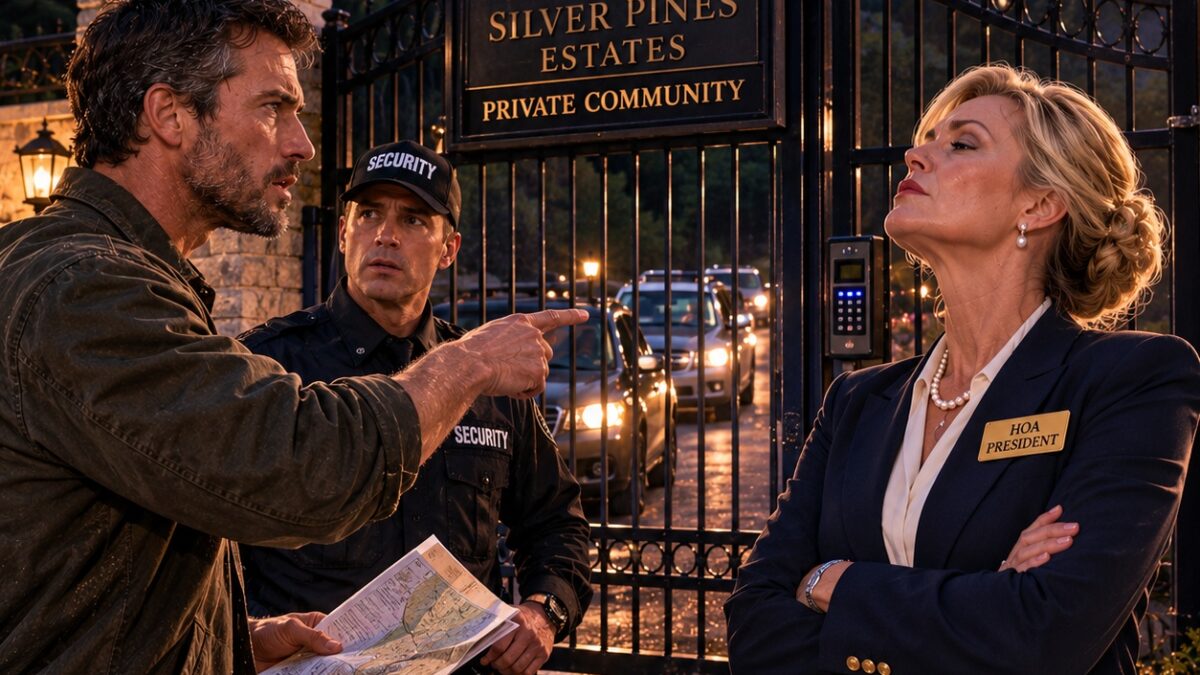
SILVER PINES ESTATES
PRIVATE COMMUNITY
The guard rolled up in a golf cart and shined his flashlight into my truck.
“Name?”
“Mason Sawyer.”
He checked a tablet.
Then checked it again.
“You’re not on the approved resident list.”
“I’m not a resident. My cabin is less than a quarter mile past that gate.”
“If you’re not on the list, I can’t let you in.”
I thought he had misunderstood.
I gave him my address.
He shook his head.
I told him I had driven that road my whole life.
He said his instructions were clear.
No name on the list meant no entry.
Resident or not.
So I called Judith Callaway, the HOA president of Silver Pines Estates, while my engine idled and my headlights washed across the gate they had built on the only way to my own front door.
She answered like she had been expecting my call.
“The gate is for security and property values,” she said smoothly. “You can apply for a temporary guest pass if you need access with any regularity.”
A guest pass.
To reach my own cabin.
Something about the ease in her voice told me this was not a misunderstanding.
It was a decision.
And I had arrived late to a fight I had not known someone else had already started.
[End Facebook Caption — full story continues below]
I sat there with my phone pressed to my ear, staring through my windshield at a gate that looked too expensive, too permanent, and too proud of itself.
“Judith,” I said, trying harder than I should have to keep my voice steady, “this is the only road to my property.”
“That may be how it was historically used,” she said, “but Silver Pines has now formalized controlled access for the benefit of all residents.”
“I’m not one of your residents.”
“That’s why I mentioned the guest-pass procedure.”
“I don’t need a guest pass to go home.”
There was a pause.
Not long.
Long enough for me to hear what she did not say.
You will if I decide you do.
“That is a board decision,” she said. “It’s not personal.”
I almost laughed.
People love saying something is not personal right before they take something personal from you.
“My grandfather built that cabin before Silver Pines existed.”
“I understand this is emotional for you.”
“No, you don’t.”
Another pause.
Then her voice cooled.
“You can contact the management office during business hours.”
“Judith, I’ve been driving eleven hours. I have nowhere else to sleep tonight.”
“I’m sorry, Mr. Sawyer, but after-hours access requires board authorization, and no board member is available to approve unscheduled entry.”
“You’re a board member.”
“I am not on site.”
“Pick up the phone and tell your guard to open the gate.”
“I’m afraid we cannot make exceptions without proper documentation.”
I looked at the guard.
He was sitting in his golf cart, pretending not to listen.
The LED sign lit the inside of my truck cab pale white.
“Then send me the documentation that gives your HOA the right to block my road.”
“You can submit a written request.”
The line went dead before I could answer.
I kept the phone against my ear for several seconds, listening to nothing.
Then I lowered it.
The guard came back to the driver-side window.
“Ma’am said you’ll need to come back during office hours.”
“My cabin is on the other side.”
“I understand.”
“No, you don’t.”
He shifted uncomfortably.
To his credit, he did not try to act tough.
He looked like a man following orders he already suspected were going to become someone else’s legal problem.
After a little radio traffic, he told me I could park in a small gravel pullout outside the gate for the night.
“As a courtesy,” he added.
“Not a precedent.”
I stared at him.
He looked away first.
I parked where he pointed, climbed into the back seat, shoved my gear bag under my head, and lay there in my boots while the gate glowed through the rear window.
I didn’t sleep.
How do you sleep fifty yards from land your family owns while a stranger’s sign tells you the road to it no longer belongs to you?
Sometime after midnight, I thought about my grandfather.
Not in a sentimental way.
In a furious one.
He had been a practical man, the kind who believed a fence should be straight, a handshake should mean something, and a man ought to read every document before he put his name on it.
He used to mention old paperwork connected to the driveway.
A plat.
An access strip.
An easement for neighboring parcels.
Words I had heard a dozen times and never cared enough to study.
Land disputes were things that happened to other people.
Not to a road your family had used without interruption for more than sixty years.
Around 1:00 a.m., with the LED sign still burning holes in my eyes, I started calling people.
A colleague from a job site gave me the number of a property attorney named Wendy Alcott.
“She lives for old easement messes,” he said.
I left Wendy a voicemail from the back seat of my truck.
I tried to sound reasonable.
I probably failed.
“My name is Mason Sawyer,” I said. “My family has owned a cabin on Ren Lake since the early sixties, and tonight a homeowners association blocked the only access road with a private gate. I need to know what my rights are before I do something stupid.”
That last part was more honest than professional.
Wendy called at 7:00 sharp.
I was awake before the phone rang.
No sane person could sleep under that sign.
Her voice was brisk but not cold.
“Mr. Sawyer, do you have the original property documents?”
“My grandfather kept everything.”
“Bring it all.”
An hour later, I was digging through my storage unit.
The fireproof box my grandfather left behind was heavier than I remembered.
Inside were deeds, old photographs, tax receipts, faded maps, and a stack of documents I had flipped through maybe twice in my life without understanding their importance.
Near the bottom, under photographs of my grandfather holding a fish beside the dock, I found a folded subdivision plat from 1958.
The edges were soft with age.
The ink had faded but not enough to hide the lines.
Wendy spread it across her desk beside her laptop.
She had short gray hair, wire-frame glasses, and a way of reading that made silence feel productive.
For almost an hour, she cross-referenced the plat with the county’s digital records.
I sat across from her pretending not to stare at every movement of her finger.
Finally, she stopped near the eastern edge of the drawing.
“There.”
She tapped a long, narrow strip running along the access road.
“Twenty feet wide.”
“Is that the road?”
“It’s the strip under the road.”
“What does that mean?”
She leaned back.
“It means the land under that part of the road was recorded as fee simple property belonging to the Sawyer parcel.”
I stared at her.
“Say that in English.”
“It means your family owns the dirt under the road. Not just the cabin lot. The actual strip the gate sits on.”
My mouth went dry.
“And Silver Pines?”
“The neighboring lots have an easement.”
“What kind?”
“A right to travel across that strip for access.”
“So they can use it.”
“Yes.”
“But they don’t own it.”
“No.”
She folded her hands.
“And an easement does not give them permission to pour concrete footings, install stone pillars, run electrical conduit, and build a permanent controlled-access structure on land they don’t own.”
For the first time since I had seen that gate, my anger had something solid to stand on.
Not emotion.
Not family history.
A recorded plat.
A twenty-foot strip.
Fee simple property belonging to the Sawyer parcel.
Wendy was careful, as good lawyers usually are when they see clients getting hopeful.
“We need to make sure this plat was never amended, challenged, superseded, or absorbed into later development records.”
“How do we do that?”
“We go to the county recorder.”
That afternoon, we drove together to the county recorder’s office.
Harold Pratt handled the search himself.
He was the kind of county employee who seemed to know the personality of every drawer in the room.
He pulled old records, cross-checked digital filings, reviewed indexes, and eventually found the original 1958 filing.
Unchanged.
Unamended.
Unchallenged.
For sixty-seven years, the boundary had remained exactly where the old plat said it was.
Harold stamped a certified copy and slid it across the counter.
“Old plats usually get discovered the hard way,” he said.
“Meaning?”
He shrugged.
“Somebody builds something without checking who owns the ground under it.”
Wendy drafted a formal letter that evening.
It went to Judith Callaway and the Silver Pines Estates board by certified mail, return receipt requested.
The letter was simple enough that anyone pretending not to understand it would have to work hard.
The twenty-foot strip under the access road was Sawyer property.
Silver Pines had only an easement.
The gate, pillars, concrete footings, electrical conduit, control panel, and related security structure had been installed without authorization.
The HOA had fifteen days to either remove the gate entirely or begin good-faith negotiations for a lawful land-use agreement.
I read the letter three times before Wendy sent it.
It felt strange seeing my family’s quiet road turned into legal language.
But legal language was apparently the only kind Judith respected.
I spent those fifteen days working two counties over, checking structural connections in a half-finished municipal building while my mind stayed back at Ren Lake.
Every few days, I called Wendy.
No response yet.
No response yet.
No response yet.
Some irrational part of me still expected Judith to call once she saw the certified plat.
Maybe she would apologize.
Maybe she would blame the developer.
Maybe she would say the board never realized the strip belonged to my family.
Maybe she would ask what reasonable compensation looked like.
That call never came.
On day fourteen, Wendy forwarded me the HOA attorney’s response.
Three paragraphs.
Cold.
Dismissive.
Almost bored.
The gate had been completed.
It was in active use.
It served all eighty-four homes in the community.
The association had no intention of removing it or entering any negotiation regarding land-use compensation.
The last paragraph was the one that stayed with me.
If Mr. Sawyer wishes to pursue litigation, he is of course entitled to do so. However, disputes of this nature concerning road easements often take years to resolve and may cost significantly more than the disputed strip of land itself is worth.
I read that line twice in my truck outside a job site.
Then a third time.
It was not a legal argument.
It was a threat wearing a tie.
They were not saying they were right.
They were saying fighting them would be expensive.
I called Wendy.
She answered on the first ring.
“You saw it,” she said.
“Yes.”
“This was not a misunderstanding.”
“No.”
“They’ve made a calculation.”
“That I’ll give up?”
“That most people would.”
I looked out across the parking lot.
The municipal building I was inspecting had steel beams lined up neatly behind temporary fencing.
Every one of them rested on foundations someone had checked, approved, and documented before anyone built upward.
Silver Pines had skipped that part and decided the cost of correcting it belonged to me.
“They miscalculated,” I said.
Wendy was quiet for a moment.
Then:
“I thought you might say that.”
Three days later, she called again with an angle I had not considered.
Because the strip under the gate belonged to me, I had a right to exercise physical control over unauthorized structures sitting on it.
But there was a limit.
“The neighbors have an easement,” she said. “That means reasonable access cannot be cut off entirely.”
“So I can’t just block the road.”
“Correct.”
“But I can restrict use of unauthorized improvements.”
“Yes, depending on how you do it.”
“That’s a lawyer answer.”
“I’m a lawyer.”
She warned me directly.
Anything aggressive could be twisted in front of a judge.
If I completely trapped eighty-four households inside their own neighborhood, I could look like the unreasonable one, no matter who built the gate first.
“Think hard before acting,” she said.
I thought hard.
Then I acted anyway.
Looking back, that was the most human decision I made in the entire story.
Maybe not the smartest.
Maybe not the cleanest.
Human.
I drove out before sunrise with a roll of barbed wire, a steel post, a laminated sign, and a secondary mechanical lock.
I did not block the whole road.
Not technically.
I set a low ring of barbed wire around the exact footprints of both gate pillars where they sat on the Sawyer strip.
Then I bolted the sign to the post.
STRUCTURE BUILT WITHOUT CONSENT ON PRIVATE LAND.
$10,000 TOLL PER VEHICLE PASS.
PAYABLE TO LANDOWNER.
Finally, I installed a secondary mechanical override lock on the gate-control housing.
A simple lock.
My lock.
On my strip of land.
I told myself I was asserting control.
I told myself Silver Pines had forced my hand.
Both things were true.
Neither thing made 7:15 that morning less chaotic.
The electronic system was not designed to deal with a mechanical override it did not control.
When the first residents tried to leave for work, the gate refused to open.
Cars backed up along the interior road.
Then more cars.
Then more.
People leaned out windows.
A man in a white SUV got out and tried the keypad again and again as if repetition could solve ownership.
Someone shouted.
Another person read the toll sign aloud and yelled, “Ten thousand dollars? Is this a joke?”
Marisol Vega lived in the house closest to the gate.
She filmed the whole thing from her driveway.
By 8:00, her video was on the Silver Pines community Facebook group with one question:
Why did nobody tell us the HOA built our gate on someone else’s land?
That question did more damage to Judith than anything I had written.
Because residents can ignore property disputes when they feel distant.
They cannot ignore missing flights, late meetings, trapped school runs, and a line of brake lights outside their own windows.
By 9:00, Sheriff Denise Cole arrived.
Someone from the HOA office had called it in as possible trespassing or vandalism.
Denise walked the scene slowly.
She read my sign twice.
Looked at the barbed wire.
Looked at the gate.
Looked at me.
“I assume you have paperwork.”
“Yes, ma’am.”
I showed her the certified 1958 plat from my truck.
She read it while standing in the dust beside the gate.
The HOA representative who had been sent to handle the scene kept shifting his weight.
His name was Kyle something.
He wore a polo shirt with the Silver Pines logo and looked like he wished Judith had come herself.
Denise finished reading.
Then looked at him.
“This is civil.”
He blinked.
“Sheriff, residents are being blocked.”
“I understand that.”
“He put a lock on community property.”
Denise turned the plat toward him.
“County records show this strip belongs to Mr. Sawyer.”
“It’s an easement.”
“It is an easement across his land.”
“But we maintain the road.”
“That does not make it yours.”
People were listening now.
Residents had gathered near the interior side of the gate.
Some still angry at me.
Some angry at everyone.
A few just confused.
Denise spoke loudly enough that there would be no mistake.
“I do not have a legal basis to force Mr. Sawyer to remove a lock or fencing that appears to be entirely on land county records show he owns. This is a civil property dispute. You need attorneys, not deputies.”
Something shifted in the crowd.
You could feel it.
An argument online is one thing.
A sheriff saying the county records show the angry man might be right is another.
Judith arrived a little after 10:00.
She got out of a black SUV wearing slacks, sunglasses, and the expression of someone whose morning had been ruined by people refusing to behave predictably.
She did not come straight to me.
She went to the residents first.
Smart.
She moved through them in a low voice, touching arms, promising the board was working on a solution, calling the situation unfortunate, temporary, and complex.
When she finally approached me, her smile looked thinner than it had sounded on the phone.
“Mason.”
“Judith.”
“I’m willing to meet with you and your attorney to discuss a temporary resolution.”
“Good.”
“That does not mean we agree to pay anyone for a strip of dirt beside a road.”
There it was.
Even surrounded by angry residents and a sheriff refusing to help her, she still could not say the word land.
Only dirt.
As if reducing it to soil made ownership childish.
I watched her walk back toward her SUV past residents who were no longer willing to pretend this was someone else’s problem.
The meeting happened two days later in a small conference room at the HOA management office.
Judith brought the HOA’s attorney, a narrow man named Paul Renner.
I brought Wendy.
Judith sat with her hands folded.
Paul sat with a stack of papers.
Wendy opened with a proposal.
A one-time land-use payment for the gate footprint.
A modest annual maintenance fee going forward.
Silver Pines would acknowledge the Sawyer ownership of the strip.
I would remove the barbed wire and mechanical lock.
Residents would regain normal access.
No one needed a lawsuit.
Judith rejected it before Wendy finished the second page.
“Paying for a strip of dirt that has functioned as an access easement for decades sets an impossible precedent,” she said.
Wendy did not blink.
“We are not asking you to pay for the easement. We are asking you to pay for permanent structures you installed outside the scope of that easement.”
“The gate benefits everyone.”
“Then everyone benefited from unauthorized construction.”
Paul cleared his throat.
“The association maintains that the gate is a reasonable access-control improvement.”
“Was the landowner’s consent requested?”
“The board approved the project.”
“That was not my question.”
Judith leaned forward.
“Silver Pines cannot be expected to renegotiate established access rights because Mr. Sawyer is emotionally attached to an outdated interpretation of county documents.”
I almost spoke.
Wendy’s pen tapped once against her legal pad.
I stayed quiet.
That tap meant let me.
“Certified county records are not an outdated interpretation,” Wendy said.
Judith’s eyes hardened.
Then, defending the gate’s cost, she said something that did not seem important until Wendy’s pen stopped moving.
“The contractor gave us an extremely fair price for the scope. Ridgepoint Builders came recommended by people we trust.”
Wendy looked up casually.
“Who runs Ridgepoint Builders?”
“Local outfit,” Judith said.
“Who owns it?”
Judith answered too quickly.
“My husband Dale knows the ownership through his construction work.”
Wendy made a small note.
She did not push.
Twenty minutes later, the negotiation collapsed.
Judith would not pay.
I would not remove the lock without an enforceable agreement.
Paul said litigation would take years.
Wendy smiled politely and said, “Then I suppose we all have time to read the old documents carefully.”
That evening, Wendy called me.
“I pulled the contractor licensing records on the way home.”
“And?”
“Ridgepoint Builders LLC is registered under a holding name.”
“What does that mean?”
“It means someone didn’t want the connection obvious unless you looked.”
“Connection to who?”
“Dale Callaway.”
I sat up.
“Judith’s husband.”
“Yes.”
Silence.
Then:
“Is that illegal?”
“Not automatically. But it raises questions.”
“What questions?”
“Did the board competitively bid the contract? Did Judith disclose the conflict? Did she vote on it? Did the association bylaws require multiple bids?”
I thought about the marble-faced pillars, the cameras, the LED sign, the guard shack.
“How much did that gate cost?”
“About one point five million dollars.”
I laughed once.
“What?”
“The HOA spent a million and a half dollars building a gate on my land through a company connected to Judith’s husband?”
“That is one way to say it.”
“How would you say it?”
“I would say we need documents.”
Two days later, documents found us.
A woman named Colleen Sharp called me.
She introduced herself as the HOA’s recording secretary.
Her voice was low and nervous.
“I heard this gate dispute has become something larger.”
“That’s one way to say it.”
“I think you need to see something before I lose my nerve.”
We met at a diner off the highway.
She brought a folder thick enough to bend at the corners.
“I keep my own certified copies of minutes,” she said. “Not the polished versions. My meeting copies.”
“Why?”
She smiled faintly.
“Because people who control official records sometimes forget secretaries also keep paper.”
Inside were minutes from a board meeting eighteen months earlier.
The gate contract approval.
Only one bid had been formally presented.
Ridgepoint Builders.
The bylaws required at least three competitive bids for capital projects exceeding $200,000.
Judith had introduced the motion to approve Ridgepoint.
Then I saw the handwritten note.
Judith Callaway stated she had no personal or financial connection to contractor.
I read it twice.
Then a third time.
“That’s her statement?”
Colleen nodded.
“She said it clearly enough that I wrote it down.”
“Did she correct the minutes later?”
“No.”
“Did anyone ask about other bids?”
“One board member did. Judith said Ridgepoint had already been vetted.”
I looked up.
“And her husband owned it.”
“Apparently.”
Colleen’s eyes filled with frustration.
“I am not trying to destroy anyone. I just can’t sit on a record that says one thing while the county filings say another.”
I called Wendy from the parking lot.
She listened.
Then said:
“Do not send anything to Judith yet.”
“Why?”
“Because if she lied in a board meeting, she needs time to explain only after others see the discrepancy. If we show our hand too early, she’ll build a bridge before anyone sees the hole.”
That was Wendy.
Methodical.
Patient.
Dangerous in a quiet way.
Around that same time, Fire Chief Ray Doss had filed something that none of us fully appreciated at first.
A routine access review for Silver Pines.
His report flagged the gate as the community’s single point of failure for emergency evacuation.
One gate.
One road.
Eighty-four homes.
If that system failed during a fire, medical emergency, or mass evacuation, traffic could bottleneck dangerously.
Ray recommended a secondary emergency exit before dry season.
Judith dismissed it in a board meeting.
Budget priorities, she said.
Other improvements came first.
Security was already addressed.
The gate was state-of-the-art.
State-of-the-art is a dangerous phrase.
It makes people stop imagining failure.
Two weeks later, the weather service issued an extreme fire danger warning across the Ren Lake region.
Dry spell.
Sustained winds.
High temperatures.
Low humidity.
The kind of conditions that turn pine needles into kindling and make everyone who grew up near wooded land listen harder to the air.
The fire started on the ridge behind Ren Lake a little after 4:00 in the afternoon.
By 5:30, the sky over Silver Pines had gone rust-red.
I was at the cabin packing what I could carry in ten minutes when the emergency alert hit every phone at once.
MANDATORY EVACUATION EFFECTIVE IMMEDIATELY.
I threw hard drives, family documents, medication, old photographs, and my grandfather’s pocketknife into a duffel bag.
Then I ran for the truck.
The road toward the gate was already hazy.
Smoke turned the trees into shadows.
Ash drifted like gray insects in the headlights.
When I reached the gate, the scene looked nothing like evacuation plans drawn on paper.
Cars were backed up three deep along the interior road.
Brake lights glowed red through smoke.
People leaned out windows.
Someone was honking without stopping.
A woman stood beside an SUV yelling for her husband to get back in the car.
The gate was frozen half open.
Wide enough for maybe one car at a time to squeeze through if the driver angled carefully and crawled.
Not wide enough for an orderly evacuation.
Definitely not wide enough for fire engines to enter while residents were trying to leave.
The electronic gate system had failed.
Maybe heat.
Maybe ash.
Maybe power fluctuation.
Maybe all three.
Whatever the reason, the expensive system Judith had defended now sat there like a wounded animal, neither open nor closed.
People were trying to force it by hand.
Nothing.
Someone shouted:
“The guy with the lock! Where’s the guy with the key?”
Me.
I still had the mechanical override key in the center console.
The same key I had used to lock eighty-four families inside their own inconvenience weeks earlier.
For three seconds, I sat in my truck with that key in my palm while smoke thickened around the windshield.
Three seconds is long enough for shame to enter.
Because I had been right about the land.
I had been right about the unauthorized gate.
I had been right about Judith.
But none of that mattered if people died behind a structure sitting on my family’s strip of dirt.
I got out and ran.
Fire Chief Ray Doss was already on scene, coordinating with a truck trying to push through from the outside.
He saw me.
“You got that override?”
“Yes.”
“Use it!”
No debate.
No civil dispute.
No HOA.
No Judith.
Just access.
I reached the control panel housing.
My hands shook hard enough that I missed the key slot the first time.
Smoke burned my eyes.
Someone behind me shouted that the fire had crossed the ridge road.
I tried again.
The key turned.
The gate lurched.
Caught.
For one horrible second, nothing happened.
Then Ray and two firefighters pushed the frame while I held the release.
Metal screamed.
The gate swung open.
Not gracefully.
Not smoothly.
Open enough.
Cars started moving immediately.
Headlights streamed past me.
Some out.
Some in, as fire units pushed through from the other side.
A man shouted “Thank you!” through a cracked window.
A woman in a minivan sobbed while her teenage son guided her through the gap.
Ray’s engine rolled past so close I felt heat from the exhaust.
Then another.
Then another.
I held the gate frame by hand for close to four minutes while the last residents cleared.
Ash settled on my shoulders.
Smoke turned my throat raw.
Somewhere behind the trees, the fire roared like a freight train moving through the ridge.
At some point, I stopped thinking about who owned what.
I only thought:
Do not let the metal swing shut.
Do not let it jam again.
Do not let the next car stop.
Marisol Vega filmed as she drove through.
She later told me instinct told her to keep going, but something about seeing me standing there with the gate in my hands after everything that had happened made her reach for her phone.
The video showed smoke behind me, cars streaming past, fire trucks pushing in, and the same gate that had started this mess held open by the man it had locked out.
The fire burned through the night.
Nearly four hundred acres on the ridge were consumed before crews established containment by morning.
Silver Pines was spared.
No deaths.
No injuries.
No homes lost inside the gated community, though two houses closest to the tree line suffered ember damage.
By the next evening, Marisol’s video was on local news.
The anchor called it “a neighborhood property dispute turned evacuation drama.”
I watched from my cabin, exhausted, throat still raw, phone buzzing with messages from people I had not heard from in years.
Everyone asked if that was really me.
I didn’t feel like a hero.
I kept thinking about Ray’s ignored report.
About a million-and-a-half-dollar gate built on land Silver Pines never owned.
About eighty-four families trusting a structure whose legal foundation was as flawed as its emergency design.
Ray filed his official incident report within a week.
It stated plainly that the Silver Pines gate functioned as the single point of failure he had warned about in writing, and that the mechanical override installed by the landowner was the only reason the evacuation bottleneck did not become significantly worse.
That report became public record.
Once residents read it, Marisol’s video changed meaning.
It was no longer a feel-good clip.
It was evidence.
At Wendy’s direction, Colleen’s minutes and the contractor licensing records were submitted to the county building and contractor licensing office.
Investigators confirmed what the paper showed.
The board had bypassed its own competitive bidding requirement.
Judith had made a documented false statement denying any personal or financial connection to Ridgepoint Builders.
Dale Callaway, her husband, was the registered managing member behind the company.
The gate had been billed above standard regional rates for comparable construction.
Ridgepoint Builders was barred from bidding on public or HOA-administered contracts in the county for three years.
Dale was required to repay a portion of the contract amount.
Just over $200,000.
That number moved through Silver Pines faster than the fire had.
Residents had already been angry about access.
Now they were angry about money.
That anger had weight.
Because the gate had not only trapped them.
It had cost them.
An emergency meeting was held inside two weeks.
The clubhouse was so packed people stood along the back wall and spilled into the hallway.
Colleen told me later she had never seen anything like it.
Residents demanded full accounting.
They wanted invoices.
Bids.
Board minutes.
Ray’s report.
The licensing investigation.
The land-use documents.
Judith tried to speak.
For the first time, they did not let her control the room.
One man stood and asked why his dues had paid for a gate built on land the HOA didn’t own.
A woman asked why the board ignored Ray Doss’s emergency-exit recommendation.
Marisol played her video again on a projector.
Smoke.
Cars.
Fire engines.
Me holding the gate.
Then someone read aloud the line from Colleen’s minutes where Judith denied any connection to Ridgepoint.
After that, the vote of no confidence was almost a formality.
Judith was removed from the board that night.
The count was something like nine to one against her.
The one dissenting member left before the meeting adjourned.
Within days, the new board contacted Wendy.
No threats.
No three-paragraph letters about litigation costs.
No arrogant language about “strips of dirt.”
They wanted to negotiate.
This time, they came with the certified plat already printed.
That felt like progress.
We settled on an annual fee for the land under the gate, a one-time payment recognizing the unauthorized structure, and a written acknowledgment of the Sawyer parcel’s fee simple ownership of the twenty-foot strip.
More importantly, Silver Pines committed to building the secondary emergency exit Ray Doss had recommended.
Funded.
Scheduled.
Before the next fire season.
I removed the barbed wire and mechanical lock after the agreement was signed.
Not before.
Where the control panel sat, I had a small brass marker set into the ground.
Nothing dramatic.
No plaque naming Judith.
No slogan.
Just a boundary marker referencing the 1958 plat.
Most people probably never noticed it.
That suited me.
The land did not need a monument.
It needed memory.
Judith and Dale sold their house four months after the fire.
Colleen told me.
I did not ask where they went.
I did not care enough to find out.
The story made regional news eventually, part of a broader segment about HOA overreach and emergency-access failures.
Our gate was the lead example.
That phrase bothered me at first.
Our gate.
It was never mine.
And, legally, never fully theirs.
But stories simplify.
Life moves.
I returned to my work rotation.
Structural inspections.
Long drives.
Gas-station coffee.
Motels.
Clipboards.
But the drive back to Ren Lake felt different after everything.
Not easier exactly.
More earned.
The new emergency exit went in that fall.
A simple gravel road through the eastern tree line, wide enough for a fire engine, unlocked, marked, and tested.
No marble pillars.
No LED sign.
No security theater.
Just access.
The kind of thing that actually protects people.
Late one evening the next spring, I came back from a job site later than planned.
The sun was dropping behind the pines when I turned onto the old road.
The gate opened smoothly on the first try.
No guard in a golf cart.
No flashlight through my windshield.
No tablet with my name missing from a list.
I drove through without stopping.
The brass marker caught the last bit of evening light near the foundation.
Small.
Quiet.
Easy to miss.
Exactly where the 1958 plat said the line belonged.
I parked at the cabin and walked down to the water instead of going inside.
The dock pilings my grandfather set decades earlier still stood.
The lake moved against them with the same patient sound it had made before Silver Pines, before Judith, before marble pillars, before anyone thought a private gate could erase a recorded line.
I stood there a long while.
Thinking about how a piece of paper from 1958 had mattered more than a million-and-a-half-dollar structure.
Thinking about Harold Pratt stamping the certified copy like he had seen this story before.
Thinking about Wendy telling me not to cut off reasonable access and me not fully listening until fire made the meaning plain.
Thinking about eighty-four families who had no idea, when they bought into Silver Pines, that the road beneath their gate belonged to a man they had never met.
And thinking about my grandfather.
He would have hated the gate.
He would have loved the marker.
A quiet piece of brass telling anyone who cared enough to look:
Check the ground before you build on it.
That was the lesson.
Not that HOAs are always evil.
Not that neighbors should fight over every inch of dirt until no one can live peacefully.
Not that I was a hero because I held a gate open during a fire.
The lesson was simpler.
Authority has a boundary.
An easement lets you cross land.
It does not let you own it.
A board vote can approve a project.
It cannot move a property line.
A million and a half dollars can buy marble pillars, cameras, private security, and an LED sign bright enough to light up a tired man’s truck at midnight.
It cannot buy the right to pretend a 1958 plat does not exist.
Silver Pines learned that the expensive way.
So did I.
Because I had been right about the road, but the fire taught me that being right does not excuse forgetting people are on the other side of the argument.
When I held that gate open, I wasn’t protecting Judith.
I wasn’t protecting her mistake.
I wasn’t surrendering my land.
I was letting families out and firefighters in.
That should never have depended on my key.
Now it doesn’t.
The emergency exit exists.
The agreement exists.
The marker exists.
The plat still exists.
And the road my grandfather drove before any developer ever looked at Ren Lake still carries me home.
The gate opens now when I come through.
But every time it does, I glance at that brass marker and remember the night it didn’t.
I remember the guard’s flashlight.
Judith’s voice telling me to apply for a guest pass.
The back seat of my truck glowing pale under that LED sign.
Wendy’s finger on the old plat.
Harold’s county seal.
Denise Cole reading the record aloud.
The line of cars at 7:15 in the morning.
The smoke at dusk.
Ray Doss shouting over the radio.
Marisol’s camera.
The gate frame hot under my hands.
And I remember that sometimes the truth under your feet is older, stronger, and more patient than anything money can build on top of it.








