𝗙𝗨𝗟𝗟 𝗦𝗧𝗢𝗥𝗬:Six Teenagers Surrounded My Car With My 8-Year-Old Inside—They Had No Idea Why I Quit Fighting
FULL STORY CONTINUATION
“Put the phone down,” I said.
Mason grinned.
“Why?”
“Because my daughter is sitting right there.”
He angled it toward the passenger window.
“Then don’t do anything embarrassing.”
That told me everything I needed to know about Mason.
The confrontation was entertainment to him.
I looked back at Ryland.
“What exactly are you saying I did?”
“You hit my dad’s truck yesterday.”
“No, I didn’t.”
“You were parked next to it.”
“Yes.”
“You left before us.”
“Yes.”
Ryland hesitated for half a second.
That was the first crack.
“You hit it before you left.”
“No.”
He stepped closer.
“So you’re calling me a liar?”
I didn’t answer.
That irritated him more than arguing would have.
Trent laughed.
“He thinks he’s tough.”
I looked at Trent.
“No.”
Then back at Ryland.
“I’m trying to take my daughter home.”
Jace moved a little closer to the driver’s door again.
I noticed.
So did Marlo.
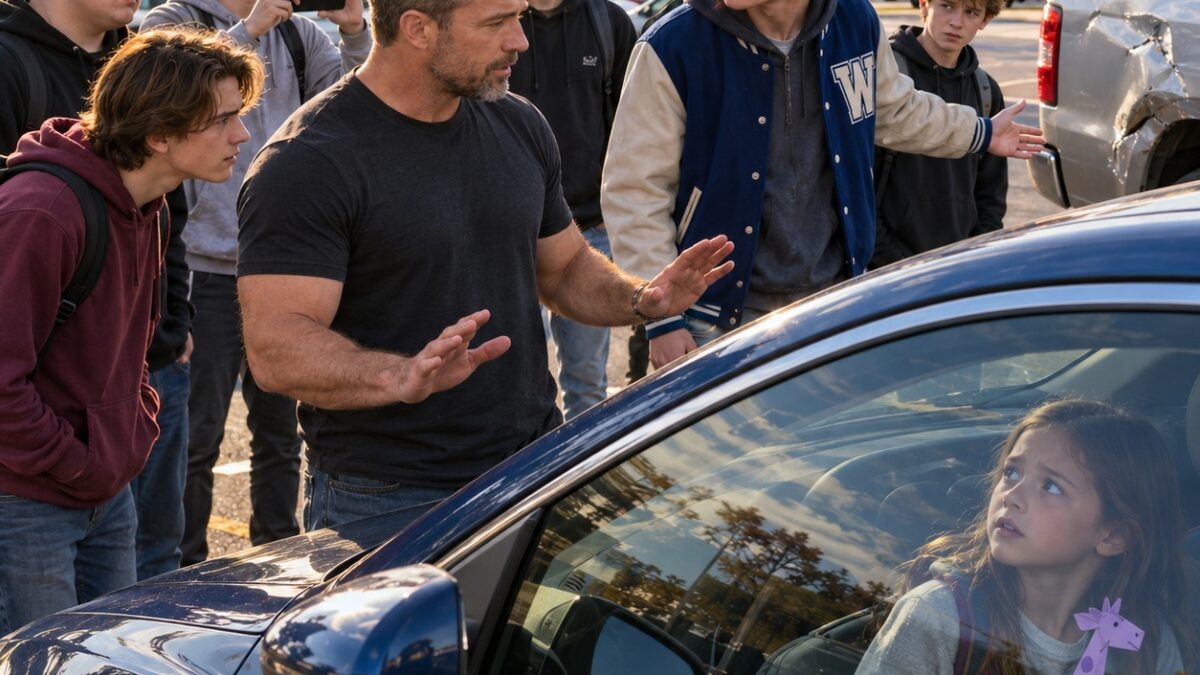
Her face was visible through the window.
She had stopped holding the giraffe.
Now both hands were in her lap.
Ryland slapped my hood.
Hard.
Marlo jumped.
Something inside me tightened.
“You’re paying for that damage.”
“No.”
Mason said to the phone:
“There you go. Dude admits he won’t pay.”
“I didn’t admit anything.”
Mason smirked.
“Whatever.”
“Turn that away from my daughter.”
He moved closer to the passenger window instead.
Marlo shrank back.
I stepped between him and the glass.
That put Mason behind my right shoulder.
Jace near my left.
Trent in front.
Ryland directly ahead.
Eli and Noah farther back.
They were no longer standing around my car casually.
They had formed a ring.
“Back up,” I said.
Ryland laughed.
“Or what?”
“Nothing.”
That answer confused him.
“I’m asking you to back away from my car so I can leave.”
Trent stepped beside him.
“What if we don’t?”
“Then I call the school.”
Mason laughed.
“Teachers are gone.”
Not all of them.
I knew that.
The principal’s car was still near the administration entrance.
Two classrooms still had lights on.
But those doors were fifty yards away.
My daughter was six feet from me.
Leaving her alone while I went for help was not happening.
I reached slowly toward my pocket.
Ryland said:
“Don’t call anybody.”
“I’m getting my phone.”
Jace moved from the driver’s door and blocked my hand.
“Wait.”
“Move.”
“Just hear him out.”
“I heard him.”
Ryland pointed at the pickup.
“You damaged that truck.”
“No.”
“My dad wants insurance information.”
“Then your father can contact me.”
“He doesn’t need to.”
“He does if he believes I damaged his property.”
Ryland’s face reddened.
“You think I’m scared to tell him?”
That was interesting.
I hadn’t said anything about fear.
“No.”
“Then give me your insurance.”
“No.”
Mason whistled.
“He’s really going to make you look stupid, Ry.”
Bad sentence.
The kind that turns a disagreement into a performance.
Ryland looked at Mason.
Then at me.
I could see the decision being made.
Not about the truck.
About status.
“I’m going to ask you one more time.”
“You already have my answer.”
He moved closer.
We were nearly chest to chest.
Inside the car, Marlo knocked lightly on the window.
“Dad?”
I turned my head.
“I’m okay.”
That was when Trent walked toward her door.
I shifted immediately.
“Stay away from the car.”
Trent stopped.
“What?”
“You heard me.”
He smiled.
“Relax.”
Then he put one hand on the roof above Marlo.
She recoiled.
The fear in her face changed everything.
Until then, I had been managing six teenagers.
Now I was protecting an eight-year-old.
I lowered my voice.
“Take your hand off my car.”
Trent stared at me.
Maybe something in my face finally registered.
He removed it.
Mason said:
“Whoa.”
Still filming.
Jace muttered:
“Maybe we should just go.”
Ryland snapped:
“Shut up.”
There.
Another distinction.
Jace was not there because he wanted a fight.
He was there because Ryland had asked him to come.
Eli was even less committed.
He had moved farther backward.
Noah looked sick.
Only Trent seemed excited.
Only Mason thought it was funny.
Ryland needed control because the lie was his.
I understood the structure now.
I looked at each of them.
“Here is what’s going to happen.”
Ryland smiled.
“You giving orders now?”
“I’m going to get into my car.”
“You’re going to move away.”
“Then if your father believes I damaged his truck, he can call me.”
“No.”
“You don’t decide that.”
Ryland grabbed my shoulder.
There are physical contacts that happen so often in ordinary life your brain barely records them.
A tap.
A bump.
A hand during a handshake.
Then there are touches your body classifies immediately.
Grip.
Pressure.
Intent.
My entire nervous system changed before I consciously decided anything.
I removed his hand.
Not violently.
Two fingers on the wrist.
Turn.
Release.
“Don’t touch me.”
Ryland stared at me.
Then shoved me.
Hard.
I took one step backward.
Marlo screamed:
“Dad!”
I looked at her immediately.
“I’m okay.”
Mason’s smile disappeared slightly.
Jace said:
“Ryland, enough.”
Ryland ignored him.
Trent moved around my left.
Jace remained near the driver’s side.
Mason still had the phone.
Eli was behind Ryland.
Noah hadn’t moved.
Six bodies.
One child inside a vehicle.
The geometry mattered.
That old part of my brain I had spent fifteen years quieting became brutally clear.
Distance.
Angles.
Hands.
Escape route.
Threat priority.
I hated how familiar it felt.
“Move away from the car,” I said.
Trent laughed.
“Or what?”
“Nothing needs to happen.”
Ryland squared his shoulders.
“You need to learn some respect.”
I looked at him.
“My kid is scared of you.”
“I know.”
My answer was so quiet he hesitated.
That was my mistake.
Or maybe his.
He mistook restraint for surrender.
Ryland swung.
Not a trained punch.
Big right hand.
Anger first.
Technique nowhere.
I moved sideways before it finished extending.
Caught his wrist.
Redirected the momentum.
Nothing dramatic.
No joint break.
No throw.
I simply gave his body the direction it was already traveling.
Ryland stumbled past me.
Nearly fell.
I released him instantly.
Nobody laughed.
Mason’s phone slowly lowered.
I stepped back toward Marlo’s door.
“I’m not here to fight you.”
Ryland turned.
His face burned red.
Humiliation.
That was more dangerous than anger.
“Cheap shot.”
“I didn’t hit you.”
“Do it again.”
“No.”
He charged.
This time both hands reached for my chest.
I sidestepped.
Controlled one arm.
Used his forward movement to turn him toward the grass strip beside the parking lot.
He landed on one knee and one hand.
Not slammed.
Not hurt.
Just suddenly no longer standing where he intended.
Trent started toward me.
Jace grabbed his arm.
“Stop.”
Trent jerked away.
“He just put Ry on the ground.”
“Ry put himself on the ground.”
Jace understood more than I expected.
Eli whispered:
“What the hell?”
Noah looked at me differently now.
Not frightened.
Recognizing that something about the situation had changed.
Ryland stood.
Grass on his jeans.
“What are you?”
“What?”
“You’ve done this before.”
“A long time ago.”
Trent noticed the scar above my eyebrow.
Mason lifted his phone again.
This time not recording me.
Searching.
“Wait.”
Nobody listened.
Mason looked between his screen and my face.
“Calder Boon?”
I closed my eyes for a second.
Damn.
“Dude.”
“What?” Ryland snapped.
Mason turned his screen around.
On it was a photograph I had not seen in years.
I was twenty-four.
Inside a cage.
Hands raised.
Blood near my eyebrow.
Championship belt around my waist.
The headline read:
BOON RETIRES AFTER TITLE DEFENSE.
Jace stared at the photograph.
Then at me.
“No way.”
Eli said:
“My brother knows who you are.”
“I doubt that.”
“He watches old fights.”
Ryland looked almost offended.
“You were a champion?”
“I used to fight professionally.”
Mason scrolled.
“Twenty-three wins?”
“Put the phone away.”
“Seventeen finishes?”
“Doesn’t matter.”
“It kind of matters,” Eli whispered.
“No.”
I looked around the circle.
“It doesn’t.”
They went silent.
“What matters is six of you surrounded a man in front of his eight-year-old daughter over a truck none of you can prove I damaged.”
The word prove changed Noah.
His eyes went immediately toward the pickup.
I followed them.
Now that nobody was moving, I studied the dent properly.
Rear passenger-side panel.
Deep crease.
Paint missing.
But not fresh.
Dust had already settled inside one portion.
More importantly, there were traces of yellow paint embedded along the lower edge.
I looked toward the loading lane.
The protective posts outside the school were painted yellow.
One had fresh silver marks where paint had been scraped away.
Interesting.
I walked three steps toward the truck.
Ryland said:
“Where are you going?”
I crouched beside the dent.
Marlo remained inside the car.
I could still see her.
“The dent happened here yesterday?”
“Yes.”
“What time?”
Ryland hesitated.
“Before you left.”
“What time?”
“Like four-thirty.”
“I picked Marlo up at four-thirty-two.”
“So?”
“I left around four-forty.”
“Exactly.”
“That doesn’t answer my question.”
Ryland’s face tightened.
I looked at Noah.
“You were here?”
He looked at Ryland.
Then me.
“Noah,” Ryland warned.
There it was.
Name and fear.
“Yes,” Noah said.
“What time did the truck get damaged?”
Ryland spun.
“Shut up.”
Noah flinched.
I stood.
“Ryland.”
He turned toward me.
“Do not threaten him.”
“Stay out of it.”
“He’s already in it.”
Noah looked down.
Mason stopped filming completely.
Jace released Trent.
Eli said:
“Just tell him.”
Ryland looked betrayed.
“Seriously?”
Eli shook his head.
“This is stupid.”
Mason muttered:
“We should’ve never come.”
“You all said you’d back me up.”
Jace answered:
“We said we’d get his insurance.”
“Same thing.”
“No, it isn’t.”
The group was coming apart.
That is what happens when intimidation depends on everybody pretending they believe the same lie.
I looked at Noah.
“What happened yesterday?”
He swallowed.
“Ryland was driving his dad’s truck.”
Ryland stepped forward.
I didn’t move.
Noah continued faster.
“He came after you left.”
“When?”
“Maybe four-forty-five.”
Exactly.
“Then?”
“He was backing out.”
“Noah.”
Ryland’s voice had become pleading now.
Not threatening.
Noah looked at him.
“You hit the yellow post.”
Silence.
Marlo opened the passenger door.
“Dad?”
“Stay there for one second, sweetheart.”
She kept the door open.
Noah continued.
“He turned too sharp.”
“The back side clipped it.”
“Mason and me were there.”
Eli said:
“I came out right after.”
Mason looked at the ground.
Ryland stared at all three of them.
Then at me.
I finally understood the whole thing.
“You told your father I hit the truck.”
Ryland said nothing.
“You needed my insurance information to support the story.”
Silence.
“Why?”
He looked away.
“Why, Ryland?”
His face changed.
The aggression drained out.
Suddenly he looked seventeen.
“My dad said if I damaged his truck again, I’d lose my car.”
There it was.
Not evil.
Fear.
Still wrong.
But understandable in a way the parking-lot performance hadn’t been.
“So you blamed me.”
He nodded once.
“And brought five people.”
“I thought you’d just pay.”
I almost laughed.
Not because it was funny.
Because teenage logic can be breathtaking.
“You thought I would accept responsibility for damaging a truck I never touched because six teenagers asked?”
His face reddened.
“I thought you wouldn’t want trouble.”
I looked at the six of them.
“That is exactly what trouble is.”
Nobody answered.
Marlo got out.
This time I let her.
She walked directly to me and grabbed my hand.
Ryland looked at her.
The shame on his face deepened.
Good.
Not humiliation.
Shame can be useful if it points toward responsibility.
I looked at him.
“You need to tell your father.”
His head snapped up.
“No.”
“Yes.”
“He’s going to kill me.”
“He is not going to kill you.”
“You don’t know my dad.”
“You’re right.”
I lowered my voice.
“But I know this gets worse every hour you keep lying.”
Ryland stared at the ground.
“What if he hates me?”
That question changed the parking lot.
The other boys stopped looking at Ryland as leader.
For the first time, they looked at him like a frightened kid.
“He might be angry.”
“That’s not better.”
“No.”
“He might take your car.”
“Probably.”
Ryland grimaced.
“But losing your car because you damaged his truck is better than becoming the kind of person who surrounds strangers with five friends to protect a lie.”
That landed.
Mason put his phone completely away.
Jace looked toward the school.
Trent said nothing.
Eli folded his arms.
Noah visibly relaxed.
Then Marlo tugged my hand.
“Dad?”
“Yeah?”
“Can we go home now?”
I looked down.
Her paper giraffe was still inside the car.
One purple leg had folded over.
“Yes.”
I opened the passenger door for her.
Before I got around to the driver’s side, Ryland said:
“Mr. Boon?”
I stopped.
“I’m sorry.”
I looked at him.
He continued.
“I shouldn’t have shoved you.”
“No.”
“And…”
He glanced at Marlo.
“I’m sorry I scared your daughter.”
Marlo looked at him from the seat.
I waited.
Then said:
“Tell your father the truth.”
Ryland nodded.
“And don’t ever surround somebody like this again.”
Another nod.
I looked at the rest.
“You either.”
Jace answered first.
“Yes, sir.”
Eli nodded.
Noah too.
Mason looked embarrassed.
Trent took the longest.
Eventually:
“Yeah.”
I got into the car.
Marlo waited until we were out of the parking lot.
Then:
“Dad.”
“Yeah?”
“Why were there six?”
I almost laughed.
“That is your first question?”
“Yes.”
“Ryland was scared.”
“He didn’t look scared.”
“People don’t always look like what they feel.”
She thought about that.
“Mason was annoying.”
“That is fair.”
“He kept filming me.”
“I know.”
“I don’t like him.”
“You don’t have to.”
“The big quiet one wasn’t as bad.”
“Jace.”
“He told the angry skinny one to stop.”
“Trent.”
“And Noah told the truth.”
“Yes.”
She looked out the window.
Then:
“Were you scared?”
That question mattered.
“A little.”
She turned immediately.
“Really?”
“Yes.”
“But you’re a champion.”
There it was.
Information moved fast.
“Mason found an old picture.”
“Were you really?”
“A long time ago.”
“Why didn’t you tell me?”
I kept my eyes on the road.
“Because it isn’t who I am anymore.”
“But you were famous?”
“For a while.”
“Did Mom know?”
I smiled.
“Your mother knew everything.”
“Was she impressed?”
“No.”
Marlo laughed.
“What did she say?”
“She said getting punched for money sounded like a poor career plan.”
“That sounds like Mom.”
“Yes.”
She became quiet.
Then:
“Could you have beat all six of them?”
I nearly drove into the curb.
“Absolutely not.”
“But—”
“No.”
“You took Ryland down twice.”
“I moved Ryland twice.”
“Same thing.”
“It isn’t.”
I glanced at her.
“Marlo, listen to me.”
She did.
“Real fights are unpredictable.”
“One person can get hurt.”
“Two people can.”
“Someone falls wrong.”
“Hits concrete.”
“A weapon appears.”
“A friend jumps in.”
“Something that begins stupid becomes permanent.”
Her expression changed.
“Then why did you fight?”
“I didn’t.”
“Dad.”
“I protected myself.”
“That’s fighting.”
“There’s a difference.”
“What?”
“I did only enough to stop him from hurting me.”
I paused.
“And to make sure nobody got to you.”
She stared at her hands.
“You looked different.”
That hurt.
“How?”
“Like…”
She searched.
“Like when you see something dangerous during an inspection.”
I smiled slightly.
“That’s actually pretty accurate.”
“You weren’t mad.”
“I was very mad.”
“You didn’t look mad.”
“That’s because being angry doesn’t mean I have to give anger control.”
Marlo absorbed that.
Children sometimes take your words more seriously than you intend.
That scared me more than Ryland had.
Because everything I said could become part of how she understood adulthood.
Monday morning, Principal Elaine Foster called me.
“Mr. Boon?”
“Yes.”
“I need to discuss what happened Thursday.”
I had already submitted a written report Friday morning.
After talking with Marlo that evening, I realized walking away was not enough.
Six older teenagers had surrounded a parent and child on school property.
Even if I did not want anybody ruined over it, the school needed to know.
Security footage covered most of the lot.
It confirmed the timeline.
My arrival Wednesday.
My departure at 4:41.
Ryland’s truck entering later.
The impact with the yellow post at 4:52.
Thursday’s confrontation.
The boys surrounding my car.
The shove.
My defensive movements.
Everything.
The school resource officer had reviewed it too.
Ryland and the others were students at Westbrook High, but several had younger siblings at the elementary school.
The district handled disciplinary consequences.
I gave a statement.
Ryland’s father declined to pursue anything against me once he saw the footage.
That sentence almost made me laugh.
There was nothing to pursue.
Principal Foster continued.
“The boys have admitted what happened.”
“All six?”
“Yes.”
“Good.”
“Ryland told his father.”
I waited.
“How did that go?”
“Apparently not well initially.”
“Understandable.”
“His father also called me.”
“Why?”
“He wanted your number.”
“No.”
She laughed slightly.
“I told him I wouldn’t release it.”
“Thank you.”
“He asked me to tell you he’s sorry.”
“That’s enough.”
There was a pause.
Then:
“I have another question.”
I knew that tone.
“No.”
“You haven’t heard the question.”
“I know.”
She laughed.
“Apparently some of our students discovered who you used to be.”
“Mason.”
“Probably.”
“I don’t want this becoming a spectacle.”
“Neither do I.”
“Good.”
A pause.
“But would you consider speaking to the students?”
“No.”
“Calder.”
“No.”
“Not about being famous.”
“Good, because I wasn’t that famous.”
“Apparently you were.”
“Internet exaggerates.”
She continued.
“We’ve had issues this year.”
“Fighting?”
“Bullying.”
That changed things slightly.
“Online harassment.”
“Parking-lot intimidation.”
“Kids recording incidents instead of helping.”
Mason.
I rubbed my forehead.
“What do you want me to say?”
“What you said Thursday.”
“I mostly told them to move.”
“Exactly.”
I still said no.
That evening, I found one of Marlo’s drawings taped to the refrigerator.
Two stick figures.
A large one.
Small one.
Holding hands.
The large figure had absurdly wide shoulders.
The small one had purple hair.
At the bottom:
MY DAD KEEPS ME SAFE.
I stared at it for a long time.
Then I called Principal Foster.
“Friday.”
“What?”
“I’ll do Friday.”
She sounded surprised.
“Really?”
“No posters.”
“Fine.”
“No old fight videos.”
“I wasn’t planning—”
“No dramatic introduction.”
“Calder.”
“I mean it.”
“Fine.”
“And don’t call me champion.”
She laughed.
“What do I call you?”
“Marlo’s dad.”
Friday morning, I stood in the school gym.
Westbrook High students filled one side because the district had combined the assembly.
Middle-school students sat on the other.
Marlo’s elementary class had not been invited.
She complained until Principal Foster let her sit near the staff section.
Ryland and the five others were in the front rows.
I could distinguish them instantly now.
Mason was not holding a phone.
Progress.
Trent looked bored.
Probably performance.
Jace sat upright.
Eli kept looking at Ryland.
Noah looked directly at me.
Ryland stared at the floor.
Principal Foster gave the shortest introduction I had ever heard.
“This is Mr. Calder Boon.”
“He is a building inspector.”
“Last week, six students made a bad decision in the parking lot.”
“Mr. Boon agreed to talk about better ones.”
Perfect.
I rolled a folding chair to the center of the gym and sat.
No stage.
No microphone stand.
Just a handheld mic.
“I used to fight professionally.”
Immediate whispers.
I waited.
“I was good at it.”
More whispers.
“That is not why I’m here.”
Quiet.
“I spent years believing the most important thing about strength was what you could do to another person.”
I looked toward Ryland.
“Then I had a daughter.”
Marlo smiled.
“And I started understanding strength differently.”
I told them about adrenaline.
Not techniques.
Consequences.
How embarrassment changes decision-making.
How groups make people do things individually they would refuse to do.
Mason stopped looking bored.
“How many of you have watched a fight instead of stopping it?”
Hands did not rise.
I smiled.
“Exactly.”
Some students laughed.
“How many have filmed one?”
A few uncomfortable faces.
“Posting somebody’s worst thirty seconds can stay with them for years.”
Mason looked down.
I continued.
“When Ryland confronted me, I had choices.”
I could feel him tense.
“I could insult him.”
“Humiliate him.”
“Prove something.”
“Or try to get my daughter home.”
I looked toward Marlo.
“That was the only victory I cared about.”
A boy near the back raised his hand.
“Could you have beaten all six?”
The gym laughed.
I shook my head.
“No.”
He looked disappointed.
“But you were a champion.”
“That does not make me bulletproof.”
More laughter.
“Movies teach terrible mathematics about fighting.”
I stood.
“If six people surround you, the smart goal is not to win.”
“It’s to leave.”
“Get help.”
“Protect whoever needs protecting.”
“Call authorities.”
“Avoid making the situation worse.”
A girl raised her hand.
“Then why did you use moves on Ryland?”
“Because he swung at me after blocking my ability to leave.”
I looked toward him.
“And I used the minimum force I believed necessary to stop the immediate threat.”
I let that settle.
“The reason I knew how to do that was training.”
“The reason I chose restraint was life.”
That was the sentence people remembered.
Not the championship story.
Good.
After the assembly, students filed out.
The six stayed.
Principal Foster remained near the wall.
Ryland approached.
“Mr. Boon.”
“Ryland.”
“I told my dad.”
“I heard.”
“He took my car.”
“I assumed.”
“For three months.”
“That sounds survivable.”
Ryland almost smiled.
“He was really mad.”
“I imagine.”
“But…”
He hesitated.
“What?”
“He said he was proud I finally told him everything.”
I nodded.
“He can be both.”
“What?”
“Angry and proud.”
Ryland looked surprised.
“My dad doesn’t really do both.”
“Maybe he does now.”
He thought about that.
Then:
“I’m sorry again.”
“I know.”
“I mean for bringing them.”
I looked toward the five boys.
“They made their own choices too.”
Jace nodded.
Mason said:
“I deleted the video.”
“Good.”
“Before posting it.”
“Better.”
Eli said:
“I should’ve told Ryland the plan was stupid.”
“Yes.”
Noah added:
“I should’ve said something Wednesday.”
“Yes.”
Trent remained silent.
I looked at him.
“What?”
He shrugged.
“I was trying to look tough.”
That was probably the most honest statement he had made.
“Did it work?”
Jace laughed.
Trent rolled his eyes.
“No.”
“Good lesson.”
Then Marlo walked over.
She took my hand.
“You done?”
“Yes.”
Ryland looked at her.
“Sorry, Marlo.”
She studied him.
Children do not rush forgiveness for social comfort the way adults often do.
Finally she said:
“Okay.”
Then:
“Don’t stand around somebody’s car like that anymore.”
“I won’t.”
She looked at Mason.
“And stop filming people.”
Mason nodded.
“Yes, ma’am.”
I nearly laughed.
We walked toward the exit.
Marlo squeezed my hand.
“Dad?”
“Yeah?”
“Were you really a champion?”
I sighed.
“A long time ago.”
“Did you have a belt?”
“Yes.”
“Where is it?”
“Storage.”
Her eyes widened.
“You have a championship belt in storage?”
“Yes.”
“Why?”
“What am I supposed to do with it?”
“Put it in the living room.”
“Absolutely not.”
“Why?”
“Because I’m not turning our house into a sports bar.”
She considered this a personal attack.
“Can I see it?”
“Someday.”
“Today?”
“No.”
“Tomorrow?”
“We’ll discuss.”
She smiled.
Then leaned against my arm.
“I think you’re still a champion.”
My throat tightened.
I looked down at her.
“Not really.”
“Yes.”
“In what?”
She shrugged.
“Dad stuff.”
That was the only championship I had ever actually cared about keeping.
Years earlier, when I retired from professional fighting, sportswriters called it surprising.
I was still winning.
Still healthy enough.
Still marketable.
People assumed I had lost my nerve.
What they didn’t know was that I had started waking up before fights and wondering why proving I could hurt another trained man still mattered so much.
Competition had given me discipline.
A career.
Money.
Friends.
It also taught me how easily identity can become attached to domination.
You win.
Therefore you matter.
Someone challenges you.
Therefore you answer.
Someone disrespects you.
Therefore you restore the hierarchy.
I had lived inside that logic long enough.
Then I left.
Marriage helped.
Fatherhood finished the job.
Marlo never cared about my record.
She cared whether I remembered strawberry yogurt.
Whether I attended art club exhibitions.
Whether I knew which stuffed rabbit she wanted after nightmares.
The world I had once lived in rewarded aggression under controlled rules.
Fatherhood rewarded control over aggression.
Different skill.
Harder sometimes.
Months after the parking-lot incident, Ryland came to our house.
His father drove him.
I nearly closed the door when I saw them.
His father introduced himself as Mark Pierce.
Mid-forties.
Work boots.
Tired face.
He held out his hand.
“I owe you an apology.”
“You didn’t surround my car.”
“My son used my truck and my anger as the excuse.”
That surprised me.
“What do you mean?”
Mark looked at Ryland.
Then back.
“When he damaged it the first time last year, I lost my temper.”
Ryland stared at the porch.
“I told him if he did it again, I’d take his car and make him pay every dollar.”
“That sounds reasonable.”
“Not the way I said it.”
Mark swallowed.
“I made him more afraid of me than of lying.”
Ryland looked up.
“No, Dad.”
“Yes.”
Interesting.
Accountability moving both directions.
Mark continued.
“That does not excuse what he did.”
“I know.”
“I just wanted you to know I’m working on my part too.”
I respected that.
Ryland was carrying something.
A cardboard box.
He handed it to Marlo.
Inside was an art kit.
Markers.
Paint.
Paper.
Nothing expensive.
She looked at him.
“What’s this?”
“Sorry present.”
Marlo looked at me.
I said:
“You don’t have to accept something because somebody apologizes.”
Ryland’s face fell slightly.
Marlo thought.
Then took the box.
“I accept it.”
Ryland smiled.
“But if you bully somebody again, I’m giving it back.”
Mark laughed before he could stop himself.
Ryland groaned.
The six boys did not become saints.
That would have been ridiculous.
Mason got suspended later that year for filming a locker-room prank.
Apparently Marlo’s lecture required reinforcement.
Trent got into another fight.
Jace joined an apprenticeship program after graduation.
Eli played baseball.
Noah started helping with the elementary school’s after-school program, which surprised everyone.
Ryland changed the most visibly.
Maybe because he had the most to change.
He started assisting the athletic department.
Not because the principal assigned him.
Because he volunteered.
One afternoon, nearly a year later, I picked Marlo up and saw two younger boys arguing near the bike racks.
Ryland was there.
Old Ryland might have gathered an audience.
This version stepped between them.
Not threatening.
Hands open.
“Go home.”
One boy protested.
Ryland shook his head.
“No fight is worth detention and your mom taking your phone.”
Practical wisdom.
They separated.
Ryland saw me watching.
He looked embarrassed.
I nodded once.
He nodded back.
That was enough.
My old MMA identity faded again after the excitement.
Good.
A few parents recognized me.
A local sports site briefly reposted old footage.
Someone asked for an interview.
I declined.
Principal Foster asked whether I would speak annually.
I agreed only if they stopped showing my fight record on the flyer.
By the third year, the talk became less about fighting and more about group pressure.
That mattered more anyway.
I would put six chairs at the front.
One for each boy.
Then ask students:
“Who caused the parking-lot problem?”
Everybody always answered:
Ryland.
I would shake my head.
“Ryland started it.”
Then point toward the other five chairs.
“But five people helped turn one lie into something dangerous.”
Mason had brought the camera.
Jace had blocked my door.
Trent escalated physically.
Eli stayed silent when he knew the story felt wrong.
Noah knew the truth and waited too long to speak.
Different choices.
Different responsibility.
That was why I never liked calling them simply six bullies.
It made them interchangeable.
They weren’t.
Groups are built from individual decisions.
So are mobs.
One leads.
One performs.
One threatens.
One provides muscle.
One stays silent.
One knows better but waits.
Remove enough of those pieces and intimidation collapses.
That is exactly what happened when Noah finally spoke.
Truth did not arrive because I had once worn a championship belt.
It arrived because a frightened sixteen-year-old decided his friend’s lie had gone far enough.
That mattered more.
Marlo is older now.
She remembers the parking lot differently than I do.
I remember angles.
Hands.
Threats.
The moment Ryland swung.
She remembers Mason’s phone.
The way Trent put his hand on our car.
And apparently my face.
“You got the inspection face,” she still says.
“What does that mean?”
“You look at everything at once.”
“That is literally my job.”
“No.”
She imitates me horribly.
Eyes narrowed.
Jaw set.
I look constipated in her version.
“Stop.”
“That’s what you looked like.”
I tell her she is disrespectful.
She says parenting requires patience.
I blame her mother.
Sometimes Marlo asks about my fights.
I tell her more now.
Not everything.
Enough.
The wins.
Losses.
Injuries.
Friends.
The absurdity of trying to cut weight while thinking about cheeseburgers.
She once watched an old title fight with me.
Halfway through, she said:
“You looked angry.”
“I wasn’t.”
“You punched that man a lot.”
“That was the agreement.”
“Still weird.”
She wasn’t wrong.
When the fight ended, younger me raised both hands as the crowd screamed.
Marlo looked from the television to me.
“Were you happy?”
That question surprised me.
“For a little while.”
“Then?”
“Then I started thinking about the next fight.”
“That sounds exhausting.”
“It was.”
She curled closer on the couch.
“Do you miss it?”
I watched the younger man on screen.
Fast.
Strong.
Certain.
“Parts.”
“Which parts?”
“Training.”
“Friends.”
“The focus.”
“Winning?”
I smiled.
“Sometimes.”
“Would you go back?”
“No.”
“Why?”
I looked at her.
“Because I like what came after better.”
Years ago, championship nights had felt like the biggest moments possible.
Lights.
Crowds.
Noise.
The referee raising my arm.
Reporters saying my name.
Then one Thursday afternoon in an elementary-school parking lot, I discovered a much harder test.
Six teenagers.
One frightened child.
Every old instinct telling me how quickly I could escalate.
Every part of the man I had become telling me not to.
I did not handle everything perfectly.
I should have called school staff sooner.
I should have reported Ryland’s earlier pressure before it escalated.
I learned from that too.
Restraint is not the same as passivity.
Walking away does not mean pretending danger did not happen.
Protecting your child sometimes means leaving.
Sometimes reporting.
Sometimes standing between her and six people until help can come.
And if necessary, sometimes using only enough force to create safety.
The championship belt still sits in storage.
Marlo eventually convinced me to show her.
She put it around her waist.
It nearly reached her knees.
“Dad?”
“Yeah?”
“This thing is ridiculous.”
“It was fashionable.”
“No, it wasn’t.”
She posed in front of the mirror.
Then handed it back after about thirty seconds.
That was all the reverence my professional legacy received.
I put the belt back in the box.
Marlo grabbed my hand.
“Come on.”
“Where?”
“Driveway.”
“What’s in the driveway?”
“Basketball.”
“You hate basketball.”
“I know.”
Apparently she had inherited some things from me after all.
I followed her outside.
The afternoon was quiet.
No crowd.
No cameras.
No strangers shouting my name.
Just a father rebounding bad shots for his daughter.
At one point she missed so badly the ball hit the side of the garage.
She laughed.
I laughed.
Then she looked at me and said:
“You know what’s funny?”
“What?”
“Ryland thought you were weak.”
“I remember.”
“He was really wrong.”
I picked up the ball.
“Maybe.”
“Not maybe.”
I passed it to her.
“Being capable of fighting isn’t why he was wrong.”
She caught the ball.
“I know.”
That made me smile.
She bent her knees.
Shot.
Missed.
The ball bounced toward me.
“What is it then?” I asked.
She shrugged.
“You didn’t let him decide who you were.”
There are moments when your child says something so accurate you understand you have been teaching each other the entire time.
I handed the ball back.
“Try again.”
She did.
This one went in.
Marlo shouted like she had just won a championship.
I raised both hands.
Because for me, she had.
The biggest victory of my life never happened beneath arena lights.
It happened in all the quiet years after I walked away from them.
And on the day six teenagers surrounded my daughter and me, the most important thing my old fighting career gave me was not the ability to put someone on the ground.
It was finally understanding why I didn’t want to.








