𝗙𝗨𝗟𝗟 𝗦𝗧𝗢𝗥𝗬:“Please Save My Puppies,” the Soaked Dog Seemed to Beg — The Navy SEAL Reached In. “I’ve Got Them.”
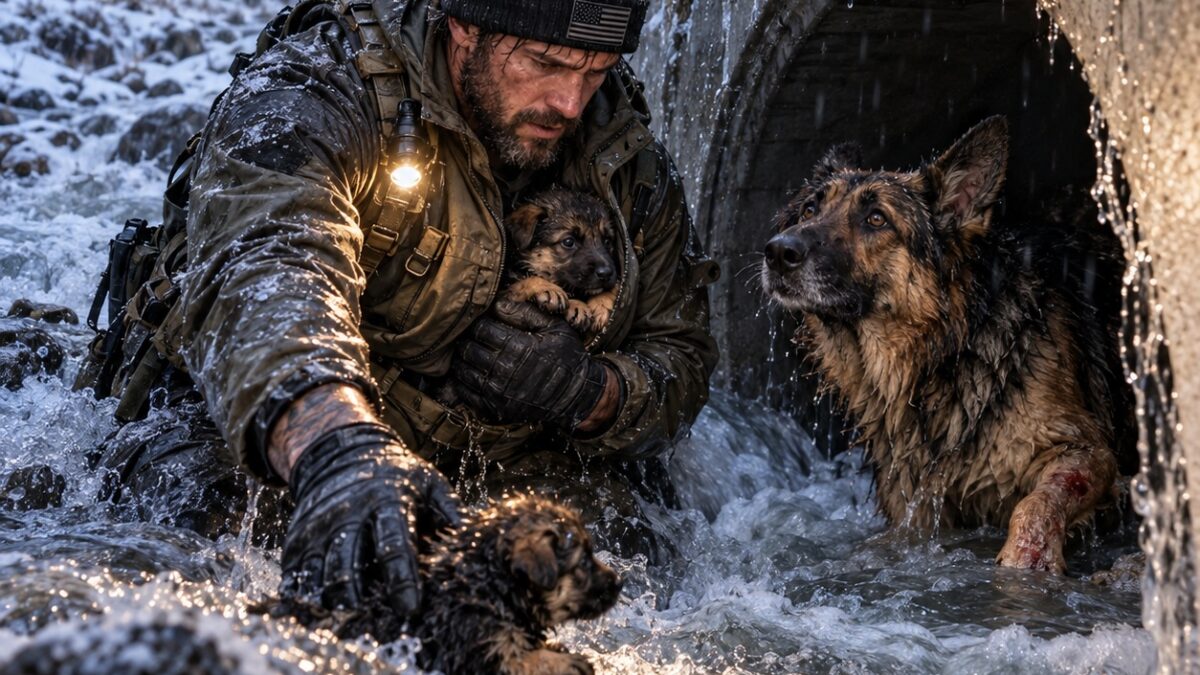
PART 2 and FULL ENDING  Thank you

The mudroom stopped looking like part of a house I was preparing to sell within twenty minutes.
I covered the tile with every old towel I could find.
Dragged an electric heater in from the garage.
Built a shallow nest out of a wooden produce crate and two fleece blankets from the hall closet.
The puppies went beside the heater.
Not directly in front of it.
I knew enough about cold exposure not to cook an animal back to normal temperature.
Slow.
Controlled.
Watch the breathing.
Watch the gums.
Watch the response.
The larger puppy stopped shivering violently after about fifteen minutes.
The smaller one worried me.
She barely reacted when I wrapped her.
Her breath carried a faint wet rasp.
I held her inside my sweatshirt against my chest while the mother stood so close her nose touched my wrist.
Every few seconds, she checked the puppy.
Then checked me.
I had spent most of my adult life around people who wanted to know where authority came from.
Rank.
Training.
Position.
This dog wanted evidence.
What would my hands do?
That was all.
When I moved carefully, she allowed me closer.
When I carried the puppy two feet away to warm another towel, the mother stood.
When I returned the puppy immediately, she lowered herself again.
No blind trust.
No panic.
Assessment.
That caught my attention.
Most exhausted dogs I had seen during rescue or disaster responses fell into one of two patterns.
Collapse.
Or chaos.
This one did neither.
Her fear had structure.
Around eleven, I opened a can of plain chicken I found in the pantry.
Mixed small pieces with warm water.
Set the bowl several feet from the crate.
The German Shepherd smelled it instantly.
Hunger sharpened her entire body.
She crossed the room.
Ate three bites too quickly.
Stopped.
Looked toward the puppies.
The male moved.
She abandoned the food and returned to him.
“You know they’re still there.”
I said.
She ignored me.
After checking both, she went back to the bowl.
Another few bites.
Then her head snapped toward the back door.
She stood there.
Staring through the glass.
Rain and snow moved beyond the porch light.
I watched her.
She scratched the floor.
Three times.
Scratch.
Scratch.
Scratch.
The same rhythm I had heard through the storm.
“You want out?”
Her ears shifted.
I opened the curtain wider.
The timber beyond the yard disappeared into darkness.
The dog leaned toward the door.
She was exhausted enough that her injured leg trembled.
Still, she wanted outside.
“No.”
I said.
“Whatever you think you need to do out there can wait.”
She looked at me.
Then toward the woods.
Back to me.
I had spent years learning to recognize the difference between fear and intention.
This was intention.
That bothered me.
A mother in her condition should have been unwilling to leave those puppies.
Her entire biology should have been pulling her inward.
Warmth.
Milk.
Protection.
Instead, every few minutes, something pulled her toward the forest.
I checked the puppies again.
The little female’s breathing was still shallow.
The male had enough energy to push his oversized paws into his sister whenever she stole his warmth.
Good.
Annoying was good.
At two in the morning, I sat against the washing machine holding the little female.
The German Shepherd lay beside the crate.
Eyes open.
The rain had eased slightly.
My phone sat facedown beside me.
Sale paperwork waited on the kitchen counter.
Realtor expected my signature.
Leave clock running.
I had come to Idaho to close one chapter cleanly.
Temporary problems were comfortable.
You entered.
Did what was required.
Handed responsibility to the right people.
Left.
That was what I told myself would happen here too.
Morning.
Veterinarian.
Shelter.
Done.
The smaller puppy shifted against my chest.
I looked down.
Then toward the dog.
She was staring at the door again.
For the first time since my father died, I wondered whether Dad would have laughed at the idea that I thought any of this was temporary.
Thomas Miller collected unfinished responsibilities the way some men collected tools.
A widow needed firewood.
He delivered it.
A neighbor’s truck would not start.
Dad appeared with jumper cables.
Storm washed out somebody’s fence.
He fixed it and refused money.
I used to tell him he made too many things his problem.
He would shrug.
“Problem’s already there.”
He once said.
“Me noticing it doesn’t create it.”
At sixteen, I thought that was sentimental nonsense.
At thirty-seven, holding a half-frozen puppy in a house I was trying to sell, it sounded less stupid.
Just before dawn, the German Shepherd finally slept.
Only twenty minutes.
Maybe thirty.
Her head rested beside the crate.
One paw touching the male puppy’s back.
The other injured paw tucked beneath her chest.
When she woke, she immediately looked at the door.
I called the first veterinary clinic that answered.
North Lake Veterinary Center.
The woman on the phone heard the words:
Five-week-old puppies.
Cold exposure.
Wet respiratory sound.
Nursing mother.
Then told me to come immediately.
Forty minutes later, I carried both pups through a side entrance while the shepherd limped close enough that her shoulder brushed my knee.
Dr. Emily Carter met us in a heated examination room.
She was the kind of veterinarian I liked immediately.
No unnecessary alarm.
No fake reassurance either.
She examined the smaller puppy first.
Stethoscope against the tiny chest.
Longer than I wanted.
“She’s still too cold.”
Emily said.
“And I’m hearing early congestion.”
“How bad?”
“Not pneumonia yet.”
“Yet?”
“She inhaled cold water or spent long enough in wet conditions that we have to watch it.”
“She needs warmth.”
“Fluids.”
“Close monitoring.”
The larger male was dehydrated.
Otherwise stronger.
He protested the thermometer hard enough to make Emily smile.
“That one’s angry.”
“Good.”
“Very.”
Then she examined the mother.
Under the wet coat, the weight loss was worse than I realized.
Worn pads.
Two cracked nails.
Fresh tear on the front paw.
Abrasions.
Nothing that looked deliberately inflicted.
That was a relief.
But the damage told another story.
Distance.
“This dog has been traveling.”
Emily said.
“More than a nursing mother should.”
No collar.
No tag.
No chip.
Teeth put her around four.
The shepherd tolerated the exam with unnatural stillness.
Not frozen.
Cooperative.
Emily ran a hand over her ribs.
The dog remained motionless until the male puppy squeaked.
Then her head turned immediately.
“Someone worked with her.”
I said.
Emily looked up.
“You noticed too?”
“She isn’t just used to people.”
“She understands expectation.”
As if the dog wanted to prove it, Emily caught the edge of a metal tray with her sleeve.
An instrument clattered across the floor.
The shepherd stepped toward it.
“Leave it.”
I said automatically.
She froze.
Front paw suspended.
Eyes directly on my face.
Emily stopped moving.
I lowered my voice.
“Stay.”
The dog remained.
I waited two seconds.
“Come.”
She crossed the room.
Stopped beside my left leg.
I felt something tighten behind my ribs.
I tried two more simple commands.
Not military precision.
But immediate enough that coincidence disappeared.
Emily folded her arms.
“That isn’t accidental.”
“No.”
“Working dog?”
“Not military level.”
“Maybe private obedience.”
“Search training?”
“Farm work?”
“Protection foundation?”
“Something.”
Emily looked at her condition.
“That makes this more complicated.”
It did.
A trained dog does not simply materialize half-starved in a flooded culvert with two nursing puppies without a story.
Emily wanted to keep the little female for several hours.
When a technician lifted her, the mother went rigid.
Low sound deep in her chest.
No lunge.
No teeth.
Warning.
I stepped beside her.
“Easy.”
She looked at me.
Then the puppy.
Emily watched.
Changed the plan.
They arranged a warm recovery area where the mother could remain close enough to see both puppies.
I stayed too.
While Emily finished paperwork, she mentioned something almost casually.
“County shelter has been calling clinics.”
“What about?”
“One of their employees didn’t show up.”
“Two days.”
I looked up.
“Megan Parker.”
Emily slid a bulletin across the counter.
Forty-six.
Dark blonde hair.
Green eyes.
Lean face.
North Idaho Animal Haven ID photo.
“Dependable.”
Emily said.
“Apparently almost annoyingly so.”
“Bad weather, so everyone assumed roadside trouble at first.”
“They still haven’t found her vehicle.”
I looked at the bulletin.
Then through the glass toward the German Shepherd.
The timing sat in my mind.
I refused to turn it into anything more.
Coincidence is not evidence.
That rule keeps people from seeing stories where only facts exist.
Still—
I remembered the dog standing at my back door.
Near four in the afternoon, Emily let us go.
The smaller puppy’s temperature was up.
Congestion still mild.
Medication.
Feeding schedule.
Return immediately if breathing worsened.
On the drive back, wet snow streaked across the windshield.
I realized I needed a name for the mother.
“The dog” sounded ridiculous.
“Mother” sounded clinical.
When we reached the cabin, she paused at the doorway until both puppies were inside.
“Sadie.”
I said.
No reason.
The word simply arrived.
She looked back.
I almost smiled.
“All right.”
“Sadie until somebody tells me otherwise.”
I refused to name the puppies.
Names felt like a step beyond temporary.
That lasted roughly six hours.
Sadie ate half her dinner.
Then stopped.
Walked to the back door.
Three scratches.
I opened the curtain.
Darkness.
Snow.
Rain.
“Nothing useful happens out there tonight.”
I told her.
Sadie checked the puppies.
Lay down.
One hour later—
door again.
Puppies.
Door.
Forest.
Puppies.
Forest.
By dawn, I stopped calling it restlessness.
She was rationing energy.
She ate enough.
Rested enough.
Then faced the woods.
Why?
On the third morning, the larger puppy had become impossible to call anything except Milo.
He pushed into everything with his head first.
The smaller female seemed like Lucy.
Quieter.
Watchful.
I hated how natural the names felt.
Sadie stood over breakfast.
Ate four fast bites.
Stopped.
Looked at Milo.
Lucy.
Door.
Back to food.
Then walked away.
She was saving herself for something.
I finally surrendered to the obvious.
Lucy was stable.
Warm.
Milo had enough energy to destroy a towel.
I arranged food.
Heat.
Water.
Emily’s instructions taped to the refrigerator.
Then I packed.
First-aid kit.
Thermal blanket.
Radio.
Flashlight.
Rope.
Gloves.
Utility tool.
I told myself this was not a mission.
Training did not care what I called it.
Sadie stood at the door before I finished putting on my shell.
Outside, she moved downhill.
Fast.
I expected her to bolt.
She did not.
Forty yards down the slope, she stopped.
Looked over her shoulder.
Waited.
When I reached her, she continued.
That erased the last question.
She was taking me somewhere.
The route moved away from the county road.
Into flooded timber.
Brown water ran between trunks.
Sadie picked paths with certainty.
She avoided submerged washouts before I could see them.
Crossed an old logging track.
Slipped beneath a fallen wire fence.
Then stopped.
Waited for me again.
She rarely sniffed for direction.
That mattered.
A dog searching tests possibilities.
Sadie was following memory.
An hour from the cabin, she left the logging road.
Climbed toward a bend in the hillside.
I saw tire tracks first.
Two deep grooves.
Across slush.
Over the shoulder.
Below us, a dark pickup sat angled against cedar trees.
Thirty feet down.
Front buried in branches.
Rear wheel suspended.
I scanned.
No movement.
Descended.
Driver’s door open.
No one inside.
Back seat:
Wool blanket.
Open dog food.
Plastic containers with North Idaho Animal Haven logos.
Rear footwell:
Cardboard transport crate.
Torn open from inside.
Sadie stiffened.
Sniffed the box once.
Turned toward the forest.
I searched the cab.
A purse under the passenger seat.
Identification.
Megan Parker.
Same face as the bulletin.
Coincidence collapsed.
The truck was hers.
I checked for phone.
None.
Coat.
Missing.
Airbag deployed.
Smear along lower door.
Mud.
Possibly blood.
Outside, the rain had damaged most tracks.
Not all.
A shallow drag line.
Partial boot impression.
Somebody had left the vehicle alive.
Maybe injured.
I radioed.
Static.
Climbed for signal.
Tried again.
County dispatch came through broken.
I identified myself.
Reported crash.
Possible missing adult.
Coordinates approximate.
Road access delayed.
Washout.
Weather incidents across county.
No immediate rescue team.
That changed nothing about the person who might still be out there.
Sadie paced near the truck.
Then moved toward the trees.
“Wait.”
She stopped instantly.
Looked at me.
That obedience unsettled me now.
Injured.
Underfed.
Puppies miles away.
Still she listened.
Still she needed to continue.
I placed Megan’s identification inside my jacket.
“Okay.”
“Show me.”
Sadie led downhill.
Then I began seeing the route.
Canine tracks.
Human impressions.
Rain-damaged.
The dog tracks went both directions.
Back to truck.
Away.
Back.
Away.
Farther on, another set cut toward the drainage corridor below my father’s property.
I saw the story.
Sadie had escaped the crash.
Carried the puppies away.
Found the culvert.
But she had not stayed there.
She had traveled between two points.
Puppies at one.
Something else at the other.
For two days.
A nursing mother had turned herself into a shuttle.
Protect one.
Return.
Protect the other.
Return again.
The terrain steepened beneath cedars.
Snow collected on Sadie’s back.
She stopped so abruptly I nearly stepped into her.
Ears forward.
Body transformed.
Then she barked once.
Sharp.
Sadie plunged through brush.
“Sadie!”
No response.
I followed.
Slid.
Caught a tree.
Listened.
Water.
Rain.
Then—
human sound.
Weak.
Not words.
An attempt at one.
I froze.
There again.
Sadie had disappeared twenty feet below.
I pushed through.
A blue tarp appeared between two trees.
Collapsed under water and snow.
Beneath it—
a woman.
Curled against a cedar trunk.
Pale skin gray from cold.
Wet dark-blonde hair.
One leg extended unnaturally.
Sadie reached her first.
Pressed her entire body against the woman’s side.
The woman’s hand moved weakly.
Into Sadie’s fur.
“You came back.”
Megan whispered.
There was relief in the words.
Not surprise.
I dropped beside her.
“Ryan Miller.”
“Can you hear me?”
Her eyes moved toward me.
“Yes.”
“Good.”
Breathing.
Pulse.
Mental status.
Cold exposure.
Leg injury.
She was shivering too little.
That concerned me.
Violent shivering means the body is still fighting hard.
When severe cold steals that response, the situation worsens.
I wrapped her in the thermal blanket.
Dry layer over shoulders.
Checked the injured leg without moving it unnecessarily.
Swelling.
Possibly fracture.
Unable to walk.
Water only after I knew she could swallow safely.
Megan ignored every question at first.
“The puppies?”
“They’re safe.”
“Both?”
“Yes.”
“Warm.”
“Seen by a veterinarian.”
“Both?”
I understood.
“Both.”
Only then did her face loosen.
She closed her eyes for several seconds.
“Thank God.”
Sadie pressed closer.
I asked:
“What happened?”
The story came slowly.
Two months earlier, North Idaho Animal Haven received a call.
Pregnant German Shepherd near an abandoned service station.
Thin.
Cautious.
Gentle.
No chip.
No collar.
No owner.
Shelter full.
Megan fostered dogs.
Sadie went home with her.
“She knew commands immediately.”
Megan whispered.
“Not tricks.”
“Real obedience.”
“Somebody trained her.”
A few weeks later—
two puppies.
Megan smiled weakly.
“Male is Milo.”
“Little girl’s Lucy.”
I stared.
“What?”
“Milo and Lucy.”
I almost laughed.
Of every name I could have chosen.
Same two.
For once, coincidence felt allowed to remain strange.
Megan had been driving them to the veterinarian before the weather worsened.
Rear tires lost traction.
Truck slid.
Impact.
She woke with her right leg trapped.
Freed herself.
Could not climb back to road.
The transport box tore open.
Sadie escaped.
But instead of running—
she returned.
Took Milo by the scruff.
Carried him uphill.
Disappeared.
Came back alone.
Then took Lucy.
Megan had no idea where.
Hours later, Sadie returned.
No puppies.
Soaked.
Lay against Megan for warmth.
Then left again.
Returned.
Left.
Returned.
At one point, she brought a torn food wrapper from the truck and dropped it near Megan.
Another time, mud covered her nearly to the chest.
She was crossing flooded ground.
“I kept telling her to stay with the puppies.”
Megan said.
Her voice cracked.
“She wouldn’t.”
I looked at Sadie.
Her head rested against Megan’s hip.
“She wasn’t choosing.”
I said.
Megan’s eyes filled.
“No.”
“She kept trying to save all of us.”
Second night.
Megan weakened.
Stopped responding normally.
Sadie stayed longer.
Licked her face.
Whined.
Then disappeared farther than before.
Expanded the search.
Found the culvert.
Saw something beyond it.
The porch light.
My father’s cabin.
Sadie scratched until somebody heard.
Then after I took the puppies in, she tried to go back.
Every look at the forest.
Every unfinished meal.
Every three scratches.
Not anxiety.
Message.
Someone else.
Still out there.
I radioed again from higher ground.
Better signal.
Gave exact condition.
Coordinates.
Safer approach.
Rescue team coming.
Delayed but moving.
I did not attempt to carry Megan out.
Leg risk.
Terrain worse.
Weather unstable.
Being capable of movement does not make movement smart.
So I did the less satisfying thing.
Waited.
Kept her warm.
Kept her awake.
Sadie lay beside her.
Every few minutes, though, the dog lifted her head toward the direction of the cabin.
Puppies miles away.
Megan beneath her nose.
Still accounting for both.
When rescue crews finally appeared through the trees, Megan reached for Sadie before she allowed anyone to move her.
“Go with him.”
She whispered.
Sadie stayed beside the litter while they secured Megan.
Followed as far as terrain allowed.
Then stopped.
Looked at me.
I understood.
“Come on.”
“We’re going home.”
By evening, Megan was at the hospital.
Stable.
Hypothermia.
Leg injury.
Expected to recover.
Sadie and I returned to the cabin.
The moment the door opened, Milo launched toward his mother with an offended squeak.
Lucy raised her head.
Pressed into Sadie’s chest.
Sadie checked them both.
Nose.
Ears.
Belly.
Then she did something she had not done since I found her.
She ate an entire meal.
Did not stop once.
Later, I stepped onto the porch.
Heavy wet snow moved across the yard.
The forest blurred.
Above me, Dad’s yellow porch light burned.
I stared at it.
Thomas left that light on during storms every winter.
Even when no one used that road.
I argued with him as a teenager.
“Waste of electricity.”
“Nobody’s out there.”
Dad always gave the same answer.
“If somebody’s lost, a light matters.”
I looked through the window.
Sadie had fallen asleep beside Milo and Lucy.
For the first time, I understood.
She had crossed flooded woods.
Injured.
Starving.
Carrying puppies.
Somewhere through rain, she saw a point of yellow.
Not proof.
Possibility.
People might be there.
Shelter might be there.
A door might open.
Dad had kept the light on for years.
The night it mattered most, he had already been dead eight months.
That unsettled me more than I wanted to admit.
The storm weakened by morning.
Cold remained.
I stood under the porch light with coffee.
Stared at it again.
Inside, Sadie slept deeply.
Milo crawled over her foreleg whenever he wanted milk.
Lucy remained weaker.
But nursing.
That was enough.
For now.
I forced myself back to the reason I came.
Boxes.
Sale.
I carried another carton toward the garage.
Saw Dad’s gloves.
Workbench.
Chipped thermos.
The sale documents still sat on the kitchen counter.
Unsigned.
I told myself nothing had changed.
Then Jack Lawson knocked.
Dad’s closest neighbor.
Sixty-five.
Tall.
Lean.
Gray beard.
Carpenter’s hands.
I remembered him from the funeral.
He carried a small wooden box.
“Your dad asked me to hold this.”
I looked at it.
“Said I’d know when to bring it.”
“You know now?”
Jack glanced through the window at Sadie.
“Seems close enough.”
We sat at the kitchen table.
I expected legal papers.
Money.
Maybe photographs.
Instead:
Drawings.
Measurements.
Receipts.
Pictures of Dad’s detached workshop.
Plans.
Insulation.
Drainage.
Washable floor.
Ventilation.
Secure kennels.
Heater.
Food storage.
Emergency veterinary supplies.
At the top of one page, in Dad’s handwriting:
WINTER ANIMAL OVERFLOW — TEMPORARY ONLY.
I read it twice.
“What is this?”
Jack leaned back.
“Your father’s next project.”
The local shelter ran out of safe space during storms.
Foster homes became inaccessible.
Roads closed.
Animals found overnight sometimes had nowhere warm to go.
Dad wanted to convert his workshop into temporary emergency holding.
Not another shelter.
A bridge.
One night.
Two days.
Until roads reopened.
Until foster placement.
Until proper care.
I turned another page.
Photo.
Dad in the workshop.
Hair almost white.
Pencil behind ear.
Awkward smile.
I felt anger.
Immediate.
Unfair.
“Why didn’t he tell me?”
Jack did not defend him quickly.
“He talked about it.”
“Not in a way that asked anything from you.”
“That isn’t the same.”
“No.”
Jack said.
“Your dad knew your work.”
“Knew you’d be gone.”
“Knew when you came home you were already splitting yourself between family and whatever came next.”
“He never wanted this cabin to feel like another person waiting with a list.”
That hurt worse than blame.
I could defend myself against accusation.
I had reasons.
Deployments.
Training.
Unpredictable orders.
Calls I planned to return.
Holidays I missed.
Flights delayed.
But kindness?
Dad had understood.
He had been proud.
He simply built a life around my absence instead of demanding I fix it.
I stared at the plans.
Realized I knew less about the last eight months of his life than half the county.
Megan called that afternoon.
Hospital.
Stronger voice.
Angry they were keeping her another night.
Good sign.
First question:
“Sadie?”
“Sleeping.”
“Milo?”
“Destroying towels.”
“Lucy?”
“Stable.”
I told her about Dad’s plans.
She went quiet.
Then explained North Idaho Animal Haven’s winter problem.
Exactly what Jack had said.
Not failing.
Just full.
Weather magnified every weakness.
A temporary heated space outside town?
Useful.
Potentially very useful.
“I’m not running an animal shelter.”
I said.
Megan almost laughed.
“Nobody asked you to.”
“Shelter handles intake.”
“Records.”
“Placements.”
“Volunteers.”
“The building is the missing piece.”
After we hung up, I left Dad’s drawings on the table.
I did not put them back in the box.
That mattered.
For the rest of the day, I kept checking things.
Workshop roof.
Heater line.
Flooring.
Drainage.
At one point, tape measure in hand, I stopped.
I was planning repairs to a house I was selling.
I hated that.
Logic still existed.
Navy career.
Deployments.
Training.
Short-notice tasking.
I could fund something.
I could not promise daily presence.
Responsibility, in my head, meant personally carrying what I accepted.
Sadie complicated that assumption.
She slept now because I was taking care of what she could not.
Emily had taken care of Lucy.
Rescue crews took Megan.
One being did not carry everything.
Maybe Dad understood that.
Maybe the workshop was never about Thomas saving every animal.
Maybe it was about creating one useful place and letting other people keep the light on.
Then Lucy coughed.
Small.
I heard it from the kitchen.
By the time I reached the mudroom, her breathing had changed.
Rapid.
Shallow.
More effort.
She refused to latch when Sadie nudged her.
I lifted her.
Heat radiated through her fur.
Fever.
My stomach dropped.
I called Emily while pulling on boots.
The freezing rain had returned.
Lucy went into a blanket beside me.
Sadie stood at the doorway.
Rigid.
Watching.
“I’m bringing her back.”
I told her.
I had no idea why I felt the need to explain myself to a dog.
Maybe because she had spent two days returning for everyone she loved.
Leaving mattered to her.
I drove.
Porch light shrinking behind me.
Ice forming on road.
North Lake’s parking lot was black glass by the time I arrived.
Emily waited outside.
One look at Lucy and her careful optimism disappeared.
Oxygen enclosure.
Warmth.
Examination.
Pneumonia.
Advanced faster than expected.
“The next few hours matter.”
Emily said.
I stood there dripping water.
Watching Lucy’s ribs rise behind clear plastic.
There was nothing useful for me to do.
I hated that.
My entire professional life had been built around usefulness.
Problem.
Task.
Action.
Here?
Emily had the medicine.
Lucy had the fight.
My role was sitting.
Jack arrived twenty minutes later.
Sadie and Milo with him.
Emily created a recovery space where Sadie could see Lucy.
Milo went into a heated kennel and immediately started chewing the blanket.
Sadie lay facing Lucy’s oxygen enclosure.
She did not take her eyes off her.
Every time Lucy moved—
Sadie’s head lifted.
I understood her.
After the crash, Sadie solved problems by moving.
Carry Milo.
Return.
Carry Lucy.
Return.
Find Megan.
Find us.
Lead me back.
Motion was agency.
Now?
Nothing to carry.
Nowhere to run.
Trust somebody else.
She hated it.
So did I.
Hours passed.
Oxygen fogged faintly against the enclosure.
I sat in a metal chair.
Elbows on knees.
Training teaches you structure for uncertainty.
Contingency.
Alternate route.
Extraction plan.
Backup.
Lucy offered none.
She weighed a few pounds.
Did not know what pneumonia was.
Did not understand oxygen.
She kept breathing because her body had not agreed to stop.
One breath.
Another.
Make the next movement.
That was what instructors used to tell us.
Do not solve the entire evolution.
Next movement.
Lucy’s version was smaller.
Next breath.
Near midnight, my phone vibrated.
Calendar reminder.
FOUR DAYS UNTIL RETURN TO DUTY.
I stared.
Four days.
Then training.
Travel.
Potential tasking.
Idaho becoming weather on a screen again.
Sadie.
Milo.
Lucy.
Workshop.
Dad’s plans.
Something ugly formed inside me.
This had been a mistake.
Not rescuing them.
Never that.
Making them personal.
That was the mistake.
I knew how to enter a crisis.
Solve what I could.
Hand it off.
Leave.
Clean.
Attachment was not clean.
Attachment made promises without checking your orders.
I thought about keeping Sadie.
Immediately rejected it.
What kind of owner disappeared for months?
I thought about the cabin project.
Rejected that too.
What kind of person builds something he cannot run?
My whole life had been shaped around avoiding promises duty could break.
Jack returned after one in the morning.
Two coffees.
Dry sweatshirt.
He handed me both.
Sat beside me.
We watched Lucy.
Finally I said:
“I’m not the right person for this.”
Jack glanced at Sadie.
Then me.
“For sitting in a chair?”
“Anything that needs me to stay.”
He waited.
I explained.
Deployments.
Absences.
Training blocks.
Orders.
No schedule.
Jack listened.
Then asked:
“How many times did your dad call when you were overseas?”
I looked at him.
“And you told yourself you’d call back when things slowed down?”
That irritated me.
Because I knew.
Sunday.
Then Monday.
After exercise.
After travel.
Most calls happened.
Some did not.
I had always treated postponement as harmless because future time felt guaranteed.
Jack wrapped both hands around the coffee.
“You keep treating tomorrow like somebody signed a contract for it.”
I looked through the glass at Lucy.
“That’s not fair.”
“No.”
Jack said.
“It probably isn’t.”
Then:
“You think if you can’t promise something ten years, you shouldn’t promise it ten minutes.”
I stared at him.
Jack nodded toward the puppy.
“She doesn’t need ten years from you tonight.”
“She needs tonight.”
The sentence landed exactly where I did not want it.
My distance had always sounded disciplined.
Responsible.
Do not promise what you cannot deliver.
Good principle.
But maybe sometimes it was fear wearing professional language.
If nothing belonged to me—
leaving could not become abandonment.
If I never committed to a future—
duty could not take the future away.
Efficient.
Also lonely.
Around four-thirty, Emily adjusted Lucy’s support.
Her face told me before the words.
Better.
Not safe.
Better.
Temperature moving correctly.
Breathing steadier.
We waited.
Just after five, Lucy lifted her head.
Small.
Barely.
I almost convinced myself I imagined it.
Emily offered water.
A few laps.
Rest.
Another lift.
Toward Sadie.
They allowed a supervised reunion.
Sadie approached the enclosure.
Slow.
Nose working.
Lucy pressed toward her.
Then started nursing.
I turned toward the window.
Dawn was gray behind ice.
My eyes burned.
I blamed exhaustion.
Nobody argued.
By the time we returned to the cabin, the storm had finally started loosening.
Lucy still needed monitoring.
Medication.
Warmth.
But she had crossed the worst part.
Sadie slept near the heater.
Lucy followed Milo in slow, stubborn steps.
The house was full of tiny signs of life.
Bowls.
Blankets.
Mud.
Medication sheet.
One chewed towel.
I looked at the sale documents.
They suddenly seemed ridiculous.
Megan came two days after leaving the hospital.
Crutches.
Rigid leg brace.
Color back in her face.
Sadie heard her voice before she entered.
The shepherd rose so quickly Milo rolled sideways.
Megan came into the mudroom.
Sadie crossed the room.
Pressed her whole body against Megan’s good leg.
Megan lowered herself awkwardly.
Buried both hands in Sadie’s fur.
Neither made a sound.
I stood back.
Understood something.
Megan had taken Sadie in when the dog had nowhere.
Then Megan became helpless.
Sadie returned the kindness with everything she had.
No contract.
No guarantee.
No calculation about ten years.
Just:
You helped me.
Now I am here.
After the reunion, I put Dad’s drawings on the kitchen table.
“I’m keeping the cabin.”
Megan looked at me.
I continued before I could reconsider.
“I’ll pay for the workshop repairs.”
“Emergency foster space.”
“Temporary.”
“But I’m not operating it.”
“I can’t.”
“Navy stays Navy.”
“If this depends on me being here every day, it fails.”
Megan studied the plans.
Then said:
“Then don’t make it yours.”
I frowned.
“The shelter can manage records.”
“Intake.”
“Volunteers.”
“Placement.”
“You provide the space.”
“Community provides the rest.”
“If this works because of you alone, it dies when your orders change.”
There it was again.
Responsibility did not always mean doing everything yourself.
Jack came over that afternoon.
Tools.
Before I officially asked.
Within one day, he removed warped wall paneling and found electrical work that needed replacement.
Emily offered two used kennels from the clinic.
Bowls.
Washable mats.
Then people started arriving.
I had not invited them.
A retired mechanic with shelves.
A woman with blankets.
Food.
A portable heater.
Lumber.
Insulation.
Noah Briggs showed up with a trailer.
Fifty-four.
Contractor.
Thick arms.
Gray beard.
He unloaded materials.
“Your dad pulled my truck out of a snowbank years ago.”
I looked at the lumber.
“Did he charge you?”
Noah laughed.
“Said I could pay him by helping somebody else.”
He set another board down.
“Looks like somebody else finally showed up.”
Story after story came with the materials.
Dad fixed a generator.
Dad repaired steps.
Dad carried firewood.
Dad drove someone to the hospital.
Dad watched a dog for three days when the owner was stranded out of town.
I had known my father was dependable.
I had not understood the size of his footprint.
For years, I measured my absences as evidence of what I failed to give him.
Now I saw something else.
Thomas had not spent those years waiting.
He lived.
Built.
Helped.
He was not a lonely father frozen in the moments his son missed.
That mattered.
The next morning, I called the realtor.
Cancelled the sale.
No speech.
No cinematic certainty.
One changed document.
Phone call.
Done.
Something inside me settled.
The workshop needed a name.
Megan suggested one.
“The Miller Light.”
“No.”
Jack immediately said:
“Yes.”
“It sounds like a monument.”
Megan pointed toward the porch.
“It’s your father’s idea.”
“Not your ego.”
I still disliked it.
I lost.
The sign went up beneath the workshop eaves.
THE MILLER LIGHT.
First winter plan:
Emergency foster referrals only.
Short term.
Written procedures.
Vet contacts.
Backup volunteers.
No improvising the organization just because the idea felt good.
Megan watched me making checklists.
“There’s the Navy part.”
“That part isn’t going anywhere.”
Milo’s future started forming.
North Idaho Animal Haven found a couple outside town.
Fenced acreage.
German Shepherd experience.
Interested once he was old enough and medically cleared.
I asked so many questions Megan eventually smiled.
“What?”
I said.
“You care who gets him.”
“Obviously.”
“You were the one who refused to name him.”
“That was before he destroyed three towels.”
“Attachment through property damage.”
“Effective strategy.”
Lucy created her own future.
Emily tried to describe her interest as medical.
Nobody believed her after she showed up carrying a puppy-sized bed she claimed the clinic “didn’t need anymore.”
Lucy climbed into her lap five minutes later.
Megan looked at me.
I looked away.
“There are worse outcomes.”
I said.
Sadie was different.
Nobody filled out an application.
Nobody discussed placement.
Because everybody saw what I was refusing to say.
When I worked in the workshop—
Sadie lay near the door.
When I walked to the cabin—
she followed.
When I sat outside—
she settled beside my boot.
One afternoon, Megan said:
“You know what she’s doing.”
“Knowing isn’t the problem.”
“What is?”
“Staying.”
The night before I had to return to duty, the weather finally cleared.
Snow covered the road.
Forest silent.
The new Miller Light sign hung beneath the workshop eaves.
The sale cancelled.
Project underway.
Milo had a likely home.
Lucy had apparently adopted her veterinarian.
Sadie remained the decision.
Megan listened to every reason I gave.
Deployments.
Training.
Travel.
Absence.
When I finished, she said:
“Sadie learned how to wait for you before you even knew her.”
I had no answer.
That night, I sat on the porch.
Sadie opened the door behind me.
Crossed the boards.
Lay beside my boot.
Yellow porch light above us.
She asked nothing.
That made it worse.
Morning came clear and bitter.
I packed the truck.
Jack shook my hand.
“Roof will still be standing when you get back.”
Megan promised not to let Milo destroy expensive materials.
Emily held Lucy.
The puppy chewed her coat zipper.
I climbed into the truck.
Then saw Sadie coming down the porch steps.
“Stay.”
She stopped.
Half a second.
Then took two more steps.
I almost repeated the command.
Stopped.
Got out.
Crouched in the snow.
One knee down.
Hand against the side of her neck.
Sadie stared at me.
For years I avoided promises unless I could control the conditions.
Dates.
Weather.
Orders.
Circumstances.
This promise was different.
It did not guarantee any of those.
It guaranteed intention.
“I’m coming back.”
Sadie held my eyes.
Then turned.
Walked to the porch.
Sat beneath the yellow light.
I got in.
Drove away.
Watched her in the mirror until the trees took her.
Six weeks later, I returned.
January.
Dry snow.
Clear roads.
Different feeling in my chest.
The Miller Light was finished.
Insulated.
Heated.
Washable floor.
Secure kennels.
Shelves.
Food.
Blankets.
Emergency supplies.
Not large.
That was part of why it worked.
It was not pretending to solve every animal-welfare problem in northern Idaho.
It solved one.
Where does a stranded animal stay tonight?
Megan was back at work.
No crutches.
Slight stiffness when tired.
Desk near the entrance.
Jack still checked the heater too often.
Milo had already gone to his new family’s farm property after clearance.
They sent photographs.
He looked enormous.
Happy.
Lucy went home with Emily.
Nobody was surprised.
I arrived at the final bend before the cabin.
Sadie heard the truck first.
Megan saw her rise from the porch.
Did not call.
Sadie came down the steps.
The truck stopped.
I opened the door.
She ran across packed snow.
I braced for impact.
She stopped several feet away.
That hurt more than if she had jumped.
For one second, Sadie stared.
Rigid.
Ears forward.
Checking.
Was I real?
Or another temporary person?
I lowered myself to one knee.
“Hey, Sadie.”
That was enough.
She crossed the distance.
Pressed her head hard against my chest.
I wrapped both arms around her.
Did not care who watched.
Did not calculate what it meant.
The answer had already happened.
When I stood, she remained against my leg.
I looked at the cabin.
Workshop.
Footprints across snow.
People.
Dogs.
Home had always been an address in my head.
Something you owned.
Maintained.
Left.
Returned to when schedule allowed.
That afternoon, for the first time, it felt different.
Home was something waiting.
Not helplessly.
Not accusingly.
Simply holding a place.
That evening, everyone left before the temperature dropped.
Jack checked the heater twice.
Megan finished the next week’s intake schedule.
Emily drove back with Lucy.
Milo was at his new home.
I ate dinner alone.
But the cabin did not feel empty.
Sadie slept near my chair.
One amber eye opened whenever I moved.
After dinner, I stepped onto the porch.
Light snow fell.
Soft.
Dry.
Nothing like the freezing rain from six weeks earlier.
I thought about Megan beneath the cedars.
Sadie traveling that impossible route.
Puppies in floodwater.
Lucy fighting for one more breath.
Dad leaving the porch light on for roads everyone else thought were empty.
None of it looked like a miracle while it happened.
That is something people get wrong.
Miracles, if they exist, rarely feel miraculous from inside the moment.
They feel cold.
Exhausting.
Inconvenient.
Uncertain.
A wet dog scratches.
A neighbor brings lumber.
A veterinarian stays late.
A man sits beside a puppy because there is nothing else he can do.
Ordinary people refuse to walk away.
That is what it looks like.
I reached toward the porch light switch.
Old habit.
Nobody on the road.
No point wasting electricity.
My fingers touched it.
Stopped.
Dad’s voice came back.
If somebody’s lost, a light matters.
I looked toward the Miller Light.
Small sign under the workshop eaves.
Maybe Dad never meant only navigation.
Maybe a light says:
There is still somewhere to go.
There is still a door that might open.
The road has not closed.
I left the switch alone.
Opened the cabin door.
Sadie stood immediately.
Followed me inside.
The yellow light remained behind us.
Steady against the snow.
Years later, people still told the story differently than I did.
They liked the beginning.
Navy SEAL crawls into flooded culvert.
Mother dog “begs” him to save puppies.
He says:
“I’ve got them.”
It makes a good story.
I understand.
But that was not the part that changed me.
The part that changed me came later.
Sadie standing at the back door.
Leaving food unfinished.
Willing to walk away from her puppies because someone else still needed her.
Dad’s drawings.
Lucy’s oxygen enclosure.
Jack telling me ten years did not matter when something needed me for ten minutes.
Megan telling me not to build something dependent on me.
Sadie sitting beneath the porch light while I drove away.
Those things changed the way I understood duty.
I used to believe duty meant being the person who carried the weight.
You train.
Prepare.
Stay useful.
Do not become a burden.
If something is yours—
you carry it.
That mindset served me well.
Saved my life.
Probably saved other people’s.
It also made me terrible at accepting any responsibility I could not personally control.
A dog?
What if I deploy?
A cabin?
What if I am gone?
A community project?
What if I cannot manage it?
A relationship?
What if duty pulls me away?
So I avoided promises.
Called it discipline.
Sadie did not have that luxury.
She had puppies.
She had Megan.
She had one injured paw.
One exhausted body.
She could not do everything.
So she did what she could.
Then found help.
That was the part I had missed for most of my adult life.
Asking for help is not abandoning responsibility.
Sharing responsibility is not weakening it.
Sometimes the most responsible thing you can build is something that does not need you to stand beside it every day.
The Miller Light became that.
I financed the repairs.
The shelter ran placement.
Volunteers handled overnight coverage.
Emily maintained veterinary support.
Jack fixed things nobody asked him to fix.
Noah found reasons to bring lumber even after construction ended.
Megan built procedures better than anything I would have written alone.
I returned whenever duty allowed.
Sometimes three months.
Sometimes six weeks.
Once almost nine.
The Miller Light stayed open.
That mattered more than my presence.
One January, a family’s dog was found wandering after a rollover during a blizzard.
Stayed two nights.
Another storm brought three farm dogs whose owner was hospitalized.
Temporary.
Warm.
Then back home.
A senior Lab came in after his elderly owner lost power and had to evacuate.
He hated everyone except Jack.
Naturally.
One night, a deputy brought in a thin Husky found beside a road.
The dog stayed forty-eight hours.
Then a foster family.
Nothing dramatic.
Exactly what Dad intended.
No life-changing rescues every week.
Just warm floors on bad nights.
That became the point.
Megan put a ledger beside the entrance.
Not for donations.
Stories.
Each animal.
Date.
Where found.
Where went.
I read it whenever I returned.
The entries felt like a continuation of Dad’s life.
Practical.
Unshowy.
Useful.
Sadie became mine officially after Megan insisted we stop pretending.
The adoption paperwork looked absurdly simple.
One signature.
Address.
Veterinary information.
I stared at it.
Megan asked:
“Problem?”
“No.”
“You look like you’re signing a mortgage.”
“Feels worse.”
She laughed.
Sadie sat beside my chair.
I signed.
Megan looked at the paper.
“Congratulations.”
“You’ve been adopted.”
I looked at Sadie.
“Apparently.”
She rested her chin on my knee.
I never became the kind of dog owner who posted daily photographs.
Emily did that enough with Lucy for everyone.
Lucy recovered fully.
Always smaller than Milo.
Also meaner.
Not actually mean.
Opinionated.
She bullied toys twice her size.
Emily pretended she had strict rules.
Nobody believed that either.
Milo grew into a huge shepherd.
His family sent pictures from their fenced property.
He liked snow.
Hated the vacuum.
Destroyed one garden hose.
I felt personally vindicated that the towel destruction had been predictive.
Megan stayed involved with Sadie.
Their bond never disappeared.
When she came to the cabin, Sadie always met her differently than she met anyone else.
Full body.
Leaning.
Quiet.
Gratitude, if dogs feel that exact thing, looked close.
My own relationship with Dad changed after his death.
That sounds impossible.
It happened anyway.
Before the storm, every object in the cabin represented something I missed.
A phone call.
A weekend.
Christmas.
A project he had not told me about.
Absence.
Afterward, the objects became evidence that he had lived even when I was not there.
That was healthier.
Harder too.
I had turned guilt into a way of keeping Dad dependent on me after death.
If I believed he had been lonely because I was gone, then my absence remained central to his story.
The community taught me otherwise.
Thomas had been busy.
Full.
Connected.
He missed me.
Loved me.
Was proud.
Also lived a whole life outside being Ryan Miller’s father.
Adults deserve that.
Parents especially.
One evening, years after the storm, Jack and I sat on the porch.
Same yellow light.
Sadie older.
Gray starting around the muzzle.
I said:
“Do you think he was disappointed in me?”
Jack did not ask who.
“No.”
Too fast.
I looked at him.
“Not ever?”
“Oh, sure.”
Jack said.
“He thought your taste in trucks was terrible.”
I laughed.
“You know what I mean.”
Jack leaned back.
“He wished he saw you more.”
“That isn’t the same as disappointment.”
“He understood the life you chose.”
“Sometimes he hated what it cost.”
“He never hated you for it.”
That mattered.
“Why didn’t he ask me to come home?”
Jack looked toward the road.
“Maybe he thought love that has to be summoned becomes obligation.”
“I don’t know if he was right.”
“Neither do I.”
Then Jack glanced at the workshop.
“But he left the light on.”
That answer was enough.
Eventually, my Navy career changed.
More training roles.
Less deployment tempo.
Not because of Sadie.
Not because I suddenly discovered domestic life and abandoned duty.
The source story people like to tell would make it that clean.
Real life was gradual.
Injuries.
Years.
Needs of the service.
My own changing priorities.
When I retired, the cabin became home full-time.
By then, Sadie was older.
The Miller Light had hosted dozens of animals.
Megan managed more people than she ever expected.
Emily claimed Lucy had matured.
Lucy immediately disproved her by stealing a sandwich.
Milo’s family visited once.
Mother and son recognized each other.
Not in the dramatic way people hoped.
Sniffing.
Pause.
Then Milo became more interested in snow.
Sadie watched him.
I wondered whether some part of her remembered floodwater.
Probably not the way humans remember.
That may be a blessing.
The thing I remembered most was her first look.
Culvert.
Water pushing at her body.
Puppies against concrete.
She looked at me.
No growl.
No surrender.
Calculation.
I imagined words because humans need words.
Please save my puppies.
Maybe that was not what she thought.
Maybe there were no thoughts like ours.
Only instinct.
Protect.
Cold.
Danger.
Hands.
Risk.
But the effect on me was the same.
She allowed help.
I reached in.
“I’ve got them.”
I thought the sentence was about two puppies.
It turned out to be about much more.
Megan.
Dad’s workshop.
Sadie herself.
Eventually me.
Because rescuing something changes the rescuer sometimes.
Not by making him noble.
By making distance harder to defend.
I had become extremely skilled at distance.
Operational necessity.
Emotional economy.
Nothing personal unless it could survive absence.
Sadie walked through that system like it did not exist.
She never asked whether I would deploy.
Never demanded a schedule.
She learned I left.
Then learned I returned.
That was enough for her.
Eventually, it became enough for me.
The old porch light burned every storm night.
I replaced the bulb with an efficient LED eventually.
Dad would have complained about the color.
I found one warm enough to match the old yellow.
That mattered more than I admitted.
One February storm, years after the original rescue, I stood inside the workshop while a volunteer settled two dogs into kennels.
Road closure.
Owner stranded.
Temporary.
Sadie sat near the doorway.
Gray muzzle.
Slow joints.
Megan came in carrying paperwork.
She looked at Sadie.
Then me.
“You realize this all started because she scratched three times.”
I looked toward the dog.
“No.”
“It started because Dad left the light on.”
Megan thought.
“Maybe.”
Then:
“He probably would’ve said it started because somebody needed a place.”
That sounded more like Thomas.
We finished the intake.
Lights dimmed.
Dogs slept.
I walked back to the cabin with Sadie.
Snow came down softly.
At the porch, she stopped.
Looked toward the forest.
For one second, I saw the younger dog.
Wet.
Thin.
Determined.
Then she turned and followed me inside.
No emergency.
No one missing.
Still, I left the light on.
Because Dad was right.
If somebody’s lost, a light matters.
And I had finally learned that lost does not always mean you cannot find the road.
Sometimes you know exactly where you are.
You simply need proof that somewhere ahead, there is still a place willing to open the door.








