𝗙𝗨𝗟𝗟 𝗦𝗧𝗢𝗥𝗬:“Please Don’t Take Her,” the German Shepherd Begged — Then the Navy SEAL Learned Who They Waited For
PART 2 AND THE COMPLETE CONCLUSION 👇👇 Thank you ❤️
I stood in the hallway for several minutes that first night without moving.
Ranger knew I was there.
His ears shifted once toward me.
That was all.
He kept watching the window.
Sadi slept behind him, curled into the blanket near the heater, her breathing slow and steady.
Every few seconds, Ranger’s eyes moved toward the dark county road visible through the trees.
Then back again.
Waiting.
There are certain postures you recognize even when they belong to another species.
I had spent most of my adult life around men trained to wait.
Wait for extraction.
Wait for a signal.
Wait for someone who should have been there ten minutes ago.
Wait because abandoning the position felt worse than accepting the possibility that nobody was coming.
Ranger looked like that.
I told myself I was projecting.
Dogs did not think like operators.
They did not build stories around duty and abandonment.
But animals understood routine.
Absence.
Scent.
Loss.
Maybe that was enough.
I went back to bed.
At 5:30, I woke to the sound of claws moving across hardwood.
Ranger was making a slow circuit of the cabin.
Living room.
Kitchen.
Mudroom.
Hallway.
Window.
He checked Sadi before each movement.
Not dramatically.
Sometimes just a glance.
Sometimes he touched her shoulder with his nose.
When I went into the kitchen, he stopped between me and her.
Not threatening.
Habit.
I set out two bowls.
Sadi began eating immediately.
Ranger stood beside his own.
Waited.
“Go ahead.”
Nothing.
He watched Sadi.
Only after she had taken several bites did he lower his head.
That sequence repeated at dinner.
Then breakfast the next morning.
By the third day, I stopped pretending it was coincidence.
I spent those first mornings doing everything responsible.
County report updated.
Animal Services contacted.
Shelters around Hamilton.
Veterinary offices.
Lost-dog boards.
Facebook groups.
Local community pages.
Nothing.
No matching photographs.
No frantic owner.
No one calling to describe a black-and-tan German Shepherd and smaller brown-gray female.
Every unanswered search made my situation more complicated.
The dogs were supposed to be temporary.
Temporary is a useful word when you do not want emotion included in planning.
I was active duty.
My leave ended in less than three weeks.
I trained.
Deployed.
Received schedule changes with almost no notice.
My life was built around accepting that I could be needed somewhere else tomorrow.
That did not fit well with two dogs who had already learned where I kept the food.
By the fourth morning, Ranger woke before me.
Sadi preferred the right-hand water bowl.
Ranger slept near the window.
Sadi liked the heater.
Both appeared within three seconds whenever I opened cheese.
That last discovery changed the cabin.
I was making eggs when I pulled cheddar from the refrigerator.
Sadi had been in the living room.
She appeared in the kitchen doorway before I finished opening the wrapper.
Sat.
Perfectly.
I stared.
“You were nowhere near this room.”
Her tail tapped once.
Ranger came behind her and sat with the grave expression of a professional who had discovered unequal distribution of resources.
I tried to remain stern.
Failed.
I laughed.
The sound startled me.
My cabin had been quiet for years.
Not sad.
Not exactly lonely.
Just controlled.
Everything where I left it.
No one depending on me between deployments.
That had always seemed practical.
Now Ranger was staring at cheese like it was a national-security matter, and Sadi was sitting beside him with her nose working furiously.
I cut two tiny pieces.
“This is a tactical failure in discipline.”
Neither cared.
They took the cheese.
For a few seconds, I forgot the date.
Forgot my unit.
Forgot the possibility that command might move my training cycle forward.
I was just a man standing in his kitchen with two dogs.
That simple feeling was more dangerous than I wanted to admit.
The first clue about Sadi came quietly.
She moved around the cabin too well.
That sounds backward.
A dog with a problem should appear to have a problem.
Sadi rarely did.
She knew the path from heater to water.
The curve around the sofa.
The kitchen doorway.
The textured mat beside the mudroom.
She never bumped the coffee table.
Never hesitated at familiar corners.
At first, I thought she was simply intelligent.
She was.
But intelligence was not the whole answer.
One afternoon I crossed the living room silently while Ranger slept.
Sadi did not turn her head.
A bird struck the snow outside the glass door.
Ranger looked immediately.
Sadi remained focused on the sound of dishes in the kitchen.
I began watching more carefully.
She reacted instantly to scent.
Sound.
Vibration.
But silent movement?
Inconsistent.
Bright rooms made her pause.
Not fear.
Calculation.
I told myself poor depth perception.
Maybe cataracts.
Maybe nothing.
Then came the mudroom steps.
Two shallow steps.
Sadi had used them several times.
That afternoon, she walked toward them and stopped inches from the edge.
Head lowered.
Body uncertain.
I pushed my chair back.
Before I reached her, Ranger stood.
He walked to Sadi’s left side.
Pressed his shoulder lightly against her ribs.
Held there for maybe one second.
Then stepped down.
Sadi followed immediately.
No hesitation.
I stopped.
Ranger had not pulled her.
Had not nudged from behind.
Had not barked.
He had simply placed his body where she needed information.
Sadi understood.
That smoothness bothered me because practiced things often look effortless.
How many times had they done that before?
The next examples came faster once I knew to look.
I left a dining chair farther out than usual.
Sadi approached along her normal path.
Before she reached it, Ranger moved into the gap.
She touched her shoulder to his side.
Adjusted course.
Passed around the chair.
At the porch threshold, Ranger crossed first.
Stopped.
Waited.
Sadi located the edge and stepped over.
When she hesitated, he returned.
Not every time.
Only when needed.
That distinction mattered.
Ranger was not controlling her.
He was not making her dependent.
He was feeding information into her world.
Enough for Sadi to make the next choice herself.
I had worked with military working dogs.
Seen dogs detect explosives, track people, clear compounds, search vehicles.
But what Ranger was doing felt different.
No visible command.
No handler.
No reward.
Just thousands of repetitions between two animals who had learned each other so deeply that guidance happened almost invisibly.
I needed facts.
The next morning, I drove both dogs to a veterinary clinic in Hamilton.
Dr. Emily Carter was forty-four and had been treating ranch animals, pets, and working dogs for almost two decades.
She did something I appreciated immediately.
She did not rush Ranger.
She crouched several feet away.
Waited.
Ranger watched her.
Then looked at Sadi.
Emily noticed.
“He checks her before deciding what he thinks of anybody.”
“That’s what I’ve been seeing.”
The basic exam went well.
Ranger was thin but healthy.
No significant joint issues.
Lungs clear.
No obvious injuries.
Sadi was underweight too, but otherwise stable.
Neither had a useful microchip.
I had expected that possibility.
Still felt disappointed.
A chip would have solved everything.
Name.
Owner.
Phone call.
Return.
Responsibility transferred.
Instead, the mystery stayed with me.
Emily examined Sadi’s eyes slowly.
Silent hand movement.
Light from different angles.
Obstacle response.
Scent versus visual tracking.
The answer arrived in her face before her words.
“She has little, if any, functional vision.”
I looked at Sadi.
She was calmly sniffing the edge of the examination table.
“But she gets around my cabin.”
Emily nodded.
“That doesn’t surprise me.”
“She avoids furniture.”
“Stable environment?”
“Yes.”
“Dogs map spaces using far more than sight.”
She explained it.
Smell marked walls, doorways, people, furniture.
Floor textures became landmarks.
Sound changed between open rooms and narrow halls.
Air moved differently near doors.
Memory completed the rest.
“A blind dog can know a familiar house better than a sighted person,” Emily said.
I thought about Sadi reaching the refrigerator the instant cheese appeared.
That almost made me smile.
“She isn’t helpless.”
“No.”
Emily’s answer was immediate.
“Not even close.”
That mattered.
Then Emily watched Ranger.
Sadi moved toward the doorway.
Ranger went ahead.
Paused at the raised metal threshold.
Sadi slowed.
Crossed.
Emily moved a rolling stool into Sadi’s previous route.
Ranger noticed before Sadi reached it.
He stepped across her path.
Sadi touched his flank.
Turned.
Avoided the stool.
Emily looked at me.
“That is not accidental.”
“Guide behavior?”
“I’d be careful with that label.”
She stood.
“He may never have had formal guide training.”
“Then what is he doing?”
“Exactly what you’re seeing.”
She glanced at Ranger.
“Helping her navigate.”
“Someone taught him?”
“Maybe some basics.”
She considered.
“Or they built this themselves.”
That possibility moved something in me.
Emily pointed out the patterns.
Ranger slowed before floor-height changes.
Stayed on Sadi’s vulnerable side.
Blocked obstacles.
Returned when she paused.
Sadi trusted contact from him without waiting for constant support.
“He doesn’t drag her through the world,” Emily said.
“He gives her enough information to move through it herself.”
I looked at Ranger.
He was standing beside Sadi.
Not touching.
Simply available.
There are moments when animals reflect something back at you that human beings often complicate.
Good teams are not built around one person doing everything.
They are built around people—or dogs—learning how others move.
Knowing when to step in.
When to step away.
When help becomes interference.
I had spent years training versions of that lesson.
I had never seen it look so quiet.
On the drive home, Ranger climbed from the truck first at a fuel stop.
Waited for Sadi.
Back at the cabin, he paused beside the dining chair I had again left out of place.
Sadi adjusted around him.
Normal.
Ordinary.
Extraordinary only because I finally understood.
That afternoon, my secure phone displayed a message from command.
Possible schedule revision.
Training cycle might start early.
Remain available for updated reporting date.
I read it twice.
The words were routine.
The effect was not.
A clock had appeared.
Until then, I had been able to treat Ranger and Sadi as an open problem.
Search for owner.
Feed them.
Keep them warm.
Repeat tomorrow.
Now tomorrow had a limit.
If nobody surfaced, I needed a placement.
A rescue outside Missoula specialized in working breeds and special-needs dogs.
They had foster capacity.
Probably.
The coordinator sounded competent.
I asked every practical question.
Could the dogs stay together?
Likely.
Experience with blind dogs?
Yes.
Working-breed behavior?
Yes.
Secure fencing?
Yes.
I thanked her.
She emailed the application.
I opened it.
Completed half.
Stopped.
The question asked:
Reason for surrender/foster placement?
I stared at the word surrender.
Ridiculous.
They were not mine.
I could not surrender animals I had found.
Still, my hands stopped typing.
Ranger was beneath the window.
Sadi beside the heater.
I told myself I wanted to find the real owner first.
True.
Not the whole truth.
The thought of moving them again bothered me.
Another house.
Another set of smells.
Another person.
Another map Sadi would have to build.
Another situation Ranger would need to evaluate.
And what if a foster decided a blind smaller dog would be easier without a large protective Shepherd?
What if someone separated them because paperwork said they were individual animals?
The idea caused a physical resistance in my chest.
That surprised me.
I closed the laptop.
“Temporary,” I told the dogs.
Ranger opened one eye.
Unimpressed.
That evening, wind moved hard through the trees.
An empty metal storage bin on my porch tipped and slammed against the railing.
The sound cracked through the cabin.
Ranger came upright so fast the rug folded beneath him.
I expected him to go to the window.
He did not.
He went to Sadi first.
She had lifted her head, disoriented by the metallic crash.
Ranger touched his muzzle to her shoulder.
Stood against her.
Waited until her breathing settled.
Only then did he go to the window.
And stare north.
I stopped reading.
The sequence was too consistent now.
Sharp metal sound.
Check Sadi.
Then road.
What did that sound mean to him?
A car accident?
A gate?
Gunfire?
Equipment?
Something had happened before I found them.
Something connected noise, Sadi, and that direction.
I wrote it down.
Not because I needed notes.
Because patterns feel harder to dismiss on paper.
Sudden sharp sound.
Find Sadi.
Check her.
Watch road.
Two days later, a contractor dropped sheet metal from a trailer several houses away.
Same response.
An electrical transformer popped somewhere in the valley.
Same response.
Ordinary pickups?
Nothing.
Dogs barking?
Nothing.
Kitchen cabinet closing?
Nothing.
Metallic explosive crack?
Sadi.
Then road.
I found Linda Parker near a service station.
She had been sorting packages into her rural postal vehicle.
“Did they react to noises when you were feeding them?”
Linda thought carefully.
That was why I liked asking her things.
She did not turn uncertainty into drama.
“Machinery sometimes.”
“How?”
“Big dog got alert.”
“Where did he look?”
She pointed north.
“Mostly that way.”
“Did they wander?”
“Oh, sure.”
“How far?”
“Couple miles at least.”
“But?”
“They always came back.”
“To the same bend?”
“Close.”
She looked at me.
“Almost like they thought they had somewhere to be.”
That sentence followed me home.
I had assumed abandonment because two thin dogs by a winter highway looked like abandonment.
A scene can tell the truth about the present and lie about the beginning.
The dogs really were alone.
Hungry.
Cold.
That did not mean somebody had left them there.
What if the road was not where they had been abandoned?
What if the road was where they had chosen to wait?
The next clue had been sitting inside my house since the first night.
Emily called near sunset.
“Were they wearing anything when you found them?”
“Ranger had a leather collar.”
“Tag?”
“No.”
“Still have it?”
I opened the narrow drawer beneath the telephone table.
The collar was there.
I had removed it because wet leather was rubbing Ranger’s fur.
Now dried, it looked better than I remembered.
Dark brown.
Hand-braided.
Heavy brass buckle.
Old enough that the interior markings had nearly worn smooth.
Emily asked for details.
Then mentioned a leatherworker outside Hamilton.
Samuel Brooks.
Retired mostly.
Had built custom collars for ranch dogs, police K9s, and working dogs for decades.
“I’m not saying it’s his.”
“Just possible.”
“Yes.”
I wrote down the address.
That night, I put the collar on the dining table.
Ranger watched me hold it.
For the first time, I was touching something from the life he had before the snow.
Before my truck.
Before my cabin.
Before Sadi learned my hallways.
My reporting date was getting closer.
The rescue application remained unfinished.
Common sense said I should prepare for leaving.
Instead, that old collar had turned my problem around.
I was no longer asking:
Where should these dogs go next?
I was asking:
Where had they come from?
Morning was bitterly cold.
I left Ranger and Sadi at the cabin.
Samuel Brooks’s workshop stood more than twenty miles outside Hamilton.
Low weathered building.
Faded sign.
Saddles behind dusty windows.
Samuel was sixty-eight.
Tall.
Thin.
White beard.
Hands permanently stained by leather dye and conditioning oil.
I put the collar on his workbench.
He said nothing at first.
Turned it once.
Ran his fingers over the braid.
Studied the brass.
“This is mine.”
My pulse changed.
“You’re sure?”
“Four-strand pattern.”
He pointed.
“I only did these for a few years.”
“How long ago?”
“Seven years. Maybe eight.”
He tried reading the faint interior marks.
Could not.
My disappointment must have shown.
Then I remembered my phone.
“Maybe the dog helps.”
I opened a photograph.
Ranger on my porch.
Sadi beside him.
Samuel leaned closer.
His face changed.
He took my phone.
Zoomed.
Looked at Ranger.
Then Sadi.
Without explanation, he walked toward a bulletin board beside the entrance.
Flyers overlapped in layers.
Hay.
Equipment repairs.
Church dinners.
Missing cats.
Missing dogs.
Samuel moved two papers.
Pulled an older flyer loose.
My stomach dropped.
Ranger’s photograph stared back at me.
Fuller body.
Cleaner coat.
Leather collar still around his neck.
Sadi sat beside him.
Well groomed.
Head angled slightly.
Below the photo:
RANGER & SADI — MISSING
I read it twice.
Ranger.
Sadi.
The names I had chosen were their real names.
That coincidence alone felt impossible.
Samuel said a man had dropped off the flyer almost two weeks earlier.
Michael Hayes.
Dogs belonged to his father.
He had left copies across the valley.
Gas stations.
Veterinary offices.
Feed stores.
Repair shops.
Anywhere his father might normally have visited.
Somebody had been looking.
Desperately.
My first assumption about abandonment collapsed completely.
I photographed the flyer.
Called the number.
Voicemail.
I left my name.
Explained I had Ranger and Sadi.
Said they were safe.
Gave my number twice.
Then drove home.
Ranger met me at the door.
Sadi came behind him.
I crouched.
Ran my fingers along the place on his neck where the collar had been.
“Somebody knows your name.”
Ranger sniffed my jacket.
The profundity was lost on him.
At 8:17 that night, my phone rang.
Michael Hayes.
His voice sounded tired enough that I recognized the last ten days before he explained them.
I told him where I found the dogs.
He stopped speaking.
“Where exactly?”
I described the guardrail.
Drainage culvert.
Pines.
Long silence.
“That’s where Dad crashed.”
My grip tightened around the phone.
Michael sent me a photograph.
Him.
His father.
Ranger.
Sadi.
No doubt.
Robert Hayes was seventy-two.
Retired police officer.
Former K9 handler.
Independent.
Stubborn.
Loved fishing.
Hated accepting help.
Two weeks earlier, Robert had driven out with Ranger and Sadi during heavy snow.
A branch loaded with ice fell across a power line.
Electrical arc exploded beside the road.
Robert had carried an exaggerated startle response to sharp explosive noises for years after losing a police partner during an operation.
Usually manageable.
That morning?
Wrong sound.
Wrong second.
Icy road.
The pickup slid off the shoulder.
Robert survived.
Badly injured.
Hospital.
Then rehabilitation.
Ranger and Sadi were found near the crash.
Michael brought them to Robert’s property.
The next morning they disappeared.
He and his wife searched everywhere.
Shelters.
Clinics.
Roads.
Online postings.
Nothing.
“Where was the accident again?” I asked.
Michael described it.
Exact bend.
Exact culvert.
Exact pines.
The same road.
After the call, I remained at the table.
The old leather collar in my hand.
Ranger lying beside Sadi.
Ten days rearranged themselves.
The miles they traveled had been survival.
Food.
Water.
Shelter.
But the road kept pulling them back.
Ranger had not been staring out my window because he expected danger.
He was waiting.
The metallic crashes did not make him afraid for himself.
They reminded him of the accident.
So he checked Sadi.
Then looked toward the place where Robert disappeared.
They had not been abandoned.
They had returned again and again to the last place their person had been.
And Sadi—blind, unable to follow visual landmarks—had gone wherever Ranger led her.
Through snow.
Cold.
Road shoulders.
Drainage ditches.
Miles.
Because she trusted him.
I looked at Ranger.
“You waited for him.”
His ears moved.
I had seen loyalty in my career.
The dramatic kind.
People running toward fire.
Pulling teammates through doors.
Holding positions.
But Ranger’s version had no audience.
No medal.
No language.
For nearly two weeks, he had done three things.
Keep Sadi alive.
Return to the road.
Wait for Robert.
I slept badly.
At 5:40 a.m., Michael called.
His father had been alert.
Improving.
And one of the first clear questions Robert had asked was about his dogs.
Michael had never told him they were missing.
He had only said:
“People are looking.”
Now he did not have to lie.
We arranged the reunion.
I loaded Ranger and Sadi into the truck shortly after sunrise.
Neither understood why the drive felt different to me.
Ranger noticed something before we reached the rehabilitation center.
He stood.
Body alert.
Nose working.
Sadi listened beside him.
Michael waited beneath the covered entrance.
The moment Ranger saw him, he froze.
Tail moved once.
Uncertain.
Michael crouched.
“Ranger.”
The dog approached in stages.
Sniffed.
Then suddenly buried his head into Michael’s chest.
Michael wrapped both arms around him.
Closed his eyes.
Sadi climbed down.
She oriented toward Michael’s voice.
Found his hand.
Leaned against his knee.
I looked away.
Some reunions belong first to the people who lost each other.
Michael led us through quiet corridors.
Interior courtyard.
Robert waited outside.
Wheelchair.
Blanket.
Thinner than the photograph.
Steel-gray hair.
Mustache.
Pale face.
But his eyes were sharp.
Ranger entered.
Three steps.
Stopped.
His nose worked hard.
Robert smelled different now.
Hospital soap.
Medication.
Clean linen.
Recovery.
His body sat lower.
Moved differently.
For several seconds, Ranger seemed unable to make the pieces match.
Robert raised one trembling hand.
“Ranger.”
A small sound escaped the Shepherd’s throat.
Not bark.
Not whine exactly.
Something in between.
Then he moved.
Cautious first.
Then faster.
A trot.
Then a run across the last few yards.
Michael grabbed the wheelchair handles before impact.
Ranger put his entire front body against Robert.
Robert buried his face in his fur.
The dog whined continuously.
Tried climbing closer.
As if the weeks could be erased by reducing distance.
Robert held him until Ranger finally stopped struggling and simply leaned.
I felt pressure behind my ribs.
Every confusing behavior narrowed into one answer.
The window.
Road.
Noise.
Waiting.
Robert.
Sadi stayed behind.
New courtyard.
Echoes.
Unfamiliar smells.
Few reliable landmarks.
I instinctively started toward her.
Stopped.
Ranger had already turned.
Even after finding Robert, he was watching Sadi.
Of course he was.
Sadi lifted her nose.
Listened to Ranger.
Listened to Robert.
Michael moved.
I quietly said:
“Give her a second.”
Sadi stepped.
Paused.
Another step.
Followed scent.
Ranger stayed beside Robert but watched every foot of her approach.
Sadi reached the wheelchair.
Her muzzle touched Robert’s knee.
Robert lowered his hand.
Before his fingers found her—
Sadi found him.
She pushed her face into his palm.
Stopped.
Robert’s entire expression broke.
“There you are.”
His voice barely worked.
“There you are, both of you.”
One hand stayed in Ranger’s coat.
The other moved slowly over Sadi’s face.
Ears.
Cheeks.
Head.
Touch confirming what sight already knew.
Michael turned away.
Wiped his face.
I stepped back toward the door.
I had brought them.
The moment did not belong to me.
Eventually Ranger settled beside Robert’s chair.
Shoulder against his leg.
Sadi tucked near his foot.
Robert looked at me.
“You found them?”
“Yes, sir.”
“On the road?”
“Yes.”
His eyes returned immediately to Ranger.
Then he asked the question that told me almost everything I needed to know about Robert Hayes.
“Did he take care of her?”
Not:
Was he hungry?
Was he hurt?
Did he behave?
Did he miss me?
Did he take care of Sadi?
I thought about the guardrail.
Food bowls.
Steps.
Furniture.
Thresholds.
Snow.
Ranger’s body always placed where Sadi needed information.
“He never left her.”
Robert closed his eyes.
His thumb rubbed Ranger’s neck.
“Good boy.”
Ranger leaned harder into him.
That simple praise seemed to carry more weight than anything I had seen in the previous ten days.
Robert was not ready to go home.
Walking.
Balance.
Stamina.
Concentration.
Everything remained work.
I offered to keep Ranger and Sadi at my cabin until he was stronger.
Robert studied me.
Not suspiciously.
Measuring.
Then nodded.
When the visit ended, Ranger resisted leaving.
He walked toward me.
Stopped.
Looked back.
Sadi waited.
Robert reached down.
Scratched beneath Ranger’s jaw.
“Go with him.”
Ranger pressed his nose into Robert’s palm.
Then returned to Sadi.
Together they followed me out.
In the parking lot, Ranger looked toward the hospital before getting into the truck.
This time, I knew who he was waiting for.
And more importantly—
Ranger knew Robert was still there.
That changed him.
He still watched the road sometimes.
But not like before.
The fixed desperation was gone.
Every few days, we returned.
Ranger no longer rushed across the courtyard.
He approached Robert.
Pressed his head against his leg.
Accepted the hand behind his ears.
Then settled.
Sadi found Robert by voice.
Then scent.
Put her muzzle beneath his fingers.
Routine.
Not reunion now.
Connection.
One afternoon I finally asked Robert:
“How did Ranger learn to help her?”
Robert looked down at Sadi sleeping beside his wheelchair.
“Little by little.”
Sadi had started losing her vision years earlier.
Not all at once.
First dim light.
Then night navigation.
Then obstacles.
Robert had worked police dogs.
He understood shaping behavior.
But he had never formally trained Ranger as a guide dog.
“I gave him some rules.”
“What kind?”
“Wait at steps.”
Robert pointed.
“Slow at doors. Don’t crowd her. Let her find you.”
“And the obstacles?”
“They built that.”
He smiled.
“Ranger figured out if he stood where she shouldn’t go, she’d touch him and change direction.”
“You trained him.”
“No.”
Robert shook his head.
“I gave him rules.”
He looked at both dogs.
“They built the rest.”
That sentence stayed with me.
I had seen teams receive awards for things that looked impossible from outside.
What nobody saw was repetition.
Thousands of tiny corrections.
Signals.
Trust.
Knowing another person’s rhythm so well you moved before words.
Ranger and Sadi had built their own version.
He did not lead every step.
She did not wait helplessly.
He gave information.
She moved.
Trust without control.
A week later, Robert’s rehabilitation team cleared him for a short outing.
He requested fishing.
Michael called that “aggressively predictable.”
We found an accessible stretch of the Bitterroot River.
Packed path.
Bench near the water.
Easy parking.
The morning was clear and cold.
Robert accepted Michael’s arm on the slick ground while complaining loudly enough to prove he was recovering.
“You people are watching me like I plan to fall into the river.”
I pulled the fishing rods from the truck.
“Complaining sounds like progress.”
He almost smiled.
Ranger transformed the second he smelled riverbank.
His nose worked nonstop.
Sadi moved more slowly.
Ranger naturally adjusted for her.
At the first uneven section, he went ahead.
Paused.
Shoulder available.
Sadi touched.
Moved.
Robert watched.
For years, he had been the one providing structure.
Long walks.
Fishing.
Exercise.
Daily movement.
Now even a few hours outside required planning.
Help.
Recovery afterward.
I saw the realization settle in him.
Did not insult him with promises.
“You’ll be back to normal soon” is often something healthy people say because another person’s changed life makes them uncomfortable.
Robert might improve greatly.
He might not return to the exact man he had been.
That truth deserved respect.
On the drive back, my phone displayed the final command notice.
Reporting date moved forward.
Confirmed.
No extension.
I read it at a stop.
Put the phone down.
Robert noticed.
“What?”
I told him.
He nodded.
No discussion.
But the problem sat between us for the rest of the drive.
Robert had a home.
Time.
History with the dogs.
But his body could no longer guarantee every long walk, every fishing trip, every physical demand.
I had strength.
Land.
A cabin Sadi knew.
A growing bond with both dogs.
But I had duty.
Training.
Deployments.
Sudden absence.
Neither of us could give them everything.
At the hospital entrance, Ranger stood between us.
Sadi leaned against him.
That was when I understood we had been asking the wrong question.
Where did the dogs belong?
Easy.
They belonged with people who loved them.
The harder question:
Why did belonging have to mean one person?
Robert eventually returned home.
Winter had begun softening.
Snow still lived beneath the pines.
Roads mostly clear.
I brought the dogs over on his first afternoon.
Sadi entered slowly.
Paused.
Collected scent.
Then started moving.
Kitchen.
Water bowl.
Textured mat beside the back door.
Rug near Robert’s chair.
Within minutes, she knew exactly where she was.
Home.
Ranger behaved differently.
He shadowed Robert.
Room to room.
Close enough for his shoulder to brush the older man’s leg.
Robert laughed.
“You don’t need to supervise me.”
But emotion lived beneath the joke.
He had spent weeks wondering whether he would ever hear those paws inside his house again.
For several hours, the old life seemed restored.
Ranger beneath the kitchen table.
Sadi in sunlight.
Robert with coffee.
Me watching.
Then four o’clock came.
Ranger went to the door.
Robert knew immediately.
Walk time.
Old routine.
He reached for his coat.
“I can handle this.”
Michael was not there.
I watched.
Robert crossed the living room.
Opened the closet.
Took several steps.
Then one hand went to the wall.
Breathing changed.
He waited for weakness to pass.
Ranger came beside him.
No command.
Robert looked down.
Something in his face collapsed quietly.
“I used to walk six miles with you.”
Ranger stood there.
Robert sank into his chair.
I said nothing.
There are moments when encouragement becomes noise.
He needed time to grieve an ability.
Not be rescued from the grief.
Over the next several weeks, the reality became impossible to ignore.
Good days?
Robert could walk shorter distances with support.
Manage feeding.
Work around the house.
Spend hours with Ranger and Sadi.
Bad days?
Fatigue arrived suddenly.
Balance worsened.
Concentration drained.
Those days angered him.
I recognized that anger.
Capable people often experience help as accusation.
You can say:
“I know you’re still useful.”
But if the person cannot do what they once did, every offered hand can briefly sound like evidence against them.
One evening, Michael left.
Ranger lay beside Robert.
Sadi slept near the kitchen.
I was preparing to go when Robert said:
“Sit down.”
His tone had changed.
No humor.
I sat.
He looked at Ranger.
“I want them to stay with you.”
“No.”
Immediate.
Robert lifted an eyebrow.
“They’re yours.”
“That is exactly why I’m asking.”
He rested a weathered hand on Ranger’s shoulder.
“I miss them when they’re gone.”
I waited.
“But missing them is about me.”
His fingers moved through Ranger’s coat.
“Ranger needs ground. Walks. Something to do.”
“Yes.”
“Sadi needs consistency.”
“Yes.”
“And him.”
Ranger’s ears shifted.
Robert looked at me.
“If I keep them here because the house feels empty without them, then I’m making my comfort more important than what they need.”
“That doesn’t mean I take them.”
“I’m not asking you to take them away.”
He paused.
“I’m asking you to give them the days I can’t.”
That sentence stayed between us.
My instinct was to promise.
I almost said:
I will.
Then reality stopped me.
“I can’t promise every day either.”
Robert nodded.
“I know.”
“Command moved my date.”
“I know.”
“Deployments.”
“Yes.”
“Training.”
“Yes.”
“I might disappear for months.”
Robert leaned back.
“Then maybe this isn’t a two-man problem.”
That was the answer.
Not clean.
Not cinematic.
Better.
Michael could handle Ranger’s longer walks when I was gone.
Robert remained the center of their original home.
I would keep them at my cabin during leave and longer stretches when I was in Montana.
Sadi would use the same verbal cues in both houses.
Same food.
Same mats.
Same routines.
Dr. Emily would monitor her eyes.
Nobody would become unnecessary.
Responsibility would move according to who could carry it.
That last idea bothered me because it exposed something I had spent years resisting.
I believed responsibility belonged to the person strong enough to hold it.
Robert’s life—and mine—had been built around that.
But Ranger and Sadi demonstrated another version.
Sometimes loyalty means letting responsibility move.
Sometimes the strongest thing a person can say is:
I can carry this today.
Or:
I cannot.
Can you?
We introduced the new routine slowly.
No sudden transfer.
No deciding the dogs had a “new owner” and acting as though history disappeared.
Blankets moved between houses.
Food schedules stayed the same.
Sadi learned both environments.
Ranger was never forced into my truck when leaving Robert.
Some afternoons he walked directly to me.
Other days, he stayed beside Robert’s porch for several minutes.
Amber eyes moving between us.
Robert never called twice.
I never bribed him.
Eventually, Ranger always checked Sadi.
And went where she went.
More of their daily gear accumulated at my cabin.
Toys.
Leashes.
Food.
A second bed Sadi ignored.
But Robert’s house remained home.
Sadi still knew the exact route to his chair.
Ranger still approached him first when we arrived.
We had avoided the kind of clean ownership transfer people love putting on paper.
There was no reason love needed one.
Shortly before I returned to duty, Robert handed me Ranger’s old collar.
Cleaned.
Conditioned.
Still worn smooth inside.
I tried giving it back.
“This belongs with you.”
Robert closed my fingers around the braid.
“It still does.”
I looked at him.
“Just not in my drawer.”
I understood.
The collar was not permission to replace him.
It was history.
Proof Ranger belonged to a life before mine.
Proof people and animals can gain new homes without erasing old ones.
I stored it in my cabin.
Did not put it around Ranger’s neck.
Then I returned to duty.
Leaving Montana felt different.
I expected guilt.
Instead, Michael sent updates.
Not reports.
Pictures.
Ranger on a trail.
Sadi beside Robert’s chair.
Emily’s follow-up.
No new health concerns.
Robert improving.
Life continued.
That mattered to me more than I expected.
For most of my career, leaving meant cutting something off.
You trained yourself not to build routines dependent on presence because eventually duty removed you.
This time, leaving did not mean abandoning.
Other people carried what I could not.
Months later, I returned to Bitterroot Valley.
Light snow was falling.
Ranger and Sadi were in the back of my truck as I pulled into Robert’s driveway.
Before opening the door, I looked through the glass.
Stopped.
Sadi was tucked against Ranger.
Warm.
Relaxed.
One of Ranger’s front legs rested loosely across her shoulders.
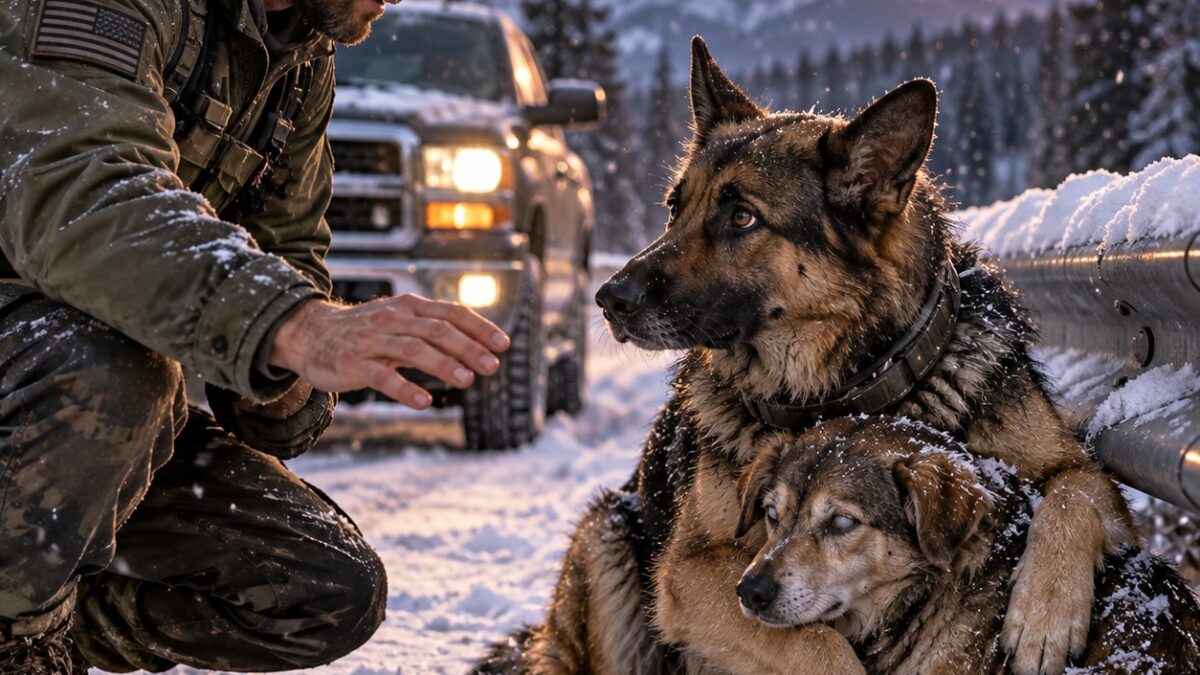
Exactly like the day I found them beside the guardrail.
But something was different.
Ranger was not watching traffic.
Not searching the road.
Robert’s front door opened.
He stepped onto the porch.
Steadier now.
One hand on the railing.
Ranger jumped from the truck.
Then immediately turned.
Waited.
Sadi climbed down.
Located his shoulder.
Followed him across the snow.
I walked behind them.
Robert had not lost his dogs.
I had not abandoned my Navy career.
Ranger still guided Sadi.
Sadi still trusted Ranger.
Nothing had returned to the exact shape it held before the accident.
Robert could not simply become the man he had been.
The dogs did not live only at his house anymore.
I could not promise to be in Montana whenever they needed me.
But what came after had become enough.
That afternoon, Robert made coffee.
Michael arrived.
Ranger moved between us.
Sadi slept near the heater.
I looked around.
Months earlier, I believed every problem needed a clean solution.
Dog belongs here.
Man belongs there.
Duty on one side.
Home on another.
Then two animals beside a snowy road had quietly destroyed that idea.
Ranger had refused to choose between protecting Sadi and waiting for Robert.
He had done both.
Sadi had not chosen between independence and accepting guidance.
She had both.
Robert did not have to choose between keeping his dogs completely or losing them.
Jake Miller did not have to choose between an active-duty career and caring about something at home.
We shared what could be shared.
Adjusted what needed adjusting.
Nobody got everything they had before.
Nobody became unnecessary.
That turned out to matter more.
Robert told me more of Ranger’s history over the following months.
He had adopted him after Ranger washed out of an early working-dog placement.
Not because he lacked intelligence.
Almost the opposite.
Ranger was too independent for the job they had planned.
Too inclined to assess before obeying.
Robert had laughed when telling me.
“Everybody called him stubborn.”
“Was he?”
“Oh, absolutely.”
Ranger lay near his chair.
Robert smiled.
“But stubborn isn’t the same as wrong.”
Sadi entered their lives later.
Rescue.
Vision already declining.
At first, Ranger ignored her.
Then she began following him.
Robert noticed he would slow near steps.
Started rewarding the behavior.
Wait.
Slow.
Threshold.
Easy.
Basic rules.
The rest developed between the dogs.
That made the story even more meaningful.
Ranger had not been assigned the role.
No certification.
No vest.
No formal guide-dog training.
He simply learned what someone he loved needed.
And kept doing it.
That was why, beside the guardrail, every person approaching Sadi became something Ranger evaluated first.
Not because he wanted ownership.
Because his entire relationship with the world had organized itself around making sure she had enough information to move safely through it.
“Do you ever worry he does too much for her?” I asked Robert.
“All the time.”
That answer surprised me.
“Then why let him?”
“I don’t let him.”
Robert shrugged.
“I make sure she still chooses.”
I thought about Emily saying the same thing.
Ranger did not drag Sadi through the world.
He gave her information.
“That’s harder than helping,” Robert said.
“What is?”
“Knowing when not to.”
Yes.
I understood that.
Military leadership teaches intervention.
Action.
Fix.
Move.
Sometimes good leadership is restraint.
Let another person struggle long enough to know they can solve something.
Be there if they cannot.
Ranger somehow knew.
Or had learned.
Either way, I started noticing the lesson everywhere.
Robert’s rehabilitation.
Michael would sometimes reach for his arm too soon.
Robert snapped.
Michael got frustrated.
Eventually they built a cue.
“If I need you, I’ll say ‘now.’”
Simple.
Michael stopped guessing.
Robert asked more often because asking no longer felt like having help forced on him.
I did the same.
If Robert said he could walk to the porch alone, I let him.
Stayed near.
Did not hover.
Some days he made it.
Some days he said:
“Now.”
Then I helped.
No speech.
No judgment.
Maybe that was what Ranger had been doing with Sadi all along.
Stay close enough to matter.
Far enough to preserve dignity.
I kept returning to that.
Eventually my active-duty life shifted too.
Not because the dogs caused some miraculous retirement.
I remained a SEAL.
Trained.
Deployed.
Did my work.
But Montana stopped feeling like merely the location where my cabin existed.
It became home.
There had always been a difference between owning property and belonging somewhere.
I discovered it slowly.
Linda Parker would stop me in town and ask about the dogs.
Emily would text reminders about Sadi’s exams.
Michael would call when Robert overdid something and needed another person to tell him he was being stubborn.
Robert would insult my fishing technique.
Ranger stole my preferred chair.
Sadi knew my kitchen.
Those were small things.
Small things are usually what permanence is made of.
A year after I found them, Bitterroot Valley went white again.
First real January storm.
I had leave.
Drove the same county road.
Same bend.
Same guardrail.
I slowed.
Could not help it.
The snow blurred the trees.
For a second, I saw the memory.
Ranger sitting between traffic and Sadi.
His front leg across her shoulders.
Amber eyes warning me not to come closer.
I pulled over.
Not exactly where the accident happened.
Close.
Ranger stood in the truck.
Sadi lifted her head.
I opened the door.
Ranger jumped down.
Sadi followed.
We walked a short distance beside the guardrail.
The world was quiet.
No logging trucks.
No power arcs.
No one waiting.
Ranger sniffed the snow.
Looked down the road once.
Then turned toward me.
No fixation.
No vigil.
The road was only a road now.
That did something to me.
Places can carry memory without remaining prisons.
I knew that from other landscapes I never discussed.
Coordinates.
Buildings.
Desert roads.
Mountains in countries I had left behind.
Sometimes part of you keeps returning there mentally because the story feels unfinished.
Ranger had returned physically.
Again and again.
Until Robert came back into his world.
Now he did not need to wait.
Sadi leaned into his side.
Ranger adjusted automatically.
I looked at both of them.
“Ready?”
Ranger walked toward the truck.
No hesitation.
Sadi followed.
We went home.
Robert was there when we arrived.
He had improved.
Not perfectly.
No miracle.
He still tired.
Still used the railing.
Still had days when concentration disappeared faster than his body.
But he walked from the kitchen to the porch without help most mornings.
Could manage short walks.
Fish when the weather cooperated.
He had learned to accept Michael on the longer outings.
And me.
That had been harder.
He once told me:
“I spent thirty years being the guy people called when things went bad.”
I understood exactly.
“Now everybody asks whether I need a chair.”
“That sounds insulting when you say it.”
“It feels insulting.”
“What changed?”
He looked toward Ranger.
“Dog doesn’t ask.”
“No.”
“He waits.”
There it was again.
Ranger.
Teaching all of us the same thing.
He waits.
One evening, Robert handed me a second object.
Old photograph.
Young Robert in police uniform beside a German Shepherd I did not recognize.
“Your first K9?”
“Buck.”
The dog looked huge.
Dark saddle.
Serious expression.
“When?”
“Long time ago.”
Robert’s thumb moved along the photo edge.
“He was with me when my partner died.”
The sharp-sound response.
I understood.
Robert did not elaborate much.
Operation.
Gunfire.
Metal barrier struck hard beside him.
Partner killed.
Buck survived.
Robert carried certain sounds forward.
Years later, the electrical arc beside the road triggered the same ancient reaction.
His body moved before his mind.
Truck slid.
Accident.
Ranger’s repeated sequence made even more sense.
Sharp sound.
Check Sadi.
Look for Robert.
Ranger had connected the sound not only to the crash.
To Robert disappearing.
“What happened to Buck?”
“Retired with me.”
“Good.”
Robert smiled faintly.
“Died at thirteen.”
He looked toward Ranger.
“I swore I wouldn’t get another working shepherd.”
“That went well.”
“Terribly.”
We laughed.
Loss had not prevented him from loving another dog.
That mattered too.
I had my own ways of keeping future loss at distance.
Deployments teach emotional economy.
You know the cost of attachment.
People move.
Teams rotate.
Friends die.
Relationships become complicated when you disappear for months.
The easiest strategy is to convince yourself you do not need much.
Ranger and Sadi ruined that strategy.
So did Robert.
Michael.
The valley.
I did not become sentimental.
At least, I refused the accusation.
But I stopped treating care like an operational vulnerability.
That was progress.
When Ranger turned seven, Michael brought a ridiculous dog cake.
Robert claimed it was embarrassing.
Then took twelve photographs.
Sadi received her own smaller one because Michael’s wife said you could not celebrate one dog without the other.
Correct.
Ranger ate too quickly.
Sadi somehow found the frosting first.
Everyone laughed.
I watched.
That old feeling returned.
Kitchen.
Two dogs.
No mission.
Nothing required from me.
For years, I thought purpose came from being needed for difficult things.
Turns out purpose sometimes comes from attending a dog’s birthday while an elderly retired K9 officer complains about frosting on his floor.
My command cycle remained unpredictable.
I missed things.
A veterinary appointment.
One fishing day.
Robert’s birthday once.
That bothered me.
He refused to let it.
“You’re not required at every event.”
“I know.”
“Then act like it.”
“Helpful.”
“You taught me that.”
“Did I?”
“No. Ranger did.”
Fair.
When I came back from longer absences, Ranger greeted me hard.
Then Sadi.
Always checked Sadi.
Always.
Even with gray beginning around his muzzle years later.
That never changed.
He did not protect her because she was weak.
That was the misconception people made whenever they learned she was blind.
Sadi was not weak.
She was confident.
Adaptable.
Stubborn in her own way.
She could map a new room in hours.
Locate a person by scent.
Navigate Robert’s house, my cabin, Emily’s clinic.
She did not need Ranger for every movement.
What she needed was partnership in the moments where vision mattered.
He offered it.
No drama.
That difference became the center of how I told their story whenever someone asked.
“Did he save her?”
Not exactly.
They saved each other in quieter ways.
Sadi gave Ranger a job larger than guarding himself.
Ranger gave Sadi information.
Robert gave both of them structure.
Michael gave Robert support.
I provided days the others could not.
Emily kept Sadi healthy.
Linda kept two lost dogs fed long enough for me to find them.
Nobody was the hero alone.
I liked that.
My career had taught me how dangerous the single-hero story can be.
Every successful operation looks simple in retelling.
One brave action.
One person.
One moment.
Reality is logistics.
Trust.
Timing.
Somebody checking batteries.
Somebody moving supplies.
Somebody showing up ten minutes early.
Teams.
Ranger and Sadi were a team.
Eventually all of us became one around them.
Several years after the accident, Robert no longer needed regular rehabilitation.
He still did exercises.
Complained about them.
Still tired faster.
But his world had expanded again.
We returned to the same accessible riverbank often.
He fished.
Michael handled heavy gear.
I usually drove if home.
Ranger worked the shoreline.
Sadi moved beside him.
One afternoon Robert caught nothing for four hours.
I caught two trout.
He accused me of choosing the better side deliberately.
“Skill.”
“Luck.”
“Training.”
“Annoying.”
Ranger sat between us.
Sadi slept in the sun.
Robert leaned back on the bench.
“This is pretty close.”
“To what?”
“Before.”
I looked at him.
He shook his head.
“No. That’s wrong.”
He watched the river.
“Not before.”
Pause.
“Good anyway.”
That sentence stayed with me more than most.
Good anyway.
We spend too much time measuring a changed life against the old one.
As if happiness only counts when it resembles the original plan.
Robert did not get his old body back.
Sadi did not get her vision.
Ranger never stopped carrying responsibility for her.
I never became a man with a predictable civilian schedule.
Nothing returned to before.
Still—
good anyway.
Maybe better in some ways we never would have chosen.
Ranger aged first.
Slowly.
Less distance on long walks.
More stiffness after cold mornings.
Still alert.
Still protective.
Still checked Sadi.
Sadi aged too.
Her blindness became complete.
By then it barely changed daily life.
Robert’s home.
My cabin.
Familiar routes.
Ranger.
Her world was full.
Emily joked that Sadi had everybody trained perfectly.
Probably true.
One winter afternoon, Ranger stopped at the mudroom steps in my cabin.
The same place I first understood what he was doing years earlier.
He stepped down.
Waited.
Sadi touched his shoulder.
Followed.
I stood in the kitchen.
Older now.
So were they.
The movement was exactly the same.
Smooth.
Small.
Built from thousands of repetitions.
I thought about the title someone might give their story.
The loyal shepherd.
The blind dog.
The Navy SEAL who rescued them.
All incomplete.
I did not rescue Ranger and Sadi.
I stopped.
That mattered.
Linda fed them.
Emily explained them.
Samuel remembered a collar.
Michael searched.
Robert loved them.
Ranger guided.
Sadi trusted.
I happened to become one link in a chain.
Maybe that is what most meaningful things are.
Not rescue.
Interruption.
A person arrives at the right moment and helps the story keep moving.
Years after I first found the dogs, I opened the drawer beneath my telephone table.
Ranger’s old leather collar was still there.
Conditioned.
Protected.
The interior marks nearly gone.
I held it.
Walked into the living room.
Ranger was sleeping near Sadi.
Robert was expected that afternoon.
Michael bringing him.
I looked at the collar.
Remembered Samuel’s shop.
The missing flyer.
The road.
The first growl.
How sure I had been that somebody had abandoned them.
I had been wrong.
That became another lesson.
Be careful with stories that arrive too quickly.
Two thin dogs beside a road.
Abandoned.
An old man unable to walk far.
Helpless.
A blind dog.
Dependent.
An active-duty man who leaves often.
Unreliable.
Easy labels.
Incomplete truths.
Robert was not helpless.
Sadi was not dependent.
I was not unreliable because duty pulled me away.
Ranger was not aggressive because he protected her.
Reality was always more specific.
More complicated.
And usually kinder than the first judgment.
Robert arrived.
Ranger woke before the truck door closed.
Sadi lifted her head.
We went outside.
Robert stepped from Michael’s vehicle.
Used a cane now.
He had for years.
Ranger approached slowly.
No desperate running anymore.
Just recognition.
Head under Robert’s hand.
Sadi found his leg.
Robert smiled.
“Everybody accounted for.”
Old police habit.
Count.
I understood.
“Yes, sir.”
He looked at me.
“You’re forty now?”
“Forty-two.”
“Getting old.”
“You’re eighty.”
“Exactly. I recognize the signs.”
We went inside.
Coffee.
The dogs settled.
Nothing dramatic.
At some point Robert saw the collar in my hand.
“Haven’t lost it.”
“No.”
“Good.”
“Want it back?”
He shook his head.
“It’s where it belongs.”
I looked around the room.
That phrase had changed meaning.
Where it belongs.
Not one house.
Not one person.
Not one version of the past.
Belonging could be distributed.
Love could be shared without becoming diluted.
Maybe Ranger had known that before any of us.
He belonged to Robert.
Later, to me too.
Sadi belonged to both homes.
Neither relationship erased the other.
The last time I drove the road where I found them with Robert beside me, spring had already replaced most of the snow.
He asked me to slow near the guardrail.
I did.
For a long moment, neither spoke.
“That’s it?”
He pointed.
“Yes.”
“Where?”
“Right side.”
I pulled over.
Robert got out carefully.
I came around.
Did not help unless he asked.
Old rule.
We stood beside the guardrail.
Traffic light.
River noise somewhere below.
Robert looked at the road.
“This is where they waited.”
“Yes.”
“How long?”
“Linda saw them about ten days.”
He swallowed.
“Stubborn son of a gun.”
“Wonder where he learned it.”
Robert ignored me.
He looked across the bend.
“I wish I could’ve told him I was alive.”
“He found out.”
“Eventually.”
“Dogs understand eventually.”
Robert smiled.
“Do they?”
“I need to believe that.”
We stood a while.
Then Robert said:
“You know what bothers me?”
“What?”
“Everybody says he waited for me.”
“He did.”
“No.”
Robert looked at me.
“He waited for us.”
I frowned.
“Him and Sadi.”
Then I understood.
Ranger had not been alone waiting for Robert.
He had carried Sadi through the waiting.
Protected her.
Fed second.
Moved with her.
Returned with her.
Every choice included both.
Robert touched the guardrail.
“He kept the family together until somebody came.”
I looked at the empty road.
Me.
Not because I was special.
Because I stopped.
Maybe that was enough.
We returned to the truck.
As I drove away, Robert never looked back.
Neither did I.
The road had finished its job.
Years later, when Ranger’s muzzle had turned almost completely gray, he still slept close enough to Sadi that she could find him without searching.
His front leg sometimes rested across her shoulders.
The same pose.
People who saw photographs called it protective.
It was.
But by then I understood it better.
It was also information.
I am here.
You know where I am.
The path is safe.
Maybe that was what all of us had been trying to say to one another.
Robert to the dogs.
Michael to Robert.
Ranger to Sadi.
Me to a cabin I had once treated as temporary.
I am here.
You know where I am.
The path is safe.
One winter morning, snow began before dawn.
I had leave.
No orders.
No deliveries.
Nothing urgent.
I made coffee.
Ranger and Sadi were in the living room.
Ranger awake.
Sadi asleep against him.
Outside, white gathered on the porch railing.
For a moment the scene looked almost exactly like the first night.
Except Ranger was not at the window.
He was not waiting for headlights.
Not watching a road.
He was sleeping.
Deeply.
Robert was home.
Michael was nearby.
I was home.
Nobody missing.
I sat in the chair across from them.
The cabin no longer felt quiet in the old way.
It felt full.
Ranger opened one eye.
Looked at me.
Closed it again.
I thought about the question I had carried from the beginning.
Who were they waiting for?
Robert, yes.
But maybe the fuller answer was bigger.
They were waiting for the world to make sense again.
For the person who disappeared to return.
For Sadi to know where she was safe.
For Ranger to be released from a vigil no one had asked him to hold.
For Robert to learn that accepting help did not make him less useful.
For me to understand that caring about something did not automatically become abandonment when duty called.
None of those things happened all at once.
They happened slowly.
Through shared responsibility.
Visits.
Walks.
Food bowls.
Phone messages.
Rehabilitation.
Trust.
The ordinary work of building a life after the plan changes.
That is why I do not think of the day beside the guardrail as the day I rescued two dogs.
That version gives me too much credit.
I think of it as the day I interrupted a wait.
Ranger had been holding the position.
Sadi had been trusting him.
Robert had been fighting his way back.
Michael had been searching.
Linda had been keeping them fed.
Samuel had kept a flyer.
Emily knew what to look for.
I stopped a truck.
That was my part.
Sometimes your part does not need to be bigger.
It only needs to happen at the right time.
If you ask me what Ranger taught me, I could give you a dozen answers.
Loyalty.
Patience.
Teamwork.
Trust.
But the one I carry most is simpler.
Love does not always mean doing everything for someone.
Sometimes it means giving them the information they need to keep moving on their own.
Sometimes it means standing close at the step.
Waiting at the threshold.
Giving a shoulder.
Then letting them choose the next footfall.
Ranger did that for Sadi.
Robert eventually learned to let Michael and me do it for him.
And somewhere along the way, I learned to let other people do the same for me.
That might be why the ending never felt like one person gained the dogs and another lost them.
Nobody lost.
The shape changed.
That was all.
Ranger and Sadi had two homes.
Robert had his dogs.
I had them too.
Michael had a father who no longer insisted on carrying everything alone.
I had a cabin that finally meant something beyond a place to sleep between orders.
Nothing returned to exactly what it had been before the accident.
It did not need to.
What came after was not a consolation prize.
It was a life.
One built around what remained.
One built honestly.
And sometimes, when I watched Ranger rest that old protective leg across Sadi’s shoulders, I could almost hear the sentence his whole body had been saying since the first moment I saw him beside that Montana road.
Not Please don’t take her.
Not anymore.
Something quieter.
Something better.
She’s with me.
And, eventually—
so was I.








