𝗙𝗨𝗟𝗟 𝗦𝗧𝗢𝗥𝗬:I Found Two Frozen Puppies Under a Drunk Man’s Boots, and the Choice I Made Followed Me Long After the Storm
FULL STORY CONTINUATION
The sheriff arrived about fifteen minutes later.
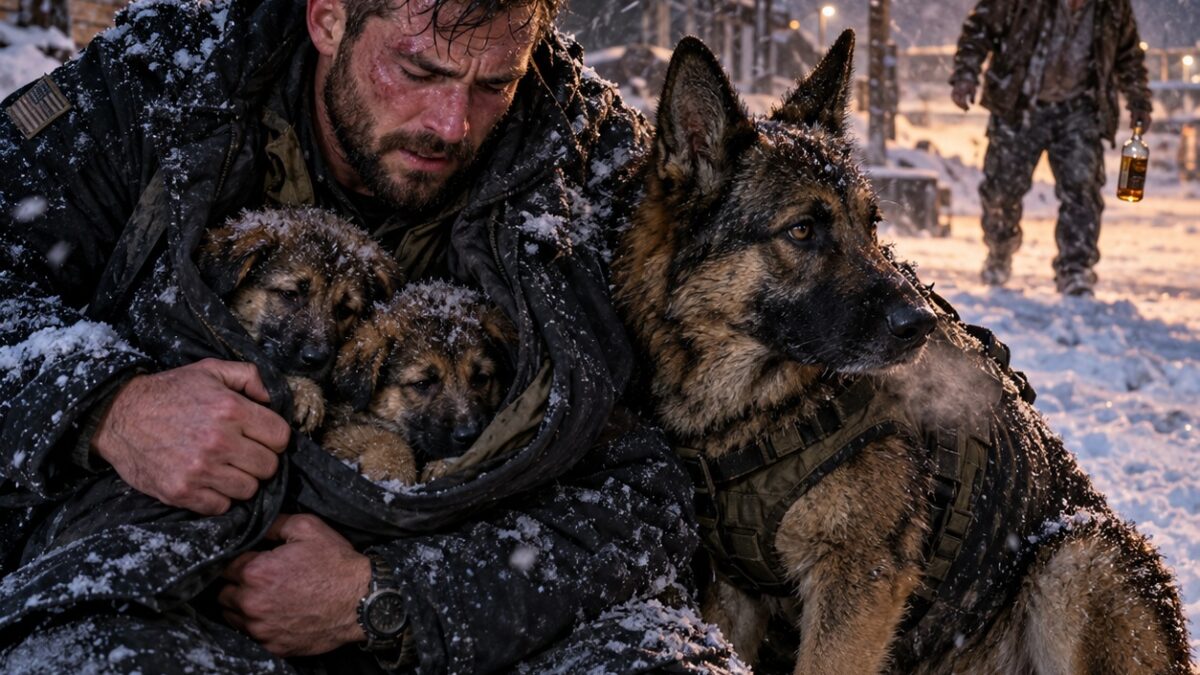
By then, I had moved the puppies into the heated cab of my truck.
Ranger sat in the back seat with them between his front legs, completely still.
I had wrapped them in an old fleece blanket I kept behind the passenger seat.
One puppy had started making a faint clicking noise when it breathed.
The other had stopped trembling altogether.
That worried me more.
People think shaking means an animal is getting worse.
Sometimes it means the body is still fighting.
When the shaking stops, you start wondering if it is running out of fight.
Sheriff David Miller pulled up behind me with his lights reflecting blue and red across the falling snow.
I had known David most of my life.
He was pushing sixty, tall and lean, with gray hair, a military-straight posture, and the permanently tired face of a man who had spent decades seeing neighbors on their worst days.
He had served Army infantry long before he wore a sheriff’s badge.
He understood the difference between force and control.
That mattered.
He stepped out.
“Michael.”
“David.”
He looked toward the truck.
“Those the dogs?”
“Yes.”
“You see what happened?”
“All of it.”
“Who?”
“Brian Holloway.”
David’s face barely moved.
But I saw recognition.
“Where’d he go?”
“Toward Cedar.”
David nodded.
“I’ll find him.”
He glanced inside my truck.
His expression changed when he saw the puppies.
“Damn.”
“I need somewhere warm.”
“Vet clinic’s closed. Roads south are getting worse.”
“I know.”
David thought for a moment.
“St. Luke’s opened their winter shelter.”
“The church?”
“Linda Parker’s running it tonight.”
That name meant something.
Linda had worked military nursing years before and spent the last decade volunteering around town after retirement.
If anybody could keep two half-frozen puppies alive until morning, it was probably her.
I climbed into the truck.
David rested one hand on my door.
“Michael.”
I looked at him.
“You did right calling me.”
“What did you think I was going to do?”
He held my gaze.
“I know you.”
I understood.
There had been a time in my life when I would have handled Brian differently.
Not necessarily illegally.
Not necessarily violently.
But I might have convinced myself fear was an acceptable teaching tool.
Years in special operations can train you to solve problems quickly.
Civilian life keeps reminding you that people are not targets.
I looked toward the road where Brian had disappeared.
“I wanted to hit him.”
David nodded.
“I figured.”
“I didn’t.”
“I noticed.”
“That supposed to be progress?”
“For you?”
A faint smile.
“Maybe.”
He closed the truck door.
I drove toward St. Luke’s.
Behind me, Ranger kept his body curved protectively around the puppies.
At the church, Linda opened the door before I reached it.
She had probably seen the headlights.
She was in her early sixties, silver-blonde hair tied low, narrow shoulders hidden beneath a heavy sweater.
She looked once at me.
Then at what I was holding.
“Bring them in.”
No panic.
No wasted questions.
I respected her immediately.
The church hall had been converted into a winter shelter.
Folding cots lined the walls.
Coffee brewed near the kitchen.
Wet coats hung from pegs beside the door.
Men and women sat quietly with blankets around their shoulders.
Some homeless.
Some stranded by weather.
Some simply without heat.
No one asked why a Navy SEAL had just walked into church carrying two nearly frozen dogs.
Pine Ridge people had always understood that emergencies did not need decoration.
Linda cleared space beside the cast-iron stove.
“Towels.”
A volunteer handed them over.
“Warm, not hot.”
I nodded.
She looked at me.
“You know that?”
“Some.”
Her eyes moved to my posture.
Then Ranger.
“Military?”
“Navy.”
“What kind?”
I hesitated.
She smiled faintly.
“Never mind.”
“SEAL.”
She nodded once.
Not impressed.
Not intimidated.
Just understanding.
“Then you know how thin the line gets.”
I looked down at the puppies.
“Yes.”
Ranger lowered himself beside them.
Linda checked them carefully.
“Cold. Shock. Malnourished.”
“Are they going to make it?”
She looked at me.
“I don’t lie to people who ask that question.”
“Good.”
“I don’t know.”
I appreciated that too.
“But they’re alive.”
“For now.”
“For now is enough to work with.”
That sentence stayed with me.
Linda spent the next hour slowly warming them.
Tiny amounts of fluid.
Dry towels.
Careful monitoring.
Nothing dramatic.
No miracle.
Life coming back one small function at a time.
Their breathing steadied.
One began trembling again.
Linda smiled when it did.
“Good.”
I had never been so happy to see an animal shiver.
Near midnight, she looked at me.
“You can sit.”
“I’m fine.”
“You’ve been standing for forty minutes.”
“I’m fine.”
“You military guys ever learn a second answer?”
I sat.
Ranger stayed beside the puppies.
One shifted against his stomach.
He didn’t move.
I watched him and realized he was doing exactly what I was doing.
Standing guard even while lying down.
Always partially working.
Always waiting for the next thing.
Linda followed my eyes.
“He yours?”
“Partner.”
“Still active?”
“Yes.”
“And you?”
“Yes.”
“How much leave?”
“Seventy-two hours.”
She made a sound that could have meant sympathy or criticism.
“Not much of a break.”
“No.”
“You sleeping?”
I looked at her.
“Define sleeping.”
“That bad.”
“I manage.”
She sat across from me.
“You don’t have to fix everything.”
I almost laughed.
“I know.”
“No, you know the sentence.”
She pointed toward my chest.
“I’m not sure you know the difference.”
That annoyed me.
Mostly because she was right.
“I don’t know how not to try.”
Linda nodded.
“That probably kept you alive.”
“It kept other people alive.”
“And if you never learn when to let go?”
I looked at Ranger.
She didn’t finish.
She didn’t need to.
Across town, David found Brian less than an hour after leaving me.
I didn’t see that part.
Brian told me about it later.
So did David.
Their versions matched closely enough that I believed both.
Brian was sitting behind a closed hardware store when the cruiser pulled up.
Half a bottle gone.
Too drunk to run.
Too ashamed to fight.
David put him in cuffs and brought him to the station.
By sunrise, Brian’s head had cleared enough for memory to become punishment.
He remembered the puppies.
His laughter.
My voice.
Ranger’s growl.
He remembered lifting his boot.
That was the part he said stayed with him.
Not because he had done worse.
Because he realized he had been capable of worse.
David put coffee in front of him.
“You remember?”
Brian nodded.
“You know what you did?”
Another nod.
Then he said something David repeated to me later.
“I don’t remember deciding to become this.”
David leaned against his desk.
“Nobody does.”
Brian looked up.
David continued.
“But choices don’t stop counting just because you’re broken.”
That sentence could sound cruel.
It wasn’t.
There is compassion that excuses everything because pain exists.
And there is compassion that sees pain clearly without letting it erase responsibility.
David understood the second kind.
Eventually Brian told him about Emily.
His daughter.
Eight years old.
Dark hair.
Loved toast slightly burned.
An avalanche had come down the eastern ridge years earlier and swallowed the road where she was traveling.
Brian had been underground at the mine when it happened.
By the time he surfaced, his daughter was gone.
His marriage failed afterward.
Then the mine shut down.
Job disappeared.
Purpose disappeared.
Alcohol filled the empty spaces.
The story explained Brian.
It did not absolve him.
David told him that directly.
“You didn’t make the mountain fall.”
Brian cried when he heard that.
Then David added:
“But you let it bury you too.”
Brian was released later that day with charges pending and conditions he knew he had earned.
He did not go to the bar.
That mattered.
Instead, he walked toward the ridge.
I saw him from the window at St. Luke’s.
At first, I didn’t recognize him.
He looked smaller in daylight.
Less threatening.
More damaged.
He stopped across the street from the church.
Didn’t come closer.
Ranger saw him.
His head lifted.
I felt every muscle in my body tighten.
Linda noticed.
“What?”
“Him.”
She looked through the frosted glass.
“The man from last night?”
“Yes.”
“You want me to call the sheriff?”
I watched Brian.
He kept his hands in his pockets.
He didn’t approach.
“No.”
“You sure?”
“Yes.”
We stood there.
Brian looked through the window.
His eyes found the puppies.
I saw his shoulders change.
He looked away quickly.
Then he walked on.
Linda studied me.
“What are you thinking?”
“I don’t know.”
“That’s unusual?”
“Yes.”
“Good for you.”
I gave her a look.
She went back to work.
The puppies survived the day.
Then the next night.
By the following morning, Linda thought their chances had improved.
We gave them names because calling them “one” and “two” started feeling cruel.
Stone and Flare.
Linda chose Flare.
I chose Stone.
She told me my name was predictable.
I told her hers was worse.
For the first time in months, I laughed without feeling like I had borrowed the sound from somebody else.
Brian went home.
His house sat at the edge of Pine Ridge beneath cottonwoods stripped bare by winter.
He later described opening the door and smelling old alcohol, dust, and a life that had stopped moving years before.
A drawing still hung on the refrigerator.
Emily’s.
Crayon mountains.
Three stick figures.
A dog.
He sat at the kitchen table and stared at it.
There was whiskey in the cabinet.
He took the bottle out.
Set it on the table.
Then left it unopened.
That was not redemption.
People love turning the first decent choice into a transformation.
It isn’t.
It is only one decent choice.
But every different life begins with one.
For several days, I barely saw Brian.
He attended his preliminary court meeting.
Checked in with David.
Avoided the bar.
Nobody celebrated him.
Nobody trusted him.
That was fair.
Meanwhile, St. Luke’s kept operating as the town’s temporary winter shelter.
The cold intensified.
Furnaces across Pine Ridge worked harder.
The old church building creaked through every night.
Linda worried about the heating system.
I noticed it too.
The boiler sounded rough.
“Has anyone inspected that thing?”
“Probably when Wyoming was still underwater.”
“Linda.”
“I’m kidding.”
“You’re terrible at it.”
“So I’ve been told.”
I offered to look at it.
She refused.
“You’re not an HVAC technician.”
“I can inspect.”
“You can drink your coffee.”
I hated being told no.
She enjoyed telling me.
The fourth night after I found Stone and Flare, I stayed at the church again.
Partly because the puppies still needed monitoring.
Partly because Ranger refused to leave.
Mostly because I didn’t want to go back to the lodge.
That bothered me.
Home leave is supposed to be restorative.
The lodge felt like a waiting room.
St. Luke’s felt alive.
Even with people struggling.
Maybe because of them.
Nobody there pretended life was easy.
That honesty helped.
The fire started just before midnight.
Quietly.
That is what people misunderstand about fires.
The dangerous ones do not always announce themselves with flames.
Sometimes the first sign is smell.
Linda caught it.
She lifted her head.
I saw her face change.
“What?”
“Electrical.”
I stood.
Then I smelled it.
Hot insulation.
Metal.
Something wrong.
Linda moved toward the rear.
I followed.
Smoke curled from beneath the floor near the old heating unit.
Thin.
Gray.
Fast-growing.
“Everybody up.”
Linda’s voice changed.
Military again.
“Coats on. Main doors. Move.”
I grabbed Stone and Flare.
Ranger stood instantly.
The first flame came through the floorboards thirty seconds later.
After that, things moved too fast.
Smoke spread across the ceiling.
People woke confused.
Some panicked.
Linda pushed them toward the main entrance.
“Stay low.”
I took the other side of the hall.
“Follow the wall. Do not go back for bags.”
One elderly man froze.
Ranger barked and nudged him toward the door.
A woman fell.
I handed the puppies to Linda for one second, pulled the woman up, then took them back.
The rear floor collapsed.
Sparks shot upward.
Flames found dry wood inside the walls.
The church turned from shelter into trap.
We got most people through the main doors.
Then part of the ceiling fell near the entrance.
I stepped back.
Heat slammed into us.
Ranger pressed against my leg.
Stone whimpered inside my coat.
Flare stopped making sound.
“Move!”
Linda shouted from outside.
I tried.
A burning beam dropped between us and the door.
The path vanished.
I turned.
Side exit.
Too much smoke.
Rear exit.
Floor gone.
Windows too high.
I dropped to one knee.
My brain did what training had taught it to do.
Assess.
Air.
Structure.
Distance.
Routes.
Time.
The problem was none of the routes stayed safe long enough.
That was new.
In combat, even bad plans usually have a direction.
Here, every direction was becoming fire.
Ranger looked at me.
Waiting.
The puppies struggled weakly against my chest.
I heard wood cracking above us.
For the first time in years, I did not immediately know what to do.
Then someone came through the smoke.
At first I thought it was one of the shelter residents.
Then I saw the beard.
Brian.
His jacket was half-zipped.
No gloves.
No mask.
His eyes were wide but focused.
“This way!”
He ran toward a side door partly buried behind fallen shelving.
He hit it with his shoulder.
Nothing.
Again.
Wood cracked.
Flames rolled behind him.
“Brian!”
He ignored me.
Third hit.
The frame gave.
Cold air punched into the building.
Fire surged toward oxygen.
For half a second the flames worsened.
But there was a path.
“Go!”
I moved.
Ranger beside me.
Brian threw debris aside with bare hands.
His sleeves began smoking.
I grabbed him.
“Move!”
He pushed me toward the door.
“Get them out!”
We burst into snow.
Cold hit my face so hard it hurt.
Ranger came through.
Then Brian.
Two seconds later, part of the roof collapsed inward.
The sound rolled across Pine Ridge.
People screamed.
Linda ran toward me.
“Puppies?”
I opened my coat.
Stone moved.
Flare coughed.
Alive.
Brian dropped to his knees.
His hands were burned.
His beard singed.
He coughed until he almost vomited.
I put the puppies beside Ranger.
He curled around them.
Then I knelt beside Brian.
His eyes met mine.
He looked terrified.
“I couldn’t.”
I frowned.
“What?”
He was shaking.
“I couldn’t leave them.”
For a moment I saw the abandoned lot again.
Snow.
Whiskey.
Two puppies under his boots.
Brian saw it too.
Shame flooded his face.
“I couldn’t…”
I grabbed his shoulder.
“You did.”
He stared at me.
“You went in.”
His mouth opened.
No sound.
“You did.”
Fire trucks arrived.
People wrapped Brian’s hands.
Linda told every responder who would listen that he had opened the side exit.
Brian tried to disappear into the crowd.
He couldn’t.
Pine Ridge is too small for that.
By dawn, the church shelter was gone.
Black beams smoked against white snow.
Nobody died.
That fact seemed almost impossible.
Brian sat wrapped in a donated coat.
His hands bandaged.
Stone and Flare slept beside Ranger.
Linda stood near the ruins.
David arrived and took in the scene.
Then he saw Brian.
“What happened?”
Brian looked down.
Linda answered.
“He ran inside.”
David’s eyes moved to me.
I nodded.
“Saved us.”
David said nothing.
But his expression changed.
The court hearing came two weeks later.
Brian’s original charges still stood.
Animal cruelty.
Reckless endangerment.
The fire did not erase them.
He did not ask for that.
That mattered to me.
The courthouse was packed.
Not because Pine Ridge loved spectacle.
Because everybody had an opinion.
Some believed Brian deserved jail.
Some believed the fire changed everything.
Some wanted punishment.
Some wanted mercy.
Most wanted both and didn’t know what that looked like.
I testified.
The prosecutor asked me about the lumberyard.
“What did you see?”
I told him.
No embellishment.
Brian drunk.
The puppies freezing.
The boot.
The laughter.
The condition of the animals.
“Did you believe the puppies were in danger?”
“Yes.”
“Could they have died?”
“Yes.”
Brian looked at the floor.
The prosecutor asked, “Do you excuse what he did because of what happened later?”
“No.”
A murmur moved through the courtroom.
Then:
“Tell us about the fire.”
I looked at Brian.
He raised his eyes.
“He went back in.”
“Why?”
“You’d have to ask him.”
“What did his action accomplish?”
“He opened an exit.”
“Did that save lives?”
“Yes.”
“How many?”
“I don’t know exactly.”
“Did it save yours?”
“Yes.”
The courtroom went quiet.
I added something I hadn’t planned.
“What Brian did to those puppies was wrong.”
The prosecutor waited.
“So was what?”
“Nothing.”
I shook my head.
“There is no ‘but.’”
Brian looked at me.
I continued.
“What he did was wrong. And when the church burned, he saved lives. Both things are true.”
That was the only honest answer.
Linda testified after me.
She described Brian forcing the door.
Burning his hands.
Running toward smoke when everybody else was trying to leave.
“I’ve treated soldiers who ran toward gunfire,” she said.
“That night, I saw the same choice.”
Brian’s attorney could have used that as a dramatic redemption argument.
Brian wouldn’t let him.
When Judge Eleanor Brooks asked if he wished to speak, he stood.
He looked sober.
Shaved.
Exhausted.
“I’m not asking anyone to forget what I did.”
His voice shook once.
“I let my pain become something ugly.”
He swallowed.
“I did that.”
No excuses.
No avalanche speech.
No blaming whiskey.
“I can’t undo it.”
He looked briefly toward me.
“Running into that church didn’t undo it either.”
The judge watched him.
“I’m asking for the chance to do something different next.”
That sentence mattered.
Not forgive me.
Not believe I’m good now.
Give me work.
Judge Brooks considered everything.
The severity of the cruelty charge.
Brian’s alcohol history.
The danger to the puppies.
The fire.
His cooperation.
His lack of prior violent convictions.
His willingness to accept responsibility.
When she finally spoke, nobody moved.
“Punishment without accountability is useless.”
Brian straightened.
“And accountability without change is incomplete.”
She sentenced him to strict supervised conditions.
Mandatory sobriety treatment.
Regular reviews.
And extensive unpaid community service connected to a new animal-rescue project Pine Ridge had already begun discussing after St. Luke’s burned.
Zero tolerance.
One violation could send him back before the court.
Brian nodded.
“I understand.”
Outside, he approached me.
His burned hands were still wrapped.
“I don’t expect forgiveness.”
“Good.”
That startled him.
“Then you can stop thinking about whether you deserve mine.”
He looked confused.
“Focus on the work.”
He nodded slowly.
Ranger approached.
Brian froze.
That was the first time they had stood that close since the lumberyard.
Ranger sniffed the bandage on his hand.
Then sat.
Brian’s eyes filled.
I noticed.
Pretended I didn’t.
There are moments you don’t need to witness too aggressively.
The town rebuilt.
Not St. Luke’s.
Not exactly.
The church would take much longer.
Instead, Pine Ridge converted an unused maintenance building on donated land into an animal rescue.
People brought lumber.
Fencing.
Insulation.
Old kennels.
Money.
Food.
Time.
I extended my leave.
That surprised my command.
It surprised me more.
I told myself I stayed because Stone and Flare needed care.
Then because Ranger could help socialize them.
Then because construction needed finishing.
Eventually, I stopped inventing reasons.
I stayed because I wanted to see something built.
I had spent years destroying threats, clearing rooms, finishing missions, leaving places behind.
Building felt different.
Slower.
Harder in ways training had not prepared me for.
Brian showed up before sunrise every day.
No speeches.
No attempts to be liked.
He hauled material.
Cleaned kennels.
Fixed gates.
Listened.
When people avoided him, he accepted it.
When someone whispered about the lumberyard, he didn’t complain.
When a volunteer refused to leave a dog alone with him, Brian said, “Fair.”
That did more for his reputation than defensiveness ever could have.
Linda ran medical intake.
I handled training and basic behavior.
Ranger became the calm center of the entire place.
Stone and Flare grew.
Fast.
By spring, they barely resembled the frozen bodies I had carried beneath my coat.
Stone was heavier.
Steadier.
More cautious.
Flare was chaos.
She stole gloves.
Dragged towels through mud.
Barked at wheelbarrows.
Brian pretended not to have a favorite.
He always checked Flare’s kennel first.
I noticed.
Never said anything.
One afternoon, I found him repairing a latch while both young shepherds slept nearby.
“Those hinges need another bolt.”
He looked at me.
“I know.”
“You missed one.”
“I was about to do it.”
“Sure.”
He sighed.
“You this annoying on deployment?”
“Worse.”
For the first time, Brian smiled around me.
It disappeared quickly.
Still counted.
Linda came to stand beside me.
“You can’t stay.”
I looked at her.
“I know.”
My leave had already been extended more than once.
Orders were waiting.
The world outside Pine Ridge had not paused because I found two puppies in snow.
Ranger would return with me.
Stone and Flare would stay.
That was harder than I expected.
Linda watched the rescue building.
“It’ll hold.”
“I know.”
“Brian too.”
I looked toward him.
“He’s got a long way to go.”
“Everybody does.”
“I don’t trust him completely.”
“You don’t have to.”
That surprised me.
Linda smiled.
“Trust is not a reward we hand out because somebody had one good month.”
“Exactly.”
“But change still deserves room.”
I watched Brian finish the latch.
“Maybe.”
“You already believe that.”
“No.”
“You’re bad at lying.”
I hated how often older women in Pine Ridge were right about me.
Spring arrived slowly.
Snow shrank into shadowed patches.
Water ran beside the roads.
Mud appeared everywhere.
The Pine Ridge Animal Rescue opened on a clear morning.
Nothing fancy.
Wood siding.
Wide windows.
Fresh fencing.
Ten kennels.
A treatment room.
Office.
Storage.
Outdoor exercise yard.
To me, it looked better than most headquarters I had worked from.
Children arrived with parents.
People brought blankets and dog food.
A local hardware store donated tools.
The first rescue dog came in before noon.
An elderly mutt with arthritis and one cloudy eye.
Brian carried him from the truck.
Gently.
That image stayed with me.
The man I had found standing over two freezing puppies now held a frightened old dog like it might break.
Redemption is a dangerous word.
People use it as though one dramatic act settles the account.
It doesn’t.
Brian had not become a different species of man.
He still woke grieving Emily.
Still had cravings.
Still had nights where he wanted to disappear into alcohol.
Still carried shame.
The difference was what he did next.
He called David.
Went to meetings.
Came to work.
Fed animals.
Scrubbed floors.
Fixed fences.
Repeated.
That was his redemption.
Boring repetition.
Daily choice.
No audience.
No fire.
No heroics.
The farewell came three weeks later.
I hated ceremonies, so Pine Ridge kindly turned mine into one anyway.
David shook my hand.
“Stay out of trouble.”
“I was doing fine until I came home.”
“Sure.”
Linda hugged me.
“You built something.”
“I helped.”
“Don’t do that.”
“What?”
“Shrink it.”
I looked at the rescue.
She continued.
“Saving something takes courage.”
Then nodded toward the building.
“Building something takes patience.”
I understood.
Brian approached last.
He kept his hands in his coat pockets.
“I’ll keep it standing.”
I looked at him.
“Don’t promise me.”
He frowned.
“Promise the work.”
He nodded.
“All right.”
Stone and Flare chased Ranger toward the gate when we left.
They barked.
Jumped.
Flare tried squeezing between the rails.
I knelt.
Stone pressed his head against the fence.
I reached through.
Scratched both of them.
“Behave.”
Flare bit my glove.
“Great.”
Brian almost laughed.
I stood.
Ranger leaned against my leg.
Time.
I walked toward the truck.
Didn’t look back immediately.
Not because leaving was easy.
Because I had learned something.
Sometimes turning around repeatedly doesn’t honor what you leave.
Sometimes it only makes leaving harder.
At the road, I looked once.
Stone and Flare were beside Brian.
Ranger watched them from my side.
Brian raised one hand.
I returned the gesture.
Then drove away.
Duty took me far from Wyoming again.
Different places.
Different missions.
I checked the rescue when I could.
Linda sent photographs.
David sent short updates.
Brian never texted unless something practical happened.
Gate repaired.
New intake.
Flare ate a shoe.
Stone scared of thunder.
Ranger’s absence bothered both pups for a while.
Eventually, new routines formed.
That made me happy.
And a little sad.
I had spent so much of my life believing being needed proved my value.
Pine Ridge taught me the opposite.
If you build something correctly, eventually it should work without you.
Months later, I was overseas when Linda sent a photograph.
Brian sat on the rescue porch.
Stone beside one leg.
Flare asleep across his boots.
The mountains rose behind them.
Her message said:
HE’S STILL SOBER.
That was all.
I stared at the picture for a long time.
I thought about the abandoned lumberyard.
Brian’s laughter.
His boot.
The rage I had felt.
If someone had told me that night that I would later trust him enough to work around those same puppies, I would have called them insane.
Maybe I still didn’t fully trust him.
Maybe trust wasn’t the point.
People sometimes ask what I learned about forgiveness.
That question always makes me uncomfortable.
Forgiveness is treated like a moral finish line.
As if decent people eventually arrive there if they are enlightened enough.
I don’t know if I forgave Brian.
Not completely.
I never forgot what I saw.
I didn’t need to.
Forgetting is not mercy.
And mercy is not pretending harm didn’t happen.
What I learned was that I could hold a person accountable without demanding that his worst act become his permanent identity.
That was harder.
Anger likes categories.
Good.
Bad.
Safe.
Dangerous.
Hero.
Coward.
Life rarely cooperates.
Brian abused helpless animals.
Brian ran into a burning building.
Both true.
He lost his daughter.
He became an alcoholic.
He caused harm.
He took responsibility.
He changed behavior.
All true.
People are inconvenient that way.
So are we.
Ranger eventually retired.
I kept him.
No debate.
He had given enough.
His muzzle went gray.
His hips slowed.
But every time we returned to Pine Ridge, Stone and Flare reacted like he had been gone five minutes instead of months.
The rescue grew.
Brian eventually became one of its most dependable workers.
Not director.
Not spokesman.
He didn’t want a title.
He said titles made him nervous.
Fair.
He preferred mornings.
Feed.
Clean.
Repair.
Walk.
Repeat.
Children from the local school began volunteering.
Brian was cautious around them at first.
Then one afternoon I saw him showing a boy how to approach a frightened dog.
“Don’t reach over his head.”
The boy stopped.
“What do I do?”
“Turn sideways a little.”
Brian demonstrated.
“Let him decide.”
The dog sniffed.
Approached.
Brian smiled.
“See?”
I watched from across the yard.
Linda joined me.
“You’re staring.”
“I know.”
“Still waiting for him to fail?”
“Maybe.”
“That fair?”
“Yes.”
She considered it.
Then nodded.
“Probably.”
That was what I liked about Linda.
She had no interest in cheap moral lessons.
People who rebuild trust do not get to control the timeline.
Brian understood that better than anyone.
Stone and Flare became the unofficial faces of the rescue.
Their story spread.
Not the sensational version.
The useful version.
Two animals almost lost in winter.
A town that decided to build something because of them.
Schools donated supplies.
Veterans volunteered.
The sheriff’s office helped transport animals.
St. Luke’s rebuilt too.
Smaller.
Safer.
The new heating system was inspected so often Linda joked the county could probably recite the serial number from memory.
Life moved.
That is what it does.
Even after the worst day.
Especially after.
One winter, years later, I returned to Pine Ridge during another storm.
Ranger was old by then.
Very old.
I had to help him out of the truck.
Brian saw us and came over.
He stopped several feet away.
“Need help?”
“No.”
He nodded.
Good answer.
Ranger walked slowly toward Stone and Flare.
The younger shepherds had grown enormous.
They immediately lowered themselves when they saw him.
No jumping.
No chaos.
As if they understood.
Ranger touched noses with Stone.
Then Flare.
His tail moved once.
Brian wiped his eyes quickly.
I pretended not to notice.
We went inside.
Coffee.
Heat.
Dog noise.
Kids laughing in the training room.
I looked around.
“What’s the count?”
“Twenty-three currently.”
“Adoptions?”
“Forty-one this year.”
“Not bad.”
Brian smiled.
“Linda says it’s good.”
“Linda is usually right.”
“Unfortunately.”
We sat on the porch later.
Snow fell lightly.
The mountains disappeared behind clouds.
Brian’s hands were steady now.
That struck me.
The first night, they had shaken around a whiskey bottle.
Now he held coffee.
“You ever think about Emily?”
The question slipped out before I decided whether it was mine to ask.
Brian looked toward the mountain.
“Every day.”
“Still hurts?”
He gave me a strange look.
“Does yours?”
I knew what he meant.
The people I had lost.
“Yes.”
“Then yes.”
Fair.
He looked down at his cup.
“I used to think getting better meant it would stop.”
“The grief?”
“Yeah.”
“It doesn’t.”
“No.”
He nodded toward the rescue.
“I just stopped letting it choose what I did next.”
That was probably the clearest explanation of recovery I had ever heard.
We sat there.
Ranger asleep between us.
Stone and Flare nearby.
No grand forgiveness.
No speeches.
Just two men who had once stood on opposite sides of cruelty sharing a porch in winter.
Eventually Brian said, “You know I’m still ashamed.”
“You should be.”
He looked at me.
I continued.
“Shame isn’t always useless.”
“No?”
“Not if it points somewhere.”
He considered that.
“And guilt?”
“Same.”
“What if it never goes away?”
“Maybe it doesn’t have to.”
He stared at the snow.
“You military guys always talk like fortune cookies?”
“Only when tired.”
He laughed.
Years passed.
Ranger’s last winter came quietly.
I knew before the veterinarian said it.
Age.
Pain.
Too much wear.
He had spent his life working beside people.
The least I could do was stay beside him at the end.
I brought him to Pine Ridge one final time.
Stone and Flare lay near him.
Linda sat with us.
Brian stood by the door until I asked him to come closer.
He did.
Ranger rested his head against my leg.
I kept one hand on him.
For a while, the room was silent except for breathing.
Then nothing.
No dramatic final look.
No perfect movie moment.
One breath.
Then the next didn’t come.
I sat there.
Couldn’t move.
Brian crouched across from me.
“I’m sorry.”
I nodded.
That was all.
Later, we buried Ranger on a ridge above the rescue.
Nothing military.
No ceremony.
Just a small marker.
RANGER
GOOD DOG. GOOD PARTNER.
Bullshit understatement.
Perfect.
Stone and Flare sat beside me.
Brian stood slightly behind.
I thought about the night Ranger first heard them.
How his body changed before mine did.
How he had pressed himself against those frozen pups without command.
Maybe he saved them as much as I did.
Probably more.
When I finally stood, Brian asked:
“You okay?”
“No.”
He nodded.
“Good.”
I almost smiled.
David had once said something similar.
Turns out Pine Ridge had a strange relationship with honesty.
Ranger’s death changed the rescue.
Not structurally.
Emotionally.
Children left flowers near his marker.
Veterans came up alone sometimes.
Stone slept by the gate for a week.
Flare stopped stealing gloves for almost two days.
A record.
I went back to duty.
Again.
Leaving never became easy.
I simply became better at understanding that returning was possible.
Eventually my own active-duty career ended.
Not with a dramatic injury.
Not with a final mission.
Time.
Bodies wear down.
Knees complain.
Service numbers change.
You leave.
I returned to Pine Ridge more permanently than I ever expected.
Not full-time at first.
Then enough.
I helped train working dogs and volunteers.
Brian ran maintenance.
Linda managed care.
David retired and somehow spent more time at the rescue afterward than when he had been sheriff.
Stone and Flare grew older.
The town changed.
A coffee shop replaced the old hardware store.
The mill finally came down.
Tourists complained about cellular service.
Pine Ridge survived.
One afternoon, a family came to adopt a dog.
Their little girl was maybe eight.
Dark hair.
Brian saw her.
I saw the moment it hit him.
Emily.
His body went still.
Years earlier, he might have walked away.
Or gone looking for alcohol.
Instead, he took one breath.
Then another.
The girl pointed toward an older shepherd mix.
“Can I pet him?”
Brian crouched.
“Ask him.”
She looked confused.
“How?”
He showed her.
Turn sideways.
Hand low.
Wait.
The dog approached.
The little girl laughed.
Brian’s eyes filled.
He smiled anyway.
Afterward, he went outside.
I followed.
“You okay?”
“No.”
“Good.”
He laughed through tears.
“You stole that from David.”
“Probably.”
He looked toward the yard.
“I miss her.”
“I know.”
“I used to think if I let myself love anything again, I was betraying her.”
I waited.
“Turns out the opposite.”
He wiped his face.
“I was betraying her by becoming somebody she would’ve been afraid of.”
There was nothing to say to that.
So I didn’t.
That is another thing Pine Ridge taught me.
Not every pain needs an answer.
Sometimes staying beside someone is enough.
Brian eventually became sober long enough that people stopped counting loudly.
Five years.
Seven.
Ten.
He still counted privately.
He told me once.
“Why?”
“Because I know what happens if I decide I’m finished doing the work.”
That was the same philosophy he had developed about redemption.
Not a prize.
Not a completed sentence.
Work.
Daily.
Imperfect.
Necessary.
By then, Stone and Flare had gray around their muzzles.
They still slept curled near each other.
Some habits survive everything.
One spring evening, I found Brian at the fence.
Hand resting on smooth wood.
Mountains turning gold behind him.
“You thinking?”
“Dangerous habit.”
“That’s my line.”
He shrugged.
We stood there.
The rescue yard was full of quiet life.
Dogs.
Volunteers.
Children.
Linda’s voice somewhere inside.
David arguing with someone about coffee.
Stone asleep in the sun.
Flare beside him.
Brian said, “Do you think people can really change?”
I looked at him.
“Why ask me?”
“You were there at the beginning.”
He meant the worst beginning.
The snow.
The whiskey.
The boot.
The puppies.
I thought about my answer.
“Yes.”
He looked relieved.
I raised a hand.
“But.”
There was always a but.
“Change isn’t what you feel.”
He waited.
“It’s what you keep doing.”
Brian nodded.
“That’s fair.”
We watched the dogs.
After a while, he said, “You ever think that night was supposed to happen?”
“No.”
The answer came too fast for him.
He looked over.
I continued.
“I don’t think puppies needed to suffer so we could learn lessons.”
He nodded slowly.
“I’m glad you said that.”
“People like turning pain into destiny because randomness scares them.”
“What do you believe?”
I looked toward Ranger’s marker on the ridge.
“That what happened happened.”
I pointed toward the rescue.
“This is what we chose to do afterward.”
Brian followed my gaze.
The building.
The dogs.
The people.
His life.
Mine.
“That enough?”
I smiled.
“More than enough.”
When I think about that first blizzard now, I no longer remember Brian’s laughter first.
I remember Ranger freezing beside me.
Ears forward.
The faint cry under the wind.
My boots leaving the road.
That step.
Small.
Almost nothing.
But every life that changed afterward came from someone deciding not to keep walking.
Two puppies lived.
A broken man finally faced what he had become.
A church burned and nobody died.
A town built a rescue.
A soldier learned that protecting something after the battle can be harder than winning the battle itself.
None of it erased what Brian did.
It shouldn’t.
But his cruelty did not get to become the only true thing about him either.
That is the part people struggle with.
We like justice simple.
Bad people punished.
Good people rewarded.
But some of the hardest cases are not about deciding whether somebody did wrong.
Brian did.
The hard part is deciding whether accountability leaves any room for a person to become something other than what he was on his worst night.
Judge Brooks gave him that room.
Pine Ridge gave him work.
The puppies gave him no opinion at all.
Animals are strange that way.
They do not understand legal records.
Public shame.
Redemption arcs.
They understand what you do in front of them.
Are you safe today?
Are your hands gentle today?
Did you bring food today?
Did you open the gate slowly?
Did you come back?
Stone and Flare watched Brian answer those questions for years.
Eventually, so did the town.
So did I.
On the last winter afternoon I remember clearly before Brian’s health began to fail, we stood outside together while snow started falling.
Not a storm.
Just quiet snow.
Flare was gone by then.
Stone too.
Ranger had been gone for years.
The rescue had other dogs now.
Other stories.
Brian looked older.
So did I.
“Funny,” he said.
“What?”
“Snow used to make me want to drink.”
“And now?”
He watched flakes settle on the fence.
“Now it makes me think somebody might need help.”
I looked at him.
He smiled.
“Annoying, isn’t it?”
“A little.”
We walked back toward the building.
Before going inside, Brian stopped.
“Michael.”
“Yeah?”
“Thank you for stopping me.”
I had imagined that conversation years before.
Thought maybe I’d say something powerful.
Instead:
“You gave me a reason.”
He frowned.
“The puppies.”
“Oh.”
“And you stopped yourself after that.”
He looked down.
“That took longer.”
“Usually does.”
He nodded.
Then we went inside.
No forgiveness ceremony.
No final absolution.
Just work waiting.
Kennels to clean.
Food bowls to fill.
A frightened dog arriving from the county shelter.
Life.
That was always the better ending.
Not the night somebody became a hero.
The morning afterward when they got up and chose what kind of person to be again.
And again.
And again.
I found two frozen puppies beneath a streetlight in Wyoming because I heard them crying and decided not to walk past.
For years, people called what followed a story about redemption.
Maybe it was.
But I think it was really a story about choices.
Mine.
Brian’s.
Linda’s.
David’s.
A whole town’s.
One terrible choice almost killed something innocent.
Then hundreds of better choices built a place where innocence could be protected.
That is the part I still believe.
Not that broken people are automatically good.
Not that pain excuses cruelty.
Not that one brave act erases harm.
Only this:
Your worst choice can become part of your story without becoming the final sentence.
Brian proved that slowly.
Stone and Flare lived long enough to prove it with him.
And every time snow fell over Pine Ridge after that, I remembered the sound that started it all.
One small whimper beneath the wind.
Barely loud enough to hear.
But loud enough to make me stop.








