𝗙𝗨𝗟𝗟 𝗦𝗧𝗢𝗥𝗬:For Five Years, Everyone Thought I Was Just a Night Nurse—Until a Retired Military K9 Recognized the Secret I Had Buried
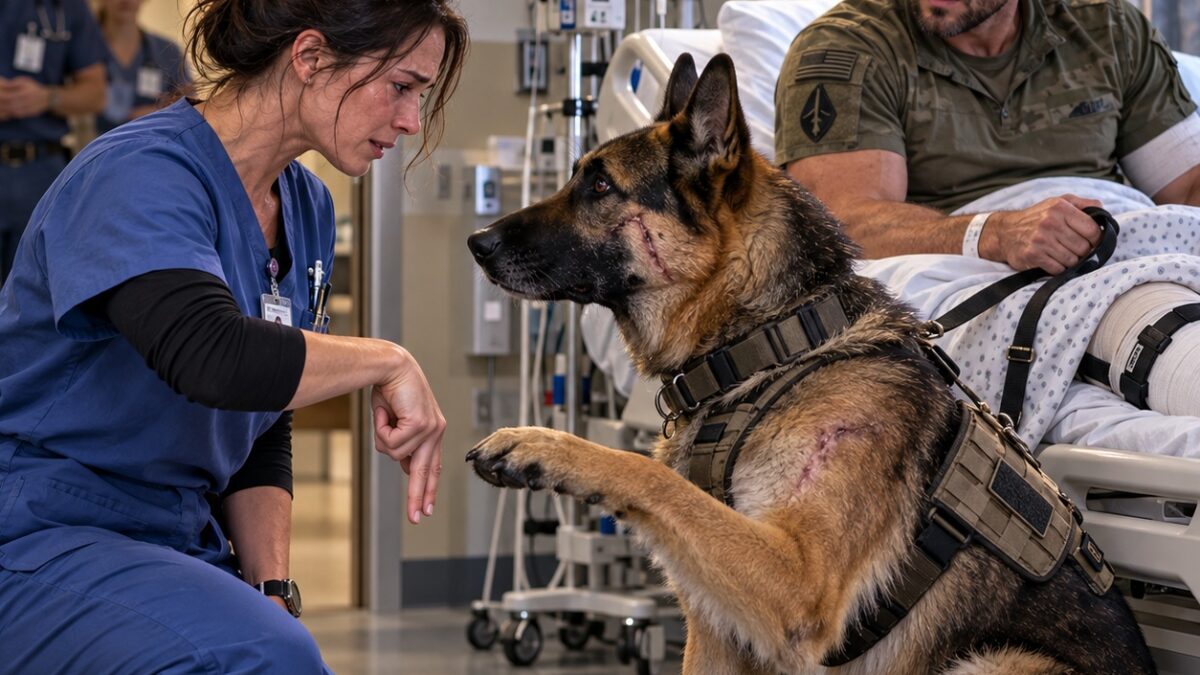
PART 2 AND THE COMPLETE CONCLUSION 👇👇 Thank you ❤️
By midnight, Providence General had settled into the artificial quiet of a hospital graveyard shift.
Machines hummed.
Elevators chimed.
Soft rubber soles squeaked on polished floors.
Somebody laughed quietly near the respiratory station.
A call light blinked in Room 406.
Another patient asked for water.
To everyone else, the building had calmed down.
To me, every sound had become a warning.
I went into the sterile supply room and started counting saline bags.
Thirty-one.
Thirty-two.
Thirty-three.
I already knew how many were there.
Inventory was simply something useful to make my hands do while my mind ran through contingencies.
Jason Carmichael had seen my hand signal.
Worse, he understood it.
Military dogs recognized people in ways human beings underestimated.
Scent.
Movement.
Cadence.
Posture.
The subtle angle at which a trained person entered a room.
Kota had not recognized my face.
He had recognized something underneath it.
Something five years of scrubs, night shifts, ordinary coffee, and practiced small talk had failed to erase.
My body had answered him automatically.
That was the problem with training.
You could abandon an identity.
You could change your hair.
Your address.
Your routine.
You could become someone who drove an old Volvo and complained about staffing ratios.
But your nervous system remembered the language that had kept you alive.
I stopped counting.
My locker was two floors below.
Inside it, beneath a false panel, was a bag I had not opened in eighteen months.
Cash.
Documents.
A passport that did not say Meline Hayes.
Emergency clothes.
A secure phone without an active account.
Five years earlier, I had promised myself I would always keep a way out.
For the first four years, I checked that bag every month.
Then every three months.
Then almost never.
That should have told me something.
I had started living here.
Not just hiding.
There was a difference.
I leaned both hands against the supply shelf.
Running was still possible.
I could clock out.
Walk downstairs.
Take the bag.
Drive north.
Cross into Canada before anyone formally asked a question.
From there, there were other routes.
Other documents.
Other places where nobody knew me.
I had done it before.
That was exactly why I hated the thought.
I was tired.
Not sleepy.
Not shift tired.
I knew how to survive those.
I was tired of disappearing.
Every time danger came close, I became another woman with another address.
Another haircut.
Another explanation.
Another empty apartment furnished as though the occupant planned to leave before the lease ended.
Providence was the first place I had stayed long enough to stop arranging my furniture for escape.
I had plants.
Two of them were alive.
One was not, but I still watered it out of guilt.
I knew which grocery store carried the tea I liked.
Evelyn had a spare key to my apartment because six months earlier I had locked myself out after a thirty-hour stretch.
Dr. Wright owed me forty dollars from an office football pool I had entered by accident.
These were ridiculous details.
They were also a life.
I told myself Jason was only one soldier.
Injured.
Confined to a bed.
No proof.
A dog behaving strangely was not an investigation.
One hand signal meant nothing if I refused to confirm it.
Then I left the supply room.
Jason was watching me through the glass of Room 412.
Not casually.
Analyzing.
His eyes followed my feet.
The way I kept my dominant hand free.
The way I turned corners without hugging the wall.
The way my gaze checked reflective surfaces before doorways.
He had spent too many years around trained people not to notice.
I almost admired him.
Almost.
I entered his room.
“Kota’s due for his nighttime water?”
Jason nodded.
“The bowl’s by the cabinet.”
I poured it.
Kota drank.
Jason kept staring.
“Something wrong with my face, Sergeant?”
“No.”
“Then stop studying it.”
“I’m not studying your face.”
That made me look at him.
“What are you studying?”
“You.”
“Same thing.”
“No.”
He shifted carefully against the pillows.
His right leg was suspended and stabilized.
Even the movement made pain cross his expression.
“You walk wrong.”
I looked down at my shoes.
“They’re hospital clogs.”
“Not what I mean.”
“Then maybe you should sleep.”
“You keep your right hand clear.”
“I’m right-handed.”
“You look at reflective glass before blind corners.”
“I work nights in a hospital.”
“You never turn your back completely on an open doorway.”
My pulse remained steady.
Jason’s eyes narrowed.
“You don’t flinch when alarms go off.”
“Neither do most nurses after enough years.”
“But helicopters bother you.”
That one irritated me.
He had been watching more carefully than I realized.
“You need rest.”
“You know military dogs.”
“I know animals.”
“You know tactical commands.”
“Kota reacted to me. That doesn’t mean I know why.”
“You used a hand signal.”
I smiled.
“Maybe I wave strangely.”
For the first time, Jason laughed.
Small.
Pained.
But real.
“You are terrible at lying.”
“No, Sergeant Carmichael.”
I adjusted his blanket.
“I’m extremely good at lying.”
His expression changed.
That had been a mistake.
I walked out before he could answer.
At 2:07 a.m., the security alarm changed.
Hospitals have dozens of sounds.
Code Blue.
Rapid response.
Fire alert.
Infant security.
Equipment alarms.
Staff hear them so often the meanings reach the body before the words reach the brain.
This one was different.
Code Silver.
Armed threat.
The PA system crackled.
“Security emergency. All staff secure in place.”
The nurses’ station went still.
Evelyn dropped a clipboard.
“What happened?”
A unit secretary held a phone against her ear.
“ER patient. Security incident downstairs.”
Then another voice came through.
“He has a weapon.”
Somebody whispered:
“Oh my God.”
I felt the old switch inside me turn.
The quiet nurse did not disappear.
That would be the wrong way to describe it.
The other woman simply stepped forward inside the same body.
My breathing slowed.
The hallway sharpened.
Distances became obvious.
Doors.
Corners.
People.
The medication room had a reinforced core and badge access.
“Everyone into medication storage.”
Evelyn looked at me.
“What?”
“Take everyone who can move. Put patients who can’t be moved behind locked doors. Medication room for staff.”
“Meline—”
“Now.”
My voice had changed.
Not louder.
Harder.
The kind of tone that assumes compliance because there is no time for discussion.
Evelyn stared for half a second.
Then obeyed.
“What are you doing?”
“Checking the corridor.”
“You are a nurse.”
“Yes.”
“Security said secure in place.”
“I’m securing the place.”
She looked as if she wanted to argue.
Then a distant gunshot sounded.
One.
Another.
Evelyn went pale.
“Go.”
She went.
I removed the heavy fire extinguisher from the wall.
It was not a weapon.
It did not need to be.
It was weight.
Reach.
Hard metal.
I positioned myself to the side of the stairwell door.
Not directly in front.
My body remembered why before my mind finished explaining it.
A sound behind me.
Metal against floor.
I turned.
Jason.
Crutches.
Kota beside him.
“What are you doing out of bed?”
“Same question.”
“Back inside.”
His eyes moved over me.
The extinguisher.
My stance.
Position relative to the doorway.
His face changed.
“You’re waiting beside the entry line.”
“Room 412.”
“That is not a nursing stance.”
“I’ve had difficult patients.”
“That’s your explanation?”
“It’s the one available.”
The stairwell door rattled.
Jason looked at it.
Then at me.
“Kota.”
The Malinois stood.
His body lowered.
I pointed toward Jason.
“Keep him with you.”
Jason’s eyes snapped to my hand.
I had used another signal.
Not classified.
Still familiar.
“You keep doing that.”
“Later.”
The lock on the stairwell door cracked.
Something struck it from the other side.
Then the door burst inward.
The armed man came through fast.
Wild eyes.
Blood across one sleeve.
Gun raised.
He looked directly forward.
Toward where he expected anyone guarding the hallway to be.
He never saw me until I moved.
I struck his weapon arm with the extinguisher.
The gun dropped.
He staggered.
I drove him to the floor.
Not gracefully.
Not theatrically.
Fast.
His face hit linoleum.
I kicked the weapon away.
Pinned him long enough for the first security officers arriving from the opposite corridor to take control.
It happened in seconds.
Long enough for everyone watching to understand exactly one thing.
I was not what I had claimed to be.
I stood.
Smoothed my scrub top.
Picked up my clipboard because it had fallen during the movement.
Evelyn came halfway out of the medication room.
Her mouth was open.
Dr. Wright had arrived from another wing.
Two guards looked at me as though they had walked into the wrong building.
And Jason stood in the doorway of Room 412.
He was not looking at me.
He was staring at the floor.
I followed his gaze.
Something black lay beside Kota’s front paws.
My stomach tightened.
The inside seam of my scrub top had torn.
A small object had fallen from the concealed pocket.
Kota sniffed it.
Then picked it up gently.
Matte black.
Heavy.
Circular.
Jason went still.
“No.”
Too late.
Kota walked toward me.
Sat.
Placed the object into my open hand.
A challenge coin.
No words.
No unit name.
Only an insignia almost nobody outside a specific world would recognize.
Jason recognized it.
His face lost all trace of humor.
“Where did you get that?”
I closed my fingers around the coin.
“Found it.”
He stared.
“That isn’t something you find.”
“People lose things.”
“A Directorate coin?”
Evelyn was close enough to hear.
“What directorate?”
“Nothing,” I said.
Jason ignored me.
“Ground Branch?”
“Sergeant.”
“I knew people who worked with teams carrying that insignia.”
“Then they probably told you not to talk about it in hospital hallways.”
His expression sharpened.
“A civilian trauma nurse doesn’t move the way you just moved.”
I said nothing.
“She doesn’t know military dog commands.”
Silence.
“She doesn’t carry a ghost coin.”
I met his eyes.
“You know less than you think.”
Jason lowered his voice.
“Maybe.”
Then he looked past me.
Toward the stairwell.
“What I do know is that whoever you are hiding from may have just found you.”
Something struck wood.
A sharp sound.
Not gunfire.
Metal.
I turned.
A narrow tactical knife was buried in the stairwell frame.
Pinned beneath the blade was a scorched strip of fabric.
The hallway disappeared.
Not literally.
My body was still there.
Providence was still there.
But another place rose behind it.
Heat.
Concrete.
Rotors.
Dust.
Bogotá.
I stepped forward.
Pulled the fabric free.
Faded field material.
A blood-type patch.
Mine.
From the final operation.
The armed man downstairs had not been a random patient escaping.
Not entirely.
Maybe the hospital had admitted him as one.
Maybe his violence had been real.
But this—
This was deliberate.
A message.
A test.
A scout.
Someone wanted to know whether the woman they thought had died five years earlier would react like the person she had been.
I had reacted.
The answer was now obvious.
Jason saw my face change.
“What is it?”
I checked the time.
“Evelyn.”
She was still near the medication room.
“Yes?”
“Lock everyone in.”
“What?”
“Now.”
“Meline, security has the man.”
“That man was not the threat.”
Jason pushed away from the door frame.
“What are you saying?”
I looked at him.
“How fast can you move?”
He glanced at his leg.
“Not fast.”
“Then we’re going to make slow work.”
“Of what?”
I pulled the knife from the wood.
“Leaving.”
His eyes narrowed.
“Why?”
“Because whoever sent that will assume the first man confirmed me.”
“You’re sure?”
“Yes.”
“How?”
“Because that is what I would do.”
Jason stopped asking.
That was one thing I liked about trained soldiers.
Once the seriousness crossed a certain threshold, curiosity waited.
I turned toward Evelyn.
“You have reinforced doors?”
“Yes.”
“Lock them.”
“Meline—”
“Please.”
That word changed her expression.
I rarely said please when giving a clinical instruction.
She understood.
“Come with us.”
“I can’t.”
“Why?”
“Because if I stay here, they come here.”
“And if you leave?”
“They follow me.”
Evelyn stared.
“You’re talking like this is normal.”
“It isn’t.”
“For you?”
I did not answer.
Her face tightened.
“Go.”
I turned.
Jason was watching.
“Kota stays with you.”
“He’ll stay with me.”
“That’s what I mean.”
We moved toward the service corridor.
Jason’s pace was terrible.
Every step hurt.
He tried hiding it.
Badly.
“Give me your arm.”
“I’m fine.”
“You’re limping on crutches.”
“I’m an Army Ranger.”
“You’re an orthopedic patient.”
“That sounded insulting.”
“It was medical.”
Kota moved at Jason’s left side.
Alert.
Silent.
The building lights flickered.
Then went out.
Emergency illumination kicked on.
Red.
Dim.
The hospital had backup power.
Someone had interrupted the primary system.
Jason looked at me.
“That happen often?”
“No.”
“Good.”
“Stop saying good when things are bad.”
“It annoys you.”
“That is not the priority.”
“Helps morale.”
We reached the freight elevator.
I pushed the button.
Nothing.
Again.
The doors opened.
We entered.
Basement.
Jason leaned against the wall.
“What’s down there?”
“Service tunnels.”
“You know hospital tunnels?”
“I know every exit from every building where I spend significant time.”
He stared.
“You mapped Providence.”
“Yes.”
“Your apartment?”
“Yes.”
“Grocery store?”
“Yes.”
He shook his head.
“You need therapy.”
“Probably.”
The elevator began descending.
Then stopped violently.
Jason grabbed the rail.
Kota widened his stance.
The lights died completely.
A second later, emergency red returned.
Heavy movement sounded above us.
The roof.
Jason whispered:
“Someone’s on the car.”
“Yes.”
“How many?”
“At least one.”
“You sound calm.”
“I’m not.”
“You look calm.”
“That is different.”
The roof hatch shifted.
We did not have time to wait.
The exact details of what followed never appeared in the public report.
That was probably for the best.
What mattered was simple.
We got the hatch open.
The man above us lost control of his position.
Jason climbed despite the pain in his leg.
I helped pull him through.
Kota followed with the kind of athletic ease that made both of us look ridiculous.
We reached the maintenance ladder.
Then the parking garage.
Cold Oregon rain blew through the ventilation openings.
The concrete smelled like oil and wet metal.
Jason’s breathing had changed.
His pain was catching up.
“Stop.”
“I can move.”
“That was not a question.”
He leaned against a pillar.
I checked his leg.
No catastrophic damage I could see.
Still dangerous.
“You need a hospital.”
He looked around.
“We just escaped one.”
“Very funny.”
Kota froze.
Instantly.
His body lowered.
Eyes fixed toward several dark vans near the exit ramp.
Jason saw it too.
His joking disappeared.
“Company.”
Five men emerged.
Dark clothing.
Weapons.
Professional spacing.
Then a sixth figure stepped from behind the vans.
No tactical armor.
Charcoal suit.
Silver at the temples.
The same thin smile I remembered from rooms where decisions about human lives were made as casually as scheduling meetings.
“Hello, Maddie.”
My body went cold.
Nobody at Providence knew that name.
Nobody had called me that in five years.
Jason looked at me.
“Maddie?”
“Later.”
The man smiled.
“Five years.”
“Sterling.”
Director Sterling Hayes.
The man I had once trusted enough to follow into places that did not officially exist.
The man I later learned had been using legitimate operational channels to hide private crimes.
“You look disappointing,” he said.
“I was hoping death had improved your personality.”
Jason made a small sound that might have been a laugh.
Hayes ignored him.
“We thought you were buried outside Caracas.”
“That was the idea.”
“You stole something from me.”
“I took something you had no right to possess.”
His smile vanished.
“Three hundred million dollars.”
Jason looked at me.
“Seriously?”
“Not the time.”
Hayes continued.
“You betrayed the Directorate.”
“No.”
My voice stayed level.
“I refused to help you use Directorate resources to fund illegal detention and private cartel operations.”
“You were not authorized to make that judgment.”
“I made it anyway.”
His eyes sharpened.
“Where are the bonds?”
“Gone.”
“Where?”
“Somewhere you can’t recover them.”
He took one step forward.
Several rifles lifted.
Kota growled.
Low.
Dangerous.
Hayes glanced at him.
“Kill the dog first.”
Jason’s expression changed.
Whatever physical weakness he had been showing disappeared behind something much colder.
“Bad choice.”
“Then the Ranger.”
I moved slightly in front of Jason.
Hayes laughed.
“There she is.”
“What?”
“The woman hiding under those blue scrubs.”
“You brought armed men into a hospital.”
“You brought yourself into a hospital.”
“No.”
I looked straight at him.
“I brought myself into a life.”
His smile faltered for the first time.
“You think pretending to be a nurse changed what you are?”
“I wasn’t pretending.”
“That is adorable.”
Behind him, one of the men shifted.
Kota noticed.
So did I.
Hayes kept talking.
He always liked hearing his own control reflected back to him.
That had been one of his weaknesses.
“You took money that belonged to operations above your clearance.”
“The money never belonged to you.”
“Where is it?”
“Gone.”
“Then why keep the drive?”
That told me he still believed the bluff.
Good.
“Insurance.”
His eyes brightened.
“There it is.”
Jason glanced toward me.
I kept my face still.
Hayes thought the encrypted drive contained access to the bonds.
It never had.
Three years earlier, I had transferred the last of those assets through verified humanitarian channels linked to refugee assistance and medical recovery organizations.
There was nothing left for him.
The drive contained enough false architecture to keep him searching.
I had expected it to buy distance.
Instead, it had bought time.
“Take her,” Hayes ordered.
That was when everything broke.
Lights.
Movement.
Noise.
Kota launched toward the closest threat on Jason’s command.
I moved.
The garage filled with confusion.
I will not pretend it was clean.
Real violence never is.
Men screamed.
Shots struck concrete.
One round tore through the fabric over my shoulder.
Jason nearly went down when his injured leg buckled.
Kota stayed between him and the nearest armed man until Jason regained balance.
I reached Hayes before he reached the exit.
He fired once.
Missed.
I knocked the weapon aside.
He fell against a car.
I drove him to the concrete.
For one moment, the entire five years between Bogotá and Providence disappeared.
He was beneath me.
Helpless.
The man responsible for the life I had abandoned.
The man who had made me sleep with exits mapped.
The man who had convinced me that anonymity was the closest thing I would ever get to peace.
His eyes found mine.
“Do it.”
I understood.
He wanted me to kill him.
Maybe because dead men do not testify.
Maybe because if I killed him, he could die believing I had never truly changed.
I lowered the weapon.
“No.”
His face changed.
“You think that makes you moral?”
“No.”
I stepped back.
“It makes you alive for court.”
Sirens screamed outside.
Many now.
Portland Police.
Federal response.
Hospital security.
Somebody had triggered every alarm Providence owned.
Hayes tried to move.
Kota growled.
He stopped.
I reached into my pocket.
Pulled out the black coin.
Placed it on his chest.
“The bonds are gone.”
He stared.
“You’re lying.”
“Three years ago.”
“No.”
“Refugee medical organizations.”
His face drained.
“The drive?”
“Empty architecture.”
He understood.
The entire mission.
The men.
The hospital assault.
Five years of searching.
All for something that had ceased to exist.
Jason leaned against the pillar.
Despite the pain, he smiled.
“You really made him invade a hospital for a bluff?”
“I never invited him.”
Hayes looked at me with absolute hatred.
“You think this is over?”
“No.”
“They’ll keep coming.”
“Maybe.”
“You’ll run.”
That sentence landed in the center of me.
Because until that moment, part of me assumed he was right.
Sirens approached.
Rain blew across the ramp.
Beyond the garage was an open road.
My Volvo sat two levels above.
The bag in my locker was still waiting.
I could disappear before sunrise.
Again.
New documents.
New country.
New hair.
New hospital.
New lies.
Kota walked toward me.
Sat.
Looked up.
Not the tactical salute.
Not the recognition posture.
Just a dog looking at someone he trusted.
Jason followed my eyes.
“You going?”
I did not answer.
“Because if you are, you should probably move before fifty cops arrive.”
“I know.”
“You always know.”
“Yes.”
“What do you want?”
That question irritated me more than any tactical question he had asked.
Want.
People like me survived by removing want from decisions.
Need.
Risk.
Probability.
Mission.
Want was dangerous.
I looked toward the hospital.
Somewhere upstairs, Evelyn was locked inside the medication room.
Dr. Wright was probably shouting at somebody.
Patients were waiting for answers.
People who had trusted Nurse Meline Hayes.
Not the ghost.
Not Maddie.
Me.
“I want my apartment.”
Jason nodded.
“Good start.”
“My terrible car.”
“It really is terrible.”
“My night shift.”
“That sounds unhealthy.”
“My coffee.”
“Hospital coffee?”
“Yes.”
“You need higher standards.”
I almost laughed.
Then I realized I was crying.
Not dramatically.
One tear.
That annoyed me.
Jason pretended not to see it.
“I don’t want another name,” I said.
His expression softened.
“Then keep this one.”
Police entered the garage.
Weapons raised.
Commands shouted.
I raised my hands.
For the first time in five years, I did not run.
The next seventy-two hours were brutal in a completely different way.
Interviews.
Statements.
Federal agencies arriving in conference rooms with acronyms stacked behind their names.
Hospital leadership demanding explanations.
Legal teams demanding different explanations.
Every system involved wanted to know where its authority began and somebody else’s failure ended.
I slept six hours in three days.
Which, ironically, was not much worse than some holiday shifts.
Jason remained admitted.
His surgical repair had been stressed but not destroyed.
Kota stayed with him whenever investigators were not asking questions.
Sterling Hayes survived.
So did three of the armed men captured in the garage.
Others were arrested over the following days.
The first major break came when federal investigators compared records Hayes assumed would never be compared.
Payments.
Contractors.
Secure travel.
Shell companies.
Operations listed under authorities that had never approved them.
The compartments that had protected him began collapsing.
One office knew about the money.
Another knew about personnel movements.
Another had records of private security teams.
Another had information from Bogotá.
Nobody had seen the full structure because Hayes had spent years ensuring they never sat in the same room.
Now they did.
Because he had attacked a civilian hospital.
The act meant to erase witnesses created hundreds.
Security cameras.
Police logs.
Hospital staff.
Patients.
Electronic records.
Weapons recovered in the garage.
The tactical team he had brought became the evidence that destroyed him.
On the fourth day, a federal investigator named Elaine Mercer sat across from me in a small conference room.
Mid-fifties.
Silver streak in her dark hair.
No wasted movements.
“You understand we verified your former status.”
“Yes.”
“Parts of your file remain compartmented.”
“Yes.”
“Parts appear deliberately inaccurate.”
“Yes.”
“Did you create those inaccuracies?”
“Some.”
She looked up.
“Which?”
“Employment timeline after separation.”
“And the death record?”
“No.”
That surprised her.
“Who did?”
“I don’t know.”
“You benefited from it.”
“Yes.”
“Did you request it?”
“No.”
She studied me.
“Were you officially sanctioned after Bogotá?”
“No.”
“Unofficially?”
I almost smiled.
“That phrase is doing a lot of work.”
Mercer did not smile.
“Were you being hunted by your own government?”
“No.”
“By Hayes?”
“Yes.”
“Why?”
“The bonds.”
“And because you knew about unauthorized programs.”
“Yes.”
“Why didn’t you come forward?”
“With what?”
I leaned back.
“A story about a senior official using compartmented funding for operations the records said did not exist?”
“You had evidence.”
“I had enough evidence to get killed before I reached anyone capable of protecting it.”
Mercer was silent.
That was not agreement.
It was understanding.
“I made the wrong choice in some places,” I said.
Her eyebrows lifted.
“Such as?”
“Hiding too long.”
That answer seemed to surprise both of us.
She closed the folder.
“Providence wants to know whether you are a threat to the hospital.”
“I’m a trauma nurse.”
“That is not what I asked.”
“No.”
I took a breath.
“I am not a threat to the hospital.”
“Will anyone else come?”
“Not for the bonds.”
“Because they are gone?”
“Yes.”
“Can you prove that?”
“I can provide the transfer architecture.”
“You kept records?”
“Enough.”
“Where?”
I looked at her.
“If I tell you, am I under arrest?”
“No.”
“Then somewhere safer than this room.”
For the first time, Mercer smiled slightly.
“You really are exhausting.”
“I’ve been told.”
Providence placed me on paid administrative leave.
Reasonable.
Their official notice used phrases like extraordinary circumstances and pending federal verification.
Evelyn called me two hours after I received it.
“You’re not fired.”
“I can read.”
“You sounded like you thought you were.”
“I sound the same all the time.”
“No, you don’t.”
I was sitting at my kitchen table.
My actual kitchen table.
I had expected to feel unsafe there after everything.
Instead, being home felt almost defiant.
“You lied to me,” Evelyn said.
“Yes.”
“For five years.”
“Yes.”
“You listed a corporate PO box as your address.”
“Yes.”
“Do you know how weird that is?”
“Yes.”
“You told me you spent Thanksgiving alone because you preferred quiet.”
“That was true.”
“You carried a fake passport.”
I paused.
“How do you know that?”
“The FBI emptied your locker.”
“Federal task force.”
“Not the point.”
“It is technically the point.”
“Meline.”
“Yes.”
“Stop correcting me.”
“Okay.”
Silence.
Then:
“I’m angry.”
“I know.”
“I thought we were friends.”
The sentence hurt more than Hayes’s bullet grazing my shoulder.
“We were.”
“You don’t hide your entire existence from a friend.”
“I did.”
“That isn’t an answer.”
I looked at the plant on my windowsill.
The dead one.
Still there.
“I didn’t know how to be known safely.”
Evelyn went quiet.
“I knew how to help patients.”
I continued.
“I knew how to work. I knew how to be useful. I knew how to listen to you complain about your ex-husband and your mother and your neighbor’s awful dog.”
“His dog is awful.”
“I know.”
“But I didn’t know how to let somebody know me without eventually needing to leave.”
Her voice softened.
“Are you leaving now?”
I looked toward the bag beside the bedroom door.
For years, it had represented safety.
Now it looked ridiculous.
“No.”
“You mean that?”
“Yes.”
“Good.”
She sniffed.
Then:
“I’m still mad.”
“Fair.”
“And I want my key back.”
I almost laughed.
“You gave me my key.”
“Then I’m keeping it.”
“Okay.”
“And when they let you come back, you’re buying coffee.”
“Hospital coffee?”
“Real coffee.”
“That sounds expensive.”
“You apparently hid sixty thousand dollars in your locker.”
“Federal investigators took it.”
“Then put it on your tab.”
I laughed.
A real laugh.
The kind that arrives unexpectedly enough to hurt.
After we hung up, I sat there for a long time.
Then I opened the emergency bag.
Passport.
Cash gone, taken into evidence.
Old clothes.
Secure phone.
A photograph I had forgotten was inside.
Me.
Years younger.
Dust-covered.
Standing beside three people whose names I still thought about more often than I admitted.
Behind us, a helicopter.
Nobody smiling.
Not because we were unhappy.
Because the picture had been taken after thirty hours without sleep.
I stared at the woman in the photograph.
For years, I had treated her like a dangerous witness.
Someone who knew too much about me.
That suddenly seemed cruel.
She had survived too.
I removed the passport.
Cut it in half.
Then the backup identity card.
Another.
Another.
I left the cash envelope alone because it was already empty.
The secure phone went on the table for federal collection.
When I finished, the bag was just nylon.
Nothing magical.
Nothing protecting me.
I threw it away.
That night I slept eight hours.
The longest uninterrupted sleep I had had in years.
Jason called the next morning.
His first words were:
“Kota misses you.”
“That sounds unlikely.”
“He keeps looking at the door.”
“He does that because he’s a dog.”
“He ignored breakfast for six minutes.”
“Tragic.”
“He’s emotionally devastated.”
“Did he eventually eat?”
“Everything.”
“Then he recovered.”
Jason laughed.
“When are you coming in?”
“I’m suspended.”
“Administrative leave.”
“You read hospital emails now?”
“Evelyn came by.”
That alarmed me.
“Why?”
“She brought soup.”
“Why?”
“I’m injured.”
“She hates cooking.”
“I know.”
“What did she bring?”
“Something from a deli poured into her own container.”
“That sounds like Evelyn.”
Jason became quieter.
“You okay?”
“Yes.”
“Real answer.”
I hated that he had learned there were two versions.
“I don’t know.”
“Better.”
“How is that better?”
“Because ‘yes’ was nonsense.”
I looked toward the window.
Rain.
Portland being Portland.
“Everything I built was supposed to work because nobody knew.”
“And now everybody knows?”
“Enough.”
“Still have the apartment?”
“Yes.”
“Job?”
“Maybe.”
“Friends?”
I thought of Evelyn.
“Yes.”
“You’re alive?”
“Yes.”
“Kota still worships you?”
“He does not worship me.”
“He saluted you.”
“That is not worship.”
“Close.”
I smiled despite myself.
Jason continued.
“Sounds like hiding wasn’t what made those things real.”
That irritated me because it was true.
“You should focus on physical therapy.”
“I’m excellent at multitasking.”
“You’re terrible at walking.”
“That was cruel.”
“Clinically accurate.”
Two weeks later, federal prosecutors formally charged Hayes with multiple offenses connected to the hospital assault, illegal contracting, conspiracy, financial crimes, and obstruction.
There were more charges later.
Names I never knew.
Programs I only knew pieces of.
The investigation expanded beyond me.
That mattered.
I did not want the story reduced to one rogue man chasing one former operative over money.
There had been victims.
People detained in places that should not have existed.
Families displaced.
Contractors killed.
Records manipulated.
Money hidden.
Hayes had treated systems like personal property.
His mistake was believing secrecy meant ownership.
It did not.
The bonds became one small piece of a much larger case.
The humanitarian transfers were verified.
No money remained under my control.
That mattered legally.
It mattered more personally.
For five years, part of me had expected someone to knock on my door and accuse me of theft.
Now a federal auditor sat across from me and said:
“The transfer trail supports your statement.”
I blinked.
“That’s it?”
“That is not a small sentence.”
“No.”
“It means you were telling the truth.”
“I knew that.”
She closed the report.
“Sometimes other people knowing matters.”
I thought about that long after she left.
Six weeks after the attack, Providence called me before federal investigators did.
Board meeting.
I wore civilian clothes.
No disguise.
Just a sweater and black pants.
It was oddly harder than tactical gear had ever been.
Dr. Wright sat at one end of the conference table.
Chief Nursing Officer Marissa Cole sat beside him.
Hospital counsel.
Security director.
Evelyn.
I looked at her.
“Why are you here?”
“Staff representative.”
“You volunteered?”
“Yes.”
“That seems dangerous.”
“Shut up.”
The board chair opened.
“We have completed our internal review.”
I nodded.
“Your clinical actions during the Code Silver event prevented further injury.”
I said nothing.
“Your handling of the assailant fell outside normal expectations for nursing personnel.”
Evelyn muttered:
“That is one way to put it.”
Someone ignored her.
“However, the hospital recognizes the extraordinary nature of the threat.”
Another folder.
“Federal authorities have verified that your prior identity and employment history were subject to protective restrictions.”
“Some of it.”
“Yes.”
The board chair looked at me.
“Some of your HR submissions were misleading.”
“Yes.”
“Would you do that again?”
“No.”
No hesitation.
That seemed to matter.
“Why not?”
“Because I’m done running.”
The room became quiet.
Dr. Wright looked down.
Evelyn smiled slightly.
The board chair folded her hands.
“Providence would like you to return.”
I had prepared for termination.
Not that.
“Why?”
Marissa Cole answered.
“Because you are an exceptional trauma nurse.”
“That existed before everyone knew about the rest.”
“Yes.”
She did not look away.
“And we failed to ask why someone with your instincts consistently performed above expected experience.”
“You think you should have investigated me earlier?”
“No.”
A faint smile.
“I think institutions are very good at accepting competence when it benefits them and becoming suspicious only when they discover they didn’t control its origin.”
That was sharper than I expected from administration.
Dr. Wright spoke.
“I want you back.”
“Because you’re short staffed?”
“That too.”
Evelyn nodded.
“Very short staffed.”
I looked around.
“What changes?”
The security director answered.
“We improve protocols.”
“For me?”
“For the hospital.”
He looked uncomfortable.
“The attack exposed weaknesses unrelated to you.”
Good.
That was true.
“We are also adding advanced violent-threat response training for staff.”
I shook my head.
“Do not train nurses to fight gunmen.”
Everyone paused.
“Train them to lock down correctly. Improve reinforced access. Communication. Safe-room placement. Security response.”
The director made a note.
“Nurses should not become security.”
Evelyn looked at me.
“You hear yourself?”
“Yes.”
“You fought gunmen.”
“Exactly.”
I looked at the room.
“That was because normal systems failed. The solution is not teaching normal people to become me.”
Nobody argued.
The board chair asked:
“Will you come back?”
I looked through the conference-room glass.
Nurses moving.
Patients being transported.
A custodian pushing a cart.
Ordinary hospital life.
Five years earlier, I had chosen Providence because ordinary felt safe.
Now ordinary looked valuable for a different reason.
“Yes.”
Evelyn exhaled.
“But,” I added.
Of course everyone hated that.
“One condition.”
The board chair lifted an eyebrow.
“What?”
“My personnel record gets corrected.”
“It will.”
“No euphemisms.”
“What do you want it to say?”
I thought about it.
“Former federal operational medical support. Prior field trauma experience. Current registered nurse.”
Dr. Wright smiled.
“That’s all?”
“That is enough.”
I did not need medals.
Clearances.
Operations.
I did not need the black coin framed.
I wanted the truth without turning my worst memories into a résumé.
Providence accepted.
My first shift back was terrible.
Not clinically.
Socially.
Everyone stared.
A resident whispered to another resident and nearly walked into an IV pole.
A security guard straightened when I passed.
One nurse I barely knew asked:
“So were you, like, an assassin?”
“No.”
“Oh.”
I kept walking.
Another asked whether I could teach her “spy stuff.”
“No.”
Evelyn intercepted the next person before they reached me.
“If anyone asks Meline whether she has killed someone, I’m assigning them every bowel prep on the fourth floor for six months.”
Questions stopped.
By midnight, a patient vomited on my shoes.
Normalcy returned beautifully.
Jason remained at Providence during the first three shifts after I returned.
His recovery had been delayed, but not permanently damaged.
I visited after rounds.
Kota became more obnoxious each time.
The moment I entered, he sat upright.
Sometimes he lifted that paw.
“Stop encouraging him,” Jason said.
“I’m not.”
“You look pleased.”
“I look professional.”
“You look emotionally compromised.”
“That is not a diagnosis.”
“It is now.”
One night I sat by his window while he finished dinner.
Kota slept between us.
Jason said:
“Sterling’s lawyers tried to argue the hospital attack was unauthorized contractor behavior.”
“It failed.”
“How do you know?”
“Mercer.”
“Your federal friend?”
“She is not my friend.”
“Does she have your phone number?”
“Yes.”
“Friend.”
“That is not the definition.”
Jason smiled.
Then he became serious.
“What happens after trial?”
“I work.”
“You think that’s all?”
“Yes.”
“You’re terrible at future planning for someone who maps grocery-store exits.”
“That is tactical planning.”
“What about life planning?”
I looked at him.
“What do you want me to say?”
“I don’t know.”
“Helpful.”
“Maybe take a vacation.”
“I dislike vacations.”
“Because you don’t know what to do without a task.”
“That is unfair.”
“It’s accurate.”
I did not answer.
He pointed toward Kota.
“He agrees.”
Kota was asleep.
“Kota is unconscious.”
“Strategic silence.”
Two months later, Jason transferred back to the renovated VA facility.
I walked him downstairs.
He used a cane instead of crutches now.
Kota wore his working harness.
Near the exit, the Malinois stopped.
Turned toward me.
Sat.
Right paw lifted.
That stupid salute.
Jason groaned.
“Kota.”
I crouched.
“No.”
Kota kept staring.
My throat tightened unexpectedly.
The first time he had done that, I wanted to vanish.
Now it felt different.
I put both hands gently against his face.
“You caused a lot of trouble.”
Tail thump.
“My career nearly ended.”
Another.
“My apartment was searched.”
Another.
“Federal agents drank all my coffee.”
Jason said:
“That last one is the real crime.”
I looked at Kota.
“Thank you.”
The words came out quietly.
Jason did not joke.
Kota leaned forward.
Pressed his forehead lightly against mine.
Then he returned to Jason.
I stood.
Jason held out his hand.
I took it.
His grip was firm.
“You saved my life.”
“Kota saved your life.”
“You helped.”
“I’m a nurse.”
“Yes.”
He smiled.
“That’s what I mean.”
He left.
I watched their vehicle disappear through Portland rain.
For once, somebody leaving did not feel like abandonment.
That was new too.
Sterling Hayes’s case took almost a year.
I testified twice.
Both times, I hated every second.
Courtrooms were worse than operations in one way.
You could not move.
You had to sit while strangers reconstructed choices you made under pressure and discuss them as if they had happened slowly enough for committee review.
Hayes watched me from the defense table.
Older.
Smaller somehow.
Power does that when institutions stop lending it their clothing.
His attorney asked:
“You stole three hundred million dollars.”
“No.”
“You removed assets from authorized Directorate control.”
“Yes.”
“Without authorization.”
“Yes.”
“Isn’t that theft?”
“They were being diverted outside lawful authority.”
“That wasn’t my question.”
“It’s the reason the answer matters.”
The prosecutor objected.
The judge intervened.
Documents were shown.
Transfers traced.
Witnesses testified.
Former contractors.
Analysts.
A finance officer who had spent years pretending not to understand strange accounts.
A man who survived one of Hayes’s unofficial facilities.
That testimony changed the room.
This was not about my decision anymore.
It was about what the money had supported.
Hayes was convicted on enough counts that the rest almost stopped mattering.
The day of sentencing, I did not attend.
Evelyn asked why.
“I already gave him enough years of my life.”
Instead, I worked.
Room 317.
Elderly woman with pneumonia.
Room 322.
Young father after emergency surgery.
Room 309.
Veteran with chest pain who kept insisting it was “probably nothing.”
It was not nothing.
We caught the problem early.
By evening, he was stable.
That felt like a better use of the day.
A week later, Elaine Mercer came to Providence.
She found me at the nurses’ station.
“You missed the sentencing.”
“I heard.”
“Long time.”
“Good.”
She handed me an envelope.
“What is this?”
“Property release.”
Inside was the black challenge coin.
I stared.
“You can keep it.”
“I thought evidence—”
“Case closed on that item.”
I turned it over.
Same weight.
Same insignia.
Same object that had fallen onto a hospital floor and detonated the life I had built around secrecy.
Mercer watched me.
“You going to throw it away?”
“I don’t know.”
“People usually keep things like that.”
“People usually didn’t fake their death to escape the people who gave it to them.”
“Fair.”
She started leaving.
“Elaine.”
She turned.
“Thank you.”
“For?”
“Believing the records enough to keep looking.”
She nodded once.
“That’s the job.”
After she left, I put the coin in my scrub pocket.
For half the shift, I hated feeling it there.
At home, I placed it inside my desk drawer.
Not hidden.
Not displayed.
Just stored.
That was where the past belonged.
Accessible.
True.
Not in control.
A few months after that, Providence asked me to help design a specialized program for veterans transferred through our trauma service.
Not a military unit.
Not anything dramatic.
A clinical liaison program.
Better intake histories.
Blast exposure questions.
PTSD-informed procedures.
Clear protocols for service animals.
Medication histories that accounted for long-term operational injuries.
Evelyn heard before I did.
“You’re becoming administration.”
“Absolutely not.”
“You have meetings.”
“I hate meetings.”
“That means you’re qualified.”
Dr. Wright became the physician sponsor.
I agreed only if my role remained clinical.
That mattered.
I had spent years being turned into whatever institutions needed.
Operative.
Asset.
Ghost.
Witness.
Threat.
Hero.
I wanted to remain what I had chosen.
A nurse.
The program grew slowly.
One case at a time.
An older Marine who became agitated whenever staff approached from behind.
A former combat engineer whose headaches made more sense after somebody finally asked about blast exposure.
A veteran who refused certain pain medication because a previous deployment had changed his relationship to sedation.
Small things.
Important things.
I learned that my past did not need to return as violence to have value.
It could become context.
Questions.
Patience.
Understanding.
One rainy afternoon, almost eighteen months after Kota first exposed me, the elevator doors opened.
Jason stepped out.
No cane.
Kota beside him.
Gray beginning around the dog’s muzzle.
I was at the nurses’ station.
For several seconds, I simply stared.
Jason smiled.
“You look disappointed.”
“You’re walking.”
“That was the plan.”
“What are you doing here?”
“Follow-up in orthopedics.”
“Across campus.”
“We took a detour.”
Kota saw me.
Stopped.
Jason sighed.
“Don’t.”
The paw lifted.
I laughed before I could stop myself.
Several nurses turned.
Kota’s tail started hitting the floor.
I crouched.
“You’re getting old.”
He pressed against me.
Jason said:
“He’s retired now.”
I looked up.
“Completely?”
“Last month.”
“How is he handling it?”
“He stole half a rotisserie chicken Sunday.”
“Successful transition.”
“Very.”
We walked outside after my shift.
Portland rain had stopped.
Rare event.
Jason asked:
“You ever take that vacation?”
“No.”
“I knew it.”
“I took three days off.”
“That is not vacation.”
“I reorganized my apartment.”
“That is deeply depressing.”
“I enjoyed it.”
“You need intervention.”
Kota walked between us.
For once, silence was comfortable.
Jason stopped near my car.
He looked at the Volvo.
“You still drive this thing.”
“It runs.”
“I thought after saving the hospital and toppling a covert criminal network you might upgrade.”
“I changed the tires.”
“Big spender.”
I unlocked the door.
Then he said:
“I bought a place outside Hood River.”
I looked at him.
“Good.”
“Little land.”
“Kota likes it?”
“He believes he owns seventeen acres.”
“He probably does.”
Jason rubbed the back of his neck.
An oddly nervous gesture for him.
“I’m having some people over Saturday.”
“People?”
“Yes.”
“Why?”
“Food.”
“Suspicious.”
“Normal people do this.”
“I’ve heard rumors.”
“You should come.”
I looked at him.
That old instinct appeared.
Calculate.
What does this mean?
What obligation?
What risk?
Then I stopped.
Maybe a meal could simply be a meal.
“Okay.”
Jason blinked.
“That easy?”
“Do you want me to refuse?”
“No.”
“Then Saturday.”
He smiled.
Kota looked between us.
“No saluting at dinner,” I told him.
Tail thump.
Saturday became another Saturday.
Then occasional Sundays.
Jason never asked me to explain things I did not want to explain.
That was probably why I eventually explained more than I expected.
Not operational details.
Not secrets belonging to other people.
Just myself.
Why helicopters bothered me.
Why I slept badly.
Why I had kept the bag.
Why I hated locked doors unless I controlled the lock.
He understood without treating understanding like permission to fix me.
That mattered.
Our relationship did not transform overnight into something cinematic.
No dramatic kiss in the rain.
No ridiculous promise that trauma vanished because two damaged people found each other.
We became friends.
Real ones.
The kind who knew when to talk and when not to.
Kota became old enough that his hips stiffened in winter.
I became the person Jason called when the dog’s appetite changed.
Jason became the person Evelyn called when she decided I was working too many extra shifts.
I objected to this alliance.
Nobody cared.
Two years after the Providence attack, I renewed my nursing license under my real legal identity.
No protected PO box.
Actual address.
That tiny line on the form took me almost five minutes.
Home address.
I stared at it.
Then typed where I lived.
No alternate.
No shell company.
No forwarding service.
My hands shook more doing that than they had in the parking garage.
Funny what fear looks like after enough time.
That same year, Providence expanded the veterans liaison program into a dedicated section attached to trauma and surgical recovery.
The board asked me to lead clinical operations.
I said no twice.
Evelyn accused me of being difficult.
Dr. Wright said:
“You’re already doing half the job without the salary.”
That offended me enough to reconsider.
I accepted on the condition I still carried patient assignments.
They agreed.
The office they gave me had a window.
I disliked that.
Too visible.
Then I realized the window faced Mount Hood on clear days.
I kept it.
On the wall, I put no medals.
No coin.
No military photographs.
Instead, I framed a simple card containing three lines:
Listen first.
Ask what the chart missed.
Never confuse calm with absence of fear.
Evelyn read it.
“Very inspirational.”
“You sound sarcastic.”
“I am.”
“Get out of my office.”
“You have an office!”
She shouted it down the corridor like an accusation.
I laughed.
Another thing I did more easily now.
Kota’s final years were peaceful.
He lived with Jason.
Walked the property.
Slept wherever he wanted.
Inspected every visitor as though national security depended on it.
Whenever I visited, he still sometimes raised that paw.
Less formal as he aged.
More like habit.
Then one winter morning, Jason called me before sunrise.
I knew before he spoke.
There are silences that carry information.
“Meline.”
“I’m here.”
“Kota didn’t get up.”
I closed my eyes.
“Is he breathing?”
“Yes.”
“Comfortable?”
“I think so.”
“I’m coming.”
The drive to Hood River took less than it should have.
Old habits.
I found Kota on a blanket near the fireplace.
Jason sat beside him.
The Malinois’s muzzle was almost entirely gray.
His breathing slow.
No fear.
Just tired.
I knelt.
Kota opened his eyes.
For one moment, they sharpened.
He recognized me.
His paw moved.
Barely.
Lifted an inch.
The salute.
My throat closed.
“No.”
I took the paw gently.
“You don’t have to do that anymore.”
Jason looked away.
I put my forehead against Kota’s.
“You already found me.”
His tail moved once.
Very small.
We stayed with him.
No dramatic rescue.
No impossible miracle.
Some endings are beautiful because nobody has to face them alone.
Kota died with Jason’s hand on his shoulder and mine around his paw.
Quiet.
Safe.
Home.
I cried harder than I expected.
For him.
For Jason.
For the first dog I had worked beside overseas.
For the people in the photograph from my emergency bag.
For every goodbye I had once survived by pretending it did not matter.
Jason did not tell me to stop.
He cried too.
That helped more than anything anyone could have said.
Weeks later, he gave me Kota’s old identification tag.
“I can’t take that.”
“Yes, you can.”
“It belongs to you.”
“He belonged to himself.”
Jason smiled sadly.
“And somehow he decided you were his problem too.”
I held the tag.
“He ruined my life.”
“He fixed it.”
“Both can be true.”
“Yes.”
I put Kota’s tag in the same desk drawer as the black coin.
One represented the life I had tried to escape.
The other represented the creature who exposed me to it.
Neither controlled me anymore.
Years passed.
Not many.
Enough.
Sterling Hayes remained in prison.
The network around him dissolved through prosecutions, resignations, investigations, and quiet corrections nobody outside government would ever care about.
My federal file was formally amended.
Not fully public.
Never would be.
But the false death annotation disappeared.
For the first time in years, I existed cleanly in the systems that recorded people.
Meline Hayes.
Registered nurse.
Former federal operational medical specialist.
Alive.
That last word meant more than it should have.
Evelyn eventually became nursing supervisor.
She pretended to hate it.
Loved it.
Dr. Wright reduced his trauma schedule after finally admitting surgeons also age.
Jason opened a rehabilitation nonprofit for injured veterans and first responders.
He claimed it was not because I had bullied him into doing something useful.
It absolutely was.
Providence partnered with his program.
That was how our lives remained entangled without either of us forcing it.
One autumn evening after a fundraiser, we stood outside the hospital.
The same sliding doors.
Same fourth-floor windows.
Different life.
Jason looked toward the entrance.
“Do you ever think about that first night?”
“With Kota?”
“Yes.”
“All the time.”
“What do you think would’ve happened if he hadn’t recognized you?”
I considered it.
“I’d probably still be hiding.”
“Really?”
“Maybe.”
“You hated hiding.”
“I was good at it.”
“That is not the same thing.”
“No.”
We stood quietly.
Then he said:
“He knew before you did.”
“What?”
“That you were tired of disappearing.”
I looked at him.
“Dogs are not philosophers.”
“Kota was.”
“Kota ate drywall once.”
“He contained multitudes.”
I laughed.
Jason held out his hand.
Not dramatic.
Not nervous.
Just offered.
I looked at it.
Then took it.
We walked toward the parking lot.
There is no perfect ending to a life like mine.
I do not believe in them.
Perfect endings erase too much truth.
People still die.
Bodies still remember.
Some nights I wake before dawn because a sound in a dream becomes a helicopter before I fully return to my room.
I still choose seats facing doors.
Still notice hands.
Still map exits without trying.
But the map no longer tells me where to run.
It simply tells me where I am.
That is different.
My apartment became a house eventually.
Not a safe house.
Not an address selected for escape routes.
A house.
Jason helped me choose it, which meant he criticized every kitchen.
Evelyn vetoed one property because she said the dining room looked haunted.
We planted a tree out back.
I managed not to kill it.
Progress.
On my desk were two objects.
A black challenge coin.
A worn K9 tag.
People who did not know the story saw metal.
That was fine.
I knew.
One represented the woman I had believed I needed to bury.
The other represented the dog who refused to let me.
Some mornings before work, I touched neither.
I did not need rituals.
I just made coffee.
Drove to Providence.
Walked through the same doors.
Answered questions.
Checked charts.
Listened.
Sometimes a young nurse would become flustered in a difficult case.
I would lower my voice.
“Look at me.”
They would.
“Breathe.”
Then:
“What is the patient telling us that the numbers aren’t?”
That was the question.
Always.
Not just medicine.
People too.
What is underneath what you first see?
The quiet nurse might have been a former operative.
The aggressive military dog might have been recognizing an old ally.
The injured Ranger might have been the first person stubborn enough to ask whether surviving and living were actually the same thing.
The administrator might become a friend.
The hospital you chose because nobody knew you might become the first place you were known and still allowed to stay.
And the past you thought would destroy you might become something you could finally set down without pretending it never happened.
Five years of hiding ended because Kota recognized me.
At first, I hated him for it.
Then I understood.
The dog did not expose a secret that destroyed my life.
He exposed the lie holding my life together.
Those were not the same thing.
The lie said:
If people know who you were, they will leave.
They did not.
The lie said:
If your past finds you, you have to run.
I stayed.
The lie said:
You can only be safe if nobody truly sees you.
That one took longest to unlearn.
Evelyn saw me.
Jason saw me.
Providence saw enough.
I stayed anyway.
Years after Kota was gone, Jason and I returned to Providence for a memorial ceremony honoring retired military and service dogs who had worked with patients in the region.
There was a small wall now.
Not dramatic.
Names.
Dates.
Short service histories.
Kota’s plaque was near the middle.
Jason stood beside me.
The inscription read:
KOTA
MILITARY WORKING DOG
THREE DEPLOYMENTS
LOYAL IN SERVICE. LOYAL IN PEACE.
I stared at the final line.
Jason said:
“You okay?”
“Yes.”
Real answer this time.
He knew.
I touched the plaque.
“Good boy.”
It was the same thing Jason had said the night I disappeared into the rain in the version of my life that almost happened.
Except I had not disappeared.
That was the difference.
I stayed.
I gave statements.
I went back to work.
I let angry friends remain angry long enough to forgive me honestly.
I watched a man who hunted me face trial.
I built something useful from skills I once believed only belonged to violence.
I learned how to accept dinner invitations.
I learned how to leave town for three days without carrying emergency documents.
I learned that a house could be chosen because I liked the trees rather than because it had three exits.
I learned that grief did not have to become distance.
I learned that being known was frightening.
And survivable.
The hospital still tells the story sometimes.
A new nurse hears about the night a retired military dog walked into Room 412 and saluted an ordinary-looking woman in blue scrubs.
The story gets exaggerated.
People say Kota barked.
He did not.
They say everyone immediately knew I was CIA.
They did not.
They say I stared at the dog and whispered some secret phrase.
I did not.
They say I looked fearless.
That is the biggest lie.
I was terrified.
From the moment Kota raised his paw, I knew something I had controlled for five years was breaking.
Courage did not mean I felt no fear.
It meant eventually I stopped letting fear choose my address.
That is the part I would keep if everything else disappeared.
Not the fight.
Not the classified coin.
Not Sterling Hayes.
Not the money.
This:
I thought safety meant never being recognized.
A retired military dog recognized me immediately.
And the life I was so afraid of losing became better only after I stopped hiding inside it.
My name is Meline Hayes.
I am a registered nurse.
I once worked in places I cannot fully discuss.
I made choices I still question.
I made others I would make again.
I have scars nobody sees.
I have friends who know enough.
I have a home.
And every time a helicopter passes low over Portland and my shoulders tense before my mind catches up, I no longer hate myself for it.
I breathe.
I look around.
I remind myself where I am.
No compound.
No extraction.
No false passport waiting downstairs.
No order to disappear.
Just Providence General.
A patient waiting.
A shift beginning.
A life I finally chose instead of escaped into.
Then I walk through the doors.
And I stay.








