𝗙𝗨𝗟𝗟 𝗦𝗧𝗢𝗥𝗬:Everyone in Omaha Feared the Man in My Corner Booth—Except Me
FULL STORY CONTINUATION
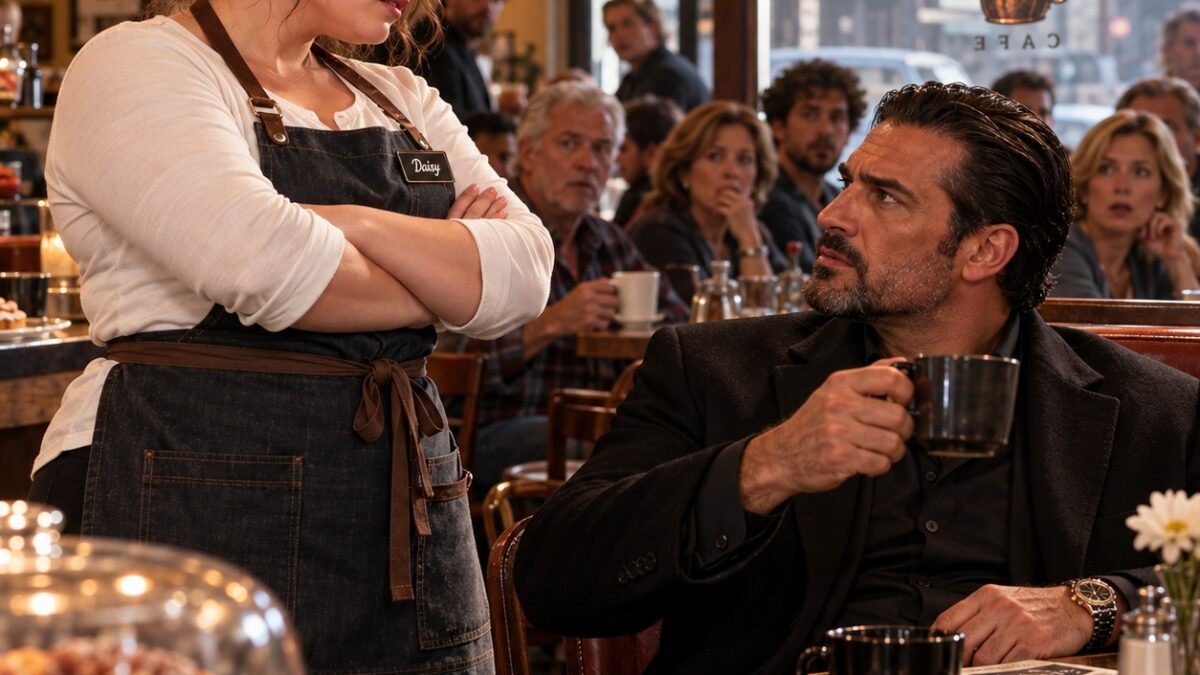
For about three seconds, the Copper Mug became the quietest place in Nebraska.
Forty people had been talking a moment earlier.
Somebody had a Husker game playing on a phone near the pastry case.
Gerald the oven had already burned one tray of cinnamon rolls and Hattie Brandt, my sixty-three-year-old baker, was publicly accusing him of sabotage.
Teddy Wynn, my nineteen-year-old barista, had milk steaming too loudly and a line of customers stretching through the door.
Then Marco said that sentence.
And every sound seemed to drop out from under me.
“I don’t come for the coffee.”
His eyes stayed on mine.
Dark.
Still.
Attentive.
Not warm exactly.
But focused on me in a way I was not used to being looked at.
I had spent years being looked over.
Looked through.
Looked up and down.
People looked at me and saw a body before they saw a person.
Marco looked like he was listening even when I had not said anything yet.
That made me nervous in a way no insult ever had.
“What?”
Brilliant answer, Daisy.
Absolutely devastating.
He leaned back slightly.
“I said I don’t come for the coffee.”
My face got hot.
“Well.”
I lifted his empty mug.
“There’s tea.”
Teddy made a sound behind the counter.
I shot him a look.
He immediately began cleaning something that was already clean.
Hattie stood in the kitchen doorway holding a rolling pin with both hands.
I retreated behind the counter.
“It means nothing,” I whispered.
Teddy stared at me.
“I didn’t say anything.”
“You are saying things with your face.”
Hattie slowly shook her head.
“Honey, I have been alive sixty-three years.”
“That is wonderful for you.”
“And I did not know a man could say that sentence.”
“He is strange.”
“Mmm-hmm.”
“He likes the corner.”
“Mmm-hmm.”
“He comes for the atmosphere.”
Hattie looked around at our mismatched chairs.
One table had a folded napkin shoved under a short leg.
The radiator made a metallic knocking sound.
Gravy, who had illegally come downstairs from the apartment, was sitting beneath table three licking his own stomach.
“The atmosphere,” she repeated.
I went into the walk-in cooler and stood there for two minutes because apparently cold air was medically necessary.
The following Tuesday, Marco returned at 7:15.
Same charcoal coat.
Same corner chair.
Same view of the front door.
I met him holding a laminated card.
I had made it at the library.
In my best chalkboard handwriting it said:
COPPER MUG POLICY: TWO CUPS PER CUSTOMER PER VISIT. MANAGEMENT RESERVES THE RIGHT TO PROTECT YOU FROM YOURSELF.
Marco read it slowly.
Then looked up.
“Two?”
“Yes.”
He nodded.
“Three.”
I stared.
“You just read the policy.”
“I did.”
“And?”
“I disagree.”
“That is not how café policy works.”
“I’ve never been especially good at café policy.”
“You are a menace.”
Something happened at the corner of his mouth.
Almost a smile.
Gone before I could be sure.
I spent the rest of the morning thinking about it.
That bothered me.
Our strange routine developed from there.
Three or four mornings every week.
Same chair.
Same coat.
Same expensive coffee.
He sat with his back against the wall and looked toward the door.
Never took out his phone.
Never opened a laptop.
Always tipped exactly twenty percent in cash.
Teddy started keeping a tally of how many words Marco spoke.
“Eleven so far this week,” he whispered one Wednesday.
“You need hobbies.”
“I have hobbies.”
“Watching our weird customer is not a hobby.”
“Three of the words were coffee, so technically he has only said nine unique things.”
Hattie overheard us.
She placed an extra kolache on Marco’s plate.
“Man that size doesn’t eat enough.”
“You think everybody doesn’t eat enough.”
“You don’t eat enough.”
“I own a café.”
“Exactly. Surrounded by food and still making bad decisions.”
I had started calling Marco Mr. Corner.
First privately.
Then, because my mouth had never respected my brain, publicly.
“Morning, Mr. Corner.”
He looked at me.
“Same thing?”
“Yes.”
“The giant expensive one you barely touch?”
“Yes.”
“You are an economic miracle.”
He never corrected the nickname.
At some point I began to look forward to seeing his coat through the window.
I did not admit that.
Not even to myself.
Then the accountant in me woke up.
It happened one Thursday while I was putting cream away.
Three cups per visit.
Sometimes four.
Expensive roast.
Weeks.
And every mug came back almost full.
I started thinking backward.
I had never actually seen Marco finish a cup.
He held it.
Warmed his hands around it.
Took occasional sips.
But he was not drinking enough caffeine to justify my concern about his heart.
Which meant he had turned our entire coffee argument into a game.
So I tested him.
I switched him to decaf.
Did not tell Teddy.
Did not tell Hattie.
Just quietly changed the pot used for Marco’s refills.
He never noticed.
For two weeks.
He sat there drinking decaf with the solemn dignity of a king accepting tribute.
That was when I knew for certain.
He had not been coming for coffee.
One Wednesday afternoon, after the lunch rush, golden light was coming through the front window.
Marco sat alone.
I brought him a warm apricot kolache.
Set it down.
“If you don’t come for the coffee, why do you keep coming?”
He looked at me for a long time.
The radiator knocked twice.
He turned the plate slightly with one finger.
It was almost nervous.
I had never seen him nervous.
Then he looked up.
“You.”
Everything inside me stopped.
I laughed once because sometimes my body mistakes emotional danger for comedy.
“You come here because of me?”
“Yes.”
No smile.
No teasing.
No escape hatch.
Just yes.
I folded my hands against my apron because suddenly I did not know what else to do with them.
“Why?”
Marco’s gaze moved slowly around the café.
“When I first came in here, you told me to wipe my feet.”
“You were flooding the building.”
“You refused me a table.”
“Mr. Abernathy has seniority.”
“You called me dramatic.”
“You are dramatic.”
“And you told me I was cut off in front of forty strangers.”
“That was responsible management.”
For the first time, I saw amusement openly in his face.
“I went home that night and nearly laughed.”
“Nearly?”
“I’m out of practice.”
Something about that sentence hurt.
Then he looked directly at me.
“I come here because this is the only room I know where nobody is afraid of me.”
My stomach turned.
I did not know what he meant yet.
Not fully.
I tried to joke.
“I’m a little afraid of you.”
Marco lifted an eyebrow.
“I also think you are dramatic.”
“I noticed.”
I walked back behind the counter.
Alphabetized sugar packets for ten minutes.
Then dropped an entire tray of spoons.
Teddy crouched beside me.
“You okay?”
“Perfect.”
“You’re alphabetizing Splenda.”
“Leave me alone.”
The following Monday, another stranger walked in.
He wore a camel-colored coat and the kind of smile men learn when they are paid to make unpleasant things sound reasonable.
“Harlan Voss.”
He handed me a card.
Riverline Partners.
He asked to speak to the owner.
“That is unfortunately me.”
He sat at table four.
Declined pastry, which made me distrust him immediately.
Then slid an offer across the table.
Four hundred fifty thousand dollars.
Cash.
Close in two weeks.
For the Copper Mug building.
I read it once.
Old instincts clicked into place.
The building was worth maybe three hundred thirty thousand on a very optimistic day.
The boiler was ancient.
The roof leaked.
I still owed money on it.
Nobody overpaid by more than a hundred thousand dollars because they had suddenly developed an emotional attachment to mismatched chairs.
I looked at the paperwork again.
“Riverline Partners incorporated eleven days ago.”
Voss’s smile held.
“Yes.”
“The money is coming from an out-of-state account.”
“Our funding structure—”
“You want the whole block?”
“We have plans for redevelopment.”
“Then why have you only approached corner properties first?”
His eyes changed.
Barely.
The pleasant salesman disappeared for half a second.
Something colder looked through him.
“You’ve done your homework.”
“I used to do other people’s homework professionally.”
I slid the offer back.
“No.”
“Miss Callaway, this is significantly above market value.”
“Yes.”
“That should appeal to you.”
“That is why it doesn’t.”
He stared.
“This was my aunt’s café.”
“That is sentimental.”
“She would haunt me.”
He gave me the card anyway.
Within a week, Maple Street started breaking.
Alda Okafor’s flower shop window was smashed overnight.
Somebody left a dead rose bush across her counter.
Mr. Lindquist’s hardware sign was painted black.
A small fire started in the alley behind another bakery and was caught before it reached the building.
Every time something happened, a polite man appeared afterward with a purchase offer.
No witnesses.
No obvious pattern police could act on.
I was angry.
And afraid.
I tried to hide both.
I put a sign in the Copper Mug window:
THIS BUILDING IS NOT FOR SALE. NEITHER IS MY DISPOSITION.
Hattie read it.
“What does disposition mean?”
“My attitude.”
“Why didn’t you write attitude?”
“Because disposition sounds expensive.”
Then something stranger happened.
Maple Street became guarded.
I did not ask for guards.
But a dark car started parking near the corner every evening.
Two men in work jackets suddenly ate lunch every day on the bench outside Mr. Lindquist’s hardware store.
They never seemed hungry.
An older man with a newspaper and deeply tired eyes began taking the back booth.
Ordered tea.
Never finished it.
His name, I eventually learned, was Gus Palmer.
I confronted Marco.
“You’re doing something.”
“No.”
“You are a terrible liar.”
“I have been called worse.”
“You put men on my street.”
He drank his decaf.
Did not blink.
“Did I?”
“Yes.”
“How do you know they’re mine?”
“They all have the same expression.”
“What expression?”
“Like parking violations are a national security concern.”
The almost-smile came back.
I put my hands on my hips.
“Stop avoiding me.”
Marco looked through the window.
A long moment passed.
“I do not like what is happening on this street.”
“Neither do I.”
“That is all.”
It was absolutely not all.
I just did not understand how much he was not telling me.
Not yet.
The last Friday of October started normally.
That detail still bothers me.
Disaster should announce itself.
Lights should flicker.
Dogs should bark.
The universe should at least have the decency to make your coffee taste strange.
Instead, the Copper Mug was packed.
Teddy wore an apron covered in cartoon tacos.
Hattie was complaining about Gerald.
Mr. Abernathy was arguing with a nursing student about football.
I was laughing at something Teddy said when I noticed a man near the register.
Heavy canvas coat zipped all the way up.
The café was warm enough to make windows fog.
He was sweating.
He had paid exact change for black coffee.
Asked where the restroom was.
Never went.
His right hand stayed in his pocket.
Most people would have seen nothing.
I had spent six years watching liars prepare themselves.
There is a stillness people get right before they do something they already regret.
Their whole body tries to become invisible.
The man kept looking at one place.
Marco’s corner.
And for the first time since I had known him, Marco was not watching the door.
He was watching me laugh.
Gus had stepped into the restroom.
The man moved.
I saw the weapon.
Afterward, everybody asked what I was thinking.
I wasn’t.
There was no plan.
No bravery.
My body moved before my mind caught up.
The nearest thing in my hand was the full coffee pot.
I crossed the space between us and used it to disrupt him before he could bring the gun up cleanly.
The shot went into the ceiling.
Plaster rained down.
People screamed and dropped.
The weapon hit the floor.
Then Marco was there.
He moved faster than I would have believed possible.
One arm went around my waist and pulled me behind him.
Gus came running.
The men from the sidewalk were suddenly inside.
Within seconds, the man who had walked in with a gun was restrained.
And I stood there holding an empty coffee pot with my knees beginning to disappear underneath me.
Marco turned.
“Daisy.”
His voice sounded wrong.
Rough.
Almost frightened.
His hands went to my shoulders.
My arms.
My face.
“Are you hurt?”
“I’m the one holding the pot.”
“Look at me.”
“I am looking.”
“Are you hurt?”
“No.”
Then my knees gave out.
He caught me.
The police arrived quickly.
What I noticed was not what they did.
It was how they acted around Marco.
A sergeant called him Mr. Bellarosa.
Not casually.
Carefully.
Nobody seemed surprised that armed men had appeared from nowhere to help him.
Marco gave a statement in four sentences.
No officer interrupted.
Nobody looked him in the eyes for very long.
I sat in the kitchen afterward wrapped in a blanket.
Hattie came in.
Closed the door.
“Honey.”
“What?”
“I need you to answer something.”
“All right.”
“Did you know who that man was?”
“The shooter?”
“No.”
She pointed through the doorway.
“Your Mr. Corner.”
I blinked.
“He’s some developer.”
Teddy stood behind her holding his phone.
His face looked apologetic.
“My uncle drove for Bellarosa Holdings.”
“So?”
“For six years.”
“So?”
“They got paid in cash.”
“That is not illegal.”
“He said people did not ask questions.”
Hattie sat beside me.
“Everybody over forty in Omaha knows Marco Bellarosa.”
“I do not.”
“You were downtown buried in spreadsheets.”
“That is not a defense.”
“It sort of is.”
Teddy handed me his phone.
I locked myself in the bathroom.
Twenty minutes.
That was how long it took to rearrange every conversation I had had with Marco.
Bellarosa family.
Old South Omaha connections.
Trucking.
Shipping.
Casinos.
Political influence.
Federal investigations.
Alleged organized crime.
Three investigations that went nowhere.
No convictions.
No witnesses.
His father Carmine had been shot when Marco was fifteen.
His mother died two years later.
Marco had taken control of the family holdings young.
The articles used words like allegedly and reportedly so often they sounded afraid of themselves.
I sat on the toilet lid staring at Teddy’s phone.
I had spent three weeks telling one of the most feared men in the Midwest he was not allowed a fourth cup of coffee.
I closed the café early.
Sent Teddy and Hattie home.
Then swept ceiling plaster in the dark until the bell above the door rang.
Marco stood there.
He had apparently been outside for nearly two hours.
No entourage.
No coat buttoned against the cold.
For once, he looked like a man who did not know what to do with his hands.
“You’re a mafia boss.”
“Yes.”
The answer made me furious.
“You’re not even going to deny it?”
“No.”
“You let me call you Mr. Corner.”
“You did not ask.”
“That is not an excuse.”
“You were correct about the coffee.”
“That is not funny.”
It was a little funny.
That made me angrier.
I threw the broom down.
“You came into my home.”
“I know.”
“You sat in Wif’s chair.”
“I know.”
“You let Hattie give you free pastry.”
Marco’s expression changed slightly.
“She is difficult to refuse.”
“She has been feeding a criminal for a month!”
“A well-fed criminal.”
“Marco.”
“Sorry.”
His apology stopped me.
No one interrupted.
No defense.
He stood there and took everything.
“You let me think you were a lonely retired cop or an auditor.”
“I did not tell you either thing.”
“You let me believe whatever was convenient for you.”
“Yes.”
I was crying now.
Which made me even angrier.
Marco waited.
Then said quietly, “That is the same as lying.”
I looked at him.
“I am sorry.”
No speech.
No justification.
“I wanted this room.”
He looked around.
“I wanted what happened in here before you knew my name.”
That hurt because I understood it.
He continued.
“And thank you.”
“Do not thank me.”
“You saved my life.”
“I am still mad at you.”
“I know.”
“Why did that man come here?”
Marco’s face went flat.
Then he told me the truth.
Gideon Strand.
Council Bluffs.
Trucking and salvage.
Years of pushing into Marco’s territory.
He had been behind the pressure on Maple Street.
Voss’s offer.
The vandalism.
The fire.
All of it was designed to force Marco into reacting.
“And now they know I come here.”
Marco looked at me.
“They know I care about this place.”
My stomach tightened.
“No.”
“They know I care about you.”
The room went very quiet.
“This is my fault.”
He said it like a verdict.
“They are coming at you because I could not stay away.”
I sat in one of Wif’s mismatched chairs.
“What happens now?”
“I can send you somewhere.”
My head came up.
“House in another state.”
“No.”
“Security.”
“No.”
“Enough money that you would never need to work.”
“No.”
Marco raised a hand.
“I am not going to do it.”
That stopped me.
He looked at me steadily.
“I could tell myself it was for your safety.”
“Yes.”
“And you would never forgive me.”
“No.”
“And you would be right.”
For most of my life, decisions had been made for me.
My mother decided what version of me would be more lovable.
Trent decided when my life became too inconvenient.
Walter at the accounting firm decided clients would prefer me behind the spreadsheets.
Marco Bellarosa, a man who could apparently make half the city rearrange itself, looked at me and said:
“You decide.”
Something inside me shifted.
I thought about Alda’s broken window.
Mr. Lindquist’s sign.
The scorched alley.
Wif chasing a drunk out of the café with a broom when I was fourteen.
“I’m staying.”
Marco’s jaw tightened.
“On my terms.”
He waited.
“One. No lies.”
“Yes.”
“No lies by omission either.”
“Yes.”
“Two. Nobody gets hurt in my café if I can help it.”
“Yes.”
“Three. You do not decide what I can handle.”
A pause.
Then:
“Yes.”
“Four. The building stays mine.”
“It is yours.”
“My chairs stay.”
“I do not want your chairs.”
“My life stays mine.”
Marco nodded.
“I’m not your project.”
“Done.”
I stared at him.
“You did not even negotiate.”
“I don’t negotiate with people who are right.”
Against every intention I had, I laughed.
Wet.
Shaky.
Real.
Then I picked up a clean mug.
“One more thing.”
Marco waited.
“Gus gets a punch card.”
“What?”
“If he is going to sit in my back booth every day pretending to drink tea, he earns a free pastry like everybody else.”
That was how we began again.
The next several weeks were the strangest of my life.
Also some of the happiest.
Marco stopped hiding the fact that people watched the street.
He did not disappear.
At five one morning, before the roaster delivery, he knocked on the back door holding two gas station cups.
I looked at them.
“No.”
“I haven’t said anything.”
“I do not drink gas station coffee.”
“I assumed as much.”
He held up the other cup.
“This one is tea.”
I stared.
“You brought me bad tea because you assumed I hated bad coffee.”
“Yes.”
“That is almost thoughtful.”
He came inside.
Then spent an hour moving fifty-pound flour sacks without being asked.
Hattie pretended she still disliked him.
Then moved his sandwich closer to the edge of the counter.
At seven, Marco tried kneading dough.
It was horrifying.
“You are strangling it.”
“It is dough.”
“It has feelings now.”
“I doubt that.”
“Move.”
I stood behind him.
Put my hands over his.
Showed him how to fold instead of crush.
He went completely still under my touch.
I felt it.
A man who had not been touched casually in a very long time.
Not searched.
Not shaken hands.
Not treated by a doctor.
Touched because someone wanted to show him how dough worked.
Neither of us spoke.
Gravy came downstairs.
Looked at us with his one good eye.
Left in disgust.
Marco watched the café constantly.
Not just threats.
People.
He watched Teddy celebrate a new apron.
Watched me hand a muffin to a teenager who was short on money.
Watched Hattie wrap leftovers for a grieving widow.
Watched Mr. Abernathy fall asleep over oatmeal.
One day Brandon, the cheerful young man from our coffee roaster, leaned against my counter for ten minutes telling me about hiking.
Marco sat in his corner.
The temperature of the room seemed to drop.
Brandon suddenly remembered he had another delivery.
Afterward, I looked at Marco.
“You stared at him like he owed you money.”
“He may.”
“No.”
“I can check.”
“You will not investigate the coffee salesman.”
“He stands too close.”
“He thinks hiking is a personality. That is punishment enough.”
I started laughing.
Marco almost smiled.
By then I knew his face well enough to see smiles before they happened.
I knew the weather of him.
That scared me.
In November, he drove me to South Omaha without explanation.
Snow had started falling lightly.
We parked in front of an old brick storefront.
Boarded windows.
Faded gold lettering above what used to be a door.
“A bakery was here.”
Marco’s hands stayed on the steering wheel.
“Czech couple owned it.”
He looked straight ahead.
“My mother brought me every Saturday.”
His voice changed.
“I sat on a stool.”
For a moment I could see the boy inside the man.
“She bought me one apricot kolache and as much milk as I could drink.”
“What was her name?”
“Rosalia.”
His mouth softened.
“She was quiet.”
“My father was not.”
He looked at the building.
“This was where she could breathe.”
Rosalia died of heart failure at forty-two.
Two years after Marco’s father was murdered.
He was seventeen.
“I never ate another kolache.”
I looked at him.
“Until my café.”
“Yes.”
“That is why you stayed the first day.”
“Yes.”
Snow collected along the windshield.
“It is not why I kept coming.”
I could not answer.
So I reached over.
Put my hand over his on the gearshift.
After a moment, he turned his hand beneath mine.
Held on.
I cried.
Quietly.
Marco did not tell me to stop.
That was the gift.
Not flowers.
Not money.
Not protection.
He trusted me with the one soft thing he still owned.
Later that month, he invited me to a charity dinner.
I said no.
Twice.
The third time I said yes.
Then regretted it until the exact moment I walked downstairs.
Hattie’s cousin altered a green velvet dress for me.
I stood in front of the mirror hearing every old voice.
Pretty face.
Packaging.
Discipline.
Too much.
Marco waited outside in a black suit.
When I came down, he stared.
A full minute.
I tugged at the neckline.
“Is it too much?”
“No.”
“It is a lot of dress.”
“Yes.”
“And I am a lot of—”
“You are a lot.”
I glared.
Marco took my hand.
Kissed the back of it.
“I have spent my entire life in rooms where everybody is careful to take up as little space as possible.”
His eyes stayed on mine.
“You take up all of it.”
My heart dropped.
“The room is better for it.”
He looked me over again.
“I have no complaint with a single inch.”
I almost did not make it to dinner.
At the ballroom, surrounded by chandeliers and people who probably spent my annual income on wine, I saw Trent.
My former fiancé.
Of course.
He worked at a bank now.
He looked me up and down.
That old smile.
Thin.
Condescending.
“Daisy Callaway.”
“Trent.”
“Well.”
He smiled.
“Look at you.”
I waited.
“You look so brave.”
There it was.
He had always been excellent at insults disguised as kindness.
For half a second, I was twenty-six again.
Watching the person I loved decide my life was too heavy.
Then I looked at him properly.
He seemed smaller than I remembered.
Not physically.
Emotionally.
A boy wearing an expensive suit.
“Thank you.”
I smiled warmly.
“I own a building.”
His smile shifted.
“And a café.”
I continued.
“I am having dinner with a man who looks at me like I personally hung the moon.”
Trent finally noticed Marco.
The color drained from his face.
Marco stood beside me.
One hand rested at my back.
He said nothing.
He did not need to.
Trent mumbled something.
Walked away.
In the car afterward, I laughed until tears came.
Then the laughter faded.
I rested my head against the cold window.
“I am so tired.”
Marco turned.
“Of what?”
“Being a person everybody has to be kind about.”
He frowned.
I looked at him.
“Do you know what I mean?”
“Yes.”
“No, I don’t think you do.”
“Then tell me.”
“My whole life.”
I looked at my hands.
“People tell me I’m beautiful like they are granting an exception.”
Marco said nothing.
“Pretty for…”
I swallowed.
“Confident despite…”
“Brave for wearing…”
I laughed bitterly.
“I am tired of compliments that sound like somebody overcame something to give them.”
Marco leaned toward me.
“I am not looking at you out of kindness, Daisy.”
My breath stopped.
“Kindness has nothing to do with it.”
His voice was low.
Certain.
Completely unashamed.
That sentence followed me home.
December arrived hard.
And Gideon Strand became impatient.
Mr. Lindquist’s hardware store burned.
Fire crews saved the building.
He stood outside in his slippers with soot on his face and said he was too old for another winter like this.
Alda boarded her flower shop and announced she was moving to her sister’s house in Kansas City.
Voss came back twice.
Higher offers.
The second time, I pointed at my chalkboard.
“If you walk into this café again, I am adding your name under PEOPLE WE DO NOT SERVE.”
He smiled.
“Old buildings have trouble in winter.”
I stopped smiling.
“So do men who threaten café owners.”
He left.
That night I called a meeting.
Every Maple Street owner.
Blinds shut.
Hot chocolate.
Hattie made enough food for a funeral.
Marco came with Gus and Dominic Vitali.
Dom was Marco’s second-in-command.
They had grown up together.
He was warmer than Marco.
Laughed loudly.
Ate like a farmhand.
Kissed Hattie’s cheek.
She pretended not to enjoy it.
He teased me constantly.
I liked him.
That mattered later.
I stood in front of the chalkboard.
For the first time since leaving forensic accounting, I let that old part of myself take control.
“Tell me everything.”
I asked each owner for dates.
Times.
Descriptions.
Vehicles.
Exact words.
Who knew what.
I wrote columns.
Patterns.
Events.
Protection schedules.
Then stepped back.
My pulse accelerated.
Not from fear.
Recognition.
“It’s not random.”
The room quieted.
I pointed.
“Mr. Lindquist’s fire happened during a shift change.”
Another mark.
“Alda’s window.”
Same thing.
“Both times, the black car at the corner was gone.”
I turned to Marco.
“Did you change the security schedule recently?”
His eyes narrowed.
“Yes.”
“When?”
“Two weeks ago.”
“The bakery fire happened that night.”
Silence.
I started writing faster.
“Only someone who knew the schedule quickly could have timed it.”
Marco did not move.
“How many people knew?”
He took too long to answer.
“Myself.”
I wrote.
“Gus.”
Another.
“Antonio Reyes.”
Security chief.
“And Dominic.”
Dom laughed.
A little too fast.
“Well, it isn’t me.”
A few people laughed nervously.
He grinned at me.
“Somebody give this woman a badge.”
I smiled.
But something in me had gone cold.
Later, after everybody left, I pulled Marco into the kitchen.
“I might be wrong.”
He waited.
“I hope I am.”
“Say it.”
“People who are guilty are often the first people who try to help.”
Marco’s face did not move.
“Dom asked me twice who else had seen the board.”
Still nothing.
“I am not accusing him.”
“Good.”
“I’m telling you how I would test it.”
Marco looked at me.
“Different information.”
I explained.
Give each person one unique false detail.
See which one reaches Strand.
He stared at me.
Dom had been at his father’s funeral.
Had slept on the floor in Marco’s house after Rosalia died.
His brother in everything except blood.
“He is my family.”
“I know.”
I put my palm against his chest.
“I am sorry.”
It took four days.
Gus received one false story.
Antonio another.
Dom got a fake shipment.
Specific place.
Specific time.
Something valuable enough Strand could not ignore.
Marco watched from a distance.
Strand’s men arrived exactly where Dom’s lie said they would.
When Marco came to my kitchen after midnight, he looked ten years older.
He sat at my small steel table.
Put his face in his hands.
I did not ask what happened.
I stood behind him.
Wrapped my arms around his shoulders.
Marco held my wrists.
Hard.
Like they were the only solid things in the room.
Dom had betrayed him.
Not an employee.
Not an associate.
His brother.
Marco meant to handle it in the morning.
That was the problem.
Dom knew Marco too well.
He also knew me.
He knew I took the garbage out every morning around quarter to five while the ovens heated.
The following morning, snow was coming down.
I tied the trash bag.
Opened the back door.
The last thing I remember clearly was cold air.
A shape moving.
A hand over my mouth.
Then the alley twisted.
When I came fully back to myself, my wrists were bound.
Concrete beneath my shoes.
Cold so deep it seemed to rise from the floor.
The old Hartman packing house.
I did not know the name yet.
I only knew it smelled like old metal, damp concrete, and a century of things nobody could completely wash away.
A boy guarded me.
Nineteen, maybe.
Thin.
No gloves.
Rifle held like something borrowed.
His hands shook.
I knew shaking hands.
I had watched them across conference tables for six years.
Some shaking belonged to dangerous men trying not to confess.
Some belonged to frightened men who had already realized they were standing in the wrong room.
This boy belonged to the second group.
“What’s your name?”
Nothing.
“I’m Daisy.”
Still nothing.
“I would shake your hand, but circumstances.”
I lifted my wrists.
His mouth twitched.
Barely.
Eventually:
“Wyatt.”
“Wyatt.”
He looked away.
“When did you last eat?”
No answer.
That was the answer.
Wif’s note came back to me.
Feed everyone.
Even here.
Especially here.
I had one lemon drop in my apron pocket.
Half melted.
I told Wyatt to take it.
He hesitated.
Then did.
His fingers shook as he unwrapped it.
Something in his face collapsed slightly at the first taste of sugar.
So I talked.
Not about Marco.
About him.
He owed money.
Bad winter.
Car payments.
His cousin knew Strand’s nephew.
He had been promised easy money.
One night.
Stand guard.
Nobody gets hurt.
I listened.
Then said quietly:
“Whatever they offered will not be enough for what they ask next.”
Wyatt stared at the floor.
“I used to find lies for a living.”
His rifle lowered a fraction.
“People always think the first compromise is the expensive one.”
I looked at him.
“It isn’t.”
“The next one costs more.”
At 6:58, a black car entered the yard.
Marco walked into the packing house alone.
No coat buttoned.
No visible weapon.
Hands empty.
A folding table stood in the middle of the floor.
Papers on it.
Gideon Strand waited beside them.
Heavy.
Silver-haired.
Hunting jacket.
He looked like somebody’s uncle at a barbecue.
Which made the gun near my head more frightening.
Marco looked at me.
Nothing else.
“Don’t you dare sign anything.”
My voice carried through the building.
Strand laughed.
Marco picked up the pen.
“I’m not asking permission.”
The papers transferred everything Strand wanted.
Property.
Restaurants.
A hotel.
River arrangements.
Years of power.
Marco did not read a single page.
That frightened me more than the gun.
Marco read everything.
Always.
Three times, according to Gus.
Now he signed.
I shouted his name.
He looked only at me.
“I have owned buildings.”
His voice carried quietly.
“Trucks.”
“Men’s silence.”
He lowered the pen.
“I have never owned anything I could not survive losing.”
My eyes burned.
“I found one thing I cannot.”
He signed.
Set down the pen.
“I would rather be poor.”
Strand smiled.
“Smart man.”
“Let her go.”
“Of course.”
Then Strand turned slightly.
“Dom.”
A shadow moved.
Dominic Vitali stepped into the light.
Good overcoat.
No smile.
He did not look at Marco.
I understood why Marco’s face changed.
Not discovery.
Confirmation.
That is worse.
Dom finally looked up.
“You gave it all away.”
His voice shook.
“Twenty-four years.”
Marco said nothing.
“I carried you.”
Dom laughed bitterly.
“I took risks you never knew about.”
He stepped closer.
“I begged you to push harder.”
“More money.”
“More river.”
“You always said no.”
Marco’s face was empty.
“We stay clean.”
Dom mimicked him.
“We stay careful.”
Then he pointed toward me.
“And she pours you coffee.”
His voice cracked.
“And you give away everything.”
Marco whispered, “Dom.”
“I would have taken a bullet for you.”
Pain twisted his face.
“I just never thought I would live long enough to watch you throw the whole city away for a baker.”
Above us, Wyatt had gone pale.
He looked at me.
At the signed papers.
At Strand’s gun.
At the men along the balcony.
Something changed inside him.
He finally understood what I had been telling him.
Nobody was leaving clean.
Wyatt moved quietly toward a side entrance.
I saw him.
Strand did not.
A bolt slid.
Then everything happened at once.
Doors opened.
Gus came through with Marco’s people.
Shouting.
Gunfire.
Men dropping weapons.
I was shoved sideways.
Strand raised his pistol toward Marco.
Marco moved.
A shot hit his arm.
He did not stop.
The confrontation ended almost as quickly as it started.
Strand went down and did not get back up.
The rest surrendered.
Dom tried to leave.
Gus caught him.
His voice was sad.
“Not tonight, son.”
Then Marco turned toward me.
Blood darkened his sleeve.
His face looked gray.
He crossed the concrete floor.
Dropped to his knees.
Freed my wrists.
Took my face in both hands.
“Look at me.”
“I am looking.”
“You’re okay?”
“You’re bleeding.”
“Daisy.”
“You are bleeding.”
His voice broke.
“I thought I was too late.”
That ended me.
I tore fabric from my apron and pressed it against his arm.
“You idiot.”
“I’m fine.”
“You are banned from saying that.”
“I signed it.”
“You signed everything!”
“I know.”
“You stupid man.”
“I would sign it again.”
I started laughing and crying at the same time.
“You are cut off.”
Marco blinked.
“From what?”
“Stubbornness.”
His mouth moved.
Even wounded, he almost smiled.
“Impossible.”
“You’re cut off from making decisions while bleeding.”
“Also impossible.”
“Marco.”
He reached up with his good hand.
Touched my cheek.
“I thought I was too late.”
His voice cracked again.
And suddenly none of the shouting mattered.
I bent my forehead to his.
“You weren’t.”
The documents Strand had forced him to sign did not survive twenty-four hours.
His lawyers treated them as what they were.
Coercion.
Worthless.
Strand’s organization scattered fast once he was gone.
The pressure on Maple Street stopped almost overnight.
Antonio Reyes handled the aftermath quietly.
Wyatt was not hurt.
I insisted on that.
He sat in the back of Gus’s car wrapped in a blanket, looking like a boy waking from a nightmare.
A paramedic was telling me my blood pressure was too high when I pointed at him.
“Somebody find that kid a job.”
The paramedic stared.
“Ma’am.”
“I am serious.”
Gus looked at Wyatt.
Then at me.
“You collect strays?”
“Hattie says I do.”
By Christmas, Wyatt washed dishes at the Copper Mug.
Hattie fed him like she was trying to correct nineteen years of nutritional failure in three weeks.
He gained weight.
Started smiling.
Teddy taught him espresso.
Badly.
Of Dominic Vitali, very little was ever said.
He disappeared from Omaha.
I never asked Marco for details.
He never offered them.
There were parts of his world I had chosen not to enter.
That boundary remained.
Marco spent two nights in the hospital.
His arm was bandaged so heavily he looked like somebody had wrapped a dinner plate around his shoulder.
I argued with four nurses.
Brought tomato soup.
Sat beside him.
He kept saying he was fine.
I threatened to pour the soup on him.
On the second night, I fell asleep in the plastic chair.
Later he told me he stayed awake looking at me.
Pencil still in my hair.
Flour on my sleeve.
Coat over my knees.
Thinking about all the walls he had built in his life.
And how I had walked through every one carrying a towel, a mug, or a plate of something warm.
The Copper Mug reopened the Saturday before Christmas.
Teddy strung colored lights across the whole front.
Alda never moved to Kansas City.
She repaired her window and put red carnations outside.
Mr. Lindquist stood in front of his hardware store insulting customers cheerfully.
Snow came down in slow white sheets.
The radiator knocked twice at 6:15.
The café filled.
I was behind the counter laughing with Hattie when the door opened at noon.
Marco walked in.
Arm in a sling.
Charcoal coat.
The room went quiet.
But the quiet was different now.
Everybody knew.
Who he was.
What he had done.
What he had almost signed away.
People on Maple Street knew he had walked alone into that packing house because one of their own had been taken.
Marco crossed the room.
Stopped in front of me.
I opened my mouth.
Nothing clever arrived.
That annoyed me.
He looked around the café.
“I have a statement.”
“Oh God.”
Teddy froze.
Hattie put a hand to her chest.
Marco ignored me.
“I have kept this place quiet for months.”
His voice carried through the room.
“As though it were something I should hide.”
My heart started pounding.
“I will not do that anymore.”
He looked at me.
“This is Daisy Callaway.”
“I think they know.”
“Daisy.”
“Sorry.”
“She is under my protection.”
I frowned.
“And under my name if she will have it.”
The whole café went silent.
Marco continued before I could react.
“Anyone in this city who has ever feared me should understand that the quickest way to lose my goodwill is to treat her badly.”
Then his expression changed.
The hardness left.
“You do not belong to me.”
His eyes held mine.
“I belong to you.”
Somewhere behind me, Teddy dropped a spoon.
Mr. Abernathy said loudly:
“About time.”
I swallowed.
“That was a really good speech.”
Marco looked almost embarrassed.
“Thank you.”
“Did you practice it?”
A pause.
“Fourteen times.”
I laughed.
“You are the worst.”
Then I went around the counter.
Put both hands on his face.
Marco kissed me.
Slowly first.
Like a man who had spent months waiting for permission and did not entirely believe he had received it.
Then deeper.
Warmer.
His good hand spread against my back.
The Copper Mug disappeared.
When we finally separated, my eyes were wet.
Marco rested his forehead against mine.
“I have spent my entire life wanting things smaller.”
I frowned.
“Smaller?”
“Easier to manage.”
His thumb brushed my back.
“Sharper.”
“Lighter.”
“Less capable of surprising me.”
He looked at me.
“I do not want you smaller.”
My throat closed.
“I want you exactly the size of every room you walk into.”
I laughed through tears.
“Difficult?”
“Yes.”
“Loud?”
“Yes.”
“Round?”
His eyes darkened.
“Yes.”
“Stubborn?”
“Painfully.”
“Alive?”
His voice dropped.
“Entirely.”
He swallowed.
“I have never wanted to be seen by anybody.”
I stopped smiling.
“You look at me, and I am visible.”
He touched my cheek.
“Do not stop.”
“I wasn’t planning to.”
January came bitter and bright.
One morning I unlocked the Copper Mug before sunrise.
Teddy had changed the chalkboard overnight.
Under the old line—
MR. CORNER: PROBATION PENDING
—someone had added in neat handwriting:
APPEAL GRANTED.
I stood looking at it.
Wif would have loved him.
She would have called Marco a nice young man.
Then she would have privately told me he looked underfed.
At 7:15, the bell rang.
Marco walked in with snow on his shoulders.
Gus followed openly now.
No pretending.
He had finally completed his punch card and was entitled to a free scone.
I carried Marco’s mug myself.
Set it down.
Folded my arms.
“Three cups?”
Marco shook his head.
“One.”
I stared.
“Self-control?”
“I have learned something.”
“That sounds dangerous.”
He picked up the mug.
“Daisy.”
“Yes?”
“This coffee is strange.”
My lips pressed together.
He continued.
“I have slept better this autumn than in twenty years.”
“Oh?”
“It does not keep me awake.”
“Interesting.”
“Which leads me to conclude it may be the finest roast in Nebraska.”
I lost it.
The laugh came out before I could stop it.
Marco’s eyes narrowed.
“What?”
I leaned both hands on the table.
“It’s decaf.”
Silence.
Gus stopped chewing.
Teddy froze with a milk pitcher raised.
Marco stared.
“What?”
“Decaf.”
“For how long?”
“Middle of October.”
“You have been serving me decaf for three months?”
“I noticed you never actually drank the coffee.”
His face became unreadable.
“I tested you.”
“Tested me.”
“Yes.”
“You changed my coffee without permission.”
“You barely drank it.”
Marco stared at me.
Then something impossible happened.
He laughed.
Not the tiny almost-smile.
Not the quiet breath I had been collecting for months.
A real laugh.
Rough.
Surprised.
A little rusty.
Like an engine turning over after years abandoned in a barn.
Gus put down his scone.
Teddy stared.
I stood there watching the most feared man in Omaha laugh because I had secretly been feeding him decaf.
And something inside my chest settled.
Finally.
When he could speak, Marco shook his head.
“I told you.”
“What?”
“I don’t come for the coffee.”
I smiled.
“Then what are you here for?”
He reached across the table.
Took my hand.
His thumb moved once over my knuckles.
“You.”
One word.
No drama.
No threat.
No empire.
Just me.
For most of my life, people had looked at me and decided something was wrong.
Too much woman.
Too much laugh.
Too much body.
Too much opinion.
My mother worried people would not see past the packaging.
Trent left when my life became inconvenient.
A partner at my accounting firm decided I belonged behind spreadsheets because clients preferred another kind of presence.
I spent years making myself easy to underestimate.
Then I inherited a café and finally stopped trying.
And somehow the man everyone else feared walked through my door because rain forced him inside and discovered the one room where he could sit without anybody caring what his last name could do.
Marco had spent his life being seen too much.
I had spent mine being seen wrong.
That was why we understood each other.
Not immediately.
Not cleanly.
We hurt each other.
He kept dangerous truths from me.
I forced him to learn that protection did not give him ownership of my choices.
He taught me that being cared for did not automatically mean being controlled.
I taught him that sometimes love looks like being told no.
No fourth coffee.
No buying my building.
No sending me away.
No turning me into a protected object and calling it devotion.
And he listened.
That mattered.
The roof loan eventually got paid.
By me.
The Copper Mug stayed mine.
Wif’s old chairs remained mismatched.
Gerald continued burning something every few weeks.
Gravy continued believing all human beings existed primarily to open cans for him.
Wyatt stayed.
Teddy collected increasingly stupid aprons.
Hattie continued feeding everyone.
Gus eventually stopped pretending to dislike our tea.
Marco came in three or four mornings every week.
Same corner.
Same chair.
Usually one cup now.
Decaf.
He complained about that for years.
Nobody believed him.
Sometimes people who knew his name came through the door and froze when they saw him.
Marco would glance at me.
I would glance at them.
Then I would ask what they wanted for breakfast.
Because inside the Copper Mug, that was the rule.
Everybody ate.
Everybody waited their turn.
Nobody was more important than Mr. Abernathy before eight in the morning.
And Marco Bellarosa—the man Omaha rearranged itself around—still wiped his feet when I told him to.
People eventually asked me whether I had been afraid when I learned who he was.
Yes.
Of course.
But fear was never the whole truth.
I was afraid of Marco’s world.
I was never afraid of the man sitting in my corner booth.
There was a difference.
I saw the boy who remembered his mother’s bakery.
The son who learned at fifteen that power could not bring a murdered father back.
The seventeen-year-old who buried his mother and apparently decided grief was a luxury he could no longer afford.
The man who had spent twenty-four years building walls so thick that nobody could touch him without asking what they wanted in return.
Then one rainy morning I handed him a towel.
He wiped his shoes.
Sat down.
And stayed.
People tell love stories as though the important moment is always the kiss.
Sometimes it is smaller.
Sometimes it is the first time somebody obeys a ridiculous café rule because being ordinary for five minutes feels better than being powerful.
Sometimes it is an untouched cup of coffee.
A decaf refill.
A woman keeping track of a man’s habits because noticing people is simply what she does.
Sometimes it is a terrified nineteen-year-old boy eating a lemon drop in a freezing warehouse and deciding he does not want to become the kind of man standing around him.
Sometimes it is a man with everything putting a pen to paper because suddenly everything means less than one life.
I never forgot seeing Marco in that packing house.
Hands empty.
Gun pointed at me.
Papers in front of him.
There are people who will say what he signed away was proof of love.
Maybe.
But that was not the thing that convinced me.
The thing that convinced me happened weeks earlier, in my dark café after the shooting.
He had enough power to put me anywhere.
Hide me.
Move me.
Protect me until I could no longer breathe.
Instead, he told me the truth and asked what I wanted.
Nobody had done that before.
That was why I stayed.
Not because he was feared.
Not because he could destroy Gideon Strand.
Not because his name opened doors.
Because when it mattered, he finally understood that loving me did not mean deciding for me.
And when it mattered for me, I understood that independence did not require facing every terrible thing alone.
Wif had been right.
Feed people.
Especially the ones who claim they are not hungry.
Marco had not been hungry for coffee.
He had not even been drinking the stuff.
He had been hungry for somewhere warm.
Somewhere ordinary.
Somewhere a woman with flour on her arms would tell him to wipe his shoes, stop scaring the delivery man, quit glaring at people, and absolutely not order a fourth cup.
Somewhere nobody needed anything from him except correct change and decent manners.
Somewhere he could be seen without being measured for danger.
He found that room.
I found something too.
For the first time in my life, I was not a package somebody needed to look past.
Not a body needing discipline.
Not a woman with potential.
Not the employee who should stay behind the spreadsheets.
Not the abandoned fiancée proving she was fine.
I was simply Daisy.
Round.
Loud.
Sharp.
Funny.
Complicated.
Scared sometimes.
Brave sometimes.
Wrong sometimes.
Stubborn almost always.
And completely visible.
Marco looked at all of it.
Never once looked away.
So on cold mornings, years later, when the radiator knocked and snow gathered along Maple Street, I would carry one mug to the corner table.
Marco would take it.
Usually without asking what was in it.
He had learned.
I would fold my arms.
“You behaving today?”
“No.”
“Then you’re on probation.”
“Appeal pending.”
I would laugh.
He would watch me.
And every now and then, usually when the café got quiet and the light came through the front window just right, he would say the sentence that started everything.
“I don’t come for the coffee.”
By then, I knew.
I always knew.
And I would still make him say it.
“What do you come for?”
Marco Bellarosa would take my hand across Wif’s old table.
The man once feared across three states would look at me like there was nothing dangerous about being known anymore.
Then he would answer the same way every time.
“You, Daisy.”
And for once in my life, being seen felt exactly like being home.








