𝗙𝗨𝗟𝗟 𝗦𝗧𝗢𝗥𝗬:Every Family Wanted Luna—But She Kept Lying Outside the Same Terrified Dog’s Cage
FULL STORY CONTINUATION
Emma’s father gave the small laugh adults give children when they assume the child has misunderstood the limits of reality.
“Sweetheart, we came for one dog.”
Emma didn’t laugh.
She looked at him.
Then at Luna.
Then at Benji.
“They’re one.”
Her father frowned.
“What?”
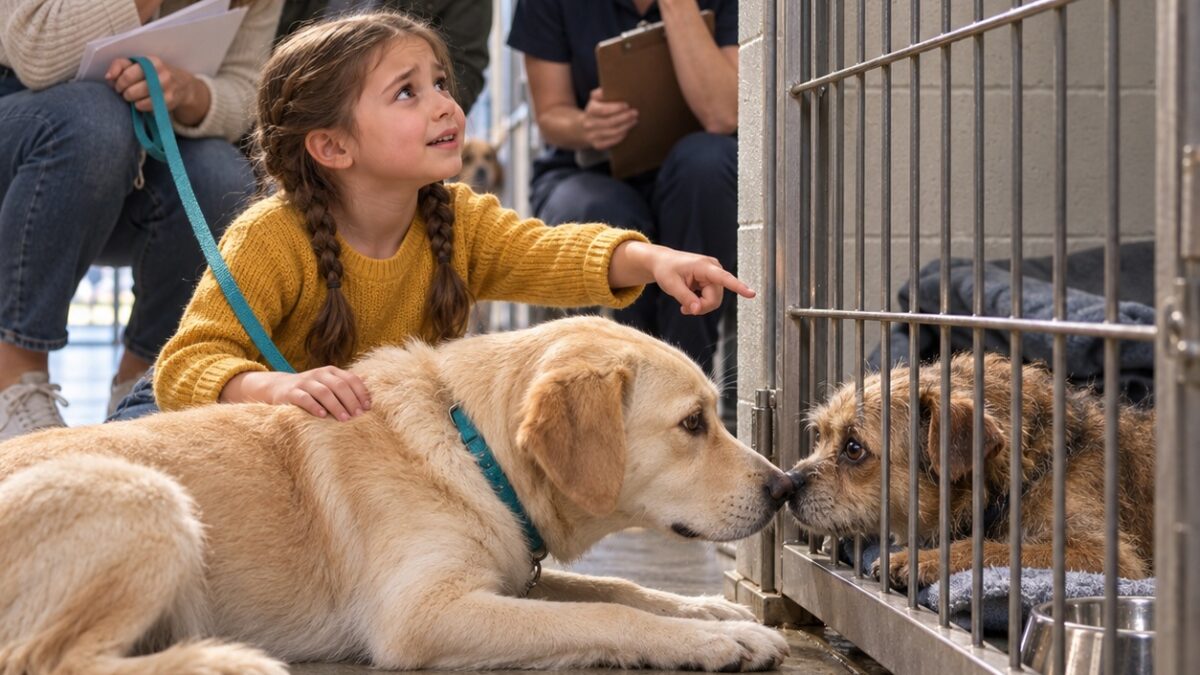
Emma pointed.
“They’re together.”
Her mother, Melissa, crouched beside her.
“Honey, Luna is one dog and Benji is another.”
“I know.”
Emma sounded almost offended by the obviousness of that information.
“But Luna won’t leave him.”
Nobody answered.
Because she was right.
Luna was lying in front of Benji’s kennel as she always did.
Head between her paws.
Benji hidden near the back.
Only his eyes visible.
Emma moved closer.
I instinctively started to warn her.
“Slowly.”
She stopped immediately.
That impressed me.
Most children hear “slowly” and interpret it as “continue at seventy percent speed.”
Emma sat down.
Not near Luna.
Not against the cage.
Several feet away.
Cross-legged.
Hands in her lap.
She looked at Benji.
Benji looked back.
No one spoke.
The shelter continued around them.
Dogs barking.
Phones ringing.
Metal bowls clattering.
People walking through the corridor.
Yet something in that small space became quiet.
Emma did not call:
“Come here, puppy.”
Did not make kissing sounds.
Did not put her fingers through the bars.
She simply waited.
Five minutes.
Maybe six.
Benji’s ears moved.
Then he shifted slightly.
That alone made me hold my breath.
Emma whispered:
“Hi.”
Benji stayed.
She smiled.
Not the bright smile she had walked in with.
A smaller one.
The kind you give something frightened when you don’t want happiness itself to feel dangerous.
Luna lifted her head.
Looked at Emma.
Then looked toward Benji.
I cannot prove dogs understand intention.
But Luna relaxed.
I saw it.
Her shoulders lowered.
Her head returned to the floor.
Emma stood.
Walked back to her parents.
“I want both.”
Her father looked at me.
I did what shelter employees have to do even when our hearts are already making bad decisions.
I explained reality.
“Benji is not like Luna.”
Emma’s expression sharpened.
“What does that mean?”
“He’s very frightened.”
“I know.”
“He may not want to be touched.”
“Okay.”
“He might hide.”
“Okay.”
“He may take a long time to trust you.”
“Okay.”
“He could have accidents in the house because fear affects behavior.”
Emma nodded.
“He may not play.”
“Okay.”
“He may never become the kind of dog who runs up to strangers.”
Her father said:
“That’s a lot, Em.”
Emma looked at Benji.
Then she said something I still remember word for word.
“I know what being scared feels like.”
Melissa’s face changed.
Emma continued.
“When I went to school the first time, I didn’t want Mom to leave.”
She glanced up at her mother.
“Mom said, ‘I’m with you.’”
Melissa’s eyes filled.
Emma pointed gently toward Benji.
“I can tell him that.”
Her father swallowed.
Emma said:
“Every day.”
Then:
“Until he believes me.”
There are moments in shelter work when you become painfully aware that adults have complicated things children still understand simply.
We talk about behavioral rehabilitation.
Trauma history.
Adjustment periods.
Thresholds.
Desensitization.
Trust-building.
Emma was seven.
Her treatment plan was:
I’ll stay.
Until he believes me.
I looked at her parents.
Melissa was crying quietly.
Her husband stared toward Luna and Benji.
I expected him to say no.
Reasonable no.
Responsible no.
Two dogs are a financial commitment.
A frightened dog is work.
They had arrived prepared for one.
Instead he asked me:
“Can they be adopted together?”
My throat tightened.
“Yes.”
“Would you recommend it?”
That was harder.
“I would recommend not separating them abruptly.”
I crouched near the family.
“Luna seems to regulate him.”
“What does that mean?”
“When she’s calm, he’s calmer.”
“She eats, he eats.”
“She stays near him, he comes forward.”
“Does he need her forever?”
“I don’t know.”
That answer mattered.
I wasn’t going to turn dependency into a fairy tale.
“He needs more than Luna.”
“He needs patient humans.”
“Routine.”
“Probably professional behavioral guidance.”
“Time.”
Melissa nodded.
“And Luna?”
I looked at the cream-colored dog.
“She needs somebody who understands why she keeps coming back to him.”
Emma answered before anyone else.
“We do.”
Her father closed his eyes briefly.
Then smiled.
“Okay.”
Melissa looked at him.
“Really?”
He nodded.
“Both.”
Emma didn’t scream.
Didn’t jump.
She looked relieved.
As though an injustice had simply been corrected.
Then came the hard part.
Getting Benji out.
I finished the paperwork first.
Spent almost an hour reviewing care.
No cornering.
No forced affection.
Safe room.
Routine.
Escape prevention.
Veterinary follow-up.
Behavior support.
Children-supervised interactions.
Emma listened better than some adults.
When everything was ready, I opened Luna’s area.
Luna stood.
Tail moved.
Emma took her leash.
Then I approached Benji’s kennel.
He immediately backed away.
I stopped.
“Hey, buddy.”
His body shook.
“You’re okay.”
Meaningless words perhaps.
But tone matters.
I opened the kennel door.
Benji did not move.
Luna came closer.
Not inside.
Stopped at the threshold.
Benji looked at her.
Luna waited.
One paw.
Benji moved forward an inch.
Then stopped.
Luna’s tail moved once.
Another inch.
I crouched sideways rather than facing him.
“Come on.”
Benji looked at me.
At Luna.
At Emma.
Then slowly placed one front paw outside the kennel.
Nobody moved.
Another paw.
He stood at the opening.
His whole body trembling.
Luna stepped beside him.
Shoulder almost touching his.
Benji came out.
For the first time since entering our shelter, Benji stood in the corridor without trying to disappear.
Emma crouched several feet away.
Held out one hand.
Not reaching.
Waiting.
Benji saw it.
His nose moved.
One step.
Then another.
I could hear my own heartbeat.
Emma whispered:
“My name is Emma.”
Benji stopped.
“I’m with you.”
He sniffed her fingertips.
Then touched them with his nose.
Emma smiled.
No squeal.
No sudden hug.
Just:
“Hi, Benji.”
I turned away for one second because my vision blurred.
I had watched hundreds of animals leave shelters.
Some dancing toward the door.
Some carried.
Some uncertain.
But when Luna walked out that afternoon, Benji beside her and Emma holding the leashes with both parents close, I sat down on the floor after the doors closed.
And cried.
Not because I knew everything would be fine.
I didn’t.
I cried because for one day, two animals who had been waiting for the world to become safe had found a child stubborn enough to wait back.
The first phone call came that evening.
Melissa.
“Don’t panic.”
Terrible opening.
“What happened?”
“Nothing bad.”
I sat down.
“Then never begin with ‘don’t panic.’”
“Sorry.”
She laughed nervously.
“Benji won’t come inside.”
Of course.
They had reached home.
Luna walked through the front door.
Benji stopped outside.
Would not cross.
No pulling.
No amount of food mattered.
“What’s Luna doing?”
“Inside the living room.”
“Can Benji see her?”
“Yes.”
“Then wait.”
“How long?”
“As long as you reasonably can.”
Emma apparently refused dinner.
Sat near the doorway instead.
Not outside.
Not crowding him.
Just visible.
Luna eventually walked back toward the entrance.
Sat several feet inside.
Benji watched.
Minutes passed.
Then one paw crossed the threshold.
Melissa’s voice cracked while telling me.
Then another.
Benji entered.
Went directly to Luna.
Lay beside her.
Stayed there the entire night.
Not in the bed they had bought.
Not near Emma.
Luna.
The second call came four days later.
“He isn’t eating enough.”
I expected that too.
“Is Luna eating?”
“Yes.”
“Feed them in the same room.”
They did.
Benji watched his bowl.
Then Luna.
Luna walked toward her own food.
Sniffed.
Ate.
Benji finally lowered his head.
One bite.
Then another.
Emma sat across the room.
Whispering encouragement.
By the end of the second week, Benji was finishing meals.
Melissa sent me a video.
Luna ate calmly.
Benji beside her.
When he stopped to look around, Luna barely reacted.
Just continued.
Safe.
Her whole body said it.
Nothing is happening.
Eat.
The third week brought the ball.
Emma called me herself.
“Rachel!”
I moved the phone away from my ear.
“What?”
“He played.”
I stopped walking.
“What?”
“Benji played!”
I smiled.
“With what?”
“The little blue ball.”
They had placed toys around the room from day one.
Benji ignored every one.
That afternoon, apparently, he approached the smallest ball.
Sniffed.
Pawed.
Then picked it up.
Melissa held her breath.
Emma stayed still.
Benji carried it to Luna.
Dropped it.
Luna looked at the ball.
Then at Benji.
Then at Emma.
According to Emma, Luna’s expression clearly said:
What exactly am I expected to do with this?
Emma rolled the ball.
Benji chased it.
Only three feet.
Then returned.
Tail moved.
Once.
Emma gasped.
Benji froze.
She immediately covered her mouth.
Sorry.
He relaxed.
Then his tail moved again.
“He wagged.”
Emma told me.
“Rachel, he wagged his tail.”
I sat at my desk staring at the intake photo we still had in the database.
Benji in the kennel corner.
Eyes enormous.
Body flattened.
And I cried again.
Shelter work teaches you to celebrate absurdly small things.
A bite of food.
One step forward.
A tail wag.
Because with frightened animals, those small things are not small.
They are votes.
Maybe the world is safe enough for this.
By week four, Benji began exploring.
Kitchen.
Back.
Hallway.
Back.
Bedroom entrance.
Back.
He never disappeared for long.
Always returned to Luna.
Luna usually stayed in one central spot.
Watching.
She had become his lighthouse.
He could sail a little farther because she remained visible.
Emma noticed.
“Why doesn’t Luna follow him?”
Melissa told me Emma asked.
Because Luna didn’t need to.
That was the answer I would have given.
Guarding does not always mean standing beside someone.
Sometimes it means becoming the place they know they can return to.
By week five, Benji surprised everyone.
Emma was reading on the couch.
Luna asleep across the room.
No invitation.
No treats.
Benji walked into the living room.
Stopped.
Looked at Luna.
Then at Emma.
Emma kept reading.
She had learned the hardest skill in loving a frightened animal:
Pretending not to need the moment.
Benji approached.
Jumped onto the couch.
Sat beside her.
Emma’s entire body went rigid because she was trying so hard not to scare him.
Benji sniffed her sleeve.
Then lowered his head onto her lap.
Emma did not move for almost a minute.
Finally one hand descended.
Slowly.
Touched his head.
Benji closed his eyes.
When Melissa walked into the room, she stopped.
Emma whispered:
“Mom.”
“I know.”
“He trusts me.”
Melissa cried.
Emma cried.
Benji kept sleeping through the emotional chaos he had caused.
When they called me, I cried too.
We were becoming ridiculous.
Week six.
Luna stopped sleeping beside Benji every night.
That was the milestone almost nobody else would have recognized.
For weeks, Luna positioned herself close.
Same room.
Within reach.
If Benji woke, she was there.
Then one evening, Luna walked to her own bed across the room.
Circled.
Lay down.
Benji watched.
He did not follow.
He went to his bed.
Several feet away.
Slept.
The distance between the beds was maybe eight feet.
To me, it looked like freedom.
Benji no longer required physical closeness to believe safety continued.
He had internalized some of it.
Luna knew before we did.
She moved away because he was ready.
That is what good caretaking eventually does.
It makes itself less necessary.
Not absent.
Less necessary.
Week seven.
Doorbell.
Benji barked.
Melissa nearly dropped a coffee mug.
Until then, the doorbell sent him hiding.
This time:
Ding-dong.
Benji ran toward the hallway.
Bark.
Another.
Luna lifted her head.
Looked.
Then put it back down.
Emma shouted:
“He’s protecting us!”
Maybe.
More likely announcing.
But let the child have her interpretation.
The important thing was not aggression.
It was ownership.
This is my house.
That sound happened at my door.
I belong here enough to respond.
Benji had crossed another invisible line.
When the story began, every new person was a threat.
Now he considered himself part of the household responsible for noticing arrivals.
That was identity.
Home.
I visited during week eight.
I had been trying not to interfere.
Partly professional boundaries.
Partly fear.
I knew the Benji in the shelter.
What if he saw me and remembered the kennel?
Ridiculous perhaps.
Still.
I pulled into their driveway.
Emma appeared at the window immediately.
Waved wildly.
I walked to the porch.
The door opened.
Benji barked.
I froze.
Not fear.
Shock.
There he was.
Not hidden.
Standing near Emma.
Luna several feet behind.
“Hi.”
I crouched.
Benji approached.
Sniffed my shoes.
Then my hand.
Tail moved.
I couldn’t speak.
He sat.
Then put his head against my knees.
Exactly as though we had always been friends.
I looked at Luna.
She sat quietly across the room.
Watching.
And I swear she looked proud.
I know.
Dogs do not smile the way humans do.
But anyone who has lived around them knows happiness does not require human facial anatomy.
Luna’s body was soft.
Eyes warm.
No vigilance.
She had handed over part of the job.
Emma sat beside me.
“See?”
Her face glowed.
“He likes you.”
I touched Benji’s ears.
“No.”
Emma frowned.
“No?”
“He trusts you.”
“What does that have to do with me?”
“Everything.”
I looked at her.
“You taught him people can be safe.”
Emma glanced at Luna.
“Luna did.”
“She taught him dogs can be safe.”
“You taught him humans can too.”
Emma thought about that with the seriousness only children can give simple truths.
Then she said:
“And Benji taught me patience.”
I stopped.
Seven years old.
Seven.
“And what did Luna teach you?”
Emma looked toward the cream-colored dog.
“That you don’t leave someone because they’re scared.”
I swallowed.
“What did your parents teach you?”
Emma glanced toward the kitchen, where Melissa was pretending she was not listening.
“That sometimes I’m right.”
Her mother laughed.
“Do not encourage her.”
I laughed too.
That visit changed something in me.
For years, I had thought shelter work meant finding homes.
Move animal from kennel to residence.
Successful outcome.
Adoption count.
Length of stay.
Return rate.
Important numbers.
Necessary.
But Luna and Benji had forced me to see something statistics do not capture.
A technically successful adoption can still fail the emotional truth of an animal.
Luna had multiple opportunities for good homes.
If we had forced separation, she might have adjusted eventually.
Maybe.
Benji might have found another placement.
Maybe.
But Luna had been telling us something through behavior.
This dog matters to me.
We almost treated that as inconvenience.
Emma saw relationship before logistics.
That embarrassed me.
Professionally.
In a useful way.
Afterward, I started watching bonded animals differently.
Not every pair needed to remain together.
Sometimes shelter stress causes temporary proximity.
Sometimes dogs truly thrive independently.
Good decisions still required careful evaluation.
But I stopped assuming human convenience should automatically outrank animal attachment.
Sometimes adoption came as a package.
Love does not always arrive in the number requested.
Months passed.
Melissa called less often.
That was good.
Families stop calling shelters when the shelter becomes history.
I would still receive photos.
Benji in the yard.
Luna asleep beside Emma.
Benji sitting near a guest.
Two dogs watching squirrels through a window.
Ordinary.
The most beautiful stage of rescue is ordinary.
No dramatic progress.
No tears.
No phone calls.
Just life.
Benji began playing with other dogs during supervised visits.
At first he stayed near Luna.
Then farther.
Eventually he approached another dog alone.
Emma proudly informed me:
“He has friends now.”
“I thought Luna was his friend.”
“She’s family.”
Again.
Seven years old.
I should have hired her.
Luna changed too.
People often focus only on Benji because his fear was visible.
But Luna had been carrying something.
Responsibility.
Hypervigilance.
She had refused home after home because she could not relax while Benji remained unsafe.
Once Benji settled, Luna became lighter.
She played more.
Ran in the yard.
Slept belly-up.
Started stealing Emma’s socks.
Guardian became dog.
That mattered.
Caretakers need freedom too.
Humans forget.
We praise the strong one.
The responsible one.
The sibling who holds everything together.
The parent who never breaks.
The nurse.
The rescuer.
The dog outside the kennel.
Then we assume because they can carry someone else, carrying costs nothing.
Luna had been carrying Benji emotionally.
When he grew safer, she finally put some of the weight down.
Melissa once sent a photograph of Luna asleep alone in sunlight.
No Benji nearby.
Caption:
SHE FINALLY TOOK THE DAY OFF.
I saved it.
My favorite photograph.
Not because Benji disappeared.
Because Luna trusted the house enough to stop watching.
Emma continued talking to me occasionally.
One day she called.
“I figured something out.”
“What?”
“Why Luna wouldn’t leave.”
“I’m listening.”
“Because Benji needed her.”
“Yes.”
“And Luna needed Benji.”
I paused.
“Why do you think Luna needed him?”
“Because if she left, she would worry forever.”
That answer landed harder than I expected.
Emma continued:
“They’re one.”
Same phrase from adoption day.
“You can’t divide one.”
I smiled.
“Technically, mathematically—”
“Rachel.”
Seven-year-old scolding an adult.
“Sorry.”
She said:
“It’s like dividing a heart.”
I stopped joking.
Some sentences need silence afterward.
I thought about all the people I had watched leave shelters carrying one animal while another barked behind them.
Most were unrelated.
Fine.
But sometimes bonds exist whether paperwork recognizes them or not.
Love creates its own architecture.
Not ownership.
Connection.
Luna did not stay because Benji was useful.
Benji did not trust her because she gave him anything material.
They regulated each other.
Belonged together in a way that changed how both experienced danger.
Emma understood that intuitively.
Adults tend to ask:
What will this cost?
How difficult?
How many beds?
How much food?
All reasonable.
Emma’s first question was:
Who will be left alone?
That is not always the deciding question.
But it should be asked.
My work at the shelter remained painful.
No fairy tale changed that.
Animals arrived injured.
Old.
Afraid.
Some were adopted quickly.
Others waited.
Some returned.
Some required more help than we could easily give.
I went home emotionally exhausted often.
People asked:
“How do you do it?”
I usually said:
“Coffee.”
The real answer was harder.
You survive shelter work by learning how to hold pain without letting pain become the entire story.
For every return, there is sometimes an Emma.
For every kennel where fear hides in the back corner, there can be a Luna lying outside.
For every animal who believes no one is staying, someone eventually might.
Not always.
That is the part people dislike hearing.
Not every story resolves perfectly.
That makes the good ones more important, not less.
They show what is possible when patience meets opportunity.
One afternoon, a couple came looking for a “perfect family dog.”
I almost laughed.
Instead, I asked what perfect meant.
Calm.
House-trained.
Good with everyone.
No medical issues.
Young but not too young.
Playful but not hyper.
Independent but affectionate.
I thought of Luna.
Then Benji.
Then Emma.
I said:
“Can I show you some dogs instead of requirements?”
They agreed.
We walked.
One dog barked too much.
Another hid.
Another jumped.
They looked uncertain.
I told them:
“You are seeing them in a shelter.”
“This may be the worst environment of their lives.”
“Don’t confuse coping behavior with complete personality.”
That sentence came directly from Benji.
Not literally.
But he taught it.
The small dog hiding in kennel twenty-seven eventually became the dog barking at his own front door.
Environment reveals different selves.
We should be careful with permanent labels based on temporary fear.
That became one of my strongest beliefs.
Benji was “fearful.”
True.
But incomplete.
He was also curious.
Playful.
Affectionate.
Protective.
Capable of trust.
Those traits were hidden because survival occupied all available space.
When fear retreated, personality returned.
People do this too.
I started recognizing it in myself.
Shelter work made me guarded.
Efficient.
Sometimes cynical.
I told myself that was professionalism.
Then Emma arrived and made me cry on the floor.
Apparently I still contained softness.
Good.
I did not want the job to take that.
Years passed faster than expected.
Emma grew.
Seven became eight.
Eight became nine.
Photos showed longer legs.
Missing teeth replaced.
Benji gained weight.
Luna’s muzzle began graying slightly.
The family moved once.
That worried me.
Moves can unsettle fearful dogs.
Melissa called beforehand.
“What should we do?”
We created a plan.
Familiar beds.
Same blankets.
Luna first.
Benji with her.
Quiet room.
Predictable routine.
Emma stayed close.
The first night in the new house, Benji paced.
Old fear.
Different walls.
Luna lay in the hallway.
Emma sat nearby reading.
No one forced him.
At midnight, he finally settled.
By day three, he explored.
By week two, he owned the couch.
Progress does not mean fear never returns.
It means there are now tools and relationships strong enough to carry you through it.
That distinction matters.
People sometimes expect healing to create a straight line.
Start scared.
End fearless.
No.
Benji still startled.
Still disliked some strangers.
Still needed time.
He was healed enough to live.
That was the goal.
Not transformation into a different personality.
Safety without erasure.
I visited again when Emma was ten.
Three years after adoption.
She opened the door.
Benji barked.
Then recognized me.
Tail.
Approached.
Luna moved more slowly now.
She came over.
Placed her chin against my hand just like the first week at the shelter.
I nearly cried.
Emma noticed.
“You always cry.”
“I absolutely do not.”
“You cried when we adopted them.”
“That was allergies.”
“There were no flowers.”
“Dust.”
“You cried on the phone.”
“Phone dust.”
She rolled her eyes.
Luna lay on the rug.
Benji near her.
Not pressed against her.
Just nearby.
Emma sat between them.
I realized the arrangement had changed.
At the shelter:
Luna between Benji and the world.
Now:
World around Benji.
Luna did not have to guard the edge anymore.
She had succeeded.
Emma scratched Benji’s chest.
“He’s brave now.”
I said:
“He was brave then too.”
Emma frowned.
“He hid.”
“Being scared doesn’t mean you aren’t brave.”
She thought.
“Then what does brave mean?”
“Doing something while you’re scared.”
She looked at Benji.
“Like coming out of the cage.”
“Yes.”
“Like touching my hand.”
“Yes.”
She smiled.
“I remember.”
“So do I.”
Melissa brought coffee.
We talked.
At one point, Emma went outside.
Both dogs followed.
Benji first.
Luna behind.
I laughed.
“Look at that.”
Melissa watched through the window.
“What?”
“He leads now.”
She smiled.
“I hadn’t noticed.”
That moment stayed with me.
Relationships evolve.
The dependent one grows.
The protector rests.
Love becomes less dramatic.
That doesn’t mean weaker.
Sometimes quiet love is stronger because it no longer needs crisis to prove itself.
Luna had once planted her body outside a cage.
Years later, she simply walked behind Benji through a backyard.
Same bond.
Different shape.
Emma eventually wrote a school essay about them.
Her mother sent me a copy.
Title:
TWO DOGS WHO ARE ONE FAMILY.
I read it at my desk.
Bad idea.
Cried again.
Phone dust.
In the essay, Emma wrote:
“When Benji was scared, Luna was brave for him until he could be brave for himself.”
I stopped.
That might be the best description of caregiving I have ever heard.
Be brave for someone temporarily.
Not forever.
Until they can carry some of their own.
Parents.
Friends.
Therapists.
Nurses.
Dogs.
Sometimes love lends strength.
It does not own weakness.
Luna never made Benji dependent by staying.
She gave him enough safety to become independent.
That difference matters enormously.
Care should expand someone’s world, not shrink it around the caregiver.
Luna knew instinctively when to remain near.
Then when to move farther away.
She did not drag Benji out of hiding.
She made hiding less necessary.
What a teacher.
My shelter began using their story during staff training.
Not the sentimental parts only.
Behavior.
Bonded pair assessments.
Fear responses.
Child interaction done correctly.
Emma’s patience.
No forcing.
We told new volunteers:
“If a frightened animal doesn’t approach you, your job is not to win.”
That concept was difficult for people.
Humans like visible success.
Animal came to me.
Animal let me pet it.
Animal loves me.
But frightened animals are not emotional vending machines.
Sometimes successful interaction means:
I entered.
I respected your distance.
Nothing bad happened.
Then I left.
That builds trust too.
Emma knew at seven.
She sat.
Waited.
The first kindness she gave Benji was leaving him control over the space between them.
Everything grew from that.
One winter, Luna became ill.
Nothing immediately catastrophic.
Age.
Joint pain.
Medication.
The family called.
Emma was older now.
Twelve.
Her voice had changed.
“Rachel?”
“Yes?”
“Luna’s hurting.”
I heard the child underneath the teenager.
We talked.
Veterinarian care.
Medication.
Rest.
Benji stayed near Luna more.
Roles reversing again.
If she struggled standing, he hovered.
If she slept, he slept nearby.
Melissa sent me a photo.
Benji’s head across Luna’s back.
I stared at it a long time.
Years earlier, Luna had lain outside his cage.
Now he watched her.
Love keeps accounts differently than people do.
No one said:
You did this for me, so I owe you exactly the same.
He simply stayed.
Because she needed him.
Emma called one evening.
“I’m scared.”
I knew what she meant.
Luna was aging.
“I know.”
“What if she dies?”
No comforting lie existed.
“One day she will.”
Emma started crying.
“So what was the point?”
The question was grief arriving early.
“What do you mean?”
“She helped Benji.”
“She finally got a home.”
“And then she just…”
Emma couldn’t finish.
I waited.
Sometimes adults rush children out of uncomfortable truths.
We shouldn’t.
Finally I said:
“Does something ending mean it wasn’t worth having?”
She was silent.
“No.”
“Would you give back the years with Luna so you never had to lose her?”
“No.”
Immediate.
“Would Benji?”
Another silence.
“No.”
“Then that’s the point.”
Emma cried harder.
I did too.
I told her:
“Love doesn’t promise we keep someone forever.”
“It promises that while they’re here, they don’t have to be alone.”
That sentence came from Luna.
Everything did eventually.
Luna improved with treatment.
For a while.
Good months followed.
Slow walks.
More sleeping.
Emma took over medication duties under parental supervision.
Benji seemed offended whenever Luna received pills hidden in cheese and he did not.
So he received tiny cheese tax.
Fairness.
Another year.
Luna’s mobility declined.
They bought rugs for traction.
Steps near the couch.
An orthopedic bed.
Benji often ignored his own bed and slept beside hers.
Emma sent pictures.
I knew where the story was going.
I hated that knowledge.
Shelter work teaches you endings.
It does not make them easier.
One spring afternoon, Melissa called.
Not Emma.
I knew before answering fully.
“Rachel.”
“Yes.”
“Luna’s not doing well.”
I sat.
“How bad?”
“Bad.”
The veterinarian believed quality of life had declined beyond what medication could reasonably restore.
Pain.
Weakness.
Little appetite.
Difficulty standing.
Emma wanted me there.
I almost said no.
Not because I didn’t care.
Because I cared too much.
Then I thought of seven-year-old Emma sitting outside Benji’s cage.
Waiting.
I drove over.
Luna lay on her bed near the living room window.
Sunlight across her coat.
More white than cream now.
Benji beside her.
Emma was fourteen.
Tall.
Tears already covering her face.
She hugged me.
Hard.
“Thank you for coming.”
Of course.
I sat on the floor.
Luna’s eyes opened.
Tail moved once.
I touched her face.
“Hi, sweetheart.”
She leaned into my palm.
Same dog.
Older body.
Same softness.
Benji watched.
He knew something.
Dogs know change.
Maybe not death as concept.
But mood.
Scent.
Weakness.
He pressed closer to Luna.
Emma said:
“He won’t leave her.”
Of course not.
The veterinarian arrived at home.
Good person.
Quiet.
Explained everything even though the family already understood.
Luna received medication to relax first.
Her body softened.
Pain easing.
Emma lay beside her.
One hand around her neck.
Benji on the other side.
Melissa and her husband behind them.
I sat near Luna’s feet.
A family formed around a dog who once refused to leave a kennel.
That image hurt.
Luna had spent so much of her story making sure someone else wasn’t alone.
Now no one allowed her to be.
Emma whispered:
“You stayed with Benji.”
Her voice broke.
“He’s okay now.”
Benji lifted his head at his name.
Emma continued:
“You did it.”
“You don’t have to watch him anymore.”
I covered my mouth.
Benji moved closer.
Put his nose against Luna’s face.
Luna breathed.
Slow.
Then Emma said the words she had once promised Benji.
“I’m with you.”
I shut my eyes.
“I’m with you.”
Again.
“Until you believe me.”
Luna exhaled.
The final medication came later.
No fear.
No kennel.
No metal door.
Home.
Emma’s hand.
Benji beside her.
Luna slipped away quietly.
Benji stayed pressed against her body afterward.
Would not move at first.
Nobody forced him.
Of course.
We had learned.
He sniffed her.
Waited.
Then lay down.
Emma lay beside him.
The two who once needed Luna most facing the first world without her.
I stayed because that was what Luna had taught us.
Stay.
Not fix.
Not rush.
Stay.
Eventually, the veterinarian left.
Luna’s body was taken respectfully.
The house became impossibly quiet.
Benji searched for several days.
Her bed.
Hallway.
Yard.
Emma slept downstairs the first week because Benji began waiting near Luna’s old spot.
She did not drag him upstairs.
She brought a blanket.
Lay on the couch.
Benji eventually jumped up beside her.
History repeating differently.
Now Emma was Luna.
Not replacing.
Carrying forward.
Benji’s appetite dropped briefly.
Melissa called me, frightened.
Veterinarian monitored.
We encouraged routine.
Food.
Walks.
Gentleness.
No pressure.
Emma sat near his bowl.
Did not beg.
Luna was gone.
But the safety she created remained in habits.
Benji ate.
Small amount.
Then more.
He grieved.
He also continued.
That felt important.
Luna’s greatest gift had never been making Benji incapable of living without her.
It had been helping him become capable of surviving even when one day she could no longer stay.
That is love at its strongest.
It prepares us for absence without making absence painless.
Months later, I visited.
Luna’s bed was gone.
Her collar framed with a photograph.
Benji met me at the door.
Bark.
Tail.
Older now.
Confident.
Emma came behind him.
“He still looks for her sometimes.”
“I’m sure.”
“I do too.”
“So do I.”
Benji went into the living room.
Jumped on couch.
Emma sat.
He put his head on her lap.
Exactly like week five all those years earlier.
I smiled.
Emma stroked his ears.
“She taught him this.”
“What?”
“How to stay.”
I shook my head.
“She taught all of us.”
Emma looked toward Luna’s photograph.
Then said:
“I used to think they were one.”
I waited.
“I still do.”
“How?”
“She’s gone.”
Emma touched Benji’s chest.
“But some of her is in how he acts.”
Then touched her own chest.
“And here.”
I had nothing to add.
Children grow up.
Sometimes wisdom grows with them instead of being replaced.
Benji lived several more years.
Happy ones.
That mattered.
He became the dog visitors never believed had once hidden in a kennel corner.
Still cautious.
Still slower with strangers.
But capable of choice.
Capable of attachment.
Capable of joy.
He barked at delivery drivers with enormous confidence.
Slept in Emma’s room.
Played in the yard.
Went on family vacations.
Experienced snow.
Hated it.
Experienced a lake.
Also hated it.
Loved car rides.
Loved cheese.
Loved one particular red blanket.
Ordinary dog things.
The most beautiful outcome possible.
When Benji eventually died years later, Emma was in college.
She came home.
Of course.
He was old.
Body tired.
The ending was peaceful.
Emma held him.
And according to Melissa, one of the final things she whispered was:
“Luna’s waiting.”
I cried when she told me.
Maybe that is sentimental.
I don’t care anymore.
After enough years around animals, you stop apologizing for the forms hope takes.
I keep a photograph of Luna and Benji in my office at the shelter.
Not the adoption photo.
Not a dramatic one.
It was taken maybe two years after they left.
Luna lies in sunlight.
Benji several feet away.
Emma between them reading a book.
Nobody looking at the camera.
Ordinary afternoon.
That photograph contains everything.
Luna no longer guarding.
Benji no longer hiding.
Emma no longer waiting for trust because trust already lives there.
People enter my office and sometimes ask:
“Who are they?”
I answer:
“Teachers.”
They laugh.
I don’t.
Because Luna taught me what loyalty looks like when nobody rewards it.
Benji taught me that fear is not identity.
Emma taught me that patience can be active love.
Her parents taught me that responsible people can expand a plan when compassion makes the original one too small.
The family taught me that adoption is not possession.
It is relationship.
And shelter work taught me that sometimes the animal everyone wants is refusing to leave because the animal nobody wants is the whole reason she still feels responsible for staying.
I wish I could say Luna and Benji changed every adoption afterward.
Reality is slower.
But we improved.
Bonded pairs received more careful evaluation.
Behavior notes became more nuanced.
We stopped labeling fearful dogs simply “shy.”
We wrote what they actually did.
Hides from unfamiliar people.
Will eat in presence of trusted dog.
Approaches after prolonged quiet exposure.
Responds better when choice is preserved.
Specifics create possibility.
Labels create assumptions.
We trained volunteers not to flood frightened animals with affection.
No:
“He just needs to know people are nice.”
He doesn’t know that.
Prove it.
Quietly.
Repeatedly.
Let him learn.
I sometimes tell new volunteers Emma’s rule.
They expect some professional protocol.
I say:
“I’m with you.”
They stare.
“What?”
“Be predictable.”
“Return.”
“Don’t demand faster trust than the animal can give.”
“Stay within safe boundaries.”
“Let consistency do the work.”
That was Emma’s entire method at seven.
Every day.
Until he believes me.
Simple does not mean easy.
Patience is hard because it denies us immediate reward.
We want progress.
Response.
Recognition.
But real love sometimes spends weeks receiving nothing visible in return.
Luna lay outside a cage.
Emma sat on a floor.
Neither demanded proof that staying worked.
Then one day Benji stepped forward.
That is the image I return to whenever shelter work feels hopeless.
One paw.
Just one.
Outside the kennel.
Toward Luna.
Toward Emma.
Toward a life he did not yet believe existed.
Fear did not vanish before the step.
The step came with trembling.
That matters.
Courage is often shaking.
Trust is often incomplete.
Healing is often messy.
You do not have to stop being afraid before moving toward something better.
Benji taught me that.
Years after the original adoption, someone asked me during a shelter fundraiser what my favorite adoption story was.
I said Luna and Benji.
They asked:
“Because the little girl adopted two?”
“No.”
“Because Luna saved Benji?”
“Not exactly.”
“Why then?”
I thought.
“Because nobody won by separating.”
The woman looked confused.
I explained.
Luna’s love did not need to compete with Emma’s.
Emma did not replace Luna.
The parents did not need Benji to choose humans over dogs.
Benji’s independence did not require leaving Luna emotionally behind.
Love expanded.
That was the lesson.
We often treat affection like limited seating.
If you love this person, what happens to me?
If the dog bonds with another dog, will he bond with us?
If a child loves a pet deeply, is that somehow excessive?
Luna and Benji taught us the opposite.
Secure bonds create capacity.
Because Luna made the world safe, Benji could eventually risk loving Emma.
Because Emma respected Luna’s place, Luna could relax enough to become simply a family dog.
Nobody lost.
Connection multiplied.
Emma’s phrase stayed with me:
Love doesn’t divide.
It joins.
Maybe that is too simple for every situation.
But for them, it was exact.
There are evenings now when the shelter finally quiets.
Adoptions done.
Floors cleaned.
Dogs settling.
Sunset through the front windows.
I walk past the kennel where Benji once lived.
Different dog inside now.
Different story.
Sometimes no dog.
An empty kennel has a strange sound.
You hear everything around it more clearly.
I can still picture Luna outside the door.
Head on paws.
Waiting.
At the time, I thought she was preventing herself from being adopted.
Now I see it differently.
She was keeping a promise.
Maybe not consciously in human language.
But with her body.
I am here.
You are not alone.
I am not leaving while you are afraid.
That promise cost her.
Homes.
Comfort.
Time.
Yet she kept it.
Then Emma arrived and made the promise bigger.
Not:
Luna, leave Benji.
Not:
Benji, stop needing Luna.
Instead:
Both of you come.
We will build enough safety for everyone.
That is why I still cry when I think about the adoption day.
Emma between them.
Luna on one side.
Benji on the other.
He trembled.
But walked.
He did not need fear to disappear before home began.
He needed someone trustworthy beside him.
Maybe all of us do.
People still ask why I remain in shelter work.
“You see so much suffering.”
Yes.
“You get attached.”
Yes.
“You have to say goodbye.”
Constantly.
“Isn’t it exhausting?”
Completely.
“Then why?”
Because every once in a while, a frightened animal takes one step.
Because sometimes a dog who refuses every adopter is not being difficult.
She is telling us something we finally learn to hear.
Because occasionally a seven-year-old girl walks into a place full of adults, notices what all of us have normalized, and says:
“They’re together.”
Because sometimes fear becomes trust.
Trust becomes play.
Play becomes home.
And home becomes years of ordinary life nobody would have believed possible when the story began behind metal bars.
That is worth something.
Everything, some days.
I do not know what people mean when they say miracles.
If they mean impossible things happening instantly, I have not seen many.
But if a miracle can happen slowly, I have seen dozens.
A frightened dog eating because another dog eats first.
A paw crossing a kennel threshold.
A nose touching a child’s hand.
A tail wagging for the first time.
A dog sleeping eight feet away from his protector because he finally believes distance is safe.
A bark at the front door.
A head on a lap.
A guardian dog sleeping in sunlight because her job is no longer necessary.
Those are miracles I recognize.
They do not arrive with lightning.
They arrive through repetition.
The last time I spoke to Emma as an adult, she was studying psychology.
That made me laugh.
“Benji’s fault?”
“Probably.”
“Luna?”
“Definitely.”
She told me she wanted to work with children who had experienced trauma.
I became quiet.
“Why?”
She answered immediately.
“Because scared doesn’t mean broken.”
I nearly cried.
Again.
She laughed.
“You’re crying, aren’t you?”
“No.”
“Phone dust?”
“Exactly.”
Then she said:
“I think I learned it from Benji.”
I looked at the photograph on my desk.
Cream-colored Luna.
Small brown Benji.
Little Emma.
“Maybe you learned it together.”
She liked that.
So do I.
Scared does not mean broken.
Dependent does not mean weak.
Protective does not mean controlling.
Waiting does not mean doing nothing.
Love does not always look like taking someone somewhere better.
Sometimes love lies down outside the cage and refuses to leave until better becomes possible for both of you.
That was Luna.
Sometimes love sits cross-legged on a shelter floor and does not reach.
That was Emma.
Sometimes love takes one trembling step because two beings have stayed long enough to make the risk seem survivable.
That was Benji.
And sometimes love is an exhausted shelter worker standing in a hallway, believing she already understands animals, only to have two dogs and one seven-year-old child teach her that her job was never merely finding houses.
It was recognizing bonds.
Protecting trust.
Making room.
I still believe that.
A house is walls.
A home is the place where fear stops having to make every decision.
Luna gave Benji the first version of that.
Emma and her parents gave them both the rest.
And when I remember them now, I do not see the shelter.
I see that final image from the adoption day.
Emma walking in the middle.
Luna to her right.
Benji to her left.
Benji still trembling.
Still uncertain.
Still afraid.
But moving forward.
He did not know the house waiting for him.
The meals.
The ball.
The couch.
The first bark.
The years beside Emma.
He knew only one thing for certain.
Luna was walking too.
For that moment, it was enough.
Sometimes it only takes one safe presence to help us walk toward a life we cannot imagine yet.
Benji had Luna.
Luna found Emma.
And Emma, somehow, had enough room in her seven-year-old heart to understand that neither should be asked to leave the other behind.








