𝗙𝗨𝗟𝗟 𝗦𝗧𝗢𝗥𝗬:Doctors Ignored the Disabled Navy SEAL—Until the New Nurse Called Him by His Secret Call Sign
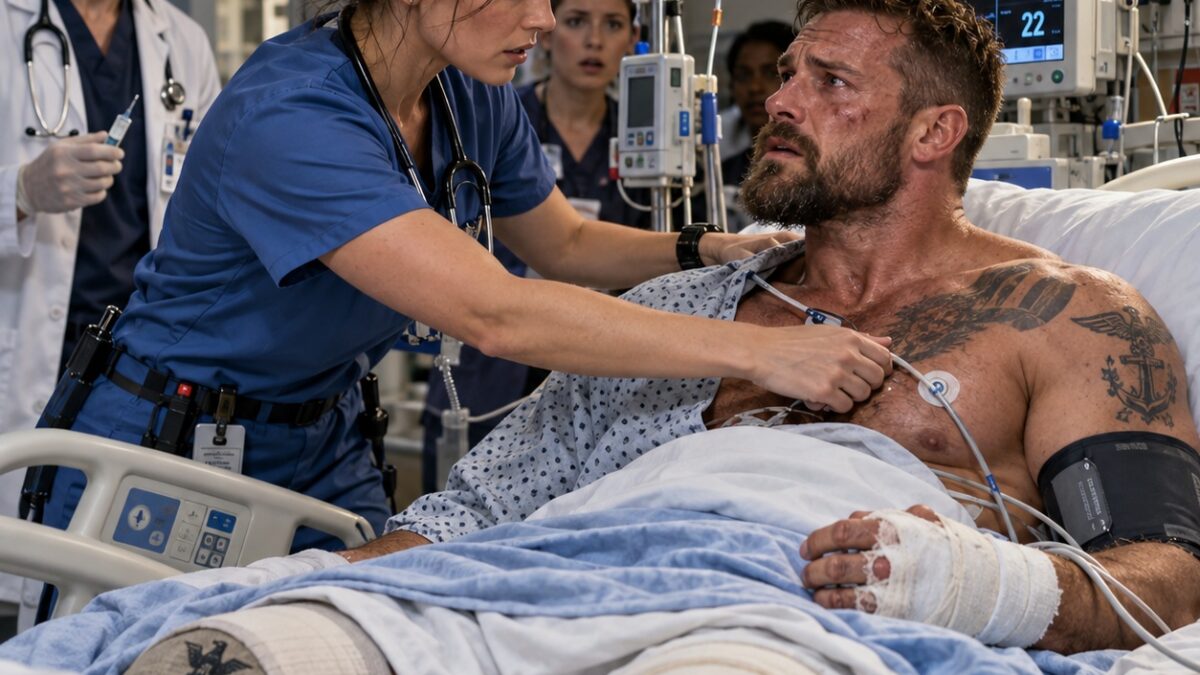
PART 2 and FULL ENDING  Thank you

I heard the name leave my mouth half a second too late.
That is the cruel thing about old training.
You can spend years burying it beneath new habits, new uniforms, new routines.
Then the right combination of sound, pressure, urgency, and fear appears, and your nervous system reaches into the past without asking permission.
Ghost.
I had not said that word aloud in years.
Jacob stared at me as though the hospital room had vanished.
For a moment, perhaps it had.
The physical therapist near the door was looking between us.
Dr. Hail still held the unused syringe.
Two aides stood beside the bed.
The monitor continued its steady electronic rhythm.
Nobody else understood why the atmosphere had changed.
They only knew it had.
Jacob’s blood pressure read 128 over 84 now.
The crisis had passed.
The more dangerous one had just begun.
“Say it again,” he whispered.
His voice was rough from clenching his jaw.
“Your pressure is stable.”
“That isn’t what I asked.”
“You need to rest.”
“Who are you?”
I adjusted his catheter line even though it no longer needed adjusting.
“I’m Nurse Donovan.”
Jacob gave a short, humorless laugh.
“No.”
His right hand tightened over the blanket.
“No, you’re not just Nurse Donovan.”
Dr. Hail finally found his voice.
“How did you know to do all that?”
I kept my attention on Jacob’s monitor.
“It’s in his chart.”
“The diagnosis is not in the chart.”
“The spinal injury is.”
“That doesn’t explain—”
“Autonomic dysreflexia is a known emergency in high spinal injuries.”
“I know what autonomic dysreflexia is.”
“Then next time recognize it before reaching for a sedative.”
Silence.
I should not have said that.
Not because it was wrong.
Because the Clare Donovan I had spent eight months building did not speak to physicians that way.
The Clare everyone knew lowered her gaze when challenged.
She did not issue clipped commands.
She did not move through emergencies like the room belonged to her.
She definitely did not call a disabled Navy SEAL by a call sign that did not appear anywhere in his civilian medical file.
Hail set the syringe down.
His face had turned red.
Part embarrassment.
Part anger.
Part something closer to fear.
“Everybody out except Nurse Donovan.”
Jacob spoke before Hail could.
The doctor looked at him.
“I need to reassess you.”
“You can reassess me later.”
“Mr. Ryan—”
“Chief.”
Hail stopped.
Jacob almost never used his former rank with hospital staff.
“Chief Ryan,” Hail corrected.
“Out.”
Hail looked toward me.
I shook my head slightly.
“Give him ten minutes.”
The fact that Hail listened was almost as revealing as anything else that had happened.
The therapist left first.
Then the aides.
Hail was last.
He paused at the door.
“We’re discussing this later.”
“I assumed.”
The door closed.
Jacob and I were alone.
I checked the monitor again because machines were easier than faces.
128 over 82.
Heart rate 88.
Respirations slowing.
“You going to keep pretending that thing needs adjusting?”
Jacob asked.
I stopped touching the tubing.
“No.”
“Good.”
I stepped back.
He studied me.
Jacob Ryan was forty-two years old, though pain often made him look older.
Before the blast, he had been six feet two.
Broad.
The kind of man military photographs make look invincible because photographs never show what happens afterward.
Now the blankets ended differently.
Both legs gone high above the knees.
The incomplete T6 injury meant the loss was more complicated than amputation alone.
Sensation came unpredictably.
Muscle control existed where it should not and disappeared where doctors expected it.
His left hand was mostly scar and partial grip.
He used a wheelchair.
He hated anyone referring to it as being “confined.”
His words:
“I’m not confined to the chair. The chair is the reason I can leave the bed.”
That sentence had been buried in a behavioral note written by a therapist who seemed surprised he understood his own life better than she did.
I had liked him before he ever knew I existed.
Maybe that was the problem.
“Ghost,” he said.
Not as a question.
I looked toward the window.
“Where did you hear it?”
I did not answer.
“SEAL command never put that call sign in public records.”
“I know.”
“It wasn’t in my intake.”
“I know.”
“Most people I served with don’t use it anymore.”
I remained quiet.
Jacob’s voice lowered.
“So either you heard something you weren’t supposed to hear…”
Pause.
“…or you were there.”
The old scar along my jaw suddenly felt hot beneath nothing.
I did not wear foundation at work anymore.
The scar was faint enough that people usually assumed it came from an accident.
Technically, it had.
Just not the kind they imagined.
“Clare.”
He used my first name for the first time.
“What happened three years ago isn’t relevant to your care today.”
His eyes changed.
That had been the wrong sentence.
“You were there.”
I closed my eyes for one second.
Not longer.
When I opened them, Jacob was watching me differently.
Not like a patient watching a nurse.
Like an operator reading a person who had just revealed a detail she could not take back.
“Were you on the bird?”
“No.”
“Ground support?”
“No.”
“JTAC?”
Closer.
I said nothing.
His face went still.
“Combat controller.”
I met his eyes.
Jacob inhaled.
Slow.
The breathing pattern again.
Four counts in.
Six out.
I had taught men that rhythm too.
His voice was almost a whisper.
“Falcon?”
I felt something inside my chest tighten so hard it became difficult to breathe.
Nobody had called me Falcon in eight years.
“Which one?”
I should have lied.
Could have.
There had been multiple controllers using variations of the name across years and units.
But Jacob was not guessing anymore.
He had placed the pieces.
“Six.”
Silence.
His expression emptied.
Then rearranged itself.
Shock first.
Recognition.
And finally something much older.
Anger.
“Falcon 6.”
“Yes.”
His right hand curled into a fist.
“You called the strike.”
There are moments a person rehearses for years without realizing they are rehearsing.
I had imagined this conversation in hotel rooms.
On long drives.
In nursing school apartments with thin walls.
At three in the morning after dreams that returned me to the same rooftop.
I had imagined Jacob finding me.
Had imagined what he would say.
What I would say.
Sometimes he screamed.
Sometimes he struck me.
Sometimes he thanked me.
The last version was always the least believable.
“Yes.”
The word barely came out.
“You called danger close.”
“Yes.”
“You were the voice.”
“Yes.”
Jacob looked away.
For several seconds, the only sound in Room 214 was his breathing.
Then he laughed once.
There was no humor in it.
“I spent three years hating that voice.”
I swallowed.
“I know.”
“No, you don’t.”
“I probably do.”
“Don’t.”
His gaze snapped back to me.
“Don’t stand there acting like you know what this is.”
I let him be angry.
He had earned anger long before he earned anything from me.
“I woke up in Germany with no legs.”
His voice sharpened.
“They told me later what happened.”
I stayed still.
“They told me we were pinned.”
“Yes.”
“That the enemy position was less than fifty meters from us.”
“Closer.”
“I know that now.”
His jaw worked.
“They said the extraction bird couldn’t get in.”
“It couldn’t.”
“They said you had no clean strike geometry.”
“I didn’t.”
“And then you gave coordinates anyway.”
“Yes.”
His eyes shone.
Not tears yet.
Something harsher.
“Do you know what I remember?”
I said nothing.
“Heat.”
His breathing became unsteady.
“White light.”
He looked toward the place beneath his blanket where his legs should have continued.
“And waking up to somebody telling me I was lucky.”
My throat tightened.
“I hate that word.”
“So do I.”
“They kept saying it.”
“I know.”
“You survived.”
He spat the phrase.
“Eleven men survived.”
Another phrase.
“Mission successful.”
His voice cracked.
“I didn’t feel successful.”
I looked at him.
“No.”
He stopped.
Maybe he expected defense.
I had none.
“I have never thought that night was a successful outcome.”
Jacob stared.
“You got the team out.”
“Yes.”
“Eleven alive.”
“Yes.”
“And you still think it was wrong?”
“No.”
That answer surprised him.
I stepped closer.
“I think it was the least impossible decision available.”
His face changed.
“Those are not the same thing.”
“No.”
I looked down at my hands.
“No, they aren’t.”
For the first time that morning, they trembled.
Real tremor.
Not the performance I sometimes used.
Jacob noticed.
Of course he did.
“I had thirty seconds,” I said.
My voice had gone quiet.
“The team leader was calling distances.”
Jacob’s eyes held mine.
“You.”
“What?”
“You were giving corrections.”
His breathing stopped briefly.
“You heard me?”
“For six months.”
He looked shocked.
“Our elements shared nets several times before that mission.”
I continued.
“I knew Ghost was the operator who never shut up about range estimates.”
A tiny movement touched his mouth.
Almost a smile.
Gone immediately.
“You were Falcon 6.”
“Yes.”
“The controller everybody said could put aircraft through a keyhole.”
“That was exaggeration.”
“Not according to our guys.”
“That night I could not find a keyhole.”
The words came out harder than I intended.
“There was no clean line.”
I stopped.
The rooftop rose behind my eyes.
Dust.
Muzzle flashes.
Radio calls.
A wounded man screaming off-channel.
Someone asking how long until air.
My own gloves slick with blood that had not been mine.
“There was no version of that strike where nobody on your roof was at risk.”
Jacob’s expression went still.
“The enemy team had elevation and overlapping fire.”
“Yes.”
“Two minutes.”
“Less.”
“How long?”
“Ninety seconds before they overran the position.”
He looked away.
I had never told anyone at Ridgeline this.
“I delayed the call.”
His eyes returned.
“What?”
“Not long.”
“How long?”
“Maybe twenty seconds.”
“Why?”
“Because I was trying to find another geometry.”
His face hardened.
“You thought there was one.”
“I needed there to be.”
“Was there?”
“No.”
The word hurt.
“There never was.”
Jacob stared at the blanket.
I continued because if I stopped now, I might never say it again.
“I called the strike because everyone on that roof was going to die otherwise.”
“Eleven.”
“Twelve counting the wounded interpreter.”
Jacob closed his eyes.
I remembered him too.
“You corrected twenty meters at the end,” Jacob whispered.
My heart stopped.
“You remember?”
“I remember your voice.”
Of course he did.
“Falcon 6, confirm danger close.”
The radio phrase returned to both of us.
I had answered:
“Confirmed.”
Jacob said quietly:
“The team lead asked if you were sure.”
“Yes.”
“You said something.”
I remembered.
“Say it.”
I could barely speak.
“There isn’t time to be sure.”
He opened his eyes.
“That was you.”
“Yes.”
For three years, he had lived inside the consequences.
For eight, I had lived inside the decision.
Neither of us had known the other was doing it.
Jacob’s voice broke first.
“I hate that call.”
“I know.”
“I hate what it did.”
“I know.”
“I hate waking up every morning and needing somebody to help me with things I could do half asleep before.”
I nodded.
“I hate that my wife left.”
That part I had not known.
“She tried.”
He swallowed.
“I don’t blame her.”
His eyes watered.
“I was angry at everybody.”
He laughed bitterly.
“Mostly myself.”
I remained quiet.
“I hated the person who called that strike because it was easier than hating the fact that the alternative was dying.”
That landed inside me.
He looked at me again.
“I used to imagine finding you.”
“I imagined you finding me.”
“What did I do?”
“In my imagination?”
“Yes.”
“Mostly yelled.”
“Reasonable.”
“Once you threw a chair.”
He almost smiled.
“I have excellent upper-body strength.”
“That version was ambitious.”
The almost-smile became real for half a second.
Then disappeared.
“What changed?”
I knew what he meant.
Why had I accepted his assignment?
Why had I watched him for eight months?
Why had I not told him sooner?
“I saw your name when I applied here.”
“You knew before you took the job?”
“Yes.”
He stared.
“Why?”
“I told myself coincidence.”
“Was it?”
“No.”
“What was it?”
I looked around Room 214.
At the discarded physical therapy schedule.
The chair positioned beside his bed.
The adaptive equipment.
The photographs turned face down on his bedside cabinet because Jacob had stopped wanting reminders of the body he used to have.
“Penance.”
His face changed.
“That’s insulting.”
I looked at him.
“I know.”
“Do you?”
“Yes.”
“You think taking care of me pays something back?”
“No.”
“Then why say it?”
“Because that’s why I started.”
I let the truth sit.
“And then?”
“Then I realized you were not a debt.”
Jacob went quiet.
“You’re a patient.”
“That sounds worse.”
“A difficult one.”
“Better.”
I continued.
“You were also the only person in this building who could make every nurse on the floor rearrange assignments by 7:05 a.m.”
That earned another tiny smile.
“You enjoy that?”
“Sometimes.”
He looked down.
“What changed for you?”
I took a breath.
“I watched you spend eight months trying to walk on legs that aren’t there.”
His face tightened.
“Doctors kept describing you as noncompliant when sometimes you were simply refusing plans built around a version of your body that didn’t exist anymore.”
He said nothing.
“I watched you learn transfers one-handed.”
His gaze moved toward his damaged left hand.
“I watched you refuse help because you needed to know which things you could still do yourself.”
“Yes.”
“I watched you fail.”
He looked at me sharply.
“And try again the next morning.”
His expression softened.
“And I realized hating the decision doesn’t undo it.”
My voice lowered.
“It only wastes whatever life exists on the other side.”
Jacob was silent for almost a minute.
Then:
“I don’t forgive the decision.”
“I am not asking you to.”
“I don’t know if I ever will.”
“You don’t owe me that.”
He looked directly at me.
“But I don’t hate you.”
My breath stopped.
“Not anymore.”
I did not know what to say.
Jacob continued.
“You made the only call that kept eleven of us alive.”
“Twelve.”
He gave me a look.
“Still correcting counts.”
“Occupational defect.”
He exhaled.
“Even if what came afterward wasn’t a life I would’ve chosen.”
The words hit harder because they were not forgiveness.
They were something more difficult.
Acceptance without pretending the damage had been justified by survival.
“That is more than I expected,” I said.
“More than I deserve.”
Jacob shook his head.
“Maybe we’re both carrying more than either of us deserves.”
His hand rested on the blanket.
“Doesn’t mean we have to carry it alone.”
For a moment, I could not breathe.
I had spent eight years thinking I needed punishment.
He had spent three years thinking he needed someone to blame.
Neither had healed either of us.
The door opened.
Dr. Hail stepped inside.
He stopped when he saw our faces.
“I can come back.”
Jacob immediately said:
“Please do.”
Hail hesitated.
“I need to reassess—”
“I’m stable.”
He looked at the monitor.
He was.
“Fine.”
Hail left.
Jacob looked toward the door.
“Still hate him.”
“He almost killed you today.”
“Exactly.”
“You are allowed temporary dislike.”
“Generous.”
I turned to leave.
“Clare.”
I stopped.
“Thank you.”
I looked back.
“For today?”
“Yes.”
He paused.
“And for that night.”
My throat closed.
“You don’t have to say that.”
“I know.”
That made it worse.
I went to the supply closet afterward.
Closed the door.
Sat on an overturned case of sterile water.
And cried.
Quietly.
Not because Jacob had forgiven me.
He had not.
Not because I had forgiven myself.
I had not either.
I cried because for eight years I had been speaking to a dead room in my own mind.
Explaining the strike to men who were no longer listening.
Replaying coordinates.
Weather.
Range.
Time.
Every possible alternative.
Now one of the men from that rooftop had finally heard me.
And he had told me something I had never allowed myself to believe.
There had not been a better decision.
Only a better way to live afterward.
My radio crackled.
“Nurse Donovan to 306.”
I wiped my face.
Stood.
Shoulders automatically curved forward.
Then I stopped.
Straightened.
I was tired of becoming smaller every time somebody looked.
I left the supply room.
By lunchtime, half the hospital knew something had happened in Room 214.
By three, the story had already mutated.
One version said I had served as a Navy medic.
Another said I had been a helicopter pilot.
Someone told an occupational therapist I had worked for the CIA.
Hospitals are extraordinary rumor ecosystems.
Facts do not survive contact with breakrooms.
I gave everyone the same answer.
“I had prior military medical experience.”
This was both true and so incomplete that it satisfied nobody.
Dr. Hail avoided me until late afternoon.
I found him in the physician workroom rewriting his incident report.
He closed the screen when I entered.
That was unnecessary.
I had already seen the note in the patient record.
Autonomic dysreflexia recognized and managed by nursing prior to physician intervention. Patient stabilized.
I appreciated the honesty.
He looked at me.
“Is it true?”
“That depends what you heard.”
“Air Force special operations.”
I leaned against the doorway.
“Combat Control.”
“Eleven years?”
“Yes.”
His face changed.
That number was in records administration could access now that the director had requested verification.
“Why didn’t you tell anyone?”
“I’m a nurse.”
“That isn’t an answer.”
“It is.”
“No.”
He stood.
“You have eleven years of military special operations experience.”
“And a nursing license.”
“Two Bronze Stars.”
I said nothing.
“A Purple Heart.”
Still nothing.
“You didn’t put any of that on your employment history.”
“None of it changes my authority to administer medication or change wound dressings.”
Hail stared.
“Today it changed everything.”
“No.”
“Yes.”
“No, doctor.”
I stepped fully into the room.
“Today his chart changed everything.”
His expression tightened.
“His injury was documented.”
“The risk was documented.”
I continued.
“The trigger patterns were documented.”
He looked down.
“You had enough information.”
He swallowed.
“Then why didn’t I see it?”
Because you were afraid of him.
I could have said it cruelly.
Instead:
“Because you decided what kind of patient he was before you walked into the room.”
Hail’s face changed.
“Combative.”
“Yes.”
“Anxious.”
“Yes.”
“Difficult.”
“Yes.”
“And when his symptoms escalated, you interpreted them through the story you had already written.”
He looked toward the wall.
I continued.
“That is the dangerous part.”
Not ignorance.
Not lack of knowledge.
Confirmation.
He already believed Jacob was psychologically volatile.
So a medical emergency became a panic attack before he ever checked the pattern.
Hail sat.
“I almost sedated him.”
“Yes.”
“Would it really have caused a stroke?”
“It could have delayed removing the trigger long enough for one.”
He rubbed his face.
“I should have listened to you.”
“Yes.”
He looked almost surprised I did not soften it.
I did not.
“You should also have walked into his room sometime in the previous four days.”
His eyes lifted.
“You checked.”
“I always check.”
“I was avoiding him.”
“I know.”
“Because every time I went in there, he made me feel incompetent.”
I considered that.
“Then become more competent.”
His jaw tightened.
Then, unexpectedly, he laughed.
One short breath.
“Do you speak to everybody this way?”
“No.”
“Lucky me.”
“You can still become a very good doctor.”
That startled him.
“You think I’m not?”
“I think you’re smart.”
“That wasn’t what I asked.”
I smiled slightly.
“Exactly.”
I left.
Three days later, Ridgeline’s east wing developed a gas leak.
The alarm sounded at 2:16 p.m.
Visiting hours.
Worst possible timing.
Families in corridors.
Therapy sessions underway.
Multiple patients dependent on wheelchairs or beds.
Several high spinal injuries.
Three ventilator-dependent patients.
A partial evacuation order came through.
Staff froze.
Not everyone.
Enough.
The alarm was loud.
Information contradictory.
One overhead message said evacuate east.
Another told staff to shelter until engineering confirmed the leak source.
Visitors moved in both directions.
An aide tried pushing a wheelchair toward the elevator.
I stepped into the hall.
Everything sharpened.
Not Kandahar.
Not a mission.
A hospital.
Different stakes.
Same principle.
Confusion kills before danger reaches you.
“West stairwell.”
Nobody heard me.
I raised my voice only slightly.
“Wheelchairs and beds to the west stairwell. Do not use elevators.”
Heads turned.
Not because I shouted.
Because I stopped sounding like Nurse Donovan.
I sounded like Falcon 6.
Not intentionally.
The voice simply existed.
“Ambulatory patients line the wall. Hand on the shoulder of the person in front of you.”
People moved.
“Staff count your assigned patients every thirty seconds.”
Claudette Marsh, the charge nurse, came around the corner.
“What’s happening?”
“Possible gas in east mechanical.”
“Engineering?”
“Still assessing.”
She looked at the hallway.
Then at me.
“What do you need?”
I respected her forever for asking that instead of reminding me she was in charge.
“Two people at every corridor intersection.”
“Done.”
“Respiratory gets ventilator patients first.”
“Already moving.”
“Security needs to stop families coming east.”
“I’ll call.”
She moved.
Dr. Hail appeared at the elevator bank with three visitors.
“West stairwell,” I told him.
He looked at the closed elevator doors.
“Wouldn’t these be faster?”
“No.”
He stopped himself.
Three days earlier, he might have argued.
“Why?”
“Gas event means potential power isolation. If elevators shut between floors, we create trapped casualties.”
He nodded.
“West stairwell.”
He turned to the visitors.
“You heard her. This way.”
Simple.
No ego.
Progress.
A seventy-eight-year-old veteran named Frank Delgado began panicking in a wheelchair.
His hands locked around the armrests.
Breaths too fast.
I crouched.
“Frank.”
No response.
“Look at me.”
His eyes found mine.
“We are walking, not running.”
“I can smell it.”
“You can smell cleaning solvent.”
“How do you know?”
“Because I can too.”
He blinked.
Good.
Reality.
“Count.”
His mouth moved.
“In for four.”
He inhaled.
“Out for six.”
Exhale.
Again.
“Am I leaving you?”
He shook his head.
“Correct.”
I stood.
“Keep counting.”
Then I moved.
The old operational part of me had once believed leaving a frightened person before they calmed completely was abandonment.
Nursing taught me something different.
Sometimes you give someone a tool and trust them to use it while you save somebody else.
Jacob was wheeled from Room 214 by an aide named Marcus who had never been able to get him to accept help without argument.
That afternoon Jacob said nothing.
He watched me.
I saw him at the west corridor checkpoint.
His gaze followed the way I moved staff.
Visitors.
Patients.
Wheelchairs.
Every thirty seconds:
“Counts.”
Numbers came back.
“Twenty-three.”
“Fourteen.”
“Nine.”
“Respiratory?”
“Three clear, one moving.”
“Pharmacy?”
“Clear.”
“Nursing rooms 220 through 229?”
“Clear.”
Six minutes.
The east wing emptied.
Six minutes after that, engineering contained the leak.
No explosion.
No injuries.
No one trapped.
No patient left in a room.
When the all-clear sounded, I realized my hands were not shaking.
Not yet.
Later they would.
Bodies collect their bills eventually.
But not in that hallway.
Jacob rolled his chair toward me.
I looked at him.
“You okay?”
He ignored the question.
“That was you.”
“What?”
“The rooftop.”
I knew immediately.
“The voice.”
He looked down the now-empty corridor.
“I never understood it.”
“What?”
“How somebody can sound that calm when everything is going wrong.”
I almost smiled.
“Practice.”
“No.”
His eyes met mine.
“Fear organized into useful behavior.”
The phrase surprised me.
“That sounds like therapy.”
“I’ve had an offensive amount.”
“Apparently some worked.”
He smiled.
“You were afraid.”
“Yes.”
“Nobody knew.”
“They didn’t need my fear.”
“What did they need?”
“Direction.”
Jacob nodded slowly.
“That’s who called the strike.”
“Yes.”
For the first time, there was no accusation in it.
Only understanding.
Hospital administration requested a meeting the next morning.
The director.
Chief nursing officer.
Risk management.
Dr. Hail.
Claudette.
And me.
My service file lay open on the table.
I hated that immediately.
The director read aloud.
“Eleven years, United States Air Force.”
I said nothing.
“Combat Control.”
Nothing.
“Three deployments.”
“Yes.”
“Two Bronze Stars.”
I looked toward the window.
“Purple Heart.”
“Yes.”
“Advanced tactical casualty training.”
“Yes.”
“Joint terminal attack controller qualification.”
“That has limited relevance to nursing.”
Hail made a noise.
I looked at him.
He was trying not to smile.
The director closed the file.
“You successfully directed a partial evacuation yesterday.”
“The team did.”
“You directed it.”
“Claudette coordinated nursing.”
Claudette said:
“She directed it.”
Traitor.
The director folded his hands.
“Nurse Donovan, how would you feel about developing a program?”
“No.”
Everyone paused.
The director blinked.
“I haven’t explained it.”
“I know administration language.”
Claudette covered a smile.
“Please let me finish.”
“Fine.”
“Tactical casualty and crisis-response training for polytrauma staff.”
I frowned.
“This is a hospital, not a tactical unit.”
“Agreed.”
“Then don’t train nurses to become soldiers.”
“That is not what I mean.”
“What do you mean?”
He slid a folder toward me.
“Yesterday half this building did not know how to move disabled patients during an evacuation.”
True.
“Five days ago, a physician nearly misidentified autonomic dysreflexia because the behavioral label on the patient influenced his clinical judgment.”
Hail looked uncomfortable.
He did not object.
The director continued.
“We have clinicians treating combat veterans without understanding how operational history affects medical presentation.”
That was true too.
“We need someone who understands both environments.”
I stared at the folder.
“Meaning me.”
“Yes.”
“No.”
The director sighed.
“Why?”
“Because you’re turning one unusual employee into a system.”
“Is that bad?”
“Yes, if the system fails when the employee leaves.”
Claudette leaned forward.
“Then build it so it doesn’t.”
I looked at her.
“You planned that sentence.”
“I did.”
Hail spoke next.
“I need the training.”
That silenced me.
He looked directly at me.
“I should have recognized Jacob’s condition.”
“Yes.”
“I didn’t.”
No excuses.
“I don’t want the next doctor to learn after someone gets hurt.”
That was the best thing I had heard him say since meeting him.
I looked at the folder again.
Polytrauma.
Spinal injury emergencies.
Evacuation of mobility-impaired patients.
PTSD-informed communication.
Combat injury histories.
Service-member communication patterns.
Good bones.
Poor details.
I hated that I was already rewriting it mentally.
The director saw my face.
“You’re doing it.”
“What?”
“Fixing the curriculum.”
“I am identifying problems.”
“That is how fixing begins.”
I looked at him.
“One condition.”
“Name it.”
“Jacob Ryan consults.”
Hail’s eyebrows lifted.
The director paused.
“Why?”
“Because everyone in this room knows what clinicians think emergencies look like.”
I looked toward the closed door as if I could see Room 214 through three walls.
“He knows what it feels like when the people around your bed freeze.”
No one argued.
Jacob agreed before administration officially asked.
He later told me Claudette had called him ten minutes after the meeting.
“She is terrifying.”
“Yes.”
“She told me refusing would prove I enjoyed complaining more than solving problems.”
“That sounds like her.”
“So now I’m consulting.”
“Excellent.”
“I hate you all.”
“Noted.”
The program began with six staff.
Two nurses.
One physical therapist.
One respiratory therapist.
Hail.
And Jacob.
I taught the first session.
Poorly.
Not because I lacked information.
Because I hated standing in front of a room talking about expertise I had spent years concealing.
The conference space had fluorescent lighting.
Dry-erase board.
Coffee nobody wanted.
I stood beside a projected slide reading:
AUTONOMIC DYSREFLEXIA: RECOGNIZE BEFORE YOU REASSURE.
Hail sat in the front.
Jacob beside him in his wheelchair.
Claudette in the back, arms crossed.
Supportive intimidation.
I began.
“A patient with a spinal lesion at T6 or above can develop a life-threatening sympathetic response below the injury.”
Everybody knew the textbook version.
I continued.
“The problem is not whether you memorized the definition.”
I clicked the slide.
A clinical scenario appeared.
“The problem is whether you recognize it when the patient is angry, sweating, in pain, and has already been labeled difficult.”
Hail looked down.
Jacob did not.
“What do you check first?” I asked.
The respiratory therapist answered:
“Blood pressure.”
“Yes.”
“Then trigger.”
“Good.”
“Bladder.”
“Most common.”
“Bowel.”
“Second.”
“What else?”
Silence.
I waited.
Eventually the PT said:
“Tight clothing?”
“Yes.”
“Skin injuries?”
“Yes.”
“Fracture?”
“Yes.”
“Pressure sore?”
“Yes.”
I looked at Hail.
“What should you not do?”
He answered immediately.
“Assume panic because behavior resembles anxiety.”
Good.
I changed the slide.
Then Jacob spoke.
“Can I say something?”
I nodded.
Everyone turned.
He hated speaking in groups.
That was exactly why what he said mattered.
“When it happened to me, I couldn’t tell you what was wrong.”
His voice was flat.
“I knew something was wrong.”
He tapped his chest.
“My brain was functioning.”
“But my body felt like somebody had turned every alarm on at once.”
The room listened.
“I heard people discussing whether I was panicking.”
He looked at Hail.
No cruelty.
“That makes you more afraid.”
Hail nodded.
Jacob continued.
“Because if you know it isn’t panic and the people treating you think it is, then you realize you may die while everybody is confidently solving the wrong problem.”
Nobody wrote for several seconds.
Good.
Some sentences deserve to reach people before notebooks interfere.
The curriculum changed after that.
Not because my military experience was magical.
Because Jacob reminded us that patients contain information professionals cannot replace.
Training expanded.
We built evacuation scenarios with actual wheelchair users.
Not empty wheelchairs.
Real users.
They immediately showed us everything our original plan got wrong.
Door widths.
Stair landing turns.
Staff assuming patients wanted to be carried.
One veteran with a high spinal injury said:
“If somebody grabs my chair without telling me, I will punch them.”
His therapist answered:
“With which arm?”
He stared.
Then laughed so hard we had to stop the exercise.
That became one of my favorite sessions.
Hospital education slowly became less about experts teaching passive patients and more about building systems with the people those systems were supposed to serve.
Jacob thrived in that role.
Not immediately.
He resisted compliments.
Complained about meetings.
Insulted PowerPoint design.
But he showed up.
Every time.
His own rehabilitation changed too.
Not because helping us magically healed him.
Life does not work like that.
He still had terrible days.
Phantom pain.
Neuropathic pain.
Skin breakdown.
Nightmares.
Anger.
One morning I found him staring out the window after throwing a prosthetics brochure across the room.
“Bad meeting?”
“They want me to trial new sockets.”
“That sounds reasonable.”
“I hate them.”
“The sockets?”
“The meetings.”
“Understandable.”
“I’m tired of everybody asking what my mobility goals are.”
“What are they?”
“That.”
I waited.
He glared.
“You did that on purpose.”
“Yes.”
He looked toward the brochure.
“I don’t know.”
“Then say that.”
“They need goals for insurance.”
“Insurance can survive uncertainty.”
Jacob smiled faintly.
“I wanted to walk.”
Past tense.
“Do you still?”
He looked down.
“I want the choice.”
That made sense.
Not walking.
Choice.
“Then make that the goal.”
He considered it.
Eventually he tried prosthetics.
They were difficult.
Painful.
Because of the level of amputation and spinal involvement, walking required enormous energy.
He could stand with support.
Take assisted steps.
Some days.
Other days his body refused.
For months he treated every failed session as proof.
I finally asked:
“Proof of what?”
“That I’m never getting back.”
“Back where?”
He looked at me as though the answer were obvious.
“Before.”
“That place doesn’t exist.”
Anger flashed.
“I know.”
“No.”
I sat across from him.
“You know your legs don’t grow back.”
His jaw tightened.
“That isn’t the same as understanding that rehabilitation is not a bridge to the old life.”
Silence.
“It is construction.”
He looked away.
“You build a life that fits what exists now.”
“That sounds like something a therapist said.”
“No.”
“What then?”
“Something I should’ve learned eight years ago.”
He looked at me.
That ended the argument.
We were alike in inconvenient ways.
Both of us had mistaken healing for return.
He wanted his old body.
I wanted my old certainty.
Neither existed.
Months after our program began, a new patient arrived.
Twenty-four-year-old Army veteran.
Fresh T5 spinal injury.
Vehicle rollover during training.
Not combat.
That mattered to him.
He kept saying:
“I didn’t even get hurt doing anything important.”
I hated that sentence.
Pain does not need heroism to qualify.
His mother visited every day.
Two weeks into his admission, his blood pressure spiked.
I was downstairs.
Hail was there first.
He took one look at the veteran’s face.
Flushed above.
Pale below.
Sweating.
Severe headache.
He checked the monitor.
198 over 110.
Then the catheter line.
Kinked.
He corrected it.
Sat the patient upright.
Checked clothing.
Requested bowel assessment.
Explained everything to the terrified mother in plain language.
By the time I arrived ninety seconds later, the pressure was already dropping.
Hail looked at me.
“I’ve got it.”
I checked the numbers.
“You do.”
The patient’s mother was crying.
He turned to her.
“This looks frightening, but we know what triggered it and the pressure is coming down.”
Calm.
No defensiveness.
No assumption.
Good medicine.
In the hallway afterward, I said:
“You didn’t need me.”
Hail leaned against the wall.
“I needed you eight months ago.”
I waited.
“I’m trying to make sure I don’t need you every time after.”
Closest thing to an apology he had managed.
I accepted it.
“Good.”
He looked offended.
“That’s all?”
“What do you want, a certificate?”
“Maybe.”
“I’ll ask education.”
He laughed.
That moment mattered to me more than watching him become embarrassed after Jacob’s crisis.
Humiliation changes very little.
Learning changes systems.
Our pilot program became permanent.
Then another VA facility asked for the curriculum.
Then another.
I resisted expansion initially.
Administration loved scaling things before they were mature.
Jacob agreed with me.
He had discovered a surprising talent for destroying bad proposals.
One regional administrator suggested condensing the training into a ninety-minute online module.
Jacob stared at him across a video call.
“Can your spinal cord complete the module for you when your blood pressure hits two hundred?”
The administrator blinked.
The proposal disappeared.
I muted my microphone to laugh.
Later I told him:
“You could try diplomacy.”
“I was diplomatic.”
“No.”
“I didn’t swear.”
“That is not the definition.”
“It’s mine.”
We kept live simulation.
Patient consultants.
Real scenarios.
Not military theater.
No shouting instructors.
No artificial macho nonsense.
The people we treated had already experienced enough environments built around proving toughness.
Our goal was better recognition.
Better communication.
Better decisions.
My own posture changed slowly.
At first, I still rolled my sleeves only halfway.
The coordinates tattoo remained covered.
One morning, during a summer shift, I rolled them above the elbow without thinking.
Claudette noticed.
Of course.
She notices everything.
Her eyes dropped to my left forearm.
Coordinates.
A narrow sequence tattooed like a watch band.
She did not ask what they meant.
I appreciated that.
Three days later Hail asked.
“What are those?”
I looked down.
“Coordinates.”
“I gathered that.”
“Then your education is functioning.”
“Where?”
I hesitated.
“Kandahar Province.”
He became quiet.
“The rooftop?”
“No.”
I traced the numbers once with my thumb.
“Landing zone afterward.”
“Why tattoo it?”
I thought about that.
For years I had told myself memorial.
Reminder.
Punishment perhaps.
“The place everybody was alive.”
Hail’s expression changed.
That was true.
Not uninjured.
Not unchanged.
Alive.
The extraction point where we counted twelve breathing people and finally believed the night might end.
“Jacob know?”
“No.”
“Are you going to tell him?”
“If he asks.”
Hail nodded.
He had learned boundaries too.
Months later Jacob did ask.
We were reviewing a training scenario.
My sleeve was rolled up.
His eyes stopped on the coordinates.
“You finally stopped hiding that.”
“I didn’t know you’d noticed.”
“I notice everything.”
“That is objectively false.”
“Rude.”
He pointed with his right hand.
“Where?”
I told him.
Jacob became very still.
“You were there.”
“Yes.”
“Extraction.”
“Yes.”
His eyes went distant.
“I don’t remember it.”
“You were unconscious.”
“Good.”
“Probably.”
“What do you remember?”
“From the LZ?”
“Yes.”
I thought.
The helicopter wash.
Medics shouting.
My own palms bleeding through gloves.
Jacob strapped to a litter.
One of the SEALs grabbing my sleeve before boarding.
Falcon.
Count them.
I had counted twice.
Twelve.
Everyone.
“Relief.”
“That’s it?”
“No.”
I touched the coordinates.
“But that is the part I wanted to keep.”
Jacob nodded.
Then:
“Can I ask you something?”
“Yes.”
“Whose dog tags are in your closet?”
I froze.
He smiled slightly.
“You look guilty.”
“How do you know about my closet?”
“Your landlord called the hospital when the pipe burst last month. Claudette helped move a box.”
I was going to murder Claudette.
“She told you?”
“No.”
“She told me you nearly tackled her when she picked it up.”
That sounded more plausible.
“They belonged to someone from my team.”
“Dead?”
“Yes.”
Jacob waited.
I did not offer more.
He did not ask.
That was how our friendship worked by then.
Enough truth.
No forced extraction.
People sometimes confuse intimacy with total access.
They are not the same.
Trust is partly knowing which locked doors belong to someone else.
One year after the program launched, Ridgeline invited Jacob and me to speak at a regional rehabilitation conference.
I refused.
Jacob accepted for both of us.
I threatened his life.
He reminded me I had ethical obligations as his nurse.
“You are not technically my assigned nurse anymore.”
“Then I’m defenseless.”
We went.
The conference hotel had terrible carpet.
Hundreds of clinicians.
Slides.
Research.
People using phrases like multidisciplinary optimization with complete sincerity.
Our session title:
WHEN THE CHART ISN’T THE WHOLE PATIENT.
I hated it less than the alternatives.
Jacob opened.
That was his idea.
He rolled to the center of the stage.
No dramatic introduction.
“My chart used to say difficult.”
The room quieted.
“Combative.”
He paused.
“Refuses staff.”
Another pause.
“All accurate sometimes.”
Laughter.
“Also useless without context.”
He described waking without legs.
Months of people discussing goals as though recovery were something professionals could prescribe.
Staff touching his chair without asking.
Doctors avoiding his room because he was angry.
Then the autonomic dysreflexia episode.
He did not name Hail.
Important.
“The physician saw panic.”
Jacob glanced toward me.
“The nurse saw a body screaming something specific.”
Then he told them about Ghost.
Not the mission details.
Only the secret call sign.
“The nurse knew it because we had been in the same war before we were in the same hospital.”
The room went completely silent.
“She was hiding that.”
He smiled.
“Badly, apparently.”
More laughter.
Then I spoke.
Not about heroism.
About pattern recognition.
Bias.
The cost of labels.
How combat history can influence medical response without explaining every symptom.
How veterans can be both traumatized and physically ill.
How spinal cord injuries can create autonomic emergencies that resemble panic to inexperienced clinicians.
How the fastest way to hurt a patient is sometimes believing the first story written about them.
At the end, somebody asked:
“Did recognizing your prior connection complicate the therapeutic relationship?”
I looked at Jacob.
He took the microphone.
“Yes.”
Everybody laughed.
Then he said:
“It also made it honest.”
The laughter stopped.
“That was more useful.”
Afterward, an older physician approached me.
Vietnam veteran.
He did not introduce himself with rank.
Just his name.
“I hid mine too.”
I knew what he meant.
His service.
“How long?”
“Thirty years.”
“Why?”
He shrugged.
“Same reason as you, probably.”
“Which one?”
“Didn’t want people thinking every part of me came from one part of my life.”
That was exactly it.
He nodded toward the stage.
“You found a middle ground?”
“I’m trying.”
“That’s probably all there is.”
I thought about that for weeks.
People like clean transformations.
Once hidden, now open.
Once ashamed, now proud.
Real life is rarely so elegant.
I did not suddenly tell coworkers everything.
I did not display medals.
I did not become “the veteran nurse” as an identity.
Some days my military past mattered clinically.
Some days it did not.
Both were allowed.
I could change a dressing without bringing Kandahar into the room.
I could also recognize a combat breathing pattern and admit where I learned it.
Integration.
Not erasure.
Not domination.
Jacob’s life shifted too.
He eventually moved out of inpatient rehabilitation.
That was complicated.
Ridgeline had become a prison and a safety net at the same time.
Leaving meant independence.
Also fewer people ten feet away when something went wrong.
He moved into an accessible apartment twenty minutes from the hospital.
First night, he called me.
“I think the refrigerator is plotting against me.”
“What?”
“Upper shelves.”
“You approved the apartment.”
“I was optimistic.”
“Move things down.”
“Profound.”
“You called a trauma nurse for appliance strategy.”
“You answered.”
Fair.
He built routines.
Home health initially.
Then less.
Adaptive driving.
Wheelchair skills.
Cooking one-handed.
Burning several meals.
I knew because he sent photographs of the damage.
He started consulting remotely for our program.
Then came in twice monthly.
New patients listened to him differently than they listened to clinicians.
He never pretended his experience was universal.
That was why it helped.
One newly injured Marine said:
“I’d rather be dead than live in a chair.”
Everyone in the room stiffened.
Jacob did not.
He said:
“I said that too.”
The Marine stared.
“Still think it sometimes.”
That shocked the staff.
Good.
“Then why are you here?”
The Marine’s voice was almost angry.
Jacob shrugged.
“Because thoughts aren’t orders.”
Silence.
“You don’t have to want the next ten years today.”
He leaned back in his chair.
“You only have to get through this afternoon without making a permanent decision for a temporary version of yourself.”
Afterward I told him:
“That was good.”
He frowned.
“Don’t sound surprised.”
“I’m constantly surprised by you.”
“Rude.”
The truth was I had begun seeing Jacob as something other than the man from the rooftop.
That sounds obvious.
It was not.
Trauma can freeze people inside one image.
For years, when I thought Ghost, I saw a radio symbol.
Position.
Distance.
Danger-close radius.
Then I saw Room 214.
Anger.
Wheelchair.
Scarred hand.
Eventually I saw Jacob.
Man who hated olives.
Loved terrible action movies.
Could not stand inspirational veteran advertising.
Had an absurdly competitive relationship with a seventy-year-old amputee in wheelchair basketball.
He became larger than the worst night of both our lives.
So did I.
One afternoon he arrived at Ridgeline wearing a faded T-shirt and stopped beside the nurses’ station.
“Falcon 6.”
Every head turned.
I glared.
“What?”
“You said you could call me that when nobody else was listening.”
“I didn’t see anyone.”
“You are literally at a nurses’ station.”
He looked around theatrically.
“My mistake.”
Claudette appeared behind him.
“What does Falcon 6 mean?”
“Nothing,” we said simultaneously.
She narrowed her eyes.
“I hate both of you.”
She walked away.
Jacob grinned.
Something had changed in the call sign.
For years, Falcon 6 had meant the moment I became the person who made an impossible decision.
Now it sometimes meant:
Clare, stop hiding behind professionalism.
Or:
Clare, I know what you’re thinking.
Or simply:
I remember who you were, and I am still here.
That was healing too.
Not transforming painful language into something cheerful.
Allowing it to carry more than pain.
Dr. Hail stayed at Ridgeline.
That surprised me.
After the autonomic dysreflexia error, he had received offers elsewhere.
He could have left and escaped the embarrassment.
He did not.
Instead, he asked to rotate more deeply through spinal cord medicine.
He studied.
Asked questions.
Admitted when he did not know.
The first time I heard him tell a resident:
“I’m not sure. Ask nursing. They’ve been with the patient all day.”
I nearly checked whether someone had replaced him.
He caught me staring.
“What?”
“Growth.”
“Don’t make it weird.”
“Too late.”
Years later, he told me the reason he stayed.
“I was afraid if I left, I’d become the doctor I was before without anyone around to remind me what it cost.”
That was more honest than I expected.
He became good.
Not perfect.
Good.
Very good eventually.
Patients trusted him because he stopped requiring them to respect his title before he respected their experience.
The program expanded to two more VA centers.
Then four.
We trained teams to recognize medical emergencies in patients whose behavioral history created misleading narratives.
Autonomic dysreflexia became one module.
Evacuation another.
Service-animal interactions.
Blast-exposure histories.
Medication sensitivities.
Communication with patients experiencing hypervigilance.
But the central principle remained simple:
The body tells the truth before our assumptions are ready to listen.
That sentence eventually appeared on the first page of every curriculum manual.
Jacob claimed I stole it from him.
I did not.
He claimed everything.
One winter, Ridgeline asked me to become director of the program.
I refused.
They offered more money.
I refused again.
Then Claudette said:
“If you don’t take it, they’re giving it to someone who thinks a tactical casualty course should include camouflage-themed folders.”
I accepted immediately.
Blackmail.
Effective.
I kept clinical shifts.
That was non-negotiable.
Administrative work can make people forget that policy eventually lands on someone’s body.
I needed rooms.
Patients.
Vitals.
Bad coffee.
Reminders of what systems were for.
On my first official day as program director, I arrived to find a small box on my desk.
No card.
Inside was a nameplate.
CLARE DONOVAN, RN
CLINICAL DIRECTOR
Under it, taped crookedly:
FALCON 6 WHEN NECESSARY
Jacob.
I removed the second line.
Then put it inside my desk drawer instead of throwing it away.
Years passed.
Not dramatically.
That was another lesson.
Healing often looks boring from outside.
Bills.
Appointments.
Work.
Arguments.
Groceries.
Birthdays you did not expect to reach.
Jacob became an increasingly respected patient advocate.
He testified before a regional VA committee about spinal-cord emergency training.
He despised every second.
Did exceptionally well.
Dr. Hail became associate medical director for polytrauma.
When somebody told me, I laughed for almost a minute.
He did not appreciate that.
Claudette retired.
Three weeks later she began volunteering at Ridgeline twice a week because, according to her, “retirement is full of people who walk too slowly.”
Nobody was surprised.
Frank Delgado’s granddaughter had a baby.
He showed me photographs.
Many photographs.
Far too many photographs.
I looked at every one.
That had always been the part of nursing I never had to fake.
Care.
The military had taught me how to keep people alive when the world was breaking.
Nursing taught me how to care what they did afterward.
The second skill saved me more than the first.
One evening, Jacob and I sat outside Ridgeline after a training session.
The sun had dropped low.
He had recently received a new wheelchair frame.
He complained it squeaked.
I told him to lubricate it.
He said that sounded obscene.
We argued for several minutes.
Then he became quiet.
“Do you still run the rooftop?”
I knew what he meant.
In my head.
At night.
“Yes.”
“How often?”
“Less.”
“Me too.”
That surprised me.
“What changed?”
Jacob looked toward the parking lot.
“More memories after it.”
I waited.
“For a long time, the explosion was the last important thing my brain stored.”
He tapped the chair arm.
“Everything after felt like aftermath.”
I understood.
“And now?”
“Now there are too many things after.”
He smiled.
“Harder for one night to convince me it’s the whole story.”
That sentence stayed with me.
Trauma wants monopoly.
It says:
Everything before led here.
Everything after comes from here.
Healing does not erase the event.
It breaks the monopoly.
Adds chapters.
People.
Failure.
Laughter.
Work.
Arguments about refrigerators.
Eventually the story becomes too large for one night to own.
“What about you?” Jacob asked.
I thought.
For years, Kandahar had been the dividing line.
Before the strike.
After the strike.
Now?
There was before nursing school.
Ridgeline.
Room 214.
The program.
Dozens of patients.
Hail changing.
Jacob changing.
Me changing.
“My story got crowded.”
He nodded.
“Good.”
“Very.”
He looked at me.
“You know I meant what I said.”
“What?”
“Back then.”
“Specificity would help.”
“I don’t forgive the strike.”
My chest tightened slightly.
Even years later.
“I know.”
“But I forgive you.”
I looked at him.
Jacob kept his eyes toward the sunset.
Those were different things.
I understood immediately.
The decision did not need forgiveness.
It existed inside war.
Ugly.
Necessary.
Costly.
But the person?
Maybe she could be released from endless trial.
I could not speak.
Jacob looked at me.
“You all right?”
“No.”
“Excellent.”
I laughed through tears.
“You waited years to say that?”
“I was busy.”
“Clearly.”
He smiled.
“You going to tell me you forgive yourself?”
“No.”
“Of course not.”
“I’m working on it.”
“That counts.”
Maybe it did.
A year later, during a new-staff orientation, a young nurse raised her hand.
“I heard you used to be special operations.”
Twenty people turned toward me.
Years earlier, I would have deflected.
Now I said:
“Yes.”
That was all.
She waited.
“What did you do?”
“Combat Control.”
“Is that why you know all this?”
I looked around the classroom.
Spinal cord emergency algorithm on the wall.
Veteran communication protocols.
Evacuation maps.
“No.”
She frowned.
“It’s why I learned some of it.”
I pointed toward the curriculum.
“But this exists because patients taught us what clinicians kept missing.”
I looked toward Jacob, sitting at the side of the room as a consultant.
“Experience is useful.”
Then toward Hail.
“Humility makes it usable.”
Hail rolled his eyes.
The class laughed.
Good.
Afterward, the nurse found me.
“I’m prior Army.”
“Okay.”
“I didn’t put it on my introduction.”
“You don’t have to.”
“I just…”
She hesitated.
“I don’t want people treating me like every opinion I have is because I served.”
I nodded.
“Then don’t let them.”
“How?”
“Boundaries.”
“That easy?”
“No.”
I smiled.
“But simple.”
She looked relieved.
I realized then that I had become the person I once needed.
Not someone telling younger veterans to announce their whole history.
Someone telling them they were allowed to choose which parts belonged in which rooms.
Integration did not mean full disclosure.
It meant not being afraid of your own truth.
There is a difference.
Eventually Ridgeline stopped introducing me at conferences with medal counts.
I insisted.
No Bronze Stars.
No Purple Heart.
No dramatic biography.
Just:
Clare Donovan, RN. Former Air Force combat controller. Clinical director, polytrauma response education.
Enough.
My medals lived in the same locked box.
The folded flag.
The dog tags that were not mine.
Some things remained private.
Privacy and hiding are not the same.
That took me years to learn.
On the fifth anniversary of the Room 214 incident, Jacob sent me a message at 6:12 a.m.
BP 122/78. Catheter unobstructed. No panic attack. You’re welcome.
I replied:
Congratulations on meeting minimum expectations.
He answered:
Falcon 6 remains emotionally unavailable.
I smiled at my phone.
Then went to work.
Ridgeline had changed.
Not because of me alone.
No system changes because one remarkable person arrives.
That is another dangerous myth.
Systems change when people stop defending failure.
Hail admitted he had been wrong.
Administration funded training.
Nurses spoke up.
Patients participated.
Jacob turned pain into knowledge without pretending the pain was therefore good.
Claudette enforced everything with terrifying efficiency.
I stopped hiding enough to let my experience be useful.
That combination changed things.
One afternoon, another autonomic dysreflexia alert sounded.
Different patient.
Different nurse.
I walked toward the room.
Before I reached it, I heard someone say:
“Sit him up.”
Another voice:
“Check catheter.”
A third:
“BP 186 and falling.”
I stopped outside.
Did not enter.
They had it.
That was the moment I knew the program had succeeded.
Not when people praised it.
When they did not need me.
I stood in the hallway.
A young aide rushed past carrying supplies.
Nobody noticed me.
For once, invisibility felt good.
Not because I was hiding.
Because the knowledge had moved beyond me.
Jacob rolled up beside me.
“You going in?”
“No.”
“Why?”
“They know what to do.”
He listened.
Inside, staff communicated calmly.
The patient’s pressure fell.
Jacob smiled.
“You built that.”
“We built it.”
“You are physically incapable of taking credit.”
“I have many talents.”
“Annoying is one.”
We moved down the hall together.
Years earlier, he had told me to get out of his wing.
Now he consulted on that wing twice a week.
Years earlier, I had wanted to disappear from every room before anyone could discover what I used to be.
Now my old call sign occasionally appeared on sticky notes Jacob left in my office.
One read:
FALCON 6 — BUY BETTER COFFEE.
I kept that one.
Not because I liked the name.
Because I liked what it no longer meant.
It no longer meant only the rooftop.
Only the strike.
Only guilt.
It also meant Room 214.
The program.
A friendship built from a decision neither of us would ever call good.
A life after.
That mattered.
There is a photograph from one of our later training classes.
I do not usually like photographs.
In this one, Jacob is in the front row.
Hail beside him.
Claudette had returned for some reason despite being retired.
Probably to criticize our organization.
I am standing near the screen.
Sleeves rolled.
Coordinates visible.
Not smiling exactly.
But not hiding.
On the whiteboard behind me, someone had written:
LISTEN TO THE BODY BEFORE YOU LISTEN TO THE LABEL.
I keep that photograph in my office.
Not the medals.
Not military photos.
That one.
Because if you asked me what my story is about now, I would not tell you about the air strike first.
I would tell you about a patient whose blood pressure reached 204 while a room full of professionals nearly treated the wrong problem.
I would tell you about the word Ghost escaping my mouth.
About a man recognizing a voice he had spent years hating.
About two people discovering they had carried opposite ends of the same night alone.
About a young doctor who could have run from his mistake and instead learned.
About a hospital that realized the most useful thing a hidden past can do is stop being hidden when somebody’s life depends on it.
And I would tell you something I did not understand when I first walked into Room 214.
Survival is not healing.
Survival is extraction.
It gets you off the rooftop.
Out of the burning vehicle.
Through surgery.
Into rehabilitation.
Survival is the first night.
Healing is everything after.
Learning your body again.
Learning your anger.
Learning which parts of the past still belong to you.
Learning that forgiveness and approval are not the same thing.
Learning that you can hate what happened without hating every person connected to it.
Learning to let a call sign become a memory instead of a sentence.
Jacob survived Kandahar.
So did I.
Neither of us healed there.
We began healing three years later in a hospital room when I made the mistake of calling him Ghost.
Maybe it was not a mistake.
Maybe some truths eventually become too heavy to keep carrying in silence.
Dr. Hail once asked me why I hid for so long.
We were finishing a late shift.
He had become a very different doctor by then.
Older.
Less certain.
Better.
“Because I was afraid of exactly what happened,” I told him.
“What happened?”
“People found out.”
He waited.
“That seems circular.”
“I thought the moment they knew about Falcon 6, nobody would see Nurse Donovan anymore.”
Hail considered that.
“Did they?”
“Some didn’t.”
“And?”
“I survived.”
He smiled slightly.
“That sounds familiar.”
“Yes.”
I looked toward Room 214.
It no longer belonged to Jacob.
Another patient slept there now.
“Then I realized hiding half of myself did not protect anybody.”
I continued.
“It just made me slower whenever somebody needed all of me at once.”
Hail nodded.
“That sounds like something we should put in the curriculum.”
“No.”
“Why?”
“Because it’s unbearably sentimental.”
“Fair.”
We walked toward the exit.
I no longer rounded my shoulders.
That stopped gradually.
I cannot tell you the day.
My eyes no longer dropped when someone important entered the room.
My hands never pretended to shake.
I rolled my sleeves.
The coordinates stayed visible.
Not an announcement.
Just skin.
Jacob still called me Falcon 6 occasionally.
Only when he wanted to irritate me.
Or when something mattered.
One evening, years after we first met, I received a voicemail.
His voice.
“Falcon 6.”
Pause.
“I just wanted to say I had a good day.”
Another pause.
“Thought somebody should know.”
Then he hung up.
I saved it.
Not because it was profound.
Because good days deserved witnesses too.
That might be the most important thing nursing taught me.
In the military, we documented wounds.
Casualties.
Evacuations.
Outcomes.
Afterward, I learned to notice quieter things.
A veteran sleeping four uninterrupted hours for the first time in months.
A patient transferring into a chair without help.
A frightened family finally understanding a diagnosis.
A young doctor checking the catheter before assuming anxiety.
A man who once wished he had died on a rooftop sending a voicemail because he had a good day.
Those are victories too.
Maybe better ones.
My name is Clare Donovan.
I served eleven years in Air Force Combat Control.
My call sign was Falcon 6.
Three years before I arrived at Ridgeline, I called a danger-close air strike outside Kandahar that saved twelve people and permanently changed several of them.
One was Chief Petty Officer Jacob Ryan.
Ghost.
He lost both legs.
Most of his left hand.
Part of the life he expected.
I carried guilt for years.
He carried anger.
Neither burden was imaginary.
Neither disappeared because we finally met.
But burdens can change when two people stop pretending they are carrying different stories.
Today, Jacob still uses a wheelchair most of the time.
He consults with clinicians who once would have described him only as difficult.
Dr. Preston Hail teaches new physicians how to distinguish behavioral assumptions from physical emergencies.
The Ridgeline program exists in multiple VA facilities now.
I still work there.
Still take clinical shifts.
Still hate administrative meetings.
Still notice exits.
Still wake from certain dreams.
Healing did not make me someone else.
It made me stop requiring myself to be.
If I could go back to the first morning I entered Room 214, I would not tell Jacob the truth immediately.
We were not ready.
But I would change one thing.
I would stop pretending weakness so nobody looked too closely.
Because there is a cost to making yourself smaller.
Eventually someone needs the full version of you.
Not your résumé.
Not your medals.
Not your worst memory.
The whole person.
Room 214 needed the nurse.
It also needed Falcon 6.
Jacob needed someone who knew the chart.
He also needed someone who understood why his body was screaming before he could explain it.
And I needed Ghost.
Not as penance.
Not as proof that the strike was justified.
I needed the living man on the other side of my worst decision to remind me that neither of us had ended on that rooftop.
That is the part I wish I had understood sooner.
The explosion was not the end of Jacob Ryan.
The call was not the end of Clare Donovan.
It was one terrible page in two lives that kept moving long after both of us were convinced it had written the conclusion.
Years later, when people ask Jacob whether he forgave the person who called the strike, he gives them the same answer.
“I never forgave the strike.”
Then, if I am standing nearby, he usually points at me.
“But her?”
He smiles.
“Yeah.”
And I always tell him he is becoming sentimental.
He tells me to shut up.
That is how I know we are all right.
Not fixed.
Not untouched.
All right.
Sometimes that is the better ending.
Not getting back what war took.
Not pretending the terrible choice was beautiful because people survived it.
Not forcing pain into some inspirational lesson.
Just this:
Two people lived.
They found each other.
They finally told the truth.
They stopped carrying the same night alone.
And they used what remained to make sure the next wounded person did not have to wait for a secret call sign before somebody finally listened.








