𝗙𝗨𝗟𝗟 𝗦𝗧𝗢𝗥𝗬: They Had Already Approved the Order to Put My Fallen Teammate’s K9 Down—Then His Nine-Year-Old Daughter Raised One Hand
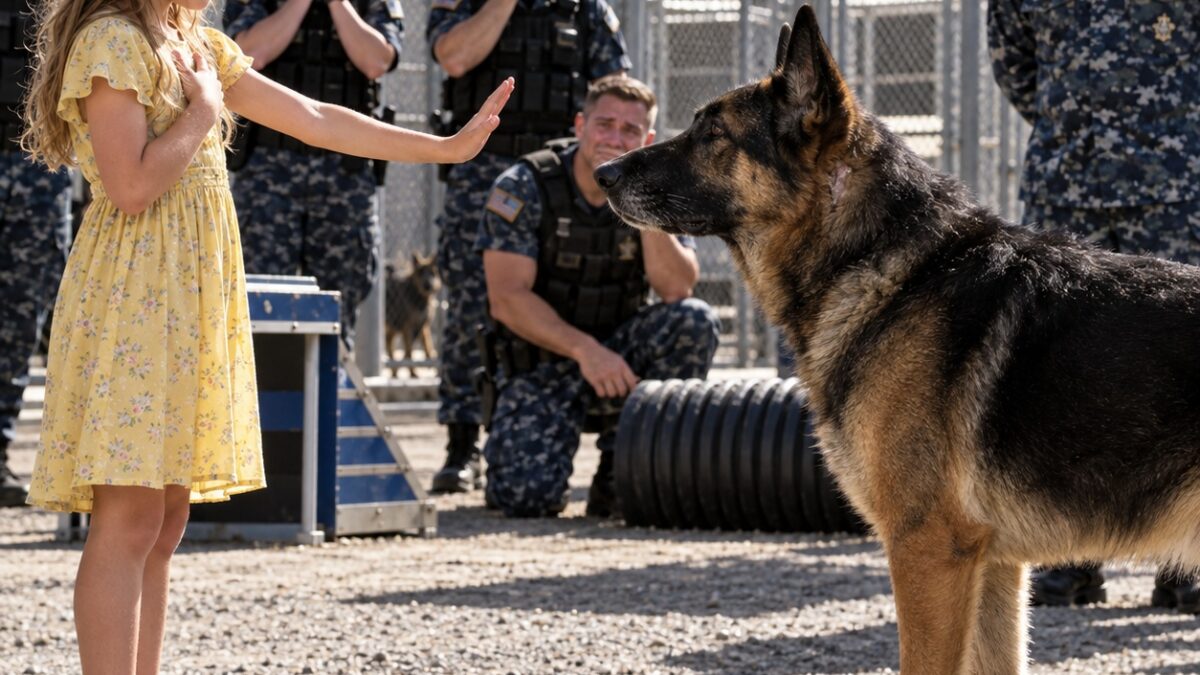
𝗙𝗨𝗟𝗟 𝗦𝗧𝗢𝗥𝗬 👇📖
I remember the silence more than anything.
There were people around us.
Rachel.
Jake.
Aaron.
Two kennel staff members.
Me.
A dog who had been classified as increasingly unsafe.
Yet after Lily made that signal, the entire yard seemed to empty of sound.
Shadow stared at her.
His ears moved forward.
His breathing changed.
The growl disappeared.
Lily did not move closer.
That mattered.
Cole had taught her well.
You do not crowd a frightened working dog because emotion tells you that love should make everything safe.
Love does not erase training.
It does not erase instinct.
It does not erase trauma.
Lily stayed where she was.
Twenty feet away.
Open palm.
Two fingers against the center of her yellow dress.
Then she repeated the gesture.
My mind went backward almost a year.
Late summer.
Training field.
Cole removing Shadow’s harness at the end of a long day.
I had seen him make that same strange motion.
Open hand.
Two fingers to his chest.
I had laughed.
“What’s that?”
Cole grinned.
“Home signal.”
“Since when do Navy dogs need secret handshakes?”
“He needs to know when he’s allowed to stop being a soldier.”
At the time, I thought it was just Cole being Cole.
He treated Shadow less like equipment and more like a teammate who happened to have four legs.
I forgot the moment almost immediately.
Until Lily repeated it.
Shadow lowered his head.
Then, slowly, he folded his hind legs beneath him.
He sat.
Jake whispered:
“No way.”
Aaron covered her mouth.
Rachel lowered the tablet she had been recording with.
I could not speak.
For six weeks, experienced people had tried food.
Voice commands.
Distance.
Routine.
Equipment.
Familiar handlers.
Nobody had asked Shadow the one question Lily had just answered.
Is the mission over?
He had been waiting for Cole to return through that gate.
Maybe he had not understood death.
Maybe all he understood was that his handler had disappeared while Shadow was still on duty.
So he stayed.
Protected the kennel.
Rejected anyone trying to move him.
Waited.
Every day.
Every night.
Then Cole’s daughter gave him the one signal that meant he no longer had to.
Rachel watched him for another full minute before speaking.
“Seven days.”
I looked at her.
“What?”
“Controlled rehabilitation trial.”
Aaron turned toward her so quickly I thought she might run across the safety line.
Rachel raised one hand.
“Do not celebrate yet.”
Lily remained kneeling.
Shadow continued sitting.
Rachel’s voice stayed clinical.
“He remains Navy property.”
Aaron nodded.
“This does not erase the incident with Jake.”
“I know.”
“He wears a basket muzzle outside the house.”
“Yes.”
“Second secure barrier in the backyard.”
“Yes.”
“Lily is never alone with him.”
Aaron swallowed.
“Yes.”
“I want daily checks.”
“Fine.”
“Any serious uncontrolled aggression ends the trial immediately.”
Aaron looked toward Shadow.
Then at Lily.
“I agree.”
Rachel crouched slightly so Lily could see her.
“This is not seven days to prove Shadow loves you.”
Lily nodded.
“We already know he recognizes you.”
Another nod.
“This is seven days to prove he can live safely around people again.”
Lily looked at Shadow.
“Okay.”
By late afternoon, the paperwork was ready.
Shadow left the facility with two leads and a secure basket muzzle.
Jake held one leash.
I held the other.
He did not fight us.
He hesitated.
That was different.
At every doorway, he paused as though deciding whether crossing it meant betraying the place where Cole had left him.
Each time, Lily walked several feet ahead.
She never pulled.
Never called.
She simply gave the home signal.
Open palm.
Two fingers to the heart.
Shadow followed.
When we reached the Bennett house, Aaron opened the front door.
Shadow stood at the threshold.
For six weeks, he had watched a gate waiting for Cole.
Now he was standing at the place Cole had once brought him after work.
Lily gave the signal.
Shadow stepped inside.
A fresh water bowl waited near the kitchen.
Dog bed by the fireplace.
Food.
Blanket.
He ignored everything.
His nose went down.
He moved through the hallway.
Then stopped in front of the coat closet.
Cole’s combat boots were sitting beside it.
Aaron had not moved them.
She told me later she had tried twice.
Both times she had carried the boots toward the garage.
Both times she put them back before the day ended.
Shadow lowered his nose.
Breathed against the leather.
Then lay down.
He rested his head across one boot.
Nobody spoke.
Lily sat several feet away on the floor.
She did not touch him.
Did not call his name.
She just stayed.
I left before dark.
Aaron stood at the doorway.
“You think this is going to work?”
“I don’t know.”
It hurt to say.
But she deserved the truth.
“Today was a good sign.”
“That isn’t what I asked.”
“No.”
She waited.
“I really don’t know.”
Her eyes moved toward the living room.
“Cole would know.”
Maybe.
Cole always seemed to know Shadow.
But Cole was gone.
That was the problem all of us were still trying to solve.
The first night almost ended the trial.
A storm came in from the Atlantic.
Wind hit the house after midnight.
The upper latch on the back door failed.
The door slammed open.
Then struck the wall again.
And again.
Shadow reacted instantly.
Aaron woke to the sound and ran into the hallway.
Shadow was standing between the open back door and Lily’s bedroom.
Rigid.
Head low.
Guarding.
Lily stepped into the hallway.
Aaron told her:
“Don’t move.”
Shadow was not looking at Lily.
He was watching the door.
The same kind of situation that would have caused a full defensive reaction days earlier.
Then Lily slowly lifted her hand.
Open palm.
Two fingers to her chest.
Shadow looked back.
His shoulders lowered.
Not completely.
Enough.
He stepped away from the doorway.
Aaron shut the door.
Locked it.
Only afterward did she understand what Rachel had been saying.
Shadow’s reactions were not random.
He believed he still had a job.
Protect.
Watch.
Respond.
The problem was not that he wanted violence.
The problem was that he no longer knew when protection was unnecessary.
That became the real work.
Routine.
Predictability.
Choice.
Every afternoon, Lily sat in the living room with an old adventure book.
She read aloud.
Not to train him.
Not officially.
She simply read.
Day one, Shadow stayed beside Cole’s boots.
Day two, he moved halfway across the room.
Day three, he ate while Lily read.
Aaron called me that night.
“He finished the bowl.”
I smiled.
“All of it?”
“All of it.”
“Good.”
“I didn’t say anything.”
“Good.”
“Lily didn’t either.”
“Even better.”
Some victories are too fragile to clap for.
While Shadow was learning to exist inside the Bennett house again, Aaron was carrying another problem quietly.
Money.
Cole’s survivor benefits had been delayed because paperwork was missing.
The mortgage was due.
Bills were piling up.
One afternoon she photographed Cole’s dark pickup truck.
She listed it for sale.
Did not tell Lily.
Their next-door neighbor found the listing.
Margaret Hayes.
Sixty-nine.
Silver hair.
Retired school-office administrator.
The kind of woman who considered asking permission a bureaucratic obstacle.
The next morning, two retired tradesmen showed up and started reinforcing the Bennett fence.
Aaron walked outside.
“Margaret.”
Margaret held a box of screws.
“What?”
“You did this?”
“Made two phone calls.”
“I didn’t ask anyone.”
Margaret looked at her.
“That appears to be your favorite problem.”
Aaron almost argued.
Then stopped.
The fence needed work.
The seven-day trial required it.
Sometimes accepting help is its own kind of courage.
Jake came later for the daily check.
Shadow saw him through the fence.
Immediately stiffened.
Jake’s hand moved unconsciously toward the place a leash normally hung from his belt.
Lily saw that.
She carried an old wooden chair into the yard.
Set it several yards from the fence.
“You can sit there.”
Jake frowned.
“I’m not afraid of him.”
Lily looked at his hands.
“Okay.”
Jake sat anyway.
He did not approach Shadow.
Did not carry a leash.
Instead he began telling Lily a story about Cole.
“Your dad forgot his lunch once during a fourteen-hour training day.”
Lily smiled faintly.
“What did he eat?”
“He blamed Shadow for stealing the lunch.”
“Did Shadow steal it?”
“No.”
I arrived at that exact moment.
Jake pointed at me.
“Mason did.”
“I did not.”
Lily laughed.
The first real laugh I had heard from her since Cole died.
Shadow lifted his head.
Nothing more.
But he listened.
Jake came back the next day.
Same chair.
Another story.
Then the next.
By the fourth visit, Shadow did not stand when Jake arrived.
He watched.
But the warning was gone.
Inside, other things changed.
Day four, Shadow lay beside Lily’s chair.
Day five, Aaron entered with laundry and heard something softly striking the hardwood.
Shadow’s tail.
Once.
Then again.
Lily kept reading.
Did not reach for him.
Did not make it a performance.
I watched from the doorway.
My hand was in my pocket.
Around Cole’s dog tag.
I had carried it for weeks.
I had told myself I was waiting for the right moment to give it to Aaron.
That was not true.
I carried it because guilt needed an object.
I had not been on Cole’s final mission.
I believed I should have been.
No evidence supported that thought.
Grief rarely cares about evidence.
If I had gone…
If I had switched rotations…
If I had said one different thing…
The mind builds whole alternate universes where the dead survive because you made a better decision.
Then punishes you for living in this one.
On the fifth morning, Rachel came for a controlled exercise in the yard.
Simple walking.
Stop.
Sit.
Return.
No unfamiliar people.
No pressure.
Shadow followed.
His movements were careful.
Responsive.
Aaron stood near Lily.
Jake stayed by the porch.
For the first time, I allowed myself to think:
Maybe.
Then a military helicopter crossed low over the neighborhood.
The sound hit suddenly.
Rotors beating the air.
Shadow froze.
His head snapped upward.
His entire body locked.
“Shadow.”
Nothing.
The helicopter passed beyond the trees.
But he stayed fixed on the sky.
That sound had been part of Cole’s final day.
I shortened the leash.
Too quickly.
Shadow pulled backward.
“Easy.”
He turned toward the wooded area behind the house.
The side gate was partly open.
One of the men repairing the fence had been carrying equipment through it.
I felt the leash slip.
“Shadow!”
Gone.
Across the yard.
Through the gate.
Into the trees.
Lily ran after him.
Aaron screamed.
“Lily!”
I followed.
Jake was behind me.
The woods stretched toward marshy ground where Cole had once taken Shadow on conditioning runs.
Lily knew one of the trails.
By the time I reached the trees, she had disappeared.
My stomach turned to ice.
I had lost Cole.
Now I had lost his daughter.
At least that was how my mind framed it.
I ran.
Branches hit my uniform.
Mud caught my boots.
Jake called Lily’s name.
I called Shadow.
No answer.
Then, on a narrow trail, I saw green and black cord caught beneath wet leaves.
Cole’s paracord bracelet.
I stopped.
Picked it up.
For several seconds, I could not move.
Jake reached me.
“What?”
I opened my hand.
His face changed.
“Lily dropped it.”
That was all I said.
What I meant was:
I failed again.
Jake understood.
“This isn’t all on you.”
“Tell me that after we find her.”
We moved deeper.
What we did not know was that Lily had already found Shadow.
He stood in a small clearing beside an oak tree.
Facing an empty path.
Waiting.
Again.
She stopped several yards away.
Did not run to him.
Did not grab him.
Cole had taught her better.
“Shadow.”
One ear moved.
He stayed facing the trail.
Lily knelt.
Open palm.
Two fingers to the heart.
Nothing.
For the first time, the signal did not work immediately.
She swallowed.
Then said the thing no adult had managed to explain to him in six weeks.
“Dad isn’t coming.”
Shadow stayed still.
“But we can still go home.”
She repeated the signal.
This time he turned.
His shoulders dropped.
One step.
Then another.
When he reached her, she did not hug him.
She stood.
Shadow leaned lightly against her leg.
Then they started back.
On the way, Lily noticed something blue beneath leaves.
Shadow’s old training ball.
Cole had used it during recovery work.
She stepped toward it.
Shadow changed instantly.
He moved in front of her.
Blocked her.
A copperhead lay partly hidden in the grass.
Lily had not seen it.
Shadow had.
He shoved her backward.
Then held position between her and the snake.
No command.
No signal.
No handler.
He chose.
By the time Lily realized Shadow was favoring one front leg, he had already been bitten.
Jake found them first.
Five days earlier, Shadow lunging toward him had made his hands shake.
Now Jake did not hesitate.
He removed his combat jacket.
Moved carefully beside the dog.
“Easy, buddy.”
Shadow allowed him close.
Jake supported his weight.
Then lifted him.
Nearly ninety pounds of working dog against his chest.
Shadow did not resist.
I reached them seconds later.
Aaron behind me.
She pulled Lily into her arms.
“Are you hurt?”
Lily shook her head.
“Shadow moved me.”
I looked at the dog.
He had protected her without being told.
Something had changed.
Not cured.
Changed.
We drove straight to Rachel.
She examined him.
Snakebite.
Immediate treatment.
Observation.
The next several hours became another kind of waiting.
Shadow had spent six weeks waiting for Cole.
Now we sat outside a clinic waiting for Shadow.
Military people are bad at helplessness.
Give us something to carry.
A perimeter.
A checklist.
A mission.
Waiting feels worse.
Jake stayed inside near Shadow.
Aaron sat with Lily.
I sat outside.
Cole’s bracelet in one hand.
His dog tag in my pocket.
Messages began reaching my phone.
People had heard what happened.
Former teammates.
Handlers.
Families.
Stories about Shadow.
The civilian he located during a search.
The frightened family he stayed beside until rescue arrived.
The teammate he helped protect.
Nobody asked us to ignore what happened with Jake.
Nobody said safety did not matter.
They said:
Remember his whole life.
That sentence stayed with me.
Two days later, Shadow stood again.
Bandage around his front leg.
Still stiff.
But stable.
Rachel watched him cross the treatment room.
“He can participate.”
Aaron looked toward the evaluation schedule.
“Today?”
Rachel nodded.
“But the assessment changes.”
No running.
No jumping.
No hard lead pressure.
If he tired, we stopped.
The Navy still needed a decision.
Not emotional.
Not symbolic.
Evidence.
Could Shadow control himself?
Could he recover from triggers?
Could he exist around unfamiliar people?
Could he choose calm without Lily rescuing every difficult moment?
We returned to the training yard.
Lieutenant Commander Thomas Reed joined Rachel.
He was the Navy veterinary liaison.
Procedural.
Calm.
Not easily moved by stories.
I respected that.
“This isn’t about whether we like him,” Thomas said.
Rachel nodded.
“It’s about whether he can remain under control.”
First test.
A stranger.
A kennel assistant named Marcus walked into the opposite side of the yard.
Shadow noticed immediately.
Ears up.
Body alert.
Marcus moved in a wide circle.
Then closer.
Shadow watched.
Did not advance.
Rachel wrote something.
Second test.
Sudden noise.
A metal tray dropped behind him.
Shadow spun.
Shoulders tightened.
Aaron held her breath.
Lily kept her hands down.
No signal.
No help.
Shadow looked at the tray.
Then at Rachel.
Several seconds.
His posture softened.
On his own.
Rachel wrote again.
“He recovered without intervention.”
Thomas nodded.
Third test.
Two children at the far end of the yard.
Carefully instructed.
Distance maintained.
They rolled a soft ball between them.
Shadow’s head turned.
He leaned forward.
I watched his feet.
He did not move.
The ball rolled again.
He looked toward Lily.
Lily did nothing.
Hands at her sides.
Shadow looked back.
Stayed.
Thomas lowered his pen.
“That matters.”
“Why?” I asked.
“He made the correction himself.”
Three stages.
Passed.
One remained.
Jake asked to speak with me.
We stepped behind the equipment building.
He handed me a revised incident report.
“What’s this?”
“I changed my statement.”
“Why?”
“My first one made it sound like Shadow attacked without warning.”
I looked at him.
“He didn’t.”
Jake shook his head.
“I brought the leash toward him.”
“I know.”
“I saw him tense.”
“You were trying to help.”
“That doesn’t change what happened.”
He looked toward the yard.
“I assumed he’d remember me enough to let me do it.”
Shadow lay near Rachel.
Watching.
“I triggered the reaction.”
“You didn’t create all of this.”
“No.”
Jake looked at me.
“But if they judge him, they should judge the truth.”
That was one of the bravest things Jake did during those weeks.
Not entering the yard.
Not carrying Shadow after the snakebite.
Correcting his own record.
People love courage when it looks physical.
Sometimes courage looks like changing a report that makes you look less innocent.
Jake entered the yard.
Same style of camouflage uniform.
Leash hanging from his right hand.
Shadow saw him.
Immediate tension.
Low warning sound.
I stepped forward.
“That’s enough.”
Jake raised one hand.
“One minute.”
Rachel warned him.
“Do not approach.”
He nodded.
Then lowered the leash onto the grass.
Slowly knelt.
Raised his right hand.
Open palm.
Then touched two fingers to his chest.
The home signal.
Shadow’s ears moved.
Jake said nothing.
Did not call his name.
Did not order him to sit.
Outside the fence, Lily watched.
I looked at her.
She understood.
“This one has to be his choice,” she whispered.
Exactly.
Shadow stood still.
Five seconds.
Ten.
Then the warning stopped.
His shoulders lowered.
He took one step toward Jake.
I stopped breathing.
Another.
Then another.
Jake stayed on his knees.
Hands still.
Shadow reached him.
Stopped.
Jake did not touch him.
Shadow lowered his head.
And rested it against Jake’s knee.
Jake closed his eyes.
Nobody moved.
No applause.
No celebration.
Rachel waited.
Shadow stepped away on his own.
Returned to the evaluation line.
Sat beside it.
Rachel closed his file.
“Shadow is not displaying uncontrolled aggression.”
Thomas looked at her.
She continued.
“His prior behavior is consistent with trauma-related defensive fixation after loss of his handler.”
Aaron started crying silently.
Rachel held up a finger.
“That does not mean the risk is gone.”
Aaron nodded.
“It means his triggers are identifiable.”
She looked at Shadow.
“He has demonstrated recovery after stress.”
Then toward Jake.
“And he has demonstrated the ability to choose a controlled response.”
I finally exhaled.
“So?”
Rachel looked at Thomas.
Then me.
“My recommendation is retirement with structure, monitoring, and continued behavioral support.”
Aaron covered her face.
Lily smiled.
Back inside the administrative building, I removed the euthanasia authorization from Shadow’s folder.
I held it for a second.
Six weeks of failure reduced to one piece of paper.
Then tore it in half.
Lily watched.
“He’s safe?”
“The order is canceled.”
Her smile widened.
Then I remembered the next problem.
“Lily.”
She looked at me.
“Shadow still belongs to the Navy.”
Her smile disappeared.
“What does that mean?”
“Passing the evaluation doesn’t automatically make him yours.”
She looked toward the window.
Shadow was outside beside Jake.
“I don’t need him to be a K9 anymore.”
“I know.”
“I just want him to be a dog.”
That sentence got Rachel.
She turned away and reopened Shadow’s medical file.
Several minutes later she called me over.
“Mason.”
“What?”
“Look.”
An old note.
Cole had asked about retirement procedures for Shadow before his final mission.
Not completed.
Just a note.
An administrative breadcrumb.
We sent it to Dana Whitmore.
Dana had spent twenty years finding paperwork everyone else considered lost.
Silver hair.
No patience for sloppy filing.
“If Cole filed something,” she said, “I’ll find it.”
Before leaving, I finally did what I had been avoiding.
I gave Aaron Cole’s dog tag.
She closed her hand around it.
“I should have gone with him.”
The words escaped before I could stop them.
Aaron looked at me.
“Cole never blamed you.”
“You don’t know that.”
“Yes.”
She held the tag against her palm.
“He told me before that mission that you had already carried enough for him.”
I looked away.
The guilt did not vanish.
Nothing that old disappears because of one sentence.
But something shifted.
It became lighter.
The next morning Dana called at 7:42.
“I found something.”
I reached the archive ten minutes later.
A thin folder sat on the table.
Dated three weeks before Cole’s final mission.
MILITARY WORKING DOG RETIREMENT REQUEST.
Shadow’s identification number.
Service record.
Preferred retirement placement.
I stopped reading.
Dana said softly:
“Keep going.”
Under placement, Cole had written:
Aaron Bennett and Lily Bennett.
Virginia Beach, Virginia.
His signature was at the bottom.
Then beneath the formal section, in Cole’s handwriting, one extra sentence.
He has spent his life bringing people home.
When his watch is over, let him come home too.
I turned away.
Dana pretended to organize papers.
I appreciated that.
For weeks, I had carried Cole’s dog tag because I believed there was one final duty I had failed.
Now Cole had left me another.
This one I knew how to complete.
The review board assembled that afternoon.
No speeches.
Evidence.
Rachel’s report.
Behavioral testing.
Jake’s revised statement.
The snakebite incident.
Shadow protecting Lily.
Cole’s signed retirement request.
Rachel spoke first.
“He is not cured.”
I respected her for using that word only to reject it.
“He requires structure.”
She continued.
“Monitoring.”
“Clear boundaries.”
“Controlled exposure.”
“But?”
Thomas asked.
“But he is responsive.”
She looked around the table.
“Manageable.”
“And capable of choosing calm when given the opportunity.”
Jake spoke next.
He did not defend himself.
He explained the leash incident exactly as he had revised it.
“I misunderstood what he was communicating.”
One board member asked:
“You’re saying his reaction was justified?”
“No.”
Jake shook his head.
“I’m saying it had a trigger.”
That distinction mattered.
“He still needs rules.”
Jake continued.
“But he also needs somewhere he understands.”
Then I placed Cole’s retirement request on the table.
Nobody spoke while they read it.
The decision came that afternoon.
Shadow would officially retire from military service.
Permanent placement transferred to Aaron and Lily Bennett.
Care plan mandatory.
Continued veterinary and behavioral support.
When I called Aaron, Lily answered.
“Senior Chief?”
“Hey, kid.”
“Is he coming home?”
I looked out the window.
Shadow lay beneath an equipment shelter beside Jake.
No muzzle in the shaded enclosure.
Head on his paws.
Calm.
“Yes.”
I smiled.
“This time for good.”
The retirement ceremony happened two days later.
Small.
That was deliberate.
Cole hated unnecessary ceremony.
He respected tradition.
Different thing.
We held it on the same field Shadow had watched from his kennel for six weeks.
The gate was visible behind us.
That mattered to me.
Rachel attended.
Jake stood beside Shadow.
Aaron and Lily waited in front.
Shadow wore his black working collar.
The same collar he had worn through years of missions.
I knelt beside him.
Placed one hand on his shoulder.
“This collar means service.”
His ears shifted.
“Training.”
“Responsibility.”
“Trust.”
I swallowed.
“And it means your job had an ending.”
I unclipped it.
For the first time in years, Shadow wore nothing marking him as military property.
Lily opened a small wooden box.
Inside was a brown leather collar.
She fastened it.
A brass tag hung from the front.
SHADOW BENNETT
RETIRED
HOME
Lily touched two fingers to her chest.
Shadow looked at her.
Then leaned against her leg.
No command.
He did not need one.
In the weeks afterward, the Bennett house slowly stopped feeling like a house where someone had just died.
Not because Cole became less important.
Because grief made room for other things beside itself.
Cole’s delayed survivor benefits were finally resolved.
Aaron removed the truck listing.
The mortgage stopped feeling like a countdown.
Margaret noticed the truck was still under the maple tree.
She walked over carrying coffee.
“You keeping it?”
“For now.”
Margaret nodded.
“Good.”
Then:
“Ugly truck.”
Aaron laughed.
A full laugh.
The first Margaret had heard since Cole died.
I began thinking about the unused fenced area behind one of our old training buildings.
Nothing formal.
Nothing grand.
A place for military families carrying grief.
Benches.
Shade.
Retired dogs.
No therapy labels required.
Just somewhere people could sit without being expected to explain themselves.
Months later, Shadow and Lily became regular visitors.
No tactical harness.
No building searches.
No gates to guard.
He spent afternoons lying near children who had lost parents, siblings, or people they loved.
Some talked to him.
Some did not.
Shadow accepted both.
He understood silence.
By spring, the Bennett yard was green again.
Permanent gate.
Fence repaired.
Cole’s truck beneath the maple.
His boots still beside the closet.
One warm afternoon, Lily found Shadow’s faded blue training ball.
The same kind Cole had used.
She carried it into the yard.
Shadow watched.
Lily threw it.
The ball rolled across the grass.
For a second, he did nothing.
Then he looked back at her.
Lily did not use the home signal.
She smiled.
“Go get it.”
Shadow ran.
Not toward a vehicle.
Not toward an obstacle course.
Not toward someone who needed finding.
A ball.
That was all.
He chased it.
Picked it up.
Brought it back.
Dropped it near Lily’s feet.
She raised one open hand.
Then touched two fingers to her heart.
The signal that had once meant:
Work is finished.
You can stop being a soldier.
Home.
Shadow stepped forward.
Rested his head against her palm.
That night, he walked down the hallway.
Cole’s boots remained by the closet.
Months earlier, Shadow had stopped there every time.
That night, he paused.
Only briefly.
Then continued.
He reached Lily’s bedroom.
Turned once on the rug.
Lay outside her door.
Closed his eyes.
That image stayed with me.
Not the day he lunged at Jake.
Not the euthanasia form.
Not even Lily standing in the yellow dress in the training yard.
That hallway.
Shadow walking past Cole’s boots.
Not forgetting.
Never forgetting.
Just no longer waiting for a man who could not come back.
For six weeks, we called Shadow unstable.
Difficult.
Dangerous.
Unmanageable.
None of those words were entirely false.
That was what made the case hard.
He had become dangerous.
He had reacted badly.
He had injured trust.
Safety mattered.
Rachel never let us pretend otherwise.
But we made a mistake when we assumed the behavior was the whole dog.
We kept asking:
Why won’t he obey?
Lily asked something different.
What does he think he is still supposed to do?
That changed everything.
Shadow had spent his life working beside Cole.
Search.
Protect.
Wait.
Return.
A handler says stay, a working dog stays.
Cole never came back to release him.
So Shadow stayed.
We thought he was refusing us.
Maybe he was obeying Cole.
That does not make every reaction acceptable.
It does not mean grief excuses danger.
But it means context matters.
Jake learned that.
I learned that.
The unit learned it.
People later turned Lily into some kind of miracle child.
I hated that version.
She did not tame an uncontrollable dog with love.
That is not what happened.
She respected distance.
Used something Cole had actually taught him.
Followed safety rules.
Accepted Rachel’s conditions.
Did not touch Shadow until he chose contact.
When he ran into the woods, she did not chase him screaming and throw her arms around him.
She stopped.
Knelt.
Waited.
Even when she finally said:
Dad isn’t coming.
She did not demand Shadow understand.
She offered him another destination.
Home.
That was the difference.
Home is not a command.
It is somewhere you are allowed to stop performing.
Cole understood that.
He knew Shadow needed a way to transition from work to family.
Open palm.
Two fingers to the heart.
No mission.
No guarding.
Home.
We almost killed a dog because the one piece of training he needed most existed outside his official record.
That fact changed procedures at the facility.
Informal handler cues started being documented.
Retirement planning improved.
Family-transition information became more detailed.
We stopped assuming official commands were the entire language between a handler and a dog.
They never are.
Teams build private vocabulary.
Tone.
Breathing.
Movement.
Routines.
Small signals.
Things nobody notices until one half of the team is gone.
Jake stayed involved in Shadow’s life.
At first because Rachel wanted controlled exposure.
Later because Shadow genuinely tolerated him.
Then liked him.
Jake never rushed that transition.
Some afternoons he sat outside the Bennett fence and told stories about Cole.
Eventually Shadow lay beside him.
The first time Jake touched his neck again, he asked Lily first.
She said:
“Ask Shadow.”
Jake laughed.
“How?”
“Wait.”
So he did.
Shadow eventually moved closer.
That was his answer.
Jake learned more from that dog than he did from his first four years around him.
So did I.
As for my guilt, it never disappeared completely.
Years later, I can still imagine the mission I did not attend.
Alternate routes.
Different choices.
Cole alive.
That is grief’s oldest trick.
It gives you responsibility for events you could not control because responsibility feels easier than helplessness.
Aaron helped me understand that.
So did the dog tag.
I eventually stopped carrying it.
Not because Cole mattered less.
Because carrying his identity against my chest was not bringing him back.
I gave it where it belonged.
To his family.
Shadow taught me the same thing.
Holding position forever is not loyalty if the mission is over.
Sometimes loyalty means moving.
That was what Cole’s final retirement request gave us.
Not simply legal permission.
Permission to finish.
He has spent his life bringing people home.
When his watch is over, let him come home too.
I still have a copy of that sentence.
It hangs inside the support area we built behind the old training facility.
Not prominently.
No big plaque.
Just a framed photocopy near one bench.
Families sometimes read it.
Some cry.
Some sit quietly.
Retired working dogs nap nearby.
Children play.
Nobody is required to speak.
Shadow became one of the oldest regulars.
By then, his muzzle had begun turning gray.
He moved slower.
But when a military helicopter passed in the distance, he no longer searched the sky for Cole.
He lifted his head.
Listened.
Then usually looked toward Lily.
She had grown taller.
Older.
Still used the signal occasionally.
Not because Shadow needed it.
Because it belonged to them now.
That is how grief changes.
At first, memories are traps.
Then, if you are fortunate, they become bridges.
The same gesture that once released Shadow from six weeks of waiting became Lily’s way of saying:
I remember Dad too.
Neither of us has to stand watch alone.
One afternoon I sat with Aaron near the support yard.
Shadow slept near Lily while she read.
Same habit.
Different book.
Aaron watched them.
“Cole would have loved this.”
“Yes.”
“He would’ve taken credit.”
I laughed.
“Absolutely.”
“He would say he trained Shadow for grief support.”
“He’d make up a qualification.”
“Print certificates.”
“With logos.”
She smiled.
Then became quiet.
“Do you think he knew?”
“Knew what?”
“That he might not come home.”
I thought about the retirement form.
Three weeks before his final mission.
His handwritten line.
Maybe Cole understood risk.
Every operator does.
But understanding risk is not the same as expecting death.
“I think he knew every mission had that possibility.”
Aaron nodded.
“And he prepared for Shadow.”
“Yes.”
“For us.”
“Yes.”
She looked at Lily.
“I spent months thinking he left me with everything.”
I did not answer.
“House.”
“Paperwork.”
“Benefits.”
“His things.”
“Lily.”
“Grief.”
Her voice tightened.
“Then I found out he had been trying to take care of us even before he left.”
I looked at Shadow.
“Sounds like Cole.”
Aaron smiled through tears.
“He was infuriating.”
“Also sounds like Cole.”
Shadow opened one eye.
Then closed it.
By the time he turned ten, the Navy no longer referred to him as a retired asset in casual conversation.
He was Shadow Bennett.
That mattered more than anyone expected.
Names change relationships.
Military working dog.
Property.
K9.
Retired.
Shadow Bennett.
Family.
Lily eventually stopped leaving water outside in case he found his way home.
Because every morning, the bowl was already inside.
And Shadow was sleeping near her door.
The first bowl she had placed outside after Cole died stayed in the garage.
Aaron could not throw it away.
I understood.
Families build museums accidentally.
Boots.
Mugs.
Jackets.
Dog bowls.
Truck keys.
A paracord bracelet.
Objects become proof that somebody existed in the rooms where silence now lives.
Healing does not mean throwing them all away.
It means choosing when they can remain without controlling where you stand.
Shadow eventually stopped sleeping outside Lily’s bedroom every night.
Sometimes he slept by the fireplace.
Sometimes near the kitchen.
Sometimes directly in the middle of the hallway where everyone had to step over him.
That was how we knew he was truly retired.
A military dog would never create that kind of obstruction.
A family dog absolutely would.
Jake complained once.
“Look at him.”
Shadow did not move.
“Elite working dog.”
Nothing.
“Now he’s a speed bump.”
Lily smiled.
“He’s off duty.”
She touched two fingers to her heart.
Shadow rolled onto his side.
We all laughed.
Those moments mattered because they were ordinary.
People tell stories about military dogs by focusing on extraordinary things.
Explosives.
Tracking.
Combat.
Rescue.
Shadow did all of that.
But after Cole died, the most important thing he learned was ordinary.
Sleep when nobody needs you.
Eat because food is there.
Chase a ball because it is fun.
Let a child read near you.
Walk past old boots.
Choose another room.
Go home.
That is harder than it sounds when your entire life has been duty.
I know.
A lot of us know.
Military people sometimes survive service only to discover nobody taught us how to stop being useful long enough to simply be alive.
Cole taught Shadow that before anyone realized how important it would become.
No mission.
No guarding.
Home.
Years later, that became something we taught people in the support program too.
Not the hand signal.
The idea.
Your watch can end without your value ending.
You can rest without betraying the people who did not come home.
You can laugh again.
Sell something.
Keep something.
Ask for help.
Change routines.
Love someone new.
None of that erases the person you lost.
Shadow taught that lesson without words.
One day a boy at the support yard sat beside him for almost an hour.
His father had died overseas.
The boy never spoke.
Shadow did not move away.
When the boy finally stood, he touched the dog’s head and said:
“My mom says I’m supposed to talk about him.”
Shadow looked up.
The boy whispered:
“I don’t want to.”
Lily, now older, heard him.
She said:
“You don’t have to talk every time.”
The boy looked at her.
“Then what do I do?”
Lily pointed toward Shadow.
“Sit.”
So he sat again.
That was the whole session.
Sometimes that is enough.
Shadow grew slower after that.
His working years had been hard on his joints.
Rachel remained involved.
Regular exams.
Medication.
Weight management.
Nothing dramatic.
Age.
For once, Shadow faced something nobody could train around.
Lily adjusted.
Shorter walks.
More time in the yard.
Ball throws that went ten feet instead of thirty.
Shadow still retrieved every one.
Eventually, one day, he watched the blue ball roll and did not chase it.
Lily went to pick it up herself.
She brought it back.
Sat beside him.
“You’re tired?”
Shadow rested his head against her leg.
She raised one open palm.
Two fingers to her heart.
“Home.”
No urgency.
No fear.
Just the oldest private language between them.
Shadow sighed.
I watched from the porch with Aaron.
She leaned against the railing.
“He finally understands.”
“What?”
“That he doesn’t have to earn being here.”
That sentence stayed with me.
Maybe that was the entire story.
Shadow spent his working life earning everything.
Praise after commands.
Food after work.
Play after training.
Purpose through performance.
Then Cole died.
The mission ended without anyone giving him permission to stop.
Shadow responded the only way he knew.
Hold position.
Stay ready.
Do not let anyone move you.
Until Lily arrived.
Not with another assignment.
Not with another leash.
With release.
Years later, when Shadow’s body finally began failing, there was no debate about where he belonged.
Not the kennel.
Not the unit.
Home.
Rachel came to the Bennett house.
Jake came.
I came.
Margaret brought food nobody touched.
Lily sat on the floor beside Shadow.
He was old now.
Gray around the muzzle.
The pale scar beneath his right ear still visible.
Cole’s boots remained by the closet.
Shadow had not slept beside them in years.
That morning, Lily placed the old blue ball nearby.
Not because he could play.
Because it was part of him.
Aaron held Cole’s dog tag.
I carried the black military collar from the retirement ceremony.
Lily wore the green-and-black paracord bracelet.
Every piece of the story in one room.
Shadow’s breathing was slow.
Rachel explained what would happen.
Lily nodded.
She had grown up around honest adults.
That was Cole’s legacy too.
She did not ask whether Shadow would be scared.
She asked:
“Will he hurt?”
Rachel said:
“No.”
Lily placed one hand against his neck.
Then she made the signal one last time.
Open palm.
Two fingers to the heart.
“No mission.”
Her voice broke.
“No guarding.”
Shadow looked at her.
“Home.”
His tail moved once.
Very small.
Lily leaned forward.
“You did good.”
I had heard those words spoken to working dogs hundreds of times.
That day they meant something different.
No reward coming.
No next task.
No return to duty.
Just acknowledgment.
You did good.
Shadow closed his eyes.
Rachel stayed with him.
So did all of us.
No one asked Lily to leave.
She had been the person who taught him his watch could end.
She had earned the right to be there when it finally did.
Afterward, the house was impossibly quiet.
Aaron cried.
Jake went outside.
I stood near Cole’s boots and felt something I had not felt in years.
Completion.
Not relief.
Not happiness.
Completion.
Cole had asked us to let Shadow come home when his watch was over.
We had.
Not perfectly.
Almost too late.
But we did.
Lily buried the blue training ball with him.
The brown leather collar remained with the family.
The old military collar went into a shadow box beside a photograph of Cole and Shadow together.
Under it, Aaron placed a copy of the retirement request.
And that handwritten sentence.
He has spent his life bringing people home.
When his watch is over, let him come home too.
The support yard still exists.
We eventually named it Bennett Field.
Not for Cole alone.
For the family.
Because that was the lesson.
Service belongs to individuals.
Grief belongs to families.
Healing often requires communities.
There are benches under the pines now.
Retired dogs visit.
Children sit.
Veterans sit.
Widows sit.
Sometimes nobody talks for an hour.
Nobody forces them.
On one bench is a small brass plate.
It does not list medals.
Ranks.
Missions.
It says:
NO MISSION.
NO GUARDING.
HOME.
People ask what it means.
Sometimes I explain.
Sometimes Lily does.
Sometimes we leave them to wonder.
Years have passed since that morning when a nine-year-old girl stood twenty feet from a dog we thought we had lost.
I still remember everything.
The yellow dress.
The wet Virginia grass.
Shadow’s growl.
Lily’s open palm.
Two fingers to her heart.
The moment his hind legs folded beneath him.
The moment all of us realized we had been asking the wrong question.
We wanted to know why Shadow would not obey.
Lily knew he was still obeying the last duty he understood.
We wanted to move him forward.
He was still waiting for the man who had always told him when the work was done.
We saw aggression.
Lily saw a sentry who had never been relieved.
That does not mean children should approach dangerous dogs.
It does not mean affection makes risk disappear.
Rachel was right from beginning to end.
Safety mattered.
Structure mattered.
Evidence mattered.
The seven-day trial mattered.
The final assessment mattered.
Jake telling the truth mattered.
The retirement review mattered.
What Lily gave us was not magic.
It was information.
One missing piece of language.
One piece important enough to change how we understood everything else.
That is why Shadow lived.
That is why he came home.
That is why Jake stopped seeing him only as the dog who lunged.
Why Aaron accepted help.
Why I finally handed over Cole’s dog tag.
Why a little support yard exists today.
Because a nine-year-old girl remembered something the adults had forgotten.
Cole had taught Shadow how to work.
But just as importantly, he had taught him how to stop.
Open palm.
Two fingers to the heart.
Work is over.
You’re safe.
Come home.
Shadow spent six weeks waiting for Cole to give him that signal again.
Cole never could.
So Lily did.
And from that morning forward, Shadow no longer spent his life staring at an empty gate.
He spent it beside the people Cole had loved most.
Not as a weapon.
Not as military property.
Not as a problem somebody had failed to solve.
As Shadow Bennett.
Retired.
Home.








