𝗙𝗨𝗟𝗟 𝗦𝗧𝗢𝗥𝗬 :They Fired the Quiet Nurse for Saving a Man’s Life—Then a Black Hawk Came Looking for Her
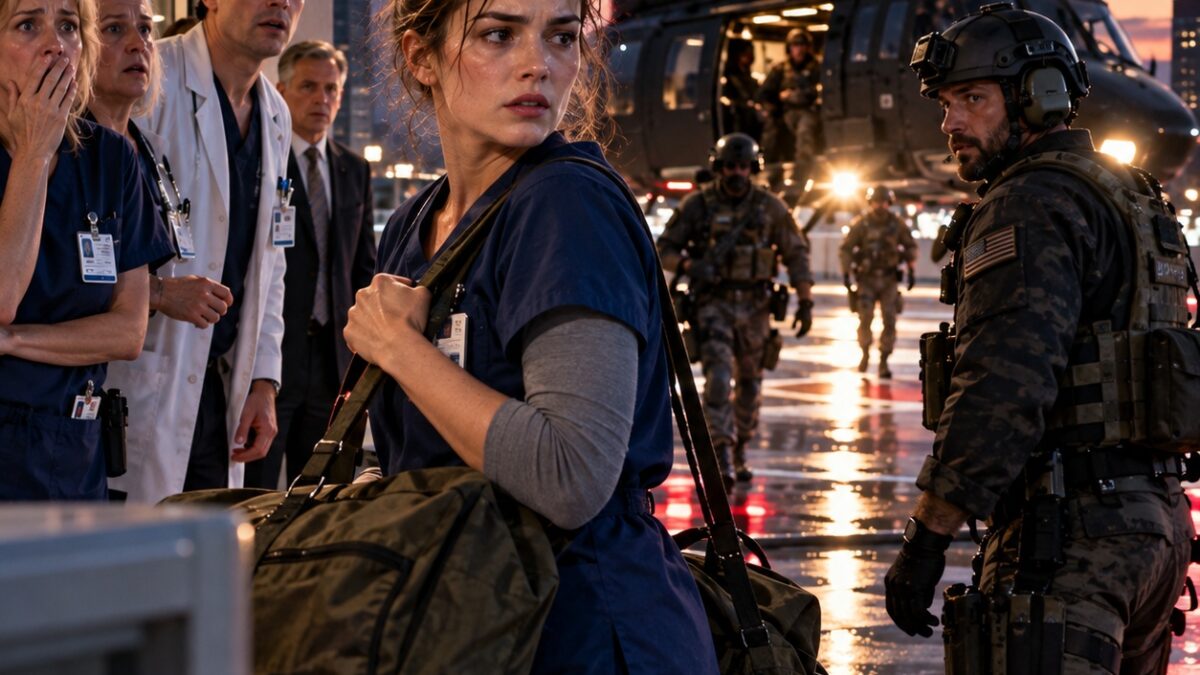
FULL STORY CONTINUATION
I drove away from St. Jude without looking back.
For exactly nine minutes.
Then I looked in the rearview mirror.
The hospital rose behind me in glass and concrete, reflecting the heavy gray Chicago sky.
Three weeks.
That was all it had taken for me to build something resembling civilian life.
Not a good life yet.
Not even a comfortable one.
But ordinary.
Ordinary had become precious to me.
There had been a time when I measured days by casualty reports.
By mission windows.
By how many units of blood were left.
By whether weather allowed evacuation.
By how long a wounded man could survive before the helicopter reached us.
At St. Jude, I measured days by medication passes, shift reports, bed assignments, and arguments over who had used the last clean portable monitor.
I had wanted that.
Desperately.
Then Croft suspended me.
And the Navy called.
I pulled into a quiet parking lot three miles from the hospital and opened my duffel.
Beneath spare scrubs and an old sweatshirt was the life I had supposedly left behind.
A compact encrypted phone.
Trauma shears.
Medical gloves.
A battered notebook.
A sealed credential wallet.
And a photograph I hadn’t looked at in months.
Six people standing beside a helicopter somewhere hot and unforgiving.
Five men.
One woman.
Me.
We looked exhausted.
Filthy.
Alive.
Two of the men in that photograph were dead now.
One had lost part of a leg.
Another had left the service.
The last one still called me when things went bad enough.
Commander Ryan Miller.
I picked up the secure phone again.
He answered immediately.
“Jenkins.”
“What happened?”
“Explosion near the port.”
“Training?”
“No.”
That single word changed everything.
“Who’s hit?”
“Reynolds.”
My fingers tightened around the phone.
Chief Petty Officer Mark Reynolds.
I knew him.
Not well.
Enough.
“He’s alive?”
“For now.”
“Evac destination?”
“St. Jude.”
I laughed once.
There was no humor in it.
“Of course.”
“Command picked it because it’s closest Level One with an open OR.”
“They just suspended me.”
Silence.
Then Miller said, “For what?”
“Saving someone.”
Another silence.
Longer.
“You serious?”
“Yes.”
“What happened?”
“Later.”
“We need you.”
“I’m not cleared.”
“You’re still certified.”
“My operational medical status was revoked after the knee.”
“Your knee doesn’t need to run.”
“That isn’t how this works.”
“Today it is.”
I closed my eyes.
The old argument.
The one I had made with myself for eighteen months.
I’m done.
I’m not who I used to be.
Someone else can do it.
Someone else should do it.
Miller interrupted my thoughts.
“Sarah.”
He almost never used my first name.
That frightened me more than his command voice.
“Reynolds won’t make twenty minutes with standard trauma management.”
I stared through the windshield.
“What’s the injury?”
“Blast fragmentation. Pelvis destroyed. Massive hemorrhage. We’ve got bilateral tourniquets high, but the bleeding is internal.”
“Blood?”
“Two units whole blood in flight.”
“Pressure?”
“Falling.”
“Conscious?”
“No.”
I leaned back.
My knee began aching the way it always did when old memories returned.
I hated that.
Pain as memory.
“You have a trauma surgeon.”
“Twenty minutes out.”
“That’s not enough.”
“No.”
I knew what they needed.
And I hated that I knew.
“Extraction point?”
Miller gave me an address near the river.
I looked once more toward St. Jude.
Then started the car.
“Copy.”
I met them inside an abandoned municipal lot.
The Black Hawk landed hard enough to throw dust and paper into the air.
No dramatic music.
No slow motion.
Real military aircraft are brutally loud.
The side door opened.
Miller stepped down.
He was bigger than I remembered.
Or maybe civilian hospitals had recalibrated my sense of scale.
His beard had more gray in it.
His eyes looked exactly the same.
Hard.
Tired.
Constantly measuring.
He stopped when he saw me.
Then looked at my St. Jude duffel.
“You look ridiculous.”
“You look old.”
“Good to see you too, Doc.”
“Don’t call me that.”
He glanced at my hospital badge.
“Nurse Jenkins?”
“Yes.”
“That’s cute.”
“I can go home.”
He stopped smiling.
“No, you can’t.”
Two other operators moved toward us.
Bull Harper.
Derek Cole.
Both men I had worked beside years earlier.
Bull looked at my plain scrubs.
“Civilian life going well?”
“I was suspended this morning.”
He stared.
“For what?”
“Can everyone stop asking that?”
“No.”
I looked at Miller.
“Where’s Reynolds?”
“Still airborne. Second bird.”
“Then why am I here?”
“Gear.”
One of the operators handed me a case.
I opened it.
Medical supplies.
Specialized vascular equipment.
Whole blood.
Things St. Jude did not routinely stock in its emergency department.
My stomach tightened.
“You brought this?”
“We knew what we might need.”
“You knew the mission risk.”
Miller looked at me.
“We knew enough.”
I changed in the back of an armored support vehicle.
Dark tactical pants.
Black combat shirt.
Boots.
Minimal plate carrier fitted with medical pouches.
No weapons.
I had never liked carrying one.
My job had always started after weapons failed.
When I braided my hair, my hands moved automatically.
That disturbed me.
Muscle memory is loyal to lives you think you’ve abandoned.
Bull watched me emerge.
“There she is.”
I ignored him.
Miller didn’t.
He looked at me for several seconds.
“You okay?”
“No.”
“Good.”
I frowned.
“That’s your response?”
“Means you’re still sane.”
We boarded.
As the helicopter lifted, Chicago fell beneath us.
Cars.
Buildings.
The river.
Thousands of people moving through ordinary lives.
I used to look down from aircraft like that and wonder what normal people worried about.
Rent.
Traffic.
School pickups.
Bad dates.
Hospital politics.
I had wanted those problems.
Now I was flying back toward the hospital that had suspended me, carrying equipment designed to keep a shattered operator alive until surgeons could repair what an explosion had done to him.
Bull sat across from me.
His voice came through the headset.
“You miss this?”
“No.”
He nodded.
“Liar.”
“I miss the people.”
“Same thing.”
“No.”
I looked at him.
“It really isn’t.”
He stopped arguing.
When we approached St. Jude, the hospital rooftop appeared through low clouds.
Miller spoke into the radio.
“Prepare Trauma One.”
The response was confused.
“Identify aircraft.”
He did.
There was a pause.
Then:
“We don’t have a military medevac scheduled.”
“You do now.”
I almost smiled.
The Black Hawk banked toward the roof.
Down below, through the emergency department windows, staff could probably already hear it.
I imagined Croft at the nurses’ station.
Brenda.
Khloe.
Drinking coffee.
Talking about how the insubordinate nurse had finally been removed.
The helicopter touched down.
Reynolds arrived seconds behind us on the second aircraft.
I saw the stretcher and forgot everything else.
Blood covered the lower half.
Tourniquets had slowed external loss but couldn’t touch the internal hemorrhage.
The pelvic region was devastated.
His skin was gray.
His pulse was barely sustainable.
Miller looked at me.
“Doc.”
This time I didn’t correct him.
“Move.”
Four operators carried the stretcher toward the elevator.
I walked beside them.
My knee hurt.
I ignored it.
The elevator doors opened into St. Jude’s emergency department.
And the room stopped.
Every face turned.
Bull shouted first.
“Clear the bay!”
People moved.
Not fast enough.
Miller shouted louder.
“Clear Trauma One now!”
Brenda froze behind the central station.
Khloe stared.
Croft stepped forward.
Designer scrubs.
Gold-rimmed glasses.
Same controlled expression he wore when students were watching.
Until he saw the blood.
Then the expression slipped.
“Excuse me.”
He approached Miller.
“You cannot enter this department with weapons.”
Miller kept moving.
“I’m the chief resident.”
“Congratulations.”
“This is a civilian trauma center.”
Miller grabbed his shoulder and moved him aside just enough to pass.
“Then act like a trauma center.”
Croft looked outraged.
I stayed behind the group.
Nobody had seen me yet.
The stretcher entered Trauma One.
Miller started giving the report.
“Blast injury. Severe pelvic trauma. Massive blood loss.”
Croft’s face drained.
Brenda rushed for IV equipment.
Khloe attached monitors.
The alarms began immediately.
Reynolds’ pressure was collapsing.
Croft looked at the injury.
For once, arrogance didn’t appear.
Only fear.
“I need surgery.”
“Then get surgery.”
“The trauma surgeon is twenty minutes out.”
Miller stepped closer.
“He doesn’t have twenty.”
“I understand that.”
“Do you?”
Croft’s hands hovered over the field.
He didn’t know where to start.
Not because he was stupid.
He wasn’t.
Croft was an excellent textbook physician.
But there is a difference between understanding trauma in controlled training and standing over catastrophic battlefield injuries while four men who love the patient watch you decide whether he lives.
Pressure reveals parts of people that credentials hide.
Croft’s hands began shaking.
Brenda saw it.
So did Khloe.
Miller looked around.
“Where is she?”
Nobody answered.
His voice hardened.
“Command said she was here.”
Brenda frowned.
“Who?”
“Jenkins.”
Khloe blinked.
“Sarah?”
Miller looked at her.
“Yes.”
Brenda’s face changed.
“She was suspended this morning.”
Miller became completely still.
“What?”
Croft looked up.
“She violated hospital protocol.”
Bull took one step forward.
“You suspended a Special Operations Independent Duty Corpsman?”
Khloe looked at Brenda.
Brenda looked at Croft.
Croft stared at Bull as if he had started speaking another language.
Bull continued.
“A Navy Cross recipient?”
The room went silent.
That was when I walked through the trauma-bay doors.
I had never liked dramatic entrances.
This one happened anyway.
Khloe saw me first.
Her mouth opened.
Brenda turned.
Then Croft.
None of them recognized me for perhaps half a second.
Same face.
Different posture.
No slouch.
No lowered eyes.
No attempt to disappear.
Dark tactical clothing.
Medical rig.
Combat boots.
Hair braided tight.
Miller looked toward me.
Relief crossed his face.
“Doc.”
I moved to Reynolds.
“Status.”
“Pelvic blast injury,” Miller said. “Two tourniquets. Two units whole blood. Pressure falling despite resuscitation.”
I snapped on gloves.
“How long since injury?”
He told me.
“Any response to blood?”
“Temporary.”
I looked at the monitors.
Then the injury.
Internal pelvic hemorrhage.
The tourniquets couldn’t stop it.
Reynolds was emptying into himself.
Croft stepped beside me.
“You can’t perform procedures here.”
I didn’t look at him.
“Thomas.”
His voice sharpened.
“You are suspended.”
I checked Reynolds’ pulse.
“Step away from the table.”
His face flushed.
“Excuse me?”
I looked at him for the first time.
“Step away.”
It was the same command I had given him the night before.
Only this time four SEALs stood around us.
Director Mitchell appeared in the doorway.
He must have run down from his office.
“Jenkins!”
I ignored him.
“You are currently suspended from clinical duties.”
Still ignored him.
“Security!”
Two hospital guards approached.
The operators turned.
Nothing overt.
Just a shift in posture.
The guards stopped.
Bull looked at Mitchell.
“This man is dying.”
Mitchell swallowed.
“That doesn’t give her authority to—”
Miller cut him off.
“Then find someone else who can do what she can do in the next sixty seconds.”
Nobody spoke.
Because there wasn’t anyone.
Not yet.
I opened the specialized vascular kit.
Croft looked down.
Recognition registered.
“You can’t.”
I prepared the equipment.
“You know how to use that?”
I looked at him.
“Yes.”
“How?”
“Later.”
Khloe stood frozen.
I pointed at her.
“Arterial line kit.”
She moved instantly.
“Ultrasound.”
She ran.
No smirk.
No gossip.
No attitude.
Fear stripped all that away.
Brenda moved toward the transfuser.
I looked at her.
“Whole blood ready?”
She nodded.
“Then run it.”
For the first time since I met Brenda, she responded to me with no resistance.
“Yes.”
I focused on Reynolds.
What I was doing was not a miracle.
It was not a cure.
It was a bridge.
A temporary way to redirect circulation and slow catastrophic bleeding until surgical control could happen.
I had done it before.
Not in Chicago.
Not in a pristine civilian trauma bay.
In environments with sand in the equipment and helicopters overhead.
That history lived in my hands.
I worked.
Croft stood a few feet away.
He looked torn between stopping me and watching.
Eventually, medicine beat ego.
He watched.
The device went into position.
I confirmed what I needed.
Then activated it.
Reynolds’ pressure responded.
Not magically.
Not perfectly.
But enough.
The monitor changed.
Brenda stared.
“Pressure is coming up.”
Khloe whispered, “Oh my God.”
I secured the line.
“Maintain blood.”
The trauma surgeon burst through the doors.
Dr. Allan Greer.
He took in the room.
Armed operators.
Blood.
Me.
Equipment.
Then the monitor.
“What happened?”
I gave him the summary.
He looked at the setup.
Then at me.
“You placed this?”
“Yes.”
He checked.
His eyebrows rose.
“Beautiful.”
Croft flinched.
Greer didn’t notice.
“He’s stable enough to move.”
I stepped back.
“He needs definitive repair.”
Greer nodded.
“Let’s go.”
The surgical team moved Reynolds.
Miller followed halfway to the door.
Then stopped.
He looked at me.
“Coming?”
“No.”
“He’s your patient.”
“He’s Greer’s patient now.”
Miller knew better than to argue with a handoff.
He nodded and went after the stretcher.
When the elevators closed, the ER became silent.
Not normal quiet.
The suffocating kind.
I removed my gloves.
Blood streaked my forearms.
Khloe stood near the monitor.
Her face had no color.
Brenda looked older than she had that morning.
Croft stared at me.
Finally:
“Who are you?”
I dropped the gloves into the waste container.
“Sarah Jenkins.”
“That isn’t what I mean.”
“I know.”
The elevator opened again.
A man in Navy dress uniform beneath a tactical jacket walked into the department.
Commander Daniel Hayes.
Gray-haired.
Rigid posture.
The kind of officer who could silence a room without asking.
He surveyed the blood on the floor.
Then me.
“Chief Jenkins.”
I straightened automatically.
Old habits.
“Sir.”
“Reynolds?”
“Stable enough for surgery.”
He nodded.
“Good work.”
“Just doing my job.”
Hayes looked toward Croft.
Then Mitchell.
His expression hardened.
“I read the incident report you filed this morning.”
Mitchell adjusted his tie.
“Commander, there are hospital procedures—”
“I’m aware.”
Croft stepped forward.
“She performed an invasive procedure without physician authorization.”
Hayes looked at him.
“And your patient survived.”
“That doesn’t erase scope-of-practice concerns.”
“No.”
Hayes surprised everyone by agreeing.
“It doesn’t.”
Croft seemed encouraged.
Then Hayes continued.
“But your report also omitted that the patient had arrested while you were focused on a competing intervention.”
Croft’s expression changed.
Hayes had details.
Of course he did.
“You omitted that Chief Jenkins identified the immediate mechanical cause.”
Croft said nothing.
“You omitted that her intervention restored circulation.”
Mitchell stepped in.
“We are still obligated to investigate—”
“Yes.”
Hayes looked at him.
“And now the Department of Defense will investigate your department.”
Mitchell went pale.
Hayes continued.
“Chief Jenkins was placed here as part of a civilian transition program for elite operational medical personnel.”
Brenda’s eyes dropped.
“She was not sent here because she lacked experience.”
Hayes looked around the ER.
“She was sent here because after ten years of combat medicine and a service-ending injury, she was attempting to build a civilian life.”
My throat tightened.
I wished he would stop.
Not because he was wrong.
Because I did not want my private history turned into a public weapon against people I disliked.
Hayes looked at Croft.
“She has maintained casualties under enemy fire.”
Then Brenda.
“Kept wounded men alive during evacuation windows most civilians cannot imagine.”
Then Khloe.
“And apparently spent three weeks here being treated like she was too stupid to clean up after you properly.”
Nobody spoke.
I finally interrupted.
“Sir.”
Hayes looked at me.
“That’s enough.”
He studied my face.
Then nodded.
“Understood.”
I appreciated that.
I didn’t need revenge.
I didn’t need Brenda humiliated.
Or Khloe.
Or even Croft.
I had wanted a civilian job.
They had made it unpleasant.
That was different from deserving public destruction.
Mitchell looked toward me.
“Sarah, the suspension is still technically active pending—”
Hayes’s gaze snapped toward him.
I raised a hand.
“No.”
Everyone looked at me.
“Let him finish.”
Mitchell swallowed.
“Pending review.”
“Okay.”
He blinked.
He had expected anger.
“I’m not fighting you.”
Croft looked confused.
I continued.
“You have policies.”
“Yes.”
“You should review what happened.”
Hayes watched me.
I knew what he was thinking.
Too generous.
Maybe.
But organizations without rules become dangerous.
I knew that better than most.
The problem wasn’t that St. Jude had protocol.
The problem was people using protocol as a substitute for judgment.
Mitchell said quietly, “Thank you.”
I nodded.
Then Hayes spoke.
“The transition partnership with St. Jude is being suspended.”
Mitchell looked alarmed.
“You’re removing the program?”
“Yes.”
“Commander—”
“The environment is not appropriate.”
Brenda looked at me.
That hurt more than I expected.
For all her bullying, part of me had still hoped I could return on Monday and somehow begin again differently.
Hayes turned toward me.
“Grab your gear.”
I didn’t move.
“Where are we going?”
“Reynolds’ team needs medical coverage.”
“I’m discharged.”
“Your status is being reviewed.”
My knee throbbed.
“No.”
The room went still.
Hayes’s expression changed.
“Chief.”
“I said no.”
Bull had returned from the elevator corridor and stopped near the door.
He watched.
I continued.
“My knee ended field operations.”
“You can teach.”
“I don’t want to go back.”
Hayes lowered his voice.
“We need you.”
“I know.”
“That used to matter.”
“It mattered too much.”
For several seconds, neither of us spoke.
Then he nodded.
Not happy.
But respectful.
“All right.”
Croft looked almost disappointed that there would be no cinematic departure.
Hayes reached into his jacket.
Pulled out a folded document.
“What’s that?”
“Temporary federal credentialing authorization.”
I stared at him.
“You came prepared.”
“I know you.”
“Apparently not well enough.”
He almost smiled.
“Keep it.”
I did.
Not because I planned to use it.
Because old operators rarely throw away documents that might matter later.
Bull approached me.
“You really staying civilian?”
“Yes.”
He looked around St. Jude.
“Here?”
That was harder.
I glanced at Brenda.
Khloe.
Croft.
Mitchell.
I didn’t know.
Before I could answer, Greer called down from surgery.
Reynolds had made it through initial control.
Still critical.
Alive.
Bull closed his eyes.
Hayes breathed out.
I felt tension leave my shoulders.
Alive.
That word mattered more than everything else.
I walked toward my locker.
Brenda followed me.
I heard her footsteps before she spoke.
“Sarah.”
I stopped.
She looked nothing like the woman who had laughed about my “rural clinic” experience.
“I owe you an apology.”
I waited.
She continued.
“I treated you badly.”
“Yes.”
Her eyes dropped.
“I thought you were arrogant.”
“Because I was quiet?”
“Because you didn’t seem to need anyone.”
That answer surprised me.
Brenda looked embarrassed.
“I’ve worked here twenty years. New nurses come in nervous. They ask questions. They want approval.”
“And I didn’t.”
“No.”
“So you decided something was wrong with me.”
“Yes.”
Honesty.
I respected that.
“I’m sorry.”
I nodded.
“Okay.”
She looked surprised.
“That’s it?”
“What do you want me to do?”
“I don’t know.”
“Brenda, I’m not going to make you suffer to prove I was hurt.”
Her eyes filled.
I continued.
“But if another nurse comes in here quiet, older, weird, inexperienced on your software, whatever—don’t decide her value before you know her.”
She nodded.
“I won’t.”
“That matters more.”
Khloe came around the corner.
She had been crying.
That surprised me.
“I’m sorry too.”
I leaned against the lockers.
“For the charts?”
Her face flushed.
“You knew?”
“You knocked them down while saying ‘oops, clumsy me.’”
“I thought you didn’t care.”
“I didn’t.”
That almost hurt her more.
“I was awful.”
“You were twenty-four.”
“That’s not an excuse.”
“No.”
She swallowed.
“Why didn’t you ever say anything?”
I considered the question.
“Because I wasn’t planning to stay long enough to matter.”
That was the truth.
And hearing myself say it exposed something uncomfortable.
Maybe I had been unfair too.
I had treated St. Jude like a waiting room.
A place to disappear.
I expected nobody to understand me because I never allowed anyone the chance.
That did not excuse bullying.
But hiding had consequences.
I took my locker key off the ring.
Then paused.
“Khloe.”
“Yes?”
“You moved fast today when I asked for equipment.”
She blinked.
“So?”
“You’re good under pressure when you stop worrying about who’s watching.”
Her eyes widened.
“That might be the nicest thing anyone has ever said to me.”
“Your standards are too low.”
She laughed through tears.
Then Croft appeared.
Of everyone, I least wanted that conversation.
He stayed near the doorway.
“Jenkins.”
“Croft.”
Brenda and Khloe quietly left.
Cowards.
Croft put his hands in his pockets.
“I didn’t know.”
“No.”
“If I had—”
“What?”
His mouth closed.
I looked at him.
“If you knew I was decorated, would you have listened?”
He said nothing.
“That’s the problem.”
He looked uncomfortable.
“You presented yourself as a novice nurse.”
“I was a novice civilian nurse.”
“You deliberately concealed your experience.”
“Much of it was classified.”
“You could have said you had advanced trauma training.”
“I did.”
He frowned.
I reminded him.
“Overseas contract work. Field stabilization.”
He looked away.
I continued.
“You heard what fit the story you had already built about me.”
Croft’s jaw tightened.
“So this is all my fault?”
“No.”
That surprised him.
“The hospital put you in charge of a trauma bay because you earned that responsibility.”
His expression softened slightly.
“You made the wrong call last night.”
“Yes.”
“You froze.”
“Yes.”
That admission cost him something.
I respected it.
“But you’re not the first doctor to freeze.”
He looked at me.
“And you won’t be the last.”
I had watched highly trained operators freeze.
Medics.
Pilots.
Officers.
People believe competence means never faltering.
It doesn’t.
Competence is what happens after.
Croft asked, “Why did you give me credit?”
I knew exactly what he meant.
After the first cardiac case weeks earlier, when I had intervened and he told Brenda he had done it.
I had stayed silent.
“Because I didn’t want attention.”
“That’s all?”
“Yes.”
His expression became bitter.
“You let me lie.”
“I let you talk.”
“That isn’t the same?”
“No.”
I picked up my duffel.
“Your choices belong to you.”
That ended the conversation.
I left St. Jude that afternoon.
Not flanked by SEALs.
Not dramatically.
Hayes drove me to the parking lot.
Bull came too because apparently silence made him uncomfortable.
As we reached my car, Bull said, “Still think civilian life is quieter?”
“Yes.”
He stared at me.
“You people had a guy fall three stories yesterday.”
“No one was shooting at us.”
“Low standards.”
Hayes looked at my knee.
“How bad?”
“Fine.”
“Lie.”
“Manageable.”
“Better.”
He leaned against the SUV.
“If you ever change your mind—”
“I won’t.”
“You always say that.”
“I mean it.”
“So did I at thirty-five.”
Bull said, “You’re both depressing.”
We ignored him.
Hayes offered his hand.
I took it.
“Good work, Chief.”
I looked at him.
“Sarah.”
He nodded.
“Good work, Sarah.”
That mattered.
I drove home.
My apartment was quiet.
The air conditioner rattled.
Someone upstairs was vacuuming.
A dog barked in the hallway.
Normal life.
I sat at my kitchen table still wearing tactical pants.
The contrast felt ridiculous.
My St. Jude badge rested beside my keys.
I turned it over.
SARAH JENKINS, RN.
Three weeks earlier, I had been proud of that badge.
Not because nursing was beneath what I had done before.
Because it was different.
Civilian nursing asked things of me military medicine rarely had.
Patience.
Long-term communication.
Dealing with families who weren’t trained to compartmentalize fear.
Electronic documentation designed by people who apparently hated nurses.
Being part of a system where you couldn’t simply bark an order and expect everyone to move.
I had been good at keeping people alive in chaos.
I had not yet learned how to live inside ordinary teamwork.
That was why I didn’t quit.
Two days later, Mitchell called.
“The review is complete.”
I sat on my couch.
“And?”
“We’re rescinding the suspension.”
I said nothing.
“Dr. Greer documented that your intervention was medically necessary.”
Still nothing.
“The patient survived surgery.”
I closed my eyes.
The construction worker.
I had thought about him constantly.
“Neurologically intact?”
“As far as we know.”
Relief moved through me.
Mitchell continued.
“There will still be a formal review of policy and escalation procedures.”
“There should be.”
He paused.
“I’d like you to return.”
That surprised me.
“Do you?”
“Yes.”
“Does Croft?”
Another pause.
“That is less relevant than it was two days ago.”
I almost laughed.
“What happened?”
“Department leadership is under review.”
“Because of me?”
“Because of multiple issues.”
I understood.
Organizations rarely break because of one event.
One event simply gives people permission to examine the cracks.
Mitchell said, “Brenda specifically asked that you return.”
That surprised me more.
“Khloe too.”
I looked at my badge.
“When?”
“Monday.”
“I’ll think about it.”
He exhaled.
“Fair.”
I returned Monday.
That shocked everyone.
Including me.
The nurses’ station became silent when I walked in wearing ordinary navy scrubs.
Same cheap shoes.
Same plain badge.
My hair in the same tight bun.
Bull would have been disappointed.
Brenda approached first.
“Morning.”
“Morning.”
She handed me an assignment sheet.
No psychiatric hold unit.
No punishment patients.
I read it.
Trauma One.
I looked at her.
“Subtle.”
She almost smiled.
“You asked to be treated according to your ability.”
“I asked you not to assume.”
“Fine. Consider this me asking.”
I took the sheet.
“Okay.”
Khloe appeared carrying coffee.
She stopped.
Held one cup out.
“For you.”
“I don’t drink vanilla.”
Her face fell.
“I thought everyone did.”
“Apparently not.”
She took it back.
We both smiled.
Croft arrived ten minutes later.
He looked at me.
I looked at him.
“Morning, Doctor.”
“Morning, Sarah.”
Not Jenkins.
Not nurse.
Sarah.
Small things matter.
The department did change.
Not instantly.
Real culture does not transform because someone gives a speech.
But slowly.
Brenda stopped assigning work as punishment.
Khloe became less interested in being Brenda’s favorite and more interested in becoming someone junior nurses trusted.
Croft started asking questions when nurses raised concerns instead of immediately defending his authority.
Sometimes he still got arrogant.
People do not receive personality transplants because a Black Hawk lands nearby.
But he improved.
So did I.
I stopped pretending silence was always strength.
Sometimes silence is avoidance.
I spoke more.
Asked questions.
Told coworkers when I didn’t understand civilian systems.
Admitted that despite everything I had done, St. Jude’s electronic charting software could defeat me faster than enemy fire ever had.
Khloe became my unofficial technology tutor.
She enjoyed that far too much.
“You can stabilize battlefield trauma but you can’t find the discharge navigator?”
“It’s badly designed.”
“It’s three tabs.”
“It’s hostile.”
“You’re eighty years old.”
“I’m thirty-four.”
“Emotionally eighty.”
I threw a roll of tape at her.
Missed.
My knee blamed me.
Six weeks later, the construction worker returned.
Not as a patient.
He came in with a walker.
His wife beside him.
I didn’t recognize him at first.
Trauma patients look different when they aren’t gray and dying.
He approached the nurses’ station.
“Sarah Jenkins?”
I stood.
“Yes.”
He smiled.
“My name’s Michael Donovan.”
I knew immediately.
He held out a hand.
“They told me you’re why I’m here.”
“That’s not accurate.”
His wife started crying.
Michael laughed.
“They said you’d say that.”
I looked toward Croft.
He was standing down the hall.
He nodded once.
I turned back.
“A lot of people kept you alive.”
“But you did something when everyone else hesitated.”
I didn’t know what to say.
He squeezed my hand.
“Thank you.”
There are medals in military medicine.
Commendations.
Coins.
Awards.
Letters.
I had received several.
Michael Donovan standing in front of me with a walker meant more than most of them.
Because this time, I wasn’t keeping a man alive long enough for him to go back to war.
I was keeping him alive so he could go home.
That was the difference I had been searching for.
Months passed.
My encrypted phone stayed quiet.
I preferred it that way.
Reynolds recovered slowly.
Bull sent updates whether I asked or not.
First surgery successful.
Then infection scare.
Then rehabilitation.
Then:
REYNOLDS WALKED TEN FEET TODAY. UGLY AS HELL BUT COUNTS.
I replied:
TELL HIM TO STOP SHOWING OFF.
Bull answered:
HE SAID YOU’RE JUST JEALOUS.
That made me smile.
Eventually, Reynolds himself called.
“Jenkins.”
“You sound alive.”
“Rumors exaggerated.”
“How’s rehab?”
“Terrible.”
“Good.”
“You’re a cruel woman.”
“Walking?”
“With assistance.”
“Then keep going.”
Silence.
Then:
“Thanks.”
I leaned against the wall outside Trauma Two.
“You don’t owe me.”
“Yes, I do.”
“No.”
“You were there.”
“That was my job.”
“Not that job.”
He meant the old one.
The life before St. Jude.
I closed my eyes.
“Reynolds.”
“Yeah?”
“Get better.”
“Yes, Doc.”
“Don’t call me that.”
He laughed.
They never stopped.
A year later, St. Jude received a large federal trauma-training grant.
Officially, it had nothing to do with me.
Unofficially, Hayes had fingerprints all over it.
I called him.
“You did this.”
“No idea what you’re talking about.”
“We suddenly have funding for advanced hemorrhage-control training.”
“Sounds useful.”
“And simulation equipment.”
“Good for you.”
“And a military-civilian exchange program.”
“Coincidence.”
“Hayes.”
“Yes?”
“Thank you.”
Silence.
Then:
“You’re welcome.”
He hung up.
The program became something I cared about deeply.
Not because I wanted civilian nurses turned into combat medics.
Because the best parts of military trauma training were not about weapons or war.
They were about clarity under pressure.
Teamwork.
Recognizing immediate threats.
Knowing when hierarchy helps and when hierarchy slows a necessary response.
Doctors trained beside nurses.
Paramedics trained beside residents.
Nobody got to hide behind titles during simulation.
The first time Croft participated, the scenario deliberately placed a subtle but critical finding in the nursing assessment.
He missed it.
Khloe caught it.
The instructor asked what he should do.
Croft looked across the room at her.
Then said:
“Listen.”
I smiled.
He noticed.
“Don’t.”
“I didn’t say anything.”
“Your face did.”
Progress.
Brenda changed too.
The day she retired, two years later, she asked me to attend her small farewell dinner.
I almost didn’t.
Then I went.
Near the end, she stood with a glass of wine.
“I spent a lot of years believing leadership meant controlling the room.”
She looked at me.
“Someone taught me that sometimes leadership means recognizing the person in the corner knows more than you do.”
Everyone glanced toward me.
I hated it.
Brenda smiled.
“Sarah hates public praise.”
“Correct.”
“So I’ll stop.”
“Thank you.”
She sat down.
Later she handed me an envelope.
Inside was my first assignment sheet.
Psych hold.
Four consecutive shifts.
She had saved a copy.
I stared at her.
“Why do you have this?”
“To remind myself I was an ass.”
I laughed.
“You were.”
“I know.”
I framed it.
Not because I resented her.
Because it reminded me how wrong first impressions can be.
People see what fits their expectations.
Brenda saw an older new nurse with plain scrubs and assumed failure.
Croft saw silence and assumed lack of knowledge.
Khloe saw someone who wouldn’t fight back and assumed weakness.
I saw arrogant civilians and assumed none of them could understand pressure.
We were all wrong in different ways.
That mattered.
Three years after the Black Hawk landed, my knee got worse.
Not catastrophically.
Enough.
My surgeon told me what I already knew.
“You’ve been compensating for years.”
“I manage.”
“That isn’t the same as healthy.”
I cut back on twelve-hour shifts.
Started teaching more.
Eventually, I became St. Jude’s trauma education coordinator.
That title would have horrified the woman who came there hoping nobody noticed her.
But I had changed.
I no longer wanted invisibility.
I wanted usefulness without being consumed by it.
Those are different things.
I kept working occasional ER shifts because teaching trauma without ever touching real patients felt dishonest.
One Friday night, a nervous new nurse named Megan stood beside me during a difficult case.
She had been licensed for six weeks.
Her hands shook.
The attending dismissed something she said.
She went quiet.
I saw myself.
Not exactly.
But enough.
“What did you notice?”
She looked startled.
“I don’t know.”
“Yes, you do.”
She described it.
Her observation mattered.
We checked.
She was right.
Later she found me.
“I thought I was being stupid.”
“Why?”
“He’s an attending.”
“So?”
“He’s been doing this twenty years.”
“That makes him experienced.”
She waited.
“It doesn’t make you blind.”
She nodded slowly.
I handed her a chart.
“Now document it.”
She laughed nervously.
“That’s the worst part.”
“Correct.”
The Navy Cross stayed in a box.
I never displayed it at work.
Not because I was ashamed.
Because I didn’t want new nurses thinking authority came from medals.
My operational history explained some of what I knew.
It did not make me infallible.
One of the most dangerous things that can happen in medicine is when people become too impressed to challenge you.
I had seen it happen to commanders.
Surgeons.
And doctors like Croft.
Respect matters.
Worship is dangerous.
Hayes retired eventually.
At his ceremony, he made the mistake of inviting me.
Bull was there.
Reynolds.
Cole.
Others I hadn’t seen in years.
My old world.
I wore a simple black dress and flat shoes because heels and my knee had declared permanent war.
Bull hugged me hard enough to threaten my ribs.
“Civilian.”
“Old man.”
“Still bossy?”
“Still ugly?”
He grinned.
Reynolds walked with a slight limp.
I stared at it.
He caught me.
“Don’t.”
“How’s the pelvis?”
“Very romantic conversation.”
“Answer.”
“Functional.”
“Pain?”
“Sometimes.”
“Rehab?”
“Still.”
I nodded.
“Good.”
He smiled.
“You really can’t turn it off.”
“No.”
Hayes made his speech.
Talked about service.
People lost.
People who carried others home.
Near the end, he looked at our group.
“There are warriors who never fire a weapon.”
I immediately looked down.
Bull whispered, “You’re screwed.”
“Shut up.”
Hayes continued.
“Some of them spend their careers running toward the part everyone else is trying to escape.”
He didn’t say my name.
I appreciated that.
Afterward, he found me near the back.
“You stayed civilian.”
“Yes.”
“You happy?”
I thought about it.
Not the automatic answer.
The real one.
“Yes.”
His smile was small.
“Good.”
“You?”
“Ask me in a year.”
“Fair.”
He handed me my old unit patch.
I stared at it.
“I thought these were destroyed.”
“Some of us ignore paperwork.”
“You were the commander.”
“Exactly.”
I held it.
For years, anything connected to that part of my life made me feel pulled backward.
This didn’t.
It felt like history.
Mine.
Not a command.
Not an obligation.
Just part of me.
“Thank you.”
He nodded.
Then said, “Doc.”
I glared.
He walked away laughing.
St. Jude became home eventually.
Not in the sentimental way hospitals like to advertise.
There were still bad shifts.
Politics.
Budget fights.
Understaffing.
Doctors with egos.
Nurses who gossiped.
Patients who screamed at us.
Families who blamed us for things we could not control.
Medicine remained messy because people are messy.
But I stopped expecting civilian life to mean no conflict.
Peace is not the absence of difficulty.
It is having a life where difficulty does not own every part of you.
I had friends.
A small house.
A dog who hated thunderstorms.
Plants I routinely forgot to water.
Sunday coffee with Khloe.
Yes, that Khloe.
Years after she knocked those charts out of my hands, she became one of the best emergency nurses I ever worked beside.
Not because the Black Hawk scared her straight.
Because she matured.
There is a difference.
She apologized once.
Then proved the apology through years of different behavior.
That is the kind that matters.
Croft became an attending.
A good one.
Still vain.
Still wore ridiculous expensive scrubs.
But when nurses spoke, he listened.
Mostly.
If he didn’t, Khloe reminded him.
Brenda retired somewhere warm.
Mitchell eventually left administration.
Life continued.
The Black Hawk became hospital folklore.
New employees heard versions.
Somebody exaggerated the number of SEALs to twelve.
Another version claimed the helicopter landed in the parking lot.
One resident insisted I had performed open surgery in Trauma One with a pocketknife.
Absolutely not.
The story grew every year.
I stopped correcting it unless the exaggeration became medically dangerous.
Once I overheard two students talking.
“That’s her.”
“Who?”
“The SEAL nurse.”
I kept walking.
“What did she do?”
“I heard she got fired and then an entire Navy team came back for her.”
Not quite.
“But she was like some secret combat surgeon.”
Definitely not.
“Why does she work here?”
That question made me stop.
I turned.
Both students froze.
I smiled.
“Because this is where my job is.”
They looked terrified.
I continued walking.
The truth was simple.
The Navy didn’t descend on St. Jude to avenge me.
They came because one of their men was dying and I happened to be the person with the right experience.
That is less satisfying than karma.
But I prefer it.
I wasn’t vindicated because powerful men respected me.
I was vindicated the moment that construction worker’s heartbeat returned.
Everything after that was noise.
The helicopter.
Hayes.
The investigation.
The apologies.
None of those things made me right.
The patient living did.
Years later, I visited Michael Donovan—the construction worker whose case started everything—during a hospital charity event.
He walked without a cane now.
He introduced me to his daughter.
“She’s the nurse.”
His daughter smiled.
“The one who saved you?”
Michael looked at me.
I gave him the warning look.
He corrected himself.
“One of the people who saved me.”
“Better.”
His daughter laughed.
Then asked, “Were you scared?”
People ask that constantly when they hear pieces of my past.
“Of what?”
“When his heart stopped.”
“Yes.”
She looked surprised.
“But you knew what to do.”
“Knowing what to do doesn’t remove fear.”
That became one of the lessons I repeated most often.
Fear and competence can exist in the same body.
So can grief and strength.
So can humility and authority.
Silence and experience.
A person can look ordinary and carry a history you would never guess.
That was the lesson St. Jude learned about me.
My lesson was harder.
I had assumed being invisible would protect me.
It did, for a while.
But invisibility also meant nobody knew when I was struggling.
Nobody knew why my knee hurt.
Why loud noises sometimes made me scan exits.
Why I never sat with my back to a door.
Why I avoided talking about family.
Why retirement had felt less like freedom and more like losing the only language I knew how to speak.
Once people knew pieces of the truth, something unexpected happened.
They didn’t only respect me more.
Some cared.
Khloe noticed bad-knee days and swapped assignments without making a show of it.
Brenda learned not to touch me from behind when I was concentrating.
Croft stopped taking offense when I needed a second after helicopter noise.
Small things.
Ordinary kindness.
It turned out being known did not automatically make me vulnerable in the way I feared.
Sometimes it made life easier.
I had spent years believing the strongest version of me was the woman who could kneel in blood and keep working while everyone else panicked.
Now I think strength looked just as much like walking into St. Jude after suspension and giving them another chance.
Letting Brenda apologize.
Letting Khloe change.
Letting Croft admit he froze.
Letting myself stay.
No medal teaches that.
No military course.
You learn it slowly.
Usually after making enough mistakes.
The hospital renovated Trauma One eventually.
New flooring.
New monitors.
Better lights.
The old supply cabinets were replaced.
During construction, someone found my black trauma shears wedged behind a baseboard.
The same pair I carried on my first day.
Facilities sent them to my office in a plastic bag.
I turned them over in my hand.
Scratched.
Dull.
Ordinary.
Brenda had mocked them because they were the only thing on my badge line that looked remotely personal.
She didn’t know they had traveled with me before St. Jude.
Afghanistan.
Yemen.
Other places.
I had cut uniforms off wounded men with them.
Then civilian jeans.
Then work clothes from a construction worker who fell three stories.
I retired the shears.
They sit in my desk now beside Hayes’s old unit patch.
Not displayed.
Just there.
Reminders.
One object from the life I left.
One from the life I chose.
The last time I saw Reynolds, we stood outside St. Jude near the ambulance entrance.
He was in Chicago for another reason and stopped by.
His limp was barely noticeable.
“Still teaching?”
“Yes.”
“Still terrifying residents?”
“Only the weak ones.”
He smiled.
“I owe you.”
“You already said that.”
“Still true.”
“No.”
I shook my head.
“You don’t owe me your life.”
“I know.”
That surprised me.
He continued.
“I owe you the chance you gave me to keep living it.”
That was different.
I could accept that.
“What have you done with it?”
He thought.
“Got married.”
I blinked.
“You?”
“Rude.”
“Accurate.”
“Two kids.”
I stared.
He laughed.
“You look more shocked by that than by the blast injury.”
“I am.”
He pulled out his phone.
Two children.
One girl.
One boy.
Both smiling.
His wife beside them.
I looked longer than I intended.
“That’s what you did with it.”
“Yeah.”
I handed the phone back.
“Good.”
He nodded toward the ER doors.
“What about you?”
“What about me?”
“What did you do with yours?”
I looked through the glass.
Nurses moving.
A resident arguing with radiology.
Khloe laughing at something by the station.
Normal chaos.
“I stayed.”
Reynolds smiled.
“Good.”
That might be the best ending anyone could have given me.
I stayed.
Not because St. Jude deserved me more than the Navy did.
Not because the military abandoned me.
Not because civilian life was easy.
I stayed because for the first time in years, I had stopped measuring my worth by whether somebody needed me in the worst moment of their life.
I could teach.
Listen.
Notice.
Go home.
Feed my dog.
Sleep.
Wake up.
Return.
No mission number.
No classified destination.
No helicopter waiting.
Just work.
Meaningful work.
The Black Hawk that landed on St. Jude’s roof became the moment everyone else finally understood I had once been someone very different.
But that wasn’t the moment my life changed.
My life changed when I walked back into the hospital after they rescinded my suspension.
Same plain scrubs.
Same cheap badge.
No tactical gear.
No operators beside me.
No Commander Hayes to explain my value.
That morning, I had to decide whether Sarah Jenkins was enough without all of that.
She was.
I know that now.
People still underestimate quiet people.
They always will.
We are a culture that confuses volume with certainty, confidence with competence, status with character.
Sometimes the loudest person in the room really is the smartest.
Sometimes the person cleaning the gurney has spent ten years holding dying men together in helicopters.
You rarely know.
So I stopped judging people by how much space they occupy.
And I stopped shrinking myself just to make other people comfortable.
I don’t tell new nurses to be silent.
I tell them to be precise.
I don’t tell them to ignore disrespect.
I tell them to choose which battles protect patients and which battles only feed ego.
And when someone with more authority says something that does not match what they are seeing, I tell them:
Look again.
Ask again.
Speak again.
Because the construction worker who survived my first month at St. Jude did not care about Croft’s title.
Reynolds did not care about mine.
In those moments, only one thing mattered.
Did somebody notice what was killing them in time?
That is the job.
Everything else is hierarchy.
Years after that muggy Friday night, I stood in Trauma One while another critically injured patient came through the doors.
A new resident started giving orders.
A young nurse at the foot of the bed stared at the monitor.
She looked uncertain.
Then she looked at me.
I nodded.
Not because I knew what she was going to say.
Because I wanted her to know she was allowed to say it.
“Doctor,” she began.
The resident turned.
She explained what she saw.
He listened.
They checked.
She was right.
The patient received treatment.
The case moved forward.
No shouting.
No humiliation.
No one needed to be rescued from anyone’s ego.
Afterward, the nurse came to me.
“I thought he was going to get mad.”
“Maybe he would have.”
“I almost didn’t say anything.”
“But you did.”
She smiled nervously.
“Were you ever scared to speak up?”
I looked around Trauma One.
For a moment I could still see Croft standing there years earlier.
Brenda beside him.
Khloe at the monitor.
Michael Donovan dying on the table.
Then another image.
Reynolds.
Blood everywhere.
Miller shouting for me.
A Black Hawk shaking the windows.
I looked back at the young nurse.
“Yes.”
“What did you do?”
I smiled.
“Eventually?”
She nodded.
“I spoke anyway.”
That is the part of my story worth remembering.
Not that I had medals.
Not that SEALs knew my name.
Not that a military helicopter landed at St. Jude.
Not that Commander Hayes embarrassed the people who had mocked me.
Those details make a dramatic story.
But they are not the point.
The point is that people had mistaken my silence for weakness.
And for a while, I had let them because being underestimated felt safer than being seen.
Then a man started dying.
And safety stopped mattering.
I did what I knew how to do.
The rest followed.
Croft learned.
Brenda learned.
Khloe learned.
So did I.
The badge they once mocked stayed clipped to my scrubs for years afterward.
Plain white plastic.
SARAH JENKINS, RN.
No medals.
No rank.
No trident.
Nothing that told strangers who I had once been.
I liked it that way.
Because by then, I no longer needed anyone to know.
Sarah Jenkins was enough.








