𝗙𝗨𝗟𝗟 𝗦𝗧𝗢𝗥𝗬 :The Quiet Nurse Everyone Mocked Knew the One Military K9 Command No Civilian Nurse Should Have Known
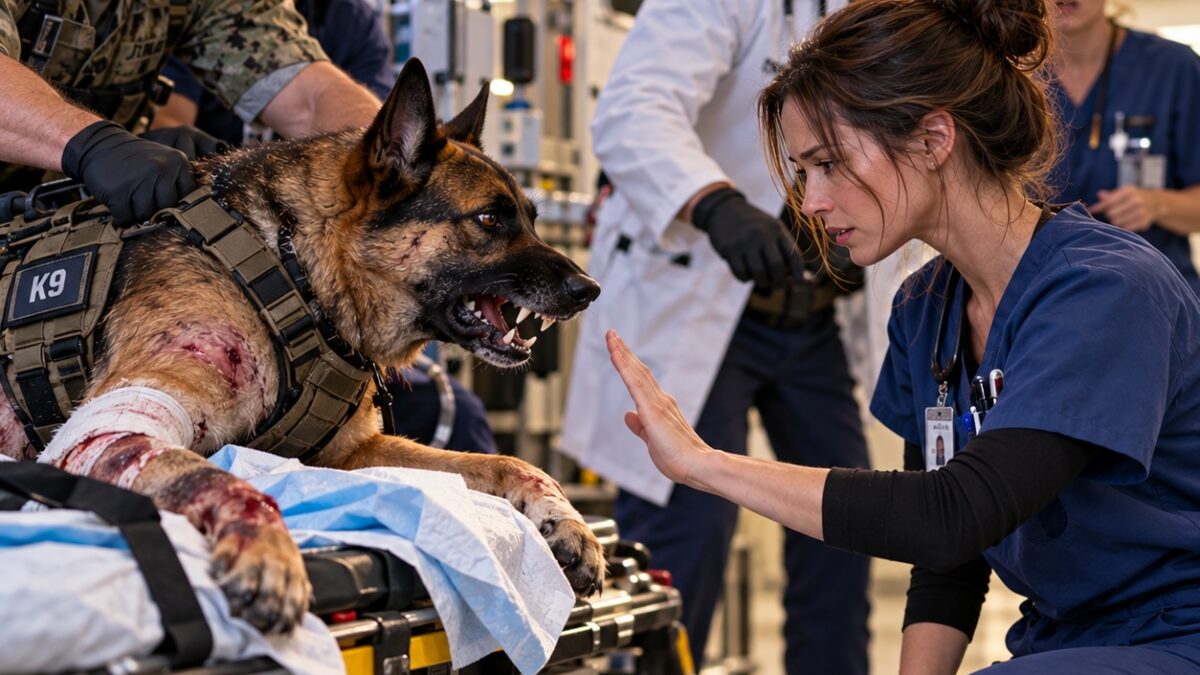
𝗙𝗨𝗟𝗟 𝗦𝗧𝗢𝗥𝗬 


[04:08–08:14]
Nobody at St. Catherine’s knew much about my life before I arrived.
They knew my age.
Thirty-four.
They knew I lived alone.
They knew I had transferred from a small veterans’ clinic outside the city.
They knew I declined nearly every staff party.
I never posted photographs with coworkers.
I did not tell funny stories about previous jobs.
I did not complain about ex-boyfriends in the break room or talk about family at lunch.
Empty space makes people uncomfortable.
So they filled mine for me.
Probably couldn’t handle a real trauma unit.
Too timid.
Too sensitive.
Too slow.
Maybe something happened at her last job.
Maybe she was demoted.
Maybe she had always been strange.
I heard versions of all of them.
The truth was less convenient.
I had spent years trying to become ordinary.
St. Catherine’s was supposed to help.
White walls.
Controlled medication cabinets.
Electronic records.
Reliable power.
No helicopters overhead.
No tents shaking in desert winds.
No blood drying on boots because water was being rationed.
No stretcher coming through a door while someone outside shouted that more casualties were two minutes behind.
Ordinary had seemed attractive.
I had discovered it was more complicated than that.
You can change the room.
Your nervous system may not receive the memo.
I still counted exits without thinking.
Still noticed who walked into a room before everyone else did.
Still disliked metal objects dropped suddenly behind me.
Still slept better when rain was loud because rain covered other sounds.
The veterans’ clinic had understood.
St. Catherine’s did not.
That afternoon, our emergency department was busier than usual.
Construction worker.
Crushed hand.
Teenage basketball player who had fainted in front of half his team.
Seventy-eight-year-old woman named Mrs. Avery complaining of chest pressure she kept calling indigestion.
Two paramedics arguing at the nurses’ station about where to put their next patient.
A toddler screaming because his brother had shoved a plastic bead into his nose.
Normal chaos.
Useful chaos.
I liked it.
People behaved differently when real problems were present.
Ego occasionally had to move aside.
In Room Four, I noticed Mrs. Avery’s lips losing color before the heart monitor showed anything dramatic.
Her breathing changed.
Small.
Enough.
I increased her oxygen.
Called for Dr. Hail.
Prepared equipment.
By the time he arrived, I already had what he would need.
Dr. Kim, one of our junior residents, looked at me.
“Good catch.”
Dr. Hail heard him.
“That’s basic observation, Dr. Kim.”
He said.
“Let’s not throw a parade.”
I stepped back.
Not angry.
Not surprised.
Mrs. Avery mattered more.
Later, in Room Seven, the teenage basketball player stared at the ceiling while pretending not to cry.
His name was Jordan.
Sixteen.
Six foot two.
Still young enough that humiliation felt more dangerous than illness.
“My teammates saw me go down.”
He said.
“They all laughed.”
“Some of them probably got scared.”
“No.”
“They laughed.”
I placed a cool cloth across his forehead.
“You’re not weak.”
He turned toward me.
“I fainted.”
“Bodies send warning signals.”
I said.
“Smart people listen before things get worse.”
His eyes filled.
“Everyone laughed.”
For half a second, Denise’s voice came back.
Walking apology.
Slow and nervous.
I looked at him.
“People laugh when they don’t understand.”
I said.
“That doesn’t make them right.”
Jordan stared at me as though the words belonged specifically to him.
Maybe they did.
By five, rain had begun tapping against the ambulance-bay windows.
The sky outside turned the color of wet concrete.
I was restocking trauma supplies when Denise appeared holding a clipboard.
“Dr. Hail wants you on discharge paperwork for the rest of shift.”
I looked up.
“I’m on trauma rotation.”
“Not anymore.”
She smiled.
No warmth.
“He said things are moving fast tonight.”
“We need people who can keep up.”
There are insults you can pretend are jokes.
That was not one.
“I can keep up.”
I said.
Denise laughed.
“Clara.”
“You move like you’re afraid the air might bruise.”
A younger nurse passing behind her snorted.
I looked back into the supply drawer.
Gauze.
Tape.
IV-start kits.
Saline flushes.
Count.
Order.
Stay where your hands are.
Denise tilted her head.
“You know, there’s nothing wrong with admitting emergency isn’t your place.”
“Some people are built for pressure.”
“Some people are built for paperwork.”
I closed the drawer.
Then looked at her.
For one second, I let enough of myself show that her smile disappeared.
“Pressure doesn’t always look loud.”
I said.
She blinked.
“What?”
The ambulance-bay doors burst open.
A hospital security guard ran inside.
Soaked.
Radio crackling.
“We need help at the bay.”
He shouted.
“Now.”
Every head turned.
Two military police officers followed him.
Wet uniforms.
Tense faces.
One had blood on his sleeve.
Not his.
Then the bark came.
Deep.
Violent.
Broken.
It hit the hallway hard enough that several people stepped backward.
Metal crashed against one of the ambulance doors.
Denise went pale.
“What is that?”
Dr. Hail came out of Room Four while pulling off his gloves.
“Report.”
The older military officer answered.
“Military working dog.”
“Male Belgian Malinois.”
“Name is Ranger.”
“Injured in a training transport accident.”
“Handler is unconscious and being treated at County General.”
“The dog refused separation.”
“We brought him here because the veterinary trauma hospital is forty minutes away.”
Another bark.
The officer continued.
“He may not have forty minutes.”
Dr. Hail frowned.
“This is a human emergency hospital.”
“We know.”
The younger officer said.
“But your facility has trauma equipment and surgical support.”
“He won’t let us near him.”
A paramedic stumbled through the bay doors.
Face white.
“He snaps at anybody who gets close.”
Dr. Hail’s answer was immediate.
“Sedate him.”
The officer shook his head.
“Can’t get close enough.”
“Catch pole.”
“He’ll fight it.”
“He’s already injured.”
“If he panics harder, we may lose him.”
Silence.
I moved toward the rain-streaked glass.
That was when I saw Ranger.
He stood near the ambulance.
Low.
Trembling.
Wet black-and-tan coat plastered against a lean body.
His right front leg barely touched the concrete.
One side of his chest and harness was dark with blood.
Ears pinned.
Eyes moving.
Hands.
Doors.
People.
Ambulance.
Left.
Right.
Back.
Front.
He was not looking for somebody to attack.
He was looking for the threat he had not yet identified.
Three grown men stood around him.
Nobody moved closer.
A young medic held a towel in shaking hands.
Ranger growled.
Not wild.
Not vicious.
Worn.
There is a difference.
My heartbeat did not speed up.
Instead, the hospital receded.
The fluorescent lights.
The voices.
Denise.
Dr. Hail.
Everything.
All I could see was Ranger.
His breathing hitched between growls.
His gaze kept moving toward the ambulance.
His head snapped every time somebody reached behind him.
He protected one side of his body.
And he kept waiting for a voice that was not there.
I knew that waiting.
I had seen it before.
Denise noticed me staring.
She gave a nervous laugh.
“Don’t tell me you’re going to whisper nice things to him.”
A few people chuckled.
Weakly.
Dr. Hail turned.
“Everyone stays back.”
“Security, clear the entrance.”
I heard myself speak.
“I can try.”
The hallway went still.
Then Denise actually laughed.
“You?”
“Clara, he’ll eat you alive.”
One resident looked uncomfortable.
“Maybe animal control—”
I ignored them.
Dr. Hail did not.
“Absolutely not.”
“Nurse Bennett, step away.”
I turned toward him.
“If you rush him with force, he’ll fight.”
“If he fights, his condition gets worse.”
“He isn’t attacking because he wants to.”
“He’s guarding because he doesn’t know who is safe.”
Dr. Hail stared.
“And you know this because you talk to stray cats?”
Somebody laughed.
Ranger barked as the medic shifted.
I looked through the glass.
“No.”
I said.
“I know because he’s waiting for the command that tells him the mission is over.”
The older military officer turned toward me sharply.
Recognition.
Not of me.
Of the language.
I took one step toward the doors.
Dr. Hail reached out.
“Bennett.”
My hand stopped on the handle.
For the first time since I arrived at St. Catherine’s, I raised my voice enough for the entire ER to hear.
“Get me a trauma kit.”
“Two large towels.”
“Saline.”
“And nobody makes a sudden movement.”
No one moved.
They were not used to taking orders from me.
Then Ranger barked again.
Desperate.
That broke the spell.
Dr. Kim grabbed the trauma kit.
I opened the door.
Cold rain-cooled air hit my face.
Behind me, the same people who had spent six months treating my caution like incompetence stood watching.
For the first time—
not one of them was laughing.
[14:44–20:17]
The ambulance bay felt colder than the rest of the hospital.
Rainwater ran in thin lines across the concrete.
Emergency lights flashed red against wet walls.
The automatic doors whispered shut behind me.
Noise from the ER disappeared.
For several seconds, Ranger’s breathing was all I heard.
He stood maybe twelve feet away.
Head low.
One injured leg trembling.
Still refusing to lie down.
That mattered.
Animals in severe pain will sometimes remain upright because lying down leaves them vulnerable.
Working dogs take that instinct further.
A down position can feel like giving up control.
Especially when the handler they trust is absent.
The older military officer stood on Ranger’s left.
Young one farther back.
A medic near the ambulance.
Everyone gave me space.
Good.
Fast movement.
Threat.
Raised voice.
Threat.
Hands coming from above.
Threat.
Crowding.
Threat.
I lowered myself slowly.
Not fully kneeling.
Enough to reduce my profile.
Turned my body slightly sideways.
Open posture.
Hands visible.
Palms loose.
Ranger growled harder.
I stopped.
“That’s it.”
I said softly.
“I hear you.”
One ear moved.
The growl changed.
Lower.
Less explosive.
Not trust.
Information.
I scanned him without staring.
Respiration too fast.
Right front leg compromised.
Blood along the harness.
Chest movement uneven.
Pain response when his weight shifted.
No obvious abdominal distension.
No collapse.
He was compensating.
Buying time.
I stepped once.
Growl.
Stopped again.
Denise’s voice came faintly through the glass.
“She’s going to get bitten.”
Dr. Hail said nothing.
I watched Ranger’s eyes.
“Ranger.”
His gaze snapped to mine.
Behind me, the younger officer inhaled.
“He knows his name.”
Of course he did.
I kept my voice low.
“Ranger.”
“Easy.”
He did not relax.
But he listened.
Enough.
I reached slowly toward my pocket.
Ranger’s shoulders tightened.
I stopped.
Then withdrew a clean pair of gloves.
Placed them on the ground between us.
Showed him my empty hands again.
“I’m not taking your mission.”
I whispered.
“I’m not taking your handler.”
“I’m here for you.”
His eyes shifted.
Handler.
That word.
Known.
Meaning.
The younger officer stepped forward without thinking.
Ranger exploded into a bark.
The officer jumped back.
I lifted one hand.
Did not turn.
“No one moves.”
The entire bay froze.
The authority in my own voice felt strange after months of compressing it.
Not unfamiliar.
Strange.
Old muscle memory.
I stepped closer.
Ranger growled.
Weaker.
His attention fixed on my hands.
“Good.”
“Watch me.”
I lowered another inch.
My knees protested.
Ignored them.
Then the command came out.
The one I had not spoken in years.
“Ranger.”
“Stand down.”
He went still.
Behind me:
“What did you say?”
I did not answer the officer.
I repeated it.
“Stand down.”
Ranger’s ears lifted.
Eyes locked on me.
The growl faded.
Not completely.
Enough.
“Good boy.”
No baby voice.
No pity.
Respect.
I had learned that from dogs before I learned it from people.
I shifted slightly.
Ranger tried to adjust his weight.
Winced.
That was when I knew our margin was shrinking.
“Trauma kit.”
I called.
Nothing.
I turned my head one inch.
“Now.”
Dr. Kim almost dropped it trying to move fast.
He reached the threshold.
Stopped.
Unsure.
“Slide it.”
He pushed it gently across the concrete.
It stopped two feet from me.
Ranger watched.
No bark.
I picked it up slowly.
His muscles tightened.
I froze.
“Easy.”
I said.
“You’re still in charge.”
That mattered.
Trust is not surrender.
It is choice.
One latch.
Pause.
Second latch.
Pause.
Gauze.
Saline.
Bandage.
Dr. Hail entered the bay behind me.
Kept his distance.
“Nurse Bennett.”
“Do not attempt anything beyond your scope.”
I did not turn.
“Then tell me who in this bay currently has control of the patient.”
Silence.
I almost regretted saying it.
Almost.
Ranger’s breathing accelerated.
“His handler commands?”
Dr. Hail asked the officers.
The older one shook his head.
“Handler is unconscious.”
“We know basic obedience.”
I glanced back.
“Then let me work.”
Something in Dr. Hail’s face changed.
Not humility yet.
Calculation.
He stepped back.
I faced Ranger.
“Down.”
Nothing.
“Ranger.”
“Down.”
His body lowered one inch.
Stopped.
Front leg trembling.
Another inch.
I wanted to reach out.
Did not.
Wrong moment.
Trust is a bridge.
One bad step can collapse the whole thing.
Ranger lowered himself.
Slowly.
Finally lay down.
Head still raised.
Eyes scanning.
But no longer ready to launch.
Behind the glass—
silence.
I moved closer.
Placed a folded towel beside him.
Not touching.
He sniffed it.
Waited.
I reached toward the lower edge of his harness.
Growl.
Stopped.
“Fair.”
I whispered.
“You warned me.”
Hand away.
Wait.
Second attempt.
Lower strap.
Away from the most sensitive area.
Ranger’s breathing hitched.
He allowed contact.
“Good.”
I moved faster after that.
Fast is not rushed.
Important difference.
Pulse.
Breathing.
Gum color.
Pupil response.
Right leg alignment.
Bleeding.
Harness pressure.
I used the towel to create controlled compression.
Bandaged the visible injury without forcing the leg.
Dr. Kim stepped closer.
“How do you know how to do that?”
I did not answer.
“Hold saline ready.”
He obeyed.
Instantly.
Ten minutes earlier, that would have surprised him.
Now it did not.
“Not closer.”
I said.
“Put it there.”
He placed it where I indicated.
Ranger followed him with his eyes.
I touched the dog’s neck lightly.
“He’s helping.”
I told Ranger.
“Leave him.”
The dog stayed down.
One of the officers looked toward the other.
Something shifted.
No dramatic applause.
No reversal.
Just authority moving away from the people who had assumed they owned it.
[20:17–28:27]
Ranger’s breathing changed again.
Fast.
Pause.
Fast.
His chest worked too hard.
I looked at Dr. Hail.
“He’s compensating.”
Dr. Hail stepped closer.
“What?”
“We have to move him.”
“Support right side.”
“No crowding.”
“No raised voices.”
“No metal clatter.”
He looked at the dog.
Then my bandage.
Then me.
“Stretcher board.”
He ordered.
“Padding first.”
I said.
“He’ll panic if cold board slides beneath him.”
Dr. Hail stopped.
Everybody saw it.
The man who had corrected me in front of nurses that morning had been corrected by me in front of the entire ER.
He did not argue.
“Soft padding.”
He repeated.
Denise ran to get it.
There is a strange kind of justice in watching someone follow an instruction she spent six months assuming you were too weak to give.
I did not enjoy it.
There was no time.
One hand stayed near Ranger’s shoulder.
Not pinning.
Grounding.
“You’re doing good.”
I whispered.
“Mission isn’t over.”
“Just changing hands.”
Ranger blinked.
Then lowered his head onto the towel.
The older military officer swallowed hard.
“He hasn’t done that since the accident.”
I looked at Ranger.
“He was waiting for permission to stop fighting.”
No one laughed.
We moved him together.
Slow.
Coordinated.
Every movement had to be predictable.
I told them when to pause.
When to shift.
When to lower.
Ranger growled once as the board touched his side.
“Stand down.”
I said.
His body trembled.
Then settled.
Seven minutes.
Later, Dr. Hail checked the clock.
Seven minutes from the moment I stepped into the bay until Ranger was stable enough to move.
Seven minutes.
People like neat numbers.
They make competence look sudden.
It was not sudden.
Those seven minutes had taken years.
Years learning not to crowd fear.
Years learning that pain has patterns.
Years learning that working dogs listen differently when they believe they are still on duty.
Years learning how to make decisions while someone was screaming beside me.
Years learning that quiet was sometimes the only thing panic could hear.
We rolled Ranger toward the treatment room.
People moved aside automatically.
I stayed at his shoulder.
Denise stood near the station holding padding she had brought too late to matter.
Her face had lost color.
I passed her without looking.
Ranger did not.
He lifted his head enough to watch her.
Denise stepped backward.
Inside the treatment room, Dr. Hail pulled on fresh gloves.
“All right.”
“We continue stabilization until veterinary trauma arrives.”
“Dr. Kim, vitals.”
Then he looked at me.
“Bennett.”
“You stay with the dog.”
I met his eyes.
For the first time all day, he did not call me hesitant.
Slow.
Overcareful.
He simply said:
“He trusts you.”
I nodded.
Ranger’s breathing steadied beneath my hand.
Outside the room, the story had already started moving through the hospital.
The quiet nurse went into the bay.
The dog listened.
She controlled the bleeding.
She knew military commands.
She knew how to handle him.
Every person who laughed that morning was suddenly reconstructing the last six months.
That is how shame begins.
Not when someone accuses you.
When new information forces you to hear your old words with different ears.
Denise returned with another towel.
Carefully.
“Do you need this?”
I looked at her.
Her face turned red.
She remembered.
Walking apology.
Slow and nervous.
Paperwork nurse.
“Yes.”
I said.
“Thank you.”
Those words hit her harder than anger might have.
She handed it over.
Moved back.
Dr. Hail cleared his throat.
“Veterinary trauma team is twelve minutes out.”
“Twelve is enough if we keep him stable.”
I said.
He did not challenge me.
That silence meant more than agreement.
I adjusted Ranger’s position slightly.
“Lower the light.”
Someone lowered it.
“Move the metal tray.”
It disappeared.
“Dr. Kim, show him your hand before you check the monitor lead.”
Kim did.
Ranger tracked him.
Then settled.
The same people who once called me slow were waiting for me to set the pace.
I should have felt vindicated.
Mostly I felt tired.
And afraid.
Because the command had come back too easily.
Stand down.
I had spent years trying not to hear another dog respond to it.
The veterinary trauma team arrived.
Four people.
Equipment cases.
Transfer gear.
Their lead veterinarian was Dr. Alicia Reyes.
Mid-forties.
Dark hair pulled back.
Efficient eyes.
She reached the doorway.
Stopped.
Looked at Ranger lying beside me.
“This is the K9 who wouldn’t let anyone within six feet?”
The older officer nodded.
“Yes, ma’am.”
Reyes looked at the bandaging.
Position.
The distance between staff.
Then me.
“How did you get him down?”
“He’s scared.”
I said.
“Not aggressive.”
She studied Ranger.
Then the work.
“This is good stabilization.”
Pause.
“Very good.”
I did not look at Dr. Hail.
I did not need to.
Reyes began preparing Ranger for transport.
When two members of her team moved toward the board, Ranger lifted his head.
Low warning.
I leaned closer.
“Ranger.”
“Stand down.”
He relaxed.
Dr. Reyes froze.
Her eyes moved toward me.
“That’s a military handler command.”
The older officer looked at me differently.
For several minutes he had been studying my face.
Not suspicion.
Memory.
“What did you say your name was?”
“Clara Bennett.”
“Bennett.”
He repeated.
“Nurse Bennett.”
The room went quiet.
My hands stopped.
He stepped closer.
“Were you attached to the 27th Medical Response Unit?”
There are moments when nine years disappear.
One question.
One unit number.
One scent.
One sound.
I did not answer.
I did not need to.
Dr. Kim looked between us.
Denise’s mouth opened.
Dr. Hail stared.
The officer swallowed.
“I heard about you.”
I looked down at Ranger.
“That was a long time ago.”
“No.”
He said.
“People still talk about it.”
Dr. Hail frowned.
“Talk about what?”
The officer looked toward him.
“Years ago, there was a rescue operation.”
“A medical convoy got hit.”
“Soldiers injured.”
“K9 team trapped.”
“One of the dogs wouldn’t let anybody approach his handler.”
The room became very still.
“Everyone thought the dog would have to be sedated.”
“But they didn’t have time.”
“The handler was bleeding out.”
The officer looked at me.
“A nurse walked in alone.”
“Calmed the dog.”
“Stabilized the handler.”
“Got both of them out.”
He paused.
“That nurse was Clara Bennett.”
Denise lowered her eyes.
Kim stared at me.
Dr. Hail’s expression changed slowly.
Confusion.
Disbelief.
Then shame.
“I did my job.”
I said.
The officer shook his head.
“You did more than that.”
“No.”
My throat tightened.
“Some people came home.”
“Some didn’t.”
That ended the questions.
Nobody asked what happened next.
Nobody asked why I left.
Nobody asked how many casualties.
There are sentences that close doors if people have enough decency to let them.
Some people came home.
Some didn’t.
That was mine.
Dr. Reyes finished preparing Ranger.
Before they wheeled him out, he lifted his head.
Looked at me.
Reyes smiled faintly.
“I think he wants permission.”
I stepped close.
Placed one hand near his harness.
“You’re safe now.”
I whispered.
“Mission complete.”
Ranger’s eyes softened.
Then he pressed his head into my hand.
Barely.
The room broke quietly.
Kim turned away and rubbed his eyes.
One nurse covered her mouth.
Denise stared at the floor.
The military officers stood straighter.
Not saluting.
Something close.
Respect without performance.
Ranger’s eyes stayed on me until the transfer doors closed.
Then he was gone.
The ER remained silent.
Dr. Hail removed his gloves.
Approached slowly.
“Nurse Bennett.”
I looked at him.
His voice had changed.
No arrogance.
No irritation.
“I owe you an apology.”
Everyone heard.
Of course they did.
He continued.
“I misjudged you.”
“I treated caution as hesitation.”
“Your calmness as weakness.”
“I assumed confidence had to look like mine.”
That last sentence was not in the apology I expected from him.
Maybe there was hope for Marcus Hail.
“I was wrong.”
I held his eyes.
No smile.
No comforting him.
“Yes.”
I said.
“You were.”
That honesty struck him harder than anger.
Denise stepped forward.
Tears visible.
“Clara.”
“I’m sorry.”
“For today.”
“For the last six months.”
“I was cruel.”
Another nurse followed.
Then another.
“I shouldn’t have laughed.”
“I’m sorry.”
“You didn’t deserve that.”
The apologies sounded awkward.
Good.
Real apologies often are.
I listened.
Then said:
“You don’t have to understand someone’s past to treat them with respect.”
Nobody answered.
Because there was nothing to argue.
[36:32–40:54]
The next morning, St. Catherine’s looked exactly the same.
Fluorescent lights.
Monitors.
Stretchers.
Coffee that tasted like somebody had described coffee to hot water.
Same desk.
Same doors.
Same people.
But when I walked in, nobody whispered.
Denise looked up from the nurses’ station.
“Morning, Clara.”
Clara.
Not Bennett.
Not sweetheart.
Not paperwork nurse.
Not walking apology.
I nodded.
“Morning.”
Dr. Kim appeared with a chart.
“Can you look at this?”
“I think I’m missing something.”
That sentence mattered more to me than an apology.
I took the chart.
“What are you worried about?”
“Pressure’s normal.”
“Pulse a little high.”
“Patient says she feels fine.”
I read.
Then looked toward the room.
“Let’s go talk to her.”
He followed.
Across the department, Dr. Hail watched.
He did not interrupt.
Did not correct.
Did not remind anyone he was chief.
He let us work.
Respect changes rooms in small ways.
Nobody stood when I entered.
Nobody became afraid of me.
That would have been another kind of failure.
They simply stopped assuming quiet meant empty.
That afternoon, one of the military officers returned.
The older one.
Sergeant First Class Owen Mercer.
I finally learned his name.
He came to the nurses’ station.
“Is Clara Bennett here?”
I stepped out of Room Six.
Mercer smiled.
“Ranger made it through surgery.”
Relief moved through the whole station.
I closed my eyes for half a second.
“Good.”
“He’ll need time.”
“Yes.”
“The trauma team said the stabilization here gave him the window they needed.”
I nodded.
Mercer held out something small.
A service patch.
Ranger’s spare K9 patch.
“He can’t thank you.”
Mercer said.
“Not in a way you’d recognize.”
“But the unit wanted you to have this.”
I stared at the patch.
Black fabric.
Gold lettering.
Nothing expensive.
It felt heavier than metal.
I had owned patches once.
Unit patches.
Medical identifiers.
Things removed from boxes years ago and shoved where I would not accidentally see them.
I took Ranger’s patch.
My eyes filled.
That surprised me.
Everyone around the station went still.
Not because they were shocked.
Because for the first time, they understood that my calmness had never meant nothing reached me.
I simply did not give every feeling to the room.
Weeks passed.
Ranger recovered.
We received updates.
Surgery successful.
Weight bearing.
Appetite improving.
Handler regained consciousness.
That detail mattered.
His handler had been badly injured in the transport accident.
Concussion.
Fractures.
Internal injuries.
But alive.
When he woke, the first question he reportedly asked was:
“Where’s Ranger?”
The second:
“Did he bite anyone?”
Mercer told me that part with a smile.
I answered:
“No.”
“He warned people.”
“Different thing.”
Mercer laughed.
“You’re going to argue that forever, aren’t you?”
“Yes.”
The hospital returned to routine.
Mostly.
People were kinder.
Some because they had learned.
Some because embarrassment made them cautious.
I could tell the difference.
Denise tried too hard at first.
“Need help, Clara?”
“Want coffee?”
“You okay with this assignment?”
I finally pulled her aside.
“You don’t have to compensate for six months in one week.”
Her face turned red.
“I’m trying.”
“I know.”
“I was awful.”
“Yes.”
She almost smiled.
“You could make this easier.”
“I could.”
“I’m choosing not to.”
She laughed.
That was the first normal conversation we had.
Then she became serious.
“Why didn’t you tell us?”
I knew what she meant.
Military medical unit.
Rescue.
Ranger.
My history.
“Would it have changed how you treated me?”
She looked ashamed.
“Yes.”
“That’s exactly why.”
She stared.
I continued.
“If you need somebody to have done something heroic before you decide not to humiliate them, the problem isn’t that you didn’t know my résumé.”
Denise looked away.
“You’re right.”
“I know.”
Her head snapped back.
I smiled for the first time.
She laughed.
Slowly, she stopped trying to be nice to me.
She started being respectful.
Better.
Dr. Hail changed too.
Not overnight.
People rarely do.
The first week, he overcorrected.
Asked my opinion constantly.
Even when he did not need it.
“Bennett, thoughts?”
Sometimes my thought was:
You are the physician.
Make the decision.
I told him.
He learned.
Eventually, he stopped treating consultation like penance.
It became normal.
Mrs. Avery came back for follow-up.
Stable.
Jordan, the basketball player, sent the ER a card.
Inside:
Bodies send warnings. Smart people listen.
Underneath:
Thanks for listening.
I kept that one.
Ranger’s patch stayed in my locker.
Not displayed.
I touched it sometimes before difficult shifts.
Not for luck.
A reminder.
The past could be useful without becoming public property.
Three weeks after the accident, I was checking a patient’s chart near Bed Five when the front doors opened.
Conversations stopped.
Ranger walked in.
Steady legs.
Service vest.
Handler at his side.
Captain Eli Morgan.
Thirty-eight.
Still wearing a brace beneath his jacket.
He moved slowly.
Ranger matched him.
The entire emergency department froze.
Not from fear this time.
Recognition.
Ranger looked around.
Ignored Dr. Hail.
Ignored Denise.
Passed the residents.
Security guards.
Nurses.
Then his eyes found me.
I stood beside a patient’s bed holding a chart.
Ranger walked straight across the ER.
Stopped at my feet.
Sat.
I looked down.
A soft smile came without permission.
“Well.”
I said.
“Hello, soldier.”
Ranger leaned his head against my leg.
No one laughed.
No one whispered.
Nobody asked why a military dog chose the quiet nurse.
Now they thought they knew.
They knew part of it.
Enough.
Captain Morgan approached.
His eyes were tired.
Kind.
“You saved him.”
I shook my head.
“No.”
“I stabilized him.”
“Dr. Reyes and her team saved him.”
Morgan looked at Ranger.
“He won’t come near most strangers.”
“He did that day.”
“He needed someone.”
“Apparently.”
Morgan studied me.
“Mercer told me who you are.”
I looked at him.
“Who I was.”
“Fair.”
Then he said:
“I’m sorry.”
“For what?”
“That you had to remember.”
That almost broke me.
Not thank you.
Not hero.
Sorry.
People often praise survival without understanding that using an old skill can reopen the wound that created it.
Morgan understood.
Maybe because he had his own.
“Thank you.”
I said.
Ranger remained against my leg.
We stood there quietly.
Eventually he left.
The ER watched the doors close.
Denise whispered:
“I’m never making fun of quiet people again.”
Dr. Kim answered:
“Probably a good general policy.”
I laughed.
The sound surprised everyone.
Including me.
But the story did not end there.
Stories about redemption often pretend one dramatic event repairs years of habit.
It doesn’t.
The hospital learned.
I did too.
For six months, I had allowed people to diminish me.
Not because I believed them.
Because confrontation felt expensive.
I had spent years paying the cost of difficult rooms.
I did not want more.
Silence protected me.
Until it did not.
There is a difference between choosing not to react and making yourself smaller so other people remain comfortable.
I had crossed that line without admitting it.
Ranger forced me to see it.
Not because he needed a hero.
Because when he needed clear direction, I gave it without apology.
I had forgotten I could do that.
Afterward, I started speaking sooner.
Not louder.
Sooner.
If medication bothered me, I said so.
If an assignment was unsafe, I said so.
If a resident dismissed a nurse’s concern, I intervened.
One afternoon, Dr. Hail started to brush off Denise when she questioned a patient’s sudden confusion.
I looked at him.
He stopped mid-sentence.
Then turned back toward Denise.
“What are you seeing?”
She explained.
The patient was developing sepsis.
Early.
We caught it.
Afterward, Denise looked at me across the station.
Neither of us said anything.
We did not need to.
People laugh when they don’t understand.
That doesn’t make them right.
Bodies send warnings.
Smart people listen.
Pressure doesn’t always look loud.
I had said those things to other people for years.
I had been slower to apply them to myself.
Months passed.
The Ranger story faded outside the hospital.
Inside, it became part of St. Catherine’s mythology.
New nurses heard pieces.
The military K9 who shut down the ambulance bay.
The quiet nurse who walked in.
The chief who got corrected.
Denise hated that version because people always made her sound worse.
“You were worse.”
I reminded her.
“True.”
Dr. Hail hated the part about being corrected.
“Soft padding was my idea.”
He claimed once.
Dr. Kim almost choked on coffee.
Healing occasionally requires revisionist humor.
I never told the full military story.
The 27th Medical Response Unit remained mine.
But the truth was this:
Years earlier, during an overseas rescue operation, our medical element responded after a convoy and K9 support team were caught in an attack.
The environment was chaos.
Dust.
Smoke.
Metal.
People shouting.
One handler trapped and bleeding.
His dog, a Belgian Malinois named Bravo, had taken a minor injury but remained on his feet.
Protecting.
Nobody could approach the handler.
Bravo lunged at anyone who tried.
Somebody wanted to sedate him.
No time.
The handler’s blood pressure was dropping.
I had trained around working dogs.
Not as a handler.
Enough to know some commands.
More importantly, enough to recognize what Bravo was doing.
He was not out of control.
He was still working.
So I went in.
Slowly.
Exactly the way I approached Ranger years later.
Stand down.
The command gave him something he understood.
Then I crawled to the handler.
Controlled the bleeding.
Kept Bravo close.
Moved both.
The handler survived.
Bravo survived.
Three other people that night did not.
That is why I hated the hero version.
People remember the two who came home.
I remembered the three who did not.
Praise can feel strange when your memory includes names nobody else says.
After that operation, people talked about me.
Briefly.
Commendation.
Recommendation.
Paperwork.
Then life continued.
Eventually, I left the military medical system.
The reasons were complicated.
Not scandal.
Not failure.
Exhaustion.
Grief.
Too many years of carrying other people’s worst minutes.
I transferred into veteran-focused clinical work.
Later nursing.
Then St. Catherine’s.
I never needed anyone there to know.
Until Ranger made the skills visible.
The funny thing is that once people learn a dramatic fact about someone, they reinterpret everything.
My double-checking became discipline.
My quietness became composure.
My patience became tactical awareness.
Same behaviors.
Different story.
That bothered me.
One morning, a new nurse whispered:
“She’s the military rescue nurse.”
I turned.
“No.”
She looked terrified.
“What?”
“I’m Clara.”
“That’s enough.”
I did not want reverence replacing disrespect.
Both create distance.
I wanted professional trust.
Nothing more.
Dr. Hail understood that eventually.
One evening, months after Ranger’s visit, we ended up alone near the ambulance bay.
Rain.
Almost exactly like that night.
He stood beside me.
“You know what I keep thinking about?”
“What?”
“The medication tray.”
I smiled slightly.
“Mr. Harris.”
“You were right to check.”
“I know.”
He laughed softly.
“I deserved that.”
“Yes.”
Then he became serious.
“I thought confidence meant making decisions quickly.”
“It can.”
“I thought hesitation was the enemy.”
“Sometimes.”
“What do you think confidence is?”
I considered.
“Knowing what needs speed.”
“And what deserves another look.”
Hail nodded.
“Fair.”
We watched rain.
Then:
“I’ve made residents afraid to question me.”
“Yes.”
Another pause.
“You enjoy this.”
“A little.”
He smiled.
“Good night, Bennett.”
“Good night, Marcus.”
First name.
That surprised him.
He left smiling.
Ranger returned once more the following year.
Not because he was injured.
A veterans’ support event at the hospital.
His handler, Captain Morgan, had transitioned out of active service after his injuries.
Ranger was nearing retirement.
He walked slower.
Still alert.
Still Ranger.
He found me near the elevators.
Sat.
I crouched.
This time I touched his shoulder immediately.
No warning.
No pain.
His tail moved once.
“Retiring?”
Morgan nodded.
“Soon.”
I looked at Ranger.
“About time.”
Morgan smiled.
“He won’t know what to do.”
“They learn.”
“How do you know?”
I looked toward the emergency department.
“Sometimes the mission changes hands.”
Morgan understood.
Ranger pressed his head against my palm.
Then moved on.
Years later, when people asked me which moment changed my life at St. Catherine’s, I rarely said Ranger.
Not exactly.
The change began before he arrived.
It began with a boy embarrassed because his teammates laughed.
A woman whose lips changed color before a monitor sounded.
A medication order I checked even though a doctor told me it was fine.
Small moments.
Ranger only made visible what had already been true.
Careful is not weak.
Quiet is not uncertain.
Gentleness and competence are not opposites.
And sometimes the person speaking least in the room is listening to something everybody louder has missed.
I kept Ranger’s patch until the fabric began wearing at the edges.
It eventually moved from my locker to a drawer at home.
Beside an old unit patch I had not touched in years.
For a long time, I could not put those two objects beside each other.
Past and present felt incompatible.
Eventually they were just fabric.
Meaningful.
But not dangerous.
That was progress.
Denise became one of my closest colleagues.
Not because one apology erased six months.
Because she changed consistently afterward.
When younger nurses made jokes at someone else’s expense, she stopped them.
When somebody was too quiet to interrupt a doctor, Denise noticed.
One afternoon, I heard a new nurse call a shy intern “the ghost.”
Denise turned immediately.
“We don’t do that here.”
Simple.
No speech.
That mattered.
Culture changes through small corrections too.
Dr. Kim eventually became an attending physician.
He remained the doctor most likely to ask nurses:
“What are you seeing?”
I took inappropriate credit.
He objected.
We argued.
Professionally.
Dr. Hail stayed chief several more years.
His voice never became quiet.
Thank God.
Hospitals need loud people sometimes.
He simply learned loudness was a tool, not evidence of being right.
He taught that lesson to residents.
Sometimes I heard him say:
“Speed is not the same as rushing.”
I never let him forget where he got it.
Ranger lived long enough to retire with Captain Morgan.
A few years after their last visit, Mercer emailed the hospital.
Ranger had died.
Old age.
At home.
Morgan beside him.
I read the message alone.
Closed my office door.
Cried.
Not because Ranger had been mine.
He had never been mine.
Because some animals enter your life for minutes and still become part of the map.
Ranger had reminded me that the part of myself I had hidden was not dangerous.
I could use it without living inside it.
That mattered.
After his death, Captain Morgan mailed me one photograph.
Ranger lying on a porch.
Gray muzzle.
Eyes half closed in sunlight.
No vest.
No mission.
On the back, Morgan had written:
He learned how to stand down.
I kept that photograph.
Still do.
There are days when St. Catherine’s becomes loud enough that I need to remember what happened.
Not the dramatic part.
Not the ambulance bay.
Not the silence when Mercer recognized me.
The deeper thing.
A dog in pain entered a place full of people who wanted the problem solved immediately.
Sedate him.
Control him.
Restrain him.
Move him.
All reasonable thoughts under pressure.
But Ranger did not first need force.
He needed someone to understand what he was still trying to do.
Protect.
Wait.
Endure.
People are not dogs.
I know.
But hospitals teach you that humans do the same thing.
A grieving parent looks angry.
A frightened child looks difficult.
An exhausted nurse looks slow.
A wounded soldier looks aggressive.
A quiet woman looks weak.
Labels are efficient.
Understanding takes longer.
Efficiency matters.
Understanding matters more when the label is wrong.
I think that is why I stayed in emergency medicine after all.
Not because I loved adrenaline.
I did not.
I loved the moment before the room decided what something meant.
The moment where observation still mattered.
Where one person could say:
Wait.
Look again.
Sometimes that prevents a medication error.
Sometimes it finds sepsis.
Sometimes it tells a terrified sixteen-year-old that fainting does not make him weak.
And sometimes—
very rarely—
it means walking into an ambulance bay toward a wounded military K9 while everyone else tells you to stay back.
I never became the loudest person at St. Catherine’s.
I did not want to.
I still checked medication twice.
Still spoke softly to children.
Still fed the stray cat.
Denise eventually started feeding him too.
We named him Captain because apparently none of us could escape military titles completely.
I still moved quietly through the halls.
The difference was that nobody mistook that movement for apology anymore.
And neither did I.
That may have been the most important change.
Because for years after leaving the military, I had believed silence was only discipline.
Then it became armor.
Then habit.
Then something dangerously close to shrinking.
Ranger made me remember silence could be chosen without surrendering my voice.
The next time Dr. Hail dismissed a concern, I did not say:
Yes, doctor.
I said:
“No.”
“Look again.”
And he did.
The first time Denise apologized to a frightened young nurse before I could intervene, I realized she had learned too.
The first time Dr. Kim handed me a chart and asked what he was missing before making a decision, I understood respect had finally replaced performance.
No one needed the story of the 27th Medical Response Unit anymore.
They knew enough.
Not that I had once done something brave.
Something simpler.
I deserved respect before they knew.
That was the lesson.
Not:
Be careful who you mock because they may secretly be a hero.
I hate that lesson.
It still makes kindness conditional.
The real lesson was:
Be careful how you treat the person you know nothing about.
Not because she may have saved lives.
Not because she may have medals hidden in a drawer.
Not because a military dog may someday reveal who she really is.
Because dignity should not require a résumé.
I was Clara Bennett before Ranger arrived.
The same nurse.
Same hands.
Same judgment.
Same scars.
Same quiet.
Ranger did not turn me into someone worth respecting.
He only made the room notice what had been standing there the whole time.
Years after that rainy evening, I still sometimes walk past the ambulance bay and remember him.
Wet coat.
Injured leg.
Eyes scanning.
A whole emergency department frozen.
And I remember lowering myself toward the floor.
One step.
Stop.
Another.
Listen.
Stand down.
People still ask how I knew what to do.
Training.
Experience.
Yes.
But that is not the whole answer.
I knew because I had once been the person everyone expected to keep functioning while hurt.
I knew what it looked like when endurance was mistaken for strength.
I knew that some creatures fight because fighting is the last thing they understand how to do.
And sometimes the kindest thing you can give them is not pity.
Not praise.
Permission.
You can stop.
Someone else has the watch.
You are safe.
Mission complete.
That was what Ranger needed that night.
It turned out I needed to hear it too.








