𝗙𝗨𝗟𝗟 𝗦𝗧𝗢𝗥𝗬: The Puppy Wouldn’t Stop Following My Patrol Car—Then He Led Me to the One Place No One Had Thought to Search
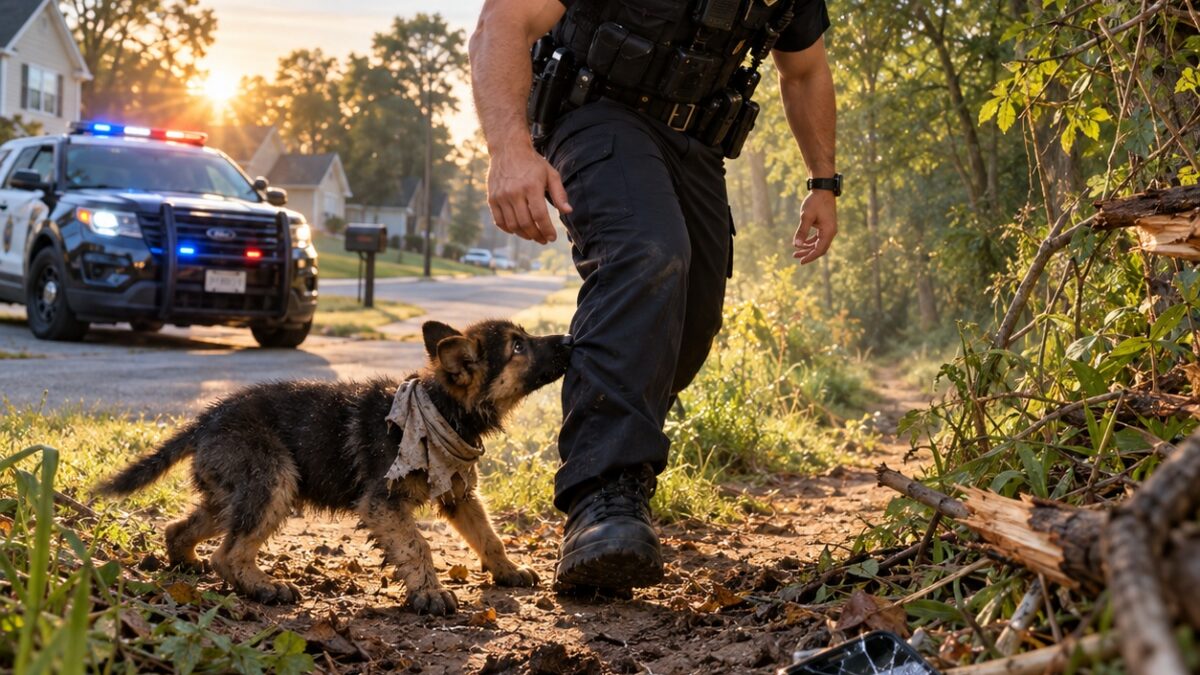
𝗙𝗨𝗟𝗟 𝗦𝗧𝗢𝗥𝗬 


The city disappeared faster than I expected.
One minute I could still hear cars passing on the main road.
A minute later, the trees swallowed everything.
No engines.
No voices.
Only leaves under my boots and the quick, uneven patter of the puppy’s paws.
He stayed ahead of me by maybe eight or ten feet.
Never farther.
Every few seconds, he stopped and looked over his shoulder.
The moment he saw me, he kept going.
I had worked enough missing-person cases to know that instinct matters, but instinct is not evidence.
So I started cataloging.
Freshly disturbed soil.
One broken branch at shoulder height.
Another lower down.
A smear in the dirt that looked like someone had stumbled.
The puppy sniffed everything.
Not randomly.
He was following something.
At one point he veered toward a patch of brush, nose down, then jerked back toward the trail.
I reached for my radio.
Then stopped.
I did not yet know what I had.
If I called half the department into the woods because a puppy seemed nervous, I would never hear the end of it.
Then the dog stopped.
His body went rigid.
He stared around the next bend.
I crouched beside him.
“What is it?”
His chest was moving too fast.
He backed into my boot.
Then made himself step forward.
That detail mattered.
He was afraid of what was ahead.
And still wanted me to go there.
I stood.
“Okay.”
I whispered.
“I’m with you.”
We rounded the bend.
The clearing looked wrong immediately.
Not because there was one dramatic piece of evidence.
Because everything was slightly disturbed.
A person who had never worked scenes might have seen dirt and bushes.
I saw a story.
Broken twigs.
Trampled leaves.
One long mark through the soil.
A piece of pale fabric caught on thorns.
The puppy ran to it.
Cried.
I pulled on gloves.
The fabric matched the strip around his neck.
Same color.
Same material.
My stomach tightened.
“This came from your person?”
The pup pushed his nose against it.
Then began pawing at the ground.
I scanned the area.
A few feet away, another flash of metal.
The puppy saw it too.
He rushed toward the object.
I moved behind him.
It was a purse.
Or what remained of one.
Torn open.
Dirty.
Strap broken.
The zipper pull was missing.
I took out the piece I had found earlier.
It matched.
The inside of the purse had been emptied.
No wallet.
No identification.
No cash.
Whoever abandoned it had removed anything useful.
The puppy buried his nose against the fabric.
His body shook.
“You know this.”
I said.
He whimpered.
Not a question anymore.
Someone had been here.
Someone who belonged to this little dog.
And something violent had happened to her.
I radioed dispatch.
“Central, Reed.”
“Go ahead.”
“I’m on the North Forest Trail off Market.”
“Possible crime scene.”
“Send one unit to my location.”
“Nature of incident?”
“Possible assault or abduction.”
That changed the dispatcher’s tone.
“Copy.”
“Units responding.”
The puppy had already moved again.
He was tracking along the drag mark.
I followed but stopped him from moving too far.
“Easy.”
He strained forward.
“I know.”
“We need backup.”
He did not care.
Of course he did not.
To him, procedure was meaningless.
Someone he loved was out there.
Every second mattered.
I understood.
Six minutes later, branches snapped behind me.
My hand went to my holster.
“Police!”
A familiar voice answered.
“Reed!”
Detective Elena Morales came through the trees first, followed by two patrol officers.
Morales looked from me to the puppy.
Then at the purse.
“What do we have?”
“Possible abduction.”
I showed her the zipper.
The disturbed ground.
The fabric.
“The dog brought me.”
Morales stared.
“The dog?”
“He found me about half a mile back.”
One of the officers looked down.
The puppy stood beside the trail, practically vibrating with impatience.
Morales crouched.
“This little thing?”
As if offended, he barked once.
Morales straightened.
“Okay.”
“Tiny witness has an attitude.”
I almost smiled.
Then I pointed toward the drag marks.
“Direction continues east.”
Morales’s expression hardened.
“Call crime scene.”
“Get medics staging nearby.”
The puppy barked again.
Ran ten feet.
Stopped.
Looked back.
Morales followed his gaze.
“He wants us moving.”
“Yes.”
She drew a breath.
“Then let’s move.”
We entered the deeper woods as a group.
The puppy led.
I stayed immediately behind him.
Morales behind me.
The two patrol officers marked major pieces of evidence as we passed.
I had seen trained tracking dogs work.
Powerful animals.
Disciplined.
Focused.
This was different.
The puppy did not understand commands.
He did not have formal scent training.
But every movement had purpose.
Morales whispered:
“I’ve never seen anything like this.”
“He’s not searching.”
I said.
“He’s remembering.”
She looked at me.
“What?”
“He was here.”
“He saw whatever happened.”
The thought made my stomach turn.
The puppy’s scratched paws.
The bruise on his shoulder.
Someone had hurt him too.
We continued.
More scuffs.
Another scrap of fabric.
A partial shoe impression.
Then the puppy darted toward a tree.
He pushed his nose into weeds at the base.
Something white was visible beneath the grass.
I moved the weeds.
Phone.
Cracked.
Mud covering the screen.
I lifted it carefully.
The display flickered when I pressed the side button.
Wallpaper appeared.
My chest went tight.
A young woman.
Maybe late twenties.
Dark hair.
Warm smile.
And in her arms—
The puppy.
Clean.
Healthy.
Wearing a red fabric collar.
The same material now torn around his neck.
He saw the image.
And cried.
He pressed his nose against the shattered glass.
Morales stood beside me.
“Oh, God.”
I swallowed.
“So that’s your person.”
The puppy pawed at the phone.
My pulse jumped.
Now we had more than a bad feeling.
We had a likely victim.
And one terrified little witness.
I keyed the radio.
“Central, upgrade this.”
“Probable abduction.”
“Female victim.”
“We have personal property and blood indicators.”
“Request full response.”
The puppy was already moving again.
I slipped the phone into an evidence bag.
“Lead us.”
I said.
He ran.
The woods thickened.
Sunlight barely reached the floor.
The slope changed under our boots.
Downward.
Morales nearly slipped once.
The puppy did too.
But every time his little body stumbled, he got back up.
I watched him and thought about how far he must have traveled before he found me.
His paws had not become scraped in ten minutes.
He had been running for hours.
Maybe all night.
I hated the thought.
We reached another patch of disturbed ground.
The puppy stopped.
Blood.
Not a few drops.
Enough to make every officer there go quiet.
Dark stains across leaves.
A smear through soil.
I crouched.
The puppy tried approaching.
I blocked him gently.
“No.”
He cried.
“I know.”
“You don’t need to see that again.”
Morales examined the direction.
“Drag pattern continues.”
One officer said:
“If she lost this much…”
He did not finish.
Nobody needed him to.
I looked at the puppy.
He looked back at me.
“No.”
I said.
“We’re not deciding that yet.”
I am not sure whether I was talking to him or myself.
We continued.
Fifteen minutes later, the puppy suddenly lifted his head.
Froze.
His nose moved rapidly.
Then he ran to the right.
“Pip—”
I called instinctively, though I did not know the name yet.
Maybe because every dog needs something you can shout after him.
He disappeared through brush.
We followed.
Branches hit my uniform.
Morales cursed behind me.
The ground dropped sharply.
The puppy stood at the edge barking toward a fallen tree below.
Not ordinary barking.
Screaming.
I slid down the slope.
“Here!”
Morales came behind me.
The puppy raced around the uprooted trunk.
He scratched frantically at branches tangled beneath the roots.
I moved toward him.
Then I saw it.
An arm.
Pale.
Still.
Half covered in leaves.
My heart seemed to stop.
“Victim!”
Officers dropped around me.
We pulled branches away carefully.
A woman lay beneath them.
Same face as the phone.
Bruised.
Blood dried along one side of her temple.
Clothing torn.
Dirt on her face.
For one terrible second, I thought we were too late.
Then her finger moved.
Barely.
“Wait.”
I shouted.
“She moved.”
Morales dropped beside me.
I cleared dirt from the woman’s neck.
Two fingers to the carotid.
Nothing.
Then—
There.
Weak.
Irregular.
But there.
“She’s alive!”
Everything changed.
Radio traffic exploded.
“MEDICS NOW.”
“VICTIM LOCATED.”
“CRITICAL.”
“PREPARE EXTRACTION.”
The puppy pushed between us.
He reached the woman’s face.
Whined.
Licked her cheek.
“Easy.”
I whispered.
But I could not bring myself to pull him away.
Her eyelids moved.
Opened a fraction.
She looked unfocused.
Confused.
Then the puppy cried again.
Her lips moved.
One broken sound.
“Pip.”
I looked down.
Pip barked.
His entire body shook.
“That your name?”
I asked.
The woman’s hand moved.
Slowly.
Painfully.
Her fingers found his fur.
The moment she touched him, something in both of them changed.
Her face relaxed.
Pip pressed his tiny body against her.
“He…”
She whispered.
“Didn’t leave.”
“No.”
I said.
“He didn’t.”
Her eyes found mine.
I leaned closer.
“He led me here.”
Tears formed despite how dehydrated she looked.
“He found…”
“You?”
“Yes.”
I said.
“He found me.”
“He would not let me walk away.”
A faint smile appeared.
Then disappeared with pain.
Paramedics arrived.
We moved back.
Pip did not understand why strangers were surrounding her.
He tried climbing over equipment.
I picked him up.
He fought me.
“No.”
I told him.
“They’re helping.”
He cried.
“Look.”
I held him so he could see her.
“You stay with me.”
“Let them help her.”
Eventually, he stopped struggling.
Pressed himself against my chest.
Shaking.
One medic glanced at him.
“That the dog who found her?”
“Yeah.”
“How old?”
“No idea.”
The medic looked at the dirt-covered puppy.
“Little bastard just saved a life.”
I looked down.
“Watch your language.”
The medic smiled.
“He’s a cop now?”
“Higher rank than you at the moment.”
Morales laughed once.
The tension needed somewhere to go.
The victim was stabilized enough to transport.
As paramedics lifted the stretcher, Pip panicked again.
He reached toward her.
The woman weakly turned her head.
“Pip.”
I moved closer.
“I’m keeping him with us.”
Her eyes closed.
But I saw the relief.
At the ambulance, one paramedic tried telling me pets could not ride.
The second paramedic looked at the puppy.
Then at the woman.
“He rides.”
End of debate.
I climbed in.
Pip in my lap.
The woman on the stretcher.
The siren started.
For the first time all morning, Pip stopped moving.
He stared at her.
Never blinked.
A paramedic placed oxygen over her face.
Her eyes opened again.
“Ma’am.”
I said.
“You’re safe.”
She looked at Pip.
“Is…”
“He’s okay.”
I lifted him slightly.
“He has some scrapes.”
“But he’s okay.”
Tears filled her eyes.
“I thought they killed him.”
“No.”
“He’s tough.”
Her hand moved toward him.
Pip stretched.
His little paw touched her fingers.
I hesitated.
“Can you tell me what happened?”
“If you can’t, don’t.”
Her breathing was labored.
But she nodded faintly.
“I was walking home.”
She whispered.
“From the grocery store.”
“Late.”
“Two men.”
I felt my jaw tighten.
“One came behind me.”
“Other had a van.”
“They grabbed me.”
She shut her eyes.
Pip whimpered.
I waited.
“They took my purse.”
“Phone fell.”
“I screamed.”
“One hit me.”
Her hand curled weakly around Pip’s paw.
“He bit one.”
I looked down.
“This guy?”
The faintest smile.
“He’s crazy.”
Pip blinked innocently.
“What happened next?”
“They kicked him.”
Her voice broke.
“He flew…”
“Into the curb.”
“I thought…”
A tear slid sideways toward her hair.
“I thought he was dead.”
I rested one hand on Pip’s back.
He had been injured.
Scared.
Small enough for one kick to end everything.
And still—
“He got up.”
She whispered.
“They drove me into the woods.”
“Pip followed.”
The paramedic looked at me.
I stared at the puppy.
“He followed the van?”
She nodded weakly.
“When they pulled me out…”
“He came from the trees.”
“Bit one again.”
“They chased him.”
“He kept barking.”
“Running.”
“He made them follow him away from me.”
Her breathing hitched.
“They finally left.”
“Did you see the vehicle?”
“Dark van.”
“No plate.”
“Anything else?”
She shook her head.
“After they left…”
“I tried crawling.”
“Couldn’t.”
“Everything hurt.”
She looked at Pip.
“He came back.”
Her voice collapsed.
“He stayed all night.”
Pip pressed closer to her hand.
“He kept me warm.”
“I thought we were both going to die.”
“And in the morning?”
“He left.”
She looked at me.
“I thought he abandoned me.”
Then tears returned.
“But he didn’t.”
“No.”
I said.
“He went looking for help.”
The paramedic turned away and pretended to adjust equipment.
His eyes were wet.
Mine were not exactly dry either.
The woman looked at me.
“He chose you.”
I shook my head.
“He tried to choose every human he could probably find.”
She almost laughed.
Then winced.
“No.”
“He chose you.”
The ambulance reached the hospital.
Everything became fast again.
Doors.
Nurses.
Questions.
Evidence.
Doctors.
Pip was temporarily taken aside for examination.
I stayed long enough to make sure the woman went into emergency treatment.
Then Morales found me.
“You okay?”
“Fine.”
“You’ve said three words since we got here.”
“That many?”
She handed me coffee.
Hospital coffee.
Somehow worse than the stuff from that morning.
“They’re working the scene.”
“Crime unit found tire impressions near an old access road.”
“Possible van route.”
“Good.”
“They’re pulling camera footage from surrounding streets.”
“Good.”
She watched me.
“You planning to sit here all night?”
I looked through the emergency-room doors.
“Yes.”
“You know you don’t have to.”
“I know.”
Morales nodded.
“Thought so.”
She left.
A veterinary technician brought Pip back.
Bandaged paws.
Shoulder bruising.
No fractures.
Mild dehydration.
Underweight.
The puppy saw me and launched himself at my boots.
I picked him up.
“You know.”
I told him.
“I met you twelve hours ago.”
His tail thumped against my arm.
“You are incredibly demanding.”
He licked my chin.
“That’s not an apology.”
Hours later, a nurse came out.
“She’s stable.”
I closed my eyes briefly.
Stable.
Not fine.
Not safe from every consequence.
But alive.
“Can I see her?”
“Briefly.”
“What about him?”
The nurse looked at Pip.
Hospital policy wrestled with human compassion on her face.
Then:
“Five minutes.”
We entered the recovery room.
The woman looked smaller in the bed.
Bruising darker now.
Machines beside her.
Pip went still when he saw her.
Then struggled.
I set him carefully near the foot of the bed.
He crawled upward.
Slowly.
As if somehow knowing he had to be gentle.
He curled beside her hip.
Refused to move.
I stood by the window.
That should have been relief.
Instead, my body finally realized the day was over.
I had seen violence for twelve years.
Car wrecks.
Domestic calls.
Bodies.
Parents receiving phone calls no parent should receive.
But something about this morning had gotten under every layer of armor I had built.
Maybe because Pip should never have been capable of what he did.
He was a baby.
He should have been chewing furniture.
Falling asleep inside laundry baskets.
Barking at his reflection.
Instead, he spent a night beside an injured woman in the woods.
Then ran until his paws bled.
Found a stranger.
And somehow made that stranger understand.
Pip lifted his head.
Looked at me.
I tried smiling.
It failed.
I walked over.
Sat.
He climbed into my lap.
No hesitation.
I wrapped both arms around him.
That was when something cracked.
I lowered my head into his fur.
One tear.
Then another.
I hated crying in uniform.
Ridiculous, I know.
The uniform does not stop you from being human.
Sometimes it only makes you better at pretending.
“You saved her.”
I whispered.
Pip pushed his face against my chest.
“You saved her.”
His paw landed over my shirt.
Right above my heart.
That did it.
I cried like I had not cried in years.
Quietly.
Shoulders shaking.
Trying not to wake the woman.
Pip did not care.
He stayed.
Eventually, I pulled myself together.
The woman woke the next morning.
Sunlight came through the blinds.
Pip had barely slept.
Every few minutes, he checked her.
Then me.
Then her.
Like he had suddenly appointed himself supervisor of all human survival.
Her eyes opened.
Pip reacted instantly.
He scrambled up the blanket.
“Pip.”
She whispered.
His entire body became wagging tail.
He nuzzled under her chin.
She wrapped both arms around him as much as the IV lines allowed.
“You came back.”
She cried.
Pip whined.
“You really came back.”
I stepped closer.
“He never gave up.”
She looked at me.
“Neither did you.”
“He did most of it.”
“I just followed directions.”
That produced a weak laugh.
The nurse entered.
Checked vital signs.
Then smiled at Pip.
“So this is the famous detective?”
“Detective?”
I asked.
“Word travels.”
“Apparently he outranks you now.”
I sighed.
“Great.”
The woman smiled.
It was the first full smile I saw from her.
“My name is Maya.”
She said later.
“Maya Thompson.”
“Daniel Reed.”
“I know.”
She looked at the uniform.
“Right.”
“Police.”
“Very subtle clue.”
Her laugh hurt her ribs.
I apologized.
Pip watched us.
For the first time since meeting him, he seemed calm.
Not exhausted.
Calm.
That difference mattered.
Over the next two days, Maya improved.
Slowly.
The doctors expected recovery to take time.
Physical therapy.
Follow-up care.
Counseling.
Rest.
She had injuries from the assault and from being left outside through the night, but there was no longer a question of whether she would survive.
She would.
That felt miraculous enough.
The investigation continued around us.
Detectives collected statements.
Crime-scene technicians processed evidence.
Security cameras were reviewed.
Maya gave descriptions as her memory cleared.
I will not pretend the case suddenly solved itself because of one heroic puppy.
Real investigations are slower.
Messier.
The men who attacked Maya became the department’s problem.
Pip had already done more than anyone could reasonably ask of him.
My part should have ended there too.
Except Pip did not seem to understand that.
Every time I entered Maya’s room, he came running.
Tail.
Ears.
Whole body.
Then after greeting me, he returned immediately to her.
It was like I had somehow been added to his small definition of family.
Maya noticed.
“You two formed a bond.”
“He thinks anyone in uniform comes with food.”
“You don’t feed him enough for that explanation.”
“I’ve known him for three days.”
“And he led you into a forest.”
“True.”
She ran one hand gently over his back.
“Pip has always been like that.”
“Stubborn?”
“Loyal.”
“Same thing in dogs sometimes.”
She smiled.
“I got him after my mother died.”
That changed the room slightly.
“He was supposed to help me feel less alone.”
“I thought I was rescuing him.”
Her eyes moved to Pip.
“Turns out he was practicing.”
I did not know what to say.
So I scratched behind Pip’s ear.
That afternoon, Maya became quiet.
Nervous.
I noticed because Pip noticed.
He stopped chewing a toy and climbed onto her bed.
“What’s wrong?”
I asked.
She hesitated.
“My doctor talked to me.”
“Okay.”
“He says I’ll need help for a while.”
“Physical therapy.”
“Someone staying with me.”
“Maybe another place temporarily.”
“That makes sense.”
“I don’t feel safe going home yet.”
I nodded.
That made sense too.
Trauma can turn a perfectly ordinary front door into a reminder that safety once failed.
Then Maya looked at Pip.
“I can’t take care of him properly right now.”
Her voice broke slightly.
Pip looked at her.
She touched his face.
“I’m having trouble walking.”
“I’m exhausted.”
“I have appointments.”
“And when I’m alone…”
She stopped.
“You don’t have to explain.”
I said.
She nodded.
Then looked directly at me.
“Would you keep him?”
I thought I had misunderstood.
“Me?”
“Temporarily.”
“Until I’m stronger.”
I looked at Pip.
Pip looked at me.
His tail moved once.
Traitor.
“You are the only person he trusts like this besides me.”
Maya continued.
“He found you.”
“He followed you.”
“He got you to listen.”
I rubbed my jaw.
“I work full shifts.”
“I know.”
“I’ve never owned a German Shepherd.”
“He’s never owned a police officer.”
“Fair.”
Her smile faded.
“I wouldn’t ask if I had another option I trusted.”
That settled it.
Not destiny.
Not magic.
Trust.
The thing Pip had been offering everyone from the moment I saw him.
“All right.”
I said.
Maya’s shoulders dropped.
“You will?”
“Temporary guardian.”
“Food.”
“Vet.”
“Walks.”
“No destroying my furniture.”
Pip barked.
“I’m taking that as contractual agreement.”
Maya laughed.
Then cried at the same time.
“Thank you.”
“You don’t need to thank me.”
“Yes.”
She said.
“I do.”
Before leaving that evening, Maya called my name.
“Daniel.”
I turned.
“There’s one more thing.”
“That sentence worries me.”
“When I’m better…”
She looked at Pip.
“I don’t want you to disappear from his life.”
I said nothing.
“He needs you too.”
She continued.
“And I think…”
She paused.
“I think maybe you need him.”
That hit somewhere I was not prepared to defend.
I had spent twelve years wearing the job like armor.
I was not lonely.
That was what I told myself.
I had colleagues.
Friends.
A routine.
An apartment that was clean because nobody else lived there to destroy the organization.
I liked quiet.
At least, I thought I did.
Then Pip crawled toward the edge of Maya’s bed.
Reached for me.
And I understood.
Maybe quiet and empty had become too similar.
“I think I might.”
I admitted.
Pip barked.
Maya smiled.
“Official temporary guardian of the bravest puppy in the world.”
“That title comes with health insurance?”
“No.”
“Retirement?”
“No.”
“Overtime?”
“Absolutely not.”
“Terrible union.”
Maya laughed again.
I scooped Pip into my arms.
He immediately buried his face against my chest.
At the doorway, I looked back.
Maya watched us.
Not sad.
Not exactly.
There was relief.
For the first time since I found her, she knew one thing she loved was safe without needing her to be strong enough to protect it.
“Take care of him.”
She said.
“With my life.”
I answered.
The words came easily.
Too easily.
Pip came home with me that night.
My apartment had never looked less prepared for another living creature.
He explored everything.
Shoes.
Couch.
Kitchen.
Bathroom.
Under the table.
He discovered my sock drawer and made an immediate criminal choice.
“Absolutely not.”
He ran.
I chased him around the coffee table.
The same puppy who had survived a violent attack and led police through miles of woods now sprinted through my apartment with one black sock hanging from his mouth.
I caught him.
Eventually.
He rolled onto his back.
I stared.
“You nearly solved an abduction today.”
“And now this is who you are?”
Tail thump.
I took the sock.
He stole it again thirty seconds later.
Maybe normal life was exactly what he needed.
I bought a dog bed.
Pip slept on my chest.
Bought chew toys.
He chewed a shoelace.
Bought training treats.
He behaved perfectly until the treats disappeared.
Then he rediscovered anarchy.
I started waking earlier.
Walking him before shift.
Coming home at lunch when possible.
My neighbor Mrs. Alvarez agreed to check on him while I worked.
Within three days, Pip had manipulated her into providing roast chicken.
“I bought dog food.”
I complained.
“He is too thin.”
“He will become a tank if you keep doing that.”
Mrs. Alvarez kissed his head.
“Good.”
I lost that argument.
Every evening, we visited Maya.
Pip knew the hospital route after two trips.
The moment we entered her floor, he pulled toward her room.
Nurses recognized him.
He became popular.
Too popular.
One nurse had taken a photograph of him wearing a tiny paper “visitor” badge.
I told her evidence of that indignity needed to be destroyed.
She informed me it was already in the staff group chat.
Pip’s reputation survived.
Maya grew stronger.
Bruising faded.
Her voice sounded more like the woman in the phone photo and less like the woman we found beneath the tree.
But trauma remained.
One afternoon, a cart crashed loudly in the hallway.
Maya froze.
Not startled.
Frozen.
Her hands locked around the blanket.
Breathing stopped.
Pip jumped onto the bed.
Pressed his body against her.
I closed the door.
“Look at me.”
She could not.
“Maya.”
Her eyes found mine eventually.
“You’re in the hospital.”
“Fourth floor.”
“It’s Tuesday.”
“Pip is here.”
“I’m here.”
She breathed.
Once.
Again.
Then broke down.
“I hate this.”
“I know.”
“I was fine before.”
“No.”
I said gently.
“You were different before.”
“Fine comes later.”
She looked at me.
“Is that police wisdom?”
“No.”
“Made it up.”
“Sounded official.”
“I’m wearing a uniform.”
“Everything sounds official.”
She laughed weakly.
The hospital arranged trauma counseling.
I was glad.
Not because Maya was weak.
Because courage and professional help are not opposites.
A person can survive something terrible and still need someone trained to help put the pieces back where they belong.
Police officers are notoriously bad at remembering that about ourselves.
Pip had his own version.
For weeks, dark vans made him panic.
If one slowed near us during a walk, he stopped.
Hair raised.
Body trembling.
The first time it happened, I tried pulling him along.
Wrong move.
He flattened himself against the sidewalk.
I stopped.
Kneeled.
Waited.
The van passed.
Pip kept staring.
“It’s gone.”
I said.
He did not care.
His body was still in another night.
I sat beside him until it caught up with the present.
Afterward, I asked Maya whether he had always feared vehicles.
“No.”
She said.
“That’s new.”
So we worked on it slowly.
Parked vehicles first.
Distance.
Treats.
No forcing.
Then moving traffic from farther away.
Pip learned.
Not because fear disappeared.
Because fear stopped making every decision.
Maya did the same.
Weeks later, she left the hospital.
Not home.
Her sister came from another state and brought her to stay in a different apartment while she continued therapy.
Pip came with me.
We visited often.
The arrangement became strange in a way that quickly stopped feeling strange.
Maya was his person.
I was also his person.
Pip apparently saw no need to choose.
Maybe humans make belonging too exclusive.
He loved her.
He loved me.
End of problem.
At first, I thought once Maya fully recovered, Pip would return to her and my apartment would go back to normal.
Then one evening she invited me for dinner.
Pip slept under the table.
We talked about everything except the case.
Bad movies.
Her work.
My job.
Whether Pip was legally allowed to consume cheese at the rate Maya gave it to him.
“He almost died.”
She argued.
“That cannot be the excuse forever.”
“It’s an excellent excuse.”
“He will weigh ninety pounds.”
“He’s a German Shepherd.”
“He may weigh ninety pounds anyway.”
“That does not mean we should accelerate the schedule.”
Maya smiled.
“You sound like his dad.”
I stopped.
She did too.
Neither of us spoke for a second.
Then Pip sneezed.
We both laughed.
Something shifted.
Not romance.
Not yet.
Just recognition.
Three lives had become entangled in a forest.
Now we were deciding what to do with that entanglement in daylight.
Months passed.
The criminal investigation continued.
I cannot pretend every question received a dramatic answer in a neat timeline.
Evidence took time.
Camera footage.
Forensics.
Interviews.
Maya’s statements.
The pieces were handled by detectives whose job was to follow them wherever they led.
What mattered for our story was that Maya no longer lived waiting for those men to decide whether she was allowed to feel safe.
She changed locks.
Worked with victim advocates.
Continued counseling.
Learned self-defense designed around escape rather than confrontation.
Returned to work gradually.
Walked alone again for the first time on a sunny afternoon with me half a block behind because she insisted I not hover.
“You’re hovering.”
She called over her shoulder.
“I am patrolling.”
“You are off duty.”
“I can patrol emotionally.”
“That is not a thing.”
“It is now.”
Pip trotted beside her.
After one block, she stopped.
I thought she was frightened.
Then she turned.
Smiling.
“I’m okay.”
I nodded.
She continued.
That moment meant more than any arrest could have.
Someone had tried to reduce Maya’s world to a van, a forest, and terror.
Every ordinary step afterward expanded it again.
Pip’s paws healed.
The bruising disappeared.
He grew.
Fast.
The little thing that once fit under my arm became legs, ears, and appetite.
His paws looked absurdly large.
The vet estimated he would become a substantial German Shepherd.
Mrs. Alvarez called him:
“My handsome police dog.”
“He is not a police dog.”
I corrected.
Pip sat beside my uniformed leg.
Mrs. Alvarez pointed.
“Look at him.”
“That proves nothing.”
She ignored me.
Then the department heard about a charity demonstration for young dogs with working potential.
Someone suggested Pip.
I said no.
Immediately.
Maya agreed.
He had already spent enough of his life trying to rescue people.
Pip did not need a badge.
He did not need formal hero status.
He needed toys.
Training.
Walks.
A family.
That became something I cared about deeply.
People love making animals earn their place through usefulness.
Rescue dog.
Service dog.
Police dog.
Hero dog.
Sometimes a dog should be allowed to be a dog.
Pip had already earned nothing because belonging should not require earning.
Maya understood.
We enrolled him in ordinary obedience classes instead.
He was terrible for the first fifteen minutes because he wanted to greet everyone.
Then astonishingly focused.
The trainer watched him.
“Strong working drive.”
I groaned.
“Don’t start.”
“What?”
“Everyone wants to give him a career.”
She laughed.
“He can have a career stealing your socks.”
“Already certified.”
We trained recall.
Stay.
Leave it.
Walking politely.
Pip loved learning.
Not because we pushed.
Because he liked communicating.
He had spent the first day of our relationship trying desperately to communicate one impossible thing.
Follow me.
Now communication became safe.
Sit.
Come.
Wait.
Good boy.
Simple.
No one’s life depended on whether I understood.
That was probably healing for both of us.
Maya returned home several months after the attack.
Not the same home.
She moved.
That surprised me.
Her old apartment felt contaminated by memories.
She chose a smaller place in a busier neighborhood.
Third floor.
Secure entrance.
Big windows.
Near a park.
Pip approved immediately.
We established an arrangement that would have sounded ridiculous before any of this happened.
Pip spent several nights each week with Maya.
Several with me.
No legal custody agreement.
Just a shared calendar on our phones labeled:
PIP OPERATIONS.
Maya chose the name.
I objected.
Then added color coding.
Apparently I had accepted the system.
Pip did not care which house.
At Maya’s, he slept beside her bed.
At mine, he slept across my feet.
He had two food bowls.
Two beds.
Three favorite blankets.
One deeply confusing sense of ownership over both couches.
I started seeing Maya even when the dog was not the reason.
Coffee.
Dinner.
A walk.
Nothing rushed.
Trauma makes people impatient for certainty.
We resisted that.
One evening she asked:
“Do you ever wonder what would’ve happened if Pip picked someone else?”
“Yes.”
“What do you think?”
I looked toward him.
He was asleep on the rug.
“I think he would’ve kept trying until somebody followed.”
Maya smiled.
“You really believe that?”
“Yes.”
“He found me outside a convenience store.”
“He could have stopped when I picked him up.”
“He didn’t.”
“He kept pulling.”
“He had one objective.”
“You.”
Her eyes filled.
“I don’t know what I did to deserve him.”
I shook my head.
“That’s the wrong question.”
“What?”
“He didn’t stay because you deserved him.”
“He stayed because he loved you.”
“You don’t earn that.”
She looked at me for a long time.
Then:
“Maybe people should work that way more often.”
“Some do.”
“Rarely.”
“True.”
The first anniversary of the attack was difficult.
Maya did not realize why she felt anxious at first.
Then she saw the date.
Her body had remembered before her mind.
She called me at five in the morning.
“Can you come over?”
I was dressed in three minutes.
Pip happened to be with me that week.
When we arrived, Maya was sitting on the kitchen floor.
Not crying.
Just staring.
I sat beside her.
No questions.
Pip crawled between us.
After a while, she said:
“I hate that they still get this day.”
“They don’t.”
“It feels like they do.”
I considered.
“What would you normally do on a Friday in October?”
“Work.”
“Anything after?”
“Maybe order Chinese food.”
“Okay.”
“What?”
“Then we work.”
“We order Chinese food.”
“And if you need to cry on the kitchen floor at five a.m., you do that too.”
She smiled faintly.
“That’s your plan?”
“Yes.”
“Terrible plan.”
“Still the plan.”
That evening, we ordered too much food.
Watched a comedy.
Pip stole a dumpling.
Maya laughed hard enough to cry.
The anniversary remained real.
But it no longer belonged only to the attack.
That was healing.
Not replacing the memory.
Adding more around it.
I changed too.
Before Pip, I thought I had become good at compartmentalizing.
That is what cops call burying things while pretending the burial is professional skill.
Then Pip crawled into my lap at the hospital and knocked a hole through years of careful emotional storage.
I began talking more.
Morales hated this development.
“You have feelings now?”
“Apparently.”
“Tragic.”
“I blame the dog.”
“Correct answer.”
She had seen me after bad calls.
Knew I tended to go silent.
One afternoon she said:
“You know therapy isn’t only for victims.”
“I know.”
“That answer means you’re not going.”
“I’m fine.”
“There it is.”
Eventually, I went.
Not because I had one dramatic breakdown.
Because twelve years of scenes had accumulated.
Pip had simply made me honest enough to notice.
My therapist asked what I wanted.
I said:
“To sleep better.”
“Good.”
“What else?”
“Nothing.”
“That’s not how therapy works.”
“I’m a cop.”
“I’m aware.”
“Is stubbornness billable?”
“At the full rate.”
I liked her immediately.
Months became years.
Pip became an adult dog.
Beautiful.
Strong.
Amber eyes.
A black saddle across his back.
People often stopped us.
“Is he a police dog?”
“No.”
“Service dog?”
“No.”
“What does he do?”
I looked at Pip.
“Mostly emotional blackmail.”
He wagged.
Sometimes people knew the story.
Local media had covered Maya’s rescue.
Pip briefly became famous.
Headlines called him miracle puppy.
Hero dog.
Tiny K9 saves kidnapped owner.
I hated most of them.
Not because Pip did not deserve praise.
Because stories simplify.
They made it sound like he had run directly from Maya to me with a fully formed plan.
Reality was more extraordinary.
He had been terrified.
Injured.
Hungry.
Confused.
He kept trying anyway.
Courage does not require certainty.
That was what Pip taught me.
He did not know whether I would understand.
He only knew he could not stop trying.
Maya eventually agreed to speak at a community safety event.
I sat in the back.
She told the story without graphic detail.
She talked about victim blaming.
That mattered.
One of the first things she had whispered in the ambulance was:
I shouldn’t have gone alone.
As though walking home from a grocery store had created two violent men.
Her therapist helped untangle that lie.
Maya told the audience:
“I spent months asking what I should have done differently.”
“Walk earlier.”
“Take a different street.”
“Call someone.”
“Carry something.”
“Then I realized those questions all begin by assuming their decision to hurt me was somehow created by one of mine.”
The room became still.
“I did not cause what happened.”
“I survived it.”
I looked down.
Pip lay beside me.
His ears lifted when he heard her voice through the speakers.
Then he rested again.
Afterward, Maya found me.
“How was I?”
“Terrible.”
She punched my arm lightly.
“Daniel.”
“You were excellent.”
“Too emotional?”
“No.”
“Too long?”
“No.”
“Did I sound nervous?”
“Yes.”
Her face fell.
I smiled.
“And you still did it.”
She understood.
We stopped pretending courage meant looking calm.
The department honored Pip once.
A simple ceremony.
No badge.
At my request.
They gave Maya a plaque recognizing Pip’s actions in leading officers to her.
Pip received a giant basket of dog toys.
He cared far more about that.
Morales held up a rubber ball.
“So this is justice.”
“Finally.”
Pip stole it.
Maya laughed.
At the ceremony, reporters asked me:
“How did you know to follow him?”
I answered:
“I didn’t.”
They looked disappointed.
“I didn’t know.”
“I listened.”
That became the quote they printed.
Maybe because it sounded profound.
It was not.
It was literal.
I listened.
That was all Pip needed someone to do.
The thought stayed with me.
How many people spend their lives sending signals nobody wants to interpret?
Children.
Victims.
Animals.
Coworkers.
Neighbors.
Sometimes the message is awkward.
Indirect.
Inconvenient.
People prefer language that fits a report.
Pip had no report.
He had scraped paws.
Torn cloth.
A whine.
And refusal to let me leave.
Thankfully, that was enough.
Maya and I grew closer.
Slowly.
Neither of us wanted the rescue to become some romantic destiny story.
She was not a wounded woman waiting for a police officer to complete her life.
I was not a hardened cop healed by a victim.
We were two people who met during something terrible and later discovered we liked each other in ordinary circumstances.
Important distinction.
Our first real date happened almost a year after the attack.
No Pip.
That was Maya’s rule.
“Why?”
“Because if we bring him, we will talk about him the whole time.”
“We talk about him anyway.”
“Exactly.”
We went to a small Italian restaurant.
Halfway through, I realized I had never seen Maya dressed for anything except hospital visits, therapy days, or dog walks.
She caught me staring.
“What?”
“Nothing.”
“That was definitely something.”
“You look nice.”
She smiled.
“You look terrified.”
“I interview violent suspects.”
“Not the same skill set.”
“No.”
It was not.
We talked until the restaurant staff began stacking chairs.
No dramatic kiss.
I walked her home.
At the door, she hugged me.
Then said:
“Don’t make this weird.”
“I wasn’t planning to.”
“You’re already making it weird.”
“I haven’t said anything.”
“Exactly.”
She kissed my cheek.
Went inside.
I stood there smiling like an idiot.
When I reached my apartment, Pip looked at me.
“I am not discussing this with you.”
He sneezed.
Our relationship grew around the dog but was not held together by him.
That mattered.
We disagreed.
About work.
About schedules.
About how much chicken constitutes “a little.”
Maya believed emotional circumstances justified extraordinary treat consumption.
I believed she was slowly converting Pip into a bear.
We compromised badly.
Years later, she moved in with me.
Then we found a house together.
Fenced yard.
Quiet street.
Enough room for Pip.
Mrs. Alvarez cried as if I were moving overseas.
“You visit.”
She commanded.
“Yes.”
“And bring my dog.”
“Your dog?”
She ignored the correction.
Pip adjusted instantly.
The first night, he walked room to room.
Sniffed.
Checked windows.
Then lay between Maya and me in the living room.
Maya touched his head.
“Do you remember when he fit in your arms?”
“He still believes he does.”
Pip tried climbing onto my lap.
Seventy pounds of evidence.
“Get off.”
He ignored me.
Maya laughed until she cried.
Sometimes I thought about the morning I first saw him.
No bigger than a shoe.
Skinny.
Dirty.
Terrified I would walk away.
Now he slept upside down across a couch he considered legally his.
A good life can look absurd from the beginning.
The investigation that connected us eventually reached its own legal conclusions, but I kept those details out of our daily life as much as possible.
Maya did not need her recovery measured against what happened to the men who attacked her.
Accountability mattered.
Safety mattered.
The courts mattered.
But healing could not wait for a verdict.
That was another lesson.
If your peace depends entirely on another person’s punishment, they still control too much of your life.
Maya worked hard to separate the two.
She followed the case when necessary.
Gave statements.
Met prosecutors.
Then went home and lived.
Pip helped.
Dogs are excellent at insisting the present exists.
You can be thinking about the worst night of your life and a German Shepherd will drop a tennis ball into your lap with absolute certainty that nothing on Earth matters more than the next throw.
Maybe sometimes he was right.
Years passed.
Pip’s muzzle eventually showed its first gray hairs.
Maya reacted as though someone had personally betrayed her.
“He is not old.”
“Never said he was.”
“You looked at the gray.”
“I have eyes.”
“Stop using them.”
That seemed unreasonable.
Pip remained energetic.
But age arrives whether you negotiate with it or not.
His long runs became shorter.
He slept deeper.
The puppy who once could not stop moving became a dog who valued afternoon sunlight.
We took him back to the trail once.
Not the exact place Maya had been found.
She did not want that.
Neither did I.
But the beginning of the path near the city.
Pip sniffed.
Stopped.
Looked around.
Maya held my hand.
“Do you think he remembers?”
“Yes.”
“You sound sure.”
“I am.”
Pip walked several yards.
Then turned back.
No panic.
No frantic whine.
Just a dog on a walk.
That mattered.
Maya crouched.
He went to her.
She buried her face in his neck.
“You little maniac.”
His tail wagged.
“You saved me.”
She whispered.
Then:
“You saved him too.”
I pretended not to hear.
She looked at me.
“You know you’re included.”
“I was fine before him.”
“Sure.”
“I was.”
“You ate dinner standing over the sink.”
“Efficient.”
“You owned one plant.”
“It died.”
“Exactly.”
Pip leaned against my leg.
Traitor again.
I looked at both of them.
“Fine.”
“What?”
“Maybe he improved the situation.”
Maya smiled.
“Growth.”
Our family did not happen because tragedy was secretly beautiful.
I hate that kind of thinking.
What happened to Maya was not meant to happen.
Pip should never have been kicked.
He should never have spent the night trying to keep an injured woman alive.
I should never have needed to find blood in a forest.
Pain does not become good because something good follows it.
But people—and dogs—can build something after pain without pretending the pain was necessary.
That is what we did.
We built dinners.
Dog walks.
Arguments.
Birthdays.
Vacations where Pip hated hotel elevators.
Sunday mornings.
Ordinary years.
Maya sometimes still had nightmares.
Less often.
I still carried calls from my career that surfaced at inconvenient times.
Pip still reacted to certain dark vans even when he was older.
Healing never became perfect.
It became livable.
Then good.
Then sometimes so normal we forgot to notice.
That was probably the greatest victory.
One evening, long after the story had stopped making local news, Maya and I sat on our back porch.
Pip lay between us.
Sunset turning the yard gold.
He lifted his head.
Looked at me.
Then at her.
The same watchful eyes.
Older now.
Peaceful.
Maya said:
“Do you ever think about why he chose you?”
“All the time.”
“What’s your answer?”
I considered.
The truth was I had no dramatic explanation.
Maybe the uniform.
Maybe my voice.
Maybe chance.
Maybe Pip simply reached a busy street and saw the first person standing still long enough to notice him.
“I think I was there.”
I said.
Maya smiled.
“That’s it?”
“That’s enough sometimes.”
She rested her head on my shoulder.
Pip placed one paw across my boot.
The morning he found me, I had believed helping people required training.
Authority.
Experience.
A badge.
Pip had none of those.
He had fear.
Pain.
Love.
And absolute refusal to give up on someone who could no longer save herself.
He did not know how investigations worked.
He did not know whether I was a good officer.
He did not know what a radio call was.
He knew one thing.
Maya was still out there.
So he kept looking until someone listened.
Years later, when people called him a hero, I understood why.
But hero always felt too clean.
Pip had been terrified.
Heroes in stories often look fearless because fear complicates the picture.
Real courage shakes.
Real courage cries.
Real courage runs on bleeding paws.
Real courage is a puppy panicking every time the stranger he desperately needs takes one step away.
And still leading that stranger back toward the place that scared him most.
That was Pip.
He never stopped being afraid that morning.
He simply loved Maya more than he feared the woods.
Maybe that is the closest definition of courage I have ever found.
When Pip eventually grew old enough that long walks became difficult, I sometimes carried him up the porch steps.
The first few times he seemed insulted.
Maya laughed.
“The great hero requires transportation.”
“He is retired.”
“From what?”
“Everything.”
Pip licked my chin.
He had never learned dignity.
One afternoon, a child in the neighborhood asked:
“Was he really a police dog?”
“No.”
I said.
“But he saved somebody.”
“Yes.”
“Then why didn’t he become one?”
I looked at Pip.
Gray muzzle.
Warm eyes.
Maya sitting nearby.
“Because saving someone once doesn’t mean you owe the world a career.”
The boy thought about that.
Then asked permission to pet him.
“Sure.”
Pip leaned into the child’s hand.
That felt right.
He had spent one terrible night working harder than any dog should ever have to work.
Everything afterward was his.
He could chase balls.
Steal socks.
Sleep on furniture.
Love two people who both claimed him.
That was enough.
Years after that first morning, I still occasionally drove past the convenience store where Pip found me.
Every time, I saw the same corner.
The same stretch of sidewalk.
The entrance to the trail farther down.
For a while, the memory made my chest tighten.
Then it softened.
I stopped seeing the blood.
The purse.
The fallen tree.
I began seeing one tiny dog standing in sunrise.
Dusty.
Too thin.
Staring directly at me.
Waiting.
I had almost walked away.
That was the part I never forgot.
Not because I blamed myself.
I had no way of knowing.
Because it reminded me how easy important things are to dismiss when they arrive in forms we are not expecting.
Pip did not arrive with a witness statement.
He could not point to a map.
He could not say:
My owner has been abducted.
He followed.
Whined.
Pulled my pants.
Refused to disappear.
The message was messy.
The urgency was not.
Sometimes listening means taking seriously what you do not yet understand.
I became a better officer because of that.
A better man too.
When frightened people struggled to explain themselves, I became more patient.
When children gave details out of order, I stopped rushing them.
When victims returned to information they had already mentioned, I remembered trauma does not tell stories chronologically.
And when someone’s behavior looked strange, I tried to ask:
What are they trying to tell me?
Pip had taught me that before most humans managed to.
Maya once said:
“You know he probably thinks you’re the one he rescued.”
“Why?”
“Because before him, you were lonely.”
“I was peaceful.”
“Lonely.”
“Independent.”
“Lonely.”
“Organized.”
“Extremely lonely.”
I looked at Pip.
“Do not encourage her.”
He wagged.
Maya smiled.
“Case closed.”
Maybe she was right.
I had spent years believing purpose came from the badge.
Help people.
Solve problems.
Move to the next call.
Pip introduced a different kind of responsibility.
Someone waiting at home.
Someone who did not care whether I had closed a case.
Someone who needed me present.
Then Maya became part of that too.
Not because I rescued her.
Because after the rescue, she let me know her.
That was the greater gift.
The version of Maya I first saw was injured beneath a tree.
For a long time, I hated that my earliest memory of her contained blood.
Years later, it stopped being the first image that came to mind.
I thought of her laughing at Pip stealing pizza crust.
Barefoot in our kitchen.
Arguing with me over curtains.
Falling asleep with a book against her chest while Pip snored beside her.
Life replaced the crime scene.
Not erased.
Replaced as the dominant image.
I was grateful for that.
The same happened with Pip.
He stopped being the starving puppy beside my patrol car.
He became every day after.
Thousands of them.
That is what time can do when it is given enough gentleness.
If you ask me what was most extraordinary about Pip, people expect:
His tracking.
His loyalty.
His ability to find help.
All remarkable.
But the thing I remember most is simpler.
He believed someone would listen.
Think about that.
He had been kicked.
His owner dragged away.
He spent a night in the woods.
He could have hidden.
Stayed beside Maya until both of them disappeared from the world.
Instead, morning came and that tiny animal made a decision.
Go.
Find someone.
Try.
Then try again.
He followed strangers.
Ignored exhaustion.
Reached the city.
And when I misunderstood him at first, he did not give up on me either.
He cried louder.
Followed closer.
Pulled harder.
Until I finally understood.
I spent my career being taught how to take control.
Pip taught me something else.
Sometimes your job is to follow.
The final years of his life were gentle.
That is all I will say.
Because he deserved that part without becoming another dramatic scene.
When the day eventually came that Maya and I had to say goodbye, we were both beside him.
Home.
His blanket.
His people.
No forest.
No fear.
Maya held his head.
I held one paw.
The same animal who once crossed miles searching for help no longer needed to search for anything.
We were there.
He knew.
His breathing slowed.
Maya whispered:
“You can rest.”
I could not speak for a while.
Then I finally said:
“You found me, buddy.”
That broke me.
Because after all those years, I still did not know why.
Maybe I never needed to.
Pip had found me.
I followed him.
Everything else came after.
Afterward, Maya and I kept his first red fabric collar in a small box.
Frayed.
Stained.
The piece around his neck when I met him.
People might think that is a sad thing to keep.
For us, it meant something different.
That torn strip was evidence that Pip had once been connected to Maya.
The first clue in the entire chain.
The thing that eventually helped me understand:
He belonged to someone.
Someone was missing.
Someone needed us.
Beside it, we kept his adult collar.
Clean.
Worn smooth from years of use.
Two pieces of one life.
Before.
After.
I sometimes held them together.
The first represented terror.
The second, home.
Neither erased the other.
That was our family too.
We had a before.
An after.
Both true.
Years later, I retired from the department.
At the small ceremony, Morales told the story of Pip.
Of course she did.
She exaggerated.
Of course.
According to her version, a “ferocious three-pound German Shepherd” had commandeered a police officer and personally run a major investigation.
I corrected:
“He was at least seven pounds.”
The room laughed.
Then Morales became serious.
She looked at me.
“You know what I remember?”
“What?”
“When we found Maya, everybody was looking at her.”
“Medics.”
“Officers.”
“Me.”
“But you kept looking at Pip too.”
I had never thought about that.
“You knew he was part of the scene.”
She said.
“Not evidence.”
“Part of it.”
I swallowed.
“He was.”
Morales nodded.
“You listened.”
There was that word again.
Maybe that was the legacy.
Not heroism.
Listening.
At the end of the retirement ceremony, someone gave me a framed photograph.
Not a department portrait.
Not my badge.
A picture Maya had taken years earlier.
Me sitting on our back steps.
Pip beside me.
His head resting against my knee.
Neither of us looking at the camera.
At the bottom, a small plaque read:
HE FOUND YOU.
YOU FOLLOWED.
I stared at it far too long.
Then laughed through tears.
“Who wrote this?”
Maya raised her hand.
“Terrible.”
“You love it.”
“I do.”
She knew.
Home that evening felt quiet.
Pip had been gone for years by then.
Still, some evenings I imagined I heard his nails crossing the kitchen.
Memory has sound.
I sat beside Maya.
The photograph rested on the table.
She took my hand.
“Do you ever wish you hadn’t followed him?”
I looked at her.
“You know the answer.”
“I like hearing it.”
“No.”
“Not once?”
“Not one second.”
Even knowing what waited in the woods.
Even knowing how frightened I would be.
Even knowing what that morning would change.
No.
Because somewhere beneath a fallen tree, a woman was still alive.
And on a city sidewalk, a puppy was trying to save her.
He only needed one person to believe his fear meant something.
I am grateful every day that I finally did.
People later told the story as though Pip followed a police officer because dogs somehow know who the good people are.
I do not believe that.
Dogs are extraordinary.
Not magical.
Pip did not know whether I was brave.
Kind.
Competent.
He saw a human being.
Maybe a uniform.
Maybe a calm face.
Maybe someone who stopped walking long enough to look down.
That was enough for him to risk trusting me.
Sometimes that is all another living creature can ask from us.
Stop.
Look.
Listen.
Take one more step.
Follow.
The rest of my life began with those five things.
And whenever I think about the morning a trembling puppy refused to let me walk away, I do not remember myself as the officer who rescued Maya Thompson.
I remember being the man who almost missed the message.
Then listened.
Pip was the one who knew where we needed to go.
I just had enough sense, eventually, to follow him.








