𝗙𝗨𝗟𝗟 𝗦𝗧𝗢𝗥𝗬: The Navy Gave My Husband’s K9 One Last Hour to Live—Then My 9-Year-Old Daughter Revealed the Secret Her Father Took to His Grave
PART 2 AND THE COMPLETE CONCLUSION 👇👇 Thank you ❤️
For several seconds, I could not speak.
The bracelet hung loosely around Lily’s small fingers.
I recognized it.
Cole wore it often on training days.
Sometimes around his wrist.
Sometimes looped through one of the straps on his gear.
I had never asked why.
That was the problem with marriage.
You spend years believing there will always be another evening to ask about the small things.
Why do you keep that old bracelet?
Why does Shadow always stare at you before you take his harness off?
Why do you make that strange gesture in the backyard?
Then suddenly there is no next evening.
Only memories that have become evidence.
“Was it an official command?”
I asked.
Lily shook her head.
“No.”
“Then how did you learn it?”
“Dad showed me.”
“When?”
“A long time ago.”
She sat on the edge of Cole’s chair.
The chair swallowed her.
“He said Shadow knows when he has to work.”
“But sometimes Shadow doesn’t know when he’s allowed to stop.”
My throat tightened.
That sounded exactly like Cole.
Not dramatic.
Not sentimental.
Practical.
Cole believed duty needed boundaries.
He used to say men who never learned how to come home eventually brought the battlefield home with them.
Apparently he believed the same thing about dogs.
“What did Dad do?”
I asked.
Lily demonstrated again.
“After hard training days, Dad took off Shadow’s harness.”
“Then he did this.”
Palm forward.
Two fingers to the chest.
“And he’d say something?”
“Sometimes.”
“What?”
“Home.”
One word.
I sat down across from her.
“Why didn’t you tell anybody?”
Her eyes filled then.
Not tears falling.
Just shining.
“I thought Dad told them.”
Of course she did.
She was nine.
Adults knew everything.
That was what children were supposed to believe.
Except Cole had not told them.
At least not officially.
And by the time anyone needed to know, he was gone.
I looked toward the clock.
Shadow’s evaluation was scheduled for the next morning.
“Go get your coat.”
Lily stood immediately.
“Are we going now?”
“No.”
“It’s too late.”
“We’ll go first thing.”
She looked disappointed.
Then:
“Can I put water outside?”
I almost said no.
Instead:
“Yes.”
Every night since Cole’s funeral, Lily had placed a bowl of water near our back door.
The first time I asked why, she gave me an answer that nearly destroyed me.
“If Shadow finds his way home, he’ll be thirsty.”
I had assumed it was another grief ritual.
Now I understood it differently.
Lily had never stopped expecting Shadow.
Not because she believed he would magically escape the facility.
Because somewhere in her mind, Shadow still belonged with us.
Cole was gone.
Shadow was not.
To her, those were two separate tragedies.
I barely slept.
Rain tapped against the windows sometime after midnight.
Cole’s boots were still beside the hall closet.
Six weeks.
Twice I had put them into a storage box.
Twice I carried them back before bedtime.
I told myself Lily might want them there.
That was a lie.
I wanted them there.
The house still contained hundreds of small proofs that Cole had existed.
His coffee mug.
His reading glasses.
A sweatshirt hanging over the back of a chair.
The boots were different.
They looked ready.
As though he might need them.
That was why I could not move them.
Maybe Shadow and I were doing the same thing.
Waiting beside different doors.
At 6:15 the next morning, Lily came downstairs in the yellow dress.
I stared.
“Jeans.”
“No.”
“It’s cold.”
“Dad liked this one.”
There was no argument strong enough to survive that sentence.
“Fine.”
I handed her a sweater.
She put it on over the dress.
Then slipped Cole’s paracord bracelet around her wrist.
The drive to the facility felt longer than usual.
Lily said almost nothing.
I did not fill the silence.
Cole had always been better at that.
I talked when nervous.
He became quieter.
Shadow apparently had inherited that habit.
Senior Chief Mason Hail met us near the secured entrance.
He looked exhausted.
Forty-three.
Broad shoulders.
Dark hair graying near his temples.
One of those men whose calmness made other people lower their own voices.
Since Cole’s death, Mason had changed too.
He rarely smiled.
His eyes seemed permanently focused on something just behind the present moment.
The instant he saw Lily, he stopped.
“No.”
Not hello.
Just:
“No.”
I almost smiled despite everything.
“She cannot go near Shadow.”
“I know.”
“His evaluation begins in less than an hour.”
“I know.”
“Yesterday he almost—”
“I know what happened to Jake.”
Lily stepped forward.
Mason looked down.
She held up the bracelet.
“I know something he remembers.”
That silenced him.
Dr. Rachel Monroe joined us a few minutes later.
Forty-one.
Dark hair in a practical ponytail.
Calm brown eyes.
She had spent more than fifteen years treating military and police working dogs.
I liked her because she never confused kindness with denial.
She cared deeply about Shadow.
She was also willing to say he might be too dangerous to place.
That was painful.
It was also responsible.
She listened while Lily explained the signal.
No interruptions.
No smile that said adorable child.
No immediate promise.
When Lily finished, Rachel asked:
“Did your father use this gesture in an official training environment?”
“No.”
“Did Shadow respond every time?”
“I think so.”
“Think or know?”
Lily considered.
“I know he looked at Dad.”
Good answer.
Rachel looked toward Mason.
“Have you seen it?”
His expression changed.
“Maybe.”
“What does maybe mean?”
“I remember Cole doing something like that once.”
“When?”
“Late training day.”
“About a year ago.”
He closed his eyes briefly.
“I asked him why.”
Rachel waited.
Mason swallowed.
“He said Shadow needed to know when he was allowed to stop being a soldier.”
Nobody spoke.
Mason looked toward the kennel corridor.
“I laughed.”
“Why?”
“I thought he was being sentimental.”
Lily looked at him.
“My dad wasn’t sentimental.”
That almost made me laugh.
“He absolutely was.”
I said.
“Just secretly.”
For the first time, Mason’s mouth almost moved toward a smile.
Rachel remained focused.
“A familiar cue could help.”
She said.
“But we cannot assume it overrides what we’ve documented.”
“I’m not asking Lily to touch him.”
I replied.
Rachel looked at my daughter.
Then through the security window toward the yard.
That morning, Shadow had already reacted when a technician passed with cleaning equipment.
He was tense.
Restless.
Still dangerous under the wrong circumstances.
Finally Rachel said:
“Twenty feet.”
I breathed.
“Behind the painted safety line.”
“No one enters his space.”
“If Shadow escalates, Lily leaves immediately.”
“Yes.”
Rachel crouched in front of her.
“You understand?”
Lily nodded.
“If I tell you to back away, you back away.”
“Yes, ma’am.”
“No running toward him.”
“I won’t.”
“No reaching.”
“I know.”
Mason added:
“And no argument if I tell you we’re done.”
Lily looked at him.
“Yes, sir.”
We entered the outer training area.
Jake Turner stood near the far fence.
His right hand was bandaged.
The sight of it made guilt move through me even though none of this was mine to cause.
Shadow was inside the secured enclosure.
At first, he was facing the gate.
Same position.
Then Lily stepped into view.
His head turned.
Everything about him changed.
He rose.
Slowly.
His eyes locked on her.
A low warning sound came from his chest.
Jake immediately shifted forward.
Mason raised one hand.
“Wait.”
Lily stopped behind the line.
Twenty feet.
Maybe slightly more.
She looked impossibly small against the open yard.
Yellow dress beneath her sweater.
White shoes.
Honey-blonde hair moving in the Atlantic wind.
Her father’s bracelet around her wrist.
Shadow growled again.
My body reacted before my mind.
Every maternal instinct screamed:
Take her away.
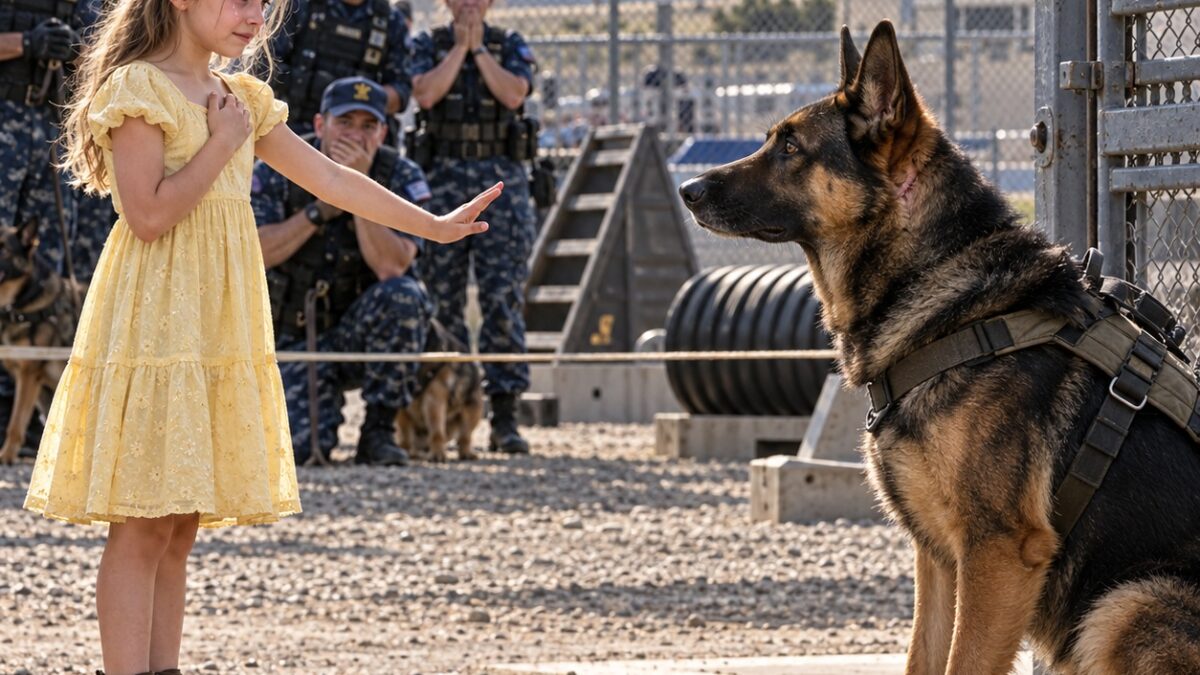
Then Lily knelt.
“Lily.”
I whispered.
She raised her right hand.
Palm forward.
Shadow surged two steps toward the barrier.
I moved.
Mason caught my arm.
“Look at him.”
I did.
Shadow had stopped.
He was staring at Lily’s hand.
Not her face.
Her hand.
Lily kept it raised.
Then slowly lowered it.
Two fingers touched the center of her chest.
Shadow’s ears shifted.
His breathing changed.
Not calm.
Different.
Searching.
Lily repeated the gesture.
Open palm.
Two fingers to heart.
No command.
No spoken name.
Nothing else.
Mason whispered:
“Oh, God.”
Rachel continued recording.
Jake stared.
“He ignored every command yesterday.”
Nobody answered.
Shadow’s head lowered.
The warning sound disappeared.
His shoulders softened.
Then, very slowly, the German Shepherd folded his hind legs beneath him.
Shadow sat.
For six weeks, experienced handlers had tried food.
Routine.
Distance.
Commands.
Equipment.
Patience.
Professional training.
My nine-year-old daughter had used none of it.
She had reminded him of something Cole taught him long before any of us understood why it mattered.
Work was over.
Home still existed.
My hand went over my mouth.
Lily began crying silently.
Shadow stared at her.
Then released a small sound.
Almost a whine.
She whispered:
“Good boy.”
Rachel lowered the tablet slightly.
Not much.
Then said the thing that kept us all grounded.
“This is not proof he is safe.”
Hope rose inside me.
She saw it.
“Do not get ahead of me, Aaron.”
I nodded.
She reviewed the recording twice.
Then the behavioral file.
Finally:
“Seven days.”
Mason looked at her.
“For what?”
“A controlled home rehabilitation trial.”
Lily turned toward me so fast her hair moved across her face.
Rachel raised a hand.
“Listen to the conditions first.”
Shadow remained Navy property.
This was not adoption.
His aggression history remained part of the evaluation.
Basket muzzle outside the Bennett house.
Dual-security fencing.
No time alone with Lily.
Daily monitoring by Mason.
No unapproved visitors.
Any serious loss of control would end the trial.
I agreed before Rachel finished.
She stopped me.
“Aaron.”
“I understand.”
“This is not seven days to prove Shadow loves Lily.”
I looked through the glass toward him.
“I know.”
“We already know there is recognition.”
Rachel continued.
“This is seven days to determine whether Shadow can safely exist in a family environment.”
Lily nodded.
“I understand.”
Temporary paperwork took most of the afternoon.
By the time Shadow left the facility, the sky had turned pale gold.
He wore a secure basket muzzle.
Mason held one lead.
Jake held the other.
I saw the stiffness in Jake’s arm.
He had come despite being afraid.
That mattered.
Shadow hesitated at the outer gate.
Lily stopped several feet ahead.
Raised her hand.
Two fingers to heart.
Shadow followed.
Not blindly.
Not perfectly.
Step by step.
When we reached our house, I opened the front door.
Fresh water waited beside the kitchen.
A new dog bed rested near the fireplace.
I had purchased it during the paperwork process.
Wishful thinking disguised as preparation.
Shadow crossed the threshold.
Ignored the water.
Ignored the bed.
Moved down the hallway.
Then stopped.
Cole’s boots.
He lowered his nose.
Sniffed.
Once.
Again.
His entire body seemed to go still.
For almost a minute, nobody moved.
Then Shadow lay down.
Placed his head across Cole’s right boot.
Lily sat several feet away.
She did not call him.
Did not touch him.
She simply stayed.
I stood in the kitchen watching my dead husband’s dog rest his head across my dead husband’s boot.
For six weeks, I had thought grief belonged mostly to people.
I no longer believed that.
The first night nearly ended the trial.
A storm rolled inland after midnight.
Wind slammed against the house.
Rain struck the windows.
At 1:18 a.m., something crashed downstairs.
I woke instantly.
The back door.
The upper latch had not caught.
A gust shoved it inward.
The door struck the wall.
Bang.
Then again.
Bang.
I ran.
Shadow was already in the hallway.
Standing between the open door and Lily’s bedroom.
His body was rigid.
Head low.
Lily had opened her bedroom door behind him.
“Don’t move.”
I said.
Shadow was not looking at her.
He stared toward the darkness outside.
Door.
Wind.
Unknown entry.
Threat.
Protect.
I could almost see the sequence firing through him.
I started closer.
Stopped.
Lily slowly raised her hand.
Palm forward.
Two fingers to chest.
Shadow looked back.
Once.
Then again.
His shoulders loosened slightly.
After several seconds, he stepped aside.
I closed the door.
Locked it properly.
Only when the bolt clicked did I realize how hard I was shaking.
Rachel’s explanation came back.
Shadow’s reactions were not random.
He believed something required protection.
The problem was that Shadow no longer knew when protection was unnecessary.
For the next several days, we did less than people expected.
No dramatic retraining.
No emotional reunion every hour.
Routine.
Breakfast.
Quiet house.
Backyard under controlled conditions.
Lily reading.
That became the most important part.
Every afternoon, she carried an old adventure book into the living room.
Sat.
Read.
No commands.
No request that Shadow come closer.
Day one, he stayed beside Cole’s boots.
Day two, halfway across the room.
Day three, he ate while she read.
I pretended not to notice.
Some victories feel too delicate to acknowledge aloud.
Day four, Shadow lay beside Lily’s chair.
Day five, I walked through carrying laundry and heard a soft sound against the floor.
Tap.
Pause.
Tap.
His tail.
Lily looked down.
Did not touch him.
She turned another page.
I placed the laundry basket down because my eyes had filled.
Outside our small bubble, life remained brutal.
Cole’s survivor benefits were delayed because paperwork was missing.
The mortgage payment was overdue.
Insurance forms arrived faster than I could answer them.
Letters addressed to Cole continued appearing.
Every envelope carrying his name felt obscene.
I quietly listed his pickup truck for sale.
Dark.
Large.
Ugly.
He loved it.
I hated it.
But it could buy us time.
Margaret Hayes next door discovered the listing.
Margaret was sixty-nine and had spent thirty years working in a public school office, which apparently taught her that asking permission only slowed useful people down.
She walked across the yard while I photographed the truck.
“You’re selling Cole’s pickup?”
“I may have to.”
She looked at me.
Then toward the temporary fencing around our backyard.
The next morning, I heard drilling.
Two retired tradesmen from the neighborhood were reinforcing weak sections of fence.
Margaret stood nearby holding screws.
“You did this?”
“I made two phone calls.”
“I didn’t ask anybody.”
“No.”
She replied.
“That appears to be your favorite problem.”
I opened my mouth.
Then looked toward Shadow through the window.
Closed it.
Let them work.
Maybe accepting help was another kind of rehabilitation.
Jake returned that morning for Mason’s required check.
Shadow saw him through the fence.
Posture changed.
Not explosive.
Tense.
Jake’s hand moved automatically toward the place where a leash usually hung.
Lily noticed.
She carried a wooden chair outside.
Placed it several yards from the fence.
“You can sit there.”
Jake looked embarrassed.
“I’m not afraid of him.”
Lily looked at his hands.
Then:
“Okay.”
I had to turn away so Jake would not see me smile.
He sat anyway.
No approach.
No testing.
Instead, he told Lily a story.
“Your dad once forgot his lunch during a fourteen-hour training day.”
Lily looked interested.
“He blamed Shadow.”
“Did Shadow take it?”
“No.”
A voice came from the driveway.
“He absolutely did.”
Mason.
Jake looked offended.
“You weren’t there.”
“I was.”
“You ate half my lunch.”
“I prevented spoilage.”
For the first time since Cole died, Lily laughed.
A real laugh.
Not the small polite laugh children use because adults are trying too hard.
Full.
Bright.
Shadow lifted his head.
Jake came back the next morning.
And the morning after.
Each time he sat outside the fence.
Each time another story about Cole.
Nothing heroic.
Cole locking himself out of his truck.
Cole accusing Shadow of stealing a glove that was in his own pocket.
Cole losing an argument with a coffee machine.
By the fourth visit, Shadow no longer stood when Jake arrived.
He watched.
That was enough.
Inside the house, change continued.
Shadow spent less time with the boots.
More beside Lily.
Mason watched from the doorway one afternoon.
His hand remained inside his uniform pocket.
I noticed.
“What are you holding?”
He pulled his hand out immediately.
“Nothing.”
That was a terrible lie.
I let it go.
Later I learned Cole’s dog tag was there.
Mason had carried it almost two weeks.
He could not give it to me.
Because giving it over made something final.
And because Mason believed that if he had been beside Cole on that last mission, something might have changed.
There was no evidence for that.
Grief does not need evidence.
On the fifth morning, Mason decided to try a simple controlled exercise.
Nothing difficult.
Walk.
Stop.
Sit.
Return.
Shadow wore his basket muzzle.
Secured lead.
Lily and I stood near the porch.
Jake stayed farther away.
Mason walked Shadow across the yard.
“Easy.”
Shadow stopped.
A few steps.
Followed.
Again.
Good.
I smiled.
Then the sound came from above.
Helicopter.
Military.
Low.
Moving toward the coast.
Shadow froze.
His head lifted.
Every muscle locked.
The helicopter passed overhead.
Rotors pounded the air.
Shadow stopped seeing our backyard.
I knew it.
Six weeks earlier, a similar sound had been part of the last day he saw Cole.
Mason shortened the leash carefully.
“Shadow.”
Nothing.
“Easy.”
Shadow pulled backward.
Then spun toward the woods.
Mason lost balance.
The lead slipped from his hand.
At the exact same moment, the side gate stood partially open.
One of the men repairing the fence had been carrying equipment through.
Shadow saw it.
Gone.
“SHADOW!”
Lily ran.
“LILY!”
She disappeared through the gate before I could catch her.
Mason ran after her.
Jake behind him.
I followed.
The woods beyond our property stretched toward a marshy area crossed by old trails.
Cole used to take Shadow there for conditioning.
He had taken Lily several times too.
That fact comforted me for half a second.
Then terrified me more.
“LILY!”
Branches tore at my sweater.
Mud caught my shoes.
Mason split toward one trail.
Jake another.
I kept running.
There are moments when grief teaches your body to expect catastrophe.
Mine remembered the casualty officers at our front door.
Two uniforms.
Cole’s name.
Words I do not remember hearing even though I remember every syllable.
I could not lose Lily too.
Not in those woods.
Not because I let Shadow come home.
But Lily had already found him.
She told me later.
He stood in a small clearing beside an old oak.
Facing an empty trail.
Waiting.
Again.
Always waiting.
She stopped several yards away.
Did not crowd him.
Cole had taught her that.
“Shadow.”
One ear moved.
She knelt.
Open palm.
Two fingers to heart.
Nothing.
Shadow kept watching the trail.
Then Lily said the words none of us had been able to give him.
“Dad isn’t coming.”
I still cannot repeat them without feeling something tear open.
“Shadow.”
She swallowed.
“But we can still go home.”
She repeated the signal.
This time, he turned.
Shoulders lowered.
One step.
Another.
He reached her.
Lily did not hug him.
She stood quietly.
Shadow leaned against her leg.
For several seconds, they remained like that.
Then she noticed her wrist.
The bracelet was gone.
Somewhere between the backyard and the clearing, Cole’s old paracord bracelet had slipped off.
On another trail, Mason found it.
Green and black against wet leaves.
He picked it up.
And something inside him finally gave way.
Jake found him standing there.
Mason’s fist closed around the bracelet.
“Lily dropped it.”
Jake understood.
This was not only about Lily.
Mason had spent six weeks carrying responsibility for every thing he could not control.
Cole.
Shadow.
Now Lily.
“This isn’t all on you.”
Jake told him.
Mason looked toward the trees.
“Tell me that after we find her.”
By then, Lily and Shadow were already heading back.
Shadow stayed beside her.
They passed a patch of tall grass.
Lily saw something blue beneath leaves.
She recognized it.
“Your ball.”
Shadow’s faded training ball.
Cole had used it during recovery drills.
She stepped toward it.
Shadow moved immediately.
Between Lily and the grass.
A copperhead was partly hidden beneath the leaves.
Lily did not see it until Shadow pushed her backward.
He placed himself between her and the snake.
No command.
No home signal.
No handler.
Choice.
Protect.
By the time the moment passed, Shadow was favoring one front leg.
Lily backed away.
He followed slowly.
Jake heard her voice first.
When he reached them, he stopped.
Five days earlier, Shadow rushing toward him had left his hands shaking.
Now the dog was injured.
Jake did not hesitate.
He removed his combat jacket.
Approached carefully.
“Easy.”
Shadow allowed him close.
Jake supported his body.
Then lifted him.
Almost forty kilograms of working dog held against the chest of the man who had once been afraid to stand inside the same fence.
Mason reached Lily.
I arrived moments later.
I grabbed her.
“Are you hurt?”
“No.”
She pointed toward Shadow.
“He moved me away.”
I looked at the dog in Jake’s arms.
There had been no instruction.
Shadow had protected my daughter because he wanted to.
We went directly to Rachel.
She examined him.
Her voice became calm in the specific way medical professionals sound when they do not want families to panic.
“The good news is you got him here quickly.”
“What’s the bad news?”
“We wait.”
Snakebite treatment.
Observation.
Monitoring.
Lily stood near the treatment-room window.
“What about his evaluation?”
Rachel looked at Shadow.
Then the schedule.
“That depends on how he recovers.”
For the first time, Shadow’s biggest problem might not be whether the Navy believed he was safe.
It might be whether he could physically complete the assessment.
Word spread through Cole’s old military community.
Messages.
Emails.
Letters.
Stories about Shadow’s service.
A former teammate remembered Shadow locating an injured servicemember during a difficult search.
Another wrote about Cole and Shadow staying beside a frightened civilian family until rescue arrived.
Nobody demanded that safety rules disappear.
That mattered.
They asked only that Shadow’s entire life be considered.
Not one bad month.
Not one frightened lunge.
Not one torn sleeve.
His entire life.
That night Mason sat outside the clinic.
Cole’s bracelet in one hand.
His dog tag still in his pocket.
Jake stayed close to Shadow.
Lily leaned against me.
And for the first time, all of us were waiting for the dog who had spent six weeks waiting for somebody else.
Two days later, Shadow stood again.
Bandage around his front leg.
Still stiff.
But stable.
Rachel watched him walk across the treatment room.
“He can participate.”
Hope.
Then:
“The evaluation has to change.”
No running.
No jumping.
No sudden leash pressure.
Stop immediately if tired.
Fair.
By midmorning, we returned to the fenced training yard.
Lily waited outside the testing area beside me.
Mason had found the bracelet in the woods and returned it.
She held it in both hands.
Shadow wore a basket muzzle.
Plain black collar.
Rachel stood with her clipboard.
Beside her was Lieutenant Commander Thomas Reed, the Navy veterinary liaison.
Forty-eight.
Procedural.
Calm.
The kind of man who believed sympathy belonged after evidence.
I respected that too.
“This is not about whether we like Shadow.”
He said.
Rachel nodded.
“It is about whether he can remain under control.”
First stage.
Stranger.
Marcus Hill entered through the opposite gate.
Twenty-six.
Patient.
Never worked directly with Shadow.
He walked in a wide circle.
Shadow watched.
Alert.
Stayed beside Rachel.
Marcus moved closer.
Shadow tracked him with his eyes.
No forward movement.
No attempt to close distance.
Rachel made a note.
Second stage.
Sudden noise.
A metal tray hit the ground several yards behind Shadow.
Clang.
Shadow spun.
Shoulders tightened.
I stopped breathing.
He looked toward the tray.
Then toward Rachel.
Nobody signaled him.
Nobody corrected him.
Several seconds passed.
His body softened on its own.
Rachel wrote again.
“He recovered without intervention.”
Thomas nodded.
Third stage.
Children.
Two Navy-family kids waited at the far end.
Caleb.
Seven.
Red hair.
Could barely stand without bouncing.
Ava.
Eleven.
Quiet.
Dark braids.
Used to service dogs.
They rolled a soft rubber ball between them.
Shadow noticed.
His head followed it.
He leaned slightly forward.
Rachel watched his feet.
He did not move.
Ball again.
Shadow looked toward Lily.
My daughter did nothing.
Hands down.
No home signal.
Shadow looked back at the children.
Stayed.
Thomas lowered his pen.
“That matters.”
Mason asked:
“Why?”
“Because he made the correction himself.”
Three stages done.
One remained.
Before the final test, Jake asked to speak privately with Mason.
They walked behind the equipment building.
Jake carried paperwork.
A revised incident report.
“I changed my statement.”
Mason looked at him.
“Why?”
“Because the first report makes it sound like Shadow reacted with no warning.”
Jake looked toward the yard.
“That isn’t what happened.”
He explained.
Shadow watched the leash.
Stepped backward.
Showed tension.
Jake saw it.
Still believed four years of familiarity would overcome fear.
He kept moving.
“I triggered him.”
Mason shook his head.
“You didn’t cause what happened to him.”
“No.”
Jake replied.
“But I helped create that moment.”
He handed over the report.
“If he gets judged, it should be on the truth.”
Then he entered the yard.
Same camouflage style as the kennel incident.
A leash hung from his hand.
Shadow saw him.
Immediate change.
Body rigid.
Low warning growl.
Mason stepped forward.
“That’s enough.”
Jake stopped.
“Give me one minute.”
Rachel’s voice sharpened.
“Do not approach him.”
“I won’t.”
Jake lowered the leash to the grass.
Slowly.
Then knelt.
Shadow continued staring.
Jake raised his right hand.
Palm forward.
Two fingers touched his chest.
The home signal.
Shadow’s ears moved.
Jake did not speak.
Did not call his name.
Outside the fence, Lily watched.
Mason glanced toward her.
I saw the question.
Should she help?
Lily kept her hands down.
“This one has to be his choice.”
For several seconds, Shadow remained still.
Growling.
Then the sound stopped.
His shoulders lowered.
One step.
Jake stayed kneeling.
Another step.
Then another.
Shadow reached him.
Jake did not reach out.
That mattered.
He did not try to prove trust.
He waited.
Shadow lowered his head.
Then rested it against Jake’s knee.
Jake closed his eyes.
Nobody spoke.
I saw tears on his face.
He did not wipe them away.
After several seconds, Shadow stepped back on his own.
Turned toward Rachel.
Walked to the evaluation line.
Settled.
Rachel watched.
Then closed the file.
“Shadow is not demonstrating uncontrolled aggression.”
Thomas looked toward her.
She continued.
“His earlier behavior is consistent with trauma-related defensive fixation following the loss of his handler.”
“That does not mean risk is gone.”
“It means his triggers are identifiable.”
“He has demonstrated recovery.”
“He has demonstrated self-correction.”
“He has demonstrated the ability to choose a controlled response.”
Mason asked:
“Recommendation?”
Rachel looked at Shadow.
“Retirement.”
“Structured placement.”
“Continued monitoring.”
My entire body loosened.
Inside the administrative building later, Mason removed the euthanasia authorization from Shadow’s folder.
He tore it once through the center.
Lily stared.
“He’s safe?”
“The order is canceled.”
Her whole face changed.
Then Mason’s expression became serious again.
“There’s another issue.”
Shadow was still Navy property.
Passing the evaluation did not make him ours.
Military working dogs had formal retirement procedures.
Placement review.
Ownership transfer.
Liability.
Documentation.
Lily’s smile faded.
“I don’t need him to be a K9 anymore.”
Mason looked at her.
She touched the bracelet.
“I just want him to be a dog.”
Across the room, Rachel reopened Shadow’s medical file.
Near the back she found an older note.
Cole had asked about retirement procedure before his final mission.
That afternoon, records specialist Dana Whitmore began searching archived files.
Dana had spent more than twenty years finding paperwork other people had given up on.
“If Cole filed anything.”
She told Mason.
“I’ll find it.”
Before Mason left that evening, he finally came to my house.
Shadow rested beside Lily.
Mason stood in the kitchen.
Hand inside his uniform pocket.
Then he pulled out Cole’s dog tag.
I stopped breathing.
“I should’ve given this to you weeks ago.”
I closed my fingers around the metal.
Warm from his body.
Mason looked down.
“I should’ve gone with him.”
I knew what he meant.
Cole’s final mission.
“I should’ve been there.”
“Mason.”
“Maybe something would’ve been different.”
“Cole never blamed you.”
“You don’t know that.”
“Yes.”
I said.
“I do.”
He looked at me.
“Before that mission, Cole told me you’d already carried enough for him.”
Mason’s face changed.
“He said that?”
“Yes.”
For a long time, he looked toward the floor.
The guilt did not disappear.
Nothing disappears because someone says the right sentence.
But I watched it become lighter.
The next morning, Dana called Mason at 7:42.
“I found something.”
He reached the archive ten minutes later.
Thin folder.
Dated three weeks before Cole’s final mission.
MILITARY WORKING DOG RETIREMENT REQUEST.
Shadow’s identification number.
Service history.
Then:
PREFERRED RETIREMENT PLACEMENT:
AARON BENNETT
LILY BENNETT
VIRGINIA BEACH, VIRGINIA
Cole’s signature.
Below it, one handwritten sentence.
Mason called me.
His voice broke before he finished reading.
“He has spent his life bringing people home.”
Pause.
“When his watch is over, let him come home, too.”
I sat down at the kitchen table.
Cole.
Of course.
The man who carried emergency batteries for emergency batteries.
The man who checked locks twice.
The man who left backup plans for vacations.
He had prepared for Shadow’s retirement.
He just never expected to miss it.
The Navy review board met that afternoon.
Shadow’s entire service record.
Rachel’s veterinary report.
Behavioral evaluation.
Jake’s revised statement.
The incident in the woods.
Cole’s signed retirement request.
Rachel did not call him cured.
She called him manageable.
Responsive.
Capable of recovering from triggers.
Capable of choosing calm behavior with appropriate structure.
Jake spoke too.
He did not defend himself.
He told them Shadow’s worst reaction happened when people misunderstood what the dog was communicating.
“He still needs rules.”
Jake said.
“But he also needs somewhere he understands.”
Mason placed Cole’s retirement request on the table.
The decision came that afternoon.
Shadow would officially retire from military service.
Permanent placement:
Aaron and Lily Bennett.
Provided we continued the care plan.
When Mason called, Lily grabbed the phone first.
“Is he coming home?”
Mason looked through his office window toward the training yard.
Shadow was resting beside Jake under the equipment shelter.
“Yes.”
He said.
“This time for good.”
Lily screamed.
Shadow lifted his head.
She ran into the living room.
Then stopped herself before touching him.
That discipline had become instinct.
She raised one hand.
Palm open.
Two fingers to her heart.
Shadow stood.
Walked toward her.
Pressed his head against her waist.
Lily wrapped her arms around his neck.
Slowly.
Carefully.
No one stopped her.
The retirement ceremony happened two days later.
Small.
Cole would have hated anything larger.
A few members of the unit.
Rachel.
Jake.
Mason.
Lily.
Me.
Shadow stood on the same field he had watched from his kennel for six weeks.
The black military working dog collar remained around his neck.
Mason knelt.
“This collar means service.”
He said.
“Training.”
“Responsibility.”
“Trust.”
His hand rested on Shadow’s shoulder.
“It also means your job had an ending.”
He unclipped it.
For the first time in years, Shadow wore nothing identifying him as a military working dog.
Lily carried a small wooden box.
Inside was a brown leather collar.
Simple.
Brass tag.
She fastened it.
The tag read:
SHADOW BENNETT
RETIRED
HOME
My vision blurred.
Lily raised her hand.
Two fingers touched her heart.
Shadow looked at her.
Then leaned against her leg.
No command.
He did not need one.
In the weeks that followed, other parts of our life began settling.
The missing documents connected to Cole’s survivor benefits were finally processed.
The delayed payments came through.
The mortgage stopped feeling like a clock counting backward.
I removed the truck listing.
Margaret noticed within twenty-four hours.
Of course.
She crossed the lawn with coffee.
“So you’re keeping that ugly pickup?”
“For now.”
She nodded.
“Good.”
Then:
“It was always hideous.”
I laughed.
A full laugh.
The first one since Cole died.
The sound surprised me.
Margaret’s face softened.
She did not comment.
That was her gift.
She knew when to interfere.
And when not to.
Mason began working on another idea.
Behind one of the older training buildings was a quiet fenced area no longer used for operational exercises.
He wanted benches.
Shade.
Retired dogs.
Military families who had lost people.
Not formal therapy unless licensed staff were involved.
Just a place where grief did not need to perform.
Some people needed to speak.
Some did not.
Mason said:
“Shadow taught me silence can still be communication.”
Several months later, the space opened.
Lily and Shadow became regular visitors.
No tactical harness.
No missions.
No searching buildings.
No waiting beside gates.
Shadow spent afternoons lying near children who were trying to understand why somebody they loved was never coming home.
Some children talked to him.
Some only touched the fur behind his ears.
Shadow accepted both.
Lily understood.
Silence could mean something.
By late spring, our backyard was green again.
The temporary fencing had been replaced with a permanent wooden gate.
Cole’s pickup still sat beneath the maple tree.
His boots remained beside the closet.
I had not moved them.
Not yet.
One warm afternoon, Lily walked into the yard carrying Shadow’s faded blue training ball.
The same one he had found in the woods.
Shadow noticed immediately.
She threw it.
The ball rolled through the grass.
Shadow watched.
Then looked back at her.
For a moment, I expected the signal.
Lily kept her hands down.
She smiled.
“Go get it!”
Shadow ran.
Not toward a vehicle.
Not toward a search area.
Not toward danger.
Not toward a missing person.
A blue rubber ball.
That was all.
He reached it.
Picked it up.
Ran back.
Dropped it near Lily’s feet.
She laughed.
Then raised one hand.
Two fingers toward her heart.
The home signal.
The gesture that had once told him:
No mission.
No guarding.
You can stop.
Shadow looked at her.
But he did not seem to need permission anymore.
He stepped closer.
Rested his head beneath her palm.
That night, I heard his nails moving through the hallway.
Months earlier, he stopped at Cole’s boots every time.
Sniffed.
Waited.
Sometimes lay down beside them.
That night, Shadow paused.
Only briefly.
Then continued.
He walked to Lily’s bedroom.
Turned once on the rug outside her door.
Lay down.
Closed his eyes.
Cole’s watch had ended.
Shadow’s old watch had ended with it.
For six weeks, everyone had looked at him and seen a military dog who had become too difficult to handle.
Lily had seen something else.
Her father’s partner still standing watch.
Shadow had not been waiting for another fight.
He had been waiting for the man who taught him when to work.
And because that man never returned, nobody had given him permission to stop.
Lily did.
Not by curing him with love.
That would be too simple.
The signal gave us one opening.
After that came structure.
Safety.
Professional evaluation.
Patience.
Rachel’s caution.
Mason’s consistency.
Jake admitting his own mistake.
Neighbors helping us build a safer fence.
Shadow learning one day at a time that every unexpected sound did not require a response.
Healing did not happen in one miraculous moment.
But one moment gave healing somewhere to begin.
Shadow came home.
Jake found the courage to stand beside him again.
Mason began letting go of the guilt he had carried since Cole’s final mission.
I learned to accept help.
And Lily learned something I would spend years understanding myself.
Continuing to live does not mean leaving the person you lost behind.
Sometimes love changes shape.
That is all.
Cole remained in the house.
Not literally.
In stories.
Photographs.
The boots beside the closet.
The way Lily laughed.
The way Mason repeated one of his sayings without realizing where it came from.
The way Shadow sometimes lifted his head when a certain kind of truck passed outside.
But the house stopped feeling like it was waiting.
That was the change.
One evening, I stood in the hallway.
Shadow slept outside Lily’s room.
Cole’s boots remained where they had always been.
For the first time, I did not look at them and think:
He should be wearing those.
I looked at them and thought:
He wore them.
Past tense.
Painful.
True.
I went downstairs.
Put Shadow’s water bowl beside the kitchen.
Not outside.
Lily no longer left it near the back door in case he found his way home.
He had.
Months later, Mason asked me whether he should remove the old gate Shadow once watched from the K9 facility.
“They’re renovating.”
He said.
“It doesn’t matter.”
I replied.
Then I surprised myself.
“Actually.”
“What?”
“Take it down.”
There was a pause.
“You sure?”
“Yes.”
“Why?”
“Because nobody’s waiting there anymore.”
Mason became quiet.
Then:
“Okay.”
The support area expanded slowly.
Not into some grand institution.
That would have been unlike Cole.
A few more benches.
Covered section for rain.
Retired working dogs whenever their families wanted to participate.
People came.
Some stayed ten minutes.
Some two hours.
One little boy whose father had died sat beside Shadow every Saturday for a month without speaking.
On the fifth visit, he whispered:
“My dad’s not coming back either.”
Shadow placed his head against the boy’s leg.
Nothing else.
The child began crying.
Nobody interrupted.
That was the point of the place.
No requirement to be inspiring.
No requirement to move on.
No requirement to explain.
Just room.
Lily sometimes read there.
The same adventure books.
Other children gathered.
Shadow slept nearby.
A dog who once guarded an empty gate now slept while children laughed around him.
That felt more significant than anything we could have put on a plaque.
Jake became part of the program too.
His relationship with Shadow never returned to what it had been before Cole died.
It became something else.
More careful.
More honest.
Sometimes Jake sat beside the fence.
Sometimes inside.
He never assumed familiarity gave him permission anymore.
One day, he admitted:
“I used to tell myself he attacked me.”
I looked at him.
“He did lunge at you.”
“Yeah.”
“But that isn’t the whole story.”
He rubbed the small scar on his hand.
“I saw the warning.”
“I thought knowing him meant I could ignore it.”
“What do you say now?”
He looked toward Shadow.
“I didn’t listen.”
That mattered.
Because Shadow had spent weeks being judged by what he did.
Jake finally admitted what happened before it.
Mason changed too.
He stopped carrying Cole’s dog tag.
I kept it inside Cole’s desk.
The paracord bracelet stayed with Lily.
She wore it until the cord began fraying.
Then she placed it in a small box beside one of her father’s photographs.
She no longer needed the object to remember.
Neither did Shadow.
Helicopters remained difficult.
The first few times one crossed low over our house, Shadow froze.
Sometimes Lily used the home signal.
Sometimes she did not.
Gradually, he learned to recover without it.
Rachel said:
“That matters more than never reacting.”
“What do you mean?”
“Recovery is not the absence of memory.”
She looked at Shadow.
“It is the ability to return.”
That sentence stayed with me.
Because it was true for all of us.
I still cried.
Lily still had nights when she wanted Cole.
Mason still wondered what might have happened if he had gone on the final mission.
Jake still carried guilt about the kennel.
Shadow still sometimes stared toward a sound with the old intensity.
None of that meant we were failing.
We returned.
Again.
And again.
Home.
Lily once asked me:
“Do you think Dad knew?”
“Knew what?”
“That Shadow would need us?”
I looked toward the dog sleeping near the fireplace.
“He filed the retirement request.”
“So yes?”
“I think he hoped.”
That seemed more honest.
Cole did not predict his own death.
He did not secretly arrange every event.
He simply knew his dog.
Knew retirement would come.
Knew where he wanted Shadow to go when it did.
Sometimes love looks like planning for a future you hope to witness.
Cole did not get to witness it.
We did.
The paperwork he signed three weeks before his final mission gave Shadow a home after his career ended.
But Lily gave him something paperwork could not.
Understanding.
I sometimes imagine what Cole would have said if he saw the day Shadow chased the blue ball through our yard.
Probably:
“Finally.”
Then something about how his dog’s retrieval technique had deteriorated.
Lily would argue.
Shadow would ignore both of them.
I miss those imaginary conversations almost as much as the real ones.
But they hurt less now.
That is another thing nobody told me.
Eventually, remembering someone can become warm again.
Not every memory remains a wound.
The yellow dress stayed in Lily’s closet until she outgrew it.
One afternoon, she brought it downstairs.
“What should we do with this?”
I looked at it.
The dress from the training yard.
The dress Cole loved.
For a second, part of me wanted to preserve it forever.
Then Lily said:
“I can’t wear it anymore.”
“No.”
“Do we have to keep everything?”
The question was bigger than the dress.
I knew it.
“No.”
I said.
“We don’t.”
She donated some clothes that year.
Not the dress.
She kept that.
But choosing what stayed and what left became part of healing.
Cole was not located inside objects.
Neither was our love for him.
Still, some objects matter.
The bracelet.
Dog tag.
Shadow’s retired collar.
The blue ball.
Ordinary things made sacred by memory.
Rachel once told me:
“Trauma makes people either hold everything or throw everything away.”
“What’s the right amount?”
“There isn’t one.”
I laughed.
“Very helpful.”
“I’m a veterinarian.”
“Wrong species.”
Fair.
Margaret continued invading our lives.
Fence repairs.
Food.
Coffee.
At some point, she acquired a key to my house.
I still do not remember giving it to her.
I accused her of theft.
She claimed I was experiencing “widow-related administrative confusion.”
I threatened to change the lock.
She brought pie.
The lock remained.
Lily adored her.
Shadow discovered Margaret carried chicken.
After that, he loved her too.
“I thought retired military dogs had discipline.”
Margaret complained while feeding him another piece.
“You are literally rewarding him.”
“That is unrelated.”
Impossible woman.
The delayed benefits were eventually resolved completely.
The mortgage stabilized.
I kept Cole’s truck.
At least for several more years.
I could have sold it later.
I never did.
Lily learned to drive in it.
The first time she sat behind the wheel, my heart almost stopped.
Cole should have been there.
Teaching her.
Criticizing mirror placement.
Pretending not to be terrified.
Instead, I sat in the passenger seat.
Shadow, older now, watched from the driveway.
Lily started the engine.
“Dad would say I’m holding the wheel wrong.”
“Yes.”
“What else?”
“He would tell you not to ride the brake.”
“I haven’t moved yet.”
“He would still say it.”
She laughed.
Then we drove.
Life kept handing us moments Cole was supposed to witness.
We learned to enter them anyway.
That may have been the hardest home signal of all.
Permission to continue.
Years later, people who knew Shadow’s story often focused on the dramatic morning.
The yellow dress.
The open hand.
Two fingers to the heart.
A condemned military dog sitting down.
I understand why.
It was unforgettable.
But when I think about Shadow, another image stays with me more.
Months afterward.
Warm afternoon.
No handlers.
No muzzle.
No evaluation.
Lily throwing his faded blue ball.
Shadow running through the grass simply because he wanted to.
No mission.
No person missing.
No danger.
No work.
A dog.
That was what Lily asked for.
“I just want him to be a dog.”
In the end, that was the greatest gift anybody gave him.
Not another heroic assignment.
Not another handler.
Retirement.
Family.
Ordinary life.
And one night, months after he came home, I stood in the hallway and watched Shadow walk past Cole’s boots without stopping.
He reached Lily’s room.
Circled once.
Lay outside her door.
Closed his eyes.
The house was quiet.
No one was waiting for a gate to open.
No one was listening for Cole’s truck.
No water bowl sat outside for a dog who had not found his way home.
For the first time since my husband died, our house felt less like a place where somebody was missing.
It felt like a place where the people—and the dog—who remained were finally learning how to stay.
Shadow had spent his life bringing people home.
Cole had written that himself.
When his watch was over, he wanted the same thing for his partner.
It took six weeks, one frightened little girl in a yellow dress, a forgotten hand signal, seven days of careful rehabilitation, and a lot of people willing to admit they did not understand grief as well as they thought they did.
But Shadow came home.
And somewhere along the way, so did we.








