𝗙𝗨𝗟𝗟 𝗦𝗧𝗢𝗥𝗬: The HOA Thought My Army Jacket Made Me Easy to Bully—She Had No Idea Who Was Already Coming Down My Street
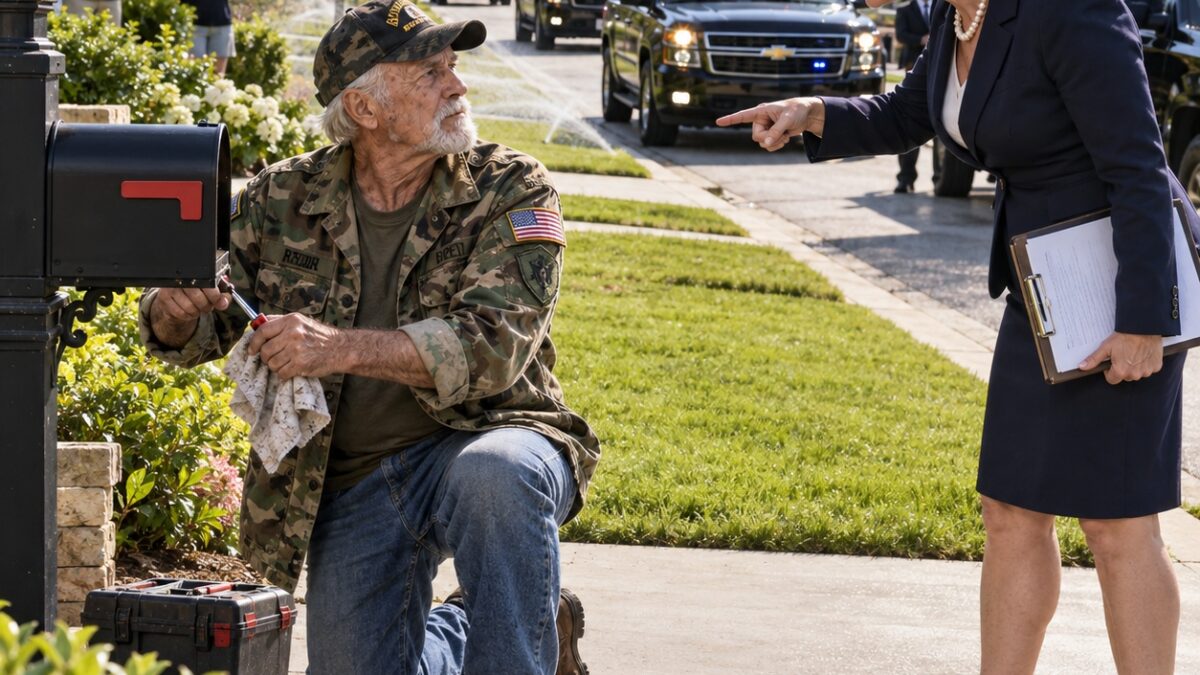
𝗙𝗨𝗟𝗟 𝗦𝗧𝗢𝗥𝗬 𝗜𝗦 𝗜𝗡 𝗧𝗛𝗘 𝗙𝗜𝗥𝗦𝗧 𝗖𝗢𝗠𝗠𝗘𝗡𝗧

Karen stared at me.
“Your what?”
“My company.”
The rumble grew louder.
Not racing engines.
No sirens.
Nothing dramatic.
Just several vehicles moving together with the kind of spacing that caught my attention immediately.
Old habits.
You notice patterns after enough years in uniform.
The first black SUV turned onto our street.
Then another.
Then a dark pickup.
Then two more vehicles behind them.
Karen looked from the convoy to me.
Her clipboard lowered slightly.
“You called people?”
“No.”
That was true.
I had not called anyone because of her.
They had already been coming.
Once a year, several men and women I had served with tried to get together.
No ceremony.
No speeches.
No pretending we were still twenty-five.
We ate too much.
Complained about our knees.
Argued over details of stories nobody remembered correctly.
Sometimes we raised a glass to people who were no longer there.
That Saturday happened to be my turn to host.
Karen had simply chosen an unfortunate morning to start a war over a jacket.
The first SUV slowed in front of my house.
A man stepped out.
Mark Delaney.
We had served together long enough ago that both of us looked completely different from the photographs.
He was still broad-shouldered.
Still moved like he checked exits without consciously deciding to.
Gray hair now.
Reading glasses clipped to his shirt.
Behind him, Denise Parker climbed from the second vehicle.
Then Lewis.
Grant.
Ramirez.
Others.
Some had remained in government service longer than I had.
Some had retired.
Several came from Special Forces backgrounds.
Every one of them carried themselves with that unmistakable mixture of age and discipline.
Karen took a step backward.
Mark looked at me.
Then at Karen.
Then at the clipboard.
“John.”
“Mark.”
He nodded toward the mailbox.
“Starting without us?”
“Loose hinge.”
“That serious?”
“Critical.”
He walked toward me.
Karen cleared her throat loudly.
Mark stopped.
She looked him up and down.
“Who are you?”
Mark glanced at me.
I sighed.
“Karen, this is Mark.”
“That doesn’t answer my question.”
Denise had reached us by then.
She smiled.
“That usually means Mark has already annoyed someone.”
“I just got out of the car.”
“Personal best.”
I almost laughed.
Karen did not.
“I am speaking with Mr. John regarding an HOA violation.”
Mark looked at my jacket.
Then the mailbox.
Then me.
“What violation?”
Karen pointed.
“That.”
Mark stared.
“The jacket?”
“Yes.”
He waited.
Karen seemed offended that he needed more explanation.
“The camouflage clothing violates the standards I am responsible for enforcing.”
Denise slowly looked at me.
“Is she serious?”
“Painfully.”
Karen’s voice sharpened.
“This is an HOA matter. It doesn’t concern you.”
Mark nodded.
“Fair enough.”
He turned toward me.
“You need help with the hinge?”
Karen blinked.
I nearly smiled.
“No. I’ve got it.”
He moved aside.
That should have ended everything.
It could have.
But people who feel their authority slipping sometimes become louder instead of wiser.
Karen raised her clipboard.
“I’m not finished.”
I put the screwdriver down again.
“Apparently not.”
By now, the rest of my friends had gathered near the driveway.
Nobody surrounded Karen.
Nobody threatened her.
Nobody needed to.
They simply stood where people naturally stand when they arrive at a friend’s house and realize something uncomfortable is happening.
Neighbors were openly watching now.
Several phones were raised.
I did not love that.
But there was no stopping it.
Karen pointed toward the group.
“What is this supposed to be?”
“Friends.”
She laughed nervously.
“These people all just happen to show up while you’re refusing HOA instructions?”
“Yes.”
Mark raised one hand.
“We can leave if this is private.”
“No,” Karen snapped.
Then she immediately seemed to regret it.
Mark lowered his hand.
“Okay.”
She looked at me.
“You think bringing in some kind of military group is going to intimidate me?”
“I didn’t bring them in.”
“They came here.”
“Yes.”
“For you.”
“Yes.”
“Why?”
That question bothered me more than it should have.
Maybe because of the way she asked it.
As though a quiet man in an old jacket could not possibly have people in his life.
As though living alone meant being alone.
Mark answered before I could.
“Because he’s our brother.”
Karen looked at him.
Mark continued calmly.
“We served together.”
One of the others nodded.
Denise said, “Different places. Different years.”
Lewis added:
“But yes. Together.”
Karen swallowed.
I knew what she saw.
Not a tactical unit.
Not soldiers arriving for some ridiculous neighborhood operation.
Veterans.
Men and women with gray hair.
Scars.
Bad shoulders.
One artificial knee.
One hearing aid.
And enough shared history to recognize when one of us was being treated without respect.
Karen seemed to realize something.
“You’re all Special Forces?”
Mark gave me a look.
I shrugged.
The original group I had served around came from different units and assignments, but several of us had Special Forces experience.
The labels mattered less to us now than they seemed to matter to everyone else.
Mark answered simply.
“Some of us.”
Karen’s expression changed anyway.
The confidence drained a little.
I did not like that.
Not because I wanted her confidence.
Because respect should not require discovering someone once wore a particular uniform.
I stepped forward.
“Karen.”
She looked at me.
“This changes nothing.”
She blinked.
“What?”
“I was right before they arrived.”
Mark looked at me and gave the smallest nod.
I continued.
“If you have a legitimate HOA complaint, give it to me in writing.”
She tightened her grip on the clipboard.
“I already told you—”
“And I already asked you to show me the rule.”
She flipped through several pages.
Quickly at first.
Then slower.
I waited.
A few neighbors exchanged looks.
Karen stopped on a page.
“There.”
She pointed.
I did not take the clipboard.
“Read it.”
Her eyes moved across the text.
“It states that homeowners may not display materials, signs, or external decorations considered disruptive to the visual uniformity of the neighborhood.”
I looked at my jacket.
Then at her.
“I’m not an external decoration.”
Someone behind me coughed to hide a laugh.
Denise failed entirely.
Karen’s face reddened.
“That isn’t the point.”
“It is exactly the point.”
“You are deliberately defying the spirit of the rules.”
“The spirit of the rule cannot magically become control over what shirt or jacket a homeowner wears.”
Her mouth tightened.
“You don’t get to interpret HOA documents however you want.”
“Neither do you.”
Mark spoke for the first time in several minutes.
“Ma’am.”
Karen turned toward him.
His tone remained polite.
“John asked for the exact rule.”
“He doesn’t need you speaking for him.”
“He doesn’t.”
Mark nodded.
“He’s doing very well.”
That earned a few smiles.
“But if the language you just read concerns signs and exterior decorations, I’m not hearing anything about personal clothing.”
Karen glared.
“Are you a lawyer?”
“No.”
“Then stay out of it.”
Mark nodded again.
“Happy to.”
And he actually stepped backward.
That seemed to make Karen angrier.
She wanted confrontation.
He would not give it to her.
I recognized the pattern.
Some people become dependent on resistance.
They need another person to shout so they can justify shouting louder.
Calm takes that weapon away.
I had learned it in places far less comfortable than a suburban driveway.
“Karen,” I said.
“This can end right now.”
“I agree.”
“Good.”
“Take off the jacket.”
I stared at her.
Behind me, someone whispered:
“She walked right back into it.”
I almost agreed.
“No.”
Her face tightened.
“Then I’m documenting noncompliance.”
“Document it.”
“Fine.”
“Fine.”
She wrote something.
Aggressively.
I returned to my mailbox.
For perhaps thirty seconds, the only sounds were sprinklers and the scrape of my screwdriver.
Then Karen said:
“You think you’re making some noble point because you served?”
I stopped.
“No.”
I stood.
“This stopped being about the jacket several minutes ago.”
“Then what is it about?”
“Boundaries.”
She crossed her arms.
“You don’t get to lecture me about boundaries.”
“I’m not.”
I wiped my hands.
“I’m telling you mine.”
That quieted her.
I continued.
“You can send notices.”
“Yes.”
“You can schedule hearings.”
“Yes.”
“You can bring legitimate covenant issues to the board.”
“Exactly.”
“What you cannot do is stand in my driveway, invent authority you haven’t shown me, and threaten me until I obey because you expect intimidation to work.”
Her eyes flicked toward my friends.
“You’re intimidating me right now.”
That stopped everyone.
Mark immediately stepped back farther.
So did Denise.
Then Lewis.
Within seconds, the entire group created more distance.
Not because Karen had accurately described their behavior.
Because disciplined people understand perception matters.
I nodded toward them.
“Better?”
Karen looked around.
Nobody was close to her.
Nobody had blocked her path.
Her white SUV sat twenty feet away.
The street behind her was completely open.
“Yes,” she said reluctantly.
“Good.”
I lowered my voice.
“Nobody here wants to intimidate you.”
She looked at my friends.
“Then why are they standing here?”
Mark answered.
“Because we came to see John.”
Denise added:
“And because his grill is allegedly working this year.”
“It worked last year.”
“It produced smoke.”
“That is technically working.”
A few neighbors laughed.
Even Karen seemed confused by the sudden normality of it.
Good.
I wanted normality.
Not victory.
Not humiliation.
Normal.
“Karen,” I said, “I’m not asking you to apologize.”
Her chin lifted.
“I wasn’t going to.”
“I figured.”
Mark looked away to hide a smile.
“I’m asking you to take whatever complaint you believe exists and handle it through the actual HOA process.”
She stayed quiet.
“No threats.”
I continued.
“No yelling.”
“No telling residents to strip off clothing because you personally decided a guideline means something it doesn’t clearly say.”
“It wasn’t like that.”
“It was exactly like that.”
A neighbor across the street spoke.
It was Carol Hayes.
Seventy-two.
Retired schoolteacher.
Five feet tall on a good day.
Nobody intimidated Carol Hayes.
“Karen.”
Karen looked over.
Carol stood on her porch.
“You did tell him to remove it.”
“That isn’t what I meant.”
Carol folded her arms.
“I heard you.”
Another neighbor stepped from his driveway.
“So did I.”
Then another.
“I’ve got it on video.”
Karen looked around.
That changed the situation more than my friends had.
Not military history.
Not uniforms.
Witnesses.
People who had watched quietly at first were now willing to say what they had seen.
I thought about how often that happens.
One person speaks.
Then another realizes silence is no longer required.
Karen looked at me.
“I was enforcing what I understood the policy to mean.”
That was the first sentence she said all morning that sounded more defensive than controlling.
“Then maybe the policy needs clarification.”
She stared at the clipboard.
I softened my voice.
“Karen, I don’t hate you.”
That surprised her.
“I don’t even know you well enough.”
Someone behind me whispered:
“John.”
I ignored it.
“But you came over here already convinced I was going to obey because you told me to.”
She shifted.
“That’s not fair.”
“It’s exactly what happened.”
I picked up the loose screw.
“You never asked about the jacket.”
“Why would that matter?”
“Because you called it inappropriate before you knew what it was.”
She looked at it.
For the first time, really looked.
Faded fabric.
Old stitching.
A unit patch that had lost some color with time.
I ran a thumb across one repaired seam.
“This isn’t sacred.”
I said it because I did not want the conversation turning into worship of a piece of clothing.
“It’s cloth.”
Then I paused.
“But it belongs to me.”
I looked at her.
“And the memories attached to it belong to me too.”
Karen’s eyes lowered.
“It represents people I served beside.”
The driveway became quiet.
“Some came home.”
I glanced toward Mark and the others.
“Some didn’t.”
Nobody behind me moved.
“I don’t wear it because I think it makes me better than my neighbors.”
My throat tightened slightly.
“I wear it because some mornings I miss people.”
Karen stared at the clipboard.
For the first time all morning, I felt something in her posture change.
Not defeat.
Maybe understanding.
Small.
Uncomfortable.
But there.
“I didn’t know,” she said.
Quietly.
I nodded.
“No.”
Then:
“You didn’t ask.”
The words hung there.
Nobody celebrated.
That mattered.
I did not want a crowd cheering because someone had been embarrassed.
If the point was respect, humiliation would have defeated it.
Mark stepped forward only enough to speak comfortably.
“Ma’am.”
Karen looked at him.
“You don’t need to understand everything a person values.”
He nodded toward my jacket.
“You just need enough restraint not to attack it before you understand.”
Karen said nothing.
Mark continued:
“We all overstep sometimes.”
I looked at him.
That was generous.
He had always been better at diplomacy than I was.
“What matters is what happens after somebody points it out.”
Karen looked down the street.
At the neighbors.
The phones.
The vehicles.
Then back at me.
“I’ll bring the clothing question to the board.”
“Good.”
“And until then…”
She stopped.
I waited.
“I won’t issue the fine.”
There it was.
Not an apology.
Not exactly.
But movement.
I nodded.
“That works.”
She turned toward her SUV.
Then stopped.
“John.”
“Yes?”
“You could have told me what the jacket meant.”
I considered that.
“I could have.”
She waited.
“But I shouldn’t have needed a war story to earn basic courtesy.”
Her expression tightened.
Then she nodded once.
“Fair.”
That one word did more than the entire argument before it.
Karen walked to her vehicle.
No one followed.
No one said anything clever.
No triumphant one-liner.
She got in.
Closed the door.
Sat there for several seconds.
Then drove away.
The street remained quiet.
I looked at my friends.
Mark looked at me.
Then the mailbox.
“You done?”
“Almost.”
“You’ve been working on one hinge for forty minutes.”
“I was interrupted.”
Denise looked toward the end of the street.
“You always have HOA command performances at reunions?”
“Only for honored guests.”
Lewis walked toward the house.
“Where’s the food?”
“Inside.”
“You haven’t started the grill?”
“It’s nine-thirty in the morning.”
“That was not my question.”
Just like that, life resumed.
That was what I loved about those people.
They had seen worse moments.
Real danger.
Real loss.
Real fear.
Nobody needed to make Karen Thompson the center of our day.
Within half an hour, chairs were in the backyard.
Coffee came out.
Someone found a deck of cards.
Mark criticized my grill.
Denise criticized Mark.
Ramirez brought enough food for thirty people even though there were ten of us.
Normal.
Across the street, neighbors continued talking.
I knew videos were spreading.
That part bothered me.
I did not want to become Veteran Destroys HOA Karen or whatever ridiculous headline the internet would invent.
I had not destroyed anybody.
I had said no.
My friends had arrived.
Karen had backed down.
End of story.
Of course, the internet rarely accepts the end of a story when it can manufacture another one.
By that evening, people from neighborhoods I had never heard of were commenting on clips.
Some praised me.
Some mocked Karen.
Some wanted her removed from the HOA.
Others insisted I had staged the arrival of my friends to intimidate her.
That last one made me laugh.
Mark read it aloud from his phone.
“‘Clearly coordinated military intimidation.’”
Denise raised her coffee.
“To Operation Mailbox Hinge.”
Everyone laughed.
I did too.
Then I took Mark’s phone and put it facedown.
“Enough.”
The table quieted.
“I mean it.”
Mark nodded.
“I know.”
“This doesn’t become harassment.”
“No.”
“Nobody contacts her.”
“Agreed.”
“Nobody contacts the HOA pretending to speak for me.”
Another nod.
I looked around the table.
“She was wrong.”
“Yes.”
“She was rude.”
“Yes.”
“She is still a person.”
That quieted everyone.
I had seen what happens when groups decide an individual deserves whatever comes next.
The uniforms change.
The language changes.
The principle does not.
You do not protect dignity by deciding your opponent no longer deserves any.
The following Monday, I received an email from the HOA board.
Not Karen.
The board president.
He apologized for the confrontation and confirmed that the cited exterior-appearance language did not regulate residents’ personal clothing.
That was enough for me.
No lawsuit.
No demand that Karen resign.
No victory tour.
I printed the email.
Put it in a drawer.
Then forgot about it.
Karen avoided my house for several weeks.
That was probably best.
The neighborhood, however, did not forget.
People started talking about other interactions they had experienced with the HOA.
Some were legitimate complaints.
Some were trivial.
Some were residents simply angry they had been told to cut their grass.
I stayed out of most of it.
The point had never been that HOAs should have no rules.
I had lived enough of my life inside organizations to understand rules matter.
Standards matter.
Consistency matters.
But authority without judgment becomes machinery.
And machinery does not know when it is crushing something human.
A month after the confrontation, I was repairing something else.
A fence latch.
I spend retirement repairing things that probably would have survived without me.
Karen’s SUV slowed.
Then stopped.
I kept working.
She stepped out.
No clipboard.
That got my attention.
“Morning.”
“Morning.”
She stood near the sidewalk.
Did not walk onto the property.
Another thing I noticed.
“I wanted to say something.”
I put the screwdriver down.
“Okay.”
She seemed uncomfortable.
Good apologies usually are.
“I was wrong.”
Simple.
No speech.
I waited.
“The rule didn’t say what I said it did.”
“No.”
“I should have checked.”
“Yes.”
“And…”
She looked at my jacket.
I happened to be wearing it again.
Not deliberately.
It was cold.
“I should not have spoken to you the way I did.”
I nodded.
“Thank you.”
She seemed surprised.
“That’s it?”
“What were you expecting?”
“I don’t know.”
“Public trial?”
She almost smiled.
“No.”
“Then we’re good.”
She looked back toward her SUV.
“I saw some of the comments online.”
I sighed.
“So did I.”
“They were…”
“Ugly.”
“Yes.”
“I told people to stop.”
She looked at me.
“Why?”
That question genuinely irritated me.
“Because I meant what I said.”
“About respect?”
“Yes.”
I picked up the screwdriver.
“It would be pretty convenient if I only believed in it when I was the one demanding it.”
Karen absorbed that.
Then nodded.
“I guess so.”
She walked back toward her SUV.
“Karen.”
She turned.
“For what it’s worth, Mark says your interpretation of the regulation was the worst tactical decision he’s witnessed in twenty years.”
She stared at me.
I smiled.
“That part I let him say.”
To my surprise, she laughed.
Only once.
But it happened.
Then she left.
Things changed afterward.
Not dramatically.
This was still an HOA.
Letters still arrived.
People still argued about landscaping.
Somebody painted a front door a shade of yellow that nearly caused a neighborhood civil war.
But Karen became different.
Not soft.
I do not think anybody would ever use that word.
She was still meticulous.
Still loved rules.
Still carried the clipboard.
But she started asking before accusing.
“Did you know the bins have to be moved by six?”
Instead of:
“Move them or I fine you.”
Small difference.
Important difference.
People responded differently too.
Less hostility.
More conversation.
Authority worked better once it stopped arriving as a threat.
A few months later, one of my neighbors, an older widower named Frank, received a warning about the flagpole in his yard.
He called me furious.
“Here we go again!”
“What happened?”
“They’re coming after the flag.”
“Did you read the notice?”
“No.”
“Read it.”
He did.
The problem was not the flag.
The metal pole had begun leaning dangerously toward the sidewalk.
The HOA wanted it repaired.
Frank became quiet.
“Oh.”
“Yeah.”
“I may have overreacted.”
“You think?”
“Don’t enjoy this.”
“I’m enjoying it immensely.”
The next morning, I helped him straighten the pole.
Karen stopped by.
Looked at the repair.
“Thank you.”
Frank grunted.
Then:
“You were right.”
Karen nearly dropped the clipboard.
I laughed so hard my back hurt.
That was community.
Not everyone agreeing.
People learning when to push.
When to listen.
When to admit they were wrong.
The reunion with my old military friends became an annual event at my house.
Karen never interrupted another one.
One year she even approved temporary parking accommodations before I asked.
Mark was devastated.
“She’s taken all the excitement out of this neighborhood.”
“You’re old.”
“You’re older.”
“Respect your elders.”
“Make me.”
Same idiots.
Same brothers.
That first Saturday eventually became one of those neighborhood stories people told newcomers.
Details grew in the retelling.
According to one version, twelve armored vehicles arrived.
There had been five civilian vehicles.
According to another, twenty Green Berets surrounded Karen.
Nobody surrounded anybody.
One child told me his father said helicopters flew overhead.
Absolutely not.
Stories like spectacle.
Reality had been much quieter.
A woman told me to remove my jacket.
I refused.
My friends arrived.
People stood with me.
She backed down.
That was enough.
The real lesson did not need tactical music.
It needed honesty.
I had stayed calm because I had learned a long time ago that anger is expensive.
Once you give it control, you rarely choose where it takes you.
Karen was angry enough for both of us.
I did not need to contribute.
People online called my calm “military discipline.”
Maybe some of it was.
Mostly it was age.
You live long enough and you learn how many arguments do not deserve your blood pressure.
But calm is not surrender.
That distinction matters.
Sometimes staying calm means leaving.
Sometimes it means compromising.
Sometimes it means looking another person in the eye and saying:
No.
Not loudly.
Not cruelly.
Just clearly.
No.
You do not get to speak to me that way.
No.
You do not get to invent power because you expect me to be intimidated.
No.
You do not get to turn a rule into something it never said simply because nobody challenged you before.
That Saturday, my word was no.
And once I said it, I did not need fifty more words to make it stronger.
My friends understood that when they arrived.
That was why they never threatened Karen.
Never shouted.
Never moved around her like some ridiculous combat team.
They simply stood with me.
There is power in that.
Not military power.
Human power.
Knowing that when somebody tries to isolate you, other people are willing to be visible beside you.
Years of service taught me that too.
Nobody gets through everything alone.
People like to celebrate individual strength.
The lone warrior.
The man who stands against everyone.
It makes good stories.
It is rarely true.
I had people.
Brothers and sisters from years ago.
Neighbors who eventually spoke.
Even Karen changed enough to become part of a better version of the community.
Standing your ground does not always mean defeating somebody.
Sometimes the better outcome is giving them room to stand differently next time.
I still have the camouflage jacket.
The cuffs are more worn now.
One zipper finally gave up.
Denise keeps threatening to throw it away.
She will not.
She knows better.
Sometimes a young neighbor asks about it.
I usually say:
“Old Army jacket.”
That is enough.
I do not tell every story sewn into it.
Some belong to me.
Some belong to people who are gone.
Every so often, I stand in the driveway wearing it while doing something pointless to the mailbox.
The hinge has not loosened since that morning.
I check anyway.
Habit.
Karen passes.
Sometimes she waves.
I wave back.
No clipboard raised like a weapon.
No threats.
No crowd.
Just two neighbors who once discovered the hard way that rules and respect are not the same thing.
Rules can tell you where to park.
How tall a fence can be.
When trash bins need to disappear from the curb.
Respect governs everything rules cannot reach.
How you approach someone.
How you speak.
Whether you ask before assuming.
Whether you remember that a homeowner is a person before he is a violation number.
I never needed Karen to respect me because I served.
That part gets lost when people retell the story.
Military service was not the argument.
My friends’ backgrounds were not the argument.
The jacket’s history was not even the argument.
I deserved basic respect before she knew any of that.
So did she.
That is why I would not let people destroy her afterward.
Respect that only flows toward people we admire is not respect.
It is preference.
The difficult version is maintaining principle when the other person has made it very easy to dislike them.
That morning, Karen believed power meant making me comply.
I think she eventually learned what I had learned somewhere far from that quiet suburban street.
Real authority is rarely the loudest voice.
The people who truly know what they can do usually do not need to announce it.
My friends did not.
I did not.
In the end, even Karen did not need to.
She drove away.
Came back weeks later.
Admitted she was wrong.
And the neighborhood survived.
No violence.
No arrests.
No dramatic revenge.
Just a line drawn and eventually understood.
Sometimes people ask me whether I felt powerful when those vehicles came around the corner.
No.
I felt relieved.
Not because I needed rescuing.
I had already decided what I was going to do.
I was keeping the jacket on.
But there is a difference between standing alone and looking over your shoulder to see people who have stood with you before.
That feeling never gets old.
Mark stepped from that first SUV exactly the way he had stepped into dozens of difficult moments years earlier.
Calm.
Annoyingly confident.
Ready if needed.
Mostly hoping he would not be.
That was what Karen saw.
Maybe that was what the neighbors saw too.
People who had experienced real danger and therefore had no interest in manufacturing it over a neighborhood dispute.
I think that contrast changed the morning.
Karen arrived prepared for a battle over control.
My friends arrived for coffee and food.
I was trying to repair a mailbox.
Only one person needed the situation to become a war.
Eventually, even she stopped.
The neighborhood went back to normal.
Sprinklers.
Dogs barking.
Children riding bicycles.
Lawns being cut too early on Saturday mornings.
And me standing in my driveway in an old camouflage jacket that somehow caused more trouble than it ever had overseas.
I still smile when I think about that.
Not because Karen was embarrassed.
Not because my friends appeared at the perfect moment.
Because the story ended with everyone walking away.
That is an underrated victory.
In the Army, I learned there are situations where force becomes necessary.
Retirement taught me something equally valuable.
Most ordinary battles should never reach that point.
Most of them can be solved by people who know where they stand, know where their authority ends, and leave enough room for the other person to back away without being destroyed.
Karen backed away.
So did I.
Then we both moved forward.
The jacket stayed.
The mailbox stayed.
The neighborhood stayed.
Only one thing really changed.
The next time someone tried to use a rule as an excuse to intimidate somebody, people asked a few more questions before staying silent.
Maybe that was worth the trouble.
Because courage is not always charging toward danger.
Sometimes it is standing calmly in your own driveway while somebody insists you have no right to stand there as yourself.
Sometimes it is a neighbor finally opening the front door and saying:
“I saw what happened.”
Sometimes it is admitting:
“I was wrong.”
And sometimes it is a convoy of old friends turning onto your street at exactly the moment somebody has mistaken your quietness for weakness.
I finished tightening the mailbox that Saturday.
Then I went inside.
Started the grill.
Sat with people I had trusted with my life.
And kept the jacket on.
Not because I had won.
Because it had always been mine to wear.








