𝗙𝗨𝗟𝗟 𝗦𝗧𝗢𝗥𝗬: The HOA President Put a Foreclosure Notice on the Home Where I Scattered My Husband’s Ashes
𝗙𝗨𝗟𝗟 𝗦𝗧𝗢𝗥𝗬 𝗜𝗦 𝗜𝗡 𝗧𝗛𝗘 𝗙𝗜𝗥𝗦𝗧 𝗖𝗢𝗠𝗠𝗘𝗡𝗧

I called the HOA office first.
No answer.
I left a message.
“This is Margaret Chen at 1247 Maple Grove Drive. I received a violation notice regarding my backyard garden. I’d like to discuss it before any additional penalties are added.”
I left my number.
Then waited.
Nobody called.
The next morning, I called again.
The property-management receptionist told me all compliance questions had to be submitted in writing.
So I wrote.
I explained that the garden was memorial landscaping.
I included photographs.
Dimensions.
Plant names.
I asked whether I could apply retroactively for approval rather than destroy it.
Three days later, I received a four-line response.
The issue would be addressed at the next board meeting.
Until then, fines remained active.
That bothered me.
If I was actively appealing, why would the meter continue running?
I did not know.
So I began reading.
The Willowbrook covenant packet was forty-seven pages long.
David had read it before we bought the house.
Of course he had.
David read warranties.
Terms of service.
Instruction manuals.
He once read the entire owner’s guide to our dishwasher.
I mocked him.
He pointed toward me with the booklet.
“Knowledge is free armor.”
At the time, I called him dramatic.
Sitting alone at the kitchen table with the HOA rules spread around me, I whispered:
“Fine.”
“You were right.”
Section 4.7 required written approval for landscaping modifications beyond basic maintenance.
Richard was correct about that much.
I had planted a new bed.
I had not asked.
That part was on me.
But the more I read, the more questions appeared.
The covenant gave the architectural committee discretion to approve modifications after installation.
Nothing required automatic removal.
Fines had procedures.
Notice.
Opportunity to cure.
Appeal.
Board review.
And several of the secondary violations looked questionable.
My little American flag decal on the mailbox was apparently unauthorized.
The wind chime David’s Army unit gave me after his retirement supposedly violated noise rules even though nobody had ever complained.
My solar lights were classified as “unauthorized electrical installations,” which seemed ridiculous considering they were battery-sized fixtures pushed into dirt.
Still, I did not go into the meeting expecting war.
I expected conversation.
That was my first mistake.
I dressed carefully.
Navy dress.
The one David liked.
I went to the salon that morning because I did not want to look like a grieving widow asking for pity.
I wanted to look like a homeowner asking reasonable people to make a reasonable decision.
I printed pictures of the garden.
A short statement about David.
A copy of his obituary.
I felt foolish including that.
Then I left it in the folder.
The clubhouse meeting lasted forty-five minutes before public comment.
Pool maintenance.
Reserve budget.
Landscaping contract.
A discussion about repainting the tennis-court lines that seemed capable of lasting until civilization ended.
Finally, Richard said:
“Public comments.”
I stood.
My knees shook.
Not from fear exactly.
From the strange humiliation of explaining something deeply personal to people sitting behind folding tables.
“My name is Margaret Chen.”
I began.
“I live at 1247 Maple Grove.”
Richard nodded.
“We’re familiar with the property.”
Of course they were.
I continued.
“My husband, David, died eighteen months ago.”
A few board members looked down.
“He served twenty-two years in the Army.”
“Three tours in Afghanistan.”
“He was cremated.”
“I scattered his ashes beneath the oak tree in our backyard because that was his favorite place.”
I heard myself use our.
Still.
Our backyard.
Our bench.
Our house.
“I planted the flowers around that tree as a memorial.”
“I understand now that I should have submitted an architectural application first.”
“I’m asking for retroactive approval.”
I passed the photographs forward.
Roses.
Lavender.
Marigolds.
Nothing outrageous.
One board member, Linda Morales, looked through them slowly.
Another woman whispered:
“They’re beautiful.”
Richard heard.
His expression hardened.
He turned toward me.
“Mrs. Chen, first let me say the board recognizes your loss.”
That sentence already felt like a door closing.
“However.”
There it was.
“Personal circumstances do not supersede the governing documents.”
“I’m not asking to supersede them.”
I said.
“I’m asking for approval.”
“The modification was made before approval.”
“Yes.”
“I understand.”
“Then you understand the violation.”
“I understand I made a procedural mistake.”
I said.
“But you have authority to approve it after the fact.”
Richard leaned back.
“If we begin making emotional exceptions, we create precedent.”
“Everyone has a reason.”
His tone remained calm.
Almost gentle.
That made it worse.
“My husband’s ashes are under those flowers.”
I said.
For the first time, my voice cracked.
Richard did not move.
“The board’s responsibility is to the entire community.”
“Uniform standards protect property values.”
I looked at the other directors.
“Does anyone think my garden lowers property values?”
Nobody answered.
Richard did.
“That isn’t the legal question.”
“No.”
I said.
“It’s the human one.”
Silence.
Then the vote.
Unanimous.
Violations upheld.
Retroactive approval denied.
Two weeks to remove the garden.
Failure would trigger additional fines and possible legal action.
I walked out carrying the same photographs I brought in.
Mrs. Patterson was waiting outside.
She had come for another issue.
“How did it go?”
I could not answer.
She looked at my face.
“Oh, Margaret.”
That was when I cried.
Not at David’s funeral.
I cried there too.
But grief tears are different.
These were humiliation tears.
Anger tears.
The kind that come because you behaved politely, prepared carefully, explained something sacred, and discovered the person across from you had already decided the answer before you opened your mouth.
Mrs. Patterson held me beside the clubhouse.
“They cannot make you tear that garden out.”
“They voted.”
“So?”
“That does not make them God.”
I laughed despite myself.
David would have liked her.
I went home.
Sat on the bench under the oak tree.
The roses were beginning to open.
I looked at the soil.
“You would tell me to file the stupid application.”
I whispered.
Then imagined David’s voice.
No.
He would have said:
Read the procedure.
Then decide.
So I did.
I filed a formal appeal.
Richard rejected it.
I requested mediation.
The board did not respond within the period I believed was reasonable.
Daily fines began.
Then new notices.
Grass one inch too high.
Newspaper left on the driveway after ten in the morning.
Car parked slightly crooked in my own driveway.
A small watering hose visible from the side gate.
Each letter contained photographs.
Times.
Measurements.
Richard’s documentation was meticulous.
That frightened me more than random harassment would have.
He was not losing his temper.
He was building something.
A record.
Against me.
Within a month, the fines exceeded fifteen hundred dollars.
I stopped sleeping.
Every morning began the same.
Coffee.
Window.
Garden.
Mailbox.
Fear.
I started dreading the little metal sound when the mail carrier closed the box.
That was not how I wanted to live in the house David and I spent thirty years saving to buy.
Then something happened that changed my perspective.
Mrs. Patterson knocked on my door carrying her own violation notice.
“Welcome mat.”
She said.
I stared.
“What?”
“Two inches too large.”
She handed me the paper.
Photograph.
Measurement.
Fine warning.
That same week, the Johnsons across the street were cited for tulips they planted in a front bed.
Mr. Johnson told me:
“I planted tulips for nine years.”
“Why now?”
Nobody knew.
Neighbors began comparing notices.
The pattern was not identical.
Some had legitimate issues.
But enforcement had become suddenly aggressive.
Especially against people who questioned Richard publicly.
One night, I could not sleep.
I went into David’s old office.
His books were still arranged exactly the way he left them.
Military history.
Insurance paperwork.
Retirement files.
Manuals.
I smiled at the dishwasher guide still tucked between two folders.
“Knowledge is free armor.”
I said.
Then opened my laptop.
I started with county property records.
Then HOA records available to homeowners.
Board minutes.
Architectural approvals.
Violations.
Some documents were available online.
Others required written requests.
The source of the story describes every violation notice as public record under state law.
The exact legal availability of HOA records can depend on jurisdiction and document type, but within what I could legitimately request as a Willowbrook homeowner, I asked for two years of enforcement records, architectural decisions, and board minutes.
Richard resisted.
I persisted.
In writing.
Always in writing.
Two weeks later, boxes appeared.
Paper.
So much paper.
I almost laughed.
David would have considered it a gift.
I made coffee.
Then began comparing.
Property.
Violation.
Date.
Outcome.
Fine.
Appeal.
Board member status.
Patterns emerged slowly.
At first, I thought I was imagining them.
Then I found Richard’s house.
Unauthorized deck extension.
No fine.
Landscaping outside the approved plan.
No fine.
Storage shed violating setback requirements.
Administrative note only.
I checked another board member.
Exterior change.
Warning.
No penalty.
Another.
Unapproved landscaping.
Retroactive approval granted.
I sat back.
Read the record again.
Retroactive approval.
The exact thing they told me would create dangerous precedent.
Apparently precedent only became dangerous when ordinary homeowners wanted it.
I kept digging.
Board members received informal corrections.
Non-board residents received fines.
People friendly with Richard often received extra time.
Residents who had challenged budgets or contracts seemed to get stricter enforcement.
Not every case.
Enough.
I built a spreadsheet.
David would have been proud.
Maybe horrified by the color coding.
He believed spreadsheets should look like military briefings.
Mine looked like a kindergarten art project.
Still, it worked.
I brought it to Mrs. Patterson.
She stared.
“Margaret.”
“Yes?”
“You’re terrifying.”
“I’m sixty-two.”
“Those are not opposites.”
The Johnsons came over.
Then Frank Morrison.
Frank was seventy-four.
Vietnam-era veteran.
He showed me years of citations over an American flag the board claimed was too large.
Then he showed me a photograph of Richard’s own decorative flag.
Bigger.
I added another row.
The fight changed.
It was no longer only my garden.
That scared me.
I had not asked to become anyone’s advocate.
I was still struggling to get through mornings without reaching for David’s coffee mug.
But once you see a pattern, you cannot unknow it.
Then Richard escalated.
My total fines crossed two thousand dollars.
He filed a lien against my property.
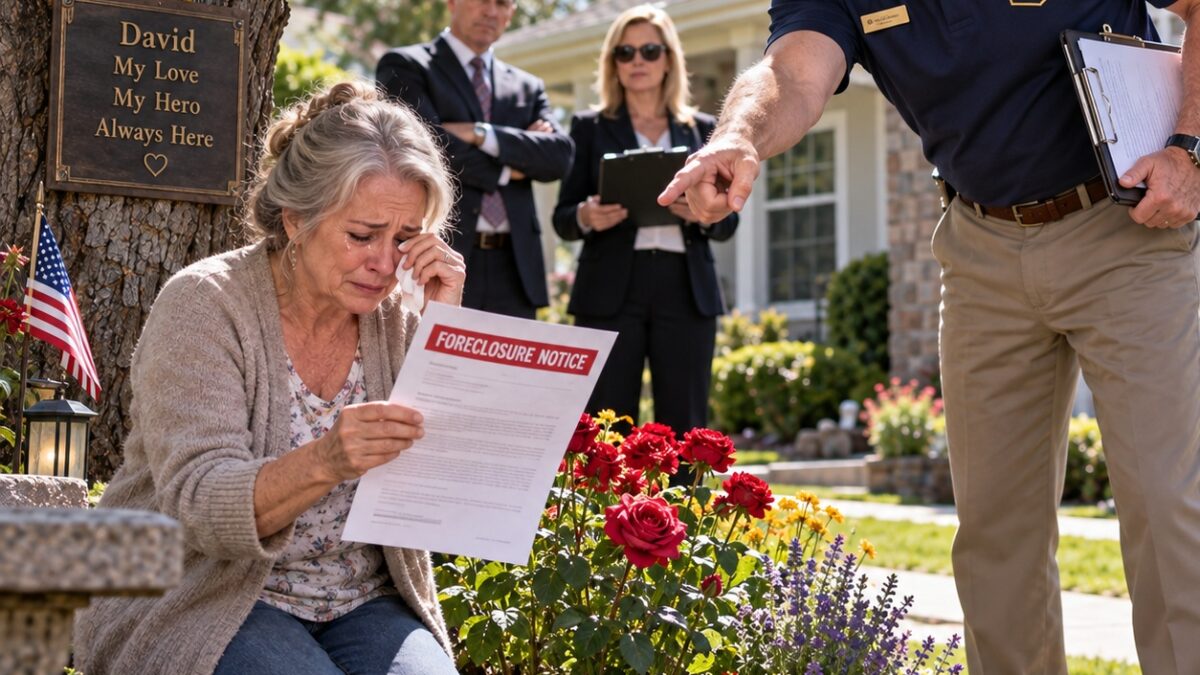
The foreclosure notice arrived on a Friday.
Late July.
Four months after I planted the first rose.
The envelope was thick.
Formal.
Legal.
I opened it at the kitchen counter.
Read.
Then sat because my legs stopped feeling reliable.
Willowbrook Estates was pursuing collection against my home.
Fines.
Fees.
Legal costs.
More than four thousand dollars now.
The house where David and I had planned to grow old.
The place where his ashes rested beneath the oak tree.
I read the same paragraph until language stopped meaning anything.
Then I went outside.
Sat on the bench.
The garden was full.
Roses.
Lavender.
Marigolds.
Beautiful.
My hands shook.
“I can’t lose this house.”
I said aloud.
No answer.
Of course.
For eighteen months, I had spoken to David regularly.
I knew he was not literally answering.
Grief does strange things to conversation.
You keep a marriage alive through habit even after one voice disappears.
“What am I supposed to do?”
Wind moved through the oak leaves.
I thought about the foreclosure notice.
The board.
The records.
Richard’s property.
The selective enforcement.
Then I remembered Colonel Patricia Williams.
David’s former commanding officer.
She called after his funeral.
Then on his birthday.
Then again the first anniversary.
“Any time.”
She had told me.
“If you need anything.”
I hated calling people because of David.
I did not want his service to become currency.
But I needed help.
Not influence.
Help.
So I called.
“Margaret?”
Her voice changed immediately.
“What happened?”
I tried explaining calmly.
I failed somewhere around the word foreclosure.
Patricia listened.
Did not interrupt.
When I finished, she was silent.
Then:
“First.”
She said.
“You need a lawyer.”
“Yes.”
“Not me.”
“Not veterans showing up angry.”
“A lawyer.”
“Yes.”
“Second.”
“David never told you everything about his last deployment.”
I closed my eyes.
“He told me enough.”
“No.”
“He didn’t.”
David had received the Bronze Star with valor.
He hated discussing it.
I knew there had been an ambush.
I knew men survived who might not have without him.
I knew the medal lived in a drawer because he disliked displaying it.
Patricia told me more.
Not classified details.
Enough.
David had made decisions under fire that saved men.
Some were still alive because he refused to abandon a position before everyone was moved.
“They love him.”
Patricia said.
“And they love you because he loved you.”
“I don’t want a mob.”
“I’m not offering one.”
“Then what?”
“I’m offering people who know attorneys.”
“Veterans organizations.”
“Military-family advocates.”
“People who can help you stop drowning alone.”
That sentence broke me.
Alone.
That was the real thing I had been doing.
Not just fighting Richard alone.
Grieving alone.
I had mistaken isolation for strength.
“Okay.”
I whispered.
“Make the calls.”
Within three days, my life changed.
A local veterans organization contacted me.
Then a military-family legal network.
Then an attorney named Rachel Levin.
She had read the violation history before she arrived.
We sat at my kitchen table.
She looked at my spreadsheet.
Then at me.
“You did this?”
“Yes.”
“Do you want a job?”
“No.”
She smiled.
“Good.”
“Because this is going to be enough work.”
Rachel explained the foreclosure needed immediate legal response.
No social-media speeches.
No threats.
Court filings.
Record preservation.
Challenge the lien.
Challenge procedure.
Document selective enforcement.
She also reviewed Richard’s treatment of my garden.
“Did he ever offer retroactive approval?”
“No.”
“Others got it?”
I handed her copies.
She looked at them.
“Interesting.”
That word from a lawyer is different from normal interesting.
It means somebody may be in trouble.
A reporter contacted me after the veterans group mentioned the case publicly.
I hesitated.
Rachel said:
“Media can help.”
“It can also hurt.”
“Tell the truth.”
“Don’t speculate.”
“Don’t call anyone criminal.”
“Don’t exaggerate.”
So I agreed.
The article ran Sunday.
GOLD STAR WIDOW FACES FORECLOSURE OVER MEMORIAL GARDEN.
I hated the headline.
David had been a soldier.
I was his wife.
Our relationship was larger than a title.
But the story spread.
Pictures of the garden.
David’s service.
The fines.
The foreclosure filing.
My quote:
“I understand communities need rules. I do not understand why the rules seem to change depending on who is being punished.”
That line traveled farther than anything else.
My phone started ringing.
Strangers offered money.
I refused most donations.
Legal help.
Accepted.
Letters.
Emails.
Veterans drove to Willowbrook.
Some wanted to protest outside Richard’s house.
I asked them not to threaten anyone.
Signs appeared anyway.
HONOR OUR HEROES.
LET MARGARET GRIEVE.
RULES NEED FAIRNESS.
The source story describes more aggressive public pressure.
I was uncomfortable with it.
I had spent my entire adulthood married to a man who understood force.
David always said:
“If you have to show everyone how powerful you are, you probably aren’t.”
I wanted scrutiny.
Not intimidation.
Then Richard went on television.
That was his biggest mistake.
He stood outside the clubhouse.
Pressed polo.
Silver hair.
Calm voice.
“The association sympathizes with Mrs. Chen.”
He said.
“However, every homeowner agreed to the same covenants.”
“Rules must be applied equally.”
“Making exceptions based on emotional circumstances creates precedent that ultimately harms every resident.”
I watched from my living room.
Mrs. Patterson sat beside me.
Halfway through, she threw popcorn at the television.
“Applied equally?”
I almost laughed.
Because Rachel had documents showing exactly the opposite.
Discovery produced internal emails.
One from Richard read:
If we give that woman with the dead soldier husband an exception, every homeowner will claim a special circumstance.
I stared at the sentence.
That woman.
Dead soldier husband.
David reduced to a phrase.
Me reduced to inconvenience.
Another email from a board member said:
This level of enforcement feels excessive.
Richard replied:
We need to make an example before others begin challenging board authority.
There it was.
Authority.
Not roses.
Not property values.
Not landscaping.
Authority.
Then Rachel obtained another piece of evidence through the legal process.
A recorded conversation involving Richard and HOA counsel.
The source transcript presents it as directly available; in our case, the evidence became usable only through proper legal channels.
Richard said he wanted my case handled aggressively enough to discourage other residents.
Rachel replayed that line twice.
Then turned it off.
“Do you understand what he just gave us?”
“Yes.”
“Motive.”
She nodded.
“And inconsistency with his public claim.”
The lawsuit expanded.
Selective enforcement.
Procedural deficiencies.
Challenge to the lien.
Improper fines.
Other claims Rachel believed the evidence could support.
I did not memorize every legal theory.
That was what lawyers were for.
My job was truth.
Then another story broke.
Richard had frequently implied in meetings that he understood military discipline personally.
Stories.
Phrases.
References that caused many residents to assume he had served.
Veterans began checking.
He had not.
I did not care as much as everyone expected.
Was it dishonest if he intentionally cultivated that impression?
Possibly.
Was it the heart of my case?
No.
I told one reporter:
“I don’t care whether Richard Hartwell served.”
“I care whether he treated people fairly.”
That quote did not get nearly as much attention.
Nuance rarely does.
The recall petition began anyway.
More than sixty percent of homeowners eventually signed.
People had their own stories.
Mrs. Patterson’s welcome mat.
The Johnsons’ tulips.
Frank’s flag.
A woman fined after questioning landscaping costs.
A young family threatened over a swing set while a board member had a larger unapproved structure.
The community split.
Some residents defended Richard.
I understood them more than people thought.
They said:
We signed rules.
Rules protect property values.
If you dislike them, move.
Those arguments were not entirely irrational.
Communities do need predictable standards.
The problem was not standards.
It was selective standards.
Secret exceptions for insiders.
Maximum punishment for critics.
A system where power decided which version of the rule appeared.
That was what I had begun fighting.
The foreclosure hearing came in August.
I barely slept the night before.
Rachel met me outside the courthouse.
“You do not have to perform.”
She said.
“What?”
“There are cameras.”
“Supporters.”
“People expecting a dramatic widow.”
“You are not responsible for giving them one.”
I exhaled.
“Thank you.”
The courtroom was packed.
Richard arrived with the HOA’s legal team.
He looked confident.
Why wouldn’t he?
The covenant existed.
I had planted the garden without prior approval.
That fact never changed.
But facts rarely exist alone.
Procedure matters.
Consistency matters.
Good faith matters.
The judge had reviewed the evidence.
Rachel challenged the lien and foreclosure.
Showed inconsistent treatment.
Retroactive approvals given to board members.
Uncited violations at Richard’s property.
Escalating fines against me.
Internal discussions about making an example.
The HOA’s attorney argued the covenants were binding.
They were.
The judge acknowledged that.
My stomach dropped for a moment.
Then he continued.
A contractual right to enforce rules did not give an association unlimited discretion to enforce them arbitrarily or in a procedurally defective way.
He questioned the selective penalties.
The appeal handling.
The escalation.
The connection between disputed violations and foreclosure.
The judge dismissed the foreclosure action before him and blocked enforcement related to the memorial garden while the legal issues were resolved under the court’s ruling.
He ordered improper amounts refunded or corrected consistent with the judgment.
The source transcript describes a sweeping civil-rights referral and an almost cinematic judicial condemnation.
Reality was more restrained.
Still devastating for the HOA.
The judge emphasized that an association claiming equal enforcement needed evidence of equal enforcement.
Ours did not have it.
When he finished, people began clapping.
The judge immediately raised his head.
“This is a courtroom.”
Silence.
I almost smiled.
Outside, reporters surrounded us.
“How do you feel?”
“Relieved.”
“Do you feel like you beat the HOA?”
“No.”
That surprised them.
“What do you feel?”
I thought.
“I feel like I get to go home.”
That was all I wanted.
Home.
The house David and I bought.
The oak tree.
The bench.
The flowers.
I returned to Willowbrook that afternoon.
Walked directly into the backyard.
Sat beneath the tree.
No cameras.
No veterans.
No attorney.
Just me.
I looked at the roses.
“We won.”
I whispered.
Then corrected myself.
“We’re staying.”
That was better.
I cried for David.
Not Richard.
Not the lawsuit.
David.
Because winning the house did not bring him back to it.
That is the thing justice stories often forget.
You can beat the threat and still live with the original loss.
A week later, Richard resigned as HOA president.
His statement cited personal reasons.
Nobody believed it.
The recall vote had enough support to remove him anyway.
Several board members stepped down.
Others stayed and cooperated with review.
A state investigation into HOA governance and finances followed.
Auditors found more problems than I expected.
Excessive legal spending.
Questionable vendor arrangements.
Reserve-fund expenditures tied to enforcement costs.
Potential conflicts of interest.
Richard’s insurance business had received homeowner referrals connected to the community.
His brother-in-law had an ownership interest in the management company doing HOA work.
Those relationships had not been handled transparently.
Not every questionable practice became a crime.
That distinction matters.
Bad governance is not automatically criminal conduct.
But public scrutiny revealed years of decisions residents had never examined closely.
More than forty homeowners had records suggesting inconsistent enforcement over the previous three years.
Some received refunds.
Some cases were reopened.
Some complaints turned out to be less serious than residents remembered.
That happened too.
Memory becomes angry.
Records become useful.
The new interim board published everything it could legally publish.
Budgets.
Contracts.
Policies.
Appeal procedures.
Meeting minutes.
People discovered transparency is boring.
Beautifully boring.
Mrs. Patterson ran for the board.
I asked:
“Why would you do that to yourself?”
“To stop people like Richard.”
“That is not a healthy retirement plan.”
She won anyway.
The Johnsons volunteered for landscaping review.
Frank Morrison joined a committee on resident rights.
I refused every nomination.
“No.”
I said.
“You started all this.”
Mrs. Patterson complained.
“I planted roses.”
“That is not the same thing.”
I had no desire to become president.
Or activist.
Or symbol.
I wanted mornings with coffee under the oak tree.
Life had other ideas.
The state review became news.
Then a national podcast contacted me.
The episode title was:
THE WIDOW’S GARDEN.
I almost said no.
Then Rachel pointed out how many people had written asking:
What do I do if my HOA is doing this?
So I agreed.
I explained the part people kept getting wrong.
“I did violate a rule.”
The host paused.
“You admit that?”
“Yes.”
“I should have submitted the application before creating the new bed.”
“Richard was right about that.”
“Then why fight?”
“Because a valid rule does not make every enforcement decision valid.”
I explained.
“One mistake did not justify selective punishment.”
“It did not justify applying standards differently to board members.”
“It did not justify turning every unrelated detail of my property into an escalating campaign.”
“And it certainly did not mean I had no right to challenge the lien and foreclosure procedures.”
That became the most downloaded section of the episode.
Not the angry parts.
The admission.
People are tired of stories where heroes are perfect.
I was not perfect.
I was grieving.
I did not read the covenant before planting.
I assumed nobody would care because the garden was beautiful.
That was still an assumption.
My case became stronger once I stopped pretending I had done nothing wrong.
The issue was proportionality.
Consistency.
Process.
Power.
Law-school professors apparently discussed the case.
I learned that from a letter.
I laughed so hard I called Emily—my niece, not Michael’s daughter from another story, just a friend’s daughter who was in law school at the time—and said:
“Somebody is teaching students about my marigolds.”
She replied:
“Please never phrase it that way again.”
Fair.
The memorial garden became locally famous.
That was strange.
Tourists came.
Not hundreds.
Enough.
People dealing with grief would ask whether they could sit on David’s bench.
At first, I hated it.
That was our place.
Mine and David’s.
Then one morning, I found a woman there crying quietly.
She apologized.
“My husband died three months ago.”
I sat beside her.
We said almost nothing.
After twenty minutes, she stood.
“Thank you.”
“For what?”
“For not telling me it gets easier.”
I understood.
People had told me that constantly.
It gets easier.
Sometimes.
Sometimes grief simply gets more familiar.
I started leaving two small watering cans near the garden.
Children walking past could help.
Parents asked first.
That became part of the morning.
One little boy poured an entire can over one marigold.
I did not correct him.
The plant survived.
The new HOA board approved the garden officially.
Retroactively.
Unanimously.
When the letter arrived, I laughed.
Then cried.
The written approval said:
Memorial garden authorized as existing landscaping feature.
No fine.
No daily penalty.
No threat.
Just permission.
David would have rolled his eyes.
“You needed six months of litigation for roses?”
“Yes.”
“That is inefficient.”
I could hear him.
The new board adopted mediation before major penalties.
Clear notice.
Actual cure periods.
Conflict-of-interest disclosures.
Reasonable exceptions for memorial landscaping, accessibility modifications, and some temporary decorations.
Not unlimited exceptions.
Rules remained.
That mattered.
Willowbrook did not become chaos.
That was Richard’s prediction.
If one exception was allowed, standards would collapse.
They did not.
Mailboxes remained black.
Lawns remained neat.
Property values did not implode.
People continued living their lives.
In fact, after the bad publicity faded, buyers returned.
The community’s reputation gradually improved.
Fair governance turned out to be less damaging to property values than national headlines about foreclosing on a widow over flowers.
Who could have predicted?
The financial consequences for the HOA were substantial.
Legal bills.
Refunds.
Audit costs.
Management transition.
Owners were angry.
Some at Richard.
Some at me.
That part hurt.
One man confronted me near the mailbox.
“My assessment went up because of your lawsuit.”
I looked at him.
He was not entirely wrong.
Community money paid for part of the response to misconduct.
“I’m sorry.”
I said.
“You’re sorry?”
“Yes.”
“I wish none of this had cost anyone.”
He looked surprised.
I continued.
“But I did not create the selective enforcement.”
“I did not choose foreclosure.”
“I did not hire the lawyers before asking whether the board was treating residents equally.”
He walked away angry.
I went home feeling sick.
Justice has invoices.
People rarely mention that.
The new board had to repair finances.
Rebid contracts.
Replenish reserves.
Some owners paid more.
That did not mean challenging misconduct had been wrong.
It meant misconduct harms communities long after the person responsible leaves.
Richard eventually moved out of state.
His insurance business lost clients after the publicity.
A licensing review resulted in professional consequences and ethics requirements.
I did not celebrate.
By then, he had stopped occupying much space in my thoughts.
That surprised people.
They expected hatred.
Hate requires attention.
I had spent enough of my life giving Richard attention.
He did not deserve retirement space in my head too.
The most meaningful moment involving him happened before he left.
I saw him at the grocery store.
Produce section.
Of all places.
We both froze.
He looked older.
Not dramatically.
Just tired.
I could have walked away.
Instead, I said:
“Richard.”
“Margaret.”
Silence.
Then:
“I’m sorry about David.”
My jaw tightened.
“You said that at the meeting.”
“I know.”
“That was not what hurt.”
He nodded.
“I know that now.”
I studied him.
“Do you?”
He looked down at his cart.
“I believed if I made one exception, everyone would want one.”
“And I thought if I showed flexibility, the board would lose authority.”
There it was again.
Authority.
He continued.
“I was wrong.”
I waited for qualification.
None came.
“I became more interested in winning compliance than whether enforcement was fair.”
That sounded rehearsed.
Maybe from ethics training.
Maybe therapy.
Maybe actual reflection.
I did not care which.
“I should not have taken your home that far.”
He said.
“No.”
“You shouldn’t have.”
“I can’t undo it.”
“No.”
“Do you forgive me?”
That question annoyed me.
Not because he asked.
Because people treat forgiveness as the ceremonial final step of every wrongdoing.
Apology.
Forgiveness.
Credits.
I thought about David.
The garden.
My sleepless nights.
Fear of losing the house.
Then:
“I don’t know.”
Richard nodded.
Fair enough.
I added:
“But I don’t hate you.”
He looked up.
“That’s all I can give you today.”
He accepted it.
We walked away in opposite directions.
I never saw him again.
Three years after the first violation notice, I still tended David’s garden every morning.
The roses had become enormous.
Lavender spread farther than I intended.
Marigolds returned seasonally.
The oak grew.
The bench needed refinishing twice.
I did it myself the first year.
Poorly.
Mrs. Patterson’s husband redid it before I could ruin it permanently.
A small plaque now sat near the garden.
IN MEMORY OF MASTER SERGEANT DAVID CHEN
AND ALL WHO SERVED.
I resisted adding the second line initially.
This was David’s garden.
Then veterans started visiting.
Widows too.
Parents who lost sons.
Children who lost mothers.
The garden became larger emotionally than the little patch of dirt I planted in grief.
On the anniversary of David’s death, the neighborhood began holding a memorial-garden walk.
Not only military losses.
Everyone.
A woman dedicated hydrangeas to her sister.
The Johnsons planted tulips for a child they lost decades earlier.
Frank placed a small flag beside a tree honoring his best friend from Vietnam.
The event raised money for veteran-support organizations.
Richard had feared precedent.
He was right about one thing.
My garden created one.
Just not the precedent he imagined.
People began making space for grief instead of hiding it behind uniform landscaping.
Not unlimited landscaping chaos.
Applications still existed.
The architectural committee still reviewed things.
But now the first question became:
How can we make this work?
Instead of:
How quickly can we punish it?
That difference changed Willowbrook.
I started receiving speaking invitations.
Homeowner conferences.
Veterans groups.
State legislative panels.
At first, I refused.
Then Rachel said:
“You complain constantly that nobody understands HOA governance.”
“I do not complain constantly.”
She stared.
“Fine.”
“Frequently.”
“So explain it.”
My testimony was not dramatic.
I did not say HOAs were evil.
That disappointed certain people.
I said private community governance needs checks.
Conflict disclosures.
Clear appeals.
Accessible records.
Proportional enforcement.
Independent review where possible.
Reasonable accommodations.
Transparency.
Rules should be understandable enough that ordinary people can know when they are violating them.
A homeowner should not need to become a part-time lawyer to plant flowers.
Legislators listened.
Some reforms passed.
Not because of me alone.
Advocates had been working on these issues for years.
My case became one example.
That was enough.
Legal groups created homeowner guides.
Someone nicknamed one version Margaret’s Manual.
I hated the name.
It stuck.
The first page said something David would have loved:
Do not panic.
Read the notice.
Check the rule.
Save everything.
Respond in writing.
Document dates.
Use appeals.
Get qualified legal advice when necessary.
Boring.
Useful.
Armor.
I kept one printed copy in David’s old office.
Right beside the dishwasher manual.
Mrs. Patterson became board president eventually.
That was a terrifying development.
She called me after the vote.
“Margaret.”
“What?”
“I won.”
“My condolences.”
She laughed.
Her administration was less exciting than Richard’s.
Budgets posted on time.
Few surprise fines.
Mediation.
Open meetings.
Nobody on television.
Success.
People underestimate boring governance.
Boring government usually means someone remembered the job is not performance.
Frank Morrison once asked me:
“Do you miss the fight?”
“No.”
“Not even a little?”
“No.”
“Liar.”
He was right.
Not the fear.
Not the foreclosure.
But there had been energy in knowing exactly what mattered each day.
Fight this.
File that.
Call lawyer.
Review records.
Grief had been replaced by mission.
When the case ended, David’s absence returned differently.
That was hard.
There was no Richard to research at midnight.
No court date.
No reporters.
Just me and the quiet house.
Therapy helped.
I had resisted therapy after David died.
I told myself I was functioning.
Bills paid.
House clean.
Why would I need help?
Then Rachel asked:
“Would David have let one of his soldiers refuse treatment because he was technically functioning?”
That was unfair.
Also effective.
My therapist, Dr. Ames, asked during our first session:
“When did you last grieve your husband without also thinking about the HOA?”
I could not answer.
The battle had merged with David.
That frightened me.
His memory deserved more than being the reason I fought Richard Hartwell.
So I began remembering other things deliberately.
David dancing badly.
David burning pancakes.
David refusing to wear sandals.
David crying when our dog died and then denying it.
David holding my hand during turbulence even though he had been in military aircraft under conditions I did not want to imagine.
The ordinary man.
Not Master Sergeant Chen.
Not Bronze Star recipient.
My husband.
That was healing.
The public always wanted the medal story.
His unit.
The ambush.
Lives saved.
I was proud.
Of course.
But heroism was not why I loved him.
I loved the man who left cabinet doors open.
The man who sang only one line of every song because that was all he remembered.
The man who kissed my forehead before leaving for deployment and told me not to worry as if telling a military spouse not to worry had ever worked in human history.
When I spoke publicly, I started telling those stories too.
One reporter once asked:
“Do you think the board would have treated you differently if they knew how decorated David was?”
I said:
“I hope not.”
She looked confused.
“What do you mean?”
“I don’t want fair treatment because my husband earned a medal.”
“I want fair treatment because I’m a homeowner and a human being.”
That became another quote people shared.
For once, I liked it.
Because veteran status mattered deeply to our family.
But dignity should not depend on discovering that the dead husband someone dismissed as “that soldier” once saved lives.
What about widows whose husbands were teachers?
Truck drivers?
Accountants?
What about people with no widow story?
Fair process has to work before biography enters the room.
That was the lesson Richard missed.
At sixty-five, I had become someone my younger self would not recognize.
Public speaking.
Policy meetings.
Legal workshops.
Mrs. Patterson called me:
“The accidental revolutionary.”
I told her revolutions involve fewer watering cans.
She disagreed.
One Sunday morning, a teenage girl knocked on my gate.
She looked nervous.
“Mrs. Chen?”
“Yes?”
“My dad died last year.”
My heart tightened.
“I’m sorry.”
She held a small plant.
Lavender.
“My mom said you might know where I could plant something.”
Not in my garden necessarily.
She wanted help creating a memorial at their house.
I invited her in.
We sat on David’s bench.
She asked:
“Does it get easier?”
Same question.
Always.
I looked at the roses.
“No.”
Her face fell.
So I continued.
“It gets different.”
“Some days are easier.”
“Some are not.”
“But eventually, remembering them doesn’t only hurt.”
She looked down at the lavender.
“How long?”
“I don’t know.”
“That sucks.”
“Yes.”
She laughed.
I liked her immediately.
We filled out an architectural application together.
That made me laugh too.
“Why are you smiling?”
“Long story.”
The new committee approved her memorial bed in five days.
No fine.
No lawyer.
No headlines.
That approval might have been the greatest victory of the entire thing.
Not mine.
The system’s.
A grieving child asked.
Somebody listened.
A rule bent without breaking.
Property values survived.
Civilization continued.
David would have appreciated the efficiency.
Years after Richard left, people still occasionally drove through Willowbrook because of the podcast.
Most were respectful.
A few treated my backyard like a tourist attraction.
I put up a small sign.
PRIVATE GARDEN — VISIT BY INVITATION.
Boundaries.
Another lesson.
Compassion does not require surrendering privacy.
The garden existed because I loved David.
Not because strangers needed content.
Eventually, media attention faded.
Good.
Flowers remained.
Better.
One spring, a storm broke a major limb from the oak tree.
I heard the crack from inside.
Ran out.
The limb had crushed part of the bench.
I stood staring.
For one ridiculous second, I thought:
Richard won.
Then laughed at myself.
Richard had been gone for years.
Weather did not care about HOA history.
Neighbors helped.
Frank brought a chainsaw.
Mrs. Patterson brought coffee.
The Johnsons helped remove branches.
A carpenter rebuilt the bench using some salvageable original wood.
Life.
Damage.
Repair.
No villain required.
That was strangely comforting.
The world can hurt us without intending anything.
Not every loss needs someone to blame.
David’s death had taught me that.
Richard temporarily made me forget.
When the repaired bench returned, I ran my hand along the wood.
Different.
Still ours.
Like me.
The first memorial-garden tour raised eight thousand dollars for veteran services.
The fifth raised nearly thirty.
I stood at the edge of the crowd that year watching children water flowers.
Mrs. Patterson came beside me.
“You know this is your fault.”
“What?”
“All these people.”
“Yes.”
“I apologize.”
“You should.”
She pointed toward a little boy carrying a watering can bigger than his torso.
“He has watered the same rose six times.”
“That rose will drown.”
“Heroically.”
We laughed.
Then Mrs. Patterson asked:
“Do you think David would be proud?”
The question hurt less than it once had.
“Yes.”
I said.
Then:
“He’d complain about parking first.”
“Of course.”
“But yes.”
That night, after everyone left, I sat alone beneath the oak.
Sunset across the pond.
Flowers damp.
David’s plaque glowing faintly in the last light.
I thought about the first letter.
Unauthorized landscape modification.
$250.
Then $675.
Then $50 daily.
Then $1,500.
$2,000.
$4,000.
Foreclosure.
How absurd numbers can become weapons when fear gives them meaning.
I thought about Richard.
Not with anger.
Just distance.
He had believed rules protected Willowbrook.
In a narrow way, he was right.
Rules matter.
The mistake was thinking enforcement itself was virtue.
It is not.
Rules can preserve fairness.
They can also hide unfairness if nobody checks who receives mercy and who receives punishment.
A good system asks more than:
Was the rule technically violated?
It also asks:
Was the process fair?
Was the response proportional?
Was discretion applied consistently?
Was someone using authority for a legitimate community purpose—or to prove they could?
My garden violated a process.
Richard violated trust.
Those were not equivalent.
That distinction took months, lawyers, a judge, and half the neighborhood to force into daylight.
It should not have.
But sometimes communities only learn after paying tuition in legal fees.
Willowbrook paid plenty.
The board did not collapse.
The neighborhood did not become anarchic.
No one painted their house fluorescent purple out of grief.
No armies of illegal rose beds destroyed property values.
People simply became less afraid of their own HOA.
That was the change I valued most.
Residents attended meetings.
Asked questions.
Board members disclosed conflicts.
People appealed without assuming they would be punished for speaking.
Rules still existed.
But nobody worshiped them.
Three years after the notice, a new couple moved into the house across from mine.
Young.
Two children.
They introduced themselves while I was gardening.
The husband looked at the flowers.
“Are you the Margaret?”
I groaned.
“There should not be a the.”
His wife laughed.
“We heard about the garden.”
“Hopefully the flowers.”
“Mostly the lawsuit.”
“Of course.”
Their daughter, maybe six, pointed toward the plaque.
“Who’s David?”
I looked at her.
“My husband.”
“Where is he?”
Her parents froze.
Children do that.
Ask the question adults spend years avoiding.
“He died.”
She frowned.
“Are the flowers for him?”
“Yes.”
She considered.
Then picked one small fallen lavender sprig from the ground.
“Can I put this by his sign?”
My throat tightened.
“Yes.”
She placed it beside the plaque.
Then ran back toward her parents.
That was David’s legacy to her.
Not a medal.
Not military heroism.
Not national service.
Flowers.
A name.
A stranger worth remembering for thirty seconds.
I loved that.
The sun lowered.
I finished watering.
Sat on the bench.
Some mornings, I still talk to David.
Less urgently now.
More like conversation.
“You would not believe Mrs. Patterson.”
Or:
“The roses are out of control.”
Or:
“I finally replaced the coffee maker.”
Sometimes nothing.
Just sitting.
People ask whether I can hear his voice in the wind.
That sounds beautiful.
No.
I hear wind.
Birds.
Children.
Lawn mowers.
Life.
David’s voice lives somewhere else.
Memory.
I do not need to pretend otherwise.
He would be proud, I think.
Not because I became some fearless activist.
I was afraid constantly.
Afraid of losing the house.
Court.
Public attention.
People judging me.
Speaking in front of legislators.
Even forgiving myself for not reading Section 4.7 before buying flowers.
Courage turned out not to be the absence of any of that.
It was filing the next paper.
Making the next call.
Sitting in the next meeting.
Then eventually knowing when to stop fighting.
That last part was harder.
Conflict gives grief shape.
Peace makes you feel everything again.
But peace was what David wanted for me.
Not endless war in his name.
So I kept the garden.
Kept the lessons.
Let Richard go.
And every spring, the roses bloom whether anyone remembers the lawsuit or not.
That feels right.
The HOA once told me the garden threatened Willowbrook’s standards.
Years later, it became one of the places neighbors loved most.
Not because I won some spectacular battle.
Because people changed what they believed a community was supposed to protect.
Uniformity?
Some.
Property values?
Of course.
But also people.
Especially when life had already taken enough from them.
David spent twenty-two years serving in an organization built on rules.
Strict ones.
He respected discipline more than anyone I knew.
Yet he also understood something Richard never did.
Good leadership is not proving you can enforce every rule.
It is knowing why the rule exists, who it protects, and when blindly enforcing it defeats the mission.
Willowbrook eventually learned that too.
I wish it had not cost so much.
But I am grateful it learned.
Today, if you walk past 1247 Maple Grove Drive, you will see a tidy house.
Black mailbox.
Gold lettering.
Trimmed lawn.
Nothing particularly rebellious.
Then, through the side gate, you may catch a glimpse of color beneath an old oak tree.
Roses.
Lavender.
Marigolds.
A bench.
A small plaque.
No giant monument.
No angry sign about the HOA.
No victory banner.
Just the garden Richard once called a violation.
I still file the landscaping paperwork now.
Every time.
David would appreciate that.
And whenever I sign my name at the bottom of an architectural request, I smile.
Not because Richard taught me obedience.
Because the system finally learned something more important than obedience.
Fairness.
That was all I had wanted from the beginning.
Not special treatment.
Not immunity because David served.
Not the right to ignore every rule because I was grieving.
Just the right to have the same rules applied to me the same way they were applied to the people enforcing them.
It took a foreclosure notice for Willowbrook to understand the difference.
But it understands now.
And every morning when I carry my watering can toward the oak tree, I pass David’s plaque, touch the top of the bench, and look at the flowers that were supposed to be gone years ago.
Then I sit.
Drink my coffee.
And let them bloom.








