𝗙𝗨𝗟𝗟 𝗦𝗧𝗢𝗥𝗬 :The HOA President Buried My Creek With 22 Truckloads of Waste and Threatened Me for Warning Her
FULL STORY CONTINUATION
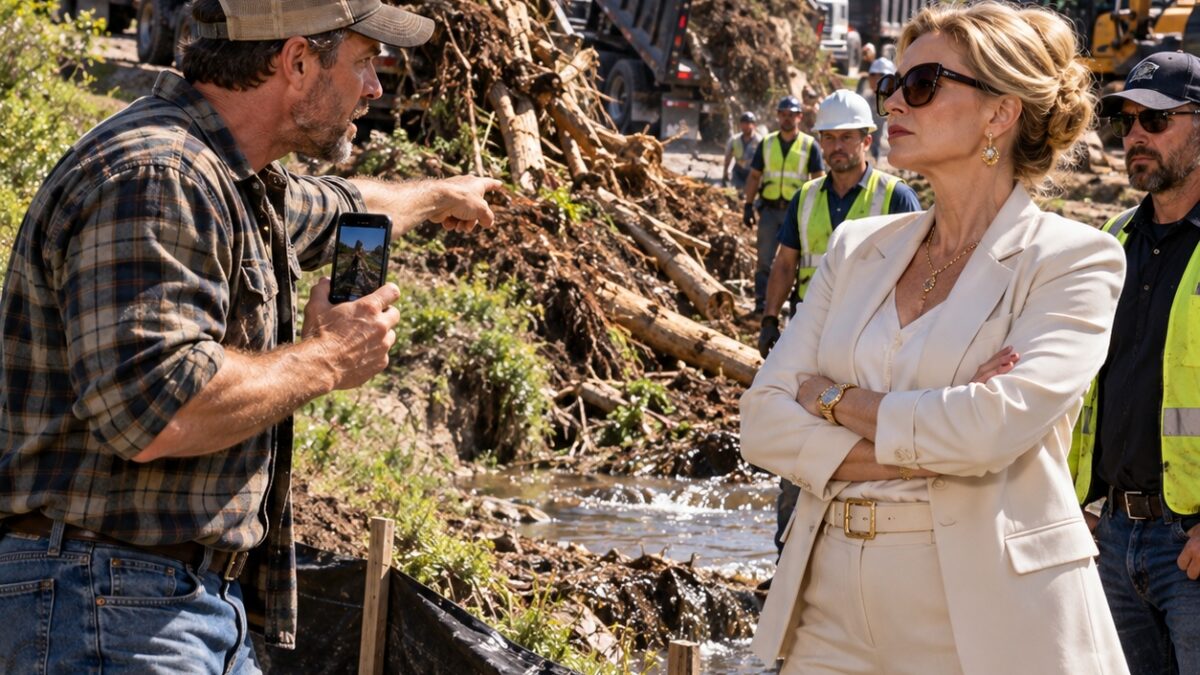
By sundown, fourteen truckloads had been dumped along the creek.
Fourteen.
I stood on the slope above them watching the excavator push one pile after another toward the water.
Every load narrowed the channel a little more.
Every branch added another place for debris to catch.
Every slab of sod looked harmless sitting dry on the bank.
That was the problem.
People look at dry material and imagine it will stay where they put it.
Water has other ideas.
I did not argue with Cynthia again that afternoon.
I recorded.
Truck numbers.
License plates.
Company logos.
Time stamps.
The excavator.
The location of the piles.
The width of the remaining channel.
Cynthia standing beside the creek telling Calvin to continue.
I filmed everything.
By six thirty, the crew left.
The valley became quiet again.
I went inside, changed my boots, and spread an old topographic map across my kitchen table.
It had come with the ranch paperwork when I bought the place.
Most people would have thrown it in a drawer and forgotten about it.
I kept old surveys.
Old drainage plans.
Old aerial photographs.
That habit came from years in construction.
A piece of paper nobody cares about today can become the most important thing in the room five years later.
I traced the creek with my finger.
My property.
The dump site.
The bend toward Stonebrook.
Then I noticed a faint blue line branching away from the main channel.
It crossed land that was now part of the golf course.
I pulled out another folder.
Planning documents.
Old site plans.
County approvals from before Brier Glenn was fully built.
Eventually I found a sheet nearly thirty years old.
The area that now contained holes eight, nine, and ten was shaded.
Across it, in neat engineering lettering:
NATURAL OVERFLOW CORRIDOR.
I leaned back.
There it was.
When the creek rose beyond channel capacity, excess water was supposed to spill across that low ground.
Spread out.
Slow down.
Then gradually return to the channel farther downstream.
That was probably why nobody had ever built houses there.
A developer had come along later and realized land too wet for homes could still grow fairway grass.
That was not necessarily irresponsible.
Golf courses can coexist with floodplains.
If you respect the floodplain.
The next morning, I drove around Stonebrook’s perimeter road.
That was when I saw the second problem.
A berm.
Freshly raised.
Long.
Running beside hole nine.
It had clearly been built to keep runoff off the fairway.
In small storms, I could see why the board loved it.
Water that once spread across the grass stayed confined.
Course remained dry.
Golfers remained happy.
Maintenance costs stayed lower.
But combine that berm with a narrowed creek and the whole thing looked different.
Someone had closed part of the overflow corridor.
Now someone was packing the creek itself with loose material.
It looked less like maintenance and more like an attempt to force water to go somewhere else.
Somewhere that was not Stonebrook.
I took photographs.
Wide shots.
Close shots.
One from the road showing the relation between the berm and the creek.
Then I went home.
What I did not know yet was that I was not the only person warning Cynthia.
Stonebrook’s superintendent was a man named Bryce Kincaid.
Forty-six.
Course superintendent for years.
He knew every low spot on those fairways better than Cynthia knew her own driveway.
Later, Bryce told me that he had confronted her the same week.
He stood in the maintenance office with a drainage plan open on the desk.
“This material is going to move.”
Cynthia looked up from her laptop.
“It’s bank stabilization.”
“Branches aren’t riprap.”
“It’s organic.”
“So are trees floating down a river.”
She frowned.
Bryce pointed toward hole eleven.
“When the creek comes up, that stuff gets carried downstream. It reaches the culvert, it starts catching.”
“Stonebrook has never had a major blockage there.”
“We’ve had problems there for years.”
“Ponding.”
“Because the culvert is undersized.”
That was not a new argument.
Months earlier, Bryce had recommended a proper drainage project.
New swale.
Larger culvert.
Corrected grades.
Engineering estimate:
$318,000.
Cynthia killed the proposal.
Stonebrook was preparing for a showcase tournament designed to attract buyers and new members.
A three-hundred-thousand-dollar excavation project would tear up the course for months.
Trenches.
Machines.
Mud.
Closed holes.
Not the image Cynthia wanted.
Blue Finch offered a cheaper plan.
Roughly $37,000 to “stabilize” the creek and process landscape material.
On paper, it sounded responsible.
In reality, they were burying branches in a drainage corridor.
Bryce refused to sign the completion report.
Cynthia apparently leaned across her desk.
“Your management contract comes up for review this year.”
Bryce stared at her.
“Is that a threat?”
“It’s a reminder.”
“Of what?”
“That people who create unnecessary problems rarely get rewarded.”
Bryce did not sign.
That same afternoon, I sent Brier Glenn HOA a formal email.
No insults.
No threats.
Just facts.
I attached photographs.
The old map.
My description of the reduced creek cross-section.
The downstream culvert.
The likely debris migration.
Then I asked for one thing.
Remove the dumped material within seventy-two hours.
Cynthia answered personally.
Three sentences.
The HOA is performing lawful maintenance under its recorded easement.
There is no material flood risk.
Mr. Talbot is instructed not to interfere with association access.
I printed it.
The next morning, I received a violation notice.
From Brier Glenn HOA.
It accused me of placing cameras and survey stakes too close to the easement.
I read the letter at the end of my driveway.
Then laughed.
My ranch was not part of Brier Glenn.
Never had been.
My parcel predated the subdivision by decades.
Their covenants had no authority over my acreage.
They might as well have mailed me a parking ticket from another state.
I could have thrown it away.
Instead, I put it into a folder.
That folder already contained the first videos.
Cynthia’s email.
The map.
The easement.
The photographs.
I had no interest in a shouting match.
Cynthia seemed to like those.
I did not.
I liked records.
Years in construction taught me something valuable.
The person who yells the loudest can control a room for five minutes.
The person holding dated photographs, signed documents, and original files usually controls what happens afterward.
So I kept building the file.
Two nights later, at 11:43 p.m., one of my trail cameras lit up.
I saw the notification the following morning.
Headlights along the creek bank.
I opened the footage.
Two Blue Finch dump trucks rolled into view.
Then the excavator.
Work lights came on.
Calvin stood beside the machine.
This time the trucks were carrying bigger material.
Whole sections of tree trunk.
Large limbs.
Roots.
More turf.
Soil.
The excavator shoved everything into the bank.
Not loosely.
Compacted.
Several logs were placed almost crosswise to the current.
I replayed one section three times.
It looked like the beginning of a beaver dam built with diesel equipment.
By sunrise, the total number of loads was twenty-two.
I saved the original files in three places.
Home computer.
External drive.
Cloud storage.
Then I sent copies to my ranch insurance agent.
After that, I filed a formal complaint with the county stormwater department.
I did not ask for money.
Did not demand punishment.
Did not even ask them to believe me.
I asked for an inspection.
Cynthia heard about it within hours.
That afternoon her white SUV stopped at my ranch gate.
I walked down.
She lowered the window.
“Withdraw the complaint.”
No greeting.
Nothing.
“Good afternoon, Cynthia.”
“This doesn’t need to involve the county.”
“You said I shouldn’t interfere with your easement.”
“That’s correct.”
“So I called somebody who can.”
She got out.
That smile appeared again.
The one she used when anger stopped working and she tried charm instead.
“Reed, we don’t need to turn this into a fight.”
“I agree.”
“The HOA would be willing to clean up your creek bank.”
“My creek bank?”
“At no charge.”
I stared at her.
“What exactly does ‘clean up’ mean?”
“We can flatten the banks, remove brush, straighten the channel, make it look much better.”
That answer told me almost everything.
“The creek doesn’t need to look better.”
“It would improve maintenance.”
“It needs to flow.”
“A straighter channel would flow.”
“Faster.”
She looked annoyed.
“And then?”
“What?”
“Where does the faster water go?”
She waved one hand.
“Downstream.”
“Exactly.”
She stared at me.
I continued.
“A creek is not a landscaping feature. You don’t straighten it because curves offend you.”
“You’re being dramatic.”
“No. You’re trying to make water behave like a golf-course drain.”
Her mouth tightened.
“You’re making this harder than it needs to be.”
I almost laughed.
“I’m not the one who put twenty-two truckloads in a channel.”
She got back into the SUV.
That afternoon, a sign appeared beside the HOA maintenance lane.
STORMWATER IMPROVEMENT PROJECT
AUTHORIZED PERSONNEL ONLY
No permit number.
No county seal.
No engineering reference.
I photographed it from three angles.
Downstream, Bryce walked the culvert again.
Small branches were already collecting against the grate even though the creek was low.
He emailed Cynthia.
Copied the full board.
His warning was specific.
More than three inches of rain in a short period could create a blockage.
Someone needed to inspect the upstream area immediately if a storm approached.
Cynthia replied only to Bryce.
She removed the board from the email chain.
Her response was one line.
Don’t create unnecessary records.
Bryce stared at it.
Then forwarded the entire exchange to his personal account.
He later told me he did not know exactly why.
He just knew it felt wrong.
He was right.
The moment somebody tells you not to create a record, creating one is probably wise.
I kept preparing.
I placed elevation stakes on my own property.
Photographed the creek from fixed points.
Logged the location of the piles.
Moved my tractor and implements to higher ground.
Cleared the drainage ditches on my ranch.
Propped low gates open so debris could not collect against them.
And most important:
I did not touch the creek.
No digging.
No trenching.
No moving logs.
No breaking piles.
Nothing.
If a disaster happened, I wanted nobody claiming I had altered the scene.
Three days later, the weather forecast changed.
Slow-moving storm.
Five to seven inches of rain.
I sent one final warning.
This time I copied the county stormwater department.
Cynthia replied within an hour.
Stonebrook has handled bigger storms than this.
I walked down to the creek.
Water was still low.
But behind the newest debris pile, the current had changed.
Instead of running cleanly downstream, it curled.
Eddied.
Swirled.
The obstruction was already changing flow.
Maybe Stonebrook had handled bigger storms.
It had never handled them with twenty-two truckloads of debris sitting upstream.
The county scheduled an inspection for the following afternoon.
The storm was forecast to arrive twelve hours earlier.
By late afternoon, clouds swallowed the valley.
Before dark, I walked the property one last time.
Equipment on high ground.
Ditches clear.
Gates open.
Then I started a video at the hilltop.
One continuous recording.
I narrated the date.
Time.
Weather.
Walked down to the creek.
Filmed the bank.
Every pile.
Every stake.
The channel.
The HOA lane.
The berm visible in the distance.
Then walked back.
No cuts.
No edits.
The rain started around six.
By eight, the creek looked like strong coffee.
By ten, water touched the bottom edge of the Blue Finch material.
My infrared camera showed grass and mulch peeling away.
Then pieces of sod.
Then branches.
Across the valley, Cynthia sat inside Stonebrook’s clubhouse with several HOA members.
Bryce later told me she had a glass of wine.
She believed the creek would carry the storm around the course the way it always had.
Bryce was not drinking.
He drove a utility cart toward hole eleven.
The creek was already almost two feet above normal.
He watched a piece of sod float toward the culvert.
Then a branch.
Then roots.
They began catching.
He called Cynthia.
“We need an excavator.”
“For what?”
“The culvert.”
“It’s still flowing.”
“It’s starting to plug.”
“What do you want to do?”
“Pull the material while we still can.”
“In this weather?”
“Yes.”
“Absolutely not.”
“Cynthia—”
“No.”
“The opening is collecting debris.”
And then she said something Bryce never forgot.
“If you put heavy equipment in the creek tonight, you create a record that our earlier work caused a problem.”
Bryce went silent.
She was not worried about the machine.
She was worried about evidence.
“Leave it alone until morning,” she told him.
Midnight came.
My rain gauge passed four inches.
At 12:37, I heard something from down in the valley.
Deep.
Hollow.
Timber knocking against stone.
I opened the camera feed.
A massive section of the debris pile lifted from the bank.
Branches tangled together.
Rolled sod.
Root mats.
Mulch.
Loose wood.
The whole mass rotated into the current and started downstream.
Ten minutes later, one of my lower cameras went black.
I stayed away from the water.
Floodwater kills experienced people every year because they convince themselves they understand it.
I understood it enough to know not to go near it.
I called the county emergency line.
Reported that man-made debris was moving downstream and creating a blockage risk.
Public works logged the call.
They could not safely put crews in the creek.
At 1:17 a.m., according to later investigation, the culvert plugged.
Water rose behind it.
Inches.
Then a foot.
Then more.
The creek tried to spread.
That was what the old flood corridor was designed for.
But the berm beside hole nine blocked part of the natural path.
So the water ran along the berm.
Volume built.
Pressure increased.
The berm that Cynthia had built to protect the fairway became a funnel.
Hundreds of thousands of gallons began moving toward one weak point.
At 1:52, my phone rang.
Cynthia.
I answered.
She was screaming.
“Water is coming toward Stonebrook!”
“Okay.”
“You need to get your excavator down there.”
“No.”
“What?”
“I’m not putting anyone into a flooded creek at two in the morning.”
“You can open the channel.”
“No.”
“This is your creek.”
“Nothing of mine is blocking it.”
“If you let my golf course flood, I’ll hold you responsible for every dollar.”
I looked at the monitor.
The bank where the HOA had piled material was nearly empty now.
I said:
“Get everyone away from the low ground.”
The call disconnected.
On Stonebrook’s side, Bryce stood on a raised cart path with rain pounding his jacket.
He watched floodwater spread toward the course.
Not randomly.
It followed the old overflow corridor almost perfectly.
At 2:41 a.m., the berm failed.
One low section broke.
That was all it took.
Water surged through.
Hole eight disappeared first.
Bunker sand washed into pale streaks.
Hole nine sat lower.
The main force hit it next.
Fairway vanished.
Bryce drove the last utility cart out minutes before the path behind him disappeared.
Then holes ten, eleven, and twelve flooded.
The irrigation pump station went under.
Electrical control cabinets shorted.
Cart paths tore apart.
Sections of asphalt lifted.
And everywhere the water went, it carried proof.
Mulch.
Branches.
Rolled turf.
Roots.
Tree limbs.
Some material still carried Blue Finch tags.
The creek had delivered their garbage directly back to Stonebrook.
Cynthia reached hole ten during the storm.
The fairway she had wanted perfectly dry was now a brown river hundreds of feet wide.
Her first instinct was not to ask what went wrong.
It was to control the story.
She started calling board members.
“Talbot’s creek overflowed.”
That was the phrase.
Not our debris moved.
Not our culvert clogged.
Not our berm redirected water.
Talbot’s creek overflowed.
She wanted the explanation established before sunrise.
Bryce stood nearby looking at branches jammed around bridge railings.
He recognized them.
His own maintenance crew had cut some of those trees days earlier.
By five, rain began easing.
Water did not.
The culvert was still choked.
Hole thirteen started flooding.
The practice range filled.
The maintenance parking lot disappeared beneath mud.
The clubhouse sat high enough to escape major damage.
By sunrise, nearly half the golf course was underwater.
I stood on the high side of my ranch watching.
I did not celebrate.
There was nothing satisfying about it.
People think vindication feels good.
Sometimes it does.
Watching millions of dollars of property disappear under floodwater because someone refused to listen did not.
There were pumps down there.
Electrical systems.
Years of maintenance.
People’s jobs.
Homeowners who had never approved any of this.
Every bit of that damage was waste.
That was what made me angry.
Around eight, Cynthia came to my property.
This time she brought the HOA attorney.
He wore rubber boots with his suit.
He introduced himself.
Then told me the association was preparing a demand holding me responsible for failure to maintain the creek.
I let him finish.
Then asked:
“Would you like to see the video before you send that?”
Cynthia snapped:
“What video?”
I opened my phone.
11:43 p.m.
Blue Finch trucks.
Calvin.
Excavator.
Whole tree trunks.
Work lights.
Debris being packed into the bank.
Cynthia stopped talking.
The lawyer watched the entire clip.
“Send me that.”
“You’ll get it through the county.”
Behind them, a large branch drifted across hole ten.
Blue paint circled the bark.
Stonebrook used that color to mark trees scheduled for removal.
Later that morning, more evidence surfaced near the culvert.
Torn landscape bags.
Purchase lot numbers.
HOA inventory.
Cynthia changed tactics again.
She sent a notice to every Brier Glenn homeowner.
Stonebrook had suffered flooding caused by a drainage incident originating from adjacent property.
My property.
No mention of Blue Finch.
No mention of midnight trucks.
No mention of Bryce’s warning.
No mention of twenty-two loads.
Then the HOA sent me a letter instructing me not to alter the creek while the insurance investigation continued.
The irony almost made me laugh.
That was exactly what I intended.
County stormwater inspector Monica Pritchard arrived that afternoon.
Forty-one.
Sharp.
Practical.
Unimpressed by titles.
She started at the culvert.
Her crew needed less than twenty minutes to identify the blockage.
Logs.
Sod.
Roots.
Plastic ties.
Landscape fabric.
Bags.
Old irrigation pipe.
Monica looked at Cynthia.
“Where did this material originate?”
Cynthia shrugged.
“Floodwater can carry debris from anywhere.”
Monica looked toward me.
I handed her an external hard drive.
“What’s this?”
“Every truck.”
Cynthia turned.
“Every load,” I continued. “Every location. Time-stamped.”
Monica took it.
For the next several hours, county personnel compared the videos against my photographs and elevation stakes.
The preliminary conclusion was brutal in its simplicity.
The HOA reduced the creek’s carrying capacity.
Loose material migrated downstream.
The culvert clogged.
Water backed up.
The berm redirected overflow.
The water entered the historic flood corridor.
Not one part of that chain required any action by me.
Cynthia tried another argument.
“Mr. Talbot should have removed the material. The creek crosses his land.”
I pulled out the easement.
The same document she had used to tell me to stay out.
Its maintenance clause gave Brier Glenn both the right and responsibility to perform drainage maintenance on that section.
Cynthia had spent three weeks claiming authority.
Now she wanted to claim helplessness.
The document did not let her have both.
Then Bryce approached Monica.
He handed her printed emails.
His warning about the culvert.
Copied to the board.
Then Cynthia’s private response.
Don’t create unnecessary records.
Monica read it once.
No expression.
“Can you forward the entire email chain to my official address?”
Bryce did it immediately.
The insurance adjuster arrived later that day.
Damage estimates began climbing.
Turf.
Greens.
Bunkers.
Footbridge.
Cart paths.
Pump station.
Electrical systems.
Irrigation.
Lost revenue.
Early estimate:
More than $1.9 million.
Cynthia wanted it categorized as a natural flood.
Act of God.
Extraordinary rainfall.
The adjuster stood in the mud looking at the debris.
Then asked the question that changed the insurance discussion.
“Before the rain started, who changed how the water moved?”
Nobody answered.
That night, Bryce emailed me.
One attachment.
Subject line:
PAGE 47
I opened it.
Stonebrook engineering study.
Eight months old.
Commissioned by the HOA itself.
The report had been prepared to understand recurring water problems around the golf course.
Its conclusions went far beyond puddling.
The existing box culvert was close to capacity.
The berm near hole nine could dramatically increase water velocity during overflow.
And underlined in bold:
NO LOOSE MATERIAL SHOULD BE PLACED IN THE UPSTREAM CREEK SECTION UNDER ANY CIRCUMSTANCES.
I read it three times.
Then I opened the meeting notes.
Cynthia Marlo.
Present.
She had known.
Eight months before the storm, engineers warned her about the exact mechanism that later destroyed Stonebrook.
That changed the central question.
It was no longer:
How could she have known?
It became:
Why did she ignore it?
The invoices answered that.
The proper drainage upgrade had been priced around $318,000.
Cynthia did not want that number in the HOA budget before the showcase tournament.
Too visible.
Too expensive.
Too disruptive.
Instead, Blue Finch received smaller contracts.
$28,400.
$31,800.
$24,600.
$36,900.
Each with harmless language.
Bank stabilization.
Organic debris management.
Landscape recycling.
Drainage appearance improvement.
Individually, none looked like a major drainage project.
Together, they formed one.
Stonebrook was trying to reshape water behavior cheaply and quietly.
Monica’s team found another problem.
The dumped material was not purely organic.
Plastic sheeting.
Irrigation tubing.
Geotextile fabric.
Packaging.
Cynthia’s argument that everything would “break down naturally” collapsed.
The county issued an emergency order.
The culvert had to be cleared.
The creek restored under supervision.
No more work without approval.
Stonebrook’s damaged holes closed indefinitely.
Pressure increased.
Cynthia turned on Calvin.
She told investigators Blue Finch had chosen where to dispose of the material without direction from the HOA.
That was a mistake.
Calvin took out his phone.
Opened the text thread.
One message from Cynthia:
Use the creek side. Keep the course clean before the event.
Another:
Pack the bank tighter. I don’t want runoff crossing nine again.
The room went quiet.
Cynthia stared at the screen.
For the first time, she seemed to realize Calvin was not going to accept responsibility for decisions she had put in writing.
Then the HOA treasurer found something worse.
Gloria Hensley was a retired accountant.
Quiet woman.
Did not care about personalities.
She cared about numbers.
While reviewing vendor files, she pulled Blue Finch’s corporate records.
A holding company owned thirty-two percent of Blue Finch Property Services.
Its name:
Marlo Capital Holdings.
The signature on the corporate filing:
Cynthia Marlo.
She had a financial stake in the contractor.
She had never fully disclosed that interest to the board.
Suddenly every strange choice made more sense.
Why Blue Finch?
Why split contracts?
Why kill the $318,000 engineering fix?
Why threaten Bryce?
Why push “organic debris management”?
Why ignore warnings?
Why tell him not to create records?
Cynthia was saving the HOA money in the short term while sending association work to a company in which she had a financial interest.
I did not call it corruption.
I did not need to.
The numbers could speak.
I added Gloria’s records to my folder.
The folder that had begun with one video on a gray Tuesday morning was now several inches thick.
Then Monica uncovered another layer.
Historic flood maps.
Development approval documents.
She placed an old topographic survey beside a modern Stonebrook map.
On the old map, the flood corridor passed through the land now occupied by holes eight, nine, ten, and eleven.
When Brier Glenn was approved, the developer had been allowed to build fairways there under one condition.
The area had to remain functional as flood overflow.
Grass was fine.
Golf was fine.
But no permanent obstruction could redirect major floodwater.
Over the years, people forgot.
Or ignored it.
Cynthia went farther.
She had the berm raised.
In small storms, it worked.
That was the dangerous part.
Success convinced her she had beaten the problem.
Fairways stayed dry.
Residents praised the improvement.
Then a major storm arrived.
The debris created the plug.
The berm created pressure.
The course sat directly where the water had always gone.
Nature had not betrayed Stonebrook.
Stonebrook tried to force nature somewhere else.
Monica presented those findings at an emergency HOA meeting.
The room was packed.
I stood near the back.
Cynthia sat at the front.
Still acting like she controlled the meeting.
Monica explained the sequence.
Culvert.
Debris.
Berm.
Overflow corridor.
Cynthia interrupted.
“This was an extraordinary rainfall event.”
Monica nodded.
“Yes.”
Cynthia seemed relieved.
Then Monica continued.
“An extraordinary storm does not erase responsibility for man-made changes that materially increase damage.”
Stonebrook’s insurer had already issued a reservation-of-rights letter.
Homeowners understood what that meant.
Possible uncovered losses.
People started demanding documents.
Contracts.
Invoices.
Meeting minutes.
Emails.
Cynthia tried to push through a vote allowing more HOA reserve money to hire attorneys.
That was when Gloria stood.
She carried a folder.
“I think the membership should know something before we approve any more spending.”
Cynthia looked at her.
“This is not on the agenda.”
Gloria did not sit.
“No. It isn’t.”
Then she explained Marlo Capital Holdings.
Thirty-two percent ownership.
Blue Finch.
Payments.
Contracts.
No full disclosure.
The room erupted.
A homeowner shouted:
“Did you profit from those contracts?”
Cynthia did not answer.
Another:
“Did our dues go to a company you own?”
“I will not respond to an accusation based on an incomplete understanding of corporate structures.”
That was not an answer.
Then Bryce stood.
He held the engineering report.
“Page forty-seven.”
The room quieted.
He read the warning about loose material.
Then his email before the storm.
Then Cynthia’s response.
Don’t create unnecessary records.
Nobody spoke.
Cynthia’s face hardened.
“You’re betraying this association to protect yourself.”
Bryce shook his head.
“I’m trying to save the golf course.”
His voice was calm.
“I was doing that before you decided to bury a creek.”
That sentence landed harder than shouting would have.
The board voted that night.
Cynthia’s authority was suspended pending audit.
No police entered.
No dramatic arrest.
Her power simply vanished under fluorescent lights in front of homeowners she had spent years controlling.
A few days later, the HOA attorney called me.
Settlement offer.
Substantial.
Diane Whitaker, my land-use attorney, came with me to the meeting.
Cynthia was there.
But she was not at the head of the table anymore.
Two attorneys.
An insurance representative.
Diane.
Me.
The association offered to restore the creek bank.
Withdraw the bogus violation letter.
Stop disputing the easement.
Compensate me for documented property damage and time.
Then add a large lump-sum payment.
All I needed to sign was a statement saying the flood had been caused primarily by unusual rainfall and no party admitted fault.
I read the document.
Twice.
The money was real.
Meaningful.
Anyone who says money would not matter is lying.
Lawyers cost money.
Property repairs cost money.
Time costs money.
But one question bothered me.
“If I sign this, what happens to the creek?”
The HOA attorney answered.
“The association will evaluate remediation options later.”
“What options?”
“We’ll develop a plan.”
“Using whose engineer?”
Silence.
I set down the pen.
Cynthia leaned forward.
“This is an extremely generous offer.”
“I know.”
“You are receiving compensation beyond your direct losses.”
“I know.”
“Then what exactly do you want?”
“The problem fixed.”
Her jaw tightened.
I laid out my conditions.
Every dumped load removed.
Unauthorized berm reevaluated.
Culvert upgraded.
Creek restored with native vegetation.
Easement limited to lawful drainage work.
Independent engineering.
County approval.
Cynthia leaned back.
“You’re exploiting a disaster.”
I pulled out the old map.
Slid it across the table.
Tapped the blue corridor running through Stonebrook.
“I didn’t put a golf course in the path of the water.”
Nobody said anything.
I did not sign that day.
The audit finished several weeks later.
Blue Finch had received more than $240,000 in HOA contracts over two years.
Cynthia’s ownership interest had not been properly disclosed.
The board formally removed her as president.
Blue Finch’s contract was terminated.
Insurance companies began negotiating responsibility.
HOA.
Contractor.
Other parties.
Repair estimates kept increasing.
Golf course reconstruction.
Creek restoration.
Drainage.
Lost revenue.
Irrigation.
Electrical.
Final projections exceeded $2.6 million.
Cynthia tried telling homeowners she was being made a scapegoat.
The record was too strong.
Video.
Photographs.
Invoices.
Engineering reports.
Email.
Texts.
Historic maps.
Corporate records.
No single document destroyed her.
That mattered.
It was the pattern.
Every small choice fit into the next.
Reject the proper drainage fix.
Hire Blue Finch.
Hide the financial tie.
Build the berm.
Dump debris.
Ignore warnings.
Threaten Bryce.
Mail me a fake HOA violation.
Send trucks after midnight.
Tell someone not to create records.
Then blame my ranch after the flood.
One choice could be explained.
All of them together could not.
A civil settlement eventually required the responsible parties to contribute to recovery.
Because of Cynthia’s financial conflict, she personally absorbed part of the legal and financial consequences instead of dumping everything onto the homeowners.
The harshest consequence had nothing to do with money.
The county refused to let Stonebrook rebuild the destroyed holes the same way.
The flood corridor had to function again.
That meant part of the course Cynthia had spent so much effort trying to keep dry would never return to her design.
Six months later, I walked down to the restored creek on a cold morning.
Mist hung across the valley.
An excavator moved onto the old hole nine.
The first time I had seen an excavator near that water, it had been packing debris into the bank.
This one was undoing the damage.
Crews lowered the berm.
The old box culvert came out.
A larger one went in.
Banks were reshaped under an engineered plan.
Native trees.
Flood-tolerant grasses.
Riparian buffer.
Stonebrook redesigned the three holes deepest in the overflow corridor.
The course did not disappear.
I never wanted that.
Destroying Stonebrook would have punished too many people who had nothing to do with Cynthia’s decisions.
Instead, the redesign respected the valley.
Part of the old hole nine became seasonal wet meadow.
A detention pond was constructed where engineers had recommended one years earlier.
Irrigation equipment moved above flood elevation.
Electrical controls were raised.
In normal weather, golfers still had a golf course.
During major storms, water had room.
Bryce kept his job.
In fact, the new board gave him more authority over technical decisions.
Calvin lost the Stonebrook contract.
Blue Finch paid part of the recovery costs under insurance agreements.
Cynthia held no HOA position.
Between legal bills, settlement exposure, and the fallout from her undisclosed ownership, she eventually sold her interest in Blue Finch.
She stayed in Brier Glenn for a while.
I occasionally saw her SUV.
We never spoke.
I did not put up a victory sign.
Did not post videos online.
Did not make jokes at her expense.
Some neighbors did.
I stayed out of it.
That surprised people.
“After everything she did?”
Yes.
After everything she did.
Accountability is not the same thing as humiliation.
I wanted the creek fixed.
The easement respected.
The record clear.
Once I had those things, I was finished.
I kept one object from the whole mess.
The old topographic map.
I had it framed.
It hangs above my kitchen table.
The faint blue line showing the flood corridor still runs toward Stonebrook.
Before the flood, it looked like an insignificant mark left by engineers decades earlier.
Now, every time I see it, I remember something simple.
Somebody already knew.
Long before Cynthia.
Long before me.
Long before expensive houses wrapped around the golf course.
Some engineer had looked at the shape of the valley and written:
Water goes here.
That was all.
The disaster happened because people decided that old warning was inconvenient.
The following spring, another storm crossed the hills.
Not as large.
Still heavy enough to test the reconstruction.
I stood on the slope.
Rain darkened the pasture.
The creek rose.
Brown.
Fast.
Water reached the new culvert.
Passed through.
No debris pile.
No branch mat.
No pressure building behind a grate.
Eventually, the creek reached overflow level.
Water slipped over the bank.
Into the restored meadow.
It spread.
Shallowed.
Slowed.
Then gradually eased back toward the main channel farther downstream.
Exactly as the old map showed.
No violent surge.
No berm collapse.
No disappearing fairway.
Bryce stood on the Stonebrook side.
When the rain eased, he walked down toward the fence line.
We watched together.
For a while, neither of us spoke.
Then he said:
“Turns out the best way to control water is to stop trying to control every inch of it.”
I nodded.
“You just have to give it somewhere to go.”
Below us, the creek ran cleaner than it had in years.
No rotting turf.
No plastic.
No branches compacted into the bank.
Across the valley was a strip of natural grass where Cynthia once demanded bone-dry fairway.
I thought back to that first gray Tuesday.
Her cream slacks.
Her sunglasses.
Her hand waving toward fourteen truckloads of debris.
“It’s organic material.”
Then:
“Keep going.”
Two words.
That decision followed her for months.
I never broke a dam.
Never opened a gate.
Never diverted water.
Never sabotaged anything.
I recorded.
That was enough.
Cynthia had position.
I had timestamps.
She had an HOA board.
I had the map.
She had lawyers.
I had twenty-two truckloads on video.
She had explanations.
The creek had physics.
People ask sometimes whether I knew the golf course would flood.
No.
Not exactly.
I knew the risk.
I knew the debris could move.
I knew the culvert could plug.
I knew the berm could make overflow worse.
But anyone who claims they can predict precisely how a flood will behave is usually selling something.
Water finds weaknesses.
The point was never that I knew exactly what would happen.
The point was that Cynthia had been warned the system was vulnerable and kept narrowing the margin anyway.
That is how disasters are built.
Rarely one giant mistake.
Usually many small ones.
The proper repair costs too much.
Use a cheaper contractor.
The engineering report is inconvenient.
Ignore it.
The creek floods part of the course.
Build a berm.
The maintenance debris needs disposal.
Put it by the creek.
A rancher complains.
Call him difficult.
A superintendent warns you.
Threaten his contract.
The county gets involved.
Create paperwork blaming somebody else.
Each decision seems manageable alone.
Together, they become catastrophe.
That was what Monica said during one later meeting.
“Systems fail in chains.”
I remember that phrase.
The creek did not flood Stonebrook because of one branch.
It flooded because of accumulated decisions.
The debris reduced capacity.
The debris migrated.
The culvert clogged.
The berm redirected water.
The overflow corridor had been constrained.
The storm supplied volume.
All those things met on the same night.
Cynthia spent months trying to identify one cause she could blame on someone else.
Nature.
My ranch.
Blue Finch.
Bryce.
The truth was harder.
The cause was a sequence she had helped create.
I think that was why the record mattered so much.
Without it, everything after the flood would have been argument.
She could say the debris had come from upstream.
I could say it came from Stonebrook.
She could say she never ordered the dumping.
Calvin could say she did.
She could say engineers never warned her.
Bryce could say they had.
She could say the easement made me responsible.
I could say it made the HOA responsible.
The evidence took most of those arguments away.
Video does not get intimidated by titles.
Email does not forget who was copied.
A map does not care who is HOA president.
An invoice does not become less real because the person reading it is angry.
Records gave everybody the same starting point.
That is why Cynthia’s sentence to Bryce—Don’t create unnecessary records—became almost symbolic afterward.
She understood records were dangerous.
Not because records create problems.
Because records preserve them.
I never enjoyed what happened to her.
That is another thing people misunderstand.
They hear a story about someone arrogant being exposed and expect the ending to feel triumphant.
It mostly felt expensive.
For everybody.
Homeowners had assessments.
Insurance fights lasted months.
Stonebrook employees lost hours while holes were closed.
Crews spent a season rebuilding things that never should have failed.
Bryce carried guilt even though he had warned her.
Calvin lost a major contract.
I spent more time with lawyers than any sane rancher wants.
Cynthia lost money, status, and eventually her ownership stake.
Nobody really won.
The best outcome was that the same thing would not happen again.
That mattered.
The new Brier Glenn board changed how projects were approved.
Engineering recommendations had to be documented.
Vendor conflicts had to be disclosed.
Drainage work required independent review.
Large contracts could not be broken into smaller pieces to avoid scrutiny.
The easement was clarified.
The creek stopped being somebody’s landscaping experiment.
I went back to ranch life.
Cattle.
Fences.
Equipment.
Rain forecasts.
Ordinary problems.
But every time a storm approached, I still checked the creek.
Habit.
One afternoon Bryce came over.
He brought coffee.
We stood at the kitchen table beneath the framed map.
He looked at it.
“You really framed the thing?”
“Sure did.”
“Looks terrible.”
“It’s historic.”
“It’s faded paper.”
“It saved my ass.”
He laughed.
Then became quiet.
“You know what still bothers me?”
“What?”
“I knew.”
I looked at him.
“I knew that culvert was vulnerable.”
“You told her.”
“I could’ve gone around her.”
“To who?”
“The county.”
“The board.”
“The insurer.”
“Maybe.”
He rubbed his jaw.
“I let the contract threat get in my head.”
“That’s why she made it.”
He looked at me.
“That doesn’t excuse me.”
“No.”
He seemed surprised.
I continued.
“But it explains the pressure.”
He nodded.
“I should’ve pushed harder.”
“Probably.”
He laughed bitterly.
“You’re terrible at comfort.”
“I’m not trying to comfort you.”
“Clearly.”
“I’m telling you the truth.”
I pointed at the map.
“You warned the board.”
“Yeah.”
“You saved the email.”
“Yeah.”
“You gave it to Monica.”
“Yeah.”
“You stood up at the meeting.”
He stared.
“You did what you should have done eventually.”
“That word ‘eventually’ bothers me.”
“It should.”
He nodded slowly.
I think he appreciated that more than reassurance.
Some mistakes should bother us.
The goal is not to make every uncomfortable feeling disappear.
The goal is to make sure the feeling changes what we do next time.
Bryce did.
The next board tried to delay a small drainage repair two years later.
Not dangerous.
Mostly budget timing.
Bryce refused.
He sent his recommendation to the full board.
Copied county engineering.
Attached photographs.
Then wrote:
For clarity, I am documenting my technical recommendation before any delay is approved.
The project was approved the following week.
He forwarded me the email.
No message.
Just the chain.
I laughed for five minutes.
Cynthia moved out of Brier Glenn eventually.
I learned because I saw a moving truck near her house.
No dramatic farewell.
No crowd watching.
She left like thousands of other people leave neighborhoods.
Boxes.
Furniture.
SUV.
Gone.
I did not walk over.
Did not need a last conversation.
The story had already ended where it mattered.
The creek flowed.
Stonebrook adapted.
The board learned.
Records remained.
Years later, people who moved into Brier Glenn did not always know Cynthia’s name.
That was probably healthy.
But they knew the wet meadow.
Some thought it had always been there.
Children saw ducks around the detention pond.
Golfers complained occasionally when seasonal water covered part of the low ground.
Then somebody would explain:
“It’s supposed to.”
Those words made me smile.
It’s supposed to.
After years of fighting water, Stonebrook finally accepted what the valley had been saying for decades.
Let it go there.
Do not block it.
Do not force it.
Do not pretend money or authority changes elevation.
I learned a similar lesson in construction.
The most expensive projects are often the ones where someone tries to defeat a natural system instead of working with it.
Water.
Slope.
Soil.
Load.
Gravity.
None of them care about politics.
They do not care whether a decision came from a board president.
They do not care how polished the presentation looked.
They do not care whether you call a pile of branches “organic bank stabilization.”
The creek did not know Cynthia Marlo.
It simply reacted to obstruction.
That is why I never thought the flood was revenge.
People liked that version.
“The creek got even.”
No.
Water does not get even.
Revenge requires emotion.
Water has none.
It follows force.
Volume.
Grade.
Resistance.
It moves from high ground to low.
If you narrow a channel, velocity rises.
If debris catches, pressure builds.
If an overflow path is blocked, water searches for another.
Nothing personal.
That impersonality was almost the most brutal part.
Cynthia could intimidate me.
Threaten Bryce.
Manipulate a board.
Pressure a contractor.
Control meeting agendas.
She could not negotiate with runoff.
The storm arrived with no opinion of her.
It simply exposed every shortcut at once.
I still have the violation letter she sent me.
The one accusing me of placing cameras and survey stakes too close to an easement on land her HOA did not govern.
It sits in the old case folder.
Sometimes I show it to people when they ask about the story.
They laugh.
I do too now.
At the time it did not feel funny.
It felt like intimidation.
That letter was supposed to make me question whether resisting the HOA was worth the trouble.
That is how small power often works.
Not by having real authority.
By making the cost of challenging fake authority feel exhausting.
A letterhead.
A deadline.
A threat.
A meeting.
A fine.
Most people have jobs.
Families.
Bills.
They do not want to spend Thursday evening reading easements.
So they comply.
I had one advantage.
I was stubborn.
And I liked documents.
Cynthia underestimated both.
The irony was that I probably would have worked with Stonebrook if they had approached me honestly.
If Bryce had come up the ranch and said:
“We have drainage problems. Can we inspect this section with an engineer?”
I would have said yes.
If the HOA had proposed widening the culvert and restoring the overflow corridor, I would have supported it.
If they needed temporary access for legitimate maintenance, fine.
The easement already allowed it.
What I would not do was pretend dumping landscaping waste into a creek became legal because Cynthia called it maintenance.
Words matter.
But words do not change what something is.
A dump is still a dump.
A berm is still a berm.
A flood corridor is still a flood corridor.
A conflict of interest is still a conflict of interest whether anybody at the meeting feels comfortable saying it.
I think about Gloria sometimes.
Quiet retired accountant.
She was not dramatic.
Did not yell at Cynthia.
Did not make accusations.
She opened corporate records.
Followed the ownership chain.
Found Marlo Capital Holdings.
That single act changed the entire meeting.
People expect wrongdoing to be exposed by heroes making speeches.
Often it is exposed by somebody patient enough to read page twelve.
Monica did the same thing.
She did not care who was angry.
She looked at the culvert.
Material.
Elevation.
Maps.
Sequence.
Bryce had emails.
I had video.
Gloria had financial records.
Calvin had texts.
The engineer had page forty-seven.
Each person held one piece.
Together, the pieces formed a picture Cynthia could no longer talk her way around.
That is probably the part of the story I respect most.
No one person brought her down.
Not me.
Not the storm.
Not Bryce.
Not Gloria.
Not Monica.
Her own decisions connected the evidence.
All we did was stop hiding the connections.
The final settlement documents were signed almost a year after the first dump truck arrived.
Diane called me.
“It’s finished.”
I was repairing a fence.
“Meaning?”
“Meaning signed.”
“Everything?”
“Everything.”
“Restoration?”
“Included.”
“Easement?”
“Clarified.”
“Costs?”
“Allocated.”
I sat on the tailgate.
For some reason, I expected a rush of emotion.
Nothing.
Just fatigue.
“Reed?”
“Yeah.”
“You won.”
I looked across the pasture toward the trees hiding the creek.
“No.”
She paused.
“What would you call it?”
“Done.”
That was enough.
I did not need victory.
I needed done.
A few months later, I received a notice from Brier Glenn.
Not a violation.
An invitation.
The new board wanted neighboring landowners at a watershed meeting.
I almost threw it away.
Then I went.
Bryce was there.
Monica attended.
Two engineers.
Several homeowners.
No one sat at the head like a monarch.
Maps covered tables.
They talked about detention.
Vegetation.
Culverts.
Maintenance access.
Actual boring drainage.
It was wonderful.
One homeowner raised his hand.
“Why can’t we just keep all water inside the creek?”
The engineer answered carefully.
“Because during major storms, the creek cannot carry all of it.”
“So what do we do?”
“Give the excess somewhere safe to go.”
I looked at Bryce.
He looked at me.
Neither of us smiled.
We were trying to behave.
Then the engineer pointed directly at the restored meadow.
“That is why this area exists.”
I almost laughed.
Three years earlier Cynthia had spent thousands trying to keep water off that exact ground.
Now the HOA was paying professionals to protect it as flood space.
Sometimes the most expensive education is the one you were offered for free and refused.
My ranch changed very little.
That was another irony.
The place Cynthia treated like the source of Stonebrook’s problems survived.
The creek eroded part of one bank.
Lost a few trees.
Deposited mud.
Normal flood damage.
The golf course took the catastrophe because it had been modified to resist the floodplain.
For months, Cynthia tried to frame the ranch as dangerous wilderness beside a civilized community.
The actual problem was civilization trying to erase what the landscape needed.
I do not romanticize nature.
Nature can be cruel.
Floods kill people.
Storms destroy homes.
A healthy creek is not gentle because it is natural.
But denying the system does not make it safer.
Respect does.
Understanding does.
Planning does.
Room does.
That word again.
Room.
Give water room.
Give drainage room.
Give engineers room to say an answer is expensive.
Give employees room to disagree.
Give boards room to hear bad news.
Cynthia removed every kind of room.
That was the real pattern.
She narrowed the creek.
Narrowed the floodplain.
Narrowed the budget choices.
Narrowed acceptable opinions.
Narrowed the record.
Eventually the entire system had nowhere left to move.
Then pressure broke something.
Years later, another heavy storm came.
Five inches.
Not as bad as the first one.
Still serious.
I woke at two in the morning because thunder shook the windows.
Old habit pulled me out of bed.
I checked the cameras.
The creek was high.
I put on boots.
Walked to the ridge.
Stonebrook’s low meadow was under water.
Exactly as designed.
The fairways higher up were fine.
New culvert running full.
No blockage.
No emergency lights.
No phone call from an HOA president screaming at me to take an excavator into floodwater.
Just rain.
I stood under my jacket hood.
Watched.
Around dawn, Bryce’s truck appeared on the far side.
He got out.
Walked to the cart path.
We were too far apart to talk.
He saw me.
Raised one hand.
I raised mine.
That was it.
We did not need to say anything.
The system was working.
By noon, the rain stopped.
By evening, water began dropping.
Two days later, most of the meadow drained back into the creek.
The grass bent.
Then slowly stood again.
Nothing dramatic.
No headlines.
No insurance adjusters.
Good engineering often looks like nothing happened.
People notice disasters.
They rarely notice systems quietly preventing them.
I noticed.
That storm meant more to me than any settlement check.
It proved the valley had not been the problem.
Neither had the creek.
The problem had been choices.
Choices could be changed.
That is a much better ending than revenge.
I still hear Cynthia’s voice sometimes when I tell this story.
“It’s organic material.”
As if that settled everything.
As if natural material cannot cause damage.
As if a tree cannot block a bridge because trees grow in forests.
Then:
“Keep going.”
Two words that seemed powerful because everyone around her obeyed.
In the end, those two words became evidence.
That is the strange thing about authority.
Every command feels temporary when you give it.
The record can make it permanent.
I imagine Cynthia wished many times that she had never written certain emails.
Never sent certain texts.
Never ordered those midnight loads.
Never threatened Bryce.
But regret does not delete timestamps.
She had been given chances.
Many.
My first warning.
Bryce’s warning.
The engineer’s report.
The visible narrowing.
The forecast.
The county complaint.
The storm itself, before the culvert completely blocked.
At every stage, she could have stopped.
That is why I rejected the idea that one unlucky storm destroyed her.
The storm was only the final test.
Her decisions had been failing long before rain arrived.
I learned something from watching that.
When a person repeatedly treats every warning as an attack, eventually nobody can help them.
Expert advice becomes disloyalty.
Questions become disrespect.
Documentation becomes betrayal.
Oversight becomes persecution.
Then the only feedback left is consequence.
Cynthia reached that point.
By the time the creek taught her what Bryce and I had been trying to say, the lesson cost millions.
I wish it had been cheaper.
I really do.
Because innocent people paid part of it.
That is the piece rage stories usually leave out.
When leaders make reckless decisions, consequences spread beyond them.
Homeowners paid.
Employees lost work.
Insurance claims increased.
Contractors went through legal fights.
Neighbors spent months angry at each other.
You can hold someone accountable without pretending the collateral damage is satisfying.
I never wanted Stonebrook ruined.
That was why I refused the first settlement.
A big check and a statement blaming the rain would have solved my problem.
Not the valley’s.
They could have rebuilt the same system.
Raised the berm again.
Kept the undersized culvert.
Called the next storm unprecedented.
I wanted the mistake removed, not renamed.
That was why Diane understood me eventually.
At first she thought I was leaving money on the table.
“You know they’re offering more than your direct loss.”
“I know.”
“Most clients would take it.”
“I know.”
“You’re sure?”
“No.”
That made her laugh.
“But?”
“But if I sign and they do nothing, the next storm becomes somebody else’s problem.”
She studied me.
“You always this difficult?”
“Ask Cynthia.”
Diane smiled.
“I already know her answer.”
The final agreement was not perfect.
No agreement is.
But it required real corrective work.
That mattered.
Today, the creek behind Talbot Ridge looks ordinary.
That is the best compliment I can give it.
Cottonwoods.
Grass.
Stone.
Water.
Some days barely a trickle.
After rain, loud and brown.
No warning signs.
No piles of landscape waste.
No Blue Finch excavator under midnight lights.
Stonebrook still operates.
Golfers play.
Families live in Brier Glenn.
Home values did not collapse.
The wet meadow became part of the course identity.
Birders even started showing up.
Some residents complained about that too.
You cannot fix everything.
I still own the ranch.
Still hate HOA meetings.
Still keep too many records.
The old case folder sits in a cabinet.
Video backups probably exist in more places than necessary.
The framed map stays over my kitchen table.
Sometimes visitors ask about it.
I tell the short version.
“HOA tried to block a creek.”
They laugh.
“That sounds stupid.”
“It was.”
“What happened?”
I look toward the window.
“Rain.”
That usually satisfies them.
The longer version is not really about rain.
It is about arrogance.
Not loud arrogance.
The quieter kind.
The kind that believes a title changes reality.
The kind that thinks being challenged means being disrespected.
The kind that sees an expensive engineering report and assumes there must be a cheaper truth available.
There was not.
The creek never cared who Cynthia was.
That is why, in the end, I did not need to beat her.
I only needed to make sure the truth survived long enough for everyone else to see it.
So I recorded.
I saved.
I waited.
Then the storm came.
And every branch she had called harmless, every load she had ordered packed into the bank, every warning she had dismissed, every shortcut she had hidden behind official language found its way into the same place.
The record.
That record did what anger never could.
It forced the story to stay still.
Cynthia could change her explanation.
The evidence could not.
She could call me difficult.
The flood map did not care.
She could blame the rain.
The engineering report already described the risk.
She could blame Calvin.
His phone had her instructions.
She could blame my property.
The easement assigned maintenance responsibility to the HOA.
She could call the debris natural.
Plastic and irrigation tubing sat in the mud.
Every escape route she tried had a document waiting.
That was the real ending.
Not the golf course underwater.
Not the board vote.
Not her losing Blue Finch.
The ending was the moment the truth became too well documented to move.
Water will always find a path.
Eventually, so will evidence.
And Cynthia Marlo spent months trying to control both.
She failed for the same reason.
She never understood that some things become more powerful the harder you try to block them.








