𝗙𝗨𝗟𝗟 𝗦𝗧𝗢𝗥𝗬: I Thought Being the New Girl in a Wheelchair Was Hard Enough—Until Three Boys Learned No One Had Been Stopping Them
𝗙𝗨𝗟𝗟 𝗦𝗧𝗢𝗥𝗬 


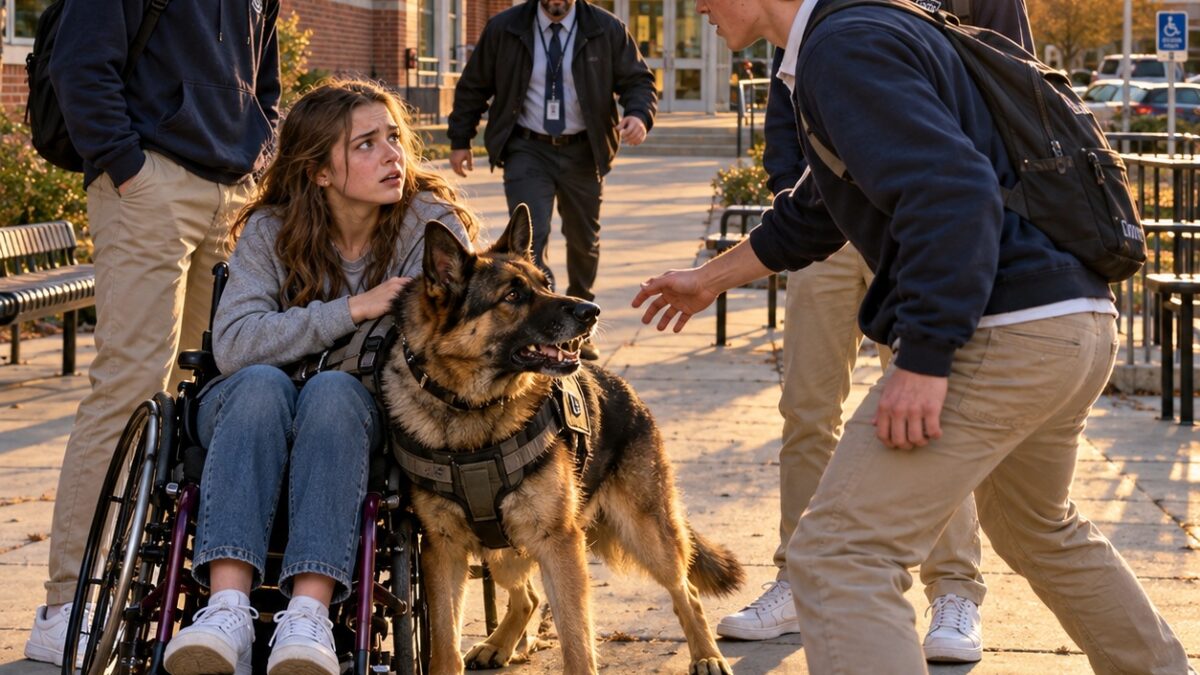
I gripped my wheels.
“Move.”
Tyler smiled wider.
“We’re talking.”
“I’m not.”
Chase stepped in front of me.
“You always this rude?”
“I said move.”
My voice sounded stronger than I felt.
Inside, my heart was hammering so hard that my vision seemed to pulse with it.
Ranger moved closer to my left side.
His body stiffened.
Not attacking.
Not lunging.
Just placing himself exactly where he had been trained to place himself when I became frightened.
Between me and the threat.
Brandon laughed.
“Look at him.”
“He thinks he’s still a cop.”
Tyler crouched slightly.
“Hey, Ranger.”
The dog stared at him.
“Don’t touch him.”
I said.
Tyler looked at me.
“What?”
“He’s working.”
That made Chase laugh.
“Working?”
“Doing what?”
“Driving your chair?”
I tried rolling backward.
Brandon grabbed one handle.
My wheelchair stopped.
“Let go.”
He did not.
“Brandon.”
I said louder.
“Let go of my chair.”
Tyler leaned closer.
“You really think people have to do whatever you say because you’re disabled?”
The question struck deeper than I wanted it to.
Because that was exactly the accusation I feared whenever I asked anyone for accommodation.
Whenever I asked for room.
A ramp.
An elevator.
An accessible desk.
Part of me was always afraid someone would think:
There she goes demanding special treatment.
Tyler saw something in my face.
And smiled.
Ranger growled.
Low.
A warning.
Tyler looked down.
“What are you gonna do?”
“Get your dog to bite me?”
“He won’t bite you.”
I said.
“As long as you leave us alone.”
“As long as?”
Tyler repeated.
Then he kicked Ranger.
Not hard enough to send him flying.
But hard enough.
Ranger yelped.
His body twisted.
For one horrible second, he looked confused.
Then he turned immediately back toward me.
Checking me.
Protecting me.
Even after being hurt.
Something inside me broke.
“STOP!”
My voice echoed across the courtyard.
Tyler laughed.
Chase laughed too.
Brandon finally released the wheelchair handle.
“You gonna cry?”
Tyler asked.
My eyes already burned.
I hated that.
I hated crying in front of people who wanted tears.
I tried to move around them.
Chase blocked me.
Tyler tapped the side of my chair with his shoe.
“Where are you going?”
“Leave me alone.”
“You know what your problem is?”
He said.
“You think everybody has to rearrange the world because you can’t walk.”
I froze.
Brandon muttered:
“Dude.”
Maybe even he heard how ugly it sounded.
Tyler did not care.
“You need ramps.”
“Special bathrooms.”
“Special parking.”
“Your own dog.”
“Teachers give you extra time.”
“And everybody has to pretend you’re brave for showing up.”
My hands tightened around the armrests.
I had spent years telling myself those comments did not matter.
That people who spoke that way were ignorant.
That I knew who I was.
But cruelty is strange.
You can understand intellectually that someone is wrong and still feel every word enter your body.
I heard my own thoughts answer him.
Maybe I am exhausting.
Maybe people are tired of accommodating me.
Maybe Ranger would have an easier life with someone else.
Maybe my parents would too.
That frightened me more than Tyler.
Because for one second, he had managed to make his voice sound like mine.
Ranger pressed himself against my knee.
I looked down.
His ears were back.
But he was there.
Still there.
I whispered:
“Good boy.”
Tyler heard me.
“Aww.”
He mocked.
“You need the dog to make you feel brave?”
Then another voice came from behind him.
“No.”
Deep.
Calm.
“Looks to me like she needs three boys to move away from her.”
All three turned.
A police officer was walking toward us.
Fast.
Not running anymore.
He had probably been running before we noticed him.
Officer Marcus Daniels.
I recognized him from the safety demonstration our school had hosted that afternoon.
He was in his forties.
Broad shoulders.
Close-cropped hair beginning to gray.
The kind of face that looked calm even when the man behind it was furious.
And he was furious.
He stopped between my chair and Tyler.
“Back up.”
Nobody moved.
Officer Daniels did not yell.
He did not need to.
“I said back up.”
Chase stepped away first.
Then Brandon.
Tyler took one step.
Officer Daniels looked at Ranger.
“You kick that dog?”
Tyler’s face changed.
“No.”
My mouth opened.
Daniels raised one hand gently toward me.
Not silencing.
More like:
I will get to you.
He looked at Tyler.
“I asked you.”
“No.”
Daniels pointed toward the security camera mounted above the courtyard entrance.
“You certain?”
Tyler looked up.
That was the first time I saw fear replace arrogance.
“Maybe my foot touched him.”
Daniels stared.
“Interesting.”
Then he looked at Brandon.
“Why were you holding the wheelchair?”
“I wasn’t.”
I found my voice.
“Yes, you were.”
Brandon looked at me.
Officer Daniels followed his gaze.
“Don’t look at her.”
He said.
“Look at me.”
Brandon did.
Daniels asked:
“Did you touch her wheelchair without permission?”
A pause.
“Yes.”
“Why?”
“We were joking.”
There it was.
The word adults had been using for weeks.
Joking.
Teasing.
Messing around.
Kids being kids.
Officer Daniels looked at all three.
“Does she look like she was laughing?”
Nobody answered.
He turned toward me.
His voice changed completely.
Softer.
“Are you hurt?”
“I don’t think so.”
“Did anyone hit you?”
“No.”
“Grab you?”
“My chair.”
“Anything else?”
I looked at Ranger.
“He kicked him.”
Daniels crouched.
Not touching Ranger.
He held out one hand near the dog, letting him smell.
“Hey, buddy.”
Ranger remained pressed against me.
“He’s working.”
I said automatically.
“I know.”
Daniels replied.
“He looks like he takes the job seriously.”
That nearly made me cry harder.
Not because it was sad.
Because somebody had finally understood.
Within fifteen minutes, the courtyard filled with adults.
Principal Holloway.
Assistant principal.
School resource staff.
A counselor.
Two teachers.
My parents were called.
The boys’ parents were called.
Officer Daniels took statements.
What surprised me most was how quickly the language changed once a police officer had seen what happened.
Nobody said:
Ignore them.
Nobody said:
They’re trying to get a reaction.
Nobody said:
Boys can be immature.
Now the phrases were:
Physical intimidation.
Interference with mobility equipment.
Harassment.
Targeting a service animal.
Safety violation.
Possible assault.
Same behavior.
Different adult watching.
That realization made me angrier than the boys had.
Principal Holloway crouched beside me.
“Maya, has this happened before?”
I looked at him.
He seemed genuinely concerned.
That almost made it worse.
“Yes.”
His face fell.
“How long?”
“Since September.”
“Why didn’t you report it?”
I stared.
“I did.”
Silence.
I watched him understand.
Not all at once.
Slowly.
Like a door opening.
I continued.
“Mrs. Palmer saw Tyler push my chair.”
“She told me to ignore him.”
“I told Mr. Sanders they were making fun of Ranger.”
“He said they were probably curious.”
“I told the lunch monitor Chase kept moving my backpack where I couldn’t reach it.”
“She said I needed to learn how to deal with difficult personalities.”
My mother arrived before I finished.
She crossed the courtyard so fast I thought she might physically run through people.
“Maya.”
Her arms went around me.
I stiffened.
Not because I did not want her.
Because I was embarrassed.
Fourteen-year-old logic is cruel.
Three boys can humiliate you for weeks and somehow you still worry that being hugged by your mother in public will make you look childish.
Then my father arrived.
He saw my face.
Then Ranger.
Then the boys.
I had never seen his expression become that still.
“What happened?”
My mother asked.
I began to answer.
My voice broke.
Then everything came out.
Not elegantly.
Not chronologically.
The jokes.
The chair.
The hallway.
The cafeteria.
The dog.
The comments.
My mother cried.
My father did not.
He simply stared at Principal Holloway.
“You knew?”
The principal shook his head.
“Not at this level.”
My father’s voice remained dangerously quiet.
“She told your staff.”
“We are investigating every previous report.”
“You should have investigated before a police officer happened to walk outside.”
No one answered.
Tyler’s father arrived in a black Mercedes.
Mr. Vaughn was exactly what I had expected without ever meeting him.
Expensive coat.
Expensive watch.
Phone in one hand.
Impatience in every movement.
He walked directly to his son.
“What happened?”
Tyler immediately said:
“Nothing.”
“We were joking around and that dog came at me.”
I shouted:
“NO.”
Everyone turned.
I had not intended to shout.
But there are moments when silence becomes heavier than fear.
“He kicked Ranger.”
I said.
“He blocked me.”
“Brandon held my chair.”
“They’ve been doing things to me for weeks.”
Mr. Vaughn looked at me.
Then at Tyler.
Then at Officer Daniels.
“My son says the animal became aggressive.”
Officer Daniels folded his arms.
“I watched part of the incident.”
Mr. Vaughn’s confidence changed slightly.
“From where?”
“Close enough.”
“And the courtyard camera appears to have captured more.”
Mr. Vaughn looked toward the principal.
“I’d like to discuss this privately.”
Officer Daniels said:
“No.”
Mr. Vaughn turned.
“Excuse me?”
“If this becomes a criminal matter, nothing about the relevant incident disappears into a private school conversation.”
“I’m not saying—”
“I know what you’re saying.”
Daniels remained calm.
“We preserve the evidence.”
Then Chase’s mother arrived.
Then Brandon’s parents.
The courtyard became a courtroom without a judge.
Everyone arguing.
Explaining.
Minimizing.
My father asked me one question.
“Do you want to go home?”
I looked at Ranger.
Then at the boys.
“Yes.”
That evening a veterinarian examined Ranger.
Bruising.
Nothing broken.
He would recover.
The vet knelt beside him.
“He did exactly what he was trained to do.”
I rubbed behind Ranger’s ears.
“He always does.”
The doctor smiled.
“He protected you without escalating.”
Then she added:
“You should be proud of him.”
I was.
I also felt guilty.
“If I hadn’t been there—”
My mother stopped me.
“Maya.”
“What?”
She pulled a chair closer.
“Do not finish that sentence.”
I looked down.
“Ranger got hurt because of me.”
“No.”
My father said from behind us.
“Ranger got hurt because somebody chose to kick him.”
He came around.
“And you were hurt because people chose to mistreat you.”
“Those choices belong to them.”
“Not you.”
I started crying again.
“I should’ve told you.”
My mother touched my face.
“Yes.”
That surprised me.
I expected:
It’s okay.
Instead:
“You should have.”
She said.
“Not because you did anything wrong.”
“Because you do not have to protect us from being your parents.”
That sentence broke me.
“I didn’t want you to worry.”
“We worry anyway.”
Dad said.
“It’s basically our hobby.”
I laughed through tears.
Then Mom said:
“Being independent does not mean suffering alone.”
That became something I would remember long after the bruising around Ranger’s ribs disappeared.
Monday morning, we returned to school.
I wanted to stay home.
My parents offered.
Dad said we could take a week.
Mom said longer if I needed it.
But something about not going felt like letting the courtyard become theirs.
So I went.
Ranger beside me.
The halls felt different immediately.
People stared.
Some whispered.
I hated it.
Then a girl named Sophie walked over.
We had science together.
She had barely spoken to me before.
“Hey.”
“Hi.”
She looked at Ranger.
“I heard what happened.”
My stomach tightened.
“Okay.”
She swallowed.
“I’m sorry.”
“You didn’t do anything.”
“That’s kind of the problem.”
I looked at her.
She continued.
“I saw Tyler push your chair once.”
“And I didn’t say anything.”
“Why?”
“I don’t know.”
“He’s Tyler.”
That was an answer.
Not a good one.
But honest.
Sophie said:
“I should’ve told someone.”
I almost replied:
I told someone.
Then stopped.
She was fourteen too.
Adults had failed me.
I did not need to make another kid carry all of that.
“Thank you.”
I said.
She nodded.
Then walked with me to science.
That day, other students came forward.
A boy had video of Tyler clapping sarcastically while Ranger helped me pick up a dropped binder.
Another clip showed Chase pulling my backpack away.
Someone had recorded Brandon moving my wheelchair several feet while I was transferring into a lab chair.
One student had video from the cafeteria.
Tyler leaning toward me.
Saying something.
My face collapsing.
There was no audio.
There did not need to be.
Evidence accumulated.
The school could no longer define the case as one bad afternoon.
It was a pattern.
Then my parents received a call.
The district was conducting an internal review.
Not only of the boys.
Of staff responses.
Mrs. Palmer.
Mr. Sanders.
The lunch monitor.
Administrators who had received smaller complaints and never connected them.
That mattered to me.
At first, I wanted only the boys punished.
Then I realized punishment alone would leave the machinery that protected them untouched.
The boys had done what they did because every earlier escalation taught them nobody serious was watching.
Tyler’s father hired an attorney.
So did Chase’s family.
Brandon’s parents did not.
They came to our house instead.
I was horrified when Mom told me.
“You invited them here?”
“They asked.”
“I don’t want to see Brandon.”
“He’s not coming.”
Only his parents.
Mr. and Mrs. Cole sat in our living room.
They looked exhausted.
Mrs. Cole cried before anyone said anything.
“I am so sorry.”
I stared.
She continued.
“We watched the videos.”
“Brandon told us it was joking.”
“I wanted to believe him.”
Then she looked at Ranger.
“I watched him hold your chair.”
Her voice cracked.
“There was nothing funny.”
My father remained quiet.
My mother asked:
“What do you expect Maya to do with your apology?”
Mrs. Cole shook her head.
“Nothing.”
“That’s not why we came.”
“We wanted her to know we aren’t defending him.”
“He’s going to counseling.”
“We removed his phone.”
“He’s suspended from athletics.”
“And whatever the school decides…”
She swallowed.
“We will not fight consequences just because they are painful.”
I did not know how to respond.
Finally:
“Why did he do it?”
Mr. Cole looked down.
“We’ve been asking ourselves that.”
Then:
“I think we spent too much time teaching him how to succeed and not enough teaching him what kind of person success should make him.”
That sentence stayed with me.
Tyler’s father took the opposite approach.
He insisted his son was being targeted because of the family’s visibility.
He called the footage “decontextualized.”
He said Ranger’s presence created “a complicated safety environment.”
Officer Daniels reportedly responded to that phrase with something that my mother refused to repeat in front of me.
I eventually found out.
It was not terrible.
Just sarcastic.
The school suspended all three boys pending disciplinary review.
Tyler’s family threatened legal action.
The district did not reverse course.
That alone felt revolutionary.
For years, people had reacted to Mr. Vaughn’s name.
His money.
His donations.
The new superintendent apparently did not care.
Or at least cared less than the previous administration.
An independent review was ordered.
Within weeks, several findings emerged.
My earlier complaints had been documented.
Poorly.
But documented.
The school had repeatedly classified harassment as peer conflict.
That wording mattered.
Peer conflict suggests two students participating.
Bullying is different.
It involves power.
Repetition.
Targeting.
Calling what happened “conflict” had made me partly responsible for solving it.
The district admitted that.
Publicly.
The principal apologized to my parents.
Then to me.
His office felt too formal.
Ranger sat beside my chair.
Principal Holloway looked exhausted.
“Maya.”
“We failed you.”
I did not answer.
He continued.
“You asked adults for help.”
“Those adults treated your reports as isolated incidents instead of identifying a pattern.”
“We should have done better.”
I looked at him.
“Why didn’t you?”
He paused.
That was probably not the response he expected.
“I think…”
He stopped.
Then started again.
“I think people assumed the boys would grow out of it.”
“Because of who their families were?”
His face changed.
“I can’t speak for every staff member.”
“That means yes.”
My mother touched my shoulder.
I kept going.
“If my dad donated a gym, would people have believed me sooner?”
The principal looked genuinely ashamed.
“I hope not.”
“That isn’t an answer.”
“No.”
He said.
“It isn’t.”
Then:
“I think influence affected how comfortable some adults felt challenging those families.”
There.
Finally.
The thing everybody knew.
Said out loud.
The school changed policies.
Not because a poster said kindness.
Actual changes.
Reports had to be logged centrally.
Repeated incidents triggered automatic administrative review.
Interfering with mobility aids became a high-level safety offense.
Harassment involving service animals received specific procedures.
Staff received disability-awareness training.
Students did too.
At first, I hated the idea of the entire school having an assembly because of me.
“I don’t want to become Disability Week.”
I told Mom.
She laughed.
“I don’t think that’s the official title.”
“You know what I mean.”
I did not want pity.
Or inspirational posters with my picture.
Or teachers looking at me like I had become fragile glass.
I wanted ordinary respect.
Officer Daniels understood that better than most.
He began checking in occasionally because the investigation required follow-up.
One afternoon after a meeting, he asked:
“How are you?”
“Everybody keeps asking me that.”
“That bad?”
“Everybody says it like they expect me to cry.”
He nodded.
“Then I’ll ask differently.”
“Okay.”
“What’s annoying you most?”
I smiled.
“That’s better.”
So I told him.
The staring.
The sudden kindness from people who had ignored me.
Teachers offering help I did not need.
Students acting afraid to say anything around me.
People asking to pet Ranger constantly because now he was a hero.
Daniels smiled.
“He hates fame?”
“He tolerates it better than I do.”
Ranger sneezed.
Daniels laughed.
Then his expression became serious.
“You know something?”
“What?”
“You don’t owe anyone an inspirational version of what happened.”
I looked at him.
“You can be angry.”
“You can hate it.”
“You can take a long time to feel okay.”
“You can also have a good day without pretending everything is healed.”
That was one of the most useful things any adult told me.
Healing was not a performance.
I had been performing strength long before the bullying.
Smiling so my parents would not worry.
Saying I was fine.
Making jokes whenever strangers stared at my wheelchair.
Acting grateful when someone praised me for doing ordinary things.
I was tired.
Therapy helped.
I started seeing Dr. Levin, a psychologist who worked with teenagers dealing with trauma and disability.
At our first session, I said:
“I don’t want to talk about the bullying.”
“Okay.”
She replied.
“What do you want to talk about?”
I stared.
“I don’t know.”
“Excellent.”
“That’s excellent?”
“It means we have options.”
She was strange.
I liked her.
Eventually we talked about the courtyard.
But more often, we talked about anger.
The kind I had aimed inward.
Why hadn’t I spoken louder?
Why had I cried?
Why had I frozen when Tyler kicked Ranger?
Why had I believed him for even one second when he called me a burden?
Dr. Levin asked:
“If another fourteen-year-old girl told you this happened to her, would you blame her for freezing?”
“No.”
“Why are your rules crueler for Maya than for everyone else?”
I hated that question.
Because I knew the answer.
Somewhere inside, I believed disability already made me vulnerable.
So I thought I had to compensate by being emotionally invulnerable.
Never need too much.
Never complain.
Never ask twice.
Never let anyone think the wheelchair was winning.
That was impossible.
And unfair.
Months passed.
The disciplinary outcome came slowly.
Brandon accepted responsibility first.
He received a lengthy suspension, behavioral conditions for return, counseling, and community-service requirements.
Chase’s family eventually stopped fighting.
Similar consequences.
Tyler’s case went farther because of the repeated conduct, his treatment of Ranger, and his refusal to accept responsibility.
He was removed from Hawthorne Ridge for the remainder of the school year and transferred under district disciplinary placement.
The exact legal details stayed mostly private because we were minors.
That was fine.
I did not need a scoreboard.
What mattered was simple.
Adults stopped treating what happened as entertainment.
His father could not buy his way out of every consequence.
That was enough.
One day, months later, Brandon asked to speak with me.
My first answer was no.
Then I changed my mind.
Not because anyone pressured me.
Because I wanted to know what he would say.
We met in the counselor’s office.
My mother waited outside.
Ranger sat beside me.
Brandon looked smaller without Tyler and Chase around him.
That surprised me.
He stared at the floor.
“I’m sorry.”
I waited.
He continued.
“I don’t expect you to forgive me.”
Good start.
“I laughed because Tyler laughed.”
“I did stuff because I wanted him to think I was funny.”
“That makes it worse.”
He nodded.
“I know.”
“Did you think about what it felt like when you grabbed my wheelchair?”
“No.”
“Why not?”
His eyes filled.
“Because I wasn’t thinking of it as part of you.”
That answer stopped me.
“What did you think it was?”
“A thing.”
He said.
“Like grabbing someone’s backpack.”
I shook my head.
“It isn’t.”
“I know now.”
“My wheelchair is how I move.”
“If you take it, you’re not taking my backpack.”
“You’re deciding whether I can leave.”
He nodded.
“I know.”
I looked at him.
“Do you?”
He swallowed.
“Yes.”
Maybe he did.
Maybe he was only starting.
That was not my responsibility.
I did not forgive him that day.
But I believed he was sorry.
Those things can coexist.
Ranger recovered completely.
No lasting injury.
Emotionally, he became more watchful around groups of teenage boys for a while.
His trainer helped us.
Gradual exposure.
Positive experiences.
Space.
Patience.
One afternoon, a boy from my science class named Jordan approached.
He stopped several feet away.
“Can I say hi to Ranger?”
I asked Ranger to settle.
Then nodded.
Jordan knelt carefully.
Ranger sniffed him.
Then rested his head briefly against Jordan’s hand.
Jordan smiled.
“Cool.”
He stood.
Did not make a huge scene.
Did not tell me Ranger was amazing.
Did not call me brave.
Just:
“See you tomorrow.”
That ordinary interaction made me happier than any assembly.
The community program Officer Daniels mentioned was called Youth Civic Leadership.
I said no three times.
He kept leaving brochures with my parents.
“That’s harassment.”
I told him.
“Document it.”
He replied.
My father laughed for five minutes.
Eventually, I attended one meeting.
Mostly because I wanted Daniels to stop asking.
There were students from different schools.
Some had been in foster care.
Some dealt with poverty.
One girl had lost her brother to gun violence.
Another student was openly gay and talked about harassment in his former school.
Nobody treated my wheelchair as the most interesting thing in the room.
That felt wonderful.
We learned public speaking.
Conflict resolution.
How school boards worked.
How to read policy.
How to propose changes.
I discovered something uncomfortable.
I liked speaking.
Not motivational speaking.
Argument.
Evidence.
Taking something that felt wrong and explaining precisely why it was wrong.
At the end of the program, each student had to present a community proposal.
Mine was called:
ACCESS IS NOT A FAVOR.
I talked about physical access.
Ramps.
Elevators.
Accessible seating.
But also social access.
The right to participate without being treated as a charity project.
The right to use mobility equipment without someone touching it.
The right to have a service animal respected.
The right to complain without being called sensitive.
When I finished, Officer Daniels was in the back.
He did not cry.
Despite what people later claimed.
His eyes were suspiciously shiny.
That is different.
The school eventually asked whether I would speak at an assembly.
My first answer:
“No.”
Then:
“Absolutely not.”
Then:
“Maybe.”
I agreed under conditions.
No dramatic video.
No giant picture of me.
No principal introducing me as “an inspiration.”
No forced apology from the boys.
And nobody pet Ranger afterward without asking.
Principal Holloway agreed.
The assembly was held in March.
I waited backstage.
My hands shook.
Ranger rested beside me.
I whispered:
“Why did I agree to this?”
His tail tapped once.
Very helpful.
Then they called my name.
The gym was full.
Hundreds of faces.
The same students who had passed me in hallways.
Some who had seen things.
Some who had spoken.
Some who had not.
I rolled to the microphone.
For several seconds, I said nothing.
Then:
“I’m not here to tell you to be kind.”
That got their attention.
“I think most of us already know kindness is good.”
“The problem is that knowing something is good doesn’t automatically make us brave enough to do it.”
The gym became quiet.
I told them about silence.
Not every cruel word.
Not every detail.
I focused on the people watching.
“I used to think the three boys were the only people who hurt me.”
I said.
“They weren’t.”
“The students who laughed hurt.”
“The adults who minimized it hurt.”
“And the people who saw something wrong and decided it wasn’t their problem made it easier for the next thing to happen.”
I paused.
Then:
“I’m not saying everybody who stayed silent was a bad person.”
“I’m saying good people can make bad situations safer for cruelty when they decide someone else will handle it.”
I saw Sophie near the front.
She was crying.
I continued.
“My wheelchair doesn’t make me brave.”
“It doesn’t make me weak either.”
“It is equipment.”
“Ranger doesn’t make me helpless.”
“He gives me more independence.”
“And when someone touches a person’s wheelchair without permission, blocks it, moves it, or uses it as a joke, that isn’t teasing a chair.”
“That is controlling where a human being can go.”
I heard nothing but ventilation.
Then I said the hardest part.
“I also want to talk to anybody who is being treated badly right now.”
My voice shook.
“You may think staying quiet proves you can handle it.”
“I thought that.”
“I was wrong.”
“Asking for help does not mean they won.”
“It means you believe your safety matters enough to make noise.”
That line almost made me cry.
I looked down at Ranger.
Then back up.
“The bravest thing I did was not survive the courtyard.”
“It was finally stop pretending I was okay.”
When I finished, nobody moved for half a second.
Then applause started.
I hated applause.
Still do.
But that day I let it happen.
Not because I felt heroic.
Because I knew some student in that gym might remember one sentence.
That was enough.
Afterward, a sixth-grade boy approached me.
He spoke so quietly I almost could not hear.
“There’s some kids bothering me on the bus.”
My heart tightened.
“Have you told anyone?”
He shook his head.
“Why?”
“They’ll say I’m a snitch.”
I looked at him.
“Want me to walk with you to the counselor?”
He nodded.
So I did.
That mattered more than the applause.
My relationship with my parents changed.
They became less hovering.
Eventually.
Dad still inspected every ramp like a structural engineer despite being an accountant.
Mom stopped asking:
“Are you okay?”
every ten minutes.
Mostly.
I became better at saying:
“No.”
when I was not.
One night, we were eating dinner when I said:
“I think I want to study law someday.”
Dad nearly inhaled a green bean.
“Law?”
Mom smiled.
“What kind?”
“Civil rights.”
“Disability law.”
“Maybe education.”
Dad recovered.
“You’re fourteen.”
“I know.”
“Last year you wanted to design video games.”
“I can contain multitudes.”
Mom laughed.
Dad pointed his fork at me.
“That leadership program has made you dangerous.”
“Yes.”
I said.
“Officer Daniels is very proud.”
Ranger received an award from the local police department for his behavior during the incident.
Technically, it was mostly ceremonial.
He did not understand certificates.
He understood the large bag of treats they gave him.
At the ceremony, Daniels knelt beside him.
“You did good, partner.”
Ranger licked his chin.
Daniels stood up looking offended.
“He has no respect for the uniform.”
“He’s retired.”
I said.
“Union rules.”
That made him laugh.
Officer Daniels remained part of our lives.
Not constantly.
He had a job.
We had lives.
But he checked in.
Came to my sixteenth birthday two years later.
Brought Ranger an absurdly expensive dog toy.
When I eventually got my learner’s permit for an adapted vehicle, Daniels told Dad:
“You look more scared than she does.”
“I am.”
Dad replied.
“He should be.”
I said.
“You hit one cone.”
Dad said.
“One.”
“It knew what it did.”
Some things healed through laughter.
Not everything.
I still hated empty courtyards for a long time.
If teenage boys laughed behind me unexpectedly, my shoulders tightened.
Whenever somebody approached Ranger too quickly, my hand moved automatically toward his harness.
Trauma does not disappear because a school holds an assembly.
But it changes.
At first, memories control the room.
Later, they become one object inside it.
Years passed.
I remained at Hawthorne Ridge through graduation.
That surprised me.
My parents offered to transfer me.
I chose to stay.
Not to prove anything.
Because I had friends there.
Teachers I trusted.
Programs I liked.
And eventually, memories unrelated to bullying outnumbered the bad ones.
Science fair.
Homecoming.
Sophie failing spectacularly at baking cookies for a fundraiser.
Jordan accidentally launching a model rocket into the baseball scoreboard.
Me getting my first B and behaving as though civilization had collapsed.
Normal adolescence returned.
That mattered.
Tyler never came back to Hawthorne Ridge while I was there.
I heard things about him.
Therapy.
Another school.
Community service.
Later, college somewhere out of state.
I did not follow.
People occasionally asked whether I wanted him ruined.
No.
I wanted him stopped.
Those are different things.
At fourteen, I probably did want him humiliated.
That passed.
Accountability should interrupt harmful behavior and protect people.
If it can also change someone, good.
I did not need to witness his transformation.
It was not owed to me.
Brandon sent me another apology two years later.
Short.
He said he had started volunteering with an adaptive sports organization after a counselor suggested it.
I was suspicious.
At first, I thought:
Of course. Community service to feel better about himself.
Then I checked myself.
Wasn’t growth what everybody claimed to want?
He wrote:
I used to think accessibility meant people getting extra things. Now I understand it means removing obstacles other people don’t have.
That was a good sentence.
I kept the letter.
Did not become his friend.
Again, those things can coexist.
Ranger got older.
That was the hardest ending inside the story.
Dogs age unfairly fast.
By the time I was eighteen, silver had begun appearing around his muzzle.
He still worked.
Still loved it.
But we started planning for retirement.
The trainer said we needed another service dog eventually.
I cried in the parking lot after that appointment.
Not because Ranger was dying.
He wasn’t.
Because I could not imagine another dog filling his place.
Mom sat beside me in the car.
“No one fills his place.”
She said.
“They make a new one.”
I looked at her.
“You’ve been going to therapy behind my back?”
She smiled.
“I raised you.”
“Same thing.”
My next dog was a yellow Lab named Sunny.
Ranger hated her for approximately six hours.
Then he discovered she could be manipulated into surrendering treats.
They became friends.
During the transition, Ranger retired fully.
He stayed home.
Slept in sunlight.
Ignored commands unless snacks were involved.
He had earned it.
The first day I went to college with Sunny instead of Ranger, I cried the entire drive.
Dad pretended not to notice.
Then he cried when we unloaded my wheelchair.
Mom accused both of us of being dramatic.
She cried hardest when they left.
College was different.
Larger.
Messier.
Nobody knew the courtyard story unless I told them.
That felt liberating.
I studied political science first.
Then pre-law courses.
Disability policy.
Civil rights history.
Education law.
The more I learned, the more I understood that what happened to me was both deeply personal and completely ordinary.
That was painful.
Students with disabilities were restrained.
Excluded.
Mocked.
Denied access.
Disbelieved.
Mobility devices moved without permission.
Service animals distracted or harmed.
Complaints minimized.
My story had felt like the universe collapsing.
For other people, versions of it happened every day.
That made me angry again.
Older anger.
Useful anger.
I interned with a disability-rights organization.
The first complaint assigned to me involved a twelve-year-old whose wheelchair had repeatedly been pushed by classmates despite reports to teachers.
I stared at the file.
My supervisor noticed.
“You okay?”
“Yes.”
Then I corrected myself.
“No.”
She waited.
“This is familiar.”
“Want another case?”
I thought.
Then:
“No.”
I wanted this one.
Not to relive what happened.
To understand what somebody should have done for me.
We helped the family document incidents.
Coordinate with the district.
Clarify protections.
Create a safety plan.
No dramatic courtroom.
No police officer arriving at the perfect moment.
Just adults doing their jobs before something catastrophic happened.
That felt better than revenge.
Prevention is less dramatic than rescue.
It is also more humane.
Officer Daniels attended my college graduation.
He stood beside Dad.
Both cried.
I accused them afterward.
Daniels denied everything.
“There was pollen.”
“Inside the arena?”
“Very aggressive pollen.”
Ranger could not come.
He was elderly by then.
We celebrated at home afterward.
I sat beside him on the floor in my graduation dress.
Placed my cap loosely on his head.
He looked humiliated.
Dad took a photograph.
It is still one of my favorites.
Ranger died the following winter.
Quietly.
At home.
I was twenty-two.
He was beside me.
His head rested in my lap.
I told him everything I should have told him years earlier.
That he had made me brave before I knew I was.
That none of what happened at school was his fault.
That I was sorry someone hurt him because they wanted to hurt me.
That he had been a very good dog.
The best.
His breathing became slower.
Then stopped.
I thought the courtyard would be the memory I associated with Ranger forever.
It wasn’t.
In the end, I remembered mornings.
His nails clicking across the kitchen floor.
The way he sneezed when impatient.
How he would lean against my leg when I studied.
How offended he looked whenever someone closed a bathroom door without him.
A life is bigger than its worst afternoon.
So is a dog’s.
So is mine.
Years after Hawthorne Ridge, the school invited me back.
I had finished law school.
Passed the bar.
Started working in disability and education advocacy.
Principal Holloway had retired.
A new principal greeted me.
The courtyard looked smaller.
That surprised me.
Trauma had made it enormous in my memory.
I rolled across the same concrete where Tyler once blocked my chair.
Sunny walked beside me.
Students filled the area.
Laughing.
Eating lunch.
Living normal lives.
I expected some dramatic emotional reaction.
Nothing came.
Then I noticed a sign near the administrative office.
REPORT IT. WE LISTEN.
Beneath it were clear procedures for bullying, harassment, disability discrimination, and safety concerns.
Policies do not guarantee goodness.
I knew that.
But somebody had tried to turn failure into structure.
That mattered.
The assembly that day was about student rights and responsibilities.
The principal introduced me as an attorney.
Not a bullying survivor.
Not an inspiration.
Attorney.
I appreciated that more than she knew.
I told the students about consent around mobility devices.
About bystander responsibility.
About how easy it is to call cruelty a joke when you are not the person trapped inside it.
Then a student asked:
“Did you ever forgive the boys?”
I thought.
“I stopped needing to hate them.”
“That’s not the same thing.”
I said.
“Forgiveness is personal.”
“Accountability is not.”
A teacher in the front row wrote that down.
I continued.
“I don’t know what kind of men they became.”
“I hope better ones.”
“But my healing never depended on that.”
That took me years to understand.
When you are hurt, you can accidentally tie your future to the person who hurt you.
You think:
I can heal when they apologize.
When they suffer.
When they understand.
When they change.
Maybe those things help.
But if they never happen, you still deserve a life.
My life became bigger than Tyler Vaughn.
Much bigger.
After the assembly, I went to the courtyard alone.
The sun was bright.
The same harsh afternoon light I remembered.
For a moment, I could see fourteen-year-old Maya.
Hands white around the armrests.
Ranger between me and three boys.
Trying not to cry.
I wanted to tell her something.
Not:
You will become a lawyer.
Not:
Everyone will admire you.
Not:
This happens for a reason.
I hate that phrase.
Cruelty does not become necessary because something meaningful grows afterward.
I wanted to tell her:
You are allowed to be afraid.
You are allowed to need help.
You are allowed to make noise.
What they are doing is wrong even if every adult around you is too uncomfortable to say it.
And the chair beneath you is not evidence that you are weaker than they are.
It is simply how you move.
Their cruelty is about them.
Not you.
I closed my eyes.
Then heard footsteps.
The current school resource officer approached.
“You Maya Bennett?”
“Yes.”
“Officer Daniels told me you’d probably wander off by yourself.”
I laughed.
“He still giving orders?”
“Apparently retirement hasn’t helped.”
“He retired?”
“Last year.”
That made me smile.
Daniels and I still spoke occasionally.
Birthdays.
Holidays.
The anniversary of Ranger’s death.
He had once told me the courtyard incident had affected him too.
Not because he had never seen bullying.
He had.
Because of how many earlier opportunities adults had to stop it.
“I was the hero in everybody’s version of that story.”
He told me once.
“I hated that.”
“Why?”
“Because I arrived late.”
That sounded absurd.
“You stopped them.”
“Yeah.”
“But ten adults should’ve stopped them before I ever walked outside.”
That stayed with me.
Heroes are useful in emergencies.
Systems are supposed to prevent needing heroes.
Officer Daniels had been brave.
Ranger had been brave.
I had been brave.
But the better version of the story is one where courage is required much earlier and in much smaller doses.
A teacher saying:
Stop touching her chair.
A student saying:
That isn’t funny.
An administrator connecting three reports before they become thirty.
A parent teaching a child that power does not turn another human being into entertainment.
Those moments do not look heroic.
They prevent the courtyard.
That became the work I cared about most.
Several years into my legal career, I represented a family in an education-access case.
The district attorney across the table kept referring to a student’s requested accommodations as “special treatment.”
The phrase irritated me.
Eventually, I leaned forward.
“Do stairs give students who can walk special treatment?”
He looked confused.
“No.”
“Then why is a ramp special?”
Silence.
“Access is not a prize.”
I said.
“It’s the condition that allows the student to participate in the first place.”
We settled the case.
No press.
No dramatic ruling.
The student went back to class with what she needed.
I went home.
Sunny asleep on the back seat.
That night, I thought about Tyler telling me the world had to rearrange itself because I could not walk.
He had been wrong.
The world does not need to rearrange itself around me.
It needs to stop being designed as though people like me do not exist.
There is a difference.
At thirty, I returned home for Ranger’s memorial anniversary.
My parents still lived in the same house.
Dad had framed Ranger’s police-service certificate beside my law-school diploma.
“That is humiliating.”
I said.
“Which one?”
He asked.
“Both together.”
“Ranger earned his.”
Mom nearly choked laughing.
On the bookshelf sat the old picture from my graduation.
Cap on Ranger’s head.
My eyes red from crying.
I picked it up.
Mom came beside me.
“You okay?”
I smiled.
“No.”
Then:
“Yes.”
Then:
“Both.”
She nodded.
We had learned better language.
Life is often both.
Strong and tired.
Healed and still sad.
Forgiving and still unwilling to forget.
Independent and needing people.
I once believed strength meant never allowing anyone to see me crumble.
Now I know strength can look like calling your mother.
Reporting harassment.
Going to therapy.
Admitting your service dog is aging.
Telling a courtroom that you need an accommodation.
Saying no.
Saying help.
Saying stop.
Those are not small words.
They saved me.
People sometimes ask whether the courtyard made me who I became.
I always correct them.
“No.”
I say.
“It tried to make me smaller.”
“What I did afterward belongs to me.”
Tyler did not give me courage.
The school’s failure did not give me purpose.
Pain is not a gift.
But human beings can build meaning out of things that should never have happened.
That meaning belongs to us.
Not to the people who hurt us.
The fourteen-year-old version of me thought survival meant getting out of that courtyard without crying.
She was wrong.
I cried.
A lot.
I still survived.
Survival was letting Officer Daniels stand between me and danger.
Letting my parents know the truth.
Letting Ranger lean against me.
Letting a therapist challenge me.
Letting friends apologize.
Letting myself become angry.
Then eventually letting anger become something more useful.
Years later, I learned something about Officer Daniels that made me call him immediately.
The day he walked into the courtyard, he had been preparing to leave campus.
His demonstration was finished.
He had already packed his materials.
Then he heard Ranger barking.
He could have assumed:
Dog.
Kids.
School staff will handle it.
Instead, he went toward the sound.
That decision took maybe three seconds.
I asked him about it.
“Why did you go?”
He seemed confused.
“I heard something wrong.”
“That’s it?”
“What else was I supposed to do?”
That answer summarized the entire story.
He heard something wrong.
So he moved toward it.
Too many other people had seen something wrong and moved away.
That is what I tell students now.
You may never have a dramatic moment where somebody’s life depends on your courage.
Most courage is boring.
Walk over.
Speak.
Tell a teacher.
Sit beside someone.
Do not laugh.
Ask whether they are okay.
Refuse to let a friend turn cruelty into a joke.
Small choices.
Repeated.
That is how communities become safe.
Or unsafe.
Tyler, Chase, and Brandon had not become cruel in one afternoon.
They practiced.
Little joke.
No consequence.
Little shove.
No consequence.
Another humiliation.
Adults minimizing.
Peers laughing.
Cruelty became easier.
Kindness works the same way.
Practice it.
It becomes easier too.
I understand why people liked calling Ranger a hero.
He was one.
But Ranger never thought about heroism.
He sensed fear.
He moved close.
He was hurt.
He stayed.
That was his whole moral philosophy.
Stay close to the person who needs you.
Maybe humans make goodness too complicated.
The last time I spoke with Officer Daniels before his retirement party, he asked:
“If you could change one thing about that whole experience, what would it be?”
“Only one?”
“One.”
I thought.
Not the kick.
Not Tyler’s words.
Not even the school’s initial response.
Finally:
“I wish I had told my parents sooner.”
Daniels nodded.
“Interesting.”
“Why?”
“I expected you to say you wished I got there earlier.”
I smiled.
“You got there when you got there.”
“What I could’ve changed was believing I had to handle it alone.”
That was the part under my control.
Not the bullying.
Not adult favoritism.
My silence.
Even then, I do not blame fourteen-year-old me.
She was doing the best she knew.
I simply wish she had known independence was not isolation.
That became one of the most important lessons of my life.
Today, if you saw me entering court, you might notice the wheelchair first.
That is fine.
It is visible.
You might notice Sunny walking beside me.
You might see case files across my lap.
Maybe you would think I look confident.
Some days I am.
Some days I am still the girl gripping her armrests in an empty courtyard.
People are allowed to contain their past without being trapped inside it.
When fear returns, I do not tell myself:
You should be over this.
I tell myself:
You know what to do.
Find your people.
Use your voice.
Document what happened.
Ask for help.
Keep moving.
That is enough.
The boys in that courtyard once tried to convince me I was a burden because the world sometimes had to make room for me.
They were wrong.
Making room for one another is what civilization is.
A ramp.
A listening adult.
A policy that actually protects.
A friend who speaks.
An officer who walks toward the barking instead of away.
A dog who refuses to leave your side.
None of those things make a person weak.
They are what allow strength to exist without becoming loneliness.
I used to think the most important moment of my story was Officer Daniels stepping into that courtyard.
It was dramatic.
Clear.
The kind people remember.
Now I think the most important moment happened later.
Much quieter.
My mother sitting beside me at the veterinarian’s office.
Me saying:
“I didn’t tell you because I didn’t want you to worry.”
And her answering:
“You do not have to protect us from being your parents.”
That sentence changed how I lived.
I stopped treating love like something I had to earn by being easy.
Stopped believing I had to make disability convenient for everybody else.
Stopped apologizing before asking for access.
Stopped assuming pain kept private was somehow more dignified.
And eventually, I stopped needing to prove I was stronger than what happened.
I simply became more myself.
Ranger helped with that.
Officer Daniels helped.
My parents.
Sophie.
Dr. Levin.
Even Brandon’s apology contributed something.
But the work was mine.
That is what I want fourteen-year-old Maya to know most.
They did not define you.
Not the boys.
Not the teachers who looked away.
Not the parents with money.
Not even the people who later called you brave.
You define yourself.
And if someone ever grabs the handles of your chair again and tries to decide where you are allowed to go, you do not have to smile, stay quiet, or prove you can handle it alone.
You are allowed to say one word as loudly as you need.
Stop.
And if the first person does not listen, say it again until somebody does.








