𝗙𝗨𝗟𝗟 𝗦𝗧𝗢𝗥𝗬: HOA Karen Tried to Bully a Veteran… She Instantly Regretted It!
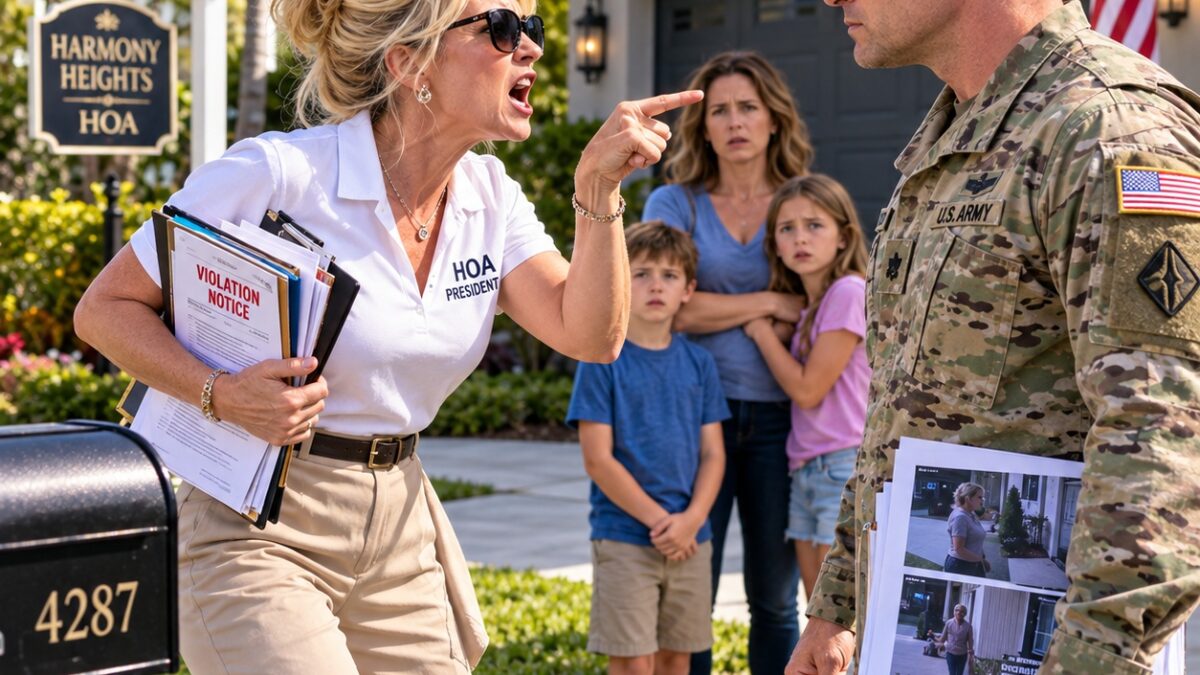
𝗙𝗨𝗟𝗟 𝗦𝗧𝗢𝗥𝗬

The first time Cheryl called me directly, I was driving home from the installation.
Bluetooth picked up the number through my truck speakers.
“David Carter?”
“Yes.”
“This is Cheryl Whitmore.”
Of course it was.
No greeting.
No small talk.
Just command mode.
“We’ve received another complaint regarding your property.”
“What now?”
She paused.
I could hear irritation in the silence.
Apparently asking what now was not sufficiently deferential.
“Your front-door wreath.”
I thought I misheard.
“My what?”
“Your wreath.”
Rebecca had hung a simple patriotic wreath the week before.
Red.
White.
Blue.
Nothing political.
Nothing offensive.
Nothing enormous.
“What’s wrong with it?”
“It has not been approved.”
“It’s a wreath.”
“Exterior decorative items must conform to community standards.”
I gripped the steering wheel.
“Is there a prohibited-wreath section I missed?”
“Mr. Carter.”
There it was.
The tone.
“You agreed to HOA restrictions when you bought the property.”
“I’m aware.”
“Then I suggest you review them.”
“I did.”
“I don’t remember anything about getting permission for seasonal decorations.”
“It isn’t seasonal.”
“It has red, white, and blue ribbon.”
“That does not automatically make it seasonal.”
I almost laughed.
Instead:
“Send me the specific rule.”
She went quiet.
Then:
“I don’t appreciate your attitude.”
That was the moment I started recording.
Not secretly in violation of anything.
I checked Florida’s consent laws and later worked through counsel on what communications could legally be preserved and used.
But I began saving every voicemail.
Every email.
Every letter.
Because I had spent enough years in the Army to know something very simple.
If somebody keeps creating paperwork around you, create your own record.
Cheryl sent the rule.
It did not say what she claimed.
The language dealt with permanent architectural additions.
Not removable decorations.
I emailed back politely.
Please identify the provision prohibiting a temporary wreath.
No answer.
The complaint disappeared.
Then a new one arrived.
Our swing set.
The children had begged for it.
Rebecca and I assembled it ourselves one Saturday.
Wooden frame.
Two swings.
Small slide.
Nothing near the property line.
Before buying it, I had checked the HOA rules.
Backyard recreational structures were permitted within certain height and setback requirements.
Ours complied.
Monday morning, Cheryl was standing at the edge of the driveway.
Clipboard.
Sunglasses.
Expression already victorious.
“That needs to come down.”
I was loading my gear into the truck.
“No.”
Her eyebrows lifted.
“What did you say?”
“I said no.”
“It has not been approved.”
“It doesn’t require separate approval under the section you cited last month.”
“You don’t decide what requires approval.”
“The governing documents do.”
For the first time, Cheryl looked genuinely offended.
Not because I was wrong.
Because I had read them.
That afternoon, I received a formal violation notice.
I replied with the exact section.
The violation vanished.
Then something changed.
Her letters became longer.
More legalistic.
More aggressive.
Late fees.
Enforcement authority.
Lien language.
Possible legal costs.
It was as though Cheryl believed increasing the number of intimidating words could create powers the documents did not actually give her.
Rebecca read one letter at the kitchen table.
“This woman hates you.”
“She barely knows me.”
“I don’t think that’s stopping her.”
Emma walked in carrying homework.
“Is the HOA lady mad again?”
I looked at Rebecca.
That bothered me.
My nine-year-old knew Cheryl as the HOA lady.
Our family had been in Harmony Heights only a few months.
Already this stranger had become a recurring character inside our house.
“No.”
I said.
“It’s adult paperwork.”
Emma shrugged.
“Can I have ice cream?”
“After homework.”
The conversation moved on.
But I sat there looking at Cheryl’s letter.
I had joined the Army young.
Not because I loved conflict.
People assume military careers attract people who want confrontation.
Some do.
Most of the good ones learn the opposite.
Conflict is expensive.
Even when you win.
Time.
Energy.
Relationships.
Sometimes blood.
The smartest fight is often the one you never enter.
For months, that was my approach with Cheryl.
Fix harmless issues.
Ignore tone.
Do not reward provocation.
Live my life.
Then she sent the mortgage letter.
It arrived certified.
Rebecca signed for it.
I came home that evening and found it centered on the kitchen table.
She did not say anything.
She did not need to.
I opened it.
Six pages.
Legal terminology.
References to continued covenant violations.
Association remedies.
Legal enforcement.
Potential costs.
Language suggesting ongoing noncompliance could jeopardize standing related to the property and potentially involve lien or mortgage consequences.
I read it twice.
Then a third time.
Rebecca watched.
“Well?”
“This is garbage.”
“Can she do that?”
“Not the way she’s making it sound.”
“Are you sure?”
That question changed my mood.
Not because Rebecca doubted me.
Because Cheryl had succeeded at something.
She had made my wife afraid we could lose our home.
Our children slept upstairs.
Their school was ten minutes away.
We had moved because we wanted stability.
Now an HOA volunteer was using legal language to turn that stability into leverage.
I set the letter down.
Rebecca whispered:
“David.”
“I know.”
“What are you going to do?”
I looked at the papers.
“Find out exactly where her authority ends.”
That was the first time I stopped trying to avoid the fight.
Not because of my ego.
Because intimidation only works while the person being intimidated believes the threat.
I needed facts.
The next morning, I spoke with a military legal-assistance attorney.
Then a civilian attorney familiar with HOA law.
That distinction mattered.
The original transcript treated federal military protections as though they automatically erased private HOA rules.
Reality is more complicated.
Military-service protections can matter significantly in housing, lending, foreclosure, court proceedings, and discrimination contexts.
But wearing a uniform does not magically exempt someone from every valid HOA covenant.
I did not want fantasy law.
I wanted accurate law.
My attorney, Marcus Bell, spent almost an hour reviewing the letters.
Then said:
“She’s overreaching.”
“How far?”
He tapped the mortgage threat.
“This language is designed to scare you.”
“Some HOA debts can eventually create lien issues if they are valid and properly processed.”
“But what she’s doing here is mixing hypothetical remedies with disputed violations in a way that makes the threat sound much more immediate than it is.”
“Can we stop it?”
“We can make them defend it.”
Good enough.
We drafted a formal response.
Not angry.
That mattered.
Angry letters feel satisfying.
Precise letters work.
Marcus identified the violations that lacked support.
Requested the authority for each threatened fine.
Demanded preservation of records.
Noted my active-duty status where legally relevant.
Warned the board against any discriminatory treatment tied to military obligations.
And requested that all future enforcement be conducted strictly through documented procedures.
Then we sent it to every board member.
Not just Cheryl.
That was important too.
Power grows in darkness.
Minutes.
Votes.
Records.
Other eyes.
Those shrink it.
Cheryl called that night.
I saved the voicemail.
Her voice was sharp.
“You didn’t need to involve an attorney.”
Interesting.
She could threaten legal action.
But me hiring counsel was escalation.
She continued.
“If you want to turn a simple compliance matter into a hostile confrontation, that’s your decision.”
Then:
“You should understand the board takes repeated defiance seriously.”
Repeated defiance.
Not violations.
Defiance.
There it was.
I played the voicemail for Rebecca.
She stared.
“She actually said that?”
“Yeah.”
“She sounds like a dictator in a gated subdivision.”
“Please don’t insult dictators.”
Rebecca laughed despite herself.
I saved the file.
Two days later, Cheryl called again.
I answered this time.
She told me I was creating unnecessary tension.
I asked which violations were still outstanding.
She shifted to my attitude.
I asked again.
She threatened board action.
I asked for the relevant provision.
She accused me of harassment.
I was sitting in my truck outside work.
I remember looking at the steering wheel and realizing the conversation had become absurd.
“Cheryl.”
“What?”
“Do not call me again unless you are communicating an actual documented HOA matter.”
“You don’t dictate how the association communicates.”
“I am asking you to communicate in writing.”
“That way neither of us has to debate what was said.”
Silence.
Then:
“You think being in the Army makes you special?”
I sat very still.
There are sentences people should hear themselves say before they release them into the world.
This was one.
“No.”
I replied.
“I think my contract with the HOA says what it says.”
“My military service is irrelevant unless you make it relevant.”
She hung up.
Another record.
The HOA meeting notice arrived three days later.
Formal hearing regarding repeated violations.
Potential fines.
Compliance review.
Rebecca read it.
“You’re going?”
“Absolutely.”
She pointed toward my closet.
“Please do not wear the uniform.”
I looked at her.
“Why?”
“Because you’ll look like you’re trying to intimidate them.”
She had a point.
Then I thought about Cheryl’s comment.
You think being in the Army makes you special?
I thought about the threatening language sent to an active-duty family.
I thought about how carefully she had framed me as defiant rather than asking whether the underlying rules actually applied.
So yes.
I wore my dress uniform.
Not because I believed medals changed HOA law.
They did not.
Not because I thought the board should fear the Army.
They should not.
I wore it because Cheryl had already dragged my military status into the conflict.
If she intended to frame my service as some kind of attitude problem, she could say it while looking at the actual person she had reduced to a stereotype.
Rebecca adjusted my collar before I left.
“You know you’re dramatic.”
“I learned from you.”
“No.”
“You learned this all by yourself.”
I kissed her.
“Wish me luck.”
“I don’t think luck is what Cheryl needs to worry about.”
Harmony Heights held meetings in the clubhouse.
Fake stone fireplace.
Stacking chairs.
Too-bright lights.
A large board table at the front.
When I walked in, conversations stopped.
Not because I looked dangerous.
Because formal military dress changes a room.
People straighten.
Look.
Wonder why it matters.
I hated that attention.
Still, I used it.
Cheryl sat near the center with a stack of paperwork tall enough to suggest she had killed an entire tree specifically for me.
Mr. Henderson, the HOA president, sat beside her.
Susan from architectural review.
Mrs. Rodriguez, treasurer.
Two other board members.
Several homeowners in the audience.
Cheryl’s eyes moved over the uniform.
Her mouth tightened.
“Mr. Carter.”
“Cheryl.”
I sat.
Henderson cleared his throat.
“Let’s keep this professional.”
“Agreed.”
Cheryl began.
She read violations one after another.
Grass height.
Trash cans.
Backyard equipment.
Decorations.
Swing set.
Alleged hostile communication.
Failure to cooperate.
I listened.
Then:
“Are you finished?”
She frowned.
“For now.”
I placed my phone on the table.
“Then I’d like the board to hear something.”
Cheryl’s posture changed.
“What?”
“Communications relevant to this enforcement history.”
I had coordinated with counsel on what could appropriately be presented.
No tricks.
No illegal recordings.
Voicemails and messages Cheryl herself had left.
I played the first.
Her voice filled the clubhouse.
If you refuse to cooperate with community enforcement, we will pursue every remedy available against your property.
Then another.
The board takes repeated defiance seriously.
Then another written message displayed on copies before the board.
Your military status does not exempt your household from consequences.
That sentence would have been fine in a legitimate compliance discussion.
It was legally and factually true in the abstract.
But placed beside unsupported citations and escalating threats, it revealed the obsession.
I was not asking for exemption.
I had repeatedly asked for the rule.
Marcus’s letter went down next.
I handed a copy to each board member.
Henderson adjusted his glasses.
Mrs. Rodriguez read quickly.
Susan slowed halfway through.
Cheryl looked increasingly pale.
Finally Henderson asked:
“Cheryl.”
“Yes?”
“Did legal counsel review the mortgage language before this went out?”
She hesitated.
“That language is standard.”
“That is not what I asked.”
Silence.
“No.”
Henderson turned toward the property manager.
“Is that standard?”
The manager looked uncomfortable.
“Not in that form.”
I sat quietly.
No victory speech.
Let documents work.
Mrs. Rodriguez raised one page.
“Why is the swing set still listed?”
Cheryl responded:
“Architectural approval was never completed.”
Susan spoke.
“Our rules exempt removable backyard recreational equipment within the height and setback limits.”
Cheryl looked at her.
“That section is ambiguous.”
Susan shook her head.
“It’s really not.”
A few people in the audience murmured.
Henderson continued.
“What outstanding violation actually exists today?”
Cheryl began sorting papers.
Grass?
Corrected immediately.
Trash cans?
No continuing violation.
Wreath?
Unsupported.
Soccer goal?
Allowed.
Swing set?
Within the exemption.
She had built a mountain out of resolved issues and questionable interpretations.
Then came the fine.
Cheryl slid a paper across the table.
Her hands were not trembling yet.
But they would.
“Mr. Carter.”
“You are being assessed a fine for continuing violations and failure to comply with HOA directives.”
I looked at the amount.
Then at Henderson.
“Was this fine approved by the board?”
Nobody answered.
I looked at Rodriguez.
“As treasurer, are you aware of it?”
“No.”
Cheryl jumped in.
“Compliance has authority—”
Henderson interrupted.
“Not to unilaterally impose that amount without the required board process.”
The room shifted.
Cheryl stared.
“Henderson.”
“No.”
He said.
“We need to stop.”
For the first time since I met her, Cheryl Whitmore did not control what happened next.
Mrs. Rodriguez spoke.
“I move that all pending enforcement charges against the Carter property be suspended until independent legal review.”
Susan:
“Second.”
Vote.
Unanimous.
Cheryl’s face changed.
Not rage first.
Disbelief.
She had arrived expecting everyone to validate her paperwork.
Instead, the paperwork had turned around.
Henderson looked at me.
“Mr. Carter.”
“The board apologizes for the way this was handled.”
“We need time to review internal procedures.”
I nodded.
“That’s all I’ve been asking for.”
Cheryl snapped:
“No.”
Everyone looked.
“This is not all he’s been asking for.”
Her voice climbed.
“He has challenged me at every step.”
There it was again.
Me.
Not the rules.
Not compliance.
Her authority.
I leaned forward.
“Cheryl.”
“You sent me a grass notice.”
“I cut the grass.”
“You complained about trash cans.”
“I moved them.”
“You challenged a swing set your own rules allow.”
“I showed you the rule.”
“You threatened legal action.”
“I hired a lawyer.”
“Every time you had a legitimate request, I handled it.”
“What you wanted was not compliance.”
“It was submission.”
The clubhouse went completely quiet.
Cheryl’s hands closed around her papers.
“You’re being dramatic.”
“Maybe.”
I said.
“But the documents are not.”
Then I stood.
I did not salute her.
Despite how the original version dramatized it, I was not going to turn a formal military salute into an HOA punchline.
Some things mean too much to use that cheaply.
I simply looked at Henderson.
“My attorney will communicate with the board.”
Then left.
Outside, I breathed.
Long.
Slow.
I had expected triumph.
Instead I felt tired.
That was the problem with conflict.
Even justified conflict consumes something.
I drove home.
Changed immediately.
T-shirt.
Jeans.
Rebecca walked into the bedroom.
“Well?”
“They suspended everything.”
Her face opened.
“All of it?”
“Pending review.”
“And Cheryl?”
I smiled.
“Having a difficult evening.”
Rebecca hugged me.
Then saw the shirt.
It said:
DON’T MESS WITH A MILITARY SPOUSE.
She started laughing.
“That’s mine.”
“I know.”
“You stole my shirt.”
“You bought it too big.”
“That does not transfer ownership.”
“I learned from the HOA.”
She threw a pillow at me.
That should have been the end.
It was not.
People like Cheryl do not always know when a battle has stopped being theirs to win.
The legal review took three weeks.
The board’s attorney concluded several of the enforcement notices had been improperly issued or unsupported.
The mortgage-threat language was criticized as unnecessarily coercive.
The fine was withdrawn.
The board also discovered Cheryl had been keeping separate compliance notes that did not always match official minutes.
That led to a broader review.
Residents heard about the dispute.
Then stories began reaching us.
A widow fined repeatedly over a dead patch of grass during a water restriction.
A family threatened over a basketball hoop that had been verbally approved.
An elderly couple warned because their trash cans remained visible while the husband was hospitalized.
A deployed service member’s spouse receiving escalating notices because a fence repair had been delayed.
Not every complaint was valid.
Not every fine was wrong.
But a pattern emerged.
Cheryl treated enforcement as personal leverage.
If residents challenged her, she escalated.
If they apologized, she softened.
Rules became less about standards and more about obedience.
Henderson called an emergency board meeting.
This one was packed.
I attended in civilian clothes.
That mattered to me.
The first meeting involved my military identity because Cheryl had made it part of the dispute.
This meeting was about homeowners.
Nothing more.
Henderson opened with the attorney’s findings.
Procedural failures.
Poor documentation.
Inconsistent enforcement.
Potential exposure if the behavior continued.
Then the treasurer, Mrs. Rodriguez, raised another concern.
Expense entries connected to enforcement activity.
Legal consultations nobody remembered authorizing.
Printing.
Certified mail.
Administrative charges.
Small individually.
Not small together.
Cheryl immediately became defensive.
“These were necessary.”
“Were they approved?”
“I am the compliance chair.”
“That is not what I asked.”
Same question.
Different night.
Susan looked at Cheryl.
“Why did you consult outside counsel about the Carter mortgage threat before notifying the board?”
Cheryl stared.
“I was protecting Harmony Heights.”
Henderson said:
“From what?”
Silence.
That question finished something.
From tall grass?
A wreath?
A swing set?
Me asking where the rule was?
The absurdity finally became visible to everyone at once.
Rodriguez moved that Cheryl be removed from compliance authority pending a formal review.
Seconded.
Passed.
Cheryl sat frozen.
Then gathered her papers.
Slowly.
“You people are going to regret this.”
Nobody answered.
She stood.
“You think he won?”
She pointed at me.
“He’ll cause problems for all of you.”
I looked around.
Several residents had endured years of her letters.
Nobody seemed frightened anymore.
I said:
“This was never supposed to be me versus you.”
“That’s the part you never understood.”
Her face twisted.
Then she stormed out.
The front doors slammed.
For several seconds, silence.
Then someone in the back started clapping.
I hated that.
I understood it.
But I hated it.
Because once a person becomes the villain in a room, crowds can become cruel too.
I stood.
“Don’t.”
The clapping stopped.
People looked at me.
“She’s gone.”
I said.
“Let the review happen.”
“We don’t need to become the thing we were complaining about.”
That felt strange coming from me.
Months earlier, part of me would have enjoyed watching Cheryl humiliated.
Now I mostly wanted the neighborhood to get better.
The board adopted new procedures.
Written authority required for major fines.
Independent review for disputed interpretations.
Board approval before threatening litigation.
No individual compliance officer could initiate lien-related language without legal review.
Enforcement history became accessible to directors.
Residents received clear appeal instructions.
Basic governance.
Things that should have existed already.
Without discretionary power, Cheryl lost interest quickly.
She remained in the neighborhood for several months.
Passive-aggressive emails.
Flyers.
Complaints.
One claimed community attire had become “increasingly casual.”
Nobody knew what that meant.
I wore cargo shorts for three days in protest.
Rebecca called that immature.
She was correct.
Then one Thursday evening, we saw the moving truck.
Cheryl’s house.
Big white truck in the driveway.
Movers carrying boxes.
Rebecca and I were sitting on the porch.
Emma was doing chalk drawings on the sidewalk.
Noah was kicking a soccer ball against the grass.
The same soccer goal Cheryl once tried to ban stood in the backyard.
Rebecca lowered her glass.
“No way.”
I followed the sound.
“What?”
“She’s moving.”
I looked toward Cheryl’s house.
Boxes.
Furniture.
A mover struggling with what sounded like a large cabinet.
Rebecca whispered:
“I didn’t think she’d actually leave.”
“Neither did I.”
Then Cheryl’s voice carried down the street.
Sharp.
Directing movers.
Correcting how they held things.
At least some traits were consistent.
A few minutes later, she came outside.
Saw us.
Stopped.
Rebecca became very still.
“Don’t.”
She whispered.
“What?”
“Do not say anything.”
“I wasn’t going to.”
“You’re smiling.”
“I smile.”
“Not like that.”
Cheryl looked at me.
For a moment, months of conflict sat between us.
Letters.
Threats.
Meetings.
Attorneys.
Then I raised one hand.
Small wave.
Nothing theatrical.
Rebecca sighed.
“You are such a child.”
Cheryl looked away.
No wave back.
Fair enough.
By Sunday, she was gone.
The house looked different immediately.
Not physically.
Same stucco.
Same landscaping.
Same driveway.
But neighborhoods carry emotional weather.
People who dominate shared spaces can make entire streets feel watched.
When that disappears, you notice.
Neighbors talked more.
People lingered outside.
Not because Cheryl had been some dictator with actual governmental power.
She was an HOA volunteer with too much influence and too little resistance.
That was the uncomfortable part.
She had not created that power alone.
We had.
Every person who ignored the meeting.
Every director who signed whatever she placed in front of them.
Every homeowner who paid a questionable fine because fighting felt exhausting.
Me too, at first.
That realization changed the way I participated.
I joined no HOA committees.
I had enough bureaucracy in my professional life.
But I attended major meetings.
Read budgets.
Reviewed proposed rule changes.
Asked questions.
Not hostile questions.
Questions.
Where is that authority?
Who approved this expense?
What is the appeal process?
Does this rule solve an actual problem?
Turns out governance improves dramatically when more than one person reads the paperwork.
The board eventually hired a professional management company for enforcement.
Not perfect.
But less personal.
That helped.
Six months after Cheryl moved, Henderson asked me to join the board.
I said no before he finished the sentence.
“You’d be good at it.”
“That is not how I want to spend Thursday nights.”
“You complain about our decisions.”
“Yes.”
“So join.”
“No.”
He laughed.
“Coward.”
“Strategic withdrawal.”
Army language.
Works everywhere.
The neighborhood barbecue happened that fall.
My house.
Burgers.
Hot dogs.
Too many people.
Rebecca had proposed inviting three families.
Somehow twenty-two appeared.
Neighbors told stories.
Their weirdest HOA notices.
Paint colors.
Mailbox posts.
A woman once warned because her daughter drew flowers in sidewalk chalk.
Henderson heard that and nearly choked.
“That was never a violation.”
“She got a warning.”
“Who signed it?”
Everyone looked at each other.
Then laughed.
We all knew.
I stood near the grill.
A neighbor named Luis raised his beer.
“To David.”
I immediately shook my head.
“No.”
He ignored me.
“For defeating the HOA.”
“I did not defeat the HOA.”
“Fine.”
“Defeating Cheryl.”
“Also not accurate.”
Rebecca called from the table:
“He does this now.”
“Military humility speech incoming.”
I pointed the spatula at her.
“Watch yourself.”
People laughed.
Then I said:
“The board worked.”
“Eventually.”
“Lawyers helped.”
“Residents spoke.”
“And Cheryl made enough mistakes that she defeated herself.”
Luis raised his beer anyway.
“To paperwork.”
That I could accept.
“To paperwork.”
Everyone drank.
Later, after people left, Rebecca and I sat on the porch.
Kids asleep.
Quiet street.
She said:
“You know what bothers me?”
“What?”
“You were right.”
“About?”
“Not fighting the first few letters.”
I smiled.
“Please repeat that.”
“No.”
“I want it recorded.”
“Absolutely not.”
Then she became serious.
“If you’d exploded over the grass, everyone would’ve thought you were the problem.”
“Probably.”
“But if you never pushed back, she would’ve kept going.”
“Definitely.”
“So when do you know which battle matters?”
I looked down the street.
That was harder.
Military life teaches selection.
Mission.
Objective.
Cost.
But civilian conflict rarely arrives with clear operational value.
Sometimes the battle is one inch of grass.
Sometimes the grass is camouflage for something else.
“I think…”
I said slowly.
“You ask what happens if you win.”
Rebecca looked at me.
“What?”
“If winning changes nothing except making the other person lose, maybe it isn’t worth much.”
“The early letters?”
“If I fought every one, I’d spend my life arguing with Cheryl.”
“But the mortgage threat?”
“That affected our security.”
“The kids.”
“Our home.”
“And the pattern was getting worse.”
“That mattered.”
Rebecca nodded.
“So some battles aren’t worth fighting.”
“Yeah.”
“And some become worth fighting because not fighting costs more.”
“Exactly.”
She leaned against me.
“Very profound.”
“Thank you.”
“You still stole my shirt.”
“Statute of limitations.”
“Not a thing.”
Life moved.
I deployed again later.
Short rotation.
Different kind of worry.
Rebecca stayed in Harmony Heights with the kids.
I expected the HOA relationship to become difficult while I was gone.
Instead, the new management company contacted her once.
Fence needed minor repair.
They asked whether military deployment complicated scheduling.
Rebecca requested an extension.
Granted.
Simple.
No threat.
No power game.
That email meant more to me than the entire boardroom victory.
Systems can learn.
Slowly.
If people make them.
When I returned, Noah had grown approximately four feet.
At least that is how it felt.
Emma acted too old to hug me in public.
Then cried against my shoulder for five minutes.
Rebecca had kept Cheryl’s original grass notice.
Framed.
I discovered it in the garage.
“You mocked me for keeping paperwork.”
“This is art.”
I read it.
Grass height exceeds community limit by approximately one inch.
I laughed.
“What are you going to do with this?”
“Hang it in your office.”
“Absolutely not.”
She did.
Above my desk.
People visiting sometimes asked.
I gave them the short version.
Neighbor got overzealous.
Rules got misused.
Board fixed it.
The long version belonged to us.
Years later, I understood Cheryl differently.
Not sympathetically enough to excuse her.
But differently.
She was not powerful because she had extraordinary intelligence.
Money.
Law.
Political influence.
She had a clipboard and a community where people mostly wanted to be left alone.
That is often enough.
Small authority expands into empty space.
People surrender tiny decisions because resisting feels exhausting.
Then one day somebody realizes the person holding the clipboard believes the silence means consent.
That was Harmony Heights.
Maybe every neighborhood has some version.
Maybe every workplace.
Every committee.
Every institution.
Power is rarely only about who claims it.
It is also about who checks it.
My mistake at first was assuming compliance would satisfy Cheryl.
That works with reasonable systems.
Correct the grass.
Done.
Move the trash cans.
Done.
But she did not want solved problems.
She wanted the relationship.
Authority above.
Homeowner below.
Once I understood that, the strategy changed.
I stopped arguing personality.
Started requiring process.
What rule?
What vote?
What authority?
What record?
That is far more effective against petty power than shouting.
Petty authority feeds on emotion.
Documentation starves it.
I also learned not every military protection people cite online works the way viral stories claim.
That matters.
My uniform did not exempt me from legitimate neighborhood rules.
Serving did not give me a legal shield against mowing my lawn.
Federal law did not magically erase private agreements.
What it gave me in certain contexts were real protections that needed to be understood accurately, not turned into slogans.
The strongest part of my case was not:
I’m Army, therefore you lose.
It was:
Show me where your documents let you do this.
And then:
Your own records do not support what you’re threatening.
That lesson is less dramatic.
It is also more useful.
Cheryl had expected me to either submit or explode.
I did neither.
I complied when the rule was valid.
Challenged when it was not.
Saved evidence.
Got counsel.
Brought the dispute into the open.
That was enough.
The dress uniform made a memorable entrance.
People always mention that.
But if I could redo the meeting, I might wear jeans.
Not because I was ashamed.
Because the documents already carried the argument.
The uniform risked making the story about who I was rather than what the HOA was doing.
Status can become another shortcut.
You should not need medals to receive fair process.
Just like you should not need wealth.
A famous surname.
Political connections.
A lawyer in the family.
Rules should be fair before they discover who is standing in front of them.
That became important to me.
Especially as an officer.
Authority is supposed to survive scrutiny.
If a rule collapses the moment someone asks:
Where is that written?
Then you did not have authority.
You had confidence.
Those are different.
A decade later, Emma was in college.
Noah nearly as tall as me.
Rebecca still taught.
I had retired from active service.
Harmony Heights looked almost exactly the same.
Florida neighborhoods resist visual change aggressively.
Our old oak tree was larger.
The swing set gone.
Soccer goal long donated.
I still owned the terrible lawn mower.
It should have died years earlier.
Refused.
One Saturday, I pulled it from the garage.
Rebecca came outside.
“You have got to replace that thing.”
“It works.”
“It sounds like it’s being murdered.”
“That’s how you know it has character.”
I started mowing.
Halfway through, I noticed something.
The grass near the mailbox was taller.
Maybe an inch.
I stopped.
Stared at it.
Then laughed so hard I had to lean on the mower.
Rebecca opened the door.
“What?”
I pointed.
She understood immediately.
“No.”
“Yes.”
“Do not.”
“I should leave it.”
“David.”
“For historical preservation.”
“Cut the grass.”
“Oppressor.”
She went inside.
I cut it.
Because some rules are reasonable.
And some battles really are not worth fighting.
That had been the point from the beginning.
Not that every HOA rule deserved defiance.
Not that homeowners should ignore agreements they signed.
Not that military service puts anyone above community standards.
The lesson was simpler.
Know the difference between a rule and a person using a rule to control you.
Know the difference between inconvenience and threat.
Know when fixing the grass costs less than feeding a feud.
And know when staying quiet allows intimidation to become the system.
Cheryl kept looking for a battle.
For months, I refused to give her one.
When she finally reached for our home, she made the battle matter.
So I fought it.
Not with threats.
Not with rank.
Not by trying to make her afraid of what the Army could do.
I fought with records.
Process.
Counsel.
And enough patience to let her own words explain exactly what she had become.
In the end, Cheryl did not lose because she picked the wrong house.
That is the version people liked telling at the barbecue.
She lost because she believed being the loudest person holding a rulebook made the rules belong to her.
They never did.
And the day the rest of Harmony Heights finally opened that rulebook for themselves, her power disappeared almost overnight.








