𝗙𝗨𝗟𝗟 𝗦𝗧𝗢𝗥𝗬: HOA bullies humiliate Marine vet: Son’s phone call delivers EPIC justice!
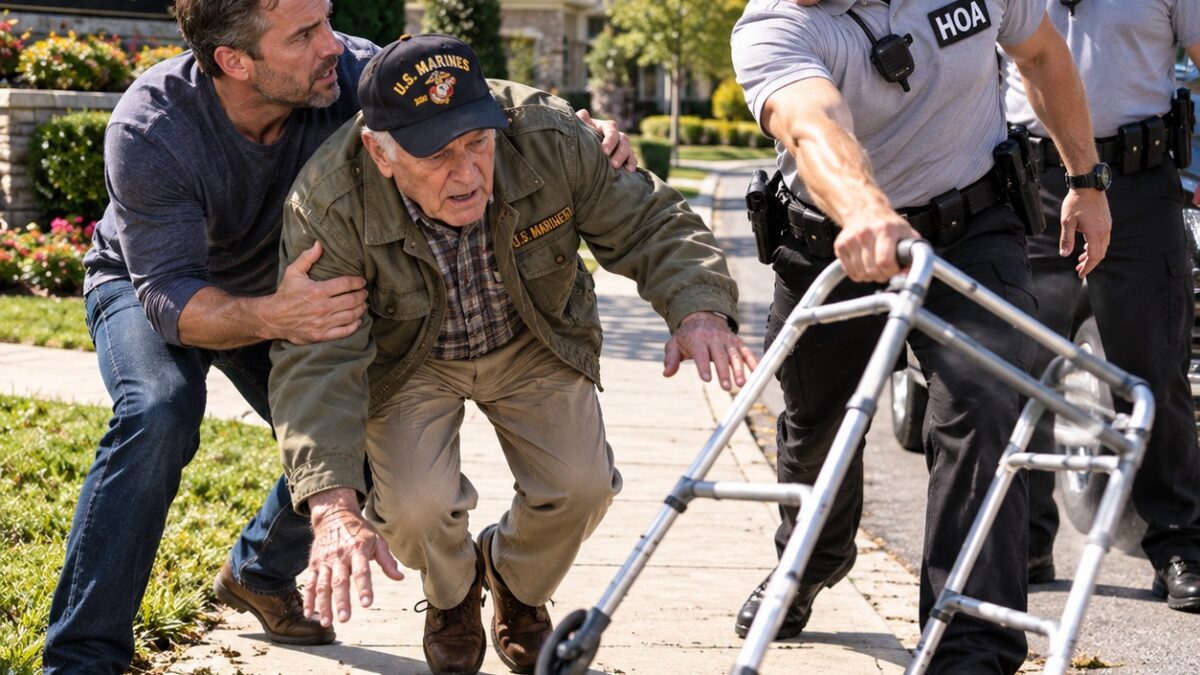
PART 2 and FULL ENDING  Thank you

I remember every sound from the next few seconds.
The SUV engine ticking as it cooled.
A landscaping crew somewhere beyond the hedge running a leaf blower.
My father’s breathing.
The small rubber foot of his walker settling back onto the concrete after I pulled it closer.
And the younger man saying:
“We’re just doing our job.”
As though those five words could erase what I had just watched him do.
I stepped toward him.
Dad’s hand closed around my sleeve.
“Jake.”
His voice was weak.
But clear.
I stopped.
That was something my father had always been able to do.
One word.
No shouting.
No performance.
Just enough authority in the tone that your body remembered he expected discipline.
The older enforcer crossed his arms.
“Your father was obstructing the path.”
“He was walking.”
I said.
“He stopped.”
“For maybe five seconds.”
“That still counts as an obstruction.”
I stared at him.
“Do you actually hear yourself?”
The younger man laughed.
“There you go.”
“What?”
“Making this bigger than it needs to be.”
I almost admired the arrogance.
Almost.
My father had been shoved.
Nearly fallen.
And somehow I had become the person escalating the situation.
That kind of reversal only works when the person doing it is accustomed to others doubting themselves.
Dad shifted beside me.
His breathing was still uneven.
“You okay?”
I asked.
“I’m fine.”
“You almost went down.”
“I said I’m fine.”
That meant:
Do not humiliate me by making my weakness the center of this.
I understood.
So I nodded.
Then turned back to the men.
“You owe him an apology.”
The younger one actually tilted his head.
“For what?”
“For putting your hands on his mobility aid.”
“He was blocking the sidewalk.”
“That isn’t an answer.”
The older enforcer spoke.
“Sir, if you continue creating a disturbance, we will document this incident.”
I laughed once.
No humor.
“You should.”
They both looked at me.
“Document every second.”
“Write down that your employee shoved a sixty-eight-year-old man’s walker while he was using it.”
The younger man’s smile faded slightly.
Not guilt.
Calculation.
He had begun to understand that the incident might not look as good written down as it had felt in the moment.
Dad whispered:
“Jake.”
I looked at him.
His face looked tired.
More tired than it had ten minutes earlier.
That made me angrier.
I had seen my father exhausted before.
After hospital stays.
After physical therapy.
After nights when pain made sleep impossible.
But this was different.
Humiliation creates a particular kind of exhaustion.
It comes from being forced to defend your right to occupy ordinary space.
Dad had spent most of his life walking into rooms as a man others automatically made room for.
Not because he demanded worship.
Because he carried certainty.
Age had changed the way strangers read him.
Now they saw walker first.
Bent posture.
Gray hair.
Slower movement.
They did not see Major Carl Adams.
They did not see the man who had mentored young officers.
They did not see the father who taught me how to change a tire in a thunderstorm because “weather doesn’t excuse ignorance.”
They did not see the man who spent weekends repairing neighbors’ fences without telling anyone.
They saw an obstruction.
That word kept burning.
Obstruction.
The younger enforcer looked at Dad.
“You need to move the walker fully off the common path.”
I took another step.
Dad tightened his hand on my sleeve.
“No.”
He said.
I turned.
He was looking at the enforcers now.
Not me.
His fingers shook on the walker.
His shoulders did not.
“These men think I’m weak.”
Dad said.
The younger one rolled his eyes.
“Nobody said—”
Dad cut him off.
“Son.”
Not to him.
To me.
Just that.
Son.
I went quiet.
Dad straightened.
It was subtle.
Maybe an inch.
But suddenly I saw another version of him.
The man from photographs in uniform.
The man who once stood at the front of formations.
The man whose voice could turn chaos into attention.
“I am Carl Adams.”
He said.
No tremor now.
“Former Major.”
“Marine Corps Reserve.”
The older enforcer’s expression changed first.
Tiny.
But I saw it.
Recognition.
Or perhaps simply the realization that this old man possessed a biography outside their rulebook.
Dad continued.
“I spent years teaching young Marines that authority without restraint is cowardice wearing a uniform.”
The younger man scoffed.
“This isn’t the Marines.”
“No.”
Dad replied.
“That is painfully obvious.”
I nearly smiled.
The younger enforcer flushed.
Dad’s voice stayed calm.
“You shoved a mobility device away from a man while he was depending on it for balance.”
“Whether I was a Marine or a grocery clerk, that would still be wrong.”
That sentence cut through me.
Because Dad understood something I had almost lost inside my anger.
His service mattered.
His history mattered.
But it was not what made him deserve dignity.
The younger man started:
“Look, if you’re trying to intimidate us with your military—”
Dad raised one hand.
“I am not intimidating you.”
“If I were, you would know the difference.”
Silence.
Then the older enforcer asked:
“Major Adams?”
Dad turned his face toward him.
“Yes.”
“Were you with the reserve training command here years ago?”
Dad studied him.
“Among other assignments.”
The man swallowed.
I saw the moment.
He knew the name.
Maybe not personally.
But enough.
I remembered something Dad once told me.
There are people who respect principles.
And people who only respect consequences.
You usually find out which one you’re dealing with when they think nobody important is watching.
I reached for my phone.
Dad glanced at me.
“What are you doing?”
“Making sure somebody important is watching.”
He frowned.
I scrolled.
There was a number I had not used in months.
Captain Harris.
Dad had mentored him years earlier.
Back then, Harris had been a young officer with more energy than judgment, according to Dad.
Now he helped direct local reserve operations and coordinated frequently with local security programs and civic organizations.
He was not some magical authority over the HOA.
He could not arrest neighborhood employees because they disrespected a veteran.
That was not how the world worked.
But he knew Dad.
More importantly, he knew people on the Oakridge security advisory board.
And he knew exactly how seriously they treated an allegation involving physical interference with an elderly resident’s mobility device.
I called.
“Captain Harris’s office.”
“This is Jake Adams.”
A pause.
“Carl’s son?”
“Yes.”
“Is he okay?”
That question almost made me lose my composure.
Why would Harris assume something was wrong?
Because people do not call old mentors’ military contacts on random Tuesday mornings.
“He almost fell.”
Silence.
“What happened?”
I looked directly at the enforcers.
Then described it.
No exaggeration.
No speech about disrespecting America.
No dramatic language.
Two HOA compliance employees confronted us over a sidewalk obstruction claim.
Dad attempted to move.
One employee shoved his walker.
Dad lost balance.
I caught him.
They refused to apologize.
Harris became very quiet.
“Where are you?”
“Oakridge coffee-lot entrance.”
“Stay there.”
The call ended.
The younger enforcer laughed.
“That supposed to scare us?”
“No.”
I put my phone away.
“It’s supposed to create a record.”
That bothered him more.
The older enforcer glanced toward their SUV.
“We’ve done what we came to do.”
“No.”
I said.
“You’re staying.”
He looked at me.
“You don’t have authority to detain us.”
“That’s true.”
I stepped aside.
“You’re free to leave.”
Neither man moved.
Interesting.
Maybe their confidence had limits after all.
Dad leaned toward me.
“You enjoying this?”
“No.”
“Liar.”
Despite everything, I laughed.
That helped.
A black pickup entered the lot about eight minutes later.
Not military.
Not dramatic.
No lights.
No siren.
Captain Harris climbed out wearing slacks and a dark quarter-zip with a Marine Corps Reserve emblem over the chest.
Mid-fifties.
Close-cropped gray hair.
The kind of man who walked quickly without looking rushed.
He came straight to Dad.
“Major.”
Dad sighed.
“I told you twenty years ago to stop calling me that.”
“You told me many things.”
“I ignored half.”
Dad’s face softened.
They shook hands.
Then Harris looked at the walker.
At Dad’s trembling grip.
At me.
Finally, the enforcers.
His expression changed.
“Which one touched the mobility aid?”
The younger man raised his chin.
“This is an HOA compliance matter.”
Harris nodded.
“I understand.”
That answer seemed to confuse him.
Harris continued.
“I’m not here as military enforcement.”
“You don’t answer to me.”
The younger man relaxed slightly.
Then Harris added:
“I am here because I know Major Adams.”
“And because Oakridge’s community security coordinator happens to be a former reservist I trained with last month.”
The older enforcer’s face drained.
The younger man tried to recover.
“We were enforcing sidewalk rules.”
Harris looked at Dad.
“Did you refuse to move?”
Dad answered:
“No.”
“I was turning the walker when he shoved it.”
Harris looked at me.
“You saw it?”
“Yes.”
“Any cameras?”
I looked up.
Parking-lot security camera.
Direct line of sight.
The younger man looked too.
There it was.
The end of his confidence.
Harris pulled out his phone.
“Good.”
He made one call.
Short.
Professional.
“Tom.”
“Need you at the coffee lot.”
“Possible physical misconduct by HOA compliance.”
“Elderly resident.”
“Mobility device.”
“Camera coverage.”
Pause.
“Carl Adams.”
Another pause.
“Yes.”
“That Carl.”
He ended the call.
The younger enforcer muttered:
“This is ridiculous.”
Dad finally looked at him.
“Why?”
“Because I know people?”
The man did not answer.
Dad continued.
“That is what should bother you.”
“You were comfortable doing it before you knew who I knew.”
Nobody spoke.
My anger shifted then.
It became colder.
Less satisfying.
Because Dad was right.
The most disturbing part was not that they had mistreated him.
It was how quickly their posture changed once they believed consequences might reach them personally.
The older enforcer finally spoke.
“Mr. Adams.”
“I apologize if the situation became physical.”
Dad’s mouth tightened.
“If?”
The man swallowed.
“You’re right.”
Then:
“I apologize.”
Dad nodded once.
Not forgiveness.
Acknowledgment.
The younger enforcer remained silent.
Harris looked toward him.
“You don’t have anything to say?”
“Not really.”
Dad surprised us.
“Good.”
Everyone looked at him.
“I don’t want an apology someone has to squeeze out of you.”
He pointed to the walker.
“Put it back where you shoved it from.”
The young man stared.
Then walked over.
Picked up the walker.
Placed it carefully in front of Dad.
The gesture was small.
Almost ridiculous.
Yet watching him handle it carefully after treating it like trash minutes before filled me with a satisfaction I am not particularly proud of.
Dad gripped the handles.
Tested his balance.
Then looked at the man.
“Next time you see someone moving slowly.”
He said.
“Your first assumption should not be that your time is worth more than their safety.”
The young enforcer looked down.
Harris did not smile.
Neither did I.
A second vehicle arrived.
Oakridge community security director Tom Bennett stepped out with the HOA property manager.
That was when the situation stopped being personal.
They asked us to describe everything again.
Recorded.
Times.
Location.
Exact words where we remembered them.
The property manager requested the footage immediately.
The younger enforcer’s face became tight.
The older one did not speak unless asked.
The video was pulled within twenty minutes.
There it was.
Dad turning.
Young man grabbing the walker.
Hard shove.
Dad pitching forward.
Me catching him.
No ambiguity.
No angle problem.
No convenient misunderstanding.
Just an ugly little act captured in clean high-definition.
The property manager watched twice.
Then closed the laptop.
“You’re both suspended pending review.”
The younger enforcer exploded.
“What?”
“You can’t be serious.”
“I’m very serious.”
“He was blocking the path.”
The property manager stared.
“Nothing in our policy authorizes physical interference with a resident’s medical or mobility equipment.”
“I was moving an obstruction.”
“You were moving a person’s walker while he was using it.”
“He could’ve—”
“Stop.”
The man stopped.
The older enforcer looked at Dad.
“I am sorry.”
This time it sounded different.
Maybe because the consequences were real now.
Maybe because shame had finally caught up.
I did not know.
Dad nodded.
Then turned toward me.
“Coffee.”
I blinked.
“What?”
“We came for coffee.”
“Dad.”
“Jake.”
He began moving.
Walker.
Step.
Walker.
Step.
Like none of us had permission to ruin the rest of his morning.
Captain Harris walked beside him.
I followed.
Behind us, the HOA staff continued talking.
Reports.
Suspensions.
Footage.
Investigation.
Dad ordered black coffee.
Same as always.
Harris insisted on paying.
Dad complained.
“You’re still cheap.”
Harris said.
“I trained you to conserve resources.”
“That is not what you called it when I bought everybody lunch.”
“Different doctrine.”
I watched them joke.
For the first time since the shove, I could breathe normally.
We sat near the window.
Dad lowered himself into a chair carefully.
I noticed his hand shaking worse than before.
“You’re hurting.”
“I’m old.”
“That’s not an answer.”
“It’s the one you’re getting.”
Harris looked at him.
“You should get checked.”
Dad glared.
“I liked you better when you were a lieutenant.”
“No, you didn’t.”
“No.”
“I really didn’t.”
Eventually, we convinced him to let me drive him to urgent care.
No fracture.
Mild strain.
Bruising.
Nothing catastrophic.
The doctor told him to rest.
Dad asked whether walking to the coffee shop counted.
The doctor said no.
Dad accused medicine of becoming authoritarian.
Normal.
That evening, I sat at his kitchen table while he iced his wrist.
The anger returned.
Without witnesses.
Without adrenaline.
Just me staring at the purple bruise forming near his forearm.
“I should’ve done something.”
Dad looked up.
“You did.”
“I mean when he shoved you.”
“You caught me.”
“I should’ve—”
“What?”
He asked.
“Hit him?”
I said nothing.
Dad leaned back.
“You think that would’ve restored my dignity?”
“No.”
“Would’ve felt good.”
“For about fifteen seconds.”
“Maybe twenty.”
I smiled despite myself.
Then he became serious.
“Son.”
“Yeah?”
“Do not turn my weakness into your excuse for losing control.”
The sentence landed hard.
“I wasn’t—”
“You were.”
He knew me too well.
“I saw your face.”
I looked away.
Dad continued.
“There was a time I would’ve reacted the same way.”
“Probably worse.”
“Then what changed?”
“Consequences.”
He adjusted the ice pack.
“And age.”
“Age is expensive education.”
I laughed.
Then:
“I hated watching them treat you like that.”
“I know.”
“They looked at you like you were nothing.”
Dad was quiet.
Finally:
“That part hurt more than the shove.”
I looked at him.
He stared toward the dark kitchen window.
“When you get old.”
He said.
“People begin speaking around you.”
“Past you.”
“Slower at you.”
“They assume the body and the mind declined together.”
“They see equipment before person.”
“Walker.”
“Cane.”
“Hearing aid.”
“Wheelchair.”
He looked down at his hands.
“I spent most of my life entering rooms where people knew my rank.”
“Now I enter rooms where strangers see an old man in the way.”
I had never heard him say anything like that.
Dad did not volunteer vulnerability.
He rationed it.
“Does it happen a lot?”
“Not like today.”
“But enough.”
I felt sick.
He continued.
“That’s why what I said mattered.”
“What?”
“That my service wasn’t the reason they were wrong.”
I nodded.
“If you hadn’t been a Marine, it still would’ve been wrong.”
“Yes.”
“Maybe more important.”
He leaned toward me.
“You were angry because they didn’t know who they were dealing with.”
“I understand why.”
“But that cannot be the lesson.”
I waited.
“The lesson is that they shouldn’t need to know.”
Silence.
Dad looked at me.
“They should not need a rank.”
“A medal.”
“A wealthy family.”
“A connection.”
“A camera.”
“A person’s dignity cannot depend on whether somebody powerful will answer the phone.”
That sentence stayed with me far longer than everything else.
Longer than the shove.
Longer than Harris arriving.
Longer than watching their faces change.
Because it complicated the victory.
I had enjoyed the reversal.
Of course I had.
My father was humiliated.
Then suddenly the people who humiliated him became afraid.
Emotionally, it felt balanced.
Morally, Dad was telling me something harder.
If the only reason a bully stops is because he discovers the victim has powerful friends, justice has not fully arrived.
The power calculation changed.
That is not the same thing as character changing.
Two days later, the HOA board requested a meeting.
Dad refused at first.
“Waste of time.”
I talked him into going.
Mostly because I wanted answers.
The boardroom was smaller than I expected.
Six directors.
Property manager.
Security director.
Legal counsel.
Dad and me.
Captain Harris offered to attend.
Dad said no.
“I don’t need a military escort to talk to my neighbors.”
That was Dad.
The board president, Elaine Porter, began with an apology.
Real one.
No if.
No misunderstanding.
“Mr. Adams.”
“What occurred was unacceptable.”
“Our employees violated policy.”
“They physically interfered with your mobility device.”
“They escalated rather than assisted.”
“And our current sidewalk enforcement language is vague enough that staff believed they could confront residents using mobility aids over temporary obstruction.”
Dad listened.
Then:
“Believed?”
Elaine nodded.
“I’m not excusing it.”
“I’m telling you we found a policy failure too.”
Good answer.
The investigation had uncovered something larger.
The HOA had recently begun emphasizing walkway enforcement after complaints about bicycles, delivery packages, landscaping equipment, and trash bins.
Compliance staff were given citation quotas.
Unofficially.
Nobody called them quotas.
They called them “weekly enforcement targets.”
Same thing.
The younger enforcer, Mason Pike, had been written up once before for aggressive contact with residents.
The older employee, Robert Lane, had never been disciplined but had apparently witnessed several interactions without intervening.
Dad asked:
“What happens now?”
Elaine replied:
“Mason is terminated.”
“Robert is suspended for thirty days and must complete retraining before returning.”
Dad’s expression did not change.
“Anything else?”
“We’re rewriting the mobility-access policy.”
“Medical devices cannot be treated as obstructions during normal use.”
“Staff will be trained to assist first.”
“Escalate only when there is an actual safety hazard.”
“Physical contact with mobility devices is prohibited except to prevent immediate harm or when requested by the user.”
Dad nodded slowly.
“That is better.”
The attorney added:
“We also want to reimburse any medical costs from the incident.”
Dad looked irritated.
“I have insurance.”
I put a hand on his arm.
“Take the reimbursement.”
“Jake.”
“Dad.”
The board president almost smiled.
Eventually, he agreed.
Then Elaine said something I did not expect.
“We would like you to serve on a temporary accessibility review committee.”
Dad stared.
“No.”
I laughed.
He glared at me.
Elaine continued.
“Not because of your military history.”
“Good.”
“Because you are a resident using mobility equipment and our policies clearly need input from people they affect.”
Dad went quiet.
That changed things.
He hated committees.
He hated HOA meetings.
He hated any gathering where someone used the phrase best practices more than twice.
But he also hated systems built without listening to people forced to live under them.
“When?”
He asked.
I stared.
Elaine smiled.
“Thursday evenings.”
“Absolutely terrible.”
Dad said.
Then:
“I’ll do it.”
That committee changed Oakridge more than Captain Harris’s phone call.
Not dramatically.
No cheering.
No headlines.
They reviewed sidewalks.
Curb cuts.
Benches.
Parking.
Temporary construction obstructions.
Pool access.
Emergency routes.
Residents using wheelchairs and walkers were invited.
Parents with strollers.
One woman recovering from a hip replacement.
An older resident with limited vision.
Suddenly, rules written by able-bodied people sitting around a conference table were being tested against actual bodies.
The difference was embarrassing.
One sidewalk Dad had supposedly obstructed was too narrow in places for two mobility devices to pass comfortably.
A decorative planter created a pinch point.
Nobody had noticed because nobody making the rule used a walker.
They moved the planter.
Widened part of the path during the next resurfacing.
Added benches.
Simple.
The world did not collapse.
I attended one meeting.
Dad introduced me as:
“My chauffeur.”
I objected.
“You invited me.”
“I regretted it.”
Same father.
The older enforcer, Robert, eventually asked to meet him.
Dad did not want to.
Then agreed.
We met at the coffee shop.
The exact place.
Robert arrived alone.
No HOA polo.
No radio.
He looked older without the uniform.
Funny how authority clothing changes a face.
He sat.
Dad drank coffee.
Robert said:
“I should have stopped Mason.”
Dad said nothing.
“I knew he was impatient.”
“I knew he was crossing a line.”
“I told myself he was just moving the walker.”
“But I watched your balance go.”
“And I still defended him.”
Dad asked:
“Why?”
Robert stared at the table.
“Because I didn’t want to look weak in front of him.”
I almost laughed at the absurdity.
A middle-aged man allowed an elderly man to be shoved because he did not want to look weak in front of a twenty-something coworker.
Then I realized how common that logic probably was.
Robert continued.
“I also thought we were supposed to be tougher.”
“New enforcement push.”
“Less arguing.”
“More compliance.”
Dad stirred his coffee.
“Did being tougher make you better at your job?”
“No.”
“Then what did it make you?”
Robert took a long time.
Finally:
“Cruel.”
Dad nodded once.
No comfort.
No humiliation.
Just agreement.
Robert looked at me.
“I’m sorry too.”
“I’m not the one you shoved.”
“I know.”
Then Dad surprised me again.
“What are you going to do differently?”
Robert described the retraining.
Accessibility policy.
Reporting aggressive interactions.
Dad stopped him.
“That’s what they are making you do.”
“What are you going to do?”
Robert sat back.
“I don’t know.”
“Figure it out.”
Meeting over.
Dad finished his coffee.
We left.
Outside, I asked:
“Do you forgive him?”
“Not relevant.”
“What does that mean?”
“It means forgiveness is not a receipt people earn by buying coffee.”
I laughed.
“Do you practice these lines?”
“I’ve had sixty-eight years.”
“Some of them are bound to be decent.”
Mason never requested a meeting.
He appealed his termination.
Lost.
Then disappeared from Oakridge life.
Months later, I saw him at a hardware store.
He saw me too.
For half a second, the old anger came back.
He looked different.
No mirrored glasses.
No radio.
Just a young man in work boots carrying paint supplies.
He started to turn away.
I surprised myself.
“Mason.”
He stopped.
I walked over.
Neither of us knew what to do.
He said:
“How’s your dad?”
“Better.”
He nodded.
“I heard they changed the sidewalks.”
“Some.”
Another pause.
Then:
“I shouldn’t have touched his walker.”
The words were so plain that I almost missed how important they were.
“No.”
“You shouldn’t have.”
“I was pissed off.”
“At what?”
He laughed bitterly.
“Everything.”
“Job sucked.”
“People argued all day.”
“Manager wanted more citations.”
“I thought being hard meant people would stop questioning me.”
“And your father…”
He looked down.
“He was moving slowly.”
I waited.
Mason swallowed.
“I took it personally.”
That might have been the most honest thing anyone said about the incident.
He took someone else’s slowness personally.
As disrespect.
As inconvenience.
As defiance.
“I’m sorry.”
He said.
This time there was no audience.
No Captain Harris.
No security director.
No camera playing back his behavior.
Just a hardware aisle.
I believed him.
Not because apology erased anything.
Because he finally seemed embarrassed by what he had been rather than merely afraid of consequences.
“I’ll tell Dad.”
I said.
“Does he hate me?”
I thought.
“No.”
Mason looked surprised.
“He doesn’t think about you enough to hate you.”
That hurt him.
I could see it.
Maybe it should have.
He nodded.
“Fair.”
We walked away.
When I told Dad, he listened.
Then:
“Good.”
“That’s it?”
“What do you want?”
“I don’t know.”
“A redemption speech?”
“Maybe.”
Dad laughed.
“People changing when nobody is watching is the redemption speech.”
Again with the lines.
The accessibility committee eventually became permanent.
Dad served one year.
Then resigned dramatically after someone suggested forming a subcommittee.
“I did not survive six decades to die in a subcommittee.”
He told me.
I believed him.
By then, Oakridge had changed in small ways.
Compliance officers introduced themselves before issuing warnings.
Mobility equipment was explicitly protected.
Residents could request accessibility reviews without filing formal architectural modification petitions.
The HOA eliminated citation targets.
Body-worn cameras were added for certain enforcement interactions after multiple unrelated complaints.
Some residents hated that.
Some enforcement staff hated it more.
Good.
Transparency should be mildly uncomfortable.
Dad continued walking to the coffee shop.
Slowly.
Walker.
Step.
Walker.
Step.
The first time we reached the spot where Mason had shoved it, I noticed Dad tense.
Tiny.
His right hand tightened.
I said nothing.
We continued.
That was another lesson.
People often treat physical recovery as the whole story.
No fracture?
Great.
Bruising healed?
Done.
But the body remembers the moment it lost control.
Dad never called it fear.
Of course not.
He called it:
“Paying attention.”
Same thing in his language.
One morning, he stopped at the narrow section.
Looked down.
Then smiled.
“What?”
I asked.
“They moved the planter.”
I looked.
He was right.
The stupid decorative planter that had made the sidewalk tighter was gone.
“Your legacy.”
I said.
“Great.”
He replied.
“Forty years from now, children will gather here and say, ‘An angry old Marine once complained about landscaping.’”
I laughed so hard a woman walking her dog stared at us.
Dad got his coffee.
Black.
No sugar.
We sat outside.
He watched people pass.
A mother with a stroller.
Man on a mobility scooter.
Teenager on crutches.
Delivery worker carrying boxes.
Nothing dramatic.
Just ordinary bodies trying to move through ordinary space.
Dad said:
“That’s what rules forget.”
“What?”
“People are messy.”
“Rules love clean categories.”
“Obstruction.”
“Violation.”
“Authorized.”
“Unauthorized.”
He nodded toward a woman helping her husband with a cane.
“Then real life shows up.”
I thought about Mason.
The walker.
The phone call.
Captain Harris.
For months, neighbors told the story as though the big moment was Dad revealing his rank.
People loved that part.
Former Marine Major humiliated by HOA.
One phone call.
Bullies panic.
It made a satisfying story.
It was also incomplete.
Dad’s rank got attention.
His connections accelerated consequences.
But neither was the reason the shove was wrong.
If Dad had been Carl Adams, retired grocery clerk, it would have been wrong.
If he had never served.
Wrong.
If nobody powerful answered my phone call.
Still wrong.
That distinction changed me.
Before that morning, I thought respect was something a person earned through accomplishment.
Dad had earned plenty.
Service.
Leadership.
Sacrifice.
Afterward, I understood dignity comes earlier.
Before achievement.
Before status.
Before anyone knows your name.
Authority reveals character most clearly when it is used against somebody who cannot easily fight back.
That became the lesson I carried.
Not:
Be careful who you mess with.
That is a bully’s lesson.
The real lesson was:
You should not need to know who someone is before deciding not to mistreat them.
A year after the incident, Captain Harris retired.
Dad attended the ceremony.
Walker and all.
Harris introduced him to a group of younger officers.
“This is Major Adams.”
Dad corrected:
“Carl.”
Nobody listened.
Harris gave a speech about mentors.
Dad pretended to hate it.
Then cried in the parking lot and threatened me if I told anyone.
“I saw nothing.”
I promised.
“Good.”
On the drive home, he stared out the window.
“You know what bothered me about that day?”
“The walker?”
“No.”
“The humiliation?”
“Partly.”
“What then?”
“That you thought my old rank was what would save me.”
I flinched.
“That’s not—”
“It was.”
He was right.
“I called Harris because I wanted them scared.”
“Yes.”
“I wanted them to realize they picked the wrong man.”
Dad turned toward me.
“They did pick the wrong man.”
Then:
“They would have picked the wrong man no matter who I was.”
That shut me up.
After a moment, he smiled.
“Still glad you called Harris.”
I laughed.
“So am I.”
“Watching Robert’s face was excellent.”
“There he is.”
“I’m old, not holy.”
That was Dad.
Moral clarity without pretending human satisfaction disappears just because you know better.
His health declined over the next several years.
Not dramatically at first.
More appointments.
Longer recovery after simple illnesses.
Walker became a rollator.
Then sometimes a wheelchair for long distances.
He hated the wheelchair.
Not because he thought wheelchairs meant weakness.
Because the thing squeaked.
“Sounds like a dying shopping cart.”
He complained.
I oiled it.
He complained anyway.
Eventually, I helped him more.
Shoes.
Appointments.
Groceries.
The role reversal frightened me at first.
The man who had always been the immovable point became somebody who needed help standing.
But Dad never became less himself.
He still criticized my parking.
Still called three minutes late “operational failure.”
Still refused decaf on philosophical grounds.
At seventy-three, he returned to an HOA accessibility meeting because they proposed replacing a curb cut with decorative stone edging.
He rolled into that boardroom like Patton in a squeaky wheelchair.
The proposal died.
Some legends are small.
I preferred his.
One winter afternoon, we sat in his living room.
Rain against the window.
Dad’s hands had become thin.
Veins prominent beneath skin.
He said:
“You remember those HOA idiots?”
“How could I forget?”
“The young one ever apologize?”
“Yeah.”
“Hardware store.”
“I told you.”
“You tell me lots of things.”
“I selectively retain.”
He looked toward me.
“Did you forgive him?”
I laughed.
“You asked me that about Robert.”
“I’m asking you.”
I thought.
“I stopped being angry.”
“Not the same.”
“No.”
“Maybe forgiveness.”
“Maybe indifference.”
Dad nodded.
“Both useful.”
Then:
“I’m glad you didn’t hit him.”
I stared.
“You’ve been holding that thought for five years?”
“Yes.”
“Very disciplined.”
“You’d have regretted it.”
“I know.”
“You might’ve won.”
“I know.”
“You still would’ve lost something.”
That was Dad’s definition of control.
Not avoiding every fight.
Knowing which victories make you smaller.
He died the following spring.
Quietly.
Hospital.
Me beside him.
No grand final speech.
No military movie ending.
His last coherent complaint was that the coffee tasted terrible.
Appropriate.
Captain Harris attended the funeral.
So did Robert.
That surprised me.
He stood near the back.
Older.
Hair grayer.
No HOA uniform.
When he saw me, he approached.
“I wasn’t sure I should come.”
“Dad would’ve said funerals are public.”
Robert smiled.
“That sounds like him.”
“He talked about that day?”
“Rarely.”
Robert looked toward the folded flag.
“I think about it all the time.”
I studied him.
“Why?”
“Because I realized how easily I let a stupid job make me cruel.”
That answer stayed with me.
Not a bad man becoming good.
More unsettling.
An ordinary man realizing he had been capable of cruelty while telling himself he was simply following procedure.
That is the danger most people ignore.
We imagine abuse of power requires evil personalities.
Often it requires ordinary people who become invested in the role more than the human being standing in front of them.
Robert shook my hand.
Then left.
After the funeral, I brought Dad’s walker home.
For weeks, it sat in my garage.
Folded.
Quiet.
I could not throw it away.
Could not donate it.
Could not look at it without hearing aluminum scrape pavement.
Eventually, I took it to a veteran mobility charity.
A volunteer asked whether I wanted a receipt.
“No.”
Then:
“Actually.”
I stopped.
“Can you put his name on the donation?”
“Sure.”
She wrote:
IN MEMORY OF CARL ADAMS.
I watched another older man test it later.
He moved slowly.
Gripped the same handles Dad had.
Took three steps.
Smiled.
“It’s solid.”
I almost cried.
“It is.”
The walker stopped being evidence of humiliation.
It became useful again.
Dad would have liked that.
Maybe not the sentimental interpretation.
He hated sentimentality.
But usefulness?
Absolutely.
Years passed.
Oakridge changed leadership.
The coffee shop changed owners.
The black SUV disappeared.
The sidewalks remained.
One morning, I found myself walking the same route alone.
No Dad beside me.
No walker.
I reached the place where it happened.
There was a bench now.
Part of the accessibility project.
A small plaque:
COMMUNITY ACCESS REST AREA.
No Carl Adams.
He had refused naming rights.
“Absolutely not.”
He told the committee.
“I’m not dying so you can put my name on furniture.”
The bench made me laugh.
I sat.
People moved past.
Nobody knew why I was smiling.
I thought about that phone call.
For years, I had told myself it changed everything.
In one sense, it did.
Harris arrived.
Security arrived.
Footage got reviewed immediately.
The enforcers lost their confidence.
But Dad’s phone-call victory was never the part he cared about.
The real victory happened later.
A rule changed.
A walkway widened.
A staff member learned to ask before touching someone’s mobility equipment.
A younger man apologized without an audience.
An older enforcer admitted he had chosen loyalty to a coworker over decency to a stranger.
Small things.
Less dramatic.
More durable.
If I told the story the way I felt it that morning, I would say:
Two arrogant HOA enforcers humiliated my Marine father, and one call made them regret it.
That version is satisfying.
But Dad taught me a better ending.
Two men mistreated an old man because they thought they could.
Then they discovered he had a history they respected more than his vulnerability.
Their fear exposed something ugly.
The neighborhood had to decide whether it wanted to correct only the men—or correct the system that let them believe vulnerability could be treated as defiance.
For once, the system changed too.
That was justice.
Not perfect.
Not dramatic.
Real.
I still have Captain Harris’s number.
He sends a message every November on Dad’s birthday.
Usually:
Thinking of the Major.
I always reply:
He’d tell you to stop calling him that.
Harris answers:
Never.
Some traditions survive.
And every time I pass an elderly person moving slowly in a parking lot now, I notice.
Not because everyone might secretly be a retired Marine.
Not because they might know somebody powerful.
Because Dad taught me to notice the person before the inconvenience.
One afternoon, years later, I was leaving a grocery store when an older woman ahead of me struggled with a walker at the curb.
Cars were waiting.
One driver honked.
The woman flinched.
For half a second, I felt the old heat.
Then I remembered Dad.
Authority without restraint is cowardice.
But so is anger without usefulness.
I walked over.
“Can I help?”
She looked embarrassed.
“My wheel’s stuck.”
I crouched.
The front wheel had jammed against the curb edge.
I lifted it gently.
“Got it.”
“Thank you.”
“No problem.”
The driver honked again.
I turned.
The woman touched my arm.
“Don’t.”
I looked at her.
She smiled.
“I’m too old to waste time teaching impatient people manners.”
I laughed.
Dad would have liked her.
We crossed.
Slowly.
The world survived waiting another thirty seconds.
That is what I remember most now.
Not the shove.
Not the phone call.
Not the moment those men learned my father’s rank.
I remember Dad gripping that walker and refusing to let another person’s disrespect decide what kind of man he would become in response.
He had once commanded Marines.
He had trained officers.
He had earned respect in rooms I would never enter.
But in the final years of his life, his greatest lessons came without a uniform.
Move slowly when you need to.
Ask for help when you need it.
Never confuse physical weakness with moral weakness.
Never let someone else’s cruelty choose your behavior for you.
And never make dignity dependent on a title.
The morning those HOA enforcers shoved his walker, I wanted them to learn they had picked the wrong old man.
Dad taught me something better.
There is no right old man to humiliate.
No right disabled person to shove aside.
No right stranger to treat like an obstruction simply because nobody important appears to be watching.
That was the lesson Captain Harris’s arrival could not teach.
Dad did.
And years later, every time I see someone moving slowly through a world built for people in a hurry, I hear his voice again.
Son.
One word.
Calm.
Commanding.
Enough to stop me before anger became the thing I regretted.
Then I remember the sentence that mattered more than his rank, his uniform, or every powerful person he ever knew.
They shouldn’t need to know who I am.
And they never should have.








