𝗙𝗨𝗟𝗟 𝗦𝗧𝗢𝗥𝗬: Four Men Mocked My Limp in a Small-Town Diner—Then the Colonel Behind Me Stood Up
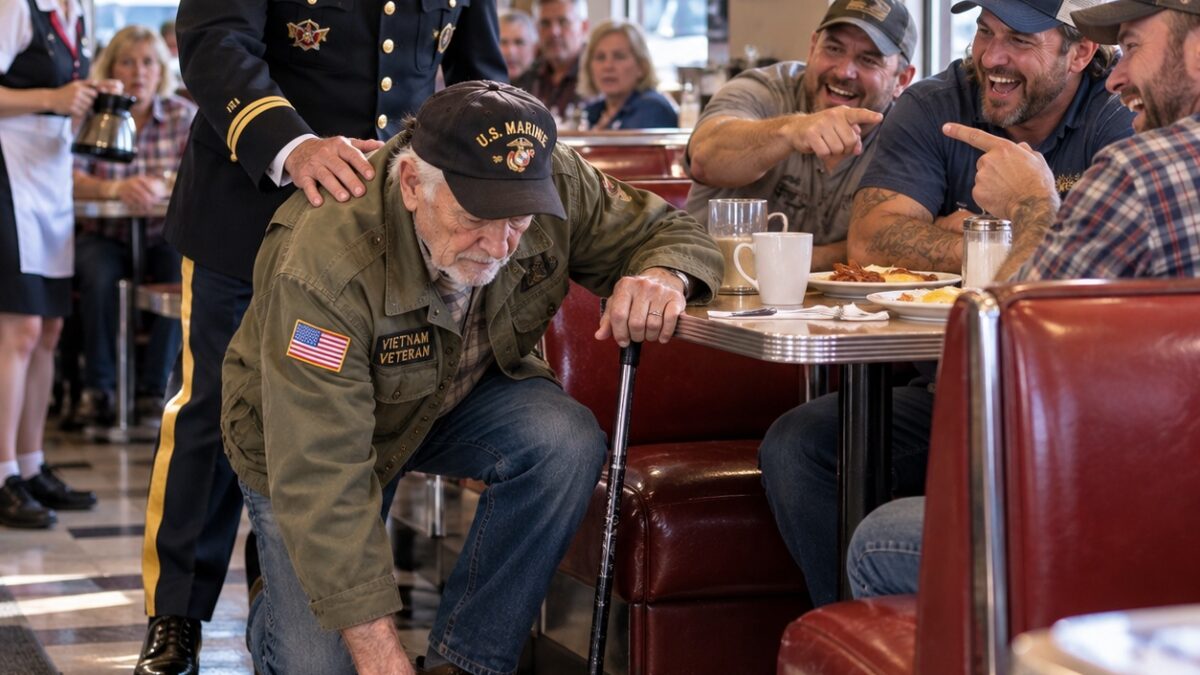
PART 2 and FULL ENDING  Thank you

I did not look around immediately.
At my age, there is a difference between curiosity and urgency.
This did not feel urgent.
It felt deliberate.
The footsteps stopped behind my booth.
Then someone bent down.
I heard metal touch ceramic.
The fork Marissa had already replaced was still there, so at first I was confused.
Then I realized the man had picked up the original fork from where it had been kicked beneath the next table.
He placed it neatly beside the plate.
I turned just enough to catch his reflection in the window.
Tall.
Straight posture.
Dress uniform.
Silver eagles on the shoulders.
Colonel.
United States Army.
The man did not sit.
He did not confront the table.
He stood directly behind me.
Feet together.
Hands at his sides.
Back straight.
At attention.
I stared at his reflection.
He looked at mine.
For a moment, neither of us spoke.
The entire diner had gone so quiet that I could hear the coffee machine hissing near the kitchen.
The four men in the corner looked pale.
Marissa stood frozen with a pot in her hand.
Jenny had stopped wiping the counter.
I returned to my breakfast.
That may sound strange.
But I had not asked the colonel to stand there.
I did not know why he was standing there.
And my eggs were getting cold.
So I took a bite.
The loudest man in the corner finally tried to recover.
“Hey, Colonel Sanders.”
Nobody laughed.
He smiled weakly.
“You backing him up, or are you just showing off the uniform?”
The colonel did not move.
The man’s smile faded.
I cut another piece of toast.
Then the colonel reached into his breast pocket.
I watched in the window.
He pulled out a small plastic sleeve.
Old.
Weathered.
The sort of thing soldiers use when they want paper or photographs to survive rain, mud, and time.
He raised it.
People turned.
Inside was a faded photograph.
I knew the picture before I could see it clearly.
My stomach tightened.
No.
I had not seen that photograph in more than fifty years.
The colonel walked around my booth.
He placed it on the table in front of me.
There I was.
Young.
Thin.
Covered in mud.
My uniform torn.
Blood running down one trouser leg.
And over my shoulder was another Marine.
Unconscious.
His face partly hidden.
I looked up at the colonel.
For the first time, I really saw him.
Older now.
Lines around his eyes.
Gray at the temples.
But I knew the face.
“David?”
His expression changed.
“Yes, sir.”
I put my fork down.
“David Holloway?”
He nodded.
Something moved through my chest that had nothing to do with age.
I had not seen David Holloway since 1970.
He turned toward the diner.
“This man,” he said, “carried me out of a burning convoy in Vietnam.”
Nobody made a sound.
His voice remained calm.
“Three miles.”
I looked at him.
“Closer to two.”
He glanced down at me.
“Felt like three.”
I almost smiled.
He turned back toward the room.
“Enemy fire the entire way.”
The men in the corner stared at him.
David held up the photograph.
“Sergeant Harold Bennett had already been wounded in the leg.”
I looked down at my coffee.
I did not like hearing this part.
Never had.
Never would.
“He refused evacuation because there were still men behind us.”
David continued.
“He came back for me.”
One of the men shifted.
David’s voice hardened.
“He carried me until his own leg gave out.”
That was not exactly how I remembered it.
The mind edits old pain.
Mine had reduced that day to images.
Smoke.
Mud.
Gunfire.
Weight across my shoulders.
Someone screaming for a corpsman.
I remembered David being younger than me.
I remembered thinking he was too young to die.
Maybe that was enough.
David lowered the picture.
“Sergeant Bennett is the reason I’m alive.”
The room stayed silent.
“The reason I got home.”
He looked at me.
“The reason I married my wife.”
His voice changed slightly.
“Raised two sons.”
Then he touched the silver eagle on his shoulder.
“And the reason I lived long enough to wear this rank.”
I stared at him.
I had not known any of that.
After Vietnam, people scattered.
Units changed.
Addresses changed.
Some men deliberately disappeared from the memories they could not carry.
I was probably one of them.
David stood straighter.
“I will not stand in a room and watch anyone ridicule the man who saved my life.”
The loudest man lowered his eyes.
Another stared at the table.
The one who had made the “cosplay Marines” comment slowly stood.
“We didn’t know.”
David looked at him.
“You didn’t ask.”
No anger.
That made it worse.
The man opened his mouth.
Closed it.
David turned toward Marissa.
“I’d like to pay for Sergeant Bennett’s breakfast.”
I shook my head.
“No.”
“Hal.”
“No.”
The old rank meant nothing between us now.
“I can buy my own eggs.”
Someone laughed nervously.
David smiled.
“Fine.”
He looked toward Marissa.
“Then put his breakfast on my tab anyway.”
“I’ll pay you back.”
“I’ll refuse.”
“That’ll be your problem.”
For the first time, the room exhaled.
Then David raised his voice.
“And as far as I’m concerned, this booth is under United States Army protection.”
I turned.
“Don’t start.”
A few people laughed.
David continued anyway.
“In honor of one of the bravest Marines I ever knew.”
That was when Michael, the owner of Rosy’s, came out from the office.
His eyes were red.
He had clearly been watching through the security cameras.
He walked toward my booth.
“Hal.”
“What?”
“I saw everything.”
“I figured.”
He looked at the four men.
Then at me.
“I want to do something.”
“No.”
“You don’t know what it is.”
“Still no.”
He smiled.
“I want to name the booth.”
“Absolutely not.”
David folded his arms.
“I like it.”
“Nobody asked you.”
Michael ignored me.
“Twelve years, Hal.”
He touched the top of the seat.
“Every Sunday.”
“So?”
“Some people earn more than a seat.”
I shook my head.
“I came here to eat breakfast.”
“And you will.”
Michael looked toward the four men.
“But today, I think you’ve earned peace too.”
Then his expression changed.
He addressed them.
“Gentlemen.”
They looked up.
“I think it’s time to settle your bill.”
Nobody argued.
The loudest man stood.
He removed his baseball cap.
Walked toward me.
Stopped several feet away.
“Sergeant Bennett.”
I waited.
“We’re sorry.”
His face had changed.
Not enough to erase what happened.
But enough that I believed shame had reached him.
“We were out of line.”
I gave one nod.
That was all.
I was not ready to make them comfortable.
Apologies matter.
Consequences do too.
They paid.
Then left.
The bell above the diner door rang behind them.
For the rest of my breakfast, nobody bothered me.
David stayed standing another minute.
I finally looked up.
“You planning to guard me while I finish my toast?”
“If necessary.”
“Sit down.”
He did.
Marissa brought another coffee.
David drank his black.
I looked at him.
“You still hate cream?”
“Always did.”
“No.”
“You used to dump sugar in it.”
He looked offended.
“I was twenty-two.”
“Exactly.”
We sat there quietly.
Two old men.
Although one of us wore a colonel’s uniform and the other had eggs on his plate.
After several minutes, I asked:
“How did you find me?”
“I didn’t.”
That surprised me.
“I’m heading to Washington.”
“Pentagon?”
He nodded.
“Stopped for breakfast.”
“You expect me to believe you randomly walked into Rosy’s?”
“Yes.”
I studied him.
“That’s a hell of a coincidence.”
“Maybe.”
I looked at the photograph.
“Why do you carry this?”
His expression softened.
“My father gave it back to me before he died.”
“Your father had it?”
“I mailed it home after I got out of the hospital.”
I touched the plastic sleeve.
“I never saw it.”
“You weren’t meant to.”
He smiled faintly.
“You weren’t much for photographs.”
“Still not.”
“Or talking.”
“Still not.”
He laughed.
Then became serious.
“I tried finding you.”
“When?”
“Several times.”
“What happened?”
“You disappeared.”
“I came home.”
“Same thing for some of us.”
He was right.
I lived quietly.
Worked construction for years.
Then building maintenance.
Married once.
Lost my wife to cancer eleven years before that Sunday.
No children.
No social media.
No veterans’ organizations.
No speeches.
No reunions.
I did not avoid people.
I simply never learned how to make the past into conversation.
David looked at me.
“You never told these people?”
“Told them what?”
“What you did.”
I shrugged.
“It happened.”
“That’s it?”
“What else should I say?”
“That you saved my life.”
“I carried a wounded man.”
“You carried me.”
“Same thing.”
“It wasn’t the same to me.”
That shut me up.
The next Sunday, I came back at 9:15.
Of course I did.
If four loud men could drive me out of my diner, then I had not learned much in seventy-six years.
Jenny smiled too widely when I entered.
That made me suspicious.
“What?”
“Nothing.”
“You’re terrible at lying.”
She pointed toward my booth.
A brass plaque had been mounted above it.
I stopped.
RESERVED FOR SERGEANT HAROLD “HAL” BENNETT
STILL STANDING
Beneath it, encased in glass, was the photograph.
Me carrying David.
Mud.
Blood.
Jungle.
I stared.
Michael appeared from behind the counter.
“No.”
“Already installed.”
“Take it down.”
“No.”
“I’ll bring tools.”
“I’ll hide them.”
“You know I used to work maintenance.”
“I know.”
Jenny laughed.
I touched the edge of the booth.
Something inside me pulled tight.
It was not pride.
That is the easiest word, but the wrong one.
Memory, maybe.
Weight.
A reminder that the twenty-something Marine in that photo and the old man with the cane were somehow still the same person.
Then I heard chairs move.
The four men from the previous Sunday were sitting near the counter.
No beer.
No laughter.
When they saw me, all four stood.
The man who had insulted me most removed his hat.
He walked over.
“Sergeant Bennett.”
I nodded.
“We came back to apologize properly.”
“You did that last week.”
“Not properly.”
He looked uncomfortable.
Good.
Real apologies usually are.
“What we said was wrong.”
I waited.
“My father served in Desert Storm.”
That surprised me.
“He would have been ashamed of me.”
I studied him.
His hands shook slightly around his cap.
People think older men stop recognizing fear.
We do not.
We have simply seen more versions of it.
“You mean it?”
“Yes.”
I glanced at the other three.
They nodded.
I looked back at him.
“Next time.”
He waited.
“Sit with the man before you laugh behind him.”
His eyes lifted.
“You might learn something worth knowing.”
He swallowed.
“Yes, sir.”
That was not forgiveness.
Not exactly.
But it was not a closed door either.
He returned to his friends.
Then the front bell rang.
I heard a familiar voice.
“Still giving people orders?”
David.
Civilian clothes this time.
Jeans.
Polo shirt.
Same posture.
I nodded toward the seat across from me.
He sat.
No ceremony.
No salute.
Just coffee.
Marissa walked over wearing a small Marine Corps pin on her apron.
I had given it to her after the previous week.
She had spent years serving me breakfast without ever asking about the limp.
That mattered.
“Coffee, gentlemen?”
“Black,” David and I said together.
We looked at each other.
She laughed.
Over the next several weeks, something strange happened to my booth.
People joined me.
Veterans sometimes.
One Navy man.
Two Army.
A former Air Force mechanic who talked enough for all of us.
One widow whose husband had served in Korea.
Sometimes strangers who had heard about what happened.
I did not particularly enjoy becoming a local story.
But most people were respectful.
They did not ask about the worst day of my life.
They asked whether they could sit.
That I could handle.
The booth became less lonely.
I had not realized it had been lonely until it wasn’t.
David stopped in whenever his travel brought him close.
We talked about ordinary things.
His wife.
His sons.
My late wife, Margaret.
Bad coffee in military barracks.
Baseball.
Knees.
Age.
Very rarely Vietnam.
Some memories are easier when you do not force them to perform.
The four men who had mocked me came back twice.
Quietly.
Once, one paid for a veteran’s breakfast and left before the man knew who did it.
I noticed.
Said nothing.
People deserve the chance to become better without being applauded for every step.
By the third Sunday, Rosy’s felt different.
Not toward me exactly.
Toward older people.
Toward veterans.
Toward anybody moving slowly.
Customers held doors more often.
People offered to carry trays.
Not because everyone had become saintly.
Because one uncomfortable morning had reminded them that strangers have histories.
That knowledge creates hesitation before cruelty.
Sometimes hesitation is enough.
One Sunday, a young father approached my booth.
His son stood beside him.
Seven or eight years old.
Notebook in both hands.
“Mr. Bennett?”
“Hal.”
“My son has a school project.”
The boy looked terrified.
“What kind?”
“He’s supposed to write about somebody brave.”
I looked at the father.
“There are firefighters down the road.”
The man smiled.
“He asked about you.”
I looked at the boy.
“You did?”
“Yes, sir.”
“What’s your name?”
“Eli.”
“Sit down, Eli.”
His father exhaled with relief.
I pointed to the chair.
“One condition.”
The boy froze.
“What?”
“You drink your coffee black.”
His eyes went wide.
His father laughed.
“I don’t drink coffee.”
“Smart kid.”
He sat.
He opened the notebook.
“What was the bravest thing you ever did?”
I sighed.
Adults ask complicated questions.
Children ask impossible ones.
“I don’t know.”
He frowned.
“But you saved Colonel Holloway.”
“I did.”
“Weren’t you scared?”
“Yes.”
He seemed surprised.
“Then how were you brave?”
I leaned back.
“That’s usually when bravery matters.”
He wrote that down.
I regretted saying something that sounded quotable.
“What happened in the jungle?”
I paused.
His father immediately said:
“You don’t have to answer.”
I appreciated him for that.
I looked at Eli.
“A friend was hurt.”
“Colonel Holloway?”
“He wasn’t a colonel then.”
“What was he?”
“Mostly a pain in the neck.”
The boy laughed.
I continued.
“He needed help.”
“So you carried him.”
“Yes.”
“Three miles?”
I glanced at David’s photograph.
“Closer to two.”
Eli wrote something.
“Colonel Holloway says three.”
“Colonel Holloway exaggerates.”
The boy grinned.
Then he asked the question that stayed with me.
“Why didn’t you tell people?”
I looked toward the diner.
At Marissa.
Jenny.
Michael.
The plaque.
The window.
“I didn’t think I had to.”
“Why?”
“Doing something brave doesn’t mean you have to spend the rest of your life telling people.”
The boy thought about that.
Then wrote again.
His father thanked me.
Before leaving, Eli turned back.
“Mr. Bennett?”
“Yes?”
“I think you’re still brave.”
I smiled.
“Wait until you see me stand up.”
He giggled.
After they left, I sat there longer than usual.
The plaque above me caught the morning light.
Still standing.
At first, I hated those words.
They seemed dramatic.
Then I began to understand what Michael meant.
Still standing did not mean untouched.
It did not mean strong every day.
It did not mean I never hurt.
My back hurt every morning.
My leg ached when weather changed.
I missed Margaret.
I missed men who never came home.
I had spent years avoiding certain sounds because they brought helicopters back into my head.
Still standing simply meant life had not finished with me.
And I had not finished with it.
That mattered.
People heard the diner story and focused on David.
The colonel who stood behind the old Marine.
The photograph.
The reveal.
The silence at the corner booth.
But when I think about that morning, another detail stays with me.
Before David stood, no one else did.
Good people were in the room.
Marissa cared.
Jenny cared.
Regular customers probably disagreed with those men.
But most stayed silent.
That is not an accusation.
I understand silence.
People avoid conflict.
They tell themselves someone else will speak.
They wonder if stepping in will make things worse.
Sometimes they are afraid.
Sometimes they are tired.
But cruelty feeds on empty space.
The men kept going because nothing pushed back.
Until Marissa picked up the fork.
Then David stood.
Those were small actions.
But the room changed.
I think about that more than the photograph.
You do not need medals to do what David did.
You do not need a colonel’s uniform.
You just need to decide somebody else’s humiliation is not entertainment.
Years passed.
Rosy’s kept the plaque.
I never managed to remove it.
Michael hid every screwdriver when I complained.
David eventually retired.
The first Sunday after retirement, he arrived at 9:14.
I looked at my watch.
“You’re early.”
“Civilian life.”
“Undisciplined already.”
He sat across from me.
Marissa brought black coffee without asking.
His hair had gone almost completely gray.
Mine had surrendered years earlier.
He looked at the photograph on the wall.
“You still hate that thing?”
“Yes.”
“Liar.”
“Colonel.”
“Retired.”
“Then nobody cares.”
He laughed.
We ate quietly.
At one point he said:
“You know I meant what I said that day.”
“What?”
“Everything after Vietnam.”
I knew.
Still, I let him say it.
“My wife.”
He paused.
“My sons.”
Another pause.
“My career.”
He looked at me.
“I had a life because you refused to leave me there.”
I stared into my coffee.
“You would’ve done the same.”
“That isn’t the point.”
“No.”
He leaned forward.
“You spent fifty years pretending it was nothing.”
“I never said nothing.”
“You act like it.”
“What do you want me to say, David?”
“Nothing.”
That surprised me.
“I just wanted you to know I remember.”
I nodded.
That I understood.
Remembering is enough.
The diner changed owners eventually.
Michael retired and sold it to his niece.
The sale contract apparently included a condition involving my booth.
I learned this when I complained that the plaque still existed.
“She can’t remove it,” Michael told me.
“You put that in a contract?”
“Yes.”
“You’re insane.”
“Legally binding insanity.”
The booth remained.
By then, people rarely asked about it.
It had become part of Rosy’s.
Like the old jukebox.
The cracked tile near the counter.
The pie case.
New customers sometimes read the plaque.
Regulars did not.
That was better.
I returned to being a man eating eggs.
Which was all I had wanted.
One morning, years after the incident, I entered the diner and realized I could no longer carry my own tray safely.
My hands had become less steady.
The back worse.
The leg slower.
I stood at the counter staring at the coffee.
Marissa was gone by then.
Retired to Florida.
A younger waitress named Claire noticed.
“Mr. Bennett?”
“I’ve got it.”
She looked at me.
Then at the tray.
Then at my cane.
“No, you don’t.”
I almost argued.
Then stopped.
Pride had carried me a long way.
So had other people.
Maybe accepting that was another form of dignity.
“Fine.”
Claire picked up the tray.
“Window booth?”
“Always.”
She carried it.
I followed with the cane.
No one laughed.
Nobody looked away.
Just breakfast.
I sat.
She placed the coffee down.
“Anything else?”
“No.”
Then I changed my mind.
“Thank you.”
She smiled.
“Anytime.”
I thought about the first Sunday.
The men.
The fork.
My refusal to let anyone help.
David standing behind me.
I had spent much of my life believing strength meant carrying your own weight.
The Marines teach you that.
But they teach something else too.
When somebody beside you cannot carry theirs, you pick it up.
And sometimes you are the one who needs somebody else.
I had been both men.
The one carrying.
The one carried.
Maybe that is what David had understood all along.
He had spent fifty years remembering the day I carried him.
Then one Sunday in Rosy’s Diner, he returned the favor.
Not through a jungle.
Not under gunfire.
He carried something smaller.
My dignity.
Just long enough for me to sit upright again.
The photograph still hangs above the booth.
I stopped arguing about it.
Underneath it, the brass plaque still reads:
RESERVED FOR SERGEANT HAROLD BENNETT
STILL STANDING
I am older now.
Much older.
Some Sundays I arrive after 9:15.
Nobody complains.
David does when he is there.
He says Marines have no respect for schedules.
I remind him I saved his life.
He tells me I have used that excuse too many times.
We drink black coffee.
Sometimes talk.
Sometimes do not.
People come and go.
Children grow up.
Veterans become old men.
Old men become photographs.
That is life.
But I learned something in that diner that I did not learn in war.
You never really know who is sitting beside you.
The limping old man may have carried somebody through fire.
The quiet woman may have buried a child.
The angry cashier may be working a second job to keep her family together.
The man eating alone may be spending the first Sunday without his wife.
Everybody carries something invisible.
You do not have to know the story before choosing kindness.
That is the point.
The men who mocked me thought they needed proof before respect became necessary.
A photograph.
A colonel.
A war story.
They did not.
I deserved basic dignity before David stood up.
So does everyone else.
That is what I wish people remembered most.
Not that an Army colonel defended an old Marine.
Not that I had once carried a wounded man through a jungle.
Just this:
You should not need to know somebody was a hero before deciding not to humiliate them.
And if one day you find yourself in a quiet room while somebody else is being laughed at, remember what happened in Rosy’s.
You do not have to shout.
You do not have to fight.
Sometimes all it takes is one person standing up.
David stood behind me.
Marissa picked up the fork.
Michael opened his door.
And a room full of people finally remembered what respect looked like.
As for me?
I finished my eggs.
Drank my coffee black.
And came back the next Sunday.
Because after helicopters, hospitals, war, loss, bad backs, worse knees, and seventy-six years of life, four fools in a diner were never going to be the thing that made Harold Bennett stop showing up.
The plaque said it better anyway.
Still standing.








