𝗙𝗨𝗟𝗟 𝗦𝗧𝗢𝗥𝗬: Everyone Warned Me Not to Touch the Police Dog in the Last Kennel—Then He Put One Shaking Paw in My Hand
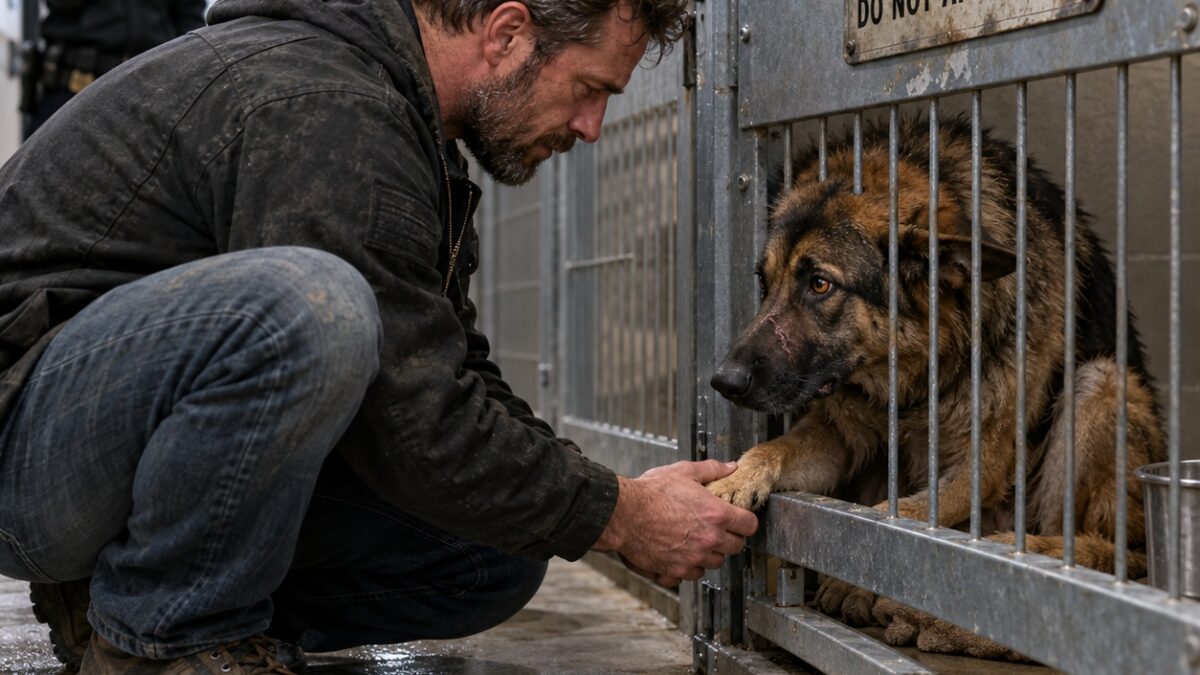
PART 2 and FULL ENDING  Thank you

Captain Morris nearly lost his mind when I told him I wanted to take Shadow home.
“You cannot be serious.”
“I am.”
“He has a documented aggression history.”
“I read the summary.”
“You haven’t read the entire file.”
“Then give it to me.”
Morris stared.
Shadow stood beside my leg.
Not pressed against me.
Not relaxed either.
His entire body seemed to exist between two instincts.
Leave.
Stay.
Leave.
Stay.
I could feel the conflict in him.
Every time someone moved quickly, his ears snapped toward the sound.
Every time a metal kennel door slammed somewhere in the building, he flinched.
But he did not retreat into the cage.
That mattered.
Morris lowered his voice.
“Daniel, he ruined three handlers.”
The phrase annoyed me.
“Ruined?”
“You know what I mean.”
“No.”
“I don’t.”
Morris looked toward Shadow.
“One ended up with stitches.”
“One filed for reassignment.”
“Another refused to handle him after an incident during training.”
“And nobody asked why?”
“Of course they asked.”
“What did they find?”
Morris hesitated.
That hesitation told me more than the answer.
“Conflicting reports.”
“Meaning?”
“Meaning Shadow’s handler said one thing.”
“Other trainees said another.”
“And everybody decided the dog was easier to blame.”
Morris’s mouth tightened.
“I didn’t say that.”
“You didn’t need to.”
Shadow shifted beside me.
I looked down.
The scar along his muzzle pulled slightly as he breathed.
Old injury.
Ugly.
He had probably healed physically months ago.
But dogs are not machines.
You do not repair flesh and expect memory to disappear with swelling.
“I’m taking him.”
I repeated.
Morris exhaled.
“You’ll need to sign liability waivers.”
“Fine.”
“Behavioral transfer forms.”
“Fine.”
“He may never be operational again.”
“I didn’t ask for operational.”
“He may never be a normal family dog.”
“I’m not asking him to become anything today.”
Morris looked at me for a long time.
Then at Shadow.
Finally:
“You always this stubborn?”
“Yes.”
“That explains your personnel file.”
I smiled.
“Print the forms.”
The first challenge came at the shelter entrance.
Shadow reached the sliding doors and froze.
Sunlight spilled across the pavement.
Cars moved beyond it.
A horn sounded somewhere down the block.
His claws tightened against the floor.
I loosened the leash.
Did not pull.
“Take your time.”
He looked outside.
Then back toward the kennel hallway.
That broke something in me.
Because I recognized the look.
When pain becomes familiar enough, freedom can feel dangerous simply because it is unfamiliar.
Shadow stood there nearly three minutes.
Nobody rushed him.
Then he stepped across the threshold.
One paw.
Then another.
His nose lifted.
Wind.
Grass.
Cars.
Food from somewhere nearby.
The world arriving all at once.
His legs trembled.
But he kept going.
At my patrol car, he stopped again.
This reaction was stronger.
Head lowered.
Ears pinned.
A low sound started in his throat.
The open rear door might as well have been another kennel.
I could see memory working through him.
Metal.
Enclosure.
Orders.
Something he did not want to repeat.
I climbed into the back seat first.
Morris, standing several yards away, looked at me like I had gone insane.
I patted the seat.
“This isn’t a cage.”
Shadow stared.
I waited.
Finally, he put his front paws inside.
Stopped.
Then climbed the rest of the way.
He pressed himself against the far corner.
I stayed beside him until his breathing slowed.
Only then did I move to the front seat.
The ride home was nearly silent.
Every time Shadow lifted his head, he found me in the mirror.
Every time, I let him look.
No command.
No reassurance unless he needed it.
Trust does not grow from constant talking.
Sometimes it grows because nothing bad happens.
Again.
And again.
And again.
My house sat on the edge of town.
Small.
One-story.
Modest yard.
Quiet street.
Before leaving for the shelter, I had no idea I would bring home a German Shepherd.
By the time we arrived, I had stopped at a pet store and spent more than I intended.
Dog bed.
Food.
Water bowls.
Toys.
Collar.
Heavy-duty leash.
The cashier asked:
“New puppy?”
I told her:
“Not exactly.”
Shadow walked through the front door cautiously.
He ignored every item I had bought.
Of course.
He paced the perimeter.
Walls.
Windows.
Hallway.
Kitchen.
Back door.
Front door again.
He sniffed the furniture as if cataloging escape routes.
I sat on the floor near the living-room wall.
No television.
No radio.
No unnecessary sound.
Eventually Shadow lay near the entrance.
Not on the expensive dog bed.
On the hard floor.
Facing the door.
Of course.
“You don’t owe me trust.”
I told him.
His ears moved toward my voice.
“We’ll build it.”
He looked at me.
Then away.
That was enough.
The first night showed me how deep the damage went.
At 2:13 a.m., I woke to the sound of nails moving across hardwood.
Slow.
Rigid.
Measured.
Shadow was pacing the hallway.
His body trembled.
Not from cold.
He stopped when I entered.
Eyes wide.
Tail tucked.
For one second, he looked like he did not know where he was.
“Shadow.”
His head snapped toward me.
I moved slowly.
“You’re home.”
I hated how strange the word sounded.
Home.
He had probably had places called home before.
Maybe kennel.
Training facility.
Patrol unit.
Handler’s house.
What did the word mean to a dog whose trust had become a liability?
Shadow turned toward the front door.
Growled.
Nothing was outside.
I checked.
Empty street.
No movement.
The growl continued.
Then I understood.
He was not warning me about something on the porch.
He was reacting to something that existed only in memory.
I reached toward his back.
Too quickly.
He recoiled so violently he nearly collided with the wall.
I stopped.
“Okay.”
No touch.
I sat.
He remained standing until dawn.
So did I.
Not beside him.
Several feet away.
Present.
The next morning, my police radio crackled.
Shadow disappeared beneath the kitchen table.
Not walked.
Bolted.
One second he was beside me.
The next he had made himself small beneath furniture.
I turned the radio off.
Kneeled several feet away.
“Hey.”
His head stayed low.
I thought about the reports.
Aggressive.
Untrainable.
Unpredictable.
None of those words described what I was seeing.
Terrified.
That word fit.
Traumatized.
That fit better.
Later, I dropped a metal spoon.
It hit the counter.
Clang.
Shadow exploded backward.
A chair overturned.
He slipped on the floor.
Panted.
Eyes searching for something terrible to follow the noise.
Punishment.
Impact.
Hands.
I did not know.
I only knew his body expected pain.
And bodies do not invent expectations like that for entertainment.
“Who did this to you?”
I whispered.
Shadow did not look at me.
For days, our routine became painfully simple.
Eat.
Walk.
Sleep.
Try.
Fail.
Try again.
He would follow me two rooms, then panic at a sound and retreat.
He accepted food from my hand one morning and refused it the next.
He slept for twenty minutes beside the fireplace, then jolted awake and paced for an hour.
Progress was not a staircase.
It was weather.
Good hour.
Bad night.
Good morning.
Terrible afternoon.
I stopped measuring.
Then one cold evening, something changed.
I was sitting against the living-room wall reading old department files.
Shadow lay six feet away.
Wind hit the windows.
He lifted his head.
Another gust rattled the glass.
He stood.
Breathing faster.
Then a trash can fell outside.
Bang.
Shadow jumped.
Hackles rose.
His eyes went to the door.
Then to me.
For the first time, he did not retreat automatically.
He looked conflicted.
Run.
Stay.
Fight.
Hide.
I set the file aside.
Opened my arms.
“Come here.”
That was all.
Shadow stared.
I expected nothing.
Then one paw moved.
Another.
Slow.
His entire body shook.
He reached me.
Stopped.
Sniffed.
Then pressed his forehead against my chest.
I forgot how to breathe.
I wrapped my arms around him carefully.
Not tight.
Not trapping.
Enough that he could feel me.
Shadow exhaled.
Long.
Shaking.
Then rested his weight against me.
That night, for the first time since I brought him home, he slept deeply enough to dream.
His paws twitched.
A soft whimper escaped.
But he did not wake.
I stayed on the floor beside him until morning.
After that, he began following me everywhere.
Bathroom.
Kitchen.
Garage.
Mailbox.
I learned there is no privacy once a German Shepherd decides you are his responsibility.
He still had triggers.
Police radio.
Sharp commands.
Metal impacts.
Men in uniform.
And one behavior bothered me more than all the others.
Whenever I reached near the left side of his neck from above, he flinched.
Not every time.
Enough.
I requested his original case file from Captain Morris.
He delayed.
I insisted.
Eventually a thick manila folder appeared on my desk.
The first photographs were painful because they showed what Shadow had once been.
Young.
Coat shining.
Eyes bright.
Ears forward.
Proud posture.
The training notes were excellent.
Exceptional detection ability.
Strong drive.
Fast command response.
High handler focus.
Excellent environmental confidence.
Then the language changed.
Sudden disobedience.
Fear responses.
Correction sensitivity.
Handler conflict.
Aggression.
Reassignment recommended.
I read every word.
Dates mattered.
The first “behavior problems” appeared after a handler change.
Sergeant Cole Maddox.
Experienced.
Highly decorated.
High training success rate.
Known for producing hard dogs.
I did not like that phrase.
Hard dogs.
I turned the page.
Incident report.
Shadow removed from service following aggression toward handler.
Minimal detail.
Too minimal.
I had spent long enough reading police reports to know what missing detail looks like.
Then a loose piece of notebook paper slipped from the file.
Handwritten.
No official letterhead.
Probably a trainee.
Shadow wasn’t aggressive.
He reacts to what Maddox does when no one else is around.
He’s scared, not dangerous.
Someone needs to help him.
Nothing after that.
No signature.
My skin went cold.
I looked across the room.
Shadow slept near the fireplace.
Paws moving slightly.
Another dream.
I read the note again.
Someone hurt you.
And everybody wrote down what you did afterward.
That was the part that made me angry.
Systems love documenting reactions.
They are not always as eager to document causes.
A dog bites.
Write the bite.
Why?
Maybe later.
Maybe never.
I sat beside Shadow.
He opened his eyes.
I touched the scar along his muzzle.
This time he did not pull away.
“I’m going to find out.”
I whispered.
His head settled against my knee.
Three nights later, his past came to my house.
Thursday.
Cold.
Quiet.
I was reviewing surveillance reports for another case.
Shadow lay nearby.
Relaxed enough that one ear had folded awkwardly against the floor.
Then his head came up.
Instantly.
No confusion.
No panic.
Alert.
He listened.
I heard nothing.
“What?”
He rose.
Moved toward the front window.
Body low.
Controlled.
This was not the terrified dog reacting to a dropped spoon.
This was trained behavior.
Professional behavior.
He smelled something.
He walked toward the back door.
I followed.
“Show me.”
Outside, the yard was dim.
Shadow’s nose worked the air.
Then I saw a silhouette near the fence.
A man.
Standing still.
Watching.
The moment he realized I had spotted him, he ran.
Shadow barked.
Not panicked.
Explosive.
Recognition.
He pulled toward the gate so hard I had to plant both feet.
“Stay.”
He fought me for two seconds.
Then stopped.
But his eyes remained fixed on the darkness.
I knew.
He had seen that man before.
The following night, I double-checked every lock.
Turned exterior lights on.
Kept my service weapon nearby.
I informed dispatch that I had noticed suspicious activity but had nothing actionable yet.
Shadow would not settle.
At 11:47 p.m., the back door clicked.
Very softly.
Lock manipulation.
I froze.
Shadow was already moving.
He stepped in front of me.
Growl.
Solid.
Grounded.
I drew my weapon.
Another click.
“Shadow.”
His ears moved.
“Stay with me.”
The door burst inward.
A masked man entered holding a handgun.
Shadow moved before I did.
He hit the intruder in the torso.
The gun fired.
The shot struck the wall near my head.
Plaster sprayed.
I moved for cover.
“POLICE!”
“DROP THE WEAPON!”
The man fought Shadow off.
Raised the gun again.
Shadow redirected.
Clamped onto the man’s sleeve and forearm.
Pulled the weapon line away.
Another shot hit the floor.
I closed the distance.
Tackled him.
Controlled the weapon arm.
Kicked the handgun away.
Cuffed him.
Shadow remained over the man’s forearm until I gave the command.
“Out.”
He released.
Immediately.
That detail mattered.
A truly uncontrollable dog does not switch off at the exact second the threat stops.
Shadow did.
He backed toward me.
Chest heaving.
Blood around his mouth from the bite.
Then pressed his head against me.
His body shook.
I knelt.
“You saved my life.”
He looked up.
And for the first time I understood exactly what everyone had gotten wrong.
Shadow had never lost his ability to work.
He had lost his ability to feel safe with the people telling him to work.
That is not the same failure.
Officers arrived within minutes.
The intruder was treated.
Weapon recovered.
Scene processed.
Body-camera footage reviewed.
The next morning, I sat outside an interrogation room with Shadow beside me.
Captain Morris came.
“He okay?”
“Better than the guy he stopped.”
Morris did not laugh.
He looked uncomfortable.
“Daniel.”
“What?”
“Word’s already spreading.”
“That the dangerous dog saved the officer who adopted him?”
Morris looked down.
“Something like that.”
I did not enjoy the irony.
Because if Shadow had been wrong by half a second, the same department would have used the word dangerous again.
Inside the interrogation room, the intruder refused to speak.
I sat across from him.
He looked at me.
Not Shadow.
Then Shadow entered.
The man’s face changed.
Small.
But obvious.
Shadow growled.
The man flinched.
“You know him.”
I said.
Silence.
“Shadow knows you.”
More silence.
“And you’re afraid of him.”
The man looked toward the door.
“You should’ve left that dog at the shelter.”
My pulse changed.
“Why?”
No answer.
“Why did you come to my house?”
“Because that dog knows things.”
I stared.
“What things?”
“Things he wasn’t supposed to survive.”
Anger moved through me.
I kept my voice level.
“He was abused by his handler.”
The intruder smiled without humor.
“Abused?”
“They called it training.”
“Who?”
He looked at Shadow.
“Dog didn’t break.”
“That was the problem.”
“He fought back.”
“So they blamed him.”
I leaned closer.
“Name.”
The man laughed.
“You think this ends with me?”
“Name.”
Nothing.
But I already had one.
Cole Maddox.
I spent the next day reopening every archived document I could access legally.
Training logs.
Old complaints.
Supervisor notes.
Veterinary records.
Disciplinary reports.
Patterns appeared.
Maddox had complaints.
Force.
Excessive correction.
Injury to working dogs.
Trainees reporting intimidation.
Most had gone nowhere.
He produced results.
Departments sometimes forgive far too much from people who produce results.
Then I found veterinary inconsistencies.
Bruising documented as training injury.
Lacerations.
Stress symptoms.
A pattern around dogs assigned to Maddox.
Shadow had not been the first.
He may have been the first to resist enough that Maddox could no longer hide it.
When I said Maddox’s name aloud at home, Shadow reacted instantly.
Head up.
Ears back.
Whine.
There was my witness.
Unable to testify.
Still telling me everything.
I should not have gone to Maddox’s old property alone.
I know that.
If this had been a report I was reviewing, I would have criticized the officer who did exactly what I did.
But anger makes hypocrites of us.
Maddox owned an abandoned training property outside town.
Department no longer used it.
Private land.
I obtained the appropriate permissions and coordinated enough oversight to avoid completely stepping outside procedure, but I still moved faster than prudence recommended.
Shadow came with me.
The moment we arrived, he changed.
Trembling.
Stiff.
But he did not retreat.
I knelt.
“You don’t have to prove anything.”
He leaned his forehead into my shoulder.
Then stepped out.
The training yard looked dead.
Rusted fences.
Bent metal poles.
Old structures.
Inside one decaying building, I found files.
Training records.
Photographs.
Punishment logs.
Material that should never have been kept privately.
Then the folder.
SHADOW — FAILURE REPORT.
Photographs showed injuries.
Bruising.
Fear.
Maddox’s notes were worse.
Needs harsher correction.
Break him until compliance.
Resists handler.
Increase pressure.
My hands began shaking.
Then the door behind me creaked.
Maddox stood there.
Older than the file photographs.
Still broad.
Still carrying himself like authority followed him automatically.
“I knew somebody would start digging.”
Shadow growled.
Not loud.
Deep.
Maddox looked at him.
“There he is.”
Then:
“You should’ve left that mut where he belonged.”
I stepped between them.
“Where?”
“Behind bars?”
“Put down?”
Maddox shrugged.
“Some dogs don’t recover.”
“Some dogs aren’t worth the liability.”
Shadow’s body trembled.
I could feel the hatred coming off Maddox.
Not fear of Shadow.
Resentment.
Because Shadow was living evidence.
“You hurt him.”
“I trained him.”
“You beat him.”
“I corrected him.”
“You terrorized him until he defended himself.”
Maddox’s jaw hardened.
“He disobeyed.”
“Dogs obey.”
“If they don’t, they learn.”
Shadow growled again.
Maddox smiled.
“See?”
“There it is.”
“That’s what he is.”
“A monster.”
I looked at Shadow.
His tail was not tucked.
That surprised me.
He was afraid.
Yes.
But standing.
Beside me.
Not behind.
I looked at Maddox.
“The monster in this room isn’t the dog.”
Maddox moved suddenly.
Toward Shadow.
His hand reached for the collar from above.
Same angle I had seen trigger Shadow before.
Shadow reacted.
He launched.
Hit Maddox in the chest.
Maddox went down.
Shadow stood above him.
Teeth visible.
Growl filling the building.
For one terrible second, I saw exactly how the old story could repeat.
Shadow bites former handler.
Dangerous dog proves everyone right.
All Maddox had to do was provoke one moment of uncontrolled fear.
“Shadow.”
His ears moved.
“Stand down.”
He froze.
Maddox stared.
“Shadow.”
I repeated.
“Back.”
The dog stepped backward.
One pace.
Then another.
He came to my side.
Maddox’s expression changed.
Disbelief.
“He never did that.”
I looked at him.
“He never trusted you.”
Maddox pushed himself up.
I already had the phone recording.
Evidence around us.
Files.
Photographs.
Logs.
And backup on the way.
“It’s over.”
I told him.
He rushed forward once more.
Shadow stepped between us.
Did not attack.
Blocked.
Growled.
Warning.
That was all.
Maddox stopped.
Sirens arrived outside.
For years, he had treated control as something produced by fear.
That night, he watched a dog he had failed obey one quiet command from a man who had never hit him.
I think that hurt Maddox more than anything else.
Maddox was taken into custody.
The investigation widened.
Former trainees came forward.
Other handlers.
Veterinary staff.
People who had seen things and convinced themselves someone else would report it.
The department reopened K9 training practices.
There were hearings.
Internal investigations.
Criminal charges tied to the break-in conspiracy and documented abuse.
Administrative consequences.
Not everything moved quickly.
Nothing serious ever does.
But Shadow’s file changed.
That mattered to me.
Not because paperwork defines truth.
Because bad paperwork had almost killed him.
The next morning, we entered the station.
People moved aside.
I noticed immediately.
Not fear exactly.
Respect.
That made me uncomfortable.
Shadow had deserved respect before saving me.
Captain Morris approached.
He crouched carefully.
Shadow watched.
No growl.
Morris looked at me.
“I owe you an apology.”
“You owe him one.”
Morris nodded.
“You’re right.”
He looked at Shadow.
“We called you dangerous when you were surviving.”
Shadow stared at him.
Probably hoping Morris had food.
Dogs are healthier about apology than humans.
Morris stood.
“I reviewed the body-cam footage.”
“The re-opened records.”
“The old evaluations.”
“The department wants to reinstate Shadow under your handler status.”
I thought I had misheard.
“As a K9?”
“Conditional return.”
“Full behavioral oversight.”
“Trauma-informed retraining.”
“But yes.”
I looked down.
Shadow’s ears tilted toward me.
“He does not need to earn his worth by going back to work.”
Morris nodded.
“I agree.”
“If he does this, it’s because he wants the work.”
“Agreed.”
“No forced correction.”
“Agreed.”
“No old methods.”
“Daniel.”
Morris looked almost offended.
“Those methods are done.”
I waited.
Then extended my hand.
“Okay.”
The first day back on the training field was harder than the confrontation with Maddox.
People expected drama.
Hero dog runs across field.
Triumphant music.
Reality?
Shadow froze at the gate.
Same kind of field.
Same fencing.
Same scent of equipment.
His breathing changed.
I crouched.
“This time is different.”
No movement.
I unclipped unnecessary tension from the lead.
“Your choice.”
He looked at the field.
Then at me.
One step.
Stopped.
Another.
Then more.
By the middle of the field, his tail had lifted slightly.
A trainer rolled a scent object across the grass.
Shadow’s nose came alive.
Work.
Not fear.
Work.
He tracked.
Found.
Looked back at me.
I laughed.
“Good boy.”
He barked once.
And ran.
Not away.
Across the field.
Toward the next task.
That was the moment I cried.
Not at the shelter.
Not during the break-in.
Not when Maddox was arrested.
There.
Watching a dog choose work that had once been weaponized against him.
Because reclaiming something is different from being forced back into it.
Weeks became months.
Shadow changed.
Slowly.
He rode patrol with me.
Not every shift.
Not every day.
We built around his tolerance.
He still hated certain metal impacts.
Some radios bothered him.
A particular tone of shouted command could make his body stiffen.
Healing did not erase history.
But his recovery window shortened.
Minutes instead of hours.
Sometimes seconds.
Children began recognizing him.
Store owners asked to pet him.
Officers who once avoided his kennel now greeted him by name.
I had mixed feelings about that.
Part of me wanted to ask where all that respect had been when he was shaking behind rusted bars.
Another part understood people can learn.
If I refused them the chance, I would be doing a version of what the shelter had done to Shadow.
Defining someone permanently by the worst thing they had believed or done.
So I watched.
Some changed.
Some simply liked a hero story.
Shadow did not care.
He cared about me.
Food.
Work.
The backyard.
One tennis ball he destroyed repeatedly despite my continuing to replace it.
And eventually the dog bed.
It took him three months to use the bed I bought on day one.
Three months.
One night, I found him curled there by the fireplace.
I took a photograph.
Morris said:
“That’s the evidence you should frame.”
Maybe.
The official commendation came later.
Shadow was recognized for saving my life during the armed break-in and for his role in exposing misconduct connected to Maddox.
There was a ceremony.
Podium.
Uniforms.
Photographers.
Shadow hated every second.
Too many people.
Too many flashes.
He tolerated it because I stood beside him.
When someone called him:
“Officer Shadow.”
His ears perked.
The crowd laughed softly.
I leaned down.
“You don’t care about titles, do you?”
He looked at my pocket where treats were stored.
Correct.
Titles are a human problem.
The most important change was quieter.
Shadow began sleeping with his back toward the front door.
At first, I did not notice.
Then one night I walked into the living room and stopped.
He was asleep beside the couch.
Back exposed to the entrance.
Head toward the fireplace.
A dog who once spent every night staring at a door waiting for danger had decided he did not need to watch it.
I sat on the floor.
He opened one eye.
Then closed it again.
That nearly meant more than the commendation.
Maddox’s case moved forward.
The evidence showed a pattern far larger than one dog.
Other K9s had been injured.
Handlers intimidated.
Reports altered or minimized.
Training methods defended because Maddox produced obedient dogs quickly.
People asked how it could have continued.
The answer was unpleasantly ordinary.
Results.
Reputation.
Fear.
Silence.
People saw pieces.
Nobody assembled them.
Some complained.
Complaints disappeared.
Some suspected.
They did not push.
And dogs cannot file grievances.
Shadow had communicated the only way he could.
Fear.
Refusal.
Eventually defense.
The system translated every signal into disobedience.
That thought followed me for years.
How often do institutions punish symptoms because examining causes would require admitting something uncomfortable about themselves?
More often than people want to know.
Maddox eventually faced the consequences of his actions.
I attended part of the proceedings.
Shadow did not.
He had already done enough.
When reporters asked whether I wanted to see Maddox punished severely, I gave an answer they found disappointing.
“I want him unable to hurt another dog.”
That was the purpose.
Justice was not supposed to entertain me.
The department changed K9 oversight.
More veterinary review.
Independent reporting channels.
Training audits.
Body-camera requirements during certain exercises.
Limits on correction methods.
Better behavioral assessment before labeling an animal aggressive.
Those reforms mattered more than one man’s sentence.
Shadow’s old “dangerous animal” designation was formally removed.
I kept a copy of that letter.
Not because Shadow could read it.
Because I could.
His new file said:
Service-related trauma history.
Demonstrated stable response under trust-based handling.
Excellent detection capability.
Protective response appropriate during armed threat.
There was still clinical language.
Systems need language.
At least this time, the language described what happened rather than who people had decided he was.
One evening months after everything, I sat on the back porch.
Sun going down.
Shadow beside me.
The air was warm.
No sirens.
No radios.
No reports.
I scratched behind his ear.
“You’ve come a long way.”
Shadow nudged my hand.
“You didn’t fail.”
I said.
“They failed you.”
His paw landed on my knee.
I froze.
The same gesture.
The shelter.
His trembling paw through the bars.
Back then it had felt like a question.
Can I trust you?
Now it felt different.
No hesitation.
No fear.
Just contact.
I placed my hand over his paw.
“You saved my life.”
His tail moved once.
“And you saved your own.”
That was important.
People wanted to give me too much credit.
Daniel rescued Shadow.
Daniel healed the broken dog.
No.
I opened a door.
Shadow walked through it.
Again.
And again.
He chose to trust.
Chose to work.
Chose not to bite Maddox when he could have.
Chose to release the armed intruder on command.
Chose the training field.
Chose sleep.
Healing was not something I did to him.
It was something he did while I tried not to make it harder.
There is humility in understanding that.
Years later, I still heard people call him the dog nobody wanted.
That phrase made good headlines.
It was not quite true.
Shadow had been unwanted by people who needed him to behave as if nothing had happened to him.
Once someone allowed his history to matter, he became understandable.
Not easy.
Understandable.
There is a difference.
He still had bad days.
A thunderstorm once sent him into a bathroom corner.
A dropped metal pan during a station cookout made him shake.
One visiting officer raised his voice sharply at another dog and Shadow immediately moved behind me.
Trauma does not ask whether the calendar has moved far enough.
It remembers through the body.
But Shadow recovered.
He looked for me.
Accepted grounding.
Returned.
Each return mattered.
At the station, younger handlers began asking me about him.
“How’d you fix him?”
I always hated that question.
“I didn’t.”
“What training did you use?”
“Patience.”
They waited for the secret technique.
“There isn’t one.”
“Structure.”
“Predictability.”
“Choice where possible.”
“Clear commands.”
“No fear-based correction.”
“Consistency.”
“That’s it?”
“That’s everything.”
One recruit asked:
“What if the dog challenges you?”
I said:
“Ask why you need to call every fear response a challenge.”
He did not like that answer.
Maybe someday he would.
Shadow became useful beyond patrol.
He helped train officers.
Not by doing anything special.
By making them reconsider assumptions.
A dog can appear aggressive because he is afraid.
A dog can resist because an instruction predicts pain.
Compliance does not always equal trust.
And obedience produced through terror may look impressive until the day the terrified animal finally cannot absorb more.
Those lessons applied to humans too.
I never said that in training.
I did not need to.
People understood.
Captain Morris changed as well.
He visited my house one afternoon without official business.
Shadow met him at the door.
No growl.
Morris crouched.
“Hey, buddy.”
Shadow sniffed him.
Then walked away.
Morris laughed.
“I guess that’s progress.”
“It means you’re boring.”
“I’ll take it.”
We sat on the porch.
Morris admitted something.
“When you took him, I thought you were going to get hurt.”
“Reasonable.”
“I also thought if something happened, I’d be able to say I warned you.”
I looked at him.
He rubbed his jaw.
“That bothers me now.”
“Why?”
“Because I was preparing to be right instead of hoping you were.”
Honest.
I respected it.
“We do that a lot in police work.”
He continued.
“Once someone gets a label.”
“Problem officer.”
“Repeat offender.”
“Dangerous dog.”
“We start interpreting everything through it.”
I nodded.
“Shadow growled because he was dangerous.”
“He hid because he was unstable.”
“He refused because he was disobedient.”
“Nobody said he was scared.”
Morris looked toward the yard where Shadow was sniffing a bush.
“No.”
“We didn’t.”
That was probably the closest thing to institutional remorse I would ever get.
It was enough to start.
The department later invited an outside K9 behavior specialist to evaluate the entire program.
She watched Shadow for two days.
At the end, she said something I remember clearly.
“He wasn’t difficult to read.”
I asked:
“What do you mean?”
“His body was screaming.”
“People just didn’t like the message.”
That was it.
The scar.
Tucked tail.
Flinching.
Shutdowns.
Hypervigilance.
The dog had been communicating constantly.
Humans had chosen the translation that protected their own reputation.
Dangerous.
Easier than:
We hurt him.
Years passed.
Shadow eventually retired again.
This time properly.
No cage.
No warning sign.
No shelter.
My house.
His choice of furniture.
An unreasonable belief that every sandwich contained a portion legally owed to him.
His muzzle grayed.
His hips stiffened.
He slept more.
But he never again slept facing the front door.
That remained his victory.
When retirement became official, Captain Morris organized a small gathering.
I told him:
“No ceremony.”
He promised.
Then somehow twenty officers appeared.
“That’s a ceremony.”
“It’s a coincidence.”
“Twenty uniformed coincidences?”
Shadow walked through them.
Years earlier, that many uniforms would have sent him into panic.
Now he sniffed one officer’s pocket because he smelled jerky.
People laughed.
I looked away for a moment because my eyes had filled.
Morris saw.
Said nothing.
Small mercy.
They gave Shadow a final collar tag.
RETIRED K9 SHADOW.
I clipped it on.
“He doesn’t care.”
Morris said.
“No.”
“He wants the jerky.”
Correct again.
Retirement suited him.
Morning walks.
Backyard sun.
Occasional visits to the station.
No emergency callouts.
No commands unless necessary.
He became gentler around children.
There was a little boy next door named Eli who adored him.
First time Eli reached toward Shadow, I stopped him.
“Ask first.”
“Can I pet him?”
I looked at Shadow.
His body loose.
“Yes.”
Eli touched his shoulder.
Shadow leaned into it.
I had to look away again.
The shelter report once said:
Not suitable around children.
Maybe at the time it had been true.
Safety matters.
But permanent identity and temporary condition are not the same.
That was the entire lesson of Shadow.
One afternoon, Eli asked:
“Why does he have that scar?”
I said:
“Someone hurt him a long time ago.”
“Did he bite them?”
“Eventually he protected himself.”
Eli thought.
“Is that why he’s brave?”
I shook my head.
“No.”
“Why is he brave?”
“Because he learned to trust again.”
The boy accepted that.
Children often understand difficult truths faster than adults because they have not spent years learning how to complicate them.
Shadow lived long enough to become almost embarrassingly spoiled.
The dog who once refused meals in a kennel developed strong opinions about chicken versus beef treats.
The dog who slept on concrete began sighing dramatically if his orthopedic bed was moved too close to the air vent.
The dog terrified of radios learned the difference between mine and every other sound in the room.
Sometimes I would turn mine on.
Static.
Shadow’s ear would twitch.
Then nothing.
Normal.
That word became precious.
Normal.
People think redemption needs a dramatic ending.
It does not.
Sometimes redemption is a dog asleep through a sound that once made him hide beneath a table.
Sometimes it is a former shelter director being ignored at the front door because the dog is too comfortable to care.
Sometimes it is a retired K9 stealing a child’s cracker.
Ordinary can be sacred after fear.
Shadow’s final years taught me as much as his working ones.
His body slowed.
Mind remained alert.
He no longer jumped into the patrol car.
I lifted him.
The first time I did, he looked offended.
“Yeah.”
I told him.
“I know.”
“Heroic dignity.”
He licked my chin.
Not dignified.
The day eventually came when the veterinarian told me we had reached the line every dog owner hopes never to see.
Pain.
Mobility.
Quality of life.
Shadow had cancer.
Advanced.
There were treatments.
None promised much time.
I sat on the clinic floor beside him.
He rested his head on my leg.
Same posture as years before.
Same trust.
The veterinarian gave us privacy.
I cried.
Not quietly.
Not professionally.
Shadow lifted his paw.
Placed it on my knee.
Again.
The shelter.
The porch.
Now this.
I covered it with my hand.
“You were supposed to get more.”
Dogs do not understand bargaining.
Maybe that is mercy.
I took him home.
For several weeks, we did everything he loved.
Slow walks.
Chicken.
Backyard sunshine.
Visitors he actually liked.
No uniforms unless they came as friends.
Morris sat on the porch with us.
So did several former handlers who had helped change the program.
Eli came over.
Read Shadow a children’s book.
Shadow slept through most of it.
Perfect.
On his last morning, sunrise came softly through the window.
Shadow could barely stand.
I lay beside him.
No kennel.
No bars.
No metal sign.
No warning.
His home.
I told him:
“You don’t have to protect me anymore.”
His breathing slowed.
“I’m okay.”
That was only partly true.
“You can rest.”
His paw moved weakly toward my hand.
I held it.
The same paw.
The first promise.
The last.
When he died, his body finally became completely still.
Not frozen with fear.
Resting.
That distinction mattered more than I can explain.
The department offered a formal memorial.
I accepted one condition.
Nobody would call him broken.
At the ceremony, I stood beside a photograph from his younger years.
Bright eyes.
Upright ears.
Before Maddox.
Beside it was another image from later.
Gray muzzle.
Sitting in my backyard.
Relaxed.
The plaque read:
K9 SHADOW
SERVICE. COURAGE. TRUST.
Simple.
Enough.
When it was my turn to speak, I looked at the officers.
Some had known the old reports.
Some had only heard the story.
I said:
“Shadow was once described as the worst police dog in this department.”
Silence.
“He was called dangerous.”
“Unstable.”
“Untrainable.”
“A liability.”
“Every label was based on what people saw him do.”
“Almost nobody asked what had been done to him first.”
I paused.
“That mistake nearly killed him.”
Nobody moved.
“He saved my life.”
“He helped expose misconduct.”
“He returned to service.”
“But if that were all I told you, I’d still be reducing him to what he could do for us.”
That was important.
“Shadow mattered before he saved an officer.”
“He mattered in the shelter.”
“He mattered when he was shaking.”
“He mattered when he could not work.”
“He mattered when he was afraid.”
“He did not earn the right to be treated gently by becoming useful again.”
A few officers looked down.
Good.
I continued.
“The best thing Shadow taught me is that trust and obedience are not the same thing.”
“You can frighten something into obedience.”
“For a while.”
“You cannot frighten it into trust.”
“Trust has to be given.”
“Then protected.”
I looked at his photograph.
“And once someone gives it after learning how dangerous trust can be, you should understand what an extraordinary gift you’ve been handed.”
That was all.
No dramatic ending.
No slogan.
Afterward, Morris gave me Shadow’s old shelter sign.
DO NOT APPROACH.
I stared.
“Why would I want this?”
“I thought you might.”
“I don’t.”
He nodded.
“What should we do with it?”
I thought.
Then:
“Throw it away.”
So we did.
Some symbols do not need preserving.
The first photograph of Shadow in my house remains on my wall.
Not the commendation photo.
Not the takedown.
Not the uniform ceremony.
The first evening.
He is lying on the hardwood near the front door.
Eyes open.
Body rigid.
Too afraid to sleep.
People sometimes ask why I keep such a sad picture.
Because I know what happened after it.
That photograph does not show a hopeless dog.
It shows a dog one day before the first good night.
A week before he first rested his head against my chest.
Months before he saved my life.
Years before he slept with his back to the door.
We often mistake an unfinished story for a failed one.
Shadow taught me not to.
Captain Morris retired.
The department’s K9 program changed leadership.
Maddox’s methods became something trainers discussed as a warning.
New officers heard Shadow’s name.
Not as the dangerous dog.
As the reason certain safeguards existed.
That was perhaps his biggest legacy.
A dog who could not write a complaint ended up changing how future dogs were treated.
I liked that.
Not because suffering must produce meaning.
I hate that idea.
Pain does not become good because something useful comes after it.
What Maddox did remained wrong.
What the department ignored remained wrong.
Shadow should never have needed to overcome any of it.
But once harm exists, we still get to choose what follows.
Silence.
Or change.
Shadow chose trust.
I chose to believe him.
Others eventually chose to listen.
That was enough.
Years after his death, I visited the shelter.
Same building.
Renovated kennels.
Brighter lighting.
Different staff.
The back corner where Shadow had lived was gone.
The old rusted cages had been replaced.
A young volunteer walked me through.
At one kennel, a frightened shepherd mix crouched near the wall.
The volunteer started:
“She’s kind of difficult.”
Then corrected herself.
“She’s scared.”
I smiled.
Small change.
Huge difference.
“What happened?”
I asked.
“We don’t know yet.”
Yet.
That word mattered.
Not:
She is aggressive.
Not:
She is broken.
Yet.
There was still something to learn.
I crouched several feet from the kennel.
Did not reach.
Did not stare.
Just sat.
The dog watched me.
No miraculous paw.
No instant transformation.
Good.
Real healing is rarely that convenient.
After a minute, she stopped backing away.
That was enough.
The volunteer asked:
“Were you the officer who had Shadow?”
“Yes.”
Her eyes widened.
“Oh.”
Then:
“I’ve heard about him.”
I smiled.
“Everybody has.”
“Was he really that dangerous?”
There it was again.
The old story surviving.
I looked at the dog in front of us.
Then answered carefully.
“Shadow was dangerous when danger was in front of him.”
“He was afraid when he was afraid.”
“He was protective when someone needed protection.”
“He was affectionate when he felt safe.”
“He was a dog.”
The volunteer laughed.
“That’s not very dramatic.”
“No.”
“The truth usually isn’t.”
I stood.
Before leaving, I looked back at the kennel.
The frightened shepherd mix had moved several inches closer to the front.
Not much.
Enough.
Outside, sunlight covered the pavement exactly like the day Shadow first stepped out.
For one second, I remembered him beside me.
Young enough to work.
Old enough to have suffered.
Standing at the threshold with the entire world ahead of him and no reason to believe it would be kinder than what came before.
Then stepping forward anyway.
That was Shadow.
People called his story redemption.
Maybe.
I think it was simpler.
Someone hurt him.
Others misunderstood him.
He survived.
Then one day, somebody finally listened.
And when he was given the choice between remaining what fear had made him and risking trust one more time, Shadow put his paw into my hand.
Everything after that began there.
Not with obedience.
Not heroism.
Not a police badge.
Trust.
Years later, when people asked me why I chose the dog everyone else hated, I always told them they had the question backward.
I did not choose Shadow because I believed I could save him.
I chose him because when every person in that shelter had already decided who he was, he still found enough courage left inside himself to ask one stranger for a chance.
And after everything that dog had survived, I knew one thing for certain.
The least I could do was not let go.








