Thirty-Two Days After We Had Stopped Expecting Anything Alive Beneath the Rubble, I Saw a Pair of Eyes in a Space No Animal Should Have Survived
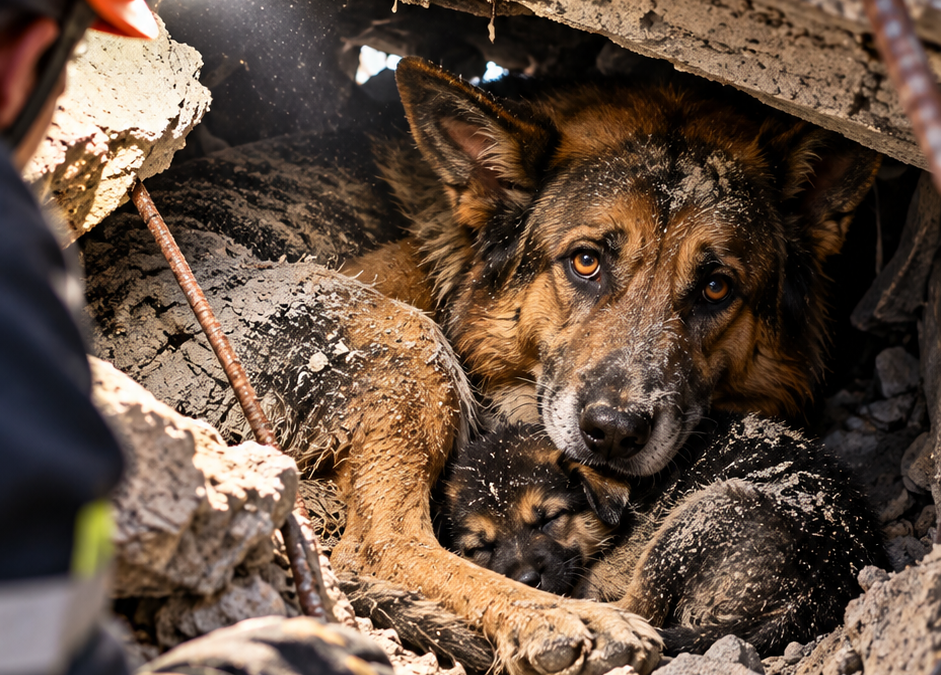
Thirty-Two Days After We Had Stopped Expecting Anything Alive Beneath the Rubble, I Saw a Pair of Eyes in a Space No Animal Should Have Survived
For thirty-two days, there had been no sunlight down there.
No warmth.
No real food.
And when I finally lowered myself close enough to see into the narrow cavity beneath the concrete, the German shepherd wasn’t looking at me as though he wanted to be rescued.
He was looking past me.
Toward something much smaller pressed against his chest.
My name is Samuel.
I had been working around animal rescue for nine years by then, and those years had taught me something I wish I had never needed to learn.
Hunger changes animals.
Fear changes them.
Pain changes them.
Put a frightened animal in darkness long enough, deprive it of food, trap it where it cannot stand or run, and eventually instincts begin stripping away everything we like to call civilized.
I had seen dogs chew wood until their mouths bled.
I had seen animals gnaw at concrete.
Metal.
Anything that might distract them from the pain twisting their stomachs.
I had seen survivors stay beside dead companions until hunger became stronger than attachment.
Those memories are ugly.
But they are real.
That’s why what happened with Max has never left me.
Because nothing in my experience prepared me for what he chose to do.
Thirty-two days.
Count them.
More than four weeks.
Nearly five.
An entire month plus two days.
Imagine spending that much time unable to stand.
Unable to stretch your legs.
Unable to see the sky.
Unable to understand whether anyone was coming.
Max, though he didn’t have that name yet, had been trapped in the deepest section of the rubble we were searching.
Two large concrete slabs had fallen toward one another and stopped before completely collapsing.
The result was a narrow triangular pocket.
Barely more than twenty inches high at its tallest point.
Too low for a German shepherd to stand.
Too tight for him to turn properly.
He had been forced onto his side.
The position of his body told me he had probably spent most of those thirty-two days that way.
Head angled toward a small crack.
That crack had given him air.
Maybe a little moisture when rain reached the debris.
But it had not given him freedom.
He could smell the outside world.
He could breathe from it.
He could not reach it.
When I first saw his eyes, I thought I was imagining them.
We had been searching for so long that shadows began playing tricks.
You stare into enough dark spaces and your mind starts inventing movement because you want movement to be there.
I lowered myself.
Moved my light.
Stopped.
There.
Two eyes.
One barely open.
The other reflecting just enough light to prove I wasn’t alone.
“Hey.”
My voice sounded too loud in the confined space.
The dog did not bark.
Didn’t growl.
Didn’t move toward me.
He couldn’t.
I shifted closer.
“Easy.”
No response.
I remember thinking he looked less like a living animal than something that had become part of the rubble.
Dust coated his coat.
His ribs were visible beneath the fur.
The once-powerful shape of a German shepherd had collapsed into angles.
Hip.
Shoulder.
Spine.
Every part of him looked too sharp.
His eyes had almost no brightness left.
But he was alive.
That should have been enough to overwhelm me.
It wasn’t.
Because then I saw the movement against his chest.
Tiny.
So small I first thought it was part of his fur.
Then I heard it.
A sound.
Barely there.
A kitten’s cry.
I stopped breathing.
“What…”
I pushed my light lower.
The dog’s body curved inward.
Not randomly.
Deliberately.
His front legs were drawn toward his stomach.
His chest bent around something.
Between his neck and forelegs was a kitten.
Maybe five or six weeks old.
Nothing more.
Tiny.
Weak.
Its fur was dirty and pressed flat.
Its eyes opened, closed, then opened again.
One of its back legs lay at an unnatural angle.
The kitten gave another faint sound.
The German shepherd moved his muzzle.
Not toward me.
Toward the kitten.
He nudged it.
Softly.
The kitten went quiet.
I remember sitting there unable to make sense of what I was seeing.
A starving German shepherd.
A kitten small enough to fit beneath his jaw.
Thirty-two days without food.
Every rule of survival suggested the same conclusion.
The kitten should not have been alive.
Not beside a starving predator.
Certainly not after that long.
But the evidence was directly in front of me.
The dog had not eaten him.
He had protected him.
Later, after we understood the layout of the cavity better, we reconstructed what probably happened.
Max had been trapped first.
At some point afterward, the kitten must have found the narrow crack.
Maybe he had been looking for shelter from rain.
Maybe he followed warmth.
Maybe he simply slipped into a space he could enter and then discovered he couldn’t climb back out.
Whatever the reason, he fell into the same darkness.
Two trapped animals.
One large.
One tiny.
No exit.
No food.
No reason to believe rescue was coming.
If Max had killed the kitten, nobody could have blamed him.
That’s difficult for people to hear.
But it’s true.
Extreme hunger is not a moral test.
Animals survive.
That is what instinct demands.
I had seen enough to know that.
Max chose something else.
From the position in which we found them and from the way they behaved afterward, it was clear the relationship had formed long before we arrived.
Max had curled himself around Pip.
That was the name we later gave the kitten.
He had used what remained of his own body heat to keep that tiny animal warm.
He had licked Pip’s fur.
Cleaned him.
When Pip cried, Max touched him with his nose.
When Pip became cold, Max pulled him closer.
When he was frightened, there had been a heartbeat beside him.
That thought still affects me.
Thirty-two days in darkness.
No voices.
No daylight.
No certainty.
But Pip could hear Max’s heart.
And Max could feel Pip breathing against him.
Sometimes I wonder whether that was what kept both of them alive.
Not food.
Not strength.
Not some extraordinary physical advantage.
The simple evidence that neither one was alone.
I whispered,
“Hey, buddy.”
Max looked at me again.
I wanted him to understand.
“We’re going to get you out.”
His eyes stayed on mine.
Then something happened that I will carry for the rest of my life.
Very slowly, using what little strength remained in his neck, Max turned his head.
He looked at Pip.
Then back at me.
That was all.
No bark.
No cry.
No dramatic movement.
Just one look toward the kitten.
Then me.
Take him first.
I know animals do not speak in sentences.
I know how easily human beings assign meanings to expressions.
I have spent years being cautious about that.
But I know what I saw.
Max did not look at me like a starving animal begging for rescue.
There was no panic in his eyes.
No demand.
Instead, there was a strange, exhausted trust.
As though the moment I appeared, he had decided his responsibility could finally be transferred.
I didn’t know him.
He had never seen me.
Yet he looked at me as though he expected me to understand the one thing that mattered.
The kitten.
I backed away enough to reach my radio.
My hand was shaking.
I called the team.
Usually, I’m precise.
Location.
Access.
Hazards.
Equipment needed.
That day, the first sentence I managed was:
“They’re both alive.”
A pause.
“What?”
I swallowed.
“Dog and kitten.”
My voice broke.
“They’re both alive. Come fast.”
Fifteen minutes later, the team reached us.
Fifteen minutes isn’t long.
That day it felt enormous.
I stayed near the cavity.
I kept talking.
Not because I believed Max understood every word.
Because silence felt wrong after thirty-two days of it.
“You’re okay.”
His eyes stayed half open.
“We’re here.”
Pip moved.
Max nudged him.
“That’s it.”
I could hear myself breathing.
“Stay with him.”
The team arrived.
Mark was among them.
Mark had been doing this kind of work for twenty years.
Two decades.
Hundreds of animals.
Some alive.
Too many not.
He was the person on our team least likely to become visibly emotional at a scene.
Not because he didn’t care.
Because after long enough in rescue work, you learn how to place emotion somewhere temporary while there is still work to do.
Mark crawled near me.
“What’ve we got?”
I moved aside.
“Look.”
He did.
Then he stopped.
For several seconds, Mark said nothing.
He lowered himself onto his knees.
Closed his eyes.
Opened them again.
I watched him stare at Max and Pip.
The German shepherd still curved around the kitten.
Mark whispered:
“I’ve never seen this.”
I didn’t answer.
He repeated it.
“Twenty years.”
His voice sounded distant.
“I have never seen anything like this in my life.”
Coming from Mark, that meant more than anything I could have said.
Then training took over.
We had to make the opening safe enough to reach them.
Pieces of concrete had to be removed carefully.
Steel reinforcing bars had to be cut.
Everything needed to happen slowly.
One wrong movement could have shifted the slabs.
No one rushed even though every part of us wanted to.
That is one of the cruelest things about rescue.
Sometimes saving a life means moving slowly while every instinct screams hurry.
Max watched.
He didn’t struggle.
I doubt he had strength left to struggle.
But whenever Pip moved, Max responded.
A nose against his fur.
A slight tightening of his body.
Protecting.
Even then.
Once the opening was large enough, we reached the kitten first.
I slid my hands beneath him.
The body weighed almost nothing.
That frightened me.
A living kitten should have weight.
Warmth.
Resistance.
Pip felt like a handful of damp wool.
When I lifted him away from Max, he cried.
A small sound.
But Max reacted instantly.
His head came up.
His eyes widened.
“Easy.”
I held Pip where Max could see him.
“He’s okay.”
Max tried to move.
“He’s okay.”
Pip cried again.
Max’s front paw scraped weakly against the concrete.
“Bring him close.”
I lowered Pip.
The kitten stretched his head.
Their noses touched.
Max relaxed slightly.
I turned to Mark.
“We keep them together as much as we can.”
He nodded.
“Absolutely.”
Pip was passed carefully out.
The moment he disappeared from Max’s view, the dog became more alert than I had thought possible.
Not energetic.
He didn’t have energy.
But focused.
Listening.
Waiting for the kitten.
Then it was Max’s turn.
Getting him out was harder because of his size and the position he’d been trapped in.
His body had been forced into that narrow posture too long.
Everything had to be slow.
“Easy, boy.”
We supported him.
Moved him inch by inch.
For the first time in thirty-two days, his body began leaving the triangular space.
First his head.
Then shoulders.
Then the rest.
Light reached his face.
Real daylight.
Max blinked.
His eyes closed immediately.
I put one hand near his head.
“Take your time.”
He opened them again.
Not fully.
Enough.
Then Pip cried from nearby.
Max heard.
His head turned.
The kitten cried again.
And that starving, dehydrated dog tried to stand.
“Whoa.”
His legs shook violently.
Mark reached for him.
“Easy.”
But Max wanted the sound.
He wanted Pip.
His front legs straightened.
His back legs barely held.
I thought he would collapse.
He didn’t.
He took one step.
A terrible, trembling step.
Then another.
Someone brought Pip closer.
Max continued.
One more step.
Until their noses touched.
Pip gave a tiny cry.
Max closed his eyes.
That was the first moment I knew we couldn’t treat them as two separate rescues.
Whatever had happened under that rubble had turned them into something together.
We transported both of them to the veterinary emergency hospital.
Dr. Kate met us.
Twenty-five years as a veterinarian had given her the same calmness Mark carried.
She could look at an animal in terrible condition and focus on what had to happen next.
But when she saw Max, even she paused.
The examination confirmed how close we had come to arriving too late.
Max had lost more than half his body weight.
The dehydration alone was life-threatening.
Every line of his body showed prolonged starvation.
Pip was in terrible condition too.
A broken hind leg.
An infected wound.
Severe weakness.
Dr. Kate looked at both of them.
Then at us.
“Another two days.”
I didn’t understand at first.
“What?”
“Two more days.”
She looked at Max.
“Maybe less.”
Then Pip.
“Neither would have survived.”
The room went quiet.
Thirty-two days.
Thirty-two.
And we had arrived with maybe forty-eight hours left.
I sat down.
Mark leaned against the wall.
Dr. Kate continued examining them.
At some point, she looked at the way Max kept trying to turn his head toward Pip.
She asked:
“He protected the kitten?”
“That’s how we found them.”
“For how long?”
“We don’t know when the kitten entered.”
“But they were together.”
“Yes.”
I explained.
The position.
Max curled around him.
The grooming.
The kitten pressed into his chest.
Dr. Kate stopped.
Her expression changed.
“I’ve seen mothers protect litters.”
She said.
“I’ve seen animals do extraordinary things for their own young.”
She looked through the glass toward Max.
“But this…”
She went quiet again.
“He could have left that kitten alone.”
“I know.”
“No one would’ve blamed him.”
“I know.”
She breathed out slowly.
“That dog was barely keeping himself alive.”
Pip made a faint sound.
Max’s head lifted.
Dr. Kate watched.
Then she said:
“He fought for him.”
I looked at her.
She continued.
“He kept sharing body heat when he had almost none to spare.”
Her eyes filled.
“That’s not survival.”
She shook her head.
“That’s love.”
Recovery took three months.
Not three days.
Not one miraculous week.
Three months.
That matters because people like the moment of rescue.
The animal comes out of the rubble.
The photograph gets taken.
Everyone cries.
But surviving the rescue and recovering from it are two different things.
For Max, coming into daylight was only the beginning.
The first week was especially difficult.
He had survived darkness.
Now he had to learn the world outside it was safe.
He didn’t trust us.
That was obvious.
If someone approached too quickly, his body stiffened.
If unfamiliar hands moved near him, his eyes followed every movement.
He never became wildly aggressive.
He didn’t have the energy.
But distrust lived in him.
Old distrust.
Not something created only by the rubble.
There were signs that people had failed him before.
We never learned the full history.
We didn’t need to invent one.
What mattered was visible in his behavior.
Someone had hurt him.
Someone had abandoned him.
Somewhere in Max’s life, he had learned a simple rule:
Humans leave.
Pip had not.
Maybe that was why the kitten mattered so much.
During Max’s first week in the veterinary ward, he often refused food unless I sat near his enclosure.
Not touching him.
Not forcing him.
Just sitting.
The first morning, I placed myself nearby.
His food remained untouched.
“You’re going to have to eat.”
Max looked at me.
I stayed.
Five minutes.
Ten.
He sniffed the bowl.
Looked toward Pip’s enclosure next door.
Pip was resting.
Then Max ate a little.
Not much.
Enough.
“Good.”
He stopped.
Watched me.
I didn’t move.
He ate again.
That became our routine.
I would arrive.
“Morning, Max.”
He hadn’t officially been named yet, but I had already started calling him that.
The name felt right.
He would lift his head.
I would sit.
Eventually, he ate.
Across from him, Pip healed.
His leg had to be treated.
The infected wound monitored.
He was tiny, but he had attitude.
Once his strength began returning, the weakness was replaced by stubbornness.
That made all of us happy.
The first time I heard Pip produce a strong, offended meow, I laughed.
“There’s the real you.”
Max’s ears shot up.
His eyes changed.
Every time Pip made noise, something happened in Max.
He became more present.
His eyes sharpened.
Tail sometimes moved.
Just once.
But we noticed.
Theresa, one of the nurses caring for them, noticed first.
“You see that?”
“What?”
“Do it again.”
“Do what?”
“Pip.”
As if summoned, Pip meowed.
Max’s tail moved against the bedding.
Theresa smiled.
“That’s twice today.”
I crouched near Max.
“You like hearing him complain?”
The tail moved again.
“Apparently.”
As their health improved, we let them spend time near one another.
Always carefully.
Always monitored.
Pip recovered faster in some ways because he was young.
Max had lost too much.
His body needed time.
But whenever they were together, his entire demeanor changed.
His focus came outward.
He sniffed Pip.
Watched him move.
Licked his head if the kitten came close enough.
It was as if the reason he had endured those thirty-two days remained in front of him.
A reminder.
You fought for this.
Keep fighting.
One day, Theresa looked at both enclosures.
Then at me.
“I want to try something.”
“What?”
She opened Pip’s.
The kitten came out immediately.
Small leg still healing.
Movement awkward.
But determined.
Then Theresa opened Max’s.
We waited.
Pip did not.
He went straight toward Max.
No hesitation.
He climbed partly over the dog.
Pressed against his neck.
Curled into the fur.
Max lowered himself.
Slowly.
Carefully.
Then the same gesture I had seen beneath the rubble returned.
His body curved.
Pip tucked himself against him.
Max began licking the kitten’s head.
Once.
Again.
Slow.
Patient.
Theresa made a sound behind me.
I turned.
She was crying.
She smiled anyway.
“I think we know what we have to do.”
I looked at them.
“Yeah.”
There was never a serious discussion about separating them after that.
We could not.
Maybe technically there were reasons someone could have offered.
Dogs and cats get adopted separately all the time.
Finding one home might be easier than finding a home willing to take both.
Max was large.
Pip would require care while continuing to recover.
There would be practical questions.
But every time we imagined one leaving without the other, we remembered thirty-two days underground.
No.
They had survived together.
They would leave together.
When their condition became stable enough for us to think about adoption, we shared their story.
The response stunned us.
More than one hundred applications in three weeks.
People wrote from everywhere.
Families.
Couples.
People with dogs.
People with cats.
People who said the story made them cry.
People who promised huge yards.
Long walks.
The best food.
Everyone wanted the famous pair.
That worried me.
A touching story can make people want the idea of an animal more than the actual animal.
Max was not simply a hero.
He was also a traumatized German shepherd learning to trust people.
Pip wasn’t only the kitten who had survived.
He was an animal still recovering from injury and infection.
They needed more than admiration.
They needed someone who understood staying.
Then we received Ruth’s application.
It wasn’t long.
No dramatic promises.
No claims she could give them a perfect life.
One paragraph stood out.
She wrote:
I know what it is like to be in darkness and have someone stay beside you. I would like to be the person who stays beside them now.
I read it twice.
Then again.
Ruth’s husband had died the previous year.
George.
After his death, she lived alone.
When Ruth arrived to meet Max and Pip, she did something I immediately liked.
Nothing.
She sat on the floor.
Didn’t call Max.
Didn’t extend her hand.
Didn’t slap her knees.
Didn’t say:
Come here, boy.
She simply sat.
Waited.
Pip approached first.
Of course.
Pip had fewer reservations about the world by then.
He sniffed her.
Climbed onto one leg.
Ruth smiled.
“Hello, little one.”
Max remained several feet away.
Watching.
Ruth didn’t look directly at him for long.
Didn’t pressure him.
Minutes passed.
Then Max stood.
He approached.
One step.
Another.
Ruth kept her hand in her lap.
He sniffed her shoulder.
Her sleeve.
Then, slowly, placed his head across her knees.
I stopped breathing.
It was the same gesture Claire—no, there was no Claire here. The same kind of gesture I had seen him give Pip under the rubble, not exactly. Need preserve source: Ruth touches ears and says.
Ruth’s eyes filled immediately.
She lifted one hand slowly.
Waited.
Max didn’t move.
Then she touched behind his ears.
“You did good.”
Her voice broke.
“You did very good, boy.”
Max closed his eyes.
Ruth continued stroking him.
Later she told us George had owned a German shepherd when he was younger.
“He always said that breed teaches you what loyalty means.”
She looked at Max.
Then at Pip, who had curled himself near Max’s front paws.
“George thought he knew loyalty.”
She smiled through tears.
“I wish he could have met this one.”
I didn’t need more convincing.
None of us did.
When adoption day came, I thought I would feel only relief.
Instead, I felt something close to grief.
For three months, Max and Pip had become part of our days.
Morning rounds.
Feeding.
Medication.
Progress.
Setbacks.
Pip’s increasingly loud opinions.
Max slowly learning my voice.
Theresa pretending she was not giving Pip extra attention.
Mark visiting more often than he admitted was necessary.
Now they were leaving.
That was the goal.
And somehow it still hurt.
Ruth arrived early.
Max recognized her.
Tail.
A real wag now.
Pip immediately investigated the carrier she brought, then refused to remain in it until Max was near.
Ruth laughed.
“So that’s how it’s going to be.”
I handed her the paperwork.
Then crouched near Max.
For a moment, he looked like the animal I had first seen beneath the concrete.
Same eyes.
Different light.
“You remember me?”
His nose touched my hand.
“I’ll take that as yes.”
I rubbed his neck.
“You don’t have to protect everybody now.”
His ears moved.
“Pip is bigger.”
Pip meowed.
“Not much bigger.”
Ruth smiled.
I swallowed.
“Go home.”
Max looked toward her.
Then back at me.
And followed Ruth.
That was the right ending.
Except it wasn’t the ending.
It was the beginning of the life they had fought so hard to reach.
Ruth kept in touch.
At first weekly.
Then every few weeks.
Photos.
Messages.
Small updates.
Pip sleeping across Max’s back.
Max waiting until Pip approached the food before eating his own.
The two of them on Ruth’s porch in sunlight.
That photograph affected me most.
Sunlight.
After thirty-two days without it, Max lay with his eyes half closed as warmth touched his fur.
Pip beside him.
Nothing dramatic.
Nothing heroic.
Just safe.
Ruth said Pip developed a habit of sleeping on Max.
Not beside him.
On him.
Max tolerated it with the expression of an exhausted parent.
“Seems familiar.”
I said when I saw the first picture.
Theresa laughed.
“He created that problem.”
Maybe.
Every night, Max slept beside Ruth’s bed.
Not on it.
Near enough that she could hear his breathing.
Ruth told me that sound helped her sleep.
One evening, she called.
Not because anything was wrong.
She just wanted to talk.
“I used to hate nighttime.”
She said.
“After George died.”
I listened.
“The house was too quiet.”
She paused.
“You know what strange thing I think about now?”
“What?”
“I lie there and hear Max breathing.”
Her voice softened.
“And sometimes Pip is purring somewhere nearby.”
I smiled.
“We saved each other.”
She said.
“All three of us.”
That sentence stayed with me.
Because rescue stories are usually told in one direction.
Person saves dog.
Dog saves kitten.
Family saves animals.
But real rescue rarely stays that simple.
Max kept Pip alive.
Pip gave Max something to protect when he might have stopped fighting for himself.
We pulled both of them from the rubble.
Dr. Kate and the veterinary team kept them alive through recovery.
Ruth gave them a home.
And somehow they gave Ruth a reason to live differently after George.
A circle.
Not a straight line.
Months later, Ruth told me something else.
“I thought my life ended after George died.”
She said.
“I wasn’t planning to die.”
She clarified.
“I was just waiting.”
I understood.
“Days happened.”
She continued.
“I got up. Ate. Slept. Did what I was supposed to.”
Her voice became quiet.
“But I wasn’t really living.”
“What changed?”
She laughed softly.
“You know.”
Max.
Pip.
“I thought waiting and living were the same thing.”
She said.
“They’re not.”
No.
They aren’t.
Ruth had been alive.
Then two animals entered her home and gave her mornings that required something from her.
Food.
Walks.
Cleaning.
Veterinary appointments.
Pip climbing where he shouldn’t.
Max watching doors.
Ordinary responsibilities.
People underestimate the healing power of being needed in ordinary ways.
Not as a hero.
Just:
Wake up.
Someone is hungry.
Someone wants outside.
Someone expects you to return.
That is life.
I visited them eventually.
Max met me near Ruth’s porch.
For one second, I saw his old caution.
Then recognition.
Tail.
I crouched.
“Hey, buddy.”
He came forward.
Allowed my hand on his neck.
Pip appeared behind him.
Larger now.
Healthy.
Still small compared with Max, of course.
He immediately rubbed against the dog’s front leg.
Ruth stood in the doorway.
“He’s been waiting for you.”
“Max?”
“No.”
She pointed.
“Pip.”
The cat meowed.
“Of course.”
I sat on the porch.
Max lay near my feet.
Pip climbed onto him.
Ruth brought tea.
We talked about George.
About rescue work.
About nothing.
The longer I sat there, the more I realized how far all three had traveled without going anywhere dramatic.
Ruth looked healthier than when we first met.
Not because grief had vanished.
George’s photograph still stood inside.
She spoke about him openly.
But grief no longer filled every room.
Max no longer watched every human hand with suspicion.
Pip’s leg had healed as much as we could have hoped.
He moved comfortably.
He had become curious and fearless enough to annoy everyone.
At one point Pip climbed onto Max’s shoulder.
Max opened one eye.
I laughed.
“You survived thirty-two days for this?”
Max sighed.
Ruth laughed too.
I looked at the dog.
The ribs were gone.
His coat had returned.
Strength in the shoulders again.
Eyes alive.
But I could still see the cavity if I let myself.
Dark.
Dust.
A tiny kitten pressed against him.
Whenever people later asked me what I thought Max had been thinking down there, I always gave the same answer.
“I don’t know.”
Because I don’t.
Maybe animals don’t frame sacrifice the way we do.
Maybe he wasn’t making a conscious moral decision each day.
Maybe protecting Pip activated instincts we don’t fully understand.
Maybe warmth benefited them both.
Maybe companionship reduced stress.
All possible.
None of that makes what happened less extraordinary.
We found a starving German shepherd who had every biological reason to prioritize himself.
Instead, his body had become shelter for something weaker.
That is what I know.
Everything else is interpretation.
People sometimes romanticize animals.
That can be dangerous.
German shepherds are strong dogs.
Any dog can bite.
Fear, pain, poor handling, or bad circumstances matter.
I don’t use Max as proof that every dog is safe.
That would dishonor reality.
But whenever someone reduces an animal to a stereotype, I remember him.
Dangerous.
Predator.
Large dog.
Those words describe possibilities.
They do not describe the whole individual.
Max was capable of surviving thirty-two days in a space where he couldn’t stand.
Capable of being cautious around humans.
Capable of carrying scars from whatever happened before we found him.
And capable of curling himself around a five-week-old kitten instead of using that kitten to extend his own survival.
All those truths existed inside the same animal.
One of the strangest things happened about a year after the rescue.
I was speaking with Mark.
We were remembering that day.
He stared at the ground for a while.
Then said:
“You know what bothered me most?”
“What?”
“The dog looked relieved when we took the kitten.”
I knew exactly what he meant.
Not relieved to be rescued.
Relieved that Pip was being rescued.
Mark rubbed his face.
“I’ve seen animals fight to get out.”
“Same.”
“I’ve seen them panic.”
“Yeah.”
“He was watching the cat.”
We stood silently.
Then Mark said:
“I don’t think I’ll ever get over that.”
Neither will I.
There are images from rescue work that follow you because they are terrible.
Then there are a few that follow you because they restore something.
Max and Pip became one of those.
When work became difficult, when someone abandoned another animal, when we arrived too late, I sometimes thought of that tiny cavity.
Not because I wanted to pretend everything ends well.
It doesn’t.
We lose animals.
We see neglect.
Cruelty.
Accidents.
Things that should not happen.
But Max reminded me that suffering doesn’t always produce cruelty.
Sometimes pain produces protection.
Sometimes fear makes one creature move closer to another instead of farther away.
Sometimes two lives survive because neither one has to endure darkness alone.
Dr. Kate once called me several months after the adoption.
“You still hear from Ruth?”
“Yes.”
“How are they?”
“Happy.”
She became quiet.
“Good.”
Then she said:
“I’ve been thinking about them.”
“Me too.”
“Thirty-two days.”
“Yeah.”
“I still don’t understand.”
“Neither do I.”
She laughed softly.
“Twenty-five years.”
She had been a veterinarian for twenty-five years.
“Still getting surprised.”
“Good.”
I said.
“Why good?”
“Means we haven’t seen everything.”
She considered.
“You’re right.”
Maybe that’s one reason I have never grown cynical enough to leave rescue work.
Just when you think you’ve mapped every possible behavior, an animal does something outside the map.
Max did that.
No manual tells you what to call it.
Instinct?
Attachment?
Protective behavior?
Bonding?
You can use clinical words.
They’re useful.
But they still don’t fully explain what it felt like to see a body starving and understand that part of the little warmth it had left had been shared.
Love is an imperfect word.
Human word.
Maybe too sentimental.
Dr. Kate used it anyway.
So do I.
Years later, Ruth sent me another photograph.
Max was older.
Gray beginning around his muzzle.
Pip was full grown.
Still sleeping against him.
They were on the porch at sunset.
Ruth had written beneath the picture:
Still together.
That was all.
I stared at those words for a long time.
Still together.
Two words.
They described the whole story better than anything else.
Under the rubble.
At the hospital.
During recovery.
Ruth’s house.
Still together.
When darkness came, together.
When light returned, together.
When their bodies healed, together.
When there was finally more than enough food, still together.
Max never had to share warmth again because Pip would freeze without it.
He did anyway.
Pip no longer needed a giant dog to keep him alive.
He still climbed onto him.
What begins as survival can become love.
Or maybe love was there before any of us recognized it.
Ruth grew older too.
When I spoke with her, she still talked about George.
But she also talked about tomorrow.
That difference mattered.
She would say:
“Tomorrow I’m taking Max for his checkup.”
Or:
“Tomorrow Pip gets his claws trimmed, if I survive.”
Or:
“Tomorrow we’re sitting outside if the weather stays warm.”
Tomorrow.
When someone has been trapped in grief, tomorrow is not a small word.
Max and Pip gave her tomorrows again.
She gave them the same.
One evening, Ruth told me:
“Sometimes I think George sent them.”
I didn’t challenge her.
Didn’t agree either.
People are allowed to make meaning in the ways that help them carry loss.
She laughed.
“I know how it sounds.”
“It sounds like you miss him.”
“Every day.”
Then:
“But missing him doesn’t mean I have to stop loving what’s still here.”
That may be one of the best things anyone ever taught me.
Max and Pip had become living proof.
Max’s past didn’t disappear because Ruth loved him.
Pip’s injury didn’t cease to have happened because his leg healed.
George remained gone.
The thirty-two days remained real.
Love did not erase any of it.
It made a life possible around it.
That distinction matters.
I think often about the moment I first looked into that cavity.
If we had arrived two days later, according to Dr. Kate, the story might have ended in darkness.
No Ruth.
No porch.
No Pip sleeping on Max’s back.
No photograph labeled Still together.
Timing is cruel that way.
It can make rescuers feel powerful when things go well.
The truth is humbling.
Sometimes we arrive in time.
Sometimes we don’t.
That day, we did.
But Max had been doing rescue work long before we reached him.
For however many days Pip was inside that cavity, Max had been the emergency system.
Warmth.
Cleaning.
Comfort.
Protection.
Heartbeat.
He had no equipment.
No medical knowledge.
No food.
Barely enough strength for himself.
He still gave what he had.
That is the part I cannot forget.
Not that he had something to spare.
He didn’t.
He gave from what he needed too.
I don’t think that means we should glorify suffering.
I don’t think love must always be self-sacrifice.
But there are moments when survival becomes shared.
One animal presses against another.
One person sits beside another.
One heart gives the other a sound to listen to through the dark.
Maybe that is why the story affected so many people.
Not because a German shepherd and kitten are an unlikely pair.
Because everyone understands darkness in some form.
Not literal rubble.
Maybe grief.
Illness.
Loneliness.
Fear.
A period of life when you cannot see the way out.
And in those moments, strength alone is sometimes not what gets us through.
Sometimes it is knowing something warm is still beside us.
A hand.
A voice.
Breathing.
A heartbeat.
Someone who refuses to leave.
Max gave Pip that.
Pip, in his own small way, may have given Max the same.
When I think of Max today, I don’t first see the strong dog he became at Ruth’s house.
I see the animal in the cavity.
Too thin.
Eyes nearly dark.
Unable to stand.
And still turning his head toward the kitten.
Take him first.
That is what I saw.
And when people ask why I named him Max, I sometimes joke that he had already done the maximum any creature could be asked to do.
That’s not really why.
The name simply came.
But it fits.
He had reached the edge of his own strength and somehow found enough left to protect another life.
Pip survived.
Max survived.
Ruth began living again.
Three lives that should never have intersected became a family.
I still visit when I can.
Max is calmer now.
Older.
Pip still behaves as though Max belongs to him.
Ruth says that whenever Max begins eating, he pauses if Pip hasn’t approached his bowl yet.
I don’t know whether that’s habit.
Memory.
Or coincidence.
Ruth is convinced.
“He still makes sure Pip eats first.”
She says.
I smile.
Some habits deserve not to be analyzed too much.
At night, Max sleeps beside Ruth’s bed.
Pip sometimes curls against him.
Ruth lies above them listening.
Three survivors.
Different darkness.
Different wounds.
Same house.
She once said to me:
“We rescued each other.”
I used to think rescue required someone strong pulling someone weak toward safety.
Now I’m not sure.
Sometimes nobody is strong.
Sometimes everyone involved is wounded.
Sometimes rescue is simply two frightened lives refusing to let the other disappear.
Max couldn’t free Pip from the rubble.
Pip couldn’t free Max.
But neither was alone when we arrived.
Maybe that’s why both were still there.
When I hear people talk about courage, they usually describe action.
Running into danger.
Fighting.
Doing something enormous.
Max taught me another kind.
Endurance.
Thirty-two days.
No audience.
No reward.
No reason to think anyone would ever know what he had done.
If we had arrived too late, his choice would have disappeared beneath the rubble with him.
No story.
No praise.
No adoption applications.
No one calling him extraordinary.
He protected Pip anyway.
That matters to me.
True compassion is what happens when no one is watching.
Max had thirty-two days without an audience.
He still chose closeness.
I have worked with animals for years since then.
I have seen other remarkable things.
I expect I will see more.
But there is one image I know nothing will replace.
Dark concrete.
A narrow triangle of air.
A German shepherd who had lost half his body weight.
A tiny kitten tucked against his chest.
My light touching their faces for the first time.
Max looking at me.
Then turning toward Pip.
I understood him.
Not because I speak some secret language of animals.
Because some gestures do not need translation.
Help him.
We did.
Then we helped Max.
And eventually Ruth helped both of them.
Now when the sun reaches Ruth’s porch, Max stretches out in the warmth.
Pip curls against him even though he no longer needs protection from cold.
Ruth sits nearby.
Three lives touching.
Nothing dramatic.
No rubble.
No emergency.
Just peace.
Maybe peace is the real opposite of darkness.
Not light.
Peace.
The knowledge that you can close your eyes because someone else is there.
Max gave Pip that beneath the concrete.
Pip gave Max a reason to keep listening for life.
Ruth gave them a home where neither had to fight anymore.
And they gave Ruth a reason to stop merely waiting for the days to pass.
When I think about all three of them, I no longer ask which one saved whom.
The answer is too simple.
All of them.
That is what love did in the end.
Not erase what happened.
Not make thirty-two days disappear.
Not remove grief.
Not rewrite scars.
It gave each of them someone beside whom those scars no longer had to be carried alone.
And after nine years of rescue work, after seeing hunger, abandonment, fear and the hard edge of survival, Max forced me to reconsider something I thought I understood.
Maybe strength is not always the ability to endure by yourself.
Maybe sometimes strength is curling closer when darkness makes every instinct tell you to protect only what is yours.
Maybe survival is not always about becoming harder.
Sometimes it is about remaining gentle when the world has given you every reason not to be.
Sometimes all that separates despair from another sunrise is a heartbeat close enough to hear.
Pip had Max’s.
Max had Pip’s.
And for thirty-two days, under concrete, without knowing whether anyone would ever find them, neither heartbeat stopped.
That is why I remember them.
That is why I always will.
Because when we finally broke through the rubble, we did not discover one animal saving another.
We found two lives that had refused to let each other face the darkness alone.
𝗧𝗛𝗘 𝗘𝗡𝗗
Thirty-Two Days After We Had Stopped Expecting Anything Alive Beneath the Rubble, I Saw a Pair of Eyes in a Space No Animal Should Have Survived
For thirty-two days, there had been no sunlight down there.
No warmth.
No real food.
And when I finally lowered myself close enough to see into the narrow cavity beneath the concrete, the German shepherd wasn’t looking at me as though he wanted to be rescued.
He was looking past me.
Toward something much smaller pressed against his chest.
My name is Samuel.
I had been working around animal rescue for nine years by then, and those years had taught me something I wish I had never needed to learn.
Hunger changes animals.
Fear changes them.
Pain changes them.
Put a frightened animal in darkness long enough, deprive it of food, trap it where it cannot stand or run, and eventually instincts begin stripping away everything we like to call civilized.
I had seen dogs chew wood until their mouths bled.
I had seen animals gnaw at concrete.
Metal.
Anything that might distract them from the pain twisting their stomachs.
I had seen survivors stay beside dead companions until hunger became stronger than attachment.
Those memories are ugly.
But they are real.
That’s why what happened with Max has never left me.
Because nothing in my experience prepared me for what he chose to do.
Thirty-two days.
Count them.
More than four weeks.
Nearly five.
An entire month plus two days.
Imagine spending that much time unable to stand.
Unable to stretch your legs.
Unable to see the sky.
Unable to understand whether anyone was coming.
Max, though he didn’t have that name yet, had been trapped in the deepest section of the rubble we were searching.
Two large concrete slabs had fallen toward one another and stopped before completely collapsing.
The result was a narrow triangular pocket.
Barely more than twenty inches high at its tallest point.
Too low for a German shepherd to stand.
Too tight for him to turn properly.
He had been forced onto his side.
The position of his body told me he had probably spent most of those thirty-two days that way.
Head angled toward a small crack.
That crack had given him air.
Maybe a little moisture when rain reached the debris.
But it had not given him freedom.
He could smell the outside world.
He could breathe from it.
He could not reach it.
When I first saw his eyes, I thought I was imagining them.
We had been searching for so long that shadows began playing tricks.
You stare into enough dark spaces and your mind starts inventing movement because you want movement to be there.
I lowered myself.
Moved my light.
Stopped.
There.
Two eyes.
One barely open.
The other reflecting just enough light to prove I wasn’t alone.
“Hey.”
My voice sounded too loud in the confined space.
The dog did not bark.
Didn’t growl.
Didn’t move toward me.
He couldn’t.
I shifted closer.
“Easy.”
No response.
I remember thinking he looked less like a living animal than something that had become part of the rubble.
Dust coated his coat.
His ribs were visible beneath the fur.
The once-powerful shape of a German shepherd had collapsed into angles.
Hip.
Shoulder.
Spine.
Every part of him looked too sharp.
His eyes had almost no brightness left.
But he was alive.
That should have been enough to overwhelm me.
It wasn’t.
Because then I saw the movement against his chest.
Tiny.
So small I first thought it was part of his fur.
Then I heard it.
A sound.
Barely there.
A kitten’s cry.
I stopped breathing.
“What…”
I pushed my light lower.
The dog’s body curved inward.
Not randomly.
Deliberately.
His front legs were drawn toward his stomach.
His chest bent around something.
Between his neck and forelegs was a kitten.
Maybe five or six weeks old.
Nothing more.
Tiny.
Weak.
Its fur was dirty and pressed flat.
Its eyes opened, closed, then opened again.
One of its back legs lay at an unnatural angle.
The kitten gave another faint sound.
The German shepherd moved his muzzle.
Not toward me.
Toward the kitten.
He nudged it.
Softly.
The kitten went quiet.
I remember sitting there unable to make sense of what I was seeing.
A starving German shepherd.
A kitten small enough to fit beneath his jaw.
Thirty-two days without food.
Every rule of survival suggested the same conclusion.
The kitten should not have been alive.
Not beside a starving predator.
Certainly not after that long.
But the evidence was directly in front of me.
The dog had not eaten him.
He had protected him.
Later, after we understood the layout of the cavity better, we reconstructed what probably happened.
Max had been trapped first.
At some point afterward, the kitten must have found the narrow crack.
Maybe he had been looking for shelter from rain.
Maybe he followed warmth.
Maybe he simply slipped into a space he could enter and then discovered he couldn’t climb back out.
Whatever the reason, he fell into the same darkness.
Two trapped animals.
One large.
One tiny.
No exit.
No food.
No reason to believe rescue was coming.
If Max had killed the kitten, nobody could have blamed him.
That’s difficult for people to hear.
But it’s true.
Extreme hunger is not a moral test.
Animals survive.
That is what instinct demands.
I had seen enough to know that.
Max chose something else.
From the position in which we found them and from the way they behaved afterward, it was clear the relationship had formed long before we arrived.
Max had curled himself around Pip.
That was the name we later gave the kitten.
He had used what remained of his own body heat to keep that tiny animal warm.
He had licked Pip’s fur.
Cleaned him.
When Pip cried, Max touched him with his nose.
When Pip became cold, Max pulled him closer.
When he was frightened, there had been a heartbeat beside him.
That thought still affects me.
Thirty-two days in darkness.
No voices.
No daylight.
No certainty.
But Pip could hear Max’s heart.
And Max could feel Pip breathing against him.
Sometimes I wonder whether that was what kept both of them alive.
Not food.
Not strength.
Not some extraordinary physical advantage.
The simple evidence that neither one was alone.
I whispered,
“Hey, buddy.”
Max looked at me again.
I wanted him to understand.
“We’re going to get you out.”
His eyes stayed on mine.
Then something happened that I will carry for the rest of my life.
Very slowly, using what little strength remained in his neck, Max turned his head.
He looked at Pip.
Then back at me.
That was all.
No bark.
No cry.
No dramatic movement.
Just one look toward the kitten.
Then me.
Take him first.
I know animals do not speak in sentences.
I know how easily human beings assign meanings to expressions.
I have spent years being cautious about that.
But I know what I saw.
Max did not look at me like a starving animal begging for rescue.
There was no panic in his eyes.
No demand.
Instead, there was a strange, exhausted trust.
As though the moment I appeared, he had decided his responsibility could finally be transferred.
I didn’t know him.
He had never seen me.
Yet he looked at me as though he expected me to understand the one thing that mattered.
The kitten.
I backed away enough to reach my radio.
My hand was shaking.
I called the team.
Usually, I’m precise.
Location.
Access.
Hazards.
Equipment needed.
That day, the first sentence I managed was:
“They’re both alive.”
A pause.
“What?”
I swallowed.
“Dog and kitten.”
My voice broke.
“They’re both alive. Come fast.”
Fifteen minutes later, the team reached us.
Fifteen minutes isn’t long.
That day it felt enormous.
I stayed near the cavity.
I kept talking.
Not because I believed Max understood every word.
Because silence felt wrong after thirty-two days of it.
“You’re okay.”
His eyes stayed half open.
“We’re here.”
Pip moved.
Max nudged him.
“That’s it.”
I could hear myself breathing.
“Stay with him.”
The team arrived.
Mark was among them.
Mark had been doing this kind of work for twenty years.
Two decades.
Hundreds of animals.
Some alive.
Too many not.
He was the person on our team least likely to become visibly emotional at a scene.
Not because he didn’t care.
Because after long enough in rescue work, you learn how to place emotion somewhere temporary while there is still work to do.
Mark crawled near me.
“What’ve we got?”
I moved aside.
“Look.”
He did.
Then he stopped.
For several seconds, Mark said nothing.
He lowered himself onto his knees.
Closed his eyes.
Opened them again.
I watched him stare at Max and Pip.
The German shepherd still curved around the kitten.
Mark whispered:
“I’ve never seen this.”
I didn’t answer.
He repeated it.
“Twenty years.”
His voice sounded distant.
“I have never seen anything like this in my life.”
Coming from Mark, that meant more than anything I could have said.
Then training took over.
We had to make the opening safe enough to reach them.
Pieces of concrete had to be removed carefully.
Steel reinforcing bars had to be cut.
Everything needed to happen slowly.
One wrong movement could have shifted the slabs.
No one rushed even though every part of us wanted to.
That is one of the cruelest things about rescue.
Sometimes saving a life means moving slowly while every instinct screams hurry.
Max watched.
He didn’t struggle.
I doubt he had strength left to struggle.
But whenever Pip moved, Max responded.
A nose against his fur.
A slight tightening of his body.
Protecting.
Even then.
Once the opening was large enough, we reached the kitten first.
I slid my hands beneath him.
The body weighed almost nothing.
That frightened me.
A living kitten should have weight.
Warmth.
Resistance.
Pip felt like a handful of damp wool.
When I lifted him away from Max, he cried.
A small sound.
But Max reacted instantly.
His head came up.
His eyes widened.
“Easy.”
I held Pip where Max could see him.
“He’s okay.”
Max tried to move.
“He’s okay.”
Pip cried again.
Max’s front paw scraped weakly against the concrete.
“Bring him close.”
I lowered Pip.
The kitten stretched his head.
Their noses touched.
Max relaxed slightly.
I turned to Mark.
“We keep them together as much as we can.”
He nodded.
“Absolutely.”
Pip was passed carefully out.
The moment he disappeared from Max’s view, the dog became more alert than I had thought possible.
Not energetic.
He didn’t have energy.
But focused.
Listening.
Waiting for the kitten.
Then it was Max’s turn.
Getting him out was harder because of his size and the position he’d been trapped in.
His body had been forced into that narrow posture too long.
Everything had to be slow.
“Easy, boy.”
We supported him.
Moved him inch by inch.
For the first time in thirty-two days, his body began leaving the triangular space.
First his head.
Then shoulders.
Then the rest.
Light reached his face.
Real daylight.
Max blinked.
His eyes closed immediately.
I put one hand near his head.
“Take your time.”
He opened them again.
Not fully.
Enough.
Then Pip cried from nearby.
Max heard.
His head turned.
The kitten cried again.
And that starving, dehydrated dog tried to stand.
“Whoa.”
His legs shook violently.
Mark reached for him.
“Easy.”
But Max wanted the sound.
He wanted Pip.
His front legs straightened.
His back legs barely held.
I thought he would collapse.
He didn’t.
He took one step.
A terrible, trembling step.
Then another.
Someone brought Pip closer.
Max continued.
One more step.
Until their noses touched.
Pip gave a tiny cry.
Max closed his eyes.
That was the first moment I knew we couldn’t treat them as two separate rescues.
Whatever had happened under that rubble had turned them into something together.
We transported both of them to the veterinary emergency hospital.
Dr. Kate met us.
Twenty-five years as a veterinarian had given her the same calmness Mark carried.
She could look at an animal in terrible condition and focus on what had to happen next.
But when she saw Max, even she paused.
The examination confirmed how close we had come to arriving too late.
Max had lost more than half his body weight.
The dehydration alone was life-threatening.
Every line of his body showed prolonged starvation.
Pip was in terrible condition too.
A broken hind leg.
An infected wound.
Severe weakness.
Dr. Kate looked at both of them.
Then at us.
“Another two days.”
I didn’t understand at first.
“What?”
“Two more days.”
She looked at Max.
“Maybe less.”
Then Pip.
“Neither would have survived.”
The room went quiet.
Thirty-two days.
Thirty-two.
And we had arrived with maybe forty-eight hours left.
I sat down.
Mark leaned against the wall.
Dr. Kate continued examining them.
At some point, she looked at the way Max kept trying to turn his head toward Pip.
She asked:
“He protected the kitten?”
“That’s how we found them.”
“For how long?”
“We don’t know when the kitten entered.”
“But they were together.”
“Yes.”
I explained.
The position.
Max curled around him.
The grooming.
The kitten pressed into his chest.
Dr. Kate stopped.
Her expression changed.
“I’ve seen mothers protect litters.”
She said.
“I’ve seen animals do extraordinary things for their own young.”
She looked through the glass toward Max.
“But this…”
She went quiet again.
“He could have left that kitten alone.”
“I know.”
“No one would’ve blamed him.”
“I know.”
She breathed out slowly.
“That dog was barely keeping himself alive.”
Pip made a faint sound.
Max’s head lifted.
Dr. Kate watched.
Then she said:
“He fought for him.”
I looked at her.
She continued.
“He kept sharing body heat when he had almost none to spare.”
Her eyes filled.
“That’s not survival.”
She shook her head.
“That’s love.”
Recovery took three months.
Not three days.
Not one miraculous week.
Three months.
That matters because people like the moment of rescue.
The animal comes out of the rubble.
The photograph gets taken.
Everyone cries.
But surviving the rescue and recovering from it are two different things.
For Max, coming into daylight was only the beginning.
The first week was especially difficult.
He had survived darkness.
Now he had to learn the world outside it was safe.
He didn’t trust us.
That was obvious.
If someone approached too quickly, his body stiffened.
If unfamiliar hands moved near him, his eyes followed every movement.
He never became wildly aggressive.
He didn’t have the energy.
But distrust lived in him.
Old distrust.
Not something created only by the rubble.
There were signs that people had failed him before.
We never learned the full history.
We didn’t need to invent one.
What mattered was visible in his behavior.
Someone had hurt him.
Someone had abandoned him.
Somewhere in Max’s life, he had learned a simple rule:
Humans leave.
Pip had not.
Maybe that was why the kitten mattered so much.
During Max’s first week in the veterinary ward, he often refused food unless I sat near his enclosure.
Not touching him.
Not forcing him.
Just sitting.
The first morning, I placed myself nearby.
His food remained untouched.
“You’re going to have to eat.”
Max looked at me.
I stayed.
Five minutes.
Ten.
He sniffed the bowl.
Looked toward Pip’s enclosure next door.
Pip was resting.
Then Max ate a little.
Not much.
Enough.
“Good.”
He stopped.
Watched me.
I didn’t move.
He ate again.
That became our routine.
I would arrive.
“Morning, Max.”
He hadn’t officially been named yet, but I had already started calling him that.
The name felt right.
He would lift his head.
I would sit.
Eventually, he ate.
Across from him, Pip healed.
His leg had to be treated.
The infected wound monitored.
He was tiny, but he had attitude.
Once his strength began returning, the weakness was replaced by stubbornness.
That made all of us happy.
The first time I heard Pip produce a strong, offended meow, I laughed.
“There’s the real you.”
Max’s ears shot up.
His eyes changed.
Every time Pip made noise, something happened in Max.
He became more present.
His eyes sharpened.
Tail sometimes moved.
Just once.
But we noticed.
Theresa, one of the nurses caring for them, noticed first.
“You see that?”
“What?”
“Do it again.”
“Do what?”
“Pip.”
As if summoned, Pip meowed.
Max’s tail moved against the bedding.
Theresa smiled.
“That’s twice today.”
I crouched near Max.
“You like hearing him complain?”
The tail moved again.
“Apparently.”
As their health improved, we let them spend time near one another.
Always carefully.
Always monitored.
Pip recovered faster in some ways because he was young.
Max had lost too much.
His body needed time.
But whenever they were together, his entire demeanor changed.
His focus came outward.
He sniffed Pip.
Watched him move.
Licked his head if the kitten came close enough.
It was as if the reason he had endured those thirty-two days remained in front of him.
A reminder.
You fought for this.
Keep fighting.
One day, Theresa looked at both enclosures.
Then at me.
“I want to try something.”
“What?”
She opened Pip’s.
The kitten came out immediately.
Small leg still healing.
Movement awkward.
But determined.
Then Theresa opened Max’s.
We waited.
Pip did not.
He went straight toward Max.
No hesitation.
He climbed partly over the dog.
Pressed against his neck.
Curled into the fur.
Max lowered himself.
Slowly.
Carefully.
Then the same gesture I had seen beneath the rubble returned.
His body curved.
Pip tucked himself against him.
Max began licking the kitten’s head.
Once.
Again.
Slow.
Patient.
Theresa made a sound behind me.
I turned.
She was crying.
She smiled anyway.
“I think we know what we have to do.”
I looked at them.
“Yeah.”
There was never a serious discussion about separating them after that.
We could not.
Maybe technically there were reasons someone could have offered.
Dogs and cats get adopted separately all the time.
Finding one home might be easier than finding a home willing to take both.
Max was large.
Pip would require care while continuing to recover.
There would be practical questions.
But every time we imagined one leaving without the other, we remembered thirty-two days underground.
No.
They had survived together.
They would leave together.
When their condition became stable enough for us to think about adoption, we shared their story.
The response stunned us.
More than one hundred applications in three weeks.
People wrote from everywhere.
Families.
Couples.
People with dogs.
People with cats.
People who said the story made them cry.
People who promised huge yards.
Long walks.
The best food.
Everyone wanted the famous pair.
That worried me.
A touching story can make people want the idea of an animal more than the actual animal.
Max was not simply a hero.
He was also a traumatized German shepherd learning to trust people.
Pip wasn’t only the kitten who had survived.
He was an animal still recovering from injury and infection.
They needed more than admiration.
They needed someone who understood staying.
Then we received Ruth’s application.
It wasn’t long.
No dramatic promises.
No claims she could give them a perfect life.
One paragraph stood out.
She wrote:
I know what it is like to be in darkness and have someone stay beside you. I would like to be the person who stays beside them now.
I read it twice.
Then again.
Ruth’s husband had died the previous year.
George.
After his death, she lived alone.
When Ruth arrived to meet Max and Pip, she did something I immediately liked.
Nothing.
She sat on the floor.
Didn’t call Max.
Didn’t extend her hand.
Didn’t slap her knees.
Didn’t say:
Come here, boy.
She simply sat.
Waited.
Pip approached first.
Of course.
Pip had fewer reservations about the world by then.
He sniffed her.
Climbed onto one leg.
Ruth smiled.
“Hello, little one.”
Max remained several feet away.
Watching.
Ruth didn’t look directly at him for long.
Didn’t pressure him.
Minutes passed.
Then Max stood.
He approached.
One step.
Another.
Ruth kept her hand in her lap.
He sniffed her shoulder.
Her sleeve.
Then, slowly, placed his head across her knees.
I stopped breathing.
It was the same gesture Claire—no, there was no Claire here. The same kind of gesture I had seen him give Pip under the rubble, not exactly. Need preserve source: Ruth touches ears and says.
Ruth’s eyes filled immediately.
She lifted one hand slowly.
Waited.
Max didn’t move.
Then she touched behind his ears.
“You did good.”
Her voice broke.
“You did very good, boy.”
Max closed his eyes.
Ruth continued stroking him.
Later she told us George had owned a German shepherd when he was younger.
“He always said that breed teaches you what loyalty means.”
She looked at Max.
Then at Pip, who had curled himself near Max’s front paws.
“George thought he knew loyalty.”
She smiled through tears.
“I wish he could have met this one.”
I didn’t need more convincing.
None of us did.
When adoption day came, I thought I would feel only relief.
Instead, I felt something close to grief.
For three months, Max and Pip had become part of our days.
Morning rounds.
Feeding.
Medication.
Progress.
Setbacks.
Pip’s increasingly loud opinions.
Max slowly learning my voice.
Theresa pretending she was not giving Pip extra attention.
Mark visiting more often than he admitted was necessary.
Now they were leaving.
That was the goal.
And somehow it still hurt.
Ruth arrived early.
Max recognized her.
Tail.
A real wag now.
Pip immediately investigated the carrier she brought, then refused to remain in it until Max was near.
Ruth laughed.
“So that’s how it’s going to be.”
I handed her the paperwork.
Then crouched near Max.
For a moment, he looked like the animal I had first seen beneath the concrete.
Same eyes.
Different light.
“You remember me?”
His nose touched my hand.
“I’ll take that as yes.”
I rubbed his neck.
“You don’t have to protect everybody now.”
His ears moved.
“Pip is bigger.”
Pip meowed.
“Not much bigger.”
Ruth smiled.
I swallowed.
“Go home.”
Max looked toward her.
Then back at me.
And followed Ruth.
That was the right ending.
Except it wasn’t the ending.
It was the beginning of the life they had fought so hard to reach.
Ruth kept in touch.
At first weekly.
Then every few weeks.
Photos.
Messages.
Small updates.
Pip sleeping across Max’s back.
Max waiting until Pip approached the food before eating his own.
The two of them on Ruth’s porch in sunlight.
That photograph affected me most.
Sunlight.
After thirty-two days without it, Max lay with his eyes half closed as warmth touched his fur.
Pip beside him.
Nothing dramatic.
Nothing heroic.
Just safe.
Ruth said Pip developed a habit of sleeping on Max.
Not beside him.
On him.
Max tolerated it with the expression of an exhausted parent.
“Seems familiar.”
I said when I saw the first picture.
Theresa laughed.
“He created that problem.”
Maybe.
Every night, Max slept beside Ruth’s bed.
Not on it.
Near enough that she could hear his breathing.
Ruth told me that sound helped her sleep.
One evening, she called.
Not because anything was wrong.
She just wanted to talk.
“I used to hate nighttime.”
She said.
“After George died.”
I listened.
“The house was too quiet.”
She paused.
“You know what strange thing I think about now?”
“What?”
“I lie there and hear Max breathing.”
Her voice softened.
“And sometimes Pip is purring somewhere nearby.”
I smiled.
“We saved each other.”
She said.
“All three of us.”
That sentence stayed with me.
Because rescue stories are usually told in one direction.
Person saves dog.
Dog saves kitten.
Family saves animals.
But real rescue rarely stays that simple.
Max kept Pip alive.
Pip gave Max something to protect when he might have stopped fighting for himself.
We pulled both of them from the rubble.
Dr. Kate and the veterinary team kept them alive through recovery.
Ruth gave them a home.
And somehow they gave Ruth a reason to live differently after George.
A circle.
Not a straight line.
Months later, Ruth told me something else.
“I thought my life ended after George died.”
She said.
“I wasn’t planning to die.”
She clarified.
“I was just waiting.”
I understood.
“Days happened.”
She continued.
“I got up. Ate. Slept. Did what I was supposed to.”
Her voice became quiet.
“But I wasn’t really living.”
“What changed?”
She laughed softly.
“You know.”
Max.
Pip.
“I thought waiting and living were the same thing.”
She said.
“They’re not.”
No.
They aren’t.
Ruth had been alive.
Then two animals entered her home and gave her mornings that required something from her.
Food.
Walks.
Cleaning.
Veterinary appointments.
Pip climbing where he shouldn’t.
Max watching doors.
Ordinary responsibilities.
People underestimate the healing power of being needed in ordinary ways.
Not as a hero.
Just:
Wake up.
Someone is hungry.
Someone wants outside.
Someone expects you to return.
That is life.
I visited them eventually.
Max met me near Ruth’s porch.
For one second, I saw his old caution.
Then recognition.
Tail.
I crouched.
“Hey, buddy.”
He came forward.
Allowed my hand on his neck.
Pip appeared behind him.
Larger now.
Healthy.
Still small compared with Max, of course.
He immediately rubbed against the dog’s front leg.
Ruth stood in the doorway.
“He’s been waiting for you.”
“Max?”
“No.”
She pointed.
“Pip.”
The cat meowed.
“Of course.”
I sat on the porch.
Max lay near my feet.
Pip climbed onto him.
Ruth brought tea.
We talked about George.
About rescue work.
About nothing.
The longer I sat there, the more I realized how far all three had traveled without going anywhere dramatic.
Ruth looked healthier than when we first met.
Not because grief had vanished.
George’s photograph still stood inside.
She spoke about him openly.
But grief no longer filled every room.
Max no longer watched every human hand with suspicion.
Pip’s leg had healed as much as we could have hoped.
He moved comfortably.
He had become curious and fearless enough to annoy everyone.
At one point Pip climbed onto Max’s shoulder.
Max opened one eye.
I laughed.
“You survived thirty-two days for this?”
Max sighed.
Ruth laughed too.
I looked at the dog.
The ribs were gone.
His coat had returned.
Strength in the shoulders again.
Eyes alive.
But I could still see the cavity if I let myself.
Dark.
Dust.
A tiny kitten pressed against him.
Whenever people later asked me what I thought Max had been thinking down there, I always gave the same answer.
“I don’t know.”
Because I don’t.
Maybe animals don’t frame sacrifice the way we do.
Maybe he wasn’t making a conscious moral decision each day.
Maybe protecting Pip activated instincts we don’t fully understand.
Maybe warmth benefited them both.
Maybe companionship reduced stress.
All possible.
None of that makes what happened less extraordinary.
We found a starving German shepherd who had every biological reason to prioritize himself.
Instead, his body had become shelter for something weaker.
That is what I know.
Everything else is interpretation.
People sometimes romanticize animals.
That can be dangerous.
German shepherds are strong dogs.
Any dog can bite.
Fear, pain, poor handling, or bad circumstances matter.
I don’t use Max as proof that every dog is safe.
That would dishonor reality.
But whenever someone reduces an animal to a stereotype, I remember him.
Dangerous.
Predator.
Large dog.
Those words describe possibilities.
They do not describe the whole individual.
Max was capable of surviving thirty-two days in a space where he couldn’t stand.
Capable of being cautious around humans.
Capable of carrying scars from whatever happened before we found him.
And capable of curling himself around a five-week-old kitten instead of using that kitten to extend his own survival.
All those truths existed inside the same animal.
One of the strangest things happened about a year after the rescue.
I was speaking with Mark.
We were remembering that day.
He stared at the ground for a while.
Then said:
“You know what bothered me most?”
“What?”
“The dog looked relieved when we took the kitten.”
I knew exactly what he meant.
Not relieved to be rescued.
Relieved that Pip was being rescued.
Mark rubbed his face.
“I’ve seen animals fight to get out.”
“Same.”
“I’ve seen them panic.”
“Yeah.”
“He was watching the cat.”
We stood silently.
Then Mark said:
“I don’t think I’ll ever get over that.”
Neither will I.
There are images from rescue work that follow you because they are terrible.
Then there are a few that follow you because they restore something.
Max and Pip became one of those.
When work became difficult, when someone abandoned another animal, when we arrived too late, I sometimes thought of that tiny cavity.
Not because I wanted to pretend everything ends well.
It doesn’t.
We lose animals.
We see neglect.
Cruelty.
Accidents.
Things that should not happen.
But Max reminded me that suffering doesn’t always produce cruelty.
Sometimes pain produces protection.
Sometimes fear makes one creature move closer to another instead of farther away.
Sometimes two lives survive because neither one has to endure darkness alone.
Dr. Kate once called me several months after the adoption.
“You still hear from Ruth?”
“Yes.”
“How are they?”
“Happy.”
She became quiet.
“Good.”
Then she said:
“I’ve been thinking about them.”
“Me too.”
“Thirty-two days.”
“Yeah.”
“I still don’t understand.”
“Neither do I.”
She laughed softly.
“Twenty-five years.”
She had been a veterinarian for twenty-five years.
“Still getting surprised.”
“Good.”
I said.
“Why good?”
“Means we haven’t seen everything.”
She considered.
“You’re right.”
Maybe that’s one reason I have never grown cynical enough to leave rescue work.
Just when you think you’ve mapped every possible behavior, an animal does something outside the map.
Max did that.
No manual tells you what to call it.
Instinct?
Attachment?
Protective behavior?
Bonding?
You can use clinical words.
They’re useful.
But they still don’t fully explain what it felt like to see a body starving and understand that part of the little warmth it had left had been shared.
Love is an imperfect word.
Human word.
Maybe too sentimental.
Dr. Kate used it anyway.
So do I.
Years later, Ruth sent me another photograph.
Max was older.
Gray beginning around his muzzle.
Pip was full grown.
Still sleeping against him.
They were on the porch at sunset.
Ruth had written beneath the picture:
Still together.
That was all.
I stared at those words for a long time.
Still together.
Two words.
They described the whole story better than anything else.
Under the rubble.
At the hospital.
During recovery.
Ruth’s house.
Still together.
When darkness came, together.
When light returned, together.
When their bodies healed, together.
When there was finally more than enough food, still together.
Max never had to share warmth again because Pip would freeze without it.
He did anyway.
Pip no longer needed a giant dog to keep him alive.
He still climbed onto him.
What begins as survival can become love.
Or maybe love was there before any of us recognized it.
Ruth grew older too.
When I spoke with her, she still talked about George.
But she also talked about tomorrow.
That difference mattered.
She would say:
“Tomorrow I’m taking Max for his checkup.”
Or:
“Tomorrow Pip gets his claws trimmed, if I survive.”
Or:
“Tomorrow we’re sitting outside if the weather stays warm.”
Tomorrow.
When someone has been trapped in grief, tomorrow is not a small word.
Max and Pip gave her tomorrows again.
She gave them the same.
One evening, Ruth told me:
“Sometimes I think George sent them.”
I didn’t challenge her.
Didn’t agree either.
People are allowed to make meaning in the ways that help them carry loss.
She laughed.
“I know how it sounds.”
“It sounds like you miss him.”
“Every day.”
Then:
“But missing him doesn’t mean I have to stop loving what’s still here.”
That may be one of the best things anyone ever taught me.
Max and Pip had become living proof.
Max’s past didn’t disappear because Ruth loved him.
Pip’s injury didn’t cease to have happened because his leg healed.
George remained gone.
The thirty-two days remained real.
Love did not erase any of it.
It made a life possible around it.
That distinction matters.
I think often about the moment I first looked into that cavity.
If we had arrived two days later, according to Dr. Kate, the story might have ended in darkness.
No Ruth.
No porch.
No Pip sleeping on Max’s back.
No photograph labeled Still together.
Timing is cruel that way.
It can make rescuers feel powerful when things go well.
The truth is humbling.
Sometimes we arrive in time.
Sometimes we don’t.
That day, we did.
But Max had been doing rescue work long before we reached him.
For however many days Pip was inside that cavity, Max had been the emergency system.
Warmth.
Cleaning.
Comfort.
Protection.
Heartbeat.
He had no equipment.
No medical knowledge.
No food.
Barely enough strength for himself.
He still gave what he had.
That is the part I cannot forget.
Not that he had something to spare.
He didn’t.
He gave from what he needed too.
I don’t think that means we should glorify suffering.
I don’t think love must always be self-sacrifice.
But there are moments when survival becomes shared.
One animal presses against another.
One person sits beside another.
One heart gives the other a sound to listen to through the dark.
Maybe that is why the story affected so many people.
Not because a German shepherd and kitten are an unlikely pair.
Because everyone understands darkness in some form.
Not literal rubble.
Maybe grief.
Illness.
Loneliness.
Fear.
A period of life when you cannot see the way out.
And in those moments, strength alone is sometimes not what gets us through.
Sometimes it is knowing something warm is still beside us.
A hand.
A voice.
Breathing.
A heartbeat.
Someone who refuses to leave.
Max gave Pip that.
Pip, in his own small way, may have given Max the same.
When I think of Max today, I don’t first see the strong dog he became at Ruth’s house.
I see the animal in the cavity.
Too thin.
Eyes nearly dark.
Unable to stand.
And still turning his head toward the kitten.
Take him first.
That is what I saw.
And when people ask why I named him Max, I sometimes joke that he had already done the maximum any creature could be asked to do.
That’s not really why.
The name simply came.
But it fits.
He had reached the edge of his own strength and somehow found enough left to protect another life.
Pip survived.
Max survived.
Ruth began living again.
Three lives that should never have intersected became a family.
I still visit when I can.
Max is calmer now.
Older.
Pip still behaves as though Max belongs to him.
Ruth says that whenever Max begins eating, he pauses if Pip hasn’t approached his bowl yet.
I don’t know whether that’s habit.
Memory.
Or coincidence.
Ruth is convinced.
“He still makes sure Pip eats first.”
She says.
I smile.
Some habits deserve not to be analyzed too much.
At night, Max sleeps beside Ruth’s bed.
Pip sometimes curls against him.
Ruth lies above them listening.
Three survivors.
Different darkness.
Different wounds.
Same house.
She once said to me:
“We rescued each other.”
I used to think rescue required someone strong pulling someone weak toward safety.
Now I’m not sure.
Sometimes nobody is strong.
Sometimes everyone involved is wounded.
Sometimes rescue is simply two frightened lives refusing to let the other disappear.
Max couldn’t free Pip from the rubble.
Pip couldn’t free Max.
But neither was alone when we arrived.
Maybe that’s why both were still there.
When I hear people talk about courage, they usually describe action.
Running into danger.
Fighting.
Doing something enormous.
Max taught me another kind.
Endurance.
Thirty-two days.
No audience.
No reward.
No reason to think anyone would ever know what he had done.
If we had arrived too late, his choice would have disappeared beneath the rubble with him.
No story.
No praise.
No adoption applications.
No one calling him extraordinary.
He protected Pip anyway.
That matters to me.
True compassion is what happens when no one is watching.
Max had thirty-two days without an audience.
He still chose closeness.
I have worked with animals for years since then.
I have seen other remarkable things.
I expect I will see more.
But there is one image I know nothing will replace.
Dark concrete.
A narrow triangle of air.
A German shepherd who had lost half his body weight.
A tiny kitten tucked against his chest.
My light touching their faces for the first time.
Max looking at me.
Then turning toward Pip.
I understood him.
Not because I speak some secret language of animals.
Because some gestures do not need translation.
Help him.
We did.
Then we helped Max.
And eventually Ruth helped both of them.
Now when the sun reaches Ruth’s porch, Max stretches out in the warmth.
Pip curls against him even though he no longer needs protection from cold.
Ruth sits nearby.
Three lives touching.
Nothing dramatic.
No rubble.
No emergency.
Just peace.
Maybe peace is the real opposite of darkness.
Not light.
Peace.
The knowledge that you can close your eyes because someone else is there.
Max gave Pip that beneath the concrete.
Pip gave Max a reason to keep listening for life.
Ruth gave them a home where neither had to fight anymore.
And they gave Ruth a reason to stop merely waiting for the days to pass.
When I think about all three of them, I no longer ask which one saved whom.
The answer is too simple.
All of them.
That is what love did in the end.
Not erase what happened.
Not make thirty-two days disappear.
Not remove grief.
Not rewrite scars.
It gave each of them someone beside whom those scars no longer had to be carried alone.
And after nine years of rescue work, after seeing hunger, abandonment, fear and the hard edge of survival, Max forced me to reconsider something I thought I understood.
Maybe strength is not always the ability to endure by yourself.
Maybe sometimes strength is curling closer when darkness makes every instinct tell you to protect only what is yours.
Maybe survival is not always about becoming harder.
Sometimes it is about remaining gentle when the world has given you every reason not to be.
Sometimes all that separates despair from another sunrise is a heartbeat close enough to hear.
Pip had Max’s.
Max had Pip’s.
And for thirty-two days, under concrete, without knowing whether anyone would ever find them, neither heartbeat stopped.
That is why I remember them.
That is why I always will.
Because when we finally broke through the rubble, we did not discover one animal saving another.
We found two lives that had refused to let each other face the darkness alone.


