The Paramedics Kept Telling Me to Let Go, but I Wouldn’t Open My Coat Until They Made Me One Promise
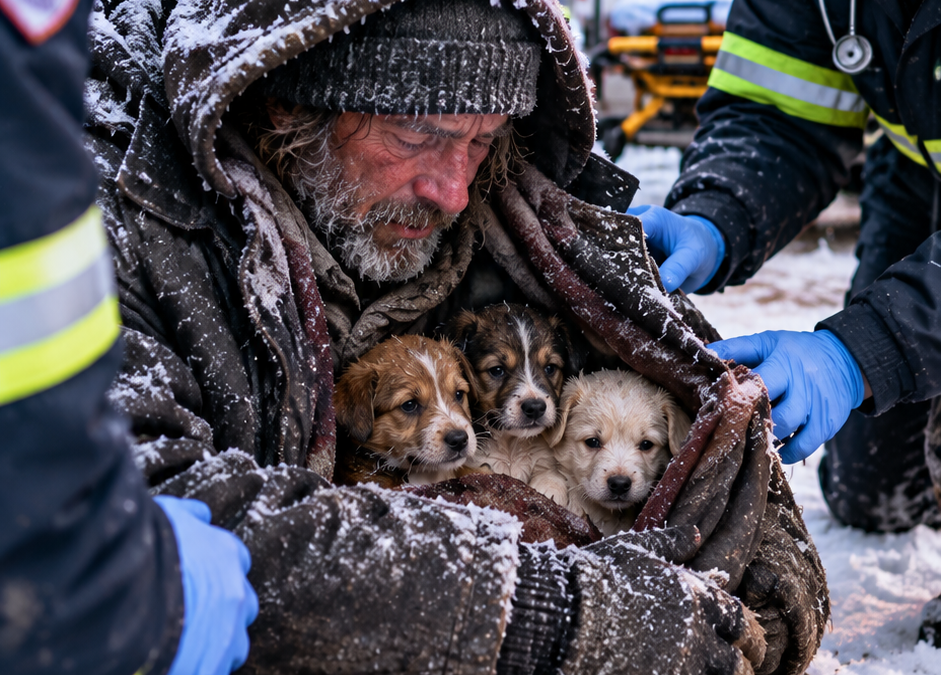
The Paramedics Kept Telling Me to Let Go, but I Wouldn’t Open My Coat Until They Made Me One Promise
The paramedics kept telling me my hands were freezing, my feet were in worse condition, and every minute mattered.
I knew they were right, but I still refused to climb into the ambulance until they looked beneath my coat and understood why I had been holding it shut with both arms.
There were three tiny heartbeats against my chest, and after five years of being treated like I belonged to nobody, they had somehow become the first lives in a long time that depended on me.
My name is James.
For five years, I lived on the streets of Middlesbury.
People use different words for men like me.
Homeless.
Rough sleeper.
Transient.
Unhoused.
Sometimes people try to be respectful.
Sometimes they don’t.
After enough years, most labels begin sounding the same.
They all mean one thing.
You don’t have a door you can close behind you.
That winter morning, the temperature had fallen to thirty-three degrees below zero.
At that temperature, cold stops feeling like weather.
It becomes an animal.
It gets inside your clothes.
Inside your shoes.
Inside the spaces between your fingers.
It bites anything exposed and waits for your body to become too tired to fight back.
I had spent the night beneath the Vernton River bridge because the concrete supports blocked some of the wind.
Not all.
But some.
When you sleep outside long enough, you stop looking for comfort.
You look for degrees of less terrible.
A dry corner is better than a wet one.
Cardboard is better than concrete.
Two blankets are better than one.
Wind from one direction is better than wind from three.
That was the mathematics of my life.
I woke sometime before sunrise because I heard something.
At first, I thought it was a rat.
Then I heard it again.
A tiny cry.
Weak.
Almost swallowed by the wind.
I pulled my coat tighter and tried to ignore it.
I was exhausted.
My feet had been numb for hours.
My fingers burned whenever I moved them.
The smart thing would’ve been to stay under the blankets.
Save body heat.
Wait until daylight.
Then the sound came again.
I knew I wasn’t going to ignore it.
“Fine.”
My voice sounded rough.
“Fine, I’m coming.”
I crawled toward the sound.
Behind a pile of old boards near one of the bridge supports was a torn cardboard box.
Inside were three puppies.
Tiny.
Shivering.
Pressed together so tightly they looked like one trembling body.
Their mother wasn’t there.
I searched.
Under the bridge.
Along the riverbank.
Behind the concrete pillars.
Nothing.
There were paw prints in the old snow, but wind had already started erasing them.
Maybe she’d gone looking for food.
Maybe she’d been injured.
Maybe she’d never return.
I didn’t know.
The puppies didn’t have time for me to solve that mystery.
One was brown with a white patch on her chest.
She tried to crawl toward me despite barely being able to stand.
“You’ve got an attitude.”
I later named her Meg.
The smallest one pressed against my palm the instant I touched him.
Teg.
And the third was gray and black, striped in places like somebody had brushed charcoal across his fur.
He stayed as far back as the little box allowed.
His whole body trembled.
Every time the wind rushed beneath the bridge, he buried his face beneath the others.
Strip.
I didn’t know those names yet.
I just knew they were freezing.
So I opened my coat.
Put them inside.
One against my chest.
Then another.
Then the third.
Their bodies were so small I could hold all of them with one arm.
I pulled the coat shut.
For the first time that night, I felt something warm.
Three heartbeats.
Fast.
Fragile.
Alive.
“All right.”
I looked toward the gray morning beyond the bridge.
“Now what?”
No answer.
That was usually how my conversations went.
I had no phone.
No car.
No place to take them.
The nearest heated public building was too far away to reach quickly on foot in that cold.
I started walking anyway.
You don’t make long-term plans when the temperature is thirty-three below.
You choose a direction and move.
My feet hurt at first.
Then they didn’t.
That should’ve frightened me more than it did.
I knew enough about cold to understand numbness was bad.
But every few seconds, one of the puppies moved under my coat.
That kept me going.
“Stay with me.”
I don’t know whether I was talking to them or myself.
Probably both.
By the time someone found us, I had stopped feeling my feet completely.
I remember a truck slowing.
Then voices.
Someone shouting.
I remember lights.
Red and white.
An ambulance.
A paramedic crouching in front of me.
“Sir, can you hear me?”
“Yeah.”
“What’s your name?”
“James.”
“We need to get you inside.”
“No.”
The paramedic looked at me as though he thought confusion had set in.
“James, it’s dangerously cold. You have signs of severe frostbite.”
“No.”
“Why not?”
I tightened my arms around my chest.
Something moved beneath the coat.
The paramedic noticed.
“What do you have there?”
“Three.”
“Three what?”
“Puppies.”
He stared at me.
I opened my coat just enough for him to see.
Meg’s head appeared first.
Then Teg.
Strip stayed hidden.
The paramedic’s expression changed immediately.
“Jesus.”
“Take them first.”
“We’re taking all of you.”
“Them first.”
“James—”
“I said them first.”
My voice came out sharper than I intended.
Another paramedic approached.
Woman.
Dark blue hat pulled low.
“What’s happening?”
“He has three puppies under his coat.”
She crouched.
“Let me see.”
I opened it again.
She put two fingers gently against Meg.
Then Teg.
Then found Strip.
“They’re cold.”
“I know.”
“We need to warm them.”
“Put them in the ambulance.”
“We need you in there too.”
“Not until they’re inside.”
She studied me.
Maybe she thought I was stubborn.
She was right.
Maybe she thought I was irrational.
Probably right about that too.
But after five years of sleeping in places nobody wanted to look at, I had learned one thing.
If you don’t insist on something, sometimes it doesn’t happen.
“Promise.”
“Promise what?”
“They stay together.”
She nodded.
“They stay together.”
“And they go first.”
“Okay.”
Only then did I let them help.
They brought a carrier.
Blankets.
Warm towels.
When they tried to take the puppies from my chest, my hands wouldn’t cooperate.
My fingers were stiff.
The skin looked wrong.
Pale.
Almost waxy.
The paramedic gently pulled my hands away.
“James, let me do it.”
I hated that.
Not her.
The helplessness.
For five years, I’d done everything alone.
Found food alone.
Found shelter alone.
Survived bad nights alone.
Suddenly I couldn’t even open my own hands.
Meg came out first.
She squeaked.
“I’m right here.”
Teg next.
Then Strip.
The moment Strip left my coat, he started crying.
Not loud.
Tiny, panicked sounds.
“Keep them together.”
“We are.”
The paramedic placed all three beneath the same blanket.
Only after I saw them touching one another did I climb into the ambulance.
I don’t remember much of the ride.
Pain came back when they started warming me.
That’s one of the cruel things about severe cold.
Numbness feels easier.
Warmth hurts.
My fingers burned.
My feet felt like someone had pressed them into fire.
I gritted my teeth.
Still, every thirty seconds, I asked the same thing.
“The puppies?”
“Still here.”
“Breathing?”
“Yes.”
“All three?”
“Yes.”
One of the paramedics finally smiled.
“You’ve asked six times.”
“I’m going to ask again.”
He checked the carrier.
“All three are breathing.”
I rested my head against the wall.
“Meg is the brave one.”
The paramedic looked at me.
“Meg?”
“The brown one.”
“You named them already?”
“Teg’s the little one.”
“And the striped one?”
“Strip.”
The woman paramedic leaned closer.
“Why Strip?”
“Look at him.”
She glanced beneath the blanket.
“Fair.”
“He hates the dark.”
“How do you know?”
“He buries his face.”
The paramedic looked at me strangely.
Not mocking.
Something else.
I think she couldn’t understand how a man barely able to feel his own feet had already memorized the personalities of three puppies he’d known for a few hours.
I couldn’t explain it either.
Maybe when nobody needs you for long enough, being needed even briefly feels enormous.
At Middlesbury Central Hospital, things moved fast.
Too fast for me.
People cut away part of my clothing.
Covered me in warming blankets.
Examined my fingers.
Then my feet.
The expression on the doctor’s face changed when he looked at them.
“What?”
He didn’t answer immediately.
That was enough.
“How bad?”
“Your fingers have frostbite, but circulation is still present.”
“My feet?”
“More severe.”
“How severe?”
“We need imaging and treatment immediately.”
“Where are the puppies?”
The doctor blinked.
“What?”
“The puppies.”
“James, we need to focus on you.”
“No.”
A nurse stepped closer.
“The animals are being kept warm.”
“Where?”
“Here temporarily.”
“Then what?”
She glanced at the doctor.
“We’re contacting an animal rescue.”
“Which one?”
“Thornton Animal Rescue.”
I knew the area.
North side of town.
“Together?”
“Yes.”
“Promise?”
The doctor exhaled.
“James, delaying treatment could cost you more tissue.”
“I want to see them.”
“You’re not understanding—”
“I understand.”
My voice dropped.
“I’ve been cold before.”
“This is different.”
“I want to see them first.”
The doctor looked frustrated.
Then a younger ICU nurse touched his arm.
“I’ll get them.”
He looked at her.
“We don’t have time.”
“Three minutes.”
He stared at me.
Then nodded.
The nurse disappeared.
I didn’t know her name then.
Later, I learned it was Anna.
She returned carrying a warm bundle of towels.
Three small heads appeared.
Meg.
Teg.
Strip.
I started crying.
I didn’t expect that.
I hadn’t cried in years.
Not when my wife left.
Not when I lost the apartment.
Not the first night I slept outside.
Not when someone stole everything I owned.
But seeing those three warm little faces broke something open.
“Come here.”
Anna brought them closer.
I took Meg first.
My bandaged fingers barely worked, so Anna supported her.
I pressed my face against the puppy’s head.
“You’re all right.”
Meg squeaked.
Teg next.
He immediately tried to push toward my chest.
“Yeah.”
I laughed through tears.
“Still clingy.”
Then Strip.
He was quieter.
His dark eyes barely open.
I held him against my cheek.
“Don’t be scared.”
I whispered something else.
Nobody heard it.
Good.
Some promises should stay between two living things.
Then I gave him back.
“Take care of them.”
Anna nodded.
“We will.”
“Don’t split them up yet.”
“We won’t.”
“Keep Strip warm.”
“I promise.”
Only then did I look toward the doctor.
“Okay.”
He nodded toward the transport team.
“We’re going now.”
The operating room lights were the last thing I remembered.
When I woke, the world felt wrong.
Too warm.
Too clean.
Hospital room.
White ceiling.
A machine beeping.
My hands were wrapped.
Both feet heavily bandaged.
I tried to move them.
Pain exploded through my legs.
“Don’t.”
Anna was beside the bed.
“What happened?”
“Procedure went well.”
“My fingers?”
“Saved.”
“All?”
“All ten.”
I closed my eyes.
“Feet?”
She hesitated.
That hesitation returned.
“Tell me.”
“Your right foot responded better.”
“And left?”
“Two toes had tissue damage that couldn’t be reversed.”
I looked at her.
“Lost?”
“Yes.”
I stared at the ceiling.
Two toes.
There are losses that sound small until they’re yours.
“Could’ve been worse,” I said.
Anna looked surprised.
“Yes.”
“The puppies?”
She smiled.
“Still your first question.”
“Answer it.”
“They’re safe.”
“All three?”
“All three.”
I exhaled.
Then slept again.
I remained in the hospital for weeks.
Hospitals are strange places when you’ve spent years outside.
At first, I couldn’t relax.
Doors closing made me nervous.
Food arriving three times a day felt suspiciously generous.
Clean sheets felt temporary.
The nurses kept telling me to use the call button.
I hated the call button.
I wasn’t used to asking for things.
Especially from people who could say no.
My doctors explained that the deeper layers of both feet had suffered serious frostbite.
My right foot would recover better.
Left side would require more rehabilitation.
Two toes were gone.
Walking would be difficult at first.
Maybe forever in some ways.
The old me would’ve listened to that and thought:
Of course.
Another thing taken.
Another piece gone.
Instead, I thought about Strip.
Then Meg.
Then Teg.
“How soon can I walk?”
The physical therapist laughed.
“You just had surgery.”
“That’s not an answer.”
“You’re going to be difficult.”
“I’ve been told.”
Rehabilitation began slowly.
Pain.
Balance.
Crutches.
Standing again after weeks in bed.
The first time I put weight through my feet, my entire body shook.
“Enough,” the therapist said.
“No.”
“James.”
“Again.”
I took one step.
Then another.
My legs had forgotten confidence.
That was all right.
So had I.
We could relearn together.
Every day, I asked about the puppies.
Anna eventually started getting updates from Thornton Animal Rescue before coming onto my floor.
“Meg is gaining weight.”
“What about Teg?”
“Also good.”
“Strip?”
“Still shy.”
“Is he eating?”
“Yes.”
“Sleeping?”
“James.”
“What?”
“They are all safe.”
“I like details.”
She shook her head.
A week later, the rescue sent photographs.
I held them carefully with bandaged fingers.
Meg had grown.
Brown coat.
White chest.
Eyes bright.
Teg looked almost too small for his bed.
Strip sat in the back corner of an enclosure, watching the camera.
I touched the photograph.
“There’s my boy.”
Anna looked at me.
“Your boy?”
I pretended not to hear.
Soon, the puppies became known at the rescue as “The Three.”
Meg.
Teg.
Strip.
My names stayed.
That mattered more than it should have.
Meg was adopted first.
A couple from Hartington.
Retired teacher and mechanic.
Big fenced yard.
I studied their photo as if I were evaluating a mortgage application.
“They good?”
Anna laughed.
“The rescue says yes.”
“That doesn’t answer me.”
“Apparently they had dogs for twenty years.”
“Okay.”
I gave my approval as though anyone had asked.
Teg went next.
An older woman in Brentwood.
She had lost her dog several months earlier.
Teg apparently climbed into her lap during the meeting and refused to leave.
“Of course.”
Anna looked up.
“What?”
“He likes closeness.”
She smiled.
“You did say that.”
“Because I know him.”
Then there was Strip.
Days passed.
Then weeks.
No adoption.
I asked why.
Anna hesitated.
“People say he’s timid.”
“So?”
“He hides when visitors come.”
“Give him time.”
“They are.”
“People want dogs to perform.”
“What?”
“They walk into a shelter and expect a puppy to run over, wag, make them feel chosen.”
I looked at Strip’s photograph.
“He doesn’t know them.”
Anna sat beside me.
“You’ve thought about this a lot.”
I didn’t answer.
I had.
Every night.
That dog had become stuck somewhere in my head.
Maybe because I understood him.
Strip stayed in the back.
Watched people.
Wanted safety before trust.
So did I.
During rehabilitation, my social worker started visiting.
Her name was Rachel Moore.
Smart woman.
Patient.
Annoyingly persistent.
She wanted to know my history.
At first, I gave her almost nothing.
“Construction.”
“What kind?”
“Commercial.”
“How long?”
“Years.”
“Family?”
“No.”
“Previous housing?”
“Apartment.”
“What happened?”
“Life.”
Rachel waited.
I hated people who could tolerate silence.
Finally, one afternoon, I gave in.
“I worked construction fifteen years.”
“Okay.”
“Had a place in Thornby.”
“Owned or rented?”
“Rented.”
“Married?”
“Yes.”
“What happened?”
“I got laid off.”
That was the beginning.
Construction slowed.
Company cut crews.
I thought I’d find another job quickly.
Didn’t.
Savings disappeared.
Stress changed the house.
My wife and I fought.
Then stopped fighting.
Silence was worse.
Eventually, she left.
Rent fell behind.
Eviction.
I stayed with a friend.
Then another.
Then a shelter.
Then outside.
At first, I fought hard to get back.
Applications.
Day labor.
Temporary rooms.
Then something inside me got tired.
That’s difficult to admit.
Homelessness doesn’t always arrive as one dramatic fall.
Sometimes it’s erosion.
One loss.
Then another.
Then you stop expecting things to improve.
After a while, being outside wasn’t a crisis.
It was Tuesday.
Rachel listened.
“What changed now?”
I looked toward the photograph of Strip taped beside my bed.
“Three puppies.”
She followed my eyes.
“That’s all?”
“No.”
I thought for a moment.
“They needed me.”
Rachel said nothing.
“For five years, nobody needed me.”
“That’s not the same as nobody caring.”
“Feels the same after long enough.”
She nodded.
“And now?”
“Now one of them is still waiting.”
Rachel looked at me.
“You’re talking about Strip.”
“Yeah.”
That afternoon, I asked her the question I’d been carrying for weeks.
“How do I adopt him?”
Rachel was quiet.
“You currently don’t have permanent housing.”
“I know.”
“The rescue won’t approve an adoption without stable housing.”
“I know.”
“You also need income.”
“I know.”
“Then you know the answer.”
“No.”
She frowned.
“I know the obstacles.”
I leaned forward.
“That’s not the same thing.”
That was the first time I saw Rachel smile at me like I had surprised her.
“So you want to try.”
“Yes.”
“Really try?”
“Yes.”
“No quitting when paperwork gets difficult?”
I almost laughed.
“Paperwork isn’t thirty-three below.”
“Fair.”
That started everything.
I stopped smoking.
Not because someone lectured me.
Because cigarettes cost money.
Dog food cost money too.
Choice seemed simple.
I attended every physical therapy session.
Then group therapy.
I hated group therapy initially.
Ten people in a room talking about feelings.
Nightmare.
On the third session, I actually spoke.
On the fifth, I listened.
By the tenth, I understood why they kept asking me to come back.
Rachel helped me apply to a supported housing program.
Weeks of forms.
Interviews.
Documentation I barely had.
Replacement identification.
Medical papers.
References.
Every time I wanted to walk away, I looked at Strip’s photograph.
“You’re expensive and you’re not even mine.”
Eventually, a room became available in Hemmington.
One room.
Shared kitchen.
Shared bathroom down the hall.
Small window.
A radiator that made terrifying noises but produced heat.
Most people would’ve looked at that room and seen very little.
I saw a door.
My door.
A key.
My key.
The first night, I sat on the mattress holding that key in my palm for almost an hour.
Five years.
Five years since I’d been able to lock a door and know the space behind it belonged to me.
Rachel came the next morning.
“How was it?”
“Too quiet.”
“You’ll adjust.”
I looked around.
“Do you think they allow dogs?”
She laughed.
“I already checked.”
“And?”
“Possible with approval.”
I tried not to smile.
Failed.
Income came next.
Construction wasn’t realistic while I was still using crutches.
Rachel found a vocational program.
Eventually, I qualified for remote telephone support work.
Not glamorous.
Customer service.
Headset.
Computer.
People angry about bills and passwords.
I loved it.
Why?
Because I worked.
Because someone gave me a schedule.
Because money appeared in my account because I had earned it.
The first paycheck, I bought groceries.
Then I went directly to a pet store.
I had not been approved for Strip yet.
Rachel caught me with a bag of dog food.
“James.”
“What?”
“You don’t own the dog.”
“Planning.”
“You own a food bowl too?”
“Maybe.”
She looked at the bed.
There was also a blanket.
“Absolutely ridiculous.”
“I survived on the street five years. Let me be ridiculous.”
She smiled.
The rescue still hesitated.
Understandably.
I had housing, but recent.
Income, but new.
Mobility limitations.
No history as a pet owner they could verify.
I attended meetings.
Answered questions.
Showed proof of income.
Showed the room.
Showed that I could get Strip outside safely.
Demonstrated I could move independently with my crutches.
I made a budget.
Dog food.
Veterinary care.
Medication.
Emergency savings.
One woman on the adoption committee asked,
“Why him?”
“Strip?”
“Yes. Why not another dog after you’re more established?”
I looked at her.
“Because he was there.”
She waited.
“When I was freezing under that bridge, he was against my chest.”
I swallowed.
“When they took him away, I told him not to be scared.”
I looked down at my hands.
“I don’t want that promise to end because paperwork says I’m inconvenient.”
She didn’t answer.
Neither did I.
Two weeks later, Rachel called.
“You sitting down?”
“Why?”
“Sit.”
“I’m already sitting.”
“Good.”
Pause.
“You’re approved.”
I couldn’t speak.
“James?”
“Yeah.”
“You hear me?”
“Yeah.”
“Strip can come home.”
Home.
The word hit harder than approved.
Not your room.
Not housing placement.
Home.
Three months after the morning under the bridge, I stood outside Thornton Animal Rescue.
Cold day.
Bright sky.
My crutches clicked against the pavement.
Rachel had offered to come.
I told her no.
Then changed my mind ten minutes later.
She stood a few feet behind me.
“Ready?”
“No.”
She smiled.
“Good.”
Emily Johnson from the rescue opened the door.
“You must be James.”
“Yeah.”
“I’ve heard a lot about you.”
“Mostly lies.”
“Of course.”
She led me through the hallway.
Dogs barking.
Metal gates.
Blankets.
Bowls.
My heart pounded harder than it had during physical therapy.
“What if he doesn’t remember me?”
Emily looked back.
“Then you’ll meet again.”
That was probably the correct answer.
I hated it.
We reached a larger room.
“Wait here.”
She disappeared.
I gripped both crutches.
Then I heard nails on the floor.
A dog came around the corner.
Not the tiny puppy I’d carried under my coat.
Bigger.
Legs too long for his body.
Gray-and-black coat.
Those striped markings still there.
Strip stopped.
Looked at me.
For two seconds, nothing happened.
My chest dropped.
Then his ears rose.
He ran.
Not cautiously.
Not shyly.
Ran.
Straight toward me.
“Whoa—”
I dropped one crutch.
Strip hit my legs.
Nearly knocked me over.
I lowered myself awkwardly.
He climbed against my chest.
Same place.
Exactly where I’d carried him in the cold.
I wrapped both arms around him.
There were people watching.
I didn’t care.
“Hey.”
Strip licked my face.
“Hey, buddy.”
More licking.
“You’re bigger.”
His tail hammered the floor.
I pressed my face into his neck.
“You remember.”
Rachel turned away.
Pretended she wasn’t crying.
I wasn’t pretending.
“You remember me.”
Strip pushed harder against me.
I whispered,
“You’re the last one.”
He stopped moving for a moment.
“And I’m probably the last man anybody would’ve chosen for you.”
His ears shifted.
“But maybe we can learn together.”
Emily came closer.
“Want to change his name?”
“No.”
“No?”
“He knows who he is.”
I scratched his chest.
“No need to start over.”
That sentence felt bigger once I’d said it.
Maybe I was talking about myself too.
“You just keep going.”
I signed the papers.
Strip came home.
The first night, he refused the dog bed I’d bought.
Of course.
Instead, he climbed onto the floor beside my mattress and rested his head on my arm.
“That’s expensive equipment over there.”
He ignored me.
“I bought that specifically.”
Nothing.
“Fine.”
I turned off the light.
Strip immediately moved closer.
I felt his breathing against my hand.
For years, darkness had meant watching my belongings.
Watching strangers.
Listening for danger.
Keeping one eye open.
That night, I slept.
Really slept.
Work continued.
Rehabilitation continued.
Crutches.
Then sometimes one crutch.
Then short distances without them.
Strip came on every walk I could manage.
At first, we were pathetic.
Me limping.
Him stopping every twenty feet to inspect something.
A block took forever.
“You’re supposed to motivate me.”
Strip sniffed a trash can.
“Excellent coaching.”
Day by day, my legs grew stronger.
So did he.
The shy puppy people had passed over changed.
Not completely.
He still disliked strangers approaching too quickly.
Still hid behind me during loud noises.
But that was fine.
We had boundaries in common.
Meg’s family contacted me first.
They invited Strip and me to visit.
Meg recognized him instantly.
They chased each other around a yard for half an hour.
I sat on a chair watching.
Meg’s owner handed me coffee.
“You saved her.”
I shook my head.
“They saved me too.”
It sounded sentimental.
I didn’t care.
Teg lived with an older woman in Brentwood named Martha.
The first time we visited, Teg climbed onto my lap despite being too big for it now.
“You still like closeness.”
Martha laughed.
“He sleeps on my feet every night.”
“Sounds right.”
Eventually, we started meeting at Stewart Park.
Meg.
Teg.
Strip.
Three dogs running together across the grass.
You would’ve never known their first home had been beneath a bridge at thirty-three below zero.
Maybe dogs understand reinvention better than people.
They don’t sit around discussing what they once were.
They run.
They eat.
They sleep.
They trust again when they can.
I tried to copy that.
My room in Hemmington remained small.
Shared kitchen.
Radiator still sounded like someone attacking pipes with a hammer.
I still had scars.
Still had pain in cold weather.
Two toes didn’t grow back.
Some mornings my balance was bad.
Sometimes when snow began falling, I could smell that bridge again.
Concrete.
River.
Dirty blankets.
Fear.
Strip noticed those mornings.
He would come over.
Put his head against my leg.
No drama.
No questions.
Just contact.
I kept working phone support.
Eventually, my supervisor gave me more hours.
Then training responsibilities.
Me.
Training new employees.
I laughed when Rachel told me it was progress.
“What?”
“Five years ago, you didn’t think anybody would trust you with anything.”
“Now they trust me with angry customers.”
“Baby steps.”
One afternoon, a caller screamed at me for ten straight minutes over an account issue.
When I hung up, Strip looked at me.
“People are exhausting.”
Tail wag.
“You’re biased.”
He put his head on my knee.
“Fine.”
Sometimes I thought about the morning under the bridge.
Not in a dramatic way.
More like checking an old scar.
What if I hadn’t heard them?
What if I had rolled over?
What if their mother had returned?
What if someone had found us thirty minutes later?
I stopped those questions eventually.
They don’t lead anywhere.
What happened happened.
I found them.
They needed warmth.
I had some.
I needed a reason to care whether I survived the winter.
They gave me one.
Fair trade.
People later heard the story.
A homeless man refusing an ambulance until puppies were loaded first.
Some called it heroic.
I don’t.
Heroes usually sound like people with choices.
That morning, I didn’t feel like I had one.
Once you hold something that small against your chest and feel it shaking, walking away isn’t really an option.
At least it wasn’t for me.
One evening, Rachel visited my room.
Strip lay beside the bed.
She looked around.
“Remember the first day we met?”
“No.”
“You barely spoke.”
“Smartest version of me.”
“You told me you were nobody.”
I looked at Strip.
“Did I?”
“Yes.”
She sat in the chair.
“What do you say now?”
I thought about it.
Construction worker?
Former homeless man?
Customer service representative?
Dog owner?
Survivor?
None felt exactly right.
Strip opened his eyes.
I smiled.
“I’m Strip’s guy.”
Rachel laughed.
“That’s it?”
“That’s enough.”
And it was.
Today, my life isn’t impressive from the outside.
One room in Hemmington.
Shared kitchen.
A job I do through a headset.
Crutches still leaning near the wall.
A dog who steals half my blanket.
But every evening, I close my door.
My door.
Strip circles twice before lying down beside me.
Sometimes he places his head on my arm.
I look at him and remember how small he once was.
A terrified striped puppy beneath a bridge.
I remember thirty-three below zero.
The ambulance.
The hospital.
The moment I thought I might lose my feet.
The months learning to walk again.
I remember being told a homeless man couldn’t adopt a dog.
They weren’t wrong.
I needed a home first.
So I found one.
Needed income.
I found that too.
Needed to prove I could care for another life.
The strange part is that trying to become the man Strip needed forced me to become someone capable of caring for myself.
That’s what changed everything.
Meg is happy.
Teg is happy.
Strip is asleep beside me while I’m telling this.
Sometimes the three of them still meet at Stewart Park.
The moment they see each other, years disappear.
They run.
Wrestle.
Chase.
Then eventually return to their people.
Their people.
I never expected to become someone’s person again.
That may be the greatest thing Strip gave me.
Not housing.
Not employment.
Not rehabilitation.
Those came through work and people willing to help.
Strip gave those efforts a direction.
A reason to keep walking when walking hurt.
A reason to save money.
A reason to close the door at night and think:
This is ours.
Sometimes winter temperatures fall hard in Middlesbury.
Not thirty-three below.
But cold enough that the old pain returns to my feet.
On those nights, Strip becomes restless.
Maybe he remembers.
Maybe he doesn’t.
I don’t pretend to know what dogs carry from puppyhood.
But he’ll climb close.
Rest against me.
And look into my face.
I always say the same thing.
“You remember that bridge?”
His ears move.
“We made it.”
Tail.
Once.
I rub his head.
“Still here.”
That’s the part that matters.
Not what we lost.
Not who walked away.
Not the five years I spent believing my life had narrowed into survival.
We’re still here.
A man missing two toes.
A dog once considered too timid for anyone to choose.
A locked door.
Heat.
Food in the cupboard.
Three old friends who still meet in the park.
And every night before I turn off the light, Strip looks at me as if he already knows the answer to the question I spent years asking myself.
Do I still belong somewhere?
Yes.
I belong here.
And he does too.
𝗧𝗛𝗘 𝗘𝗡𝗗
The Paramedics Kept Telling Me to Let Go, but I Wouldn’t Open My Coat Until They Made Me One Promise
The paramedics kept telling me my hands were freezing, my feet were in worse condition, and every minute mattered.
I knew they were right, but I still refused to climb into the ambulance until they looked beneath my coat and understood why I had been holding it shut with both arms.
There were three tiny heartbeats against my chest, and after five years of being treated like I belonged to nobody, they had somehow become the first lives in a long time that depended on me.
My name is James.
For five years, I lived on the streets of Middlesbury.
People use different words for men like me.
Homeless.
Rough sleeper.
Transient.
Unhoused.
Sometimes people try to be respectful.
Sometimes they don’t.
After enough years, most labels begin sounding the same.
They all mean one thing.
You don’t have a door you can close behind you.
That winter morning, the temperature had fallen to thirty-three degrees below zero.
At that temperature, cold stops feeling like weather.
It becomes an animal.
It gets inside your clothes.
Inside your shoes.
Inside the spaces between your fingers.
It bites anything exposed and waits for your body to become too tired to fight back.
I had spent the night beneath the Vernton River bridge because the concrete supports blocked some of the wind.
Not all.
But some.
When you sleep outside long enough, you stop looking for comfort.
You look for degrees of less terrible.
A dry corner is better than a wet one.
Cardboard is better than concrete.
Two blankets are better than one.
Wind from one direction is better than wind from three.
That was the mathematics of my life.
I woke sometime before sunrise because I heard something.
At first, I thought it was a rat.
Then I heard it again.
A tiny cry.
Weak.
Almost swallowed by the wind.
I pulled my coat tighter and tried to ignore it.
I was exhausted.
My feet had been numb for hours.
My fingers burned whenever I moved them.
The smart thing would’ve been to stay under the blankets.
Save body heat.
Wait until daylight.
Then the sound came again.
I knew I wasn’t going to ignore it.
“Fine.”
My voice sounded rough.
“Fine, I’m coming.”
I crawled toward the sound.
Behind a pile of old boards near one of the bridge supports was a torn cardboard box.
Inside were three puppies.
Tiny.
Shivering.
Pressed together so tightly they looked like one trembling body.
Their mother wasn’t there.
I searched.
Under the bridge.
Along the riverbank.
Behind the concrete pillars.
Nothing.
There were paw prints in the old snow, but wind had already started erasing them.
Maybe she’d gone looking for food.
Maybe she’d been injured.
Maybe she’d never return.
I didn’t know.
The puppies didn’t have time for me to solve that mystery.
One was brown with a white patch on her chest.
She tried to crawl toward me despite barely being able to stand.
“You’ve got an attitude.”
I later named her Meg.
The smallest one pressed against my palm the instant I touched him.
Teg.
And the third was gray and black, striped in places like somebody had brushed charcoal across his fur.
He stayed as far back as the little box allowed.
His whole body trembled.
Every time the wind rushed beneath the bridge, he buried his face beneath the others.
Strip.
I didn’t know those names yet.
I just knew they were freezing.
So I opened my coat.
Put them inside.
One against my chest.
Then another.
Then the third.
Their bodies were so small I could hold all of them with one arm.
I pulled the coat shut.
For the first time that night, I felt something warm.
Three heartbeats.
Fast.
Fragile.
Alive.
“All right.”
I looked toward the gray morning beyond the bridge.
“Now what?”
No answer.
That was usually how my conversations went.
I had no phone.
No car.
No place to take them.
The nearest heated public building was too far away to reach quickly on foot in that cold.
I started walking anyway.
You don’t make long-term plans when the temperature is thirty-three below.
You choose a direction and move.
My feet hurt at first.
Then they didn’t.
That should’ve frightened me more than it did.
I knew enough about cold to understand numbness was bad.
But every few seconds, one of the puppies moved under my coat.
That kept me going.
“Stay with me.”
I don’t know whether I was talking to them or myself.
Probably both.
By the time someone found us, I had stopped feeling my feet completely.
I remember a truck slowing.
Then voices.
Someone shouting.
I remember lights.
Red and white.
An ambulance.
A paramedic crouching in front of me.
“Sir, can you hear me?”
“Yeah.”
“What’s your name?”
“James.”
“We need to get you inside.”
“No.”
The paramedic looked at me as though he thought confusion had set in.
“James, it’s dangerously cold. You have signs of severe frostbite.”
“No.”
“Why not?”
I tightened my arms around my chest.
Something moved beneath the coat.
The paramedic noticed.
“What do you have there?”
“Three.”
“Three what?”
“Puppies.”
He stared at me.
I opened my coat just enough for him to see.
Meg’s head appeared first.
Then Teg.
Strip stayed hidden.
The paramedic’s expression changed immediately.
“Jesus.”
“Take them first.”
“We’re taking all of you.”
“Them first.”
“James—”
“I said them first.”
My voice came out sharper than I intended.
Another paramedic approached.
Woman.
Dark blue hat pulled low.
“What’s happening?”
“He has three puppies under his coat.”
She crouched.
“Let me see.”
I opened it again.
She put two fingers gently against Meg.
Then Teg.
Then found Strip.
“They’re cold.”
“I know.”
“We need to warm them.”
“Put them in the ambulance.”
“We need you in there too.”
“Not until they’re inside.”
She studied me.
Maybe she thought I was stubborn.
She was right.
Maybe she thought I was irrational.
Probably right about that too.
But after five years of sleeping in places nobody wanted to look at, I had learned one thing.
If you don’t insist on something, sometimes it doesn’t happen.
“Promise.”
“Promise what?”
“They stay together.”
She nodded.
“They stay together.”
“And they go first.”
“Okay.”
Only then did I let them help.
They brought a carrier.
Blankets.
Warm towels.
When they tried to take the puppies from my chest, my hands wouldn’t cooperate.
My fingers were stiff.
The skin looked wrong.
Pale.
Almost waxy.
The paramedic gently pulled my hands away.
“James, let me do it.”
I hated that.
Not her.
The helplessness.
For five years, I’d done everything alone.
Found food alone.
Found shelter alone.
Survived bad nights alone.
Suddenly I couldn’t even open my own hands.
Meg came out first.
She squeaked.
“I’m right here.”
Teg next.
Then Strip.
The moment Strip left my coat, he started crying.
Not loud.
Tiny, panicked sounds.
“Keep them together.”
“We are.”
The paramedic placed all three beneath the same blanket.
Only after I saw them touching one another did I climb into the ambulance.
I don’t remember much of the ride.
Pain came back when they started warming me.
That’s one of the cruel things about severe cold.
Numbness feels easier.
Warmth hurts.
My fingers burned.
My feet felt like someone had pressed them into fire.
I gritted my teeth.
Still, every thirty seconds, I asked the same thing.
“The puppies?”
“Still here.”
“Breathing?”
“Yes.”
“All three?”
“Yes.”
One of the paramedics finally smiled.
“You’ve asked six times.”
“I’m going to ask again.”
He checked the carrier.
“All three are breathing.”
I rested my head against the wall.
“Meg is the brave one.”
The paramedic looked at me.
“Meg?”
“The brown one.”
“You named them already?”
“Teg’s the little one.”
“And the striped one?”
“Strip.”
The woman paramedic leaned closer.
“Why Strip?”
“Look at him.”
She glanced beneath the blanket.
“Fair.”
“He hates the dark.”
“How do you know?”
“He buries his face.”
The paramedic looked at me strangely.
Not mocking.
Something else.
I think she couldn’t understand how a man barely able to feel his own feet had already memorized the personalities of three puppies he’d known for a few hours.
I couldn’t explain it either.
Maybe when nobody needs you for long enough, being needed even briefly feels enormous.
At Middlesbury Central Hospital, things moved fast.
Too fast for me.
People cut away part of my clothing.
Covered me in warming blankets.
Examined my fingers.
Then my feet.
The expression on the doctor’s face changed when he looked at them.
“What?”
He didn’t answer immediately.
That was enough.
“How bad?”
“Your fingers have frostbite, but circulation is still present.”
“My feet?”
“More severe.”
“How severe?”
“We need imaging and treatment immediately.”
“Where are the puppies?”
The doctor blinked.
“What?”
“The puppies.”
“James, we need to focus on you.”
“No.”
A nurse stepped closer.
“The animals are being kept warm.”
“Where?”
“Here temporarily.”
“Then what?”
She glanced at the doctor.
“We’re contacting an animal rescue.”
“Which one?”
“Thornton Animal Rescue.”
I knew the area.
North side of town.
“Together?”
“Yes.”
“Promise?”
The doctor exhaled.
“James, delaying treatment could cost you more tissue.”
“I want to see them.”
“You’re not understanding—”
“I understand.”
My voice dropped.
“I’ve been cold before.”
“This is different.”
“I want to see them first.”
The doctor looked frustrated.
Then a younger ICU nurse touched his arm.
“I’ll get them.”
He looked at her.
“We don’t have time.”
“Three minutes.”
He stared at me.
Then nodded.
The nurse disappeared.
I didn’t know her name then.
Later, I learned it was Anna.
She returned carrying a warm bundle of towels.
Three small heads appeared.
Meg.
Teg.
Strip.
I started crying.
I didn’t expect that.
I hadn’t cried in years.
Not when my wife left.
Not when I lost the apartment.
Not the first night I slept outside.
Not when someone stole everything I owned.
But seeing those three warm little faces broke something open.
“Come here.”
Anna brought them closer.
I took Meg first.
My bandaged fingers barely worked, so Anna supported her.
I pressed my face against the puppy’s head.
“You’re all right.”
Meg squeaked.
Teg next.
He immediately tried to push toward my chest.
“Yeah.”
I laughed through tears.
“Still clingy.”
Then Strip.
He was quieter.
His dark eyes barely open.
I held him against my cheek.
“Don’t be scared.”
I whispered something else.
Nobody heard it.
Good.
Some promises should stay between two living things.
Then I gave him back.
“Take care of them.”
Anna nodded.
“We will.”
“Don’t split them up yet.”
“We won’t.”
“Keep Strip warm.”
“I promise.”
Only then did I look toward the doctor.
“Okay.”
He nodded toward the transport team.
“We’re going now.”
The operating room lights were the last thing I remembered.
When I woke, the world felt wrong.
Too warm.
Too clean.
Hospital room.
White ceiling.
A machine beeping.
My hands were wrapped.
Both feet heavily bandaged.
I tried to move them.
Pain exploded through my legs.
“Don’t.”
Anna was beside the bed.
“What happened?”
“Procedure went well.”
“My fingers?”
“Saved.”
“All?”
“All ten.”
I closed my eyes.
“Feet?”
She hesitated.
That hesitation returned.
“Tell me.”
“Your right foot responded better.”
“And left?”
“Two toes had tissue damage that couldn’t be reversed.”
I looked at her.
“Lost?”
“Yes.”
I stared at the ceiling.
Two toes.
There are losses that sound small until they’re yours.
“Could’ve been worse,” I said.
Anna looked surprised.
“Yes.”
“The puppies?”
She smiled.
“Still your first question.”
“Answer it.”
“They’re safe.”
“All three?”
“All three.”
I exhaled.
Then slept again.
I remained in the hospital for weeks.
Hospitals are strange places when you’ve spent years outside.
At first, I couldn’t relax.
Doors closing made me nervous.
Food arriving three times a day felt suspiciously generous.
Clean sheets felt temporary.
The nurses kept telling me to use the call button.
I hated the call button.
I wasn’t used to asking for things.
Especially from people who could say no.
My doctors explained that the deeper layers of both feet had suffered serious frostbite.
My right foot would recover better.
Left side would require more rehabilitation.
Two toes were gone.
Walking would be difficult at first.
Maybe forever in some ways.
The old me would’ve listened to that and thought:
Of course.
Another thing taken.
Another piece gone.
Instead, I thought about Strip.
Then Meg.
Then Teg.
“How soon can I walk?”
The physical therapist laughed.
“You just had surgery.”
“That’s not an answer.”
“You’re going to be difficult.”
“I’ve been told.”
Rehabilitation began slowly.
Pain.
Balance.
Crutches.
Standing again after weeks in bed.
The first time I put weight through my feet, my entire body shook.
“Enough,” the therapist said.
“No.”
“James.”
“Again.”
I took one step.
Then another.
My legs had forgotten confidence.
That was all right.
So had I.
We could relearn together.
Every day, I asked about the puppies.
Anna eventually started getting updates from Thornton Animal Rescue before coming onto my floor.
“Meg is gaining weight.”
“What about Teg?”
“Also good.”
“Strip?”
“Still shy.”
“Is he eating?”
“Yes.”
“Sleeping?”
“James.”
“What?”
“They are all safe.”
“I like details.”
She shook her head.
A week later, the rescue sent photographs.
I held them carefully with bandaged fingers.
Meg had grown.
Brown coat.
White chest.
Eyes bright.
Teg looked almost too small for his bed.
Strip sat in the back corner of an enclosure, watching the camera.
I touched the photograph.
“There’s my boy.”
Anna looked at me.
“Your boy?”
I pretended not to hear.
Soon, the puppies became known at the rescue as “The Three.”
Meg.
Teg.
Strip.
My names stayed.
That mattered more than it should have.
Meg was adopted first.
A couple from Hartington.
Retired teacher and mechanic.
Big fenced yard.
I studied their photo as if I were evaluating a mortgage application.
“They good?”
Anna laughed.
“The rescue says yes.”
“That doesn’t answer me.”
“Apparently they had dogs for twenty years.”
“Okay.”
I gave my approval as though anyone had asked.
Teg went next.
An older woman in Brentwood.
She had lost her dog several months earlier.
Teg apparently climbed into her lap during the meeting and refused to leave.
“Of course.”
Anna looked up.
“What?”
“He likes closeness.”
She smiled.
“You did say that.”
“Because I know him.”
Then there was Strip.
Days passed.
Then weeks.
No adoption.
I asked why.
Anna hesitated.
“People say he’s timid.”
“So?”
“He hides when visitors come.”
“Give him time.”
“They are.”
“People want dogs to perform.”
“What?”
“They walk into a shelter and expect a puppy to run over, wag, make them feel chosen.”
I looked at Strip’s photograph.
“He doesn’t know them.”
Anna sat beside me.
“You’ve thought about this a lot.”
I didn’t answer.
I had.
Every night.
That dog had become stuck somewhere in my head.
Maybe because I understood him.
Strip stayed in the back.
Watched people.
Wanted safety before trust.
So did I.
During rehabilitation, my social worker started visiting.
Her name was Rachel Moore.
Smart woman.
Patient.
Annoyingly persistent.
She wanted to know my history.
At first, I gave her almost nothing.
“Construction.”
“What kind?”
“Commercial.”
“How long?”
“Years.”
“Family?”
“No.”
“Previous housing?”
“Apartment.”
“What happened?”
“Life.”
Rachel waited.
I hated people who could tolerate silence.
Finally, one afternoon, I gave in.
“I worked construction fifteen years.”
“Okay.”
“Had a place in Thornby.”
“Owned or rented?”
“Rented.”
“Married?”
“Yes.”
“What happened?”
“I got laid off.”
That was the beginning.
Construction slowed.
Company cut crews.
I thought I’d find another job quickly.
Didn’t.
Savings disappeared.
Stress changed the house.
My wife and I fought.
Then stopped fighting.
Silence was worse.
Eventually, she left.
Rent fell behind.
Eviction.
I stayed with a friend.
Then another.
Then a shelter.
Then outside.
At first, I fought hard to get back.
Applications.
Day labor.
Temporary rooms.
Then something inside me got tired.
That’s difficult to admit.
Homelessness doesn’t always arrive as one dramatic fall.
Sometimes it’s erosion.
One loss.
Then another.
Then you stop expecting things to improve.
After a while, being outside wasn’t a crisis.
It was Tuesday.
Rachel listened.
“What changed now?”
I looked toward the photograph of Strip taped beside my bed.
“Three puppies.”
She followed my eyes.
“That’s all?”
“No.”
I thought for a moment.
“They needed me.”
Rachel said nothing.
“For five years, nobody needed me.”
“That’s not the same as nobody caring.”
“Feels the same after long enough.”
She nodded.
“And now?”
“Now one of them is still waiting.”
Rachel looked at me.
“You’re talking about Strip.”
“Yeah.”
That afternoon, I asked her the question I’d been carrying for weeks.
“How do I adopt him?”
Rachel was quiet.
“You currently don’t have permanent housing.”
“I know.”
“The rescue won’t approve an adoption without stable housing.”
“I know.”
“You also need income.”
“I know.”
“Then you know the answer.”
“No.”
She frowned.
“I know the obstacles.”
I leaned forward.
“That’s not the same thing.”
That was the first time I saw Rachel smile at me like I had surprised her.
“So you want to try.”
“Yes.”
“Really try?”
“Yes.”
“No quitting when paperwork gets difficult?”
I almost laughed.
“Paperwork isn’t thirty-three below.”
“Fair.”
That started everything.
I stopped smoking.
Not because someone lectured me.
Because cigarettes cost money.
Dog food cost money too.
Choice seemed simple.
I attended every physical therapy session.
Then group therapy.
I hated group therapy initially.
Ten people in a room talking about feelings.
Nightmare.
On the third session, I actually spoke.
On the fifth, I listened.
By the tenth, I understood why they kept asking me to come back.
Rachel helped me apply to a supported housing program.
Weeks of forms.
Interviews.
Documentation I barely had.
Replacement identification.
Medical papers.
References.
Every time I wanted to walk away, I looked at Strip’s photograph.
“You’re expensive and you’re not even mine.”
Eventually, a room became available in Hemmington.
One room.
Shared kitchen.
Shared bathroom down the hall.
Small window.
A radiator that made terrifying noises but produced heat.
Most people would’ve looked at that room and seen very little.
I saw a door.
My door.
A key.
My key.
The first night, I sat on the mattress holding that key in my palm for almost an hour.
Five years.
Five years since I’d been able to lock a door and know the space behind it belonged to me.
Rachel came the next morning.
“How was it?”
“Too quiet.”
“You’ll adjust.”
I looked around.
“Do you think they allow dogs?”
She laughed.
“I already checked.”
“And?”
“Possible with approval.”
I tried not to smile.
Failed.
Income came next.
Construction wasn’t realistic while I was still using crutches.
Rachel found a vocational program.
Eventually, I qualified for remote telephone support work.
Not glamorous.
Customer service.
Headset.
Computer.
People angry about bills and passwords.
I loved it.
Why?
Because I worked.
Because someone gave me a schedule.
Because money appeared in my account because I had earned it.
The first paycheck, I bought groceries.
Then I went directly to a pet store.
I had not been approved for Strip yet.
Rachel caught me with a bag of dog food.
“James.”
“What?”
“You don’t own the dog.”
“Planning.”
“You own a food bowl too?”
“Maybe.”
She looked at the bed.
There was also a blanket.
“Absolutely ridiculous.”
“I survived on the street five years. Let me be ridiculous.”
She smiled.
The rescue still hesitated.
Understandably.
I had housing, but recent.
Income, but new.
Mobility limitations.
No history as a pet owner they could verify.
I attended meetings.
Answered questions.
Showed proof of income.
Showed the room.
Showed that I could get Strip outside safely.
Demonstrated I could move independently with my crutches.
I made a budget.
Dog food.
Veterinary care.
Medication.
Emergency savings.
One woman on the adoption committee asked,
“Why him?”
“Strip?”
“Yes. Why not another dog after you’re more established?”
I looked at her.
“Because he was there.”
She waited.
“When I was freezing under that bridge, he was against my chest.”
I swallowed.
“When they took him away, I told him not to be scared.”
I looked down at my hands.
“I don’t want that promise to end because paperwork says I’m inconvenient.”
She didn’t answer.
Neither did I.
Two weeks later, Rachel called.
“You sitting down?”
“Why?”
“Sit.”
“I’m already sitting.”
“Good.”
Pause.
“You’re approved.”
I couldn’t speak.
“James?”
“Yeah.”
“You hear me?”
“Yeah.”
“Strip can come home.”
Home.
The word hit harder than approved.
Not your room.
Not housing placement.
Home.
Three months after the morning under the bridge, I stood outside Thornton Animal Rescue.
Cold day.
Bright sky.
My crutches clicked against the pavement.
Rachel had offered to come.
I told her no.
Then changed my mind ten minutes later.
She stood a few feet behind me.
“Ready?”
“No.”
She smiled.
“Good.”
Emily Johnson from the rescue opened the door.
“You must be James.”
“Yeah.”
“I’ve heard a lot about you.”
“Mostly lies.”
“Of course.”
She led me through the hallway.
Dogs barking.
Metal gates.
Blankets.
Bowls.
My heart pounded harder than it had during physical therapy.
“What if he doesn’t remember me?”
Emily looked back.
“Then you’ll meet again.”
That was probably the correct answer.
I hated it.
We reached a larger room.
“Wait here.”
She disappeared.
I gripped both crutches.
Then I heard nails on the floor.
A dog came around the corner.
Not the tiny puppy I’d carried under my coat.
Bigger.
Legs too long for his body.
Gray-and-black coat.
Those striped markings still there.
Strip stopped.
Looked at me.
For two seconds, nothing happened.
My chest dropped.
Then his ears rose.
He ran.
Not cautiously.
Not shyly.
Ran.
Straight toward me.
“Whoa—”
I dropped one crutch.
Strip hit my legs.
Nearly knocked me over.
I lowered myself awkwardly.
He climbed against my chest.
Same place.
Exactly where I’d carried him in the cold.
I wrapped both arms around him.
There were people watching.
I didn’t care.
“Hey.”
Strip licked my face.
“Hey, buddy.”
More licking.
“You’re bigger.”
His tail hammered the floor.
I pressed my face into his neck.
“You remember.”
Rachel turned away.
Pretended she wasn’t crying.
I wasn’t pretending.
“You remember me.”
Strip pushed harder against me.
I whispered,
“You’re the last one.”
He stopped moving for a moment.
“And I’m probably the last man anybody would’ve chosen for you.”
His ears shifted.
“But maybe we can learn together.”
Emily came closer.
“Want to change his name?”
“No.”
“No?”
“He knows who he is.”
I scratched his chest.
“No need to start over.”
That sentence felt bigger once I’d said it.
Maybe I was talking about myself too.
“You just keep going.”
I signed the papers.
Strip came home.
The first night, he refused the dog bed I’d bought.
Of course.
Instead, he climbed onto the floor beside my mattress and rested his head on my arm.
“That’s expensive equipment over there.”
He ignored me.
“I bought that specifically.”
Nothing.
“Fine.”
I turned off the light.
Strip immediately moved closer.
I felt his breathing against my hand.
For years, darkness had meant watching my belongings.
Watching strangers.
Listening for danger.
Keeping one eye open.
That night, I slept.
Really slept.
Work continued.
Rehabilitation continued.
Crutches.
Then sometimes one crutch.
Then short distances without them.
Strip came on every walk I could manage.
At first, we were pathetic.
Me limping.
Him stopping every twenty feet to inspect something.
A block took forever.
“You’re supposed to motivate me.”
Strip sniffed a trash can.
“Excellent coaching.”
Day by day, my legs grew stronger.
So did he.
The shy puppy people had passed over changed.
Not completely.
He still disliked strangers approaching too quickly.
Still hid behind me during loud noises.
But that was fine.
We had boundaries in common.
Meg’s family contacted me first.
They invited Strip and me to visit.
Meg recognized him instantly.
They chased each other around a yard for half an hour.
I sat on a chair watching.
Meg’s owner handed me coffee.
“You saved her.”
I shook my head.
“They saved me too.”
It sounded sentimental.
I didn’t care.
Teg lived with an older woman in Brentwood named Martha.
The first time we visited, Teg climbed onto my lap despite being too big for it now.
“You still like closeness.”
Martha laughed.
“He sleeps on my feet every night.”
“Sounds right.”
Eventually, we started meeting at Stewart Park.
Meg.
Teg.
Strip.
Three dogs running together across the grass.
You would’ve never known their first home had been beneath a bridge at thirty-three below zero.
Maybe dogs understand reinvention better than people.
They don’t sit around discussing what they once were.
They run.
They eat.
They sleep.
They trust again when they can.
I tried to copy that.
My room in Hemmington remained small.
Shared kitchen.
Radiator still sounded like someone attacking pipes with a hammer.
I still had scars.
Still had pain in cold weather.
Two toes didn’t grow back.
Some mornings my balance was bad.
Sometimes when snow began falling, I could smell that bridge again.
Concrete.
River.
Dirty blankets.
Fear.
Strip noticed those mornings.
He would come over.
Put his head against my leg.
No drama.
No questions.
Just contact.
I kept working phone support.
Eventually, my supervisor gave me more hours.
Then training responsibilities.
Me.
Training new employees.
I laughed when Rachel told me it was progress.
“What?”
“Five years ago, you didn’t think anybody would trust you with anything.”
“Now they trust me with angry customers.”
“Baby steps.”
One afternoon, a caller screamed at me for ten straight minutes over an account issue.
When I hung up, Strip looked at me.
“People are exhausting.”
Tail wag.
“You’re biased.”
He put his head on my knee.
“Fine.”
Sometimes I thought about the morning under the bridge.
Not in a dramatic way.
More like checking an old scar.
What if I hadn’t heard them?
What if I had rolled over?
What if their mother had returned?
What if someone had found us thirty minutes later?
I stopped those questions eventually.
They don’t lead anywhere.
What happened happened.
I found them.
They needed warmth.
I had some.
I needed a reason to care whether I survived the winter.
They gave me one.
Fair trade.
People later heard the story.
A homeless man refusing an ambulance until puppies were loaded first.
Some called it heroic.
I don’t.
Heroes usually sound like people with choices.
That morning, I didn’t feel like I had one.
Once you hold something that small against your chest and feel it shaking, walking away isn’t really an option.
At least it wasn’t for me.
One evening, Rachel visited my room.
Strip lay beside the bed.
She looked around.
“Remember the first day we met?”
“No.”
“You barely spoke.”
“Smartest version of me.”
“You told me you were nobody.”
I looked at Strip.
“Did I?”
“Yes.”
She sat in the chair.
“What do you say now?”
I thought about it.
Construction worker?
Former homeless man?
Customer service representative?
Dog owner?
Survivor?
None felt exactly right.
Strip opened his eyes.
I smiled.
“I’m Strip’s guy.”
Rachel laughed.
“That’s it?”
“That’s enough.”
And it was.
Today, my life isn’t impressive from the outside.
One room in Hemmington.
Shared kitchen.
A job I do through a headset.
Crutches still leaning near the wall.
A dog who steals half my blanket.
But every evening, I close my door.
My door.
Strip circles twice before lying down beside me.
Sometimes he places his head on my arm.
I look at him and remember how small he once was.
A terrified striped puppy beneath a bridge.
I remember thirty-three below zero.
The ambulance.
The hospital.
The moment I thought I might lose my feet.
The months learning to walk again.
I remember being told a homeless man couldn’t adopt a dog.
They weren’t wrong.
I needed a home first.
So I found one.
Needed income.
I found that too.
Needed to prove I could care for another life.
The strange part is that trying to become the man Strip needed forced me to become someone capable of caring for myself.
That’s what changed everything.
Meg is happy.
Teg is happy.
Strip is asleep beside me while I’m telling this.
Sometimes the three of them still meet at Stewart Park.
The moment they see each other, years disappear.
They run.
Wrestle.
Chase.
Then eventually return to their people.
Their people.
I never expected to become someone’s person again.
That may be the greatest thing Strip gave me.
Not housing.
Not employment.
Not rehabilitation.
Those came through work and people willing to help.
Strip gave those efforts a direction.
A reason to keep walking when walking hurt.
A reason to save money.
A reason to close the door at night and think:
This is ours.
Sometimes winter temperatures fall hard in Middlesbury.
Not thirty-three below.
But cold enough that the old pain returns to my feet.
On those nights, Strip becomes restless.
Maybe he remembers.
Maybe he doesn’t.
I don’t pretend to know what dogs carry from puppyhood.
But he’ll climb close.
Rest against me.
And look into my face.
I always say the same thing.
“You remember that bridge?”
His ears move.
“We made it.”
Tail.
Once.
I rub his head.
“Still here.”
That’s the part that matters.
Not what we lost.
Not who walked away.
Not the five years I spent believing my life had narrowed into survival.
We’re still here.
A man missing two toes.
A dog once considered too timid for anyone to choose.
A locked door.
Heat.
Food in the cupboard.
Three old friends who still meet in the park.
And every night before I turn off the light, Strip looks at me as if he already knows the answer to the question I spent years asking myself.
Do I still belong somewhere?
Yes.
I belong here.
And he does too.


