𝗙𝗨𝗟𝗟 𝗦𝗧𝗢𝗥𝗬 The HOA Renamed My Private Farm Road, Scheduled the Asphalt, and Expected 73 Families to Keep Using It Without Ever Asking Me
𝗙𝗨𝗟𝗟 𝗦𝗧𝗢𝗥𝗬
The mail carrier.
And whoever was delivering feed.
Occasionally a neighbor came through.
Sometimes a hunter.
Sometimes a veterinarian.
Nobody cared.
Then Willow Crest arrived.
The first survey stakes appeared beyond my southern boundary almost fifteen years ago.
A developer bought several hundred acres of former soybean ground and announced plans for seventy-three homes.
Within two years, fields became streets.
The streets became cul-de-sacs.
Then came the houses.
Stucco.
Stone fronts.
Three-car garages.
Matching mailboxes.
A clubhouse.
A pool.
Decorative entrance pillars.
Willow Crest was the kind of neighborhood where the grass seemed to know there were rules.
I never had anything against the people living there.
Most were decent.
Some waved.
Some bought hay from me for landscaping.
A few brought their children over when calves were born.
One family even invited me to a graduation party.
The problem didn’t begin with the residents.
It began with a favor.
During construction, a foreman named Carl stopped at my barn.
He had dust on his jeans and a hard hat tucked under one arm.
“Mister Kesler?”
“That’s me.”
He pointed toward the lane.
“We’re having trouble getting concrete trucks through the north entrance. County’s doing drainage work out there. Would you mind if we used your road for a few weeks?”
I looked past him at the line of trucks waiting along the shoulder.
“How many?”
“Maybe six or eight a day.”
“For how long?”
“Three weeks. Four at the most.”
I thought about it for perhaps thirty seconds.
“All right.”
His face relaxed.
“Seriously?”
“Stay slow around the cattle.”
“Yes, sir.”
“And if you tear it up, you fix it.”
“Absolutely.”
He held out his hand.
I shook it.
That was the agreement.
No lawyer.
No contract.
No easement.
No payment.
A handshake between two men.
The trucks used the lane for about five weeks.
They left ruts.
Carl sent a grader.
The grader smoothed everything out.
Then construction slowed, the north entrance reopened, and the developer moved on.
I thought the matter was finished.
For a while, it was.
Then one morning, I noticed a sedan coming up Kesler Lane that I didn’t recognize.
The woman driving waved.
I waved back.
Two days later, another car came through.
Then another.
At first, I assumed people were lost.
Then my niece showed me a map application on her phone.
“Uncle Ray, look.”
She entered the clubhouse address.
The navigation route sent her through Kesler Lane.
My private road had become a shortcut.
I remember laughing.
“Computers,” I said.
That was my first mistake.
I treated it like something harmless.
The traffic grew slowly enough that I adjusted without realizing I was adjusting.
Five cars became ten.
Ten became twenty.
Residents learned that using my lane shaved several minutes off the drive to County Road 9.
Delivery drivers found it.
Contractors found it.
Teenagers found it.
Then one morning, a school bus came rumbling past the barn.
I stepped outside as it passed.
The driver, Gloria Martinez, lowered her window.
“Morning, Ray!”
I stared at the bus.
“Morning.”
“You mind us coming through?”
There were children looking out the windows behind her.
I should have said something then.
I should have told her the district needed permission.
Instead, I said, “Just keep it slow.”
She smiled.
“Always do.”
That became the problem.
I kept saying yes without saying the word.
Every time I didn’t object, somebody interpreted silence as permission.
Every time another month passed, permission started looking like ownership.
At some point, people stopped waving.
Not everybody.
But enough.
The lane became part of their routine.
They turned onto it while drinking coffee, arguing through Bluetooth headsets, checking mirrors, scolding children in the back seat.
They drove past my barn as if the barn were scenery beside a public street.
If I was moving cattle across the lane, drivers got impatient.
Once, a man in a silver SUV honked while I was trying to get three heifers through an open gate.
I walked over to his window.
“You in a hurry?”
He rolled it down about three inches.
“I have a meeting.”
“These cattle live here.”
He stared at me.
“I’m just trying to get through.”
“So are they.”
He sighed dramatically.
That should have told me everything.
Still, I didn’t close the road.
Part of it was habit.
Part of it was pride.
My father had never locked that gate.
Neighbors used to help neighbors without contracts.
If somebody needed to cross your land, you let them.
If somebody’s tractor broke, you pulled it.
If snow blocked a driveway, you plowed it.
You didn’t count favors.
You didn’t send invoices.
At least, that was the world I had inherited.
I didn’t realize how much the world around the lane had changed.
That laminated notice made it impossible to ignore.
After feeding the cattle, I showered, changed shirts, and drove into Marlo Creek.
The county recorder’s office occupied the second floor of a brick building beside the courthouse.
I had known Marcy Doyle for years.
She had been deputy recorder when my mother transferred a small parcel to me after my father died.
When I walked in, Marcy looked up from her computer.
“Ray Kesler. Either somebody died or somebody’s arguing about land.”
“Second one.”
She raised an eyebrow.
“That sounds more interesting.”
I slid the HOA notice across her desk.
Marcy read it.
Her expression changed.
“Connector road?”
“That’s what they’re calling it.”
“Kesler Lane?”
“Yes.”
She looked at me.
“You sell them something?”
“No.”
“Grant an easement?”
“No.”
“Sign anything?”
“No.”
She stood.
“Sit down.”
For the next hour, Marcy pulled deeds, plats, subdivision records, development agreements, utility easements, road dedications, and county maps.
We went back decades.
My father’s deed.
My parents’ transfer.
My deed.
The Willow Crest subdivision plat.
The builder’s filings.
Nothing crossed Kesler Lane.
Finally, Marcy put both hands on the folder.
“Ray.”
“Yeah?”
“There is no easement.”
“You’re sure?”
“I’m looking at every recorded document attached to both properties. Nothing gives the developer, the HOA, or the public a right through your land.”
“What about all the years they’ve been using it?”
“That’s a question for a lawyer if they want to argue prescriptive rights. But recorded easement?”
She tapped the folder.
“Nothing.”
I sat back.
Some part of me had expected to discover that I was wrong.
Maybe my father had signed something I didn’t know about.
Maybe the developer filed an agreement years ago.
Maybe I had forgotten a document buried in the paperwork after my mother died.
But there was nothing.
The lane was mine.
Start to finish.
“Can I get copies?”
Marcy smiled without humor.
“I already started printing.”
I carried the folder back to my truck.
I didn’t drive home immediately.
I sat behind the wheel with the engine off.
People crossed the courthouse square carrying coffee.
A sheriff’s cruiser rolled through the intersection.
Somewhere nearby, church bells struck eleven.
I looked at the folder on the passenger seat.
That was when the confusion disappeared.
Not the anger.
The confusion.
There is something almost calming about knowing exactly where the line is.
That evening, I strapped a trail camera to an oak beside the gate.
Not because I planned some elaborate case.
I wanted to know how much traffic we were actually talking about.
The next morning, I pulled the memory card.
I sat at my kitchen table with coffee and started counting.
I stopped once because I thought I had made a mistake.
Then I counted again.
Four hundred twelve vehicles.
In one day.
I stared at the number.
Four hundred twelve.
Some were repeats.
People leaving and returning.
School buses.
Delivery vans.
Landscaping trucks.
Residents.
Contractors.
But every one of them had put weight onto gravel I paid to maintain.
I pulled old receipts from a drawer.
Stone deliveries.
Grading.
Drainage work.
Culvert repairs.
Over roughly three years, I had spent close to six thousand dollars keeping that lane passable.
Six thousand dollars.
Nobody from Willow Crest had ever offered fifty cents.
Then I remembered the delivery van.
Two weeks earlier, I had been moving heifers from the lower pasture.
The lane crests a small hill near the barn.
Visibility isn’t terrible if you’re moving at twenty miles an hour.
At forty, it becomes dangerous.
That van appeared over the rise while three heifers were crossing.
The driver hit the brakes.
Gravel sprayed.
The nearest animal jumped sideways.
The front bumper missed her by perhaps six inches.
The driver leaned on the horn.
I still remembered the sound.
I remembered my hands shaking afterward.
Not with fear.
With the realization that someday somebody was going to get hurt on a road they believed belonged to nobody.
My phone rang Wednesday afternoon.
The screen showed a number I didn’t recognize.
“Ray Kesler.”
“Mister Kesler, this is Linda Puit from Willow Crest.”
Her voice was bright.
Professional.
The kind of voice people use when they believe the difficult part of a conversation has already been decided.
“Hello, Linda.”
“I’m calling about the connector improvements tomorrow. I just wanted to make sure you knew crews will be arriving early.”
“I saw the notice.”
“Wonderful. We’re thrilled to finally make the road safer.”
I looked out my kitchen window toward the lane.
“Whose road?”
There was a pause.
Not long.
Just long enough to tell me she hadn’t expected the question.
“The community connector.”
“That isn’t what I asked.”
Another pause.
“Mister Kesler, I’m not sure I understand.”
“It’s Kesler Lane. It sits on my property.”
Her tone softened in the way people sometimes soften their voices when they think someone else is being unreasonable.
“Well, everyone has used it for years.”
“That’s true.”
“So we’re simply formalizing maintenance.”
“You’re paving my land.”
“It functions as the neighborhood connector.”
“That doesn’t make it yours.”
She gave a little laugh.
I remember that laugh clearly.
It wasn’t cruel.
That almost made it worse.
It was dismissive.
“Well, I mean, at this point it’s basically public.”
Basically public.
I found a pen and wrote those words on the back of the laminated notice.
Basically public.
“Linda, don’t send that crew.”
Her voice changed slightly.
“Mister Kesler—”
“I’m asking you clearly. Do not send contractors onto my property tomorrow.”
“We have already scheduled the work.”
“Then unschedule it.”
“We’ll talk Thursday.”
She hung up.
I sat there with the phone in my hand.
That was the moment anger finally arrived.
Not because she disagreed with me.
Because she had been informed.
Clearly.
Directly.
And her response had been to proceed anyway.
Thursday morning, I was outside by seven.
I had the county records in a waterproof folder.
At 7:10, I heard diesel engines.
A dump truck turned onto the lane.
Behind it came a paving truck, a roller, two pickups, and several workers wearing reflective vests.
I stood in the middle of the road.
The first truck stopped.
A young man climbed from one of the pickups.
He couldn’t have been more than thirty.
“Morning.”
“Morning.”
“You Mister Kesler?”
“Yes.”
“I’m Tyler. Foreman with Brenner Paving.”
He offered his hand.
I shook it.
“You folks planning to work here?”
“Yes, sir. We’re resurfacing the connector.”
“No, you’re not.”
His cheerful expression lasted about another second.
“I’m sorry?”
“This is private property.”
Tyler looked behind him.
Then toward the subdivision.
“They told us it was a dedicated easement.”
“Who told you?”
“Our work order came through Willow Crest.”
“Did they give you the easement?”
He hesitated.
“I’d have to check.”
“I already checked.”
I handed him the folder.
He didn’t want to take it at first.
Then he did.
He flipped through the documents.
His face changed.
He read several pages twice.
Then he rubbed the back of his neck.
“Mister Kesler, I’m going to call my office.”
“Please do.”
I waited.
The crew waited.
One of the drivers climbed out and smoked beside his truck.
Tyler spoke quietly into his phone for several minutes.
When he came back, he handed me the folder.
“We’re pulling out.”
“I appreciate that.”
“I’m sorry.”
“You didn’t know.”
He nodded toward the HOA notice.
“They specifically told us access was established.”
“It isn’t.”
He looked embarrassed.
“We should have verified.”
“Probably.”
Within twenty minutes, the crew was gone.
As the last truck backed toward County Road 9, I saw something green sticking out of the dirt beside my gate.
A new metal road sign.
Someone had already planted it.
WILLOW CREST CONNECTOR
I stared at it.
Then I grabbed the post with both hands and pulled.
The soil was loose.
It came free.
I threw it into the bed of my pickup.
That night, I sat alone on the porch.
The sun went down behind the barn.
Crickets started in the grass.
For the first time since Monday, everything was quiet enough for me to think.
I didn’t want revenge.
That part mattered to me.
I didn’t want seventy-three families trapped in some feud they didn’t understand.
Most of them had probably never seen a deed.
They had bought houses.
Somebody showed them a convenient route.
They used it.
Year after year.
Eventually convenience became expectation.
Expectation became entitlement.
I understood how it happened.
But understanding something does not make it acceptable.
The HOA had crossed a line the moment it tried to permanently alter my property without permission.
And if I allowed it, the next argument would be even harder.
They would say I had consented to pavement.
Then lights.
Then maintenance.
Then public access.
Eventually, Kesler Lane would belong to me on paper and to everyone else in practice.
I thought about my father.
He would have hated the whole situation.
He believed a man’s word ought to be enough.
But he also believed a fence meant something.
So did a gate.
So did a deed.
Around midnight, I made my decision.
Friday morning, I woke at four-thirty.
Before sunrise, I backed the tractor to the gate.
I had bought a steel farm gate years earlier and never installed it.
By five, it was hanging.
I wrapped a chain around the post.
Then I snapped a heavy padlock shut.
The sound was louder than I expected.
Metal against metal.
Final.
I hung a white sign at eye level.
PRIVATE ROAD
ACCESS BY WRITTEN AGREEMENT ONLY
My phone number was underneath.
Then I went to feed the cattle.
At 6:40, the first car arrived.
The driver stopped.
Waited.
Backed up.
Then another came.
Then three more.
By seven, there were headlights stretching toward Willow Crest.
By 7:30, people were getting out of their cars.
Some stared at the sign.
Some took pictures.
One man called the number printed underneath while standing fifteen feet from me.
My phone rang in my pocket.
I answered.
“Yes?”
“Are you Ray?”
I looked at him.
“Yes.”
He looked toward the barn.
“Is that you standing there?”
“Yes.”
“Can you open this?”
“No.”
“Why?”
“Because it’s private property.”
“We use this road every day.”
“I know.”
“I’m going to be late.”
“There’s another entrance.”
“That adds fifteen minutes.”
“Fourteen, depending on the light.”
He stared at me.
“You can’t just close a road.”
“I can close mine.”
The school bus arrived at 7:42.
Gloria was driving.
She saw the line.
She saw me.
Then she climbed down from the bus.
“Ray.”
“Morning.”
She looked at the gate.
“So this is happening.”
“For now.”
Several children were watching through the windows.
I lowered my voice.
“This isn’t about you.”
Gloria sighed.
“I know.”
“I’m sorry the kids are caught in it.”
She shook her head.
“I’m not mad at you.”
“You’re not?”
“No.”
She looked toward Willow Crest.
“I’m mad at whoever let it get this far.”
That meant more to me than she probably knew.
She climbed back into the bus and somehow turned that enormous thing around without touching either ditch.
The detour added fourteen minutes to the route.
By eight-thirty, traffic was stacking up at the light on Hollis Pike.
By nine, my phone had thirty-two missed calls.
At ten, somebody left a voicemail calling me a miserable old farmer.
I was fifty-eight.
I didn’t think that qualified as old, but I let that part go.
Around noon, Marcy texted me a screenshot from the Willow Crest Facebook group.
The first post read:
Does anyone know the crazy farmer who closed our road?
Forty-one replies.
I read every one.
People complained about school.
Work.
Commutes.
Property values.
Emergency access.
One woman claimed I had illegally barricaded a public street.
Another suggested calling the sheriff.
A man wrote that people had “used that connector forever.”
Not one person asked the question I had asked Linda.
Whose road?
That bothered me more than the insults.
Saturday morning, a black sedan rolled up and stopped outside the gate.
A man in a navy suit stepped out carrying a leather briefcase.
He looked uncomfortable on gravel.
“Mister Kesler?”
“Yes.”
“Mark Stole. I represent the Willow Crest Homeowners Association.”
“I figured.”
He glanced at the gate.
“May we talk?”
“You’re already here.”
His mouth tightened.
“We believe the association may have acquired access rights through longstanding continuous use.”
“Prescriptive use.”
His eyebrows lifted.
“You’ve spoken with counsel?”
“No.”
“Then you’ve done some reading.”
“A little.”
He shifted his briefcase.
“I’ll be candid. Litigation over prescriptive easement rights can become expensive.”
“I imagine.”
“For everyone.”
“I imagine that too.”
“It might be better to resolve this before positions harden.”
I studied him.
He expected resistance.
Maybe anger.
Instead, I walked to my truck and pulled out an envelope.
“I agree.”
I handed it to him.
“What’s this?”
“A solution.”
He opened it.
Inside was an easement proposal I had spent most of Friday evening drafting after talking with an insurance agent, a road contractor, and a retired surveyor I knew from church.
The agreement offered Willow Crest guaranteed access for twenty years.
The terms were straightforward.
Twenty-five dollars per home each month for use and maintenance.
With seventy-three homes, that came to $1,825 per month.
The HOA would pay for professional paving and drainage work according to specifications I approved.
They would maintain a two-million-dollar liability policy covering the road and naming me as an additional insured.
Speed would be limited to fifteen miles per hour.
Appropriate cattle-crossing signs would be installed.
No widening, lighting, excavation, utilities, or structural modifications without my written approval.
The HOA would also pay a one-time sixty-thousand-dollar sum covering prior uncompensated wear, repairs, administration, and formalization of access.
And every sign calling it the Willow Crest Connector would be removed.
Mark read slowly.
When he reached the payment terms, he looked up.
“Sixty thousand dollars?”
“Yes.”
“Plus monthly access?”
“Yes.”
“That’s steep.”
“It’s an invoice.”
“For what?”
“A service your clients have been taking for free.”
He closed the packet.
“You realize a court could find they already have a right.”
“A court could find a lot of things.”
“And if we seek an injunction, that gate may come down while the case is pending.”
“Then you should file.”
His expression changed.
Not much.
Just enough.
I think he had expected me to negotiate against myself.
Instead, I opened the gate long enough for him to turn his sedan around.
Before he left, he lowered the window.
“This could become unpleasant.”
“It already did.”
The sedan disappeared toward County Road 9.
Then the farm went quiet again.
That quiet was harder than the arguments.
People like to imagine confidence as something solid.
You make a decision.
You stand by it.
You never doubt yourself.
That wasn’t how it felt.
I barely slept for the next week.
Every time headlights slowed near the gate, I wondered if someone was serving papers.
Every time my phone rang, I expected an attorney.
I thought about what a lawsuit could cost.
I thought about retirement savings.
Attorney fees.
Court hearings.
Expert witnesses.
Surveyors.
Months of stress.
Maybe years.
I imagined a judge deciding that all those years of unchallenged use had created rights I never intended to give.
I imagined losing control of the road anyway after spending tens of thousands of dollars defending it.
I thought about Gloria and the schoolchildren.
I thought about the families who had nothing to do with Linda’s decision.
Some mornings, guilt sat heavier than anger.
I would drive past the locked gate and see cars taking the long route.
A few drivers glared at me.
Others waved.
One elderly resident stopped near the gate while I was repairing fence.
She didn’t yell.
She just said, “I wish somebody had explained all this before it happened.”
“So do I.”
“My husband thought this was always a county road.”
“It never was.”
She nodded slowly.
“That changes things.”
“Yes, ma’am.”
She drove away.
That conversation stayed with me.
Most entitlement isn’t born from cruelty.
It grows out of assumptions nobody challenges.
Still, assumptions become dangerous when people with authority start writing contracts, hiring crews, and making permanent decisions based on them.
On the seventh day, I drove past Willow Crest.
There were cars lined up at the main entrance during evening traffic.
The light at Hollis Pike backed up almost half a mile.
I felt a sharp twist in my stomach.
I had caused that.
Not alone.
But I had caused it.
I could have opened the gate.
I could have accepted an apology.
I could have told myself the lesson had been learned.
Then I pictured the laminated notice.
Improvements begin Thursday.
No request.
No call beforehand.
No acknowledgment that the road belonged to another person.
I kept driving.
On the ninth day, Mark Stole called.
“Ray.”
“Mark.”
“The board is reviewing your proposal.”
“Good.”
“They have concerns about the payment.”
“I expected that.”
“They may counter.”
“They’re welcome to.”
“What if they ask you to reopen the road while negotiations continue?”
“No.”
He exhaled.
“You’re making this harder.”
“No. I’m making it written.”
Silence.
Then he said, “I’ll be in touch.”
He never called again.
The eleventh morning was cold for early fall.
I was in the machine shed replacing a worn belt on the hay elevator when I heard tires on gravel.
I wiped my hands and stepped outside.
A car had stopped near the house.
Not the black sedan.
Linda Puit’s SUV.
She got out alone.
No lawyer.
No board members.
No folder full of threats.
Just Linda.
She carried my easement proposal in one hand.
For a moment, neither of us spoke.
Then she said, “Could we talk?”
I almost said we already had.
Instead, I nodded toward the house.
“Coffee?”
Her expression softened with surprise.
“Yes.”
My mother had believed coffee was required whenever somebody entered your kitchen, even if they had arrived to repossess the furniture.
I had inherited the habit.
I poured two cups.
Linda sat at the same table where I had counted four hundred twelve vehicles less than two weeks earlier.
She looked tired.
Not defeated.
Just tired.
I sat across from her.
She placed the proposal between us.
“I read your deed.”
“All of it?”
“All of it.”
“And?”
“The road belongs to you.”
I said nothing.
She wrapped both hands around the mug.
“I also read the subdivision records.”
I waited.
“There’s no dedicated connector.”
“No.”
“No written easement.”
“No.”
“No road transfer.”
“No.”
She looked down at the coffee.
“I should have checked.”
“Yes.”
Her eyes lifted.
“I should have asked you before we scheduled anything.”
“Yes.”
The second answer came out quieter.
Linda leaned back.
For the first time since this began, she didn’t sound like a board president.
She sounded like a person who had made a mistake and knew the mistake had become larger because she refused to admit it early.
“I honestly believed we had access rights.”
“I know.”
“You do?”
“I don’t think you woke up wanting to steal my road.”
Her mouth tightened.
“That’s not how the neighborhood is describing you.”
“I’ve seen some of it.”
“People are angry.”
“So am I.”
She nodded.
Then she said something I didn’t expect.
“I’m embarrassed.”
I looked at her.
“The paving company called me after they left. Their office asked us for the recorded easement. We didn’t have one.”
She gave a short, humorless laugh.
“I spent two days telling everybody there had to be one somewhere.”
“There wasn’t.”
“No.”
Silence settled between us.
Finally, Linda said, “I should have asked the first time.”
I didn’t answer immediately.
Then I said, “That’s all it would have taken.”
She almost smiled.
“You could have just told us.”
I looked at her.
“I did.”
Her smile disappeared.
“Wednesday on the phone.”
She lowered her eyes.
“Thursday with your paving crew.”
I tapped the proposal.
“You answered with asphalt.”
She didn’t argue.
That mattered.
A person can apologize all day and still refuse responsibility.
Linda didn’t.
After a while, she opened the agreement.
“The board voted last night.”
I felt my shoulders tighten.
“And?”
“We’ll accept the access agreement with two changes.”
“What changes?”
“The insurance company wants slightly different indemnity language, and our contractor needs flexibility on drainage specifications because of county runoff requirements.”
“Those sound reasonable.”
“The money stays.”
I stared at her.
“All of it?”
“Sixty thousand.”
“And monthly?”
“Yes.”
I hadn’t expected that.
Linda watched my face.
“You look disappointed.”
“I’m suspicious.”
That actually made her laugh.
A real laugh this time.
“I don’t blame you.”
She pulled a pen from her purse.
“Our attorney already marked the insurance language. If you approve it, I have authority to sign.”
I reviewed the changes.
They were minor.
Nothing changed ownership.
Nothing expanded access beyond what I had offered.
Nothing gave the HOA control over the property.
I picked up my reading glasses and went through every line twice.
Linda waited.
Finally, I pushed the agreement back.
“That works.”
She signed.
Then she handed me the pen.
I signed too.
For several seconds, neither of us moved.
Eleven days of anger, traffic, accusations, threats, and sleepless nights had ended with two signatures at my kitchen table.
I wish I could say I felt victorious.
I didn’t.
Mostly, I felt tired.
And relieved.
There was no pleasure in knowing I had enough leverage to disrupt seventy-three households.
I had never wanted power over them.
I wanted authority over my own land.
Those are not the same thing.
That afternoon, Linda returned with two board members and Mark Stole.
We met at the gate.
Mark gave me a signed insurance certificate.
One of the board members handed me confirmation of the first payment.
Everything was in order.
I unlocked the padlock.
The chain fell loose.
Then I swung the steel gate open.
A woman waiting in the first car looked uncertain.
I stepped aside.
She drove through slowly.
Then another.
Then another.
Within minutes, Kesler Lane sounded exactly as it had before.
Tires on gravel.
Engines.
The school bus.
Delivery trucks.
Ordinary life.
But nothing about it felt the same.
Because now every tire crossing that road did so under an agreement.
Not an assumption.
Not a favor somebody had forgotten.
Not a memory nobody could prove.
Paper.
Within a month, Willow Crest hired a road contractor.
This time, nobody arrived without calling.
The contractor met me at the barn.
We walked the lane together.
We discussed drainage.
Cattle access.
Shoulders.
Speed.
Where paving should stop near the equipment yard.
They resurfaced the road properly.
Not cheaply.
Proper base preparation.
Drainage improvements.
A durable surface wide enough for safe two-way traffic without swallowing unnecessary pieces of my pasture.
No streetlights.
I had refused those.
I didn’t want suburban lighting spilling across cattle fields at night.
The HOA accepted that.
They installed two fifteen-mile-per-hour signs.
They added a cattle-crossing sign near the pasture gate.
And at the entrance, they installed a new marker.
I was there when it went up.
It read:
KESLER LANE
PRIVATE ROAD
SHARED BY AGREEMENT
I stood looking at it longer than I expected.
One of the workers asked, “Good?”
I nodded.
“Good.”
The green WILLOW CREST CONNECTOR sign still sits in my barn.
I hung it on the wall beside my father’s old grader blade.
Not as a trophy.
More like a reminder.
Traffic on the lane today is almost exactly what it was before I closed the gate.
The school bus comes through every weekday.
Gloria still waves.
Delivery vans use it.
Residents use it.
The same elderly woman who once stopped to ask what happened occasionally brings me peach preserves.
Some drivers still go too fast.
I call the HOA.
Now they respond.
Once a teenager tore through at nearly fifty miles per hour.
I gave Linda the camera footage.
His parents had him at my door the following afternoon.
He apologized.
I told him I didn’t care about apologies nearly as much as I cared about not scraping him or one of my cows off the road someday.
He never did it again.
The monthly payment arrives on schedule.
Most of it goes into an account for road maintenance.
The sixty thousand covered years of wear, legal review, improvements around the gate, and some repairs I had put off longer than I should have.
But the money was never the part I thought about afterward.
What stayed with me was how easily a favor had transformed into a perceived right.
Nobody held a meeting ten years earlier and said, “We should take Ray Kesler’s road.”
That wasn’t what happened.
It happened one ordinary day at a time.
A construction foreman asked for temporary access.
I said yes.
A resident discovered the shortcut.
I didn’t object.
Another followed.
Then another.
The school bus came through.
I let it.
The map software began routing people there.
Nobody questioned it.
Years passed.
Children grew up believing Kesler Lane had always connected their neighborhood to County Road 9.
New homeowners were told about the shortcut by old homeowners.
Real estate agents mentioned it.
Delivery drivers mapped it.
The road became normal.
And once something becomes normal, people stop wondering who paid for it.
Who maintains it.
Who assumes the liability.
Who owns the ground underneath it.
Then one Monday morning, somebody zip-tied a notice to my gate.
That notice was the final step in a process nobody had consciously started.
The favor had disappeared.
Only the expectation remained.
I thought about my father often during those eleven days.
For years, I had wondered what he would have done.
Part of me believed he would have hated the gate.
Maybe he would have walked into Willow Crest and settled the whole thing over coffee.
Maybe people listened differently back then.
Or maybe I had turned him into something simpler in my memory.
My father was generous.
But he was not weak.
He helped neighbors because they asked.
That distinction mattered.
A request acknowledges that the other person has a choice.
Entitlement removes the choice and then acts offended when you reclaim it.
The gate taught me that.
So did Linda.
We never became friends exactly.
But after the agreement, we developed something better than the relationship we had before.
We became direct.
If the HOA wanted to do maintenance, Linda called.
If I needed the road clear to move equipment, I called her.
Once every few years, we reviewed the insurance.
When the association changed management companies, Linda personally made sure the easement went into the transition file.
No assumptions.
No vague promises.
No “everyone knows.”
Everything stayed on paper.
About a year after the dispute, I saw Linda at the county fair.
She was standing beside a food trailer holding two lemonades.
Her husband had wandered off somewhere.
She noticed me.
“Ray.”
“Linda.”
She looked toward the grandstand.
“You know, every time I drive your road now, I see that private-road sign.”
“That was the idea.”
She smiled.
“I deserve that.”
“Probably.”
She handed me one of the lemonades.
“I bought two by mistake.”
“You expecting me to believe that?”
“No.”
I took it anyway.
We stood there for a while watching families move past.
Eventually she said, “Do you know what bothered me most?”
“What?”
“You were right about something.”
“That sounds painful.”
“It is.”
I smiled.
She continued.
“I kept thinking you had suddenly taken something away from us. That’s how it felt.”
“I know.”
“But we never actually had it.”
I looked at her.
“You had access.”
“Because you allowed it.”
“Yes.”
She nodded.
“And we stopped seeing the difference.”
That was the entire dispute in one sentence.
I could have spent thousands of dollars on lawyers explaining it.
Linda did it for free.
You had access.
You didn’t have ownership.
There is a difference.
Years have passed now.
The red barn still leans east.
The cattle still manage to stand in whichever place is least convenient.
My knees complain more every winter.
The maple near the north fence lost a large limb in a storm.
And Kesler Lane is smoother than it has ever been.
Sometimes I stand at the gate early in the morning and watch cars leave Willow Crest.
People head to work.
Children head to school.
A landscaping crew rattles through pulling a trailer.
Someone waves.
Someone doesn’t.
Life continues.
The road never moved.
Not one inch.
That is what still amazes me.
The boundaries were exactly where they had always been.
The deed never changed.
Ownership never changed.
The physical facts never changed.
Only people’s understanding of them changed.
Before the gate, the road operated on memory.
After the gate, it operated on agreement.
Before the gate, I paid for everybody’s convenience.
After the gate, the people benefiting from it shared the responsibility.
Before the gate, somebody could look at decades of kindness and mistake it for surrender.
Afterward, nobody could.
I sometimes wonder whether sixty thousand dollars was too much.
I wonder whether the padlock was too dramatic.
There were certainly kinder ways I could have handled certain moments.
Maybe I could have called a neighborhood meeting before shutting the road.
Maybe I could have given the residents several days’ warning.
Maybe fewer families would have felt blindsided.
Those questions are fair.
I don’t pretend every decision I made was perfect.
What I know is that I had already tried the simplest approach.
I told Linda the road was mine.
She laughed.
I asked her not to send a crew.
She sent one anyway.
By Thursday morning, the argument was no longer about misunderstanding.
It was about whether my permission mattered.
And once it became that question, I knew I could not answer halfway.
Either I controlled access to my land or I didn’t.
Either my consent was required or it wasn’t.
Either the deed meant something or it was just paper in a courthouse folder while everyone else made decisions around it.
So I closed the gate.
Not because I hated my neighbors.
Not because I wanted money.
Not because I enjoyed watching people take the long way to work.
I closed it because sometimes the only way to remind people that a privilege exists is to remove it long enough for them to notice.
The lesson cost all of us something.
Willow Crest paid money.
I lost sleep.
Residents lost time.
Linda lost some pride.
But what we gained was clarity.
That clarity has outlasted the anger.
Nobody calls Kesler Lane public anymore.
Nobody plants signs without asking me.
Nobody schedules construction on my land.
And nobody in Willow Crest has lost access.
That may be the part outsiders misunderstand.
I did not close the road permanently.
I did not punish seventy-three families forever.
I simply changed the basis on which the road was being used.
From assumption to agreement.
From entitlement to responsibility.
From a handshake nobody remembered to a contract nobody could misunderstand.
Every once in a while, I walk into the barn and see that old green sign hanging beside the grader blade.
WILLOW CREST CONNECTOR.
I still remember the morning I pulled it from the ground.
I remember the anger in my chest.
The paving trucks.
The black sedan.
The line of headlights behind the locked gate.
I remember sitting awake at two in the morning wondering whether I had made the biggest financial mistake of my life.
And I remember Linda sitting at my kitchen table with both hands around a coffee mug, admitting that she should have asked.
That was all I had wanted from the beginning.
Not submission.
Not victory.
Permission to matter on my own property.
My father built that road with rented machinery, borrowed trucks, and stubbornness.
For decades, I maintained it because it was ours.
Then I shared it because sharing seemed like the decent thing to do.
I still believe sharing is decent.
I still believe neighbors should help each other.
But I learned something I wish I had understood years earlier.
Generosity works only when both people remember it is voluntary.
The moment somebody starts demanding what you once gave freely, the relationship has already changed.
That Monday morning, the HOA thought Kesler Lane was theirs because everybody had been driving on it for years.
Eleven days later, they understood something much simpler.
The road had always belonged to me.
They were welcome to use it.
But this time, they were going to ask.
𝗧𝗛𝗘 𝗘𝗡𝗗
The HOA Renamed My Private Farm Road, Scheduled the Asphalt, and Expected 73 Families to Keep Using It Without Ever Asking Me
The first thing that bothered me wasn’t the paving crew—it was seeing somebody else’s name printed across a road my family had maintained for more than three decades.
Standing at my gate that Monday morning, I realized seventy-three families had grown so comfortable with my kindness that nobody remembered it had ever been mine to give.
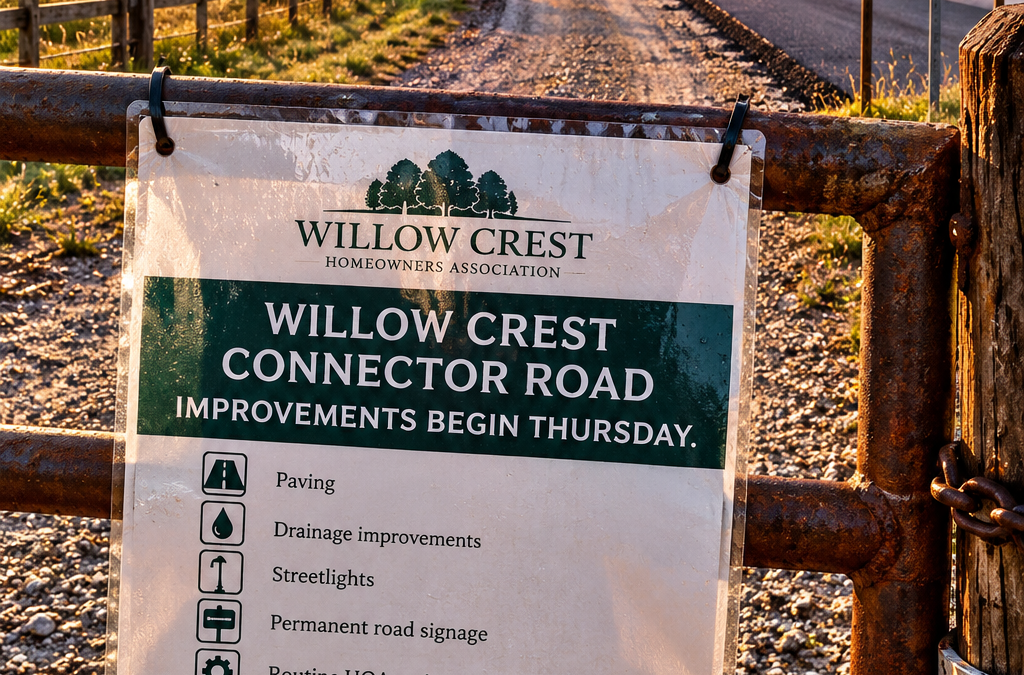
The notice was laminated.
That detail stayed with me.
Someone had taken the time to print it on heavy paper, seal it against the weather, punch holes through the corners, and fasten it to my gate with two black zip ties.
It wasn’t temporary.
It wasn’t a question.
It wasn’t a request.
It was an announcement.
WILLOW CREST CONNECTOR ROAD IMPROVEMENTS BEGIN THURSDAY.
I stood there in my work boots with one hand resting on the gate and read those words twice.
Then a third time.
The sun had barely cleared the tree line behind my eastern hayfield, and the dew was still heavy enough to darken the toes of my boots. Somewhere behind me, one of the cattle bawled impatiently because I was late bringing feed.
Normally that sound would have pulled me away.
That morning, I barely heard it.
My eyes stayed on the notice.
Under the heading was a neat little schedule.
Paving.
Drainage improvements.
Streetlights.
Permanent road signage.
Routine HOA maintenance.
At the bottom, beneath a paragraph thanking residents for their patience during construction, was a signature.
Linda Puit
President, Willow Crest Homeowners Association
For several seconds, I didn’t feel angry.
I felt confused.
Kesler Lane was not part of Willow Crest.
It had never been part of Willow Crest.
It ran from County Road 9 to my farm, a mile and a quarter of gravel laid across land that belonged to my family before Willow Crest was even an idea in some developer’s conference room.
Yet there it was.
Somebody had renamed my road.
Somebody had scheduled construction on it.
Somebody had hired contractors to alter it.
And not one person had asked me a single question.
I reached for the notice.
Then stopped.
My first instinct had been to rip it down.
That would have felt satisfying for maybe ten seconds.
My second instinct was to call an attorney.
My third was to drive straight into Willow Crest, knock on Linda Puit’s door, and ask exactly what gave her the right to schedule asphalt over land she didn’t own.
I did none of those things.
My father used to tell me that anger was expensive because it made you pay before you knew the price.
So I left the notice exactly where it was.
Then I went to feed the cattle.
My name is Ray Kesler.
My family has farmed outside Marlo Creek, Ohio, since 1961.
The farm is 140 acres of hayfield, pasture, low woods, a machine shed, two ponds, and a red barn that leans slightly east because my father refused to admit one wall had shifted until he was too old to fix it.
People who don’t farm sometimes imagine land as something passive.
A possession.
An investment.
A number on a deed.
To me, land is memory with boundaries.
There’s a maple near the north fence where my mother used to hang a tire swing.
There’s a shallow dip in the west field where my father overturned a tractor in 1974 and walked away with nothing worse than three broken ribs and a story he exaggerated for the next thirty years.
There’s a stone beside the barn where our old collie, Jasper, was buried when I was twelve.
And there is Kesler Lane.
My father built it.
Not metaphorically.
Actually built it.
He rented a grader from a man named Frank Willis, hauled crushed limestone in borrowed trucks, and spent most of one August shaping that lane from County Road 9 to the house.
I was a kid then.
I remember riding beside him while he cursed rocks, drainage, mosquitoes, and the grader in equal measure.
The lane had never been fancy.
It didn’t need to be.
For most of my life, it had three regular users.
Me.
The mail carrier.
And whoever was delivering feed.
Occasionally a neighbor came through.
Sometimes a hunter.
Sometimes a veterinarian.
Nobody cared.
Then Willow Crest arrived.
The first survey stakes appeared beyond my southern boundary almost fifteen years ago.
A developer bought several hundred acres of former soybean ground and announced plans for seventy-three homes.
Within two years, fields became streets.
The streets became cul-de-sacs.
Then came the houses.
Stucco.
Stone fronts.
Three-car garages.
Matching mailboxes.
A clubhouse.
A pool.
Decorative entrance pillars.
Willow Crest was the kind of neighborhood where the grass seemed to know there were rules.
I never had anything against the people living there.
Most were decent.
Some waved.
Some bought hay from me for landscaping.
A few brought their children over when calves were born.
One family even invited me to a graduation party.
The problem didn’t begin with the residents.
It began with a favor.
During construction, a foreman named Carl stopped at my barn.
He had dust on his jeans and a hard hat tucked under one arm.
“Mister Kesler?”
“That’s me.”
He pointed toward the lane.
“We’re having trouble getting concrete trucks through the north entrance. County’s doing drainage work out there. Would you mind if we used your road for a few weeks?”
I looked past him at the line of trucks waiting along the shoulder.
“How many?”
“Maybe six or eight a day.”
“For how long?”
“Three weeks. Four at the most.”
I thought about it for perhaps thirty seconds.
“All right.”
His face relaxed.
“Seriously?”
“Stay slow around the cattle.”
“Yes, sir.”
“And if you tear it up, you fix it.”
“Absolutely.”
He held out his hand.
I shook it.
That was the agreement.
No lawyer.
No contract.
No easement.
No payment.
A handshake between two men.
The trucks used the lane for about five weeks.
They left ruts.
Carl sent a grader.
The grader smoothed everything out.
Then construction slowed, the north entrance reopened, and the developer moved on.
I thought the matter was finished.
For a while, it was.
Then one morning, I noticed a sedan coming up Kesler Lane that I didn’t recognize.
The woman driving waved.
I waved back.
Two days later, another car came through.
Then another.
At first, I assumed people were lost.
Then my niece showed me a map application on her phone.
“Uncle Ray, look.”
She entered the clubhouse address.
The navigation route sent her through Kesler Lane.
My private road had become a shortcut.
I remember laughing.
“Computers,” I said.
That was my first mistake.
I treated it like something harmless.
The traffic grew slowly enough that I adjusted without realizing I was adjusting.
Five cars became ten.
Ten became twenty.
Residents learned that using my lane shaved several minutes off the drive to County Road 9.
Delivery drivers found it.
Contractors found it.
Teenagers found it.
Then one morning, a school bus came rumbling past the barn.
I stepped outside as it passed.
The driver, Gloria Martinez, lowered her window.
“Morning, Ray!”
I stared at the bus.
“Morning.”
“You mind us coming through?”
There were children looking out the windows behind her.
I should have said something then.
I should have told her the district needed permission.
Instead, I said, “Just keep it slow.”
She smiled.
“Always do.”
That became the problem.
I kept saying yes without saying the word.
Every time I didn’t object, somebody interpreted silence as permission.
Every time another month passed, permission started looking like ownership.
At some point, people stopped waving.
Not everybody.
But enough.
The lane became part of their routine.
They turned onto it while drinking coffee, arguing through Bluetooth headsets, checking mirrors, scolding children in the back seat.
They drove past my barn as if the barn were scenery beside a public street.
If I was moving cattle across the lane, drivers got impatient.
Once, a man in a silver SUV honked while I was trying to get three heifers through an open gate.
I walked over to his window.
“You in a hurry?”
He rolled it down about three inches.
“I have a meeting.”
“These cattle live here.”
He stared at me.
“I’m just trying to get through.”
“So are they.”
He sighed dramatically.
That should have told me everything.
Still, I didn’t close the road.
Part of it was habit.
Part of it was pride.
My father had never locked that gate.
Neighbors used to help neighbors without contracts.
If somebody needed to cross your land, you let them.
If somebody’s tractor broke, you pulled it.
If snow blocked a driveway, you plowed it.
You didn’t count favors.
You didn’t send invoices.
At least, that was the world I had inherited.
I didn’t realize how much the world around the lane had changed.
That laminated notice made it impossible to ignore.
After feeding the cattle, I showered, changed shirts, and drove into Marlo Creek.
The county recorder’s office occupied the second floor of a brick building beside the courthouse.
I had known Marcy Doyle for years.
She had been deputy recorder when my mother transferred a small parcel to me after my father died.
When I walked in, Marcy looked up from her computer.
“Ray Kesler. Either somebody died or somebody’s arguing about land.”
“Second one.”
She raised an eyebrow.
“That sounds more interesting.”
I slid the HOA notice across her desk.
Marcy read it.
Her expression changed.
“Connector road?”
“That’s what they’re calling it.”
“Kesler Lane?”
“Yes.”
She looked at me.
“You sell them something?”
“No.”
“Grant an easement?”
“No.”
“Sign anything?”
“No.”
She stood.
“Sit down.”
For the next hour, Marcy pulled deeds, plats, subdivision records, development agreements, utility easements, road dedications, and county maps.
We went back decades.
My father’s deed.
My parents’ transfer.
My deed.
The Willow Crest subdivision plat.
The builder’s filings.
Nothing crossed Kesler Lane.
Finally, Marcy put both hands on the folder.
“Ray.”
“Yeah?”
“There is no easement.”
“You’re sure?”
“I’m looking at every recorded document attached to both properties. Nothing gives the developer, the HOA, or the public a right through your land.”
“What about all the years they’ve been using it?”
“That’s a question for a lawyer if they want to argue prescriptive rights. But recorded easement?”
She tapped the folder.
“Nothing.”
I sat back.
Some part of me had expected to discover that I was wrong.
Maybe my father had signed something I didn’t know about.
Maybe the developer filed an agreement years ago.
Maybe I had forgotten a document buried in the paperwork after my mother died.
But there was nothing.
The lane was mine.
Start to finish.
“Can I get copies?”
Marcy smiled without humor.
“I already started printing.”
I carried the folder back to my truck.
I didn’t drive home immediately.
I sat behind the wheel with the engine off.
People crossed the courthouse square carrying coffee.
A sheriff’s cruiser rolled through the intersection.
Somewhere nearby, church bells struck eleven.
I looked at the folder on the passenger seat.
That was when the confusion disappeared.
Not the anger.
The confusion.
There is something almost calming about knowing exactly where the line is.
That evening, I strapped a trail camera to an oak beside the gate.
Not because I planned some elaborate case.
I wanted to know how much traffic we were actually talking about.
The next morning, I pulled the memory card.
I sat at my kitchen table with coffee and started counting.
I stopped once because I thought I had made a mistake.
Then I counted again.
Four hundred twelve vehicles.
In one day.
I stared at the number.
Four hundred twelve.
Some were repeats.
People leaving and returning.
School buses.
Delivery vans.
Landscaping trucks.
Residents.
Contractors.
But every one of them had put weight onto gravel I paid to maintain.
I pulled old receipts from a drawer.
Stone deliveries.
Grading.
Drainage work.
Culvert repairs.
Over roughly three years, I had spent close to six thousand dollars keeping that lane passable.
Six thousand dollars.
Nobody from Willow Crest had ever offered fifty cents.
Then I remembered the delivery van.
Two weeks earlier, I had been moving heifers from the lower pasture.
The lane crests a small hill near the barn.
Visibility isn’t terrible if you’re moving at twenty miles an hour.
At forty, it becomes dangerous.
That van appeared over the rise while three heifers were crossing.
The driver hit the brakes.
Gravel sprayed.
The nearest animal jumped sideways.
The front bumper missed her by perhaps six inches.
The driver leaned on the horn.
I still remembered the sound.
I remembered my hands shaking afterward.
Not with fear.
With the realization that someday somebody was going to get hurt on a road they believed belonged to nobody.
My phone rang Wednesday afternoon.
The screen showed a number I didn’t recognize.
“Ray Kesler.”
“Mister Kesler, this is Linda Puit from Willow Crest.”
Her voice was bright.
Professional.
The kind of voice people use when they believe the difficult part of a conversation has already been decided.
“Hello, Linda.”
“I’m calling about the connector improvements tomorrow. I just wanted to make sure you knew crews will be arriving early.”
“I saw the notice.”
“Wonderful. We’re thrilled to finally make the road safer.”
I looked out my kitchen window toward the lane.
“Whose road?”
There was a pause.
Not long.
Just long enough to tell me she hadn’t expected the question.
“The community connector.”
“That isn’t what I asked.”
Another pause.
“Mister Kesler, I’m not sure I understand.”
“It’s Kesler Lane. It sits on my property.”
Her tone softened in the way people sometimes soften their voices when they think someone else is being unreasonable.
“Well, everyone has used it for years.”
“That’s true.”
“So we’re simply formalizing maintenance.”
“You’re paving my land.”
“It functions as the neighborhood connector.”
“That doesn’t make it yours.”
She gave a little laugh.
I remember that laugh clearly.
It wasn’t cruel.
That almost made it worse.
It was dismissive.
“Well, I mean, at this point it’s basically public.”
Basically public.
I found a pen and wrote those words on the back of the laminated notice.
Basically public.
“Linda, don’t send that crew.”
Her voice changed slightly.
“Mister Kesler—”
“I’m asking you clearly. Do not send contractors onto my property tomorrow.”
“We have already scheduled the work.”
“Then unschedule it.”
“We’ll talk Thursday.”
She hung up.
I sat there with the phone in my hand.
That was the moment anger finally arrived.
Not because she disagreed with me.
Because she had been informed.
Clearly.
Directly.
And her response had been to proceed anyway.
Thursday morning, I was outside by seven.
I had the county records in a waterproof folder.
At 7:10, I heard diesel engines.
A dump truck turned onto the lane.
Behind it came a paving truck, a roller, two pickups, and several workers wearing reflective vests.
I stood in the middle of the road.
The first truck stopped.
A young man climbed from one of the pickups.
He couldn’t have been more than thirty.
“Morning.”
“Morning.”
“You Mister Kesler?”
“Yes.”
“I’m Tyler. Foreman with Brenner Paving.”
He offered his hand.
I shook it.
“You folks planning to work here?”
“Yes, sir. We’re resurfacing the connector.”
“No, you’re not.”
His cheerful expression lasted about another second.
“I’m sorry?”
“This is private property.”
Tyler looked behind him.
Then toward the subdivision.
“They told us it was a dedicated easement.”
“Who told you?”
“Our work order came through Willow Crest.”
“Did they give you the easement?”
He hesitated.
“I’d have to check.”
“I already checked.”
I handed him the folder.
He didn’t want to take it at first.
Then he did.
He flipped through the documents.
His face changed.
He read several pages twice.
Then he rubbed the back of his neck.
“Mister Kesler, I’m going to call my office.”
“Please do.”
I waited.
The crew waited.
One of the drivers climbed out and smoked beside his truck.
Tyler spoke quietly into his phone for several minutes.
When he came back, he handed me the folder.
“We’re pulling out.”
“I appreciate that.”
“I’m sorry.”
“You didn’t know.”
He nodded toward the HOA notice.
“They specifically told us access was established.”
“It isn’t.”
He looked embarrassed.
“We should have verified.”
“Probably.”
Within twenty minutes, the crew was gone.
As the last truck backed toward County Road 9, I saw something green sticking out of the dirt beside my gate.
A new metal road sign.
Someone had already planted it.
WILLOW CREST CONNECTOR
I stared at it.
Then I grabbed the post with both hands and pulled.
The soil was loose.
It came free.
I threw it into the bed of my pickup.
That night, I sat alone on the porch.
The sun went down behind the barn.
Crickets started in the grass.
For the first time since Monday, everything was quiet enough for me to think.
I didn’t want revenge.
That part mattered to me.
I didn’t want seventy-three families trapped in some feud they didn’t understand.
Most of them had probably never seen a deed.
They had bought houses.
Somebody showed them a convenient route.
They used it.
Year after year.
Eventually convenience became expectation.
Expectation became entitlement.
I understood how it happened.
But understanding something does not make it acceptable.
The HOA had crossed a line the moment it tried to permanently alter my property without permission.
And if I allowed it, the next argument would be even harder.
They would say I had consented to pavement.
Then lights.
Then maintenance.
Then public access.
Eventually, Kesler Lane would belong to me on paper and to everyone else in practice.
I thought about my father.
He would have hated the whole situation.
He believed a man’s word ought to be enough.
But he also believed a fence meant something.
So did a gate.
So did a deed.
Around midnight, I made my decision.
Friday morning, I woke at four-thirty.
Before sunrise, I backed the tractor to the gate.
I had bought a steel farm gate years earlier and never installed it.
By five, it was hanging.
I wrapped a chain around the post.
Then I snapped a heavy padlock shut.
The sound was louder than I expected.
Metal against metal.
Final.
I hung a white sign at eye level.
PRIVATE ROAD
ACCESS BY WRITTEN AGREEMENT ONLY
My phone number was underneath.
Then I went to feed the cattle.
At 6:40, the first car arrived.
The driver stopped.
Waited.
Backed up.
Then another came.
Then three more.
By seven, there were headlights stretching toward Willow Crest.
By 7:30, people were getting out of their cars.
Some stared at the sign.
Some took pictures.
One man called the number printed underneath while standing fifteen feet from me.
My phone rang in my pocket.
I answered.
“Yes?”
“Are you Ray?”
I looked at him.
“Yes.”
He looked toward the barn.
“Is that you standing there?”
“Yes.”
“Can you open this?”
“No.”
“Why?”
“Because it’s private property.”
“We use this road every day.”
“I know.”
“I’m going to be late.”
“There’s another entrance.”
“That adds fifteen minutes.”
“Fourteen, depending on the light.”
He stared at me.
“You can’t just close a road.”
“I can close mine.”
The school bus arrived at 7:42.
Gloria was driving.
She saw the line.
She saw me.
Then she climbed down from the bus.
“Ray.”
“Morning.”
She looked at the gate.
“So this is happening.”
“For now.”
Several children were watching through the windows.
I lowered my voice.
“This isn’t about you.”
Gloria sighed.
“I know.”
“I’m sorry the kids are caught in it.”
She shook her head.
“I’m not mad at you.”
“You’re not?”
“No.”
She looked toward Willow Crest.
“I’m mad at whoever let it get this far.”
That meant more to me than she probably knew.
She climbed back into the bus and somehow turned that enormous thing around without touching either ditch.
The detour added fourteen minutes to the route.
By eight-thirty, traffic was stacking up at the light on Hollis Pike.
By nine, my phone had thirty-two missed calls.
At ten, somebody left a voicemail calling me a miserable old farmer.
I was fifty-eight.
I didn’t think that qualified as old, but I let that part go.
Around noon, Marcy texted me a screenshot from the Willow Crest Facebook group.
The first post read:
Does anyone know the crazy farmer who closed our road?
Forty-one replies.
I read every one.
People complained about school.
Work.
Commutes.
Property values.
Emergency access.
One woman claimed I had illegally barricaded a public street.
Another suggested calling the sheriff.
A man wrote that people had “used that connector forever.”
Not one person asked the question I had asked Linda.
Whose road?
That bothered me more than the insults.
Saturday morning, a black sedan rolled up and stopped outside the gate.
A man in a navy suit stepped out carrying a leather briefcase.
He looked uncomfortable on gravel.
“Mister Kesler?”
“Yes.”
“Mark Stole. I represent the Willow Crest Homeowners Association.”
“I figured.”
He glanced at the gate.
“May we talk?”
“You’re already here.”
His mouth tightened.
“We believe the association may have acquired access rights through longstanding continuous use.”
“Prescriptive use.”
His eyebrows lifted.
“You’ve spoken with counsel?”
“No.”
“Then you’ve done some reading.”
“A little.”
He shifted his briefcase.
“I’ll be candid. Litigation over prescriptive easement rights can become expensive.”
“I imagine.”
“For everyone.”
“I imagine that too.”
“It might be better to resolve this before positions harden.”
I studied him.
He expected resistance.
Maybe anger.
Instead, I walked to my truck and pulled out an envelope.
“I agree.”
I handed it to him.
“What’s this?”
“A solution.”
He opened it.
Inside was an easement proposal I had spent most of Friday evening drafting after talking with an insurance agent, a road contractor, and a retired surveyor I knew from church.
The agreement offered Willow Crest guaranteed access for twenty years.
The terms were straightforward.
Twenty-five dollars per home each month for use and maintenance.
With seventy-three homes, that came to $1,825 per month.
The HOA would pay for professional paving and drainage work according to specifications I approved.
They would maintain a two-million-dollar liability policy covering the road and naming me as an additional insured.
Speed would be limited to fifteen miles per hour.
Appropriate cattle-crossing signs would be installed.
No widening, lighting, excavation, utilities, or structural modifications without my written approval.
The HOA would also pay a one-time sixty-thousand-dollar sum covering prior uncompensated wear, repairs, administration, and formalization of access.
And every sign calling it the Willow Crest Connector would be removed.
Mark read slowly.
When he reached the payment terms, he looked up.
“Sixty thousand dollars?”
“Yes.”
“Plus monthly access?”
“Yes.”
“That’s steep.”
“It’s an invoice.”
“For what?”
“A service your clients have been taking for free.”
He closed the packet.
“You realize a court could find they already have a right.”
“A court could find a lot of things.”
“And if we seek an injunction, that gate may come down while the case is pending.”
“Then you should file.”
His expression changed.
Not much.
Just enough.
I think he had expected me to negotiate against myself.
Instead, I opened the gate long enough for him to turn his sedan around.
Before he left, he lowered the window.
“This could become unpleasant.”
“It already did.”
The sedan disappeared toward County Road 9.
Then the farm went quiet again.
That quiet was harder than the arguments.
People like to imagine confidence as something solid.
You make a decision.
You stand by it.
You never doubt yourself.
That wasn’t how it felt.
I barely slept for the next week.
Every time headlights slowed near the gate, I wondered if someone was serving papers.
Every time my phone rang, I expected an attorney.
I thought about what a lawsuit could cost.
I thought about retirement savings.
Attorney fees.
Court hearings.
Expert witnesses.
Surveyors.
Months of stress.
Maybe years.
I imagined a judge deciding that all those years of unchallenged use had created rights I never intended to give.
I imagined losing control of the road anyway after spending tens of thousands of dollars defending it.
I thought about Gloria and the schoolchildren.
I thought about the families who had nothing to do with Linda’s decision.
Some mornings, guilt sat heavier than anger.
I would drive past the locked gate and see cars taking the long route.
A few drivers glared at me.
Others waved.
One elderly resident stopped near the gate while I was repairing fence.
She didn’t yell.
She just said, “I wish somebody had explained all this before it happened.”
“So do I.”
“My husband thought this was always a county road.”
“It never was.”
She nodded slowly.
“That changes things.”
“Yes, ma’am.”
She drove away.
That conversation stayed with me.
Most entitlement isn’t born from cruelty.
It grows out of assumptions nobody challenges.
Still, assumptions become dangerous when people with authority start writing contracts, hiring crews, and making permanent decisions based on them.
On the seventh day, I drove past Willow Crest.
There were cars lined up at the main entrance during evening traffic.
The light at Hollis Pike backed up almost half a mile.
I felt a sharp twist in my stomach.
I had caused that.
Not alone.
But I had caused it.
I could have opened the gate.
I could have accepted an apology.
I could have told myself the lesson had been learned.
Then I pictured the laminated notice.
Improvements begin Thursday.
No request.
No call beforehand.
No acknowledgment that the road belonged to another person.
I kept driving.
On the ninth day, Mark Stole called.
“Ray.”
“Mark.”
“The board is reviewing your proposal.”
“Good.”
“They have concerns about the payment.”
“I expected that.”
“They may counter.”
“They’re welcome to.”
“What if they ask you to reopen the road while negotiations continue?”
“No.”
He exhaled.
“You’re making this harder.”
“No. I’m making it written.”
Silence.
Then he said, “I’ll be in touch.”
He never called again.
The eleventh morning was cold for early fall.
I was in the machine shed replacing a worn belt on the hay elevator when I heard tires on gravel.
I wiped my hands and stepped outside.
A car had stopped near the house.
Not the black sedan.
Linda Puit’s SUV.
She got out alone.
No lawyer.
No board members.
No folder full of threats.
Just Linda.
She carried my easement proposal in one hand.
For a moment, neither of us spoke.
Then she said, “Could we talk?”
I almost said we already had.
Instead, I nodded toward the house.
“Coffee?”
Her expression softened with surprise.
“Yes.”
My mother had believed coffee was required whenever somebody entered your kitchen, even if they had arrived to repossess the furniture.
I had inherited the habit.
I poured two cups.
Linda sat at the same table where I had counted four hundred twelve vehicles less than two weeks earlier.
She looked tired.
Not defeated.
Just tired.
I sat across from her.
She placed the proposal between us.
“I read your deed.”
“All of it?”
“All of it.”
“And?”
“The road belongs to you.”
I said nothing.
She wrapped both hands around the mug.
“I also read the subdivision records.”
I waited.
“There’s no dedicated connector.”
“No.”
“No written easement.”
“No.”
“No road transfer.”
“No.”
She looked down at the coffee.
“I should have checked.”
“Yes.”
Her eyes lifted.
“I should have asked you before we scheduled anything.”
“Yes.”
The second answer came out quieter.
Linda leaned back.
For the first time since this began, she didn’t sound like a board president.
She sounded like a person who had made a mistake and knew the mistake had become larger because she refused to admit it early.
“I honestly believed we had access rights.”
“I know.”
“You do?”
“I don’t think you woke up wanting to steal my road.”
Her mouth tightened.
“That’s not how the neighborhood is describing you.”
“I’ve seen some of it.”
“People are angry.”
“So am I.”
She nodded.
Then she said something I didn’t expect.
“I’m embarrassed.”
I looked at her.
“The paving company called me after they left. Their office asked us for the recorded easement. We didn’t have one.”
She gave a short, humorless laugh.
“I spent two days telling everybody there had to be one somewhere.”
“There wasn’t.”
“No.”
Silence settled between us.
Finally, Linda said, “I should have asked the first time.”
I didn’t answer immediately.
Then I said, “That’s all it would have taken.”
She almost smiled.
“You could have just told us.”
I looked at her.
“I did.”
Her smile disappeared.
“Wednesday on the phone.”
She lowered her eyes.
“Thursday with your paving crew.”
I tapped the proposal.
“You answered with asphalt.”
She didn’t argue.
That mattered.
A person can apologize all day and still refuse responsibility.
Linda didn’t.
After a while, she opened the agreement.
“The board voted last night.”
I felt my shoulders tighten.
“And?”
“We’ll accept the access agreement with two changes.”
“What changes?”
“The insurance company wants slightly different indemnity language, and our contractor needs flexibility on drainage specifications because of county runoff requirements.”
“Those sound reasonable.”
“The money stays.”
I stared at her.
“All of it?”
“Sixty thousand.”
“And monthly?”
“Yes.”
I hadn’t expected that.
Linda watched my face.
“You look disappointed.”
“I’m suspicious.”
That actually made her laugh.
A real laugh this time.
“I don’t blame you.”
She pulled a pen from her purse.
“Our attorney already marked the insurance language. If you approve it, I have authority to sign.”
I reviewed the changes.
They were minor.
Nothing changed ownership.
Nothing expanded access beyond what I had offered.
Nothing gave the HOA control over the property.
I picked up my reading glasses and went through every line twice.
Linda waited.
Finally, I pushed the agreement back.
“That works.”
She signed.
Then she handed me the pen.
I signed too.
For several seconds, neither of us moved.
Eleven days of anger, traffic, accusations, threats, and sleepless nights had ended with two signatures at my kitchen table.
I wish I could say I felt victorious.
I didn’t.
Mostly, I felt tired.
And relieved.
There was no pleasure in knowing I had enough leverage to disrupt seventy-three households.
I had never wanted power over them.
I wanted authority over my own land.
Those are not the same thing.
That afternoon, Linda returned with two board members and Mark Stole.
We met at the gate.
Mark gave me a signed insurance certificate.
One of the board members handed me confirmation of the first payment.
Everything was in order.
I unlocked the padlock.
The chain fell loose.
Then I swung the steel gate open.
A woman waiting in the first car looked uncertain.
I stepped aside.
She drove through slowly.
Then another.
Then another.
Within minutes, Kesler Lane sounded exactly as it had before.
Tires on gravel.
Engines.
The school bus.
Delivery trucks.
Ordinary life.
But nothing about it felt the same.
Because now every tire crossing that road did so under an agreement.
Not an assumption.
Not a favor somebody had forgotten.
Not a memory nobody could prove.
Paper.
Within a month, Willow Crest hired a road contractor.
This time, nobody arrived without calling.
The contractor met me at the barn.
We walked the lane together.
We discussed drainage.
Cattle access.
Shoulders.
Speed.
Where paving should stop near the equipment yard.
They resurfaced the road properly.
Not cheaply.
Proper base preparation.
Drainage improvements.
A durable surface wide enough for safe two-way traffic without swallowing unnecessary pieces of my pasture.
No streetlights.
I had refused those.
I didn’t want suburban lighting spilling across cattle fields at night.
The HOA accepted that.
They installed two fifteen-mile-per-hour signs.
They added a cattle-crossing sign near the pasture gate.
And at the entrance, they installed a new marker.
I was there when it went up.
It read:
KESLER LANE
PRIVATE ROAD
SHARED BY AGREEMENT
I stood looking at it longer than I expected.
One of the workers asked, “Good?”
I nodded.
“Good.”
The green WILLOW CREST CONNECTOR sign still sits in my barn.
I hung it on the wall beside my father’s old grader blade.
Not as a trophy.
More like a reminder.
Traffic on the lane today is almost exactly what it was before I closed the gate.
The school bus comes through every weekday.
Gloria still waves.
Delivery vans use it.
Residents use it.
The same elderly woman who once stopped to ask what happened occasionally brings me peach preserves.
Some drivers still go too fast.
I call the HOA.
Now they respond.
Once a teenager tore through at nearly fifty miles per hour.
I gave Linda the camera footage.
His parents had him at my door the following afternoon.
He apologized.
I told him I didn’t care about apologies nearly as much as I cared about not scraping him or one of my cows off the road someday.
He never did it again.
The monthly payment arrives on schedule.
Most of it goes into an account for road maintenance.
The sixty thousand covered years of wear, legal review, improvements around the gate, and some repairs I had put off longer than I should have.
But the money was never the part I thought about afterward.
What stayed with me was how easily a favor had transformed into a perceived right.
Nobody held a meeting ten years earlier and said, “We should take Ray Kesler’s road.”
That wasn’t what happened.
It happened one ordinary day at a time.
A construction foreman asked for temporary access.
I said yes.
A resident discovered the shortcut.
I didn’t object.
Another followed.
Then another.
The school bus came through.
I let it.
The map software began routing people there.
Nobody questioned it.
Years passed.
Children grew up believing Kesler Lane had always connected their neighborhood to County Road 9.
New homeowners were told about the shortcut by old homeowners.
Real estate agents mentioned it.
Delivery drivers mapped it.
The road became normal.
And once something becomes normal, people stop wondering who paid for it.
Who maintains it.
Who assumes the liability.
Who owns the ground underneath it.
Then one Monday morning, somebody zip-tied a notice to my gate.
That notice was the final step in a process nobody had consciously started.
The favor had disappeared.
Only the expectation remained.
I thought about my father often during those eleven days.
For years, I had wondered what he would have done.
Part of me believed he would have hated the gate.
Maybe he would have walked into Willow Crest and settled the whole thing over coffee.
Maybe people listened differently back then.
Or maybe I had turned him into something simpler in my memory.
My father was generous.
But he was not weak.
He helped neighbors because they asked.
That distinction mattered.
A request acknowledges that the other person has a choice.
Entitlement removes the choice and then acts offended when you reclaim it.
The gate taught me that.
So did Linda.
We never became friends exactly.
But after the agreement, we developed something better than the relationship we had before.
We became direct.
If the HOA wanted to do maintenance, Linda called.
If I needed the road clear to move equipment, I called her.
Once every few years, we reviewed the insurance.
When the association changed management companies, Linda personally made sure the easement went into the transition file.
No assumptions.
No vague promises.
No “everyone knows.”
Everything stayed on paper.
About a year after the dispute, I saw Linda at the county fair.
She was standing beside a food trailer holding two lemonades.
Her husband had wandered off somewhere.
She noticed me.
“Ray.”
“Linda.”
She looked toward the grandstand.
“You know, every time I drive your road now, I see that private-road sign.”
“That was the idea.”
She smiled.
“I deserve that.”
“Probably.”
She handed me one of the lemonades.
“I bought two by mistake.”
“You expecting me to believe that?”
“No.”
I took it anyway.
We stood there for a while watching families move past.
Eventually she said, “Do you know what bothered me most?”
“What?”
“You were right about something.”
“That sounds painful.”
“It is.”
I smiled.
She continued.
“I kept thinking you had suddenly taken something away from us. That’s how it felt.”
“I know.”
“But we never actually had it.”
I looked at her.
“You had access.”
“Because you allowed it.”
“Yes.”
She nodded.
“And we stopped seeing the difference.”
That was the entire dispute in one sentence.
I could have spent thousands of dollars on lawyers explaining it.
Linda did it for free.
You had access.
You didn’t have ownership.
There is a difference.
Years have passed now.
The red barn still leans east.
The cattle still manage to stand in whichever place is least convenient.
My knees complain more every winter.
The maple near the north fence lost a large limb in a storm.
And Kesler Lane is smoother than it has ever been.
Sometimes I stand at the gate early in the morning and watch cars leave Willow Crest.
People head to work.
Children head to school.
A landscaping crew rattles through pulling a trailer.
Someone waves.
Someone doesn’t.
Life continues.
The road never moved.
Not one inch.
That is what still amazes me.
The boundaries were exactly where they had always been.
The deed never changed.
Ownership never changed.
The physical facts never changed.
Only people’s understanding of them changed.
Before the gate, the road operated on memory.
After the gate, it operated on agreement.
Before the gate, I paid for everybody’s convenience.
After the gate, the people benefiting from it shared the responsibility.
Before the gate, somebody could look at decades of kindness and mistake it for surrender.
Afterward, nobody could.
I sometimes wonder whether sixty thousand dollars was too much.
I wonder whether the padlock was too dramatic.
There were certainly kinder ways I could have handled certain moments.
Maybe I could have called a neighborhood meeting before shutting the road.
Maybe I could have given the residents several days’ warning.
Maybe fewer families would have felt blindsided.
Those questions are fair.
I don’t pretend every decision I made was perfect.
What I know is that I had already tried the simplest approach.
I told Linda the road was mine.
She laughed.
I asked her not to send a crew.
She sent one anyway.
By Thursday morning, the argument was no longer about misunderstanding.
It was about whether my permission mattered.
And once it became that question, I knew I could not answer halfway.
Either I controlled access to my land or I didn’t.
Either my consent was required or it wasn’t.
Either the deed meant something or it was just paper in a courthouse folder while everyone else made decisions around it.
So I closed the gate.
Not because I hated my neighbors.
Not because I wanted money.
Not because I enjoyed watching people take the long way to work.
I closed it because sometimes the only way to remind people that a privilege exists is to remove it long enough for them to notice.
The lesson cost all of us something.
Willow Crest paid money.
I lost sleep.
Residents lost time.
Linda lost some pride.
But what we gained was clarity.
That clarity has outlasted the anger.
Nobody calls Kesler Lane public anymore.
Nobody plants signs without asking me.
Nobody schedules construction on my land.
And nobody in Willow Crest has lost access.
That may be the part outsiders misunderstand.
I did not close the road permanently.
I did not punish seventy-three families forever.
I simply changed the basis on which the road was being used.
From assumption to agreement.
From entitlement to responsibility.
From a handshake nobody remembered to a contract nobody could misunderstand.
Every once in a while, I walk into the barn and see that old green sign hanging beside the grader blade.
WILLOW CREST CONNECTOR.
I still remember the morning I pulled it from the ground.
I remember the anger in my chest.
The paving trucks.
The black sedan.
The line of headlights behind the locked gate.
I remember sitting awake at two in the morning wondering whether I had made the biggest financial mistake of my life.
And I remember Linda sitting at my kitchen table with both hands around a coffee mug, admitting that she should have asked.
That was all I had wanted from the beginning.
Not submission.
Not victory.
Permission to matter on my own property.
My father built that road with rented machinery, borrowed trucks, and stubbornness.
For decades, I maintained it because it was ours.
Then I shared it because sharing seemed like the decent thing to do.
I still believe sharing is decent.
I still believe neighbors should help each other.
But I learned something I wish I had understood years earlier.
Generosity works only when both people remember it is voluntary.
The moment somebody starts demanding what you once gave freely, the relationship has already changed.
That Monday morning, the HOA thought Kesler Lane was theirs because everybody had been driving on it for years.
Eleven days later, they understood something much simpler.
The road had always belonged to me.
They were welcome to use it.
But this time, they were going to ask.



