𝗙𝗨𝗟𝗟 𝗦𝗧𝗢𝗥𝗬 The HOA Had Been Selling Access to My Family’s Private Lake for Six Years, and One Question About the Money Made the Entire Board Go Silent
𝗙𝗨𝗟𝗟 𝗦𝗧𝗢𝗥𝗬
I read the deed descriptions until my eyes hurt.
I studied plat maps.
I searched satellite images.
I still didn’t believe it emotionally.
So the first weekend after the estate transfer was completed, I drove there.
The last forty minutes were on gravel.
The road narrowed until pine trees crowded both sides, tall enough that their branches partially blocked the afternoon sky.
My cell signal disappeared.
Then the road curved around a granite ridge and everything opened.
The first glimpse of the lake stopped me.
I pulled the truck over without even realizing I was doing it.
The water stretched through the trees like dark glass.
Granite outcroppings broke through the shoreline.
Pines covered the ridges beyond it.
An old wooden dock extended into the water from a clearing below the road, leaning slightly to one side but still standing.
Nothing moved except the tops of the trees.
I understood, for the first time, why Walt might have stayed there.
There was something about the place that made silence feel intentional.
Not empty.
Protected.
I stood beside the truck for several minutes just listening.
Then I noticed the tire tracks.
At first, they didn’t seem important.
The land had been unmanaged during probate.
Hunters trespassed.
Fishermen trespassed.
People drove onto rural property all the time when they assumed nobody was watching.
But these tracks were fresh.
And there were a lot of them.
Not one truck.
Not two.
Multiple vehicles had recently used the access road.
The tracks overlapped in the dirt around a clearing close to the shoreline.
I crouched beside one of them.
Deep tread.
Probably a pickup.
Another was narrower.
SUV, maybe.
Then I noticed a cigarette butt near the edge of the clearing.
A crushed aluminum can.
A piece of fishing line caught around a shrub.
I stood slowly.
Someone had been coming here regularly.
That irritated me, but it didn’t frighten me.
Not yet.
I spent the next hour walking the shoreline around the old dock.
The property was too large to inspect properly in one weekend, so I concentrated on the roads around the lake.
That was when I found the gate.
It stood about a quarter mile away, partly hidden behind a dense stand of pines where a secondary access road cut toward the water.
At first I assumed it was something Walt had installed.
Then I got closer.
The posts were newer.
The chain-link fencing was clean compared with everything else on the property.
A heavy combination lock secured the gate.
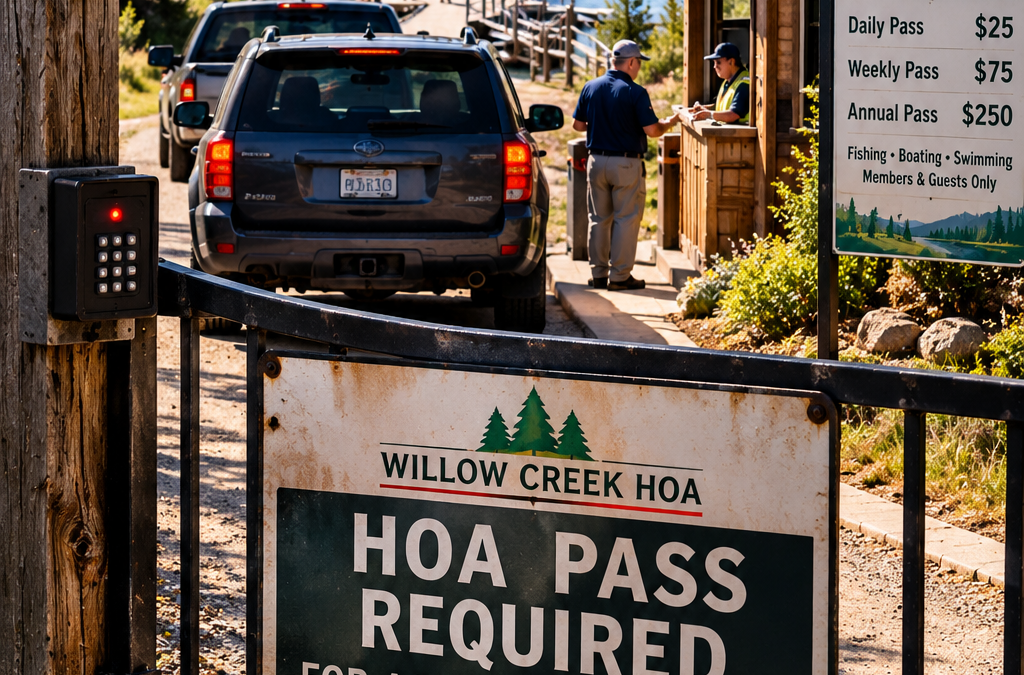
And zip-tied to the metal was a laminated sign.
I read it once.
Then again.
Then a third time.
LAKESIDE FISHING ACCESS
MEMBERS AND DAY-PASS HOLDERS ONLY
PASS REQUIRED
CONTACT RIDGELINE HOLLOW HOA
I just stood there.
The wind moved through the pine branches overhead.
Somewhere behind me, water tapped quietly against the shoreline.
I read the words again because my brain kept trying to turn them into something reasonable.
It couldn’t.
Ridgeline Hollow.
I knew the name only because Daniel Mercer had mentioned it during probate.
It was a residential subdivision roughly two miles from one of the property boundaries.
I wasn’t a member.
Walt hadn’t been a member.
None of the estate documents connected the subdivision to the land.
Yet there I was, standing on property I now legally owned, looking at a locked gate telling me I needed permission from an HOA to use it.
I checked my GPS coordinates.
Then I checked the plat map I had downloaded onto my phone.
No mistake.
The gate stood well inside my property.
Not close to the line.
Not in some disputed strip.
Inside.
I walked along the fence.
It ran just far enough to prevent vehicles from bypassing the gate without going through trees.
Someone had spent real money installing this.
Then I studied the sign more closely.
The corners were faded from years of sun.
The plastic covering was scratched.
This was not new.
Whatever I was looking at had been operating for a long time.
There was a phone number printed at the bottom.
I called it.
A woman answered after two rings.
“Ridgeline Hollow Homeowners Association. This is Carol. Are you calling about a day pass?”
Her tone was cheerful, practiced.
That question told me more than she realized.
“A day pass for what?”
“For lake access.”
“What lake?”
There was a slight hesitation.
“Lake Mercer.”
I looked through the gate toward the road leading to my shoreline.
“How much?”
“Thirty-five dollars for a daily guest pass. Residents can also purchase the seasonal program.”
I almost admired how casually she said it.
“How much is that?”
“The founders access package is four hundred fifty dollars annually.”
I let several seconds pass.
Then I said, “Carol, what exactly does Ridgeline Hollow HOA have to do with Lake Mercer?”
Silence.
“Excuse me?”
“I’m asking what legal interest your HOA has in that lake.”
Her voice changed immediately.
The friendly administrative tone disappeared.
“May I ask who’s calling?”
I gave her my name.
Nothing.
Then I added, “I’m the new owner of the Bennett property.”
Another silence.
Longer this time.
“The eighty-four-hundred-acre Bennett property,” I continued. “Including Lake Mercer.”
I could hear paper moving on her end.
“Oh.”
That one word was the first honest response I received from the HOA.
I looked at the gate.
“I’m standing on my property right now, Carol. Your association has installed a locked gate on it.”
“I’m not familiar with the property details.”
“You answered the phone by asking if I wanted to buy a fishing pass.”
“That’s handled through the access program.”
“An access program to property you don’t own?”
“I think someone from the board should speak with you.”
“Good. Put them on.”
“They’re not available.”
“Then have someone call me.”
“I can do that.”
“When?”
“I’ll pass along your information.”
“That wasn’t my question.”
She said nothing.
I repeated my number anyway.
Before hanging up, I asked one more thing.
“How long has your association been selling these passes?”
Another pause.
“I don’t have that information in front of me.”
The line went dead shortly afterward.
No one called me back.
Not that afternoon.
Not that evening.
Not the next morning.
By then, my irritation had hardened into suspicion.
I drove home Sunday night and started searching.
Ridgeline Hollow had a website.
It looked exactly like thousands of HOA websites across America.
Board announcements.
Trash pickup schedules.
Landscaping notices.
A clubhouse calendar.
Minutes from previous meetings.
Community newsletters archived as PDFs.
I searched the word “lake.”
Dozens of results appeared.
The oldest reference I found was six years earlier.
LAKESIDE FOUNDERS ACCESS RENEWAL NOW OPEN.
The next year:
Annual Lake Mercer passes remain $450 per household.
Then:
Guest day passes available for $35 through the HOA office.
There were reminders about fishing limits.
Boat launch schedules.
Access weekends.
A volunteer shoreline cleanup.
One newsletter thanked residents for helping make the “private lake program one of Ridgeline Hollow’s most valued amenities.”
I leaned closer to the screen.
Private lake program.
Their amenity.
My family’s lake.
Then I found the photographs.
Families standing beside boats.
Children holding bass.
Couples sitting on the dock.
One photograph showed a little boy holding his first fish while his father crouched beside him.
Another showed six HOA residents beside the boat ramp.
Behind them I recognized the granite shoreline I had walked two days earlier.
There was no ambiguity anymore.
This wasn’t occasional trespassing.
The HOA had created an organized business.
For six years, they had sold access to land they did not own.
I opened a spreadsheet.
Founders passes were $450 annually.
How many households purchased them?
I didn’t know.
Day passes were $35.
How many had they sold?
I didn’t know that either.
But even conservative assumptions became uncomfortable quickly.
Twenty annual passes?
That was $9,000 a year.
Thirty?
$13,500.
Forty?
$18,000.
Then add guest fees.
Boat access.
Special events.
Maybe maintenance charges.
Multiply everything by six years.
The money could easily reach six figures.
I sat in the glow of my computer screen long after midnight.
It wasn’t the amount that bothered me most.
It was the confidence.
This wasn’t one dishonest person sneaking through a fence.
People had printed forms.
Accepted payments.
Scheduled access.
Maintained records.
Issued rules.
Installed infrastructure.
Somewhere along the way, an entire organization had convinced itself that my great-uncle’s property belonged to them whenever they wanted to profit from it.
The following morning, I called Daniel.
“You ever hear anything about Walt allowing Ridgeline Hollow to use the lake?”
“No.”
“Any lease?”
“No.”
“Easement?”
“Not that I encountered.”
“License agreement?”
“Again, not that I saw.”
“What about anything informal?”
“That’s harder to answer.”
I explained everything.
The gate.
The sign.
The phone call.
The newsletters.
There was silence on his end.
Finally he said, “You need the county records.”
That was exactly what I was thinking.
I drove to the county recorder’s office the next morning.
I stayed most of the day.
I pulled subdivision plats.
Property records.
Recorded easements.
HOA formation documents.
Historical parcel maps.
Road dedications.
Access agreements.
Anything containing the names Bennett, Mercer, Ridgeline Hollow, or the developer who had originally created the subdivision.
Nothing gave the HOA a recorded right to the lake.
There was no lake easement.
No recreational easement.
No lease.
No shoreline conveyance.
No deed restriction granting Ridgeline Hollow access.
Then a clerk helped me locate a collection of older HOA planning documents submitted during the subdivision’s development.
Buried inside a meeting summary was the closest thing I found to justification.
One paragraph.
That was it.
According to the summary, the original developer had stated that Walter Bennett had “verbally expressed his willingness” to allow limited recreational use of the lake by future Ridgeline Hollow residents in exchange for “general upkeep and stewardship of access areas.”
No date.
No terms.
No signature.
No duration.
No legal description.
No statement from Walt.
No witness.
Nothing showing what “limited recreational use” even meant.
There was certainly nothing authorizing the HOA to collect hundreds of dollars from residents.
Yet somehow that paragraph had become the foundation of everything.
I kept digging.
Later meeting minutes referred to “traditional lake rights.”
Then “community lake privileges.”
Then “established lake access.”
Each phrase sounded more official than the one before it.
It was like watching fiction become history one meeting at a time.
Someone had said Walt once verbally agreed to something.
A few years later, the board referred to it as an established arrangement.
Then another board inherited the language and treated it like permanent property rights.
Eventually they built a payment system around it.
The transformation would have been almost fascinating if the land hadn’t been mine.
Then I found records of the boat ramp.
The HOA had approved funds for “Lake Mercer ramp improvements.”
Improvements.
That word suggested something existing.
But older aerial imagery showed no formal ramp in that location.
They had built it.
On Walt’s shoreline.
I searched county permit records.
Nothing under Walt’s name.
Nothing indicating owner approval.
I felt my stomach tighten.
They hadn’t simply profited from access.
They had physically altered the property.
I returned to the lake the next day and found the ramp.
Once I knew where to look, it was obvious.
Gravel had been graded down toward the shoreline.
Timbers reinforced the edges.
A narrow launch area descended into the water.
There was even a metal post nearby where somebody had once mounted rules.
I stood there imagining Walt living farther back on the property while strangers launched boats into his lake.
Had he known?
Maybe.
Had he objected?
I had no idea.
His declining health appeared repeatedly in the final years of his records.
Perhaps he stopped visiting that part of the property.
Perhaps he saw the occasional fisherman and decided it wasn’t worth fighting over.
Perhaps he truly had once told someone they could fish.
But permission to let a neighbor cast a line was not permission to create a commercial access operation.
That distinction mattered.
The following week, I emailed the HOA formally.
I requested copies of every document they relied upon to claim access rights.
I asked for six years of revenue records related to Lake Mercer.
I asked who authorized construction of the ramp.
I requested the name of the HOA’s attorney.
Carol replied two days later.
Her email was short.
The board believes the lake arrangement predates current leadership and has historically operated with the consent of the Bennett estate.
The Bennett estate.
Not Walt.
Not me.
The estate.
As if a dead man’s property automatically consented to whatever they had been doing.
I replied with one question.
Please provide the recorded instrument granting Ridgeline Hollow HOA lake access.
No answer.
Three days later, I requested a place on the agenda for the next board meeting.
Carol called me.
“I’m not sure a board meeting is the best forum for this.”
“Why?”
“This appears to be a legal matter.”
“Then your board should probably know about it.”
“They’re aware.”
“Good. Put me on the agenda.”
“There may be privacy concerns.”
“For whom?”
She sighed.
“I’m trying to prevent this from becoming unnecessarily confrontational.”
I almost laughed.
“You’ve been charging people to enter my property for six years, Carol. I think we’re already past the stage where avoiding an uncomfortable conversation is the priority.”
She became quiet.
Finally she said, “I’ll speak to Gary.”
“Who’s Gary?”
“Our board president.”
“Excellent. Tell Gary I’ll be there.”
Two days later, she called again.
Gary preferred to meet privately.
I declined.
“If the HOA collected money publicly,” I told her, “the explanation can happen publicly.”
So I showed up.
Ridgeline Hollow’s clubhouse looked exactly like the kind of place where nothing serious should ever happen.
Beige walls.
Stackable chairs.
A coffee station in the back.
Framed photographs of neighborhood picnics.
Maybe thirty people attended.
The moment I walked through the door, conversations began fading.
I recognized several faces.
Newsletter photographs.
Fishing weekends.
Boat ramp cleanups.
People who had unknowingly—or perhaps knowingly—used my land.
Some looked curious.
Some defensive.
A few wouldn’t meet my eyes.
Carol sat at a folding table near the front.
She recognized me immediately even though we had never met.
Gary sat in the center.
Late fifties, silver hair, expensive quarter-zip sweater, the relaxed posture of someone accustomed to controlling a room where everybody already knew his name.
When the meeting began, they went through normal business first.
Landscaping contract.
Pool closure dates.
A complaint about street parking.
I sat through all of it.
Eventually Gary cleared his throat.
“We also have a property access matter regarding Lake Mercer.”
Property access matter.
That was how he described six years of selling my property.
He gestured toward me.
“I understand the Bennett estate’s new owner is present.”
I stood.
“My name is Ethan Bennett.”
Gary smiled thinly.
“Thank you for joining us.”
I carried a folder to the front table.
“I brought copies.”
“Copies of what?”
“The deed. County plat. Easement index. Your lake program newsletters. And the meeting summary your HOA appears to be relying on.”
His smile disappeared.
I handed documents down the table.
Then I faced the room.
“I’ll make this simple. Lake Mercer lies entirely within my property. The access road lies within my property. The gate your HOA installed lies within my property. The boat ramp your HOA built lies within my property.”
Somebody shifted in a chair.
I continued.
“I have found no recorded easement, lease, license, deed restriction, or conveyance giving Ridgeline Hollow any right to enter that land or sell access to it.”
Gary leaned toward his microphone.
“I think that characterization ignores the historical arrangement.”
“What historical arrangement?”
“Your uncle had an understanding with the original developer.”
“Show me.”
“It was verbal.”
“Then show me something signed by Walt confirming it.”
Gary’s jaw tightened.
“Or something witnessed,” I added. “Or dated. Or anything defining duration, access rights, fees, commercial use, shoreline construction, or transferability.”
He said nothing.
I opened the meeting summary.
“This paragraph says the developer claimed Walt was willing to allow limited recreational use in exchange for upkeep.”
“That is correct.”
“No. That is what the developer claimed. Those are not the same thing.”
Several people began whispering.
Gary glanced toward them.
I continued.
“Even assuming Walt said exactly that, explain how ‘limited recreational use’ became a $450 annual membership program.”
“That fee covers maintenance.”
“All of it?”
“It supports the access program.”
“How much did the program collect last year?”
“I don’t have those figures in front of me.”
“Then how much did it collect over six years?”
“That would require reviewing the accounts.”
“I already requested the accounts.”
Gary looked toward Carol.
She lowered her eyes.
I asked again.
“How much money has this HOA collected by selling access to Lake Mercer?”
No one answered.
That silence changed the room.
Until then, some residents probably viewed me as the outsider who had inherited land and now wanted to take away their fishing privileges.
But money made the issue clearer.
Someone had been collecting it.
Someone controlled the accounts.
Someone knew where it went.
A man near the back raised his hand.
Gary ignored him.
I looked directly at Gary.
“Was every dollar collected used on the lake?”
“This isn’t an interrogation.”
“No. It’s much simpler. Your organization charged people for something it didn’t own. I’m asking what happened to their money.”
Gary pushed his chair back slightly.
“The HOA acted in good faith under a longstanding arrangement.”
“Good faith doesn’t create title.”
“Neither does inheriting property erase historical understandings.”
I felt anger rise, but I kept my voice level.
“You’re right. It doesn’t erase valid easements. It doesn’t erase leases. It doesn’t erase covenants. Show me one.”
He couldn’t.
Then a woman near the back spoke.
She looked to be in her early forties.
I remembered seeing her in one newsletter photo with two teenage boys beside the lake.
“Gary.”
He pretended not to hear her.
“Gary.”
This time several people turned around.
She stood.
“What about the shoreline options?”
Gary’s face changed.
Only slightly.
But I saw it.
“What shoreline options?” I asked.
The woman looked at me.
“You don’t know?”
“No.”
She looked back at Gary.
He said, “Lisa, this is not relevant to the current discussion.”
“It seems pretty relevant.”
“Please sit down.”
She didn’t.
Then she looked at me again.
“Last year, Gary offered three families an opportunity to reserve future waterfront lots.”
For several seconds, I honestly thought I had misunderstood her.
“Waterfront lots where?”
She pointed toward the folder containing my plat.
“Along Lake Mercer.”
I slowly turned toward Gary.
“Explain that.”
He said nothing.
Lisa continued.
“He said the HOA was working toward formalizing ownership of part of the shoreline. Families could pay deposits now to secure first option when the lots were created.”
My skin went cold.
“How much?”
“I don’t know what everybody paid. We paid twelve thousand five hundred.”
The room erupted.
People started talking over one another.
Gary raised both hands.
“These were refundable reservations connected to a proposed future transaction.”
I stared at him.
“A transaction involving whose land?”
“No transfer was finalized.”
“That is not what I asked.”
“We anticipated negotiations with the Bennett property.”
“With Walt?”
Gary hesitated.
“With the estate.”
“Did you ever speak to Walt?”
“No.”
“Did you ever speak to the probate attorney?”
“No.”
“Did you ever speak to me?”
“Obviously not before tonight.”
“So you took deposits for options on land you never owned and had never negotiated to purchase.”
“That is an inflammatory description.”
“It’s an accurate description.”
“It was contingent.”
“Contingent on what?”
“Future acquisition.”
“By whom?”
“The association.”
“Did the association have a purchase agreement?”
“No.”
“Letter of intent?”
“No.”
“Option contract?”
“No.”
“Appraisal?”
Gary looked irritated now.
“This concept never advanced beyond preliminary planning.”
Lisa spoke from behind me.
“You took our money.”
That sentence silenced everyone.
Gary looked at her.
“Your funds remain accounted for.”
“Then why did you tell us the shoreline plan was almost approved?”
“I never used those words.”
“Yes, you did.”
Another man stood.
“You told us the same thing.”
Gary’s face drained.
I watched the confrontation unfolding around me and felt something shift inside my head.
Until that moment, I had treated the problem as property law.
Trespass.
Unauthorized access.
Unjust enrichment, perhaps.
Maybe conversion.
Maybe some claim involving improvements made without owner consent.
But selling supposed future interests in someone else’s real estate was something else.
I closed my folder.
Gary looked at me.
“We can discuss this rationally.”
“I think we’re finished discussing it tonight.”
He frowned.
“What exactly does that mean?”
“It means I’m getting an attorney.”
I walked out.
Lisa followed me into the parking lot.
“Wait.”
I turned.
She looked embarrassed.
“I didn’t know.”
“I believe you.”
“We thought the HOA had rights to the shoreline.”
“I know.”
“Gary showed us maps.”
That caught my attention.
“What maps?”
“He had drawings showing future lots.”
“Do you still have them?”
“Yes.”
“Keep everything.”
She stared at me.
“Are we going to lose the money?”
“I don’t know.”
“Are you going to sue us?”
“No.”
Her shoulders lowered slightly.
“You’re not the one who sold my property.”
That night, I called a real-estate attorney named Patricia Hale.
A friend recommended her.
I sent her everything digitally before our first meeting.
The deed.
The plat maps.
HOA records.
Newsletters.
The alleged verbal arrangement.
Emails.
Photographs of the gate.
Photographs of the boat ramp.
And, after Lisa sent them to me, copies of the waterfront option paperwork.
Patricia read quietly for almost twenty minutes while I sat across from her desk.
Eventually she removed her glasses.
“This is substantially worse than you initially described.”
“That’s comforting.”
“I’m serious.”
“So what do we do?”
She tapped the waterfront option agreement.
“This first.”
“Why?”
“Because this is no longer simply a dispute about recreational access.”
She pointed to a paragraph.
“They accepted money from residents in exchange for a claimed priority right relating to future waterfront property.”
“Property they didn’t own.”
“Correct.”
“Is that fraud?”
“That depends on intent, representations, knowledge and other facts we haven’t established yet. But it raises serious issues.”
“What about the fishing money?”
“That may also be recoverable depending on the accounting and applicable statutes.”
“And the gate?”
“Easy part.”
“The ramp?”
“Potentially more complicated, especially if there are permitting or environmental issues.”
She leaned back.
“Most importantly, do not destroy anything. Don’t cut the lock yet. Don’t remove the sign. Photograph everything. Preserve evidence.”
I had been planning to arrive the next morning with bolt cutters.
I admitted that.
Patricia almost smiled.
“I understand the impulse. Don’t.”
Within a week, she sent a formal demand to Ridgeline Hollow HOA.
The letter required immediate suspension of all sales of access to Lake Mercer.
No annual passes.
No guest passes.
No boat launch privileges.
No representations that residents possessed access rights.
It demanded records showing every dollar collected through the lake program for the previous six years.
It demanded copies of contracts with vendors who performed work on my property.
And it demanded documentation related to every supposed waterfront option.
The HOA hired outside counsel almost immediately.
That alone told me they finally understood the seriousness of the situation.
For the next several weeks, the tone changed completely.
No more cheerful administrative language.
No more references to “traditional access.”
No more vague claims that Walt had been fine with everything.
Now every communication went through lawyers.
Their attorney initially argued that the HOA had relied in good faith upon a longstanding implied license.
Patricia’s response was simple.
Even if some personal permission had once existed, that did not automatically establish a transferable, perpetual commercial right to sell access.
Then came the accounting.
It was worse than I expected.
The lake program had generated substantial revenue over six years.
Not all of it had been retained as profit.
Money had paid for gravel.
Gate maintenance.
Insurance.
Boat ramp work.
Shoreline cleanup.
Administrative costs.
But large portions had also flowed into the HOA’s general operating account.
In practical terms, residents who paid to use Walt’s property had helped subsidize expenses unrelated to the lake.
That made me furious.
The HOA had effectively converted someone else’s asset into one of its revenue sources.
And because Walt had become increasingly isolated and ill, nobody had challenged them.
The shoreline deposits were even uglier.
Three families had paid substantial amounts.
They had documents describing priority opportunities to acquire future lakefront parcels once the HOA finalized a shoreline expansion project.
There had been no shoreline expansion project.
Not legally.
No agreement with Walt.
No negotiation with his estate.
Nothing.
Gary had been selling expectations.
When Patricia explained the documents to the HOA’s counsel, their posture changed again.
Settlement discussions began almost immediately.
Gary stopped attending meetings.
I later learned that board members were blaming one another.
Some claimed they had never known the full history.
Some said Gary had assured them everything was legal.
Others insisted the program predated them.
Carol called me once during that period.
Not through attorneys.
Directly.
I almost didn’t answer.
“Ethan?”
“Yes.”
“This is Carol.”
“I know.”
She sounded tired.
“I wanted to say something.”
I waited.
“I really did believe the lake agreement was legitimate.”
“I figured you probably did.”
“I’ve worked for the association four years. The program was already operating when I started.”
“That doesn’t surprise me.”
“I’m not asking you to excuse anything.”
“Okay.”
“I just don’t want you thinking everyone here was deliberately stealing from your uncle.”
I looked out my window.
“I don’t.”
She sounded surprised.
“You don’t?”
“No. I think organizations are capable of doing something worse in a different way.”
“What do you mean?”
“People inherit assumptions. Nobody checks the original facts because everybody before them acted like those facts were settled.”
She said nothing.
“So a questionable permission becomes an arrangement,” I continued. “An arrangement becomes a right. A right becomes a program. A program starts collecting money. Then ten years later nobody remembers that the whole thing began with one undocumented sentence.”
Carol exhaled.
“That’s probably exactly what happened.”
“For the fishing program, maybe.”
I paused.
“But selling waterfront options is different.”
“Yes.”
We both knew who I meant.
Gary resigned from the board two weeks later.
The three families received full refunds of their shoreline deposits as part of the settlement structure.
The HOA agreed permanently to stop representing that it possessed ownership or permanent recreational rights in Lake Mercer.
The unauthorized access program was dissolved.
They paid a settlement covering a negotiated portion of the historical lake-access revenue and my legal costs.
I could have pushed harder.
Patricia told me that plainly.
“You have leverage.”
“I know.”
“You could shut access down completely.”
“I know.”
“You could remove the gate, close the road and prohibit every Ridgeline Hollow resident from setting foot near the lake.”
“I know.”
She studied me.
“But you don’t want to.”
That was the part I had trouble explaining.
During those weeks, I kept returning to the old newsletter photographs.
The little boy holding his first bass.
Families standing on the dock.
An elderly couple sitting in folding chairs by the water.
Kids carrying fishing poles twice their height.
None of them had stolen anything intentionally.
They had paid.
That mattered to me.
They believed the HOA had the authority to sell them access.
The wrongdoing belonged higher up.
I thought about Walt too.
A man I never met.
A man who had apparently spent most of his life keeping the world at a distance.
Maybe he really had once told somebody from Ridgeline Hollow that neighbors could fish.
Maybe he liked knowing the lake was being used.
Maybe he hated it.
I would never know.
What I did know was that I didn’t want my first act as owner to be throwing families away from a place they had loved for years.
The land wasn’t the problem.
The deception was.
So I proposed a different solution.
Ridgeline Hollow would have no ownership role.
No implied rights.
No authority to issue passes.
No control over the gate.
No ability to advertise the lake as an HOA amenity.
But I would create my own limited access program.
Legally.
Clearly.
Transparently.
People could purchase day passes directly from me.
Seasonal access would be capped to prevent overcrowding.
Boats would require reservations.
Certain shoreline areas would remain completely closed for conservation.
All revenue would be tracked separately.
A fixed portion would go directly toward trail maintenance, water testing, invasive species prevention, fish habitat work and repairs to the old dock.
No vague “maintenance surcharge.”
No disappearing money.
No pretending someone else owned the lake.
Patricia stared at me when I told her.
“You realize you don’t owe them this.”
“I know.”
“You could keep the entire lake private.”
“I know.”
“Then why not?”
I thought about it.
“Because I don’t want Gary deciding what this place becomes.”
That answer seemed to satisfy her.
If I shut everything down permanently out of anger, then the fraud would still be controlling my decision.
I wanted control back.
Actual control.
Not revenge.
When the new access structure was announced, reactions were mixed.
Some residents were embarrassed.
Some were relieved.
A few were angry that prices or rules had changed.
One man emailed demanding that longtime members be grandfathered in.
I replied with a single sentence.
There had never been anything legal to grandfather.
He didn’t write back.
Others sent apologies.
Lisa and her husband were among the first people to sign up under the legitimate system.
She showed me their old paperwork one afternoon as we stood near the gate.
“I feel stupid every time I look at this.”
“Don’t.”
“We should have checked.”
“You paid an incorporated HOA in your own neighborhood. Most people wouldn’t hire a title attorney before believing their board about a community amenity.”
She looked toward the water.
“My boys learned to fish here.”
“I saw the photos.”
She smiled.
“That was Noah. He talked about that bass for six months.”
I laughed.
“I believe it.”
Then she grew serious.
“Thank you for not closing it.”
“I came close.”
“I wouldn’t have blamed you.”
“I would have blamed me eventually.”
Carol became an unexpected part of the transition.
After the settlement, she contacted me through Patricia and offered to help transfer the old scheduling records.
At first, I was suspicious.
Then I realized she knew every operational problem the HOA had encountered.
Which weekends became overcrowded.
Where vehicles got stuck after heavy rain.
Which boaters ignored speed restrictions.
What sections of shoreline were eroding.
What months produced the most trash.
She helped me set up an online reservation system.
This time, every page clearly identified the lake as private property.
Every pass stated exactly what it granted.
Temporary permission.
Nothing more.
No permanent right.
No implied easement.
No transferability.
I even had Patricia draft language saying participation could never be used as evidence of an ownership interest.
She called it excessive.
I called it experience.
The old gate stayed.
I replaced the lock.
The first morning after the new system officially opened, I drove down before sunrise.
Mist hovered above the lake.
The granite outcrops looked almost blue in the early light.
I parked near the old dock and stood with coffee while the sun climbed over the ridge.
Around seven, a pickup approached the gate.
A father and daughter got out.
She looked maybe ten.
She carried a bright red fishing rod.
The father entered the new code.
The gate opened.
They drove down slowly and parked well away from me.
The girl ran toward the shoreline.
Her father called after her to slow down.
For some reason, that was the moment the entire ordeal finally felt finished.
Not when the settlement was signed.
Not when Gary resigned.
Not when the money arrived.
Not even when the HOA officially acknowledged it had no property interest in the lake.
It was watching that kid run toward the water.
She didn’t know anything about deeds.
She didn’t know about recorded easements.
She didn’t know about Gary or fraudulent options or six years of unauthorized fees.
She just knew she was going fishing with her father.
And this time, nobody had lied to them about why they were allowed to be there.
I walked down the dock.
The father looked nervous when he recognized me.
“You’re Mr. Bennett?”
“Ethan is fine.”
He extended his hand.
“I just wanted to say we appreciate you keeping this open.”
“You followed the reservation rules. That’s all I ask.”
His daughter turned around.
“Dad!”
We both looked toward her.
Her line was already in the water.
He laughed.
“I’d better go before she catches something and claims I missed it.”
“Good luck.”
I watched them for a while.
Then I walked the shoreline alone.
There were still reminders of what happened everywhere.
The gravel ramp.
Old holes drilled into a post where the HOA rules sign had once hung.
A faded paint mark on a tree identifying a parking boundary nobody had ever been authorized to create.
For a long time, those things made me angry.
Eventually, they became evidence of something else.
How easily ownership can become blurred when nobody checks.
How easily repeated behavior can begin to feel like entitlement.
Somebody enters a property once with permission.
Then again.
Then somebody else does it.
Years pass.
A new group arrives.
Nobody remembers who originally said yes.
Then someone writes the assumption into meeting minutes.
A later board treats those minutes as authority.
Soon they install a gate.
Then a ramp.
Then they charge money.
Eventually, a board president starts talking about waterfront lots.
At every stage, the next step seems only slightly more aggressive than the one before it.
Until somebody finally pulls the deed.
That was the part I couldn’t stop thinking about.
The entire scheme rested on the assumption that no one would ever force them back to the beginning.
No one would ask the simplest question.
Where is the document that says you can do this?
Gary’s mistake wasn’t just greed.
It was believing years of repetition had converted assumption into ownership.
They hadn’t.
Six years of collecting fees did not move a property line.
Six years of residents launching boats did not rewrite the deed.
Six years of HOA newsletters calling Lake Mercer an amenity did not make it one.
Paperwork has a strange kind of patience.
People argue.
Boards change.
Memories fade.
Stories evolve.
Deeds wait.
Months after everything settled, I finally went through more of Walt’s personal papers.
Most were ordinary.
Tax receipts.
Equipment manuals.
Handwritten notes about timber stands.
Old weather logs.
Receipts for fuel.
Then, inside a metal file box, I found a photograph.
Walt stood beside the lake sometime in the late 1980s.
He looked younger than I had ever imagined him.
Heavy beard.
Denim jacket.
One hand resting on the same dock I now used.
On the back, in faded ink, he had written:
Quiet enough to hear yourself think.
I sat on the floor holding that photograph for a long time.
For most of my life, Walt had been almost fictional to me.
An obscure relative.
The strange uncle who disappeared into the woods.
But after inheriting his land, walking his roads, reading his files, and fighting over the lake he had protected for decades, he started feeling less distant.
I began to understand him.
Maybe not completely.
But enough.
He hadn’t bought all that land because he wanted to control everything.
I think he bought it because he valued choosing what happened there.
That difference mattered.
Choice.
That was what the HOA had taken.
Not just money.
Not just access.
Choice.
They decided who could enter.
They decided what access cost.
They decided where boats could launch.
They decided what improvements would be installed.
Gary even decided pieces of the shoreline might someday be sold.
All without asking the owner.
That was the violation underneath everything else.
The lake produced income now.
Not an enormous amount.
Enough to maintain itself comfortably.
We rebuilt part of the dock the following spring.
We repaired erosion near the ramp.
A fisheries biologist helped establish habitat zones.
A local conservation group tested water quality twice a year.
Some access fees funded trail repair farther north on the property.
The books were simple.
Anyone involved could see where the money went.
I liked that.
No mystery.
No invented authority.
No hidden arrangements.
Gary moved out of Ridgeline Hollow less than a year later.
I never spoke to him again.
I heard rumors about why he left.
I ignored them.
By then, I no longer cared about humiliating him.
I cared about fixing what he had distorted.
Ridgeline Hollow elected a new board.
Their new president contacted Patricia before contacting me.
That made me laugh.
But it also told me they had learned something.
Eventually we established a narrow written maintenance agreement allowing the HOA to contribute volunteers twice a year for approved cleanup days.
Nothing more.
Three pages.
Property boundaries attached.
Revocable permission clearly stated.
No implied future rights.
No fees handled by the HOA.
Signatures.
Dates.
Everything the original arrangement should have had if it had ever been legitimate.
Carol joked when she saw it.
“This is a lot of paperwork for picking up trash.”
“It’s exactly enough paperwork.”
She laughed.
“Fair point.”
The most strange part of the entire experience was how quickly something that initially felt enormous became normal.
The first time someone told me I owned 8,400 acres, I couldn’t comprehend it.
The first time I saw the lake, it looked almost unreal.
The first time I saw the HOA gate, I felt like I had stepped into somebody else’s dispute.
Then slowly the land became familiar.
I learned which roads flooded.
Where deer crossed before dusk.
Which section of shoreline stayed shaded through most of the summer.
Where Walt had stored old equipment.
Which ridge gave the best view after a storm.
The inheritance stopped feeling like a number.
It became responsibility.
That made the HOA situation bother me in a deeper way.
Property that large doesn’t feel like something you truly possess in the ordinary sense.
You manage it.
Protect it.
Make decisions that outlast you.
Walt had done that for decades.
Then his health failed.
The moment nobody was watching closely, other people began deciding what his silence meant.
They interpreted absence as permission.
That may have been the most dangerous assumption of all.
Silence does not mean consent.
Age does not erase ownership.
Isolation does not make property abandoned.
And repetition does not make something legal.
One afternoon about a year after I inherited the estate, I walked down to the gate and stopped beside the old Ridgeline Hollow sign.
I had kept it.
I’m not sure why.
Maybe evidence.
Maybe a reminder.
The plastic was cloudy from weather.
The words were still readable.
MEMBERS AND DAY-PASS HOLDERS ONLY.
PASS REQUIRED.
CONTACT RIDGELINE HOLLOW HOA.
I remembered exactly how I felt the first time I saw it.
Confused.
Then irritated.
Then almost amused at how absurd it seemed.
I had no idea that sign represented six years of transactions.
Thousands of dollars.
A manufactured history.
Unauthorized construction.
Three families paying deposits toward land that was never available for sale.
All of it compressed into one laminated piece of plastic zip-tied to a fence.
I turned it over in my hands.
Then put it back in the storage shed.
I didn’t want to destroy it.
Some mistakes deserve to remain visible.
Not because you want to stay angry.
Because forgetting how they began makes repeating them easier.
The new sign at the gate is much simpler.
LAKE MERCER PRIVATE PROPERTY
AUTHORIZED ACCESS BY RESERVATION
That’s it.
The combination changes regularly.
I control it.
I know who enters.
I know why they are there.
And every person who pays for access knows exactly who owns the land and exactly what their payment provides.
Sometimes I stand beside the lake when nobody else is around and try to imagine Walt there.
I wonder whether he would approve of what I did.
Maybe he would think I was too generous.
Maybe he would have welded the gate shut and told Ridgeline Hollow to find another lake.
Maybe he would have opened the entire place for free.
I’ll never know.
But I do know one thing.
I didn’t inherit the obligation to copy every decision he would have made.
I inherited the right to make the next ones.
That was what the HOA failed to understand.
Ownership wasn’t really about keeping people out.
It was about being the person who had the lawful authority to decide when they could come in.
Six years of assumptions had taken that decision away from Walt.
I took it back.
And once I did, I chose to open the gate.
Just not for them.
For me.
On my terms.
With the truth written plainly enough that no future board could ever pretend it belonged to anyone else.
𝗧𝗛𝗘 𝗘𝗡𝗗
The HOA Had Been Selling Access to My Family’s Private Lake for Six Years, and One Question About the Money Made the Entire Board Go Silent
Three weeks after I inherited 8,400 acres from a great-uncle I had never met, I found a locked gate on my own property telling me I needed an HOA pass to reach my own lake.
By the time I discovered how long they had been charging strangers to use it, the fishing fees were the least disturbing thing I found.
The first time the lawyer called, I hung up on him.
I genuinely thought it was a scam.
He called back less than a minute later.
“Please don’t disconnect again,” he said. “My name is Daniel Mercer. I’m a probate attorney representing the estate of Walter Bennett.”
The name meant almost nothing to me.
“Walter who?”
There was a short pause.
“Walter Bennett. Your great-uncle.”
That made me pause.
I had heard the name Walt maybe twice growing up. My mother had mentioned him on rare occasions, usually when someone in the family brought up relatives nobody had seen in years.
Uncle Walt.
The recluse.
The one who had bought land somewhere out west decades ago and apparently decided that forests were better company than people.
That was nearly everything I knew.
I leaned against my kitchen counter, phone pressed to my ear.
“You’re saying he died?”
“Yes.”
“I’m sorry to hear that, but I don’t understand why you’re calling me.”
“You are his closest surviving relative.”
I almost laughed.
Not because it was funny.
Because it sounded ridiculous.
I had never spoken to the man.
Never received a Christmas card from him.
Never visited him.
As far as I knew, he might not even have known my first name.
I assumed the lawyer was about to tell me that I had inherited a rusted pickup truck, an abandoned cabin, or, more likely, decades of unpaid taxes.
Instead he said, “Mr. Bennett’s estate includes approximately eighty-four hundred acres.”
I stopped breathing for a second.
“I’m sorry?”
“Eight thousand four hundred acres.”
“That can’t be right.”
“It is.”
He continued speaking, but I barely heard him.
Something about title records.
Mineral rights.
Timber classifications.
Property tax status.
A residence.
Several outbuildings.
Then he said something that made me ask him to repeat himself again.
“The property also contains a privately owned lake comprising approximately three hundred forty acres.”
I stared across my kitchen.
“Three hundred forty acres of land around a lake?”
“No. Three hundred forty acres of water.”
I sat down.
There are numbers that enter your head easily.
Ten acres.
Fifty acres.
Even five hundred acres, if somebody explains it slowly enough.
But 8,400 acres?
I had no emotional framework for that.
And a 340-acre private lake?
That sounded less like an inheritance and more like the description of some billionaire’s wilderness retreat.
I asked the obvious question.
“What’s wrong with it?”
“Excuse me?”
“There has to be something wrong with it. Environmental contamination? Back taxes? Lawsuits?”
“Not according to the estate file.”
“So he just left all of this to me?”
“You are the beneficiary under his will.”
“Why?”
The attorney hesitated.
“I can’t answer that definitively.”
Neither could I.
For the next week, I kept expecting the catch.
It never came.
There were taxes, of course. Probate expenses. Maintenance issues. A long list of practical problems associated with suddenly owning more land than some small towns.
But the estate was real.
The deed was real.
Walter Bennett had purchased most of the property in several transactions beginning in the 1970s, back when large stretches of rural land in that region sold for prices that now seemed impossible.
He had gradually consolidated neighboring parcels until the holdings formed one enormous piece of mostly uninterrupted forest and ridge country.
And Lake Mercer—though everybody in the family papers simply called it Walt’s Lake—sat well within those boundaries.
Private.
Not state-owned.
Not county water.
Not jointly held.
Private.
I read the deed descriptions until my eyes hurt.
I studied plat maps.
I searched satellite images.
I still didn’t believe it emotionally.
So the first weekend after the estate transfer was completed, I drove there.
The last forty minutes were on gravel.
The road narrowed until pine trees crowded both sides, tall enough that their branches partially blocked the afternoon sky.
My cell signal disappeared.
Then the road curved around a granite ridge and everything opened.
The first glimpse of the lake stopped me.
I pulled the truck over without even realizing I was doing it.
The water stretched through the trees like dark glass.
Granite outcroppings broke through the shoreline.
Pines covered the ridges beyond it.
An old wooden dock extended into the water from a clearing below the road, leaning slightly to one side but still standing.
Nothing moved except the tops of the trees.
I understood, for the first time, why Walt might have stayed there.
There was something about the place that made silence feel intentional.
Not empty.
Protected.
I stood beside the truck for several minutes just listening.
Then I noticed the tire tracks.
At first, they didn’t seem important.
The land had been unmanaged during probate.
Hunters trespassed.
Fishermen trespassed.
People drove onto rural property all the time when they assumed nobody was watching.
But these tracks were fresh.
And there were a lot of them.
Not one truck.
Not two.
Multiple vehicles had recently used the access road.
The tracks overlapped in the dirt around a clearing close to the shoreline.
I crouched beside one of them.
Deep tread.
Probably a pickup.
Another was narrower.
SUV, maybe.
Then I noticed a cigarette butt near the edge of the clearing.
A crushed aluminum can.
A piece of fishing line caught around a shrub.
I stood slowly.
Someone had been coming here regularly.
That irritated me, but it didn’t frighten me.
Not yet.
I spent the next hour walking the shoreline around the old dock.
The property was too large to inspect properly in one weekend, so I concentrated on the roads around the lake.
That was when I found the gate.
It stood about a quarter mile away, partly hidden behind a dense stand of pines where a secondary access road cut toward the water.
At first I assumed it was something Walt had installed.
Then I got closer.
The posts were newer.
The chain-link fencing was clean compared with everything else on the property.
A heavy combination lock secured the gate.
And zip-tied to the metal was a laminated sign.
I read it once.
Then again.
Then a third time.
LAKESIDE FISHING ACCESS
MEMBERS AND DAY-PASS HOLDERS ONLY
PASS REQUIRED
CONTACT RIDGELINE HOLLOW HOA
I just stood there.
The wind moved through the pine branches overhead.
Somewhere behind me, water tapped quietly against the shoreline.
I read the words again because my brain kept trying to turn them into something reasonable.
It couldn’t.
Ridgeline Hollow.
I knew the name only because Daniel Mercer had mentioned it during probate.
It was a residential subdivision roughly two miles from one of the property boundaries.
I wasn’t a member.
Walt hadn’t been a member.
None of the estate documents connected the subdivision to the land.
Yet there I was, standing on property I now legally owned, looking at a locked gate telling me I needed permission from an HOA to use it.
I checked my GPS coordinates.
Then I checked the plat map I had downloaded onto my phone.
No mistake.
The gate stood well inside my property.
Not close to the line.
Not in some disputed strip.
Inside.
I walked along the fence.
It ran just far enough to prevent vehicles from bypassing the gate without going through trees.
Someone had spent real money installing this.
Then I studied the sign more closely.
The corners were faded from years of sun.
The plastic covering was scratched.
This was not new.
Whatever I was looking at had been operating for a long time.
There was a phone number printed at the bottom.
I called it.
A woman answered after two rings.
“Ridgeline Hollow Homeowners Association. This is Carol. Are you calling about a day pass?”
Her tone was cheerful, practiced.
That question told me more than she realized.
“A day pass for what?”
“For lake access.”
“What lake?”
There was a slight hesitation.
“Lake Mercer.”
I looked through the gate toward the road leading to my shoreline.
“How much?”
“Thirty-five dollars for a daily guest pass. Residents can also purchase the seasonal program.”
I almost admired how casually she said it.
“How much is that?”
“The founders access package is four hundred fifty dollars annually.”
I let several seconds pass.
Then I said, “Carol, what exactly does Ridgeline Hollow HOA have to do with Lake Mercer?”
Silence.
“Excuse me?”
“I’m asking what legal interest your HOA has in that lake.”
Her voice changed immediately.
The friendly administrative tone disappeared.
“May I ask who’s calling?”
I gave her my name.
Nothing.
Then I added, “I’m the new owner of the Bennett property.”
Another silence.
Longer this time.
“The eighty-four-hundred-acre Bennett property,” I continued. “Including Lake Mercer.”
I could hear paper moving on her end.
“Oh.”
That one word was the first honest response I received from the HOA.
I looked at the gate.
“I’m standing on my property right now, Carol. Your association has installed a locked gate on it.”
“I’m not familiar with the property details.”
“You answered the phone by asking if I wanted to buy a fishing pass.”
“That’s handled through the access program.”
“An access program to property you don’t own?”
“I think someone from the board should speak with you.”
“Good. Put them on.”
“They’re not available.”
“Then have someone call me.”
“I can do that.”
“When?”
“I’ll pass along your information.”
“That wasn’t my question.”
She said nothing.
I repeated my number anyway.
Before hanging up, I asked one more thing.
“How long has your association been selling these passes?”
Another pause.
“I don’t have that information in front of me.”
The line went dead shortly afterward.
No one called me back.
Not that afternoon.
Not that evening.
Not the next morning.
By then, my irritation had hardened into suspicion.
I drove home Sunday night and started searching.
Ridgeline Hollow had a website.
It looked exactly like thousands of HOA websites across America.
Board announcements.
Trash pickup schedules.
Landscaping notices.
A clubhouse calendar.
Minutes from previous meetings.
Community newsletters archived as PDFs.
I searched the word “lake.”
Dozens of results appeared.
The oldest reference I found was six years earlier.
LAKESIDE FOUNDERS ACCESS RENEWAL NOW OPEN.
The next year:
Annual Lake Mercer passes remain $450 per household.
Then:
Guest day passes available for $35 through the HOA office.
There were reminders about fishing limits.
Boat launch schedules.
Access weekends.
A volunteer shoreline cleanup.
One newsletter thanked residents for helping make the “private lake program one of Ridgeline Hollow’s most valued amenities.”
I leaned closer to the screen.
Private lake program.
Their amenity.
My family’s lake.
Then I found the photographs.
Families standing beside boats.
Children holding bass.
Couples sitting on the dock.
One photograph showed a little boy holding his first fish while his father crouched beside him.
Another showed six HOA residents beside the boat ramp.
Behind them I recognized the granite shoreline I had walked two days earlier.
There was no ambiguity anymore.
This wasn’t occasional trespassing.
The HOA had created an organized business.
For six years, they had sold access to land they did not own.
I opened a spreadsheet.
Founders passes were $450 annually.
How many households purchased them?
I didn’t know.
Day passes were $35.
How many had they sold?
I didn’t know that either.
But even conservative assumptions became uncomfortable quickly.
Twenty annual passes?
That was $9,000 a year.
Thirty?
$13,500.
Forty?
$18,000.
Then add guest fees.
Boat access.
Special events.
Maybe maintenance charges.
Multiply everything by six years.
The money could easily reach six figures.
I sat in the glow of my computer screen long after midnight.
It wasn’t the amount that bothered me most.
It was the confidence.
This wasn’t one dishonest person sneaking through a fence.
People had printed forms.
Accepted payments.
Scheduled access.
Maintained records.
Issued rules.
Installed infrastructure.
Somewhere along the way, an entire organization had convinced itself that my great-uncle’s property belonged to them whenever they wanted to profit from it.
The following morning, I called Daniel.
“You ever hear anything about Walt allowing Ridgeline Hollow to use the lake?”
“No.”
“Any lease?”
“No.”
“Easement?”
“Not that I encountered.”
“License agreement?”
“Again, not that I saw.”
“What about anything informal?”
“That’s harder to answer.”
I explained everything.
The gate.
The sign.
The phone call.
The newsletters.
There was silence on his end.
Finally he said, “You need the county records.”
That was exactly what I was thinking.
I drove to the county recorder’s office the next morning.
I stayed most of the day.
I pulled subdivision plats.
Property records.
Recorded easements.
HOA formation documents.
Historical parcel maps.
Road dedications.
Access agreements.
Anything containing the names Bennett, Mercer, Ridgeline Hollow, or the developer who had originally created the subdivision.
Nothing gave the HOA a recorded right to the lake.
There was no lake easement.
No recreational easement.
No lease.
No shoreline conveyance.
No deed restriction granting Ridgeline Hollow access.
Then a clerk helped me locate a collection of older HOA planning documents submitted during the subdivision’s development.
Buried inside a meeting summary was the closest thing I found to justification.
One paragraph.
That was it.
According to the summary, the original developer had stated that Walter Bennett had “verbally expressed his willingness” to allow limited recreational use of the lake by future Ridgeline Hollow residents in exchange for “general upkeep and stewardship of access areas.”
No date.
No terms.
No signature.
No duration.
No legal description.
No statement from Walt.
No witness.
Nothing showing what “limited recreational use” even meant.
There was certainly nothing authorizing the HOA to collect hundreds of dollars from residents.
Yet somehow that paragraph had become the foundation of everything.
I kept digging.
Later meeting minutes referred to “traditional lake rights.”
Then “community lake privileges.”
Then “established lake access.”
Each phrase sounded more official than the one before it.
It was like watching fiction become history one meeting at a time.
Someone had said Walt once verbally agreed to something.
A few years later, the board referred to it as an established arrangement.
Then another board inherited the language and treated it like permanent property rights.
Eventually they built a payment system around it.
The transformation would have been almost fascinating if the land hadn’t been mine.
Then I found records of the boat ramp.
The HOA had approved funds for “Lake Mercer ramp improvements.”
Improvements.
That word suggested something existing.
But older aerial imagery showed no formal ramp in that location.
They had built it.
On Walt’s shoreline.
I searched county permit records.
Nothing under Walt’s name.
Nothing indicating owner approval.
I felt my stomach tighten.
They hadn’t simply profited from access.
They had physically altered the property.
I returned to the lake the next day and found the ramp.
Once I knew where to look, it was obvious.
Gravel had been graded down toward the shoreline.
Timbers reinforced the edges.
A narrow launch area descended into the water.
There was even a metal post nearby where somebody had once mounted rules.
I stood there imagining Walt living farther back on the property while strangers launched boats into his lake.
Had he known?
Maybe.
Had he objected?
I had no idea.
His declining health appeared repeatedly in the final years of his records.
Perhaps he stopped visiting that part of the property.
Perhaps he saw the occasional fisherman and decided it wasn’t worth fighting over.
Perhaps he truly had once told someone they could fish.
But permission to let a neighbor cast a line was not permission to create a commercial access operation.
That distinction mattered.
The following week, I emailed the HOA formally.
I requested copies of every document they relied upon to claim access rights.
I asked for six years of revenue records related to Lake Mercer.
I asked who authorized construction of the ramp.
I requested the name of the HOA’s attorney.
Carol replied two days later.
Her email was short.
The board believes the lake arrangement predates current leadership and has historically operated with the consent of the Bennett estate.
The Bennett estate.
Not Walt.
Not me.
The estate.
As if a dead man’s property automatically consented to whatever they had been doing.
I replied with one question.
Please provide the recorded instrument granting Ridgeline Hollow HOA lake access.
No answer.
Three days later, I requested a place on the agenda for the next board meeting.
Carol called me.
“I’m not sure a board meeting is the best forum for this.”
“Why?”
“This appears to be a legal matter.”
“Then your board should probably know about it.”
“They’re aware.”
“Good. Put me on the agenda.”
“There may be privacy concerns.”
“For whom?”
She sighed.
“I’m trying to prevent this from becoming unnecessarily confrontational.”
I almost laughed.
“You’ve been charging people to enter my property for six years, Carol. I think we’re already past the stage where avoiding an uncomfortable conversation is the priority.”
She became quiet.
Finally she said, “I’ll speak to Gary.”
“Who’s Gary?”
“Our board president.”
“Excellent. Tell Gary I’ll be there.”
Two days later, she called again.
Gary preferred to meet privately.
I declined.
“If the HOA collected money publicly,” I told her, “the explanation can happen publicly.”
So I showed up.
Ridgeline Hollow’s clubhouse looked exactly like the kind of place where nothing serious should ever happen.
Beige walls.
Stackable chairs.
A coffee station in the back.
Framed photographs of neighborhood picnics.
Maybe thirty people attended.
The moment I walked through the door, conversations began fading.
I recognized several faces.
Newsletter photographs.
Fishing weekends.
Boat ramp cleanups.
People who had unknowingly—or perhaps knowingly—used my land.
Some looked curious.
Some defensive.
A few wouldn’t meet my eyes.
Carol sat at a folding table near the front.
She recognized me immediately even though we had never met.
Gary sat in the center.
Late fifties, silver hair, expensive quarter-zip sweater, the relaxed posture of someone accustomed to controlling a room where everybody already knew his name.
When the meeting began, they went through normal business first.
Landscaping contract.
Pool closure dates.
A complaint about street parking.
I sat through all of it.
Eventually Gary cleared his throat.
“We also have a property access matter regarding Lake Mercer.”
Property access matter.
That was how he described six years of selling my property.
He gestured toward me.
“I understand the Bennett estate’s new owner is present.”
I stood.
“My name is Ethan Bennett.”
Gary smiled thinly.
“Thank you for joining us.”
I carried a folder to the front table.
“I brought copies.”
“Copies of what?”
“The deed. County plat. Easement index. Your lake program newsletters. And the meeting summary your HOA appears to be relying on.”
His smile disappeared.
I handed documents down the table.
Then I faced the room.
“I’ll make this simple. Lake Mercer lies entirely within my property. The access road lies within my property. The gate your HOA installed lies within my property. The boat ramp your HOA built lies within my property.”
Somebody shifted in a chair.
I continued.
“I have found no recorded easement, lease, license, deed restriction, or conveyance giving Ridgeline Hollow any right to enter that land or sell access to it.”
Gary leaned toward his microphone.
“I think that characterization ignores the historical arrangement.”
“What historical arrangement?”
“Your uncle had an understanding with the original developer.”
“Show me.”
“It was verbal.”
“Then show me something signed by Walt confirming it.”
Gary’s jaw tightened.
“Or something witnessed,” I added. “Or dated. Or anything defining duration, access rights, fees, commercial use, shoreline construction, or transferability.”
He said nothing.
I opened the meeting summary.
“This paragraph says the developer claimed Walt was willing to allow limited recreational use in exchange for upkeep.”
“That is correct.”
“No. That is what the developer claimed. Those are not the same thing.”
Several people began whispering.
Gary glanced toward them.
I continued.
“Even assuming Walt said exactly that, explain how ‘limited recreational use’ became a $450 annual membership program.”
“That fee covers maintenance.”
“All of it?”
“It supports the access program.”
“How much did the program collect last year?”
“I don’t have those figures in front of me.”
“Then how much did it collect over six years?”
“That would require reviewing the accounts.”
“I already requested the accounts.”
Gary looked toward Carol.
She lowered her eyes.
I asked again.
“How much money has this HOA collected by selling access to Lake Mercer?”
No one answered.
That silence changed the room.
Until then, some residents probably viewed me as the outsider who had inherited land and now wanted to take away their fishing privileges.
But money made the issue clearer.
Someone had been collecting it.
Someone controlled the accounts.
Someone knew where it went.
A man near the back raised his hand.
Gary ignored him.
I looked directly at Gary.
“Was every dollar collected used on the lake?”
“This isn’t an interrogation.”
“No. It’s much simpler. Your organization charged people for something it didn’t own. I’m asking what happened to their money.”
Gary pushed his chair back slightly.
“The HOA acted in good faith under a longstanding arrangement.”
“Good faith doesn’t create title.”
“Neither does inheriting property erase historical understandings.”
I felt anger rise, but I kept my voice level.
“You’re right. It doesn’t erase valid easements. It doesn’t erase leases. It doesn’t erase covenants. Show me one.”
He couldn’t.
Then a woman near the back spoke.
She looked to be in her early forties.
I remembered seeing her in one newsletter photo with two teenage boys beside the lake.
“Gary.”
He pretended not to hear her.
“Gary.”
This time several people turned around.
She stood.
“What about the shoreline options?”
Gary’s face changed.
Only slightly.
But I saw it.
“What shoreline options?” I asked.
The woman looked at me.
“You don’t know?”
“No.”
She looked back at Gary.
He said, “Lisa, this is not relevant to the current discussion.”
“It seems pretty relevant.”
“Please sit down.”
She didn’t.
Then she looked at me again.
“Last year, Gary offered three families an opportunity to reserve future waterfront lots.”
For several seconds, I honestly thought I had misunderstood her.
“Waterfront lots where?”
She pointed toward the folder containing my plat.
“Along Lake Mercer.”
I slowly turned toward Gary.
“Explain that.”
He said nothing.
Lisa continued.
“He said the HOA was working toward formalizing ownership of part of the shoreline. Families could pay deposits now to secure first option when the lots were created.”
My skin went cold.
“How much?”
“I don’t know what everybody paid. We paid twelve thousand five hundred.”
The room erupted.
People started talking over one another.
Gary raised both hands.
“These were refundable reservations connected to a proposed future transaction.”
I stared at him.
“A transaction involving whose land?”
“No transfer was finalized.”
“That is not what I asked.”
“We anticipated negotiations with the Bennett property.”
“With Walt?”
Gary hesitated.
“With the estate.”
“Did you ever speak to Walt?”
“No.”
“Did you ever speak to the probate attorney?”
“No.”
“Did you ever speak to me?”
“Obviously not before tonight.”
“So you took deposits for options on land you never owned and had never negotiated to purchase.”
“That is an inflammatory description.”
“It’s an accurate description.”
“It was contingent.”
“Contingent on what?”
“Future acquisition.”
“By whom?”
“The association.”
“Did the association have a purchase agreement?”
“No.”
“Letter of intent?”
“No.”
“Option contract?”
“No.”
“Appraisal?”
Gary looked irritated now.
“This concept never advanced beyond preliminary planning.”
Lisa spoke from behind me.
“You took our money.”
That sentence silenced everyone.
Gary looked at her.
“Your funds remain accounted for.”
“Then why did you tell us the shoreline plan was almost approved?”
“I never used those words.”
“Yes, you did.”
Another man stood.
“You told us the same thing.”
Gary’s face drained.
I watched the confrontation unfolding around me and felt something shift inside my head.
Until that moment, I had treated the problem as property law.
Trespass.
Unauthorized access.
Unjust enrichment, perhaps.
Maybe conversion.
Maybe some claim involving improvements made without owner consent.
But selling supposed future interests in someone else’s real estate was something else.
I closed my folder.
Gary looked at me.
“We can discuss this rationally.”
“I think we’re finished discussing it tonight.”
He frowned.
“What exactly does that mean?”
“It means I’m getting an attorney.”
I walked out.
Lisa followed me into the parking lot.
“Wait.”
I turned.
She looked embarrassed.
“I didn’t know.”
“I believe you.”
“We thought the HOA had rights to the shoreline.”
“I know.”
“Gary showed us maps.”
That caught my attention.
“What maps?”
“He had drawings showing future lots.”
“Do you still have them?”
“Yes.”
“Keep everything.”
She stared at me.
“Are we going to lose the money?”
“I don’t know.”
“Are you going to sue us?”
“No.”
Her shoulders lowered slightly.
“You’re not the one who sold my property.”
That night, I called a real-estate attorney named Patricia Hale.
A friend recommended her.
I sent her everything digitally before our first meeting.
The deed.
The plat maps.
HOA records.
Newsletters.
The alleged verbal arrangement.
Emails.
Photographs of the gate.
Photographs of the boat ramp.
And, after Lisa sent them to me, copies of the waterfront option paperwork.
Patricia read quietly for almost twenty minutes while I sat across from her desk.
Eventually she removed her glasses.
“This is substantially worse than you initially described.”
“That’s comforting.”
“I’m serious.”
“So what do we do?”
She tapped the waterfront option agreement.
“This first.”
“Why?”
“Because this is no longer simply a dispute about recreational access.”
She pointed to a paragraph.
“They accepted money from residents in exchange for a claimed priority right relating to future waterfront property.”
“Property they didn’t own.”
“Correct.”
“Is that fraud?”
“That depends on intent, representations, knowledge and other facts we haven’t established yet. But it raises serious issues.”
“What about the fishing money?”
“That may also be recoverable depending on the accounting and applicable statutes.”
“And the gate?”
“Easy part.”
“The ramp?”
“Potentially more complicated, especially if there are permitting or environmental issues.”
She leaned back.
“Most importantly, do not destroy anything. Don’t cut the lock yet. Don’t remove the sign. Photograph everything. Preserve evidence.”
I had been planning to arrive the next morning with bolt cutters.
I admitted that.
Patricia almost smiled.
“I understand the impulse. Don’t.”
Within a week, she sent a formal demand to Ridgeline Hollow HOA.
The letter required immediate suspension of all sales of access to Lake Mercer.
No annual passes.
No guest passes.
No boat launch privileges.
No representations that residents possessed access rights.
It demanded records showing every dollar collected through the lake program for the previous six years.
It demanded copies of contracts with vendors who performed work on my property.
And it demanded documentation related to every supposed waterfront option.
The HOA hired outside counsel almost immediately.
That alone told me they finally understood the seriousness of the situation.
For the next several weeks, the tone changed completely.
No more cheerful administrative language.
No more references to “traditional access.”
No more vague claims that Walt had been fine with everything.
Now every communication went through lawyers.
Their attorney initially argued that the HOA had relied in good faith upon a longstanding implied license.
Patricia’s response was simple.
Even if some personal permission had once existed, that did not automatically establish a transferable, perpetual commercial right to sell access.
Then came the accounting.
It was worse than I expected.
The lake program had generated substantial revenue over six years.
Not all of it had been retained as profit.
Money had paid for gravel.
Gate maintenance.
Insurance.
Boat ramp work.
Shoreline cleanup.
Administrative costs.
But large portions had also flowed into the HOA’s general operating account.
In practical terms, residents who paid to use Walt’s property had helped subsidize expenses unrelated to the lake.
That made me furious.
The HOA had effectively converted someone else’s asset into one of its revenue sources.
And because Walt had become increasingly isolated and ill, nobody had challenged them.
The shoreline deposits were even uglier.
Three families had paid substantial amounts.
They had documents describing priority opportunities to acquire future lakefront parcels once the HOA finalized a shoreline expansion project.
There had been no shoreline expansion project.
Not legally.
No agreement with Walt.
No negotiation with his estate.
Nothing.
Gary had been selling expectations.
When Patricia explained the documents to the HOA’s counsel, their posture changed again.
Settlement discussions began almost immediately.
Gary stopped attending meetings.
I later learned that board members were blaming one another.
Some claimed they had never known the full history.
Some said Gary had assured them everything was legal.
Others insisted the program predated them.
Carol called me once during that period.
Not through attorneys.
Directly.
I almost didn’t answer.
“Ethan?”
“Yes.”
“This is Carol.”
“I know.”
She sounded tired.
“I wanted to say something.”
I waited.
“I really did believe the lake agreement was legitimate.”
“I figured you probably did.”
“I’ve worked for the association four years. The program was already operating when I started.”
“That doesn’t surprise me.”
“I’m not asking you to excuse anything.”
“Okay.”
“I just don’t want you thinking everyone here was deliberately stealing from your uncle.”
I looked out my window.
“I don’t.”
She sounded surprised.
“You don’t?”
“No. I think organizations are capable of doing something worse in a different way.”
“What do you mean?”
“People inherit assumptions. Nobody checks the original facts because everybody before them acted like those facts were settled.”
She said nothing.
“So a questionable permission becomes an arrangement,” I continued. “An arrangement becomes a right. A right becomes a program. A program starts collecting money. Then ten years later nobody remembers that the whole thing began with one undocumented sentence.”
Carol exhaled.
“That’s probably exactly what happened.”
“For the fishing program, maybe.”
I paused.
“But selling waterfront options is different.”
“Yes.”
We both knew who I meant.
Gary resigned from the board two weeks later.
The three families received full refunds of their shoreline deposits as part of the settlement structure.
The HOA agreed permanently to stop representing that it possessed ownership or permanent recreational rights in Lake Mercer.
The unauthorized access program was dissolved.
They paid a settlement covering a negotiated portion of the historical lake-access revenue and my legal costs.
I could have pushed harder.
Patricia told me that plainly.
“You have leverage.”
“I know.”
“You could shut access down completely.”
“I know.”
“You could remove the gate, close the road and prohibit every Ridgeline Hollow resident from setting foot near the lake.”
“I know.”
She studied me.
“But you don’t want to.”
That was the part I had trouble explaining.
During those weeks, I kept returning to the old newsletter photographs.
The little boy holding his first bass.
Families standing on the dock.
An elderly couple sitting in folding chairs by the water.
Kids carrying fishing poles twice their height.
None of them had stolen anything intentionally.
They had paid.
That mattered to me.
They believed the HOA had the authority to sell them access.
The wrongdoing belonged higher up.
I thought about Walt too.
A man I never met.
A man who had apparently spent most of his life keeping the world at a distance.
Maybe he really had once told somebody from Ridgeline Hollow that neighbors could fish.
Maybe he liked knowing the lake was being used.
Maybe he hated it.
I would never know.
What I did know was that I didn’t want my first act as owner to be throwing families away from a place they had loved for years.
The land wasn’t the problem.
The deception was.
So I proposed a different solution.
Ridgeline Hollow would have no ownership role.
No implied rights.
No authority to issue passes.
No control over the gate.
No ability to advertise the lake as an HOA amenity.
But I would create my own limited access program.
Legally.
Clearly.
Transparently.
People could purchase day passes directly from me.
Seasonal access would be capped to prevent overcrowding.
Boats would require reservations.
Certain shoreline areas would remain completely closed for conservation.
All revenue would be tracked separately.
A fixed portion would go directly toward trail maintenance, water testing, invasive species prevention, fish habitat work and repairs to the old dock.
No vague “maintenance surcharge.”
No disappearing money.
No pretending someone else owned the lake.
Patricia stared at me when I told her.
“You realize you don’t owe them this.”
“I know.”
“You could keep the entire lake private.”
“I know.”
“Then why not?”
I thought about it.
“Because I don’t want Gary deciding what this place becomes.”
That answer seemed to satisfy her.
If I shut everything down permanently out of anger, then the fraud would still be controlling my decision.
I wanted control back.
Actual control.
Not revenge.
When the new access structure was announced, reactions were mixed.
Some residents were embarrassed.
Some were relieved.
A few were angry that prices or rules had changed.
One man emailed demanding that longtime members be grandfathered in.
I replied with a single sentence.
There had never been anything legal to grandfather.
He didn’t write back.
Others sent apologies.
Lisa and her husband were among the first people to sign up under the legitimate system.
She showed me their old paperwork one afternoon as we stood near the gate.
“I feel stupid every time I look at this.”
“Don’t.”
“We should have checked.”
“You paid an incorporated HOA in your own neighborhood. Most people wouldn’t hire a title attorney before believing their board about a community amenity.”
She looked toward the water.
“My boys learned to fish here.”
“I saw the photos.”
She smiled.
“That was Noah. He talked about that bass for six months.”
I laughed.
“I believe it.”
Then she grew serious.
“Thank you for not closing it.”
“I came close.”
“I wouldn’t have blamed you.”
“I would have blamed me eventually.”
Carol became an unexpected part of the transition.
After the settlement, she contacted me through Patricia and offered to help transfer the old scheduling records.
At first, I was suspicious.
Then I realized she knew every operational problem the HOA had encountered.
Which weekends became overcrowded.
Where vehicles got stuck after heavy rain.
Which boaters ignored speed restrictions.
What sections of shoreline were eroding.
What months produced the most trash.
She helped me set up an online reservation system.
This time, every page clearly identified the lake as private property.
Every pass stated exactly what it granted.
Temporary permission.
Nothing more.
No permanent right.
No implied easement.
No transferability.
I even had Patricia draft language saying participation could never be used as evidence of an ownership interest.
She called it excessive.
I called it experience.
The old gate stayed.
I replaced the lock.
The first morning after the new system officially opened, I drove down before sunrise.
Mist hovered above the lake.
The granite outcrops looked almost blue in the early light.
I parked near the old dock and stood with coffee while the sun climbed over the ridge.
Around seven, a pickup approached the gate.
A father and daughter got out.
She looked maybe ten.
She carried a bright red fishing rod.
The father entered the new code.
The gate opened.
They drove down slowly and parked well away from me.
The girl ran toward the shoreline.
Her father called after her to slow down.
For some reason, that was the moment the entire ordeal finally felt finished.
Not when the settlement was signed.
Not when Gary resigned.
Not when the money arrived.
Not even when the HOA officially acknowledged it had no property interest in the lake.
It was watching that kid run toward the water.
She didn’t know anything about deeds.
She didn’t know about recorded easements.
She didn’t know about Gary or fraudulent options or six years of unauthorized fees.
She just knew she was going fishing with her father.
And this time, nobody had lied to them about why they were allowed to be there.
I walked down the dock.
The father looked nervous when he recognized me.
“You’re Mr. Bennett?”
“Ethan is fine.”
He extended his hand.
“I just wanted to say we appreciate you keeping this open.”
“You followed the reservation rules. That’s all I ask.”
His daughter turned around.
“Dad!”
We both looked toward her.
Her line was already in the water.
He laughed.
“I’d better go before she catches something and claims I missed it.”
“Good luck.”
I watched them for a while.
Then I walked the shoreline alone.
There were still reminders of what happened everywhere.
The gravel ramp.
Old holes drilled into a post where the HOA rules sign had once hung.
A faded paint mark on a tree identifying a parking boundary nobody had ever been authorized to create.
For a long time, those things made me angry.
Eventually, they became evidence of something else.
How easily ownership can become blurred when nobody checks.
How easily repeated behavior can begin to feel like entitlement.
Somebody enters a property once with permission.
Then again.
Then somebody else does it.
Years pass.
A new group arrives.
Nobody remembers who originally said yes.
Then someone writes the assumption into meeting minutes.
A later board treats those minutes as authority.
Soon they install a gate.
Then a ramp.
Then they charge money.
Eventually, a board president starts talking about waterfront lots.
At every stage, the next step seems only slightly more aggressive than the one before it.
Until somebody finally pulls the deed.
That was the part I couldn’t stop thinking about.
The entire scheme rested on the assumption that no one would ever force them back to the beginning.
No one would ask the simplest question.
Where is the document that says you can do this?
Gary’s mistake wasn’t just greed.
It was believing years of repetition had converted assumption into ownership.
They hadn’t.
Six years of collecting fees did not move a property line.
Six years of residents launching boats did not rewrite the deed.
Six years of HOA newsletters calling Lake Mercer an amenity did not make it one.
Paperwork has a strange kind of patience.
People argue.
Boards change.
Memories fade.
Stories evolve.
Deeds wait.
Months after everything settled, I finally went through more of Walt’s personal papers.
Most were ordinary.
Tax receipts.
Equipment manuals.
Handwritten notes about timber stands.
Old weather logs.
Receipts for fuel.
Then, inside a metal file box, I found a photograph.
Walt stood beside the lake sometime in the late 1980s.
He looked younger than I had ever imagined him.
Heavy beard.
Denim jacket.
One hand resting on the same dock I now used.
On the back, in faded ink, he had written:
Quiet enough to hear yourself think.
I sat on the floor holding that photograph for a long time.
For most of my life, Walt had been almost fictional to me.
An obscure relative.
The strange uncle who disappeared into the woods.
But after inheriting his land, walking his roads, reading his files, and fighting over the lake he had protected for decades, he started feeling less distant.
I began to understand him.
Maybe not completely.
But enough.
He hadn’t bought all that land because he wanted to control everything.
I think he bought it because he valued choosing what happened there.
That difference mattered.
Choice.
That was what the HOA had taken.
Not just money.
Not just access.
Choice.
They decided who could enter.
They decided what access cost.
They decided where boats could launch.
They decided what improvements would be installed.
Gary even decided pieces of the shoreline might someday be sold.
All without asking the owner.
That was the violation underneath everything else.
The lake produced income now.
Not an enormous amount.
Enough to maintain itself comfortably.
We rebuilt part of the dock the following spring.
We repaired erosion near the ramp.
A fisheries biologist helped establish habitat zones.
A local conservation group tested water quality twice a year.
Some access fees funded trail repair farther north on the property.
The books were simple.
Anyone involved could see where the money went.
I liked that.
No mystery.
No invented authority.
No hidden arrangements.
Gary moved out of Ridgeline Hollow less than a year later.
I never spoke to him again.
I heard rumors about why he left.
I ignored them.
By then, I no longer cared about humiliating him.
I cared about fixing what he had distorted.
Ridgeline Hollow elected a new board.
Their new president contacted Patricia before contacting me.
That made me laugh.
But it also told me they had learned something.
Eventually we established a narrow written maintenance agreement allowing the HOA to contribute volunteers twice a year for approved cleanup days.
Nothing more.
Three pages.
Property boundaries attached.
Revocable permission clearly stated.
No implied future rights.
No fees handled by the HOA.
Signatures.
Dates.
Everything the original arrangement should have had if it had ever been legitimate.
Carol joked when she saw it.
“This is a lot of paperwork for picking up trash.”
“It’s exactly enough paperwork.”
She laughed.
“Fair point.”
The most strange part of the entire experience was how quickly something that initially felt enormous became normal.
The first time someone told me I owned 8,400 acres, I couldn’t comprehend it.
The first time I saw the lake, it looked almost unreal.
The first time I saw the HOA gate, I felt like I had stepped into somebody else’s dispute.
Then slowly the land became familiar.
I learned which roads flooded.
Where deer crossed before dusk.
Which section of shoreline stayed shaded through most of the summer.
Where Walt had stored old equipment.
Which ridge gave the best view after a storm.
The inheritance stopped feeling like a number.
It became responsibility.
That made the HOA situation bother me in a deeper way.
Property that large doesn’t feel like something you truly possess in the ordinary sense.
You manage it.
Protect it.
Make decisions that outlast you.
Walt had done that for decades.
Then his health failed.
The moment nobody was watching closely, other people began deciding what his silence meant.
They interpreted absence as permission.
That may have been the most dangerous assumption of all.
Silence does not mean consent.
Age does not erase ownership.
Isolation does not make property abandoned.
And repetition does not make something legal.
One afternoon about a year after I inherited the estate, I walked down to the gate and stopped beside the old Ridgeline Hollow sign.
I had kept it.
I’m not sure why.
Maybe evidence.
Maybe a reminder.
The plastic was cloudy from weather.
The words were still readable.
MEMBERS AND DAY-PASS HOLDERS ONLY.
PASS REQUIRED.
CONTACT RIDGELINE HOLLOW HOA.
I remembered exactly how I felt the first time I saw it.
Confused.
Then irritated.
Then almost amused at how absurd it seemed.
I had no idea that sign represented six years of transactions.
Thousands of dollars.
A manufactured history.
Unauthorized construction.
Three families paying deposits toward land that was never available for sale.
All of it compressed into one laminated piece of plastic zip-tied to a fence.
I turned it over in my hands.
Then put it back in the storage shed.
I didn’t want to destroy it.
Some mistakes deserve to remain visible.
Not because you want to stay angry.
Because forgetting how they began makes repeating them easier.
The new sign at the gate is much simpler.
LAKE MERCER PRIVATE PROPERTY
AUTHORIZED ACCESS BY RESERVATION
That’s it.
The combination changes regularly.
I control it.
I know who enters.
I know why they are there.
And every person who pays for access knows exactly who owns the land and exactly what their payment provides.
Sometimes I stand beside the lake when nobody else is around and try to imagine Walt there.
I wonder whether he would approve of what I did.
Maybe he would think I was too generous.
Maybe he would have welded the gate shut and told Ridgeline Hollow to find another lake.
Maybe he would have opened the entire place for free.
I’ll never know.
But I do know one thing.
I didn’t inherit the obligation to copy every decision he would have made.
I inherited the right to make the next ones.
That was what the HOA failed to understand.
Ownership wasn’t really about keeping people out.
It was about being the person who had the lawful authority to decide when they could come in.
Six years of assumptions had taken that decision away from Walt.
I took it back.
And once I did, I chose to open the gate.
Just not for them.
For me.
On my terms.
With the truth written plainly enough that no future board could ever pretend it belonged to anyone else.



