𝗙𝗨𝗟𝗟 𝗦𝗧𝗢𝗥𝗬 The HOA Gave Me 30 Days to Pay $42,000 for “Neighborhood Improvements,” and the More I Asked What I Was Paying For, the More Desperate They Became to Stop Me
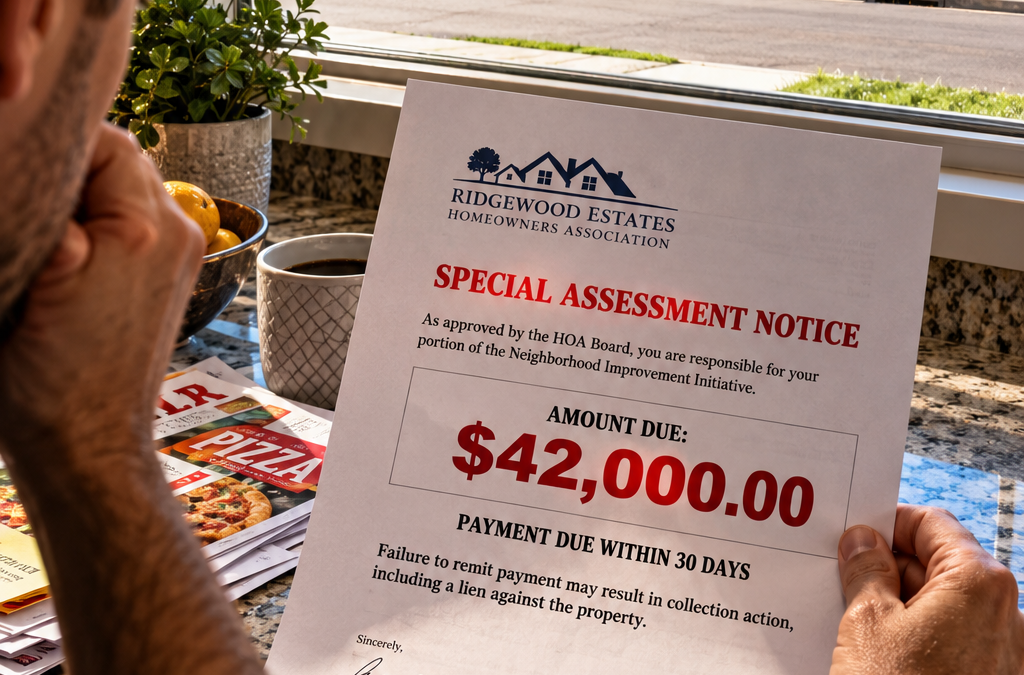
𝗙𝗨𝗟𝗟 𝗦𝗧𝗢𝗥𝗬
I could hear typing in the background.
I tried to keep my voice calm.
“Can you at least tell me what projects are included in the neighborhood improvement initiative?”
“I’m not authorized to discuss individual board expenditures.”
“Then who is?”
“You can contact the board.”
“Can you give me the president’s email?”
“It’s listed in your homeowner portal.”
“Thank you.”
I hung up.
The conversation lasted less than five minutes.
But something about it bothered me.
Not just what she had said.
How she had said it.
There had been no confusion.
No attempt to look up the information.
No surprise that a homeowner wanted to know where $42,000 was going.
The answer felt prepared.
Four months.
Annual meeting.
Board approved.
Pay the assessment.
It was as though my question itself was inconvenient.
I emailed the board president that afternoon.
His name had appeared on newsletters for years. I had seen him at community events, walking around with the relaxed confidence of someone who enjoyed being recognized.
My email was polite.
I explained that I had received the assessment.
I asked for the project scope, contractor information, board vote record, and an itemized breakdown of costs.
Then I waited.
One day passed.
Then two.
On the third morning, I finally received a response.
Two sentences.
The assessment was approved by the board in accordance with the association’s governing documents.
Please remit payment by the stated due date.
I read the message twice.
Then I leaned back in my chair.
Forty-two thousand dollars.
Two sentences.
Not one answer.
I typed a reply.
I am not disputing that the board approved an assessment. I am asking what specific improvements the assessment is funding and how the amount was calculated.
I hesitated before sending it.
Part of me still wanted to believe this was ordinary bureaucracy.
Bad communication.
Lazy management.
A board that was used to homeowners not asking questions.
I sent it.
No response came.
The next day, nothing.
The day after that, nothing.
By the end of the week, I understood something important.
They weren’t unable to explain the assessment.
They were choosing not to.
That changed the situation.
I pulled out the thick binder of governing documents I had received when I bought the house.
I had barely looked at it in years.
Like most homeowners, I had skimmed the rules when I moved in and then shoved the binder onto a shelf.
Now I sat at my dining table with a highlighter and started reading.
Declarations.
Bylaws.
Rules.
Financial provisions.
Meeting procedures.
Page after page of dense language.
It took hours.
Eventually, I found the section I needed.
Homeowners had the right to inspect certain association financial records and board meeting minutes upon written request.
I read the clause twice.
Then I looked up the applicable state law.
The law was even clearer.
Associations were required to maintain financial records.
Owners had inspection rights.
There were procedures.
Deadlines.
Responsibilities.
I felt something shift inside me.
Until that moment, the HOA had controlled the conversation.
They had the invoice.
They had the deadline.
They had the threat.
They had the lawyers and management company.
All I had was a question.
Now I had something else.
A right.
I wrote a formal records request.
I asked for board meeting minutes relating to the assessment, budget documents, contracts, invoices, vendor information, payment records, and any documents connected to the so-called neighborhood improvement initiative.
Then I printed it.
Signed it.
Sent it by certified mail with return receipt.
I kept a copy.
That was when I stopped feeling like a homeowner asking permission.
I was now documenting everything.
Three weeks passed.
Nothing.
Every afternoon, I checked the mailbox with growing frustration.
Meanwhile, the assessment deadline kept moving closer.
I would lie in bed at night thinking about that number.
$42,000.
I had savings.
But not the kind of savings you casually handed over because an HOA sent a one-page notice.
I thought about what would happen if they filed a lien.
Legal fees.
Collection costs.
Credit issues.
The possibility of having to fight people who had access to an association attorney paid for, in part, by homeowners like me.
That was the most infuriating part.
If they decided to come after me, they could potentially use our own dues to finance the attorney trying to force me into silence.
A thin folder finally arrived.
I carried it inside and opened it immediately.
At first, I felt relieved.
Then I started reading.
The board minutes were heavily redacted.
Entire sections were blacked out.
The budget summary contained vague categories.
Contracted services.
Administrative costs.
Miscellaneous improvements.
Recreational planning.
No meaningful descriptions.
No vendor names.
No contracts.
No supporting invoices.
I flipped through the folder twice.
It was technically a response.
But it wasn’t an answer.
Then I saw one line.
Landscaping enhancement — $18,400.
I stared at it.
Landscaping?
I knew our landscaping.
Every homeowner did.
The same shrubs had been sitting near the entrance for years.
The same patchy grass surrounded the clubhouse.
The same mulch beds ran along the common walkway.
If the HOA had spent nearly nineteen thousand dollars improving landscaping, I wanted to know where.
That Saturday morning, I got in my car with my phone and drove every common area in the neighborhood.
I photographed the entrance.
The clubhouse.
The small green space.
The walking path.
The retention pond.
The decorative beds.
I took pictures of shrubs, trees, mulch, grass, fencing, and signs.
At one point, an older neighbor walking her dog stopped beside my car.
“What are you doing?”
“Trying to find eighteen thousand dollars’ worth of landscaping.”
She looked around.
“Let me know if you find it.”
I laughed.
She didn’t.
She looked toward the clubhouse and shook her head.
“They haven’t even replaced those dead bushes.”
I followed her gaze.
She was right.
Two brown shrubs still stood near the clubhouse wall.
Dead.
Not dying.
Dead.
I took pictures of those too.
By Sunday evening, I had documented everything.
There had been no landscaping enhancement worth $18,400.
Not even close.
So I submitted another records request.
This one was narrower.
Please provide the invoices, contracts, payment records, and vendor information supporting the $18,400 landscaping enhancement expenditure.
I expected another delay.
Instead, four days later, I received a letter.
Not from the board.
From an attorney.
The association’s attorney.
The envelope looked more serious than anything the board had sent.
Heavy paper.
Formal letterhead.
My full name and address.
The first paragraph accused me of engaging in repeated and disruptive communications.
The second warned that continued harassment of board members could result in further legal action.
I read the word twice.
Harassment.
I went through every email I had sent.
There were not many.
They were polite.
There were no threats.
No insults.
No profanity.
No personal accusations.
I had asked what my money was being used for.
That was harassment now?
I felt anger rising, but underneath it was something more uncomfortable.
Fear.
The letter was designed to create fear.
That was obvious.
The board president couldn’t answer my questions, so now a lawyer was telling me to stop asking them.
I sat at my kitchen table with the attorney’s letter beside the $42,000 assessment notice.
For the first time, I wondered how many other homeowners had received similar letters over the years.
How many people had asked one question, gotten intimidated, and backed down.
How many had decided that fighting an HOA wasn’t worth the stress.
Maybe that was what the board was counting on.
Ordinary people had jobs.
Families.
Mortgages.
Aging parents.
Children.
Health problems.
Nobody wanted to spend evenings reading statutes and financial records.
Nobody wanted certified mail and attorney letters arriving at their home.
That was the advantage organizations like this sometimes had.
Not that they were always right.
That they could make resistance exhausting.
I looked at the word harassment again.
Then I laughed quietly.
Not because anything was funny.
Because they had just made a mistake.
If I had been wrong, the easiest solution would have been to send the invoice.
Here is the $18,400 landscaping work.
Here is the contractor.
Here are the receipts.
Here is what was done.
Conversation over.
Instead, they had sent an attorney.
I folded the letter and placed it in a file.
“They picked the wrong person to scare,” I whispered.
Two days later, something appeared in my mailbox that changed everything.
There was no HOA logo.
No law office return address.
No management company letterhead.
Just a plain envelope.
No return address at all.
I carried it inside.
The moment I opened it, I knew somebody wanted me to see something.
There was a photocopied invoice.
A landscaping company.
Dated eight months earlier.
Routine mowing.
Mulch.
Basic maintenance.
Total amount: $3,200.
Nothing close to $18,400.
Stapled to the invoice was a small yellow sticky note.
Four handwritten words.
Ask about the pool.
I sat down.
For a long time, I didn’t move.
The house seemed unusually quiet.
I read the note again.
Ask about the pool.
“What pool?”
I said.
Our neighborhood didn’t have a pool.
There had occasionally been talk of adding one years earlier, but everyone knew the cost would have been enormous. No construction had started. No proposal had been circulated.
Nothing.
Yet someone had anonymously sent me an ordinary landscaping invoice proving that at least one legitimate payment was far below the amount shown in the board’s summary.
And that same person wanted me to ask about a pool.
That meant somebody knew more.
Maybe an employee.
Maybe a former board member.
Maybe someone at the management company.
I didn’t know.
But I knew one thing.
I could not build a case around an anonymous sticky note.
If I accused the board publicly based on that alone, they would destroy me.
They would call it rumor.
Misinformation.
Personal hostility.
They might sue.
The attorney’s letter had already shown me how they intended to respond.
I put the anonymous envelope inside my growing file.
Then I went back to the law.
I read the state’s HOA statute again, more carefully this time.
There it was.
Financial records were required to be made available within a defined period after a proper written request.
Ten business days.
Not four months.
Not whenever the annual meeting happened.
Ten business days.
And there were consequences for noncompliance.
I drafted another letter.
This one was different.
There was no friendly introduction.
No “I hope you’re doing well.”
I cited the statute by number.
I cited the section.
I listed the documents I wanted.
I included the date of my prior requests.
I referenced their incomplete production.
Then I added one sentence.
Please consider this a formal statutory request for records subject to the ten-business-day production requirement.
I printed copies.
One for the management company.
One for the board president.
One for every board member.
Certified mail.
Return receipt requested.
Nobody would be able to say they hadn’t received it.
The receipts started coming back.
Signed.
One after another.
Then I waited.
Day one.
Day two.
Day five.
Day eight.
On the tenth business day, a package arrived.
It was thick enough that the mail carrier had to leave it by my door.
I carried it inside and put it on the dining table.
My hands were shaking slightly.
Not from fear exactly.
From anticipation.
I knew there was a possibility I had spent weeks chasing nothing.
Maybe the numbers were legitimate.
Maybe there was an innocent explanation buried somewhere in the paperwork.
Part of me hoped there was.
People sometimes assume that when you investigate wrongdoing, you want to find it.
I didn’t.
I wanted them to prove me wrong.
I wanted a boring invoice showing that the money had been spent properly.
I wanted to close the folder, pay whatever legitimate obligation I actually owed, and go back to living my life.
I started reading.
Page one.
Page two.
Budget summaries.
Bank transaction reports.
Pages of accounting records.
Page seven.
Management invoices.
Page nine.
Reimbursement logs.
Page eleven.
Vendor statements.
Then page fourteen.
I stopped.
Premier Outdoor Concepts LLC.
Payment amount: $9,750.
Description: Recreational Enhancement — Phase 1.
I read it again.
Recreational enhancement.
Ask about the pool.
My pulse accelerated.
I searched the company name on my laptop.
The business existed.
Technically.
An LLC.
I found its registered address.
Residential property.
Three streets away from the HOA president’s home.
Then I found the registered agent.
I recognized the last name.
I searched further.
It took less than twenty minutes.
The registered agent was the HOA president’s brother-in-law.
I leaned back.
For several seconds, I couldn’t think.
The anonymous note sat inside the file beside me.
Ask about the pool.
I opened the payment documentation again.
Premier Outdoor Concepts.
$9,750.
Recreational enhancement.
I kept digging.
The supporting documents referenced materials.
Delivery address.
I checked it.
Private residence.
Not the clubhouse.
Not the entrance.
Not the retention pond.
Not any common parcel owned by the association.
A private residence.
I compared names.
Addresses.
Property records.
The destination was connected to the board president’s family.
That was the moment suspicion became something heavier.
Something uglier.
The board wasn’t simply refusing to explain a badly documented project.
Association money appeared to have been routed into work benefiting a private property.
And the vendor receiving the money was tied directly to the president’s family.
I felt physically sick.
I thought about every homeowner who had received the same assessment notice.
Retired couples.
Young families.
People paying college tuition.
People already stretched thin.
People who might have taken loans.
People who might have dipped into retirement savings because the letter threatened their homes.
Forty-two thousand dollars.
How many had paid without questioning it because they were afraid?
I kept reading.
The next major payment was $14,600.
Consulting and administrative fees.
Paid to the property management company.
I searched prior statements.
Something didn’t make sense.
The management company had waived the association’s regular management fees for two consecutive months.
Yet around the same period, it had received this large additional payment.
I put the statements side by side.
Waived fees on one page.
Large consulting payment on another.
Maybe there was an explanation.
But there was no supporting work product.
No detailed consulting report.
No meaningful description showing what fourteen thousand six hundred dollars had purchased.
Just broad language.
Administrative support.
Project coordination.
Consulting services.
I wrote a question mark beside it.
Then I found the security audit.
$6,200.
At first, that sounded plausible.
Security assessments could cost money.
Then I read the invoice.
One site visit.
Two hours.
I searched the company.
Another family connection.
The owner was related to a board member.
I stared at my laptop.
“You’re kidding me.”
I wasn’t even angry anymore.
Not in the ordinary sense.
The feeling had moved past anger into disbelief.
Three major expenses.
Three conflicts or apparent conflicts.
Family connections.
Private addresses.
Vague services.
Then came the reimbursements.
$1,200.
Board expenses.
$850.
Planning costs.
$2,100.
Administrative reimbursement.
More.
And more.
Handwritten notes.
No receipts.
No supporting invoices.
Nothing showing who had spent the money or why.
By the time I reached the end, the amount tied to the so-called neighborhood improvement initiative totaled $42,000.
Exactly.
I spread the documents across my dining table.
$9,750 to Premier Outdoor Concepts.
$14,600 in consulting and administrative fees.
$6,200 for the security audit.
$11,450 scattered through undocumented reimbursements and planning expenses.
Forty-two thousand dollars.
And not one dollar I could identify had resurfaced a road.
Repaired a sidewalk.
Replaced a streetlight.
Improved the clubhouse.
Added neighborhood landscaping.
Built any shared recreational facility.
The phrase neighborhood improvement suddenly felt obscene.
I sat there until the sun went down.
The dining room slowly darkened around me, but I didn’t turn on the lights.
I kept thinking about the first phone call.
That information is available at the annual meeting.
Four months away.
Then the board president.
Please remit payment by the due date.
Then the attorney.
Continued harassment may result in further action.
Now I understood why they didn’t want to answer.
The silence hadn’t been incompetence.
It had been protection.
Protection for themselves.
The next morning, I started building the file properly.
I did not want emotion to weaken the evidence.
I created a timeline.
Assessment notice issued.
My first request.
Management response.
Board president response.
Certified records request.
Incomplete production.
Landscaping discrepancy.
Second request.
Attorney threat.
Anonymous invoice.
Statutory demand.
Fuller document production.
Then I organized the financial records.
Every transaction got its own folder.
Company registration.
Property address.
Family relationship.
Invoice.
Payment record.
Relevant board minutes.
I printed maps.
Public business registrations.
Property records.
Copies of the management statements.
I highlighted nothing that couldn’t be supported.
No speculation.
No accusations I couldn’t document.
I wanted the evidence to speak before I did.
While I was working, one thought kept returning.
What if the board came after me harder?
They had already accused me of harassment.
What if they filed something?
What if they sued me?
What if the neighbors believed them instead?
I would be lying if I said I felt fearless.
I didn’t.
There were nights I considered stopping.
One night, around midnight, I sat at the kitchen table staring at the file and thought about the simplest option.
Pay.
Walk away.
Let someone else deal with it.
That would have been easier.
Maybe not financially.
But emotionally.
There is a kind of exhaustion that comes from knowing the people who control part of your property rights are angry with you.
You begin noticing unfamiliar cars.
You wonder whether every violation notice is retaliation.
You reread emails before sending them because you know anything you say might later be used against you.
Home stops feeling completely private.
I hated that.
I hated that a place I had worked so hard to own suddenly felt like territory someone else believed they could control.
Then I looked at the assessment notice again.
Forty-two thousand dollars.
I imagined an elderly neighbor writing that check.
I imagined someone refinancing debt to pay it.
I imagined a family postponing college expenses.
And I imagined the board president standing beside a private backyard project paid for with money labeled neighborhood improvement.
I closed the file.
“No.”
I wasn’t paying for silence.
The next open board meeting was scheduled for the following week.
Usually, attendance was miserable.
Ten people on a good night.
Sometimes fewer.
This meeting was different before it even started.
I had quietly spoken to several neighbors.
I did not tell them conclusions.
I told them one thing.
“If you paid the assessment, you may want to come.”
That was enough.
By the time I arrived at the clubhouse, nearly every folding chair had been taken.
People stood along the back wall.
Homeowners I had never seen at a meeting were there.
Couples sat together holding assessment notices.
One man had a folder of his own.
A woman near the door whispered to her husband as I walked past.
The board members sat behind the long table at the front.
The president was in the center.
He saw me.
His expression changed.
Only slightly.
But I noticed.
The management company representative sat beside him.
The room buzzed with low conversation.
The president tapped his microphone.
“Let’s call the meeting to order.”
Routine items came first.
Landscaping.
Parking.
A maintenance request.
I could feel frustration building around me.
Everyone knew why they were there.
Finally, homeowner comments began.
I stood.
The president looked at me.
“Please state your name and address for the record.”
I did.
“I’d like to discuss the special assessment.”
He immediately leaned toward the microphone.
“That matter has already been approved.”
“I know.”
“Then if your concern is whether the board had authority—”
“My concern is where the money went.”
The room became quiet.
He shifted in his chair.
“Financial matters have been reviewed by management.”
“Good.”
I picked up the first document.
“Then this should be easy.”
He frowned.
I walked to the front with a stack of printed packets.
“I have copies for homeowners.”
The president raised his hand.
“You cannot distribute unauthorized materials during an official board meeting.”
I stopped.
“These are association financial records.”
His face tightened.
The management representative leaned toward him and whispered something.
I continued handing them out.
People began flipping through pages.
I returned to the front.
“The assessment notice describes forty-two thousand dollars in neighborhood improvements.”
“Correct.”
“Can you identify one neighborhood improvement that cost forty-two thousand dollars?”
He looked toward the management representative.
She answered instead.
“The assessment funded several initiatives.”
“Please name them.”
“Various recreational, administrative, landscaping, and security-related projects.”
I nodded.
“Let’s start with landscaping.”
I held up the budget page.
“Eighteen thousand four hundred dollars was identified as landscaping enhancement.”
“Correct.”
“What was enhanced?”
She hesitated.
“Maintenance and improvement work.”
“Where?”
“The association’s common areas.”
“Which common areas?”
“I don’t have the specific locations in front of me.”
“I photographed every common area.”
The president interrupted.
“This is becoming argumentative.”
“No. It’s becoming specific.”
A murmur moved through the room.
I pulled out the anonymous landscaping invoice, but I did not mention where it had come from.
“I also have an invoice showing routine mowing and mulch for thirty-two hundred dollars.”
The president’s eyes narrowed.
“Where did you obtain that?”
“I don’t think the source is as important as whether it’s authentic.”
“You may be presenting stolen association records.”
“Is it authentic?”
He didn’t answer.
That silence hit the room harder than anything I could have said.
A homeowner behind me called out.
“Answer her.”
The president raised his voice.
“We are not going to turn this meeting into a circus.”
I reached for the next page.
“Then let’s talk about Premier Outdoor Concepts LLC.”
The management representative stopped moving.
The president looked at me.
For the first time that evening, I saw genuine alarm.
I placed the company registration on the display table.
“Premier Outdoor Concepts received nine thousand seven hundred fifty dollars for something described as Recreational Enhancement, Phase One.”
The president said nothing.
I placed another document beside it.
“This is the company’s registered address.”
Then another.
“This is its registered agent.”
Someone near the front whispered, “Oh my God.”
I looked directly at the president.
“The registered agent is your brother-in-law.”
The room erupted.
Not shouting exactly.
Not yet.
But dozens of voices rose at once.
“What?”
“Are you serious?”
“His brother-in-law?”
The president struck the table with his palm.
“Order.”
I waited.
He pointed toward me.
“This is exactly the kind of misinformation I’ve warned about.”
I held up the state registration.
“This isn’t my information. It’s the state’s corporate registration.”
I held up the payment record.
“This came from the association’s own financial production.”
Then I placed the delivery documentation beside them.
“And the materials connected to this payment were delivered to a private residence.”
Someone shouted from the back.
“Whose house?”
I didn’t answer immediately.
The president did.
“Private property information is not relevant.”
That was the wrong response.
The room exploded.
A man stood.
“We paid forty-two thousand dollars each and you’re saying private property isn’t relevant?”
Another homeowner stood.
“My wife and I took money out of our retirement account!”
The president tried to regain control.
“Sit down.”
“No.”
The man’s voice cracked.
“No, I’m not sitting down.”
The room went quiet again.
He was older, maybe in his late sixties.
I had seen him walking in the mornings but had never spoken to him.
He held up his assessment notice.
“We paid you because this letter said you could put a lien on our house.”
The president said, “Sir—”
“We were scared.”
His wife reached up and held his arm.
He continued.
“We thought we had no choice.”
That hit me harder than anything in the documents.
For weeks, I had treated the $42,000 assessment as numbers.
Invoices.
Contracts.
Corporations.
Now I saw what the numbers meant.
Fear.
Real fear.
A couple who had spent decades building their savings had handed over money because a letter threatened their home.
The woman beside him looked close to tears.
I turned back toward the board.
“This is why homeowners have a right to know where their money goes.”
The president’s face was red.
“There has been no misuse of funds.”
“Then explain the payment.”
He stared at me.
I waited.
Nothing.
I moved to the next document.
“Fourteen thousand six hundred dollars was paid to the property management company for consulting and administrative fees.”
The management representative spoke quickly.
“Those were legitimate project coordination expenses.”
“Can you show us the work product?”
“There are administrative functions that do not produce individual work product.”
“Then explain why the management company waived its normal management fees for two months around the same period.”
Her face changed.
I placed those statements down.
“Two months of waived fees, followed by a fourteen-thousand-six-hundred-dollar consulting payment.”
“Those transactions are unrelated.”
“Then documentation should make that obvious.”
Silence.
I moved on.
“Six thousand two hundred dollars for a security audit.”
A board member near the end of the table suddenly stared down at his hands.
“The invoice describes a two-hour site visit.”
I held up the company record.
“The company owner is related to a board member.”
The homeowner beside me whispered, “This is unbelievable.”
I wasn’t finished.
“The remaining eleven thousand four hundred fifty dollars is spread across reimbursements described as board expenses and planning costs.”
I lifted several pages.
“There are no receipts attached.”
The president interrupted again.
“Association officers incur legitimate expenses.”
“Then produce the receipts.”
“They may not have been retained.”
“You threatened to put liens on homeowners’ homes for money the board can’t document.”
That sentence landed differently.
I heard someone behind me say, “Jesus.”
I looked around the room.
People weren’t merely angry anymore.
They looked betrayed.
That was worse.
HOAs run on a strange kind of trust.
Most homeowners don’t attend meetings.
They don’t inspect bank statements.
They don’t read every contract.
They assume the people elected to the board are doing boring, responsible work on everyone’s behalf.
Budgeting.
Hiring contractors.
Maintaining common property.
Enforcing rules.
The system only functions because most people assume the people holding the checkbook aren’t using it for themselves.
Once that assumption breaks, every past decision becomes suspicious.
I could see that realization spreading across the room.
A woman near the center raised her hand.
“Mr. President, did association money pay for work at a private residence?”
He didn’t answer directly.
“Some association projects involve staging or storage at off-site locations.”
“Was there a pool?”
The question came from somewhere behind me.
My stomach tightened.
The anonymous note.
Ask about the pool.
The president’s face changed again.
A man near the back repeated it louder.
“Was association money used for a private pool?”
The president pushed his microphone away.
“This meeting is out of control.”
He started gathering papers.
I looked at him.
“Where was the recreational enhancement installed?”
He stood.
“This discussion is over.”
“No.”
The older homeowner who had spoken earlier remained standing.
“For you, maybe.”
The president looked toward him.
The man held up the financial packet.
“For us, it’s just starting.”
People began speaking all at once.
“I want an audit.”
“So do I.”
“Independent audit.”
“Not management.”
“Who approved these vendors?”
“Was there a conflict-of-interest vote?”
“Who signed the checks?”
The president kept trying to speak over them.
One homeowner finally shouted, “No confidence.”
The room quieted enough for everyone to hear.
She was standing near the aisle.
“I move that the homeowners demand an immediate vote of no confidence in this board.”
The president shook his head.
“That is not procedurally proper at this meeting.”
“Then schedule one.”
Another homeowner stood.
“Tonight.”
“You cannot simply invent procedures.”
Someone laughed bitterly.
“Apparently the board can.”
That sent another wave through the room.
The management representative whispered urgently to the president.
He ignored her.
Then a woman three rows from the front stood and held up her phone.
“I’m contacting the state’s HOA oversight division tonight.”
The president looked at her.
“For what?”
She almost smiled.
“For them to decide.”
That was the moment I knew the board had lost the room.
Not because everyone understood every accounting issue.
They didn’t need to.
They understood the essential facts.
They had been billed $42,000.
They had been threatened with liens.
The board had refused to explain the assessment.
The HOA attorney had attempted to intimidate a homeowner asking for records.
And the documents showed payments tied to relatives, private addresses, vague services, and missing receipts.
The president could call it misinformation.
He could call me difficult.
He could call my questions harassment.
But he could no longer keep the documents out of homeowners’ hands.
That changed everything.
The meeting ended without any meaningful resolution from the board.
Technically.
Emotionally, it ended the old HOA.
People stayed in the parking lot long after the board members left.
Neighbors who had barely spoken before exchanged phone numbers.
Someone created an email group.
Another homeowner offered to organize the financial records.
A retired accountant volunteered to review the numbers.
The older couple who had spoken during the meeting came over to me.
The wife held my hand.
For a moment, she didn’t say anything.
Then she whispered, “Thank you.”
I felt uncomfortable.
“I haven’t fixed anything.”
“You asked.”
Her eyes were wet.
“We didn’t.”
Her husband looked toward the clubhouse.
“We should have.”
“No,” I said.
“You received an official notice threatening your home. You trusted that it was legitimate.”
He shook his head.
“We were scared.”
“I know.”
That was the sentence that stayed with me.
We were scared.
Not greedy.
Not careless.
Scared.
The board’s power had depended partly on that fear.
Pay now.
Ask later.
Don’t create trouble.
Don’t challenge authority.
Don’t make yourself a target.
I understood because I had felt it too.
The difference was that fear had made me angry enough to keep going.
The next three weeks were unlike anything our neighborhood had experienced.
Homeowners demanded records.
Multiple complaints were filed.
The board’s finances were scrutinized by people who suddenly had no interest in accepting broad categories like miscellaneous improvement.
Every transaction became a question.
Every relative-connected vendor became a conflict that needed explanation.
Every missing receipt mattered.
The president sent one association-wide email claiming that accusations circulating among homeowners were incomplete and misleading.
It backfired.
Within hours, residents were replying with specific questions.
Who approved Premier Outdoor Concepts?
Was the family relationship disclosed?
What property received the recreational materials?
What did the $14,600 consulting payment purchase?
Where was the security audit report?
Where were the receipts for $11,450 in reimbursements?
The board could no longer answer one person privately.
Now they had to answer the neighborhood.
And they couldn’t.
Three weeks after the meeting, the board president resigned.
There was no dramatic speech.
No apology.
No admission.
Just a written notice stating that he was stepping down effective immediately.
I read it standing in the same kitchen where I had opened the original assessment notice.
I expected to feel victorious.
I didn’t.
I felt exhausted.
Because by then, the issue had become larger than one man.
The property management company was terminated shortly afterward.
Homeowners insisted that no company involved in the disputed transactions should participate in reviewing its own records.
An independent, homeowner-led financial audit process began.
People volunteered.
Records were preserved.
Bank statements were requested.
Old vendor payments were examined.
Minutes from previous years were compared against actual expenditures.
The $42,000 assessment that had started everything became only one piece of a much larger financial review.
Then came the part that frightened me most.
Early in the audit, someone called me.
“You need to see this.”
I met several homeowners at the clubhouse.
The retired accountant who had volunteered to help had spread older financial statements across a table.
She looked tired.
There were circles and notes everywhere.
“What’s wrong?”
I asked.
She looked at me.
“I’m not ready to say anything is wrong.”
That phrasing made my stomach tighten.
“But?”
“But the forty-two thousand dollars may not be the biggest issue.”
Nobody spoke.
She pointed to several older payments.
“I need more records before I draw conclusions.”
I stared at the pages.
Years.
Different vendors.
Different categories.
Different amounts.
The same kind of vague descriptions.
Consulting.
Planning.
Reimbursement.
Enhancement.
I thought about the anonymous envelope.
The cheap photocopy.
The yellow sticky note.
Four words.
Ask about the pool.
Whoever had sent it hadn’t written:
The pool is everything.
They hadn’t written:
This is the only problem.
They had simply given me a place to begin.
That night, I returned home and placed the original assessment notice on my dining table one last time.
It looked smaller somehow.
Still threatening.
Still outrageous.
But no longer powerful.
That piece of paper had once made me feel helpless.
It had told me I owed $42,000.
It had told me I had thirty days.
It had told me my home could be placed at risk.
And for a few terrible hours, I had believed my only choices were to pay or suffer the consequences.
Now I understood something I wished I had understood earlier.
A demand is not the same thing as an explanation.
Authority is not the same thing as accountability.
And official letterhead does not make every number honest.
I opened the file where I had kept everything.
The first email.
The certified mail receipts.
The redacted minutes.
The attorney’s threat.
The invoices.
The corporate registrations.
The photographs of dead shrubs the HOA had somehow described as landscaping enhancement.
Then I found the anonymous envelope.
The sticky note was still attached.
Ask about the pool.
I smiled for the first time in weeks.
Not because any of it was funny.
Not because the damage was finished.
And certainly not because every question had been answered.
I smiled because whoever had sent those four words had understood something the board had forgotten.
Secrets become fragile the moment somebody starts asking for receipts.
The president was gone.
The management company was gone.
The homeowners were organized.
The audit was moving forward.
And for the first time since that Tuesday afternoon, I could sit inside my own home without feeling as though a group of strangers behind a conference table controlled what happened next.
There were still unanswered questions.
There might be more difficult discoveries ahead.
But they would no longer be hidden behind vague budget lines and threats.
Not if we could help it.
The original $42,000 bill had been designed to make us afraid enough to pay without asking questions.
Instead, it taught an entire neighborhood to start asking them.
And once we did, nobody could tell us to wait four months for answers again.
𝗧𝗛𝗘 𝗘𝗡𝗗
The HOA Gave Me 30 Days to Pay $42,000 for “Neighborhood Improvements,” and the More I Asked What I Was Paying For, the More Desperate They Became to Stop Me
The letter gave me thirty days to pay $42,000 or risk a lien against the home I had spent years building a life in. The moment I asked for one simple thing—a receipt—the people demanding my money stopped answering like neighbors and started treating me like a threat.
It arrived on a Tuesday.
There was nothing dramatic about the envelope.
That was the part I remembered most clearly afterward.
It sat between a pizza flyer and my water bill, plain white paper with the homeowners association logo printed neatly in the upper-left corner. I almost put it on the counter with the rest of the mail and forgot about it until after dinner.
I had lived in the neighborhood long enough to know what HOA envelopes usually contained.
A reminder about trash cans.
A notice about landscaping.
An announcement about a meeting almost nobody attended.
Nothing worth ruining an afternoon over.
I opened it standing beside the kitchen island.
One page slid out.
I read the first paragraph.
Then I stopped.
I read it again.
SPECIAL ASSESSMENT NOTICE.
My portion of what the board called a neighborhood improvement initiative was $42,000.
Payment due within thirty days.
I actually laughed the first time I saw the number.
Not because it was funny.
Because my mind rejected it.
Forty-two thousand dollars was not an HOA fee.
It was not a minor assessment.
It was the price of a new car.
It was more than some people had saved for retirement.
It was the kind of number that could change a family’s financial life.
I looked lower on the page, expecting an explanation.
There wasn’t one.
No project list.
No contractor names.
No construction schedule.
No description of what was supposedly being improved.
No indication of how the board had calculated each homeowner’s share.
There was just the amount.
$42,000.
And underneath it, in bold type, a sentence that instantly changed the way the letter felt in my hands.
Failure to remit payment may result in collection action, including a lien against the property.
I stared at that sentence.
My home.
Not some investment property.
Not a vacation house.
My home.
The place where I had spent years slowly replacing old fixtures, repairing the back deck, planting trees, painting rooms, and building a life that finally felt stable.
And now a group of people sitting on an HOA board was telling me I had thirty days to produce $42,000 or they might put a lien against it.
For neighborhood improvements.
I walked to the front window and looked outside.
The street looked exactly the way it had looked the week before.
And the month before.
And the year before.
There were no construction trucks.
No survey markers.
No new landscaping crews.
No torn-up sidewalks.
No new streetlights.
No equipment parked near the clubhouse.
Nothing.
Our neighborhood hadn’t even managed to repaint the faded entrance sign everyone had complained about for two years.
I looked back down at the notice.
“What improvements?”
I said it out loud even though nobody was there to answer me.
That question should have been easy.
It should have required one email.
Maybe two.
Instead, it became the question that nearly tore our HOA apart.
I called the management office the following morning.
A woman answered after three rings.
I gave her my name, address, and account number.
“I’m calling about the special assessment notice.”
“Yes.”
Her response was immediate, almost too immediate.
“I’d like a breakdown of the improvement costs.”
There was a pause.
“Financial information will be available for homeowner review at the annual meeting.”
“When is that?”
“Approximately four months from now.”
I looked at the notice sitting beside my laptop.
“My payment is due in thirty days.”
“Correct.”
“So you’re telling me I have to pay forty-two thousand dollars in thirty days, but I have to wait four months to find out what I’m paying for?”
Another pause.
“The board has approved the assessment in accordance with the association’s governing documents.”
“That isn’t what I asked.”
“I’m sorry?”
“I asked what the money is for.”
She repeated herself.
“The financial information will be available at the annual meeting.”
I could hear typing in the background.
I tried to keep my voice calm.
“Can you at least tell me what projects are included in the neighborhood improvement initiative?”
“I’m not authorized to discuss individual board expenditures.”
“Then who is?”
“You can contact the board.”
“Can you give me the president’s email?”
“It’s listed in your homeowner portal.”
“Thank you.”
I hung up.
The conversation lasted less than five minutes.
But something about it bothered me.
Not just what she had said.
How she had said it.
There had been no confusion.
No attempt to look up the information.
No surprise that a homeowner wanted to know where $42,000 was going.
The answer felt prepared.
Four months.
Annual meeting.
Board approved.
Pay the assessment.
It was as though my question itself was inconvenient.
I emailed the board president that afternoon.
His name had appeared on newsletters for years. I had seen him at community events, walking around with the relaxed confidence of someone who enjoyed being recognized.
My email was polite.
I explained that I had received the assessment.
I asked for the project scope, contractor information, board vote record, and an itemized breakdown of costs.
Then I waited.
One day passed.
Then two.
On the third morning, I finally received a response.
Two sentences.
The assessment was approved by the board in accordance with the association’s governing documents.
Please remit payment by the stated due date.
I read the message twice.
Then I leaned back in my chair.
Forty-two thousand dollars.
Two sentences.
Not one answer.
I typed a reply.
I am not disputing that the board approved an assessment. I am asking what specific improvements the assessment is funding and how the amount was calculated.
I hesitated before sending it.
Part of me still wanted to believe this was ordinary bureaucracy.
Bad communication.
Lazy management.
A board that was used to homeowners not asking questions.
I sent it.
No response came.
The next day, nothing.
The day after that, nothing.
By the end of the week, I understood something important.
They weren’t unable to explain the assessment.
They were choosing not to.
That changed the situation.
I pulled out the thick binder of governing documents I had received when I bought the house.
I had barely looked at it in years.
Like most homeowners, I had skimmed the rules when I moved in and then shoved the binder onto a shelf.
Now I sat at my dining table with a highlighter and started reading.
Declarations.
Bylaws.
Rules.
Financial provisions.
Meeting procedures.
Page after page of dense language.
It took hours.
Eventually, I found the section I needed.
Homeowners had the right to inspect certain association financial records and board meeting minutes upon written request.
I read the clause twice.
Then I looked up the applicable state law.
The law was even clearer.
Associations were required to maintain financial records.
Owners had inspection rights.
There were procedures.
Deadlines.
Responsibilities.
I felt something shift inside me.
Until that moment, the HOA had controlled the conversation.
They had the invoice.
They had the deadline.
They had the threat.
They had the lawyers and management company.
All I had was a question.
Now I had something else.
A right.
I wrote a formal records request.
I asked for board meeting minutes relating to the assessment, budget documents, contracts, invoices, vendor information, payment records, and any documents connected to the so-called neighborhood improvement initiative.
Then I printed it.
Signed it.
Sent it by certified mail with return receipt.
I kept a copy.
That was when I stopped feeling like a homeowner asking permission.
I was now documenting everything.
Three weeks passed.
Nothing.
Every afternoon, I checked the mailbox with growing frustration.
Meanwhile, the assessment deadline kept moving closer.
I would lie in bed at night thinking about that number.
$42,000.
I had savings.
But not the kind of savings you casually handed over because an HOA sent a one-page notice.
I thought about what would happen if they filed a lien.
Legal fees.
Collection costs.
Credit issues.
The possibility of having to fight people who had access to an association attorney paid for, in part, by homeowners like me.
That was the most infuriating part.
If they decided to come after me, they could potentially use our own dues to finance the attorney trying to force me into silence.
A thin folder finally arrived.
I carried it inside and opened it immediately.
At first, I felt relieved.
Then I started reading.
The board minutes were heavily redacted.
Entire sections were blacked out.
The budget summary contained vague categories.
Contracted services.
Administrative costs.
Miscellaneous improvements.
Recreational planning.
No meaningful descriptions.
No vendor names.
No contracts.
No supporting invoices.
I flipped through the folder twice.
It was technically a response.
But it wasn’t an answer.
Then I saw one line.
Landscaping enhancement — $18,400.
I stared at it.
Landscaping?
I knew our landscaping.
Every homeowner did.
The same shrubs had been sitting near the entrance for years.
The same patchy grass surrounded the clubhouse.
The same mulch beds ran along the common walkway.
If the HOA had spent nearly nineteen thousand dollars improving landscaping, I wanted to know where.
That Saturday morning, I got in my car with my phone and drove every common area in the neighborhood.
I photographed the entrance.
The clubhouse.
The small green space.
The walking path.
The retention pond.
The decorative beds.
I took pictures of shrubs, trees, mulch, grass, fencing, and signs.
At one point, an older neighbor walking her dog stopped beside my car.
“What are you doing?”
“Trying to find eighteen thousand dollars’ worth of landscaping.”
She looked around.
“Let me know if you find it.”
I laughed.
She didn’t.
She looked toward the clubhouse and shook her head.
“They haven’t even replaced those dead bushes.”
I followed her gaze.
She was right.
Two brown shrubs still stood near the clubhouse wall.
Dead.
Not dying.
Dead.
I took pictures of those too.
By Sunday evening, I had documented everything.
There had been no landscaping enhancement worth $18,400.
Not even close.
So I submitted another records request.
This one was narrower.
Please provide the invoices, contracts, payment records, and vendor information supporting the $18,400 landscaping enhancement expenditure.
I expected another delay.
Instead, four days later, I received a letter.
Not from the board.
From an attorney.
The association’s attorney.
The envelope looked more serious than anything the board had sent.
Heavy paper.
Formal letterhead.
My full name and address.
The first paragraph accused me of engaging in repeated and disruptive communications.
The second warned that continued harassment of board members could result in further legal action.
I read the word twice.
Harassment.
I went through every email I had sent.
There were not many.
They were polite.
There were no threats.
No insults.
No profanity.
No personal accusations.
I had asked what my money was being used for.
That was harassment now?
I felt anger rising, but underneath it was something more uncomfortable.
Fear.
The letter was designed to create fear.
That was obvious.
The board president couldn’t answer my questions, so now a lawyer was telling me to stop asking them.
I sat at my kitchen table with the attorney’s letter beside the $42,000 assessment notice.
For the first time, I wondered how many other homeowners had received similar letters over the years.
How many people had asked one question, gotten intimidated, and backed down.
How many had decided that fighting an HOA wasn’t worth the stress.
Maybe that was what the board was counting on.
Ordinary people had jobs.
Families.
Mortgages.
Aging parents.
Children.
Health problems.
Nobody wanted to spend evenings reading statutes and financial records.
Nobody wanted certified mail and attorney letters arriving at their home.
That was the advantage organizations like this sometimes had.
Not that they were always right.
That they could make resistance exhausting.
I looked at the word harassment again.
Then I laughed quietly.
Not because anything was funny.
Because they had just made a mistake.
If I had been wrong, the easiest solution would have been to send the invoice.
Here is the $18,400 landscaping work.
Here is the contractor.
Here are the receipts.
Here is what was done.
Conversation over.
Instead, they had sent an attorney.
I folded the letter and placed it in a file.
“They picked the wrong person to scare,” I whispered.
Two days later, something appeared in my mailbox that changed everything.
There was no HOA logo.
No law office return address.
No management company letterhead.
Just a plain envelope.
No return address at all.
I carried it inside.
The moment I opened it, I knew somebody wanted me to see something.
There was a photocopied invoice.
A landscaping company.
Dated eight months earlier.
Routine mowing.
Mulch.
Basic maintenance.
Total amount: $3,200.
Nothing close to $18,400.
Stapled to the invoice was a small yellow sticky note.
Four handwritten words.
Ask about the pool.
I sat down.
For a long time, I didn’t move.
The house seemed unusually quiet.
I read the note again.
Ask about the pool.
“What pool?”
I said.
Our neighborhood didn’t have a pool.
There had occasionally been talk of adding one years earlier, but everyone knew the cost would have been enormous. No construction had started. No proposal had been circulated.
Nothing.
Yet someone had anonymously sent me an ordinary landscaping invoice proving that at least one legitimate payment was far below the amount shown in the board’s summary.
And that same person wanted me to ask about a pool.
That meant somebody knew more.
Maybe an employee.
Maybe a former board member.
Maybe someone at the management company.
I didn’t know.
But I knew one thing.
I could not build a case around an anonymous sticky note.
If I accused the board publicly based on that alone, they would destroy me.
They would call it rumor.
Misinformation.
Personal hostility.
They might sue.
The attorney’s letter had already shown me how they intended to respond.
I put the anonymous envelope inside my growing file.
Then I went back to the law.
I read the state’s HOA statute again, more carefully this time.
There it was.
Financial records were required to be made available within a defined period after a proper written request.
Ten business days.
Not four months.
Not whenever the annual meeting happened.
Ten business days.
And there were consequences for noncompliance.
I drafted another letter.
This one was different.
There was no friendly introduction.
No “I hope you’re doing well.”
I cited the statute by number.
I cited the section.
I listed the documents I wanted.
I included the date of my prior requests.
I referenced their incomplete production.
Then I added one sentence.
Please consider this a formal statutory request for records subject to the ten-business-day production requirement.
I printed copies.
One for the management company.
One for the board president.
One for every board member.
Certified mail.
Return receipt requested.
Nobody would be able to say they hadn’t received it.
The receipts started coming back.
Signed.
One after another.
Then I waited.
Day one.
Day two.
Day five.
Day eight.
On the tenth business day, a package arrived.
It was thick enough that the mail carrier had to leave it by my door.
I carried it inside and put it on the dining table.
My hands were shaking slightly.
Not from fear exactly.
From anticipation.
I knew there was a possibility I had spent weeks chasing nothing.
Maybe the numbers were legitimate.
Maybe there was an innocent explanation buried somewhere in the paperwork.
Part of me hoped there was.
People sometimes assume that when you investigate wrongdoing, you want to find it.
I didn’t.
I wanted them to prove me wrong.
I wanted a boring invoice showing that the money had been spent properly.
I wanted to close the folder, pay whatever legitimate obligation I actually owed, and go back to living my life.
I started reading.
Page one.
Page two.
Budget summaries.
Bank transaction reports.
Pages of accounting records.
Page seven.
Management invoices.
Page nine.
Reimbursement logs.
Page eleven.
Vendor statements.
Then page fourteen.
I stopped.
Premier Outdoor Concepts LLC.
Payment amount: $9,750.
Description: Recreational Enhancement — Phase 1.
I read it again.
Recreational enhancement.
Ask about the pool.
My pulse accelerated.
I searched the company name on my laptop.
The business existed.
Technically.
An LLC.
I found its registered address.
Residential property.
Three streets away from the HOA president’s home.
Then I found the registered agent.
I recognized the last name.
I searched further.
It took less than twenty minutes.
The registered agent was the HOA president’s brother-in-law.
I leaned back.
For several seconds, I couldn’t think.
The anonymous note sat inside the file beside me.
Ask about the pool.
I opened the payment documentation again.
Premier Outdoor Concepts.
$9,750.
Recreational enhancement.
I kept digging.
The supporting documents referenced materials.
Delivery address.
I checked it.
Private residence.
Not the clubhouse.
Not the entrance.
Not the retention pond.
Not any common parcel owned by the association.
A private residence.
I compared names.
Addresses.
Property records.
The destination was connected to the board president’s family.
That was the moment suspicion became something heavier.
Something uglier.
The board wasn’t simply refusing to explain a badly documented project.
Association money appeared to have been routed into work benefiting a private property.
And the vendor receiving the money was tied directly to the president’s family.
I felt physically sick.
I thought about every homeowner who had received the same assessment notice.
Retired couples.
Young families.
People paying college tuition.
People already stretched thin.
People who might have taken loans.
People who might have dipped into retirement savings because the letter threatened their homes.
Forty-two thousand dollars.
How many had paid without questioning it because they were afraid?
I kept reading.
The next major payment was $14,600.
Consulting and administrative fees.
Paid to the property management company.
I searched prior statements.
Something didn’t make sense.
The management company had waived the association’s regular management fees for two consecutive months.
Yet around the same period, it had received this large additional payment.
I put the statements side by side.
Waived fees on one page.
Large consulting payment on another.
Maybe there was an explanation.
But there was no supporting work product.
No detailed consulting report.
No meaningful description showing what fourteen thousand six hundred dollars had purchased.
Just broad language.
Administrative support.
Project coordination.
Consulting services.
I wrote a question mark beside it.
Then I found the security audit.
$6,200.
At first, that sounded plausible.
Security assessments could cost money.
Then I read the invoice.
One site visit.
Two hours.
I searched the company.
Another family connection.
The owner was related to a board member.
I stared at my laptop.
“You’re kidding me.”
I wasn’t even angry anymore.
Not in the ordinary sense.
The feeling had moved past anger into disbelief.
Three major expenses.
Three conflicts or apparent conflicts.
Family connections.
Private addresses.
Vague services.
Then came the reimbursements.
$1,200.
Board expenses.
$850.
Planning costs.
$2,100.
Administrative reimbursement.
More.
And more.
Handwritten notes.
No receipts.
No supporting invoices.
Nothing showing who had spent the money or why.
By the time I reached the end, the amount tied to the so-called neighborhood improvement initiative totaled $42,000.
Exactly.
I spread the documents across my dining table.
$9,750 to Premier Outdoor Concepts.
$14,600 in consulting and administrative fees.
$6,200 for the security audit.
$11,450 scattered through undocumented reimbursements and planning expenses.
Forty-two thousand dollars.
And not one dollar I could identify had resurfaced a road.
Repaired a sidewalk.
Replaced a streetlight.
Improved the clubhouse.
Added neighborhood landscaping.
Built any shared recreational facility.
The phrase neighborhood improvement suddenly felt obscene.
I sat there until the sun went down.
The dining room slowly darkened around me, but I didn’t turn on the lights.
I kept thinking about the first phone call.
That information is available at the annual meeting.
Four months away.
Then the board president.
Please remit payment by the due date.
Then the attorney.
Continued harassment may result in further action.
Now I understood why they didn’t want to answer.
The silence hadn’t been incompetence.
It had been protection.
Protection for themselves.
The next morning, I started building the file properly.
I did not want emotion to weaken the evidence.
I created a timeline.
Assessment notice issued.
My first request.
Management response.
Board president response.
Certified records request.
Incomplete production.
Landscaping discrepancy.
Second request.
Attorney threat.
Anonymous invoice.
Statutory demand.
Fuller document production.
Then I organized the financial records.
Every transaction got its own folder.
Company registration.
Property address.
Family relationship.
Invoice.
Payment record.
Relevant board minutes.
I printed maps.
Public business registrations.
Property records.
Copies of the management statements.
I highlighted nothing that couldn’t be supported.
No speculation.
No accusations I couldn’t document.
I wanted the evidence to speak before I did.
While I was working, one thought kept returning.
What if the board came after me harder?
They had already accused me of harassment.
What if they filed something?
What if they sued me?
What if the neighbors believed them instead?
I would be lying if I said I felt fearless.
I didn’t.
There were nights I considered stopping.
One night, around midnight, I sat at the kitchen table staring at the file and thought about the simplest option.
Pay.
Walk away.
Let someone else deal with it.
That would have been easier.
Maybe not financially.
But emotionally.
There is a kind of exhaustion that comes from knowing the people who control part of your property rights are angry with you.
You begin noticing unfamiliar cars.
You wonder whether every violation notice is retaliation.
You reread emails before sending them because you know anything you say might later be used against you.
Home stops feeling completely private.
I hated that.
I hated that a place I had worked so hard to own suddenly felt like territory someone else believed they could control.
Then I looked at the assessment notice again.
Forty-two thousand dollars.
I imagined an elderly neighbor writing that check.
I imagined someone refinancing debt to pay it.
I imagined a family postponing college expenses.
And I imagined the board president standing beside a private backyard project paid for with money labeled neighborhood improvement.
I closed the file.
“No.”
I wasn’t paying for silence.
The next open board meeting was scheduled for the following week.
Usually, attendance was miserable.
Ten people on a good night.
Sometimes fewer.
This meeting was different before it even started.
I had quietly spoken to several neighbors.
I did not tell them conclusions.
I told them one thing.
“If you paid the assessment, you may want to come.”
That was enough.
By the time I arrived at the clubhouse, nearly every folding chair had been taken.
People stood along the back wall.
Homeowners I had never seen at a meeting were there.
Couples sat together holding assessment notices.
One man had a folder of his own.
A woman near the door whispered to her husband as I walked past.
The board members sat behind the long table at the front.
The president was in the center.
He saw me.
His expression changed.
Only slightly.
But I noticed.
The management company representative sat beside him.
The room buzzed with low conversation.
The president tapped his microphone.
“Let’s call the meeting to order.”
Routine items came first.
Landscaping.
Parking.
A maintenance request.
I could feel frustration building around me.
Everyone knew why they were there.
Finally, homeowner comments began.
I stood.
The president looked at me.
“Please state your name and address for the record.”
I did.
“I’d like to discuss the special assessment.”
He immediately leaned toward the microphone.
“That matter has already been approved.”
“I know.”
“Then if your concern is whether the board had authority—”
“My concern is where the money went.”
The room became quiet.
He shifted in his chair.
“Financial matters have been reviewed by management.”
“Good.”
I picked up the first document.
“Then this should be easy.”
He frowned.
I walked to the front with a stack of printed packets.
“I have copies for homeowners.”
The president raised his hand.
“You cannot distribute unauthorized materials during an official board meeting.”
I stopped.
“These are association financial records.”
His face tightened.
The management representative leaned toward him and whispered something.
I continued handing them out.
People began flipping through pages.
I returned to the front.
“The assessment notice describes forty-two thousand dollars in neighborhood improvements.”
“Correct.”
“Can you identify one neighborhood improvement that cost forty-two thousand dollars?”
He looked toward the management representative.
She answered instead.
“The assessment funded several initiatives.”
“Please name them.”
“Various recreational, administrative, landscaping, and security-related projects.”
I nodded.
“Let’s start with landscaping.”
I held up the budget page.
“Eighteen thousand four hundred dollars was identified as landscaping enhancement.”
“Correct.”
“What was enhanced?”
She hesitated.
“Maintenance and improvement work.”
“Where?”
“The association’s common areas.”
“Which common areas?”
“I don’t have the specific locations in front of me.”
“I photographed every common area.”
The president interrupted.
“This is becoming argumentative.”
“No. It’s becoming specific.”
A murmur moved through the room.
I pulled out the anonymous landscaping invoice, but I did not mention where it had come from.
“I also have an invoice showing routine mowing and mulch for thirty-two hundred dollars.”
The president’s eyes narrowed.
“Where did you obtain that?”
“I don’t think the source is as important as whether it’s authentic.”
“You may be presenting stolen association records.”
“Is it authentic?”
He didn’t answer.
That silence hit the room harder than anything I could have said.
A homeowner behind me called out.
“Answer her.”
The president raised his voice.
“We are not going to turn this meeting into a circus.”
I reached for the next page.
“Then let’s talk about Premier Outdoor Concepts LLC.”
The management representative stopped moving.
The president looked at me.
For the first time that evening, I saw genuine alarm.
I placed the company registration on the display table.
“Premier Outdoor Concepts received nine thousand seven hundred fifty dollars for something described as Recreational Enhancement, Phase One.”
The president said nothing.
I placed another document beside it.
“This is the company’s registered address.”
Then another.
“This is its registered agent.”
Someone near the front whispered, “Oh my God.”
I looked directly at the president.
“The registered agent is your brother-in-law.”
The room erupted.
Not shouting exactly.
Not yet.
But dozens of voices rose at once.
“What?”
“Are you serious?”
“His brother-in-law?”
The president struck the table with his palm.
“Order.”
I waited.
He pointed toward me.
“This is exactly the kind of misinformation I’ve warned about.”
I held up the state registration.
“This isn’t my information. It’s the state’s corporate registration.”
I held up the payment record.
“This came from the association’s own financial production.”
Then I placed the delivery documentation beside them.
“And the materials connected to this payment were delivered to a private residence.”
Someone shouted from the back.
“Whose house?”
I didn’t answer immediately.
The president did.
“Private property information is not relevant.”
That was the wrong response.
The room exploded.
A man stood.
“We paid forty-two thousand dollars each and you’re saying private property isn’t relevant?”
Another homeowner stood.
“My wife and I took money out of our retirement account!”
The president tried to regain control.
“Sit down.”
“No.”
The man’s voice cracked.
“No, I’m not sitting down.”
The room went quiet again.
He was older, maybe in his late sixties.
I had seen him walking in the mornings but had never spoken to him.
He held up his assessment notice.
“We paid you because this letter said you could put a lien on our house.”
The president said, “Sir—”
“We were scared.”
His wife reached up and held his arm.
He continued.
“We thought we had no choice.”
That hit me harder than anything in the documents.
For weeks, I had treated the $42,000 assessment as numbers.
Invoices.
Contracts.
Corporations.
Now I saw what the numbers meant.
Fear.
Real fear.
A couple who had spent decades building their savings had handed over money because a letter threatened their home.
The woman beside him looked close to tears.
I turned back toward the board.
“This is why homeowners have a right to know where their money goes.”
The president’s face was red.
“There has been no misuse of funds.”
“Then explain the payment.”
He stared at me.
I waited.
Nothing.
I moved to the next document.
“Fourteen thousand six hundred dollars was paid to the property management company for consulting and administrative fees.”
The management representative spoke quickly.
“Those were legitimate project coordination expenses.”
“Can you show us the work product?”
“There are administrative functions that do not produce individual work product.”
“Then explain why the management company waived its normal management fees for two months around the same period.”
Her face changed.
I placed those statements down.
“Two months of waived fees, followed by a fourteen-thousand-six-hundred-dollar consulting payment.”
“Those transactions are unrelated.”
“Then documentation should make that obvious.”
Silence.
I moved on.
“Six thousand two hundred dollars for a security audit.”
A board member near the end of the table suddenly stared down at his hands.
“The invoice describes a two-hour site visit.”
I held up the company record.
“The company owner is related to a board member.”
The homeowner beside me whispered, “This is unbelievable.”
I wasn’t finished.
“The remaining eleven thousand four hundred fifty dollars is spread across reimbursements described as board expenses and planning costs.”
I lifted several pages.
“There are no receipts attached.”
The president interrupted again.
“Association officers incur legitimate expenses.”
“Then produce the receipts.”
“They may not have been retained.”
“You threatened to put liens on homeowners’ homes for money the board can’t document.”
That sentence landed differently.
I heard someone behind me say, “Jesus.”
I looked around the room.
People weren’t merely angry anymore.
They looked betrayed.
That was worse.
HOAs run on a strange kind of trust.
Most homeowners don’t attend meetings.
They don’t inspect bank statements.
They don’t read every contract.
They assume the people elected to the board are doing boring, responsible work on everyone’s behalf.
Budgeting.
Hiring contractors.
Maintaining common property.
Enforcing rules.
The system only functions because most people assume the people holding the checkbook aren’t using it for themselves.
Once that assumption breaks, every past decision becomes suspicious.
I could see that realization spreading across the room.
A woman near the center raised her hand.
“Mr. President, did association money pay for work at a private residence?”
He didn’t answer directly.
“Some association projects involve staging or storage at off-site locations.”
“Was there a pool?”
The question came from somewhere behind me.
My stomach tightened.
The anonymous note.
Ask about the pool.
The president’s face changed again.
A man near the back repeated it louder.
“Was association money used for a private pool?”
The president pushed his microphone away.
“This meeting is out of control.”
He started gathering papers.
I looked at him.
“Where was the recreational enhancement installed?”
He stood.
“This discussion is over.”
“No.”
The older homeowner who had spoken earlier remained standing.
“For you, maybe.”
The president looked toward him.
The man held up the financial packet.
“For us, it’s just starting.”
People began speaking all at once.
“I want an audit.”
“So do I.”
“Independent audit.”
“Not management.”
“Who approved these vendors?”
“Was there a conflict-of-interest vote?”
“Who signed the checks?”
The president kept trying to speak over them.
One homeowner finally shouted, “No confidence.”
The room quieted enough for everyone to hear.
She was standing near the aisle.
“I move that the homeowners demand an immediate vote of no confidence in this board.”
The president shook his head.
“That is not procedurally proper at this meeting.”
“Then schedule one.”
Another homeowner stood.
“Tonight.”
“You cannot simply invent procedures.”
Someone laughed bitterly.
“Apparently the board can.”
That sent another wave through the room.
The management representative whispered urgently to the president.
He ignored her.
Then a woman three rows from the front stood and held up her phone.
“I’m contacting the state’s HOA oversight division tonight.”
The president looked at her.
“For what?”
She almost smiled.
“For them to decide.”
That was the moment I knew the board had lost the room.
Not because everyone understood every accounting issue.
They didn’t need to.
They understood the essential facts.
They had been billed $42,000.
They had been threatened with liens.
The board had refused to explain the assessment.
The HOA attorney had attempted to intimidate a homeowner asking for records.
And the documents showed payments tied to relatives, private addresses, vague services, and missing receipts.
The president could call it misinformation.
He could call me difficult.
He could call my questions harassment.
But he could no longer keep the documents out of homeowners’ hands.
That changed everything.
The meeting ended without any meaningful resolution from the board.
Technically.
Emotionally, it ended the old HOA.
People stayed in the parking lot long after the board members left.
Neighbors who had barely spoken before exchanged phone numbers.
Someone created an email group.
Another homeowner offered to organize the financial records.
A retired accountant volunteered to review the numbers.
The older couple who had spoken during the meeting came over to me.
The wife held my hand.
For a moment, she didn’t say anything.
Then she whispered, “Thank you.”
I felt uncomfortable.
“I haven’t fixed anything.”
“You asked.”
Her eyes were wet.
“We didn’t.”
Her husband looked toward the clubhouse.
“We should have.”
“No,” I said.
“You received an official notice threatening your home. You trusted that it was legitimate.”
He shook his head.
“We were scared.”
“I know.”
That was the sentence that stayed with me.
We were scared.
Not greedy.
Not careless.
Scared.
The board’s power had depended partly on that fear.
Pay now.
Ask later.
Don’t create trouble.
Don’t challenge authority.
Don’t make yourself a target.
I understood because I had felt it too.
The difference was that fear had made me angry enough to keep going.
The next three weeks were unlike anything our neighborhood had experienced.
Homeowners demanded records.
Multiple complaints were filed.
The board’s finances were scrutinized by people who suddenly had no interest in accepting broad categories like miscellaneous improvement.
Every transaction became a question.
Every relative-connected vendor became a conflict that needed explanation.
Every missing receipt mattered.
The president sent one association-wide email claiming that accusations circulating among homeowners were incomplete and misleading.
It backfired.
Within hours, residents were replying with specific questions.
Who approved Premier Outdoor Concepts?
Was the family relationship disclosed?
What property received the recreational materials?
What did the $14,600 consulting payment purchase?
Where was the security audit report?
Where were the receipts for $11,450 in reimbursements?
The board could no longer answer one person privately.
Now they had to answer the neighborhood.
And they couldn’t.
Three weeks after the meeting, the board president resigned.
There was no dramatic speech.
No apology.
No admission.
Just a written notice stating that he was stepping down effective immediately.
I read it standing in the same kitchen where I had opened the original assessment notice.
I expected to feel victorious.
I didn’t.
I felt exhausted.
Because by then, the issue had become larger than one man.
The property management company was terminated shortly afterward.
Homeowners insisted that no company involved in the disputed transactions should participate in reviewing its own records.
An independent, homeowner-led financial audit process began.
People volunteered.
Records were preserved.
Bank statements were requested.
Old vendor payments were examined.
Minutes from previous years were compared against actual expenditures.
The $42,000 assessment that had started everything became only one piece of a much larger financial review.
Then came the part that frightened me most.
Early in the audit, someone called me.
“You need to see this.”
I met several homeowners at the clubhouse.
The retired accountant who had volunteered to help had spread older financial statements across a table.
She looked tired.
There were circles and notes everywhere.
“What’s wrong?”
I asked.
She looked at me.
“I’m not ready to say anything is wrong.”
That phrasing made my stomach tighten.
“But?”
“But the forty-two thousand dollars may not be the biggest issue.”
Nobody spoke.
She pointed to several older payments.
“I need more records before I draw conclusions.”
I stared at the pages.
Years.
Different vendors.
Different categories.
Different amounts.
The same kind of vague descriptions.
Consulting.
Planning.
Reimbursement.
Enhancement.
I thought about the anonymous envelope.
The cheap photocopy.
The yellow sticky note.
Four words.
Ask about the pool.
Whoever had sent it hadn’t written:
The pool is everything.
They hadn’t written:
This is the only problem.
They had simply given me a place to begin.
That night, I returned home and placed the original assessment notice on my dining table one last time.
It looked smaller somehow.
Still threatening.
Still outrageous.
But no longer powerful.
That piece of paper had once made me feel helpless.
It had told me I owed $42,000.
It had told me I had thirty days.
It had told me my home could be placed at risk.
And for a few terrible hours, I had believed my only choices were to pay or suffer the consequences.
Now I understood something I wished I had understood earlier.
A demand is not the same thing as an explanation.
Authority is not the same thing as accountability.
And official letterhead does not make every number honest.
I opened the file where I had kept everything.
The first email.
The certified mail receipts.
The redacted minutes.
The attorney’s threat.
The invoices.
The corporate registrations.
The photographs of dead shrubs the HOA had somehow described as landscaping enhancement.
Then I found the anonymous envelope.
The sticky note was still attached.
Ask about the pool.
I smiled for the first time in weeks.
Not because any of it was funny.
Not because the damage was finished.
And certainly not because every question had been answered.
I smiled because whoever had sent those four words had understood something the board had forgotten.
Secrets become fragile the moment somebody starts asking for receipts.
The president was gone.
The management company was gone.
The homeowners were organized.
The audit was moving forward.
And for the first time since that Tuesday afternoon, I could sit inside my own home without feeling as though a group of strangers behind a conference table controlled what happened next.
There were still unanswered questions.
There might be more difficult discoveries ahead.
But they would no longer be hidden behind vague budget lines and threats.
Not if we could help it.
The original $42,000 bill had been designed to make us afraid enough to pay without asking questions.
Instead, it taught an entire neighborhood to start asking them.
And once we did, nobody could tell us to wait four months for answers again.



