𝗙𝗨𝗟𝗟 𝗦𝗧𝗢𝗥𝗬 The HOA Forged My Signature on a $100,000 Deal and Invited Investors to a Closing They Thought I’d Never See
𝗙𝗨𝗟𝗟 𝗦𝗧𝗢𝗥𝗬
I didn’t understand what he meant when I was twelve.
I understood perfectly by the time I met Regina Ashworth.
Our property covered eleven acres of wooded mountain ground bordering Cedar Ridge Estates.
For most of my life, that land had been quiet.
There were pines behind the forge, a narrow gravel road along the western boundary, and beyond that a slope dropping toward what used to be undeveloped timberland.
Then Cedar Ridge arrived.
The first phase brought forty luxury mountain cabins arranged around a private lake, all cedar beams, stone chimneys, polished decks, oversized windows, and marketing copy about “authentic mountain living.”
The development itself didn’t bother me.
People were allowed to build on their land.
People were allowed to make money.
I had even done business with Cedar Ridge once.
Two years earlier, their HOA had hired Milbrook to fabricate decorative entrance gates.
The job had been straightforward.
We designed a pair of heavy steel gates with forged cedar branches worked into the panels.
I invoiced the HOA.
They paid me.
I installed them.
End of relationship.
Or so I thought.
Regina Ashworth became HOA president several months later.
She was the kind of woman who could turn a neighborhood meeting into a corporate presentation.
Everything about her appeared curated.
Her clothes.
Her smile.
Her car.
The careful way she pronounced property values.
She talked about Cedar Ridge not as a place where people lived but as a “brand.”
The residents were “stakeholders.”
The lake was an “amenity anchor.”
Their annual picnic became a “community engagement event.”
I used to joke with my foreman that one day Regina would rename breathing an “oxygen utilization initiative.”
But beneath the polished language was ambition.
Real ambition.
Regina wanted Cedar Ridge Phase Two.
Twenty additional cabins.
A boutique lodge.
A larger recreation complex.
More investors.
More recognition.
She wanted Cedar Ridge to become the kind of destination people drove hours to visit and bragged about owning property in.
There was only one problem.
The development was remote.
Phase One had sold reasonably well, but outside investors were cautious about putting significant money into another round of construction so far from town.
Regina needed something that would make Phase Two feel established before the first foundation was poured.
Apparently, she decided that something would be me.
I learned about it on a Tuesday evening.
I had been at the forge since six that morning.
We were finishing a set of balcony rails for a restored hotel downtown, and one section had been fighting me all afternoon.
I had finally shut down the power hammer and was washing black scale from my hands when my phone rang.
The caller was Margaret Ellis, a client I had known for more than fifteen years.
I had restored the ironwork on her family’s Victorian house.
“Dana,” she said immediately, “congratulations.”
I leaned against the sink.
“For what?”
There was a pause.
“The Cedar Ridge project.”
I frowned.
“What Cedar Ridge project?”
“The expansion. Phase Two. I saw the investment prospectus online. Milbrook is their artisan partner.”
For several seconds I honestly thought she had confused me with someone else.
“Margaret, I’m not involved in Cedar Ridge Phase Two.”
Now she sounded confused.
“It has your name all over it.”
A strange cold feeling moved through me.
“Send me the link.”
She did.
I stood alone in the office attached to my workshop and opened the document on my computer.
The first page showed a rendering of a mountain lodge beside the lake.
The second described projected occupancy.
The third contained site plans.
Then I reached page four.
I stopped breathing.
Across the top were the words:
FOUNDING ARTISAN PARTNERSHIP — MILBROOK IRONWORKS.
Underneath were three photographs.
My photographs.
One showed me standing beside a finished gate.
Another showed a close-up of a hand-forged latch.
The third showed the interior of my forge.
They had been taken from my website.
Beneath the photographs was a paragraph describing Milbrook Ironworks as a “heritage regional partner committed to Cedar Ridge’s next chapter.”
Then came the quote.
My quote.
Except I had never said it.
“We’re thrilled to be growing alongside Cedar Ridge’s vision for the future and bringing generations of Milbrook craftsmanship to this extraordinary new community.”
I read it twice.
Then a third time.
My hands had gone completely still.
It is difficult to explain what it feels like to see words beneath your name that you never spoke.
There is a particular kind of violation in it.
Someone hasn’t simply lied about you.
They have climbed inside your identity and used your voice.
But the worst part was lower on the page.
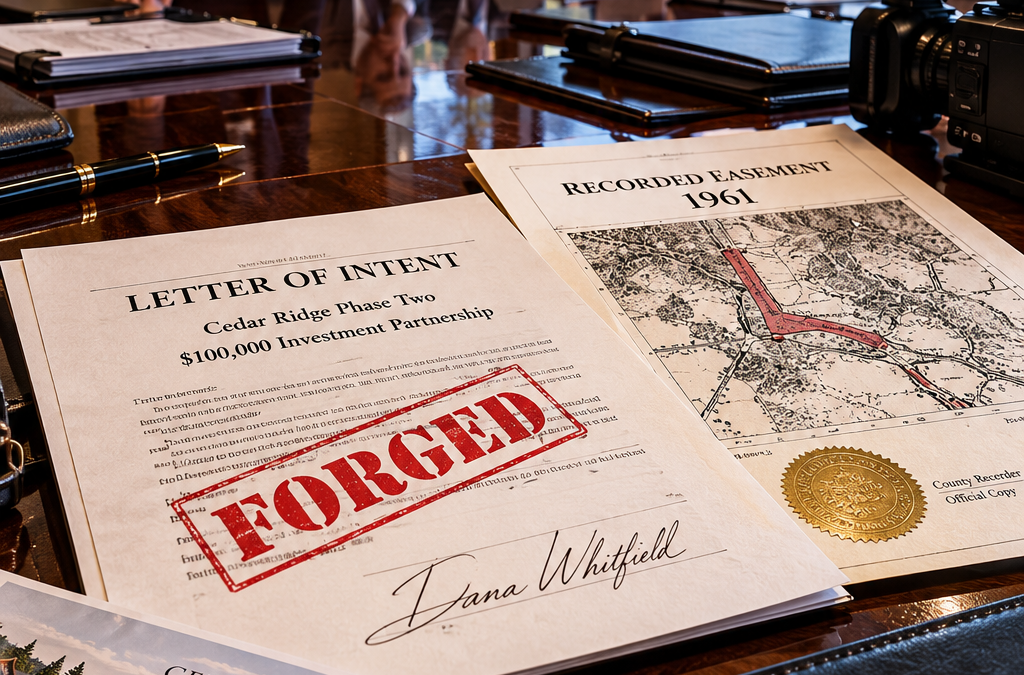
A letter of intent.
According to the document, Milbrook Ironworks had committed to providing custom entrance gates, fireplace hardware, architectural fixtures, hand-forged cabinet hardware, exterior railings, and decorative metalwork for all twenty proposed cabins.
Estimated partnership value:
More than $100,000.
At the bottom was my name.
Dana Whitfield.
And beneath it was a signature.
For one absurd second, I stared at it wondering whether there had been some document I had forgotten signing.
Then I looked closer.
I knew exactly where they had gotten it.
Two years earlier, when I fabricated the Phase One entrance gates, I had signed the final invoice by hand.
Whoever created this document had copied that signature.
They had stretched it slightly.
Smoothed it.
Dropped it onto the letter.
But it was mine.
And it wasn’t mine.
That distinction made my stomach turn.
I called Margaret back.
“Where did you get this?”
“A developer forwarded it to my husband. Dana, are you telling me this isn’t real?”
“No.”
My voice sounded distant even to me.
“I’m telling you I have never seen that letter before tonight.”
The silence on the other end was immediate.
“Oh, my God.”
After we hung up, I stayed in the office for nearly an hour.
Anger came first.
Hot and clean.
Then fear.
Not fear of Regina.
Fear of what could happen once a lie like that started moving.
What if suppliers saw it?
What if clients thought I had committed my shop to months of Cedar Ridge work?
What if someone made financial decisions believing I had guaranteed production?
What if Cedar Ridge collapsed and my name was attached to it?
Milbrook Ironworks wasn’t just a business to me.
It was sixty-five years of my family’s reputation.
My grandfather had built it.
My father had protected it.
I had inherited not only the equipment and the property but every handshake that had come before me.
We survived because people trusted our word.
A forged signature attacked the one thing I could not replace with money.
Trust.
I printed the entire prospectus.
The next morning, I drove to the Cedar Ridge clubhouse.
I didn’t call first.
I didn’t want Regina prepared.
The clubhouse lobby looked exactly the way Regina liked everything to look—stone fireplace, leather furniture, polished floors, flower arrangement that probably cost more than some people’s monthly groceries.
Regina was standing near the main entrance with a clipboard while two men in expensive outdoor jackets waited beside her.
Investors, I assumed.
Perfect.
“Regina.”
She turned.
Her smile faded slightly when she saw the papers in my hand.
“Dana. I’m in the middle of something.”
“So am I.”
I held up the prospectus.
“We need to talk.”
Her eyes flicked toward the two men.
“Can it wait?”
“No.”
That got her attention.
I walked closer.
“You used my business name, my photographs, and a forged copy of my signature on a letter claiming I agreed to more than a hundred thousand dollars in work.”
The two men stopped pretending not to listen.
Regina gave a quick little laugh.
It was the laugh people use when they need everyone else to believe a problem is beneath notice.
“Dana, relax.”
I stared at her.
She lowered her voice.
“It’s a marketing piece.”
“It’s a letter of intent.”
“It’s preliminary.”
“It has my signature on it.”
She exhaled through her nose.
“Everyone in this county knows Milbrook. I assumed you’d appreciate the exposure.”
That sentence almost made me laugh.
“Exposure?”
“Yes.”
“For my own company?”
“You know what I mean.”
“No, Regina. Explain it.”
Her expression tightened.
She glanced toward the investors again.
Then she stepped closer to me.
“The deal isn’t final yet. Nothing has been executed. It was simply included to reassure investors that we have established local partners.”
“By telling them I signed something I didn’t sign.”
“You’re making this unnecessarily dramatic.”
I opened the prospectus and pointed at the bottom of the letter.
“Did I write that signature?”
Regina crossed her arms.
“Dana—”
“Yes or no?”
She looked at me with open irritation.
“No, obviously you didn’t personally put pen to paper.”
One of the investors shifted behind her.
I felt my pulse slow.
There are moments when anger becomes useful.
That was one of them.
“Did I authorize anyone else to sign for me?”
“No.”
“Did I agree to supply Phase Two?”
“Not formally.”
“Did I approve the quote attributed to me?”
She rolled her eyes.
“It’s marketing language.”
“That isn’t what I asked.”
Regina’s jaw flexed.
“No.”
I nodded.
“So you knowingly distributed a financing document using my business, a fabricated quote, and a signature I never authorized.”
She waved one hand.
“Stop calling it a financing document like we’re committing securities fraud. It’s a prospectus. Nobody is going to sue anybody over a little enthusiasm on paper.”
I kept looking at her.
She should have stopped.
Instead, Regina smiled.
“You run a blacksmith shop, Dana. This is a multimillion-dollar development process. Sometimes materials go out before every minor partner has been fully onboarded.”
Minor partner.
The words landed harder than I expected.
Maybe because they revealed exactly how she saw me.
Not as an owner.
Not as a businesswoman.
Not as someone whose consent mattered.
I was decoration.
Local authenticity.
A photograph of sparks flying from an anvil that made her luxury cabins feel genuine.
“You never onboarded me at all,” I said.
“I was going to call you after closing.”
“And tell me what?”
“That you now owed me twenty cabins’ worth of metalwork?”
She sighed dramatically.
“Honestly, Dana, I thought you’d be grateful.”
“Grateful that you forged my signature?”
Her expression hardened.
“It’s not forgery.”
“What is it?”
“Marketing.”
She said the word as if that settled everything.
Then she looked me up and down.
I was wearing work boots, jeans, and a canvas jacket with a burn mark near one cuff.
Regina gave a small, dismissive smile.
“Now, if you’ll excuse me, I have investors waiting. And frankly, you’re not exactly dressed for this kind of meeting.”
Something inside me became very calm.
I folded the prospectus.
“Correct it.”
“What?”
“Send a written retraction to every person who received this. Remove my company. Remove my photographs. Remove the letter.”
Regina turned away.
“We’ll deal with it later.”
“No. You’ll deal with it now.”
She looked back at me.
“Dana, don’t make threats you can’t enforce.”
That was the moment everything changed.
Because Regina thought my leverage was the forged letter.
It wasn’t.
The forged letter was merely the reason I had finally decided to use the leverage my family had owned for sixty-five years.
I walked out of the clubhouse without another word.
The moment the doors closed behind me, I took out my phone.
My hands were steady.
I called my attorney.
His name was Daniel Reeves.
Daniel had represented Milbrook for nearly a decade and had the irritating habit of becoming calmer the more serious a problem became.
When I finished explaining what Regina had done, he was silent for several seconds.
Then he said, “Send me everything.”
“I already have printed copies.”
“Good.”
“There’s something else.”
“What?”
“The western easement.”
Another pause.
“What about it?”
“They’re using it for Phase Two.”
His tone changed immediately.
“Construction traffic?”
“I’ve already seen survey trucks and equipment trailers.”
“Did you give written commercial permission?”
“No.”
“Did your father?”
“No.”
“Your grandfather?”
“Not for Cedar Ridge. Obviously.”
Daniel inhaled slowly.
“Bring me the deed file.”
I already knew what was in it.
My grandfather had acquired the western strip in 1961 when he purchased the original forge property.
The recorded documents included an eleven-foot right-of-way easement running across our land toward what was then timber acreage.
The terms were unusual because the road had originally served logging operations.
Commercial traffic exceeding two tons required written permission from the controlling landowner.
That permission was expressly revocable.
When Cedar Ridge Phase One was built, most construction used another approach from the southern side.
But Phase Two was different.
The terrain around the proposed cabins and lodge made that old road the only practical route wide and stable enough for concrete trucks, cranes, excavation equipment, and large material deliveries.
Regina had apparently assumed that because residents occasionally used the road and because light maintenance vehicles passed through, Cedar Ridge had permanent commercial access.
They did not.
By three that afternoon, Daniel had confirmed it.
“The recorded language is clear,” he told me.
I was sitting across from him in his office with the original deed file open between us.
“No construction traffic over two tons without written permission from Milbrook.”
“And they don’t have it.”
“No.”
“Can I revoke access immediately?”
He looked at me.
“You never granted commercial permission in the first place. But yes, we can send formal notice stating that any implied tolerance is revoked effective immediately.”
I leaned back.
For the first time since seeing that signature, I felt like I could breathe.
Daniel studied me.
“Dana, I want to be clear about something.”
“I know.”
“This cannot look retaliatory.”
“It isn’t.”
“Then give me a legitimate basis.”
“That road crosses active industrial property. Heavy equipment has been entering without scheduling, spotters, or coordination. We’ve had trucks passing within yards of employee parking.”
“Documented?”
“I have security footage.”
“Good.”
He nodded.
“We cite safety exposure, unauthorized heavy traffic, and noncompliance with the recorded easement terms. We send notice to the HOA, developer, general contractor, and title counsel if we can identify them.”
I looked at the forged letter sitting on his desk.
“And the signature?”
“Separate cease and desist. Separate issue.”
“Can they really claim this was just marketing?”
“They can claim whatever they want.”
“That isn’t what I asked.”
Daniel almost smiled.
“No. A fabricated signature on a document presented to investors as evidence of a commercial commitment is not magically harmless because Regina calls it marketing.”
I looked out his office window.
I had expected vindication to feel satisfying.
Instead I felt tired.
“She looked me in the face and admitted it.”
“Where?”
“The clubhouse lobby.”
“Anyone present?”
“Two investors.”
“Excellent.”
I frowned at him.
“That’s a strange response.”
“Professionally excellent. Morally appalling.”
That made me laugh for the first time all day.
Daniel sent the letters that afternoon.
One demanded immediate withdrawal of every prospectus containing my name, photographs, fabricated quote, or forged signature.
The other revoked all commercial and construction access across the Milbrook easement effective immediately.
Then I asked him one more question.
“When is their closing?”
He looked at the prospectus.
“You know?”
“It’s in there.”
Regina had been so confident that she had included the title company, date, and scheduled signing window in the investor materials.
Daniel read it.
“Friday.”
“Can I attend?”
He leaned back.
“That depends on what you mean by attend.”
“I mean walk in with proof before they close.”
His eyebrows rose.
“You enjoy subtlety, I see.”
“She told me not to make threats I couldn’t enforce.”
“That is not a legal reason to walk into a closing.”
“No.”
I looked at him.
“But fraud is.”
Daniel was quiet.
Then he nodded toward the forged letter.
“Bring a clean copy of your authentic signature.”
“I can do better.”
Back at Milbrook, I pulled the original two-year-old entrance gate invoice from our records.
There it was.
My real signature.
The exact signature someone had copied.
I placed the invoice beside the forged letter.
Once you knew what you were looking at, the manipulation was obvious.
The proportions matched too perfectly.
Even a small flourish near the final “d” had been duplicated.
Someone had lifted it.
Friday morning arrived cold and bright.
I went to the workshop as usual.
That surprised my crew.
My foreman, Luis, watched me light the forge.
“You’re going to the closing today, right?”
“At ten.”
He looked at the clock.
It was seven twenty.
“And you’re working first?”
“I work every morning.”
Luis stared at me.
“You know normal people would be pacing around their kitchen.”
“I’m not normal people.”
“That part I know.”
I smiled.
Then I spent the next hour shaping a length of heated steel for a decorative bracket.
Hammer.
Turn.
Hammer.
Turn.
Back to the fire.
There was comfort in the rhythm.
Metalwork punishes distraction.
If your mind wanders, you miss your heat.
If you swing angry, you miss your mark.
If you rush, the material shows it.
By the time I shut down and cleaned up, my anger had condensed into something harder.
Resolve.
I changed my shirt.
Kept my work boots.
Picked up the document folder.
And drove downtown.
The title company occupied the second floor of a restored brick building near the courthouse.
I arrived fifteen minutes after the scheduled start.
That was intentional.
I wanted the closing underway.
Not finished.
Underway.
The receptionist looked up when I entered.
“Can I help you?”
“I’m here for the Cedar Ridge Phase Two closing.”
“Are they expecting you?”
“No.”
That made her hesitate.
Before she could stop me, a woman stepped out from the hallway.
Late fifties.
Gray suit.
Sharp eyes.
Professional posture.
I later learned her name was Patricia Hale, the senior closing officer.
“Who are you?” she asked.
“Dana Whitfield. Milbrook Ironworks.”
Recognition flashed across her face.
That told me everything.
She had seen my name in the documents.
“I need five minutes in that room.”
“Ms. Whitfield, the closing is private.”
“I understand.”
I handed her the forged letter.
Then the authentic invoice.
“Your closing package contains a commercial letter of intent with my forged signature.”
Patricia looked down.
Her expression did not change, but her attention sharpened instantly.
“I also formally revoked construction access to the development site three days ago.”
I handed her the easement.
She read the first page.
Then looked at me.
“Wait here.”
She disappeared into the conference room.
Less than a minute later, the door opened.
“Come in.”
The room was larger than I expected.
Mahogany table.
Leather chairs.
Water glasses.
Coffee.
Stacks of documents.
A small camera mounted near the far wall with a red recording light illuminated.
There were twelve people in the room.
Regina.
Two investors.
The developer.
Attorneys.
A representative from the financing side.
Patricia.
And several others whose names I never caught.
Regina saw me.
Her face went white.
“What are you doing here?”
“This is a private closing.”
I walked to the table.
Nobody stopped me.
I placed the forged letter in the center.
Then the original invoice carrying my authentic signature.
Then the certified easement.
“Good morning.”
I looked around the table.
“My name is Dana Whitfield. I own Milbrook Ironworks.”
One investor looked at his packet.
I continued.
“My company appears on page four of the investment prospectus you received.”
Regina interrupted.
“Patricia, this is completely inappropriate.”
Patricia raised one hand.
“Let her finish.”
That silenced Regina.
I looked directly at the investors.
“I did not sign the letter of intent included in your materials.”
Nobody moved.
“I did not agree to become Cedar Ridge’s exclusive founding artisan partner.”
The investor nearest me reached toward the forged page.
“I did not commit to supply custom metalwork for twenty cabins.”
He picked it up.
“And I never authorized the quote attributed to me.”
He looked at the signature.
Then at me.
I slid the old invoice toward him.
“That is my authentic signature from an invoice Milbrook issued Cedar Ridge two years ago.”
The investor placed the papers side by side.
The attorney beside him leaned closer.
His face changed almost immediately.
“They’re identical,” he said.
“Almost,” I answered.
“The signature on the Cedar Ridge letter appears to have been copied from the invoice.”
Regina pushed back from the table.
“That is speculation.”
I turned toward her.
“Three days ago, in your clubhouse lobby, you admitted I had not personally signed the document and had not authorized anyone else to sign it.”
Her cheeks flushed.
“I said it was preliminary.”
“You said it was marketing.”
“It was.”
One of the investors looked at her.
“Regina, did she authorize this?”
Regina’s mouth opened.
Nothing came out.
He asked again.
“Did Milbrook Ironworks authorize this letter?”
“It was part of an early partnership strategy.”
“That’s not my question.”
Regina looked around the room.
For the first time, there was nowhere safe for her eyes to land.
“Dana had expressed support for Cedar Ridge historically.”
I almost laughed.
“I fabricated two entrance gates for you.”
“That demonstrates a relationship.”
“It demonstrates that you paid an invoice.”
The developer lowered his pen.
Regina shot him a look.
Then she turned back to me.
“This entire performance is vindictive because of a minor documentation issue.”
I felt anger flare again.
“Minor?”
I tapped the forged letter.
“You put my family’s company behind a financial commitment I never agreed to make.”
“No money changed hands.”
“You presented it to investors.”
“The closing hadn’t happened.”
“That’s why I’m here before it does.”
Silence.
Regina’s breathing became audible.
Then she pointed at the easement.
“And that has nothing to do with this.”
Patricia looked down at the certified document.
“It may have quite a lot to do with this.”
Regina stiffened.
Patricia turned to me.
“Explain.”
I did.
“The only heavy-construction route into the Phase Two site crosses an eleven-foot recorded right-of-way on Milbrook property.”
The developer shook his head.
“We have access.”
“You have residential and light vehicle access.”
“We’ve been using that road for months.”
“For survey crews and pickups. The easement requires written permission from Milbrook for commercial traffic over two tons.”
The developer looked at Regina.
She looked away.
I continued.
“You do not have that permission.”
His face tightened.
“We have alternate access.”
“Where?”
“The southern route.”
One of the engineers at the table spoke quietly.
“The grade doesn’t support concrete delivery.”
Every head turned toward him.
He immediately looked uncomfortable.
The developer leaned forward.
“We can improve it.”
“With what access for the equipment?” I asked.
Nobody answered.
I placed a copy of Daniel’s notice on the table.
“Effective Tuesday, any tolerance of unauthorized commercial use was formally revoked.”
Regina’s composure finally cracked.
“You did that because of the prospectus.”
I looked at her.
“I did it because you were sending heavy construction traffic through active industrial property without written authorization.”
“You’re sabotaging the development.”
“No.”
My voice remained even.
“I am controlling access across my own land under a recorded agreement your team should have reviewed before promising investors construction access.”
One of the attorneys closed his folder.
That sound was small.
But I remember it.
Because it felt like the first brick falling.
Patricia picked up the forged letter.
Then the authentic signature.
Then the easement notice.
When she spoke, her voice was almost unnervingly calm.
“This closing is suspended immediately.”
Regina stared at her.
“What?”
“We cannot complete the transaction under these conditions.”
“This is ridiculous.”
Patricia did not blink.
“We have a material representation in the investor prospectus that is now directly disputed by the named contracting party.”
“It’s not material.”
“The prospectus identifies Milbrook as the exclusive founding artisan partner and places a six-figure commitment on that relationship.”
“That doesn’t affect the land financing.”
“It affects representations made to the parties providing financing.”
Regina’s voice rose.
“We can remove the page.”
Patricia looked at the easement.
“You also appear to have an unresolved access issue.”
“We have alternate access.”
“Your own development team just indicated that route may not support required construction traffic.”
Regina turned sharply toward the engineer.
He looked down.
Patricia continued.
“I am not making a final legal determination regarding the easement from this table. But I am absolutely not recording a closing package while primary site access is actively disputed and while one of the represented project partners is standing in this room alleging a forged signature.”
One of the investors pushed his chair back.
Regina looked at him.
“Charles, don’t overreact.”
He stood.
He was a tall man in his sixties with the restrained expression of someone trying very hard not to say what he actually thought.
“Did you forge her signature?”
Regina froze.
“Charles—”
“Yes or no?”
She glanced at me.
“It wasn’t intended as a legally binding—”
“That is not what I asked.”
The same question that had trapped her in the clubhouse had followed her into the closing room.
Did you authorize it?
Did she sign it?
Did you forge it?
Regina had plenty of words.
She had no answer.
Charles buttoned his jacket.
“Call me when counsel has reviewed this.”
He turned to his attorney.
They walked out together.
Regina stepped after him.
“Charles, please.”
The door shut.
The second investor sat motionless for perhaps twenty seconds.
Then he gathered his papers.
Regina looked desperate now.
“This is fixable.”
He glanced at the forged letter.
“Maybe.”
He stood.
“But not today.”
Then he left too.
I looked toward the camera.
The red light was still on.
Less than eleven minutes had passed since I walked into the room.
The closing was finished.
Not completed.
Finished.
Regina stood beside her chair with one hand braced against the table.
Nobody spoke to her.
That silence was harsher than anything I could have said.
For nearly a year, she had built herself around the idea that she was the person who made deals happen.
The rainmaker.
The visionary.
The woman who could turn Cedar Ridge from forty cabins around a lake into a destination development.
And now the entire room had watched two investors walk out because of a document carrying a signature she had never been entitled to use.
I should have felt triumphant.
Instead, I felt something quieter.
Relief.
My name belonged to me again.
At least in that room.
Regina finally looked at me.
There was no polish left in her expression.
“You’re proud of this?”
The question surprised me.
I studied her.
“Proud of what?”
“Destroying a year of work.”
“I didn’t put my forged signature in your prospectus.”
“You knew exactly what would happen if you came here.”
“Yes.”
“You could have handled this privately.”
I stared at her.
“I came to your clubhouse privately.”
Her mouth tightened.
“I asked you to correct it.”
She said nothing.
“I gave you the chance.”
“That didn’t require humiliating me in front of investors.”
The anger I had been containing all week finally surfaced.
Not loudly.
But completely.
“You humiliated yourself.”
Regina flinched.
“You decided my consent was optional because you thought my company looked useful in a brochure.”
“That isn’t fair.”
“You copied my signature.”
“I was trying to keep this development alive.”
“And that made my name yours?”
She looked away.
I moved closer.
“Do you know what Milbrook means to me?”
She said nothing.
“My grandfather built that shop when he had almost nothing. My father spent thirty years making sure every person who hired us knew our word meant something. I have spent my entire adult life protecting the same reputation.”
My voice tightened.
“You took sixty-five years of trust and turned it into a sales prop because you thought I was too small to challenge you.”
“That is not what happened.”
“It is exactly what happened.”
Her eyes hardened.
“You don’t understand the pressure I was under.”
“No.”
I shook my head.
“And pressure doesn’t give you ownership of other people.”
Patricia stepped closer.
“Ms. Ashworth, I strongly recommend that you stop discussing the substance of this dispute until you have counsel present.”
Regina looked at her.
Then at the nearly empty table.
Her hands began gathering papers that no longer mattered.
I picked up my authentic invoice but left copies of everything else with Patricia.
As I walked toward the door, Regina spoke behind me.
“Dana.”
I stopped.
She seemed to search for something to say.
An accusation.
A threat.
An explanation.
Instead, she whispered, “What am I supposed to do now?”
I looked back at her.
“Tell the truth.”
Then I left.
By Monday morning, half the county seemed to know.
I never figured out exactly how the story spread.
Maybe one of the investors told someone.
Maybe one of the attorneys did.
Maybe Cedar Ridge homeowners noticed construction crews had stopped showing up and started asking questions.
Small communities have their own communication systems.
Nothing stays private for long.
The Cedar Ridge board called an emergency meeting that week.
I wasn’t there.
Daniel advised me not to attend.
But afterward, three different homeowners called me.
The board had obtained a copy of the prospectus.
They reviewed the forged letter.
They reviewed the fabricated quote.
They reviewed the correspondence from my attorney.
And then they asked Regina to explain.
Apparently, she tried.
For nearly forty minutes.
She argued that the prospectus was preliminary.
She said the marketing contractor had moved too quickly.
She claimed everyone understood that letters of intent were nonbinding.
She accused me of exploiting an old easement to interfere with community growth.
But the board kept returning to one question.
Did Dana Whitfield authorize the signature?
Eventually, Regina admitted that I had not.
The vote was seven to zero.
She was removed as HOA president.
The board also prohibited her from handling future contracts or investor communications on behalf of Cedar Ridge.
When I heard the result, I sat at my desk for a long time.
I expected to feel satisfaction.
Instead, I thought about the first morning she came to my shop two years earlier to approve the entrance gate design.
She had complimented my work.
She had walked around the forge asking questions.
She had seemed genuinely impressed.
At some point between that day and the investment prospectus, admiration had become entitlement.
She had stopped seeing the person behind the work.
Maybe that was the part that bothered me most.
People often imagine theft as taking an object.
A car.
Money.
Equipment.
Jewelry.
But reputation can be stolen too.
So can consent.
So can the right to decide what your own name stands beside.
Daniel filed a formal fraud complaint with the county prosecutor’s office over the forged signature.
Separately, we pursued a civil claim involving the unauthorized commercial use of my name, business identity, photographs, fabricated endorsement, and signature.
I did not enjoy that process.
Anyone who has never been involved in legal action tends to imagine it as dramatic.
Courtrooms.
Angry speeches.
A judge bringing down a gavel.
Reality is mostly documents.
Emails.
Phone calls.
Waiting.
More documents.
Insurance representatives.
Statements.
Lawyers arguing over language one phrase at a time.
Regina retained counsel immediately.
The HOA’s insurance carrier became involved.
Their position shifted several times.
First, the document was supposedly nonbinding marketing.
Then it was an unauthorized action by a marketing vendor.
Then someone suggested the signature had been inserted as a placeholder and accidentally left in the final packet.
That argument lasted until Daniel produced the witness information from the clubhouse conversation where Regina had openly acknowledged I had not signed the document.
After that, the tone changed.
They wanted settlement discussions.
Daniel called me one afternoon.
“Sixty thousand.”
I was standing near the forge door watching rain hit the gravel yard.
“What?”
“They’ve offered sixty thousand dollars to resolve the civil claim.”
“And the retraction?”
“Included.”
“To everyone?”
“Every investor or prospective investor known to have received the prospectus.”
“My photographs?”
“Removed.”
“My company name?”
“Removed from all Cedar Ridge Phase Two materials unless you provide written consent.”
“And the apology?”
“Written.”
I was quiet.
“What about the criminal complaint?”
“That is separate. The prosecutor controls that process. The settlement does not require you to withdraw anything.”
I watched water run from the roof.
“Does Regina have to sign the retraction?”
“The HOA will.”
“That wasn’t my question.”
Daniel paused.
“We can demand that she personally acknowledge the unauthorized signature.”
I thought about it.
Then shook my head even though he couldn’t see me.
“No.”
“You sure?”
“I don’t need a confession framed on my wall.”
“Then what do you need?”
I looked back into the shop.
Luis was at the welding table.
Our youngest employee was grinding a railing panel.
The old power hammer sat in the corner, still working but getting harder to maintain every year.
“I need this finished.”
Daniel negotiated the final language.
We settled.
Sixty thousand dollars.
Written retractions.
Written apologies.
Permanent removal of Milbrook Ironworks from Cedar Ridge marketing unless I expressly approved otherwise.
No fabricated endorsements.
No unauthorized use of our photographs.
No signature.
No implied partnership.
When the final papers arrived, I signed my own name slowly.
That mattered to me.
It sounds small.
But after weeks of looking at the copied version, putting pen to paper myself felt almost ceremonial.
Dana Whitfield.
Mine.
The settlement money went straight back into Milbrook.
I had wanted a second forge bay for years.
We built it.
I bought the industrial power hammer I had been delaying because the price always felt just beyond what I could responsibly justify.
The first time we powered it on, the whole floor seemed to vibrate.
Luis stood beside me grinning.
“You know what your grandfather would say?”
I folded my arms.
“That it’s too loud?”
“That we’re spoiled.”
I laughed.
“He definitely would.”
I also hired an apprentice.
Her name was Emma Collins.
Twenty-one years old.
Smart.
Patient.
Not afraid of heat.
She had applied almost two years earlier, but I kept delaying because I wasn’t certain the shop could support another full-time trainee.
The settlement changed that.
On her first morning, I handed her an apron and brought her to my grandfather’s old anvil.
“This one is older than both of us combined,” I said.
She ran one hand over the worn face.
“You still use it?”
“Every week.”
She smiled.
“Why?”
“Because old things can still have authority.”
I heard my grandfather in my own words and had to look away for a moment.
By late fall, Milbrook was busier than ever.
The Cedar Ridge Phase Two property was not.
Without the financing package and without an approved heavy-construction route, the project sat untouched.
The developer explored alternatives.
Surveyors came back once.
Engineers inspected the southern grade.
There were rumors they might build a completely new access road from another parcel.
Maybe someday they would.
I never cared whether Phase Two eventually happened.
I had never wanted to stop Cedar Ridge from developing its own land.
That wasn’t the point.
The point was that they were going to do it without selling my name as part of the package.
One cold November afternoon, I drove the western boundary road after checking a fence line.
I stopped where my property overlooked the proposed Phase Two site.
The surveying stakes were still there.
Orange ribbons snapped in the wind.
Weeds had grown around the markers where the boutique lodge was supposed to stand.
Farther down, the gravel access road reached the edge of the Milbrook easement and simply stopped being useful.
Beyond it sat acres of untouched ground.
For a long time, I remained in my truck.
There was no dramatic feeling.
No urge to celebrate.
Just quiet.
I thought about that moment at the closing table.
The forged letter beneath the conference room lights.
Regina’s coffee cup suspended halfway to her lips.
The investor comparing the two signatures.
The red light on the title company camera.
For days afterward, people had told me how satisfying it must have been.
They imagined revenge.
But I never thought of it that way.
Revenge would have meant I wanted Regina to lose because hurting her felt good.
What I wanted was simpler.
I wanted my name back.
My grandfather used to stamp certain pieces before they left the forge.
Not everything.
Only important commissions.
A small MILBROOK maker’s mark struck into the steel.
When I was younger, I once asked him why the mark mattered when most clients already knew who had made the piece.
He handed me the stamp.
“Because once your name goes on something,” he said, “you’re telling the world you stand behind it.”
At the time, I thought he was talking about craftsmanship.
Years later, standing beside the unfinished Cedar Ridge development, I finally understood the other half of that lesson.
If your name means you stand behind something, then nobody else gets to decide where your name goes.
Nobody gets to borrow your reputation because it makes their deal look safer.
Nobody gets to manufacture your approval because asking permission might produce an answer they do not want.
And nobody gets to tell you that your consent is merely a formality.
I drove back to the workshop before dark.
Emma was finishing her first set of hand-forged hinges.
They were rough.
Uneven in places.
But good for a beginner.
She held one up nervously.
“What do you think?”
I took it from her.
The edges needed cleaning.
The pin fit was a little tight.
The taper could have been more consistent.
But the hinge was sound.
“Put your mark on it,” I said.
Her eyes widened.
“You mean it?”
“If you’re willing to stand behind the work.”
She looked at the hinge for several seconds.
Then nodded.
“Yes.”
I handed it back.
“Then it’s yours.”
Across the shop, the new power hammer struck hot steel with a deep mechanical thud.
Sparks scattered across the floor.
The second forge burned bright.
The building my grandfather started with almost nothing was fuller than it had been in years.
I stood there listening to the sound of people working and realized that the ugliest thing Regina had done had ultimately reminded me why Milbrook survived in the first place.
It wasn’t the land.
It wasn’t the tools.
It wasn’t even the iron.
It was ownership of our word.
My grandfather’s.
My father’s.
Mine.
Outside, beyond the trees, the unfinished development remained silent.
The stakes for the lodge slowly disappeared into winter grass.
And the road Regina had counted on still crossed the same eleven feet of recorded land it had crossed since 1961.
Nothing about that road looked powerful.
It was gravel.
Mud.
Pines.
An old legal description buried in county records.
But sometimes the strongest boundaries are the ones people ignore because they assume you will never enforce them.
Regina had looked at my workshop and seen a small local business she could use.
She had looked at my signature and seen decoration.
She had looked at my silence and mistaken it for permission.
What she never understood was that I had spent my life working with steel.
And steel teaches you something important.
You can bend it.
You can stretch it.
You can hammer it into almost any shape if you understand the heat.
But every piece has a point where pressure stops shaping it and starts breaking something.
Regina found mine the moment she put my name on a promise I never made.
And after that, I made certain that every promise carrying the Whitfield name belonged to the person who had earned the right to sign it.
𝗧𝗛𝗘 𝗘𝗡𝗗
The HOA Forged My Signature on a $100,000 Deal and Invited Investors to a Closing They Thought I’d Never See
The room was still smiling when I slid the forged letter of intent across the mahogany closing table, face up, and let twelve people stare at a signature that was supposed to be mine.
Regina Ashworth’s coffee cup stopped halfway to her mouth, because in that exact second she understood that the lie she had spent months selling was now sitting beneath a title company camera that was still recording.
For a moment, nobody spoke.
I could hear the low hum of the ventilation system above us and the faint scrape of paper beneath one investor’s hand.
Regina’s eyes moved from the forged letter to me.
Then to the second document I had placed beside it.
A certified copy of a recorded easement dated 1961.
Her face changed.
Not dramatically.
Regina was too practiced for that.
She had spent years mastering the kind of expression wealthy developers and ambitious board presidents wore when something went wrong in public—the tight mouth, lifted chin, controlled breathing, the silent insistence that whatever had just happened was merely an inconvenience.
But I saw the truth anyway.
Her fingers tightened around that coffee cup.
And for the first time since I had met her, Regina Ashworth looked afraid.
Three days earlier, she had laughed in my face.
Now twelve people were waiting for her to explain why she had sold them a six-figure partnership using my business, my reputation, my photographs, and a signature I had never written.
I didn’t raise my voice.
I didn’t need to.
“My name is Dana Whitfield,” I said. “I own Milbrook Ironworks. The company listed in your investment prospectus as the exclusive founding artisan partner for Cedar Ridge Phase Two.”
One of the attorneys slowly looked down at the packet in front of him.
I continued.
“I never signed that letter.”
Regina stood so quickly that her chair rolled backward several inches.
“This is a private closing.”
Her voice came out sharper than she intended.
I looked directly at her.
“Apparently not private enough to keep my name out of it.”
No one laughed.
That was when I knew the room had already shifted.
Three days earlier, Regina still believed I was just the woman with soot on her sleeves who ran the old forge down the road.
She had no idea how much that old forge controlled.
Milbrook Ironworks had been in my family since 1961.
My grandfather, Samuel Whitfield, started it with a coal forge, two anvils, one rusted pickup truck, and the kind of stubbornness that either builds a business or destroys a man trying.
In his case, it built one.
By the time my father took over, Milbrook had become known throughout the county for architectural ironwork.
We made hand-forged gates for historic homes, balcony rails for hotels, fireplace surrounds, staircase balusters, hinges, brackets, restoration hardware, and custom fixtures for anyone willing to wait for work done properly.
Nothing about the place was glamorous.
The main building was a long timber-and-steel workshop darkened by decades of smoke.
The concrete floor had scars from dropped stock and dragged equipment.
The walls held hammers older than I was.
When the forge was running, the air smelled like hot scale, coal, steel, machine oil, and sweat.
I loved every inch of it.
I grew up there.
My grandfather taught me how to swing a hammer before I was strong enough to swing it properly.
My father taught me how to judge heat by color.
Bright orange for heavy movement.
Cherry red for controlled shaping.
Dull red when the metal was losing cooperation and needed to go back into the fire.
But the most important lesson came from my grandfather.
“Steel tells you when you’re asking too much,” he used to say. “People don’t. So pay closer attention to people.”
I didn’t understand what he meant when I was twelve.
I understood perfectly by the time I met Regina Ashworth.
Our property covered eleven acres of wooded mountain ground bordering Cedar Ridge Estates.
For most of my life, that land had been quiet.
There were pines behind the forge, a narrow gravel road along the western boundary, and beyond that a slope dropping toward what used to be undeveloped timberland.
Then Cedar Ridge arrived.
The first phase brought forty luxury mountain cabins arranged around a private lake, all cedar beams, stone chimneys, polished decks, oversized windows, and marketing copy about “authentic mountain living.”
The development itself didn’t bother me.
People were allowed to build on their land.
People were allowed to make money.
I had even done business with Cedar Ridge once.
Two years earlier, their HOA had hired Milbrook to fabricate decorative entrance gates.
The job had been straightforward.
We designed a pair of heavy steel gates with forged cedar branches worked into the panels.
I invoiced the HOA.
They paid me.
I installed them.
End of relationship.
Or so I thought.
Regina Ashworth became HOA president several months later.
She was the kind of woman who could turn a neighborhood meeting into a corporate presentation.
Everything about her appeared curated.
Her clothes.
Her smile.
Her car.
The careful way she pronounced property values.
She talked about Cedar Ridge not as a place where people lived but as a “brand.”
The residents were “stakeholders.”
The lake was an “amenity anchor.”
Their annual picnic became a “community engagement event.”
I used to joke with my foreman that one day Regina would rename breathing an “oxygen utilization initiative.”
But beneath the polished language was ambition.
Real ambition.
Regina wanted Cedar Ridge Phase Two.
Twenty additional cabins.
A boutique lodge.
A larger recreation complex.
More investors.
More recognition.
She wanted Cedar Ridge to become the kind of destination people drove hours to visit and bragged about owning property in.
There was only one problem.
The development was remote.
Phase One had sold reasonably well, but outside investors were cautious about putting significant money into another round of construction so far from town.
Regina needed something that would make Phase Two feel established before the first foundation was poured.
Apparently, she decided that something would be me.
I learned about it on a Tuesday evening.
I had been at the forge since six that morning.
We were finishing a set of balcony rails for a restored hotel downtown, and one section had been fighting me all afternoon.
I had finally shut down the power hammer and was washing black scale from my hands when my phone rang.
The caller was Margaret Ellis, a client I had known for more than fifteen years.
I had restored the ironwork on her family’s Victorian house.
“Dana,” she said immediately, “congratulations.”
I leaned against the sink.
“For what?”
There was a pause.
“The Cedar Ridge project.”
I frowned.
“What Cedar Ridge project?”
“The expansion. Phase Two. I saw the investment prospectus online. Milbrook is their artisan partner.”
For several seconds I honestly thought she had confused me with someone else.
“Margaret, I’m not involved in Cedar Ridge Phase Two.”
Now she sounded confused.
“It has your name all over it.”
A strange cold feeling moved through me.
“Send me the link.”
She did.
I stood alone in the office attached to my workshop and opened the document on my computer.
The first page showed a rendering of a mountain lodge beside the lake.
The second described projected occupancy.
The third contained site plans.
Then I reached page four.
I stopped breathing.
Across the top were the words:
FOUNDING ARTISAN PARTNERSHIP — MILBROOK IRONWORKS.
Underneath were three photographs.
My photographs.
One showed me standing beside a finished gate.
Another showed a close-up of a hand-forged latch.
The third showed the interior of my forge.
They had been taken from my website.
Beneath the photographs was a paragraph describing Milbrook Ironworks as a “heritage regional partner committed to Cedar Ridge’s next chapter.”
Then came the quote.
My quote.
Except I had never said it.
“We’re thrilled to be growing alongside Cedar Ridge’s vision for the future and bringing generations of Milbrook craftsmanship to this extraordinary new community.”
I read it twice.
Then a third time.
My hands had gone completely still.
It is difficult to explain what it feels like to see words beneath your name that you never spoke.
There is a particular kind of violation in it.
Someone hasn’t simply lied about you.
They have climbed inside your identity and used your voice.
But the worst part was lower on the page.
A letter of intent.
According to the document, Milbrook Ironworks had committed to providing custom entrance gates, fireplace hardware, architectural fixtures, hand-forged cabinet hardware, exterior railings, and decorative metalwork for all twenty proposed cabins.
Estimated partnership value:
More than $100,000.
At the bottom was my name.
Dana Whitfield.
And beneath it was a signature.
For one absurd second, I stared at it wondering whether there had been some document I had forgotten signing.
Then I looked closer.
I knew exactly where they had gotten it.
Two years earlier, when I fabricated the Phase One entrance gates, I had signed the final invoice by hand.
Whoever created this document had copied that signature.
They had stretched it slightly.
Smoothed it.
Dropped it onto the letter.
But it was mine.
And it wasn’t mine.
That distinction made my stomach turn.
I called Margaret back.
“Where did you get this?”
“A developer forwarded it to my husband. Dana, are you telling me this isn’t real?”
“No.”
My voice sounded distant even to me.
“I’m telling you I have never seen that letter before tonight.”
The silence on the other end was immediate.
“Oh, my God.”
After we hung up, I stayed in the office for nearly an hour.
Anger came first.
Hot and clean.
Then fear.
Not fear of Regina.
Fear of what could happen once a lie like that started moving.
What if suppliers saw it?
What if clients thought I had committed my shop to months of Cedar Ridge work?
What if someone made financial decisions believing I had guaranteed production?
What if Cedar Ridge collapsed and my name was attached to it?
Milbrook Ironworks wasn’t just a business to me.
It was sixty-five years of my family’s reputation.
My grandfather had built it.
My father had protected it.
I had inherited not only the equipment and the property but every handshake that had come before me.
We survived because people trusted our word.
A forged signature attacked the one thing I could not replace with money.
Trust.
I printed the entire prospectus.
The next morning, I drove to the Cedar Ridge clubhouse.
I didn’t call first.
I didn’t want Regina prepared.
The clubhouse lobby looked exactly the way Regina liked everything to look—stone fireplace, leather furniture, polished floors, flower arrangement that probably cost more than some people’s monthly groceries.
Regina was standing near the main entrance with a clipboard while two men in expensive outdoor jackets waited beside her.
Investors, I assumed.
Perfect.
“Regina.”
She turned.
Her smile faded slightly when she saw the papers in my hand.
“Dana. I’m in the middle of something.”
“So am I.”
I held up the prospectus.
“We need to talk.”
Her eyes flicked toward the two men.
“Can it wait?”
“No.”
That got her attention.
I walked closer.
“You used my business name, my photographs, and a forged copy of my signature on a letter claiming I agreed to more than a hundred thousand dollars in work.”
The two men stopped pretending not to listen.
Regina gave a quick little laugh.
It was the laugh people use when they need everyone else to believe a problem is beneath notice.
“Dana, relax.”
I stared at her.
She lowered her voice.
“It’s a marketing piece.”
“It’s a letter of intent.”
“It’s preliminary.”
“It has my signature on it.”
She exhaled through her nose.
“Everyone in this county knows Milbrook. I assumed you’d appreciate the exposure.”
That sentence almost made me laugh.
“Exposure?”
“Yes.”
“For my own company?”
“You know what I mean.”
“No, Regina. Explain it.”
Her expression tightened.
She glanced toward the investors again.
Then she stepped closer to me.
“The deal isn’t final yet. Nothing has been executed. It was simply included to reassure investors that we have established local partners.”
“By telling them I signed something I didn’t sign.”
“You’re making this unnecessarily dramatic.”
I opened the prospectus and pointed at the bottom of the letter.
“Did I write that signature?”
Regina crossed her arms.
“Dana—”
“Yes or no?”
She looked at me with open irritation.
“No, obviously you didn’t personally put pen to paper.”
One of the investors shifted behind her.
I felt my pulse slow.
There are moments when anger becomes useful.
That was one of them.
“Did I authorize anyone else to sign for me?”
“No.”
“Did I agree to supply Phase Two?”
“Not formally.”
“Did I approve the quote attributed to me?”
She rolled her eyes.
“It’s marketing language.”
“That isn’t what I asked.”
Regina’s jaw flexed.
“No.”
I nodded.
“So you knowingly distributed a financing document using my business, a fabricated quote, and a signature I never authorized.”
She waved one hand.
“Stop calling it a financing document like we’re committing securities fraud. It’s a prospectus. Nobody is going to sue anybody over a little enthusiasm on paper.”
I kept looking at her.
She should have stopped.
Instead, Regina smiled.
“You run a blacksmith shop, Dana. This is a multimillion-dollar development process. Sometimes materials go out before every minor partner has been fully onboarded.”
Minor partner.
The words landed harder than I expected.
Maybe because they revealed exactly how she saw me.
Not as an owner.
Not as a businesswoman.
Not as someone whose consent mattered.
I was decoration.
Local authenticity.
A photograph of sparks flying from an anvil that made her luxury cabins feel genuine.
“You never onboarded me at all,” I said.
“I was going to call you after closing.”
“And tell me what?”
“That you now owed me twenty cabins’ worth of metalwork?”
She sighed dramatically.
“Honestly, Dana, I thought you’d be grateful.”
“Grateful that you forged my signature?”
Her expression hardened.
“It’s not forgery.”
“What is it?”
“Marketing.”
She said the word as if that settled everything.
Then she looked me up and down.
I was wearing work boots, jeans, and a canvas jacket with a burn mark near one cuff.
Regina gave a small, dismissive smile.
“Now, if you’ll excuse me, I have investors waiting. And frankly, you’re not exactly dressed for this kind of meeting.”
Something inside me became very calm.
I folded the prospectus.
“Correct it.”
“What?”
“Send a written retraction to every person who received this. Remove my company. Remove my photographs. Remove the letter.”
Regina turned away.
“We’ll deal with it later.”
“No. You’ll deal with it now.”
She looked back at me.
“Dana, don’t make threats you can’t enforce.”
That was the moment everything changed.
Because Regina thought my leverage was the forged letter.
It wasn’t.
The forged letter was merely the reason I had finally decided to use the leverage my family had owned for sixty-five years.
I walked out of the clubhouse without another word.
The moment the doors closed behind me, I took out my phone.
My hands were steady.
I called my attorney.
His name was Daniel Reeves.
Daniel had represented Milbrook for nearly a decade and had the irritating habit of becoming calmer the more serious a problem became.
When I finished explaining what Regina had done, he was silent for several seconds.
Then he said, “Send me everything.”
“I already have printed copies.”
“Good.”
“There’s something else.”
“What?”
“The western easement.”
Another pause.
“What about it?”
“They’re using it for Phase Two.”
His tone changed immediately.
“Construction traffic?”
“I’ve already seen survey trucks and equipment trailers.”
“Did you give written commercial permission?”
“No.”
“Did your father?”
“No.”
“Your grandfather?”
“Not for Cedar Ridge. Obviously.”
Daniel inhaled slowly.
“Bring me the deed file.”
I already knew what was in it.
My grandfather had acquired the western strip in 1961 when he purchased the original forge property.
The recorded documents included an eleven-foot right-of-way easement running across our land toward what was then timber acreage.
The terms were unusual because the road had originally served logging operations.
Commercial traffic exceeding two tons required written permission from the controlling landowner.
That permission was expressly revocable.
When Cedar Ridge Phase One was built, most construction used another approach from the southern side.
But Phase Two was different.
The terrain around the proposed cabins and lodge made that old road the only practical route wide and stable enough for concrete trucks, cranes, excavation equipment, and large material deliveries.
Regina had apparently assumed that because residents occasionally used the road and because light maintenance vehicles passed through, Cedar Ridge had permanent commercial access.
They did not.
By three that afternoon, Daniel had confirmed it.
“The recorded language is clear,” he told me.
I was sitting across from him in his office with the original deed file open between us.
“No construction traffic over two tons without written permission from Milbrook.”
“And they don’t have it.”
“No.”
“Can I revoke access immediately?”
He looked at me.
“You never granted commercial permission in the first place. But yes, we can send formal notice stating that any implied tolerance is revoked effective immediately.”
I leaned back.
For the first time since seeing that signature, I felt like I could breathe.
Daniel studied me.
“Dana, I want to be clear about something.”
“I know.”
“This cannot look retaliatory.”
“It isn’t.”
“Then give me a legitimate basis.”
“That road crosses active industrial property. Heavy equipment has been entering without scheduling, spotters, or coordination. We’ve had trucks passing within yards of employee parking.”
“Documented?”
“I have security footage.”
“Good.”
He nodded.
“We cite safety exposure, unauthorized heavy traffic, and noncompliance with the recorded easement terms. We send notice to the HOA, developer, general contractor, and title counsel if we can identify them.”
I looked at the forged letter sitting on his desk.
“And the signature?”
“Separate cease and desist. Separate issue.”
“Can they really claim this was just marketing?”
“They can claim whatever they want.”
“That isn’t what I asked.”
Daniel almost smiled.
“No. A fabricated signature on a document presented to investors as evidence of a commercial commitment is not magically harmless because Regina calls it marketing.”
I looked out his office window.
I had expected vindication to feel satisfying.
Instead I felt tired.
“She looked me in the face and admitted it.”
“Where?”
“The clubhouse lobby.”
“Anyone present?”
“Two investors.”
“Excellent.”
I frowned at him.
“That’s a strange response.”
“Professionally excellent. Morally appalling.”
That made me laugh for the first time all day.
Daniel sent the letters that afternoon.
One demanded immediate withdrawal of every prospectus containing my name, photographs, fabricated quote, or forged signature.
The other revoked all commercial and construction access across the Milbrook easement effective immediately.
Then I asked him one more question.
“When is their closing?”
He looked at the prospectus.
“You know?”
“It’s in there.”
Regina had been so confident that she had included the title company, date, and scheduled signing window in the investor materials.
Daniel read it.
“Friday.”
“Can I attend?”
He leaned back.
“That depends on what you mean by attend.”
“I mean walk in with proof before they close.”
His eyebrows rose.
“You enjoy subtlety, I see.”
“She told me not to make threats I couldn’t enforce.”
“That is not a legal reason to walk into a closing.”
“No.”
I looked at him.
“But fraud is.”
Daniel was quiet.
Then he nodded toward the forged letter.
“Bring a clean copy of your authentic signature.”
“I can do better.”
Back at Milbrook, I pulled the original two-year-old entrance gate invoice from our records.
There it was.
My real signature.
The exact signature someone had copied.
I placed the invoice beside the forged letter.
Once you knew what you were looking at, the manipulation was obvious.
The proportions matched too perfectly.
Even a small flourish near the final “d” had been duplicated.
Someone had lifted it.
Friday morning arrived cold and bright.
I went to the workshop as usual.
That surprised my crew.
My foreman, Luis, watched me light the forge.
“You’re going to the closing today, right?”
“At ten.”
He looked at the clock.
It was seven twenty.
“And you’re working first?”
“I work every morning.”
Luis stared at me.
“You know normal people would be pacing around their kitchen.”
“I’m not normal people.”
“That part I know.”
I smiled.
Then I spent the next hour shaping a length of heated steel for a decorative bracket.
Hammer.
Turn.
Hammer.
Turn.
Back to the fire.
There was comfort in the rhythm.
Metalwork punishes distraction.
If your mind wanders, you miss your heat.
If you swing angry, you miss your mark.
If you rush, the material shows it.
By the time I shut down and cleaned up, my anger had condensed into something harder.
Resolve.
I changed my shirt.
Kept my work boots.
Picked up the document folder.
And drove downtown.
The title company occupied the second floor of a restored brick building near the courthouse.
I arrived fifteen minutes after the scheduled start.
That was intentional.
I wanted the closing underway.
Not finished.
Underway.
The receptionist looked up when I entered.
“Can I help you?”
“I’m here for the Cedar Ridge Phase Two closing.”
“Are they expecting you?”
“No.”
That made her hesitate.
Before she could stop me, a woman stepped out from the hallway.
Late fifties.
Gray suit.
Sharp eyes.
Professional posture.
I later learned her name was Patricia Hale, the senior closing officer.
“Who are you?” she asked.
“Dana Whitfield. Milbrook Ironworks.”
Recognition flashed across her face.
That told me everything.
She had seen my name in the documents.
“I need five minutes in that room.”
“Ms. Whitfield, the closing is private.”
“I understand.”
I handed her the forged letter.
Then the authentic invoice.
“Your closing package contains a commercial letter of intent with my forged signature.”
Patricia looked down.
Her expression did not change, but her attention sharpened instantly.
“I also formally revoked construction access to the development site three days ago.”
I handed her the easement.
She read the first page.
Then looked at me.
“Wait here.”
She disappeared into the conference room.
Less than a minute later, the door opened.
“Come in.”
The room was larger than I expected.
Mahogany table.
Leather chairs.
Water glasses.
Coffee.
Stacks of documents.
A small camera mounted near the far wall with a red recording light illuminated.
There were twelve people in the room.
Regina.
Two investors.
The developer.
Attorneys.
A representative from the financing side.
Patricia.
And several others whose names I never caught.
Regina saw me.
Her face went white.
“What are you doing here?”
“This is a private closing.”
I walked to the table.
Nobody stopped me.
I placed the forged letter in the center.
Then the original invoice carrying my authentic signature.
Then the certified easement.
“Good morning.”
I looked around the table.
“My name is Dana Whitfield. I own Milbrook Ironworks.”
One investor looked at his packet.
I continued.
“My company appears on page four of the investment prospectus you received.”
Regina interrupted.
“Patricia, this is completely inappropriate.”
Patricia raised one hand.
“Let her finish.”
That silenced Regina.
I looked directly at the investors.
“I did not sign the letter of intent included in your materials.”
Nobody moved.
“I did not agree to become Cedar Ridge’s exclusive founding artisan partner.”
The investor nearest me reached toward the forged page.
“I did not commit to supply custom metalwork for twenty cabins.”
He picked it up.
“And I never authorized the quote attributed to me.”
He looked at the signature.
Then at me.
I slid the old invoice toward him.
“That is my authentic signature from an invoice Milbrook issued Cedar Ridge two years ago.”
The investor placed the papers side by side.
The attorney beside him leaned closer.
His face changed almost immediately.
“They’re identical,” he said.
“Almost,” I answered.
“The signature on the Cedar Ridge letter appears to have been copied from the invoice.”
Regina pushed back from the table.
“That is speculation.”
I turned toward her.
“Three days ago, in your clubhouse lobby, you admitted I had not personally signed the document and had not authorized anyone else to sign it.”
Her cheeks flushed.
“I said it was preliminary.”
“You said it was marketing.”
“It was.”
One of the investors looked at her.
“Regina, did she authorize this?”
Regina’s mouth opened.
Nothing came out.
He asked again.
“Did Milbrook Ironworks authorize this letter?”
“It was part of an early partnership strategy.”
“That’s not my question.”
Regina looked around the room.
For the first time, there was nowhere safe for her eyes to land.
“Dana had expressed support for Cedar Ridge historically.”
I almost laughed.
“I fabricated two entrance gates for you.”
“That demonstrates a relationship.”
“It demonstrates that you paid an invoice.”
The developer lowered his pen.
Regina shot him a look.
Then she turned back to me.
“This entire performance is vindictive because of a minor documentation issue.”
I felt anger flare again.
“Minor?”
I tapped the forged letter.
“You put my family’s company behind a financial commitment I never agreed to make.”
“No money changed hands.”
“You presented it to investors.”
“The closing hadn’t happened.”
“That’s why I’m here before it does.”
Silence.
Regina’s breathing became audible.
Then she pointed at the easement.
“And that has nothing to do with this.”
Patricia looked down at the certified document.
“It may have quite a lot to do with this.”
Regina stiffened.
Patricia turned to me.
“Explain.”
I did.
“The only heavy-construction route into the Phase Two site crosses an eleven-foot recorded right-of-way on Milbrook property.”
The developer shook his head.
“We have access.”
“You have residential and light vehicle access.”
“We’ve been using that road for months.”
“For survey crews and pickups. The easement requires written permission from Milbrook for commercial traffic over two tons.”
The developer looked at Regina.
She looked away.
I continued.
“You do not have that permission.”
His face tightened.
“We have alternate access.”
“Where?”
“The southern route.”
One of the engineers at the table spoke quietly.
“The grade doesn’t support concrete delivery.”
Every head turned toward him.
He immediately looked uncomfortable.
The developer leaned forward.
“We can improve it.”
“With what access for the equipment?” I asked.
Nobody answered.
I placed a copy of Daniel’s notice on the table.
“Effective Tuesday, any tolerance of unauthorized commercial use was formally revoked.”
Regina’s composure finally cracked.
“You did that because of the prospectus.”
I looked at her.
“I did it because you were sending heavy construction traffic through active industrial property without written authorization.”
“You’re sabotaging the development.”
“No.”
My voice remained even.
“I am controlling access across my own land under a recorded agreement your team should have reviewed before promising investors construction access.”
One of the attorneys closed his folder.
That sound was small.
But I remember it.
Because it felt like the first brick falling.
Patricia picked up the forged letter.
Then the authentic signature.
Then the easement notice.
When she spoke, her voice was almost unnervingly calm.
“This closing is suspended immediately.”
Regina stared at her.
“What?”
“We cannot complete the transaction under these conditions.”
“This is ridiculous.”
Patricia did not blink.
“We have a material representation in the investor prospectus that is now directly disputed by the named contracting party.”
“It’s not material.”
“The prospectus identifies Milbrook as the exclusive founding artisan partner and places a six-figure commitment on that relationship.”
“That doesn’t affect the land financing.”
“It affects representations made to the parties providing financing.”
Regina’s voice rose.
“We can remove the page.”
Patricia looked at the easement.
“You also appear to have an unresolved access issue.”
“We have alternate access.”
“Your own development team just indicated that route may not support required construction traffic.”
Regina turned sharply toward the engineer.
He looked down.
Patricia continued.
“I am not making a final legal determination regarding the easement from this table. But I am absolutely not recording a closing package while primary site access is actively disputed and while one of the represented project partners is standing in this room alleging a forged signature.”
One of the investors pushed his chair back.
Regina looked at him.
“Charles, don’t overreact.”
He stood.
He was a tall man in his sixties with the restrained expression of someone trying very hard not to say what he actually thought.
“Did you forge her signature?”
Regina froze.
“Charles—”
“Yes or no?”
She glanced at me.
“It wasn’t intended as a legally binding—”
“That is not what I asked.”
The same question that had trapped her in the clubhouse had followed her into the closing room.
Did you authorize it?
Did she sign it?
Did you forge it?
Regina had plenty of words.
She had no answer.
Charles buttoned his jacket.
“Call me when counsel has reviewed this.”
He turned to his attorney.
They walked out together.
Regina stepped after him.
“Charles, please.”
The door shut.
The second investor sat motionless for perhaps twenty seconds.
Then he gathered his papers.
Regina looked desperate now.
“This is fixable.”
He glanced at the forged letter.
“Maybe.”
He stood.
“But not today.”
Then he left too.
I looked toward the camera.
The red light was still on.
Less than eleven minutes had passed since I walked into the room.
The closing was finished.
Not completed.
Finished.
Regina stood beside her chair with one hand braced against the table.
Nobody spoke to her.
That silence was harsher than anything I could have said.
For nearly a year, she had built herself around the idea that she was the person who made deals happen.
The rainmaker.
The visionary.
The woman who could turn Cedar Ridge from forty cabins around a lake into a destination development.
And now the entire room had watched two investors walk out because of a document carrying a signature she had never been entitled to use.
I should have felt triumphant.
Instead, I felt something quieter.
Relief.
My name belonged to me again.
At least in that room.
Regina finally looked at me.
There was no polish left in her expression.
“You’re proud of this?”
The question surprised me.
I studied her.
“Proud of what?”
“Destroying a year of work.”
“I didn’t put my forged signature in your prospectus.”
“You knew exactly what would happen if you came here.”
“Yes.”
“You could have handled this privately.”
I stared at her.
“I came to your clubhouse privately.”
Her mouth tightened.
“I asked you to correct it.”
She said nothing.
“I gave you the chance.”
“That didn’t require humiliating me in front of investors.”
The anger I had been containing all week finally surfaced.
Not loudly.
But completely.
“You humiliated yourself.”
Regina flinched.
“You decided my consent was optional because you thought my company looked useful in a brochure.”
“That isn’t fair.”
“You copied my signature.”
“I was trying to keep this development alive.”
“And that made my name yours?”
She looked away.
I moved closer.
“Do you know what Milbrook means to me?”
She said nothing.
“My grandfather built that shop when he had almost nothing. My father spent thirty years making sure every person who hired us knew our word meant something. I have spent my entire adult life protecting the same reputation.”
My voice tightened.
“You took sixty-five years of trust and turned it into a sales prop because you thought I was too small to challenge you.”
“That is not what happened.”
“It is exactly what happened.”
Her eyes hardened.
“You don’t understand the pressure I was under.”
“No.”
I shook my head.
“And pressure doesn’t give you ownership of other people.”
Patricia stepped closer.
“Ms. Ashworth, I strongly recommend that you stop discussing the substance of this dispute until you have counsel present.”
Regina looked at her.
Then at the nearly empty table.
Her hands began gathering papers that no longer mattered.
I picked up my authentic invoice but left copies of everything else with Patricia.
As I walked toward the door, Regina spoke behind me.
“Dana.”
I stopped.
She seemed to search for something to say.
An accusation.
A threat.
An explanation.
Instead, she whispered, “What am I supposed to do now?”
I looked back at her.
“Tell the truth.”
Then I left.
By Monday morning, half the county seemed to know.
I never figured out exactly how the story spread.
Maybe one of the investors told someone.
Maybe one of the attorneys did.
Maybe Cedar Ridge homeowners noticed construction crews had stopped showing up and started asking questions.
Small communities have their own communication systems.
Nothing stays private for long.
The Cedar Ridge board called an emergency meeting that week.
I wasn’t there.
Daniel advised me not to attend.
But afterward, three different homeowners called me.
The board had obtained a copy of the prospectus.
They reviewed the forged letter.
They reviewed the fabricated quote.
They reviewed the correspondence from my attorney.
And then they asked Regina to explain.
Apparently, she tried.
For nearly forty minutes.
She argued that the prospectus was preliminary.
She said the marketing contractor had moved too quickly.
She claimed everyone understood that letters of intent were nonbinding.
She accused me of exploiting an old easement to interfere with community growth.
But the board kept returning to one question.
Did Dana Whitfield authorize the signature?
Eventually, Regina admitted that I had not.
The vote was seven to zero.
She was removed as HOA president.
The board also prohibited her from handling future contracts or investor communications on behalf of Cedar Ridge.
When I heard the result, I sat at my desk for a long time.
I expected to feel satisfaction.
Instead, I thought about the first morning she came to my shop two years earlier to approve the entrance gate design.
She had complimented my work.
She had walked around the forge asking questions.
She had seemed genuinely impressed.
At some point between that day and the investment prospectus, admiration had become entitlement.
She had stopped seeing the person behind the work.
Maybe that was the part that bothered me most.
People often imagine theft as taking an object.
A car.
Money.
Equipment.
Jewelry.
But reputation can be stolen too.
So can consent.
So can the right to decide what your own name stands beside.
Daniel filed a formal fraud complaint with the county prosecutor’s office over the forged signature.
Separately, we pursued a civil claim involving the unauthorized commercial use of my name, business identity, photographs, fabricated endorsement, and signature.
I did not enjoy that process.
Anyone who has never been involved in legal action tends to imagine it as dramatic.
Courtrooms.
Angry speeches.
A judge bringing down a gavel.
Reality is mostly documents.
Emails.
Phone calls.
Waiting.
More documents.
Insurance representatives.
Statements.
Lawyers arguing over language one phrase at a time.
Regina retained counsel immediately.
The HOA’s insurance carrier became involved.
Their position shifted several times.
First, the document was supposedly nonbinding marketing.
Then it was an unauthorized action by a marketing vendor.
Then someone suggested the signature had been inserted as a placeholder and accidentally left in the final packet.
That argument lasted until Daniel produced the witness information from the clubhouse conversation where Regina had openly acknowledged I had not signed the document.
After that, the tone changed.
They wanted settlement discussions.
Daniel called me one afternoon.
“Sixty thousand.”
I was standing near the forge door watching rain hit the gravel yard.
“What?”
“They’ve offered sixty thousand dollars to resolve the civil claim.”
“And the retraction?”
“Included.”
“To everyone?”
“Every investor or prospective investor known to have received the prospectus.”
“My photographs?”
“Removed.”
“My company name?”
“Removed from all Cedar Ridge Phase Two materials unless you provide written consent.”
“And the apology?”
“Written.”
I was quiet.
“What about the criminal complaint?”
“That is separate. The prosecutor controls that process. The settlement does not require you to withdraw anything.”
I watched water run from the roof.
“Does Regina have to sign the retraction?”
“The HOA will.”
“That wasn’t my question.”
Daniel paused.
“We can demand that she personally acknowledge the unauthorized signature.”
I thought about it.
Then shook my head even though he couldn’t see me.
“No.”
“You sure?”
“I don’t need a confession framed on my wall.”
“Then what do you need?”
I looked back into the shop.
Luis was at the welding table.
Our youngest employee was grinding a railing panel.
The old power hammer sat in the corner, still working but getting harder to maintain every year.
“I need this finished.”
Daniel negotiated the final language.
We settled.
Sixty thousand dollars.
Written retractions.
Written apologies.
Permanent removal of Milbrook Ironworks from Cedar Ridge marketing unless I expressly approved otherwise.
No fabricated endorsements.
No unauthorized use of our photographs.
No signature.
No implied partnership.
When the final papers arrived, I signed my own name slowly.
That mattered to me.
It sounds small.
But after weeks of looking at the copied version, putting pen to paper myself felt almost ceremonial.
Dana Whitfield.
Mine.
The settlement money went straight back into Milbrook.
I had wanted a second forge bay for years.
We built it.
I bought the industrial power hammer I had been delaying because the price always felt just beyond what I could responsibly justify.
The first time we powered it on, the whole floor seemed to vibrate.
Luis stood beside me grinning.
“You know what your grandfather would say?”
I folded my arms.
“That it’s too loud?”
“That we’re spoiled.”
I laughed.
“He definitely would.”
I also hired an apprentice.
Her name was Emma Collins.
Twenty-one years old.
Smart.
Patient.
Not afraid of heat.
She had applied almost two years earlier, but I kept delaying because I wasn’t certain the shop could support another full-time trainee.
The settlement changed that.
On her first morning, I handed her an apron and brought her to my grandfather’s old anvil.
“This one is older than both of us combined,” I said.
She ran one hand over the worn face.
“You still use it?”
“Every week.”
She smiled.
“Why?”
“Because old things can still have authority.”
I heard my grandfather in my own words and had to look away for a moment.
By late fall, Milbrook was busier than ever.
The Cedar Ridge Phase Two property was not.
Without the financing package and without an approved heavy-construction route, the project sat untouched.
The developer explored alternatives.
Surveyors came back once.
Engineers inspected the southern grade.
There were rumors they might build a completely new access road from another parcel.
Maybe someday they would.
I never cared whether Phase Two eventually happened.
I had never wanted to stop Cedar Ridge from developing its own land.
That wasn’t the point.
The point was that they were going to do it without selling my name as part of the package.
One cold November afternoon, I drove the western boundary road after checking a fence line.
I stopped where my property overlooked the proposed Phase Two site.
The surveying stakes were still there.
Orange ribbons snapped in the wind.
Weeds had grown around the markers where the boutique lodge was supposed to stand.
Farther down, the gravel access road reached the edge of the Milbrook easement and simply stopped being useful.
Beyond it sat acres of untouched ground.
For a long time, I remained in my truck.
There was no dramatic feeling.
No urge to celebrate.
Just quiet.
I thought about that moment at the closing table.
The forged letter beneath the conference room lights.
Regina’s coffee cup suspended halfway to her lips.
The investor comparing the two signatures.
The red light on the title company camera.
For days afterward, people had told me how satisfying it must have been.
They imagined revenge.
But I never thought of it that way.
Revenge would have meant I wanted Regina to lose because hurting her felt good.
What I wanted was simpler.
I wanted my name back.
My grandfather used to stamp certain pieces before they left the forge.
Not everything.
Only important commissions.
A small MILBROOK maker’s mark struck into the steel.
When I was younger, I once asked him why the mark mattered when most clients already knew who had made the piece.
He handed me the stamp.
“Because once your name goes on something,” he said, “you’re telling the world you stand behind it.”
At the time, I thought he was talking about craftsmanship.
Years later, standing beside the unfinished Cedar Ridge development, I finally understood the other half of that lesson.
If your name means you stand behind something, then nobody else gets to decide where your name goes.
Nobody gets to borrow your reputation because it makes their deal look safer.
Nobody gets to manufacture your approval because asking permission might produce an answer they do not want.
And nobody gets to tell you that your consent is merely a formality.
I drove back to the workshop before dark.
Emma was finishing her first set of hand-forged hinges.
They were rough.
Uneven in places.
But good for a beginner.
She held one up nervously.
“What do you think?”
I took it from her.
The edges needed cleaning.
The pin fit was a little tight.
The taper could have been more consistent.
But the hinge was sound.
“Put your mark on it,” I said.
Her eyes widened.
“You mean it?”
“If you’re willing to stand behind the work.”
She looked at the hinge for several seconds.
Then nodded.
“Yes.”
I handed it back.
“Then it’s yours.”
Across the shop, the new power hammer struck hot steel with a deep mechanical thud.
Sparks scattered across the floor.
The second forge burned bright.
The building my grandfather started with almost nothing was fuller than it had been in years.
I stood there listening to the sound of people working and realized that the ugliest thing Regina had done had ultimately reminded me why Milbrook survived in the first place.
It wasn’t the land.
It wasn’t the tools.
It wasn’t even the iron.
It was ownership of our word.
My grandfather’s.
My father’s.
Mine.
Outside, beyond the trees, the unfinished development remained silent.
The stakes for the lodge slowly disappeared into winter grass.
And the road Regina had counted on still crossed the same eleven feet of recorded land it had crossed since 1961.
Nothing about that road looked powerful.
It was gravel.
Mud.
Pines.
An old legal description buried in county records.
But sometimes the strongest boundaries are the ones people ignore because they assume you will never enforce them.
Regina had looked at my workshop and seen a small local business she could use.
She had looked at my signature and seen decoration.
She had looked at my silence and mistaken it for permission.
What she never understood was that I had spent my life working with steel.
And steel teaches you something important.
You can bend it.
You can stretch it.
You can hammer it into almost any shape if you understand the heat.
But every piece has a point where pressure stops shaping it and starts breaking something.
Regina found mine the moment she put my name on a promise I never made.
And after that, I made certain that every promise carrying the Whitfield name belonged to the person who had earned the right to sign it.



