For Two Weeks My Husband Said the Dog at Our Door Was Just a Stray, but I Couldn’t Ignore the Way He Kept Looking Inside
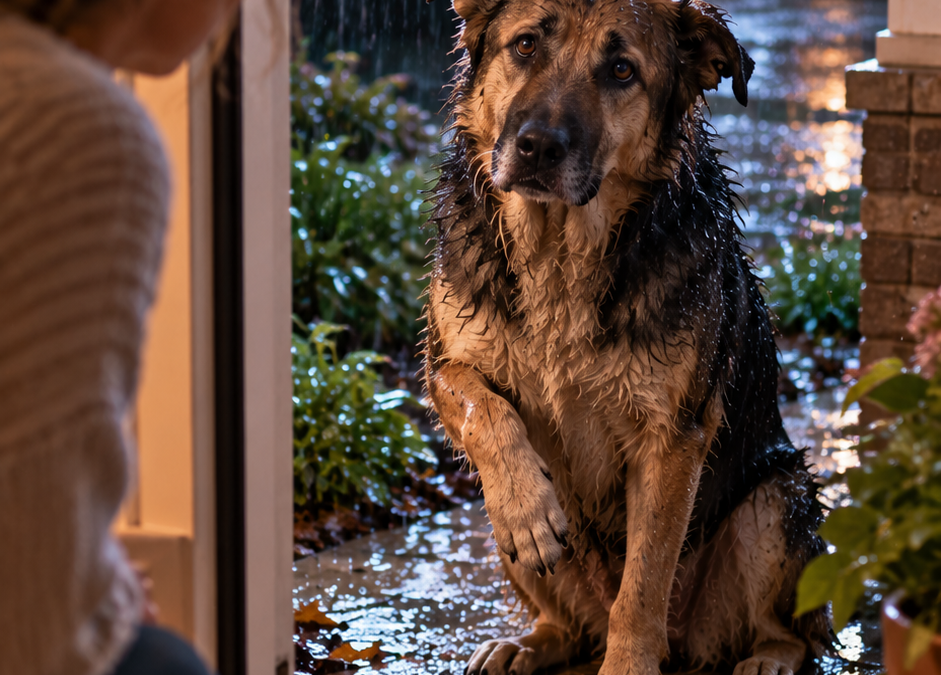
For Two Weeks My Husband Said the Dog at Our Door Was Just a Stray, but I Couldn’t Ignore the Way He Kept Looking Inside
For two weeks, my husband tried to convince me I was imagining things.
“He’s just a stray, Laura.”
Marc said it the first night.
He said it the next morning when the dog was still there.
He said it four days later when I found the same muddy animal sitting beneath our kitchen window in the rain.
And he said it again at the end of the second week, when the dog had stopped wandering around the property and begun waiting beside our back door as though he already knew which house he had chosen.
“He wants food,” Marc said.
“No.”
“What do you mean, no?”
“He wants something else.”
Marc looked through the window at the dog.
The animal was lying on the wet grass with his front paws crossed, head lifted toward the house.
“What?”
“I don’t know.”
“That’s convenient.”
“I know what hunger looks like.”
Marc folded his arms.
“You also know what imagination looks like.”
I glared at him.
He kissed my forehead and walked away.
That was Marc’s way of ending arguments he thought were ridiculous.
The problem was that I couldn’t let this one go.
There was something about the dog’s eyes.
Something that made me feel as though every time he looked through our doorway, he was asking the same question.
Can I stay?
I first saw him on a night of heavy rain.
I had gone downstairs because wind was rattling one of the kitchen windows.
The house was dark except for the small lamp above the stove.
I tightened the latch, turned to go back upstairs, and saw a shape beyond the glass.
At first, I thought it was a trash bag caught in the hedge.
Then it moved.
I stepped closer.
A dog stood outside.
Large.
Dark coat.
Broad chest.
One front paw held slightly off the ground.
Water streamed from his ears and muzzle.
His ribs were visible even through wet fur.
He wasn’t barking.
Wasn’t scratching.
Wasn’t pacing.
He simply stood there.
Watching the house.
I opened the door a few inches.
Marc’s voice came from behind me.
“What are you doing?”
I jumped.
“There’s a dog.”
“At midnight?”
“Apparently.”
He came closer.
The dog lifted his head.
Marc sighed.
“Close the door.”
“He’s soaked.”
“He’ll find somewhere dry.”
“Marc.”
“Laura.”
That tone.
The one he used when he believed I was about to complicate our lives.
“I’m not bringing him inside.”
I said.
“Good.”
“I’m giving him food.”
“That is how you bring a dog inside eventually.”
“It’s raining.”
“It rains on animals.”
I stared at him.
“Very compassionate.”
“I’m realistic.”
He disappeared upstairs.
I found an old bowl.
Water.
Some chicken left from dinner.
When I stepped outside, the dog backed away immediately.
Not far.
Five or six feet.
Enough to tell me he was afraid.
“It’s okay.”
He stared.
I put the bowls on the ground.
Then returned inside.
For twenty minutes, he did not move.
I watched from behind the curtain.
Finally, he approached.
He drank first.
For a long time.
Then smelled the chicken.
He ate only half.
That surprised me.
A dog that thin should have devoured everything.
Instead, after several bites, he turned toward the house again.
Not the food.
The house.
He lay near the back step.
In the rain.
In the morning, he was gone.
Marc looked pleased.
“See?”
“See what?”
“Stray.”
I said nothing.
That evening, he came back.
Same dog.
Same place.
This time the weather was dry.
He sat beside the door.
When I approached the glass, his tail moved once.
Not excitement.
Acknowledgment.
“You again.”
Marc looked over my shoulder.
“You fed him.”
“Yes.”
“So he came back.”
“That doesn’t explain why he’s staring into the house.”
“He’s looking at the woman with chicken.”
I opened the door.
The dog retreated.
I placed food outside.
He ate.
Again, not all of it.
Then sat.
Watching.
The third night, the same.
The fourth.
By the fifth day, I had begun thinking about him at work.
Was he there?
Had he left?
Was he injured?
Had he belonged to someone?
I started putting a towel near the back step.
Marc discovered it.
“Laura.”
“What?”
“You gave him bedding.”
“It is a towel.”
“It is the first stage of dog ownership.”
“He doesn’t even come inside.”
“Yet.”
The dog appeared almost every day.
Sometimes in the morning.
Sometimes late afternoon.
Always returning.
He explored the yard but never wandered far once we were home.
When I went outside, he watched.
If I tried moving closer, he backed away.
Not aggressively.
His fear had structure.
He wanted proximity without contact.
That fascinated and disturbed me.
Something had happened to him.
I started sitting on the back step.
No reaching.
No food in my hands.
Just sitting.
The first time, he remained nearly twenty feet away.
The second, perhaps fifteen.
By the end of the first week, he sat near the hedge while I drank coffee.
Marc opened the kitchen window.
“This is how cults begin.”
I turned.
“What?”
“You’re both just sitting there staring at each other.”
“Go away.”
The dog looked toward Marc.
Marc pointed.
“See? Judgmental.”
I laughed.
The dog’s ears shifted.
For half a second, his mouth opened slightly.
Not quite a smile.
Something close.
“Did you see that?”
I whispered.
Marc was already gone.
I began calling the dog “Boy” because I needed something to say.
“Morning, Boy.”
“Food’s there.”
“Don’t worry.”
“You’re safe.”
Safe.
I said that word often.
I don’t know why.
Maybe because he looked as though he had forgotten what it meant.
During the second week, he allowed me to stand within several feet.
Then one morning, he approached me first.
I was hanging laundry outside.
He came slowly.
Head low.
I stopped moving.
“Okay.”
He smelled the air around my hand.
I did not touch him.
He took another step.
His nose brushed my fingers.
My throat tightened.
“There you are.”
I whispered.
Then I made the mistake of moving my hand toward his head.
The reaction was immediate.
He recoiled.
Not merely stepping away.
He ducked violently, as though expecting a blow.
My stomach dropped.
“Oh.”
I lowered my hand.
“Sorry.”
The dog remained several feet away.
Watching.
I crouched instead.
“I won’t do that.”
His ears moved.
“Not unless you ask.”
That afternoon, I told Marc.
“He’s been hurt.”
“You don’t know that.”
“He flinched.”
“Strays flinch.”
“Not like that.”
Marc looked tired.
We had already argued about the dog too many times.
“What do you want to do?”
“Take him to a veterinarian.”
“He won’t let you touch him.”
“I’ll figure it out.”
“And if he belongs to somebody?”
“Then we find them.”
“If he doesn’t?”
I hesitated.
Marc saw it.
“No.”
“I didn’t say anything.”
“You didn’t need to.”
“Marc.”
“We are not adopting every animal that appears in the yard.”
“How many animals have appeared in our yard?”
“That is not the point.”
“He’s old.”
“Exactly.”
“He’s injured.”
“Exactly.”
“He may need us.”
Marc sighed.
“You hear yourself?”
“Yes.”
“You already decided.”
“No.”
“You have.”
I looked through the window.
The dog was asleep beside the back step.
Even asleep, his body seemed tense.
“I think he decided first.”
Marc closed his eyes.
For several seconds, he said nothing.
Then:
“Veterinarian.”
I turned.
“What?”
“We take him to a veterinarian.”
My face must have changed because he raised one finger.
“This is not agreement.”
“Of course.”
“This is identification.”
“Absolutely.”
“We check for a microchip.”
“Yes.”
“And then he goes wherever he belongs.”
I nodded.
Marc stared.
“You’re lying.”
“I’m agreeing.”
“You’re agreeing suspiciously.”
I kissed his cheek.
“Thank you.”
The next challenge was getting the dog into a car.
I did not want to force him.
So I sat near the open rear door with food.
It took nearly an hour.
Marc stood inside watching through the kitchen window.
At one point he came outside.
“You know normal people have hobbies.”
“Go back inside.”
Eventually the dog placed his front paws inside.
Then retreated.
Tried again.
Finally climbed onto the seat.
I closed the door gently.
His entire body stiffened.
I sat beside him.
“Okay.”
He panted.
“You’re okay.”
Marc drove.
I remained in back.
For the first ten minutes, the dog pressed against the door.
Then gradually he lowered himself.
His head came close to my knee.
Not touching.
Close.
At the veterinary office, he almost refused to leave the car.
A technician helped us.
The examination took patience.
He tolerated hands near his body better than his head.
The moment the veterinarian approached his ears, he recoiled.
She stopped immediately.
“We’ll go slowly.”
I noticed the expression on her face.
“What?”
“Nothing yet.”
She checked his weight.
Paws.
Legs.
Heart.
Teeth.
Scars.
Then brought out the scanner.
“Let’s see if somebody registered you.”
Marc stood near the wall.
I sat beside the dog.
The veterinarian passed the scanner over his shoulders.
Beep.
I froze.
Marc straightened.
The veterinarian looked at the screen.
“He has a chip.”
My heart began pounding.
I should have been relieved.
This was exactly what we had wanted.
Proof.
Identity.
A family.
Instead, I felt afraid.
Because suddenly the dog was not a mystery anymore.
He could belong to someone.
Someone might arrive and take him away.
That thought surprised me.
I had known him two weeks.
Apparently that was enough.
The veterinarian entered the chip number into the database.
Then stopped.
Her face changed.
“What?”
I asked.
She turned the monitor.
There was an address.
A name.
The dog’s name:
Kaiser.
I repeated it softly.
“Kaiser.”
The dog lifted his head.
Marc and I looked at each other.
Again.
“Kaiser.”
This time his ears came forward.
There was no question.
That was his name.
Beneath it:
Owner: Eleanor Bennett.
Age seventy-one.
Address in a small village near the Welsh border.
The registration had been entered eight years earlier.
The veterinarian looked from the screen to Kaiser.
“I’d estimate him around nine or ten.”
I did the math.
“So he spent almost his entire life with her.”
“Looks that way.”
Marc moved closer.
“How far away is that address?”
The veterinarian searched.
Approximately one hundred and twenty kilometers.
I stared at Kaiser.
“One hundred and twenty?”
Marc gave a disbelieving laugh.
“That’s impossible.”
“No.”
The veterinarian said.
“Difficult.”
“Not impossible.”
I looked down.
Kaiser had lowered his head onto his paws.
His eyes were closed.
For the first time since he appeared at our house, he was not watching a door.
That detail struck me later.
At the time, all I could think about was Eleanor Bennett.
I called the number listed on the chip.
No answer.
Again.
Nothing.
I left a message.
“My name is Laura. I believe I found your dog, Kaiser. Please call me.”
That sentence felt strange.
Your dog.
Not mine.
We waited.
No call.
The veterinarian gave us what information she legally could.
Kaiser needed treatment regardless of ownership.
He was severely underweight.
His paws were damaged.
He had an old injury in one front leg.
And his ears—
Those were worse than they initially looked.
Chronic inflammation.
Untreated for a long time.
The veterinarian spoke carefully.
“This would have been painful.”
“How long?”
“Potentially months.”
I looked at Kaiser.
Every time I had moved toward his head, he had flinched.
Not because someone necessarily struck him.
Touch itself had probably hurt.
That realization changed the memory.
Maybe he wasn’t afraid of hands.
Maybe he was afraid of pain.
I asked:
“Can he come home with us while we locate the owner?”
Marc looked at me.
The veterinarian looked at him.
Then back at me.
“For now, yes, assuming you’re willing to manage treatment.”
“We are.”
Marc started:
“Laura—”
“We are.”
He sighed.
“We are.”
The next day, my phone rang.
Unknown number.
I answered immediately.
“Hello?”
“Is this Laura?”
An older man’s voice.
“Yes.”
“You called about Eleanor Bennett’s dog.”
I stood.
“Yes.”
“Is Kaiser with you?”
“He is.”
The man exhaled.
A long sound.
“Good.”
Something about the way he said it made my chest tighten.
“Are you family?”
“No.”
“Neighbor.”
He told me his name, but what mattered was the story.
Eleanor had been forced to move three months earlier because of health problems.
Her daughter had taken her in.
The move had happened quickly.
Too quickly.
Doctors.
Packing.
People coming and going.
Someone was supposed to take Kaiser to a shelter.
The neighbor did not know exactly who.
Only that arrangements had been discussed.
“Then the movers came.”
he said.
“There was noise.”
“Doors open.”
“Kaiser got frightened.”
“He ran.”
“Did anyone search?”
“For a while.”
His voice carried shame that perhaps did not belong entirely to him.
“We thought he’d come back.”
“He knew the village.”
“He always came back.”
“But he didn’t.”
“And Eleanor?”
“She couldn’t return.”
“Health.”
“She was devastated.”
I sat down.
“Does she know he was lost?”
“Yes.”
“Can she take him back?”
Silence.
“No.”
I looked toward the living room.
Kaiser lay near the doorway.
Always near an exit.
Always where he could see if someone left.
“Was he loved?”
I asked.
The neighbor sounded surprised.
“Yes.”
“Very much.”
“Eleanor had him almost his whole life.”
“Why were his ears untreated?”
“I don’t know.”
“Her health got bad.”
“Maybe things slipped.”
The answer hurt because it was probably true.
Neglect does not always begin with lack of love.
Sometimes capacity disappears before affection does.
People become sick.
Overwhelmed.
Old.
Responsibilities fall apart.
The result for the animal is still pain.
Both things can be true.
“What happens now?”
I asked.
“I suppose the shelter.”
He said.
I closed my eyes.
Shelters near us were overloaded.
I knew that already.
“So nobody is coming for him?”
“No.”
I looked at Kaiser.
He looked back.
For the first time in two weeks, something inside me settled.
I thanked the neighbor.
Hung up.
Marc was standing behind me.
“How much did you hear?”
“Enough.”
I told him everything.
He rubbed one hand across his face.
“This is a mess.”
“He has nowhere to go.”
“He has an owner.”
“Who can’t care for him.”
“That doesn’t make him ours.”
“I know.”
“We can’t just take someone else’s dog.”
“I know.”
“You’re saying ‘I know’ in the way you do when you’re going to ignore everything after it.”
“Marc.”
“No.”
He paced toward the kitchen.
I followed.
“He walked one hundred and twenty kilometers.”
“We don’t know that.”
“His registered home is one hundred and twenty kilometers away.”
“That doesn’t prove he walked directly.”
“Fine.”
“He traveled one hundred and twenty kilometers through somewhere.”
“Fields.”
“Roads.”
“Woods.”
“Rain.”
“Hungry.”
“Injured.”
Marc turned.
“And somehow ended here.”
“Yes.”
“Why us?”
“I don’t know.”
“That is exactly my point.”
“No.”
I looked toward Kaiser.
“He didn’t come because we were special.”
Marc frowned.
“He came because I opened the door.”
Silence.
I continued.
“He needed somewhere people would let him stay.”
“That could have been any house.”
“Yes.”
“But it was ours.”
Marc looked frustrated.
“You’re turning coincidence into destiny.”
“No.”
“I’m turning a dog into a dog.”
“He needed help.”
“We gave it.”
“That doesn’t mean we keep him forever.”
“Where do you want him to go?”
Marc said nothing.
“The shelters are full.”
“Eleanor can’t care for him.”
“He’s old.”
“He’s injured.”
“He’s been wandering long enough to lose almost nine kilos.”
I felt my voice breaking.
“And he still came to our door.”
Marc looked down.
“Laura.”
“What?”
“We didn’t plan for a dog.”
“Kaiser didn’t plan for this either.”
That ended it.
Not because Marc agreed.
Because there was nothing easy left to say.
He sat at the kitchen table.
Kaiser remained near the doorway.
After a long time, Marc asked:
“Does he snore?”
I stared.
“What?”
“Old dogs snore.”
“Is that your concern?”
“I value sleep.”
I started laughing.
He looked irritated.
“What?”
“You’re surrendering.”
“I am not.”
“Yes, you are.”
“I asked a medical question.”
“Kaiser can stay?”
Marc sighed so dramatically that Kaiser lifted his head.
“Fine.”
I waited.
“At least he doesn’t snore.”
Marc muttered.
That turned out to be spectacularly wrong.
Kaiser’s recovery took nearly three months.
There was no instant transformation.
No moment when we fed him once, gave him a bed, and he understood he was safe forever.
Trust did not work like that.
His body began healing before his fear did.
The veterinarian built a careful feeding plan.
Kaiser had lost close to nine kilograms.
His paws were raw enough that some pads still bled.
For the first several days, walks were short.
Only enough for bathroom breaks.
The old front-leg fracture had healed badly long before his journey.
Cold weather would probably always make him limp.
His ears required ongoing treatment.
That became the hardest part.
The first time I approached with medication, Kaiser backed himself against the wall.
I stopped.
“Okay.”
His eyes fixed on the bottle.
Maybe he recognized the shape.
Maybe only my hand near his head frightened him.
I sat on the floor.
Did nothing.
For ten minutes.
Then twenty.
Kaiser slowly lowered himself.
I talked.
Not about anything important.
Work.
The weather.
Marc.
“Kaiser, you should know Marc thinks you are temporary.”
Kaiser’s ears moved.
“He is wrong.”
From the doorway, Marc said:
“I can hear you.”
“Good.”
“He’s manipulating you.”
“He is lying on a blanket.”
“Exactly.”
Eventually, Kaiser allowed me to touch the side of his face.
Then his ear.
He flinched.
I stopped.
Tried later.
The process took days.
By the end of the first week, he understood something.
My hand approaching did not always mean pain.
Sometimes medicine hurt briefly.
Then relief followed.
His body began changing.
Eyes brighter.
Coat cleaner.
More energy.
But emotionally he remained watchful.
For the first week, Kaiser would not eat unless I sat beside him.
If I placed the bowl down and walked away, he stared.
Sometimes he followed me instead.
“Eat.”
I pointed.
Nothing.
I sat.
He ate.
The first morning I left for work after we officially decided to keep him, Kaiser panicked.
Not dramatically.
No destruction.
That almost made it worse.
He stood at the door.
Watching.
I touched his shoulder.
“I’ll be back.”
His body went rigid.
“You don’t believe me.”
I understood.
Someone had left before.
Maybe Eleanor had not chosen to abandon him emotionally.
Kaiser did not understand medical necessity.
He understood one thing.
His person disappeared.
Then strangers came.
Then noise.
Then he ran.
Then home was gone.
I crouched.
“I am coming back.”
Marc stood behind me with coffee.
“You realize he doesn’t speak English.”
“He understands more than you.”
“I was afraid you’d say that.”
I went to work.
When I returned that evening, Kaiser was waiting at the door.
The moment I stepped inside, he pressed his body against my legs.
Not jumping.
Not wild.
Relief.
Pure relief.
I nearly cried.
“You see?”
I whispered.
“I came back.”
The pattern repeated for weeks.
Every time I left, he watched.
Every time I returned, he confirmed.
Then one day, something changed.
I came home.
Kaiser was sleeping.
He did not hear me at first.
I stood in the doorway looking at him.
That small moment meant more to me than any dramatic greeting.
He had slept while I was gone.
He trusted the house enough to close his eyes.
But before that came the night Marc discovered Kaiser absolutely did snore.
I woke because something warm touched my hand.
At first, I thought Marc had moved.
Then I felt fur.
I opened my eyes.
Kaiser had climbed onto the bed.
I had no idea how long he’d been there.
His head rested beside my pillow.
One ear almost touched my cheek.
He was asleep.
Completely.
His breathing deep.
And with each exhale came a low rumbling snore.
I smiled.
Then Marc rolled over.
“What is that?”
I whispered:
“Kaiser.”
Another snore.
Marc opened one eye.
The dog snored again.
Louder.
Marc stared.
“You lied.”
“What?”
“You said he didn’t snore.”
“You asked before we’d heard him sleep.”
“This is industrial.”
I started laughing.
Kaiser’s tail moved once.
While he was asleep.
That stopped me.
I watched it.
One small sweep across the blanket.
Then stillness.
Even asleep, surrounded by warmth, hearing us talk, something inside him knew he was safe.
Marc muttered:
“All right.”
“What?”
“I admit he was searching for something.”
I smiled.
Marc pulled the blanket higher.
“Earplugs.”
“What?”
“He was searching for earplugs.”
I laughed into the pillow.
Kaiser’s tail moved again.
That night, he slept between us until morning.
Marc claimed he hated it.
Two weeks later, I found him buying a dog bed online.
“What is that?”
“Nothing.”
“Marc.”
“Discount.”
“It’s orthopedic.”
“Old dog.”
“So he is staying?”
“He’s been staying.”
“That’s not what I asked.”
Marc clicked the purchase button.
“Don’t start.”
The bed arrived.
Marc assembled the raised frame himself.
Kaiser ignored it.
Slept beside the sofa.
Marc looked personally offended.
“I paid good money for that.”
I said:
“He doesn’t understand consumer economics.”
Three nights later, Kaiser used it.
Marc took a picture.
He did not send it to me.
He sent it to his brother.
I discovered that by accident.
“Who are you?”
I asked.
Marc put his phone away.
“Go to work.”
Gradually, the man who had called Kaiser “just a stray” became ridiculous.
Morning walks.
At first, Marc claimed he walked Kaiser because I took too long getting ready.
Then because “the dog has a schedule.”
Then because “exercise is good for both of us.”
Within months, if Kaiser slept late, Marc checked whether he was sick.
One evening I arrived home and found the living room unusually quiet.
Marc was sitting on the floor with his back against the sofa.
Asleep.
Kaiser’s head rested across his lap.
Also asleep.
Both snoring.
Not similar snores.
Marc had a rough, intermittent rumble.
Kaiser produced a long vibrating sound.
Together they sounded like broken farm equipment.
I stood in the doorway trying not to laugh.
Then I sat on the floor near them.
Kaiser woke slightly.
One eye opened.
He saw me.
His tail moved once.
Then he went back to sleep.
I thought about that first rainy night.
The dog outside.
Marc telling me to close the door.
Me leaving food.
Kaiser watching the house as though the food was secondary.
For two weeks, I tried to convince Marc the dog had not appeared randomly.
But sitting there beside them, I finally understood I had been wrong too.
I kept thinking I had found Kaiser.
I hadn’t.
Kaiser had found us.
Not because he knew us.
Not because some magical force pointed toward our house.
He found a door.
One door among hundreds.
And for whatever reason, he stopped.
Maybe he smelled food.
Maybe he heard voices.
Maybe he was too tired to go farther.
Maybe there is no greater explanation.
But he stayed because we let him.
That is enough.
Two years have passed now.
Kaiser is still with us.
He regained the weight he needed.
His paw pads healed completely.
The first winter after recovery, his old front leg bothered him.
The veterinarian had warned us.
He limps more when temperatures drop.
Marc notices before I do.
“His leg is stiff.”
he says.
Then shortens the walk.
Kaiser’s ears healed too.
That mattered emotionally.
At first, any hand approaching them caused tension.
Now Marc can sit beside him at night and rub both ears gently.
Kaiser closes his eyes.
His entire face relaxes.
Sometimes I watch from across the room.
There is something almost sacred in it.
A place on his body once associated with pain became a place where affection happens.
I don’t think Kaiser forgot fear.
I think he learned that fear no longer predicted what came next.
That is different.
He changed in other ways.
He no longer waits beside the door when I leave.
That was one of the last habits to disappear.
For months, even after everything else improved, Kaiser positioned himself where he could monitor the entrance.
If Marc left, ears up.
If I left, body tense.
If both of us prepared to go, he became restless.
We worked on it.
Routine.
Return.
Again.
Again.
Again.
Leaving.
Coming back.
Nothing dramatic.
Trust built through repetition.
Now I can put on my coat and Kaiser may not even stand.
Sometimes he watches from the sofa.
As if saying:
Yes.
You leave.
You return.
I know.
The first time that happened, I almost felt offended.
“You could pretend to miss me.”
Marc said:
“This is what you wanted.”
“I wanted secure attachment.”
“You got indifference.”
Kaiser yawned.
I pointed.
“Disrespectful.”
Marc laughed.
But we both knew what the yawn meant.
Home had become predictable.
At night, Kaiser usually lies at our feet while we watch television.
His orthopedic bed is nearby.
He uses it when he chooses.
More often, he sprawls on the rug.
Sometimes Marc rubs his ears.
Sometimes I rest my foot against his side.
Kaiser breathes slowly.
Peacefully.
Two years ago, this dog could barely sleep unless he heard my voice.
Now he sleeps while we move through the house.
He knows we are there.
He knows if we leave, we come back.
That is healing.
Not forgetting what happened.
Knowing it isn’t happening anymore.
I sometimes think about Eleanor Bennett.
We never met.
I don’t know everything about her life.
I don’t know whether she thinks about Kaiser every day.
I suspect she does.
Her health forced a move she apparently did not want.
Circumstances moved faster than everyone could manage.
Kaiser got lost inside that chaos.
I have never wanted to turn her into a villain simply because we became his final home.
Love and ability are not always the same.
Sometimes people love an animal and still become unable to provide what it needs.
That is painful.
It is also real.
We eventually made sure the ownership questions were properly resolved.
Kaiser became ours.
Legally.
Practically.
Emotionally.
Though if you asked Marc, Kaiser had apparently become his long before the paperwork caught up.
Once I joked:
“You know he’s my dog.”
Marc looked genuinely offended.
“Your dog?”
“He came to me.”
“He walks with me every morning.”
“I fed him first.”
“I bought the orthopedic bed.”
“He ignored it.”
“He uses it now.”
“Because I convinced him.”
Kaiser lay between us.
Marc looked down.
“Kaiser.”
The dog’s head lifted.
“Who do you belong to?”
Kaiser looked at Marc.
Then me.
Then walked toward the kitchen.
I smiled.
“He belongs to food.”
Marc nodded.
“Fair.”
The distance still amazes me.
One hundred and twenty kilometers.
We do not know every road Kaiser took.
We cannot prove a straight path.
His journey probably wandered.
Maybe the real distance was longer.
Fields.
Small roads.
Wooded areas.
Rain.
Cold.
Unknown people.
His damaged paws.
His aching old leg.
Chronic ear pain.
Hunger.
He kept moving.
People like to romanticize that.
“Dogs know where they’re meant to go.”
Maybe.
But when I imagine Kaiser during that journey, I do not imagine certainty.
I imagine fear.
Fatigue.
Confusion.
I imagine an old dog searching without understanding why home had disappeared.
That makes what he did more powerful, not less.
Courage without fear is easy.
Continuing while frightened is harder.
Kaiser continued.
Until he reached our house.
The image I remember most clearly is not him starving.
Not the veterinarian’s screen.
Not his ruined paws.
It’s the first rainy night.
His eyes.
I stood behind the glass.
He stood outside.
He did not bark.
Did not force himself toward me.
He looked.
At the time, I thought the message in his eyes was:
Feed me.
Later:
Help me.
Now I think it was simpler.
Please don’t make me keep going.
That possibility still hurts.
Maybe our house was not a destination he had known.
Maybe it was simply the first place where someone looked back.
I can live with that explanation.
Marc now tells the story differently than he did at the beginning.
To hear him tell it, he was merely “being cautious.”
I remind him:
“You said I was losing my mind.”
“I said you were becoming emotionally invested.”
“You said, ‘That dog is just a stray.’”
“He was technically a stray.”
“You wanted to close the door.”
“It was cold.”
“That makes your argument worse.”
Marc sighs.
Then Kaiser walks over.
Marc immediately scratches behind his ears.
Traitor.
One night recently, rain struck the kitchen windows almost exactly the way it had that first evening.
I woke around midnight.
The house was dark.
For a moment, memory brought me backward.
I went downstairs.
Kaiser was asleep near the living room.
Not beside the door.
Not alert.
Sleeping.
I stood watching.
He began moving his paws.
Small movements.
Running in his dream.
One paw.
Then another.
His breathing quickened slightly.
Two years ago, I might have assumed he was reliving the journey.
Perhaps he was.
Perhaps dogs dream in fragments.
Smells.
Roads.
Rain.
Fear.
I sat beside him.
His paws continued moving.
Then he stopped.
Opened his eyes.
Saw me.
Tail.
One soft movement.
“It’s okay.”
I whispered.
“You don’t have to run anymore.”
Kaiser rested his head against my leg.
The rain continued outside.
He went back to sleep.
That was when Marc appeared in the hallway.
“What are you doing?”
“Nothing.”
“You’re talking to the dog at midnight.”
“Yes.”
He looked at Kaiser.
Then sat beside us.
For a while, neither of us spoke.
Finally Marc said:
“You were right.”
I turned.
“What?”
He stared at Kaiser.
“Two years ago.”
“Say it louder.”
“No.”
“I need documentation.”
“Forget it.”
I smiled.
Marc continued:
“He knew what he needed.”
I looked down.
“Maybe.”
“No.”
Marc rubbed Kaiser’s ear.
“I think animals know more about safety than we give them credit for.”
I laughed softly.
“That sounds suspiciously like something I would’ve said.”
“Don’t ruin this.”
“All right.”
He looked at me.
“Sometimes they know where they need to go.”
There it was.
From the man who said Kaiser was just a stray.
I leaned against Marc’s shoulder.
Kaiser sighed between us.
Maybe Marc was right.
Maybe Kaiser knew.
Not our names.
Not our address.
Not our marriage.
Not whether we had room.
He knew something smaller.
This door opened.
This woman brought food.
This voice stayed gentle.
No hand hurt when it approached.
No one drove him away.
He could stop running.
Sometimes that is all home begins as.
A place where you are allowed to stop.
Two years later, Kaiser has routines.
He waits beside Marc every morning while he ties his shoes.
He knows exactly where treats are kept.
He has learned that the refrigerator opening does not automatically mean food for him, though he continues testing this principle.
He likes one corner of the sofa despite having a very expensive dog bed.
He hates heavy rain.
He loves sun patches.
He snores loudly enough that Marc now keeps earplugs in the bedside drawer, which feels like justice.
He still limps when winter becomes particularly cold.
He still dislikes strangers touching his ears.
But with us, he closes his eyes.
He knows.
That word matters.
He knows.
For the first weeks, Kaiser knew nothing.
Would we feed him again?
Would the door open tomorrow?
Would I return from work?
Would Marc change his mind?
Would hands hurt?
Would sleep be safe?
Now he knows.
Breakfast comes.
Walks happen.
Marc complains but shares the couch.
I leave and return.
The house remains.
No one is packing it away.
No movers arrive.
No one sends him somewhere else.
He belongs.
People often say rescue stories are about humans saving animals.
That description has always felt incomplete to me.
Kaiser changed our house.
Marc became softer in ways he pretends not to notice.
I became more willing to trust what I observe even when I cannot yet prove it.
We both became more attentive to what fear looks like when it hides behind silence.
Kaiser never asked to be saved dramatically.
He did not collapse at our feet.
He did not perform some heroic act.
He stood outside in the rain.
Then came back.
Again.
Again.
Again.
Until someone understood.
Maybe that was his form of asking.
And maybe opening the door was ours.
Today, when Kaiser sleeps at our feet, I sometimes think about how close his story came to ending differently.
Another road.
Another house.
Another person who did not open the door.
A shelter with no space.
An untreated infection.
His old leg finally refusing to carry him farther.
Too many possibilities.
I don’t dwell on them.
The real story is enough.
An elderly dog lost the only home he had known.
He traveled roughly one hundred and twenty kilometers through a world he could not understand.
He arrived exhausted, underweight, injured, and afraid.
For two weeks, my husband insisted I was assigning meaning to something ordinary.
Maybe I was.
Maybe there is nothing mystical about Kaiser choosing our yard.
But meaning does not require magic.
Sometimes meaning is simply what happens after someone decides not to look away.
I looked.
Then I opened the door.
Marc eventually opened his heart.
Kaiser stopped watching the exit.
That is the entire transformation.
Three small acts.
Look.
Open.
Stay.
I used to think rescue required extraordinary courage.
Now I think sometimes it only requires being the person who says:
Come in.
You don’t have to keep going.
There is room here.
One evening not long ago, Marc and I were sitting on the couch.
Kaiser lay between our feet.
Television running.
Nothing interesting.
Rain beginning outside.
Marc leaned down and touched Kaiser’s ear.
The dog closed his eyes.
Peace.
Complete.
I watched his face.
No tension.
No question.
No waiting.
Just rest.
Marc noticed me looking.
“What?”
“Nothing.”
“You’re doing that emotional thing.”
“What emotional thing?”
“Where you look at the dog and think something dramatic.”
“I wasn’t.”
“You were.”
I smiled.
“What do you think he remembers?”
Marc looked at Kaiser.
“The old house?”
“Maybe.”
“Eleanor?”
“I’m sure.”
“The journey?”
Marc was quiet.
Then:
“Probably.”
I touched Kaiser’s shoulder.
“Do you think he knows this is permanent?”
Marc answered immediately.
“Yes.”
“How?”
“He snores.”
I laughed.
“That is your evidence?”
“A frightened dog doesn’t sleep like that.”
I looked down.
Kaiser was already drifting deeper.
Within seconds, the first low snore began.
Marc pointed.
“See?”
I smiled.
Maybe he was right.
There are many ways to recognize safety.
Sometimes it is a door staying open.
Sometimes a hand touching a painful ear without causing pain.
Sometimes eating even when nobody sits beside you.
Sometimes watching the people you love leave without believing they are gone forever.
And sometimes it is sleeping so deeply that your paws move through dreams while the house around you stays exactly where it was.
Kaiser still runs in his sleep.
I see it sometimes.
His legs twitch.
Breathing changes.
Maybe he is crossing those fields again.
Maybe he is moving along wet roads.
Maybe he is following whatever instinct carried him forward for one hundred and twenty kilometers.
I don’t wake him.
Because when the dream ends, he opens his eyes and sees us.
Marc.
Me.
His bed.
His bowl.
His house.
No rain.
No road.
No need to keep searching.
He found what he was looking for.
Not a particular address.
Not the family he had lost.
Not even me.
He found a place where someone opened the door and did not close it again.
And in the end, that was enough.
For him.
For Marc.
And, unexpectedly, for me too.
𝗧𝗛𝗘 𝗘𝗡𝗗
For Two Weeks My Husband Said the Dog at Our Door Was Just a Stray, but I Couldn’t Ignore the Way He Kept Looking Inside
For two weeks, my husband tried to convince me I was imagining things.
“He’s just a stray, Laura.”
Marc said it the first night.
He said it the next morning when the dog was still there.
He said it four days later when I found the same muddy animal sitting beneath our kitchen window in the rain.
And he said it again at the end of the second week, when the dog had stopped wandering around the property and begun waiting beside our back door as though he already knew which house he had chosen.
“He wants food,” Marc said.
“No.”
“What do you mean, no?”
“He wants something else.”
Marc looked through the window at the dog.
The animal was lying on the wet grass with his front paws crossed, head lifted toward the house.
“What?”
“I don’t know.”
“That’s convenient.”
“I know what hunger looks like.”
Marc folded his arms.
“You also know what imagination looks like.”
I glared at him.
He kissed my forehead and walked away.
That was Marc’s way of ending arguments he thought were ridiculous.
The problem was that I couldn’t let this one go.
There was something about the dog’s eyes.
Something that made me feel as though every time he looked through our doorway, he was asking the same question.
Can I stay?
I first saw him on a night of heavy rain.
I had gone downstairs because wind was rattling one of the kitchen windows.
The house was dark except for the small lamp above the stove.
I tightened the latch, turned to go back upstairs, and saw a shape beyond the glass.
At first, I thought it was a trash bag caught in the hedge.
Then it moved.
I stepped closer.
A dog stood outside.
Large.
Dark coat.
Broad chest.
One front paw held slightly off the ground.
Water streamed from his ears and muzzle.
His ribs were visible even through wet fur.
He wasn’t barking.
Wasn’t scratching.
Wasn’t pacing.
He simply stood there.
Watching the house.
I opened the door a few inches.
Marc’s voice came from behind me.
“What are you doing?”
I jumped.
“There’s a dog.”
“At midnight?”
“Apparently.”
He came closer.
The dog lifted his head.
Marc sighed.
“Close the door.”
“He’s soaked.”
“He’ll find somewhere dry.”
“Marc.”
“Laura.”
That tone.
The one he used when he believed I was about to complicate our lives.
“I’m not bringing him inside.”
I said.
“Good.”
“I’m giving him food.”
“That is how you bring a dog inside eventually.”
“It’s raining.”
“It rains on animals.”
I stared at him.
“Very compassionate.”
“I’m realistic.”
He disappeared upstairs.
I found an old bowl.
Water.
Some chicken left from dinner.
When I stepped outside, the dog backed away immediately.
Not far.
Five or six feet.
Enough to tell me he was afraid.
“It’s okay.”
He stared.
I put the bowls on the ground.
Then returned inside.
For twenty minutes, he did not move.
I watched from behind the curtain.
Finally, he approached.
He drank first.
For a long time.
Then smelled the chicken.
He ate only half.
That surprised me.
A dog that thin should have devoured everything.
Instead, after several bites, he turned toward the house again.
Not the food.
The house.
He lay near the back step.
In the rain.
In the morning, he was gone.
Marc looked pleased.
“See?”
“See what?”
“Stray.”
I said nothing.
That evening, he came back.
Same dog.
Same place.
This time the weather was dry.
He sat beside the door.
When I approached the glass, his tail moved once.
Not excitement.
Acknowledgment.
“You again.”
Marc looked over my shoulder.
“You fed him.”
“Yes.”
“So he came back.”
“That doesn’t explain why he’s staring into the house.”
“He’s looking at the woman with chicken.”
I opened the door.
The dog retreated.
I placed food outside.
He ate.
Again, not all of it.
Then sat.
Watching.
The third night, the same.
The fourth.
By the fifth day, I had begun thinking about him at work.
Was he there?
Had he left?
Was he injured?
Had he belonged to someone?
I started putting a towel near the back step.
Marc discovered it.
“Laura.”
“What?”
“You gave him bedding.”
“It is a towel.”
“It is the first stage of dog ownership.”
“He doesn’t even come inside.”
“Yet.”
The dog appeared almost every day.
Sometimes in the morning.
Sometimes late afternoon.
Always returning.
He explored the yard but never wandered far once we were home.
When I went outside, he watched.
If I tried moving closer, he backed away.
Not aggressively.
His fear had structure.
He wanted proximity without contact.
That fascinated and disturbed me.
Something had happened to him.
I started sitting on the back step.
No reaching.
No food in my hands.
Just sitting.
The first time, he remained nearly twenty feet away.
The second, perhaps fifteen.
By the end of the first week, he sat near the hedge while I drank coffee.
Marc opened the kitchen window.
“This is how cults begin.”
I turned.
“What?”
“You’re both just sitting there staring at each other.”
“Go away.”
The dog looked toward Marc.
Marc pointed.
“See? Judgmental.”
I laughed.
The dog’s ears shifted.
For half a second, his mouth opened slightly.
Not quite a smile.
Something close.
“Did you see that?”
I whispered.
Marc was already gone.
I began calling the dog “Boy” because I needed something to say.
“Morning, Boy.”
“Food’s there.”
“Don’t worry.”
“You’re safe.”
Safe.
I said that word often.
I don’t know why.
Maybe because he looked as though he had forgotten what it meant.
During the second week, he allowed me to stand within several feet.
Then one morning, he approached me first.
I was hanging laundry outside.
He came slowly.
Head low.
I stopped moving.
“Okay.”
He smelled the air around my hand.
I did not touch him.
He took another step.
His nose brushed my fingers.
My throat tightened.
“There you are.”
I whispered.
Then I made the mistake of moving my hand toward his head.
The reaction was immediate.
He recoiled.
Not merely stepping away.
He ducked violently, as though expecting a blow.
My stomach dropped.
“Oh.”
I lowered my hand.
“Sorry.”
The dog remained several feet away.
Watching.
I crouched instead.
“I won’t do that.”
His ears moved.
“Not unless you ask.”
That afternoon, I told Marc.
“He’s been hurt.”
“You don’t know that.”
“He flinched.”
“Strays flinch.”
“Not like that.”
Marc looked tired.
We had already argued about the dog too many times.
“What do you want to do?”
“Take him to a veterinarian.”
“He won’t let you touch him.”
“I’ll figure it out.”
“And if he belongs to somebody?”
“Then we find them.”
“If he doesn’t?”
I hesitated.
Marc saw it.
“No.”
“I didn’t say anything.”
“You didn’t need to.”
“Marc.”
“We are not adopting every animal that appears in the yard.”
“How many animals have appeared in our yard?”
“That is not the point.”
“He’s old.”
“Exactly.”
“He’s injured.”
“Exactly.”
“He may need us.”
Marc sighed.
“You hear yourself?”
“Yes.”
“You already decided.”
“No.”
“You have.”
I looked through the window.
The dog was asleep beside the back step.
Even asleep, his body seemed tense.
“I think he decided first.”
Marc closed his eyes.
For several seconds, he said nothing.
Then:
“Veterinarian.”
I turned.
“What?”
“We take him to a veterinarian.”
My face must have changed because he raised one finger.
“This is not agreement.”
“Of course.”
“This is identification.”
“Absolutely.”
“We check for a microchip.”
“Yes.”
“And then he goes wherever he belongs.”
I nodded.
Marc stared.
“You’re lying.”
“I’m agreeing.”
“You’re agreeing suspiciously.”
I kissed his cheek.
“Thank you.”
The next challenge was getting the dog into a car.
I did not want to force him.
So I sat near the open rear door with food.
It took nearly an hour.
Marc stood inside watching through the kitchen window.
At one point he came outside.
“You know normal people have hobbies.”
“Go back inside.”
Eventually the dog placed his front paws inside.
Then retreated.
Tried again.
Finally climbed onto the seat.
I closed the door gently.
His entire body stiffened.
I sat beside him.
“Okay.”
He panted.
“You’re okay.”
Marc drove.
I remained in back.
For the first ten minutes, the dog pressed against the door.
Then gradually he lowered himself.
His head came close to my knee.
Not touching.
Close.
At the veterinary office, he almost refused to leave the car.
A technician helped us.
The examination took patience.
He tolerated hands near his body better than his head.
The moment the veterinarian approached his ears, he recoiled.
She stopped immediately.
“We’ll go slowly.”
I noticed the expression on her face.
“What?”
“Nothing yet.”
She checked his weight.
Paws.
Legs.
Heart.
Teeth.
Scars.
Then brought out the scanner.
“Let’s see if somebody registered you.”
Marc stood near the wall.
I sat beside the dog.
The veterinarian passed the scanner over his shoulders.
Beep.
I froze.
Marc straightened.
The veterinarian looked at the screen.
“He has a chip.”
My heart began pounding.
I should have been relieved.
This was exactly what we had wanted.
Proof.
Identity.
A family.
Instead, I felt afraid.
Because suddenly the dog was not a mystery anymore.
He could belong to someone.
Someone might arrive and take him away.
That thought surprised me.
I had known him two weeks.
Apparently that was enough.
The veterinarian entered the chip number into the database.
Then stopped.
Her face changed.
“What?”
I asked.
She turned the monitor.
There was an address.
A name.
The dog’s name:
Kaiser.
I repeated it softly.
“Kaiser.”
The dog lifted his head.
Marc and I looked at each other.
Again.
“Kaiser.”
This time his ears came forward.
There was no question.
That was his name.
Beneath it:
Owner: Eleanor Bennett.
Age seventy-one.
Address in a small village near the Welsh border.
The registration had been entered eight years earlier.
The veterinarian looked from the screen to Kaiser.
“I’d estimate him around nine or ten.”
I did the math.
“So he spent almost his entire life with her.”
“Looks that way.”
Marc moved closer.
“How far away is that address?”
The veterinarian searched.
Approximately one hundred and twenty kilometers.
I stared at Kaiser.
“One hundred and twenty?”
Marc gave a disbelieving laugh.
“That’s impossible.”
“No.”
The veterinarian said.
“Difficult.”
“Not impossible.”
I looked down.
Kaiser had lowered his head onto his paws.
His eyes were closed.
For the first time since he appeared at our house, he was not watching a door.
That detail struck me later.
At the time, all I could think about was Eleanor Bennett.
I called the number listed on the chip.
No answer.
Again.
Nothing.
I left a message.
“My name is Laura. I believe I found your dog, Kaiser. Please call me.”
That sentence felt strange.
Your dog.
Not mine.
We waited.
No call.
The veterinarian gave us what information she legally could.
Kaiser needed treatment regardless of ownership.
He was severely underweight.
His paws were damaged.
He had an old injury in one front leg.
And his ears—
Those were worse than they initially looked.
Chronic inflammation.
Untreated for a long time.
The veterinarian spoke carefully.
“This would have been painful.”
“How long?”
“Potentially months.”
I looked at Kaiser.
Every time I had moved toward his head, he had flinched.
Not because someone necessarily struck him.
Touch itself had probably hurt.
That realization changed the memory.
Maybe he wasn’t afraid of hands.
Maybe he was afraid of pain.
I asked:
“Can he come home with us while we locate the owner?”
Marc looked at me.
The veterinarian looked at him.
Then back at me.
“For now, yes, assuming you’re willing to manage treatment.”
“We are.”
Marc started:
“Laura—”
“We are.”
He sighed.
“We are.”
The next day, my phone rang.
Unknown number.
I answered immediately.
“Hello?”
“Is this Laura?”
An older man’s voice.
“Yes.”
“You called about Eleanor Bennett’s dog.”
I stood.
“Yes.”
“Is Kaiser with you?”
“He is.”
The man exhaled.
A long sound.
“Good.”
Something about the way he said it made my chest tighten.
“Are you family?”
“No.”
“Neighbor.”
He told me his name, but what mattered was the story.
Eleanor had been forced to move three months earlier because of health problems.
Her daughter had taken her in.
The move had happened quickly.
Too quickly.
Doctors.
Packing.
People coming and going.
Someone was supposed to take Kaiser to a shelter.
The neighbor did not know exactly who.
Only that arrangements had been discussed.
“Then the movers came.”
he said.
“There was noise.”
“Doors open.”
“Kaiser got frightened.”
“He ran.”
“Did anyone search?”
“For a while.”
His voice carried shame that perhaps did not belong entirely to him.
“We thought he’d come back.”
“He knew the village.”
“He always came back.”
“But he didn’t.”
“And Eleanor?”
“She couldn’t return.”
“Health.”
“She was devastated.”
I sat down.
“Does she know he was lost?”
“Yes.”
“Can she take him back?”
Silence.
“No.”
I looked toward the living room.
Kaiser lay near the doorway.
Always near an exit.
Always where he could see if someone left.
“Was he loved?”
I asked.
The neighbor sounded surprised.
“Yes.”
“Very much.”
“Eleanor had him almost his whole life.”
“Why were his ears untreated?”
“I don’t know.”
“Her health got bad.”
“Maybe things slipped.”
The answer hurt because it was probably true.
Neglect does not always begin with lack of love.
Sometimes capacity disappears before affection does.
People become sick.
Overwhelmed.
Old.
Responsibilities fall apart.
The result for the animal is still pain.
Both things can be true.
“What happens now?”
I asked.
“I suppose the shelter.”
He said.
I closed my eyes.
Shelters near us were overloaded.
I knew that already.
“So nobody is coming for him?”
“No.”
I looked at Kaiser.
He looked back.
For the first time in two weeks, something inside me settled.
I thanked the neighbor.
Hung up.
Marc was standing behind me.
“How much did you hear?”
“Enough.”
I told him everything.
He rubbed one hand across his face.
“This is a mess.”
“He has nowhere to go.”
“He has an owner.”
“Who can’t care for him.”
“That doesn’t make him ours.”
“I know.”
“We can’t just take someone else’s dog.”
“I know.”
“You’re saying ‘I know’ in the way you do when you’re going to ignore everything after it.”
“Marc.”
“No.”
He paced toward the kitchen.
I followed.
“He walked one hundred and twenty kilometers.”
“We don’t know that.”
“His registered home is one hundred and twenty kilometers away.”
“That doesn’t prove he walked directly.”
“Fine.”
“He traveled one hundred and twenty kilometers through somewhere.”
“Fields.”
“Roads.”
“Woods.”
“Rain.”
“Hungry.”
“Injured.”
Marc turned.
“And somehow ended here.”
“Yes.”
“Why us?”
“I don’t know.”
“That is exactly my point.”
“No.”
I looked toward Kaiser.
“He didn’t come because we were special.”
Marc frowned.
“He came because I opened the door.”
Silence.
I continued.
“He needed somewhere people would let him stay.”
“That could have been any house.”
“Yes.”
“But it was ours.”
Marc looked frustrated.
“You’re turning coincidence into destiny.”
“No.”
“I’m turning a dog into a dog.”
“He needed help.”
“We gave it.”
“That doesn’t mean we keep him forever.”
“Where do you want him to go?”
Marc said nothing.
“The shelters are full.”
“Eleanor can’t care for him.”
“He’s old.”
“He’s injured.”
“He’s been wandering long enough to lose almost nine kilos.”
I felt my voice breaking.
“And he still came to our door.”
Marc looked down.
“Laura.”
“What?”
“We didn’t plan for a dog.”
“Kaiser didn’t plan for this either.”
That ended it.
Not because Marc agreed.
Because there was nothing easy left to say.
He sat at the kitchen table.
Kaiser remained near the doorway.
After a long time, Marc asked:
“Does he snore?”
I stared.
“What?”
“Old dogs snore.”
“Is that your concern?”
“I value sleep.”
I started laughing.
He looked irritated.
“What?”
“You’re surrendering.”
“I am not.”
“Yes, you are.”
“I asked a medical question.”
“Kaiser can stay?”
Marc sighed so dramatically that Kaiser lifted his head.
“Fine.”
I waited.
“At least he doesn’t snore.”
Marc muttered.
That turned out to be spectacularly wrong.
Kaiser’s recovery took nearly three months.
There was no instant transformation.
No moment when we fed him once, gave him a bed, and he understood he was safe forever.
Trust did not work like that.
His body began healing before his fear did.
The veterinarian built a careful feeding plan.
Kaiser had lost close to nine kilograms.
His paws were raw enough that some pads still bled.
For the first several days, walks were short.
Only enough for bathroom breaks.
The old front-leg fracture had healed badly long before his journey.
Cold weather would probably always make him limp.
His ears required ongoing treatment.
That became the hardest part.
The first time I approached with medication, Kaiser backed himself against the wall.
I stopped.
“Okay.”
His eyes fixed on the bottle.
Maybe he recognized the shape.
Maybe only my hand near his head frightened him.
I sat on the floor.
Did nothing.
For ten minutes.
Then twenty.
Kaiser slowly lowered himself.
I talked.
Not about anything important.
Work.
The weather.
Marc.
“Kaiser, you should know Marc thinks you are temporary.”
Kaiser’s ears moved.
“He is wrong.”
From the doorway, Marc said:
“I can hear you.”
“Good.”
“He’s manipulating you.”
“He is lying on a blanket.”
“Exactly.”
Eventually, Kaiser allowed me to touch the side of his face.
Then his ear.
He flinched.
I stopped.
Tried later.
The process took days.
By the end of the first week, he understood something.
My hand approaching did not always mean pain.
Sometimes medicine hurt briefly.
Then relief followed.
His body began changing.
Eyes brighter.
Coat cleaner.
More energy.
But emotionally he remained watchful.
For the first week, Kaiser would not eat unless I sat beside him.
If I placed the bowl down and walked away, he stared.
Sometimes he followed me instead.
“Eat.”
I pointed.
Nothing.
I sat.
He ate.
The first morning I left for work after we officially decided to keep him, Kaiser panicked.
Not dramatically.
No destruction.
That almost made it worse.
He stood at the door.
Watching.
I touched his shoulder.
“I’ll be back.”
His body went rigid.
“You don’t believe me.”
I understood.
Someone had left before.
Maybe Eleanor had not chosen to abandon him emotionally.
Kaiser did not understand medical necessity.
He understood one thing.
His person disappeared.
Then strangers came.
Then noise.
Then he ran.
Then home was gone.
I crouched.
“I am coming back.”
Marc stood behind me with coffee.
“You realize he doesn’t speak English.”
“He understands more than you.”
“I was afraid you’d say that.”
I went to work.
When I returned that evening, Kaiser was waiting at the door.
The moment I stepped inside, he pressed his body against my legs.
Not jumping.
Not wild.
Relief.
Pure relief.
I nearly cried.
“You see?”
I whispered.
“I came back.”
The pattern repeated for weeks.
Every time I left, he watched.
Every time I returned, he confirmed.
Then one day, something changed.
I came home.
Kaiser was sleeping.
He did not hear me at first.
I stood in the doorway looking at him.
That small moment meant more to me than any dramatic greeting.
He had slept while I was gone.
He trusted the house enough to close his eyes.
But before that came the night Marc discovered Kaiser absolutely did snore.
I woke because something warm touched my hand.
At first, I thought Marc had moved.
Then I felt fur.
I opened my eyes.
Kaiser had climbed onto the bed.
I had no idea how long he’d been there.
His head rested beside my pillow.
One ear almost touched my cheek.
He was asleep.
Completely.
His breathing deep.
And with each exhale came a low rumbling snore.
I smiled.
Then Marc rolled over.
“What is that?”
I whispered:
“Kaiser.”
Another snore.
Marc opened one eye.
The dog snored again.
Louder.
Marc stared.
“You lied.”
“What?”
“You said he didn’t snore.”
“You asked before we’d heard him sleep.”
“This is industrial.”
I started laughing.
Kaiser’s tail moved once.
While he was asleep.
That stopped me.
I watched it.
One small sweep across the blanket.
Then stillness.
Even asleep, surrounded by warmth, hearing us talk, something inside him knew he was safe.
Marc muttered:
“All right.”
“What?”
“I admit he was searching for something.”
I smiled.
Marc pulled the blanket higher.
“Earplugs.”
“What?”
“He was searching for earplugs.”
I laughed into the pillow.
Kaiser’s tail moved again.
That night, he slept between us until morning.
Marc claimed he hated it.
Two weeks later, I found him buying a dog bed online.
“What is that?”
“Nothing.”
“Marc.”
“Discount.”
“It’s orthopedic.”
“Old dog.”
“So he is staying?”
“He’s been staying.”
“That’s not what I asked.”
Marc clicked the purchase button.
“Don’t start.”
The bed arrived.
Marc assembled the raised frame himself.
Kaiser ignored it.
Slept beside the sofa.
Marc looked personally offended.
“I paid good money for that.”
I said:
“He doesn’t understand consumer economics.”
Three nights later, Kaiser used it.
Marc took a picture.
He did not send it to me.
He sent it to his brother.
I discovered that by accident.
“Who are you?”
I asked.
Marc put his phone away.
“Go to work.”
Gradually, the man who had called Kaiser “just a stray” became ridiculous.
Morning walks.
At first, Marc claimed he walked Kaiser because I took too long getting ready.
Then because “the dog has a schedule.”
Then because “exercise is good for both of us.”
Within months, if Kaiser slept late, Marc checked whether he was sick.
One evening I arrived home and found the living room unusually quiet.
Marc was sitting on the floor with his back against the sofa.
Asleep.
Kaiser’s head rested across his lap.
Also asleep.
Both snoring.
Not similar snores.
Marc had a rough, intermittent rumble.
Kaiser produced a long vibrating sound.
Together they sounded like broken farm equipment.
I stood in the doorway trying not to laugh.
Then I sat on the floor near them.
Kaiser woke slightly.
One eye opened.
He saw me.
His tail moved once.
Then he went back to sleep.
I thought about that first rainy night.
The dog outside.
Marc telling me to close the door.
Me leaving food.
Kaiser watching the house as though the food was secondary.
For two weeks, I tried to convince Marc the dog had not appeared randomly.
But sitting there beside them, I finally understood I had been wrong too.
I kept thinking I had found Kaiser.
I hadn’t.
Kaiser had found us.
Not because he knew us.
Not because some magical force pointed toward our house.
He found a door.
One door among hundreds.
And for whatever reason, he stopped.
Maybe he smelled food.
Maybe he heard voices.
Maybe he was too tired to go farther.
Maybe there is no greater explanation.
But he stayed because we let him.
That is enough.
Two years have passed now.
Kaiser is still with us.
He regained the weight he needed.
His paw pads healed completely.
The first winter after recovery, his old front leg bothered him.
The veterinarian had warned us.
He limps more when temperatures drop.
Marc notices before I do.
“His leg is stiff.”
he says.
Then shortens the walk.
Kaiser’s ears healed too.
That mattered emotionally.
At first, any hand approaching them caused tension.
Now Marc can sit beside him at night and rub both ears gently.
Kaiser closes his eyes.
His entire face relaxes.
Sometimes I watch from across the room.
There is something almost sacred in it.
A place on his body once associated with pain became a place where affection happens.
I don’t think Kaiser forgot fear.
I think he learned that fear no longer predicted what came next.
That is different.
He changed in other ways.
He no longer waits beside the door when I leave.
That was one of the last habits to disappear.
For months, even after everything else improved, Kaiser positioned himself where he could monitor the entrance.
If Marc left, ears up.
If I left, body tense.
If both of us prepared to go, he became restless.
We worked on it.
Routine.
Return.
Again.
Again.
Again.
Leaving.
Coming back.
Nothing dramatic.
Trust built through repetition.
Now I can put on my coat and Kaiser may not even stand.
Sometimes he watches from the sofa.
As if saying:
Yes.
You leave.
You return.
I know.
The first time that happened, I almost felt offended.
“You could pretend to miss me.”
Marc said:
“This is what you wanted.”
“I wanted secure attachment.”
“You got indifference.”
Kaiser yawned.
I pointed.
“Disrespectful.”
Marc laughed.
But we both knew what the yawn meant.
Home had become predictable.
At night, Kaiser usually lies at our feet while we watch television.
His orthopedic bed is nearby.
He uses it when he chooses.
More often, he sprawls on the rug.
Sometimes Marc rubs his ears.
Sometimes I rest my foot against his side.
Kaiser breathes slowly.
Peacefully.
Two years ago, this dog could barely sleep unless he heard my voice.
Now he sleeps while we move through the house.
He knows we are there.
He knows if we leave, we come back.
That is healing.
Not forgetting what happened.
Knowing it isn’t happening anymore.
I sometimes think about Eleanor Bennett.
We never met.
I don’t know everything about her life.
I don’t know whether she thinks about Kaiser every day.
I suspect she does.
Her health forced a move she apparently did not want.
Circumstances moved faster than everyone could manage.
Kaiser got lost inside that chaos.
I have never wanted to turn her into a villain simply because we became his final home.
Love and ability are not always the same.
Sometimes people love an animal and still become unable to provide what it needs.
That is painful.
It is also real.
We eventually made sure the ownership questions were properly resolved.
Kaiser became ours.
Legally.
Practically.
Emotionally.
Though if you asked Marc, Kaiser had apparently become his long before the paperwork caught up.
Once I joked:
“You know he’s my dog.”
Marc looked genuinely offended.
“Your dog?”
“He came to me.”
“He walks with me every morning.”
“I fed him first.”
“I bought the orthopedic bed.”
“He ignored it.”
“He uses it now.”
“Because I convinced him.”
Kaiser lay between us.
Marc looked down.
“Kaiser.”
The dog’s head lifted.
“Who do you belong to?”
Kaiser looked at Marc.
Then me.
Then walked toward the kitchen.
I smiled.
“He belongs to food.”
Marc nodded.
“Fair.”
The distance still amazes me.
One hundred and twenty kilometers.
We do not know every road Kaiser took.
We cannot prove a straight path.
His journey probably wandered.
Maybe the real distance was longer.
Fields.
Small roads.
Wooded areas.
Rain.
Cold.
Unknown people.
His damaged paws.
His aching old leg.
Chronic ear pain.
Hunger.
He kept moving.
People like to romanticize that.
“Dogs know where they’re meant to go.”
Maybe.
But when I imagine Kaiser during that journey, I do not imagine certainty.
I imagine fear.
Fatigue.
Confusion.
I imagine an old dog searching without understanding why home had disappeared.
That makes what he did more powerful, not less.
Courage without fear is easy.
Continuing while frightened is harder.
Kaiser continued.
Until he reached our house.
The image I remember most clearly is not him starving.
Not the veterinarian’s screen.
Not his ruined paws.
It’s the first rainy night.
His eyes.
I stood behind the glass.
He stood outside.
He did not bark.
Did not force himself toward me.
He looked.
At the time, I thought the message in his eyes was:
Feed me.
Later:
Help me.
Now I think it was simpler.
Please don’t make me keep going.
That possibility still hurts.
Maybe our house was not a destination he had known.
Maybe it was simply the first place where someone looked back.
I can live with that explanation.
Marc now tells the story differently than he did at the beginning.
To hear him tell it, he was merely “being cautious.”
I remind him:
“You said I was losing my mind.”
“I said you were becoming emotionally invested.”
“You said, ‘That dog is just a stray.’”
“He was technically a stray.”
“You wanted to close the door.”
“It was cold.”
“That makes your argument worse.”
Marc sighs.
Then Kaiser walks over.
Marc immediately scratches behind his ears.
Traitor.
One night recently, rain struck the kitchen windows almost exactly the way it had that first evening.
I woke around midnight.
The house was dark.
For a moment, memory brought me backward.
I went downstairs.
Kaiser was asleep near the living room.
Not beside the door.
Not alert.
Sleeping.
I stood watching.
He began moving his paws.
Small movements.
Running in his dream.
One paw.
Then another.
His breathing quickened slightly.
Two years ago, I might have assumed he was reliving the journey.
Perhaps he was.
Perhaps dogs dream in fragments.
Smells.
Roads.
Rain.
Fear.
I sat beside him.
His paws continued moving.
Then he stopped.
Opened his eyes.
Saw me.
Tail.
One soft movement.
“It’s okay.”
I whispered.
“You don’t have to run anymore.”
Kaiser rested his head against my leg.
The rain continued outside.
He went back to sleep.
That was when Marc appeared in the hallway.
“What are you doing?”
“Nothing.”
“You’re talking to the dog at midnight.”
“Yes.”
He looked at Kaiser.
Then sat beside us.
For a while, neither of us spoke.
Finally Marc said:
“You were right.”
I turned.
“What?”
He stared at Kaiser.
“Two years ago.”
“Say it louder.”
“No.”
“I need documentation.”
“Forget it.”
I smiled.
Marc continued:
“He knew what he needed.”
I looked down.
“Maybe.”
“No.”
Marc rubbed Kaiser’s ear.
“I think animals know more about safety than we give them credit for.”
I laughed softly.
“That sounds suspiciously like something I would’ve said.”
“Don’t ruin this.”
“All right.”
He looked at me.
“Sometimes they know where they need to go.”
There it was.
From the man who said Kaiser was just a stray.
I leaned against Marc’s shoulder.
Kaiser sighed between us.
Maybe Marc was right.
Maybe Kaiser knew.
Not our names.
Not our address.
Not our marriage.
Not whether we had room.
He knew something smaller.
This door opened.
This woman brought food.
This voice stayed gentle.
No hand hurt when it approached.
No one drove him away.
He could stop running.
Sometimes that is all home begins as.
A place where you are allowed to stop.
Two years later, Kaiser has routines.
He waits beside Marc every morning while he ties his shoes.
He knows exactly where treats are kept.
He has learned that the refrigerator opening does not automatically mean food for him, though he continues testing this principle.
He likes one corner of the sofa despite having a very expensive dog bed.
He hates heavy rain.
He loves sun patches.
He snores loudly enough that Marc now keeps earplugs in the bedside drawer, which feels like justice.
He still limps when winter becomes particularly cold.
He still dislikes strangers touching his ears.
But with us, he closes his eyes.
He knows.
That word matters.
He knows.
For the first weeks, Kaiser knew nothing.
Would we feed him again?
Would the door open tomorrow?
Would I return from work?
Would Marc change his mind?
Would hands hurt?
Would sleep be safe?
Now he knows.
Breakfast comes.
Walks happen.
Marc complains but shares the couch.
I leave and return.
The house remains.
No one is packing it away.
No movers arrive.
No one sends him somewhere else.
He belongs.
People often say rescue stories are about humans saving animals.
That description has always felt incomplete to me.
Kaiser changed our house.
Marc became softer in ways he pretends not to notice.
I became more willing to trust what I observe even when I cannot yet prove it.
We both became more attentive to what fear looks like when it hides behind silence.
Kaiser never asked to be saved dramatically.
He did not collapse at our feet.
He did not perform some heroic act.
He stood outside in the rain.
Then came back.
Again.
Again.
Again.
Until someone understood.
Maybe that was his form of asking.
And maybe opening the door was ours.
Today, when Kaiser sleeps at our feet, I sometimes think about how close his story came to ending differently.
Another road.
Another house.
Another person who did not open the door.
A shelter with no space.
An untreated infection.
His old leg finally refusing to carry him farther.
Too many possibilities.
I don’t dwell on them.
The real story is enough.
An elderly dog lost the only home he had known.
He traveled roughly one hundred and twenty kilometers through a world he could not understand.
He arrived exhausted, underweight, injured, and afraid.
For two weeks, my husband insisted I was assigning meaning to something ordinary.
Maybe I was.
Maybe there is nothing mystical about Kaiser choosing our yard.
But meaning does not require magic.
Sometimes meaning is simply what happens after someone decides not to look away.
I looked.
Then I opened the door.
Marc eventually opened his heart.
Kaiser stopped watching the exit.
That is the entire transformation.
Three small acts.
Look.
Open.
Stay.
I used to think rescue required extraordinary courage.
Now I think sometimes it only requires being the person who says:
Come in.
You don’t have to keep going.
There is room here.
One evening not long ago, Marc and I were sitting on the couch.
Kaiser lay between our feet.
Television running.
Nothing interesting.
Rain beginning outside.
Marc leaned down and touched Kaiser’s ear.
The dog closed his eyes.
Peace.
Complete.
I watched his face.
No tension.
No question.
No waiting.
Just rest.
Marc noticed me looking.
“What?”
“Nothing.”
“You’re doing that emotional thing.”
“What emotional thing?”
“Where you look at the dog and think something dramatic.”
“I wasn’t.”
“You were.”
I smiled.
“What do you think he remembers?”
Marc looked at Kaiser.
“The old house?”
“Maybe.”
“Eleanor?”
“I’m sure.”
“The journey?”
Marc was quiet.
Then:
“Probably.”
I touched Kaiser’s shoulder.
“Do you think he knows this is permanent?”
Marc answered immediately.
“Yes.”
“How?”
“He snores.”
I laughed.
“That is your evidence?”
“A frightened dog doesn’t sleep like that.”
I looked down.
Kaiser was already drifting deeper.
Within seconds, the first low snore began.
Marc pointed.
“See?”
I smiled.
Maybe he was right.
There are many ways to recognize safety.
Sometimes it is a door staying open.
Sometimes a hand touching a painful ear without causing pain.
Sometimes eating even when nobody sits beside you.
Sometimes watching the people you love leave without believing they are gone forever.
And sometimes it is sleeping so deeply that your paws move through dreams while the house around you stays exactly where it was.
Kaiser still runs in his sleep.
I see it sometimes.
His legs twitch.
Breathing changes.
Maybe he is crossing those fields again.
Maybe he is moving along wet roads.
Maybe he is following whatever instinct carried him forward for one hundred and twenty kilometers.
I don’t wake him.
Because when the dream ends, he opens his eyes and sees us.
Marc.
Me.
His bed.
His bowl.
His house.
No rain.
No road.
No need to keep searching.
He found what he was looking for.
Not a particular address.
Not the family he had lost.
Not even me.
He found a place where someone opened the door and did not close it again.
And in the end, that was enough.
For him.
For Marc.
And, unexpectedly, for me too.


