For Three Years James Had Not Spoken to Anyone, Until One Morning I Heard Him Whispering to the Most Frightened Dog in the Building
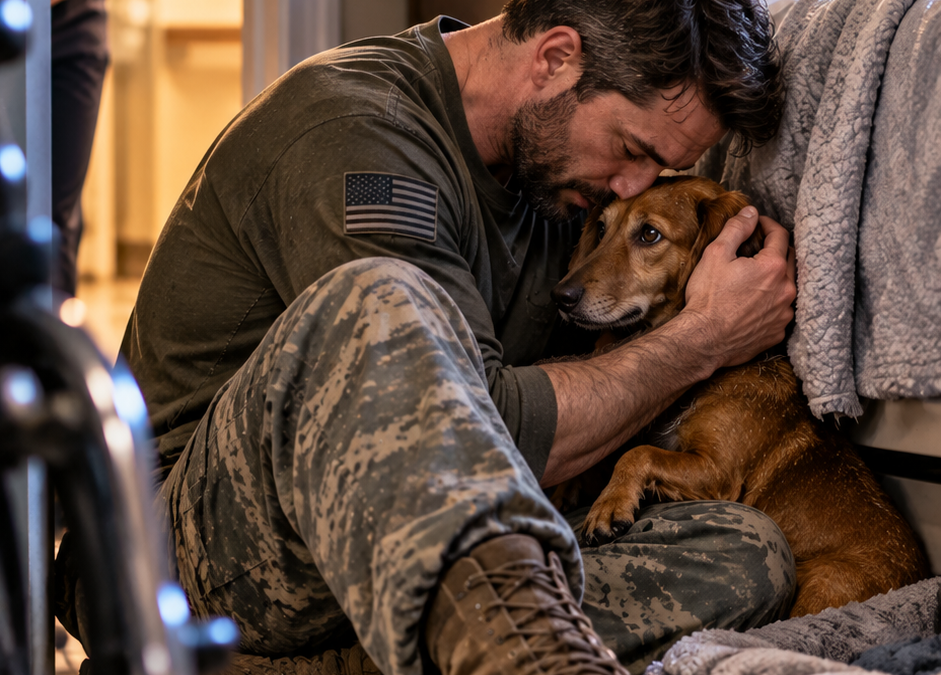
For Three Years James Had Not Spoken to Anyone, Until One Morning I Heard Him Whispering to the Most Frightened Dog in the Building
For three years, James Morrison had not spoken a single word to anyone at our rehabilitation center.
Not to doctors.
Not to nurses.
Not to the family members who still visited even when he could barely look at them.
Then one morning, while I was walking past his room, I heard a voice so faint that I stopped in the hallway and wondered whether I had imagined it.
“It’s okay,” the voice whispered.
A pause.
“You’re okay.”
I knew that voice before I understood how impossible it was.
James was speaking.
But he was not speaking to me.
He was talking to a frightened little dachshund sitting three feet away from him.
And in that moment, I understood that James had not found his way back to the world.
He had found his way to one living creature who was just as afraid of the world as he was.
My name is Sarah Jenkins.
By then, I had been a nurse at the rehabilitation center for ten years.
Ten years is long enough to stop being surprised by most sounds.
I had heard laughter loud enough to fill an entire floor.
I had heard people crying behind bathroom doors because they did not want anyone to know.
I had heard arguments.
Nightmares.
Angry voices demanding to go home.
Quiet voices asking whether home would ever feel like home again.
Once, I heard a man sing the same four lines of an old country song every night for almost six months because they were the only lyrics he could remember.
Human beings make noise when they hurt.
Usually.
James was different.
He arrived at the center three years before Stay did.
Colonel James Morrison.
Former military.
Tall.
Broad-shouldered even after months of poor sleep and too little appetite.
He carried himself like a man whose body remembered discipline even when the rest of him had stopped cooperating.
His file contained more information than I am comfortable repeating.
Most of it belonged to him.
But the part everyone knew was simple.
James did not speak.
He could speak physically.
His doctors had determined that long before I met him.
There was no injury preventing sound.
But James had stopped using his voice.
Completely.
The first months, people tried everything.
Questions.
Encouragement.
Speech exercises.
Writing boards.
Family photographs.
Music.
Silence.
Pressure.
No pressure.
Nothing changed.
James communicated when necessary.
A nod.
Shake of the head.
Pointing.
Occasionally writing a word.
Water.
No.
Pain.
Outside.
Enough.
He understood us.
That was never in doubt.
Sometimes he understood too much.
If a room became crowded, his shoulders tightened.
If someone moved behind him unexpectedly, his body went rigid.
Certain sounds made him leave without explanation.
But he never shouted.
Never argued.
Never told anyone to stop.
He simply disappeared deeper into silence.
There were staff members who found that silence intimidating.
Others found it frustrating.
I found it sad.
Not because quiet itself is sad.
Silence can be peaceful.
James’s silence was not.
It had weight.
You could feel it when you entered his room.
It was the silence of someone guarding something.
The silence of a door held shut from the inside.
I learned not to knock too hard.
“Morning, James.”
Nod.
“Breakfast?”
Small nod.
“Pain?”
Head shake.
“Want the curtains open?”
Sometimes yes.
Sometimes no.
I stopped asking questions that required more.
Maybe that was why he tolerated me.
I never tried to trick a word out of him.
Other people occasionally did.
“You know, James, you could just say yes.”
Nothing.
“We know you can talk.”
Nothing.
“Wouldn’t it be easier if you told us?”
Nothing.
I hated those conversations.
Not because the questions were malicious.
People wanted to help.
But after months of watching James, I began to believe his silence was not an empty space waiting for us to fill.
It was something he was using.
Protection, perhaps.
Control.
Maybe both.
So I gave him what I gave many residents.
Routine.
“Medication at nine.”
Nod.
“Physical therapy at ten.”
Nod.
“Lunch at noon. And before you ask with your face, yes, it’s soup again.”
Once, very early in our time together, I thought I saw the corner of his mouth move.
That counted as progress in my mind.
Then Stay arrived.
His shelter paperwork called him a long-haired dachshund mix.
Small.
Golden-blond coat.
Short legs.
Long body.
Dark round eyes so large they made his fear impossible to miss.
The shelter had been looking for a temporary placement for animals suited to our therapeutic program.
Most animals selected were confident.
Social.
Predictable around wheelchairs, walkers, sudden movement, and unusual environments.
Stay was none of those things.
I still do not know why Elizabeth approved him.
Dr. Elizabeth White was the center’s psychologist and one of the strongest advocates for animal-assisted work.
When I first saw the dog trembling beneath a chair in her office, I said, “That one?”
Elizabeth looked at me.
“Yes.”
“He’s terrified.”
“I noticed.”
“He’s supposed to help people?”
“Maybe.”
“How?”
She smiled.
“I don’t know yet.”
That was Elizabeth.
She was comfortable with not knowing.
I was a nurse.
I preferred blood pressure readings.
Stay’s history was incomplete.
He had come from a shelter.
He startled at sudden noise.
Avoided hands reaching down from above.
Often hid beneath furniture.
Did not bark much.
When frightened, he froze.
The rescue had considered him adoptable but worried he would struggle in a busy home.
They hoped a structured environment might help socialize him.
“Why is he called Stay?” I asked.
Elizabeth glanced down.
“Shelter nickname.”
“That’s a terrible command-name combination.”
“I didn’t choose it.”
Stay looked at me.
I crouched several feet away.
“Hello, Stay.”
The dog immediately lowered himself.
“Okay.”
I stood again.
“We’re going to be friends eventually.”
Stay disappeared farther beneath the chair.
Elizabeth laughed.
“Strong start.”
For the first week, Stay stayed mostly with Elizabeth and one handler.
He was introduced slowly to the center.
Quiet hallways first.
Then the garden.
Then selected residents.
He did reasonably well with people who ignored him.
That was the pattern.
The less someone wanted him, the more interested he became.
One afternoon, Elizabeth walked him past James’s room.
James was sitting near the window.
Stay stopped.
Not because James called.
Obviously.
Not because James moved.
He barely did.
Stay simply stopped outside the open door.
His nose lifted.
James looked toward him.
They stared at each other.
Elizabeth waited.
Stay took one step into the room.
James’s body tensed.
The dog stopped.
Neither moved.
After almost a minute, Stay backed into the hallway.
That was all.
The next day, he stopped there again.
Then again.
Eventually, James began leaving his door slightly wider.
I noticed.
I did not mention it.
Stay did not enter every day.
Sometimes he only stood outside.
Other times he made it halfway.
James never reached for him.
That may have been why the dog continued coming.
Everyone else wanted to touch Stay.
James wanted nothing.
At least visibly.
The dog could approach without being grabbed.
Could retreat without being called back.
Could exist in the room without becoming a project.
Perhaps that felt safe.
Within two weeks, Stay had started spending ten or fifteen minutes a day inside James’s room.
Usually near the doorway.
James sat by the wall or on the edge of the bed.
They did not touch.
They did not play.
To anyone else, it would have looked like nothing.
But I began adjusting my rounds so I would pass by.
Not because I expected anything dramatic.
I liked the way James looked when the dog was there.
Less distant.
His eyes followed Stay.
Not anxiously.
Curiously.
That was new.
One morning, Stay crawled under James’s bed.
James looked down.
I said, “Congratulations.”
His eyes moved toward me.
“You have a roommate.”
No response.
“Rent is expensive.”
Nothing.
“Make him pay half.”
James looked toward the bed.
And once again, I saw something almost like amusement.
I left before I could ruin it.
A few days later came the morning I will never forget.
It was just after seven.
The building was quiet.
Morning shift change had ended.
Breakfast trays had not yet reached the floor.
I was carrying medication records when I passed James’s room.
His door was open maybe six inches.
I heard something.
At first, I thought it was ventilation.
A thin sound.
Air.
Then it came again.
“It’s okay.”
I stopped.
My entire body stopped.
The hallway seemed suddenly too bright.
Another whisper.
“Easy.”
I stepped closer.
Slowly.
I looked through the opening.
James was sitting on the floor with his back against the wall.
I had never seen him sit there before.
Stay stood near the center of the room.
His tail was low.
His body cautious.
But he was not hiding.
James’s hands rested openly on his knees.
No reaching.
No calling.
Only that voice.
Rough.
Weak from disuse.
Almost more breath than sound.
“You’re okay.”
Stay took one small step.
James swallowed.
The effort of producing even those words seemed enormous.
Stay moved closer.
James whispered again.
“No one’s going to hurt you.”
I felt tears hit my eyes so quickly that I had to blink them away.
James had not spoken in three years.
Three years.
We had documented every attempt.
Every almost.
Every failed exercise.
And now he was using his voice as if it belonged to the dog.
Not us.
Stay moved another step.
James did not notice me.
I backed away.
Immediately.
I did not call Elizabeth.
Did not run down the hall announcing a breakthrough.
For almost twenty minutes, I said nothing.
Because instinct told me that if we turned that moment into an event, we might destroy it.
When I finally found Elizabeth, I closed her office door.
“He spoke.”
She looked up.
“What?”
“James.”
Her face changed.
“To whom?”
That was the strange question.
Not what did he say?
To whom?
“Stay.”
Elizabeth leaned back slowly.
“Are you sure?”
“Yes.”
“What did he say?”
“‘It’s okay.’ ‘Easy.’ ‘No one’s going to hurt you.’”
She covered her mouth.
For several seconds neither of us spoke.
Then Elizabeth asked, “Did he know you were there?”
“No.”
“Good.”
That answer surprised me.
“You don’t want to tell him we heard?”
“Absolutely not.”
“Why?”
“Because he didn’t speak to us.”
She was right.
James had not decided to rejoin conversation.
He had made one narrow bridge.
To one frightened dog.
Our job was not to stampede across it.
The next days confirmed it.
James remained silent with people.
“Good morning.”
Nod.
“Coffee?”
Nod.
“Stay visiting?”
His eyes moved toward the door.
That was the only difference.
But when he was alone with Stay, the whispering returned.
Sometimes I heard fragments while passing.
“Sun’s out.”
Pause.
“Want to go outside?”
Another day:
“Slow.”
Then:
“That’s it.”
The voice was rough.
Broken in places.
His vocal cords had gone largely unused for years.
Producing sound tired him.
Elizabeth arranged gentle support without making a spectacle of it.
No formal demand to “practice.”
No one stood over him with worksheets.
His voice came when Stay came.
And Stay listened.
That was the beautiful part.
The dog did not react as though words were extraordinary.
He did not care that James’s voice cracked.
Did not ask him to repeat.
Did not look surprised.
For Stay, the voice was simply another safe sound.
Maybe that was what James needed.
Someone who did not know what his silence meant.
Someone who could not compare this whisper to the man he had once been.
Human beings carried history into James’s room.
Colonel.
Soldier.
Patient.
Son.
Friend.
Survivor.
Stay carried none.
To Stay, James was simply the quiet man who sat still and never forced contact.
That was enough.
The dog changed too.
In his first weeks, Stay reacted to almost everything.
A dropped tray.
Footsteps.
Doors.
Raised voices.
If anyone approached too quickly, he disappeared beneath furniture.
With James, he began testing distance.
Five feet.
Four.
Three.
One afternoon, Elizabeth and I stood outside the room watching through the doorway.
Stay approached James’s chair.
James sat with one hand hanging loosely beside his leg.
The dog sniffed.
Retreated.
Returned.
Then placed his muzzle in James’s palm.
James froze.
So did we.
Stay stayed there.
The whole world seemed to narrow to that small contact.
James slowly curved his fingers.
Touched the side of the dog’s face.
Stay did not run.
James stroked his head.
Once.
Twice.
Then I heard the whisper.
“You too.”
Pause.
“You’ve seen it too.”
Elizabeth’s eyes filled.
James continued, so softly I barely heard him.
“You know.”
I did not know exactly what he meant.
None of us did.
It was not testimony.
He was not telling us his story.
He was recognizing something.
Fear.
Maybe the knowledge of what it feels like to become very still because the world does not feel safe.
Stay closed his eyes beneath James’s hand.
That afternoon changed their relationship.
From then on, the dog approached more quickly.
He began lying beside James.
Then near his feet.
Then touching him.
A shoulder against a boot.
A head on his ankle.
Small contacts.
James’s whisper strengthened.
Not dramatically.
It was still quiet enough that you had to be nearby.
But the words stopped breaking apart as much.
His breathing became steadier when he spoke.
“Come on.”
“Outside.”
“Good boy.”
“Not that way.”
Once I heard:
“You’re stubborn.”
I almost laughed because it was the most ordinary sentence James Morrison had spoken in three years.
Ordinary became precious.
Two months after Stay arrived, the dog was sleeping on James’s bed.
No one officially approved that.
No one stopped it either.
The first night, I entered for medication and found Stay curled at James’s feet.
I raised an eyebrow.
James looked at me.
Stay remained asleep.
“Health code nightmare.”
James’s mouth moved.
No sound.
Then I realized he was smiling.
Not broadly.
But unmistakably.
I placed the cup of water beside him.
“I saw nothing.”
James nodded.
Stay stayed.
Morning walks came next.
Before Stay, getting James outside had been inconsistent.
Some days he walked the halls.
Some days the garden.
Some weeks almost nothing beyond required therapy.
Now, at dawn, he reached for Stay’s leash.
The first morning I saw them preparing to leave, I almost asked whether he needed someone with him.
I stopped myself.
James clipped the leash.
Stay looked up.
James whispered, “Ready?”
The dog wagged.
They went outside.
Our center had five acres of grounds.
Old trees.
Grass.
Walking paths.
Benches.
Enough space that residents could move without feeling watched every second.
James and Stay moved slowly.
The dachshund’s legs were short.
James’s stride naturally long.
He adjusted.
That mattered.
The man who had spent three years moving through the world as though other people’s pace did not concern him now shortened every step for a twelve-pound dog.
I watched through the window.
At one bench, James stopped.
Stay looked up.
James said something.
I could not hear.
Later, passing nearby, I caught a fragment.
“Look how green.”
Another morning:
“Bird.”
Stay lifted his head.
“Over there.”
These were not profound statements.
That was why they mattered.
James was narrating the world again.
Bench.
Grass.
Sun.
Bird.
Morning.
He was placing language on ordinary things.
Maybe rediscovering that words did not always have to carry unbearable weight.
Some words could simply mean tree.
Some sentences could simply mean we should rest.
And Stay listened as if every syllable deserved attention.
The dog’s transformation was equally gradual.
His tail lifted.
Not high at first.
No longer pressed against his belly.
He stopped trembling constantly.
He tolerated more people.
First me.
Then Elizabeth.
Then selected residents.
But James remained his center.
If overwhelmed, Stay returned to him.
James never seemed offended by that dependence.
Perhaps he understood.
Then came the rainy evening when something new happened.
The weather had kept everyone inside.
The common room was unusually crowded.
Television on.
Rain against the windows.
Several residents playing cards.
I was at the nursing station when I saw James enter with Stay.
He usually avoided the room at busy hours.
That evening, he stayed.
He sat at the edge of a couch.
Stay beside his shoe.
A younger veteran named Thomas noticed the dog.
Thomas had been at the center only a few weeks.
He was sociable in the way James was not.
He approached carefully.
“Is that your dog, Mr. Morrison?”
James looked at him.
I stopped writing.
I should not have watched.
I did anyway.
James held Thomas’s gaze for several seconds.
Then nodded.
Yes.
Thomas smiled.
“He’s cute.”
Stay looked up.
“Can I pet him?”
James looked down at the dog.
Stay looked back.
For a moment, it seemed like a private consultation.
James leaned slightly forward.
His lips moved.
“Go ahead.”
So quiet Thomas did not hear.
Stay did.
The dog stood.
Walked toward Thomas.
Thomas crouched.
Offered his hand.
Stay sniffed.
Then allowed him to touch his head.
Small event.
A dog receiving a pet.
Nothing remarkable if you did not know them.
But I knew.
James had just allowed another person into the world he shared with Stay.
That was the first voluntary social opening I had seen from him in three years.
He did not speak directly to Thomas.
Not yet.
But he facilitated contact.
Afterward, James remained in the common room another twenty minutes.
That was progress.
Not dramatic recovery.
Not cure.
Progress.
Elizabeth was careful with those distinctions.
“Don’t expect linear change,” she told staff.
Some days James whispered freely to Stay.
Other days not at all.
Some weeks he participated more.
Then retreated.
We stopped treating retreat as failure.
Healing is not a staircase.
It is weather.
It moves.
A year passed.
James never became talkative.
I think people outside rehabilitation sometimes imagine recovery as restoration.
The old person returns.
The former personality comes back.
Everything damaged gets placed where it used to be.
That was not James.
Elizabeth had said something early that I never forgot.
“He isn’t becoming his old self.”
“What is he becoming?”
“Himself now.”
James’s speech expanded slowly.
One morning, I entered with medication.
“Morning.”
Usually a nod.
Instead:
“Morning.”
One word.
Rough.
Soft.
I stopped.
He immediately looked irritated.
Not angry.
Embarrassed.
I kept my expression neutral.
“Sleep okay?”
Nod.
I put down the medication.
“Breakfast in twenty.”
Then I left.
In the hallway, I pressed my back against the wall and cried silently.
Because if I had celebrated in front of him, he might never have done it again.
A week later:
“Thank you.”
He said it after I brought Stay a blanket.
Two words.
I acted as though James had been speaking forever.
“Sure.”
Then walked to the nurses’ station and nearly strangled my coworker when she started cheering.
“Don’t.”
“But Sarah—”
“Do not make this about us.”
She understood.
Eventually James began occasionally answering simple questions verbally.
Not always.
Choice mattered.
He could speak.
That did not mean he owed anyone speech.
That lesson was important for us too.
One afternoon, Thomas made a joke in the common room.
Not a particularly good one.
James surprised everyone by responding with a quiet comment.
Thomas stared.
Then laughed.
James smiled.
Later I asked Thomas what James had said.
Thomas shook his head.
“Terrible joke.”
“What?”
“I’m not repeating it.”
“Was it funny?”
“No.”
I smiled.
“Perfect.”
James had attempted humor.
Badly.
That felt profoundly alive.
At night, something else happened.
For months, staff noticed James spoke more when he believed no one was listening.
Stay slept beside him.
Lights low.
Hall quiet.
From outside the room, sometimes there was a continuous murmur.
Not isolated words anymore.
Sentences.
Long ones.
I never deliberately listened.
That was his privacy.
Later, James himself told Elizabeth some of what he talked about.
Not details.
Broad things.
Mountains.
Nights.
Storms.
People he had lost.
Places he remembered.
A former life that sometimes felt as though it belonged to someone else.
Stay heard what we did not.
Maybe that was why James could say it.
A dog does not interrupt a painful memory with advice.
Does not say, “You should move on.”
Does not say, “At least…”
Does not ask why.
Does not compare.
Stay listened.
Sometimes licked James’s hand.
Sometimes slept.
Imagine telling the hardest parts of your life to someone who might fall asleep halfway through and knowing that somehow this feels safe rather than insulting.
Maybe safety was exactly that.
No performance.
No consequence.
No demand for meaning.
Just words released into darkness while a small body breathed beside him.
One morning, I asked James if Stay kept him awake.
He looked at the dachshund occupying a ridiculous amount of bed space for such a small animal.
Then he whispered:
“Snoring.”
I laughed.
Stay raised his head.
James pointed.
“He knows.”
That was the longest spontaneous statement he had made to me at that point.
Two words and a pronoun.
I treasured it more than some entire conversations.
The second year of their relationship brought more changes.
Stay became confident enough to attend supervised events around the center.
James came with him.
We stopped thinking of Stay as an intervention for James.
They were simply together.
If you invited one, you planned for both.
Then a local elementary school arranged a visit.
The children came to sing.
Bring cards.
Visit residents.
I was nervous.
Children are wonderful.
They are also unpredictable.
Stay had improved enormously, but sudden grabbing still worried me.
James sat in his usual place near the edge of the room.
Stay beside him.
A small red-haired girl with freckles noticed the dog.
She approached slowly.
I started moving closer.
James saw me.
One look told me to stop.
So I did.
The girl stood several feet away.
“Your dog is really cute.”
James looked at her.
Silence.
The child waited.
Most adults become uncomfortable with silence after about three seconds.
Children sometimes do not.
She simply stood.
Stay wagged.
The girl smiled.
“What’s his name?”
James’s face changed.
I saw the decision happen.
He leaned forward slightly.
His voice was so low the girl moved closer.
“Stay.”
Her eyes brightened.
“That’s a funny name.”
James almost smiled.
Then she asked:
“What’s your name?”
That question affected him differently.
He became still.
The room continued around them.
Children talking.
Music.
Staff moving.
But James looked as though he had been asked something much larger.
What is your name?
James Morrison.
Colonel.
Veteran.
Patient.
Resident.
All technically answers.
He looked at Stay.
The dog looked back.
Then James whispered:
“I’m his human.”
The little girl accepted this instantly.
“Okay.”
She crouched.
“Can I pet him?”
James looked at Stay.
Then nodded.
The girl touched the dog’s ears.
Stay leaned forward.
James watched.
I turned away because tears had already begun.
I am his human.
Later, Elizabeth said, “That may have been the most important answer he’s given.”
“Why?”
“Because he chose an identity.”
Not what happened to him.
Not what profession defined him.
Not what we called him.
Who he wanted to be now.
The person that small dog trusted.
That was enough.
Two years after Stay arrived, James left residential rehabilitation.
Not because every difficulty had vanished.
It had not.
He continued receiving support.
Continued therapy.
Continued working on speech and everything else that came with rebuilding a life.
But he no longer needed to live at the center.
He found a small house nearby.
Single story.
Low steps.
A porch.
Backyard.
Perfect for dachshund legs.
The day James moved, I went over with Elizabeth.
The house had almost no furniture.
Bed.
Table.
Two chairs.
One couch someone donated.
Dog bed.
Of course Stay ignored the dog bed and immediately occupied the couch.
James stared at him.
“Your bed.”
Stay remained.
James pointed.
“Paid for it.”
Nothing.
I laughed.
“You finally found someone who respects you less than we do.”
James looked at me.
Then said, quietly but clearly:
“Obviously.”
I almost dropped the box I was carrying.
He smiled.
That smile had become easier too.
We finished unpacking.
Before leaving, I stood on the porch.
Stay sat beside James.
Golden evening light touched the dog’s coat.
For a moment, I remembered the first time I saw them together.
James on the floor.
Stay three feet away.
Both afraid to move.
Now the dog leaned against his ankle.
James rested a hand on his back without thinking.
Ordinary.
That was what made it beautiful.
“How are you feeling?” I asked.
Old question.
James looked at the house.
Then Stay.
His answer came after a long pause.
“Home.”
One word.
Enough.
They still live there today.
I visit sometimes.
Not often.
James is no longer my patient, and I believe people deserve a life that is not constantly observed by the professionals who helped them reach it.
But we became friends in the quiet way some relationships develop after years of knowing one another.
Coffee on the porch.
Short conversations.
Long silences.
Stay always present.
James still does not speak much.
Some days more.
Some days almost nothing.
He no longer apologizes for either.
That may be one of the most important changes.
His voice belongs to him.
He uses it when he chooses.
Stay is older too.
A little gray around the muzzle.
Still short-legged.
Still ridiculously expressive.
Still capable of taking up the center of an entire couch.
In the evenings, James sits on the porch.
Stay beside him.
Sometimes neighbors walk past and hear James talking.
Quietly.
Not the strained whispers from years earlier.
A low voice now.
Still soft.
Warm.
Occasionally there is laughter.
The first time I heard James laugh out loud, really laugh, I was standing near the porch steps.
Stay had attempted to jump onto a low chair and missed.
Nothing serious.
The dog looked offended.
James laughed.
A rough sound.
Surprised him as much as me.
Stay stared.
James covered his mouth.
Then laughed again.
I started laughing too.
“What?”
James shook his head.
“Nothing.”
Stay finally made the jump.
James said:
“Show-off.”
The ordinary word carried more history than anyone passing the house could possibly know.
People sometimes tell the story differently now.
I have heard versions.
“The dog made a mute veteran speak.”
I dislike that.
James was never a miracle waiting for an animal to activate.
Stay did not cure him.
James did the work.
Every day.
Stay created a place where some of that work could begin without feeling like work.
There is a difference.
The dog did not drag James back into the world.
Stay sat at the edge of it.
Waited.
And James eventually moved closer.
Maybe because Stay needed him too.
That part mattered.
When James first met Stay, everyone else in his life was trying to help him.
Doctors.
Nurses.
Psychologists.
Family.
Therapists.
Stay was not.
Stay was afraid.
He needed safety.
James could give something instead of only receiving.
“Easy.”
“You’re okay.”
“Come here.”
Those first words were not about James.
That may be exactly why they came.
It is easier sometimes to find your voice when someone else needs to hear it.
And Stay did.
He had been frightened of people.
Frightened of noise.
Frightened of hands.
James’s whisper became something predictable.
Low.
Gentle.
No surprise.
The dog learned:
That voice means safe.
James learned something in return.
My voice can mean safety.
Think about what that must have been like after three years of treating speech as something impossible.
Not:
Talk because doctors want you to.
Not:
Talk because your family misses hearing you.
Not:
Talk to prove recovery.
Talk because a frightened animal is looking at you and needs reassurance.
That is different.
Purpose changes difficult things.
I sometimes think back to the morning I overheard those first words.
“It’s okay.”
At the time, I believed James was talking to Stay.
Now I wonder whether part of him was also speaking to himself.
You’re okay.
Easy.
No one is going to hurt you.
Maybe both needed the sentence.
Maybe healing began because neither had to admit which one.
Years later, I asked James something I had never dared ask while he lived with us.
We were sitting on his porch.
Stay asleep across his feet.
“Why him?”
James looked down.
“At first.”
He waited.
Speech still sometimes required time.
I never rushed him.
“Why could you talk to Stay?”
James thought for nearly a minute.
Then said:
“He didn’t know me before.”
I understood immediately.
But I let him continue.
“Everybody else…”
Pause.
“Knew who I was.”
Colonel.
Soldier.
Friend.
Family member.
The James from before.
Stay had no before.
“So there was nothing to live up to?” I asked.
James nodded.
“He didn’t want me back.”
That sentence hit me.
I knew exactly what he meant.
Everyone loved James.
But loving him sometimes carried longing.
We want the old James.
We miss his voice.
We miss his jokes.
We remember how he used to be.
Stay remembered nothing.
The dog did not want a former version.
He wanted the person in the room.
I looked down at Stay.
“That little animal may be wiser than all of us.”
James smiled.
“Low bar.”
I laughed.
His jokes had improved slightly.
Not much.
A few minutes later, he added something.
“He was scared.”
“Yes.”
“So…”
Long pause.
“I knew what not to do.”
That may have been the entire foundation of their relationship.
James knew not to crowd him.
Not to reach too quickly.
Not to demand.
Not to turn progress into performance.
The very things James needed from us, he gave instinctively to Stay.
Then the dog gave them back.
Space.
Patience.
Listening without pressure.
I wish I could say we professionals had planned that.
We did not.
Sometimes care means recognizing when something useful is happening and having the discipline not to interfere.
Stay taught us too.
People ask whether James speaks normally now.
I never know what “normally” means.
He speaks enough for his life.
Some days he can hold a conversation.
Short.
Quiet.
Other days he prefers nodding.
He talks more at home than anywhere else.
And he talks most to Stay.
Always has.
Every night, I am told, the routine remains.
James turns off the lights.
Stay climbs onto the bed.
He sleeps against James’s side now rather than only at his feet.
James talks.
Not because he is practicing.
Because that is what they do.
He tells Stay about the day.
Weather.
People.
Old memories.
Sometimes difficult ones.
Sometimes mundane ones.
Grocery store.
A bird in the yard.
A neighbor’s terrible lawn mower.
The dog listens.
Or sleeps.
Both seem acceptable.
Once, I asked James whether it bothered him that Stay sometimes fell asleep while he was speaking.
He said:
“Best audience.”
“Because he doesn’t interrupt?”
James nodded.
“Or argue?”
Another nod.
“Or tell bad jokes?”
James looked at me.
I raised my hands.
“I walked into that one.”
Stay snored.
James smiled.
There are photographs around his house now.
Not many.
One from the center.
Stay sitting beside James on the lawn.
Another from the day they moved.
One of the schoolgirl with the freckles petting Stay while James watched.
I had not known anyone took it.
James keeps it on a shelf.
The girl probably has no idea what her question meant.
“What’s your name?”
“I’m his human.”
Those words contain almost everything I know about James’s recovery.
For years, people defined him through what he had lost.
Speech.
Connection.
Function.
The identity he chose was based on what remained.
Relationship.
Care.
Being needed.
Love.
Maybe human beings rebuild more effectively from what remains than from constant attention to what is gone.
Stay remained.
James remained.
They started there.
On difficult anniversaries, James still becomes quieter.
I will not explain which anniversaries.
They belong to him.
Stay seems to know.
The dog stays closer.
No special training.
No command.
He simply notices.
James notices when Stay’s joints hurt.
Stay notices when James wants silence.
They know each other’s rhythms now.
Two aging bodies learning accommodation.
Some mornings, James shortens the walk because Stay’s legs are stiff.
Some evenings, Stay refuses to go inside until James does.
The balance continues.
Who saved whom?
People love that question.
I think it is the wrong one.
Saving suggests one stands on solid ground while pulling another out.
That was never James and Stay.
They met on uncertain ground.
One unable to use his voice.
One unable to trust people.
Neither had what the other supposedly needed.
Yet somehow that made the relationship possible.
James did not overwhelm Stay because James understood retreat.
Stay did not overwhelm James because a dog does not require explanations.
They learned safety together.
Then speech.
Then touch.
Then walks.
Then other people.
Then home.
If that is rescue, it moved both ways.
The last time I visited, the sun was setting.
Golden light across the porch.
Stay lay with his head on James’s lap.
The dog’s eyes were closed.
James was talking.
I arrived quietly enough that he did not notice at first.
I heard him say:
“You remember the first room?”
Stay’s ear moved.
“You were scared of everything.”
Tail tap.
“So was I.”
James stroked the dog’s head.
I remained near the walkway.
Then Stay opened his eyes and saw me.
Tail wag.
James followed his gaze.
“You could announce yourself.”
“I was enjoying the lecture.”
James rolled his eyes.
I sat on the porch.
Stay returned his head to James’s knee.
We watched the sunset.
After several minutes, I said, “Do you ever think about what would have happened if Stay hadn’t come to the center?”
James’s hand stopped.
He considered.
“No.”
“No?”
“No point.”
Typical James.
Practical.
I smiled.
“What about the opposite?”
He looked at me.
“What would have happened to Stay if he hadn’t met you?”
James stroked one velvet ear.
“Someone else.”
“You think?”
“Maybe.”
“But he got you.”
James’s expression softened.
“Yes.”
I looked at them.
“I think he did pretty well.”
James glanced down.
Stay was snoring.
“He’s lazy.”
“He’s retired.”
“He never worked.”
I laughed.
The dog slept through the insult.
Then James became serious.
“He gave me somewhere to put the words.”
I stopped smiling.
“What?”
James looked toward the horizon.
“When they came back.”
“The words?”
He nodded.
“Didn’t know what to do with them.”
I waited.
“People…”
His jaw tightened slightly.
“People heard meaning.”
That sentence was pure James.
Precise.
A person hears a word and responds.
Analyzes.
Feels.
Questions.
Stay heard sound.
Tone.
Presence.
“So you could say things without managing someone else’s reaction.”
James nodded.
That was another piece I had never considered.
When he spoke to Stay, James did not have to comfort the listener.
Did not have to explain.
Did not have to watch someone become sad because he was sad.
Words could simply leave him.
That freedom mattered.
The dog moved in his sleep.
James placed a hand on his side.
“He listened.”
I looked at Stay.
“Still does.”
James smiled.
“He snores.”
“Also true.”
Night gathered around the porch.
Eventually I stood.
“See you next week?”
James nodded.
Then, after I had walked a few steps:
“Sarah.”
I turned.
“Thanks.”
Years earlier, those two words would have destroyed me.
Now I simply smiled.
“You’re welcome.”
I drove home thinking about that first morning again.
The barely open door.
The whisper.
“It’s okay.”
I used to tell new nurses that rehabilitation rarely looks the way people imagine.
It is not a montage.
Not a straight line.
Sometimes progress is a man saying good morning after three years.
Sometimes it is remaining in a crowded room for twenty minutes.
Sometimes it is allowing another person to pet your dog.
Sometimes it is a tiny dachshund who stops trembling.
Sometimes it is a whispered sentence spoken in darkness when nobody else is listening.
We tend to measure recovery using things we can count.
Words spoken.
Distance walked.
Meals eaten.
Days without crisis.
Those measurements matter.
But some changes are harder to capture.
A person beginning to identify himself by love instead of loss.
A frightened animal learning hands can be gentle.
A voice becoming a home rather than a demand.
I saw those things happen.
Slowly.
There was no single miracle.
Even the first whisper was not a miracle in the way people later described it.
It was a beginning.
The important part was everything after.
James chose to whisper again the next day.
Stay chose to approach again.
Then again.
Trust accumulated.
A life changed by repetition.
The dog’s name still makes me smile.
Stay.
What a strange name for a creature who had once wanted to run from everything.
What a perfect name for what James needed most.
Not advice.
Not pressure.
Not someone demanding he return to who he had been.
Stay.
Stay here.
Stay beside me.
Stay until the fear passes.
Stay while I find the words.
Stay even if the words do not come.
And James did the same for the dog.
Maybe that was their first conversation before either of them understood it.
I won’t force you.
I won’t leave.
You don’t have to be ready.
I’m still here.
Today, James is not the man who arrived at our center.
He is not the man he was before arriving either.
He is James.
The person he became after everything.
Quiet.
Dry sense of humor.
Still hates crowded rooms.
Makes good coffee.
Keeps an absurd number of blankets for a tiny dog.
And sometimes sits on his porch at sunset talking for long stretches to the creature curled beside him.
Stay is not the terrified shelter dog anymore.
He is confident enough to greet visitors.
Selective enough to ignore them afterward.
He still prefers James.
That has never changed.
When the evening becomes cool, Stay leans against his leg.
James usually places a hand on his back.
Sometimes they sit silently.
Sometimes James whispers.
From the road, you might hear fragments.
A laugh.
A sentence.
Something almost musical in the rhythm.
Words that had been missing for years.
Returned slowly.
Not because the world demanded them.
Because one small living creature made room for them.
People often say Stay gave James his voice back.
I would say it differently.
James’s voice was always his.
Stay gave him somewhere safe enough to use it.
And James gave Stay the same thing.
A place where fear did not have to disappear before love could begin.
Maybe that is why they understood each other.
Neither waited for the other to become whole.
They met exactly where they were.
One silent.
One shaking.
And from there, together, they moved.
Three feet became one.
Silence became a whisper.
A whisper became sentences.
A room became a path.
A path became a shared world.
Eventually, a small house near our center became home.
Every time I visit, Stay eventually falls asleep against James.
His little body rises and falls.
James’s hand rests on him.
If I stay late enough, the porch lights come on.
The evening turns dark.
James grows quieter.
But the silence is different now.
It is no longer a wall.
It is simply space between words.
And that difference means everything.
Three years without a voice.
Then:
“It’s okay.”
Those were the first words I heard.
After everything that came later, I think they were exactly the right ones.
For Stay.
For James.
Maybe for both.
And even now, when James’s voice becomes softer and the rest of the world has gone quiet, Stay is always there.
Listening.
𝗧𝗛𝗘 𝗘𝗡𝗗
For Three Years James Had Not Spoken to Anyone, Until One Morning I Heard Him Whispering to the Most Frightened Dog in the Building
For three years, James Morrison had not spoken a single word to anyone at our rehabilitation center.
Not to doctors.
Not to nurses.
Not to the family members who still visited even when he could barely look at them.
Then one morning, while I was walking past his room, I heard a voice so faint that I stopped in the hallway and wondered whether I had imagined it.
“It’s okay,” the voice whispered.
A pause.
“You’re okay.”
I knew that voice before I understood how impossible it was.
James was speaking.
But he was not speaking to me.
He was talking to a frightened little dachshund sitting three feet away from him.
And in that moment, I understood that James had not found his way back to the world.
He had found his way to one living creature who was just as afraid of the world as he was.
My name is Sarah Jenkins.
By then, I had been a nurse at the rehabilitation center for ten years.
Ten years is long enough to stop being surprised by most sounds.
I had heard laughter loud enough to fill an entire floor.
I had heard people crying behind bathroom doors because they did not want anyone to know.
I had heard arguments.
Nightmares.
Angry voices demanding to go home.
Quiet voices asking whether home would ever feel like home again.
Once, I heard a man sing the same four lines of an old country song every night for almost six months because they were the only lyrics he could remember.
Human beings make noise when they hurt.
Usually.
James was different.
He arrived at the center three years before Stay did.
Colonel James Morrison.
Former military.
Tall.
Broad-shouldered even after months of poor sleep and too little appetite.
He carried himself like a man whose body remembered discipline even when the rest of him had stopped cooperating.
His file contained more information than I am comfortable repeating.
Most of it belonged to him.
But the part everyone knew was simple.
James did not speak.
He could speak physically.
His doctors had determined that long before I met him.
There was no injury preventing sound.
But James had stopped using his voice.
Completely.
The first months, people tried everything.
Questions.
Encouragement.
Speech exercises.
Writing boards.
Family photographs.
Music.
Silence.
Pressure.
No pressure.
Nothing changed.
James communicated when necessary.
A nod.
Shake of the head.
Pointing.
Occasionally writing a word.
Water.
No.
Pain.
Outside.
Enough.
He understood us.
That was never in doubt.
Sometimes he understood too much.
If a room became crowded, his shoulders tightened.
If someone moved behind him unexpectedly, his body went rigid.
Certain sounds made him leave without explanation.
But he never shouted.
Never argued.
Never told anyone to stop.
He simply disappeared deeper into silence.
There were staff members who found that silence intimidating.
Others found it frustrating.
I found it sad.
Not because quiet itself is sad.
Silence can be peaceful.
James’s silence was not.
It had weight.
You could feel it when you entered his room.
It was the silence of someone guarding something.
The silence of a door held shut from the inside.
I learned not to knock too hard.
“Morning, James.”
Nod.
“Breakfast?”
Small nod.
“Pain?”
Head shake.
“Want the curtains open?”
Sometimes yes.
Sometimes no.
I stopped asking questions that required more.
Maybe that was why he tolerated me.
I never tried to trick a word out of him.
Other people occasionally did.
“You know, James, you could just say yes.”
Nothing.
“We know you can talk.”
Nothing.
“Wouldn’t it be easier if you told us?”
Nothing.
I hated those conversations.
Not because the questions were malicious.
People wanted to help.
But after months of watching James, I began to believe his silence was not an empty space waiting for us to fill.
It was something he was using.
Protection, perhaps.
Control.
Maybe both.
So I gave him what I gave many residents.
Routine.
“Medication at nine.”
Nod.
“Physical therapy at ten.”
Nod.
“Lunch at noon. And before you ask with your face, yes, it’s soup again.”
Once, very early in our time together, I thought I saw the corner of his mouth move.
That counted as progress in my mind.
Then Stay arrived.
His shelter paperwork called him a long-haired dachshund mix.
Small.
Golden-blond coat.
Short legs.
Long body.
Dark round eyes so large they made his fear impossible to miss.
The shelter had been looking for a temporary placement for animals suited to our therapeutic program.
Most animals selected were confident.
Social.
Predictable around wheelchairs, walkers, sudden movement, and unusual environments.
Stay was none of those things.
I still do not know why Elizabeth approved him.
Dr. Elizabeth White was the center’s psychologist and one of the strongest advocates for animal-assisted work.
When I first saw the dog trembling beneath a chair in her office, I said, “That one?”
Elizabeth looked at me.
“Yes.”
“He’s terrified.”
“I noticed.”
“He’s supposed to help people?”
“Maybe.”
“How?”
She smiled.
“I don’t know yet.”
That was Elizabeth.
She was comfortable with not knowing.
I was a nurse.
I preferred blood pressure readings.
Stay’s history was incomplete.
He had come from a shelter.
He startled at sudden noise.
Avoided hands reaching down from above.
Often hid beneath furniture.
Did not bark much.
When frightened, he froze.
The rescue had considered him adoptable but worried he would struggle in a busy home.
They hoped a structured environment might help socialize him.
“Why is he called Stay?” I asked.
Elizabeth glanced down.
“Shelter nickname.”
“That’s a terrible command-name combination.”
“I didn’t choose it.”
Stay looked at me.
I crouched several feet away.
“Hello, Stay.”
The dog immediately lowered himself.
“Okay.”
I stood again.
“We’re going to be friends eventually.”
Stay disappeared farther beneath the chair.
Elizabeth laughed.
“Strong start.”
For the first week, Stay stayed mostly with Elizabeth and one handler.
He was introduced slowly to the center.
Quiet hallways first.
Then the garden.
Then selected residents.
He did reasonably well with people who ignored him.
That was the pattern.
The less someone wanted him, the more interested he became.
One afternoon, Elizabeth walked him past James’s room.
James was sitting near the window.
Stay stopped.
Not because James called.
Obviously.
Not because James moved.
He barely did.
Stay simply stopped outside the open door.
His nose lifted.
James looked toward him.
They stared at each other.
Elizabeth waited.
Stay took one step into the room.
James’s body tensed.
The dog stopped.
Neither moved.
After almost a minute, Stay backed into the hallway.
That was all.
The next day, he stopped there again.
Then again.
Eventually, James began leaving his door slightly wider.
I noticed.
I did not mention it.
Stay did not enter every day.
Sometimes he only stood outside.
Other times he made it halfway.
James never reached for him.
That may have been why the dog continued coming.
Everyone else wanted to touch Stay.
James wanted nothing.
At least visibly.
The dog could approach without being grabbed.
Could retreat without being called back.
Could exist in the room without becoming a project.
Perhaps that felt safe.
Within two weeks, Stay had started spending ten or fifteen minutes a day inside James’s room.
Usually near the doorway.
James sat by the wall or on the edge of the bed.
They did not touch.
They did not play.
To anyone else, it would have looked like nothing.
But I began adjusting my rounds so I would pass by.
Not because I expected anything dramatic.
I liked the way James looked when the dog was there.
Less distant.
His eyes followed Stay.
Not anxiously.
Curiously.
That was new.
One morning, Stay crawled under James’s bed.
James looked down.
I said, “Congratulations.”
His eyes moved toward me.
“You have a roommate.”
No response.
“Rent is expensive.”
Nothing.
“Make him pay half.”
James looked toward the bed.
And once again, I saw something almost like amusement.
I left before I could ruin it.
A few days later came the morning I will never forget.
It was just after seven.
The building was quiet.
Morning shift change had ended.
Breakfast trays had not yet reached the floor.
I was carrying medication records when I passed James’s room.
His door was open maybe six inches.
I heard something.
At first, I thought it was ventilation.
A thin sound.
Air.
Then it came again.
“It’s okay.”
I stopped.
My entire body stopped.
The hallway seemed suddenly too bright.
Another whisper.
“Easy.”
I stepped closer.
Slowly.
I looked through the opening.
James was sitting on the floor with his back against the wall.
I had never seen him sit there before.
Stay stood near the center of the room.
His tail was low.
His body cautious.
But he was not hiding.
James’s hands rested openly on his knees.
No reaching.
No calling.
Only that voice.
Rough.
Weak from disuse.
Almost more breath than sound.
“You’re okay.”
Stay took one small step.
James swallowed.
The effort of producing even those words seemed enormous.
Stay moved closer.
James whispered again.
“No one’s going to hurt you.”
I felt tears hit my eyes so quickly that I had to blink them away.
James had not spoken in three years.
Three years.
We had documented every attempt.
Every almost.
Every failed exercise.
And now he was using his voice as if it belonged to the dog.
Not us.
Stay moved another step.
James did not notice me.
I backed away.
Immediately.
I did not call Elizabeth.
Did not run down the hall announcing a breakthrough.
For almost twenty minutes, I said nothing.
Because instinct told me that if we turned that moment into an event, we might destroy it.
When I finally found Elizabeth, I closed her office door.
“He spoke.”
She looked up.
“What?”
“James.”
Her face changed.
“To whom?”
That was the strange question.
Not what did he say?
To whom?
“Stay.”
Elizabeth leaned back slowly.
“Are you sure?”
“Yes.”
“What did he say?”
“‘It’s okay.’ ‘Easy.’ ‘No one’s going to hurt you.’”
She covered her mouth.
For several seconds neither of us spoke.
Then Elizabeth asked, “Did he know you were there?”
“No.”
“Good.”
That answer surprised me.
“You don’t want to tell him we heard?”
“Absolutely not.”
“Why?”
“Because he didn’t speak to us.”
She was right.
James had not decided to rejoin conversation.
He had made one narrow bridge.
To one frightened dog.
Our job was not to stampede across it.
The next days confirmed it.
James remained silent with people.
“Good morning.”
Nod.
“Coffee?”
Nod.
“Stay visiting?”
His eyes moved toward the door.
That was the only difference.
But when he was alone with Stay, the whispering returned.
Sometimes I heard fragments while passing.
“Sun’s out.”
Pause.
“Want to go outside?”
Another day:
“Slow.”
Then:
“That’s it.”
The voice was rough.
Broken in places.
His vocal cords had gone largely unused for years.
Producing sound tired him.
Elizabeth arranged gentle support without making a spectacle of it.
No formal demand to “practice.”
No one stood over him with worksheets.
His voice came when Stay came.
And Stay listened.
That was the beautiful part.
The dog did not react as though words were extraordinary.
He did not care that James’s voice cracked.
Did not ask him to repeat.
Did not look surprised.
For Stay, the voice was simply another safe sound.
Maybe that was what James needed.
Someone who did not know what his silence meant.
Someone who could not compare this whisper to the man he had once been.
Human beings carried history into James’s room.
Colonel.
Soldier.
Patient.
Son.
Friend.
Survivor.
Stay carried none.
To Stay, James was simply the quiet man who sat still and never forced contact.
That was enough.
The dog changed too.
In his first weeks, Stay reacted to almost everything.
A dropped tray.
Footsteps.
Doors.
Raised voices.
If anyone approached too quickly, he disappeared beneath furniture.
With James, he began testing distance.
Five feet.
Four.
Three.
One afternoon, Elizabeth and I stood outside the room watching through the doorway.
Stay approached James’s chair.
James sat with one hand hanging loosely beside his leg.
The dog sniffed.
Retreated.
Returned.
Then placed his muzzle in James’s palm.
James froze.
So did we.
Stay stayed there.
The whole world seemed to narrow to that small contact.
James slowly curved his fingers.
Touched the side of the dog’s face.
Stay did not run.
James stroked his head.
Once.
Twice.
Then I heard the whisper.
“You too.”
Pause.
“You’ve seen it too.”
Elizabeth’s eyes filled.
James continued, so softly I barely heard him.
“You know.”
I did not know exactly what he meant.
None of us did.
It was not testimony.
He was not telling us his story.
He was recognizing something.
Fear.
Maybe the knowledge of what it feels like to become very still because the world does not feel safe.
Stay closed his eyes beneath James’s hand.
That afternoon changed their relationship.
From then on, the dog approached more quickly.
He began lying beside James.
Then near his feet.
Then touching him.
A shoulder against a boot.
A head on his ankle.
Small contacts.
James’s whisper strengthened.
Not dramatically.
It was still quiet enough that you had to be nearby.
But the words stopped breaking apart as much.
His breathing became steadier when he spoke.
“Come on.”
“Outside.”
“Good boy.”
“Not that way.”
Once I heard:
“You’re stubborn.”
I almost laughed because it was the most ordinary sentence James Morrison had spoken in three years.
Ordinary became precious.
Two months after Stay arrived, the dog was sleeping on James’s bed.
No one officially approved that.
No one stopped it either.
The first night, I entered for medication and found Stay curled at James’s feet.
I raised an eyebrow.
James looked at me.
Stay remained asleep.
“Health code nightmare.”
James’s mouth moved.
No sound.
Then I realized he was smiling.
Not broadly.
But unmistakably.
I placed the cup of water beside him.
“I saw nothing.”
James nodded.
Stay stayed.
Morning walks came next.
Before Stay, getting James outside had been inconsistent.
Some days he walked the halls.
Some days the garden.
Some weeks almost nothing beyond required therapy.
Now, at dawn, he reached for Stay’s leash.
The first morning I saw them preparing to leave, I almost asked whether he needed someone with him.
I stopped myself.
James clipped the leash.
Stay looked up.
James whispered, “Ready?”
The dog wagged.
They went outside.
Our center had five acres of grounds.
Old trees.
Grass.
Walking paths.
Benches.
Enough space that residents could move without feeling watched every second.
James and Stay moved slowly.
The dachshund’s legs were short.
James’s stride naturally long.
He adjusted.
That mattered.
The man who had spent three years moving through the world as though other people’s pace did not concern him now shortened every step for a twelve-pound dog.
I watched through the window.
At one bench, James stopped.
Stay looked up.
James said something.
I could not hear.
Later, passing nearby, I caught a fragment.
“Look how green.”
Another morning:
“Bird.”
Stay lifted his head.
“Over there.”
These were not profound statements.
That was why they mattered.
James was narrating the world again.
Bench.
Grass.
Sun.
Bird.
Morning.
He was placing language on ordinary things.
Maybe rediscovering that words did not always have to carry unbearable weight.
Some words could simply mean tree.
Some sentences could simply mean we should rest.
And Stay listened as if every syllable deserved attention.
The dog’s transformation was equally gradual.
His tail lifted.
Not high at first.
No longer pressed against his belly.
He stopped trembling constantly.
He tolerated more people.
First me.
Then Elizabeth.
Then selected residents.
But James remained his center.
If overwhelmed, Stay returned to him.
James never seemed offended by that dependence.
Perhaps he understood.
Then came the rainy evening when something new happened.
The weather had kept everyone inside.
The common room was unusually crowded.
Television on.
Rain against the windows.
Several residents playing cards.
I was at the nursing station when I saw James enter with Stay.
He usually avoided the room at busy hours.
That evening, he stayed.
He sat at the edge of a couch.
Stay beside his shoe.
A younger veteran named Thomas noticed the dog.
Thomas had been at the center only a few weeks.
He was sociable in the way James was not.
He approached carefully.
“Is that your dog, Mr. Morrison?”
James looked at him.
I stopped writing.
I should not have watched.
I did anyway.
James held Thomas’s gaze for several seconds.
Then nodded.
Yes.
Thomas smiled.
“He’s cute.”
Stay looked up.
“Can I pet him?”
James looked down at the dog.
Stay looked back.
For a moment, it seemed like a private consultation.
James leaned slightly forward.
His lips moved.
“Go ahead.”
So quiet Thomas did not hear.
Stay did.
The dog stood.
Walked toward Thomas.
Thomas crouched.
Offered his hand.
Stay sniffed.
Then allowed him to touch his head.
Small event.
A dog receiving a pet.
Nothing remarkable if you did not know them.
But I knew.
James had just allowed another person into the world he shared with Stay.
That was the first voluntary social opening I had seen from him in three years.
He did not speak directly to Thomas.
Not yet.
But he facilitated contact.
Afterward, James remained in the common room another twenty minutes.
That was progress.
Not dramatic recovery.
Not cure.
Progress.
Elizabeth was careful with those distinctions.
“Don’t expect linear change,” she told staff.
Some days James whispered freely to Stay.
Other days not at all.
Some weeks he participated more.
Then retreated.
We stopped treating retreat as failure.
Healing is not a staircase.
It is weather.
It moves.
A year passed.
James never became talkative.
I think people outside rehabilitation sometimes imagine recovery as restoration.
The old person returns.
The former personality comes back.
Everything damaged gets placed where it used to be.
That was not James.
Elizabeth had said something early that I never forgot.
“He isn’t becoming his old self.”
“What is he becoming?”
“Himself now.”
James’s speech expanded slowly.
One morning, I entered with medication.
“Morning.”
Usually a nod.
Instead:
“Morning.”
One word.
Rough.
Soft.
I stopped.
He immediately looked irritated.
Not angry.
Embarrassed.
I kept my expression neutral.
“Sleep okay?”
Nod.
I put down the medication.
“Breakfast in twenty.”
Then I left.
In the hallway, I pressed my back against the wall and cried silently.
Because if I had celebrated in front of him, he might never have done it again.
A week later:
“Thank you.”
He said it after I brought Stay a blanket.
Two words.
I acted as though James had been speaking forever.
“Sure.”
Then walked to the nurses’ station and nearly strangled my coworker when she started cheering.
“Don’t.”
“But Sarah—”
“Do not make this about us.”
She understood.
Eventually James began occasionally answering simple questions verbally.
Not always.
Choice mattered.
He could speak.
That did not mean he owed anyone speech.
That lesson was important for us too.
One afternoon, Thomas made a joke in the common room.
Not a particularly good one.
James surprised everyone by responding with a quiet comment.
Thomas stared.
Then laughed.
James smiled.
Later I asked Thomas what James had said.
Thomas shook his head.
“Terrible joke.”
“What?”
“I’m not repeating it.”
“Was it funny?”
“No.”
I smiled.
“Perfect.”
James had attempted humor.
Badly.
That felt profoundly alive.
At night, something else happened.
For months, staff noticed James spoke more when he believed no one was listening.
Stay slept beside him.
Lights low.
Hall quiet.
From outside the room, sometimes there was a continuous murmur.
Not isolated words anymore.
Sentences.
Long ones.
I never deliberately listened.
That was his privacy.
Later, James himself told Elizabeth some of what he talked about.
Not details.
Broad things.
Mountains.
Nights.
Storms.
People he had lost.
Places he remembered.
A former life that sometimes felt as though it belonged to someone else.
Stay heard what we did not.
Maybe that was why James could say it.
A dog does not interrupt a painful memory with advice.
Does not say, “You should move on.”
Does not say, “At least…”
Does not ask why.
Does not compare.
Stay listened.
Sometimes licked James’s hand.
Sometimes slept.
Imagine telling the hardest parts of your life to someone who might fall asleep halfway through and knowing that somehow this feels safe rather than insulting.
Maybe safety was exactly that.
No performance.
No consequence.
No demand for meaning.
Just words released into darkness while a small body breathed beside him.
One morning, I asked James if Stay kept him awake.
He looked at the dachshund occupying a ridiculous amount of bed space for such a small animal.
Then he whispered:
“Snoring.”
I laughed.
Stay raised his head.
James pointed.
“He knows.”
That was the longest spontaneous statement he had made to me at that point.
Two words and a pronoun.
I treasured it more than some entire conversations.
The second year of their relationship brought more changes.
Stay became confident enough to attend supervised events around the center.
James came with him.
We stopped thinking of Stay as an intervention for James.
They were simply together.
If you invited one, you planned for both.
Then a local elementary school arranged a visit.
The children came to sing.
Bring cards.
Visit residents.
I was nervous.
Children are wonderful.
They are also unpredictable.
Stay had improved enormously, but sudden grabbing still worried me.
James sat in his usual place near the edge of the room.
Stay beside him.
A small red-haired girl with freckles noticed the dog.
She approached slowly.
I started moving closer.
James saw me.
One look told me to stop.
So I did.
The girl stood several feet away.
“Your dog is really cute.”
James looked at her.
Silence.
The child waited.
Most adults become uncomfortable with silence after about three seconds.
Children sometimes do not.
She simply stood.
Stay wagged.
The girl smiled.
“What’s his name?”
James’s face changed.
I saw the decision happen.
He leaned forward slightly.
His voice was so low the girl moved closer.
“Stay.”
Her eyes brightened.
“That’s a funny name.”
James almost smiled.
Then she asked:
“What’s your name?”
That question affected him differently.
He became still.
The room continued around them.
Children talking.
Music.
Staff moving.
But James looked as though he had been asked something much larger.
What is your name?
James Morrison.
Colonel.
Veteran.
Patient.
Resident.
All technically answers.
He looked at Stay.
The dog looked back.
Then James whispered:
“I’m his human.”
The little girl accepted this instantly.
“Okay.”
She crouched.
“Can I pet him?”
James looked at Stay.
Then nodded.
The girl touched the dog’s ears.
Stay leaned forward.
James watched.
I turned away because tears had already begun.
I am his human.
Later, Elizabeth said, “That may have been the most important answer he’s given.”
“Why?”
“Because he chose an identity.”
Not what happened to him.
Not what profession defined him.
Not what we called him.
Who he wanted to be now.
The person that small dog trusted.
That was enough.
Two years after Stay arrived, James left residential rehabilitation.
Not because every difficulty had vanished.
It had not.
He continued receiving support.
Continued therapy.
Continued working on speech and everything else that came with rebuilding a life.
But he no longer needed to live at the center.
He found a small house nearby.
Single story.
Low steps.
A porch.
Backyard.
Perfect for dachshund legs.
The day James moved, I went over with Elizabeth.
The house had almost no furniture.
Bed.
Table.
Two chairs.
One couch someone donated.
Dog bed.
Of course Stay ignored the dog bed and immediately occupied the couch.
James stared at him.
“Your bed.”
Stay remained.
James pointed.
“Paid for it.”
Nothing.
I laughed.
“You finally found someone who respects you less than we do.”
James looked at me.
Then said, quietly but clearly:
“Obviously.”
I almost dropped the box I was carrying.
He smiled.
That smile had become easier too.
We finished unpacking.
Before leaving, I stood on the porch.
Stay sat beside James.
Golden evening light touched the dog’s coat.
For a moment, I remembered the first time I saw them together.
James on the floor.
Stay three feet away.
Both afraid to move.
Now the dog leaned against his ankle.
James rested a hand on his back without thinking.
Ordinary.
That was what made it beautiful.
“How are you feeling?” I asked.
Old question.
James looked at the house.
Then Stay.
His answer came after a long pause.
“Home.”
One word.
Enough.
They still live there today.
I visit sometimes.
Not often.
James is no longer my patient, and I believe people deserve a life that is not constantly observed by the professionals who helped them reach it.
But we became friends in the quiet way some relationships develop after years of knowing one another.
Coffee on the porch.
Short conversations.
Long silences.
Stay always present.
James still does not speak much.
Some days more.
Some days almost nothing.
He no longer apologizes for either.
That may be one of the most important changes.
His voice belongs to him.
He uses it when he chooses.
Stay is older too.
A little gray around the muzzle.
Still short-legged.
Still ridiculously expressive.
Still capable of taking up the center of an entire couch.
In the evenings, James sits on the porch.
Stay beside him.
Sometimes neighbors walk past and hear James talking.
Quietly.
Not the strained whispers from years earlier.
A low voice now.
Still soft.
Warm.
Occasionally there is laughter.
The first time I heard James laugh out loud, really laugh, I was standing near the porch steps.
Stay had attempted to jump onto a low chair and missed.
Nothing serious.
The dog looked offended.
James laughed.
A rough sound.
Surprised him as much as me.
Stay stared.
James covered his mouth.
Then laughed again.
I started laughing too.
“What?”
James shook his head.
“Nothing.”
Stay finally made the jump.
James said:
“Show-off.”
The ordinary word carried more history than anyone passing the house could possibly know.
People sometimes tell the story differently now.
I have heard versions.
“The dog made a mute veteran speak.”
I dislike that.
James was never a miracle waiting for an animal to activate.
Stay did not cure him.
James did the work.
Every day.
Stay created a place where some of that work could begin without feeling like work.
There is a difference.
The dog did not drag James back into the world.
Stay sat at the edge of it.
Waited.
And James eventually moved closer.
Maybe because Stay needed him too.
That part mattered.
When James first met Stay, everyone else in his life was trying to help him.
Doctors.
Nurses.
Psychologists.
Family.
Therapists.
Stay was not.
Stay was afraid.
He needed safety.
James could give something instead of only receiving.
“Easy.”
“You’re okay.”
“Come here.”
Those first words were not about James.
That may be exactly why they came.
It is easier sometimes to find your voice when someone else needs to hear it.
And Stay did.
He had been frightened of people.
Frightened of noise.
Frightened of hands.
James’s whisper became something predictable.
Low.
Gentle.
No surprise.
The dog learned:
That voice means safe.
James learned something in return.
My voice can mean safety.
Think about what that must have been like after three years of treating speech as something impossible.
Not:
Talk because doctors want you to.
Not:
Talk because your family misses hearing you.
Not:
Talk to prove recovery.
Talk because a frightened animal is looking at you and needs reassurance.
That is different.
Purpose changes difficult things.
I sometimes think back to the morning I overheard those first words.
“It’s okay.”
At the time, I believed James was talking to Stay.
Now I wonder whether part of him was also speaking to himself.
You’re okay.
Easy.
No one is going to hurt you.
Maybe both needed the sentence.
Maybe healing began because neither had to admit which one.
Years later, I asked James something I had never dared ask while he lived with us.
We were sitting on his porch.
Stay asleep across his feet.
“Why him?”
James looked down.
“At first.”
He waited.
Speech still sometimes required time.
I never rushed him.
“Why could you talk to Stay?”
James thought for nearly a minute.
Then said:
“He didn’t know me before.”
I understood immediately.
But I let him continue.
“Everybody else…”
Pause.
“Knew who I was.”
Colonel.
Soldier.
Friend.
Family member.
The James from before.
Stay had no before.
“So there was nothing to live up to?” I asked.
James nodded.
“He didn’t want me back.”
That sentence hit me.
I knew exactly what he meant.
Everyone loved James.
But loving him sometimes carried longing.
We want the old James.
We miss his voice.
We miss his jokes.
We remember how he used to be.
Stay remembered nothing.
The dog did not want a former version.
He wanted the person in the room.
I looked down at Stay.
“That little animal may be wiser than all of us.”
James smiled.
“Low bar.”
I laughed.
His jokes had improved slightly.
Not much.
A few minutes later, he added something.
“He was scared.”
“Yes.”
“So…”
Long pause.
“I knew what not to do.”
That may have been the entire foundation of their relationship.
James knew not to crowd him.
Not to reach too quickly.
Not to demand.
Not to turn progress into performance.
The very things James needed from us, he gave instinctively to Stay.
Then the dog gave them back.
Space.
Patience.
Listening without pressure.
I wish I could say we professionals had planned that.
We did not.
Sometimes care means recognizing when something useful is happening and having the discipline not to interfere.
Stay taught us too.
People ask whether James speaks normally now.
I never know what “normally” means.
He speaks enough for his life.
Some days he can hold a conversation.
Short.
Quiet.
Other days he prefers nodding.
He talks more at home than anywhere else.
And he talks most to Stay.
Always has.
Every night, I am told, the routine remains.
James turns off the lights.
Stay climbs onto the bed.
He sleeps against James’s side now rather than only at his feet.
James talks.
Not because he is practicing.
Because that is what they do.
He tells Stay about the day.
Weather.
People.
Old memories.
Sometimes difficult ones.
Sometimes mundane ones.
Grocery store.
A bird in the yard.
A neighbor’s terrible lawn mower.
The dog listens.
Or sleeps.
Both seem acceptable.
Once, I asked James whether it bothered him that Stay sometimes fell asleep while he was speaking.
He said:
“Best audience.”
“Because he doesn’t interrupt?”
James nodded.
“Or argue?”
Another nod.
“Or tell bad jokes?”
James looked at me.
I raised my hands.
“I walked into that one.”
Stay snored.
James smiled.
There are photographs around his house now.
Not many.
One from the center.
Stay sitting beside James on the lawn.
Another from the day they moved.
One of the schoolgirl with the freckles petting Stay while James watched.
I had not known anyone took it.
James keeps it on a shelf.
The girl probably has no idea what her question meant.
“What’s your name?”
“I’m his human.”
Those words contain almost everything I know about James’s recovery.
For years, people defined him through what he had lost.
Speech.
Connection.
Function.
The identity he chose was based on what remained.
Relationship.
Care.
Being needed.
Love.
Maybe human beings rebuild more effectively from what remains than from constant attention to what is gone.
Stay remained.
James remained.
They started there.
On difficult anniversaries, James still becomes quieter.
I will not explain which anniversaries.
They belong to him.
Stay seems to know.
The dog stays closer.
No special training.
No command.
He simply notices.
James notices when Stay’s joints hurt.
Stay notices when James wants silence.
They know each other’s rhythms now.
Two aging bodies learning accommodation.
Some mornings, James shortens the walk because Stay’s legs are stiff.
Some evenings, Stay refuses to go inside until James does.
The balance continues.
Who saved whom?
People love that question.
I think it is the wrong one.
Saving suggests one stands on solid ground while pulling another out.
That was never James and Stay.
They met on uncertain ground.
One unable to use his voice.
One unable to trust people.
Neither had what the other supposedly needed.
Yet somehow that made the relationship possible.
James did not overwhelm Stay because James understood retreat.
Stay did not overwhelm James because a dog does not require explanations.
They learned safety together.
Then speech.
Then touch.
Then walks.
Then other people.
Then home.
If that is rescue, it moved both ways.
The last time I visited, the sun was setting.
Golden light across the porch.
Stay lay with his head on James’s lap.
The dog’s eyes were closed.
James was talking.
I arrived quietly enough that he did not notice at first.
I heard him say:
“You remember the first room?”
Stay’s ear moved.
“You were scared of everything.”
Tail tap.
“So was I.”
James stroked the dog’s head.
I remained near the walkway.
Then Stay opened his eyes and saw me.
Tail wag.
James followed his gaze.
“You could announce yourself.”
“I was enjoying the lecture.”
James rolled his eyes.
I sat on the porch.
Stay returned his head to James’s knee.
We watched the sunset.
After several minutes, I said, “Do you ever think about what would have happened if Stay hadn’t come to the center?”
James’s hand stopped.
He considered.
“No.”
“No?”
“No point.”
Typical James.
Practical.
I smiled.
“What about the opposite?”
He looked at me.
“What would have happened to Stay if he hadn’t met you?”
James stroked one velvet ear.
“Someone else.”
“You think?”
“Maybe.”
“But he got you.”
James’s expression softened.
“Yes.”
I looked at them.
“I think he did pretty well.”
James glanced down.
Stay was snoring.
“He’s lazy.”
“He’s retired.”
“He never worked.”
I laughed.
The dog slept through the insult.
Then James became serious.
“He gave me somewhere to put the words.”
I stopped smiling.
“What?”
James looked toward the horizon.
“When they came back.”
“The words?”
He nodded.
“Didn’t know what to do with them.”
I waited.
“People…”
His jaw tightened slightly.
“People heard meaning.”
That sentence was pure James.
Precise.
A person hears a word and responds.
Analyzes.
Feels.
Questions.
Stay heard sound.
Tone.
Presence.
“So you could say things without managing someone else’s reaction.”
James nodded.
That was another piece I had never considered.
When he spoke to Stay, James did not have to comfort the listener.
Did not have to explain.
Did not have to watch someone become sad because he was sad.
Words could simply leave him.
That freedom mattered.
The dog moved in his sleep.
James placed a hand on his side.
“He listened.”
I looked at Stay.
“Still does.”
James smiled.
“He snores.”
“Also true.”
Night gathered around the porch.
Eventually I stood.
“See you next week?”
James nodded.
Then, after I had walked a few steps:
“Sarah.”
I turned.
“Thanks.”
Years earlier, those two words would have destroyed me.
Now I simply smiled.
“You’re welcome.”
I drove home thinking about that first morning again.
The barely open door.
The whisper.
“It’s okay.”
I used to tell new nurses that rehabilitation rarely looks the way people imagine.
It is not a montage.
Not a straight line.
Sometimes progress is a man saying good morning after three years.
Sometimes it is remaining in a crowded room for twenty minutes.
Sometimes it is allowing another person to pet your dog.
Sometimes it is a tiny dachshund who stops trembling.
Sometimes it is a whispered sentence spoken in darkness when nobody else is listening.
We tend to measure recovery using things we can count.
Words spoken.
Distance walked.
Meals eaten.
Days without crisis.
Those measurements matter.
But some changes are harder to capture.
A person beginning to identify himself by love instead of loss.
A frightened animal learning hands can be gentle.
A voice becoming a home rather than a demand.
I saw those things happen.
Slowly.
There was no single miracle.
Even the first whisper was not a miracle in the way people later described it.
It was a beginning.
The important part was everything after.
James chose to whisper again the next day.
Stay chose to approach again.
Then again.
Trust accumulated.
A life changed by repetition.
The dog’s name still makes me smile.
Stay.
What a strange name for a creature who had once wanted to run from everything.
What a perfect name for what James needed most.
Not advice.
Not pressure.
Not someone demanding he return to who he had been.
Stay.
Stay here.
Stay beside me.
Stay until the fear passes.
Stay while I find the words.
Stay even if the words do not come.
And James did the same for the dog.
Maybe that was their first conversation before either of them understood it.
I won’t force you.
I won’t leave.
You don’t have to be ready.
I’m still here.
Today, James is not the man who arrived at our center.
He is not the man he was before arriving either.
He is James.
The person he became after everything.
Quiet.
Dry sense of humor.
Still hates crowded rooms.
Makes good coffee.
Keeps an absurd number of blankets for a tiny dog.
And sometimes sits on his porch at sunset talking for long stretches to the creature curled beside him.
Stay is not the terrified shelter dog anymore.
He is confident enough to greet visitors.
Selective enough to ignore them afterward.
He still prefers James.
That has never changed.
When the evening becomes cool, Stay leans against his leg.
James usually places a hand on his back.
Sometimes they sit silently.
Sometimes James whispers.
From the road, you might hear fragments.
A laugh.
A sentence.
Something almost musical in the rhythm.
Words that had been missing for years.
Returned slowly.
Not because the world demanded them.
Because one small living creature made room for them.
People often say Stay gave James his voice back.
I would say it differently.
James’s voice was always his.
Stay gave him somewhere safe enough to use it.
And James gave Stay the same thing.
A place where fear did not have to disappear before love could begin.
Maybe that is why they understood each other.
Neither waited for the other to become whole.
They met exactly where they were.
One silent.
One shaking.
And from there, together, they moved.
Three feet became one.
Silence became a whisper.
A whisper became sentences.
A room became a path.
A path became a shared world.
Eventually, a small house near our center became home.
Every time I visit, Stay eventually falls asleep against James.
His little body rises and falls.
James’s hand rests on him.
If I stay late enough, the porch lights come on.
The evening turns dark.
James grows quieter.
But the silence is different now.
It is no longer a wall.
It is simply space between words.
And that difference means everything.
Three years without a voice.
Then:
“It’s okay.”
Those were the first words I heard.
After everything that came later, I think they were exactly the right ones.
For Stay.
For James.
Maybe for both.
And even now, when James’s voice becomes softer and the rest of the world has gone quiet, Stay is always there.
Listening.


