For Three Days, the Little Dachshund Kept Watching the Same Texas Road as If Someone Had Promised to Return
For Three Days, the Little Dachshund Kept Watching the Same Texas Road as If Someone Had Promised to Return
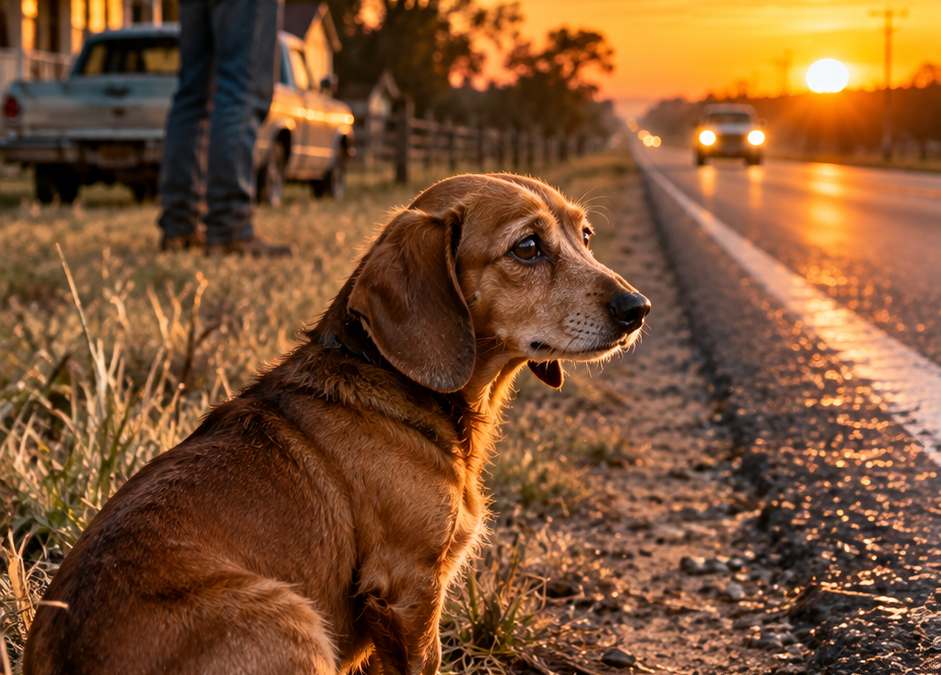
For three days, the little dachshund sat beside the same stretch of highway in East Texas and stared west.
The farmer who finally called us told me the dog had barked almost constantly the first night.
The second night, he barked less.
On the third, he stopped making noise entirely.
“That’s when I got worried,” the farmer said.
I looked at him.
“You weren’t worried before?”
He removed his cap and rubbed the top of his head.
“I thought somebody would come back.”
Then his eyes shifted toward the dog.
“So did he.”
That sentence stayed with me.
My name is Sloan.
At the time, I was still fairly young in animal control, young enough to believe that experience would eventually teach me how to stop taking certain cases home in my head.
I know better now.
Some animals remain with you because of what happened to them.
Others remain because of the way they looked at you when you arrived.
Oliver was the second kind.
When I reached that road, he was sitting several yards from the shoulder near a patch of dry grass and scrub.
He was small.
Golden-brown coat.
Long body.
Short legs.
A dachshund, probably still young enough to have more energy than he was showing.
Except he wasn’t moving much.
He sat facing the road.
Not the farmhouse behind him.
Not me.
The road.
West.
Every time a vehicle appeared in the distance, his ears lifted.
The car would grow louder.
Pass.
Disappear.
And his ears would lower again.
Then he would wait for the next one.
I had seen abandoned dogs before.
Dogs left at gas stations.
Dogs tied to fences.
Dogs dumped near fields because somebody convinced themselves a rural road was somehow kinder than a shelter.
Some panic.
Some run.
Some become defensive.
Some attach themselves to the first human who offers food.
This dog did none of those things.
He waited.
That was worse.
The farmer stood several feet behind me.
His name was Earl.
His wife, Marjorie, watched from the porch.
“How long has he been in that exact spot?” I asked.
“Moves a little at night.”
“For water?”
“I put a bowl out.”
“Did he drink?”
“A little.”
“Food?”
“Wouldn’t touch it at first.”
I looked at the dog.
“Has anyone tried catching him?”
Earl nodded toward his forearm.
“I tried getting close yesterday. He ran into the brush.”
“Did he bite?”
“No.”
“Growl?”
“No.”
“Then what happened?”
“He just got scared.”
I opened the back of my truck.
Water.
Food.
A blanket.
Slip lead.
Carrier.
Standard things.
Then I stopped.
Something about the dog told me not to begin with equipment.
So I left all of it except the water and food.
I walked toward him until I saw his body tighten.
Then I stopped.
Maybe fifteen feet away.
He glanced at me.
Only briefly.
Then back to the road.
I sat down.
Not kneeling.
Not crouching.
I sat all the way on the ground, legs crossed, making myself lower than him.
Earl looked confused.
“You planning to be there awhile?”
“Yes.”
“How long?”
“As long as he needs.”
The dog’s ears moved at my voice.
I poured water into a shallow bowl and placed it halfway between us.
Then a few pieces of soft food beside it.
He watched.
I slid my hands into my lap.
No reaching.
No calling him.
No command.
I had been taught to use confidence around frightened animals.
Clear movements.
Controlled energy.
Firm voice when necessary.
But there are moments when authority is exactly the wrong language.
That dog did not need to be controlled.
His entire world had already been controlled by someone else.
Put in a car.
Driven somewhere unfamiliar.
Left.
He needed one thing from me before anything else.
Time.
So I talked.
Not loudly.
Not in the bright, fake voice people sometimes use with scared dogs.
Just normal.
“I know you’re looking for them.”
One ear turned toward me.
“I don’t know where they are.”
The dog kept watching west.
“I’m sorry.”
A pickup came over the rise.
The dachshund stood.
His entire body changed.
Hope is visible in animals if you know what to watch.
Head higher.
Weight forward.
Ears alert.
He took two steps toward the pavement.
I held still.
The truck passed.
A man inside barely glanced over.
The dog followed it with his eyes until the sound disappeared.
Then he sat again.
Something tightened in my throat.
Earl sighed behind me.
“Every time.”
I nodded.
I understood then why the dog had remained.
He had not simply been abandoned beside a road.
He believed the road itself would fix the mistake.
They drove away that way.
Therefore they would return that way.
It made sense inside the only story he had.
“I know,” I said quietly.
The dog looked toward me.
“I know you think they’re coming back.”
His eyes stayed on mine for maybe two seconds.
Then west again.
Marjorie came down from the farmhouse carrying another bottle of water.
She was probably in her sixties, hair pulled back, work boots muddy.
She stopped near Earl.
“Still nothing?”
“Not yet.”
She looked at me sitting in the dirt.
“You want a chair?”
“No, thank you.”
“You’re going to ruin your pants.”
“They’ve had worse.”
Marjorie gave me a small smile.
Then she looked at the dachshund.
“He has heart, that little thing.”
I didn’t answer immediately.
She continued.
“He just can’t understand why.”
That was exactly it.
“I’m not sure I understand either.”
Marjorie folded her arms.
“People.”
Sometimes that single word contains an entire accusation.
I kept talking.
Not because I thought the dog understood every sentence.
Tone matters.
Rhythm matters.
Presence matters.
“I’m Sloan.”
He glanced at me.
“I help dogs.”
Nothing.
“I’m not going to grab you.”
His ears moved.
“I’m not going to chase you.”
A car approached.
He stood again.
Watched.
Not them.
Sat.
“I wish I could explain it.”
I swallowed.
“I wish I could tell you there was some mistake.”
He lowered his head.
“But I don’t think there was.”
That was the hardest part about abandoned animals.
Humans want reasons.
Money.
Moving.
Divorce.
No-pet housing.
Behavioral problems.
Convenience.
Sometimes the reason matters for prevention.
To the animal, it does not.
A dog does not understand financial crisis.
A dog does not understand that a landlord changed rules.
A dog does not understand someone saying, “We can’t do this anymore.”
He understands:
Yesterday I belonged with you.
Today I am here alone.
The mind searches for the missing piece.
What changed?
Was it something I did?
Did I fail?
Will you come back when I do better?
I looked at the dachshund.
“Whatever happened, it wasn’t because you weren’t good enough.”
He looked at me again.
Of course, I had no idea what his old life had been.
Maybe he chewed furniture.
Maybe he barked.
Maybe he had accidents.
Maybe he was difficult.
None of that made a roadside abandonment acceptable.
“You hear me?”
The dog blinked.
“Not your fault.”
I put my hand palm-up on the ground beside my knee.
Far from him.
No pressure.
The first hour passed.
He did not approach me.
But he approached the food.
That mattered.
One step.
Stop.
Look at me.
Another.
Stop.
Look toward the road.
He reached the food.
Sniffed.
Ate one bite.
Then lifted his head immediately.
A car in the distance.
He watched.
The car turned before reaching us.
He returned to the food.
Another bite.
Look west.
Another bite.
Look west.
He ate exactly half.
Then backed away.
I remember staring at the remaining pieces and wondering why half.
Maybe enough.
Maybe caution.
Or maybe, and I know this is probably me giving human logic to a dog, he was saving some.
For later.
For the family he believed might still return.
That thought hurt enough that I stopped following it.
During the second hour, I moved closer.
Only three steps.
I waited after each one.
His body remained tense but he did not retreat.
“That’s all.”
I sat again.
Now maybe eight feet apart.
He watched me differently.
Not trusting.
Evaluating.
Animals who have been abandoned sometimes look at new people as though trying to solve a dangerous pattern.
You came closer.
What comes next?
Do you leave too?
Do you hurt me?
Do you take me somewhere else?
I continued talking.
I told him things he could not possibly understand.
About my job.
About the first dog I had helped.
About how I still made mistakes.
About Linda, my mentor, who had been doing this work for twenty-three years and somehow still believed most people were worth giving one more chance.
“I don’t always agree with her,” I told the dog.
One ear lifted.
“She says I’m impatient.”
He looked at me.
“She’s probably right.”
Earl chuckled behind us.
I almost forgot he and Marjorie were still there.
The dachshund’s head tilted slightly.
I smiled.
“There.”
He blinked.
“First opinion you’ve had about me.”
The afternoon light changed slowly.
Heat softened.
Long shadows reached across the shoulder.
Every passing vehicle repeated the same wound.
Hear engine.
Stand.
Hope.
Watch.
Lose it.
Sit.
I began hating the road for him.
Halfway through the third hour, I moved closer again.
This time I was within reach if he chose to come.
I extended one hand.
Palm up.
Fingers loose.
Then waited.
His nose lifted.
He smelled me from where he stood.
One step.
Stop.
He looked west.
Nothing.
Another step.
He sniffed my fingertips without touching them.
Pulled back.
Then leaned forward again.
Nose against skin.
Back.
Again.
I did not move.
My shoulder began aching from holding my arm out.
I ignored it.
Finally he looked into my eyes.
There are things we see in animals because we need to see them.
I know that.
I have spent enough years in this profession to respect the danger of pretending we can translate every look into words.
But I can tell you what I saw in that dog.
Confusion.
Not fear anymore.
Not even simple sadness.
Confusion so deep it looked almost innocent.
As if he truly believed there had to be an explanation he had somehow missed.
I imagined the question because there was no way not to.
Was I bad?
Did I do something wrong?
I loved them.
Why didn’t that make them stay?
My professional composure disappeared.
I had been working hard to keep my voice steady.
Suddenly I couldn’t.
“I know.”
He sniffed my hand.
“I know.”
My eyes burned.
“It doesn’t make sense.”
The dog stepped closer.
“I can’t tell you why.”
My voice cracked.
“I wish I could.”
Another inch.
“But I can tell you something.”
His nose touched my palm.
“I won’t leave you here.”
For one second, nothing happened.
Then he lowered his head.
Not beside my hand.
Into it.
His small skull settled into my palm.
And he closed his eyes.
I had been there almost three hours.
According to Earl, the dog had been awake or barely sleeping for three days.
Watching.
Listening.
Waiting.
Now, with his head resting in the hand of someone he had never met before, his entire body loosened.
His breathing changed.
Long inhale.
Slow exhale.
Again.
I could feel the weight of him through my fingers.
He was not heavy.
That was the problem.
He weighed less than he should have.
Still, the moment felt enormous.
Marjorie made a small sound behind me.
When I looked over, she was crying.
Earl removed his cap again.
I looked back at the dog.
“Okay.”
He kept his eyes closed.
“You don’t have to watch the road right now.”
My thumb moved gently along the top of his head.
“Rest.”
He did.
For maybe a minute.
Maybe five.
Time became strange.
Eventually I shifted my other arm beneath him.
His eyes opened.
“No pressure.”
I paused.
He did not move away.
I lifted him carefully.
Long body against my chest.
Ribs more visible beneath my hands than they appeared beneath his coat.
He did not struggle.
Did not stiffen.
He simply allowed himself to be carried.
As I walked toward the truck, his head turned.
Back toward the road.
West.
Still looking.
I stopped.
For one terrible second, I thought he would fight to get down.
He didn’t.
He only watched.
“I know.”
I said it again.
“I know.”
I placed him on the back bench.
He curled into one corner.
I left the door open while I thanked Earl and Marjorie.
“You’ll let us know?” Marjorie asked.
“Yes.”
“If nobody claims him?”
“Yes.”
“Tell him…”
She stopped.
I waited.
Marjorie looked embarrassed.
“Nothing.”
I knew what she meant.
Tell him somebody cared.
I nodded anyway.
“I will.”
I climbed into the truck.
The dachshund remained sitting behind me.
I started the engine.
He stood immediately.
Looked through the rear window.
The farmhouse grew smaller.
The road curved.
Still he watched.
I could not decide which hurt more.
That he was leaving the place where he had been abandoned.
Or that some part of him still seemed to believe we were simply moving to a better position from which to wait.
By the time we reached the office, his posture had softened.
He still looked backward.
But no longer with frantic expectation.
Something closer to exhaustion.
Acceptance may be too human a word.
All I know is that the desperate question in his body had become quieter.
Linda was waiting outside.
She was fifty-two then.
Twenty-three years in animal welfare.
The kind of woman who could look at an animal once and see three things I had missed.
She watched me get out.
Then saw the dachshund.
No collar.
Thin.
Quiet.
She sighed.
“Another one people didn’t deserve.”
That was Linda.
No wasted greeting when she already understood.
I opened the rear door.
The dog stayed where he was.
“Come on.”
Nothing.
Linda leaned in beside me.
“Don’t ask.”
“I wasn’t.”
“You were about to.”
“I was inviting.”
“You were about to turn inviting into insisting.”
She knew me too well.
So we waited.
Eventually the dog moved toward the edge.
I lifted him down.
Linda looked at his face.
“How long?”
“Three days on the road.”
“Confirmed?”
“Farmer watched him.”
“Dumped?”
“Looks that way.”
“Owner?”
“Nothing yet.”
She knelt.
The dog moved behind my leg.
Linda saw it.
“Attached already.”
“He just knows me.”
“Same thing starts there.”
I looked down.
“We need a name for intake.”
Linda shrugged.
“You found him.”
That is how he became Oliver.
I cannot give you a logical reason.
The name arrived.
Small dog.
Large eyes.
A constant expression of asking something.
Oliver.
It fit.
Maybe because he reminded me of a child in a story I had loved when I was young.
Someone small surrounded by a world that did not explain itself properly.
Someone still asking.
When?
Where?
Why?
I wrote it on his temporary card.
OLIVER.
Male.
Dachshund.
Found roadside, East Texas.
Possible abandonment.
The veterinarian saw him the same day.
Mild dehydration.
Underweight.
No major injury.
Paw pads irritated.
Otherwise physically sound.
The vet was older, experienced, someone who had examined thousands of frightened dogs.
He watched Oliver during the exam.
Oliver tolerated everything.
Temperature.
Teeth.
Ears.
Abdomen.
He did not resist.
But whenever footsteps sounded outside the room, Oliver turned toward the door.
Every single time.
The veterinarian noticed.
“He’s going to keep looking.”
I looked at him.
“For what?”
“You know.”
“The family.”
“Yes.”
I hated how certain he sounded.
“He’ll adjust.”
“Maybe.”
“Probably.”
The vet looked toward Oliver.
“Some dogs shift quickly. New food, new person, new routine, and their loyalty follows safety.”
“And him?”
“He’s different.”
“How do you know?”
“I don’t know for sure.”
He scratched Oliver lightly behind the ear.
“But look at him.”
Footsteps outside.
Oliver’s head snapped toward the door.
The veterinarian continued.
“He’ll think whoever comes next is temporary.”
“That’s depressing.”
“It’s not.”
“How isn’t it?”
“He needs someone patient enough not to take it personally.”
I frowned.
“What does that mean?”
“It means whoever adopts him may spend a while being second choice.”
The words irritated me.
“Why would you tell an adopter that?”
“Because somebody needs to know before they expect gratitude.”
Oliver looked toward us.
The vet said, “He may keep waiting for the people who left him.”
I swallowed.
“And if they never come?”
“They won’t.”
“I know.”
“But he doesn’t.”
I stared at Oliver.
The veterinarian’s voice softened.
“So he needs somebody willing to stay until staying becomes its own answer.”
I understood the sentence later.
Not then.
The first night at the shelter, Oliver barely slept.
I know because I stayed longer than I should have.
At ten, he was sitting inside his kennel facing the door.
At eleven, same position.
I put a blanket inside.
He sniffed it.
Sat again.
I placed food.
He did not eat.
“Oliver.”
His ears moved.
I sat outside the kennel.
“Eat.”
Nothing.
I moved the bowl closer to him.
Nothing.
Finally, I sat on the floor.
Back against the wall.
Just like the road.
After several minutes, Oliver lowered his head and ate.
Slowly.
Every few bites, he checked the door.
I stayed until he finished.
The next morning, Linda found me there early.
“You sleep?”
“Yes.”
“Lie better.”
“I slept.”
“Where?”
“My place.”
“How long?”
“Enough.”
She looked toward Oliver.
He was standing at the kennel door.
Listening to a vehicle pull into the lot.
A car door closed.
Oliver’s ears went up.
His whole body moved forward.
A staff member entered.
Not them.
Oliver sat.
Linda watched.
“He’s going to break your heart if you let him.”
“I’m not letting anything happen.”
“You already named him.”
“Intake required it.”
“You named him Oliver.”
“So?”
“You always choose normal names when you’re attached.”
“That makes no sense.”
“Your detached names are terrible.”
I ignored her.
Days passed.
Oliver learned the shelter routine.
Breakfast.
Cleaning.
Walk.
Quiet time.
Visitors.
Dinner.
Lights out.
But routine did not become home.
Not yet.
Every morning, he listened for cars.
Every opening door pulled him upright.
He would run toward the front of his kennel.
Ears raised.
Eyes fixed.
Then somebody else entered.
His body lowered.
Again.
Again.
Again.
I began arriving early because watching him wait alone became unbearable.
That was not professional.
I knew it.
Linda knew it.
Oliver certainly did not care.
I sat near him while he ate.
He would not finish if I left.
I placed my hand lightly against his back at night.
Only then would he settle enough to sleep.
Sometimes I wondered whether I was making things worse.
Was I encouraging dependence?
Was I becoming another temporary person?
Linda told me to stop overthinking.
“Safety first.”
“He has to learn independence.”
“He has to learn safety before independence means anything.”
I looked at Oliver.
He slept beneath my hand.
“What happens when he gets adopted?”
“You leave your hand out of somebody else’s business.”
“Very helpful.”
“That’s why I’m the mentor.”
Oliver dreamed sometimes.
Small movements.
Paws twitching.
One low whine.
Then waking.
Immediately looking toward the door.
I began imagining roads.
Cars.
Hands placing him down.
Maybe someone saying, “Stay.”
Maybe they said nothing.
Maybe they drove away before he understood.
I tried not to invent details.
Invented cruelty can become its own kind of indulgence.
What happened was enough.
He had been with them.
Then he wasn’t.
He had remained in the place they left him for three days.
That was fact.
The rest belonged to silence.
One morning I found Oliver already awake before sunrise.
He sat perfectly still.
Head tilted.
Listening.
There were no cars.
No people.
No footsteps.
Only the building settling.
“He’s listening for ghosts,” I said.
Linda had come in behind me.
“No.”
I looked at her.
“He’s listening for a pattern that used to mean something.”
“That’s worse.”
She sat beside me.
We watched Oliver.
After a while she said, “You can’t replace them, Sloan.”
“I know.”
“Do you?”
“Yes.”
“You keep looking at him like you want to prove something.”
I frowned.
“What?”
“That if you care enough, he’ll forget.”
I looked away.
Linda continued.
“He doesn’t need to forget.”
“That family abandoned him.”
“I know.”
“They don’t deserve space in his head.”
“That isn’t how memory works.”
I hated when she was right.
“What am I supposed to do?”
“Nothing dramatic.”
Oliver turned toward us.
Linda nodded at him.
“You can’t be the family that never left.”
“They already had that chance.”
“Exactly.”
She looked at me.
“But you can be the person who stays now.”
I swallowed.
“And if that isn’t enough?”
Linda smiled.
“For him? That’s everything.”
I looked at Oliver.
She continued.
“He may never understand why they left.”
The door to the hallway opened.
Oliver stood.
A technician entered.
Not them.
He sat again.
Linda said, “But eventually he can understand that you came back.”
That became our language.
Not replacement.
Return.
Every morning, I came back.
Every afternoon after field calls, I came back.
If I had paperwork, I sometimes completed it near his kennel.
Oliver would lie with his nose near the gate.
We said very little.
The veterinarian was right.
He did not switch loyalty simply because somebody new was kind.
He kept a part of himself pointed toward the old road.
But slowly, other things appeared beside it.
When my truck pulled in, Oliver began recognizing the engine.
At first he still rushed the door for every vehicle.
Then he started reacting differently to mine.
Ears higher.
Tail movement.
He knew.
I was not fooling myself into believing it meant more than it did.
He knew the person who sat beside him was back.
That was enough.
Several weeks passed.
No owner came forward.
No missing-dog report matched him.
No one called saying they had made a terrible mistake.
No explanation arrived.
Oliver became legally available for adoption.
That frightened me more than I expected.
Not because I wanted to keep him.
My schedule was wrong.
My work was unpredictable.
I knew the difference between loving an animal and being the right home.
But I had become protective.
Too protective, according to Linda.
“You’re going to interrogate adopters until they confess to crimes they haven’t committed.”
“I ask relevant questions.”
“You asked the last couple what they would do if he still looked at the door after six months.”
“That was relevant.”
“They wanted a dog, Sloan. Not a psychological evaluation.”
“He needs the right person.”
“Yes.”
“That’s my point.”
“No. Your point is that nobody is good enough because you’re afraid he’ll be left again.”
I did not answer.
Linda softened.
“So are they.”
“Who?”
“Every person who works here.”
She looked toward Oliver.
“But eventually you have to let someone prove they stay.”
Claire called on a Wednesday.
Young voice.
Calm.
She said she had seen Oliver’s listing.
“I had a dachshund when I was a kid.”
“What happened to him?”
“Died when I was eight.”
“How long ago?”
“Ten years.”
I did the math.
Claire was eighteen.
Young.
That immediately made me cautious.
“You live alone?”
“With my aunt right now. I’m starting college locally.”
“Permission from homeowner?”
“Yes.”
“Fenced yard?”
“Yes.”
“Other animals?”
“No.”
“Why Oliver?”
She was quiet.
Then said, “Because he looks like he’s waiting.”
I stopped writing.
“What?”
“The picture.”
The adoption photo showed Oliver sitting near the kennel door.
Not smiling.
Not performing.
Just watching.
Claire said, “Everybody else looked like they wanted someone to come get them.”
“And Oliver?”
“He looks like he thinks someone specific is supposed to.”
I leaned back in my chair.
“When can you come?”
That afternoon.
Claire arrived early.
She was younger-looking than I expected.
Jeans.
Simple shirt.
Nervous hands.
She did not walk directly toward Oliver.
That was the first thing I noticed.
“Where should I sit?”
“Meeting room.”
“Can he come in when he wants?”
I looked at her.
“Yes.”
We brought Oliver into the room on a loose lead.
Claire sat on the floor.
Not in the chair.
Not kneeling.
Cross-legged.
Exactly the way I had sat beside the road.
Something moved through me.
Oliver stayed near the door.
Claire did not call him.
Five minutes.
Ten.
She talked.
Not at him.
Near him.
“My dog was named Pip.”
Oliver’s ear moved.
“He slept in my bed even though my mom said he wasn’t allowed.”
I smiled from the doorway.
Claire continued.
“He ate breakfast off my plate sometimes.”
I said, “That probably wasn’t healthy.”
She glanced at me.
“I was eight.”
“Fair.”
Then back to Oliver.
“Pip was my best friend.”
Oliver looked at her.
“When he died, I begged for another dog.”
She rubbed her thumb across her palm.
“My mom said no.”
No judgment.
Just memory.
“I thought if I waited long enough, eventually I’d get another dachshund.”
Oliver took one step.
Claire pretended not to notice.
“I waited ten years.”
Another step.
I looked at Linda standing farther down the hallway.
She was watching too.
Claire said, “So I guess I understand waiting.”
Oliver stopped.
She smiled faintly.
“Maybe not like you do.”
He sat.
Still several feet away.
Claire remained on the floor.
Twenty minutes.
Thirty.
An hour.
Most adopters become restless.
They begin bribing.
Treats.
Toys.
Kissing sounds.
“Come here.”
They need a result.
Proof the dog likes them.
Claire asked for none.
She talked.
Paused.
Sometimes sat in silence.
At one point I went inside.
“You don’t have to stay two hours.”
“I know.”
“He might not come.”
“I know.”
“You can visit again.”
“I know.”
I frowned.
“Then why are you still here?”
Claire looked at Oliver.
“Because he is.”
Simple.
I went back to the doorway.
An hour and a half passed.
Oliver had moved closer.
Not dramatically.
A few feet.
Then another.
Claire kept her hands in her lap.
Finally she said something that made Linda inhale beside me.
“I know I’m not your first choice.”
Oliver watched her.
Claire’s voice remained soft.
“I know if that car pulled in right now and the people you’re waiting for got out, you’d probably run past me.”
My throat tightened.
She smiled sadly.
“That’s okay.”
Oliver stood.
“But you’re my first choice now.”
He took one step.
Claire did not move.
“So I can wait too.”
Oliver approached.
Sniffed her shoe.
Then her jeans.
Then one hand.
Claire held perfectly still.
He circled slightly.
Sniffed her hair.
Backed away.
Returned.
Then he looked into her eyes.
A full minute.
It felt longer.
Claire’s eyes filled but she did not reach.
Oliver took the final step.
Placed his head in her palm.
Closed his eyes.
Claire broke.
One tear.
Then another.
She covered her mouth with her free hand but kept the other perfectly steady beneath Oliver’s head.
“Oh.”
That was all she could say.
Behind me, Linda put one hand over her heart.
I cried too.
No point pretending otherwise.
Oliver stood there with his small golden head in Claire’s palm.
Same gesture.
The road.
Me.
Now her.
Trust had become a ritual.
Not automatic.
Chosen.
I stepped into the room.
Claire looked up.
“Does he do this?”
“When he decides.”
“What?”
“That you’re safe enough to rest.”
She cried harder.
“I don’t want to mess this up.”
“Then don’t promise him perfection.”
“What do I promise?”
I looked at Oliver.
“Return.”
The adoption did not happen that minute.
There were checks.
Conversations.
A home visit.
Practical things.
I made Claire come back.
More than once.
Partly because I needed to see consistency.
Partly because Oliver did.
Every time, she sat on the floor.
Every time, she waited.
By the third visit, Oliver walked to her sooner.
By the fourth, he recognized her before she fully entered.
His tail moved.
Not wildly.
Still Oliver.
But enough.
Linda elbowed me.
“You see?”
“What?”
“Return.”
I ignored how satisfied she looked.
The day Oliver left the shelter, I was afraid.
Not of Claire.
Of history.
A car.
A dog.
A departure.
I kept remembering the Texas road.
I helped load his things.
Food.
Blanket.
Medical records.
A few toys he barely cared about.
Claire crouched beside him.
“You ready?”
Oliver looked toward the shelter door.
Then toward her car.
Then at me.
I knelt.
“Go.”
He put his head against my hand.
“Don’t do that.”
My voice failed.
Linda stood several yards away pretending she was checking paperwork.
I stroked his ears.
“You don’t need to wait for me.”
Oliver blinked.
“Okay?”
I smiled.
“Somebody else is coming back now.”
Claire wiped her eyes.
“I will.”
I looked at her.
“Every day.”
“Yes.”
“Even if he acts like you’re temporary.”
“I know.”
“Even if he waits at the door.”
“I know.”
“Even if—”
Linda called from behind me.
“Sloan.”
I turned.
“That’s enough.”
I sighed.
Claire smiled.
“She can keep going.”
“No, she cannot.”
I looked at Oliver one last time.
“Go home.”
He followed Claire.
That night I hated the empty kennel.
Linda found me standing there.
“You did good.”
“Don’t.”
“You did.”
“He looked back.”
“Of course he did.”
“What if he thinks I left him?”
Linda shook her head.
“You are unbelievable.”
“What?”
“He looked back because he has a neck.”
I laughed despite myself.
Then cried again.
Linda put an arm around my shoulders.
“He has to learn new roads now.”
The first update came that evening.
A photograph.
Oliver on Claire’s bed.
Not sleeping.
Sitting.
Looking toward the bedroom door.
Claire wrote:
He ate half his dinner. I’m sitting nearby. I’m not going anywhere.
The next morning:
He slept two hours beside me.
Then:
He ran to the door when a car came.
That one hurt.
I called.
“Is he okay?”
Claire laughed softly.
“You told me he would do this.”
“I know.”
“He waited maybe five minutes.”
“Then?”
“He came back to the bedroom.”
That mattered.
A week.
Two.
A month.
Oliver continued running toward the door when vehicles approached.
At first, every car.
Then certain sounds.
He would stand.
Listen.
Wait.
Claire never dragged him away.
Never said, “Stop.”
Never acted offended.
She waited with him.
Sometimes she sat on the floor beside the door.
“She’s not reinforcing it?” I asked Linda.
“You’re asking me behavioral questions now?”
“You have twenty-three years.”
“I have common sense.”
“What does common sense say?”
“Let the dog learn what happens next.”
“What happens next?”
“Claire stays.”
That became the whole answer.
Car comes.
Oliver waits.
Door does not produce old family.
Minutes pass.
Claire still there.
Morning.
Claire still there.
Night.
Claire still there.
Next day.
Again.
Again.
Again.
Eventually the waiting changed.
Not suddenly.
There was no magical morning when he forgot.
But Claire began noticing something.
Oliver reacted to her car differently.
Not with stillness.
With movement.
Real excitement.
She sent me a video.
The front door opened.
Oliver heard the engine.
His entire body began wagging.
Not just his tail.
Hips.
Shoulders.
Long dachshund body bending almost in half.
Claire entered.
Oliver ran to her.
She crouched.
He put his head on her knee.
Then—this mattered most—he did not look back at the door.
He stayed with her.
I watched the video three times.
Then sent it to Linda.
She replied:
Told you.
I did not dignify that with an answer.
Months passed.
Oliver gained weight.
His coat improved.
He claimed Claire’s pillow.
She complained.
I reminded her that she had chosen a dachshund.
“He has his own bed.”
“And?”
“He doesn’t use it.”
“Again: dachshund.”
He acquired three toys.
One became his favorite.
A stuffed animal shaped vaguely like another dachshund.
Claire sent a photograph of him asleep with it between his front legs.
“He looks ridiculous,” I said when she called.
“He loves it.”
“Still ridiculous.”
“He carries it everywhere.”
“Good.”
That word slipped out softer than I intended.
Good.
A dog who once spent three days watching a road now carried a toy through a house that belonged to him.
Ordinary.
That was the miracle.
Not some dramatic transformation.
Ordinary.
Food bowl.
Bed.
Garden.
Toy.
Person comes home.
Person comes home again.
And again.
Trust is built from repetition more than declarations.
Claire understood that naturally.
I once asked her whether being “second choice” had ever hurt.
She thought for a while.
“Maybe the first week.”
“Why?”
“Because I wanted him to look at me the way I imagined he looked at them.”
I understood.
“And now?”
“Now I don’t care.”
“What changed?”
She laughed.
“He snores on my face.”
“Romantic.”
“Very.”
Then she became serious.
“I think I was treating love like a ranking.”
“What do you mean?”
“Like if he still remembered them, there was less room for me.”
I stayed quiet.
Claire continued.
“But that isn’t true.”
“No.”
“He can remember them.”
“Yes.”
“He can even miss them.”
“Yes.”
“And still know I’m home.”
That was exactly what Linda had tried to teach me.
Replacement was never the goal.
Security was.
Oliver did not need amnesia.
He needed a future stronger than the waiting.
About a year later, Claire sent me a letter.
Not an email.
Actual paper.
Handwritten.
I opened it at my desk.
Sloan,
I used to think I was the one saving Oliver.
I don’t think that anymore.
Every day he teaches me that waiting can be one of the bravest things a living creature does.
Not passive waiting.
The kind where you keep believing someone might still show up even after life gives you reasons not to.
He still goes to the door sometimes when he hears a car.
But now I know he isn’t waiting for them.
He’s waiting for me.
I know because when I walk in, he stops watching the door.
He comes with me.
You told me I might be his second choice for a while.
I was afraid of that.
Now I understand it doesn’t matter.
Being someone’s second chapter does not make you second place.
He is my first choice.
And I think, now, I’m his home.
Thank you for sitting beside the road long enough for him to believe people could stay.
—Claire
I read it twice.
Then took it to Linda.
She read silently.
Handed it back.
“Well?”
I asked.
“Well what?”
“You’re not going to say it?”
“What?”
“Told you.”
Linda smiled.
“I don’t need to.”
“That’s worse.”
She laughed.
Years have passed since then.
I still drive East Texas roads.
Some empty.
Some crowded.
Some beautiful in a lonely way.
I still respond to abandoned animals.
I still get angry.
I still have to remind myself not to turn anger into a story more dramatic than the facts.
And sometimes I still think about Oliver sitting beside that highway.
Three days.
Facing west.
The first night, barking.
Calling.
The second, quieter.
The third, silent.
Earl had said, “When he stopped barking, I knew he’d given up.”
I no longer think that was true.
Oliver had not given up.
He had simply run out of ways to call them back.
There is a difference.
Hope does not always look loud.
Sometimes it looks like a small dog sitting beside a road after his voice is gone.
Still turning toward every engine.
Still lifting his ears.
Still asking the same impossible question.
Where are you?
What Oliver taught me is that love and understanding are not the same thing.
He never received an explanation.
No owner came to apologize.
No family stood before him and said why.
There was no neat answer.
Only absence.
For a long time I thought healing required understanding.
Maybe sometimes it does.
But Oliver showed me another possibility.
Sometimes the answer to “Why did they leave?” never comes.
And the more important question becomes:
Who stayed?
I stayed on the road that afternoon.
Linda stayed beside us through the shelter weeks.
Claire stayed after adoption.
Again.
Again.
Again.
That repetition did what explanation could not.
It built a new truth.
Everyone does not leave.
That is the lesson I carry now.
Not that abandonment stops hurting.
Not that kindness cancels betrayal.
It doesn’t.
But one person leaving does not make departure a law of nature.
One family failing you does not mean every hand will let go.
Oliver learned that slowly.
So did I.
Sometimes I wonder what happened inside him the first evening at Claire’s house.
New room.
New smells.
New person.
Maybe he sat near the door because doors still meant possibility.
Maybe he thought:
This person is kind.
But temporary.
The real family is coming.
Then morning came.
Claire was there.
Another night.
Claire still there.
A week.
Still there.
A month.
Still there.
At some point, waiting changed direction.
That is what moves me most.
He did not stop waiting.
He simply began waiting for the person who actually returned.
That is a different kind of hope.
One built from evidence.
Not fantasy.
Claire told me once that when she comes home from work, Oliver hears her car before she reaches the driveway.
He runs to the door.
Tail pounding so hard that his whole body moves.
When she enters, he presses against her legs.
Then follows her through the house.
He does not remain at the threshold staring outside.
The door closes.
And he is done with it.
That may sound like nothing.
To me, it is everything.
The road no longer owns him.
The old family no longer owns every arriving engine.
Home became a present-tense thing.
There is a photograph on my phone that I have never deleted.
Claire sent it not long ago.
Oliver in sunlight.
Belly up.
Four paws in the air.
His ridiculous stuffed dachshund beside him.
Eyes closed.
Completely unguarded.
You can tell a great deal about a dog by how he sleeps.
The Oliver I met on the road would not close his eyes.
He could not.
Every second might be the second they returned.
The Oliver in that photograph sleeps as though nothing important can happen without him knowing that someone will still be there when he wakes.
That is trust.
Not obedience.
Not dependency.
Trust.
I sometimes show the photograph to new officers.
Not because every case ends this way.
It doesn’t.
I make that clear.
Some dogs take months.
Some never become openly affectionate.
Some remain fearful.
Some owners return.
Some legal cases become complicated.
Some endings hurt.
Rescue work is not a collection of miracles.
It is work.
Paperwork.
Driving.
Waiting.
Medical bills.
Adoption screening.
Disappointment.
Loss.
But Oliver’s photograph reminds me why the slow part matters.
Anybody can understand the dramatic moment.
Dog beside road.
Officer arrives.
Dog is “saved.”
People like clean endings.
The real rescue happened afterward.
When I stayed three hours instead of thirty minutes.
When I sat with him while he ate.
When Linda reminded me not to compete with his memory.
When Claire stayed on the floor for two hours without saying, “Come here.”
When she accepted being temporary in his mind long enough to become permanent in his life.
That is the part people skip.
Trust cannot always be collected in one emotional scene.
Sometimes you earn it by appearing tomorrow.
And the day after that.
And the day after that.
There is one conversation with Linda I remember especially clearly.
It happened shortly before Claire adopted Oliver.
He was sitting at the front of his kennel again.
A vehicle had just arrived.
His ears went up.
Someone else entered.
He stayed there anyway.
I said, “Maybe he’s always going to do this.”
Linda shrugged.
“Maybe.”
“That doesn’t bother you?”
“No.”
“I want him to stop waiting.”
“Why?”
“Because it hurts him.”
“Does it?”
I looked at her.
“What do you mean?”
Linda nodded toward Oliver.
“He’s eating.”
“Yes.”
“He sleeps.”
“With help.”
“He trusts you.”
“Some.”
“He plays a little.”
“Barely.”
“He’s moving forward.”
I sighed.
“But he still waits.”
Linda folded her arms.
“Sloan, you keep thinking healing means the old behavior disappears.”
“What does it mean then?”
“It means his life gets bigger than it.”
That stopped me.
His life gets bigger than it.
I looked at Oliver.
Small kennel.
Small body.
Huge memory.
Linda continued.
“He can still look at the door.”
She tapped my shoulder.
“He just needs enough good things behind him that the door isn’t the whole world anymore.”
Claire gave him that.
A garden.
A bed.
A person.
A stuffed toy.
Breakfast.
Walks.
Sunlight.
Returning footsteps.
His life became bigger than the road.
That is what I think about now whenever someone asks if rescued animals “forget.”
I hope Oliver did not need to forget.
Memory was not the enemy.
The abandonment was.
Trust did not require erasing his past.
It required giving his present enough weight.
The east Texas road still exists.
I drove past it once years later.
I recognized the farmhouse.
Earl and Marjorie had moved, according to a neighbor.
The patch of grass looked ordinary.
Cars passed.
Nobody slowed.
There was no marker.
No sign saying a small dog once spent three days there waiting for people who never returned.
I pulled over anyway.
Just for a minute.
I walked to the approximate spot.
Grass.
Dust.
Heat.
Nothing else.
I remembered sitting cross-legged.
Oliver fifteen feet away.
Food between us.
That impossible westward stare.
I wondered if roads remember anything.
Probably not.
Good.
Some places should be allowed to forget.
Animals deserve that luxury too.
I stood there maybe five minutes.
Then got back in my truck.
Before leaving, I texted Claire.
How’s Oliver?
She responded with a photograph almost immediately.
Oliver asleep on her pillow.
Only half of her face visible beside him because apparently he had claimed the rest.
I laughed.
The caption read:
Terrible. Neglected. Has only 80% of the bed.
I wrote back:
Call animal control.
She replied:
He says you’re not allowed here.
I smiled all the way back to the highway.
That was the ending I wanted.
Not revenge against whoever dumped him.
Not some dramatic reunion.
Not even forgiveness.
A joke.
A bed.
An ordinary day.
Oliver becoming ordinary.
People do not always understand why that matters so much to me.
The extraordinary part of rescue gets attention.
The ordinary part is success.
A dog stealing a pillow.
Refusing breakfast until you add something better.
Barking at a delivery truck.
Dragging a stuffed toy into the yard.
Waiting at the door because a person is coming home.
Those things mean the animal is no longer defined only by what happened.
Oliver was once “the abandoned dachshund.”
Now he is Claire’s dog.
That title is better.
I remain grateful that I was the one who reached him that day.
Not because I think I did something heroic.
I sat.
That was most of it.
I sat in the dirt long enough to stop being another moving threat.
Long enough for hunger to beat fear.
Long enough for him to smell my hand twice.
Long enough for exhaustion to let him close his eyes.
Sometimes people believe helping must look active.
Catch.
Carry.
Treat.
Fix.
But patience is an action too.
Waiting can be work.
Oliver taught Claire that.
He taught me first.
He spent three days waiting for the wrong people.
Then I spent three hours waiting for him.
Later Claire spent two hours waiting on a shelter floor.
Different kinds of waiting.
One wounded.
One repaired.
That distinction stays with me.
Waiting for someone who chose to leave can break you.
Waiting beside someone who is afraid can heal them.
Oliver experienced both.
Maybe that is why Claire’s sentence in her letter meant so much.
Being the second choice doesn’t matter when you are the first for what matters now.
At first, I disliked the idea that Claire was Oliver’s “second choice.”
It sounded unfair.
Then I understood.
Love has chronology.
Someone comes first.
Someone else comes later.
Later is not lesser.
Claire was not competing with the family who abandoned Oliver.
She was building something they had surrendered.
Presence.
Trust.
A future.
If Oliver remembered them forever, fine.
He also learned Claire’s footsteps.
Claire’s car.
Claire’s voice.
Claire’s side of the bed.
That was not second place.
That was home.
One night, long after the adoption, I was alone in my truck driving back from another call.
Empty highway.
Texas darkness.
No city lights nearby.
Headlights cutting a narrow tunnel ahead.
I began thinking about all the animals still waiting somewhere.
In backyards.
Shelters.
Parking lots.
Roads.
Dogs looking toward gates.
Cats beneath buildings.
Old animals waiting for owners who died.
Young animals waiting for families who changed their minds.
The number can crush you if you let it.
You cannot save all of them.
Every person in this work eventually has to accept that sentence.
I hated it when I was young.
Still hate it.
But Linda taught me something useful.
“You don’t have to save all of them to make saving one matter.”
At the time, it sounded like something printed on a poster.
Years later, I understand.
Oliver mattered entirely to Oliver.
That is enough.
He did not need statistics.
He needed somebody at the side of one road on one afternoon.
I happened to be that person.
Then he needed somebody in a shelter.
Linda.
Then he needed somebody for the rest of his life.
Claire.
Rescue moved from hand to hand.
That is often how it works.
One person does not become everything.
We become the next safe place.
Maybe that is the most honest definition of my job.
Not hero.
Not savior.
Next safe place.
I arrive after something has already gone wrong.
I cannot undo it.
I cannot explain human betrayal to a dog.
I cannot make three days disappear.
I cannot return a family that should not have left.
But I can sit.
I can wait.
I can say, in whatever language an animal understands:
You do not have to solve the past before we move forward.
Oliver never solved it.
Neither did I.
There was no answer waiting at the end.
Why did they leave him?
I do not know.
Perhaps I never will.
But years later, that question no longer feels central.
The more important answer is visible in Claire’s photographs.
Because they left, someone else had to stay.
She did.
Today, Oliver is older.
His golden coat has begun lightening around the muzzle.
Claire says he is stubborn.
Demanding.
Possessive about pillows.
Selective about food.
He still carries the stuffed dachshund sometimes.
And yes, he still notices cars.
That part never disappeared completely.
But now when Claire’s car turns into the driveway, he knows the sound.
He runs.
That image matters to me.
Not Oliver watching a car disappear.
Oliver hearing one return.
The story began with taillights moving away.
I like that his life became about headlights coming home.
Claire once sent me a short message after a difficult day.
He was waiting at the door before I even got out of the car.
I needed that today.
I wrote back:
So did he.
She replied:
Maybe that’s why we found each other.
Maybe.
I do not believe every rescue happens for a reason.
Sometimes that idea can be cruel.
It turns suffering into a necessary step toward a happy ending.
Oliver did not need to be abandoned in order to deserve Claire.
He deserved not to be abandoned at all.
But once the wrong happened, good people still had choices.
Earl called.
Marjorie brought water.
I sat.
Linda guided me.
Claire stayed.
That is enough meaning for me.
Not fate.
Response.
What do we do after someone else fails?
That question defines more rescue stories than destiny ever could.
I think back to Oliver’s first night in the shelter.
Sitting upright.
Facing the door.
Every sound pulling him awake.
If I could speak to that version of him now, I would not say:
Stop waiting.
I would say:
You’re waiting for the wrong car.
One day a different engine will matter.
A different pair of footsteps.
A different key in the door.
You will still lift your ears.
Still run.
Still hope.
But this time the person will come in.
And the next day, she’ll come in again.
That is how trust will change.
Not by convincing you nobody ever leaves.
People do.
But by proving that someone can return.
Again.
Again.
Again.
Oliver is sleeping in Claire’s arms as I write this.
That is what she told me in her latest message.
She sent another photograph.
Sunlight across the room.
Oliver on his back.
Belly exposed.
Four short legs pointed upward.
No vigilance.
No road.
No question.
Just sleep.
I stared at it for a long time.
Dogs do smile, in their own way.
Not necessarily the way we like to romanticize it.
But you can see comfort.
Loose mouth.
Soft eyes.
Body open.
Safety written into posture.
Oliver looked safe.
That word is enough.
I began this work because I thought saving animals meant removing them from danger.
Sometimes it does.
But Oliver taught me that rescue continues long after danger is gone.
Freedom from the road was only the first step.
He needed freedom from expectation.
Not by forgetting.
By learning a new pattern.
Someone leaves.
Someone returns.
Someone stays.
The first time his old family drove away, Oliver stayed behind.
The first time I drove away from that road, Oliver came with me.
The first time Claire drove away from the shelter, Oliver went home.
Those three departures look similar from outside.
A dog.
A car.
A road.
But emotionally they are opposite stories.
One was abandonment.
One was rescue.
One was belonging.
Maybe that is why I remember his head in my palm so clearly.
That was the hinge.
The moment he stopped facing west long enough to close his eyes.
He did not know me.
He did not know where I would take him.
He had every reason to assume humans disappeared.
Still, he gave me the weight of his head.
Trust is not the absence of evidence against you.
Sometimes it is a choice made despite the evidence.
Oliver made that choice.
Then Claire made hers.
She chose a dog who might look past her for somebody else.
She stayed anyway.
Eventually, he stopped looking past her.
That is the part that matters.
When people ask me which case I remember most, I do not always tell them Oliver’s.
There have been more dramatic rescues.
More serious injuries.
More dangerous scenes.
But when I am alone on a road and evening light begins falling across Texas fields, I think of him.
A little golden dachshund facing west.
Waiting.
Listening.
Trying to understand.
And I remember what Linda said.
You cannot be the people who never left.
You can be the one who stays.
That has become one of the simplest rules of my life.
Not only with dogs.
With people too.
You cannot rewrite the first abandonment.
You cannot become the person somebody lost.
You cannot explain every betrayal.
Sometimes all you can do is return tomorrow.
And then again.
Enough times that your presence becomes a fact.
Oliver never got his explanation.
He got something better.
A person who kept coming home.
For a dog who once spent three days beside a highway waiting for a family that never returned, I cannot imagine a clearer ending than that.


