For Four Years, My Grandfather Had Given Up on Words, Until an Old German Shepherd Made Him Use His Voice Again
For Four Years, My Grandfather Had Given Up on Words, Until an Old German Shepherd Made Him Use His Voice Again
For four years, my grandfather had not spoken a single word to any of us.
We took him to the shelter because we thought an old dog might give him a reason to leave the house again.
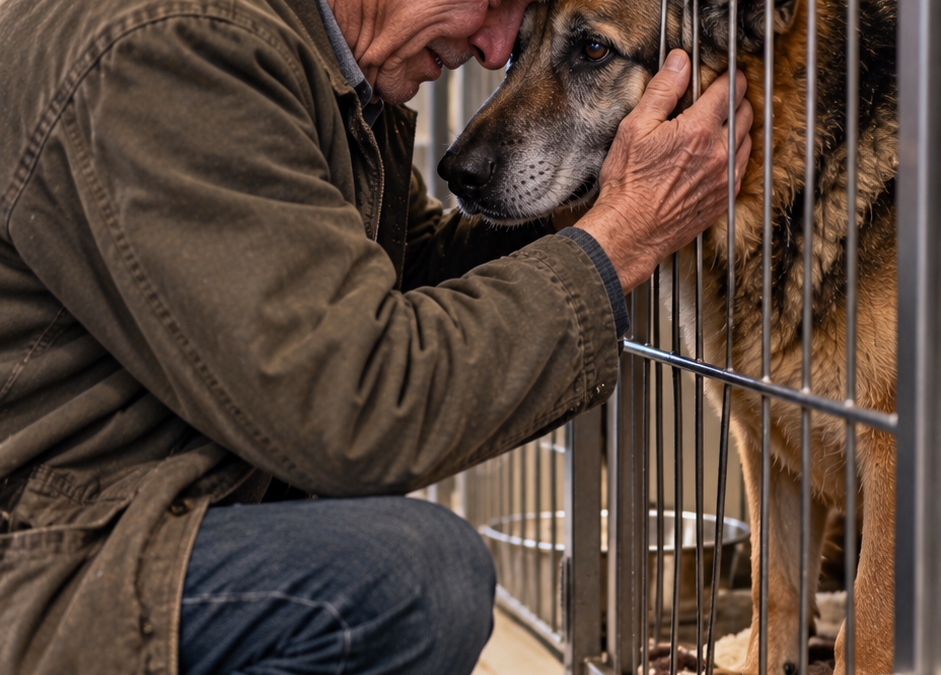
None of us expected him to kneel in front of one kennel, look into the eyes of an aging German Shepherd, and say the sentence that broke four years of silence.
“you lost your companion too, didn’t you?”
That was what my grandfather said.
At first, I thought I had imagined it.
His voice was so rough, so faint, that it barely sounded like the voice I remembered from childhood.
Four years without speaking had changed it.
It came out cracked and rusted, as though the words had been buried somewhere too deep and had to scrape their way back into the world.
But it was him.
Walter.
My grandfather.
The man who had once read stories to me until I fell asleep on his chest.
The man who used to call me “little bird” because I never stopped talking.
The man who had spent my childhood filling every room he entered with a voice so steady and familiar that I used to believe it could never disappear.
And yet it had.
For four years.
Until Duke.
My grandmother died four years before that afternoon.
I don’t like saying she “passed away.”
It sounds gentle.
There was nothing gentle about watching the person who had been beside my grandfather for most of his adult life disappear.
Her name was Margaret.
To everyone else, she had been a wife, a mother, a grandmother, a neighbor.
To Walter, she had been the structure around which every ordinary day had been built.
Coffee in the morning.
Lunch at noon.
Arguments about the thermostat.
Cherry season.
Sunday meals.
The radio in the kitchen.
Her sweater over the back of a chair.
Her hand touching his shoulder when she passed behind him.
They had spent so many decades together that I don’t think my grandfather knew where one life ended and the other began.
Then one day she was gone.
At her funeral, people cried openly.
My mother.
My father.
My brother Ben.
Me.
Neighbors.
Friends.
My grandfather did not.
He stood near the grave wearing the same dark coat he’d worn to church for years.
Hands folded.
Jaw tight.
Eyes dry.
People came to him one by one.
“I’m so sorry, Walter.”
He nodded.
“She was a wonderful woman.”
He nodded.
“If you need anything…”
Another nod.
No words.
At first, nobody thought much of it.
Grief makes people strange.
Some cry immediately.
Some don’t.
Some speak constantly.
Some become quiet.
We assumed Grandfather needed time.
The first day became a week.
Then two.
My mother called.
He answered the phone.
He listened.
He never spoke.
“Papa?”
Silence.
“I know you’re there.”
A breath.
Nothing else.
She began asking yes-or-no questions.
“Did you eat?”
One tap on the table meant yes.
Two meant no.
That became their system for a while.
Ridiculous, maybe.
Necessary.
When we visited, Walter communicated with gestures.
He pointed.
Nodded.
Shook his head.
Once, my father became frustrated.
“Just say something.”
My mother’s face tightened.
“Dad.”
“No, somebody has to say it.”
My grandfather stared at the floor.
My father regretted it immediately.
“I’m sorry.”
Walter got up and went outside.
He sat on the porch until dark.
The doctors found nothing physically wrong with his voice.
He could make sound.
His throat worked.
His vocal cords worked.
There was no medical reason he couldn’t speak.
He simply didn’t.
Or couldn’t in some way none of us understood.
That distinction mattered.
People said depression.
Grief.
Trauma.
Withdrawal.
I heard all the words.
They changed nothing.
Walter remained silent.
The worst part was that he had once been such a talkative man.
He was a farmer.
Or had been for most of his life.
Cherries.
A little acreage.
Some wood.
Enough work that his hands never completely lost their roughness.
When I was little, I loved his hands.
They were huge.
Cracked at the knuckles.
Strong enough to split firewood.
Gentle enough to lift me under the arms and swing me through the air.
“Again!”
“You’ll make me dizzy.”
“Again!”
He always did.
He told stories while he worked.
Stories about weather.
Harvests.
His own father.
The year hail destroyed half the crop.
The first time he saw my grandmother at a dance.
He would exaggerate things.
Grandmother would correct him from the kitchen.
“That is not what happened, Walter.”
“It’s close.”
“It’s not even close.”
“You’re ruining the story.”
“You’re inventing the story.”
I grew up believing that was what love sounded like.
Two voices constantly correcting each other.
Then one voice disappeared permanently.
And the other chose silence.
Four years.
My mother still brought him groceries.
I visited whenever I could.
He ate.
Bathed.
Kept the house clean enough.
Sat on the porch.
Watched television with the sound low or off.
Walked to the mailbox.
Sometimes he looked at old photographs.
He existed.
That was the word that frightened me.
He existed.
But it did not feel like he was living.
His silence spread through the family.
We stopped telling certain stories because they seemed pointless without his response.
Sunday dinners became smaller.
My mother worried constantly.
My father pretended not to.
I avoided mentioning Grandma because I never knew what it would do to him.
The whole family reorganized itself around what Walter could not bear.
Then one morning, my mother called me.
“I want to take him to the shelter.”
“What?”
“Your grandfather.”
“I understand that part.”
“There’s an old dog.”
I waited.
“Mom.”
“Just listen.”
She had spoken with a volunteer named Debbie at the local shelter.
There was an older German Shepherd there.
Duke.
Nobody wanted him.
He had been there six months.
“Why?”
“He’s old.”
“So?”
“Arthritis. Bad ear infection. Dental issues.”
My mother sighed.
“People keep choosing younger dogs.”
I was quiet.
“And you think Grandpa wants a dog?”
“No.”
“Then why are we doing this?”
“Because maybe he doesn’t know what he wants.”
I didn’t love that answer.
There is something dangerous about deciding what a grieving person needs.
You can turn help into pressure.
But my mother sounded exhausted.
“I just want him to leave the house.”
“Does he even like dogs?”
“Your grandfather likes anything that doesn’t talk too much.”
Despite everything, I laughed.
Then immediately felt guilty.
My mother laughed too.
That alone made the idea seem worth trying.
We didn’t tell Walter he was adopting a dog.
We told him we were going out.
He resisted by simply not putting on his coat.
My mother stood by the door.
“Dad.”
Walter remained in his chair.
“We are leaving this house.”
No reaction.
“Today.”
He looked at her.
She held out his coat.
“You can hate me in the car.”
He stared another five seconds.
Then stood.
That was victory number one.
At the shelter, noise hit us immediately.
Barking.
Metal kennel doors.
People talking.
Dogs moving.
My grandfather flinched.
For someone who had spent four years inside near-total silence, it must have been overwhelming.
“Maybe this is a bad idea,” I whispered.
My mother shook her head.
“Just give him a minute.”
Debbie met us near the front.
She was one of those people who seemed incapable of speaking about animals casually.
Every dog had a biography.
Every cat had emotional history.
She recognized my grandfather immediately.
“Mr. Walter?”
He nodded.
“I’m Debbie.”
Another nod.
My mother had warned her about the silence.
She didn’t comment.
I liked her for that.
“There’s somebody I’d like you to meet.”
Walter gave my mother a look.
She ignored it.
We walked down the row.
Young dogs jumped at the gates.
A Labrador mix spun in circles.
A terrier barked so loudly I covered one ear.
Walter moved slowly.
He looked at them.
No expression.
Then we reached the last section.
The noise changed.
Older dogs.
Less movement.
Less expectation.
Debbie stopped.
“Duke.”
At first, I saw only a large shape lying near the back.
German Shepherd.
Gray mixed into the black around his face.
His ears sagged slightly.
His body looked heavy.
Not overweight.
Tired.
He didn’t stand when we approached.
Debbie crouched.
“Hey, handsome.”
Duke opened his eyes.
Looked at us.
Then closed them again.
“He’s been here six months.”
My mother whispered, “Why?”
Debbie gave the answer she had probably given many times.
“Age.”
Duke was old enough that people looked at him and calculated grief before love had even started.
“His hips?”
“Arthritis.”
“Serious?”
“Manageable.”
She pointed gently.
“His right rear leg bothers him most.”
“And the ear?”
“Being treated.”
“Teeth?”
“He needs dental work.”
My mother glanced at Grandfather.
He was staring at Duke.
Something in his face had changed.
Tiny.
But I knew him well enough to see it.
Attention.
Real attention.
Not the distant look he gave television.
Not the polite glance he gave visitors.
He was looking at Duke as if something about the dog had interrupted a thought he’d been carrying for years.
Duke opened his eyes again.
Their eyes met.
Grandfather stepped closer.
Debbie started explaining more.
“He came in after—”
Walter raised one hand.
Debbie stopped.
He moved to the kennel.
Then slowly lowered himself to one knee.
My mother looked at me.
I held my breath.
Grandfather hadn’t knelt easily in years.
His joints were stiff.
His body moved cautiously.
But he lowered himself until his face was level with Duke’s.
The dog watched.
Neither moved.
Thirty seconds.
Maybe longer.
Then Duke shifted.
He raised his head.
Walter leaned closer to the fence.
His lips parted.
At first, I thought he was breathing differently.
Then sound came.
“you lost your companion too, didn’t you?”
Everything stopped.
The barking was still there.
People were still moving.
But for me, the entire shelter became silent.
My mother made a sound behind me.
I turned.
Tears were already running down her face.
Debbie had one hand over her mouth.
I couldn’t feel my own face.
My grandfather had spoken.
Not one word.
A sentence.
A complete sentence.
And it wasn’t to us.
It was to Duke.
“you lost your companion too.”
His voice was raw.
Broken.
But unmistakable.
Walter.
Duke’s ears lifted slightly.
His tail moved once.
One slow sweep against the kennel floor.
Grandfather put his fingers through the wire.
His hands were trembling.
That frightened me almost as much as the voice.
Walter’s hands didn’t tremble.
Not when I was a child.
Not chopping wood.
Not carrying crates.
Not even at Grandma’s funeral.
But now his fingers shook against the metal.
Duke looked at them.
Then began to stand.
Painfully.
His hips came up first.
His right rear leg barely touched the ground.
His back curved.
For a moment, I thought he would lie down again.
Instead, he took one step.
Then another.
Until his nose reached Walter’s fingers.
Duke inhaled.
Long.
Slow.
He smelled Grandfather as if scent could explain what words couldn’t.
Walter’s face changed.
Four years of control disappeared.
His mouth twisted.
His eyes closed.
And my grandfather cried.
I had never seen it.
Not once.
He used to tell me, “Men don’t cry, Emily.”
When I scraped my knee.
When a boy broke my heart.
When I cried at a movie.
“Chin up.”
“Teeth together.”
“Move forward.”
That was Walter.
Feelings were things you carried privately.
Pain became work.
Grief became silence.
But on that shelter floor, he finally broke his own rule.
His forehead touched the kennel bars.
His fingers remained against Duke’s muzzle.
And Walter cried.
Quietly.
No dramatic sobbing.
No shouting.
His shoulders shook.
Tears fell onto his hands.
The kind of crying that seemed to come from somewhere older than language.
I knelt beside him.
Didn’t touch him.
Not yet.
I was afraid touching him might make him stop.
For four years, we had wanted him to speak.
Suddenly I understood speech had never been the real problem.
Feeling was.
He had sealed grief somewhere so deep that words couldn’t get past it.
Duke had found the door.
The old dog remained at the bars.
His nose pressed against Walter’s fingers.
No excitement.
No demand.
Just presence.
Debbie wiped her face.
Then did something she later admitted she wasn’t supposed to do.
She unlocked the kennel.
“I shouldn’t.”
My mother looked at her.
Debbie opened it anyway.
“This one needs to come out.”
Duke stepped forward.
Slowly.
The right hind leg barely supporting him.
Walter remained on his knees.
The dog stopped in front of him.
Sniffed his chest.
His sleeve.
His face.
Then Duke leaned.
He placed his head over my grandfather’s shoulder.
Not beside it.
On it.
Like an embrace.
Walter froze.
Then wrapped both arms around Duke’s neck.
The dog stayed still.
Two old bodies leaning into each other on a cold concrete floor.
One man who had lost his wife.
One dog who, according to Debbie, had lost the animal companion he’d lived with before arriving at the shelter.
Both left behind by the lives they understood.
My mother was crying harder now.
I reached for her hand.
She squeezed mine.
Debbie turned away briefly.
Nobody spoke.
Nobody wanted to break whatever was happening.
Eventually Walter whispered something into Duke’s fur.
I couldn’t hear it.
I didn’t need to.
His voice existed.
That was enough.
After several minutes, I stood.
I looked at Debbie.
“We’re taking him.”
She blinked.
My mother nodded immediately.
“Yes.”
“No questions.”
Debbie looked at Walter.
“Mr. Walter?”
Grandfather’s hand rested on Duke’s head.
He nodded.
Then said aloud, “Yes.”
The second word.
Clearer than the first sentence.
Debbie crouched.
“I need you to know everything first.”
Walter waited.
“He’s got arthritis.”
No reaction.
“The ear infection is improving, but it’ll need follow-up.”
Grandfather stroked Duke’s ear gently.
“And his teeth need work.”
Walter nodded.
“It can get expensive.”
That was when he looked directly at her.
Then he spoke again.
“I’ve saved money for four years because I had nothing to buy.”
My mother pressed both hands over her mouth.
Grandfather looked at Duke.
“Now I do.”
Debbie’s chin trembled.
Walter continued.
“His health.”
That was the moment the rest of us lost whatever composure we still had.
Even Debbie cried openly.
Grandfather didn’t seem embarrassed anymore.
Maybe after four years of silence, embarrassment had become irrelevant.
We completed the adoption process.
That evening, Duke came home with us.
I sat in the front passenger seat.
My mother drove.
Grandfather and Duke sat in the back.
Duke’s head rested against Walter.
Grandfather moved his fingers in small circles around the dog’s ears.
The same gentle motion I remembered seeing him use with Grandma sometimes when they sat together.
“Tough old boy, aren’t you?”
My mother looked at me.
I looked back.
Neither of us spoke.
Grandfather continued.
“Yeah.”
Pause.
“Big old boy.”
Duke’s eyes closed.
“We’re both old.”
A weak smile appeared on Walter’s face.
“Not much we can do about that.”
That was more speech than we’d heard from him in four years.
I watched trees pass outside the window because if I kept looking at him, I knew I would start sobbing again.
His voice was fragile.
Like something newly repaired.
I was afraid to celebrate too loudly.
Afraid we’d frighten it back into hiding.
So we drove.
Grandfather talked softly to Duke.
Not constantly.
Just little sentences.
“I’m here.”
“Easy.”
“Good boy.”
The most ordinary words in the world.
They sounded miraculous.
The first week was not magical.
That’s important.
Duke did not arrive and instantly become joyful.
Walter did not suddenly return to the grandfather I remembered.
Healing rarely respects the dramatic moment that begins it.
Duke barely ate.
He lay on the living room rug.
Sometimes he lifted his head when Walter moved.
Usually he didn’t.
Getting him outside required patience.
His hip hurt.
The new house smelled unfamiliar.
His routines had disappeared.
Walter understood that better than any of us.
He didn’t force him.
Grandfather sat on the floor beside him.
Hours.
No television sometimes.
No conversation.
Just the old man and the old dog.
If Walter spoke, it was simple.
“You don’t have to.”
“You can stay.”
“We’ve got time.”
That sentence became his favorite.
We’ve got time.
I don’t know if he meant Duke.
Himself.
Both.
I visited every day.
I brought the special food the veterinarian recommended.
I also brought sandwiches for Grandfather.
Before Duke, Walter would often claim he had eaten by pointing to an empty plate.
I never knew whether to believe him.
Now I put a sandwich beside him.
“Eat.”
He would give me a look.
“Both of you.”
Duke’s ear would move.
Grandfather almost smiled.
One afternoon, I walked in without knocking.
Then stopped in the hallway.
Someone was singing.
Quietly.
Off-key.
“You Are My Sunshine.”
My grandmother’s favorite song.
I couldn’t move.
Walter sat in his old chair.
Duke sat in front of him.
Grandfather sang.
Not loudly.
His voice cracked.
He forgot a word once and hummed through it.
Duke watched as though he had never heard anything more important.
His tail moved slowly against the rug.
Walter reached the end.
Silence.
Then he said, “She loved that one.”
Duke’s ears lifted.
Grandfather rubbed his forehead.
“Used to sing it wrong.”
He smiled.
Actually smiled.
“Said I was wrong.”
I pressed one hand to my mouth.
I backed into the hallway before he saw me crying.
For years, hearing Grandma’s favorite song had felt dangerous.
Now Grandfather was singing it.
Not because he’d forgotten her.
Because he remembered.
There is a difference.
Two weeks after Duke came home, he began walking farther.
First to the front door.
Then porch.
Then gate.
Grandfather went with him.
Neither moved quickly.
Walter had stiffness in his knees.
Duke limped.
Right rear leg barely lifting some mornings.
They looked almost synchronized.
Step.
Pause.
Step.
Pause.
“Easy, Duke.”
They would reach the gate.
Rest.
Next day, farther.
One afternoon I watched from the porch.
Grandfather looked down at Duke.
“We’re not winning any races.”
Duke sniffed the grass.
Walter laughed.
A short sound.
Almost rusty.
But laughter.
I hadn’t realized how much I’d missed it.
Neighbors noticed too.
For four years, they’d seen Walter sitting alone on the porch.
Silent.
Now he passed their houses talking to a German Shepherd.
“Come on.”
“Slow.”
“That’s it.”
Sometimes people waved.
Grandfather waved back.
Eventually, he started saying, “Morning.”
A small word.
Yet every one felt like a stone being removed from a wall.
My mother changed too.
Her face looked less tired.
For four years, she had carried the belief that she should be able to fix her father.
She couldn’t.
None of us could.
Duke didn’t “fix” him either.
That’s not what happened.
He gave Walter somewhere to put love that had been trapped.
That was different.
Grandmother’s death had not removed Grandfather’s capacity to love.
It had left all that love with nowhere to go.
Duke appeared.
Old.
Hurting.
Grieving.
Patient.
And Walter recognized something.
Maybe himself.
One Sunday, the family gathered at Grandfather’s house.
Like the old days.
My father.
Mother.
Me.
Ben.
Ben’s wife.
The rest of the family.
Ten people around the table.
Food everywhere.
Too much, naturally.
Grandmother would have complained there weren’t enough serving dishes.
Walter sat at the head.
Duke lay beneath him.
One old paw stretched across Grandfather’s shoe.
We ate.
People talked.
Grandfather mostly listened.
But not silently anymore.
He answered.
Short sentences.
A joke.
A correction.
At one point, Ben told a story incorrectly.
Grandfather interrupted.
“That’s not how it happened.”
The table went silent.
Then everyone laughed.
Ben grinned.
“There he is.”
Grandfather looked embarrassed.
Then laughed too.
After dinner, Walter stood.
Duke lifted his head immediately.
Grandfather picked up his glass.
I felt everyone become still.
He looked around the table.
My mother.
My father.
Ben.
Me.
Faces that had spent four years waiting for his voice.
“I want to make a toast.”
His voice was stronger now.
Still rough.
But his.
My mother immediately started crying.
Walter saw.
“Let me finish first.”
That made us laugh.
Then his expression changed.
“To Margaret.”
Silence.
Grandmother’s name.
He had not spoken it aloud in four years.
My throat closed.
“To your grandmother.”
He looked toward the empty chair that had once been hers.
Then down.
Duke was looking up.
“And to this dog.”
Walter’s hand rested on Duke’s head.
“The one who gave her back to me.”
He paused.
Then corrected himself.
“No.”
His voice trembled.
“The one who gave me back to all of you.”
My father looked down.
Ben wiped his face.
Mother didn’t even try hiding the tears.
Walter’s eyes filled too.
But he kept going.
“I thought losing her meant losing everything that made words worth saying.”
He swallowed.
“I was wrong.”
Duke leaned against his leg.
Walter smiled down.
“Turns out this old fellow is a pretty good listener.”
We raised our glasses.
Nobody made it through the toast without crying.
Even my father.
Even Ben, who had inherited Walter’s old belief that men should keep emotion under control.
That night, everyone left gradually.
I stayed to help clean.
Grandfather washed one plate.
I took it from him.
“Sit.”
“I can wash dishes.”
“You’re seventy-something years old.”
“So?”
“So I said sit.”
He gave me the same irritated look he used when I was fifteen.
That alone made me happy.
Eventually, we went out to the porch.
The moon was high.
Air cold enough that I pulled my sweater tighter.
Duke lay across Walter’s feet.
Grandfather stroked his head.
For a while, neither of us spoke.
The silence didn’t feel dangerous anymore.
That was new.
Then Grandfather said, “Emily.”
I turned.
“Yes, Grandpa?”
He looked toward the yard.
“I thought when your grandmother died, she took my voice with her.”
I stayed very still.
“I didn’t plan not to speak.”
He rubbed Duke’s ear.
“I just…”
He searched.
“Every word felt wrong.”
I waited.
“If I talked about weather, it felt disrespectful.”
His eyes stayed forward.
“If I talked about food, it felt pointless.”
“If I talked about her…”
His voice broke.
He stopped.
Duke lifted his head.
Walter placed a hand on him.
“If I talked about her, then she was really gone.”
I felt tears come.
“So I said nothing.”
Four years explained in five words.
So I said nothing.
“I thought silence kept her close.”
He smiled sadly.
“But silence doesn’t keep people close.”
“What does?”
I asked.
Walter looked down at Duke.
“Remembering them out loud.”
I started crying.
He continued.
“This old boy…”
He scratched Duke beneath the chin.
“He doesn’t need me to be fine.”
Duke closed his eyes.
“He doesn’t need me to say something clever.”
“Doesn’t even need me to say anything.”
Walter leaned back.
“But he listens to the silence.”
I looked at him.
Grandfather’s face was older than it had been four years earlier.
Obviously.
But grief had changed him too.
There were lines I hadn’t noticed.
Hollowness around his eyes.
Yet something had returned.
Presence.
“I thought I had nothing left to say without her.”
He looked toward me.
“Duke showed me there’s always something.”
“What?”
He smiled.
“Whatever is true.”
I moved closer and hugged him.
His shoulders weren’t as broad as when I was little.
His back felt thinner.
But he was warm.
He put one arm around me.
For a second, I was a child again.
Duke’s tail thumped against the porch boards.
Walter laughed.
“Jealous?”
Duke lifted his head.
“Come here, then.”
The dog pushed closer.
We stayed there under the moon.
Grandfather.
Duke.
Me.
I thought about that first day at the shelter.
Walter kneeling.
The sentence.
you lost your companion too.
Maybe that was why Duke reached him when we couldn’t.
We kept trying to pull Grandfather out of grief.
Talk.
Eat.
Visit.
Come with us.
Move forward.
Duke asked for nothing.
He simply existed beside him with his own losses, pain, old age, silence.
He did not demand recovery.
He shared the space.
Sometimes that is what allows a person to move.
Not being dragged out of darkness.
Discovering someone else sitting there who doesn’t seem afraid of it.
Duke’s health improved gradually.
The ear infection cleared.
He had the dental work he needed.
His arthritis never disappeared.
Old joints don’t become young because they’re loved.
But medication helped.
Warmth helped.
Soft bedding helped.
Walking helped.
Grandfather became disciplined about Duke’s care.
He kept medication times written down.
Bought better food.
Placed rugs across slippery floors.
He talked to the veterinarian more than he talked to some relatives.
“Duke is stiff this morning.”
“He’s eating less.”
“That ear looks red.”
My mother joked that Grandfather had become an overprotective parent.
He didn’t deny it.
“I’ve got money invested in this dog.”
“His health,” I reminded him.
Walter smiled.
“Exactly.”
Duke helped Walter physically too.
Grandfather had spent four years becoming smaller.
Fewer walks.
Less movement.
More chair.
Duke needed outside.
Even if only slowly.
So Walter walked.
Gate.
Mailbox.
End of road.
Back.
The old man and the old dog.
Both limping.
Both moving.
I often joined.
One morning, Walter stopped halfway down the road.
Duke stopped beside him.
Grandfather rested one hand on the dog’s back.
“Need a break?”
Duke panted.
Grandfather nodded.
“Me too.”
They stood together until both were ready.
That became their rhythm.
No embarrassment.
No need to pretend strength.
If Duke hurt, they stopped.
If Walter hurt, Duke waited.
They learned each other’s pace.
There was something beautiful about that.
Grandfather had spent his whole life pushing through discomfort.
Farmers do that.
Pain?
Work.
Tired?
Work.
Sad?
Work.
But Duke could not be bullied out of arthritis.
He needed patience.
And in learning patience with Duke, Walter learned some with himself.
On difficult days, when grief returned suddenly, he no longer disappeared entirely into silence.
Sometimes he’d sit beside Duke and say, “Missing her today.”
That was all.
Three words.
But three words were better than four years.
Duke would put his head near Walter’s knee.
No solution.
No advice.
Presence.
My mother once asked Grandfather whether talking made the grief worse.
He thought about it.
“No.”
“Better?”
He shook his head.
“Different.”
That felt honest.
People like to describe healing as if pain shrinks every day.
It doesn’t.
Sometimes grief stays the same size while your life grows around it.
Duke gave Walter something else to grow.
Routine.
Responsibility.
Affection.
Humor.
Concern.
Morning walks.
Vet appointments.
Songs.
Words.
Margaret remained.
She always would.
Duke didn’t replace her.
No animal could.
That was never the point.
Love does not replace.
It expands.
That took me years to understand.
One afternoon, I found Grandfather going through old photographs.
Before Duke, that usually meant a bad day.
This time, Duke lay beside the chair.
Walter held up a picture.
“Look at her.”
Duke did not.
“This was your grandmother at twenty-eight.”
I sat down.
Grandfather smiled.
“She hated this picture.”
“Why?”
“Thought her hair looked terrible.”
“It does.”
Walter looked offended.
“Watch yourself.”
I laughed.
He laughed.
Then his fingers touched the photograph gently.
“Beautiful.”
I looked at him.
He was smiling and crying at the same time.
Four years earlier, he could not say her name.
Now he could tell stories.
That was not forgetting.
That was remembering without drowning.
Duke remained beside him.
Always.
Months passed.
People stopped reacting every time Walter spoke.
At first, every sentence felt like an event.
Eventually, his voice became part of the house again.
That was perhaps the best sign.
Ordinary.
“Coffee?”
“Where’s my coat?”
“Duke, leave that alone.”
“Emily, shut the door.”
Normal complaints.
Normal questions.
Normal life.
The miracle wasn’t that Walter spoke once.
It was that speaking stopped being miraculous.
One evening, I realized I’d been sitting with him for almost an hour and hadn’t consciously thought about his voice.
We had simply talked.
Weather.
Ben.
Groceries.
Duke’s medication.
I drove home crying because I understood what that meant.
He was back.
Not the old Walter.
Grief doesn’t return people unchanged.
But present.
Engaged.
Reachable.
Back.
Duke grew older.
Of course.
His face became grayer.
He needed longer rests.
Some mornings he didn’t want to walk to the gate.
Grandfather never forced him.
“You gave me my pace back.”
Walter would say.
“I’ll give you yours.”
They spent more time together on the porch.
Duke at his feet.
Walter in his chair.
Sometimes talking.
Sometimes not.
Silence had changed meaning completely.
Before Duke, Walter’s silence had been sealed.
Hard.
A wall.
With Duke, silence became shared.
Soft.
Restful.
You could sit beside it without being afraid.
That distinction may sound small.
It wasn’t.
There were evenings I visited and found both asleep.
Grandfather in the chair.
Duke on the rug.
Television on mute.
One hand resting on the dog’s back.
I would stand in the doorway and think about the shelter.
Duke facing months in a kennel.
Nobody wanting the expense.
The arthritis.
The age.
Walter sitting alone for four years.
Nobody knowing how to reach him.
Two lives people might have mistaken for finished.
Neither was.
That is why I have become careful with the word “too late.”
Too late to adopt an old dog.
Too late to begin again after grief.
Too late to speak.
Too late to love something new.
We say those words because endings frighten us.
We calculate risk.
How long will the dog live?
How much will treatment cost?
What if I love him and lose him?
Those are real questions.
But they aren’t the only questions.
Another is:
What might happen in whatever time remains?
Six months in a shelter did not tell us Duke’s value.
Four years of silence did not tell us Walter’s future.
The rest of the story had not happened yet.
Sometimes I think about the family who might have walked past Duke before we arrived.
Maybe several families.
Saw age.
Saw arthritis.
Saw cost.
Continued.
I don’t blame them.
Every family has limits.
But I wish they could have seen what we saw later.
Duke listening to “You Are My Sunshine.”
Duke walking beside Walter.
Duke under the dinner table while Grandfather toasted Margaret.
Duke on the porch during that moonlit conversation.
No adoption card could describe that.
“Old German Shepherd.”
“Arthritis.”
“Needs dental care.”
True.
Incomplete.
People are that way too.
“Widower.”
“Depressed.”
“Nonverbal for four years.”
True.
Incomplete.
Labels describe conditions.
They do not describe everything a life can still become.
I learned that from both of them.
Last Sunday, we gathered again at Grandfather’s.
Fewer tears this time.
More laughter.
Duke slept most of dinner.
Walter told the same story twice.
Nobody corrected him until the third time.
Ben said, “Grandpa, you already told us.”
Walter pointed at him.
“I was silent four years. I’ve got catching up to do.”
The whole table exploded in laughter.
Duke lifted his head.
Walter looked down.
“Not you.”
Duke’s tail moved.
“You’re stuck listening.”
That sentence made my mother cry.
She tried hiding it behind her napkin.
Walter noticed.
“Stop that.”
She laughed.
“I can’t help it.”
“Too many criers in this family.”
I stared at him.
He caught me.
“What?”
“You created this family.”
Walter thought about it.
“Good point.”
Then he smiled.
The man who used to say men don’t cry had become the man who could tease us about crying.
Maybe that was another kind of healing.
Not becoming less emotional.
Becoming less afraid of emotion.
Duke never cared whether tears were weakness.
He treated them like rain.
Something that happened.
Something you sat through.
Walter learned.
So did the rest of us.
Tonight, as I write this, they are asleep in the living room.
Grandfather in his old chair.
Duke at his feet.
The television is on.
Sound muted.
Walter’s hand rests on Duke’s back.
Every few minutes his fingers move slightly, as though even asleep he needs to confirm the dog is still there.
Duke breathes slowly.
His old chest rises.
Falls.
Walter’s does the same.
Two old souls.
No longer alone.
I don’t know how much time they have.
None of us do.
Duke was already old when we met him.
Grandfather is not getting younger.
The thought hurts.
But I no longer believe the answer to future grief is refusing present love.
That is what Walter had done after Margaret died.
He shut the door because losing someone had hurt too much.
Then Duke arrived carrying his own losses and lay quietly on the other side of that door until Grandfather opened it.
Not all at once.
One sentence.
One touch.
One walk.
One song.
One dinner.
One ordinary day after another.
Grandfather once told me Margaret took his ability to speak with her.
Now he understands she didn’t.
His voice had simply become buried beneath everything he could not bear to feel.
Duke didn’t give Walter a new voice.
He reminded him the old one was still there.
And the first thing that voice chose to say was not about himself.
It was recognition.
you lost your companion too, didn’t you?
Maybe that is why the sentence mattered so much.
It wasn’t merely speech.
It was Walter looking outside his own grief for the first time in four years and seeing another living creature’s pain.
That was the crack.
The good kind.
The one that lets light through.
The day Walter spoke again, everyone thought Duke had rescued him.
I thought so too.
Now I believe it was more equal than that.
Walter rescued an old dog nobody wanted.
He paid for his treatment.
Gave him warmth.
Food.
A porch.
A family.
A place where his painful body could rest.
Duke gave Walter somewhere to place the love he thought had died with Margaret.
He listened.
Waited.
Walked slowly.
Stayed close.
Neither cured the other.
They simply gave each other enough reason to keep moving.
Sometimes rescue looks like that.
Not one strong creature saving one weak creature.
Two damaged lives leaning against each other until both can stand.
I think back to Duke placing his head on Grandfather’s shoulder in the shelter.
At the time, I thought it looked human.
A hug.
Now I think that interpretation was too small.
Duke didn’t need to behave like a human for the gesture to matter.
He behaved like himself.
A tired old dog recognizing safety.
Grandfather did the same.
They met without pretending to be unbroken.
That was the beginning.
Yesterday, I asked Walter something.
We were on the porch.
Duke asleep against his shoes.
“Do you ever wish we’d found Duke sooner?”
Grandfather looked surprised.
“Why?”
“Four years.”
I didn’t need to explain.
He looked toward the yard.
Then shook his head.
“No.”
“No?”
“I wish Margaret hadn’t died.”
His hand moved over Duke’s head.
“I wish he hadn’t lost whoever he lost.”
Another pause.
“But I don’t know if we would’ve understood each other sooner.”
That answer stayed with me.
Maybe timing isn’t always about deserving.
Sometimes two lives have to arrive at the same place before recognition is possible.
Grandfather needed Duke exactly as he was.
Old.
Slow.
Quiet.
Hurting.
Duke needed Grandfather exactly as he was.
Patient.
Lonely.
Full of unused tenderness.
Neither needed fixing first.
They met there.
The shelter floor.
Concrete.
Metal gate.
One sentence.
Sometimes beginnings are that small.
I often wonder what Debbie remembers.
For us, that day divided our family history.
Before Duke.
After Duke.
For her, maybe it was one adoption among hundreds.
But I know she remembers because she still asks about him.
Every few months, she calls my mother.
“How are the old men?”
That’s what she calls them.
The old men.
Mom sends photographs.
Walter asleep in his chair.
Duke beside him.
Walter walking slowly with the leash.
Duke wearing a ridiculous winter coat Grandfather claimed he would never buy.
The blue one.
Walter hated the color.
Bought it anyway.
“He’s cold.”
“He has fur.”
“Not enough.”
This from the man who once thought buying a dog coat was nonsense.
Love makes hypocrites of us all.
A few weeks ago, I arrived early in the morning.
The front door was unlocked.
I heard Walter in the kitchen.
He was talking.
I paused.
Not because hearing him speak is unusual anymore.
Because I heard who he was talking to.
Margaret.
Not literally.
Her photograph sat on the counter.
Grandfather was making coffee.
“Your dog wants eggs again.”
Duke waited nearby.
Walter glanced at the picture.
“Yes, I know he’s not your dog.”
He smiled.
“Would’ve been if you’d met him.”
I stood outside the doorway.
He continued.
“You’d spoil him.”
Pause.
“More than I do.”
Then he looked at Duke.
“Don’t listen.”
Duke’s tail moved.
I stepped away before Walter noticed me.
I cried in the bathroom.
Not from sadness.
Not entirely.
For four years, Grandfather avoided speaking because words made Margaret’s absence real.
Now he spoke to her because words kept love moving.
That’s what Duke had changed.
Not memory.
The direction memory flowed.
It no longer pulled Walter only backward.
It moved with him.
Into breakfast.
Walks.
Family dinners.
Songs.
Conversations with an old German Shepherd.
Love had changed form.
Grandfather was right.
I used to think that phrase was just something people said after loss because reality was too painful.
Now I understand it differently.
Love does not remain identical.
It cannot.
People leave.
Bodies age.
Dogs die.
Children grow up.
Homes change.
But love can move.
From husband to memory.
From silence to speech.
From one hand to another living creature’s fur.
From an old song once shared with a wife to the same song sung to a dog.
Nothing replaces Margaret.
Duke isn’t supposed to.
He carries something else.
A continuation.
Permission.
Proof that caring again is not betrayal.
That may have been Walter’s greatest fear.
If he laughed, did it mean he’d forgotten?
If he loved Duke, did that reduce what he had felt for Margaret?
If he resumed living, was he leaving her behind?
Duke answered without words.
Love doesn’t work like a chair with one seat.
Making room for something new does not evict what came before.
Walter could miss Margaret and love Duke.
Cry and laugh.
Remember and continue.
We all can.
My grandfather taught me many things when I was young.
How to identify a cherry ready to pick.
How to stack wood so it dried properly.
How to keep my feet when someone bigger pushed me.
How to work even when tired.
He also taught me some things I had to unlearn.
Men don’t cry.
Pain should be swallowed.
Silence is strength.
Duke helped him unlearn them first.
Now Walter cries sometimes.
He doesn’t apologize.
He talks about Margaret.
He says “I miss her.”
He tells Duke when he’s having a difficult morning.
He calls my mother just to talk.
Sometimes too early.
She never complains.
How could she?
Four years she would have given anything to hear his voice.
Now when he calls at seven asking how long chicken should stay in the oven, she answers.
Even when he already knows.
Voice is a gift once you’ve lost it.
We learned not to take it casually.
Duke taught us that too.
Someday, the house will be quiet again.
I know.
I don’t like writing that sentence.
But denying endings never saved anyone from them.
Duke’s old.
Walter’s old.
Time will do what time does.
The difference now is that silence will not come from refusing love.
When grief returns, as it always does, we will speak.
We’ll tell stories.
We will say names.
We’ll cry.
We’ll probably sing badly.
That’s the inheritance I want.
Not Walter’s old rule.
Teeth together and move on.
Something better.
Feel it.
Say it.
Stay beside someone.
Then move when you’re ready.
Maybe slowly.
Maybe limping.
But move.
Right now, Duke shifts in his sleep.
Walter’s hand slides from his back.
Without opening his eyes, Grandfather reaches down until he finds the fur again.
His fingers settle.
Duke exhales.
Walter does too.
The television flickers across the room without sound.
I sit nearby writing and think of that shelter kennel.
Six months nobody chose Duke.
Four years none of us could reach Walter.
Then somehow, they recognized each other.
No diagnosis explained it.
No grand plan.
Just one old man kneeling in front of one old dog.
A sentence.
you lost your companion too, didn’t you?
Duke’s tail moved once.
Walter’s world moved with it.
That was all it took to begin.
Not to finish grief.
Grief doesn’t finish.
To begin living beside it.
Tomorrow morning, Walter will wake.
Duke will probably already be watching.
Grandfather will complain that his knees hurt.
Duke will stand slowly because his hips hurt too.
They’ll go outside.
Two old bodies.
One porch.
One yard.
A few careful steps.
Grandfather will talk.
Duke will listen.
Maybe Duke will stop near the gate.
Walter will stop too.
“Take your time.”
He says that often now.
I don’t think he realizes he’s talking to himself too.
Take your time.
We’ve got time.
Not forever.
No one gets forever.
But today.
This walk.
This morning.
This conversation.
This old dog beside you.
That can be enough.
Four years ago, I thought we had lost my grandfather when we lost my grandmother.
I know now that we hadn’t.
He was still there.
Deep inside the silence.
Waiting without knowing he was waiting.
And somewhere else, behind a shelter gate, an old German Shepherd was waiting too.
Then the two of them met.
Grandfather spoke.
Duke stood despite the pain in his hips.
One reached through the bars.
The other placed his muzzle against those trembling fingers.
And for the first time in four years, neither of them had to carry grief alone.
That is how Walter found his voice.
Not because Duke made the pain disappear.
Not because Grandfather stopped loving Margaret.
Because one wounded creature looked at another and finally understood:
You know this too.
And sometimes, before healing can begin, that is the only sentence we need.
𝗧𝗛𝗘 𝗘𝗡𝗗
For Four Years, My Grandfather Had Given Up on Words, Until an Old German Shepherd Made Him Use His Voice Again
For four years, my grandfather had not spoken a single word to any of us.
We took him to the shelter because we thought an old dog might give him a reason to leave the house again.
None of us expected him to kneel in front of one kennel, look into the eyes of an aging German Shepherd, and say the sentence that broke four years of silence.
“you lost your companion too, didn’t you?”
That was what my grandfather said.
At first, I thought I had imagined it.
His voice was so rough, so faint, that it barely sounded like the voice I remembered from childhood.
Four years without speaking had changed it.
It came out cracked and rusted, as though the words had been buried somewhere too deep and had to scrape their way back into the world.
But it was him.
Walter.
My grandfather.
The man who had once read stories to me until I fell asleep on his chest.
The man who used to call me “little bird” because I never stopped talking.
The man who had spent my childhood filling every room he entered with a voice so steady and familiar that I used to believe it could never disappear.
And yet it had.
For four years.
Until Duke.
My grandmother died four years before that afternoon.
I don’t like saying she “passed away.”
It sounds gentle.
There was nothing gentle about watching the person who had been beside my grandfather for most of his adult life disappear.
Her name was Margaret.
To everyone else, she had been a wife, a mother, a grandmother, a neighbor.
To Walter, she had been the structure around which every ordinary day had been built.
Coffee in the morning.
Lunch at noon.
Arguments about the thermostat.
Cherry season.
Sunday meals.
The radio in the kitchen.
Her sweater over the back of a chair.
Her hand touching his shoulder when she passed behind him.
They had spent so many decades together that I don’t think my grandfather knew where one life ended and the other began.
Then one day she was gone.
At her funeral, people cried openly.
My mother.
My father.
My brother Ben.
Me.
Neighbors.
Friends.
My grandfather did not.
He stood near the grave wearing the same dark coat he’d worn to church for years.
Hands folded.
Jaw tight.
Eyes dry.
People came to him one by one.
“I’m so sorry, Walter.”
He nodded.
“She was a wonderful woman.”
He nodded.
“If you need anything…”
Another nod.
No words.
At first, nobody thought much of it.
Grief makes people strange.
Some cry immediately.
Some don’t.
Some speak constantly.
Some become quiet.
We assumed Grandfather needed time.
The first day became a week.
Then two.
My mother called.
He answered the phone.
He listened.
He never spoke.
“Papa?”
Silence.
“I know you’re there.”
A breath.
Nothing else.
She began asking yes-or-no questions.
“Did you eat?”
One tap on the table meant yes.
Two meant no.
That became their system for a while.
Ridiculous, maybe.
Necessary.
When we visited, Walter communicated with gestures.
He pointed.
Nodded.
Shook his head.
Once, my father became frustrated.
“Just say something.”
My mother’s face tightened.
“Dad.”
“No, somebody has to say it.”
My grandfather stared at the floor.
My father regretted it immediately.
“I’m sorry.”
Walter got up and went outside.
He sat on the porch until dark.
The doctors found nothing physically wrong with his voice.
He could make sound.
His throat worked.
His vocal cords worked.
There was no medical reason he couldn’t speak.
He simply didn’t.
Or couldn’t in some way none of us understood.
That distinction mattered.
People said depression.
Grief.
Trauma.
Withdrawal.
I heard all the words.
They changed nothing.
Walter remained silent.
The worst part was that he had once been such a talkative man.
He was a farmer.
Or had been for most of his life.
Cherries.
A little acreage.
Some wood.
Enough work that his hands never completely lost their roughness.
When I was little, I loved his hands.
They were huge.
Cracked at the knuckles.
Strong enough to split firewood.
Gentle enough to lift me under the arms and swing me through the air.
“Again!”
“You’ll make me dizzy.”
“Again!”
He always did.
He told stories while he worked.
Stories about weather.
Harvests.
His own father.
The year hail destroyed half the crop.
The first time he saw my grandmother at a dance.
He would exaggerate things.
Grandmother would correct him from the kitchen.
“That is not what happened, Walter.”
“It’s close.”
“It’s not even close.”
“You’re ruining the story.”
“You’re inventing the story.”
I grew up believing that was what love sounded like.
Two voices constantly correcting each other.
Then one voice disappeared permanently.
And the other chose silence.
Four years.
My mother still brought him groceries.
I visited whenever I could.
He ate.
Bathed.
Kept the house clean enough.
Sat on the porch.
Watched television with the sound low or off.
Walked to the mailbox.
Sometimes he looked at old photographs.
He existed.
That was the word that frightened me.
He existed.
But it did not feel like he was living.
His silence spread through the family.
We stopped telling certain stories because they seemed pointless without his response.
Sunday dinners became smaller.
My mother worried constantly.
My father pretended not to.
I avoided mentioning Grandma because I never knew what it would do to him.
The whole family reorganized itself around what Walter could not bear.
Then one morning, my mother called me.
“I want to take him to the shelter.”
“What?”
“Your grandfather.”
“I understand that part.”
“There’s an old dog.”
I waited.
“Mom.”
“Just listen.”
She had spoken with a volunteer named Debbie at the local shelter.
There was an older German Shepherd there.
Duke.
Nobody wanted him.
He had been there six months.
“Why?”
“He’s old.”
“So?”
“Arthritis. Bad ear infection. Dental issues.”
My mother sighed.
“People keep choosing younger dogs.”
I was quiet.
“And you think Grandpa wants a dog?”
“No.”
“Then why are we doing this?”
“Because maybe he doesn’t know what he wants.”
I didn’t love that answer.
There is something dangerous about deciding what a grieving person needs.
You can turn help into pressure.
But my mother sounded exhausted.
“I just want him to leave the house.”
“Does he even like dogs?”
“Your grandfather likes anything that doesn’t talk too much.”
Despite everything, I laughed.
Then immediately felt guilty.
My mother laughed too.
That alone made the idea seem worth trying.
We didn’t tell Walter he was adopting a dog.
We told him we were going out.
He resisted by simply not putting on his coat.
My mother stood by the door.
“Dad.”
Walter remained in his chair.
“We are leaving this house.”
No reaction.
“Today.”
He looked at her.
She held out his coat.
“You can hate me in the car.”
He stared another five seconds.
Then stood.
That was victory number one.
At the shelter, noise hit us immediately.
Barking.
Metal kennel doors.
People talking.
Dogs moving.
My grandfather flinched.
For someone who had spent four years inside near-total silence, it must have been overwhelming.
“Maybe this is a bad idea,” I whispered.
My mother shook her head.
“Just give him a minute.”
Debbie met us near the front.
She was one of those people who seemed incapable of speaking about animals casually.
Every dog had a biography.
Every cat had emotional history.
She recognized my grandfather immediately.
“Mr. Walter?”
He nodded.
“I’m Debbie.”
Another nod.
My mother had warned her about the silence.
She didn’t comment.
I liked her for that.
“There’s somebody I’d like you to meet.”
Walter gave my mother a look.
She ignored it.
We walked down the row.
Young dogs jumped at the gates.
A Labrador mix spun in circles.
A terrier barked so loudly I covered one ear.
Walter moved slowly.
He looked at them.
No expression.
Then we reached the last section.
The noise changed.
Older dogs.
Less movement.
Less expectation.
Debbie stopped.
“Duke.”
At first, I saw only a large shape lying near the back.
German Shepherd.
Gray mixed into the black around his face.
His ears sagged slightly.
His body looked heavy.
Not overweight.
Tired.
He didn’t stand when we approached.
Debbie crouched.
“Hey, handsome.”
Duke opened his eyes.
Looked at us.
Then closed them again.
“He’s been here six months.”
My mother whispered, “Why?”
Debbie gave the answer she had probably given many times.
“Age.”
Duke was old enough that people looked at him and calculated grief before love had even started.
“His hips?”
“Arthritis.”
“Serious?”
“Manageable.”
She pointed gently.
“His right rear leg bothers him most.”
“And the ear?”
“Being treated.”
“Teeth?”
“He needs dental work.”
My mother glanced at Grandfather.
He was staring at Duke.
Something in his face had changed.
Tiny.
But I knew him well enough to see it.
Attention.
Real attention.
Not the distant look he gave television.
Not the polite glance he gave visitors.
He was looking at Duke as if something about the dog had interrupted a thought he’d been carrying for years.
Duke opened his eyes again.
Their eyes met.
Grandfather stepped closer.
Debbie started explaining more.
“He came in after—”
Walter raised one hand.
Debbie stopped.
He moved to the kennel.
Then slowly lowered himself to one knee.
My mother looked at me.
I held my breath.
Grandfather hadn’t knelt easily in years.
His joints were stiff.
His body moved cautiously.
But he lowered himself until his face was level with Duke’s.
The dog watched.
Neither moved.
Thirty seconds.
Maybe longer.
Then Duke shifted.
He raised his head.
Walter leaned closer to the fence.
His lips parted.
At first, I thought he was breathing differently.
Then sound came.
“you lost your companion too, didn’t you?”
Everything stopped.
The barking was still there.
People were still moving.
But for me, the entire shelter became silent.
My mother made a sound behind me.
I turned.
Tears were already running down her face.
Debbie had one hand over her mouth.
I couldn’t feel my own face.
My grandfather had spoken.
Not one word.
A sentence.
A complete sentence.
And it wasn’t to us.
It was to Duke.
“you lost your companion too.”
His voice was raw.
Broken.
But unmistakable.
Walter.
Duke’s ears lifted slightly.
His tail moved once.
One slow sweep against the kennel floor.
Grandfather put his fingers through the wire.
His hands were trembling.
That frightened me almost as much as the voice.
Walter’s hands didn’t tremble.
Not when I was a child.
Not chopping wood.
Not carrying crates.
Not even at Grandma’s funeral.
But now his fingers shook against the metal.
Duke looked at them.
Then began to stand.
Painfully.
His hips came up first.
His right rear leg barely touched the ground.
His back curved.
For a moment, I thought he would lie down again.
Instead, he took one step.
Then another.
Until his nose reached Walter’s fingers.
Duke inhaled.
Long.
Slow.
He smelled Grandfather as if scent could explain what words couldn’t.
Walter’s face changed.
Four years of control disappeared.
His mouth twisted.
His eyes closed.
And my grandfather cried.
I had never seen it.
Not once.
He used to tell me, “Men don’t cry, Emily.”
When I scraped my knee.
When a boy broke my heart.
When I cried at a movie.
“Chin up.”
“Teeth together.”
“Move forward.”
That was Walter.
Feelings were things you carried privately.
Pain became work.
Grief became silence.
But on that shelter floor, he finally broke his own rule.
His forehead touched the kennel bars.
His fingers remained against Duke’s muzzle.
And Walter cried.
Quietly.
No dramatic sobbing.
No shouting.
His shoulders shook.
Tears fell onto his hands.
The kind of crying that seemed to come from somewhere older than language.
I knelt beside him.
Didn’t touch him.
Not yet.
I was afraid touching him might make him stop.
For four years, we had wanted him to speak.
Suddenly I understood speech had never been the real problem.
Feeling was.
He had sealed grief somewhere so deep that words couldn’t get past it.
Duke had found the door.
The old dog remained at the bars.
His nose pressed against Walter’s fingers.
No excitement.
No demand.
Just presence.
Debbie wiped her face.
Then did something she later admitted she wasn’t supposed to do.
She unlocked the kennel.
“I shouldn’t.”
My mother looked at her.
Debbie opened it anyway.
“This one needs to come out.”
Duke stepped forward.
Slowly.
The right hind leg barely supporting him.
Walter remained on his knees.
The dog stopped in front of him.
Sniffed his chest.
His sleeve.
His face.
Then Duke leaned.
He placed his head over my grandfather’s shoulder.
Not beside it.
On it.
Like an embrace.
Walter froze.
Then wrapped both arms around Duke’s neck.
The dog stayed still.
Two old bodies leaning into each other on a cold concrete floor.
One man who had lost his wife.
One dog who, according to Debbie, had lost the animal companion he’d lived with before arriving at the shelter.
Both left behind by the lives they understood.
My mother was crying harder now.
I reached for her hand.
She squeezed mine.
Debbie turned away briefly.
Nobody spoke.
Nobody wanted to break whatever was happening.
Eventually Walter whispered something into Duke’s fur.
I couldn’t hear it.
I didn’t need to.
His voice existed.
That was enough.
After several minutes, I stood.
I looked at Debbie.
“We’re taking him.”
She blinked.
My mother nodded immediately.
“Yes.”
“No questions.”
Debbie looked at Walter.
“Mr. Walter?”
Grandfather’s hand rested on Duke’s head.
He nodded.
Then said aloud, “Yes.”
The second word.
Clearer than the first sentence.
Debbie crouched.
“I need you to know everything first.”
Walter waited.
“He’s got arthritis.”
No reaction.
“The ear infection is improving, but it’ll need follow-up.”
Grandfather stroked Duke’s ear gently.
“And his teeth need work.”
Walter nodded.
“It can get expensive.”
That was when he looked directly at her.
Then he spoke again.
“I’ve saved money for four years because I had nothing to buy.”
My mother pressed both hands over her mouth.
Grandfather looked at Duke.
“Now I do.”
Debbie’s chin trembled.
Walter continued.
“His health.”
That was the moment the rest of us lost whatever composure we still had.
Even Debbie cried openly.
Grandfather didn’t seem embarrassed anymore.
Maybe after four years of silence, embarrassment had become irrelevant.
We completed the adoption process.
That evening, Duke came home with us.
I sat in the front passenger seat.
My mother drove.
Grandfather and Duke sat in the back.
Duke’s head rested against Walter.
Grandfather moved his fingers in small circles around the dog’s ears.
The same gentle motion I remembered seeing him use with Grandma sometimes when they sat together.
“Tough old boy, aren’t you?”
My mother looked at me.
I looked back.
Neither of us spoke.
Grandfather continued.
“Yeah.”
Pause.
“Big old boy.”
Duke’s eyes closed.
“We’re both old.”
A weak smile appeared on Walter’s face.
“Not much we can do about that.”
That was more speech than we’d heard from him in four years.
I watched trees pass outside the window because if I kept looking at him, I knew I would start sobbing again.
His voice was fragile.
Like something newly repaired.
I was afraid to celebrate too loudly.
Afraid we’d frighten it back into hiding.
So we drove.
Grandfather talked softly to Duke.
Not constantly.
Just little sentences.
“I’m here.”
“Easy.”
“Good boy.”
The most ordinary words in the world.
They sounded miraculous.
The first week was not magical.
That’s important.
Duke did not arrive and instantly become joyful.
Walter did not suddenly return to the grandfather I remembered.
Healing rarely respects the dramatic moment that begins it.
Duke barely ate.
He lay on the living room rug.
Sometimes he lifted his head when Walter moved.
Usually he didn’t.
Getting him outside required patience.
His hip hurt.
The new house smelled unfamiliar.
His routines had disappeared.
Walter understood that better than any of us.
He didn’t force him.
Grandfather sat on the floor beside him.
Hours.
No television sometimes.
No conversation.
Just the old man and the old dog.
If Walter spoke, it was simple.
“You don’t have to.”
“You can stay.”
“We’ve got time.”
That sentence became his favorite.
We’ve got time.
I don’t know if he meant Duke.
Himself.
Both.
I visited every day.
I brought the special food the veterinarian recommended.
I also brought sandwiches for Grandfather.
Before Duke, Walter would often claim he had eaten by pointing to an empty plate.
I never knew whether to believe him.
Now I put a sandwich beside him.
“Eat.”
He would give me a look.
“Both of you.”
Duke’s ear would move.
Grandfather almost smiled.
One afternoon, I walked in without knocking.
Then stopped in the hallway.
Someone was singing.
Quietly.
Off-key.
“You Are My Sunshine.”
My grandmother’s favorite song.
I couldn’t move.
Walter sat in his old chair.
Duke sat in front of him.
Grandfather sang.
Not loudly.
His voice cracked.
He forgot a word once and hummed through it.
Duke watched as though he had never heard anything more important.
His tail moved slowly against the rug.
Walter reached the end.
Silence.
Then he said, “She loved that one.”
Duke’s ears lifted.
Grandfather rubbed his forehead.
“Used to sing it wrong.”
He smiled.
Actually smiled.
“Said I was wrong.”
I pressed one hand to my mouth.
I backed into the hallway before he saw me crying.
For years, hearing Grandma’s favorite song had felt dangerous.
Now Grandfather was singing it.
Not because he’d forgotten her.
Because he remembered.
There is a difference.
Two weeks after Duke came home, he began walking farther.
First to the front door.
Then porch.
Then gate.
Grandfather went with him.
Neither moved quickly.
Walter had stiffness in his knees.
Duke limped.
Right rear leg barely lifting some mornings.
They looked almost synchronized.
Step.
Pause.
Step.
Pause.
“Easy, Duke.”
They would reach the gate.
Rest.
Next day, farther.
One afternoon I watched from the porch.
Grandfather looked down at Duke.
“We’re not winning any races.”
Duke sniffed the grass.
Walter laughed.
A short sound.
Almost rusty.
But laughter.
I hadn’t realized how much I’d missed it.
Neighbors noticed too.
For four years, they’d seen Walter sitting alone on the porch.
Silent.
Now he passed their houses talking to a German Shepherd.
“Come on.”
“Slow.”
“That’s it.”
Sometimes people waved.
Grandfather waved back.
Eventually, he started saying, “Morning.”
A small word.
Yet every one felt like a stone being removed from a wall.
My mother changed too.
Her face looked less tired.
For four years, she had carried the belief that she should be able to fix her father.
She couldn’t.
None of us could.
Duke didn’t “fix” him either.
That’s not what happened.
He gave Walter somewhere to put love that had been trapped.
That was different.
Grandmother’s death had not removed Grandfather’s capacity to love.
It had left all that love with nowhere to go.
Duke appeared.
Old.
Hurting.
Grieving.
Patient.
And Walter recognized something.
Maybe himself.
One Sunday, the family gathered at Grandfather’s house.
Like the old days.
My father.
Mother.
Me.
Ben.
Ben’s wife.
The rest of the family.
Ten people around the table.
Food everywhere.
Too much, naturally.
Grandmother would have complained there weren’t enough serving dishes.
Walter sat at the head.
Duke lay beneath him.
One old paw stretched across Grandfather’s shoe.
We ate.
People talked.
Grandfather mostly listened.
But not silently anymore.
He answered.
Short sentences.
A joke.
A correction.
At one point, Ben told a story incorrectly.
Grandfather interrupted.
“That’s not how it happened.”
The table went silent.
Then everyone laughed.
Ben grinned.
“There he is.”
Grandfather looked embarrassed.
Then laughed too.
After dinner, Walter stood.
Duke lifted his head immediately.
Grandfather picked up his glass.
I felt everyone become still.
He looked around the table.
My mother.
My father.
Ben.
Me.
Faces that had spent four years waiting for his voice.
“I want to make a toast.”
His voice was stronger now.
Still rough.
But his.
My mother immediately started crying.
Walter saw.
“Let me finish first.”
That made us laugh.
Then his expression changed.
“To Margaret.”
Silence.
Grandmother’s name.
He had not spoken it aloud in four years.
My throat closed.
“To your grandmother.”
He looked toward the empty chair that had once been hers.
Then down.
Duke was looking up.
“And to this dog.”
Walter’s hand rested on Duke’s head.
“The one who gave her back to me.”
He paused.
Then corrected himself.
“No.”
His voice trembled.
“The one who gave me back to all of you.”
My father looked down.
Ben wiped his face.
Mother didn’t even try hiding the tears.
Walter’s eyes filled too.
But he kept going.
“I thought losing her meant losing everything that made words worth saying.”
He swallowed.
“I was wrong.”
Duke leaned against his leg.
Walter smiled down.
“Turns out this old fellow is a pretty good listener.”
We raised our glasses.
Nobody made it through the toast without crying.
Even my father.
Even Ben, who had inherited Walter’s old belief that men should keep emotion under control.
That night, everyone left gradually.
I stayed to help clean.
Grandfather washed one plate.
I took it from him.
“Sit.”
“I can wash dishes.”
“You’re seventy-something years old.”
“So?”
“So I said sit.”
He gave me the same irritated look he used when I was fifteen.
That alone made me happy.
Eventually, we went out to the porch.
The moon was high.
Air cold enough that I pulled my sweater tighter.
Duke lay across Walter’s feet.
Grandfather stroked his head.
For a while, neither of us spoke.
The silence didn’t feel dangerous anymore.
That was new.
Then Grandfather said, “Emily.”
I turned.
“Yes, Grandpa?”
He looked toward the yard.
“I thought when your grandmother died, she took my voice with her.”
I stayed very still.
“I didn’t plan not to speak.”
He rubbed Duke’s ear.
“I just…”
He searched.
“Every word felt wrong.”
I waited.
“If I talked about weather, it felt disrespectful.”
His eyes stayed forward.
“If I talked about food, it felt pointless.”
“If I talked about her…”
His voice broke.
He stopped.
Duke lifted his head.
Walter placed a hand on him.
“If I talked about her, then she was really gone.”
I felt tears come.
“So I said nothing.”
Four years explained in five words.
So I said nothing.
“I thought silence kept her close.”
He smiled sadly.
“But silence doesn’t keep people close.”
“What does?”
I asked.
Walter looked down at Duke.
“Remembering them out loud.”
I started crying.
He continued.
“This old boy…”
He scratched Duke beneath the chin.
“He doesn’t need me to be fine.”
Duke closed his eyes.
“He doesn’t need me to say something clever.”
“Doesn’t even need me to say anything.”
Walter leaned back.
“But he listens to the silence.”
I looked at him.
Grandfather’s face was older than it had been four years earlier.
Obviously.
But grief had changed him too.
There were lines I hadn’t noticed.
Hollowness around his eyes.
Yet something had returned.
Presence.
“I thought I had nothing left to say without her.”
He looked toward me.
“Duke showed me there’s always something.”
“What?”
He smiled.
“Whatever is true.”
I moved closer and hugged him.
His shoulders weren’t as broad as when I was little.
His back felt thinner.
But he was warm.
He put one arm around me.
For a second, I was a child again.
Duke’s tail thumped against the porch boards.
Walter laughed.
“Jealous?”
Duke lifted his head.
“Come here, then.”
The dog pushed closer.
We stayed there under the moon.
Grandfather.
Duke.
Me.
I thought about that first day at the shelter.
Walter kneeling.
The sentence.
you lost your companion too.
Maybe that was why Duke reached him when we couldn’t.
We kept trying to pull Grandfather out of grief.
Talk.
Eat.
Visit.
Come with us.
Move forward.
Duke asked for nothing.
He simply existed beside him with his own losses, pain, old age, silence.
He did not demand recovery.
He shared the space.
Sometimes that is what allows a person to move.
Not being dragged out of darkness.
Discovering someone else sitting there who doesn’t seem afraid of it.
Duke’s health improved gradually.
The ear infection cleared.
He had the dental work he needed.
His arthritis never disappeared.
Old joints don’t become young because they’re loved.
But medication helped.
Warmth helped.
Soft bedding helped.
Walking helped.
Grandfather became disciplined about Duke’s care.
He kept medication times written down.
Bought better food.
Placed rugs across slippery floors.
He talked to the veterinarian more than he talked to some relatives.
“Duke is stiff this morning.”
“He’s eating less.”
“That ear looks red.”
My mother joked that Grandfather had become an overprotective parent.
He didn’t deny it.
“I’ve got money invested in this dog.”
“His health,” I reminded him.
Walter smiled.
“Exactly.”
Duke helped Walter physically too.
Grandfather had spent four years becoming smaller.
Fewer walks.
Less movement.
More chair.
Duke needed outside.
Even if only slowly.
So Walter walked.
Gate.
Mailbox.
End of road.
Back.
The old man and the old dog.
Both limping.
Both moving.
I often joined.
One morning, Walter stopped halfway down the road.
Duke stopped beside him.
Grandfather rested one hand on the dog’s back.
“Need a break?”
Duke panted.
Grandfather nodded.
“Me too.”
They stood together until both were ready.
That became their rhythm.
No embarrassment.
No need to pretend strength.
If Duke hurt, they stopped.
If Walter hurt, Duke waited.
They learned each other’s pace.
There was something beautiful about that.
Grandfather had spent his whole life pushing through discomfort.
Farmers do that.
Pain?
Work.
Tired?
Work.
Sad?
Work.
But Duke could not be bullied out of arthritis.
He needed patience.
And in learning patience with Duke, Walter learned some with himself.
On difficult days, when grief returned suddenly, he no longer disappeared entirely into silence.
Sometimes he’d sit beside Duke and say, “Missing her today.”
That was all.
Three words.
But three words were better than four years.
Duke would put his head near Walter’s knee.
No solution.
No advice.
Presence.
My mother once asked Grandfather whether talking made the grief worse.
He thought about it.
“No.”
“Better?”
He shook his head.
“Different.”
That felt honest.
People like to describe healing as if pain shrinks every day.
It doesn’t.
Sometimes grief stays the same size while your life grows around it.
Duke gave Walter something else to grow.
Routine.
Responsibility.
Affection.
Humor.
Concern.
Morning walks.
Vet appointments.
Songs.
Words.
Margaret remained.
She always would.
Duke didn’t replace her.
No animal could.
That was never the point.
Love does not replace.
It expands.
That took me years to understand.
One afternoon, I found Grandfather going through old photographs.
Before Duke, that usually meant a bad day.
This time, Duke lay beside the chair.
Walter held up a picture.
“Look at her.”
Duke did not.
“This was your grandmother at twenty-eight.”
I sat down.
Grandfather smiled.
“She hated this picture.”
“Why?”
“Thought her hair looked terrible.”
“It does.”
Walter looked offended.
“Watch yourself.”
I laughed.
He laughed.
Then his fingers touched the photograph gently.
“Beautiful.”
I looked at him.
He was smiling and crying at the same time.
Four years earlier, he could not say her name.
Now he could tell stories.
That was not forgetting.
That was remembering without drowning.
Duke remained beside him.
Always.
Months passed.
People stopped reacting every time Walter spoke.
At first, every sentence felt like an event.
Eventually, his voice became part of the house again.
That was perhaps the best sign.
Ordinary.
“Coffee?”
“Where’s my coat?”
“Duke, leave that alone.”
“Emily, shut the door.”
Normal complaints.
Normal questions.
Normal life.
The miracle wasn’t that Walter spoke once.
It was that speaking stopped being miraculous.
One evening, I realized I’d been sitting with him for almost an hour and hadn’t consciously thought about his voice.
We had simply talked.
Weather.
Ben.
Groceries.
Duke’s medication.
I drove home crying because I understood what that meant.
He was back.
Not the old Walter.
Grief doesn’t return people unchanged.
But present.
Engaged.
Reachable.
Back.
Duke grew older.
Of course.
His face became grayer.
He needed longer rests.
Some mornings he didn’t want to walk to the gate.
Grandfather never forced him.
“You gave me my pace back.”
Walter would say.
“I’ll give you yours.”
They spent more time together on the porch.
Duke at his feet.
Walter in his chair.
Sometimes talking.
Sometimes not.
Silence had changed meaning completely.
Before Duke, Walter’s silence had been sealed.
Hard.
A wall.
With Duke, silence became shared.
Soft.
Restful.
You could sit beside it without being afraid.
That distinction may sound small.
It wasn’t.
There were evenings I visited and found both asleep.
Grandfather in the chair.
Duke on the rug.
Television on mute.
One hand resting on the dog’s back.
I would stand in the doorway and think about the shelter.
Duke facing months in a kennel.
Nobody wanting the expense.
The arthritis.
The age.
Walter sitting alone for four years.
Nobody knowing how to reach him.
Two lives people might have mistaken for finished.
Neither was.
That is why I have become careful with the word “too late.”
Too late to adopt an old dog.
Too late to begin again after grief.
Too late to speak.
Too late to love something new.
We say those words because endings frighten us.
We calculate risk.
How long will the dog live?
How much will treatment cost?
What if I love him and lose him?
Those are real questions.
But they aren’t the only questions.
Another is:
What might happen in whatever time remains?
Six months in a shelter did not tell us Duke’s value.
Four years of silence did not tell us Walter’s future.
The rest of the story had not happened yet.
Sometimes I think about the family who might have walked past Duke before we arrived.
Maybe several families.
Saw age.
Saw arthritis.
Saw cost.
Continued.
I don’t blame them.
Every family has limits.
But I wish they could have seen what we saw later.
Duke listening to “You Are My Sunshine.”
Duke walking beside Walter.
Duke under the dinner table while Grandfather toasted Margaret.
Duke on the porch during that moonlit conversation.
No adoption card could describe that.
“Old German Shepherd.”
“Arthritis.”
“Needs dental care.”
True.
Incomplete.
People are that way too.
“Widower.”
“Depressed.”
“Nonverbal for four years.”
True.
Incomplete.
Labels describe conditions.
They do not describe everything a life can still become.
I learned that from both of them.
Last Sunday, we gathered again at Grandfather’s.
Fewer tears this time.
More laughter.
Duke slept most of dinner.
Walter told the same story twice.
Nobody corrected him until the third time.
Ben said, “Grandpa, you already told us.”
Walter pointed at him.
“I was silent four years. I’ve got catching up to do.”
The whole table exploded in laughter.
Duke lifted his head.
Walter looked down.
“Not you.”
Duke’s tail moved.
“You’re stuck listening.”
That sentence made my mother cry.
She tried hiding it behind her napkin.
Walter noticed.
“Stop that.”
She laughed.
“I can’t help it.”
“Too many criers in this family.”
I stared at him.
He caught me.
“What?”
“You created this family.”
Walter thought about it.
“Good point.”
Then he smiled.
The man who used to say men don’t cry had become the man who could tease us about crying.
Maybe that was another kind of healing.
Not becoming less emotional.
Becoming less afraid of emotion.
Duke never cared whether tears were weakness.
He treated them like rain.
Something that happened.
Something you sat through.
Walter learned.
So did the rest of us.
Tonight, as I write this, they are asleep in the living room.
Grandfather in his old chair.
Duke at his feet.
The television is on.
Sound muted.
Walter’s hand rests on Duke’s back.
Every few minutes his fingers move slightly, as though even asleep he needs to confirm the dog is still there.
Duke breathes slowly.
His old chest rises.
Falls.
Walter’s does the same.
Two old souls.
No longer alone.
I don’t know how much time they have.
None of us do.
Duke was already old when we met him.
Grandfather is not getting younger.
The thought hurts.
But I no longer believe the answer to future grief is refusing present love.
That is what Walter had done after Margaret died.
He shut the door because losing someone had hurt too much.
Then Duke arrived carrying his own losses and lay quietly on the other side of that door until Grandfather opened it.
Not all at once.
One sentence.
One touch.
One walk.
One song.
One dinner.
One ordinary day after another.
Grandfather once told me Margaret took his ability to speak with her.
Now he understands she didn’t.
His voice had simply become buried beneath everything he could not bear to feel.
Duke didn’t give Walter a new voice.
He reminded him the old one was still there.
And the first thing that voice chose to say was not about himself.
It was recognition.
you lost your companion too, didn’t you?
Maybe that is why the sentence mattered so much.
It wasn’t merely speech.
It was Walter looking outside his own grief for the first time in four years and seeing another living creature’s pain.
That was the crack.
The good kind.
The one that lets light through.
The day Walter spoke again, everyone thought Duke had rescued him.
I thought so too.
Now I believe it was more equal than that.
Walter rescued an old dog nobody wanted.
He paid for his treatment.
Gave him warmth.
Food.
A porch.
A family.
A place where his painful body could rest.
Duke gave Walter somewhere to place the love he thought had died with Margaret.
He listened.
Waited.
Walked slowly.
Stayed close.
Neither cured the other.
They simply gave each other enough reason to keep moving.
Sometimes rescue looks like that.
Not one strong creature saving one weak creature.
Two damaged lives leaning against each other until both can stand.
I think back to Duke placing his head on Grandfather’s shoulder in the shelter.
At the time, I thought it looked human.
A hug.
Now I think that interpretation was too small.
Duke didn’t need to behave like a human for the gesture to matter.
He behaved like himself.
A tired old dog recognizing safety.
Grandfather did the same.
They met without pretending to be unbroken.
That was the beginning.
Yesterday, I asked Walter something.
We were on the porch.
Duke asleep against his shoes.
“Do you ever wish we’d found Duke sooner?”
Grandfather looked surprised.
“Why?”
“Four years.”
I didn’t need to explain.
He looked toward the yard.
Then shook his head.
“No.”
“No?”
“I wish Margaret hadn’t died.”
His hand moved over Duke’s head.
“I wish he hadn’t lost whoever he lost.”
Another pause.
“But I don’t know if we would’ve understood each other sooner.”
That answer stayed with me.
Maybe timing isn’t always about deserving.
Sometimes two lives have to arrive at the same place before recognition is possible.
Grandfather needed Duke exactly as he was.
Old.
Slow.
Quiet.
Hurting.
Duke needed Grandfather exactly as he was.
Patient.
Lonely.
Full of unused tenderness.
Neither needed fixing first.
They met there.
The shelter floor.
Concrete.
Metal gate.
One sentence.
Sometimes beginnings are that small.
I often wonder what Debbie remembers.
For us, that day divided our family history.
Before Duke.
After Duke.
For her, maybe it was one adoption among hundreds.
But I know she remembers because she still asks about him.
Every few months, she calls my mother.
“How are the old men?”
That’s what she calls them.
The old men.
Mom sends photographs.
Walter asleep in his chair.
Duke beside him.
Walter walking slowly with the leash.
Duke wearing a ridiculous winter coat Grandfather claimed he would never buy.
The blue one.
Walter hated the color.
Bought it anyway.
“He’s cold.”
“He has fur.”
“Not enough.”
This from the man who once thought buying a dog coat was nonsense.
Love makes hypocrites of us all.
A few weeks ago, I arrived early in the morning.
The front door was unlocked.
I heard Walter in the kitchen.
He was talking.
I paused.
Not because hearing him speak is unusual anymore.
Because I heard who he was talking to.
Margaret.
Not literally.
Her photograph sat on the counter.
Grandfather was making coffee.
“Your dog wants eggs again.”
Duke waited nearby.
Walter glanced at the picture.
“Yes, I know he’s not your dog.”
He smiled.
“Would’ve been if you’d met him.”
I stood outside the doorway.
He continued.
“You’d spoil him.”
Pause.
“More than I do.”
Then he looked at Duke.
“Don’t listen.”
Duke’s tail moved.
I stepped away before Walter noticed me.
I cried in the bathroom.
Not from sadness.
Not entirely.
For four years, Grandfather avoided speaking because words made Margaret’s absence real.
Now he spoke to her because words kept love moving.
That’s what Duke had changed.
Not memory.
The direction memory flowed.
It no longer pulled Walter only backward.
It moved with him.
Into breakfast.
Walks.
Family dinners.
Songs.
Conversations with an old German Shepherd.
Love had changed form.
Grandfather was right.
I used to think that phrase was just something people said after loss because reality was too painful.
Now I understand it differently.
Love does not remain identical.
It cannot.
People leave.
Bodies age.
Dogs die.
Children grow up.
Homes change.
But love can move.
From husband to memory.
From silence to speech.
From one hand to another living creature’s fur.
From an old song once shared with a wife to the same song sung to a dog.
Nothing replaces Margaret.
Duke isn’t supposed to.
He carries something else.
A continuation.
Permission.
Proof that caring again is not betrayal.
That may have been Walter’s greatest fear.
If he laughed, did it mean he’d forgotten?
If he loved Duke, did that reduce what he had felt for Margaret?
If he resumed living, was he leaving her behind?
Duke answered without words.
Love doesn’t work like a chair with one seat.
Making room for something new does not evict what came before.
Walter could miss Margaret and love Duke.
Cry and laugh.
Remember and continue.
We all can.
My grandfather taught me many things when I was young.
How to identify a cherry ready to pick.
How to stack wood so it dried properly.
How to keep my feet when someone bigger pushed me.
How to work even when tired.
He also taught me some things I had to unlearn.
Men don’t cry.
Pain should be swallowed.
Silence is strength.
Duke helped him unlearn them first.
Now Walter cries sometimes.
He doesn’t apologize.
He talks about Margaret.
He says “I miss her.”
He tells Duke when he’s having a difficult morning.
He calls my mother just to talk.
Sometimes too early.
She never complains.
How could she?
Four years she would have given anything to hear his voice.
Now when he calls at seven asking how long chicken should stay in the oven, she answers.
Even when he already knows.
Voice is a gift once you’ve lost it.
We learned not to take it casually.
Duke taught us that too.
Someday, the house will be quiet again.
I know.
I don’t like writing that sentence.
But denying endings never saved anyone from them.
Duke’s old.
Walter’s old.
Time will do what time does.
The difference now is that silence will not come from refusing love.
When grief returns, as it always does, we will speak.
We’ll tell stories.
We will say names.
We’ll cry.
We’ll probably sing badly.
That’s the inheritance I want.
Not Walter’s old rule.
Teeth together and move on.
Something better.
Feel it.
Say it.
Stay beside someone.
Then move when you’re ready.
Maybe slowly.
Maybe limping.
But move.
Right now, Duke shifts in his sleep.
Walter’s hand slides from his back.
Without opening his eyes, Grandfather reaches down until he finds the fur again.
His fingers settle.
Duke exhales.
Walter does too.
The television flickers across the room without sound.
I sit nearby writing and think of that shelter kennel.
Six months nobody chose Duke.
Four years none of us could reach Walter.
Then somehow, they recognized each other.
No diagnosis explained it.
No grand plan.
Just one old man kneeling in front of one old dog.
A sentence.
you lost your companion too, didn’t you?
Duke’s tail moved once.
Walter’s world moved with it.
That was all it took to begin.
Not to finish grief.
Grief doesn’t finish.
To begin living beside it.
Tomorrow morning, Walter will wake.
Duke will probably already be watching.
Grandfather will complain that his knees hurt.
Duke will stand slowly because his hips hurt too.
They’ll go outside.
Two old bodies.
One porch.
One yard.
A few careful steps.
Grandfather will talk.
Duke will listen.
Maybe Duke will stop near the gate.
Walter will stop too.
“Take your time.”
He says that often now.
I don’t think he realizes he’s talking to himself too.
Take your time.
We’ve got time.
Not forever.
No one gets forever.
But today.
This walk.
This morning.
This conversation.
This old dog beside you.
That can be enough.
Four years ago, I thought we had lost my grandfather when we lost my grandmother.
I know now that we hadn’t.
He was still there.
Deep inside the silence.
Waiting without knowing he was waiting.
And somewhere else, behind a shelter gate, an old German Shepherd was waiting too.
Then the two of them met.
Grandfather spoke.
Duke stood despite the pain in his hips.
One reached through the bars.
The other placed his muzzle against those trembling fingers.
And for the first time in four years, neither of them had to carry grief alone.
That is how Walter found his voice.
Not because Duke made the pain disappear.
Not because Grandfather stopped loving Margaret.
Because one wounded creature looked at another and finally understood:
You know this too.
And sometimes, before healing can begin, that is the only sentence we need.


