𝗙𝗨𝗟𝗟 𝗦𝗧𝗢𝗥𝗬 Behind Their Million-Dollar Gates, 400 Homes Were Quietly Depending on Rights to My 1,800 Acres That Had Expired Eleven Years Ago
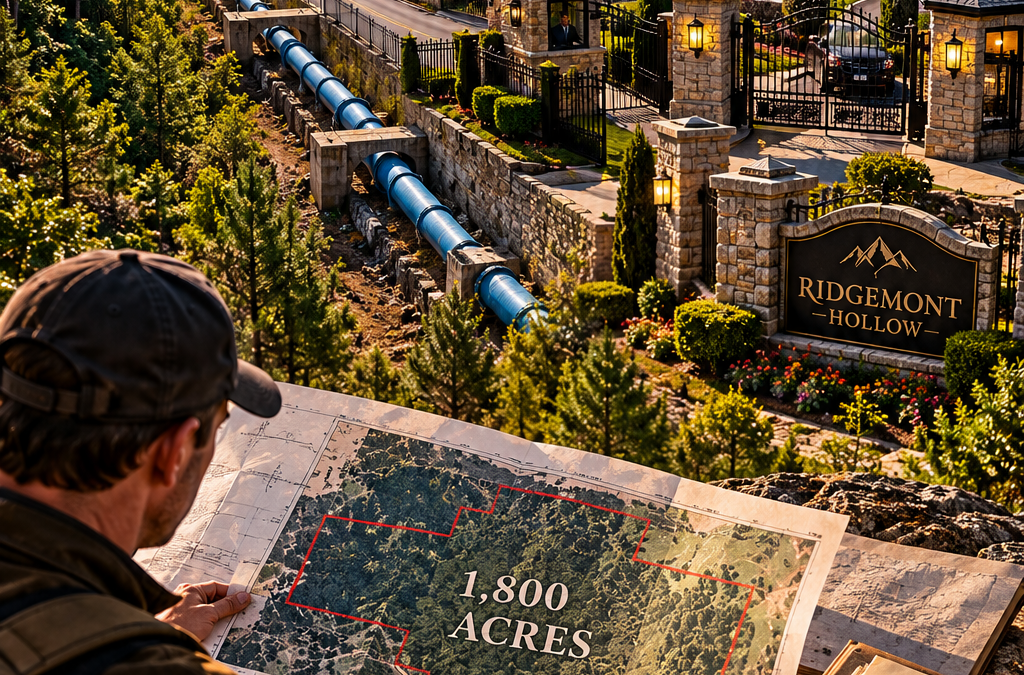
𝗙𝗨𝗟𝗟 𝗦𝗧𝗢𝗥𝗬
And if none of that happened, I still owned eighteen hundred acres bordering an established luxury community.
Land doesn’t need to be exciting every year.
Sometimes it just needs to remain land.
I made an offer.
The family accepted.
I expected to close in thirty days.
It took eleven weeks.
That should have told me something.
The first delays were ordinary.
Title work.
Boundary questions.
An old tax parcel that had been merged incorrectly.
Then my attorney started asking about records filed decades earlier.
He found references to underground utility access.
An emergency transportation route.
A water infrastructure agreement.
Nothing looked alarming enough to stop the closing.
The title company wanted exceptions listed.
The seller’s attorney insisted the documents were ancient and routine.
Everyone treated them as leftovers from the period when Ridgemont Hollow was being built.
I asked my attorney the obvious question.
“Do they affect what I can do with the land?”
“Possibly around a few narrow corridors.”
“Can Ridgemont control the property?”
“No.”
“Can they build on it?”
“Not based on what I’m seeing.”
“Can they stop me from buying it?”
“No.”
That was enough for me.
I signed.
The closing documents were thick enough to stop a door.
I left the title office owning eighteen hundred acres.
I thought I had purchased a long-term land investment.
Two weeks later, my lawyer called.
His name was Daniel.
We had worked together on several transactions, and he was not a dramatic person.
That is why I remember his opening sentence.
“You didn’t just buy land.”
I leaned back in my office chair.
“What did I buy?”
“Leverage.”
I laughed.
“I’m serious.”
“Against who?”
“Ridgemont Hollow.”
That got my attention.
Daniel had continued digging through the historical filings after closing because two of the easement references didn’t match modern parcel numbers.
What he found was a series of agreements dating back about sixty years.
Long before Ridgemont Hollow existed in its current form, the owners of my tract had granted limited rights across two portions of the property.
One right allowed a road.
The other allowed water infrastructure.
When Ridgemont Hollow was later developed, those rights were incorporated into the subdivision’s planning.
The road became its secondary emergency access.
The water corridor became part of the infrastructure feeding several wells and, later, a backup storage system.
“Okay,” I said. “So they have easements.”
“Maybe not.”
“What does that mean?”
“It means the agreements had expiration clauses.”
I sat forward.
“Expiration?”
“Yes.”
“When?”
Daniel paused.
“Eleven years ago.”
I looked out the window.
“You’re sure?”
“The original agreements were time-limited. There were renewal provisions. I cannot find recorded renewals.”
“Maybe they renewed privately.”
“Maybe. But if they did, nobody recorded anything. And their attorney hasn’t contacted the title company to correct it.”
“So they’re using my property under expired documents.”
“That is what it appears.”
I let that settle.
“What exactly runs across my land?”
“The emergency road cuts through the northeast corner. The water infrastructure is farther south.”
“How important is the road?”
“I don’t know yet.”
“And the water?”
“Same answer.”
Daniel paused.
Then he added, “Don’t do anything until we understand the whole picture.”
I agreed.
At that point, I wasn’t angry.
I wasn’t excited either.
I had no reason to be.
Ridgemont Hollow had existed for thirty years.
Whatever paperwork had been forgotten obviously hadn’t caused disaster.
I assumed we would identify the technical issue, their attorney would clean up the filings, they’d compensate me for whatever rights they needed, and everybody would go back to their lives.
Three weeks later, a black SUV came up my driveway.
By then I had started using an old house near the southern edge of the property whenever I was working out there.
The place wasn’t impressive.
Two bedrooms.
A porch.
Metal roof.
Gravel driveway.
The previous owners had used it during hunting season.
I was outside repairing a section of fence when I saw the SUV.
It was polished enough that I noticed how ridiculous it looked with dust collecting along the doors.
A man stepped out.
Mid-fifties.
Tailored blazer.
Expensive shoes.
Carefully controlled expression.
He walked toward me and offered his hand.
“Mister—”
I stopped him.
“My name isn’t important.”
He hesitated.
“I’m Richard Hale. President of the Ridgemont Hollow Homeowners Association.”
That explained the vehicle.
“What can I do for you?”
“I was hoping we might discuss the property.”
“What about it?”
“The shared boundary.”
He said it casually.
Too casually.
I looked at the fence.
“Boundary’s been surveyed.”
“Yes, of course. I meant certain infrastructure located near the boundary.”
There it was.
I pointed toward the house.
“Coffee?”
He glanced at his watch.
“Sure.”
Inside, I poured two cups.
Richard sat at the small kitchen table.
I pushed one toward him.
He never touched it.
Instead, he kept looking through the window toward the trees.
At first, I thought he was simply uncomfortable being there.
Ridgemont Hollow’s clubhouse probably had better coffee cups than my entire kitchen.
But as he talked, I realized something else.
He wasn’t looking at the house.
He was looking at the land.
Measuring it.
Thinking about it.
Calculating something.
“We understand you recently acquired the Porter tract,” he said.
“That’s what the county says.”
He smiled politely.
“It’s a substantial property.”
“It is.”
“Our community has maintained a long relationship with the former owners.”
“Did you?”
“Informally.”
I waited.
Richard folded his hands.
“There are certain historical access arrangements that are important to Ridgemont.”
“I’m aware of some old agreements.”
His eyes changed slightly.
Not much.
But enough.
“I see.”
“My attorney found them.”
“Good. Then perhaps this will be simple.”
“Maybe.”
He finally reached for the coffee cup, then changed his mind before touching it.
“The emergency lane has existed for decades.”
“So I’ve seen.”
“And there are utility lines.”
“So I’ve heard.”
“We’d like to confirm that you’ll honor the historical arrangement.”
“Which arrangement?”
“The existing access.”
“Existing under which agreement?”
His pause was longer this time.
“I’d have to let counsel answer the technical details.”
“Then maybe counsel should contact my lawyer.”
Richard smiled again.
But the smile didn’t reach his eyes.
“Of course.”
He stood soon after.
We shook hands at the door.
His visit had lasted less than twenty minutes.
As his SUV disappeared down the driveway, I looked through the screen door at the untouched coffee on my table.
Something about it bothered me.
Not because he hadn’t drunk it.
Because the man had been nervous.
I had dealt with nervous buyers.
Nervous sellers.
Nervous attorneys.
Richard Hale had the particular nervousness of a man hoping I didn’t know something.
Two days later, I found out what.
A certified letter arrived from Ridgemont Hollow’s attorney.
The tone was completely different from Richard’s.
No polite references to neighbors.
No shared history.
No conversation.
The letter stated that my property was subject to “pre-existing community infrastructure rights” relating to the emergency road and water facilities.
It demanded that I acknowledge those rights.
It further demanded that I grant a permanent, no-cost easement confirming continued access.
The word demanded appeared more than once.
I read it twice.
Then a third time.
They weren’t requesting that we fix an expired document.
They were telling me that whatever history existed gave them permanent rights whether I agreed or not.
I called Daniel.
“This doesn’t sound like somebody who wants a technical correction.”
“No.”
“Do they have a case?”
“I don’t know. This is getting beyond routine title work.”
“What do you recommend?”
“Find an easement litigator.”
I called three attorneys.
The first spent half the consultation talking about how expensive the case could become.
The second represented developers regularly and seemed more interested in whether I wanted to sell.
The third was a woman named Rebecca Sloan.
She specialized in property rights, servitudes, easements, and access disputes.
Within twenty minutes of our first meeting, I knew I had found the right lawyer.
Rebecca didn’t tell me what she thought I wanted to hear.
She asked questions.
When were the agreements signed?
Who signed them?
Were renewal provisions automatic or discretionary?
Who maintained the road?
Who maintained the water line?
Had taxes ever been assessed differently because of the easement?
Did the HOA pay the prior landowners?
Had there been interruption of use?
Were there municipal approvals tied to the road?
Had the fire marshal relied on it?
Were the wells permitted?
Had Ridgemont expanded the water system after the original agreement?
I didn’t know half the answers.
“Good,” she said.
“Good?”
“It means we’re not pretending yet.”
Rebecca spent almost two weeks researching.
She pulled archived planning commission minutes.
Fire department filings.
Old subdivision plats.
HOA records available through public litigation files.
State water permits.
Recorded deeds.
Historical maps.
Then she called me into her office.
She had sticky notes covering half a conference table.
She sat across from me.
“The agreements expired.”
“Both?”
“Both.”
“No renewal?”
“Nothing valid that I can find.”
“Can they claim permanent rights because they’ve kept using them?”
“They can claim many things.”
“Can they win?”
“Possibly. Prescriptive easement, estoppel, implied rights, reliance arguments. Their attorney will have options.”
That sobered me.
“So they own it anyway.”
“I didn’t say that.”
She slid a document toward me.
“The original agreements specifically defined the rights as temporary and renewable only through affirmative action. That hurts any argument that they believed the rights were inherently permanent.”
“How badly?”
“Enough that I would not want to be their lawyer explaining why nobody renewed them for eleven years.”
I stared at the document.
Rebecca leaned back.
“There’s another issue.”
“Of course there is.”
“Ridgemont hasn’t merely continued the original use.”
“What do you mean?”
“The water arrangement appears to have expanded after the original documents expired.”
I frowned.
“I thought it supplied three wells.”
“So did I.”
She opened another file.
“It feeds a backup reservoir system.”
“For how many houses?”
“Potentially the entire community.”
I stared at her.
“Four hundred homes?”
“More than four hundred, yes.”
“And the road?”
She tapped another document.
“The emergency lane is part of Ridgemont’s fire safety plan.”
I felt something cold move through my chest.
“Required?”
“For a community of that size, yes.”
“How required?”
“Required enough that losing approved secondary access creates problems with current fire code compliance and insurance underwriting.”
I didn’t say anything.
Rebecca watched me.
“They’ve been using your land for more than convenience.”
“They’ve been depending on it.”
“Yes.”
“Illegally?”
She chose her words carefully.
“They’ve been operating under rights that appear to have expired. I would not use the word illegally as casually as they might use the word permanent.”
That was why I liked her.
She never turned uncertainty into theater.
But the essential fact was clear.
Ridgemont Hollow depended on my property far more than I had realized.
I drove back to the forest that afternoon.
I walked the emergency road.
Calling it a road was generous.
It was a paved strip branching from the back of the subdivision, passing through a locked gate, then cutting across the northeastern corner of my land before eventually reaching a county route.
There was a sign marking it for emergency vehicles.
The gate had Knox-box access for firefighters.
At first glance, it seemed unused.
But tire marks showed regular inspections.
The water corridor was harder to see.
Much of the line was underground.
There were access covers, control points, and a fenced service area near one of the old well sites.
I stood there listening to water moving faintly through infrastructure beneath land I had barely known contained pipes.
That evening, I sat on the porch with copies of the agreements across my lap.
For the first time since buying the property, I understood Richard’s visit.
He hadn’t been worried that I might dispute a boundary.
He had known exactly what his board had allowed to expire.
He was hoping I wouldn’t discover how important those expired rights had become.
I remembered the untouched coffee.
His glances toward the trees.
His careful language.
Historical arrangement.
Shared infrastructure.
Simple clarification.
Nothing about the situation was simple.
The certified letter had been designed to establish the opposite impression.
They wanted me to believe everything had already been decided.
That their use was permanent.
That my ownership came second.
That I had purchased land subject to obligations I had no right to question.
For the first time, I got angry.
Not because Ridgemont needed access.
If they had approached me honestly, I probably would have negotiated immediately.
Communities need fire roads.
People need water.
Those are not trivial things.
But they hadn’t come to me saying, “We have a serious problem. We failed to renew our agreements. Can we work something out?”
They had arrived with a demand.
Grant us permanent rights.
No cost.
No negotiation.
That mattered.
I waited a full day before replying because I knew anger was a poor drafting tool.
My response was four sentences.
I confirmed that I was aware of the historical agreements.
I confirmed that counsel had advised me those agreements had expired.
I stated that I had no intention of granting no-cost permanent rights across my property.
And finally, I wrote that I was evaluating all lawful uses of the land, including development.
That final sentence changed everything.
My phone started ringing the next morning before seven-thirty.
By nine, I had eleven missed calls.
Not from the HOA attorney.
From residents.
I hadn’t given them my number.
Apparently somebody had.
The first caller sounded angry.
“Are you the man who bought the forest?”
“Yes.”
“Do you understand you could put hundreds of families at risk?”
“Who is this?”
He gave me his name.
I recognized the street.
Ridgemont Hollow.
“Our insurance company says we’re losing secondary fire access.”
“I haven’t closed any road.”
“Your lawyer says you won’t guarantee it.”
“There’s a difference.”
“You can’t hold a neighborhood hostage.”
“I’m not.”
“You bought that property knowing the road was there.”
“I bought it knowing old easements existed. That’s not the same thing.”
He kept talking.
I ended the call.
The second caller was different.
A woman.
Older, judging from her voice.
She wasn’t angry.
She was scared.
“My carrier sent us a non-renewal notice.”
“I’m sorry.”
“They said it’s related to fire access.”
“I’ve heard that’s an issue.”
“My husband is seventy-eight. We can’t move easily.”
I didn’t know what to say.
She continued.
“I don’t know what the board did or didn’t renew. I just need to know whether you’re going to block the fire department.”
“No.”
She went quiet.
“No?”
“I have never told anyone I intend to block emergency vehicles.”
“But the road—”
“The road issue needs a legal agreement. That’s different from me locking firefighters out tomorrow.”
She exhaled.
“Thank you.”
After we hung up, I sat at the kitchen table for several minutes.
That call stayed with me.
It is easy to dislike an organization.
Harder to dislike four hundred households individually.
Behind Ridgemont’s gates were people who had nothing to do with an expired easement.
Retirees.
Families.
Children.
People who had simply bought homes and paid dues believing somebody else was handling the infrastructure.
I started digging deeper.
What I learned explained the panic.
Ridgemont Hollow had one normal legal entrance and exit.
One.
The grand stone entrance everyone used.
The road through my property was their only approved secondary emergency route.
Under older regulations, the arrangement had apparently passed without much scrutiny.
But state fire safety requirements had tightened.
Insurance companies were reassessing communities with wildfire exposure, forest adjacency, limited egress, and high-value structures.
Ridgemont checked several boxes.
Without a recognized secondary access route, some insurers were projecting dramatic premium increases.
Others were refusing renewals entirely.
One estimate circulated among residents suggested increases near forty percent.
For a two-million-dollar home, that was not a minor inconvenience.
The water issue was just as serious.
Six years earlier, the region had gone through a severe drought.
Ridgemont’s primary system had been stressed badly enough that the HOA helped construct a backup reservoir arrangement.
The water infrastructure crossing my land had become part of that system.
The old easement had never contemplated the full scope of what now depended on it.
In practical terms, Ridgemont Hollow’s resilience rested partly on land it did not own and rights it had failed to maintain.
When Rebecca summarized it, she used one sentence.
“They turned temporary permission into critical infrastructure and forgot to secure the permission.”
That was the entire problem.
I sat on my porch that evening.
The sun dropped behind the ridge.
A barred owl called from somewhere across the creek.
The forest looked exactly the same as it had before I knew any of this.
That struck me as strange.
Eighteen hundred acres of trees.
Dirt.
Water.
Rock.
Deer.
Old logging trails.
Nothing visible had changed.
But legally, economically, politically, the meaning of the land had transformed.
Three weeks earlier, I had owned forest.
Now I owned a pressure point in a multimillion-dollar community.
I didn’t like the feeling as much as I expected.
Leverage sounds satisfying until real people depend on what you control.
Rebecca warned me not to confuse legal advantage with moral permission.
“You are entitled to protect your property,” she said.
“Obviously.”
“You are entitled to compensation.”
“Yes.”
“You are entitled to reject terms.”
“Yes.”
“But decide what you actually want before you sit down with them.”
I looked at her.
“Meaning?”
“If what you want is money, say money.”
“If I want privacy?”
“Say privacy.”
“If I want them embarrassed?”
She stared at me.
“Then you’re paying me too much, because revenge doesn’t require specialized counsel.”
That made me laugh.
But she was right.
Ridgemont requested a formal meeting.
Not at my house.
At their clubhouse.
I almost refused on principle.
Rebecca told me to go.
“Let them show you how they think.”
So I did.
The clubhouse looked exactly like I expected.
Stone exterior.
Tall windows.
Marble floors.
Dark wood.
A chandelier large enough to require its own maintenance budget.
Photographs of golf tournaments and charity events lined the hallway.
A receptionist directed me into a boardroom.
Seven board members sat behind a long polished table.
Richard Hale was in the center.
Their attorney sat at one end.
Rebecca sat beside me.
I remember thinking how carefully the room had been designed to project authority.
The raised table.
The lighting.
The arrangement of chairs.
Everyone on their side sat together.
I sat opposite them.
One landowner.
Seven board members.
Two attorneys.
Four hundred homes in the background.
Richard opened.
“Thank you for coming.”
I nodded.
“We all agree this situation needs resolution.”
“I hope so.”
He cleared his throat.
“The community is prepared to offer a one-time payment in exchange for confirming the existing access rights.”
There it was again.
Confirming.
Not purchasing.
Not negotiating.
Confirming.
“What amount?” Rebecca asked.
Their attorney slid a paper across.
The number wasn’t insulting.
It was actually more generous than I expected.
But that wasn’t the point.
I looked at Richard.
“What exactly are you buying?”
He frowned.
“The easements.”
“Which easements?”
“The emergency road and water infrastructure.”
“Permanent?”
“Yes.”
“Any expansion rights?”
“Reasonable maintenance and modernization.”
“Who decides what’s reasonable?”
His attorney answered.
“We can define that.”
I opened my folder.
“I think we should start somewhere else.”
I slid the packet across the table.
Richard opened it.
Inside were copies of the original agreements.
Expiration clauses highlighted.
Recorded plats.
Fire marshal documentation.
Insurance notices residents had voluntarily sent me.
Maps showing the emergency access classification.
Water system permits.
And a market analysis Rebecca had recommended I obtain.
That final document was the one that changed the room.
It showed what eighteen hundred acres bordering a wealthy, effectively constrained community might be worth under several development scenarios.
The land didn’t need Ridgemont’s permission for every possible project.
Some concepts would require county approvals.
Some would require infrastructure work.
Some might fail entirely.
But one fact was undeniable.
Developers would pay heavily for a tract that large in that location.
And if I sold the property to someone whose priorities were different from mine, Ridgemont could spend years dealing with a much more aggressive neighbor.
Nobody spoke for several seconds.
A board member near the end of the table was the first.
Her name was Caroline Mercer.
She had barely said a word all meeting.
She looked at me.
“What do you actually want?”
Finally.
The right question.
I looked around the table.
“I don’t want to destroy your neighborhood.”
Nobody moved.
“I don’t want your golf course. I don’t want your clubhouse. I don’t want four hundred angry families calling me.”
Richard leaned back.
I continued.
“I didn’t buy the land because I wanted leverage against you. I didn’t know the extent of the road or water issue until after closing.”
Their attorney glanced at Rebecca.
I went on.
“What I want is a real agreement.”
Richard said, “We’re offering one.”
“No. You’re offering money in exchange for permanent control rights written broadly enough that thirty years from now somebody could decide maintenance means widening a road, adding infrastructure, clearing trees, or sending contractors across my property whenever they want.”
“That’s not our intention.”
“The last agreement wasn’t supposed to expire unnoticed either.”
That landed.
I leaned forward.
“I want defined corridors. Defined uses. Defined maintenance rights. Environmental protections. Advance notice before non-emergency work. Limits on expansion. Liability insurance. Restoration obligations if anything is damaged. No public access. No resident shortcut traffic. No future claim that your rights extend beyond what is written.”
Richard stared at me.
“And compensation?”
“I haven’t decided.”
That seemed to surprise them more than anything else.
Caroline asked, “You aren’t demanding a purchase price?”
“I’m demanding clarity.”
Their attorney said, “Surely you understand these rights have significant value.”
“Yes.”
“Then why wouldn’t you seek compensation?”
“Maybe I will.”
I looked at Richard.
“But if you think this is only about money, you’ll make the same mistake twice.”
They asked for two weeks.
I gave them two weeks.
What happened during those two weeks tested me more than the HOA ever did.
The first developer called three days after the meeting.
He had heard rumors about the property.
Small counties are like that.
Nothing remains private if surveyors, lawyers, title companies, insurance carriers, fire officials, and four hundred homeowners are all talking.
He wanted to meet.
I agreed.
His company specialized in large residential projects.
He looked at the land as numbers.
Road frontage.
Density.
Utility extensions.
Phase one.
Phase two.
Potential yield.
He spoke about trees as clearing costs.
Creeks as drainage constraints.
Ridges as premium lots.
His offer came two days later.
It was almost twice what I had paid.
I said no.
Then another developer called.
Commercial and mixed use.
He talked about a resort-style community.
Maybe luxury cabins.
Maybe estate lots.
Maybe a private recreation complex.
He offered more.
I didn’t answer immediately.
The third offer was the one that nearly changed everything.
Nearly triple my purchase price.
I sat at my kitchen table staring at the number.
It was more money than I had made in the previous five years combined.
Enough to buy several other properties.
Enough to eliminate debt.
Enough to turn one good acquisition into the kind of year investors talk about for the rest of their careers.
Daniel called.
“You could take this and never think about Ridgemont again.”
“I know.”
Rebecca was more cautious.
“If you sell, your easement dispute becomes somebody else’s problem.”
“I know.”
“And the buyer may not share your restraint.”
“I know.”
That was the point.
I knew.
I knew exactly what a large developer would do.
Not because developers are villains.
Because development is their business.
They would maximize the land.
They would push infrastructure.
They would study every legal advantage.
They would demand road connectivity.
They might challenge Ridgemont on access.
They might use the emergency route as bargaining leverage.
They might build hundreds of homes along the ridges overlooking a neighborhood that had spent thirty years protecting itself from exactly that kind of outside change.
For one evening, I let myself imagine it.
Selling.
Signing the documents.
Taking the money.
Driving away.
No more calls.
No HOA.
No infrastructure problem.
No responsibility.
If Ridgemont didn’t like what came next, they could negotiate with the developer.
Part of me thought they deserved it.
That was the part I distrusted.
The next morning, I walked into the forest before sunrise.
No phone.
No paperwork.
No lawyers.
I followed an old logging trail north.
Mist sat above the creek bottoms.
A deer crossed thirty yards ahead of me.
Higher up the ridge, sunlight started coming through the canopy.
I walked for almost two hours.
Eventually, I reached the stand of white oaks that had impressed me the first time I toured the land.
I sat against one.
The tree was wide enough that three men would have struggled to reach around it.
I thought about the developer’s map.
That ridge had been marked for premium homes.
Best views.
Highest value.
Maybe twelve lots.
Maybe fifteen.
The offer on my kitchen table suddenly felt different.
It wasn’t just money for land.
It was money for what the land would stop being.
There is nothing wrong with building houses.
People need places to live.
I had sold land for development before.
But I realized I didn’t want to sell this one.
Not yet.
Maybe not ever.
The forest had been left alone for generations because nobody could quite figure out what to do with it.
That had become part of its value.
And somewhere along the way, I had started caring about that more than the return.
I laughed at myself sitting under that tree.
Fifteen years buying overlooked land, and apparently I had finally become sentimental.
But sentiment wasn’t the whole reason.
The deeper reason was simpler.
If I sold because I was angry at Ridgemont, I would be allowing them to dictate what I did with my own property.
That would be a strange kind of victory.
They had tried to assert control over the land.
Selling it in revenge would still mean they had controlled my decision.
I wanted something else.
I wanted to keep it.
When Ridgemont called at the end of the second week, Richard asked me back to the clubhouse.
This time there were only four board members, both attorneys, and me.
The atmosphere was different.
Less theater.
More exhaustion.
Richard opened a revised proposal.
The money was higher.
The easement language was narrower.
They had accepted several of our conditions.
I let him finish.
Then I closed the folder.
“I’m not selling.”
He frowned.
“We’re not asking you to sell the property.”
“I know.”
Caroline studied me.
“You received development offers.”
I looked at her.
“News travels quickly.”
“How serious?”
“Serious.”
Richard asked, “Are you planning to develop?”
“No.”
The room went still.
I continued.
“I’m keeping the land the way it is.”
Their attorney asked, “For how long?”
“I don’t know. Maybe permanently.”
Richard looked confused.
“Then what are we doing here?”
“We’re fixing your easement problem.”
“You’re turning down compensation?”
“Most of it.”
He leaned back.
“Why?”
“Because I don’t need to punish four hundred families to prove I own the land.”
Nobody said anything.
I looked at each of them.
“But I am not giving you what your first letter demanded.”
Richard’s jaw tightened.
“You’ll get the emergency access you need. You’ll get the water rights you need. You’ll get enough maintenance authority to keep both systems safe and functional.”
Caroline asked, “And you?”
“I get control over everything else.”
Rebecca slid our proposed term sheet across the table.
It was detailed.
Very detailed.
The road easement would remain within an exact surveyed corridor.
Emergency use was always permitted.
Routine inspection was permitted under defined conditions.
No general resident traffic.
No conversion into a public or neighborhood connector.
No widening without written approval except where legally required for emergency safety.
No decorative lighting.
No signage beyond emergency and safety signage.
No utility additions disguised as maintenance.
No commercial access.
No construction staging outside the easement.
The water easement was equally precise.
Existing infrastructure could remain.
Repairs and replacements were allowed.
Capacity could be maintained.
Expansion beyond defined limits required separate written approval.
Contractors had to restore disturbed land.
Large tree removal required consultation unless an immediate emergency existed.
Ridgemont had to maintain adequate liability coverage.
Damage had to be repaired.
Environmental contamination became their responsibility.
And most importantly, the new agreement could not be used as evidence for any broader access claim.
No implication.
No expansion by custom.
No prescriptive right based on additional use.
What was written was what they had.
Nothing more.
Caroline read for several minutes.
“Ninety-nine years?”
“Yes.”
“Why not permanent?”
“Because nothing should last forever without somebody reconsidering it.”
Richard almost smiled at that.
The expiration problem had finally become funny enough to acknowledge.
Their attorney said, “Ninety-nine years is functionally permanent for most practical purposes.”
“Then you shouldn’t have a problem with it.”
Rebecca hid a smile.
We negotiated for another six weeks.
Not dramatically.
Mostly carefully.
Every word mattered.
Their attorney wanted broader emergency definitions.
Rebecca wanted protections against routine maintenance being declared an emergency.
The HOA wanted guaranteed access for utility vehicles.
I wanted notice when possible.
We argued about tree removal.
We argued about indemnity.
We argued about whether major water system upgrades qualified as replacement or expansion.
We argued over survey monuments, gates, locks, emergency codes, restoration standards, insurance certificates, inspection schedules, contractors, drainage, surface materials, and what happened if state regulations changed.
That was exactly what should have happened thirty years earlier.
Not because contracts make people distrust one another.
Because good contracts tell honest people what they promised after memory becomes inconvenient.
Somewhere during those negotiations, the relationship with Ridgemont changed.
Richard came back to the house once.
I offered coffee again.
This time he drank it.
I noticed.
So did he.
He smiled.
“I suppose this means progress.”
“Depends what you think of the coffee.”
“Better than our attorney’s.”
“That isn’t difficult.”
We sat on the porch instead of inside.
For the first time, he told me what had happened.
The easement renewal had apparently fallen between two administrations.
One management company left.
Another came in.
Several board members changed.
The original attorney retired.
Records were transferred badly.
Everyone assumed somebody else had handled it.
Years passed.
Then nobody wanted to raise the issue because fixing it would require admitting that the community had been relying on rights that might no longer exist.
“So you knew before I bought?” I asked.
Richard looked toward the trees.
“I knew there was uncertainty.”
“That’s not what I asked.”
He nodded.
“Yes.”
“How long?”
“About eight months.”
I let that sit.
“And nobody contacted the owners?”
“The board was discussing options.”
“For eight months?”
“It was complicated.”
“No. It was uncomfortable.”
He looked at me.
“That’s fair.”
That answer surprised me.
He continued.
“We were afraid if we approached the family, they’d demand more than the community could afford.”
“So instead you waited.”
“Yes.”
“Then they sold to me.”
“Yes.”
“And you sent me a demand letter.”
He looked embarrassed.
“Counsel advised an aggressive posture.”
“Did you agree with it?”
“At the time.”
“And now?”
He took another drink of coffee.
“No.”
That was probably the closest thing to an apology I was going to get.
It was enough.
Six weeks after the first board meeting, we signed.
Ninety-nine years.
Recorded with the county.
Surveyed.
Insured.
Defined.
Emergency access secured.
Water infrastructure secured.
My privacy protected.
My development rights outside the easement untouched.
No free-floating claims.
No handshake.
No assumption.
No language broad enough to swallow the land later.
Ridgemont paid the legal and surveying costs related to formalizing the agreement.
There was a modest administrative payment, nothing remotely close to the development offers or even their earlier proposal.
I didn’t want their money to become the story.
The agreement was the story.
The signatures happened at the county recorder’s office rather than the clubhouse.
I requested that.
Neutral ground.
Richard signed for Ridgemont.
I signed as landowner.
Rebecca reviewed the final pages one last time.
The clerk stamped the filing.
That sound was surprisingly ordinary.
Just a mechanical thump.
After months of calls, letters, meetings, threats, insurance fears, legal research, and millions of dollars in potential development value, the problem ended with a stamp.
Outside, Richard extended his hand.
I shook it.
“Thank you,” he said.
“For what?”
“Not selling.”
I looked at him.
“You know I still could someday.”
He smiled faintly.
“Let me have one peaceful afternoon.”
“Fair enough.”
The developer’s highest offer remained open for another month.
I declined it formally.
That was harder than signing the easement.
I won’t pretend otherwise.
There is something painful about saying no to that much money.
For several nights, I did the math again.
What I could have bought.
What I could have invested.
How quickly that capital could have multiplied.
But every time I walked the property, the regret softened.
The first autumn after the agreement was spectacular.
The ridges turned red and gold.
I repaired the old hunting house.
I cleared several miles of trail.
I brought in a forester to design a long-term management plan that preserved mature stands while allowing selective harvesting in other areas.
I worked with a conservation group about protecting the creek corridor.
None of it generated the immediate return that development would have.
I didn’t care.
The land felt like mine in a way it hadn’t during the dispute.
Not because Ridgemont had lost something.
Because we had finally defined what each of us had.
That distinction matters.
People sometimes hear a story like this and want a villain.
The wealthy HOA.
The arrogant board president.
The landowner with all the leverage.
Real life is rarely that clean.
Ridgemont made serious mistakes.
They allowed critical agreements to expire.
They hid from the problem.
They relied on infrastructure crossing somebody else’s property for more than a decade without correcting the legal foundation.
Then when ownership changed, their first instinct was not humility.
It was pressure.
Their attorney’s letter treated my property rights like an inconvenience.
That angered me.
It still does when I think about it.
But four hundred homeowners were not responsible for that decision.
Many had no idea.
Some were frightened.
Some were angry because they had been told I was threatening their safety.
A few apologized once they understood what had happened.
Others never did.
That is normal too.
Caroline Mercer later told me that the board meeting after my development letter was the ugliest meeting she had attended in twelve years.
Some directors wanted to sue immediately.
Others wanted to buy part of the forest.
One suggested condemning the easement if the county could be persuaded to intervene.
Another wanted to blame the former management company.
Everyone wanted somebody else to be responsible.
Eventually Caroline asked the same question she later asked me.
What do we actually want?
The answer was obvious.
They wanted certainty.
So did I.
That common interest was what saved the negotiation.
I didn’t need access through Ridgemont.
I didn’t need their clubhouse.
I didn’t need their golf course.
I didn’t need their approval to enjoy my land.
They needed a narrow strip across mine.
Once everyone stopped pretending otherwise, we could talk like adults.
The funny thing is that Ridgemont’s walls look different to me now.
Before the dispute, I saw them as symbols of exclusivity.
Stone pillars telling the world who belonged inside and who didn’t.
Maybe they still are partly that.
But walls create dependence too.
When you design a place around controlled access, the routes you do allow become more important.
When you restrict water options, the lines you rely on become more valuable.
When you organize four hundred homes behind a single formal entrance, one secondary road can become more important than acres of landscaping.
Control has a weakness.
The more precisely you control your world, the more vulnerable you become to the few things outside your control.
Ridgemont had spent thirty years regulating almost everything within its boundaries.
They could fine a homeowner for painting a door the wrong shade.
They could regulate fences.
They could approve roofs.
They could restrict parked vehicles.
But they could not vote themselves ownership of my forest.
They could not pass a board resolution that renewed an expired property right.
They could not fine me into submission.
They could not send a violation notice and make eighteen hundred acres part of their jurisdiction.
They had to ask.
That was the part they struggled with.
Not because every person on the board was arrogant.
Because institutions become accustomed to authority.
Ridgemont’s board spent most of its time telling homeowners what was permitted.
Then suddenly it was sitting across from one man who wasn’t a member and didn’t need permission from them.
That changes a conversation.
It changed me too.
Before this, I thought leverage was mostly financial.
You buy something cheaply.
Someone else needs it.
You negotiate from strength.
Simple.
But leverage carries responsibility.
I could have made Ridgemont suffer.
Legally, perhaps not in every way I imagined, but enough.
I could have dragged negotiations out.
I could have demanded a larger payment.
I could have sold to the highest bidder.
I could have used the insurance crisis to force terms that had nothing to do with fair access.
For a few angry days, some of those options felt satisfying.
Then I realized I was in danger of becoming the exact kind of person I resented.
Someone who sees power and immediately asks how much discomfort it can produce.
So I narrowed the question.
What did I actually need?
Privacy.
Control.
Protection.
Legal clarity.
Respect for the land.
What did Ridgemont actually need?
Emergency access.
Water reliability.
Insurance certainty.
Infrastructure continuity.
Those needs were not mutually exclusive.
The conflict had never required a winner and loser.
It required boundaries.
Real ones.
Not decorative gates.
Legal boundaries.
The kind written clearly enough that nobody had to guess.
Richard still drives past my gate occasionally.
Ridgemont’s emergency route is not open for normal neighborhood traffic, so he doesn’t come through often.
Usually he is meeting an inspector or checking some maintenance issue.
Every time he sees me, he waves.
The first few times, I thought it was performative.
Now I think it’s habit.
Once, about a year after the agreement, he pulled over while I was cutting brush near the easement.
He lowered the window.
“Everything all right?”
“Fine.”
“Our contractor isn’t causing trouble?”
“Not today.”
He laughed.
Then he glanced toward the forest.
“Still not selling?”
“No.”
“You know there are people on our board who pray every night that answer stays the same.”
“They should worry about interest rates instead.”
He smiled.
Before he drove away, he said, “For what it’s worth, I’m glad you’re the one who bought it.”
I wasn’t sure whether that was a compliment.
“So am I.”
He left.
I stood there watching his SUV disappear behind the trees.
The first time he had visited, he arrived in that same kind of vehicle wearing an expensive blazer, refusing my coffee, hoping I didn’t understand what I owned.
Now there was no mystery between us.
He knew exactly what I owned.
So did I.
That was healthier.
I still have the original certified letter.
I keep it in the property file.
Every once in a while, I read the language.
Permanent.
Pre-existing rights.
Demand.
No-cost access.
The confidence of it almost makes me laugh now.
Not because the HOA was foolish.
Because paper can make uncertainty sound certain if the person reading it doesn’t question the premise.
Had I signed what they sent, Ridgemont might have gained permanent rights far broader than the expired agreements ever gave them.
I would have received nothing.
Future owners of my property would have inherited the burden.
And ten years later, somebody might have described the arrangement as something that had “always existed.”
That phrase bothers me now.
Always.
Almost nothing involving land has always existed.
Roads were built by someone.
Water lines were granted by someone.
Access was negotiated by someone.
Boundaries came from surveys.
Rights came from deeds.
Behind every thing people call normal is usually a document, a decision, or a person who once said yes.
The danger comes when everyone remembers the benefit and forgets the permission.
Ridgemont remembered the emergency road.
They forgot the landowner.
They remembered the water.
They forgot the agreement.
They remembered decades of use.
They forgot the expiration date.
I could have responded by making them remember through pain.
Instead, I made them remember through paper.
Ninety-nine years of it.
Sometimes that sounds less dramatic than the alternative.
Good.
Not every property dispute needs a bulldozer, a lawsuit, or somebody screaming beside a locked gate.
Sometimes the strongest ending is one where everybody can still live with each other afterward.
The forest is still there.
That’s what matters most to me.
On winter mornings, snow settles into the old logging roads.
In spring, the creek rises and moves brown water through the lower ravines.
Summer closes the canopy until some places feel dark at noon.
Autumn turns the ridges into color.
No subdivision signs.
No rows of houses.
No construction entrances.
At least not yet.
Maybe someday circumstances will change.
Maybe someone after me will develop part of it.
No landowner controls the future forever.
But if that day comes, Ridgemont’s rights will be clear.
So will the landowner’s.
Nobody will need to dig through sixty-year-old agreements and wonder what somebody meant.
Nobody will be able to pretend silence equals consent.
That alone made the fight worthwhile.
The strangest part is that I bought the land because nobody else wanted the trouble.
The zoning.
The title history.
The old easements.
The access questions.
The forgotten records.
All the things that scared other buyers away.
Those complications ended up being the reason the property became so valuable.
Not just financially.
Strategically.
Personally.
The overlooked piece turned out to hold something four hundred expensive homes depended on.
That is land.
People can build walls around themselves.
They can install gates.
They can hire guards.
They can regulate every visible detail.
They can create the impression that everything important is inside.
But roads cross boundaries.
Water crosses boundaries.
Fire doesn’t care about gates.
And ownership does not disappear because someone richer finds it inconvenient.
Ridgemont Hollow learned that.
So did I.
For thirty years, they had looked toward the forest behind their neighborhood as empty space.
Something beyond the fence.
Something outside their world.
I bought it because I thought other people had underestimated its value.
I was right.
But not for the reason I expected.
Its greatest value wasn’t timber.
It wasn’t development potential.
It wasn’t even the millions somebody offered me to walk away.
Its value was that the land forced everyone involved to recognize something simple.
Dependence does not create ownership.
Need does not erase permission.
And power does not have to become punishment.
I could have turned eighteen hundred acres into a weapon.
Instead, I turned an expired arrangement into a boundary everyone could live with.
The trees stayed standing.
Ridgemont kept its emergency road.
The reservoir kept its water connection.
The homeowners kept their insurance protection.
And I kept the one thing I had wanted once I understood what was happening.
My land.
On my terms.
Written down this time.
𝗧𝗛𝗘 𝗘𝗡𝗗
Behind Their Million-Dollar Gates, 400 Homes Were Quietly Depending on Rights to My 1,800 Acres That Had Expired Eleven Years Ago
For thirty years, Ridgemont Hollow had built walls, gates, rules, and a private road to make sure people like me understood exactly where their world ended.
What nobody behind those gates seemed prepared for was the day I bought the 1,800 acres holding the emergency road and water system their entire community could not afford to lose.
My name doesn’t matter much to this story.
The land does.
I’ve spent fifteen years buying property other people overlook.
Not beachfront lots.
Not trophy ranches.
Not farmland somebody’s grandfather is emotionally attached to and three developers are already bidding on.
I look for the pieces everyone else ignores.
Old timber parcels.
Landlocked acreage.
Scrub ground beside industrial corridors.
Forgotten sections behind subdivisions.
Properties burdened with strange access problems, questionable zoning, bad topography, ugly maps, or enough paperwork to scare away anyone who wants a clean transaction.
Most people see headaches.
I see questions.
And sometimes the right question is worth more than the land itself.
That was how I found the forest behind Ridgemont Hollow.
It was eighteen hundred acres of dense hardwood, steep ridges, narrow creek bottoms, old logging trails, and enough untouched interior ground that you could walk for an hour without hearing traffic.
On a county map, it looked like a dark green block pressed against the back side of one of the wealthiest gated communities in the state.
Ridgemont Hollow.
Even the name sounded expensive.
The main entrance had two stone towers, iron gates, a fountain, and a staffed guardhouse.
Beyond those gates were more than four hundred homes, most starting around two million dollars and climbing quickly from there.
There was a private golf course.
A clubhouse with stone columns.
Tennis courts.
Walking trails.
A swimming complex.
Landscaping crews that seemed to replace flowers every time the seasons changed.
The neighborhood had rules for everything.
Fence height.
Exterior colors.
Roof materials.
Vehicles visible from the street.
Holiday decorations.
Mailbox styles.
Where contractors could park.
How long a garbage container could remain outside.
Ridgemont Hollow had spent three decades creating certainty.
Everything inside the gates was controlled.
Everything matched.
Everything had a process.
Everything had a committee.
The forest behind them was the opposite.
No manicured entrances.
No lighting.
No sidewalks.
No guard.
No fountain.
No board meeting deciding whether an oak tree was sufficiently attractive.
Just woods.
The property had been owned by the same family for three generations.
The last surviving siblings had inherited it from their father, who had inherited it from his.
They lived in different states.
None of them wanted to manage timber.
None wanted to deal with taxes.
And none wanted to spend years fighting through whatever zoning or access problems would come with selling it to a large developer.
So the land sat.
That is exactly the kind of property I pay attention to.
I first saw it in early spring.
The leaves weren’t fully out yet.
I parked near an old logging entrance and spent most of the day walking.
There was nothing dramatic about it at first.
No giant lake.
No mountain view that belonged on a calendar.
But the farther I went, the more I liked it.
The woods were mature.
The creeks were clean.
Deer tracks crossed the mud everywhere.
On the western ridge, I found an old stone wall half-swallowed by moss.
Near the center of the tract was a stand of white oaks that must have been there before most of Ridgemont Hollow had even been designed.
I sat on a fallen tree and listened.
That was what sold me.
The silence.
If you’ve spent enough years buying land, you learn the difference between property that looks valuable and property that feels valuable.
This place felt valuable.
Not because I had some grand vision.
The numbers simply worked.
The asking price was low relative to the acreage.
There was timber value.
There were conservation possibilities.
There was potential for selective future development if zoning ever changed.
And if none of that happened, I still owned eighteen hundred acres bordering an established luxury community.
Land doesn’t need to be exciting every year.
Sometimes it just needs to remain land.
I made an offer.
The family accepted.
I expected to close in thirty days.
It took eleven weeks.
That should have told me something.
The first delays were ordinary.
Title work.
Boundary questions.
An old tax parcel that had been merged incorrectly.
Then my attorney started asking about records filed decades earlier.
He found references to underground utility access.
An emergency transportation route.
A water infrastructure agreement.
Nothing looked alarming enough to stop the closing.
The title company wanted exceptions listed.
The seller’s attorney insisted the documents were ancient and routine.
Everyone treated them as leftovers from the period when Ridgemont Hollow was being built.
I asked my attorney the obvious question.
“Do they affect what I can do with the land?”
“Possibly around a few narrow corridors.”
“Can Ridgemont control the property?”
“No.”
“Can they build on it?”
“Not based on what I’m seeing.”
“Can they stop me from buying it?”
“No.”
That was enough for me.
I signed.
The closing documents were thick enough to stop a door.
I left the title office owning eighteen hundred acres.
I thought I had purchased a long-term land investment.
Two weeks later, my lawyer called.
His name was Daniel.
We had worked together on several transactions, and he was not a dramatic person.
That is why I remember his opening sentence.
“You didn’t just buy land.”
I leaned back in my office chair.
“What did I buy?”
“Leverage.”
I laughed.
“I’m serious.”
“Against who?”
“Ridgemont Hollow.”
That got my attention.
Daniel had continued digging through the historical filings after closing because two of the easement references didn’t match modern parcel numbers.
What he found was a series of agreements dating back about sixty years.
Long before Ridgemont Hollow existed in its current form, the owners of my tract had granted limited rights across two portions of the property.
One right allowed a road.
The other allowed water infrastructure.
When Ridgemont Hollow was later developed, those rights were incorporated into the subdivision’s planning.
The road became its secondary emergency access.
The water corridor became part of the infrastructure feeding several wells and, later, a backup storage system.
“Okay,” I said. “So they have easements.”
“Maybe not.”
“What does that mean?”
“It means the agreements had expiration clauses.”
I sat forward.
“Expiration?”
“Yes.”
“When?”
Daniel paused.
“Eleven years ago.”
I looked out the window.
“You’re sure?”
“The original agreements were time-limited. There were renewal provisions. I cannot find recorded renewals.”
“Maybe they renewed privately.”
“Maybe. But if they did, nobody recorded anything. And their attorney hasn’t contacted the title company to correct it.”
“So they’re using my property under expired documents.”
“That is what it appears.”
I let that settle.
“What exactly runs across my land?”
“The emergency road cuts through the northeast corner. The water infrastructure is farther south.”
“How important is the road?”
“I don’t know yet.”
“And the water?”
“Same answer.”
Daniel paused.
Then he added, “Don’t do anything until we understand the whole picture.”
I agreed.
At that point, I wasn’t angry.
I wasn’t excited either.
I had no reason to be.
Ridgemont Hollow had existed for thirty years.
Whatever paperwork had been forgotten obviously hadn’t caused disaster.
I assumed we would identify the technical issue, their attorney would clean up the filings, they’d compensate me for whatever rights they needed, and everybody would go back to their lives.
Three weeks later, a black SUV came up my driveway.
By then I had started using an old house near the southern edge of the property whenever I was working out there.
The place wasn’t impressive.
Two bedrooms.
A porch.
Metal roof.
Gravel driveway.
The previous owners had used it during hunting season.
I was outside repairing a section of fence when I saw the SUV.
It was polished enough that I noticed how ridiculous it looked with dust collecting along the doors.
A man stepped out.
Mid-fifties.
Tailored blazer.
Expensive shoes.
Carefully controlled expression.
He walked toward me and offered his hand.
“Mister—”
I stopped him.
“My name isn’t important.”
He hesitated.
“I’m Richard Hale. President of the Ridgemont Hollow Homeowners Association.”
That explained the vehicle.
“What can I do for you?”
“I was hoping we might discuss the property.”
“What about it?”
“The shared boundary.”
He said it casually.
Too casually.
I looked at the fence.
“Boundary’s been surveyed.”
“Yes, of course. I meant certain infrastructure located near the boundary.”
There it was.
I pointed toward the house.
“Coffee?”
He glanced at his watch.
“Sure.”
Inside, I poured two cups.
Richard sat at the small kitchen table.
I pushed one toward him.
He never touched it.
Instead, he kept looking through the window toward the trees.
At first, I thought he was simply uncomfortable being there.
Ridgemont Hollow’s clubhouse probably had better coffee cups than my entire kitchen.
But as he talked, I realized something else.
He wasn’t looking at the house.
He was looking at the land.
Measuring it.
Thinking about it.
Calculating something.
“We understand you recently acquired the Porter tract,” he said.
“That’s what the county says.”
He smiled politely.
“It’s a substantial property.”
“It is.”
“Our community has maintained a long relationship with the former owners.”
“Did you?”
“Informally.”
I waited.
Richard folded his hands.
“There are certain historical access arrangements that are important to Ridgemont.”
“I’m aware of some old agreements.”
His eyes changed slightly.
Not much.
But enough.
“I see.”
“My attorney found them.”
“Good. Then perhaps this will be simple.”
“Maybe.”
He finally reached for the coffee cup, then changed his mind before touching it.
“The emergency lane has existed for decades.”
“So I’ve seen.”
“And there are utility lines.”
“So I’ve heard.”
“We’d like to confirm that you’ll honor the historical arrangement.”
“Which arrangement?”
“The existing access.”
“Existing under which agreement?”
His pause was longer this time.
“I’d have to let counsel answer the technical details.”
“Then maybe counsel should contact my lawyer.”
Richard smiled again.
But the smile didn’t reach his eyes.
“Of course.”
He stood soon after.
We shook hands at the door.
His visit had lasted less than twenty minutes.
As his SUV disappeared down the driveway, I looked through the screen door at the untouched coffee on my table.
Something about it bothered me.
Not because he hadn’t drunk it.
Because the man had been nervous.
I had dealt with nervous buyers.
Nervous sellers.
Nervous attorneys.
Richard Hale had the particular nervousness of a man hoping I didn’t know something.
Two days later, I found out what.
A certified letter arrived from Ridgemont Hollow’s attorney.
The tone was completely different from Richard’s.
No polite references to neighbors.
No shared history.
No conversation.
The letter stated that my property was subject to “pre-existing community infrastructure rights” relating to the emergency road and water facilities.
It demanded that I acknowledge those rights.
It further demanded that I grant a permanent, no-cost easement confirming continued access.
The word demanded appeared more than once.
I read it twice.
Then a third time.
They weren’t requesting that we fix an expired document.
They were telling me that whatever history existed gave them permanent rights whether I agreed or not.
I called Daniel.
“This doesn’t sound like somebody who wants a technical correction.”
“No.”
“Do they have a case?”
“I don’t know. This is getting beyond routine title work.”
“What do you recommend?”
“Find an easement litigator.”
I called three attorneys.
The first spent half the consultation talking about how expensive the case could become.
The second represented developers regularly and seemed more interested in whether I wanted to sell.
The third was a woman named Rebecca Sloan.
She specialized in property rights, servitudes, easements, and access disputes.
Within twenty minutes of our first meeting, I knew I had found the right lawyer.
Rebecca didn’t tell me what she thought I wanted to hear.
She asked questions.
When were the agreements signed?
Who signed them?
Were renewal provisions automatic or discretionary?
Who maintained the road?
Who maintained the water line?
Had taxes ever been assessed differently because of the easement?
Did the HOA pay the prior landowners?
Had there been interruption of use?
Were there municipal approvals tied to the road?
Had the fire marshal relied on it?
Were the wells permitted?
Had Ridgemont expanded the water system after the original agreement?
I didn’t know half the answers.
“Good,” she said.
“Good?”
“It means we’re not pretending yet.”
Rebecca spent almost two weeks researching.
She pulled archived planning commission minutes.
Fire department filings.
Old subdivision plats.
HOA records available through public litigation files.
State water permits.
Recorded deeds.
Historical maps.
Then she called me into her office.
She had sticky notes covering half a conference table.
She sat across from me.
“The agreements expired.”
“Both?”
“Both.”
“No renewal?”
“Nothing valid that I can find.”
“Can they claim permanent rights because they’ve kept using them?”
“They can claim many things.”
“Can they win?”
“Possibly. Prescriptive easement, estoppel, implied rights, reliance arguments. Their attorney will have options.”
That sobered me.
“So they own it anyway.”
“I didn’t say that.”
She slid a document toward me.
“The original agreements specifically defined the rights as temporary and renewable only through affirmative action. That hurts any argument that they believed the rights were inherently permanent.”
“How badly?”
“Enough that I would not want to be their lawyer explaining why nobody renewed them for eleven years.”
I stared at the document.
Rebecca leaned back.
“There’s another issue.”
“Of course there is.”
“Ridgemont hasn’t merely continued the original use.”
“What do you mean?”
“The water arrangement appears to have expanded after the original documents expired.”
I frowned.
“I thought it supplied three wells.”
“So did I.”
She opened another file.
“It feeds a backup reservoir system.”
“For how many houses?”
“Potentially the entire community.”
I stared at her.
“Four hundred homes?”
“More than four hundred, yes.”
“And the road?”
She tapped another document.
“The emergency lane is part of Ridgemont’s fire safety plan.”
I felt something cold move through my chest.
“Required?”
“For a community of that size, yes.”
“How required?”
“Required enough that losing approved secondary access creates problems with current fire code compliance and insurance underwriting.”
I didn’t say anything.
Rebecca watched me.
“They’ve been using your land for more than convenience.”
“They’ve been depending on it.”
“Yes.”
“Illegally?”
She chose her words carefully.
“They’ve been operating under rights that appear to have expired. I would not use the word illegally as casually as they might use the word permanent.”
That was why I liked her.
She never turned uncertainty into theater.
But the essential fact was clear.
Ridgemont Hollow depended on my property far more than I had realized.
I drove back to the forest that afternoon.
I walked the emergency road.
Calling it a road was generous.
It was a paved strip branching from the back of the subdivision, passing through a locked gate, then cutting across the northeastern corner of my land before eventually reaching a county route.
There was a sign marking it for emergency vehicles.
The gate had Knox-box access for firefighters.
At first glance, it seemed unused.
But tire marks showed regular inspections.
The water corridor was harder to see.
Much of the line was underground.
There were access covers, control points, and a fenced service area near one of the old well sites.
I stood there listening to water moving faintly through infrastructure beneath land I had barely known contained pipes.
That evening, I sat on the porch with copies of the agreements across my lap.
For the first time since buying the property, I understood Richard’s visit.
He hadn’t been worried that I might dispute a boundary.
He had known exactly what his board had allowed to expire.
He was hoping I wouldn’t discover how important those expired rights had become.
I remembered the untouched coffee.
His glances toward the trees.
His careful language.
Historical arrangement.
Shared infrastructure.
Simple clarification.
Nothing about the situation was simple.
The certified letter had been designed to establish the opposite impression.
They wanted me to believe everything had already been decided.
That their use was permanent.
That my ownership came second.
That I had purchased land subject to obligations I had no right to question.
For the first time, I got angry.
Not because Ridgemont needed access.
If they had approached me honestly, I probably would have negotiated immediately.
Communities need fire roads.
People need water.
Those are not trivial things.
But they hadn’t come to me saying, “We have a serious problem. We failed to renew our agreements. Can we work something out?”
They had arrived with a demand.
Grant us permanent rights.
No cost.
No negotiation.
That mattered.
I waited a full day before replying because I knew anger was a poor drafting tool.
My response was four sentences.
I confirmed that I was aware of the historical agreements.
I confirmed that counsel had advised me those agreements had expired.
I stated that I had no intention of granting no-cost permanent rights across my property.
And finally, I wrote that I was evaluating all lawful uses of the land, including development.
That final sentence changed everything.
My phone started ringing the next morning before seven-thirty.
By nine, I had eleven missed calls.
Not from the HOA attorney.
From residents.
I hadn’t given them my number.
Apparently somebody had.
The first caller sounded angry.
“Are you the man who bought the forest?”
“Yes.”
“Do you understand you could put hundreds of families at risk?”
“Who is this?”
He gave me his name.
I recognized the street.
Ridgemont Hollow.
“Our insurance company says we’re losing secondary fire access.”
“I haven’t closed any road.”
“Your lawyer says you won’t guarantee it.”
“There’s a difference.”
“You can’t hold a neighborhood hostage.”
“I’m not.”
“You bought that property knowing the road was there.”
“I bought it knowing old easements existed. That’s not the same thing.”
He kept talking.
I ended the call.
The second caller was different.
A woman.
Older, judging from her voice.
She wasn’t angry.
She was scared.
“My carrier sent us a non-renewal notice.”
“I’m sorry.”
“They said it’s related to fire access.”
“I’ve heard that’s an issue.”
“My husband is seventy-eight. We can’t move easily.”
I didn’t know what to say.
She continued.
“I don’t know what the board did or didn’t renew. I just need to know whether you’re going to block the fire department.”
“No.”
She went quiet.
“No?”
“I have never told anyone I intend to block emergency vehicles.”
“But the road—”
“The road issue needs a legal agreement. That’s different from me locking firefighters out tomorrow.”
She exhaled.
“Thank you.”
After we hung up, I sat at the kitchen table for several minutes.
That call stayed with me.
It is easy to dislike an organization.
Harder to dislike four hundred households individually.
Behind Ridgemont’s gates were people who had nothing to do with an expired easement.
Retirees.
Families.
Children.
People who had simply bought homes and paid dues believing somebody else was handling the infrastructure.
I started digging deeper.
What I learned explained the panic.
Ridgemont Hollow had one normal legal entrance and exit.
One.
The grand stone entrance everyone used.
The road through my property was their only approved secondary emergency route.
Under older regulations, the arrangement had apparently passed without much scrutiny.
But state fire safety requirements had tightened.
Insurance companies were reassessing communities with wildfire exposure, forest adjacency, limited egress, and high-value structures.
Ridgemont checked several boxes.
Without a recognized secondary access route, some insurers were projecting dramatic premium increases.
Others were refusing renewals entirely.
One estimate circulated among residents suggested increases near forty percent.
For a two-million-dollar home, that was not a minor inconvenience.
The water issue was just as serious.
Six years earlier, the region had gone through a severe drought.
Ridgemont’s primary system had been stressed badly enough that the HOA helped construct a backup reservoir arrangement.
The water infrastructure crossing my land had become part of that system.
The old easement had never contemplated the full scope of what now depended on it.
In practical terms, Ridgemont Hollow’s resilience rested partly on land it did not own and rights it had failed to maintain.
When Rebecca summarized it, she used one sentence.
“They turned temporary permission into critical infrastructure and forgot to secure the permission.”
That was the entire problem.
I sat on my porch that evening.
The sun dropped behind the ridge.
A barred owl called from somewhere across the creek.
The forest looked exactly the same as it had before I knew any of this.
That struck me as strange.
Eighteen hundred acres of trees.
Dirt.
Water.
Rock.
Deer.
Old logging trails.
Nothing visible had changed.
But legally, economically, politically, the meaning of the land had transformed.
Three weeks earlier, I had owned forest.
Now I owned a pressure point in a multimillion-dollar community.
I didn’t like the feeling as much as I expected.
Leverage sounds satisfying until real people depend on what you control.
Rebecca warned me not to confuse legal advantage with moral permission.
“You are entitled to protect your property,” she said.
“Obviously.”
“You are entitled to compensation.”
“Yes.”
“You are entitled to reject terms.”
“Yes.”
“But decide what you actually want before you sit down with them.”
I looked at her.
“Meaning?”
“If what you want is money, say money.”
“If I want privacy?”
“Say privacy.”
“If I want them embarrassed?”
She stared at me.
“Then you’re paying me too much, because revenge doesn’t require specialized counsel.”
That made me laugh.
But she was right.
Ridgemont requested a formal meeting.
Not at my house.
At their clubhouse.
I almost refused on principle.
Rebecca told me to go.
“Let them show you how they think.”
So I did.
The clubhouse looked exactly like I expected.
Stone exterior.
Tall windows.
Marble floors.
Dark wood.
A chandelier large enough to require its own maintenance budget.
Photographs of golf tournaments and charity events lined the hallway.
A receptionist directed me into a boardroom.
Seven board members sat behind a long polished table.
Richard Hale was in the center.
Their attorney sat at one end.
Rebecca sat beside me.
I remember thinking how carefully the room had been designed to project authority.
The raised table.
The lighting.
The arrangement of chairs.
Everyone on their side sat together.
I sat opposite them.
One landowner.
Seven board members.
Two attorneys.
Four hundred homes in the background.
Richard opened.
“Thank you for coming.”
I nodded.
“We all agree this situation needs resolution.”
“I hope so.”
He cleared his throat.
“The community is prepared to offer a one-time payment in exchange for confirming the existing access rights.”
There it was again.
Confirming.
Not purchasing.
Not negotiating.
Confirming.
“What amount?” Rebecca asked.
Their attorney slid a paper across.
The number wasn’t insulting.
It was actually more generous than I expected.
But that wasn’t the point.
I looked at Richard.
“What exactly are you buying?”
He frowned.
“The easements.”
“Which easements?”
“The emergency road and water infrastructure.”
“Permanent?”
“Yes.”
“Any expansion rights?”
“Reasonable maintenance and modernization.”
“Who decides what’s reasonable?”
His attorney answered.
“We can define that.”
I opened my folder.
“I think we should start somewhere else.”
I slid the packet across the table.
Richard opened it.
Inside were copies of the original agreements.
Expiration clauses highlighted.
Recorded plats.
Fire marshal documentation.
Insurance notices residents had voluntarily sent me.
Maps showing the emergency access classification.
Water system permits.
And a market analysis Rebecca had recommended I obtain.
That final document was the one that changed the room.
It showed what eighteen hundred acres bordering a wealthy, effectively constrained community might be worth under several development scenarios.
The land didn’t need Ridgemont’s permission for every possible project.
Some concepts would require county approvals.
Some would require infrastructure work.
Some might fail entirely.
But one fact was undeniable.
Developers would pay heavily for a tract that large in that location.
And if I sold the property to someone whose priorities were different from mine, Ridgemont could spend years dealing with a much more aggressive neighbor.
Nobody spoke for several seconds.
A board member near the end of the table was the first.
Her name was Caroline Mercer.
She had barely said a word all meeting.
She looked at me.
“What do you actually want?”
Finally.
The right question.
I looked around the table.
“I don’t want to destroy your neighborhood.”
Nobody moved.
“I don’t want your golf course. I don’t want your clubhouse. I don’t want four hundred angry families calling me.”
Richard leaned back.
I continued.
“I didn’t buy the land because I wanted leverage against you. I didn’t know the extent of the road or water issue until after closing.”
Their attorney glanced at Rebecca.
I went on.
“What I want is a real agreement.”
Richard said, “We’re offering one.”
“No. You’re offering money in exchange for permanent control rights written broadly enough that thirty years from now somebody could decide maintenance means widening a road, adding infrastructure, clearing trees, or sending contractors across my property whenever they want.”
“That’s not our intention.”
“The last agreement wasn’t supposed to expire unnoticed either.”
That landed.
I leaned forward.
“I want defined corridors. Defined uses. Defined maintenance rights. Environmental protections. Advance notice before non-emergency work. Limits on expansion. Liability insurance. Restoration obligations if anything is damaged. No public access. No resident shortcut traffic. No future claim that your rights extend beyond what is written.”
Richard stared at me.
“And compensation?”
“I haven’t decided.”
That seemed to surprise them more than anything else.
Caroline asked, “You aren’t demanding a purchase price?”
“I’m demanding clarity.”
Their attorney said, “Surely you understand these rights have significant value.”
“Yes.”
“Then why wouldn’t you seek compensation?”
“Maybe I will.”
I looked at Richard.
“But if you think this is only about money, you’ll make the same mistake twice.”
They asked for two weeks.
I gave them two weeks.
What happened during those two weeks tested me more than the HOA ever did.
The first developer called three days after the meeting.
He had heard rumors about the property.
Small counties are like that.
Nothing remains private if surveyors, lawyers, title companies, insurance carriers, fire officials, and four hundred homeowners are all talking.
He wanted to meet.
I agreed.
His company specialized in large residential projects.
He looked at the land as numbers.
Road frontage.
Density.
Utility extensions.
Phase one.
Phase two.
Potential yield.
He spoke about trees as clearing costs.
Creeks as drainage constraints.
Ridges as premium lots.
His offer came two days later.
It was almost twice what I had paid.
I said no.
Then another developer called.
Commercial and mixed use.
He talked about a resort-style community.
Maybe luxury cabins.
Maybe estate lots.
Maybe a private recreation complex.
He offered more.
I didn’t answer immediately.
The third offer was the one that nearly changed everything.
Nearly triple my purchase price.
I sat at my kitchen table staring at the number.
It was more money than I had made in the previous five years combined.
Enough to buy several other properties.
Enough to eliminate debt.
Enough to turn one good acquisition into the kind of year investors talk about for the rest of their careers.
Daniel called.
“You could take this and never think about Ridgemont again.”
“I know.”
Rebecca was more cautious.
“If you sell, your easement dispute becomes somebody else’s problem.”
“I know.”
“And the buyer may not share your restraint.”
“I know.”
That was the point.
I knew.
I knew exactly what a large developer would do.
Not because developers are villains.
Because development is their business.
They would maximize the land.
They would push infrastructure.
They would study every legal advantage.
They would demand road connectivity.
They might challenge Ridgemont on access.
They might use the emergency route as bargaining leverage.
They might build hundreds of homes along the ridges overlooking a neighborhood that had spent thirty years protecting itself from exactly that kind of outside change.
For one evening, I let myself imagine it.
Selling.
Signing the documents.
Taking the money.
Driving away.
No more calls.
No HOA.
No infrastructure problem.
No responsibility.
If Ridgemont didn’t like what came next, they could negotiate with the developer.
Part of me thought they deserved it.
That was the part I distrusted.
The next morning, I walked into the forest before sunrise.
No phone.
No paperwork.
No lawyers.
I followed an old logging trail north.
Mist sat above the creek bottoms.
A deer crossed thirty yards ahead of me.
Higher up the ridge, sunlight started coming through the canopy.
I walked for almost two hours.
Eventually, I reached the stand of white oaks that had impressed me the first time I toured the land.
I sat against one.
The tree was wide enough that three men would have struggled to reach around it.
I thought about the developer’s map.
That ridge had been marked for premium homes.
Best views.
Highest value.
Maybe twelve lots.
Maybe fifteen.
The offer on my kitchen table suddenly felt different.
It wasn’t just money for land.
It was money for what the land would stop being.
There is nothing wrong with building houses.
People need places to live.
I had sold land for development before.
But I realized I didn’t want to sell this one.
Not yet.
Maybe not ever.
The forest had been left alone for generations because nobody could quite figure out what to do with it.
That had become part of its value.
And somewhere along the way, I had started caring about that more than the return.
I laughed at myself sitting under that tree.
Fifteen years buying overlooked land, and apparently I had finally become sentimental.
But sentiment wasn’t the whole reason.
The deeper reason was simpler.
If I sold because I was angry at Ridgemont, I would be allowing them to dictate what I did with my own property.
That would be a strange kind of victory.
They had tried to assert control over the land.
Selling it in revenge would still mean they had controlled my decision.
I wanted something else.
I wanted to keep it.
When Ridgemont called at the end of the second week, Richard asked me back to the clubhouse.
This time there were only four board members, both attorneys, and me.
The atmosphere was different.
Less theater.
More exhaustion.
Richard opened a revised proposal.
The money was higher.
The easement language was narrower.
They had accepted several of our conditions.
I let him finish.
Then I closed the folder.
“I’m not selling.”
He frowned.
“We’re not asking you to sell the property.”
“I know.”
Caroline studied me.
“You received development offers.”
I looked at her.
“News travels quickly.”
“How serious?”
“Serious.”
Richard asked, “Are you planning to develop?”
“No.”
The room went still.
I continued.
“I’m keeping the land the way it is.”
Their attorney asked, “For how long?”
“I don’t know. Maybe permanently.”
Richard looked confused.
“Then what are we doing here?”
“We’re fixing your easement problem.”
“You’re turning down compensation?”
“Most of it.”
He leaned back.
“Why?”
“Because I don’t need to punish four hundred families to prove I own the land.”
Nobody said anything.
I looked at each of them.
“But I am not giving you what your first letter demanded.”
Richard’s jaw tightened.
“You’ll get the emergency access you need. You’ll get the water rights you need. You’ll get enough maintenance authority to keep both systems safe and functional.”
Caroline asked, “And you?”
“I get control over everything else.”
Rebecca slid our proposed term sheet across the table.
It was detailed.
Very detailed.
The road easement would remain within an exact surveyed corridor.
Emergency use was always permitted.
Routine inspection was permitted under defined conditions.
No general resident traffic.
No conversion into a public or neighborhood connector.
No widening without written approval except where legally required for emergency safety.
No decorative lighting.
No signage beyond emergency and safety signage.
No utility additions disguised as maintenance.
No commercial access.
No construction staging outside the easement.
The water easement was equally precise.
Existing infrastructure could remain.
Repairs and replacements were allowed.
Capacity could be maintained.
Expansion beyond defined limits required separate written approval.
Contractors had to restore disturbed land.
Large tree removal required consultation unless an immediate emergency existed.
Ridgemont had to maintain adequate liability coverage.
Damage had to be repaired.
Environmental contamination became their responsibility.
And most importantly, the new agreement could not be used as evidence for any broader access claim.
No implication.
No expansion by custom.
No prescriptive right based on additional use.
What was written was what they had.
Nothing more.
Caroline read for several minutes.
“Ninety-nine years?”
“Yes.”
“Why not permanent?”
“Because nothing should last forever without somebody reconsidering it.”
Richard almost smiled at that.
The expiration problem had finally become funny enough to acknowledge.
Their attorney said, “Ninety-nine years is functionally permanent for most practical purposes.”
“Then you shouldn’t have a problem with it.”
Rebecca hid a smile.
We negotiated for another six weeks.
Not dramatically.
Mostly carefully.
Every word mattered.
Their attorney wanted broader emergency definitions.
Rebecca wanted protections against routine maintenance being declared an emergency.
The HOA wanted guaranteed access for utility vehicles.
I wanted notice when possible.
We argued about tree removal.
We argued about indemnity.
We argued about whether major water system upgrades qualified as replacement or expansion.
We argued over survey monuments, gates, locks, emergency codes, restoration standards, insurance certificates, inspection schedules, contractors, drainage, surface materials, and what happened if state regulations changed.
That was exactly what should have happened thirty years earlier.
Not because contracts make people distrust one another.
Because good contracts tell honest people what they promised after memory becomes inconvenient.
Somewhere during those negotiations, the relationship with Ridgemont changed.
Richard came back to the house once.
I offered coffee again.
This time he drank it.
I noticed.
So did he.
He smiled.
“I suppose this means progress.”
“Depends what you think of the coffee.”
“Better than our attorney’s.”
“That isn’t difficult.”
We sat on the porch instead of inside.
For the first time, he told me what had happened.
The easement renewal had apparently fallen between two administrations.
One management company left.
Another came in.
Several board members changed.
The original attorney retired.
Records were transferred badly.
Everyone assumed somebody else had handled it.
Years passed.
Then nobody wanted to raise the issue because fixing it would require admitting that the community had been relying on rights that might no longer exist.
“So you knew before I bought?” I asked.
Richard looked toward the trees.
“I knew there was uncertainty.”
“That’s not what I asked.”
He nodded.
“Yes.”
“How long?”
“About eight months.”
I let that sit.
“And nobody contacted the owners?”
“The board was discussing options.”
“For eight months?”
“It was complicated.”
“No. It was uncomfortable.”
He looked at me.
“That’s fair.”
That answer surprised me.
He continued.
“We were afraid if we approached the family, they’d demand more than the community could afford.”
“So instead you waited.”
“Yes.”
“Then they sold to me.”
“Yes.”
“And you sent me a demand letter.”
He looked embarrassed.
“Counsel advised an aggressive posture.”
“Did you agree with it?”
“At the time.”
“And now?”
He took another drink of coffee.
“No.”
That was probably the closest thing to an apology I was going to get.
It was enough.
Six weeks after the first board meeting, we signed.
Ninety-nine years.
Recorded with the county.
Surveyed.
Insured.
Defined.
Emergency access secured.
Water infrastructure secured.
My privacy protected.
My development rights outside the easement untouched.
No free-floating claims.
No handshake.
No assumption.
No language broad enough to swallow the land later.
Ridgemont paid the legal and surveying costs related to formalizing the agreement.
There was a modest administrative payment, nothing remotely close to the development offers or even their earlier proposal.
I didn’t want their money to become the story.
The agreement was the story.
The signatures happened at the county recorder’s office rather than the clubhouse.
I requested that.
Neutral ground.
Richard signed for Ridgemont.
I signed as landowner.
Rebecca reviewed the final pages one last time.
The clerk stamped the filing.
That sound was surprisingly ordinary.
Just a mechanical thump.
After months of calls, letters, meetings, threats, insurance fears, legal research, and millions of dollars in potential development value, the problem ended with a stamp.
Outside, Richard extended his hand.
I shook it.
“Thank you,” he said.
“For what?”
“Not selling.”
I looked at him.
“You know I still could someday.”
He smiled faintly.
“Let me have one peaceful afternoon.”
“Fair enough.”
The developer’s highest offer remained open for another month.
I declined it formally.
That was harder than signing the easement.
I won’t pretend otherwise.
There is something painful about saying no to that much money.
For several nights, I did the math again.
What I could have bought.
What I could have invested.
How quickly that capital could have multiplied.
But every time I walked the property, the regret softened.
The first autumn after the agreement was spectacular.
The ridges turned red and gold.
I repaired the old hunting house.
I cleared several miles of trail.
I brought in a forester to design a long-term management plan that preserved mature stands while allowing selective harvesting in other areas.
I worked with a conservation group about protecting the creek corridor.
None of it generated the immediate return that development would have.
I didn’t care.
The land felt like mine in a way it hadn’t during the dispute.
Not because Ridgemont had lost something.
Because we had finally defined what each of us had.
That distinction matters.
People sometimes hear a story like this and want a villain.
The wealthy HOA.
The arrogant board president.
The landowner with all the leverage.
Real life is rarely that clean.
Ridgemont made serious mistakes.
They allowed critical agreements to expire.
They hid from the problem.
They relied on infrastructure crossing somebody else’s property for more than a decade without correcting the legal foundation.
Then when ownership changed, their first instinct was not humility.
It was pressure.
Their attorney’s letter treated my property rights like an inconvenience.
That angered me.
It still does when I think about it.
But four hundred homeowners were not responsible for that decision.
Many had no idea.
Some were frightened.
Some were angry because they had been told I was threatening their safety.
A few apologized once they understood what had happened.
Others never did.
That is normal too.
Caroline Mercer later told me that the board meeting after my development letter was the ugliest meeting she had attended in twelve years.
Some directors wanted to sue immediately.
Others wanted to buy part of the forest.
One suggested condemning the easement if the county could be persuaded to intervene.
Another wanted to blame the former management company.
Everyone wanted somebody else to be responsible.
Eventually Caroline asked the same question she later asked me.
What do we actually want?
The answer was obvious.
They wanted certainty.
So did I.
That common interest was what saved the negotiation.
I didn’t need access through Ridgemont.
I didn’t need their clubhouse.
I didn’t need their golf course.
I didn’t need their approval to enjoy my land.
They needed a narrow strip across mine.
Once everyone stopped pretending otherwise, we could talk like adults.
The funny thing is that Ridgemont’s walls look different to me now.
Before the dispute, I saw them as symbols of exclusivity.
Stone pillars telling the world who belonged inside and who didn’t.
Maybe they still are partly that.
But walls create dependence too.
When you design a place around controlled access, the routes you do allow become more important.
When you restrict water options, the lines you rely on become more valuable.
When you organize four hundred homes behind a single formal entrance, one secondary road can become more important than acres of landscaping.
Control has a weakness.
The more precisely you control your world, the more vulnerable you become to the few things outside your control.
Ridgemont had spent thirty years regulating almost everything within its boundaries.
They could fine a homeowner for painting a door the wrong shade.
They could regulate fences.
They could approve roofs.
They could restrict parked vehicles.
But they could not vote themselves ownership of my forest.
They could not pass a board resolution that renewed an expired property right.
They could not fine me into submission.
They could not send a violation notice and make eighteen hundred acres part of their jurisdiction.
They had to ask.
That was the part they struggled with.
Not because every person on the board was arrogant.
Because institutions become accustomed to authority.
Ridgemont’s board spent most of its time telling homeowners what was permitted.
Then suddenly it was sitting across from one man who wasn’t a member and didn’t need permission from them.
That changes a conversation.
It changed me too.
Before this, I thought leverage was mostly financial.
You buy something cheaply.
Someone else needs it.
You negotiate from strength.
Simple.
But leverage carries responsibility.
I could have made Ridgemont suffer.
Legally, perhaps not in every way I imagined, but enough.
I could have dragged negotiations out.
I could have demanded a larger payment.
I could have sold to the highest bidder.
I could have used the insurance crisis to force terms that had nothing to do with fair access.
For a few angry days, some of those options felt satisfying.
Then I realized I was in danger of becoming the exact kind of person I resented.
Someone who sees power and immediately asks how much discomfort it can produce.
So I narrowed the question.
What did I actually need?
Privacy.
Control.
Protection.
Legal clarity.
Respect for the land.
What did Ridgemont actually need?
Emergency access.
Water reliability.
Insurance certainty.
Infrastructure continuity.
Those needs were not mutually exclusive.
The conflict had never required a winner and loser.
It required boundaries.
Real ones.
Not decorative gates.
Legal boundaries.
The kind written clearly enough that nobody had to guess.
Richard still drives past my gate occasionally.
Ridgemont’s emergency route is not open for normal neighborhood traffic, so he doesn’t come through often.
Usually he is meeting an inspector or checking some maintenance issue.
Every time he sees me, he waves.
The first few times, I thought it was performative.
Now I think it’s habit.
Once, about a year after the agreement, he pulled over while I was cutting brush near the easement.
He lowered the window.
“Everything all right?”
“Fine.”
“Our contractor isn’t causing trouble?”
“Not today.”
He laughed.
Then he glanced toward the forest.
“Still not selling?”
“No.”
“You know there are people on our board who pray every night that answer stays the same.”
“They should worry about interest rates instead.”
He smiled.
Before he drove away, he said, “For what it’s worth, I’m glad you’re the one who bought it.”
I wasn’t sure whether that was a compliment.
“So am I.”
He left.
I stood there watching his SUV disappear behind the trees.
The first time he had visited, he arrived in that same kind of vehicle wearing an expensive blazer, refusing my coffee, hoping I didn’t understand what I owned.
Now there was no mystery between us.
He knew exactly what I owned.
So did I.
That was healthier.
I still have the original certified letter.
I keep it in the property file.
Every once in a while, I read the language.
Permanent.
Pre-existing rights.
Demand.
No-cost access.
The confidence of it almost makes me laugh now.
Not because the HOA was foolish.
Because paper can make uncertainty sound certain if the person reading it doesn’t question the premise.
Had I signed what they sent, Ridgemont might have gained permanent rights far broader than the expired agreements ever gave them.
I would have received nothing.
Future owners of my property would have inherited the burden.
And ten years later, somebody might have described the arrangement as something that had “always existed.”
That phrase bothers me now.
Always.
Almost nothing involving land has always existed.
Roads were built by someone.
Water lines were granted by someone.
Access was negotiated by someone.
Boundaries came from surveys.
Rights came from deeds.
Behind every thing people call normal is usually a document, a decision, or a person who once said yes.
The danger comes when everyone remembers the benefit and forgets the permission.
Ridgemont remembered the emergency road.
They forgot the landowner.
They remembered the water.
They forgot the agreement.
They remembered decades of use.
They forgot the expiration date.
I could have responded by making them remember through pain.
Instead, I made them remember through paper.
Ninety-nine years of it.
Sometimes that sounds less dramatic than the alternative.
Good.
Not every property dispute needs a bulldozer, a lawsuit, or somebody screaming beside a locked gate.
Sometimes the strongest ending is one where everybody can still live with each other afterward.
The forest is still there.
That’s what matters most to me.
On winter mornings, snow settles into the old logging roads.
In spring, the creek rises and moves brown water through the lower ravines.
Summer closes the canopy until some places feel dark at noon.
Autumn turns the ridges into color.
No subdivision signs.
No rows of houses.
No construction entrances.
At least not yet.
Maybe someday circumstances will change.
Maybe someone after me will develop part of it.
No landowner controls the future forever.
But if that day comes, Ridgemont’s rights will be clear.
So will the landowner’s.
Nobody will need to dig through sixty-year-old agreements and wonder what somebody meant.
Nobody will be able to pretend silence equals consent.
That alone made the fight worthwhile.
The strangest part is that I bought the land because nobody else wanted the trouble.
The zoning.
The title history.
The old easements.
The access questions.
The forgotten records.
All the things that scared other buyers away.
Those complications ended up being the reason the property became so valuable.
Not just financially.
Strategically.
Personally.
The overlooked piece turned out to hold something four hundred expensive homes depended on.
That is land.
People can build walls around themselves.
They can install gates.
They can hire guards.
They can regulate every visible detail.
They can create the impression that everything important is inside.
But roads cross boundaries.
Water crosses boundaries.
Fire doesn’t care about gates.
And ownership does not disappear because someone richer finds it inconvenient.
Ridgemont Hollow learned that.
So did I.
For thirty years, they had looked toward the forest behind their neighborhood as empty space.
Something beyond the fence.
Something outside their world.
I bought it because I thought other people had underestimated its value.
I was right.
But not for the reason I expected.
Its greatest value wasn’t timber.
It wasn’t development potential.
It wasn’t even the millions somebody offered me to walk away.
Its value was that the land forced everyone involved to recognize something simple.
Dependence does not create ownership.
Need does not erase permission.
And power does not have to become punishment.
I could have turned eighteen hundred acres into a weapon.
Instead, I turned an expired arrangement into a boundary everyone could live with.
The trees stayed standing.
Ridgemont kept its emergency road.
The reservoir kept its water connection.
The homeowners kept their insurance protection.
And I kept the one thing I had wanted once I understood what was happening.
My land.
On my terms.
Written down this time.



