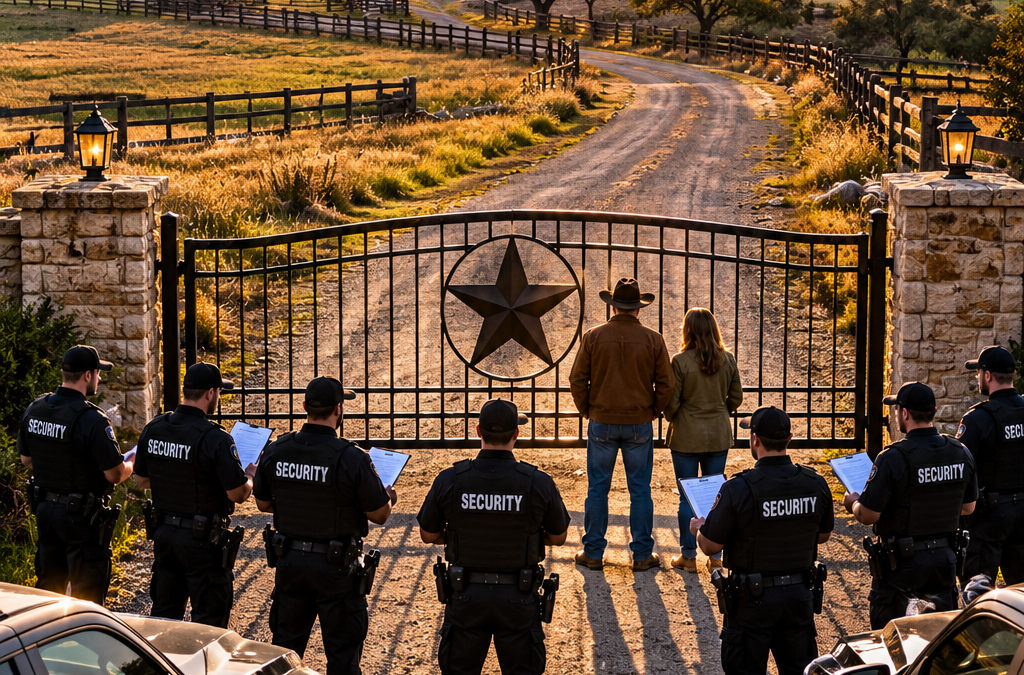
𝗙𝗨𝗟𝗟 𝗦𝗧𝗢𝗥𝗬 At six in the morning, eight uniformed security guards lined up outside the gate of the ranch my wife and I had spent ten years building, carrying paperwork that supposedly gave them the authority to remove us from our own land. By the time I walked down the driveway to face them, I understood that the fight with my HOA had stopped being about fences, landscaping, or fines—it had become a fight over whether fifty acres I owned could still truly belong to me.
𝗙𝗨𝗟𝗟 𝗦𝗧𝗢𝗥𝗬
The HOA maintained a private access road, handled a couple of common drainage issues, and organized occasional community meetings.
The dues were modest.
The rules looked ordinary enough when I first glanced through them.
Nothing seemed threatening.
Nothing made me believe an organization designed to maintain roads and neighborhood standards would ever attempt to control every decision I made on fifty acres of private land.
For years, it didn’t.
The board members were people I saw at cookouts.
Neighbors waved from trucks.
Someone would call if a branch came down across the road.
Someone else would organize a cleanup after a storm.
It felt informal.
Friendly.
Almost unnecessary.
Then the composition of the board changed.
I didn’t pay much attention when it happened.
That was another mistake.
A woman named Linda Mercer became HOA president.
I knew who she was, but only casually.
She lived closer to the front of the development in a large stone house with immaculate landscaping, perfectly trimmed hedges, and enough decorative lighting to make the place visible from the county road after dark.
Linda was the kind of person who remembered every rule anyone else had broken.
At first, she seemed efficient.
She sent newsletters.
Scheduled meetings.
Had new signs installed.
She talked constantly about protecting “community standards” and “property values.”
I didn’t object.
Why would I?
My ranch was clean.
My home was maintained.
My land wasn’t abandoned.
I wasn’t running a junkyard or blasting music at midnight.
Whatever Linda wanted to accomplish had nothing to do with me.
At least, that was what I thought.
The first letter arrived on a Monday.
I remember that because Sarah brought it inside with the rest of the mail while I was fixing a broken hinge on one of the barn doors.
She walked into the barn holding a white envelope.
“Marcus?”
I kept working.
“Yeah?”
“Did you apply for something with the HOA?”
I turned.
“No.”
She held up the envelope.
“Then what’s this?”
I wiped my hands on my jeans and opened it.
At the top was the HOA letterhead.
Below that were several paragraphs of formal language.
The sentence that caught my attention was simple.
NOTICE OF VIOLATION: UNAUTHORIZED PROPERTY MODIFICATION.
I read it twice.
Sarah watched my face.
“What?”
“Our fence.”
“What about it?”
“Apparently it doesn’t comply with HOA standards.”
She stared at me.
“Which fence?”
I looked down at the letter.
It didn’t say.
That was the first thing that bothered me.
We had thousands of feet of fencing.
Perimeter fence.
Pasture fencing.
Decorative fencing near the house.
A smaller fence around Sarah’s garden.
“What standard?” she asked.
“I don’t know.”
She took the paper from me.
“This doesn’t even say what’s wrong with it.”
“I’ll call them.”
At that point, I still considered the whole thing a misunderstanding.
The next morning, I called the HOA number.
Linda answered.
“Linda, this is Marcus.”
“Good morning, Marcus.”
“I received a violation notice.”
“Yes.”
That answer caught me off guard.
There was no uncertainty in her voice.
“You know about it?”
“I’m the board president.”
“Right. I’m trying to understand what fence you’re referring to.”
“Your fencing doesn’t match approved community standards.”
“Which section?”
“Your property fencing.”
I looked out my office window toward the nearest pasture.
“Linda, I have fifty acres. You’re going to have to be more specific.”
There was a pause.
“The board conducted an exterior review.”
“Okay.”
“And determined that your fencing is inconsistent with current standards.”
“Current standards according to what rule?”
“You should review the governing documents.”
“I have.”
“Then you should understand.”
I leaned back in my chair.
I remember thinking she was being difficult for no reason.
“Linda, I’m asking a simple question. Tell me what I need to correct.”
“You received the notice.”
“The notice doesn’t identify the section of fence, the defect, or the rule.”
“You’re expected to bring the property into compliance.”
“Compliance with what?”
Another pause.
Then her voice changed.
Not dramatically.
Just enough.
A little colder.
“Marcus, the board isn’t required to debate every enforcement decision with individual homeowners.”
That was the first moment I felt something was wrong.
Not dangerous.
Not yet.
Just wrong.
“I don’t want a debate,” I said. “I want to know what I’m accused of violating.”
“I suggest you attend the next board meeting.”
“When is it?”
“Three weeks.”
“And the notice says I have ten days to correct the violation.”
“Then I suggest you act before then.”
She hung up.
I sat there holding the phone for several seconds.
Sarah appeared in the doorway.
“Well?”
“I have absolutely no idea.”
Five days later, another letter arrived.
NOTICE OF VIOLATION: UNAUTHORIZED LANDSCAPING.
This one referred vaguely to modifications near the main residence.
I walked outside and spent almost twenty minutes trying to figure out what they meant.
We had planted native grasses.
Added several oak trees.
Built flower beds around the porch.
Nothing unusual.
Nothing new enough to explain why the HOA suddenly cared.
Two days later, the third notice came.
Gate color violation.
I actually laughed when I read it.
Sarah didn’t.
“What’s funny?”
“Our gate is apparently the wrong color.”
She looked toward the entrance.
Our gate was dark brown.
It had been dark brown for years.
“Did they change the rules?”
“I don’t know.”
“Did anyone tell us?”
“No.”
The fourth notice arrived the next day.
Then the fifth.
Then the sixth.
Then the seventh.
Seven violations in fourteen days.
Every envelope seemed more absurd than the one before it.
Unauthorized landscaping.
Noncompliant fencing.
Improper gate color.
Unapproved exterior alteration.
Accessory structure violation.
Decorative feature violation.
Failure to obtain architectural review.
Each violation carried a fine.
Five hundred dollars.
Seven hundred fifty.
Twelve hundred.
Then late charges started appearing.
By the second week, Sarah had stopped laughing about any of it.
One evening, she spread the letters across the kitchen table.
“Marcus, look at this.”
“I’ve looked at them.”
“No. Look at the numbers.”
She had written them down.
The fines.
The deadlines.
The additional fees.
I pulled out a chair.
“This can’t be right.”
“That’s what I’m saying.”
“Some of these are charging us again for the same thing.”
“I know.”
I rubbed my forehead.
The house felt suddenly smaller.
That irritated me more than I can explain.
We had fifty acres.
Fifty acres.
And somehow eight sheets of paper had made me feel trapped inside my own kitchen.
“I’ll talk to them again.”
Sarah gave me a look.
“You said that last time.”
“I know.”
“They aren’t explaining anything.”
“I know.”
“Then why do you keep acting like this is going to fix itself?”
That question landed harder than I wanted it to.
Because she was right.
I had been treating the HOA like an annoying neighbor who would eventually get bored.
I told myself reasonable people would take over.
I told myself the board would realize the notices were excessive.
I told myself someone would look at the records and admit there had been a mistake.
Mostly, I told myself I was too busy to make a war out of it.
So I ignored some letters.
Answered others.
Sent a few emails.
Waited.
That was the worst thing I could have done.
The fines didn’t disappear.
They multiplied.
Late fees were added.
Additional enforcement charges appeared.
By the end of the second month, the total claimed balance was $8,750.
Sarah stared at the number on the latest statement.
“Eight thousand seven hundred fifty dollars?”
“I see it.”
“For what?”
“I don’t know.”
“Marcus, that’s not an answer.”
“I know it’s not.”
She pushed the paper toward me.
“I want you to go to the meeting.”
So I did.
The HOA board met in a small community building near the entrance.
There were folding chairs, fluorescent lights, a long plastic table, and a coffee machine that sounded like it was struggling to stay alive.
Linda sat at the center.
Two other board members sat beside her.
When my turn came, I placed a folder on the table.
“I’ve received seven violation notices.”
Linda looked down at her papers.
“I’m aware.”
“I’ve asked repeatedly for clarification.”
“You’ve been given notice.”
“No. I’ve been given accusations. That’s different.”
One board member shifted uncomfortably.
Linda folded her hands.
“What specifically are you requesting?”
“A hearing.”
“This is a board meeting.”
“A hearing on the violations. I want each violation identified, the rule cited, the evidence presented, and a chance to respond.”
Linda’s expression barely changed.
“The board has already reviewed your property.”
“Without me.”
“That isn’t unusual.”
“Then let me appeal.”
“You can submit your concerns in writing.”
“I already did.”
“We received them.”
“And?”
“The board disagreed.”
“Based on what?”
Her mouth tightened.
“Marcus, this isn’t a courtroom.”
“No, it isn’t. But you’re trying to fine me almost nine thousand dollars.”
“The fines are the result of your refusal to comply.”
“With rules you won’t identify.”
“We have identified them.”
“Where?”
“In the governing documents.”
“Which sections?”
She looked at me for several seconds.
Then she said, “You need to stop being argumentative.”
I felt my jaw tighten.
“I’m not being argumentative. I’m asking what rule I violated.”
“Your tone is exactly why communication has become difficult.”
I almost laughed.
Instead, I opened the folder.
“Fine. Let’s take them one at a time.”
Linda raised her hand.
“No.”
I stopped.
“No?”
“This isn’t the place.”
“You just said I could discuss my concerns.”
“You may submit written materials.”
“I have.”
“Then the board will review them.”
“When?”
“When appropriate.”
I looked around the table.
Neither of the other board members would meet my eyes.
That told me more than anything Linda had said.
This wasn’t a process anymore.
It was a decision that had already been made.
I stood.
“Then I want the denial in writing.”
Linda looked at me.
“The denial of what?”
“My request for a hearing.”
“You haven’t made a formal request.”
“I have emails proving otherwise.”
“Then you’ll receive whatever response the board considers appropriate.”
I left furious.
But anger wasn’t what frightened Sarah.
Uncertainty was.
Every few days she asked the same questions.
Can they really keep adding fines?
Can they put something on the property?
Can they take the house?
I kept telling her no.
At first, I believed it.
Then Linda called me into another meeting.
She didn’t ask Sarah to come.
It was just Linda, one other board member, and me.
She placed a copy of our account statement on the table.
“Your balance remains unpaid.”
“Because I dispute every one of these charges.”
“That doesn’t suspend enforcement.”
“It should.”
“It doesn’t.”
“I’ve requested documentation.”
“You’ve received sufficient documentation.”
“No, Linda. I haven’t.”
Her eyes hardened.
Then she said the sentence that changed the entire fight.
“If you don’t pay, the association has the right to place a lien on your property.”
I stared at her.
“What?”
“A lien.”
“I know what a lien is.”
“Then you understand the seriousness.”
“You’re threatening to place a lien on fifty acres over disputed fence and landscaping violations.”
“I’m explaining the association’s remedies.”
“And then what?”
She didn’t answer immediately.
That silence made the next words worse.
“If necessary, the association can pursue foreclosure.”
I felt something cold settle in my stomach.
“Foreclosure.”
“If an enforceable debt remains unpaid.”
“My ranch?”
Linda leaned back.
“Your property is subject to the governing documents just like everyone else’s.”
I looked at the woman sitting beside her.
She was staring down at her notebook.
I stood slowly.
“You are threatening my home over violations you still won’t properly explain.”
“We’re enforcing community standards.”
“No. You’re threatening my home.”
Linda’s voice stayed calm.
“You signed the documents when you purchased the property.”
I left without saying anything else.
That night, Sarah cried.
Not loudly.
That somehow made it worse.
She sat at the kitchen table with one hand covering her mouth while I paced.
“I don’t understand,” she said. “How can they take a fifty-acre ranch over a brown gate?”
“They can’t.”
“You just told me she said they could.”
“She said they could try.”
“Marcus.”
I stopped pacing.
Sarah’s eyes were red.
“This is our home.”
“I know.”
“We spent ten years building this.”
“I know.”
“Can they actually take it?”
I wanted to tell her absolutely not.
I wanted to say Linda was bluffing.
I wanted to promise nothing could touch us because our deed had our names on it and our payments were current and we had done nothing remotely serious enough to justify losing our home.
But for the first time since the letters began, I realized I didn’t know enough to make that promise.
“I’ll call an attorney tomorrow.”
Sarah nodded.
That night I barely slept.
Every noise outside woke me.
Every time I closed my eyes, I saw the ranch from the day we bought it.
Then I imagined someone else behind our gate.
The next morning I called an attorney named David Collins.
David specialized in property disputes and association law.
His office was about forty minutes away.
I brought every document I had.
The notices.
The letters.
The emails.
The HOA rules.
The account statements.
David read quietly for almost an hour.
Every few minutes he made a note.
Finally, he removed his glasses.
“You’ve got a problem.”
My stomach tightened.
“How bad?”
“That depends on whether the board is incompetent or aggressive.”
“What’s the difference?”
“If they’re incompetent, they may back off when challenged.”
“And if they’re aggressive?”
“We challenge harder.”
I leaned forward.
“Can they put a lien on my property?”
“An association may have lien rights depending on the governing documents and applicable law.”
“That’s not exactly comforting.”
“I’m not trying to comfort you. I’m trying to keep you from making decisions based on fear.”
I nodded.
David tapped one of the violation notices.
“What concerns me is the process.”
“Meaning?”
“You asked for specifics.”
“Several times.”
“You requested a hearing.”
“Several times.”
“You requested evidence.”
“Yes.”
“And they ignored or denied those requests.”
“Yes.”
He picked up another sheet.
“They’re also stacking fees while the underlying violations remain disputed.”
“Exactly.”
David leaned back.
“Don’t pay anything yet.”
“Sarah wants this over.”
“I understand. But if you pay all of this without preserving your objections, you may make the dispute harder.”
“So what do I do?”
“You document everything.”
“I already have.”
“Document more.”
He looked directly at me.
“From this point forward, Marcus, stop thinking like an angry homeowner.”
“What should I think like?”
“A witness.”
That sentence changed the way I approached everything.
I went home and built a file.
Then another.
I photographed every fence line.
Every gate.
Every structure referenced in any violation notice.
I measured setbacks.
I collected old photographs showing the same improvements had existed for years.
I printed emails.
Saved voicemail messages.
Created a timeline.
I compared every notice to the HOA covenants.
I marked sections.
Made copies.
Built folders labeled by date.
Sarah helped.
Some nights we stayed at the kitchen table until midnight.
It wasn’t how we’d imagined spending our evenings on the ranch.
But the fear began turning into something else.
Resolve.
Once you start documenting an abuse of power, it stops feeling invisible.
You can see the pattern.
And patterns are harder to deny.
David helped me prepare a formal dispute.
It was detailed.
Professional.
Every allegation was answered.
Every unsupported charge was challenged.
Every request for a hearing was documented.
We demanded that enforcement stop until the board followed its own procedures.
I delivered the package by certified mail.
For the first time in weeks, I felt hopeful.
I thought Linda would read it and understand that this had gone too far.
Instead, she escalated.
Her response accused me of harassing the board.
I read that paragraph three times.
“Harassing?”
Sarah looked up.
“What?”
“She says my documentation constitutes harassment.”
Sarah took the letter.
“That’s ridiculous.”
There was more.
Linda claimed my communications had become disruptive.
She accused me of intimidating board members.
She stated that my conduct represented a threat to orderly community governance.
I felt my face getting hot.
“Threat?”
Sarah looked worried.
“You didn’t threaten anyone.”
“Of course I didn’t.”
“I’ve seen every email.”
“I know.”
“You barely even raised your voice at the meeting.”
“I know.”
That was what frightened me.
The statements weren’t misunderstandings.
They were inventions.
And once someone in authority starts creating a written record accusing you of things you didn’t do, you have to ask why.
Two days later, David called.
“The board voted.”
“On what?”
“The lien.”
I stood up from my desk.
“What do you mean?”
“They’ve authorized action against the property.”
My mouth went dry.
“They’re actually doing it.”
“Looks that way.”
“What now?”
“We go to court.”
“How fast?”
“Immediately.”
David’s voice sharpened.
“Marcus, listen carefully. We don’t wait and argue about this for six months after the lien appears on your title. We stop it before it gets there.”
“Can we?”
“We’re going to ask a judge for emergency relief.”
The next forty-eight hours were a blur.
Affidavits.
Documents.
Copies.
Declarations.
Legal filings.
Sarah sat beside me in David’s office while we signed papers.
Her hands were cold.
When she finished signing, she looked at David.
“Can they take the ranch while this is happening?”
“Not if I can stop them first.”
It wasn’t a guarantee.
But it was enough.
David filed for an emergency restraining order.
We went before a judge.
The court didn’t decide the whole dispute that day.
That wasn’t the point.
The immediate question was whether the HOA should be allowed to proceed with the lien while serious procedural issues remained unresolved.
The order came through.
Temporary restraint.
The HOA couldn’t file the lien while the dispute was pending.
When David called me with the news, I walked outside.
Sarah followed.
“Well?”
“They can’t file it.”
She stared at me.
“You’re sure?”
“For now.”
Her knees nearly gave out.
I caught her.
She pressed her face against my chest.
For the first time since Linda had used the word foreclosure, Sarah cried from relief instead of fear.
I should have realized Linda wouldn’t take the setback quietly.
Three weeks later, on a Wednesday morning, I woke to the sound of engines.
Not one engine.
Several.
Heavy tires moved across the road outside our property.
I opened my eyes.
The bedroom was still dark.
The clock read 6:03 a.m.
Sarah shifted beside me.
“What is that?”
“I don’t know.”
Another vehicle stopped.
Then another.
I went to the window.
Headlights cut through the early-morning darkness near our entrance.
For a second, I thought there had been an accident.
Then I saw the vehicles lined along the road.
SUVs.
Security vehicles.
Men standing near our gate.
I counted them.
Eight.
Sarah came beside me.
“Who are they?”
“I don’t know.”
One of the guards shifted, and I saw equipment on his belt.
My pulse accelerated.
“Stay inside.”
“Marcus.”
“Stay inside.”
I got dressed quickly and grabbed my phone.
By the time I stepped onto the porch, dawn was beginning to break over the eastern pasture.
The air was cool.
Everything else about that morning looked normal.
Birds in the trees.
Mist low across part of the field.
Our horses moving near the far fence.
Except eight uniformed strangers were standing at my gate.
I walked down the driveway.
Slowly.
I didn’t open the gate.
One guard stepped forward.
He looked to be in his forties.
Broad shoulders.
Professional posture.
He held a clipboard with several sheets attached.
“Mr. Marcus?”
“Who’s asking?”
He gave me his name and the security company.
Then he said, “We have an authorization from the homeowners association.”
“For what?”
“Property enforcement.”
I stared at him.
“Meaning?”
He glanced down at the document.
“You’ve been determined to be in ongoing violation of community standards and have refused to comply with association directives.”
“So?”
“We’ve been authorized to remove you from the property.”
For several seconds, I thought I had misunderstood him.
“Say that again.”
“We have authorization to escort you from the premises.”
“My premises?”
“Sir—”
“My fifty acres?”
“That’s what the order says.”
I almost laughed.
Not because anything was funny.
Because the alternative was shouting.
“This is my home.”
“I understand.”
“No, I don’t think you do. You’re standing outside my gate telling me an HOA board gave you permission to physically remove me from land I own.”
“Sir, we’re just carrying out the authorization we’ve been given.”
“By Linda Mercer?”
“The association.”
“Linda Mercer signed it?”
He didn’t answer.
That told me enough.
“You are not entering this property.”
His posture stiffened.
“We would prefer not to escalate the situation.”
“You brought eight security guards to my home before sunrise.”
Behind me, I heard Sarah coming down the driveway.
I turned.
She had her phone to her ear.
“Police are coming.”
The lead guard looked toward her.
Then back at me.
“Mr. Marcus, I suggest you cooperate.”
“With what? Being removed from my own house without a court order?”
“We have documentation.”
“From an HOA.”
He held the clipboard higher.
“The board believes it has authority under the governing documents.”
“Does that paper have a judge’s signature?”
He didn’t answer.
“Does it?”
“No.”
“Then nobody is coming through that gate.”
By the time deputies arrived, the sun was visible above the trees.
Two patrol vehicles stopped near the security SUVs.
The deputies looked as confused as I felt.
One approached me.
I explained what was happening.
Then he spoke with the security supervisor.
The supervisor handed him the document.
Both deputies read it.
One read it twice.
Finally, he walked back toward me.
“Mr. Marcus, this is unusual.”
“Unusual?”
“Very.”
“Can they come onto my property?”
He hesitated.
That hesitation terrified me more than a clear answer would have.
“We’re trying to determine exactly what authority they’re claiming.”
“It’s an HOA letter.”
“I understand.”
“So tell them to leave.”
“We need to be careful here.”
“Careful about what?”
He lowered his voice.
“Private property agreements can create enforcement rights. I’m not saying this is valid. I’m saying we aren’t prepared to resolve a civil property dispute on the roadside.”
Sarah stepped forward.
“So you’re going to let eight men drag us out of our house?”
“No, ma’am. That’s not what I said.”
“It sounded like it.”
The deputy exhaled.
“We’re not going to allow violence. But if they claim contractual authority, this may need to be resolved in court.”
“It’s already in court,” I said.
That got his attention.
“We have a restraining order.”
“Against what?”
“The HOA’s attempt to encumber the property.”
“Do you have it?”
“Inside.”
“I’d like to see it.”
I started back toward the house.
Then I heard another voice.
“What in God’s name is happening out here?”
Everyone turned.
An older man was walking down the county road toward us.
He wore jeans, boots, and a light jacket.
I knew him.
Robert Hayes.
He lived three properties down.
I knew he had worked in law before retirement, but we had never talked much about it.
Mostly we waved when we passed one another.
Sometimes we spoke about rain.
Cattle.
Road repairs.
Normal rural conversations.
That morning he walked straight toward the cluster of deputies and guards.
The security supervisor raised one hand.
“Sir, this is private HOA business.”
Robert stopped.
“Private business?”
“Yes, sir.”
“Then why are there eight guards and two police cars blocking half the road?”
The supervisor looked irritated.
“You’ll need to return to your property.”
Robert’s eyebrows rose.
“I’ll need to?”
“Sir—”
“No. I’m curious. Finish that sentence.”
The deputy nearest me stepped in.
“Mr. Hayes, we’re sorting it out.”
Robert looked at him.
“What’s the issue?”
The deputy explained quickly.
HOA enforcement.
Property violations.
Security company.
Authorization to remove the homeowner.
Robert’s entire expression changed.
“Remove him?”
The lead guard nodded.
“That’s correct.”
“From his own property?”
“Under HOA authority.”
Robert stared at him.
Then held out his hand.
“Let me see that document.”
The guard didn’t move.
“Sir, you’re not a party to this.”
Robert looked at him for a long moment.
Then said quietly, “I spent forty-two years on the bench.”
The road went silent.
Even the deputy looked surprised.
I had known Robert was a retired judge.
I had not known he’d served that long.
Robert continued.
“And in those forty-two years, I encountered more property disputes than I care to remember. So when eight private security guards tell me a homeowners association has authorized the physical removal of an owner from his land based on covenant violations, I become very interested in the piece of paper supposedly allowing it.”
The supervisor’s confidence changed.
Not completely.
But enough.
He handed Robert the document.
Robert read the first page.
Then the second.
His jaw tightened.
“Who drafted this?”
“I don’t know.”
“Who signed it?”
“The association president.”
Robert looked up.
“Where is the court order?”
“There isn’t one.”
“Where is the eviction judgment?”
“There isn’t one.”
“Foreclosure order?”
“No.”
“Writ of possession?”
“No.”
Robert stared at the guard.
“Then what exactly do you think you’re enforcing?”
“The board’s authority under the covenants.”
Robert looked back at the document.
“The board can write whatever it wants on letterhead. That doesn’t magically turn it into judicial process.”
The supervisor crossed his arms.
“We were told the homeowner is in violation.”
“That’s irrelevant to whether you can physically remove him.”
“There are unpaid fines.”
“Also irrelevant to whether you can physically remove him.”
“He has refused to comply.”
“Still irrelevant.”
The guard shifted.
Robert turned toward the deputy.
“Has this man received a judicial order authorizing removal?”
The deputy shook his head.
“Not that we’ve seen.”
“Has title transferred?”
“No.”
“Has there been a completed foreclosure?”
“No.”
“Then what are we doing?”
No one answered.
Robert looked at me.
“Marcus, were you given a hearing on these alleged violations?”
“No.”
“You requested one?”
“Several times.”
“In writing?”
“Yes.”
“Do you have copies?”
“A whole folder.”
Robert nodded.
“Good.”
Then he looked toward the guard again.
“I’m going to give you some advice. Do not enter that gate based on this piece of paper.”
The supervisor’s face hardened.
“We take our instructions from our client.”
“Then call your client.”
“We already have authorization.”
“Call her again.”
The guard hesitated.
Robert handed the document back.
“If you cross that gate and attempt to physically remove a deeded owner without lawful process, this dispute is going to become much larger than whatever your client told you it was.”
The supervisor stepped aside and made a phone call.
I couldn’t hear Linda’s side.
I could hear his.
“We have an issue.”
Pause.
“There’s a retired judge here.”
Another pause.
“No, ma’am.”
Longer pause.
“He reviewed the authorization.”
The guard turned slightly away.
“No, I’m not comfortable proceeding.”
Thirty seconds later, he ended the call.
He returned to the others.
“We’re standing down.”
Sarah exhaled so sharply I heard it from several yards away.
The security guards climbed back into their vehicles.
One after another, the SUVs pulled away.
I watched the last one disappear down the road.
Only then did I realize how hard my hands were shaking.
Robert looked at me.
“You’re already represented?”
“Yes.”
“Call your lawyer.”
“I will.”
“No.”
He pointed toward my phone.
“Now.”
David answered on the third ring.
I told him what had happened.
There was a long silence.
Then he said, “They did what?”
I repeated it.
“Eight guards.”
“Yes.”
“At your residence.”
“Yes.”
“With an HOA document claiming authority to remove you.”
“Yes.”
Another silence.
“Marcus, don’t touch anything. Don’t throw anything away. Get copies of every police report. Write down every name you can remember.”
Robert nodded while I listened.
David continued.
“And tell Judge Hayes I would very much like to speak with him.”
I looked at Robert.
“He wants to talk to you.”
Robert held out his hand for the phone.
“Good.”
The two of them spoke for almost ten minutes.
I couldn’t hear David.
I heard Robert use phrases like due process, contractual authority, enforcement procedure, and colorable claim.
When he finally returned my phone, he looked at me.
“Your lawyer knows what he’s doing.”
“I hope so.”
Robert glanced toward the empty road.
“They made a serious mistake this morning.”
“Serious enough to end this?”
“No.”
That answer disappointed me.
Robert must have seen it.
“But serious enough that they’re no longer controlling the story.”
The next stage moved quickly.
David amended our legal action.
We added evidence of the attempted removal.
The security company’s written authorization became central.
The police reports confirmed the guards had appeared at the property under instructions from the HOA.
Robert provided a statement about what he witnessed.
I submitted copies of every hearing request.
Every unanswered email.
Every notice.
Every fine.
Every escalation.
Once the documents were arranged chronologically, the pattern was impossible to miss.
Violation.
Request for explanation.
No meaningful response.
Fine.
Request for hearing.
Denied or ignored.
More fines.
Threat of lien.
Emergency court order stopping the lien.
Private security sent to the property.
The matter eventually came before the court for a fuller hearing.
I had been in court before for minor things.
Traffic issues.
Business paperwork.
Nothing prepared me for what it felt like to sit there knowing the place Sarah and I had built was part of the dispute.
Linda sat across the room with the HOA’s attorney.
She looked completely different from the woman who had sat behind that folding table telling me I was argumentative.
Her posture was rigid.
She avoided looking at me.
David placed our records before the court.
The HOA’s attorney argued that the association had broad authority to enforce covenants.
David did not deny that associations could enforce valid restrictions.
He attacked the procedure.
Notice.
Opportunity to respond.
Authority for specific fines.
Authority for escalating enforcement.
Authority for attempting to remove an owner physically.
The judge questioned the HOA attorney carefully.
“Where was the hearing?”
The attorney shifted through papers.
“The association’s position is that the homeowner had multiple opportunities to communicate with the board.”
“That wasn’t my question.”
Silence.
The judge repeated it.
“Where was the hearing?”
“There were board meetings.”
“Was there a formal proceeding at which the alleged violations were presented and the homeowner allowed to challenge the evidence?”
The attorney hesitated.
“Not in that format.”
The judge looked at another document.
“Was he given the specific factual basis for each fine?”
“Notices were sent.”
“Again, that was not my question.”
I glanced toward Linda.
Her face had tightened.
Then the court reached the attempted removal.
The judge held up the HOA authorization.
“I want to understand this document.”
The HOA attorney stood.
“Your Honor—”
“This purports to authorize private security personnel to escort the homeowner from his own property.”
“The board believed it had enforcement authority.”
“Authority from where?”
The attorney began explaining covenant language.
The judge interrupted.
“I’m not asking whether the association may enforce restrictions. I’m asking what legal instrument permitted private guards to remove the record owner from possession.”
The attorney had no good answer.
The judge looked at Linda.
“Did you sign this?”
Her attorney leaned toward her.
Linda answered.
“Yes.”
“On what basis did you believe you could order private security to remove Mr. Marcus from his residence?”
“I was advised that the association had enforcement power.”
“By whom?”
“Our management resources.”
“That’s not a legal basis.”
Linda’s voice became quieter.
“We were trying to protect the community.”
I felt something twist in my chest when she said that.
Protect the community.
From what?
My brown gate?
My fence?
My refusal to pay fines she couldn’t properly justify?
David stood.
“Your Honor, the community was never in danger. The evidence shows a homeowner repeatedly asking for the basic information necessary to understand and contest charges against his property.”
The judge reviewed the record.
The ruling did not come as one dramatic sentence.
Real courtrooms rarely work that way.
It came piece by piece.
The notice process was inadequate.
The fines could not stand as imposed.
The attempted lien enforcement was improper under the circumstances.
The board’s escalation had exceeded what the record supported.
The attempted physical removal was especially indefensible.
The disputed fines were invalidated.
The association was ordered to cover substantial legal costs.
Further proceedings addressed damages arising from the board’s conduct.
Eventually, the matter ended with the HOA paying me $45,000.
Linda resigned as board president.
I did not celebrate when I heard.
That surprised me.
For months, I had imagined what victory would feel like.
I thought I would want to see Linda embarrassed.
I thought I would want an apology.
I thought I would stand at my gate, look toward her part of the neighborhood, and feel vindicated.
Instead, I felt tired.
Just tired.
Sarah and I sat on the back porch the evening after the final paperwork was completed.
The sun was dropping behind the western hill.
Everything looked exactly as it had before the first violation notice arrived.
Same field.
Same barn.
Same fence.
Same house.
But I was different.
Sarah rested her feet on the porch rail.
“Forty-five thousand dollars,” she said.
“After what we spent fighting them.”
“Still.”
I nodded.
She was quiet for a moment.
“Do you feel like we won?”
I thought about it.
“Yes.”
“But?”
I looked across the ranch.
“But I don’t think winning means what I thought it meant.”
“What does it mean?”
“It means we’re still here.”
Sarah smiled.
“That’s enough.”
She was right.
The next morning I walked the property alone.
I started at the house and followed the fence toward the north pasture.
For months, every improvement had become evidence.
The gate was evidence.
The trees were evidence.
The guest house was evidence.
The fencing was evidence.
I’d photographed everything so many times that I’d stopped seeing those things as parts of our home.
They had become exhibits.
I stopped near one of the old oak trees.
Sarah and I had planted it years earlier.
It was much smaller then.
I remembered her standing over the hole telling me I’d dug it too shallow.
I’d told her I knew how to plant a tree.
She had taken the shovel from me.
Apparently I did not.
I laughed when I remembered it.
That was when I realized what the HOA dispute had really taken from us.
Not money.
Not only money.
It had taken ordinary life.
For months, we had stopped enjoying the ranch.
Every envelope became a threat.
Every unfamiliar vehicle made Sarah look toward the gate.
Every email notification made my chest tighten.
I had become obsessed with proving ownership of a place whose deed already had my name on it.
That was the part I never expected.
Before all of this, I thought property ownership was simple.
You bought land.
You paid for it.
You maintained it.
You followed the law.
It was yours.
But ownership can become complicated when private agreements, association rules, enforcement procedures, and money all collide.
The most dangerous moment in my case wasn’t when the guards arrived.
It wasn’t even when Linda threatened foreclosure.
It was earlier.
It was when I received the first few letters and decided they were too ridiculous to take seriously.
I thought ignoring something unreasonable made it powerless.
It didn’t.
Paper creates a record.
Deadlines create consequences.
Silence can be interpreted as acceptance.
The HOA had been building a file while I was assuming common sense would eventually solve everything.
By the time I started paying attention, they already had weeks of unanswered notices and a growing balance attached to my name.
David had told me to stop thinking like an angry homeowner and start thinking like a witness.
I understood that advice better afterward.
Anger tells you to tear up the letter.
A witness saves it.
Anger tells you to call someone and scream.
A witness writes down the conversation.
Anger tells you everyone knows the accusation is absurd.
A witness asks for the exact rule in writing.
That difference saved me.
The documents mattered.
The photographs mattered.
The emails mattered.
The certified letters mattered.
The requests for a hearing mattered.
When the dispute finally reached a courtroom, nobody had to rely on my memory alone.
There was a record.
A clear one.
Judge Hayes came by several weeks after everything ended.
He arrived in an old pickup truck and parked outside the barn.
I was replacing a board on one of the stalls.
He leaned against the doorway.
“Looks quieter around here.”
“That’s the idea.”
He smiled.
“How’s Sarah?”
“Better.”
“And you?”
“Getting there.”
He nodded like he understood.
I put down the hammer.
“I never properly thanked you.”
“For what?”
“You know exactly what.”
He shrugged.
“I walked down a road.”
“You walked down a road at exactly the right time.”
Robert looked toward the gate.
“They were never going to get away with what they were trying to do.”
“You sure?”
“Eventually? Yes.”
“Eventually is a dangerous word when eight guards are at your gate.”
That made him quiet.
I continued.
“The deputies weren’t sure. The guards thought they had authority. Sarah was terrified. I didn’t know what happened if they crossed onto the property.”
Robert nodded.
“That’s why procedure matters.”
“I used to think procedure was just paperwork.”
“Most people do.”
He walked over and picked up the loose board I’d removed.
“Until somebody tries to use paperwork against them.”
We stood there for a while.
Then I asked the question I’d thought about a hundred times.
“What if you hadn’t come outside?”
Robert studied me.
“I don’t know.”
That answer stayed with me.
Not because it frightened me.
Because it was honest.
Maybe the guards would have backed down after seeing the court order.
Maybe the deputies would have stopped them.
Maybe David would have reached someone by phone.
Maybe I would have locked the gate and nothing more would have happened.
Or maybe the confrontation would have escalated.
I don’t know.
What I do know is that I never wanted my home to depend on the coincidence of a retired judge seeing headlights from three properties away.
After the lawsuit, the HOA changed.
Not overnight.
There were arguments.
Resignations.
Special meetings.
Neighbors who had stayed quiet began speaking up.
People I barely knew stopped me near the mailbox or called the house.
One man told me he’d been fined for an equipment trailer he had owned for eleven years.
A woman said she’d paid hundreds over landscaping she had never understood was prohibited.
Another neighbor admitted he’d been afraid to challenge the board because he thought doing so would make him a target.
I realized our dispute had never been as isolated as I’d believed.
Most people simply handled their fear privately.
Some paid.
Some complied.
Some moved things behind fences.
Some stopped asking questions.
Power grows easily in that kind of silence.
At one of the first community meetings after Linda resigned, I sat in the back.
I had no interest in joining the board.
People assumed I would.
Absolutely not.
I had spent enough of my life thinking about HOA rules.
A new acting president opened the meeting.
The first major proposal was simple.
Every violation notice would have to identify the exact covenant provision involved.
Every owner would have a defined appeal process.
Fines couldn’t continue stacking during certain pending appeals without review.
Enforcement actions would require documented authorization.
Some neighbors thought those protections were excessive.
I almost laughed.
Six months earlier, I might have agreed with them.
Then a man near the front said, “Why do we need all these procedures? If someone’s violating a rule, they’re violating a rule.”
I raised my hand.
The room became strangely quiet.
The acting president recognized me.
I stood.
“Because boards can be wrong.”
Nobody interrupted.
“And homeowners can be wrong too. That’s why you need a process that doesn’t depend on whoever happens to be angry that week.”
The man nodded slightly.
I continued.
“If the violation is legitimate, a fair process doesn’t weaken enforcement. It strengthens it. You show the rule, show the evidence, let the owner respond, and document the decision.”
Someone behind me said, “What about people who just refuse to cooperate?”
“Then you have a record proving that.”
I looked around the room.
“What happened at my ranch wasn’t caused by one bad letter. It happened because nobody stopped the escalation. Every step became justification for the next one.”
That was all I said.
I sat down.
The proposal passed.
Months went by.
Life became ordinary again.
That was the greatest victory.
Sarah planted tomatoes.
I repaired fences without photographing them first.
We hosted Thanksgiving in the main house.
My brother slept in the guest cottage.
My nieces spent half the weekend trying to convince Sarah they needed horses of their own.
On Christmas morning, fog settled low across the pasture.
Sarah and I drank coffee on the porch.
No certified mail.
No attorneys.
No security vehicles.
Just quiet.
She looked toward the entrance.
“You still check the gate every morning.”
I looked at her.
“I do not.”
“You absolutely do.”
“I’m looking at the weather.”
“Through the gate?”
“It’s a very informative gate.”
She laughed.
I hadn’t realized how much I’d missed that sound.
I reached over and took her hand.
“I’m sorry.”
“For what?”
“For letting it get so bad before I took it seriously.”
Sarah squeezed my fingers.
“You didn’t cause what they did.”
“No. But I should’ve responded sooner.”
“Maybe.”
“I thought ignoring them was the same as refusing to be intimidated.”
“And now?”
“Now I think knowing what you’re dealing with is better than pretending it can’t hurt you.”
She nodded.
Then she looked across the property.
“This is still ours.”
I followed her eyes.
The ranch stretched beneath the pale Texas sky.
Fifty acres.
The same fifty acres Linda once reduced to account numbers, violation codes, and enforcement notices.
But to Sarah and me, every part of it held a memory.
The porch where we ate dinner during renovations because the kitchen wasn’t finished.
The tree line where our first dog used to disappear chasing rabbits.
The guest house where my mother spent her last Christmas before she passed.
The barn Sarah insisted could be saved when every contractor told us tearing it down would be easier.
The fence I had supposedly violated HOA standards by building.
I smiled at that one.
The fence was still standing.
So was the gate.
So were we.
I used to think the biggest threat to losing your home had to be something enormous.
A foreclosure after losing your job.
A fire.
A natural disaster.
A financial collapse.
Something dramatic enough that you could see it coming.
My experience taught me something different.
Sometimes the threat begins with one envelope.
A vague accusation.
A deadline you don’t understand.
A fine you assume isn’t worth fighting.
Then another envelope arrives.
Then another.
And before you realize how far things have gone, you’re sitting at your kitchen table trying to understand how someone else’s interpretation of a rule became a threat against the place where your wife sleeps.
That does something to you.
It makes you question whether ownership means what you thought it meant.
But the experience taught me something else too.
A piece of paper with official-looking language isn’t automatically correct.
A board vote doesn’t automatically make an action lawful.
A person with a title doesn’t automatically have unlimited authority.
And a homeowner who asks questions is not automatically being difficult.
The morning the guards arrived, I felt completely outnumbered.
Eight of them.
Two police cars.
An HOA president somewhere on the phone insisting she had the authority to decide who could remain on my property.
I remember standing behind that gate wondering how something so absurd had become so real.
Then an older man walked down the road.
Robert didn’t bring an army.
He didn’t scream.
He didn’t threaten anyone.
He asked questions.
Where is the court order?
Where is the judgment?
Where is the lawful process?
Those questions broke through the intimidation because nobody on the other side had adequate answers.
That stayed with me more than the settlement did.
More than Linda resigning.
More than every invalid fine disappearing from the ledger.
Facts don’t always arrive loudly.
Sometimes they walk down a Texas road wearing old boots and ask to see the paperwork.
Years later, I still own the ranch.
The board has changed several times.
The neighborhood is quieter politically than it used to be.
Occasionally, someone new moves in and hears part of the story.
They’ll ask me whether it’s true.
“Did the HOA really send eight guards to your gate?”
“Yes.”
“Did they really think they could remove you?”
“Apparently.”
“And a judge happened to live nearby?”
“Three properties down.”
Usually they laugh because, from a distance, the whole thing sounds unbelievable.
I don’t laugh much anymore.
I remember Sarah standing barefoot at the end of the driveway with 911 on her phone.
I remember the guards’ vehicles in the predawn darkness.
I remember hearing a deputy use the phrase civil gray area while my stomach twisted.
I remember Linda telling me the HOA could pursue foreclosure.
Those moments were real.
But so was what came afterward.
One evening, years after the dispute, I was replacing a hinge on the same entrance gate.
The sun was low.
A truck slowed on the road.
It was Robert.
He rolled down his window.
“Trouble with the gate?”
“Just a hinge.”
He grinned.
“HOA-approved hinge?”
I stared at him.
He started laughing.
I laughed too.
“Get off my property, Judge.”
“I’m on the county road.”
“Gray area.”
That made him laugh even harder.
He drove away.
I finished tightening the bolt and stood back.
For a moment, I looked at the gate.
Such a simple thing.
Steel.
Wood.
Hinges.
A latch.
During the dispute, that gate had become the physical line between everything we’d built and people who believed paperwork gave them the right to cross it.
That morning, I had stood on one side.
Eight guards had stood on the other.
And the entire conflict came down to a question I should have asked much earlier.
What, exactly, gives you the authority to do this?
Not what do you claim.
Not what does your letter say.
Not what did the board vote.
What gives you the authority?
That question eventually exposed everything.
The missing procedure.
The unsupported fines.
The refusal to provide a meaningful hearing.
The aggressive escalation.
The attempt to use private security in a way the board could not justify.
I closed the gate.
The latch clicked.
Then I turned toward the house.
Sarah was standing on the porch.
“You coming in?”
“In a minute.”
She folded her arms.
“You’ve been fixing that hinge for an hour.”
“I’m appreciating my HOA-compliant gate.”
She shook her head and went inside.
I stayed where I was for another minute.
The ranch was quiet.
Nothing dramatic.
Nothing worth filming.
No guards.
No police.
No lawyers.
No threatening letters.
Just land.
Our land.
When Sarah and I first stood there ten years before the dispute, I thought freedom meant having enough space that nobody could tell me how to live.
I know better now.
Space alone doesn’t protect you.
A deed alone doesn’t protect you.
Even being right doesn’t always protect you immediately.
Sometimes you have to defend the ordinary things you assumed nobody could question.
And sometimes defending them means remaining calm long enough to build a record while someone else is doing everything possible to make you panic.
I almost learned that too late.
But the ranch is still here.
The fence is still here.
The gate is still here.
And every morning when I walk outside and see fifty acres opening beneath a Texas sunrise, I remember exactly what it took to keep them that way.
Not because someone powerful rescued me.
Not because the HOA suddenly developed a conscience.
And not because Linda chose to stop.
It ended because her authority had limits, and eventually those limits were forced into the open.
For months, she had controlled the letters.
The fines.
The meetings.
The threats.
That Wednesday morning, she even thought she controlled who could walk through my gate.
She didn’t.
And once that became clear, everything else began to fall apart.
I walked back toward the house.
Sarah had left the porch light on for me even though sunset was still an hour away.
I opened the door.
She was in the kitchen.
Dinner was cooking.
The radio was playing softly.
A stack of mail sat on the counter.
Years earlier, the sight of that stack would have made my chest tighten.
Now I glanced at it and kept walking.
Sarah noticed.
“No HOA letters?”
“If there are, they can wait until after dinner.”
She smiled.
“Look at you.”
I kissed her forehead.
Then I looked through the kitchen window toward the gate one last time.
It stood exactly where I had put it.
On my land.
Where it belonged.



