PART 2: We Thought the Scarred Dog Was Attacking a Blind Cat—Then We Saw What He Had Been Doing to Keep Him Alive
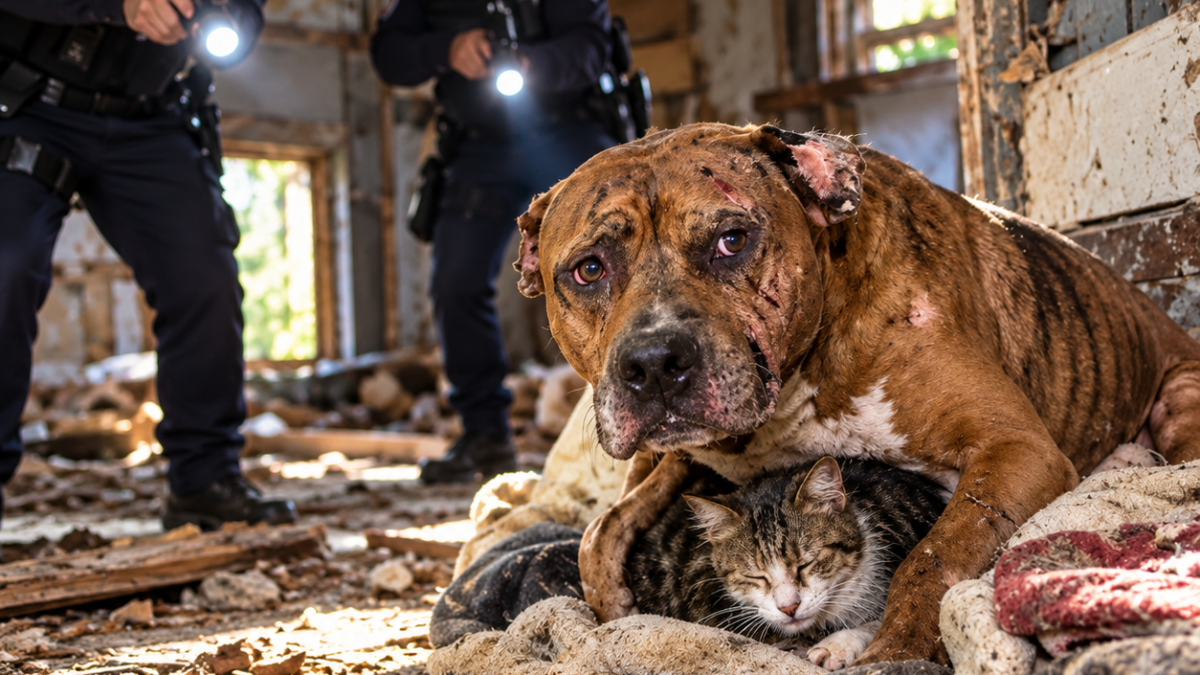
PART 2
“Barnaby!”
The technician reached for the trailing leash.
Missed.
Barnaby’s nails struck the polished floor as he tore down the corridor.
Luc, who had been standing near reception with a cup of coffee, dropped the cup.
“What happened?”
“He got out!”
Instinct made me move.
Then I stopped myself.
The dog wasn’t running toward the exit.
He wasn’t looking for a person.
He turned left at the intersection between the canine wing and the treatment rooms.
Straight toward the cat section.
“Don’t chase him,” I shouted.
The technician froze.
Barnaby reached a closed door.
Stopped.
Sniffed underneath it.
Then began whining.
Not barking.
Not scratching wildly.
Just that same low, desperate sound.
From the other side came a faint meow.
Barnaby’s whole body went still.
His tail moved once.
I looked at the shelter manager, Isabelle Martin.
“Gaston?”
She nodded.
Barnaby lowered himself onto the floor and pressed his nose against the gap beneath the door.
Another meow.
He closed his eyes.
For the first time all evening, every muscle in his body seemed to relax.
Isabelle put one hand over her mouth.
Luc whispered, “You’ve got to be kidding me.”
The veterinarian, Dr. Claire Renard, arrived behind us.
She watched for several seconds.
Then said, “Open the door.”
Isabelle turned.
“We can’t put a dog into the cat ward.”
“I didn’t say put him into the ward. Open it enough so he can see—or smell—what’s inside.”
Gaston was in a large recovery enclosure several feet from the door.
The moment the door opened, his head lifted.
His cloudy eyes didn’t focus.
But his nose worked.
“Barnaby,” I whispered.
The dog took one step inside.
Gaston made another sound.
Barnaby walked directly toward the enclosure.
He pressed his muzzle between the bars.
Gaston stood.
Or tried to.
With only three legs and almost no strength, he stumbled against the side.
Barnaby whined.
Gaston reached through the bars and touched Barnaby’s nose.
Everything stopped.
The pacing.
The shaking.
The searching.
Barnaby lay down.
Gaston did the same.
Their faces remained inches apart.
Dr. Renard looked at Isabelle.
“I think we’re changing the rules tonight.”
Isabelle sighed.
“I knew you were going to say that.”
They didn’t simply release Barnaby into a room full of cats.
Instead, staff cleared a small medical isolation room.
Easy to disinfect.
Warm.
Quiet.
Large enough for a dog bed and an enclosed cat bed.
Barnaby entered first.
Then Gaston.
The cat’s food was placed in the corner.
Gaston ignored it.
Barnaby sniffed the bowl.
Then looked toward him.
I swear what happened next seemed almost intentional.
Barnaby touched the bowl with his nose.
Pushed it.
Once.
Again.
Until it was closer to Gaston’s face.
Gaston sniffed.
Then ate.
Luc stared through the observation window.
“I don’t think anybody is going to believe this.”
Dr. Renard smiled faintly.
“Then don’t exaggerate it.”
“What?”
“Tell them exactly what happened.”
That advice became more important than any of us understood at the time.
Because within two weeks, half the city would know Barnaby and Gaston’s names.
But before there were cameras and reporters and strangers sending bags of dog food to the shelter, there were two old animals sleeping beside each other in a small medical room.
And a question.
Who had they belonged to?
The first answer came the following morning.
Barnaby had a microchip.
The number was faint on the scanner at first, so the technician checked twice.
Registered animal:
Male mixed-breed dog.
Name:
BARNEY.
Age:
Approximately nine.
Owner:
Marcel Fournier.
Address:
17 Rue des Forges.
Luc was standing beside me when Isabelle read the address.
He looked up.
“That’s the warehouse.”
I checked again.
Same street.
Same number.
“The warehouse was someone’s home?”
“Maybe a business address.”
We searched municipal records.
The building belonged to Rivière Development Group.
It had once been a machine-parts warehouse.
It closed eighteen months earlier.
But one name appeared repeatedly in older paperwork.
Marcel Fournier.
Night caretaker.
On-site maintenance employee.
The owner listed on Barnaby’s microchip.
“Barney,” Luc said.
Barnaby lifted his head.
There was no question.
That was his real name.
Isabelle looked toward the medical room.
“So we’ve been calling him Barnaby for twelve hours.”
“Close enough,” I said.
Luc smiled.
“Apparently.”
We tried Gaston.
The cat showed no reaction.
There was no microchip.
No collar.
Nothing identifying him.
I called the phone number attached to Marcel’s registration.
Disconnected.
Then the emergency contact.
Also disconnected.
I was technically no longer required to investigate.
The initial call had been an animal-welfare matter, not a criminal complaint.
Animal control could handle the rest.
I told myself that twice.
Then I looked through the glass.
Barnaby had stretched out on his side.
Gaston was asleep against his chest.
I called a friend in municipal records.
“Can you help me locate Marcel Fournier?”
“How old?”
“Seventy-two according to an old employment file.”
“Why?”
“Found his dog.”
My friend paused.
“Alive?”
“The dog?”
“The man.”
That question bothered me.
“I don’t know.”
He called back forty minutes later.
Marcel Fournier had been admitted to Saint-Pierre Hospital seven weeks earlier after collapsing at a bus stop.
He never returned to the warehouse.
He died twelve days after admission.
I sat at my desk for a long time.
Luc came in.
“What?”
I told him.
His face fell.
“So he didn’t leave them.”
“No.”
“Did anybody know he had animals?”
“That is what I’m going to find out.”
The hospital couldn’t give us details beyond what was necessary without formal process.
But one item in the municipal record helped.
Emergency contact:
Sophie Fournier.
Niece.
I found her number.
She answered on the third ring.
“Hello?”
“Ms. Fournier?”
“Yes.”
“My name is Sergeant Julien Delmas with the Angers police.”
Immediate fear entered her voice.
“What happened?”
“Nothing has happened to you. I’m calling about your uncle Marcel.”
Silence.
“He died last month.”
“I know. I’m sorry.”
“Why are police calling?”
“Did your uncle have a large brown dog?”
Her breathing changed.
“Barney?”
I looked through the window.
Barnaby had raised his head at the sound of my voice.
“Yes.”
“Oh my God.”
Sophie began crying.
“Is he alive?”
“Yes.”
“And Gaston?”
I looked at the old cat.
“Gray tabby? Missing a back leg?”
She made a broken sound.
“Both?”
“Both are alive.”
She cried hard enough that I had to wait.
When she could speak again, she said, “They told me they’d been taken care of.”
“Who?”
“The property management company.”
“What exactly did they tell you?”
Sophie explained.
After Marcel was hospitalized, she traveled from Lyon to Angers.
Her uncle’s small caretaker apartment was built into the rear of the warehouse.
Sophie couldn’t access it because the building owner had changed locks after the warehouse closed.
She called the property manager.
A man named Claude Perrin.
“I told him Barney and Gaston were inside.”
“What did he say?”
“That he knew.”
“What happened next?”
“He said they’d arrange animal services.”
“Did you see the animals?”
“No. He told me I wasn’t allowed inside because the building was unsafe.”
“And you believed they were taken to a shelter?”
“Yes.”
“Did he tell you which one?”
“He said a private rescue.”
“Name?”
“He wouldn’t give me one.”
That was a problem.
“Did you ask?”
“Five times.”
“Do you have those messages?”
Another pause.
“Yes.”
“Don’t delete anything.”
“I won’t.”
“What happened to your uncle’s belongings?”
“Most were boxed up. I collected what they let me take.”
“Anything from the animals?”
“Barney’s old leash. Gaston’s carrier. Some photographs.”
She started crying again.
“I kept asking where they were because I wanted to know they were safe.”
I looked through the glass.
Barnaby was cleaning Gaston’s face.
“They’re safe now.”
Sophie whispered, “Can I see them?”
“Yes.”
She arrived the next afternoon.
I almost didn’t recognize her when she entered the shelter because she looked younger than I expected.
Maybe thirty-five.
Dark hair.
Red coat.
She carried a worn canvas bag.
Barnaby was in the medical room.
The moment Sophie’s voice reached the hallway, his ears lifted.
She stopped outside the glass.
“Barney?”
He stood.
His tail started moving.
Not violently.
Slowly at first.
Then harder.
Sophie covered her mouth.
“Oh, sweetheart.”
Isabelle opened the door.
Barnaby moved toward her.
Sophie crouched.
He pushed his whole head against her chest.
She wrapped both arms around him.
“I thought you were somewhere safe.”
Barnaby licked her cheek.
Behind him, Gaston stood unsteadily.
Sophie laughed through tears.
“And you.”
Gaston walked toward her voice.
She held out her hand.
He sniffed.
Then rubbed his face against her fingers.
“He remembers you?”
“I used to bring Uncle Marcel groceries every few months.”
She looked at me.
“Gaston was already old when Marcel found him.”
“Found him where?”
“Under a loading dock.”
The cat had been injured years earlier.
Marcel took him to a veterinarian.
The damaged rear leg had to be removed.
Afterward, Gaston never left.
“And Barney?”
Sophie touched the dog’s torn ear.
“Marcel adopted him from a rescue about six years ago.”
“Do you know where the scars came from?”
She shook her head.
“The rescue said his earlier life hadn’t been good.”
No details.
I was glad.
Barnaby didn’t need his worst experiences invented for him.
Sophie opened the canvas bag.
Inside was a faded green blanket.
She placed it on the floor.
Barnaby froze.
Sniffed.
Then lay down on it immediately.
Gaston walked over.
Turned once.
Curled against him.
Sophie sat on the floor and cried.
Luc, standing beside me, whispered, “That answers whether the blanket was theirs.”
We left them alone for a while.
Later, Sophie showed me the messages.
Her:
What happened to Barney and Gaston?
Claude Perrin:
Arrangements made.
Her:
Where?
Perrin:
Local animal partner.
Her:
Which one? I want to call.
No response.
Next day.
Her:
Please tell me where my uncle’s animals are.
Perrin:
Handled. Focus on estate matters.
Three days later:
Her:
I need confirmation they’re safe.
Perrin:
They are no longer your responsibility.
That last line bothered me.
I sent copies to animal control.
Officer Élodie Marchand opened a formal inquiry.
Then we inspected the warehouse again.
In daylight, it looked different.
Still abandoned.
Still filthy.
But now we knew where to look.
Marcel’s caretaker room sat behind a metal door near the loading bay.
Most furniture had been removed.
A narrow bed remained.
Two empty bowls.
A broken lamp.
Scratches around the lower part of the door.
On one wall hung a hook.
Sophie told us that was where Barnaby’s leash used to hang.
We found cat-food tins.
Dog-food wrappers.
Old veterinary receipts.
One photograph under a cabinet.
Marcel sitting outside the warehouse.
Barnaby beside his chair.
Gaston on his lap.
Marcel was smiling.
I had never met him.
But looking at that photograph, I understood something.
Those animals hadn’t been surviving in that warehouse because no one had ever loved them.
They had been surviving because the person who loved them disappeared and the people who came afterward didn’t consider them important enough.
That was different.
And somehow worse.
The question became:
How had they remained inside for nearly seven weeks?
We knew Barnaby could leave the caretaker room because the interior door was open.
But the warehouse exterior doors had been locked when Luc and I arrived.
A broken section near the loading dock allowed a small animal through.
Gaston could never have climbed it easily.
Barnaby might have escaped through a lower damaged panel.
But he hadn’t.
He stayed.
Food wrappers near their nest came from several different places.
A bakery.
Convenience store.
Fast-food restaurant.
Someone had been feeding them.
We found out who three days later.
His name was Karim Bensaïd.
He worked nights at a bakery half a kilometer away.
When he saw the local shelter post asking for information about two animals found in the warehouse, he called.
“I was leaving food.”
“How long?” I asked.
“Maybe five weeks.”
“Why didn’t you call animal control?”
His face dropped.
“I thought they belonged to the caretaker.”
“He died.”
“I know that now.”
Karim explained that he saw Barnaby near the rear loading dock late one night.
The dog ran when he approached.
The next night, Karim left stale bread and meat scraps.
They disappeared.
After that, he brought leftovers when he could.
“Did you ever see Gaston?”
“Once.”
“Where?”
“Near the opening in the loading dock.”
“Could he get outside?”
“Barely.”
Karim looked ashamed.
“I should’ve called.”
“You fed them.”
“That wasn’t enough.”
“No.”
I didn’t lie.
“But it was something.”
He nodded.
“Barney always carried food back inside.”
I stopped.
“What?”
“He didn’t eat outside.”
Karim had watched Barnaby pick up pieces of bread or meat.
The dog carried them through the broken panel.
Back to Gaston.
Sometimes he returned and ate what remained.
Sometimes there was nothing left.
That explained the warehouse scene.
Barnaby wasn’t accidentally sharing food.
He had been doing it for weeks.
A dog with visible ribs was taking what little food he found and carrying it back to a three-legged blind cat.
When the local newspaper eventually wrote about it, that detail was the one everyone remembered.
But another detail mattered more to me.
Barnaby could leave.
He had an opening large enough.
He chose not to.
Gaston couldn’t safely survive outside.
So Barnaby stayed with him.
The investigation into Claude Perrin moved slowly.
He denied wrongdoing.
His first statement was simple.
He told Sophie he had arranged care because that was what his maintenance contractor told him.
The contractor said otherwise.
The contractor, a man named Benoît Laroche, provided his work orders.
One entry dated six weeks earlier:
CLEAR CARETAKER QUARTERS. REMOVE PERSONAL PROPERTY. ANIMALS PRESENT. MANAGEMENT TO HANDLE.
Benoît had written a note beneath it:
Dog + cat left onsite pending pickup.
I asked, “Who was supposed to pick them up?”
“Perrin said he’d arrange it.”
“Did you see anyone arrive?”
“No.”
“When did you leave?”
“About four.”
“Were the animals still inside?”
“Yes.”
“Did you lock the building?”
“I locked the main doors.”
My stomach tightened.
“Knowing the animals were still there?”
Benoît looked uncomfortable.
“I asked.”
“What did Perrin say?”
He hesitated.
“Tell me exactly.”
Benoît rubbed his hands together.
“He said leave the rear panel unsecured.”
“So they could get out?”
“Yes.”
“Gaston had three legs and was nearly blind.”
“I didn’t know that.”
“Did you see him?”
“Only under the bed.”
“You left?”
His face flushed.
“Yes.”
“Why?”
“Because it wasn’t my building.”
That answer stayed with me.
Not my building.
Not my animals.
Not my responsibility.
Everybody taking one step backward until the only creatures left holding responsibility were a dog and a cat.
Benoît eventually handed over text messages.
One conversation ended the argument about whether Perrin knew.
Benoît:
Shelter pickup confirmed?
Perrin:
No budget for private transport. Municipal people can collect if someone reports them.
Benoît:
Should I call?
Perrin:
Do what you want after hours. I’m done spending on Fournier’s mess.
Another message:
Leave rear access. They’ll wander out.
That one made me stare at the screen for a long time.
Gaston couldn’t wander anywhere safely.
Perrin had never seen him closely.
That became part of his defense later.
He claimed he didn’t know the cat was disabled.
The prosecutor’s response was simple.
Then why hadn’t he checked?
The city became aware of Barnaby and Gaston before the legal case was complete.
A shelter volunteer posted a photograph.
Nothing graphic.
Barnaby lying on the green blanket.
Gaston tucked against his chest.
Caption:
They survived together. Now they recover together.
Within twenty-four hours, thousands of people had shared it.
Donations arrived.
Blankets.
Food.
Veterinary funds.
A local pet store offered to pay for Gaston’s eye examination.
A retired carpenter built a raised platform so Gaston could climb beside Barnaby’s bed without jumping.
A woman mailed twenty cat toys, despite Gaston being mostly blind and showing absolutely no interest in them.
Luc found that hilarious.
“At least he’s spoiled.”
“He’s eighty percent asleep.”
“Still spoiled.”
The media began calling.
I wanted nothing to do with it.
Then one reporter asked a question that changed my mind.
“Why did you initially think Barnaby was attacking Gaston?”
I didn’t like the answer.
Because Barnaby was scarred.
Large.
Growling.
Standing over a smaller animal.
Because seventeen years of police work had trained me to decide what danger looked like quickly.
That had kept me alive.
It could also make me wrong.
So I agreed to one interview.
I said:
“When we entered, Barnaby was warning us away. I interpreted that as aggression. What I didn’t understand was that every movement he made was protective. He wasn’t moving toward us. He was keeping himself between us and Gaston.”
The reporter asked, “Do you regret drawing your weapon?”
I paused.
“Yes.”
The word surprised even me.
Then I clarified.
“I don’t regret taking a potentially dangerous situation seriously. I regret that Barnaby had probably spent much of his life being judged by his appearance, and my first reaction added one more person to that list.”
The next day, people started calling the station asking how to adopt him.
Dozens.
Then hundreds.
Some wanted Barnaby.
Very few initially mentioned Gaston.
The shelter refused every application that proposed separating them.
Isabelle called me one morning.
“You’ve created a monster.”
“What?”
“My voicemail.”
I laughed.
“How many?”
“Eighty-three messages.”
“Good.”
“No. Half want ‘the hero dog’ for their children.”
“That sounds nice.”
“He’s terrified of loud groups and has never lived with children as far as we know.”
“Oh.”
“Another man wants him as a security dog.”
My face hardened.
“No.”
“Already rejected.”
“And Gaston?”
“Several people said they don’t want a cat.”
I looked through the medical-room glass.
Barnaby and Gaston were asleep.
“Then they don’t want Barnaby.”
“Exactly.”
That made adoption harder.
Barnaby was improving physically.
Gaston was more complicated.
Dr. Renard estimated him at fourteen or fifteen.
He had early kidney disease.
Severe cataracts.
One leg missing.
Arthritis in the remaining rear leg.
He needed medication and regular bloodwork.
“Could he have a good life?” I asked.
“Yes.”
“How long?”
She gave me the answer veterinarians always give when they’re being honest.
“I don’t know.”
Barnaby had his own issues.
He startled when anyone raised a hand too quickly.
He disliked brooms.
Metal chains made him freeze.
He became anxious if Gaston was taken out of the room.
But he was not generally aggressive.
He allowed staff to handle him.
He learned that food arrived twice a day.
He gained four kilos in six weeks.
His coat changed.
The dull brown became almost mahogany in sunlight.
One afternoon, I visited in uniform.
Barnaby saw me through the glass.
His tail moved.
I stopped.
“Did he just…”
Isabelle smiled.
“He likes you.”
“That seems like poor judgment.”
“You did rescue him.”
“I pointed a weapon at him.”
“He may not understand the symbolic complexity.”
I entered.
Barnaby approached.
Sniffed my uniform.
Then leaned against my leg.
Thirty-five kilos of dog.
I almost fell.
“Personal space.”
Tail.
Gaston heard my voice and began meowing.
I sat on the floor.
Barnaby lay beside me.
Gaston climbed over his front leg and settled between us.
I looked at both.
“You two are creating serious problems.”
Gaston purred.
Barnaby sighed.
“You’re not even listening.”
I visited again the next day.
Then two days later.
Then nearly every day after work.
I told myself it was because of the investigation.
Luc stopped pretending to believe me.
“You’re going to adopt them.”
“No.”
“You visit more than the volunteers.”
“I am checking on witnesses.”
“The witnesses don’t speak.”
“Exactly. Difficult interviews.”
Luc grinned.
“You’ve already bought dog treats.”
“Evidence-management tool.”
“What about the cat treats?”
“Separate witness.”
He laughed for the rest of the shift.
The truth was more complicated.
I lived alone.
My wife, Émilie, had died three years earlier after a long illness.
Our daughter, Manon, was twenty-three and studying in Paris.
After Émilie’s death, I had become very good at making the house quiet.
Work.
Home.
Dinner.
Television I didn’t really watch.
Sleep.
Repeat.
I didn’t want a dog.
I certainly didn’t want a giant scarred dog and a nearly blind three-legged elderly cat.
Then Manon came home one weekend.
I made the mistake of taking her to the shelter.
The moment she saw Barnaby and Gaston together, she looked at me.
“No.”
I hadn’t said anything.
“You’re thinking it.”
“I am not.”
“Papa.”
“Absolutely not.”
Barnaby came to the glass.
Manon crouched.
He sniffed her hand.
Gaston meowed from behind him.
Manon smiled.
“They’re coming home with you.”
“I work twelve-hour shifts.”
“You have neighbors.”
“My yard isn’t completely fenced.”
“Fix it.”
“Gaston needs medical care.”
“You can afford it.”
“I don’t know anything about cats.”
“Nobody does. They prefer it that way.”
I glared at her.
She smiled.
“You’re lonely.”
That ended the joking.
“Manon.”
“I’m not saying that to hurt you.”
“I know.”
“You come home to an empty house every night.”
“I am fine.”
“I know.”
She looked at Barnaby.
“He isn’t.”
That was unfair.
Exactly as unfair as the truth often is.
I didn’t adopt them.
Not then.
Instead, I agreed to temporary weekend fostering.
A test.
One weekend.
Isabelle insisted on a home inspection first.
“You know I’m a police sergeant.”
“And?”
“You trust me to carry a firearm.”
“I don’t trust you to remember that lilies can be poisonous to cats.”
I stared.
“Fair.”
I fenced the back garden.
Bought two beds.
One enormous.
One small.
Barnaby used the small one.
Gaston took the large one.
Of course.
Their first night in my house was chaos.
Barnaby paced.
Gaston bumped into the kitchen chair.
Barnaby immediately ran to him.
Gaston hissed because Barnaby moved too fast.
Barnaby looked offended.
I moved the chair.
At 1:00 a.m., Gaston began meowing.
Barnaby got out of his bed.
Walked to the kitchen.
Returned.
Nudged Gaston.
Gaston followed.
Water.
I stood in the hallway watching.
Barnaby had been guiding him.
Not officially.
Not with training.
He simply knew when Gaston couldn’t find something.
The second morning, I woke on the couch.
I didn’t remember falling asleep there.
Barnaby was on the floor beside me.
Gaston was sleeping on Barnaby’s side.
For the first time since Émilie died, I woke because another living creature was making too much noise in the house.
Gaston snored.
Loudly.
I smiled before I remembered I was supposed to dislike this arrangement.
Manon called.
“Well?”
“It has been one night.”
“And?”
“The cat snores.”
“So did Maman.”
I laughed.
The sound surprised me.
After a moment, Manon became quiet.
Then she said, “I haven’t heard you laugh like that in a while.”
I looked at Barnaby.
He was awake now.
Watching me.
“It’s temporary.”
“Of course.”
They stayed through Sunday.
When I drove them back to the shelter, Barnaby recognized the parking lot.
His body changed.
He began whining.
Gaston became restless.
I hated every meter between the car and the entrance.
Isabelle met me.
“How’d it go?”
“Fine.”
“Fine?”
“The cat insulted my furniture.”
“Normal.”
“The dog stole half a roast.”
“Also normal.”
“I didn’t say he could.”
“Did you leave it where he could reach it?”
“Yes.”
“Then legally, that was his roast.”
I handed her the leash.
Barnaby didn’t move.
He leaned toward me.
I felt something inside my chest tighten.
“Come on.”
He stayed.
Isabelle didn’t pull him.
I walked inside with them.
Twenty minutes later, I was back in my car.
Alone.
The silence felt unbearable.
I hated that most of all.
Monday morning, I called Isabelle.
“What paperwork is required for longer foster placement?”
She laughed.
I almost hung up.
“Don’t.”
“I didn’t say anything.”
“You laughed.”
“Come at five.”
They came home again that evening.
The formal legal case against Claude Perrin expanded at roughly the same time.
Investigators learned his company had been responsible for several vacant properties.
Three former tenants reported similar behavior after emergency hospitalizations or evictions:
Belongings removed early.
Animals left for relatives or municipal services to “handle.”
Most situations had eventually been resolved safely.
But the pattern mattered.
Perrin’s attorney argued he was managing distressed properties with limited resources.
He wasn’t an animal-control professional.
He relied on subcontractors.
The prosecutor answered with his own messages.
No budget.
Leave access.
They’ll wander out.
I’m done spending on Fournier’s mess.
That wasn’t negligence born from confusion.
That was a decision.
Still, I wanted the story to remain accurate.
Barnaby and Gaston hadn’t been locked inside an airtight room without food.
A rear access panel was open.
Karim fed them.
Water leaked from an old pipe in the warehouse after rain.
They survived because a series of small circumstances kept them alive.
But the person responsible for arranging safe removal had chosen not to do it.
That was enough.
Perrin eventually faced charges related to animal abandonment and neglect under local law, along with separate regulatory consequences tied to property management.
The legal system moved slowly.
Barnaby and Gaston didn’t care.
They learned my house.
Barnaby discovered the refrigerator.
Gaston discovered the radiator.
Barnaby hated the vacuum cleaner.
Gaston couldn’t hear it well enough to care.
I bought Gaston three expensive cat beds.
He slept in a cardboard box.
I bought Barnaby an orthopedic dog bed.
He slept beside the box.
When Manon visited, she took photographs.
One showed Barnaby’s giant body curled around Gaston’s cardboard box like a security wall.
She sent it to me while sitting in the same room.
Caption:
YOUR CHILDREN.
I replied:
YOUR INHERITANCE IS BEING SPENT ON CAT MEDICATION.
She sent:
WORTH IT.
The weekend foster became one month.
Then two.
Isabelle stopped asking when I would return them.
I stopped pretending I might.
But we couldn’t finalize adoption while the legal ownership question remained tied to Marcel’s estate.
Sophie was Marcel’s nearest surviving relative.
She signed a formal relinquishment of any estate claim to Barnaby.
Gaston had no documented ownership record, but she gave a sworn statement that he had belonged to Marcel for years.
She wanted them to remain together.
“Would you take them yourself?” I asked.
Her face fell.
“I have two dogs and a toddler in a small apartment.”
“You don’t need to explain.”
“I feel guilty.”
“Don’t.”
“He was my uncle.”
“And you tried.”
She looked toward Barnaby.
“He loved that dog.”
“I know.”
“He used to say Barney made people cross the street, but Gaston made everyone stop.”
That sounded exactly right.
Sophie brought more photographs.
Marcel and Barnaby in the snow.
Gaston sleeping on Marcel’s newspaper.
Barnaby wearing a ridiculous red scarf.
One photograph showed all three in the doorway of the warehouse caretaker apartment.
Marcel’s hand rested on Barnaby’s head.
Gaston sat at his feet.
On the back Marcel had written:
My night shift.
I framed it.
Put it in my living room.
The first time Barnaby approached the photograph, he sniffed the frame.
Then walked away.
He didn’t need pictures.
His memory lived somewhere else.
Gaston began having trouble with his kidneys in January.
Nothing immediately severe.
Dr. Renard changed his food.
Added medication.
He needed more fluids.
Barnaby hated every veterinary appointment that took Gaston away.
So the clinic adapted.
If Gaston needed bloodwork, Barnaby came.
If Gaston stayed for fluids, Barnaby lay beside the treatment cage whenever possible.
One technician joked that Barnaby was “emotional support staff.”
Dr. Renard corrected her.
“No.”
She pointed toward Gaston.
“He’s management.”
One afternoon, Gaston had to remain at the clinic for four hours.
I tried taking Barnaby home.
He refused to leave the parking lot.
I stood beside my car.
“Barney.”
Nothing.
“Home.”
He looked toward the clinic.
“Gaston is staying.”
Barnaby sat.
I pulled gently.
Nothing.
A woman walking past smiled.
“Who’s walking who?”
“Currently nobody.”
I called Dr. Renard.
“Can he wait inside?”
Five minutes later Barnaby was under a desk in the treatment office.
Completely calm.
When Gaston’s fluids finished, the cat was returned to him.
Barnaby stood.
Sniffed every inch of him.
Then looked at Dr. Renard.
She laughed.
“He’s fine.”
Barnaby sniffed Gaston again.
“Second opinion?”
Tail wag.
Their bond fascinated behaviorists.
But every expert who visited warned us not to romanticize it beyond evidence.
Barnaby was not consciously “sacrificing his life” in the human sense.
We couldn’t know what thoughts he had in the warehouse.
We could observe behavior.
He remained with Gaston when he could have left.
He brought food inside.
He positioned himself between Gaston and strangers.
He became distressed when separated.
Gaston ate and moved more normally when Barnaby was near.
That was enough.
The facts were more moving than exaggeration.
The city’s reaction grew.
Schoolchildren sent drawings.
Almost all depicted Barnaby twice his actual size.
Gaston usually appeared tiny enough to fit beneath one paw.
One child drew both in a house with a policeman.
I stared at that picture longer than I should have.
Manon saw it on my kitchen counter.
“You kept it.”
“It was evidence.”
“Of?”
“Bad proportions.”
She laughed.
Then looked at me.
“Have you signed the adoption papers yet?”
“Can’t until the case clears.”
“You would?”
I didn’t answer.
She raised an eyebrow.
“Yes,” I said.
It was the first time I admitted it aloud.
“Yes. If they’ll let me.”
Manon hugged me.
“Don’t make this emotional.”
“Too late.”
The legal hearing took place in early spring.
Perrin denied intentionally abandoning the animals.
His attorney’s argument was careful.
Marcel had died unexpectedly.
The warehouse was scheduled for redevelopment.
Property staff had safety concerns.
Perrin believed the animals would leave through the rear access and be collected by municipal services.
He had not physically harmed them.
He had not locked them in a cage.
He had no personal responsibility for Marcel’s pets.
Then Sophie testified.
She described her calls.
Her messages.
Her repeated requests for the location of the “private rescue.”
The attorney asked, “Did Mr. Perrin ever explicitly tell you he personally delivered the animals?”
“No.”
“So you assumed?”
“I asked him where they were.”
“That wasn’t my question.”
She took a breath.
“No. He didn’t say he personally delivered them.”
The attorney nodded.
Then Sophie added, “He told me they were safe.”
Silence.
The prosecutor introduced the message:
They are no longer your responsibility.
Then Perrin’s message to Benoît:
No budget for private transport. Municipal people can collect if someone reports them.
Then:
Leave rear access. They’ll wander out.
The prosecutor asked Perrin, “At the time you wrote this, had you contacted municipal animal services?”
“No.”
“Any rescue?”
“No.”
“Any veterinarian?”
“No.”
“Any family member willing to collect them?”
Perrin looked toward Sophie.
“No.”
“You had one.”
His attorney objected.
The judge allowed the prosecutor to rephrase.
“Ms. Fournier had repeatedly asked for information about the animals, correct?”
“Yes.”
“Did you offer her access to retrieve them?”
“The building was unsafe.”
“Did you bring the animals to her?”
“No.”
“Did you tell her they remained onsite?”
“No.”
“Why?”
Perrin hesitated.
“I thought the situation would resolve.”
That phrase angered me.
Resolve.
As if problems solve themselves when people stop looking.
The prosecutor placed a photograph from our first night on the screen.
Not graphic.
Barnaby over Gaston.
Bread on the floor.
Old blankets.
“Did this look resolved?”
Perrin’s attorney objected to the emotional framing.
The judge sustained it.
The photograph was removed.
Good.
The case should stand on facts.
Not emotional manipulation.
Then Benoît testified.
He admitted locking the main doors.
Leaving the rear panel unsecured.
Walking away.
The prosecutor asked, “Why didn’t you call animal control yourself?”
Benoît stared at his hands.
“I thought Mr. Perrin would.”
“You texted him.”
“Yes.”
“He replied that municipal services could collect the animals ‘if someone reports them.’”
“Yes.”
“Did you understand that nobody had reported them?”
Benoît swallowed.
“Yes.”
“Why didn’t you?”
“I was afraid I’d lose the contract.”
That was the first moment I saw Perrin look directly at him.
Benoît continued.
“I had two children. Work was slow. I told myself the dog could get out.”
“And the cat?”
“I didn’t know how bad he was.”
The prosecutor nodded.
“But you saw him?”
“Yes.”
“Did you check?”
“No.”
Benoît looked toward the gallery.
“I should have.”
That answer mattered.
Not because it erased his part.
Because he stopped pretending.
Perrin never did.
His defense rested largely on the argument that the animals technically had a possible exit and that food remained in the caretaker room initially.
But the court focused on responsibility.
He had assumed control of the building.
He knew domestic animals remained.
He represented to the family that care had been arranged.
He deliberately declined to arrange it.
The judgment did not produce the dramatic scene people expect from movies.
No shouting.
No collapse.
No sudden confession.
Perrin was found responsible for offenses connected to abandonment and failure to arrange proper care.
He received fines, probationary conditions, restitution obligations for veterinary and shelter expenses, and restrictions related to animal custody in properties his company managed.
More damaging professionally, the city opened a regulatory review.
Several public property contracts were suspended.
Later, his company lost eligibility for certain municipal management work after inspectors documented broader compliance failures.
People online called it revenge.
I didn’t.
It was accountability.
The distinction mattered to me.
Revenge would have required me to enjoy his suffering.
I didn’t know him well enough for that.
I wanted the next caretaker who was hospitalized to know their dog wouldn’t become somebody else’s inconvenient expense.
That was all.
Outside the courthouse, Perrin approached me.
I was in uniform.
Luc immediately moved closer.
Perrin stopped several feet away.
“Sergeant.”
“Mr. Perrin.”
He looked older than he had during the first hearing.
“Are the animals still alive?”
The question surprised me.
“Yes.”
“The cat too?”
“Yes.”
He nodded.
“I thought the dog would leave.”
I stared at him.
“He could have.”
Perrin looked confused.
“There was an opening.”
“I know.”
“Then why didn’t he?”
“Because Gaston couldn’t.”
Perrin said nothing.
I continued.
“Barnaby stayed.”
His face changed.
Maybe he had never understood that.
Maybe nobody had told him.
For several seconds, he looked toward the courthouse steps.
Then said, “I didn’t know.”
“No.”
I paused.
“You didn’t check.”
That was the last thing I ever said to him.
I didn’t need a better line.
The adoption cleared eleven days later.
Isabelle called while I was at work.
“Congratulations.”
“For what?”
“You’re officially eligible.”
“For retirement?”
“Barnaby and Gaston.”
I stopped walking.
“What?”
“Estate issue cleared. County hold lifted.”
Luc heard the conversation from across the room.
He grinned.
Isabelle continued.
“You still want them?”
I pretended to think.
“Let me check my schedule.”
She laughed.
“Julien.”
“Yes.”
My voice broke slightly.
“Yes, I want them.”
We signed the papers that afternoon.
Sophie came.
Manon took the train from Paris without telling me.
Luc arrived carrying a bag of treats large enough to feed Barnaby for a month.
Dr. Renard signed the final medical clearance.
Isabelle placed two adoption certificates on the desk.
BARNABY DELMAS.
GASTON DELMAS.
I looked at the names.
“This seems excessive.”
Manon smiled.
“You’re emotional.”
“I am not.”
“You’ve been staring at the paper for thirty seconds.”
“Administrative diligence.”
Sophie handed me Marcel’s green blanket.
“It should go with them.”
I took it.
“Are you sure?”
“Yes.”
Then she gave me the framed copy of the photograph:
My night shift.
“I kept the original.”
“Good.”
She crouched beside Barnaby.
“You’ve got a house now.”
Barnaby licked her hand.
Then she touched Gaston.
“You too, old man.”
Gaston bit her lightly.
She laughed.
“He remembers me.”
“Apparently with mixed feelings.”
The shelter staff lined the hallway when we left.
I hated that.
I hate being watched.
Barnaby didn’t.
He walked beside me.
Gaston rode in a carrier placed where Barnaby could smell him.
At the front door, Isabelle said, “Don’t come back.”
Barnaby wagged.
I said, “That’s rude.”
“To them. You still have to visit.”
We did.
Frequently.
The first month as their legal owner changed almost nothing in daily life.
Except I stopped calling their stay temporary.
Barnaby’s bed moved into my bedroom.
Gaston still preferred Barnaby’s bed.
Barnaby eventually accepted the couch.
I pretended not to.
He knew I was pretending.
Gaston learned the house completely despite his vision.
He used the wall as a guide.
Memorized the hallway.
Found the litter box.
Found food.
Found the radiator.
Once, Manon moved a chair.
Gaston walked directly into it.
He stood still.
Then began yelling.
Not meowing.
Yelling.
Manon rushed over.
“I’m sorry!”
I pointed at the chair.
“Never rearrange his kingdom.”
“I moved it twelve inches.”
“He has filed a complaint.”
Gaston continued yelling.
Barnaby came from the kitchen.
Sniffed him.
Then pushed between Gaston and the chair as if personally escorting him around the obstacle.
Manon stared.
“He really does guide him.”
“Sometimes.”
Barnaby led Gaston three feet.
Then abandoned him to investigate a sandwich.
Heroism has limits.
The local attention eventually faded.
I was grateful.
Barnaby and Gaston became animals again instead of symbols.
That was better.
Barnaby loved cold weather.
Gaston hated it.
Barnaby wanted long walks.
Gaston preferred sleep.
Barnaby disliked bicycles.
Gaston disliked everyone before breakfast.
Barnaby learned exactly which cupboard contained treats.
Gaston learned the sound of the refrigerator cheese drawer.
Ordinary habits replaced the warehouse in my mind.
That’s how healing happened for me too.
I stopped seeing Barnaby first as the dog I almost misjudged.
He became the dog who drooled on my uniform.
The dog who stole one shoe but never the pair.
The dog who took up eighty percent of the sofa while somehow looking offended if I asked for space.
Gaston became the cat who woke me at 5:17 every morning.
Not because he was hungry.
His breakfast time was six.
Apparently he wanted me awake enough to appreciate the anticipation.
One morning I found Barnaby asleep in the kitchen.
Gaston was lying on his back.
Not beside him.
On him.
I sent Manon a photograph.
She replied:
HOSTAGE SITUATION.
I wrote:
NEGOTIATIONS ONGOING.
She sent:
PAY IN TUNA.
That was life.
A year after the warehouse rescue, the city animal-services department invited me to attend the introduction of a new emergency protocol.
I expected bureaucracy.
There was plenty.
But the policy mattered.
When an elderly, hospitalized, evicted, or deceased resident was known to have animals in a property managed by a third party, responsibility had to be documented.
Who had custody?
Who had contacted family?
Who had contacted animal services?
Where were the animals transferred?
No more “handled.”
No more vague promises.
A name.
A location.
A record.
Sophie attended.
Karim too.
Benoît came unexpectedly.
He stood near the back.
After the meeting, he approached me.
“How are they?”
“Good.”
He nodded.
“I’m glad.”
I didn’t know what to say.
Then he asked, “Does Barnaby still carry food to the cat?”
I smiled.
“Sometimes.”
Benoît looked down.
“I should’ve called.”
“Yes.”
He nodded.
No excuse.
No argument.
That was enough.
He had started volunteering one Saturday a month with an animal transport charity.
I learned that later.
He never advertised it.
Never contacted reporters.
He just drove animals from temporary homes to clinics and shelters.
I respected that.
People do not repair a failure by pretending it never happened.
They repair what they can by behaving differently afterward.
The second winter was harder on Gaston.
His kidney disease progressed.
He lost weight.
Dr. Renard adjusted medication.
Added fluids twice weekly.
Gaston hated every second.
Barnaby supervised.
If Gaston complained during treatment, Barnaby stood.
If Gaston relaxed, Barnaby lay down.
One evening after fluids, Gaston was tired.
I put him on the green blanket.
Barnaby lay beside him.
Gaston stretched his front leg.
Touched Barnaby’s face.
Exactly as he had in the warehouse.
Barnaby closed his eyes.
I sat across from them.
For a moment, I was back in that dark building.
Weapon in my hand.
Dog growling.
Cat hidden underneath him.
I had thought courage looked like standing your ground.
Barnaby taught me another version.
Sometimes courage looked like staying beside someone who couldn’t get out without you.
Gaston rallied.
Spring helped.
Warm sunlight.
Open windows.
He sat on the terrace while Barnaby slept nearby.
Sophie visited.
She brought an old audio recording from Marcel’s phone.
“I don’t know if I should play it.”
“What is it?”
“My uncle talking.”
I hesitated.
“Why?”
“Listen.”
She pressed play.
Marcel’s voice filled the room.
“Barney, leave Gaston’s food alone.”
Barnaby’s head snapped up.
Sophie stopped breathing.
The recording continued.
“Barney.”
Barnaby stood.
He moved toward the phone.
Tail wagging.
Then Marcel laughed in the recording.
“There you are.”
Barnaby whined.
My chest tightened.
Gaston lifted his head too.
Sophie began crying.
“I shouldn’t have done this.”
“Wait.”
Barnaby sniffed the phone.
Then walked toward the green blanket.
He lay down.
Gaston followed.
Sophie sat beside them.
We played the recording once more.
Barnaby listened.
Then put his head down.
No panic.
No searching at the doors.
Just recognition.
Sophie stroked his neck.
“You remember him.”
Of course he did.
That evening I thought about memory.
I had once assumed the kindest thing would be for Barnaby and Gaston to forget the warehouse.
Forget losing Marcel.
Forget being left.
But memory isn’t a room you empty before you can live somewhere new.
They carried Marcel with them.
That didn’t make my home less theirs.
Love doesn’t require erasing whoever came before.
The following summer, Luc retired.
His wife organized a party.
Barnaby was invited.
Gaston was not because, according to Luc, “Gaston doesn’t attend parties. Parties attend Gaston.”
Fair.
Barnaby stood beside Luc during half the photographs.
Someone joked that Luc should adopt him.
I said, “Try.”
Barnaby immediately walked back to me.
Luc looked offended.
“After everything we went through?”
“You held the flashlight.”
“You were the one pointing the weapon.”
“That is not helping your case.”
Everyone laughed.
Later, Luc became serious.
“I still think about that night.”
“Me too.”
“We were seconds from getting it completely wrong.”
I nodded.
“That scares me.”
“It should.”
He looked at Barnaby.
“What changed your mind?”
“The dog moved sideways.”
Luc frowned.
“What?”
“He mirrored me.”
I remembered it exactly.
Every time I moved to see what was under him, Barnaby moved to block my angle.
“He wasn’t trying to attack.”
“He was shielding Gaston.”
“Yeah.”
Luc looked down.
“Tiny detail.”
“Everything was.”
That became something I taught younger officers.
Not Barnaby’s whole story.
Just the observation.
Behavior matters more than appearance.
Direction matters.
Context matters.
A growl is information.
A scar isn’t a verdict.
Distance matters.
What’s behind the animal matters.
You can take safety seriously without letting the first story in your head become the only story.
Barnaby became part of one training session.
He was terrible at it.
He spent ten minutes begging for food and then fell asleep.
I told the officers:
“This is the dangerous suspect.”
Barnaby snored.
Good demonstration.
Three years after the rescue, Gaston turned—according to Dr. Renard’s estimate—seventeen.
Or sixteen.
Or possibly eighteen.
Nobody knew.
Manon insisted on a birthday.
We chose the date we found them.
Gaston received tuna.
Barnaby received steak.
Gaston stole part of the steak.
Barnaby allowed it.
Some patterns never changed.
Sophie came.
Karim brought bread as a joke.
“Not stale this time.”
I laughed.
We sat in my garden.
The green blanket lay in the shade.
Gaston was thinner.
Barnaby’s muzzle had begun turning gray.
But they were together.
Safe.
The city had largely forgotten the viral story.
I preferred that.
Then a young reporter contacted me.
She was writing a piece about bonded animals in shelters.
“Can I interview you?”
“No.”
She laughed nervously.
“I was told you might say that.”
“Who told you?”
“Isabelle.”
“Traitor.”
The reporter asked one question before leaving.
“Do you still think Barnaby saved Gaston?”
I looked toward the garden.
Gaston was lying against Barnaby.
Barnaby had one paw stretched across the cat’s blanket.
“Yes.”
“Did Gaston save Barnaby too?”
I thought about the warehouse.
Barnaby could have escaped.
Maybe without Gaston, he would have wandered onto a road.
Maybe he’d have avoided people.
Maybe he’d have been found sooner.
Maybe not.
We couldn’t know.
But emotionally?
Barnaby had spent seven weeks with a purpose.
Stay.
Find food.
Return.
Protect.
Gaston gave him someone to remain for.
“Yes,” I said.
“How?”
“I think Gaston gave Barnaby a reason not to become only what happened to him.”
She wrote that down.
I immediately regretted how sentimental it sounded.
Then Barnaby leaned over and licked Gaston’s head.
The reporter smiled.
“I’m keeping it.”
“Of course you are.”
Gaston declined slowly over the next year.
Kidneys.
Arthritis.
Age.
Nothing dramatic.
Nothing unfair beyond the basic unfairness of time.
We adapted.
Lower litter box.
More rugs.
Fluid treatments at home.
He stopped jumping completely.
Barnaby became his ramp.
Gaston would climb partly across him to reach the couch.
Barnaby tolerated this with the patience of someone who had accepted his life choices.
One cold January morning, Gaston refused food.
That had almost never happened.
I offered tuna.
Nothing.
Chicken.
Nothing.
A little cheese.
He sniffed.
Turned away.
I called Dr. Renard.
She came to the house.
After examining him, she sat beside me.
“His kidneys have worsened significantly.”
I looked toward the living room.
Barnaby was lying beside Gaston.
“What can we do?”
“Hospitalization. IV fluids. More tests.”
“Would it fix this?”
“No.”
“How much time?”
“I can’t promise.”
“Would he be comfortable?”
“Maybe temporarily.”
I knew where the conversation was going.
I hated it.
“Today?”
“Not necessarily.”
I exhaled.
“He’s still alert. Still comfortable enough at rest. We can support him at home and see whether appetite returns.”
It did.
For a while.
Two weeks.
Then one morning Gaston couldn’t stand even on his remaining strong legs.
Barnaby tried nudging him.
Gaston meowed weakly.
Barnaby lay down.
I called Manon.
Sophie.
Dr. Renard.
Everyone who needed to know.
Gaston spent his final afternoon on Marcel’s green blanket.
Sunlight came through the window.
Barnaby stayed with him.
I offered food once.
Gaston refused.
I didn’t ask again.
Around four, Sophie arrived.
She sat beside him.
“You stubborn old thing.”
Gaston moved one ear.
“He insulted you,” I said.
“Probably.”
She touched his face.
“I wish Uncle Marcel could see you.”
I looked at the framed photograph.
Maybe not see.
But this was what he would have wanted.
Safe.
Warm.
Not alone.
Dr. Renard came after sunset.
Barnaby knew something was different.
He stood near Gaston.
Wouldn’t move.
We didn’t make him.
Dr. Renard gave Gaston medication to help him relax.
He sank deeper into the blanket.
Barnaby sniffed him.
Then lay down.
Gaston lifted his front paw.
Weakly.
He touched Barnaby’s muzzle.
The exact same gesture.
Warehouse.
Shelter.
Home.
Now.
Barnaby closed his eyes.
Sophie began crying.
So did Manon.
I put my hand on Barnaby’s back.
Dr. Renard gave the final medication only when Gaston was deeply asleep.
His breathing became slower.
Then stopped.
Barnaby stayed still.
For several seconds, I wondered if he understood.
Then he sniffed Gaston.
Once.
Twice.
He nudged him.
No response.
Barnaby stood.
Walked in a small circle.
Returned.
Lay beside him.
He stayed there for more than an hour.
We let him.
When the veterinary service finally came to take Gaston, Barnaby followed to the front door.
He watched.
Then turned back into the house.
That night, he slept on the green blanket.
Alone.
For the first week, Barnaby searched.
Not frantically.
The house.
Gaston’s feeding place.
The radiator.
The cardboard box.
Every familiar location.
He stopped eating one morning.
I panicked.
Dr. Renard said, “Give him time.”
“I hate that advice.”
“I know.”
I stayed home.
Barnaby eventually ate dinner.
The next day, breakfast too.
Manon visited.
Barnaby followed her around.
A month after Gaston died, Sophie brought a small urn containing part of his ashes.
We placed it beside Marcel’s photograph.
The rest were buried under a tree in my garden.
Barnaby sniffed the soil.
Then lay nearby.
Not every day.
Just that afternoon.
Spring came.
Barnaby changed.
He became more attached to me.
Not anxiously.
Just present.
If I went upstairs, he followed.
If I worked in the garden, he lay nearby.
If I watched television, he took Gaston’s old side of the couch.
I sometimes wondered whether we had become replacements for each other.
I had lost Émilie.
He had lost Marcel.
Then Gaston.
Maybe that language was wrong.
No one replaces anyone.
We were simply what remained.
And remaining is not a lesser kind of love.
The city opened a new shelter annex the following year.
Isabelle invited me.
I tried refusing.
Manon accepted for me.
“Stop doing that.”
“No.”
The new building included something the old shelter hadn’t had.
Flexible bonded-pair rooms.
Not only dog-dog or cat-cat.
Animals of different species could remain together during intake when veterinary and behavioral staff determined it was safe.
A plaque near the entrance showed a photograph.
Barnaby and Gaston.
Not the warehouse.
Not thin.
Not frightened.
At my house.
Gaston asleep between Barnaby’s paws.
Underneath:
SOME FAMILIES DON’T LOOK THE WAY WE EXPECT.
I stared at it.
Isabelle appeared beside me.
“Too sentimental?”
“Yes.”
“You hate it?”
“No.”
I touched the edge of the frame.
“No. It’s right.”
The first residents in one of those rooms were a senior terrier and a rabbit surrendered after their owner entered long-term care.
They had lived together six years.
Old policy might have separated them automatically.
New policy didn’t.
Manon whispered, “Barnaby and Gaston did that.”
“Partly.”
“No, Papa.”
She looked at me.
“They did.”
Maybe she was right.
Perrin’s name wasn’t on any plaque.
I was glad.
The most satisfying consequence wasn’t that his company had lost contracts.
It was that his decision helped create procedures making the same decision harder for the next person.
Accountability should outlive anger.
Barnaby grew old.
Eleven.
Twelve.
His scars faded beneath gray fur.
His torn ear remained.
His hips stiffened.
He no longer needed long walks.
He preferred the garden.
Visitors still found him intimidating until he leaned against them demanding scratches.
Karim visited occasionally.
Barnaby adored him.
Probably because Karim smelled like bread.
Benoît came once with an animal-transport charity.
He stood outside my gate.
Barnaby approached.
Benoît looked nervous.
“Will he remember me?”
“I don’t know.”
Barnaby sniffed his hand.
Then accepted a treat.
Benoît cried.
Not dramatically.
Just quietly.
“I left him there.”
I didn’t answer.
He continued.
“I’ve transported one hundred twenty-three animals since.”
“That doesn’t undo it.”
“I know.”
Barnaby nudged his hand for another treat.
Benoît gave him one.
“I know.”
That was enough.
You cannot change what already happened.
You can only decide what kind of person gets to make your next decision.
At thirteen, Barnaby developed heart disease.
Manageable.
Medication.
Slower days.
The first time he refused a walk, I knew something had changed.
He chose Gaston’s old spot near the radiator.
I sat beside him.
“You becoming a cat?”
Tail wag.
“Terrible career move.”
He rested his head on my knee.
The following months were gentle.
Nothing dramatic.
Medication.
Checkups.
Short walks.
Sleep.
Manon got married.
Barnaby attended the small garden ceremony wearing a blue collar.
He slept through the vows.
At the reception, he stole cheese.
I considered that a success.
A year later Manon had a daughter.
My granddaughter, Léa.
I was nervous introducing her to Barnaby.
Not because he had ever shown aggression toward her.
Because he was old.
Sore.
Children are unpredictable.
We kept distance.
One day Léa, then almost two, sat behind a baby gate.
Barnaby lay on the other side.
She pushed a soft toy through.
Barnaby sniffed it.
Léa laughed.
He wagged.
That became their relationship.
Gate first.
Then supervised distance.
Eventually Léa sat beside me while Barnaby rested several feet away.
She called him “Bar.”
The first time she touched his torn ear, he closed his eyes.
Manon whispered, “Look at him.”
I knew.
The dog I had once seen as a threat was letting a toddler touch the part of him that looked most damaged.
Life had strange symmetry.
Barnaby’s final winter came quietly.
He was fourteen or maybe fifteen by then.
Older than anyone expected for a dog of his size and history.
His heart medications increased.
His hips weakened.
I installed a ramp.
He refused it for a week.
Then used it as though it had been his idea.
Same family habit as Gaston.
He still ate.
Still enjoyed the garden.
Still followed me.
Until one February morning he didn’t.
I came downstairs.
Barnaby was on the green blanket.
He lifted his head.
Tail once.
I prepared breakfast.
He didn’t move.
“Barney?”
No response beyond his eyes following me.
I brought the bowl.
He sniffed.
Turned away.
My chest tightened.
I called Dr. Renard.
She examined him at home.
His heart had worsened.
There was fluid building where it shouldn’t.
We could hospitalize.
Increase medication.
Maybe buy days.
Maybe a few weeks.
I asked the same question I had asked for Gaston.
“Would those days be good?”
Claire looked at Barnaby.
“Some might.”
“And the rest?”
She didn’t answer.
I knew.
I asked for one day.
She adjusted his medication for comfort.
Manon came with Léa.
Sophie traveled from Lyon.
Luc, now fully gray-haired and happily retired, arrived carrying roast chicken.
Karim brought bread.
“Still not stale.”
Barnaby ate some chicken.
Ignored the bread.
Karim looked offended.
“All those years and now he develops standards.”
We laughed.
That mattered.
I didn’t want Barnaby’s final day to become a ceremony about sadness.
He had already had enough people looking at his scars and deciding what his story was.
So we sat in the garden.
Cold sun.
Blankets.
Barnaby between us.
Sophie brought Marcel’s old phone recording.
She asked, “Too much?”
I thought.
Then nodded.
“Play it.”
Marcel’s voice:
“Barney, leave Gaston’s food alone.”
Barnaby’s ear moved.
Then Marcel laughed.
“There you are.”
Barnaby lifted his head.
Tail.
One slow sweep.
Sophie began crying.
I did too.
Then we played a recording Manon had made years later.
Gaston meowing furiously because his breakfast was late.
Barnaby’s head lifted again.
His tail moved twice.
Luc laughed.
“He remembers the dictator.”
“Everyone remembers Gaston.”
At sunset, people left until only Manon, Sophie, Dr. Renard, and I remained.
Léa had kissed Barnaby on the head before going home.
Barnaby lay inside near the open patio door.
The green blanket beneath him.
Gaston and Marcel’s photograph on the shelf.
His breathing was slow.
I sat on the floor.
For years, I had thought about what I would say when this moment came.
Nothing sounded right.
So I told him the truth.
“The first thing I ever did when I met you was get you completely wrong.”
Barnaby looked at me.
“I thought you were hurting Gaston.”
His ear shifted.
“You were the only one in that building doing your job.”
Manon sat beside me.
I stroked Barnaby’s head.
“I was supposed to protect people.”
My voice broke.
“You protected your family better than any of us.”
Sophie put her hand over her mouth.
Barnaby’s head became heavier against my leg.
“I spent a lot of time feeling guilty about that first night.”
Manon whispered, “Papa.”
“It’s okay.”
I looked down.
“Maybe that’s why I kept coming back.”
Barnaby breathed slowly.
“I’m glad I did.”
Dr. Renard gave him the first medication.
His body relaxed.
No tension.
No pain in the hips.
No need to stand.
I put one hand over the old scar on his shoulder.
“You don’t need to watch the door anymore.”
Manon cried quietly.
I continued.
“Marcel isn’t coming back.”
My voice cracked.
“And Gaston isn’t waiting for food.”
I smiled through tears.
“If there is somewhere they are, I’m sure Gaston is already complaining.”
Sophie laughed.
Barnaby’s tail moved once.
That was the last time.
Dr. Renard gave the final medication only after he was deeply asleep.
His breathing slowed.
One breath.
Another.
Then silence.
For several seconds, I couldn’t move.
My hand stayed on his shoulder.
Dr. Renard listened.
Then whispered, “He’s gone.”
Manon put her arm around me.
I was fifty-eight years old.
A police sergeant.
I had stood at accident scenes.
Hospitals.
Crime scenes.
Front doors where nobody wanted the news I carried.
I cried harder over that dog than I had cried in years.
Not because his death was the greatest tragedy I had seen.
Because Barnaby had become proof that my life after Émilie wasn’t finished.
I had thought I was rescuing him.
People love saying that.
It makes the story simple.
But Barnaby came into an empty house and filled it with noise.
Then Gaston filled it with complaints.
They forced me to change routines.
Come home earlier.
Walk outside.
Call Sophie.
See Manon more.
Meet neighbors.
Volunteer.
Laugh.
Grieve again.
Live again.
That was not a rescue flowing in one direction.
It never had been.
We buried part of Barnaby’s ashes beneath the same tree as Gaston’s.
Sophie placed a little of Marcel’s green blanket there.
Not all of it.
I kept the rest.
On the shelf in my living room sit two small urns.
Gaston.
Barnaby.
Beside Marcel’s photograph.
My night shift.
I sometimes joke that the three of them are still supervising the house.
Years have passed since the warehouse.
I’m retired now.
Luc and I meet for coffee.
Manon brings Léa every Sunday.
The shelter’s bonded-animal rooms are still in use.
The emergency property protocol is still active.
The Compass—no, that’s prior story; avoid. The city fund established after their case helps cover emergency transport for animals whose owners are hospitalized or displaced.
Karim volunteers.
Benoît still drives for the transport charity.
Sophie sends Christmas cards.
Claude Perrin completed his sentence and faded from my life.
I never checked what happened to his company after the final contract review.
For a while, I thought that meant I had gone soft.
Then I understood.
The best consequence wasn’t watching him lose something.
It was reaching a point where his name no longer mattered.
Barnaby and Gaston outlived his role in their story.
That was the only revenge worth keeping.
Sometimes new officers ask me about “the warehouse dog.”
Someone has always heard some version.
Usually exaggerated.
They say Barnaby fought off attackers.
He didn’t.
They say Gaston was minutes from death.
He wasn’t.
They say Barnaby didn’t eat for weeks so Gaston could.
We can’t prove that.
So I correct them.
Facts matter.
Barnaby was underweight.
He had access to an opening.
He repeatedly carried food into the warehouse.
Gaston was blind, three-legged, elderly, and less able to navigate outside.
Barnaby remained with him.
When we entered, Barnaby placed himself between us and Gaston.
When they were separated, both became distressed.
When reunited, both settled and Gaston ate.
They lived together until Gaston died peacefully years later.
Barnaby stayed beside him to the end.
That’s the story.
It doesn’t need anything added.
One evening not long ago, Léa—now old enough to ask difficult questions—sat beside me looking through photographs.
She found the first shelter picture.
Barnaby lying around Gaston.
“Grandpa?”
“Yes?”
“Was Barnaby a hero?”
I thought about the word.
“What do you think?”
“He saved the cat.”
“Yes.”
“So yes.”
I smiled.
“Then yes.”
She looked at another photograph.
Me kneeling beside Barnaby in the garden.
“Were you a hero?”
“No.”
She frowned.
“You saved them too.”
“Lots of people helped.”
“But you found them.”
“I almost misunderstood what I found.”
She thought about that.
Children are good at holding contradictions adults try to simplify.
Then she said, “But you changed your mind.”
I looked at her.
“Yes.”
“That’s good.”
That answer stayed with me.
Maybe that’s the part of the story that belongs to humans.
Barnaby knew what he was doing from the beginning.
Protect Gaston.
Stay.
Bring food back.
Keep strangers away until they proved safe.
We were the ones who needed time to understand.
The final photograph in the album was taken a few months before Gaston died.
My garden.
Late afternoon.
Barnaby stretched in the grass.
Gaston curled against his chest.
No warehouse.
No dirty blankets.
No stale bread.
No locked doors.
Gaston was asleep.
Barnaby’s head rested beside him.
His eyes were open.
Not tense.
Not guarding.
Just watching the yard.
Léa touched the photograph.
“He’s still protecting him.”
I shook my head.
“No.”
She looked up.
“He doesn’t have to anymore.”
That is the image I keep.
Not the moment I entered the warehouse with my hand on a weapon.
Not Barnaby’s scars.
Not Gaston’s missing leg.
Not the courtroom.
Not the headlines.
Two old animals in a garden where nothing was coming to hurt them.
Barnaby had spent weeks keeping himself between Gaston and the world.
In the end, the greatest thing we could give him was a life where he finally didn’t have to.
[END OF STORY]







