PART 2: Tiny Was Only Two, but He Had Already Stopped Asking Humans for Love—Then One Morning, He Took a Single Step Toward Me
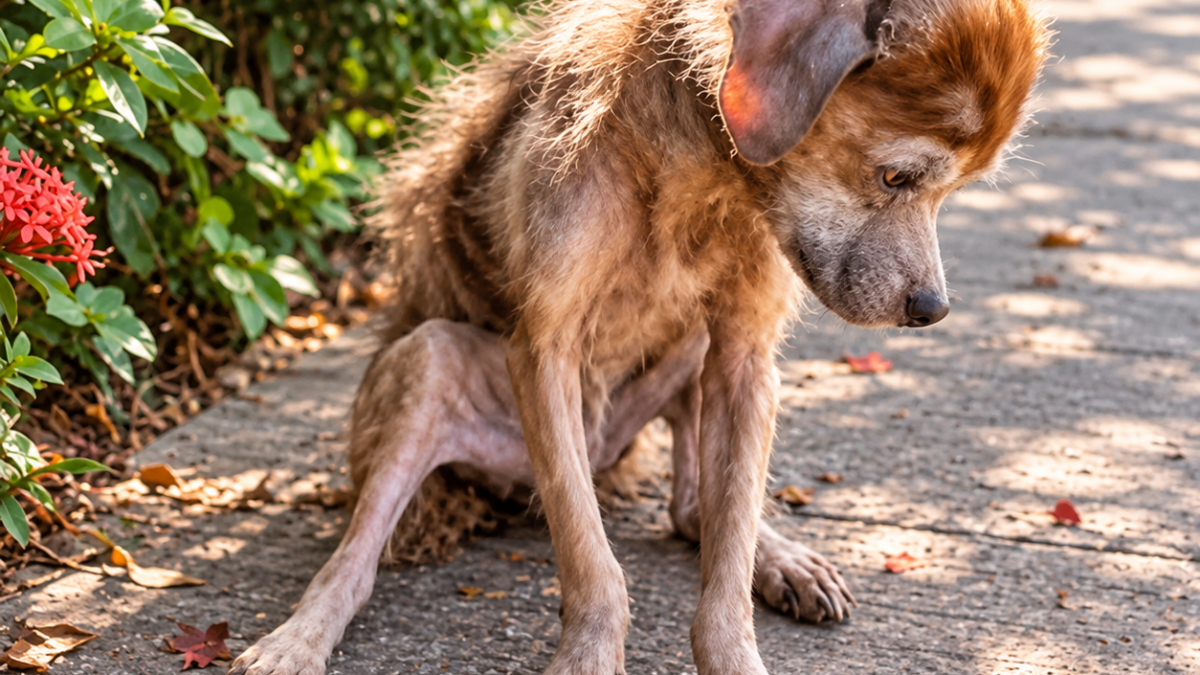
Tiny never cried when we found him.
He never ran toward us, never begged to be picked up, and never tried to escape when I reached for him.
But the way that two-year-old dog stood there with his head lowered told me he had already learned something no animal that young should have had to learn.
My name is Claire Bennett, and I had been volunteering with a small rescue group outside Asheville, North Carolina, for almost six years when Tiny came into my life.
It was a Wednesday afternoon.
Hot.
Humid.
The kind of summer day when even the birds seemed tired.
A delivery driver called our rescue after noticing a thin dog standing beside an abandoned storage building near an old industrial road.
He had apparently been there for most of the morning.
When I arrived with another volunteer named Melissa, I saw him immediately.
He wasn’t hiding.
That was what struck me first.
Most frightened strays either run or make themselves difficult to approach.
This dog simply stood.
Head lowered.
Tail hanging.
One front paw barely touching the ground.
He was young.
That was obvious from his face.
Maybe two years old.
But there was nothing puppy-like about the way he watched us.
“Hey, sweetheart,” I said.
His eyes lifted for half a second.
Then dropped again.
Melissa whispered, “Look at his legs.”
I had already noticed.
They were trembling.
Not because he was growling or preparing to run.
Because standing itself was exhausting him.
His body was painfully thin.
His hips showed beneath his coat.
The weak front leg stayed slightly raised, as though putting full weight on it had become something he no longer trusted.
I moved closer.
No reaction.
Five feet.
Three.
Two.
“Can I touch you?”
Of course he couldn’t answer.
I held my hand near his face.
Tiny smelled my fingers.
Then he simply stood there.
He didn’t pull away.
But he didn’t move toward me either.
No lick.
No tail wag.
No hopeful little push into my palm.
He allowed kindness without participating in it.
That hurt more than fear would have.
I gently touched his cheek.
Nothing.
I ran my hand along the side of his neck.
Still nothing.
Melissa looked at me.
“He’s shut down.”
“Maybe.”
I crouched.
Tiny’s knees trembled harder.
“Okay. We’re not making you stand here.”
I expected him to resist when I slipped a leash around his neck.
He didn’t.
When I took one step, he followed.
Slowly.
Carefully.
His weak leg barely moved through its full range.
Every few steps, he stopped.
I waited.
Then he followed again.
It took us almost ten minutes to cross a distance I could have walked in thirty seconds.
But I refused to carry him unless he showed me he couldn’t continue.
Something in his face told me that choosing to walk mattered.
When we reached the car, he stopped again.
I opened the rear door.
He looked inside.
Then at me.
“You don’t know where this goes, do you?”
His eyes stayed on mine for one second.
That was the first time I saw uncertainty instead of emptiness.
I lifted him carefully.
He weighed far less than he should have.
Tiny didn’t struggle.
He rested against my arms without relaxing into them.
At the veterinary clinic, blood tests showed that several of his values were far below where they should have been.
Malnutrition had taken a serious toll.
His muscles were weak.
His coat was dull.
His body lacked the reserves a healthy young dog should have carried easily.
Then came the X-rays.
I stood beside Dr. Morgan Lee while she studied them.
“What’s wrong with the leg?”
She moved closer to the screen.
Then looked again.
“No fracture.”
I exhaled.
“That’s good?”
“Very.”
“Then why can’t he use it normally?”
“Could be an old soft-tissue injury. Severe weakness. Pain from prolonged strain. Possibly nerve involvement.”
“Will he walk normally?”
“I don’t know yet.”
I looked through the glass door.
Tiny lay on a blanket.
Head down.
Eyes open.
“What does he need?”
“Food.”
Dr. Lee looked at me.
“Treatment. Rest. Physical rehabilitation.”
Then she glanced toward him too.
“And time.”
“For the leg?”
“For everything.”
That evening, I sat beside Tiny’s kennel and offered him a small bowl of food.
He smelled it.
Then looked away.
I waited.
Five minutes later, he smelled it again.
Then finally took one bite.
I almost cried over that single mouthful.
Tiny ate slowly.
Carefully.
When he finished, I held out my hand.
He looked at it.
Then at me.
But he did not move closer.
That was when I understood.
Getting strength back into Tiny’s body might be the easy part.
The harder distance was the twelve inches between his head and my hand.
And I had no idea how long it would take him to decide that crossing it was safe.
PART 2
The first week with Tiny was a lesson in lowering expectations.
I had been involved in rescue long enough to know better than to expect dramatic transformations, but even I caught myself wanting too much.
I wanted the first tail wag.
The first kiss.
The first moment when his face softened and he realized everything was different.
Tiny wasn’t interested in giving me a movie scene.
He was interested in surviving Tuesday.
Then Wednesday.
Then Thursday.
So that became our schedule.
Morning bloodwork when needed.
Small meals.
Medication.
Short supported walks.
Rest.
More food.
More rest.
And absolutely no pressure for affection.
Tiny ate in the same quiet treatment room every day.
At first, he wouldn’t eat if anyone stood nearby.
I had to set the bowl down and move to the opposite side of the room.
Even then, he waited.
He would smell the food.
Look at me.
Look at the door.
Then finally lower his head.
By the third day, the pause became shorter.
By the fifth, he began eating as soon as I sat down several feet away.
“That’s progress,” Melissa said.
“I know.”
“You don’t sound excited.”
“I’m trying not to scare it away.”
Melissa laughed.
Tiny kept eating.
We placed a thick fleece blanket in his kennel.
The first night, he slept curled tightly on one corner of it.
The second night, almost the same position.
On the fourth morning, I arrived early and stopped outside the room.
Tiny was asleep.
Stretched out.
Actually stretched out.
All four legs relaxed.
His chin resting flat against the blanket.
For several seconds, I simply watched.
Dr. Lee came up behind me.
“What?”
I pointed.
She smiled.
“Good.”
“He’s taking up space.”
She looked at me.
“That matters.”
It did.
Animals who don’t feel safe often make themselves small.
Tiny had spent his first days curled into himself.
Now he had stretched one leg across the entire blanket as though, somewhere during the night, his body had decided it no longer needed to protect every inch of itself.
I took a photograph.
Not for social media.
For me.
I wanted evidence that small changes counted.
His bloodwork improved slowly.
The numbers moved in the right direction.
Not dramatically.
But steadily.
His weight increased.
Then we started working more seriously on the weak leg.
Dr. Lee believed a combination of prolonged malnutrition, underdeveloped muscle, and an older untreated soft-tissue injury had left it weak and painful.
“Nothing broken,” she reminded me.
“But that doesn’t mean nothing happened.”
Tiny began short rehabilitation sessions with a veterinary technician named Aaron.
The first involved nothing impressive.
Standing evenly.
Shifting weight.
Moving his paw onto a low foam surface.
Tiny hated it.
Not loudly.
Tiny almost never complained.
He simply looked at Aaron as if Aaron had deeply disappointed him.
Aaron laughed.
“I’m sorry, buddy.”
Tiny stared.
“We’re building character.”
More staring.
I said, “I think he thinks he already has enough character.”
Tiny’s mouth opened slightly.
For one second, I could have sworn he almost smiled.
By day ten, he was placing more weight on the leg.
Day twelve, he crossed the treatment room without stopping.
Day thirteen, he slipped slightly and immediately froze.
I crouched several feet away.
“You’re okay.”
Tiny lowered his head.
I wanted to walk over.
I didn’t.
“Try again.”
He stood still.
Aaron waited beside me.
Nobody moved.
After almost thirty seconds, Tiny took one step.
Then another.
He crossed the room.
That night, I wrote in his chart:
**Tiny chose to continue after becoming frightened.**
It wasn’t medically important.
Emotionally, it felt enormous.
Then came the second week.
And something changed.
I entered the room after lunch.
Tiny lifted his head.
I stopped.
He looked directly at me.
Not because I had food.
I didn’t.
Not because I called his name.
I hadn’t yet.
He simply heard the door and looked.
“Hi.”
His ears moved.
That was all.
I sat on the floor.
Tiny remained on his blanket.
Ten feet away.
I started answering emails on my phone.
Five minutes.
Ten.
Fifteen.
Then I heard the faint sound of nails on the floor.
I didn’t look up immediately.
I was afraid the movement would stop.
Another step.
Then another.
I kept my eyes on the screen even though I wasn’t reading a single word.
Tiny stopped about six feet away.
I waited.
He sat.
That was it.
I almost laughed.
He had crossed four feet voluntarily, and I felt like someone had handed me a trophy.
The next day, he did it again.
Five feet away.
Then four.
Three days later, he sat beside the leg of my chair.
Not touching.
Just near.
I placed my hand loosely on the floor.
Tiny looked at it.
Then away.
I left it there.
After almost two minutes, his nose touched my fingers.
One second.
Gone.
I didn’t react.
At least not outwardly.
Inside, I was screaming.
That evening, I called my mother.
She answered:
“Did something happen?”
“Yes.”
“What?”
“He smelled my hand.”
Silence.
Then:
“Claire, I love you, but you need human friends.”
I laughed so hard Tiny lifted his head from across the room.
“Sorry.”
My mother asked, “Is that the little dog?”
“Yes.”
“The one who won’t come near people?”
“He comes near me now.”
I heard her smile through the phone.
“Then I understand why you called.”
Tiny’s story began spreading quietly through our rescue page.
We never used the worst photographs.
I’ve always hated when suffering becomes advertising.
We showed his progress.
A bowl finished.
Tiny standing more evenly.
Tiny sleeping stretched across his blanket.
Tiny lifting his head when Aaron entered.
People sent encouraging comments.
A local elementary school sent handmade cards.
One said:
**TINY YOU ARE BIG BRAVE.**
Aaron taped it above his kennel.
Another read:
**YOU CAN USE MY LEGS IF YOUR LEG GETS TIRED.**
I had to walk out of the room after reading that one.
Tiny did not care about the cards.
But he liked the envelopes.
Apparently they smelled interesting.
By week three, his body was changing visibly.
His hip bones were less sharp.
His coat had begun to shine.
He no longer trembled simply from standing.
His weak paw touched the ground fully more often.
Then, on a Thursday morning, Tiny did something no one expected.
He asked for attention.
I was sitting at a desk completing paperwork.
Tiny stood beside me.
I assumed he wanted to go outside.
I reached for his leash.
He didn’t move toward the door.
Instead, he took one step forward.
Then pushed his nose underneath my hand.
I froze.
Tiny waited.
I slowly scratched beneath his chin.
His eyes closed.
Not completely.
Just enough.
I scratched his neck.
He leaned.
Very slightly.
But he leaned.
“Melissa.”
She was across the room.
“What?”
“Come here.”
She approached.
Tiny moved away instantly.
I cursed myself.
“Sorry.”
Melissa stopped.
“What happened?”
“He asked me to pet him.”
Her face changed.
“He did?”
“Yes.”
I looked toward Tiny.
He was back near his blanket.
“But apparently the audience ruined it.”
“Don’t worry.”
She smiled.
“He’ll do it again.”
He did.
That afternoon.
Then the next morning.
And the next.
Soon Tiny would approach me when I entered.
Not every time.
But often.
Sometimes his tail moved.
One slow wag.
Two.
He wasn’t enthusiastic yet.
He was experimenting.
Testing.
If I come toward you, what happens?
If I touch you, what happens?
If I trust this morning, will the afternoon punish me for it?
I had no answers about his past.
That bothered me.
Where had a two-year-old dog learned to expect so little?
We had scanned him for a microchip.
Nothing.
We checked lost-pet reports.
Nothing matched.
We searched local community pages.
No one claimed him.
I tried telling myself it didn’t matter.
Tiny was safe now.
The past could stay behind him.
Then a woman named Grace Palmer emailed the rescue.
She attached a photograph.
The subject line said:
**I think I know this dog.**
My heart started beating faster before I even opened it.
The photograph showed a young dog standing behind a chain-link fence.
Thin face.
Same dark markings around his ears.
Same white streak on his chest.
One front paw turned slightly outward.
Tiny.
Younger.
But Tiny.
I called Grace.
“Where did you take this?”
“At a rental house on Mason Street.”
“When?”
“About eight months ago.”
“Who lived there?”
“A man named Jason Keller.”
My stomach tightened.
“Did the dog belong to him?”
“I think so.”
Grace explained that she had lived next door.
She saw Tiny in the yard almost every day.
Back then, his name had been Toby.
“He was friendly,” she said.
“Very friendly?”
“Oh, yes. He used to come to the fence when I went outside.”
My chest hurt.
The dog who had stood silently when I touched him had once run toward a fence for affection.
“What happened?”
Grace became quiet.
“I moved away about four months ago.”
“Before you moved, did he look healthy?”
“Not really.”
“How not healthy?”
“He got thinner.”
I wrote everything down.
“And his leg?”
“That’s why I contacted you.”
I stopped.
“What about it?”
“He started limping.”
“When?”
“Maybe a month before I moved.”
“Did you ever ask Jason?”
“Yes.”
“What did he say?”
Grace hesitated.
“He said Toby was dramatic.”
I gripped my pen.
“Dramatic?”
“He said the dog had stepped wrong and would get over it.”
“Did he?”
“No.”
Grace swallowed.
“Before I moved, the dog stopped coming to the fence.”
That sentence sat heavily between us.
“Did you see him at all?”
“Sometimes lying near the back porch.”
“Did you call anyone?”
Her voice became defensive.
“I thought about it.”
I softened mine.
“I’m not accusing you.”
“I should have.”
“Maybe.”
I hated false reassurance.
Sometimes people should have acted.
But guilt alone didn’t help Tiny now.
“You contacted us today.”
Grace began crying.
“I saw the picture and knew.”
I thanked her.
Then called animal control.
Officer James Holloway met me the following morning.
He had worked cruelty and neglect investigations for nearly a decade.
I showed him the photograph.
Grace’s statement.
Tiny’s medical records.
James studied everything.
“You sure that’s him?”
“No.”
“But?”
“I’d bet my car.”
“Your car is terrible.”
“My point stands.”
He smiled faintly.
Then looked serious.
“If we can connect Tiny to Keller, we can ask questions.”
“Can you investigate?”
“Yes.”
“What happens if he just says the dog ran away?”
“Then we look for evidence.”
I was learning that phrase.
Evidence.
Not anger.
Not assumptions.
Not stories that felt true.
Evidence.
James visited the Mason Street property.
Jason Keller no longer lived there.
The landlord had evicted him six weeks earlier.
Why?
Unpaid rent.
Property damage.
And several complaints about animals.
My pulse jumped when James told me.
“Animals?”
“Apparently more than one dog at different times.”
“What happened to them?”
“Working on it.”
We found Jason through forwarding records and a business registration.
He worked part-time for a small moving company.
When James first contacted him, Jason denied ever owning a dog matching Tiny.
Then James showed him Grace’s photograph.
Jason changed his answer.
He said Toby had belonged to an ex-girlfriend.
Who?
He wouldn’t provide a full name.
Then he said the dog had run away.
When?
He wasn’t sure.
“Did he report him missing?” I asked.
“No.”
“Call a shelter?”
“No.”
“Animal control?”
“No.”
“Post online?”
“Nothing we found.”
I stared at James.
“He abandoned him.”
“Maybe.”
“James.”
“We still need the rest.”
The rest came from a surprising place.
The storage building where Tiny had been found had one functioning security camera.
It wasn’t pointed directly at the road.
Mostly it covered a loading entrance.
But part of the gravel lot appeared in the corner.
The owner, Mr. Delgado, allowed investigators to review footage.
At 11:38 the night before we found Tiny, an older white pickup entered the lot.
Stopped.
A man got out.
Opened the passenger door.
A small dog appeared.
The dog did not jump down.
The man reached inside.
Lifted him.
Placed him on the ground.
My stomach twisted when James described it.
“Can you see his face?”
“Partially.”
“Truck plate?”
“Not clearly.”
“Is it Jason?”
“Looks similar.”
I crossed my arms.
“That’s not enough.”
James gave me a surprised look.
“What?”
“I’m learning.”
He almost smiled.
“No. It’s not enough.”
Then Mr. Delgado found better footage.
A second camera covered the driveway entrance.
The pickup’s rear plate was visible for less than a second.
Investigators enhanced the frame.
The plate registered to Jason Keller.
I closed my eyes.
“Now?”
“Now we have a truck.”
“And a man?”
“We’ll compare.”
The timeline tightened.
Jason’s phone records later placed his device near the industrial road around the same period.
Tiny’s old veterinary history provided another piece.
Grace remembered the name of a clinic Jason once mentioned.
James contacted them through the proper investigative process.
They found Toby.
Same approximate age.
Same markings.
And a note from seven months earlier.
**Possible soft-tissue strain front leg. Rest recommended. Recheck if lameness persists.**
There had been no recheck.
At that visit, Toby weighed nearly fourteen pounds more than Tiny weighed when we found him.
Fourteen pounds.
On a dog his size, it was enormous.
I sat beside Tiny that evening.
He was lying stretched across his blanket.
Strong enough now that both front paws rested comfortably in front of him.
“They found your old name.”
His ear moved.
“Toby.”
Nothing.
I tried again.
“Toby?”
Tiny lifted his head.
My heart stopped.
“Tiny?”
He looked too.
I laughed.
“You’ll answer to anything if chicken might be involved.”
But I kept thinking about Toby.
Tiny was the name we gave the dog who barely occupied space.
Toby had been the dog who ran toward Grace’s fence.
Maybe both were true.
Maybe identity can survive things that behavior doesn’t.
Jason was interviewed again.
This time, investigators showed him the truck footage.
He admitted driving Tiny to the industrial road.
His explanation was simple.
He said he was being evicted.
He had nowhere to take the dog.
He had no money.
He assumed someone would find him.
I felt rage rise so quickly I became dizzy.
“He assumed?”
James nodded.
“What about the leg?”
“Jason says it wasn’t serious.”
“What about the weight loss?”
“He says Tiny was picky.”
I laughed.
Not kindly.
Tiny now ate with enthusiasm.
He had gained nearly ten pounds under structured feeding.
Picky wasn’t the word.
James continued.
“We’re gathering veterinary opinion.”
Dr. Lee provided it.
Tiny’s condition was inconsistent with a dog who had simply missed several meals.
The muscle loss and blood abnormalities reflected longer-term inadequate nutrition.
His leg injury had not received appropriate follow-up care.
No bones had been broken.
That was good.
But the absence of a fracture didn’t make prolonged pain acceptable.
Jason’s attorney later emphasized exactly that.
No broken bones.
No permanent catastrophic injury documented.
I hated the argument.
Dr. Lee didn’t.
She remained calm.
“An animal does not need a broken bone to require veterinary care.”
That line became important later.
Meanwhile, Tiny knew nothing about legal strategy.
Thank God.
Tiny was busy discovering toys.
His first favorite was a stuffed green dinosaur.
Melissa gave it to him.
At first, he only smelled it.
Then one afternoon I walked into the recovery room and found the dinosaur upside down beneath his paw.
Tiny had his mouth around one leg.
I stopped.
“What are you doing?”
Tiny froze.
I laughed.
“Continue.”
He shook the toy.
His tail wagged.
Once.
Twice.
Then harder.
It was the first time I saw him play.
Not survive.
Not eat.
Not cooperate.
Play.
I sat on the floor.
Tiny shook the dinosaur again.
Then dropped it.
I rolled it gently toward him.
He stared.
Then pounced.
His weak leg slipped slightly.
He recovered.
No fear.
No freezing.
Just another attempt.
I covered my face.
Melissa entered.
“What happened?”
“He attacked a dinosaur.”
She looked at Tiny.
The dinosaur was pinned beneath both paws.
“Oh.”
She smiled.
“This is serious.”
“Very.”
We celebrated with chicken.
By the end of month two, Tiny was medically ready to leave the clinic environment.
His bloodwork had improved dramatically.
His weight was approaching healthy range.
His gait remained slightly uneven, but physical therapy had strengthened the weak leg.
More important to me, he had begun seeking people.
Not everyone.
Tiny remained cautious with strangers.
But once someone became familiar, he approached.
He would place his head beneath my hand.
Lean into Aaron.
Follow Melissa toward the food room.
He had opinions now.
That was wonderful.
He disliked wet grass.
He loved scrambled eggs.
He was suspicious of men wearing baseball caps.
He adored quiet women.
He hated squeaky toys but loved soft fabric toys.
And he had developed a ridiculous habit of stealing towels from the laundry basket.
One day, I found him asleep with three.
“Tiny.”
His eyes opened.
“That’s excessive.”
Tail wag.
“Those are not yours.”
No concern.
It was impossible to look at him and see the dog from the industrial road.
Except sometimes.
Some movements still revealed him.
If someone reached over his head too quickly, Tiny lowered his body.
If a door slammed, he froze.
If I walked away while he was eating, he sometimes stopped and watched until I returned.
Healing is not erasure.
That became obvious.
We opened foster applications.
I immediately became difficult.
Nina, our rescue director, sat across from me.
“You rejected six.”
“Yes.”
“Why?”
“Reasons.”
“One has a fenced yard, works from home, and has twenty years of dog experience.”
“She said she wants a dog who follows her everywhere.”
“And?”
“Tiny needs to choose.”
Nina stared at me.
“That might be the most rescue-person sentence you’ve ever said.”
“I mean it.”
“You’re emotionally compromised.”
“Probably.”
“Are you adopting him?”
“No.”
“Then eventually someone else has to.”
I looked through the window.
Tiny was sleeping beside his dinosaur.
“I know.”
Then came application number seven.
A woman named Natalie Brooks.
Thirty-four.
Occupational therapist.
Lived alone in a small house with a fenced yard.
No children.
One older cat.
Worked four days per week.
Her application contained a sentence that stopped me.
**I don’t need a dog who loves me immediately. I’m okay being ignored for as long as he needs.**
I read it twice.
Then called her.
“Why did you write that?”
She laughed nervously.
“Is it bad?”
“No.”
“I adopted a fearful cat six years ago.”
“How long before she let you touch her?”
“Eight months.”
I sat up.
“Eight?”
“She was worth waiting for.”
That was the first point in Natalie’s favor.
I interviewed her for over an hour.
“What if Tiny never becomes cuddly?”
“That’s okay.”
“He is cuddly now with familiar people.”
“Also okay.”
“What if he regresses after moving?”
“I expect some regression.”
“What if his leg needs future therapy?”
“I’m an occupational therapist. I’m probably going to annoy your veterinarian with questions.”
I smiled despite myself.
“What if he hides?”
“I let him hide safely.”
“What if he doesn’t want visitors touching him?”
“Then visitors don’t touch him.”
“What if someone says he just needs to get over it?”
“I stop inviting them.”
I wrote a check mark beside her name.
Tiny met Natalie four days later.
She entered the room.
Sat on the floor.
Did not look directly at him.
Did not extend her hand.
Did not call him.
Tiny watched.
Five minutes.
Ten.
Natalie talked to me quietly.
Tiny got up.
Walked halfway across the room.
Stopped.
Natalie continued talking as if nothing happened.
Tiny took another step.
Then another.
He smelled her shoe.
She didn’t move.
He smelled her knee.
Nothing.
Then Tiny sat beside her.
Not touching.
I felt tears forming.
Natalie whispered:
“Can I look at him?”
“Not yet.”
She smiled.
“Okay.”
After several minutes, Tiny stood.
Walked away.
I exhaled.
Natalie said:
“That went well.”
I stared at her.
“Most people would ask why he walked away.”
“He wanted to.”
Point two hundred in her favor.
We scheduled another meeting.
Tiny came closer faster.
Third meeting, he accepted a treat from her hand.
Fourth, he touched her fingers with his nose.
Fifth, he leaned against her knee.
Natalie froze.
Tiny stayed.
I smiled.
“You can breathe.”
“I’m afraid to ruin it.”
“I know.”
Tiny sat there for almost a minute.
Then wandered toward me.
I looked at Natalie.
“He likes you.”
Her eyes filled.
“I like him too.”
The foster trial began the following weekend.
I packed his things.
Blanket.
Food.
Medication.
Harness.
Green dinosaur.
Three towels he believed belonged to him.
Nina raised an eyebrow.
“You’re giving her towels?”
“They’re his.”
“You complained about that for weeks.”
“They’re emotionally significant.”
“You need help.”
Probably.
When Natalie drove away, Tiny sat in the back seat looking through the window.
I kept smiling until the car disappeared.
Then I walked behind the rescue building and cried.
Aaron found me.
“You okay?”
“No.”
“Good sign.”
“How?”
“You’d be worse if you didn’t care.”
I wiped my face.
“I hate this.”
“You say that every adoption.”
“I mean it every time.”
The first night, Natalie sent one photograph.
Tiny under her kitchen table.
Not hiding.
Watching.
The message:
**Ate half his dinner. Walked around the yard twice. Has not acknowledged the cat. Cat has definitely acknowledged him.**
Day two:
Tiny slept in his crate with the door open.
Day three:
He finished breakfast.
Day four:
He followed Natalie from the kitchen to the living room.
Day six:
A photo of Tiny lying on the couch.
I called immediately.
“You let him on furniture?”
Natalie laughed.
“He invited himself.”
“Good.”
Day nine:
Tiny approached Natalie while she was reading and put his chin on her ankle.
Day twelve:
His first full-body tail wag when she came home.
Day fourteen:
Tiny carried the green dinosaur to her bedroom.
I watched every video more times than I will admit.
Then, on day seventeen, Natalie called.
My stomach dropped.
“Tiny okay?”
“Yes.”
“The cat?”
“Still offended.”
“Then why are you calling?”
There was a pause.
“I think he’s scared of my brother.”
I straightened.
“What happened?”
“My brother visited. Baseball cap. Loud voice. Tiny froze and hid behind the couch.”
I remembered.
Men in baseball caps.
“Did your brother approach?”
“He tried.”
“How?”
“He bent down and reached over him.”
I closed my eyes.
“Okay.”
“I stopped him.”
“Good.”
“I told him to ignore Tiny.”
“Very good.”
“But Tiny wouldn’t come out for hours.”
Natalie sounded devastated.
“I messed up.”
“No.”
“I should’ve prepared better.”
“Yes.”
Silence.
I softened.
“But one mistake doesn’t mean you ruined everything.”
“What do I do?”
“Give Tiny control.”
We made a plan.
Her brother would not return for several days.
Next visit, no hat.
Quiet voice.
No eye contact.
No reaching.
Treats tossed away from his body, not used to lure Tiny closer.
Tiny could leave.
Tiny could stay.
Tiny decided.
The second visit lasted fifteen minutes.
Tiny remained across the room.
Third visit, twenty minutes.
Tiny took one treat from the floor.
Fourth, he smelled the man’s shoe.
Two months later, Tiny allowed him to scratch his chest.
Not head.
Chest.
That was his choice.
Natalie sent me a photo.
I replied:
**THIS is why I chose you.**
She responded:
**Tiny chose me. You were paperwork.**
Fair.
The adoption became permanent at the end of sixty days.
We held no giant event.
Tiny didn’t like crowds.
Natalie signed papers in a quiet office.
I signed as rescue representative.
Tiny lay beneath the desk.
Afterward, Natalie knelt.
“Want to go home?”
Tiny stood.
Tail wagging.
Home.
That word was no longer theoretical.
The investigation into Jason continued in the background.
I tried not to let it dominate Tiny’s story.
Jason’s attorney argued that he had been facing eviction and financial crisis.
That was true.
His attorney argued that Tiny had not sustained a fracture.
Also true.
He argued Jason had left Tiny near a building because he believed employees would arrive in the morning.
Possibly true.
But the security video showed the hour.
11:38 p.m.
The industrial building wasn’t operating overnight.
Jason did not knock at a residence.
Call animal control.
Contact our rescue.
Take Tiny to a shelter.
Leave food.
Leave water.
Or notify anyone that a weak dog had been left there.
The prosecution’s case focused not on dramatic language but on choices.
That mattered.
Dr. Lee testified about Tiny’s condition.
James presented the camera evidence.
Grace testified about the weight loss and the leg problem she had observed.
The clinic records showed that follow-up care had been recommended months earlier.
The landlord provided photographs taken during the eviction inspection.
One showed a nearly empty backyard with a damaged plastic dog bowl.
Another showed a torn bag of inexpensive food.
None of those things alone proved everything.
Together, they built a timeline.
Then came one more piece.
Jason had texted his former coworker the morning Tiny was found.
The coworker contacted investigators after seeing the rescue post.
The message said:
**Finally got rid of the dog last night. One less thing to deal with.**
I read it once.
Then put the paper down.
For weeks, I had tried to imagine some version of events that made Jason less deliberate.
Maybe he panicked.
Maybe he intended to call someone.
Maybe he thought Tiny would be discovered immediately.
That text removed much of my uncertainty.
“One less thing to deal with.”
Tiny.
A thing.
I went home that night furious.
Tiny was already with Natalie permanently by then.
So my own house was quiet.
I called her.
“Can I come see him?”
“Of course.”
She didn’t ask why.
When I arrived, Tiny ran toward the entryway.
Ran.
Not perfectly.
His gait still had a tiny unevenness when he moved fast.
But he ran.
Tail whipping.
Eyes bright.
He stopped three feet from me.
Then came closer and pushed his head into my hands.
I knelt.
“Hi.”
He licked my chin.
First time ever.
I laughed through tears.
Natalie watched.
“What happened?”
“Nothing to him.”
“Legal case?”
I nodded.
She sat beside us.
I told her about the message.
Her face tightened.
Then she looked at Tiny.
He was trying to climb partly into my lap.
“He’s not a thing.”
“No.”
“He’s expensive.”
I looked at her.
She smiled.
“And dramatic about breakfast.”
I laughed.
“And he owns half my towels now.”
Tiny wagged.
Natalie rubbed his chest.
“But not a thing.”
“No.”
That helped.
The hearing took place three months later.
Jason appeared with his attorney.
I was not required to testify, but I attended.
Natalie came too.
Tiny stayed home.
That was important.
He had no reason to sit inside a government building while humans argued about his worst months.
Jason looked smaller than I remembered from the security footage.
Tired.
Nervous.
I expected to feel triumph.
I didn’t.
I felt tired too.
The prosecution presented the evidence.
Not every detail.
Enough.
Jason eventually entered an agreement resolving the charges.
The court imposed fines.
Restitution for a portion of Tiny’s veterinary care.
Probation.
An animal-ownership restriction for a specified period.
Mandatory education on appropriate animal care and surrender options.
Community service.
The court also required compliance with any future animal-control inspections during the restricted period.
Was it some dramatic sentence designed for a viral story?
No.
Would some people say it wasn’t enough?
Probably.
But it was real.
There was a record.
There were restrictions.
There was financial accountability.
And most importantly, Jason could not simply repeat the same behavior the following week with another dog.
Outside the courthouse, he approached me.
His attorney had already walked ahead.
Natalie stood beside me.
Jason stopped several feet away.
“You’re Claire?”
“Yes.”
“You found Toby?”
“Tiny.”
“He was Toby.”
“He was.”
Jason looked down.
“How is he?”
For a second, anger almost answered for me.
Then I remembered Tiny’s bright eyes when I visited.
“He’s good.”
Jason nodded.
“Walking?”
“Yes.”
“Leg okay?”
“Much stronger.”
He swallowed.
“I didn’t think it was that bad.”
I stared at him.
“Your neighbor saw him limping for weeks.”
“I know.”
“The veterinarian told you to recheck.”
“I couldn’t afford it.”
“You could have surrendered him.”
Jason’s face tightened.
“You think shelters always make that easy?”
“No.”
That surprised him.
I continued.
“They don’t.”
I worked in rescue.
I knew waits existed.
Fees existed.
Paperwork existed.
People were turned away sometimes because capacity was terrible.
“But difficult isn’t the same as impossible.”
He looked away.
“I was getting evicted.”
“I know.”
“I lost work.”
“I know.”
“I had nowhere to go.”
“I know.”
His eyes met mine.
“You don’t know what that feels like.”
“You’re right.”
I paused.
“But Tiny knew what it felt like to be hungry.”
Jason said nothing.
“He knew what it felt like when his leg hurt.”
Silence.
“He knew what it felt like to be left in a parking lot at almost midnight.”
Jason’s face reddened.
“I thought someone would find him.”
“Then why didn’t you call someone and make sure?”
No answer.
I didn’t raise my voice.
Didn’t need to.
“You protected yourself from embarrassment.”
Jason looked at me.
“And Tiny paid for it.”
He lowered his eyes.
For a moment, he looked strangely like Tiny had the day I found him.
That thought disturbed me.
Then Jason said quietly:
“I’m sorry.”
I believed he was sorry.
Maybe only because consequences had arrived.
Maybe because time had given him perspective.
Maybe both.
People are complicated.
I looked at him.
“Don’t tell me.”
He frowned.
“Tell the next person who says they’re overwhelmed to ask for help before they run out of choices.”
Then Natalie and I left.
That was enough.
I never needed Jason destroyed.
I needed the truth acknowledged.
I needed another animal to have a better chance because someone had learned what happened when shame became abandonment.
That became the beginning of something much bigger.
After Tiny’s case, our rescue created an emergency owner-support program.
We had always offered help informally.
Now we made it visible.
Food assistance.
Temporary foster placement during housing emergencies.
Lists of low-cost veterinary clinics.
Transportation.
Short-term boarding partnerships.
Behavior support.
Owner surrender scheduling.
We called it the **Tiny Steps Program**.
Nina chose the name.
I accused her of being sentimental.
She said:
“You cried when he smelled your hand.”
“That was medically significant.”
“No, it wasn’t.”
We kept the name.
The idea was simple.
People often don’t make terrible decisions at the beginning of a crisis.
They make them at the end.
After money is gone.
After a landlord deadline.
After weeks without sleep.
After fear and shame have narrowed every option.
If we could reach them earlier, maybe fewer animals would end up where Tiny had.
The first month, we helped six families.
One needed food for two weeks between paychecks.
One needed a foster while the owner entered the hospital.
One needed help getting a dog to a low-cost clinic.
A young man called because his apartment had banned his dog after a management change.
He was crying.
“I don’t want to leave him somewhere.”
That sentence stopped me.
“Good.”
He sounded confused.
“What?”
“You called before doing that.”
We found temporary foster care.
Three weeks later, he moved.
Got his dog back.
When I watched them reunite, I thought of Jason.
That was the revenge I wanted.
Not misery.
Alternatives.
Every safe surrender was one less abandoned dog.
Every owner who asked for help was one decision Tiny’s story had changed.
Meanwhile, Tiny became almost embarrassingly happy.
Natalie sent updates constantly.
His relationship with the cat, June, evolved from mutual suspicion to reluctant partnership.
June discovered Tiny’s bed was warm.
Tiny discovered June occasionally left food in her bowl.
Diplomacy followed.
One photograph showed both of them sleeping on the same couch.
Tiny on one end.
June on the other.
Exactly three feet between them.
Natalie captioned it:
**International peace agreement.**
Tiny’s favorite activity became morning walks.
At first, twenty minutes.
Then thirty.
His leg strengthened enough that Dr. Lee approved longer routes as long as Natalie monitored fatigue.
Tiny did not limp constantly anymore.
Only after excessive activity or cold days.
Natalie learned his limits.
She never pushed.
Sometimes the best rehabilitation is knowing when to stop.
Six months after adoption, Tiny returned to the clinic for bloodwork.
I met them there.
The numbers came back normal.
Normal.
I stared at the sheet.
“Again.”
Dr. Lee frowned.
“What?”
“Say it again.”
“His bloodwork is within normal limits.”
I smiled.
Tiny stood beside Natalie.
Healthy weight.
Shiny coat.
Bright eyes.
One paw planted fully on the floor.
I knelt.
“You hear that?”
Tiny kissed my nose.
Dr. Lee laughed.
“He definitely knows what normal blood values mean.”
“Highly educated.”
We took a photograph outside the clinic.
Tiny standing.
Steady.
Head high.
The difference between that picture and the first one almost didn’t look real.
In the original, his body asked to disappear.
In the new one, Tiny looked directly at the camera.
Not because we made noise.
Not because we held food.
He simply looked.
Confident.
Present.
There.
A year after I found him, Natalie invited everyone to a small anniversary picnic.
Not a birthday.
We didn’t know Tiny’s exact birthday.
So we celebrated what Natalie called his **Home Day**.
Tiny wore a blue bandanna.
June stayed home because cats have boundaries.
Aaron came.
Melissa.
Nina.
Dr. Lee.
James.
Grace came too.
I had never met her in person.
She walked into the yard and stopped when she saw Tiny.
“Oh my God.”
Tiny noticed her.
Grace crouched.
“Toby?”
His ears moved.
She started crying.
“I’m sorry.”
Tiny approached slowly.
Smelled her hands.
Then leaned into her.
Grace covered her mouth.
“He used to come to the fence every day.”
I rubbed her shoulder.
“He comes to people again.”
She cried harder.
That reunion healed something I hadn’t realized Grace carried.
Later, she asked:
“Do you think he remembers me?”
“Probably.”
“Do you think he remembers the bad things?”
I looked toward Tiny.
He was chasing a tennis ball badly.
He had no idea how retrieval worked.
He would run to the ball.
Smell it.
Then leave it.
Natalie did most of the retrieving.
“I think dogs remember more through feeling than stories.”
Grace watched him.
“So maybe?”
“Maybe.”
I smiled.
“But look at him.”
Tiny was now trying to steal Aaron’s picnic napkin.
“Whatever he remembers, it isn’t stopping him.”
That became important to me too.
Trauma narratives sometimes freeze animals forever in the worst chapter.
We keep saying:
The abandoned dog.
The neglected dog.
The frightened dog.
As if suffering becomes a permanent first name.
Tiny deserved more.
He was Tiny who loved eggs.
Tiny who hated rain.
Tiny who slept upside down.
Tiny who stole towels.
Tiny who believed Natalie’s cat was unnecessarily judgmental.
Tiny who once had a weak leg and now attempted to chase butterflies.
The past explained him.
It did not own him.
Two years passed.
Then three.
Tiny became a regular visitor at our rescue’s quiet-room program.
That surprised me.
He was never an outgoing therapy dog.
Crowds still overwhelmed him.
But fearful dogs sometimes responded well to him.
We would bring Tiny into a large fenced room with a newly rescued dog, always under controlled conditions.
Tiny didn’t rush.
Didn’t demand play.
Often, he simply lay down.
One young dog named Rosie spent two days hiding behind a crate.
Tiny lay twenty feet away.
Rosie watched him.
The next day, fifteen feet.
Then ten.
By the fourth session, Rosie came out.
She did not approach us.
She approached Tiny.
Smelled his shoulder.
Tiny remained still.
Then Rosie lay beside him.
I sat on the floor crying.
Nina handed me a tissue.
“You’re becoming predictable.”
“Shut up.”
Tiny lifted his head.
Then went back to sleep.
Rosie was adopted three weeks later.
That happened more than once.
Tiny never became some magical healer.
I hated descriptions like that.
He was just calm.
He understood distance.
Maybe because humans had once forced too much of it on him.
He allowed other dogs to choose.
Exactly what we had done for him.
The Tiny Steps Program grew too.
A local veterinary clinic offered discounted appointments.
A pet food company donated supplies.
A landlord association agreed to distribute emergency pet-resource information with eviction notices.
That last partnership mattered deeply.
No one should interpret an eviction notice as permission to abandon an animal.
We wanted information in people’s hands before panic.
One afternoon, an envelope arrived at the rescue.
No return address.
Inside was a cashier’s check for $500.
Attached was a note.
**For Tiny Steps. I should have asked for help sooner. — J.K.**
I knew immediately.
Jason Keller.
I sat staring at it.
Nina walked in.
“What?”
I handed her the note.
She read it.
“Oh.”
“What do we do?”
“Deposit it.”
I looked at her.
“That’s all?”
“What do you want? A ceremony?”
“No.”
She placed the note on my desk.
“If guilt bought dog food, let guilt buy dog food.”
I laughed.
That was Nina.
The donation helped cover veterinary care for a family who was temporarily homeless.
I never wrote Jason back.
There was nothing to say.
Consequences mattered.
Change mattered more.
Years continued.
Tiny turned six.
Then seven.
We estimated.
His old leg developed early arthritis.
Dr. Lee was unsurprised.
Natalie managed it carefully.
Weight control.
Supplements recommended by his veterinarian.
Occasional medication.
Low-impact exercise.
Rugs during slippery weather.
He remained active.
Just not reckless.
Mostly.
One winter, Natalie sent a video of Tiny running through two inches of snow.
His weak leg forgotten.
Tail high.
He ran three circles.
Then stopped abruptly because snow touched his stomach.
He turned toward the house.
I watched the video five times.
The dog who had once used every ounce of strength just to stand now had enough strength to decide winter was unacceptable.
That felt like victory.
At eight, Tiny started going gray around the muzzle.
I objected.
“You’re too young.”
Natalie said:
“You have gray hair.”
“This is about him.”
Tiny ignored both of us.
His trust expanded over the years.
Not universally.
He never loved strangers reaching for his head.
We stopped expecting him to.
Boundaries are not failures.
But he became affectionate.
Extremely.
Especially with Natalie.
When she returned from work, Tiny met her at the door.
Not calmly.
He danced.
Actually danced.
Front feet moving.
Tail swinging.
Small vocal sounds.
The first time I saw it, I laughed.
“Who is this dog?”
Natalie hugged him.
“The one you gave me.”
“No.”
I shook my head.
“The dog I gave you barely touched my fingers.”
Tiny came over and leaned against me.
Natalie smiled.
“Maybe he was always this dog.”
That hit me.
Maybe.
Maybe joy is not something rescue creates.
Maybe sometimes we only remove what was preventing it from appearing.
Tiny taught me that too.
At nine, Natalie’s life changed.
She got engaged.
Her fiancé was named Ben.
Not our clinic technician Ben.
Another Ben.
I distrusted him on principle.
Tiny did too.
The first meeting was awkward.
Ben entered.
Tiny retreated.
Ben knew the rules.
No reaching.
No staring.
No pressure.
After several visits, Tiny smelled his hand.
Months later, he accepted pets.
A year later, Tiny slept beside his feet.
When Natalie and Ben married, their ceremony took place outdoors.
Tiny attended for twenty minutes.
Blue bow tie.
He hated the bow tie.
Loved the chicken.
Then left early with a pet sitter because crowds were not his thing.
Perfect.
The marriage came with another change.
A baby.
Natalie called me when she was pregnant.
“I’m scared.”
“About what?”
“Tiny.”
Not because she thought he was dangerous.
Because changes were hard for him.
We planned.
Baby sounds played quietly.
New furniture introduced gradually.
Schedule adjustments before the baby arrived, not after.
Tiny could investigate new objects without pressure.
Safe spaces remained his.
No forced interactions.
When baby Sophie came home, Tiny smelled the carrier from several feet away.
Then walked away.
Excellent.
Over months, curiosity grew.
We never romanticized it.
A dog does not need to “love” a baby.
Safe coexistence is enough.
Tiny eventually chose more.
When Sophie began sitting independently, Tiny sometimes lay nearby.
Never close enough for grabbing.
Natalie supervised every second.
As Sophie grew, she learned:
“Tiny chooses.”
That was the family rule.
No hugging.
No climbing.
No following him to his bed.
Offer.
Wait.
Accept no.
By age three, Sophie understood consent with animals better than many adults.
One afternoon, I visited.
Sophie sat on the floor holding a treat.
Tiny stood five feet away.
She said:
“Tiny can come if Tiny wants.”
My eyes burned.
Tiny approached.
Took the treat gently.
Then lay beside her.
Sophie smiled at me.
“He wanted.”
“Yes.”
I looked at Natalie.
She knew why I was emotional.
Tiny had built a family culture around choice.
That was a legacy I never expected.
At ten, his arthritis worsened.
Walks became shorter.
He still loved them.
But half a mile was enough.
Sometimes less.
Natalie bought a stroller for longer outings.
Tiny initially refused.
Then discovered sitting in it allowed him to travel without effort while judging pedestrians.
He became enthusiastic.
People would see him and ask:
“What happened?”
Natalie had learned the answer.
“He’s old and spoiled.”
She no longer began with the abandonment.
That made me proud.
Tiny had earned the right to be introduced by the present.
The rescue marked the tenth anniversary of the Tiny Steps Program.
By then it had helped more than eight hundred animals in some way.
Food.
Temporary foster.
Veterinary referrals.
Behavior support.
Safe surrender.
Housing emergencies.
Eight hundred.
At the event, we displayed Tiny’s first photograph beside a recent one.
First:
Head down.
Thin.
One paw barely touching the ground.
Recent:
Gray muzzle.
Standing steady.
Bright eyes.
Sophie’s hand resting near—but not on—his shoulder.
The caption read:
**Sometimes the first step is simply giving someone enough safety to choose the second.**
Tiny attended briefly.
He slept through half his own celebration.
Appropriate.
Officer James, now retired, sat beside me.
“Remember the camera footage?”
“I try not to.”
“You were furious.”
“I’m still furious if I think about it too long.”
He nodded.
“Jason ever contact you again?”
“Not directly.”
I told him about the donation.
James smiled.
“Interesting.”
“Do you think people change?”
He took a long time answering.
“Sometimes consequences are the first thing that makes them stop long enough to try.”
I looked at Tiny.
“That enough?”
“For the law?”
He shrugged.
“Sometimes.”
“For life?”
He looked at me.
“That’s above my pay grade.”
Fair.
Tiny reached twelve.
Maybe a little older.
His hearing declined.
His vision became cloudy.
The weak front leg that had once defined his posture now carried years of arthritis.
Some mornings, he struggled to stand.
Natalie helped him.
Not immediately.
She gave him a second to try.
Tiny liked trying.
If he couldn’t, she used a support harness.
He never seemed embarrassed around her.
That was beautiful.
Trust had become practical.
Not dramatic.
If I fall, you help.
If I hurt, you notice.
If I need space, you give it.
If I come closer, you stay.
One spring morning, Natalie called.
Tiny had stopped eating breakfast.
My stomach tightened.
“What did Dr. Lee say?”
“Appointment at eleven.”
I met them there.
Tiny walked inside slowly.
He still recognized the building.
Still smelled everything.
Bloodwork showed kidney changes.
Not immediate crisis.
But significant.
Medication.
Diet.
Monitoring.
We gained months.
Good ones.
Tiny ate again.
Took short walks.
Slept in sunlight.
Watched Sophie start kindergarten.
Stole a sandwich from Ben at age twelve.
I congratulated him.
Then autumn came.
Tiny began declining faster.
More bad mornings.
Longer recovery after walks.
Less interest in food.
Natalie kept a quality-of-life journal.
We had taught families to do that for years.
Now we had to use it ourselves.
Good day.
Good day.
Mixed.
Good.
Bad.
Mixed.
Bad.
The pattern slowly changed.
One evening, I visited.
Tiny was on his blanket.
Not curled.
Stretched out.
Just like that first morning at the clinic when I realized he was beginning to feel safe.
I sat beside him.
“Hi, Tiny.”
His eyes opened.
Tail moved once.
I held out my hand.
Old habit.
I didn’t touch him immediately.
Tiny looked at my fingers.
Then slowly moved his head.
Placed his chin directly into my palm.
My throat closed.
“You remember?”
Natalie sat across from me.
“He always remembers you.”
I scratched beneath his chin.
That first touch had taken weeks.
Now he gave it freely.
Sophie entered quietly.
She was seven.
Old enough to understand that Tiny was sick.
She sat several feet away.
“Can I come closer?”
Natalie looked at Tiny.
Tiny remained relaxed.
“Yes. Slowly.”
Sophie sat beside him.
She did not hug him.
She placed her hand on the blanket.
Tiny moved his paw until it touched her fingers.
Sophie began crying.
“Is Tiny going away?”
No adult in the room wanted to answer.
Natalie did.
“Yes.”
“Where?”
“We don’t know exactly.”
Sophie thought.
“Will he be scared?”
Natalie looked at me.
Then Tiny.
“No.”
She said it firmly.
“He won’t be alone.”
That sentence broke me.
The following morning, Dr. Lee came to the house.
Tiny’s pain had increased.
His body was exhausted.
He no longer wanted food.
The good moments had become too brief.
We knew.
Knowing did not make it easy.
Tiny lay on his favorite blanket.
Green dinosaur beside him.
Yes.
The original one.
Repaired so many times it barely resembled a dinosaur.
Natalie sat near his head.
Ben beside her.
Sophie held the corner of the blanket.
I sat on the other side.
Dr. Lee gave us time.
As much as we needed.
I touched Tiny’s cheek.
He leaned into me.
Even then.
A dog who once could not lean into affection now spent his final moments choosing it.
I whispered:
“You know what everybody called you?”
His eyes stayed on mine.
“Tiny.”
Tail movement.
“But you changed a lot of things for such a little guy.”
Natalie laughed while crying.
I continued.
“You taught us to wait.”
Tiny breathed slowly.
“To stop pulling scared animals toward us just because we wanted them to love us.”
I stroked his ear.
“To let them decide.”
My voice broke.
“You taught us that being quiet doesn’t mean having nothing to say.”
Sophie whispered:
“Tiny is brave.”
I looked at her.
“Yes.”
Then I looked back at him.
“But he doesn’t have to be brave anymore.”
That was important.
Tiny had spent enough of his life working hard just to stand.
He didn’t need to perform strength for us.
Natalie leaned close.
“You can rest.”
Tiny’s eyes closed briefly.
Opened.
Then looked toward her.
The person he had chosen.
The woman who sat on a floor years earlier and waited for him to decide whether her shoe was worth smelling.
“You’re home,” she whispered.
Tiny relaxed.
His final moments were quiet.
No fear.
No kennel.
No abandoned building.
No trembling legs trying to hold him upright.
A blanket.
His dinosaur.
A family.
Hands he had chosen.
And then he was gone.
Sophie cried against Ben.
Natalie pressed her forehead to Tiny’s.
I sat there with one hand still beneath his chin.
For several minutes, none of us moved.
Dr. Lee cried too.
Veterinarians do that sometimes.
They just become good at continuing afterward.
Tiny was cremated privately.
Natalie kept his ashes at home beneath a framed photograph.
Not the rescue picture.
Not the thin dog.
The photograph was from a family camping trip.
Tiny sitting beside a lake.
Gray muzzle.
Blue harness.
Head high.
Sophie beside him.
Underneath, Natalie placed one sentence:
**HE CAME CLOSER WHEN HE WAS READY.**
I couldn’t have chosen anything better.
Several weeks after Tiny died, an envelope arrived at the rescue.
The handwriting was unfamiliar.
Inside was a letter.
From Jason.
He had heard about Tiny through an old acquaintance who followed our page.
The letter was short.
He wrote that he was sorry Tiny had died.
He wrote that he had followed some of the rescue’s work over the years.
He said the court-required education had initially made him angry.
Later, after volunteering at a community food bank, he had begun helping distribute pet food too.
He wrote:
**I know I don’t get credit for doing basic things years too late. I just wanted you to know I never left another animal anywhere.**
I read that sentence several times.
Then:
**I tell people to call before they panic. I tell them there are places that help. I wish somebody had forced me to listen to that before Toby paid for my mistakes.**
I folded the letter.
Nina asked:
“You responding?”
“No.”
“Why?”
I thought about it.
“Because I don’t think he wrote it for an answer.”
She nodded.
We placed the letter in Tiny’s private case file.
Not public.
Not part of the memorial.
Tiny’s legacy did not need Jason attached to it forever.
But privately, I was glad.
The court had punished a choice.
Maybe time had changed a person.
Both things could exist.
That is more satisfying to me now than revenge ever was.
If Jason had simply suffered forever, Tiny would still be gone.
But if Jason stopped one person from abandoning another dog because he finally understood what his own decision cost?
That mattered.
Tiny Steps continued.
The year after Tiny died, the program helped 143 animals.
One case stayed with me.
A young woman named Alicia called at almost midnight.
She was living in her car.
Her dog, Niko, had a skin infection.
She had no money.
She said:
“I’m scared somebody’s going to think I’m a bad person.”
I remembered Jason saying he had been ashamed.
I remembered the industrial road.
I said:
“I care more about what happens next than how you got here.”
She started crying.
We arranged a motel that allowed pets for two nights through an emergency partner.
Got Niko into a low-cost clinic.
Found temporary foster care while Alicia entered transitional housing.
Six weeks later, she took Niko back.
She sent us a photograph.
Dog on a bed.
Alicia beside him.
Underneath:
**THANK YOU FOR LETTING ME ASK BEFORE I BROKE.**
I printed it.
Placed it beside Tiny’s photograph in my office.
That is the revenge I believe in now.
Not making the person who failed feel endless pain.
Making the next failure less likely.
Tiny’s worst day built a door another person could walk through before making the same terrible decision.
That is justice with somewhere to go.
Today, new volunteers still hear Tiny’s story.
I show them two videos.
The first is from his second week.
Tiny sitting six feet away from me.
Head slightly raised.
Watching.
Nothing dramatic.
The second is years later.
Tiny standing in Natalie’s kitchen.
Healthy.
Gray around the muzzle.
Tail wagging so hard his whole back end moves.
He walks directly toward Natalie.
Pushes his nose under her hand.
Demands attention.
New volunteers always smile.
Then I explain why I show the first clip.
Not the roadside.
Not the clinic bloodwork.
Not the weak leg.
The six-foot distance.
Because that was Tiny’s real challenge.
The body healed through medicine.
Food.
Rest.
Rehabilitation.
But trust could not be prescribed.
We could not put it in a bowl.
Could not wrap it in a bandage.
Could not schedule it twice daily.
Tiny had to decide.
One foot.
Then another.
Six feet.
Five.
Four.
A nose against fingers.
A chin in a palm.
A head against a knee.
A home.
An entire life can exist inside distances that small.
I think about the first time I touched him.
Tiny allowed it.
That was all.
He gave me permission because he didn’t have the energy or confidence to object.
People often mistook tolerance for affection.
Tiny taught me not to.
Real affection arrived later.
It looked different.
He chose it.
That distinction changed the way I interact with every frightened animal now.
I don’t ask:
“Why won’t you love me?”
I ask:
“What would help you feel safe enough to decide?”
Sometimes the answer is food.
Sometimes distance.
Sometimes a closed door.
Sometimes another dog.
Sometimes three weeks of sitting on the floor doing absolutely nothing.
People like dramatic rescue stories because the transformation is easy to see.
Before.
After.
Thin.
Healthy.
Frightened.
Happy.
But Tiny’s transformation was not a straight line.
He had setbacks.
Bad days.
Unexpected fears.
His leg never became perfect.
His past never disappeared completely.
He didn’t become the dog he might have been if nothing bad had happened.
He became himself.
That was enough.
More than enough.
For years, I thought the most beautiful moment in Tiny’s story was the first time he asked me to pet him.
Then I thought it was the day he ran toward Natalie.
Later, maybe the moment he placed his paw beside Sophie’s hand.
Now I think it was something simpler.
The morning I found him stretched across his blanket.
Legs relaxed.
Taking up space.
Because that was the first sign.
Before trust.
Before adoption.
Before bright eyes.
Before the tail wag.
His body had decided, for one night, that it did not need to make itself smaller.
That is where healing started.
Not with a heroic act.
Not with revenge.
Not with somebody promising him the world.
A blanket.
A meal.
A quiet room.
And enough safety to stretch out.
Tiny was only about two when I met him.
His legs trembled beneath him.
One paw barely touched the floor.
His eyes stayed lowered.
He made no sound.
He did not run toward us.
He did not ask to be held.
He did not know whether the hands reaching for him were worth trusting.
Years later, when his body had grown old, Tiny spent his final morning surrounded by hands he had chosen.
Natalie’s.
Sophie’s.
Mine.
That is the ending I carry.
Not the industrial road.
Not Jason.
Not the court.
Not the blood test.
Tiny’s life was bigger than the things that happened to him.
And whenever someone asks why we still run a program named after a small dog most of our newer volunteers never met, I tell them:
Because Tiny taught us that help should arrive before desperation becomes abandonment.
Because he taught us that patience is an action.
Because he taught us that trust belongs to the one giving it.
And because sometimes the greatest distance a frightened animal ever travels is not across a road, a clinic, or a new home.
Sometimes it is twelve inches.
From where he stands alone—
to the hand he finally chooses to touch.







