PART 2: The HOA’s Fake Cops Kept Cutting Through My Ranch After I Refused to Sell—So I Put Six Steel Bollards in Their Path
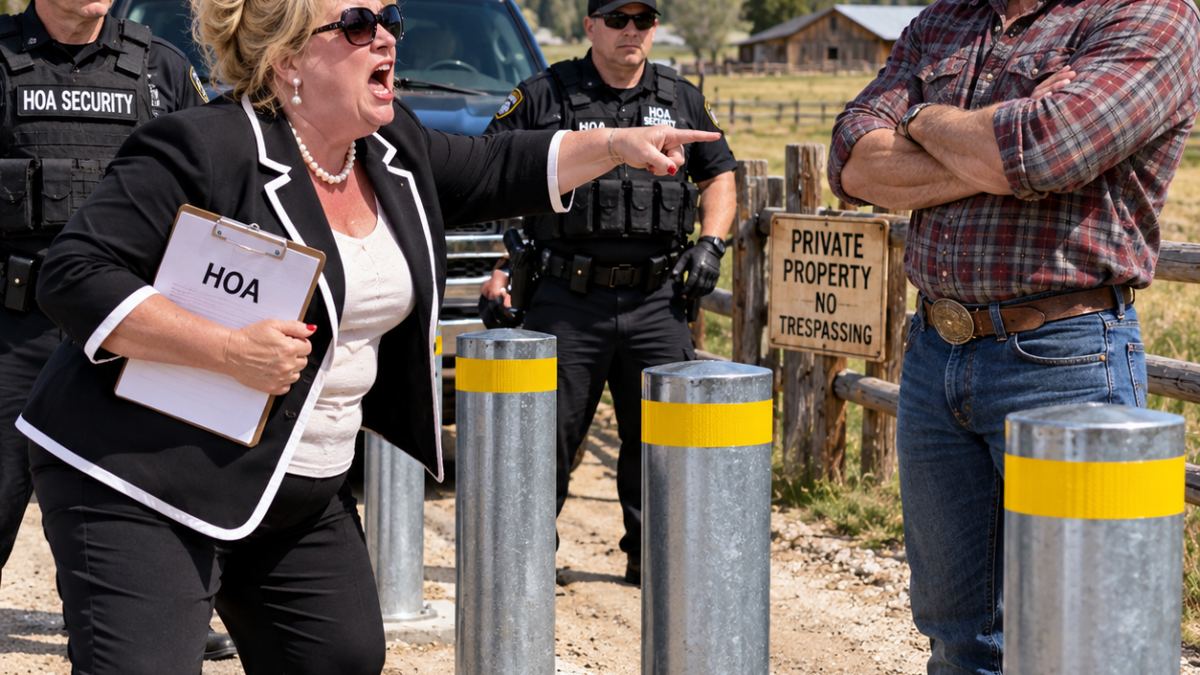
PART 2
They had never said the words.
Not once.
They had never called themselves deputies. Never said sheriff. Never said police.
They had used phrases like *official business* and *we have authority*. They had worn dark uniforms and shiny badges. They had mounted emergency-style lights on their sedan. One of them had kept a hand near his belt while ordering me out of the road.
Then they had allowed my own assumptions to finish the job.
“No,” I finally told the dispatcher. “They didn’t actually say they were police.”
There was a pause.
“Do you have video?”
“I do.”
“Keep it. Back it up. And if they return, don’t physically confront them. Call us.”
I wrote down the incident number she gave me.
After hanging up, I remained at the kitchen table for a long time.
The house was too quiet.
Helen had always been better at moments like that. I was the kind of man who wanted a problem to have a broken hinge, a clogged line, a sick calf—something I could put my hands on. Helen could look at people and see the machinery inside them.
When our neighbor once spent six months trying to provoke my father into a boundary dispute, I had wanted to tear out the fence and settle it in an afternoon.
Helen had stopped me.
“He doesn’t want the fence,” she had said. “He wants you angry enough to make a mistake.”
I remembered that sentence now.
The next morning, I carried two cups of coffee up the hill before remembering halfway there that I only needed one.
I almost laughed.
Almost.
Helen’s grave sat beneath a live oak overlooking the eastern pasture. Her headstone was simple because she had insisted on simple.
I sat on the bench beside it and watched cattle move slowly through the grass.
“Somebody’s trying to make me mad enough to do something stupid,” I said.
A breeze moved through the oak leaves.
I took a sip of coffee.
“You’d probably tell me I’m making it too easy for them.”
For a while I said nothing.
Then I looked south, toward the clean rooftops of Ridgewood Estates.
Victor Harmon had offered me $4.5 million.
There had been nights when I stared at that number on the paper and wondered whether refusing it was pride.
The ranch needed work. The barn roof would need replacing within a few years. My knees hurt in cold weather. I was sixty-two, living alone, and trying to maintain eighty acres that had once been worked by three generations at the same time.
Four and a half million dollars could make a lot of problems disappear.
But it could not replace the hill beneath my boots.
When Helen was dying, we had discussed everything people avoid discussing until they no longer can.
Her funeral.
The cattle.
The bank accounts.
My life after hers.
She had been lying in a hospital bed we had moved into our bedroom when she said, “Put me up on the east hill.”
I thought she was talking about someday taking her there in the truck.
Then I saw her expression.
“You mean…”
“That’s where I want to stay.”
“Helen.”
“I’m serious.”
She reached for my hand.
“I spent forty years waking up to that pasture. Don’t stick me in some cemetery where everybody around me is a stranger.”
I had promised.
Now Victor Harmon wanted to turn the hill into another row of expensive houses.
My decision had nothing to do with beating a developer.
I simply had one promise left to keep.
***
I made what I later considered my final attempt at being reasonable.
Ridgewood’s clubhouse looked like a resort hotel dropped into cattle country. Stone columns, manicured shrubs, polished glass doors. My muddy work boots sounded wrong on the tile floor.
The receptionist looked at them, then at me.
“Can I help you?”
“I need Victor Harmon.”
“Do you have an appointment?”
“No.”
“Mr. Harmon is extremely busy.”
“So am I.”
Maybe something in my face convinced her.
She made a phone call.
Two minutes later, Harmon appeared from a hallway wearing pressed khakis and a blue golf shirt.
“Mr. Dawson.”
He extended his hand.
I did not take it.
His hand remained there for half a second before dropping.
“We need to talk about your security company.”
The smallest change appeared around his eyes.
“My security company?”
“Ridgewood Security Services.”
“Ridgewood contracts security for the neighborhood.”
“They’ve crossed my ranch six times.”
His expression softened into professional concern.
“That sounds like a misunderstanding.”
“It isn’t.”
“Our personnel patrol the community perimeter. Your boundaries are irregular in several locations. They may have accidentally crossed—”
“Six times?”
He stopped.
I continued.
“They use a white sedan. Light bar on top. Dark uniforms. Badges.”
Harmon nodded slowly.
“Uniformed security personnel tend to wear uniforms.”
“They told me they had authority.”
“They do have authority within Ridgewood.”
“They weren’t inside Ridgewood.”
For the first time, neither of us spoke.
The pleasant expression remained on his face, but it had become work for him.
Finally, he said, “I’ll talk to the supervisor.”
“Do that.”
“Of course.”
“And keep them off my ranch.”
He gestured toward a seating area.
“Earl, perhaps we could use this opportunity to revisit our other conversation.”
“My name is Mr. Dawson to you.”
Another tiny crack.
“Mr. Dawson, then. The acquisition offer is still open.”
“No.”
“You didn’t even let me finish.”
“You’ve finished three times.”
His smile hardened.
“Phase Two is happening eventually.”
“Not on my land.”
“Development patterns don’t stop because one property owner becomes sentimental.”
That word stopped me.
Sentimental.
He had reduced my entire life to sentimentality.
I walked closer.
“You stay on your side of that fence, Victor. Your employees stay on your side. Your vehicles stay on your side.”
His eyes held mine.
Then he smiled again.
“Of course.”
I left.
That night at 11:43, the white sedan came through my gate again.
I knew the exact time because I was awake.
Blue and red light flickered over my bedroom ceiling.
The engine climbed as the car crossed the pasture.
By the time I reached the porch, all I saw were taillights.
They had not even waited twenty-four hours.
I called the sheriff’s office and added the incident to the report.
Then I sat in my kitchen until dawn.
That was the night I stopped believing Victor Harmon wanted to persuade me.
He wanted to wear me down.
***
The pressure changed after that.
It became quieter.
At first, I thought I was imagining it.
Larry at the feed store had known me for twenty years. Normally, buying cattle mineral from him required thirty minutes because neither of us knew how to end a conversation.
That Thursday, he rang up my order without looking at me.
“How’s Kelly doing?” I asked. His daughter had gotten married a month earlier.
“Fine.”
“Still moving to San Antonio?”
“Think so.”
He handed me my receipt.
“Take care, Earl.”
At the gas station, a man I had known since high school suddenly became fascinated with the lottery display when I walked inside.
Two days later, three county complaint notices arrived.
One involved livestock odor.
One involved excessive equipment noise.
One alleged that runoff from my property was entering Ridgewood.
I read the third letter twice.
My ranch drainage flowed north.
Ridgewood was south.
The complaint was physically impossible.
That afternoon, a gray SUV stopped outside my gate.
A woman stepped out.
I recognized her from Ridgewood. Linda Morales. Mid-fifties. Gray streak through dark hair. She had waved to me often enough that I knew her face but not much else.
She stayed on the road.
“Mr. Dawson?”
“That’s me.”
She looked behind her before approaching.
“I probably shouldn’t be here.”
“Then I appreciate you being here anyway.”
She gave a nervous half-smile.
“Victor’s been talking about you.”
“What’s he saying?”
“That you’re unstable. Angry. That you’ve threatened Ridgewood employees.”
I laughed once.
Her face told me it was not funny.
“At Tuesday’s meeting,” she continued, “he said you were deliberately creating problems because you wanted more money.”
“I don’t want his money.”
“I know.”
“How?”
“Because he showed us copies of his offers. He kept increasing them. If money was the issue, you would’ve taken four and a half million.”
She folded her arms tightly.
“Some people believe him anyway.”
“What else?”
She hesitated.
“Residents are being encouraged to file complaints.”
The word *encouraged* told me everything.
“By Harmon?”
“He doesn’t say, ‘Go file false complaints.’ He says things like, ‘Document every disturbance caused by the ranch.’ He knows how to phrase things.”
So did his security guards.
Nobody ever said the thing directly.
Nobody ever left the clean fingerprint.
Linda looked at the house, then back toward Ridgewood.
“I just thought you should know.”
“Why are you telling me?”
Her mouth tightened.
“Because this isn’t the first time Victor has decided somebody is in his way.”
Before I could ask what she meant, she stepped backward.
“I need to go.”
“Linda.”
She stopped.
“What happened the other time?”
She shook her head.
“Not here.”
Then she drove away.
That was the first moment I understood Victor Harmon’s real strength.
It was not money.
It was fear.
***
I upgraded my cameras.
The original trail cameras had been intended for deer, not evidence, but they were good enough to establish dates and times.
During the next two weeks, they recorded four more unauthorized crossings.
The first was at 7:15 in the morning.
The second happened after sunset.
The third came at 2:08 a.m.
The fourth was personal.
The sedan stopped in the middle of the pasture.
The passenger stepped out.
By then I knew him as Tommy, though I had not yet learned his last name.
He walked to one of my fence posts, looked directly toward the trail camera, and smiled.
Then he urinated on the post.
I watched the recording in my kitchen.
Once.
Twice.
A third time.
Not because I enjoyed humiliating myself, but because I needed to understand what I was seeing.
He knew the camera was there.
That meant the act was not simply disrespect.
It was a message.
*We know you’re recording us.*
*We don’t care.*
I froze the clearest frame of his uniform and enlarged it.
The badge was generic.
A shield.
An eagle.
No agency name.
No badge number.
Then I noticed a patch on his upper sleeve.
RIDGEWOOD SECURITY.
I went backward through older footage.
Same patch.
Same badge.
Same vehicle.
They had never actually hidden what they were.
They had merely counted on the uniform doing the thinking for me.
The next morning, I drove into Cedar Mill and spent nearly two hours looking through public business filings.
A clerk named Denise eventually took pity on me.
“What exactly are you trying to find?”
“Ridgewood Security Services.”
“Company registration?”
“Ownership.”
She typed for less than a minute.
“There.”
She turned the monitor.
Ridgewood Security Services LLC.
Business address: Ridgewood Estates clubhouse.
Registered agent: Victor Harmon.
Principal ownership: Victor Harmon.
I stared at the screen.
“Can I get a certified copy of that?”
Denise looked at me more carefully.
“You having trouble with these people?”
“Yes.”
She printed the form.
“Then get two.”
I did.
***
I drove directly to the clubhouse.
The receptionist stood when she saw me.
“Mr. Dawson, you cannot just—”
I walked past her.
Harmon was on the phone when I opened his office door.
He looked up.
For a second, his face showed annoyance.
Then the smile appeared.
“I’ll call you back.”
He placed the phone down.
“This is becoming a habit.”
I put the certified business record on his desk.
“Ridgewood Security belongs to you.”
He glanced at it.
“Yes.”
No denial.
No hesitation.
That surprised me.
“You told me Ridgewood contracted security.”
“We do.”
“With your company.”
“My company provides the contract.”
“You own both ends.”
“I own a business that provides a needed service. There’s nothing illegal about that.”
“Your men have been trespassing on my ranch.”
“So you’ve said.”
“They’re using uniforms and emergency-style lights to make people think they’re law enforcement.”
His expression changed.
Not much.
Enough.
I knew I had finally touched something he cared about.
“They have never identified themselves as police officers.”
There it was.
He knew the exact line they had been walking.
I leaned both hands on his desk.
“That sentence came awful fast.”
“I know how my employees are trained.”
“They told me they had authority.”
“They do.”
“Not over me.”
Harmon leaned back.
“Earl, what do you actually want?”
“I want you off my land.”
“We’re not on your land.”
“Your employees are.”
He sighed.
The performance of patience had begun to bore him.
“Your property sits between Ridgewood’s eastern section and County Road Twelve. Taking the public route adds almost nine miles to certain patrol loops.”
“That sounds expensive.”
“It’s inefficient.”
“Still sounds like your problem.”
He tapped the paper with one finger.
“This whole thing could disappear tomorrow.”
“I’m listening.”
“Sign the sale agreement.”
I stood straight.
He continued.
“Take the money. Keep a life estate on the house for twelve months if you need time. We’ll even discuss relocating the family burial site respectfully.”
The room became very still.
“You looked into Helen.”
It was the first time I had said her name to him.
He did not ask who I meant.
That told me he had.
He tried to recover.
“Any responsible developer performs due diligence.”
“You looked into my wife’s grave.”
“We looked into encumbrances on the property.”
I picked up the business filing.
“Keep your men away from me.”
His voice became quieter.
“Think carefully about how much of your remaining life you want to spend fighting.”
I turned toward the door.
“Was that a threat?”
“No.”
I looked back.
Harmon smiled.
“Just an observation.”
I left before anger made my decisions for me.
Helen had been right again.
He wanted a mistake.
I refused to give him one.
***
Sheriff Ray Caldwell arrived at my ranch after dark.
Ray and I had known each other since high school. He had gone into law enforcement after a football injury killed his plans of playing in college. I had stayed on the ranch.
Life had taken us in different directions without quite separating us.
He sat at my kitchen table and watched every recording.
He said almost nothing.
When Tommy urinated on the fence post, Ray’s jaw tightened.
When one of the men ordered me to step aside because they had “authority,” Ray replayed the audio twice.
Finally, he closed the laptop.
“They’re not deputies.”
“I know.”
“They’re not police of any kind.”
“I know that too.”
“Those badges are designed to look official without actually identifying an agency.”
“Exactly.”
Ray looked at the business filing.
“Harmon owns the company?”
“Certified copy.”
He whistled under his breath.
“Cute.”
“That the technical term?”
“No. The technical terms would require a prosecutor.”
“Can you arrest them?”
“For driving across your land? I can cite or arrest for trespass under the right circumstances, especially after clear notice. The impersonation issue takes more work. I need evidence of what they represented themselves to be, what they intended, what authority they claimed. I don’t want Harmon walking away because we rushed it.”
“So I keep letting them do this?”
“No.”
His answer came immediately.
“You secure your property.”
“How?”
“Fence. Locked gate. Barriers. Whatever is lawful and plainly visible.”
“And if they break through?”
“Then they create better evidence.”
I looked at him.
“That’s your advice?”
“My advice is that you do not touch them, threaten them, chase them, ram them, point a weapon at them, or give Victor Harmon a single photograph he can put in front of a jury and call you dangerous.”
Ray pushed the laptop back toward me.
“Document everything.”
“I am.”
“Document more.”
He stood.
At the door, he paused.
“Earl.”
“Yeah?”
“You’re angry.”
“Wouldn’t you be?”
“Yes.”
“That a problem?”
“Only if he gets to choose what you do with it.”
After Ray left, I stood on the porch watching his cruiser disappear.
I knew another person who would say almost exactly the same thing.
Marcus Morgan had been my family’s attorney for fifteen years.
I called him the next morning.
***
Marcus’s office looked as though paper reproduction had gotten out of control.
Legal pads covered one chair. Case files occupied another. Books were stacked on the floor beside his desk.
I handed him my folder.
He spent more than an hour reading.
When he finished, he removed his glasses.
“You’ve got several possible claims.”
“I don’t want claims. I want them gone.”
“That’s what every client says before seeing the cost of litigation.”
“What are my choices?”
He counted them on his fingers.
“We seek an injunction. Useful, but not instant. We bring a civil action for trespass and harassment. Also useful, also not instant. We continue pushing the criminal complaint. That moves on the government’s timetable.”
“So Harmon gets to keep driving across my ranch while everybody schedules hearings?”
“No.”
Marcus stood and walked to a cabinet.
“There’s another option.”
He returned with a photograph.
It showed thick steel posts set vertically into concrete.
“Bollards.”
“I know what they are.”
“Then you know why I like them.”
I studied the picture.
“A gate can be cut.”
“Yes.”
“A fence can be driven through.”
“Yes.”
“These?”
Marcus smiled faintly.
“Much less cooperative.”
I put the photograph down.
“What happens when somebody hits one?”
“What happens when somebody drives into a visible concrete wall?”
“Marcus.”
“I’m serious. The critical word is *visible*. We do this correctly or we don’t do it.”
He took out a legal pad.
“Bright paint. Reflective markings. Proper signs. Advance written notice. Cameras. No cables hidden at bumper height, no trenches, no concealed barriers, no surprises. Nothing that could reasonably be called a trap.”
“And if they ignore all of it?”
“Then they made a choice.”
I looked again at the photograph.
For several seconds I imagined six of those posts across the entrance.
Solid.
Unarguable.
The first thing in months that did not depend on somebody returning my phone call.
“How soon?”
Marcus grinned.
“Now you sound like your father.”
***
I ordered six.
Forty-two inches above ground, heavy steel, anchored deep in concrete.
The installer came Tuesday morning with a flatbed, an auger, bags of concrete, and three men who looked at the ruts across my pasture and immediately understood why they were there.
The foreman pointed toward the entrance.
“Vehicle access?”
“Not anymore.”
He looked at my NO TRESPASSING sign.
“Somebody ignoring that?”
“Repeatedly.”
He nodded.
“Harder to ignore steel.”
Marcus had helped me draft a formal notice.
I sent it to Victor Harmon by certified mail.
It stated plainly that physical vehicle barriers were being installed at the ranch entrances; unauthorized vehicles were prohibited; the barriers would be marked and visible; and anyone entering without permission did so in violation of posted restrictions.
No threats.
No clever language.
No emotion.
Just notice.
The installers worked for four hours.
When they finished, six yellow posts stood across the unauthorized route the security sedan had been using.
Reflective tape wrapped the upper sections.
Large signs stood on both sides:
PRIVATE PROPERTY
NO TRESPASSING
STEEL VEHICLE BARRIERS
STOP — NO UNAUTHORIZED ENTRY
I photographed everything.
Then I photographed it again from the driver’s perspective.
Marcus reviewed the pictures.
“Good.”
“Good enough?”
He zoomed in.
“Replace the left sign.”
“What’s wrong with it?”
“Brush obscures the bottom corner from this angle.”
“That’s six inches.”
“And some lawyer will spend six hours talking about those six inches.”
I cut the brush.
Then I replaced both signs with larger ones.
I photographed them in daylight and after dark with headlights pointed toward them.
The reflective lettering glowed.
There would be no argument that the barriers were hidden.
A few days later, the certified-mail receipt came back.
Delivered.
Signed at the Ridgewood clubhouse.
Harmon had been warned.
After everything that had happened, part of me expected him to appear at the gate that afternoon screaming about obstruction.
He did not.
Nothing happened.
For five days.
Then six.
Then seven.
The silence bothered me more than the harassment.
Every morning, I checked the cameras.
Deer.
A coyote.
A delivery truck slowing at the signs, turning around, and using the proper entrance.
No white sedan.
No uniforms.
No Harmon.
Maybe the bollards had ended it.
That should have satisfied me.
Instead, I kept waking during the night.
On the eighth night, I sat at my kitchen table at two in the morning and reviewed old footage.
I had watched most of it so many times I knew when birds would cross the frame.
Then I noticed the audio icon.
I had concentrated on the video and never paid much attention to the microphones on the trail cameras.
I put on headphones.
Wind.
Engine noise.
Static.
On one recording, the sedan slowed near the barn.
The passenger turned toward the driver.
His voice was faint.
“Old man’s got cameras now.”
The driver laughed.
“Who cares?”
More static.
Then:
“What’s he gonna do?”
I played it again.
And again.
*What’s he gonna do?*
That was the entire problem.
They had never believed there could be consequences.
The cameras had not frightened them because they assumed nobody important would care.
The signs had not stopped them because they assumed paper rules were for weaker people.
My complaints had not stopped them because they understood how slowly systems move.
They had mistaken patience for helplessness.
I closed the laptop.
The next afternoon, Linda Morales knocked on my door.
She looked worse than the first time.
“Victor held a board meeting last night.”
I let her inside.
She shook her head.
“I can’t stay.”
“What happened?”
“He spent almost the whole meeting talking about you.”
“What did he say?”
“That the bollards are illegal.”
“They’re not.”
“I know. Other people said the same thing.”
“And?”
“He called them booby traps.”
I almost smiled.
“They’re forty-two inches tall and painted highway yellow.”
“I know.”
“Did somebody tell him about my letter?”
Her eyes flicked toward mine.
“What letter?”
There it was.
I explained the certified notice.
Linda stared at me.
“He never mentioned it.”
“Not surprised.”
“He made it sound like you secretly installed something dangerous.”
“Those signs are visible from the county road.”
“I know.”
She looked toward the window.
Then she said, “He told the board he was going to ‘resolve the access issue’ this weekend.”
The phrase tightened something in my chest.
“What does that mean?”
“I asked.”
“What did he say?”
“That we’d all understand soon enough.”
I waited.
Linda swallowed.
“He was angry, Earl. Not normal angry. Desperate angry.”
It was the first time she had called me Earl.
“What is he desperate about?”
She hesitated.
Then she gave me the other piece.
“Phase Two financing.”
“What about it?”
“My husband works in commercial lending. He heard Ridgewood’s expansion loan has deadlines attached. Victor promised investors site control by the end of the quarter.”
“My land.”
“Yes.”
“And he doesn’t have it.”
“No.”
For the first time, Harmon’s behavior made financial sense.
Four and a half million dollars had sounded like an enormous offer to me.
To him, it might have been cheaper than admitting to lenders that his planned expansion depended on property he did not own.
Every month I refused him might be costing more than the offer itself.
He was not merely arrogant.
He was trapped by his own promises.
That made him more dangerous, not less.
I called Ray.
“I can’t park a deputy at your gate based on something said during an HOA meeting,” he told me.
“I know.”
“But I’ll be close Saturday.”
“Why Saturday?”
“Because if I were Harmon and said ‘this weekend,’ I wouldn’t wait until Sunday.”
I called Marcus next.
“Stay out of the road,” he said.
“You worried?”
“Yes.”
“About the bollards?”
“About you.”
That irritated me.
“I’m not going to do anything.”
“Good. Continue not doing anything. Cameras on. Phone charged. Doors locked. If they arrive, call law enforcement. Do not argue with them.”
“I can talk on my own property.”
“Earl.”
“What?”
“Harmon wants footage of an angry rancher.”
I looked toward Helen’s hill.
“I know.”
“Then don’t give him one.”
***
Saturday arrived gray and cool.
I woke before sunrise.
I checked the cameras.
All working.
I checked the signs.
Still standing.
I walked the bollards.
Nothing disturbed.
Then I went up to Helen.
“I feel ridiculous,” I told her.
The grave offered no opinion.
“I’m sitting around waiting for people to trespass on my ranch like I’ve got nothing better to do.”
A bird landed on the fence.
I drank my coffee.
“You’d tell me to quit pretending I’m not nervous.”
That much I knew.
So I said it aloud.
“I’m nervous.”
There.
The truth was smaller once spoken.
I returned to the house and worked until noon repairing a hydraulic line on the tractor.
At 2:17 p.m., my phone chimed.
Motion detected.
I wiped my hands on a rag and opened the camera feed.
White sedan.
County Road Twelve.
My stomach tightened.
Behind it came a black SUV with tinted windows.
Two vehicles.
The sedan slowed near my gate.
For half a second I thought they would stop.
Then the light bar came alive.
Blue.
Red.
Blue.
Red.
The same colors that had flickered across my bedroom ceiling.
I called Ray before stepping outside.
“They’re here.”
“I’m moving.”
I put the phone in my pocket and walked toward the entrance.
Not to confront them.
I wanted to be visible.
I wanted every camera to show exactly where I had been.
About fifty feet inside my property, I stopped.
The sedan turned toward the unauthorized access path.
The new signs faced the driver directly.
STOP.
PRIVATE PROPERTY.
STEEL VEHICLE BARRIERS.
I saw the driver.
Derek Sloan, though I would not learn his full name until later.
Dark glasses.
Dark uniform.
The passenger was Tommy.
The car rolled forward.
Surely they would stop.
It kept moving.
Twenty miles an hour.
Maybe more.
Derek’s head shifted.
He had seen the bollards.
The sedan slowed slightly.
Then the engine rose.
He accelerated.
For one impossible second, I could not understand what I was seeing.
Later, the video would show that he had steered toward the widest-looking gap between two posts, apparently believing the sedan could squeeze through.
It could not.
The right front corner struck the first steel bollard.
The sound was violent.
Metal folded.
The hood buckled upward.
The windshield fractured.
Airbags exploded inside the cabin.
The sedan stopped so abruptly that its rear end lifted and dropped.
The black SUV behind it locked its brakes.
Tires screamed.
It still struck the sedan from behind.
Then everything became quiet except for the electronic pulse of that ridiculous light bar.
Blue.
Red.
Blue.
Red.
Steam curled from the sedan’s damaged front end.
I did not move.
My phone was already recording.
The driver’s door opened.
Derek staggered out.
Blood ran from a cut near his eyebrow, but he was on his feet.
Tommy emerged from the passenger side holding his forehead.
Derek stared at the destroyed front of the sedan.
Then he saw me.
“You!”
I kept the phone raised.
He walked toward me.
“You set a trap!”
“Stay where you are.”
“You tried to kill us!”
“The barriers are marked.”
“You put those there because of us!”
“Yes.”
That answer stopped him for half a second.
Then he started toward me again.
A door opened behind him.
Victor Harmon stepped out of the black SUV.
Of course.
Suddenly, the second vehicle made sense.
Harmon had come to watch.
Or supervise.
His face had gone almost colorless.
He stared at the sedan.
Then at the warning signs.
Then at the bollards.
Finally, he looked at me.
“What have you done?”
I nearly laughed.
“What have *I* done?”
“This is criminal.”
“You received written notice.”
His eyes moved.
Just once.
Toward Derek.
That tiny glance told me something important.
Derek had not known.
Harmon had received the letter.
Harmon had never told his own men.
Derek turned.
“What notice?”
Harmon did not answer.
“What notice, Victor?”
That was the first crack.
Not in the car.
In them.
People had begun stopping on County Road Twelve.
A pickup pulled over.
Then another.
Residents from Ridgewood walked toward the entrance after hearing the crashes.
Linda appeared among them.
Phone in her hand.
Recording.
Harmon saw her.
“Everybody needs to step back,” he shouted. “This is an active security incident.”
Ray’s voice came from behind him.
“No, it isn’t.”
A real sheriff’s cruiser had stopped on the county road.
Real emergency lights flashed behind it.
Ray stepped out.
Two deputies followed several minutes later.
Derek pointed toward me.
“That man set a vehicle trap!”
Ray looked at the six bright-yellow bollards.
Then at the enormous warning sign.
Then at the wreck.
He slowly removed his sunglasses.
“Those?”
“They weren’t here before!”
Ray looked at me.
“How long?”
“Eleven days.”
“Notice?”
“Certified. Signed for at Ridgewood.”
“Video?”
“Four cameras.”
Ray nodded once.
Then he turned toward Derek.
“Identification.”
Derek reached toward his chest.
Ray’s posture changed immediately.
“Slow.”
Derek froze.
Then carefully removed the badge.
Ray took it.
Turned it over.
“No agency.”
“We’re security.”
“I know.”
“We have authority here.”
Ray looked toward the ranch.
“No, you don’t.”
Derek’s mouth opened.
Ray continued.
“Driver’s license.”
While another deputy handled Derek, Ray approached Tommy.
Tommy had become very quiet.
“You armed?”
“No.”
“Anything on your belt that can hurt me?”
“Pepper spray.”
“Keep your hands where I can see them.”
Harmon moved closer.
“Sheriff, this is a misunderstanding.”
Ray turned toward him.
“Victor, I suggest you stop talking until I understand why your security vehicle just crossed a posted private-property line after repeated complaints.”
“We have an access agreement.”
I spoke for the first time.
“No, you don’t.”
Harmon looked at me.
“Yes, we do.”
That caught me off guard.
Ray heard it too.
“Show me.”
Harmon hesitated.
“It isn’t on me.”
“Where is it?”
“Our files.”
“What kind of agreement?”
“Historic access easement.”
I actually felt my confidence slip.
An easement?
My family deed contained old utility rights and one livestock-access provision dating back decades. I had reviewed the property documents more than once, but old land records could be complicated.
Harmon saw the uncertainty in my face.
His confidence returned.
“This ranch has never had the legal right to block that route.”
Ray looked at me.
“Earl?”
“I’ve never seen an easement there.”
“That doesn’t mean there isn’t one,” Harmon said.
Derek smiled through the blood on his cheek.
For the first time since the crash, I wondered whether I had missed something enormous.
Ray did not take sides.
“Everyone stays here while we sort this out.”
An ambulance checked Derek and Tommy.
Neither injury appeared serious enough to require immediate transport.
Deputies photographed the signs, the road, the bollards, the tire marks, the vehicles, and the property entrance.
Then Ray watched my camera footage.
The sedan was clearly visible approaching.
The signs were clearly visible.
So were the bollards.
Most importantly, the video showed the sedan slowing before Derek accelerated toward the opening.
Ray watched that part twice.
“He saw them.”
“Yes.”
“Looks that way.”
Harmon interrupted.
“He was attempting to exercise a legal access right.”
Ray looked at him.
“You have that easement document?”
“My attorney does.”
“Then have him send it.”
Harmon crossed his arms.
Nobody was smiling anymore.
The two security men were detained while deputies reviewed the prior complaints and footage I had already filed.
Ray collected their badges for examination.
When he saw the blue-and-red light bar and the markings used on the uniforms, he shook his head.
“You boys worked very hard to look like something you’re telling me you never claimed to be.”
Derek said nothing.
Tommy looked at Harmon.
That glance was different from the others.
There was fear in it.
By sunset, the sedan was on a tow truck.
The SUV was damaged but drivable.
Ray did not arrest Harmon that afternoon.
He did, however, take Derek and Tommy to the sheriff’s office for formal interviews after confirming the prior trespass notices and complaints.
Before leaving, Harmon approached me.
He stopped on the public side of the bollards.
“Enjoy this while you can.”
Linda was ten feet away recording.
I looked at her phone.
Then back at Harmon.
“You sure that’s what you want to say?”
His eyes followed mine to the camera.
He turned and walked away.
That was the second crack.
***
The easement scared me.
I barely slept.
At seven the next morning, I called Marcus.
By eight-thirty, we were in his office with my deed, surveys, title history, and every recorded easement affecting the ranch.
Marcus worked without talking.
Around eleven, he slid one document toward me.
“There was an easement.”
My stomach dropped.
“Was?”
“Keep listening.”
The document dated to 1958.
A neighboring ranch had once been granted seasonal cattle access across a narrow strip near my eastern boundary.
“That’s their route?”
“Partially.”
“So Harmon’s right?”
“No.”
Marcus tapped the page.
“The easement benefited a specific parcel owned by the Walker family. It was for agricultural livestock movement. It did not create a public road. It was not a general vehicle-access easement. And more importantly…”
He turned another page.
“The Walker parcel was divided in 1989. The relevant tract was later acquired by the county for drainage mitigation. The easement was formally released in 1994.”
I stared at the release.
Recorded.
Stamped.
Clear.
“Victor knows about the old easement.”
“Probably.”
“But not the release?”
Marcus removed his glasses.
“I wouldn’t assume that.”
“You think he knows.”
“I think a professional developer buying three hundred acres performs title work.”
I sat back.
“So he’s using a dead easement.”
“Or he’s hoping nobody checks whether it’s dead.”
That afternoon, Harmon’s lawyer sent Ray a copy of the 1958 easement.
He did not send the 1994 release.
Marcus sent both.
That became the third crack.
And this one ran straight through Harmon’s story.
***
The investigation widened.
Derek and Tommy had not been arrested solely because their costumes looked suspicious. Investigators built the case from months of recordings, their statements, my written trespass notices, the light-bar use, and evidence about how they had represented their authority.
Then Tommy made Victor’s situation much worse.
He hired his own attorney.
Within forty-eight hours, he gave investigators text messages.
Marcus heard about them when the district attorney’s office contacted us for additional footage.
I did not get to see everything immediately, but portions later became part of court records.
Victor had been messaging the security team for months.
**Run the Dawson route again.**
**Make sure he sees you.**
**Do not identify as police. Let the uniform speak for itself.**
Another message arrived after my first complaint:
**He needs to understand we control access around Ridgewood.**
And after I visited Harmon’s office:
**Old man complained again. Increase patrol frequency.**
The most damaging message had been sent before the Saturday crash.
**Clear the route this weekend. I don’t care what he put up. We need access established.**
Derek replied:
**He’s got posts now.**
Victor answered:
**They’re intimidation. Do your job. I’ll be behind you.**
There was no direct instruction to crash a car into a bollard.
There did not need to be.
Victor knew the barriers existed.
Victor had received the certified notice.
Victor ordered his men back onto the property anyway.
Then he drove behind them to watch.
When Marcus read that message to me, I did not feel triumphant.
I felt tired.
For months, part of me had wondered whether I was becoming paranoid.
Maybe the repeated crossings were incompetence.
Maybe the complaints were coincidence.
Maybe I was connecting events because anger wanted a pattern.
The text messages removed the last uncertainty.
It had been deliberate from the beginning.
***
Ridgewood began turning on Victor almost immediately.
Linda called me after an emergency HOA meeting.
“I’ve never seen anything like it.”
“What happened?”
“People brought copies of the arrest reports.”
“Derek and Tommy?”
“They’ve been charged.”
“Already?”
“Several counts are pending, but yes.”
I sat down at my kitchen table.
“And Victor?”
“Still telling everybody it’s a misunderstanding.”
“Of course.”
“He tried to say Ridgewood Security acted independently.”
“That’ll be interesting.”
“Why?”
“He owns it.”
Linda laughed despite herself.
“Somebody printed the corporate filing and handed a copy to every board member.”
I smiled.
“Who would do something like that?”
“Couldn’t imagine.”
I heard voices behind her.
“Are you at the meeting?”
“In the parking lot.”
“What happened with Phase Two?”
There was a pause.
Then:
“That’s the other reason everyone is furious.”
I waited.
Linda lowered her voice.
“Victor used HOA money to pay Ridgewood Security.”
That was not automatically improper. Associations hire security companies all the time.
But this one was Victor’s company.
“How much?”
“More than two hundred thousand dollars over eighteen months.”
“Approved?”
“That’s what people are asking.”
The fight had changed.
It was no longer just about my ranch.
Once residents started looking at Victor’s records, they found other questions.
Contracts awarded without competitive bids.
Management fees paid to entities connected to him.
Legal expenses related to Phase Two that had been described broadly as “community development.”
Nothing I personally knew enough to call criminal.
But plenty that homeowners wanted explained.
The man who had used the HOA to isolate me was suddenly trapped inside a room full of his own members asking for documents.
For the first time, he was the one being watched.
***
A week after the crash, Harmon came to my ranch alone.
No security guards.
No SUV.
He drove a rented pickup and parked on the county road.
I saw him on the camera and walked outside.
He stopped at the bollards.
“I need five minutes.”
“You’ve used up more than that.”
“I’m serious.”
“So am I.”
He looked older.
Not dramatically. Just enough that I noticed.
“I made mistakes.”
That might have been the first honest sentence I ever heard from him.
I waited.
“The security situation got out of control.”
“You ordered it.”
“I ordered patrols.”
“Across my property.”
“Because the route matters to the development.”
“There is no easement.”
He looked at me sharply.
So he had learned Marcus found the release.
“You had no right to block historical access.”
“The historical access ended in 1994.”
“That’s debatable.”
“No. That’s recorded.”
He exhaled.
“I’m here to solve this.”
That old leather-folder tone had returned.
“What are you offering now?”
“Six million.”
I stared at him.
“Six-point-two if you sign before the end of the month.”
It was more money than I had ever imagined my ranch being worth.
Enough to retire anywhere.
Enough to travel.
Enough to never repair another fence.
Victor saw the hesitation.
He mistook it for interest.
“You keep the house for eighteen months. We’ll cover relocation expenses. We’ll move the burial site professionally and establish a private memorial—”
“No.”
“Earl.”
“No.”
“You’re turning down six-point-two million because of a grave?”
I stepped closer to the bollards.
“Because of a promise.”
His shoulders dropped.
Maybe he genuinely could not understand.
“You’ll be dead someday too.”
“Yes.”
“What happens to the land then?”
“Not your problem.”
His face tightened.
“You could destroy a major development over sentiment.”
“No, Victor.”
I pointed toward Ridgewood.
“You built a development plan around land you never owned. I didn’t destroy anything.”
That landed.
For a few seconds he looked as if he wanted to say something vicious.
Instead, he returned to his truck.
I called after him.
“Victor.”
He looked back.
“Don’t come onto this ranch again.”
He nodded.
It was the first boundary I ever gave him that he respected immediately.
By then, he finally understood what crossing one could cost.
***
The criminal cases moved slower than gossip and faster than I expected.
Derek eventually pleaded guilty to charges connected to impersonating a public servant, criminal trespass, and reckless conduct stemming from the repeated incidents.
Tommy cooperated.
His attorney negotiated a lighter sentence in exchange for records, messages, and testimony.
I attended one hearing.
Derek looked different without the uniform.
Smaller.
That surprised me.
For months, the dark shirt, tactical belt, mirrored glasses, badge, and flashing lights had made him appear larger than he was.
Sitting beside his lawyer in a plain button-down shirt, he looked like an ordinary man who had made a long series of arrogant decisions.
The prosecutor asked whether he understood he had been formally notified not to enter my property.
“Yes.”
“Did you continue entering?”
“Yes.”
“Why?”
Derek stared at the table.
“I was told the company had access rights.”
“By whom?”
His attorney shifted beside him.
Derek answered anyway.
“Mr. Harmon.”
“Did you ever verify those rights?”
“No.”
“Did you know Mr. Dawson disputed them?”
“Yes.”
“Did you know law enforcement had already been contacted?”
“Yes.”
“Why did you keep going?”
Derek did not answer immediately.
Finally he said, “Because I didn’t think anything would happen.”
That sentence stayed with me.
Not because it was shocking.
Because it was exactly true.
Derek eventually received a custodial sentence followed by supervision, while Tommy received a shorter sentence and probation after cooperating. Both lost their security licenses.
Their careers in private security were effectively over.
Victor’s case took longer.
His lawyers fought everything.
They argued that his instructions had been misunderstood.
They argued the security company had operational independence.
They argued the old easement created a legitimate good-faith dispute.
Then prosecutors produced the title report from Victor’s own development acquisition file.
The 1994 easement release was listed in it.
He had known.
That was the document Marcus had suspected existed.
Victor had purchased Ridgewood’s original development acreage with a title report explicitly showing that the old access right across my ranch had been terminated years before.
He had still given the 1958 easement to the sheriff without the release.
He had still ordered his men to “establish” access.
He had still told the HOA that I was blocking a lawful route.
There are lies that survive because nobody knows where to look.
Victor’s problem was that eventually everybody knew exactly where to look.
***
I was subpoenaed for a grand-jury-related interview and later gave a formal statement as the prosecution developed its case.
Marcus sat beside me.
The prosecutor, a woman named Elaine Porter, had a stack of exhibits arranged by date.
She began with Victor’s first purchase offer.
Then the second.
Then the third.
Then the first security crossing.
Then my complaint.
Then Victor’s messages ordering increased patrols.
One event by itself could be explained.
Together, they formed a line.
Offer.
Refusal.
Pressure.
Complaint.
Escalation.
False access claim.
More pressure.
That was why Ray had told me to document everything.
Truth becomes harder to dismiss when it has dates.
Victor ultimately avoided a full trial.
His attorneys negotiated a plea on charges related to the intimidation scheme and the false representations surrounding the access dispute. Separate civil and regulatory actions followed involving Ridgewood Security and its licensing.
He did not receive the prison sentence some Ridgewood residents wanted.
I discovered that justice rarely arrives in the dramatic shape people imagine.
There was no judge pounding a gavel while Victor begged.
No cinematic confession.
No single afternoon when the universe balanced itself perfectly.
There were hearings.
Lawyers.
Documents.
Delays.
Fines.
Probation.
Restrictions.
A civil settlement.
Legal bills large enough to hurt even a wealthy man.
And something Victor valued more than any of those things.
Loss of control.
The Ridgewood board removed him as president.
Residents demanded an independent audit.
His security company lost its ability to operate.
The expansion financing collapsed after the land-control deadline passed.
Phase Two died.
The new Ridgewood board formally notified me that the association claimed no access right across my property and would not support any future attempt to establish one without my written consent.
I kept that letter.
Not because I needed it.
Because I enjoyed having it.
***
The strangest part was what happened between Ridgewood and me afterward.
For years, I had thought of the subdivision as Victor Harmon’s kingdom.
It turned out most of the people living there had simply been trying to live their lives.
Some had believed his stories about me.
Some had been afraid to question him.
Some had not paid attention until the wreck forced them to.
One Sunday afternoon, Linda drove over with her husband, Carlos.
They brought pie.
I had no idea what the proper response was to receiving an apology pie from an HOA, so I made coffee.
Carlos looked toward Helen’s hill.
“Linda told me why you wouldn’t sell.”
I nodded.
“My wife would haunt me if I sold her burial place too.”
Linda elbowed him.
“What? She would.”
For the first time in months, I laughed until my eyes watered.
Then Linda became serious.
“I owe you an apology.”
“You warned me.”
“Not soon enough.”
“You warned me when everybody else was staying quiet.”
“I believed some of what Victor said at first.”
I appreciated that she admitted it.
“What changed your mind?”
“The complaints.”
“What about them?”
“He circulated a spreadsheet during a board meeting.”
I frowned.
“A spreadsheet?”
“Tracking complaints against your property. It had target numbers.”
I stared at her.
“Target numbers?”
“Five odor complaints. Three noise complaints. Two environmental complaints. He called it ‘documentation strategy.’”
Carlos shook his head.
“That’s when she came home and said, ‘This is nuts.’”
Linda looked embarrassed.
“I should’ve spoken up publicly.”
“You had to live next to the man.”
“So did you.”
“No. I lived next to his development. Different thing.”
She smiled.
The new HOA board eventually sent two representatives to meet me.
They did not ask me to join.
That would have been funny.
They asked whether there were simple things Ridgewood could do to reduce friction along the boundary.
We agreed on fencing responsibilities, drainage maintenance, and a phone number residents could use if cattle ever got loose.
It took forty minutes.
No threats.
No lawyers.
No fake cops.
Just neighbors talking about a fence.
I remember thinking how much misery one controlling man had created by making ordinary cooperation impossible.
***
The bollards stayed.
Marcus asked about them six months later.
“You ever planning to take those things out?”
“No.”
“Sentimental?”
I looked at him.
He grinned.
“Bad word?”
“Very.”
That spring, I repainted them.
Bright yellow.
Fresh reflective tape.
Then I added something.
A small dark-blue letter near the top of each post.
H.
Six posts.
Six H’s.
Nobody else knew what they meant.
Helen.
The morning after the paint dried, I carried my coffee up to her grave.
The ranch looked exactly as it had before Victor Harmon entered my life.
Grass rolling toward the creek.
Cattle spread across the pasture.
Old barn catching the morning sun.
Except now six yellow posts stood near the road.
From the hill they looked tiny.
I sat beside Helen.
“Well,” I said, “you were right.”
Silence.
“You usually were.”
A hawk circled above the eastern pasture.
“I almost made the mistake.”
I rubbed my thumb along the edge of the coffee mug.
“I almost let him make me angry enough to become the man he told everybody I was.”
That had bothered me more than I admitted.
Victor’s plan had required two versions of me.
The real Earl Dawson—a widowed rancher who wanted to be left alone.
And the Earl Dawson he described publicly—hostile, unstable, dangerous, unreasonable.
Every time I lost my temper, he gained a little material for the second man.
The thing that saved me was not the steel.
It was patience.
The bollards worked because the paperwork came first.
The paperwork worked because the cameras came first.
The cameras mattered because I kept my hands at my sides when men wearing fake authority tried to provoke me.
I had spent my life believing standing your ground meant refusing to move.
I learned there were times it meant refusing to be moved emotionally, too.
***
Several months later, I saw Victor one final time.
I was leaving the county hardware store with two rolls of fencing wire when a black pickup parked three spaces away.
Victor stepped out.
No pressed golf shirt.
No Ridgewood logo.
No expensive SUV.
Jeans and a plain jacket.
He looked at me.
I looked at him.
Neither of us walked away.
Finally, he said, “You happy?”
It was such a strange question that I set the fencing wire in my truck bed before answering.
“About what?”
“You won.”
“This wasn’t a game.”
“Everything is a game to somebody.”
“That was your problem.”
His jaw tightened.
He had lost weight.
“I lost millions because of eighty acres.”
“No.”
His eyes narrowed.
“You lost millions because you promised people eighty acres you didn’t own.”
“You could’ve sold.”
“You could’ve built somewhere else.”
“It wasn’t that simple.”
“It was from where I stood.”
He looked toward the road.
“I had investors. Loans. Contractors. Families expecting jobs. Homeowners expecting values to go up.”
“And that made my property yours?”
“No.”
It was the first time I heard him answer that question correctly.
He rubbed his jaw.
“I thought you’d eventually take the money.”
“I know.”
“Everybody has a number.”
“No.”
He gave a tired laugh.
“Apparently.”
I thought about Helen.
Then I asked the question I had wondered about for a year.
“Why the uniforms?”
Victor looked back at me.
“What?”
“Why make them look like cops?”
“They were security.”
“You know what I mean.”
He was silent long enough that I thought he would leave.
Then he said, “People listen to uniforms.”
There was no pride in his voice anymore.
Just fact.
“You knew they weren’t police,” he continued. “Eventually.”
“Eventually.”
“But the first time?”
I remembered stepping aside.
“No.”
He nodded.
“That’s why.”
He picked up his keys.
That answer disturbed me more than an apology would have comforted me.
Victor walked toward his pickup.
I called after him.
“Harmon.”
He stopped.
“You ever figure out where you went wrong?”
He looked at me over his shoulder.
“I underestimated you.”
I shook my head.
“No. You overestimated what a uniform could make you entitled to.”
He stared at me for several seconds.
Then he got into his truck.
I never spoke to him again.
***
Life became ordinary.
That was the best ending I could have asked for.
The county stopped sending nonsense complaint notices.
Larry at the feed store returned to taking thirty minutes to sell me ten minutes’ worth of supplies.
One afternoon he finally admitted why he had avoided me.
“Victor told people you pulled a rifle on his security guys.”
“I don’t even carry a rifle in the truck.”
“I know that now.”
“You knew it then.”
Larry looked ashamed.
“Probably.”
I let him sit with that.
Then I asked about his daughter.
We moved on.
Not everything required punishment.
Sometimes embarrassment was enough.
The barn roof still needed replacing.
My left knee still hurt when storms moved through.
A calf got through the south fence and led me on a forty-minute walk through cedar brush.
Real ranch problems returned.
Problems I understood.
Problems that did not wear badges.
One morning, about a year after the crash, a truck with out-of-state plates slowed at my gate.
The driver stopped before the bollards.
I was carrying a bucket toward the barn.
He rolled down his window.
“Morning.”
“Morning.”
“GPS says this road cuts through to Ridgewood.”
“It doesn’t.”
He looked at the six steel posts.
“I can see that.”
“County road is two miles west.”
“Appreciate it.”
He started to pull away, then stopped.
“Those posts for cattle?”
I looked at the white scrape still visible beneath the newest coat of yellow paint on the first bollard.
“No.”
He laughed as though I had made a joke.
Maybe I had.
He drove away.
I finished feeding the cattle.
Then I poured another cup of coffee and climbed the hill.
Helen’s headstone had collected a few oak leaves overnight. I brushed them away and sat down.
Below us, sunlight touched the six yellow bollards one by one.
Each small blue H caught the light.
For most of my life, that ranch had belonged to me because a courthouse deed said it did.
After Victor Harmon, ownership felt different.
Not bigger.
Not louder.
Just clearer.
I had not saved the land by becoming more frightening than the men who came after it.
I had saved it by giving them every opportunity to stop, documenting every time they chose not to, and putting something solid at the boundary when words were no longer enough.
I took a drink of coffee.
The eastern pasture was quiet.
No flashing lights.
No engines tearing through the grass.
No stranger telling me to step aside.
Just cattle moving slowly beneath the morning sun, the old barn behind them, and the hill where Helen had asked me to keep her.
I rested my hand against the cool stone beside me.
“Still here,” I said.
Then I sat with her and watched the sun rise over land that had never been for sale.
[END OF STORY]








