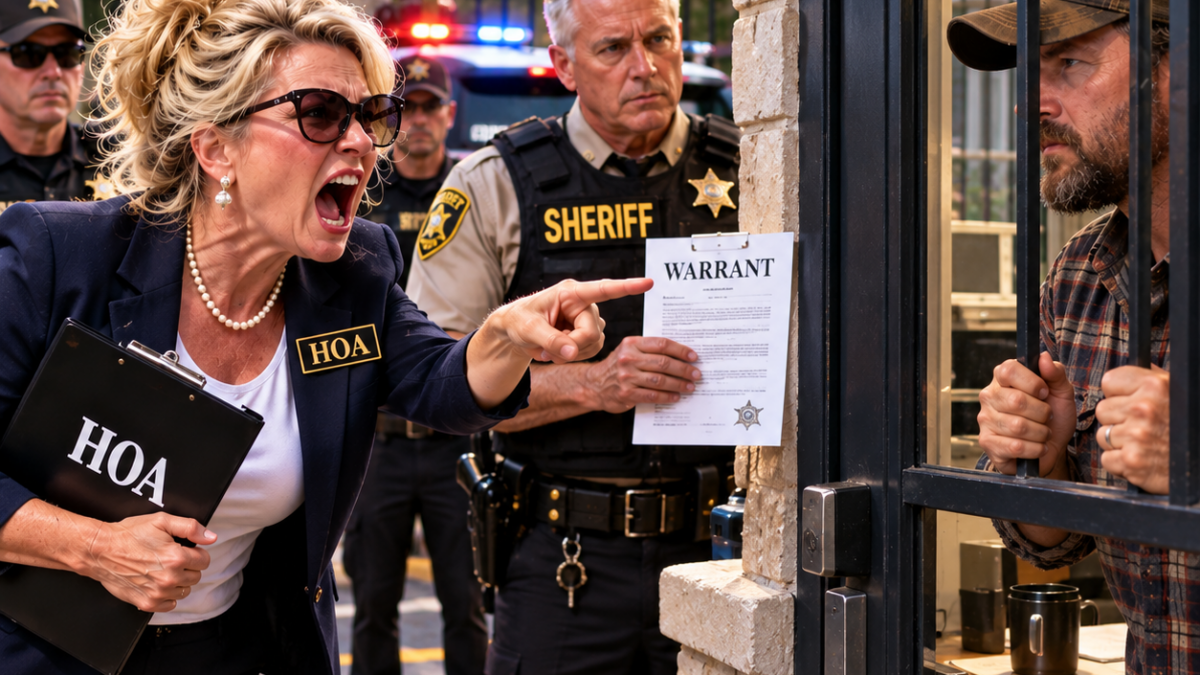
PART 2: The HOA Locked Me in a Guardhouse Until I Signed Away My Road—By Dawn, the Sheriff Had a Warrant
PART 2
Vanessa spread the subdivision exhibit across the hood of my truck.
The paper was newer than my access document, but it wasn’t something she’d drawn in the clubhouse that morning. It was a legitimate recorded exhibit connected to the development of Black Ridge.
Hawthorn Road was clearly shown.
So was the entrance parcel.
The rebuilt pavement.
Drainage infrastructure.
Landscaping.
Access features.
Vanessa placed one finger on the entrance.
“This is Black Ridge property.”
“I can see that.”
“We maintain it.”
“I can see that too.”
“Your vehicle is currently on it.”
“Also true.”
She looked at me as though she’d just finished a proof.
I didn’t dismiss the document.
That would have been stupid.
Black Ridge really did own and maintain property at the entrance.
Its residents really had paid for pavement, drainage, landscaping, cameras, and the new security installation.
But those facts answered a different question.
I unfolded my own document beside hers.
“My access predates the subdivision.”
Vanessa barely glanced at it.
“Our counsel reviewed the gate project.”
“Then let your counsel review both instruments tomorrow.”
“The board already voted.”
“Fine. Open the gate tonight. You preserve your legal position. I preserve mine. Tomorrow, I’ll send this to your attorney and we can argue through paper.”
Her face hardened.
“The system only works if access is controlled consistently.”
There it was.
Not title.
Not a court order.
Not an emergency.
Consistency.
I looked at the new gate.
Black Ridge had apparently spent close to $180,000 building a system around one assumption: everyone who passed through those columns could be placed under Black Ridge’s authority.
And now, on the very first day that system became fully operational, I was standing there with paperwork saying I wasn’t one of them.
I opened the agreement again.
The $46,800 was broken into categories.
Historical road contribution.
Security allocation.
Gate project participation.
Compliance charges.
But the language below the number mattered more.
I pointed to it.
“You’re not asking me to pay for pavement.”
Vanessa said nothing.
“You’re asking me to change my legal position.”
“We’re asking you to participate fairly in infrastructure you benefit from.”
“No. This says I acknowledge Black Ridge’s continuing authority over my passage and accept future access rules.”
“Because the entrance must be controlled.”
“And this release?”
“You’ve disputed prior notices.”
“Exactly.”
I closed the folder again.
“I am not signing away a recorded right just because you put a gate on top of it.”
Brock stood several feet away.
He’d been listening quietly.
I turned to him.
“If you think I’m trespassing, call the sheriff.”
That changed his expression.
Not much.
Enough.
“We could have county come out and document it,” he said.
“Good. Do that.”
Vanessa looked at him.
“This is a board access matter. We’re not calling deputies every time someone refuses the policy.”
Brock stopped.
That was the first clean exit from what happened next.
He could have called dispatch.
Vanessa could have opened the gate under protest.
I could have parked at the side of the road while a deputy looked at documents.
Nobody needed to surrender anything.
Nobody needed to touch anyone.
Instead Vanessa handed me the agreement again.
“Mr. Price, your choices have been explained.”
“So have yours.”
I stepped out of the truck.
Not toward the gate.
Not toward Vanessa.
I walked around the front fender so I could photograph the barrier, the guardhouse, the position of my truck, and the entrance.
Then I reached for my phone.
“I’m calling the sheriff myself.”
Vanessa looked at Brock.
“Take the keys until this is resolved.”
For a second, even Brock looked surprised.
“Vanessa—”
“He has been denied access. We are not letting him drive through the barrier.”
I held the keys in my hand.
“You don’t need those to stop the truck. The gate is closed.”
Brock approached slowly.
“Sir, let’s not make this harder.”
“Then don’t.”
“Give me the keys.”
“No.”
“Security needs to control the vehicle while the incident is being resolved.”
“Then call the sheriff and tell them you intend to seize my keys.”
Brock looked at Vanessa.
She said:
“Secure the vehicle.”
He reached.
His hand closed around the keys.
I could have pulled away.
I didn’t.
I looked directly at him.
“If you’re taking my property, call law enforcement and explain why.”
Brock said nothing.
Another guard had come out of the booth.
Vanessa lifted the agreement.
“You can wait inside while we resolve this.”
“I can wait right here.”
“The road needs to stay clear.”
“My truck isn’t blocking traffic.”
“The guardhouse is more appropriate.”
“No.”
She looked toward my phone.
“Security will take the phone while you’re inside.”
“No.”
The second guard moved closer.
I heard Brock lower his voice.
“Sir, we don’t allow recording inside the security office.”
“Then I won’t enter the security office.”
Vanessa lost patience.
“Take it.”
The guard reached for my arm.
That was the moment I pressed the recorder in my shirt pocket.
It was small.
I used it for field notes in my work.
One button.
No screen necessary.
I’d forgotten I even had it until the situation began turning strange.
I pressed once.
Then I kept both hands visible.
“I’m not resisting.”
Brock said, “Nobody said you’re being detained.”
“Then give me my keys and let me leave.”
He didn’t.
“I’m also not consenting to a search.”
No answer.
“I’m not consenting to you taking my phone.”
The second guard took it anyway.
There was no punch.
No dramatic tackle.
Nobody slammed my face against the truck.
That almost made what happened worse.
They behaved as if this was a normal business procedure.
Like taking a man’s keys, phone, and freedom of movement was just another checkbox in HOA access control.
They walked me toward the guardhouse.
Inside, the air-conditioning was cold.
Vanessa placed the agreement on a desk.
Then a pen.
“Sign it. Pay the amount due, and we can be finished tonight.”
I remained standing.
“I don’t owe Black Ridge $46,800.”
“You’ve benefited from infrastructure maintained by this association for years.”
“Then make that argument in court.”
“It doesn’t need to come to that.”
“Apparently it already has.”
She pushed the pen closer.
“You have a way home sitting in front of you.”
I looked at the paper.
“No. I have a way of surrendering my position sitting in front of me.”
“You’re being unreasonable.”
“I asked you to call the sheriff.”
“We’re not turning this into a police matter.”
I looked at Brock.
“If I’ve committed a crime, call them.”
No response.
“If I haven’t, open the door.”
Vanessa stared at me.
Then she walked into the hallway.
Brock followed her.
I moved toward the doorway.
The second guard blocked it.
“Stay here.”
“Am I free to leave?”
He looked toward the hallway instead of answering.
Then the steel door closed.
I heard the lock engage.
The clock above the desk read 5:41 p.m.
I tried the handle once.
Locked.
I knocked.
“I do not consent to being held here.”
No answer.
“Call law enforcement or open this door.”
Vanessa’s voice came from the hallway.
“You’ll be released when this matter is resolved.”
I stepped closer to the door.
“What does resolved mean?”
“When you complete the access agreement.”
I let the silence sit for two seconds.
Then I said loudly enough for everyone nearby to hear:
“So you’re keeping me in here until I sign?”
Nobody corrected me.
That was when I stopped arguing.
Not because I gave up.
Because I realized every additional word gave them another opportunity to reshape what was happening.
So I watched.
The room was small.
Painted concrete-block walls.
No window.
One desk.
One fluorescent fixture.
One metal chair.
The chair bothered me.
At first I thought it was simply heavy.
Then I looked at the legs.
Bolts ran through steel plates directly into the floor.
Why bolt down one chair in a little HOA guardhouse?
I sat only once.
Then stood again.
The AC kicked on and off.
Through the door I could hear the gate operating.
Barrier arm rising.
Barrier arm lowering.
Radios chirping.
Resident vehicles coming and going.
Normal neighborhood life continued twenty feet away while I was locked in a room because I refused to sign over control of the road to my own land.
At some point, a guard brought me a bottle of water.
He opened the door only enough to enter.
I looked at him.
“Can I leave?”
“Talk to Miss Whitmore.”
“That’s not an answer.”
He placed the bottle on the desk.
“I don’t make the policy.”
“Then call somebody who does.”
He left.
The lock clicked again.
I checked my watch.
Nearly seven.
I thought about my house sitting beyond the trees.
Thirty-seven acres.
My own driveway.
My own bed.
Less than a few miles away.
And completely inaccessible because somebody had built an iron gate across the road and decided I needed permission to use a right recorded before their subdivision existed.
The more I thought about signing, the more certain I became that I couldn’t.
If I signed just to leave, Black Ridge would use that signature forever.
**Mr. Price acknowledged association authority.**
**Mr. Price accepted the gate terms.**
**Mr. Price agreed to current and future access rules.**
That signature would become their answer every time I challenged them.
So I waited.
And because I had nothing else to do, I started noticing the room.
The cabinet near the back wall was slightly open.
Inside were several bundles of plastic flex restraints.
Zip-tie handcuffs.
I stood still.
There might have been an innocent explanation.
Security operations sometimes keep restraints.
That alone proved nothing.
Then I noticed a clipboard hanging near the desk.
Most sheets looked ordinary.
Vehicle logs.
Incident numbers.
Gate notes.
One page didn’t.
At the top, someone had handwritten:
**HOLD LIST**
Seven entries underneath.
Names or initials.
Dates.
Times.
Incident numbers.
Beside several entries were disposition notes.
One read:
**SIGNED ACKNOWLEDGMENT — RELEASED**
Another listed a duration.
**47 MINUTES**
I read it twice.
My first assumption had been that Vanessa had improvised something insane because I refused her agreement.
The list suggested otherwise.
I stepped away.
A few minutes later, I heard the lock.
A guard entered.
He walked straight to the clipboard.
He read one incident number into his radio, wrote a time beside it, hung the list back up, and left.
The lock clicked.
Current paperwork.
Not forgotten paperwork.
Not an old joke.
They were using it.
I looked at the bolted chair again.
For the first time, the room felt much smaller.
What I didn’t know was that evidence had already left Black Ridge without me.
My truck had a dash camera.
Not unusual.
I drove frequently for work, so I’d installed a system that uploaded selected clips over its own cellular connection.
If somebody stole the truck or camera, the important footage wasn’t necessarily lost with it.
The dashcam had recorded the confrontation.
Brock stopping me.
Vanessa arriving.
The agreement.
My refusal.
Brock taking my keys.
Two guards walking me away.
It did not show inside the guardhouse.
It couldn’t show the locked door.
It couldn’t show the hold list.
It couldn’t prove whether I’d voluntarily entered and chosen to remain.
But it showed enough.
My work also had a safety check-in procedure.
Because I traveled frequently between field locations, certain assignments required routine status confirmation.
That night I missed one.
A missed check-in alone wasn’t an emergency.
People forgot.
Meetings ran late.
Phones died.
My supervisor called.
No answer.
Called again.
Still nothing.
Then someone noticed my vehicle hadn’t moved from the Black Ridge entrance for hours.
The newest dashcam upload was reviewed.
By a little after 2:30 in the morning, Sheriff Conrad Bell received a welfare report.
I knew none of this.
Inside the room, I’d lost track of time.
At some point I heard a different vehicle outside.
Then lower voices.
A radio tone that didn’t sound like Black Ridge security.
Footsteps.
One guard said from the hallway:
“County’s asking about Price.”
Brock answered:
“Tell them it’s an access dispute.”
I moved toward the door.
A marked sheriff’s unit had arrived.
The deputy asked to speak with me.
That request never reached the room.
Brock went outside.
I later heard the body-camera recording.
His explanation sounded almost reasonable.
I was a nonresident.
There was an access disagreement.
I had agreed to remain in the security office while paperwork was being resolved.
That version had enough surface credibility to matter.
The dashcam didn’t show anyone beating me.
Nobody had dragged me visibly through the gate.
Black Ridge had a written security policy permitting something called a **temporary hold** when an access incident required law-enforcement review.
On paper, Brock could almost make the situation sound procedural.
Except for one problem.
Black Ridge had never called law enforcement.
Not when they stopped me.
Not when they took my keys.
Not when they took my phone.
Not when the door locked.
Not during the first hour.
Or second.
Or third.
The deputy checked dispatch.
Nothing.
No trespass complaint.
No disturbance report.
No request for assistance.
No call involving Gideon Price.
If the security policy allowed a temporary hold pending law enforcement, why had nobody requested law enforcement?
The deputy asked Brock:
“Is Mr. Price free to leave right now?”
Brock answered indirectly.
“That depends on whether the access matter is resolved.”
The deputy asked again.
“Can he walk out of that building right now if he wants to?”
Instead of answering, Brock went inside and called Vanessa.
I could hear enough through the wall to understand someone official was asking questions.
Brock put the call on speaker.
Then I heard the deputy’s voice.
“Ma’am, I need a clear answer. Is Gideon Price free to leave?”
Vanessa answered immediately.
“He is free to leave as soon as he completes the access acknowledgment.”
Silence.
I sat back in the bolted chair.
For the first time all night, I smiled.
Not because anything was over.
Because someone outside had finally asked the right question.
And Vanessa had answered it exactly the wrong way.
Voluntary people do not need to sign contracts before they’re allowed to leave.
Sheriff Conrad Bell separated two issues.
The first was my confinement.
The second was Hawthorn Road.
They were related factually.
Legally, they were not the same problem.
That distinction became important.
Conrad and Assistant District Attorney Elise Marlow pulled county recorder files.
Older right-of-way instruments.
Subdivision plat.
Later Black Ridge access exhibits.
Vanessa’s exhibit was genuine.
Black Ridge really owned and maintained entrance property.
But an older recorded instrument gave access benefiting the tract that later became my thirty-seven acres.
That instrument existed before Black Ridge.
Nothing they could find at three in the morning clearly showed the right had ever been released or extinguished.
A sheriff wasn’t going to settle property title in the dark.
He didn’t need to.
The records were enough to undermine any simple claim that I was obviously trespassing.
Then they reviewed Black Ridge’s own security policy.
Temporary hold pending law enforcement.
Yet Black Ridge had held me for hours without notifying law enforcement.
The policy that initially made Brock’s story sound legitimate now raised a worse question.
If they were waiting for deputies, why hadn’t they called deputies?
Then dispatch found an earlier complaint.
A previous contractor dispute.
Same guardhouse.
The caller had reported that Black Ridge security would not let him leave until he signed an acknowledgment connected to the disagreement.
That incident had ended without charges because the caller later declined further action.
One old complaint didn’t establish a criminal pattern.
But it meant my situation might not be unique.
Meanwhile, the dashcam showed Brock taking my keys.
Black Ridge admitted I was inside.
Brock wouldn’t say I could leave.
Vanessa had explicitly conditioned release on my signature.
A judge was contacted remotely.
Conrad and Elise prepared an emergency warrant application.
The application was careful.
It did not pretend the Hawthorn Road title dispute had been resolved.
It didn’t need to.
It described the circumstances of confinement and asked for authority to preserve the evidence needed to determine exactly what Black Ridge security had been doing.
Guardhouse.
Video system.
Incident logs.
Digital records.
Access and detention files.
Before dawn, the judge signed it.
Inside, I still knew almost nothing.
Around four in the morning, Brock opened the room again.
He carried the agreement.
“Last chance to end this before it becomes official.”
I looked at him.
“It’s been official since you locked the door.”
“Sign and you can go home.”
“Open the door or call the sheriff.”
“We’re past that.”
“No, Brock. You’re not.”
I pushed the agreement away.
He stared at me.
I could see fatigue in his face now.
Not confidence.
Fatigue.
Maybe fear.
Then he left.
Locked door again.
A few minutes later, more vehicles arrived.
One.
Then another.
Then another.
The hallway came alive.
Vanessa’s voice.
Faster than before.
Worried.
“How many?”
Brock answered:
“Three county units I can see. Maybe more down the road.”
“They have no authority to interfere with association security.”
Nobody responded.
Then Vanessa asked:
“Where are the old hold sheets?”
Something in my stomach tightened.
A voice said:
“Active binder.”
“Move them.”
Then:
“What about the camera system?”
Brock lowered his voice.
“We should wait.”
“We are not giving them years of internal security material because one man refuses to sign an access agreement.”
I stood beside the door and listened.
Then Vanessa said something worse.
“Archive tonight’s files. Clear anything that doesn’t need to stay on the local machine.”
Brock said:
“Vanessa—”
“Do it.”
For the first time that night, I realized their fear was no longer about me.
It was about the records.
That was another moment when everything could have stopped.
Someone could have said:
No.
Preserve everything.
Cooperate.
Instead Vanessa was still trying to control the situation.
One of the younger guards was told to carry the active incident binder into a back office.
He didn’t.
He walked outside.
Later I learned what he told the deputy.
Gideon Price was still locked in the back room.
Staff had been ordered to move records.
Someone had instructed them to clear camera files.
That guard probably saved himself years of explaining why he obeyed.
He had signed up to work security.
Not destroy evidence.
Then I heard Conrad.
“Sheriff’s Office. We have a search warrant. Open the gate and secure the building.”
No response.
Again.
“Open the gate. Secure the building.”
Vanessa yelled from the hallway:
“You do not let them damage association property!”
Even inside the room, I almost laughed.
I’d been behind a locked steel door for nearly twelve hours.
She was worried about the gate.
Deputies gave them another opportunity.
Nobody opened the entrance.
A deputy cut the lock on the pedestrian service gate.
Then came boots.
Radios.
Commands.
Not a movie raid.
No gunfire.
No screaming charge.
Just trained people taking control of a place where HOA policy had been treated like the highest law for too long.
I heard:
“Where is Price?”
A guard answered:
“Back room.”
“Locked?”
Silence.
Brock finally said:
“Yes.”
Footsteps approached.
The lock turned.
The door opened.
Sheriff Conrad Bell stood there with two deputies behind him.
He was gray-haired, broad-shouldered, and completely calm.
“Mr. Price?”
“Yes.”
“Are you injured?”
“Not that I know of.”
“Need medical attention?”
“Nothing urgent.”
He stepped aside.
“You’re coming out.”
I walked through the doorway.
The outer office clock read 5:27 a.m.
The room clock had read 5:41 p.m. when they locked me in.
Eleven hours.
Forty-six minutes.
Outside, the air felt cold.
Not because it was actually cold.
Because I’d spent the entire night breathing fluorescent, recycled air in a room without windows.
A medic checked me.
Blood pressure.
Hydration.
Basic examination.
My phone and keys were found inside a security drawer.
Deputies photographed them before returning them because they were now evidence.
The agreement was seized too.
So was the hold list.
The binder.
Incident records.
Camera system.
Workstation data.
Deputies secured the digital system before files could be cleared.
They found activity consistent with attempts to move or delete material after sheriff’s vehicles arrived.
That did not automatically prove every crime investigators were considering.
It did create a record.
A very bad one.
The security staff were separated.
Interviewed individually.
Not everybody was treated the same.
Some guards had simply worked gate duty.
Some had limited involvement.
Others had taken property, enforced confinement, or followed instructions involving records.
Vanessa and Brock were taken into custody based on probable cause surrounding my ongoing confinement.
Not because deputies disliked HOAs.
Not because the sheriff decided my road belonged to me at sunrise.
Because by then the evidence about that locked room had become its own issue.
The eastern sky was starting to turn gray.
Vanessa saw me outside.
For the first time all night, she didn’t look angry.
She looked confused.
“This is an internal Black Ridge matter.”
Nobody answered.
She looked toward Elise Marlow, who had arrived while the warrant was being executed.
“Why are you doing all of this for him?”
Elise glanced toward me.
Then back at Vanessa.
“Mr. Price is a senior investigator with the state’s civil rights enforcement office.”
Vanessa’s face changed.
I saw the assumption forming immediately.
She thought that was why the sheriff had come.
Elise shut it down.
“That isn’t why they’re here.”
Vanessa stared at her.
“If he sold lawn mowers for a living, that door would still have been locked.”
That mattered to me.
I had deliberately not mentioned my job all night.
Not because I was setting some clever trap.
Because my title had nothing to do with whether Black Ridge was allowed to keep me in a locked room until I signed a contract.
I didn’t want:
**Do you know who I am?**
I wanted:
**Is this legal if you do it to anyone?**
A deputy carried the hold binder past us in an evidence box.
Vanessa watched it.
The sun rose behind the iron entrance gate.
I was outside.
The records weren’t.
That was when Black Ridge’s real trouble began.
The criminal investigation moved in one direction.
The Hawthorn Road dispute moved in another.
They had to.
Being wrong about the road wouldn’t automatically prove every detention allegation.
Being investigated for confinement wouldn’t automatically establish my property rights.
The law didn’t work by emotional shortcut.
Investigators reviewed the hold list.
The seven earlier entries weren’t identical.
Several involved ordinary incidents where people voluntarily waited while deputies were contacted.
That mattered.
Nobody wanted to turn routine security work into something it wasn’t.
Other entries were harder.
The 47-minute hold matched the earlier dispatch complaint.
A contractor confirmed that he’d been kept in the room during an access disagreement until he signed an acknowledgment.
Another visitor described being prevented from leaving during a dispute over alleged property damage until paperwork was completed.
Not every person wanted to pursue a case.
Not every hold became a criminal allegation.
But the pattern was becoming clearer.
The room had been used at times not merely to wait for law enforcement but as leverage.
Wait.
Sign.
Acknowledge.
Comply.
Then leave.
Black Ridge suspended its detention-related procedure within days.
The board hired outside counsel.
Its insurer was notified.
An independent review of security practices began.
Vanessa was removed as president.
That happened quickly.
The rest didn’t.
People imagine a warrant means instant justice.
It doesn’t.
There were interviews.
Evidence reviews.
Charging decisions.
Court dates.
Motions.
Lawyers.
Months of work.
Brock’s conduct was evaluated differently from younger guards who had limited roles.
The instructions involving records became a separate issue because deputies had preserved workstation activity and because one guard had refused to participate.
Some people from earlier hold incidents filed civil claims.
Others gave statements and wanted nothing more to do with Black Ridge.
My own civil claim concerning the detention moved through insurance and counsel.
I didn’t discuss the details publicly.
I didn’t need to.
What mattered emotionally was simpler.
Black Ridge had taken nearly twelve hours from me because it believed a locked room and a contract could solve a property dispute faster than a courthouse.
It couldn’t give those hours back.
The road itself required title work.
I hired an attorney who specialized in land title and access rights.
Then a licensed surveyor.
They traced Hawthorn through records older than Black Ridge.
Old instruments.
Plats.
Legal descriptions.
Developer documents.
Subdivision filings.
The conclusion was less dramatic than either side had originally claimed.
Black Ridge owned the entrance property.
True.
Black Ridge maintained pavement and drainage there.
True.
It could implement reasonable security for its property.
True.
And my parcel had a recorded access right crossing that same area.
Also true.
Those rights could exist simultaneously.
Black Ridge didn’t have to pretend the entrance wasn’t theirs.
I didn’t have to pretend their maintenance costs were imaginary.
But owning the land beneath an access corridor didn’t automatically allow the owner to extinguish the recorded access benefiting another tract.
The survey created another problem for Black Ridge.
Part of the new gate installation physically interfered with the established corridor.
Once the HOA’s new outside counsel reviewed both the title chain and survey, the tone changed quickly.
The $46,800 demand disappeared.
No dramatic apology.
Just:
Withdrawn.
The agreement disappeared too.
Black Ridge stopped claiming I needed to sign it.
The HOA adopted a written access protocol recognizing my recorded right and other nonmember rights crossing the entrance.
My access credential could not be canceled simply because a board officer wanted leverage.
Emergency services received independent entry procedures.
Security guards were instructed that disputes involving recorded access rights were to be documented and referred to counsel or law enforcement.
Not solved by confiscating keys.
Not solved by taking phones.
Not solved with a locked room.
Not solved with a signature demanded at the gate.
The gate itself took longer.
Black Ridge did not have to demolish its entire $180,000 entrance.
I never wanted that.
The neighborhood had legitimate security concerns.
Residents had paid for cameras, lighting, barriers, landscaping, and improved traffic control.
The solution was to make those improvements coexist with the rights already crossing the property.
Control equipment was moved.
The barrier configuration changed.
The approach was rebuilt so my access corridor could not simply be shut at the discretion of an HOA officer.
I received independent access.
If Black Ridge wanted to dispute my rights in the future, it could use lawyers.
Not a gate arm.
The guardhouse remained too.
But the back room changed.
The bolted chair was removed.
The flex restraints were removed.
The hold list disappeared.
The room went back to ordinary security and storage use.
The first time I saw photographs after the renovation, that detail affected me more than I expected.
No chair.
No clipboard.
Plain floor.
It looked smaller.
Almost harmless.
For nearly twelve hours, that room had felt like the entire world.
Now it looked pathetic.
A concrete box somebody had given too much authority.
Under the civil resolution, Black Ridge reimbursed my documented title, survey, and legal costs connected to the road dispute.
Its insurer handled the separate detention-related claim.
The exact terms remained private.
People later asked if I “made a fortune.”
No.
That was never the point.
Money could reimburse invoices.
It could recognize losses.
It could not reimburse eleven hours and forty-six minutes of sitting in a locked room wondering whether anyone knew where I was.
It could not give me back the moment I saw seven names on the hold list and realized I might not be the first.
What gave me satisfaction was watching every piece of leverage Vanessa had tried to use disappear.
The $46,800 demand?
Gone.
The contract requiring me to acknowledge HOA authority?
Gone.
The discretionary ability to block my recorded passage?
Gone.
The detention practice?
Gone.
The bolted chair?
Gone.
The rule allowing security to treat private property disputes like internal HOA compliance matters?
Gone.
And Vanessa?
No longer president.
I didn’t need to stand at a board meeting and humiliate her.
I didn’t need neighbors chanting my name.
I didn’t need revenge in the theatrical sense.
Her decisions had created a record.
The record did the work.
The dashcam did more than anger ever could.
Brock taking my keys.
On video.
Vanessa presenting the agreement.
On video.
Me refusing.
On video.
Security walking me away.
On video.
Then the deputy’s body camera captured the most important sentence of the night.
**He is free to leave as soon as he completes the access acknowledgment.**
If Vanessa had simply said yes when the deputy asked whether I was free to leave, the investigation might have developed differently.
If she had opened the door.
Returned my phone.
Returned my keys.
Preserved the files.
Called counsel.
Maybe the night still would have been serious.
But she kept making the same mistake.
Every time the situation offered an exit, she treated backing down like losing control.
That became the real pattern.
At the gate:
Call the sheriff?
No.
Let me through under protest?
No.
Let me wait outside?
No.
Keep my phone?
No.
Free to leave?
After you sign.
Preserve records?
Move them.
Camera files?
Clear what we don’t need.
Open the gate for the warrant?
No.
Every decision was about control.
And each one reduced the control she actually had.
Months afterward, Conrad and I spoke briefly at the county courthouse after one of the related proceedings.
“I’ve wondered something,” I told him.
“What?”
“What would’ve happened if Vanessa told your deputy I was free to leave?”
He thought about it.
“Depends what happened next.”
“Meaning?”
“If the door opened and you walked out, immediate circumstances change. We’d still document. Your property and phone issues still matter. Dashcam still matters. Your allegation still matters.”
“But no warrant?”
“Maybe not that morning.”
I nodded.
“Her answer did it.”
“Her answer was significant.”
“And the old complaint.”
“Significant.”
“The policy.”
“Significant.”
I smiled.
“You people hate simple answers.”
“Usually because simple answers get people in trouble.”
Fair.
I asked him another question.
“Did you know what I did for work before you sent the deputy?”
“No.”
“When did you find out?”
“Later.”
“Good.”
He looked at me.
“You worried about that?”
“I don’t want anyone thinking the door opened because of my title.”
“It didn’t.”
“Elise said that.”
“She was right.”
That mattered more to me than almost anything.
Because one of the ugliest things about the guardhouse was how normal they acted.
If security could do that only because they thought I was unimportant, then my job title becoming relevant later would have missed the lesson.
The door shouldn’t have been locked for anybody.
Not a state investigator.
Not a contractor.
Not a delivery driver.
Not a homeowner.
Not some teenager accused of damaging a gate arm.
Authority has limits even when the person in front of you doesn’t know exactly where those limits are.
Especially then.
My supervisor asked whether I wanted time off.
I took a couple days.
I didn’t think I needed them until I got home.
That first morning after being released, I slept maybe three hours.
Then woke convinced I’d heard a lock.
My house was silent.
Sunlight came through the bedroom curtains.
No fluorescent light.
No concrete walls.
No guard radios.
I walked downstairs.
Made coffee.
Then stood at a window looking toward the distant tree line.
My own property felt strangely unfamiliar.
For nearly twelve hours I had been separated from it by a gate less than a few miles away.
I drove nowhere that day.
The next evening, I found myself checking my pockets repeatedly.
Keys.
Phone.
Recorder.
Keys.
Phone.
Recorder.
It was stupid.
Nothing had disappeared.
But having somebody take those things while insisting I wasn’t being detained had left a mark.
Words matter less when every practical exit has already been removed.
That’s one thing I never forgot.
Brock kept saying nobody had said I was detained.
Yet:
No keys.
No phone.
Locked door.
Guard outside.
Release conditioned on signature.
You can call it a waiting room if you want.
The handle still doesn’t turn.
The investigation into prior holds produced another uncomfortable lesson.
Not every earlier person had fought.
Some signed.
That didn’t make them weak.
Most people placed into an unexpected confrontation want one thing:
To get home.
If someone puts a document in front of you and says the fastest way to end the nightmare is to sign, signing can feel rational.
That’s exactly why the process was dangerous.
A signature obtained under those circumstances could later be made to look voluntary.
The paper wouldn’t show the locked door.
It wouldn’t show the missing phone.
It wouldn’t show the person checking the clock.
It would just show:
**Signature.**
That was what I had been afraid of all night.
Black Ridge might have pointed to my own name and said:
**See? He agreed.**
That’s why the earlier notation on the hold list stayed with me.
**SIGNED ACKNOWLEDGMENT — RELEASED.**
Four words.
How many arguments had those four words ended later?
I don’t know.
Maybe none.
Maybe several.
But the process had allowed the possibility.
The board’s independent review was blunt about one thing: private security could protect property, observe, document, contact law enforcement, and enforce legitimate access protocols within lawful authority.
It could not become a private court.
That was what the guardhouse had slowly become.
A place where security disputes were not merely documented.
They were “resolved.”
Sign this.
Acknowledge that.
Accept the condition.
Then leave.
It was efficient.
That was probably why somebody kept doing it.
Bad systems often survive because they work—until you ask what they’re working to accomplish.
Black Ridge wanted compliance.
The room produced compliance.
But it did so by creating risks nobody on the board had apparently thought through carefully enough.
After the incident, the board changed more than the guardhouse.
Vendor instructions changed.
Security training changed.
Incident escalation changed.
Any significant confrontation requiring a person to remain on-site triggered law-enforcement notification.
Recorded property-right disputes went to counsel.
Guards were prohibited from demanding releases, legal acknowledgments, easement concessions, or financial agreements as conditions for departure.
That sounds obvious.
It wasn’t obvious there the afternoon they locked me in.
Vanessa eventually stopped attending the meetings I could see in public board materials.
I didn’t follow her life.
Some neighbors wanted me to.
They sent messages.
“She’s furious.”
“She’s blaming Brock.”
“People want resignations.”
“Did you hear what she said?”
I stopped reading most of it.
My problem had never been her personality.
I didn’t need her socially destroyed.
I needed the gate fixed.
The right recognized.
The detention practice ended.
The costs covered.
The records preserved.
Everything else was noise.
My title attorney once asked me:
“Would you have paid anything for maintenance if Black Ridge had approached you differently?”
“Maybe.”
That surprised him.
“Really?”
“Sure. If they came with actual numbers, a voluntary road-maintenance arrangement, something tied to reasonable use—I’d listen.”
“So the money wasn’t the main issue.”
“Never.”
“What if the number was smaller?”
“I still wouldn’t sign that agreement.”
“Why?”
“Because $46,800 was temporary. The legal acknowledgment was permanent.”
He nodded.
That was exactly it.
Black Ridge had focused on a large dollar amount because large numbers feel powerful.
But the expensive part was the signature.
Money can be paid once.
Control can last decades.
If I’d signed that afternoon, the next board could point to it.
The board after that too.
Different president.
Different security company.
Different gate.
Same sentence.
**Gideon Price acknowledged Black Ridge’s authority.**
No.
The road records deserved to be resolved on their own merits.
Not under fluorescent light behind a locked door.
The surveyor eventually showed me exactly how the old Hawthorn corridor related to the Black Ridge gate.
We stood near the entrance with field equipment while security kept a polite distance.
Very polite now.
He pointed to the line.
“The corridor predates the subdivision layout.”
“And the gate?”
“Part of the installation intrudes into the functional corridor.”
“Meaning?”
“The gate can exist. It needs to be configured so the benefited tract’s passage isn’t physically subject to discretionary closure inconsistent with the recorded right.”
“That’s the lawyer version.”
“I’m a surveyor.”
“Somehow worse.”
He laughed.
Then he showed me the monuments and recorded geometry.
That was another satisfying moment.
Not because it proved Black Ridge owned nothing.
They owned plenty.
But the facts allowed both sides to exist.
That is what Vanessa had refused to accept at the gate.
Her logic had been binary.
Black Ridge property means Black Ridge control.
My attorney’s position was more precise.
Black Ridge owned the land.
My tract held a recorded passage right across part of it.
Property law is full of overlapping rights.
Ownership isn’t always absolute control over every use.
Once the board’s new lawyers accepted that, the solution became engineering and procedure instead of force.
Move this equipment.
Reconfigure this barrier.
Recognize these credentials.
Preserve emergency access.
Document disputes.
Nobody needed a bolted chair.
The first time I drove through after the permanent changes, I expected to feel triumphant.
I didn’t.
I felt nervous.
My hands were tight on the steering wheel.
The stone columns appeared around the bend.
Same black iron.
Same landscaping.
Same cameras.
The guardhouse was still there.
A different guard was working.
I slowed automatically.
He looked at the access system.
The barrier opened.
No hand raised.
No SUV.
No leather folder.
No $46,800 agreement.
I drove through.
For fifty yards, I kept looking in the rearview mirror.
The gate remained open long enough for me to clear it.
Then closed behind me.
Normal.
That was all I had wanted.
Controlled security without surrendering my road.
I continued toward my acreage.
Trees closed around Hawthorn.
The entrance disappeared.
By the time I reached my driveway, my shoulders had relaxed.
I parked beside the house.
Turned off the engine.
Sat there for a minute.
No one had followed me.
No one had called.
No one had demanded a signature.
I was home.
That felt like revenge.
Not Vanessa in handcuffs.
Not Brock losing a job.
Not a giant settlement figure.
Driving home.
Sometimes restoring something ordinary is more satisfying than destroying the person who took it from you.
The legal aftermath continued after that.
The detention case didn’t magically vanish because the gate was fixed.
Civil claims involving earlier incidents moved at different speeds.
Some people wanted settlements.
Others wanted statements on record.
Investigators differentiated conduct carefully.
The younger guard who warned deputies about the records mattered.
He had been present.
He wasn’t treated as if he had made every decision Vanessa made.
That mattered to me too.
Accountability should be specific.
Otherwise it becomes another version of the same abuse.
Vanessa had treated anyone at the gate as one category:
Subject to Black Ridge.
The investigation did the opposite.
Who took keys?
Who took the phone?
Who locked the door?
Who gave orders?
Who heard objections?
Who conditioned release?
Who tried to move records?
Who resisted those instructions?
Different actions.
Different responsibility.
That’s how authority is supposed to work.
Evidence before conclusion.
I used that lesson in my own job afterward.
I had spent years investigating institutional conduct, yet being on the other side of a locked door changed something in me.
Procedures I’d once read clinically suddenly had texture.
“Person was not free to leave.”
That phrase sounds sterile on paper.
In reality, it can mean staring at a door handle for hours.
“Personal property retained.”
That can mean touching an empty pocket where your phone should be and wondering whether anyone knows where you are.
“Release conditioned upon acknowledgment.”
That can mean a pen lying on a desk while fatigue tells you that one signature could make the night stop.
Language compresses experience.
Necessary for reports.
Dangerous if we forget what’s underneath it.
I became less impressed by institutional phrases after Black Ridge.
**For your safety.**
**Pending resolution.**
**Temporary hold.**
**Controlled access.**
**Administrative procedure.**
Any phrase can describe something reasonable.
Any phrase can hide something unreasonable.
The question is always what people can actually do.
Can they leave?
Can they refuse?
Can they call someone?
Can they keep their property?
Can they challenge the decision somewhere independent?
If the answer to those questions is no, then the label matters less than the reality.
About a year later, I received a package from my attorney.
Inside were final copies of several road-related documents.
Survey.
Access protocol.
Recorded clarifications.
Correspondence.
I added them to the same vehicle document pouch where I’d kept the original access paper.
Then I thought better of it.
I made copies.
One set in the truck.
One in the house.
One digital.
My lawyer laughed when I told him.
“Trauma-induced document management.”
“Exactly.”
“Probably harmless.”
I looked at the stack.
“One thing Black Ridge did accomplish.”
“What’s that?”
“I’ll never travel without records again.”
The $46,800 demand was framed and hanging above my fireplace.
I’m kidding.
I shredded my copy after the legal hold ended.
I didn’t want it.
For months that document had represented the entire dispute.
Then eventually it became worthless paper.
The road mattered.
The right mattered.
The signed survey mattered.
The corrected gate mattered.
The agreement Vanessa thought could change all of that by force didn’t.
That was satisfying too.
People overestimate the power of paper when the signature was obtained under the wrong circumstances.
The better answer was never to sign in the first place.
A neighbor from Black Ridge eventually approached me at a gas station.
I recognized him vaguely.
He looked embarrassed.
“You’re Price, right?”
“Yeah.”
“I’m in Black Ridge.”
“I figured.”
He glanced toward my truck.
“I wanted to say something.”
I waited.
“Most of us had no idea they were doing that in the guardhouse.”
“I assumed.”
“People think the whole neighborhood supported Vanessa.”
“I don’t.”
“We wanted the gate.”
“I know.”
“We were having real problems.”
“I know that too.”
He seemed relieved.
“Dumping got bad. Someone stole packages. Cars were cutting through.”
“I never disputed your right to secure your property.”
“Just your access.”
“Exactly.”
He shook his head.
“She told us outsiders were trying to exploit roads we paid for.”
“I’m sure she believed that.”
“You don’t sound angry.”
“I was.”
“Not anymore?”
I considered it.
“I’m precise.”
He laughed nervously.
“What does that mean?”
“It means your neighborhood needing security didn’t give Vanessa authority to lock me in a room.”
He nodded.
“Fair.”
That conversation mattered because it reminded me how easy it would have been to turn the story into residents versus outsider.
It wasn’t.
Most Black Ridge residents wanted a gate.
Reasonable.
They wanted less dumping.
Reasonable.
Less theft.
Reasonable.
Safer roads.
Reasonable.
The problem was not the desire for security.
It was the assumption that security authority had no boundary.
A gate is a tool.
A guardhouse is a tool.
Cameras are tools.
Policies are tools.
They become dangerous when somebody mistakes possession of the tool for unlimited authority to use it.
By the following year, the Black Ridge entrance had become boring again.
That may be the highest compliment I can give it.
Residents entered.
Visitors checked in.
Delivery drivers followed instructions.
My credential worked.
The barrier opened.
Security disputes went through proper channels.
The road continued.
No drama.
No hold list.
No chair.
No signatures demanded under lock.
Just a gate doing gate things.
That’s what it should have been from the beginning.
One morning, I drove through around 5:30.
Almost exactly the time Conrad had opened that room.
The eastern sky was beginning to brighten.
For a moment, memory overlaid itself on the present.
County units.
Deputies.
Evidence boxes.
Vanessa’s face.
My keys being photographed.
The cold air outside.
Then the barrier rose.
I drove through.
No one stopped me.
In the mirror, the guardhouse shrank behind the trees.
I thought about the sentence Vanessa had used the afternoon before the warrant.
**Your land is outside Black Ridge. Your access isn’t.**
In the end, she was partly right in a way she hadn’t intended.
My road crossed Black Ridge property.
That meant our rights overlapped.
It did not mean mine disappeared.
Property systems work because different rights can coexist.
Her gate.
My passage.
Their security.
My access.
Their pavement.
My route home.
The mistake was thinking one side had to erase the other.
The settlement didn’t erase Black Ridge’s gate.
It forced the gate to respect the road beneath it.
That’s why the ending satisfied me.
I didn’t destroy what the neighborhood had built.
I didn’t need to.
I just made sure it could no longer be used to destroy what existed before it.
Another question people ask is whether I regret stepping out of the truck.
Sometimes.
If I’d stayed inside and called the sheriff immediately, perhaps the whole guardhouse episode would never have happened.
But that’s hindsight.
At the time, I stepped out to document the scene.
Vanessa ordered the keys taken afterward.
I had no reason to imagine security would escalate from a gate disagreement to confinement.
You can spend years reconstructing the moment where you might have changed the outcome.
Eventually I stopped.
The relevant choices weren’t all mine.
Brock could have called deputies.
Vanessa could have opened the barrier under protest.
They could have let me wait beside my truck.
They could have left my phone alone.
They could have unlocked the door.
They could have released me at any point during eleven hours and forty-six minutes.
They could have preserved the records.
They could have complied when the warrant arrived.
The fact that I might have chosen differently doesn’t erase the choices they actually made.
That distinction helped me let go.
The recorder in my shirt pocket survived the night.
Its audio wasn’t perfect.
Clothing rustle.
Muffled voices.
Air-conditioning.
But it captured enough.
My objections.
Requests to call the sheriff.
Requests to leave.
Vanessa telling me release depended on the agreement.
That recorder wasn’t the centerpiece people expected.
The deputy’s body camera was cleaner.
The dashcam was clearer.
The guardhouse records were powerful.
But the little audio file mattered to me personally.
It reminded me that even without knowing help was coming, I had done one thing correctly.
I kept saying the truth plainly.
“I’m not consenting.”
“Am I free to leave?”
“Call law enforcement.”
“Open the door.”
No threats.
No grand speech.
No attempt to fight guards.
Just questions that forced reality into words.
That’s another lesson I carried forward.
When somebody hides behind vague procedure, ask concrete questions.
Can I leave?
Yes or no.
Did an engineer approve this?
Yes or no.
Do you have a recorded right?
Show me.
Did you call law enforcement?
When?
Authority becomes easier to examine when language becomes specific.
Vanessa preferred phrases.
**Board access matter.**
**Controlled system.**
**Policy compliance.**
**Matter resolved.**
The deputy asked:
**Can he walk out right now?**
That question broke everything open.
Years later, I still think about it.
Not the warrant.
Not the money.
Not even the road.
The question.
Can he leave?
One clear sentence can do what twenty pages of policy can’t.
Black Ridge’s new board eventually invited me to a meeting about a future road-maintenance arrangement.
I almost declined.
Then I went.
Different president.
Different counsel.
No security personnel in the room.
They presented actual maintenance numbers.
Pavement wear.
Drainage.
Snow and storm cleanup.
Gate upkeep.
They asked whether outside benefited tracts might participate voluntarily under an agreement that expressly preserved existing recorded access.
I read it.
Then I said:
“This is the conversation you should have had with me the first time.”
The new president nodded.
“I know.”
We didn’t agree on everything.
But we negotiated.
Like adults.
No locked door.
No confiscated keys.
No $46,800 threat.
No waiver of underlying rights.
That meeting did more to repair my relationship with Black Ridge than any apology could have.
Because it proved the conflict had never required force.
They could ask.
I could answer.
We could disagree.
Lawyers could revise language.
Numbers could move.
Rights could remain intact.
That is what institutions are supposed to do when interests overlap.
The old board treated disagreement as noncompliance.
The new board treated it as negotiation.
Huge difference.
I eventually agreed to a limited maintenance contribution tied to specific services and explicit preservation of my recorded access.
Some people were shocked when they heard that.
“After everything they did?”
Yes.
Because fairness goes both ways.
If I benefit from certain maintenance and a reasonable voluntary agreement preserves my rights, I can contribute.
What I would never do was pay $46,800 under pressure and sign a document transforming an existing property right into something the HOA could grant or revoke.
The new agreement didn’t do that.
The new agreement started by acknowledging the access right.
That’s why I could sign it.
Consent feels very different when the door is open.
That sentence probably summarizes the whole story.
Consent feels different when the door is open.
The last time I saw Vanessa was outside the courthouse.
We were maybe thirty feet apart.
She looked older.
So did I.
Neither of us approached.
For a moment, I wondered what I would say if she did.
I thought I wanted an apology once.
By then I didn’t.
What could she say?
That she thought she was protecting Black Ridge?
I knew.
That she believed the road was under HOA authority?
I knew.
That she never expected the situation to become criminal?
Obviously.
None of that changed the steel door.
The most meaningful apology had already happened in concrete, steel, policy, and recorded documents.
The gate was reconfigured.
The room was stripped.
The right was recognized.
The policy was changed.
Those things mattered.
Words would have been smaller.
So I got into my truck.
Drove home.
Through Hawthorn.
The barrier lifted before I reached it.
There was no guard stepping into my lane.
No president with a folder.
No demand.
The stone columns were still there.
The cameras were still there.
The landscaping looked better than it had the year before.
Black Ridge still had its security.
I still had my road.
That’s what should have happened from day one.
I followed Hawthorn past the subdivision entrance.
The pavement narrowed.
Trees closed in.
My acreage began where the manicured common property ended.
Morning light came through the hardwoods.
I slowed near my driveway.
In the rearview mirror, I could barely see the top of one stone entrance column.
The gate looked tiny from that distance.
That felt appropriate.
For one night, Black Ridge had made that gate feel bigger than my deed, bigger than the road, bigger than the sheriff, bigger than the difference between consent and coercion.
By sunrise, it wasn’t.
It was just metal.
The road was older.
The record was stronger.
And the door they locked me behind had ultimately preserved more evidence against their own decisions than it ever pressured out of me.
I parked at the house and turned off the engine.
My keys stayed in my hand.
My phone stayed in my pocket.
Nobody asked me to sign anything.
There was no dramatic crowd waiting to congratulate me.
No music.
No speech.
Just morning wind through the trees on thirty-seven acres that I could reach again without asking an HOA president for permission.
People sometimes call what happened afterward revenge.
Maybe it was.
But not the kind Vanessa expected.
I didn’t take their gate away.
I made them move it out of the way of my rights.
I didn’t demand that every guard be punished equally.
The investigation separated the people who made decisions from the people who refused to cross certain lines.
I didn’t bankrupt the neighborhood.
The HOA kept functioning.
I didn’t need a giant public apology.
The new rules said more than an apology ever could.
And I didn’t sign away Hawthorn Road.
That was the part that mattered most.
Vanessa had put a pen on a desk and believed eleven hours behind a locked door would make surrender feel easier than resistance.
She was wrong.
By dawn, the sheriff had the warrant.
By the time the records were reviewed, Black Ridge had lost the detention practice.
By the time the title work was finished, it had lost the $46,800 demand.
By the time the gate was rebuilt, it had lost the ability to close my road whenever a board officer decided I hadn’t complied.
And months later, when I drove home at sunrise without stopping at the guardhouse, I finally understood what the most satisfying kind of revenge looked like.
It wasn’t watching someone else lose everything.
It was watching every illegitimate piece of power they had tried to use against me disappear one by one, while the one thing they wanted me to surrender remained exactly where it had been long before Black Ridge ever existed.
**The road.**
**My road home.**