PART 2: The HOA Bulldozed My $10,000 Stone Wall for an Emergency Road—Then Their Own Plans Cost Them $15,000 in Court
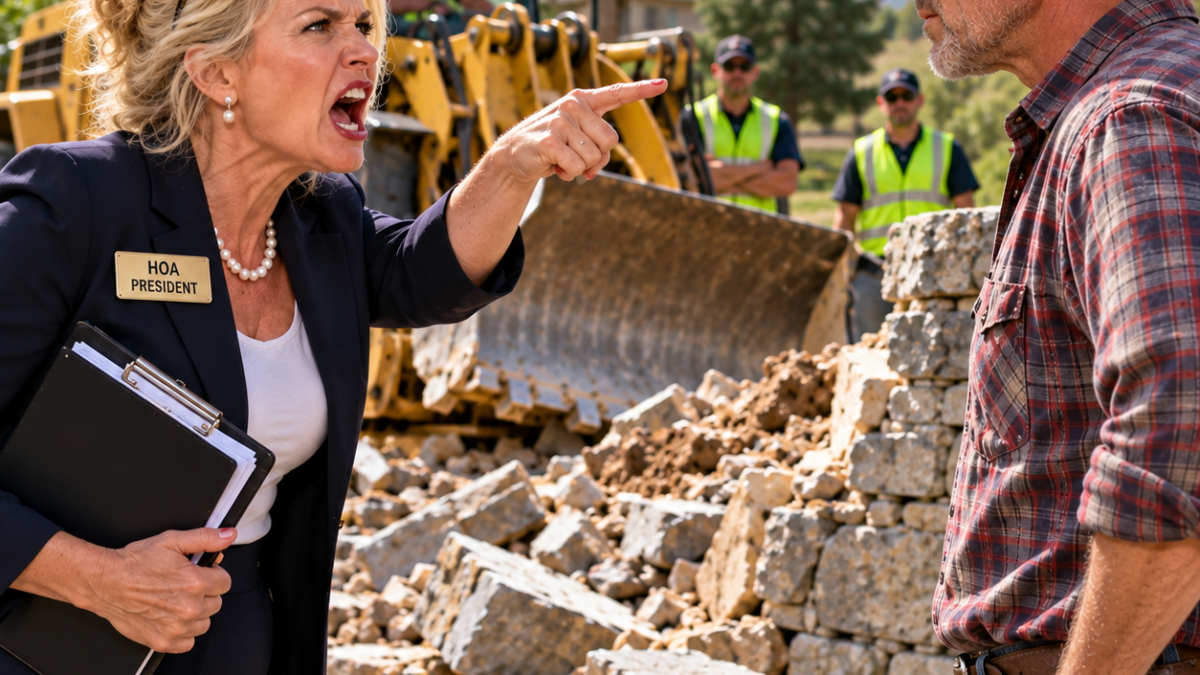
PART 2
The excavator arrived on a Thursday while I was away picking up hydraulic hose for my tractor.
I knew something was wrong before I reached the house.
A dump truck was parked along the Cedar Ridge lane.
Behind it sat a compact excavator.
Not near my retaining wall.
Where my retaining wall had been.
For a few seconds, I genuinely couldn’t understand what I was seeing.
The southern end of the wall was gone.
Maybe twenty feet.
Fieldstone lay in piles beside the road.
Some pieces had been shoved uphill into my pasture.
The drainage gravel behind the wall was exposed.
Fresh crushed stone had already been spread through part of the opening.
I pulled onto my driveway.
Stopped.
And took out my phone.
I didn’t walk toward the operator screaming.
I didn’t block the machine.
I didn’t climb into the cab.
I started recording.
Truck identification.
Excavator.
Broken stone.
Gravel.
Stakes.
Exposed slope.
Fence.
Drainage outlet.
Then I saw Barbara.
She stood beside a white pickup holding a rolled plan.
“We tried to reach you,” she said.
“You knew I objected to work here.”
“The association has access rights.”
She said it with the calm confidence of someone repeating something that had already been settled in a room I hadn’t been invited into.
“Show me.”
Barbara unrolled the drawing across the pickup hood.
A shaded corridor followed the lane.
It was wider than the one she had shown me during the easement negotiation.
“You have the recorded document that lets you remove my wall?”
“Our attorney reviewed the easement.”
“That’s not what I asked.”
She tapped the drawing.
“This is the access area.”
I photographed it.
Every corner.
Every note.
Revision block.
Sheet number.
Legend.
The excavator operator had already shut the machine down.
A man in a reflective vest walked over.
“Mason Reed,” he said. “Site superintendent.”
“Daniel Mercer.”
I pointed uphill.
“That pasture is mine.”
Mason looked at Barbara.
I continued.
“I never authorized removal of that wall.”
Barbara answered before he could.
“They’re inside the HOA easement.”
Maybe she was right.
That was the frustrating part.
I did not know.
I had not yet seen the old easement.
So instead of pretending I knew more than I did, I showed Mason something I could prove.
My email to Barbara refusing the new easement.
Then the follow-up requesting proof of existing rights.
Mason scrolled.
His expression changed.
“Did our office get any of this?”
Barbara said, “The property issue was resolved before you mobilized.”
That sentence changed Mason’s posture.
He turned toward the excavator operator.
“Hold up. Don’t move anything else.”
Barbara frowned.
“This work is scheduled for inspection.”
“I need to check the layout.”
“You have authorization.”
“I have authorization from my client.”
He looked toward me.
“I don’t have authority to decide a property dispute.”
That was the first smart thing anybody involved in the project had said to me in days.
Mason showed me the stakes his crew had been instructed to follow.
Near the south end, they stayed close to the existing lane.
Farther north, the layout pushed deeper into my pasture.
I stood there looking from stake to stake.
This wasn’t somebody shaving six inches off a shoulder.
They were building a wider road geometry.
Mason pulled a work order from his truck.
His company had been hired to widen the emergency route, place road base, and prepare it for paving.
Attached was the same plan Barbara had shown me.
In the lower corner was a revision block.
**REVISION C.**
Something about it bothered me.
I remembered seeing HOA notices referring to drainage review.
Revised alignment.
Updated plans.
I couldn’t remember which revision.
So I photographed that box twice.
Then I went back to the wall.
Once I got closer, the damage looked worse.
The excavator hadn’t only pulled stones.
Drainage fabric hung from the exposed cut.
Part of the perforated pipe had been crushed.
Gravel that should have remained loose and free-draining had been mixed with soil.
Road base was compacted over part of the outlet area.
I took out a tape measure.
Photographed width.
Height.
Distance from identifiable points.
I wasn’t trying to calculate damages myself.
I wanted scale that nobody could later argue about.
Mason called his project manager.
When he returned, he said:
“Our office wants us out of the disputed section until property limits are verified.”
Barbara immediately objected.
“This is scheduled for inspection.”
“We’ll continue where the scope isn’t disputed.”
“The association authorized the full alignment.”
Mason stayed calm.
“And now the landowner has shown me written objections we weren’t aware of. I need our office to verify the property issue.”
The crew secured equipment.
Then left.
They did not rebuild the wall.
They didn’t remove the road gravel.
They left the slope open.
By late afternoon, there was a raw gap where three years of stable stonework had been.
Rain was in the forecast.
Before Barbara left, I said:
“Preserve every plan, work order, email, survey, board authorization, and contractor communication connected to this widening.”
She stared at me.
Said nothing.
Then drove away.
That night I sat at my kitchen table looking through photographs.
The excavator proved who physically damaged the wall.
The broken drainage pipe proved the extent of some damage.
But neither photograph explained why the crew believed it had permission.
For that, the most important image was not dramatic at all.
A tiny rectangle in the corner of a plan.
Revision C.
The next morning I called a licensed surveyor.
Her name was Lina Ortiz.
I gave her my deed.
The HOA correspondence.
Photographs.
Site plan.
I told her:
“I don’t want you to prove they trespassed.”
She raised an eyebrow.
“What do you want?”
“Tell me where everything actually is.”
That distinction mattered.
I did not need a surveyor acting like a lawyer.
I needed coordinates.
Lina came out the following day.
Set control points.
Recovered monumentation.
Checked deed calls.
Measured the road.
Wall.
Fence.
Construction stakes.
Her first finding was not what I wanted to hear.
My cattle fence was wrong.
Not wildly wrong.
But wrong.
It sat several feet inside my actual property.
I stared at the markers.
“So I own farther toward the road?”
“Yes.”
“Which means Barbara looking at the fence would think the HOA area was wider.”
“Yes.”
That explained part of her confidence.
She had referred to my fence repeatedly during negotiations.
Lina pointed toward it.
“The fence isn’t the boundary.”
Then toward the stakes.
“But their stakes aren’t the boundary either.”
Her survey showed the proposed widening moved progressively farther into my land as it approached the damaged wall.
I asked:
“So they exceeded the easement?”
She shook her head.
“I can tell you where the easement is after I see the recorded instrument.”
“You can’t answer from location alone?”
“I can answer where things are. Somebody else needs to answer what rights attach to those locations.”
Again, a professional refusing to overstate.
At the time, I wanted people to tell me Cedar Ridge was obviously wrong.
Instead, everyone competent kept making the case narrower.
It turned out that was exactly what I needed.
That afternoon Mason called.
His company had notified its liability carrier.
If the demolished wall sat outside the undisputed project area, his employer might be exposed.
The insurer wanted every document the crew had relied on.
That gave Mason an independent reason to preserve records.
He wasn’t becoming my friend.
He was protecting his company.
Good.
People preserve evidence more reliably when their own money depends on it.
The work order confirmed Cedar Ridge had supplied Revision C.
The plan came from the HOA project file.
Not directly from the engineering firm.
That established who gave the crew the drawing.
It did not yet prove Revision C was wrong.
Then Barbara finally sent me the old easement.
It existed.
That fact mattered.
Cedar Ridge really did have recorded access rights along part of the subdivision lane.
The easement predated my ownership.
Barbara highlighted several paragraphs.
“Access.”
“Maintenance.”
“Improvements.”
She emailed:
“Your new survey does not eliminate Cedar Ridge’s recorded rights.”
She was correct.
Lina proving my fence was misplaced did not erase an easement.
For a few days, Cedar Ridge’s position looked stronger than mine.
The contractor stayed away from the disputed section.
The HOA refused to concede.
Barbara began telling board members the whole conflict had resulted from my misunderstanding of an old fence.
I heard that from one neighbor.
“Barbara says your fence was in the wrong place.”
“It was.”
He looked surprised.
“So the HOA was right?”
“About the fence.”
“Not the wall?”
“I don’t know yet.”
That answer disappointed him.
People prefer stories where one side is completely right from the beginning.
Reality is usually less cooperative.
The title review arrived three days later.
My attorney, Eric Langley, called.
“They do have access rights over part of your land.”
“I know.”
“The easement is legitimate.”
“How much?”
“It describes a defined corridor associated with the existing lane.”
“And the new widening?”
“That’s where it gets interesting.”
The easement allowed access and maintenance within a fixed corridor.
It did not contain an open-ended right to move that corridor farther into my pasture every time Cedar Ridge decided the road needed to be wider.
Eric had Lina overlay the recorded corridor on her survey.
The existing lane fit.
The proposed widening did not.
Near the damaged wall, the construction stakes extended beyond the recorded corridor into the slope supporting my pasture.
I looked at the overlay.
“So the wall is outside their easement?”
“The damaged portion is outside the corridor they’re relying on.”
“That sounds pretty clear.”
“It answers one question.”
“What’s left?”
“Revision C.”
He was right.
If Cedar Ridge’s engineer had designed Revision C specifically based on some other land right or county requirement, we needed to know.
Eric requested the county project file.
That file changed everything.
There were multiple generations of the emergency-access design.
Revision C was real.
It was not forged.
It had once been a legitimate engineering concept.
At an earlier stage, the developer considered widening toward my pasture.
Then a county reviewer wrote a note beside the alignment:
**ADDITIONAL PROPERTY RIGHTS REQUIRED BEFORE CONSTRUCTION.**
I read the sentence and felt my heartbeat change.
That was why Barbara had offered me $6,000.
Revision C assumed the additional strip would be acquired.
Then I refused.
The engineer continued working.
Revision D adjusted drainage.
Revision E modified the centerline.
Revision F shifted more of the widening toward Cedar Ridge’s common property and required reconstruction of part of their ditch and culvert.
Revision F cost more.
It also avoided needing my eight feet.
The county file showed Revision F had become the alignment carried forward after the property issue remained unresolved.
I looked at Eric.
“So Revision C was dead.”
“Careful.”
He pointed at the file.
“Earlier design. Not necessarily meaningless. But the county notes show it required rights Cedar Ridge had not yet obtained.”
“And Revision F exists because they didn’t get them.”
“That appears to be the sequence.”
“Then why did Mason have C?”
“That’s the next question.”
Mason’s insurer answered it.
Four days before demolition, Mason’s project manager had emailed Barbara.
The construction layout widened beyond the existing road edge.
He asked:
**Have additional property rights been secured?**
I sat in Eric’s office staring at the email.
The contractor had asked the exact question I had asked.
Barbara replied:
“The board has reviewed the access issue. Proceed within the corridor shown on the attached plan.”
Attached:
Revision C.
No confession.
No message saying:
Daniel refused, but do it anyway.
No message saying:
We know we don’t have the land.
That wasn’t what made the exchange powerful.
By the time Barbara sent Revision C to Mason, three things were already true.
I had refused the new easement.
I had repeatedly asked Cedar Ridge to prove the old easement covered the widening.
And the contractor had independently asked whether additional property rights were secured.
Barbara responded not with a new deed, amendment, or acquisition agreement.
She responded with the drawing that assumed those rights would be acquired.
That was harder to defend as an innocent misunderstanding.
Cedar Ridge’s lawyer changed strategy.
They stopped arguing my fence proved the boundary.
Stopped claiming every shaded area on Revision C belonged to the HOA.
The new argument was more sophisticated.
The old easement, counsel said, permitted reasonable improvements necessary to keep the access lane safe and functional.
That was their best argument.
If widening an existing access route counted as reasonable modernization within an easement, perhaps Cedar Ridge did not need additional rights after all.
Eric did not laugh at it.
That bothered me.
“You think they could win?”
“I think old easements create arguments.”
“The county itself said additional rights required.”
“That helps us. A lot.”
“What hurts us?”
“The HOA really does have an easement. The lane really has been used for years. The emergency-access need is genuine. Judges don’t ignore those facts.”
“So what do we argue?”
“That an easement can be improved within its scope. It cannot automatically expand itself geographically.”
That sounded almost too simple.
It wasn’t.
Meanwhile, Tom inspected the damage.
He pulled several loose stones away from the opening.
Then crouched beside the exposed drainage.
“Here.”
The perforated pipe was crushed.
“You can patch it?”
“Not correctly with the slope open like this.”
Rain was forecast.
I looked uphill toward the pasture.
“What happens if we get three inches?”
“Depends where water goes.”
That was not an answer I enjoyed.
“What do you recommend?”
“Temporary stabilization. Now.”
“How much?”
He gave me the number.
I swore.
He shrugged.
“You can wait for lawyers or keep the hill where it is.”
I authorized the work.
Temporary drain.
Fabric.
Stone.
Slope stabilization.
Temporary fencing to keep cattle away from the opening.
I paid before the case had resolved anything.
That introduced another problem.
Even if Cedar Ridge lost, what exactly would they owe?
My original wall had cost a little over $10,000.
But rebuilding after demolition cost more.
Materials had gone up.
The drainage was damaged.
Road gravel contaminated part of the drainage zone.
The slope had to be repaired.
Temporary stabilization cost money.
Fencing cost money.
Surveying cost money.
Lawyers cost money.
I started another folder.
Receipts.
Invoices.
Photographs.
Tom’s reports.
Lina’s survey.
No emotional numbers.
Only documents.
The case moved slowly.
Slower than I expected.
The first court order did not settle the easement.
It simply prohibited Cedar Ridge from widening farther into the disputed section while the scope question was pending.
The wall remained damaged.
The contractor stayed away.
The emergency-access project stalled at that point.
Barbara blamed me.
Not publicly in some dramatic way.
She did it through language.
Emails to residents talked about “ongoing access litigation.”
Board summaries referred to “property constraints.”
One update said the association was “working through a landowner dispute affecting completion of a life-safety connection.”
I read that last phrase and got angry enough to draft a response.
Eric told me not to send it.
“She’s making me sound like I’m blocking fire trucks.”
“What does the county require?”
“A functional second route.”
“Does the county require that route to cross your wall?”
“No.”
“Then let the project file say that for us.”
I deleted the draft.
Months passed.
Discovery produced more records.
Then one independent confirmation mattered more than every argument Barbara and I had made.
The county engineer responsible for reviewing the emergency-access project gave a statement.
Revision C was an earlier concept.
It required additional property rights.
Revision F was the alignment carried forward after the property issue remained unresolved.
The county’s emergency-access requirement was genuine.
But the county had never ordered Cedar Ridge to obtain that access by widening across my retaining wall.
The government required the result.
Cedar Ridge remained responsible for obtaining whatever land rights its chosen design needed.
That distinction became the spine of the case.
The HOA had a real safety obligation.
It did not have unlimited authority to solve that obligation with somebody else’s property.
By the time we reached the bench hearing, certain facts were no longer seriously disputed.
Cedar Ridge had caused the demolition.
An easement existed.
My old fence had been misplaced.
The subdivision needed emergency access.
Revision C had once been a legitimate engineering drawing.
Those facts made Cedar Ridge sound more reasonable than the dramatic version of the story.
Their attorney leaned into them.
“Cedar Ridge has maintained this lane for years.”
True.
“The association possesses recorded access and maintenance rights.”
True.
“The subdivision had a genuine emergency-access requirement.”
True.
“Mrs. Pike relied on counsel, project professionals, and the association’s recorded easement.”
Partly true.
“The modernization of an existing access route falls within a reasonable interpretation of those rights.”
That was the disputed part.
The judge listened.
Then asked one question.
“If Revision C required additional property rights, were those rights acquired?”
Cedar Ridge’s attorney paused.
“No separate new easement was executed.”
“Were they acquired by deed?”
“No.”
“Purchase?”
“No.”
“Condemnation?”
“No.”
The judge looked at Eric.
Eric did not smile.
The judge turned back.
“Then why was Revision C provided to the contractor after the contractor specifically asked whether the additional property rights existed?”
Cedar Ridge’s answer was Barbara’s belief.
She believed the existing easement already supplied sufficient authority.
That was the heart of their defense.
Not that I had signed.
Not that Cedar Ridge had bought the eight feet.
Not that the county had ordered them onto my property.
That Barbara believed the old easement was enough.
The judge went document by document.
Recorded easement.
Defined corridor.
Lina’s survey.
County review note.
Revision C.
Revision F.
My refusal.
Contractor’s question.
Barbara’s response.
The documents did not support a boundary that moved simply because widening was cheaper on my side.
The judge did not invalidate Cedar Ridge’s easement.
That mattered.
Had he done that, the decision would have gone farther than the evidence.
The HOA could still access the existing corridor.
It could maintain the lane.
It could repair it.
It could make improvements consistent with the rights granted.
What it could not do was take a limited access right and stretch it several more feet into my pasture merely because the alternative design required rebuilding its own drainage system.
The ruling came down.
Cedar Ridge exceeded the scope of its easement.
The widening that destroyed my retaining wall was unauthorized.
I heard the words.
Expected to feel triumphant.
Instead, I felt tired.
Months of the case had been compressed into a few paragraphs.
The wall was still broken.
The pasture still needed repair.
The drainage still needed rebuilding.
Winning the authority question only moved us to the next fight.
Money.
Barbara’s lawyer now argued over my repair bill.
My original wall cost just over $10,000.
My total damages request exceeded $15,000.
Cedar Ridge said I was trying to improve the property at their expense.
On one point, they were right.
The survey had shown my old cattle fence sat inside my true property line.
When rebuilding, I wanted the fence reset accurately.
Their attorney argued:
“Mr. Mercer would receive a better-positioned fence than he had before the incident.”
Eric looked at me.
I knew what he was thinking.
“Don’t fight that one.”
“I wasn’t planning to.”
I had spent the whole case insisting Cedar Ridge shouldn’t get rights it never owned.
I wasn’t going to turn around and demand they pay for an improvement their demolition had not caused.
The judge separated the costs.
Fence improvement?
Mine.
Actual restoration of what the unauthorized widening damaged?
Cedar Ridge’s.
Tom documented everything.
Masonry.
Drainage pipe.
Drainage stone.
Removal of contaminated material.
Slope reconstruction.
Compaction.
Road gravel removal.
Temporary stabilization.
Required livestock fencing while the wall remained unsafe.
Lina documented the disturbed area.
Invoices supported the numbers.
The judge awarded:
**$15,000.**
People later described it as:
“They destroyed his $10,000 wall and the judge made them pay $15,000.”
That was true in broad terms.
But the reason mattered.
The judge did not look at my original bill and decide to punish Cedar Ridge by adding fifty percent because Barbara annoyed him.
The $15,000 reflected proven restoration costs caused by the demolition.
That distinction mattered to me.
I didn’t want revenge money invented from anger.
I wanted the land restored.
The court also permanently barred Cedar Ridge from expanding the lane outside the recorded easement unless it obtained additional property rights.
The old easement survived.
Their road survived.
Their emergency-access obligation survived.
My property line survived too.
After the hearing, Barbara passed me in the courthouse hallway.
For a second, I thought she would keep walking.
She stopped.
“This could have been resolved without all of this.”
I stared at her.
“Yes.”
She seemed surprised.
“You refused the easement.”
“I refused your price and your design.”
“We had a safety deadline.”
“You had Revision F.”
“That design was significantly more expensive.”
“And?”
Her jaw tightened.
“Residents are paying for this.”
“Residents were going to pay for an emergency road either way.”
“They’re now paying legal costs too.”
I looked at her.
“You’re right.”
She waited.
I continued.
“That’s what happens when somebody chooses the cheap eight feet before buying the eight feet.”
She walked away.
I didn’t feel good after saying it.
Not bad either.
Just finished.
Cedar Ridge eventually returned to Revision F.
That was the part that made the whole dispute so ridiculous.
The solution had already existed.
The contractor came back months later.
This time, the stakes stayed on Cedar Ridge’s side.
The HOA rebuilt part of its drainage system.
The ditch was modified.
The culvert was adjusted.
The road widened toward common property instead of my pasture.
It cost more.
Exactly as everyone had known from the beginning.
But the emergency route still got built.
Fire trucks could use it.
Ambulances could use it.
Residents got their second access.
No catastrophe followed from respecting my property line.
One afternoon Mason walked over while his crew was setting equipment.
“Daniel.”
“Mason.”
“Just wanted you to see the limits before we start.”
He showed me the updated plan.
Revision F.
Survey control.
Work limits.
I almost laughed.
“This is the conversation we should’ve had six months ago.”
He nodded.
“Yeah.”
I looked at him.
“Your company came out of this pretty clean.”
“Because we stopped.”
“And because you asked about the rights before mobilizing.”
“Our risk people were pretty happy somebody put that in an email.”
“I was too.”
Mason smiled.
“For different reasons.”
He was right.
His company avoided becoming the center of the case because the records showed his project manager had questioned the property issue.
Then when I showed Mason the dispute, he stopped further work.
The first twenty feet were already gone.
That damage still mattered.
But his company had not blindly driven deeper into the pasture after being warned.
Barbara remained on the board through the next election.
She continued insisting she had been trying to keep a legitimate safety project on schedule.
I believed her.
That was one of the more uncomfortable conclusions I reached.
I did not believe she woke up one morning thinking:
I want to steal Daniel Mercer’s pasture.
She had a real problem.
An inspection deadline.
Home closings.
Emergency access.
Contractor schedules.
An expensive Revision F.
Then an old easement sitting in the title documents.
She convinced herself that old right was broad enough.
When the contractor asked about additional property rights, she answered from that belief.
The mistake was not caring about safety.
The mistake was deciding urgency allowed her to assume authority she had never actually secured.
At the next election, Barbara lost the presidency.
There was no mob.
No dramatic recall hearing.
No police investigation.
No handcuffs.
Residents voted.
Someone else won.
A neighbor stopped me near the feed store afterward.
“You hear about Barbara?”
“Yes.”
“Happy?”
I thought about it.
“Not really.”
He looked disappointed.
“She bulldozed your wall.”
“She authorized the project.”
“You sued them.”
“I defended the property line.”
“And now she lost.”
“Yes.”
“That’s not satisfying?”
I loaded a bag of mineral into my truck.
“You know what’s satisfying?”
“What?”
“A wall that stays where I paid to put it.”
That took longer.
Tom returned after Cedar Ridge’s payment issue was resolved.
The temporary stabilization came out.
Damaged drainage stone had to be excavated.
Contaminated material had to be removed.
The crushed pipe was replaced.
The outlet was rebuilt.
The slope was cut back to stable material.
Compacted correctly.
Layer by layer.
Watching the repair taught me something ugly about demolition.
Destroying three years of stable work had taken a machine less than an hour.
Rebuilding it correctly took days.
Tom stood beside the open slope one morning.
“See this?”
He pointed toward a section of soil.
“What?”
“Machine packed their road base into your drainage zone.”
“Can we leave it?”
“No.”
“Why?”
“Water hits that and stops moving the way the system was designed.”
“So remove it.”
“That’s the plan.”
Another bill.
Another step Cedar Ridge probably never considered when the excavator bucket took the first stone.
Tom’s crew rebuilt the retaining wall along its proper alignment.
Heavy gray stone.
Drainage behind it.
Outlet open.
Fabric placed correctly.
I paid separately to move the cattle fence to the surveyed boundary.
The judge had been right.
That improvement belonged to me.
I wanted the entire outcome to remain clean.
Cedar Ridge paid for what it damaged.
I paid for what I chose to improve.
When the work finished, the new section looked strange.
Too clean.
The older fieldstone carried three years of rain, mud, lichen, and weather.
The rebuilt portion looked freshly washed.
A visible scar.
For a while, every time I walked past it, I saw the excavator again.
Broken pipe.
Barbara’s plan.
Revision C.
Then winter came.
Rain darkened the stone.
Mud settled into the joints.
Grass began filling disturbed soil.
The new section slowly stopped looking new.
Cattle took longer.
Animals remember changes in places they use every day.
During the dispute, temporary fencing had narrowed the lane.
They hesitated there.
One old cow would stop every time and stare at the rebuilt wall as if expecting machinery to reappear.
Then one morning she walked through without pausing.
That small thing made me smile.
By the following spring, the pasture looked like land again instead of evidence.
That distinction mattered.
For months I had looked at everything through a legal lens.
Stone became damages.
Pipe became an exhibit.
Fence became survey evidence.
Rain became risk documentation.
Orange stakes became proof.
Revision numbers became arguments.
I hated it.
I hadn’t bought twenty-eight acres so I could spend my evenings reading easement language.
I wanted cattle.
Hay.
Mud.
Tractor repairs.
Ordinary frustration.
Not lawyers.
The first heavy spring rain after full restoration came overnight.
I woke around three to water hammering the roof.
For months, storms had made me think about the open slope.
Temporary stabilization.
Whether water would reach the damaged drainage zone.
That morning, I put on boots after daylight and walked down.
Clear water flowed from the restored drain beneath the wall.
No muddy seepage.
No washout.
No sagging.
The pasture remained where it belonged.
I stood at the bottom looking uphill.
That was the first moment the $15,000 judgment actually felt real.
Not when the judge announced it.
Not when attorneys exchanged paperwork.
Not when Cedar Ridge wrote checks.
Here.
Water leaving through a pipe.
Stone holding soil.
That was what compensation was supposed to accomplish.
Restore what could be restored.
The land did not care who won in court.
The slope cared whether someone rebuilt the drainage correctly.
Cedar Ridge’s new emergency connection opened not long afterward.
Revision F looked almost ordinary once constructed.
That annoyed me.
The lane curved slightly toward the subdivision side.
Their ditch had been reworked.
A culvert structure changed.
Fresh pavement tied everything together.
If you drove through without knowing the story, you would never think:
This alignment exists because an HOA demolished a neighboring landowner’s retaining wall and lost in court.
You’d just see a road.
One afternoon I stood beside Mason watching final paving.
“That’s it?”
He looked at me.
“What were you expecting?”
“I don’t know. Something uglier.”
He laughed.
“Engineering’s like that. Expensive alternatives can look pretty boring when they’re finished.”
“So Revision F always worked?”
“From a construction standpoint?”
“Yes.”
“Sure.”
“Just cost more.”
“And took more work on the drainage.”
I shook my head.
Eight feet.
That was all they had wanted.
The cheapest eight feet in the project.
Those eight feet ended up costing Cedar Ridge:
Legal fees.
Survey work.
Contractor interruption.
Drainage redesign.
The Revision F work they had tried to avoid.
My $15,000 restoration award.
Their own professional costs.
Months of delay.
And eventually Barbara’s presidency.
I never calculated the grand total.
I didn’t need to.
It was obviously more than the $6,000 they had initially offered me.
A lot more.
People sometimes asked if I regretted not just negotiating for a higher easement price.
What if Cedar Ridge had offered $20,000?
Would I have sold?
Maybe.
Under a different design.
With engineered slope stabilization.
Clear liability.
A proper construction schedule.
Drainage replacement.
Fence relocation.
Enough compensation for the permanent land right.
I had never treated my property line as sacred simply because it was mine.
Land gets bought.
Easements get negotiated.
Roads move.
Utilities cross farms.
That happens every day.
The difference is agreement.
Cedar Ridge’s original mistake was not asking.
They asked.
Their deeper mistake came after I answered no.
They decided an older document could do the work my signature had refused to do.
That is where negotiation became a lawsuit.
One summer afternoon, I found one of the original fieldstones half buried near the pasture.
The demolition crew must have pushed it farther uphill than Tom’s men noticed.
I dug around it with a shovel.
Rolled it free.
Heavy.
Gray.
One side still had a little dried mortar.
I carried it—slowly, with more stubbornness than sense—to the rebuilt wall.
Tom happened to stop by the next day.
I showed him.
“Think this belongs anywhere?”
He looked at the stone.
Then the wall.
“Structurally? Doesn’t matter now.”
“I figured.”
“You want it in there for sentimental reasons?”
“Not sentimental.”
“What then?”
I thought about it.
“Evidence.”
He laughed.
“You’re done with court, Daniel.”
“I know.”
“Then stop turning rocks into exhibits.”
He was right.
I put the stone beside the barn instead.
For a while it sat there.
Eventually weeds grew around it.
That was probably healthier.
A year after the judgment, Cedar Ridge held a community safety day.
Fire department.
Ambulance crew.
Kids climbing through emergency vehicles.
Their new emergency route was part of the demonstration.
A Cedar Ridge resident named Karen, who I knew casually, invited me.
“You should come.”
“Why?”
“Because that road caused half the neighborhood to lose its mind.”
“I think I’ve spent enough time looking at it.”
She laughed.
Then said:
“You know most people didn’t understand what the case was about.”
“What did they think?”
“That you were blocking the emergency entrance.”
I wasn’t surprised.
“What do they think now?”
“That Barbara used the wrong plan.”
“That’s closer.”
Karen hesitated.
“Were you against the emergency road?”
“No.”
“Ever?”
“No.”
“Then why didn’t anybody explain that?”
“I did.”
“To the board?”
“Repeatedly.”
She shook her head.
“Funny how stories get simplified.”
Not funny.
But true.
The easiest version had always been:
Farmer refuses safety project.
The true version required more words.
Farmer refuses sale of land because proposed route destabilizes retaining structure.
HOA claims old easement already supplies authority.
Contractor receives earlier plan dependent on property rights that were never acquired.
Wall gets demolished.
Court decides easement exists but does not reach that far.
Road built anyway using more expensive authorized alignment.
Less emotionally efficient.
More accurate.
That experience changed how I understood property disputes.
People often reduce them to greed.
Someone wants money.
Someone won’t share.
Someone is stubborn.
Sometimes.
But a property right is not valuable only because of the dirt itself.
Those eight feet were holding something.
Drainage.
Slope.
Wall.
Fence.
Cattle movement.
The geometry of a working pasture.
You cannot look at a strip on a plan and assume its cost is measured by square footage.
That was Barbara’s first error.
Her second was assuming urgency changed the answer.
Years later, I still had the Revision C photograph.
I kept it with the settlement records.
The tiny box that first caught my attention became almost symbolic.
Revision C.
At the time I photographed it, I had no idea what it meant.
I only knew the drawing felt unfamiliar.
That small decision—photograph the revision block—gave Eric the clue he needed to compare plan histories.
Without it, we probably would still have gotten the county file.
Eventually.
But evidence collected before people know what matters has a special value.
It is hard to accuse someone of manufacturing significance later when the photograph was taken at the scene, before anybody understood the argument.
That was another lesson.
When something goes wrong, document first.
Interpret later.
I had been lucky enough to do that almost instinctively.
Maybe because I had spent years fixing equipment.
If a hydraulic system fails, you don’t start replacing every component because you’re angry.
You look.
Find leak.
Check pressure.
Trace line.
Understand system.
Property conflicts aren’t that different.
Broken wall.
Wrong plan.
Old easement.
Survey.
County file.
Email.
Sequence.
The story came together piece by piece.
One afternoon Eric called me months after everything had closed.
“I’ve got a strange question.”
“That’s never good.”
“A local attorney has a client with a driveway easement dispute. They’re asking about surveyors.”
“Use Lina.”
“That’s what I thought.”
He laughed.
“You realize you’ve become a referral source.”
“I’d rather go back to being a guy with cows.”
“That option is still available.”
So I did.
Mostly.
Hay season came.
Mower broke.
A calf slipped through a gate.
Pump failed.
Normal problems returned.
Barbara moved out of the presidency and eventually became someone I saw only occasionally.
Once, maybe two years later, we ended up in the same hardware store aisle.
She was looking at landscape edging.
I needed bolts.
For a moment, neither of us knew whether to speak.
She did first.
“Daniel.”
“Barbara.”
“How’s the wall?”
“Still there.”
She gave a small smile.
“I suppose I deserved that.”
I hadn’t meant it as an insult.
“It’s holding well.”
“That’s good.”
She looked down the aisle.
Then said:
“I wish the project had gone differently.”
“So do I.”
“I still believe we had to get the emergency access completed.”
“I never disagreed with that.”
“I know that now.”
That surprised me.
“You didn’t then?”
She sighed.
“By the end, everything felt like opposition.”
“I was opposing Revision C.”
“To me it felt like you were opposing the deadline.”
“That was the problem.”
She looked at me.
For once, there was no board table.
No lawyer.
No contractor.
No map.
Just two people in a hardware store.
She said:
“I should have stopped after the contractor asked about the property rights.”
I did not expect that.
“No argument here.”
She almost laughed.
“I suppose not.”
Then she said:
“I really believed the old easement was broad enough.”
“I know.”
“You believe me?”
“Yes.”
“Why?”
“Because if you knew for certain it wasn’t, sending Revision C after Mason asked would’ve been incredibly stupid.”
She laughed once.
“That sounds like you.”
“I’m not trying to be cruel.”
“I know.”
We stood there.
Then I said:
“You had Revision F.”
“It was more expensive.”
“I know.”
“The board was already angry about project costs.”
“I know that too.”
She nodded.
“I thought I was solving the problem.”
That may have been the most honest sentence Barbara ever said about the entire dispute.
I believed her.
The damage came from how she defined the problem.
Her problem was:
Get emergency access completed before inspection without exceeding budget.
My problem was:
Keep the bottom of my pasture from being undermined by a road project.
The county’s problem was:
Ensure the subdivision had functional emergency access.
Mason’s problem was:
Build whatever his client had lawfully authorized.
All four problems could have been solved together.
Revision F proved that.
But once Barbara treated my eight feet as the easiest variable to move, everything fell apart.
We said goodbye.
I bought bolts.
She bought edging.
That was the last real conversation we ever had.
I didn’t forgive the demolition in some dramatic emotional moment.
I simply stopped carrying it.
The rebuilt wall helped.
So did time.
By the third year, you had to know where to look to distinguish the rebuilt stone.
Moss began forming on the shaded side.
Grass covered the slope.
The drainage outlet stayed clear.
Cattle walked the lane without hesitation.
The fence line made more sense now that it actually matched the survey.
Ironically, one part of the property was better than before.
I paid for that part myself.
That mattered.
Whenever I stood there, I knew Cedar Ridge had not financed my improvement.
They restored the damage.
I corrected my fence.
Clean division.
Maybe that sounds obsessive.
After a boundary dispute, clean divisions become comforting.
The first time a fire engine used Cedar Ridge’s new emergency route during an actual call, I heard the siren from my barn.
A resident had a medical emergency.
The truck came in through one entrance.
An ambulance used the other.
Revision F.
Functional.
Exactly what the county had wanted.
I watched from the hill.
For a moment I thought about the certified letter calling my refusal an obstacle to a life-safety project.
Then I watched the vehicles pass without touching my wall.
That settled something inside me.
The conflict had never been safety versus property.
That was a false choice.
It had been cheap design versus authorized design.
Once the authorized design was built, both interests survived.
That may have been the most satisfying consequence of all.
Nobody could point to the finished road and say:
See? Daniel prevented emergency access.
I hadn’t.
The access existed.
The wall existed.
Both could exist.
They always could.
Another spring brought one of the hardest rains we’d had in years.
Water poured off the ridge.
Cedar Ridge’s ditch ran full.
Their reconstructed culvert handled it.
My drain discharged steadily beneath the wall.
I stood under a raincoat at the bottom of the pasture watching.
Tom drove up.
“You come out here every storm now?”
“Maybe.”
“That’s healthy.”
“You’re the one who built it.”
“I know it works.”
“I like evidence.”
He shook his head.
We watched water flow.
After a while, he said:
“You know, that wall’s probably better now than the original.”
“Don’t say that too loud.”
“Why?”
“Cedar Ridge might ask for a refund.”
He laughed so hard he had to turn away.
That was when I realized the story had finally become something I could joke about.
For a long time, I couldn’t.
The wall represented anger.
Then litigation.
Then restoration.
Eventually it became what it had originally been.
Infrastructure.
Stone holding earth.
Nothing more dramatic.
That was progress.
People still occasionally told the story wrong.
“Didn’t your HOA bulldoze your wall?”
“Not my HOA.”
“You weren’t a member?”
“No.”
“And they still had an easement?”
“Yes.”
“But they lost?”
“They exceeded it.”
“Judge gave you fifteen grand?”
“For documented restoration.”
“So punitive damages?”
“No.”
That answer disappointed people.
They wanted the satisfying version where a reckless HOA gets destroyed by a furious judge.
The real result was more precise.
And because it was precise, it mattered more.
The judge respected Cedar Ridge’s rights.
Then respected mine.
He did not erase their easement.
He did not give me every dollar I requested.
He did not force them to pay for my improved fence.
He did not award some fantasy punishment.
He simply drew the line.
Existing corridor:
The HOA can use it.
Beyond that corridor:
Acquire rights first.
Damage caused by crossing that line:
Pay the proven restoration cost.
There is something deeply satisfying about a decision that doesn’t need exaggeration.
Fifteen thousand dollars.
Permanent restriction.
Road redesigned.
Wall restored.
That was enough.
Years after the lawsuit, Cedar Ridge repaved the lane again.
This time, I received notice.
A real one.
Drawing attached.
Work limits highlighted.
No encroachment beyond existing easement.
A paragraph said:
“Any field condition requiring work outside the recorded corridor will result in suspension pending documented property authorization.”
I read that sentence twice.
Then laughed.
I emailed back:
“Received.”
Nothing else.
No attorney.
No surveyor.
No court.
The paving crew came.
Worked.
Left.
My wall never moved.
That is what rules look like when people actually follow them.
Boring.
I had learned to appreciate boring.
One evening near sunset, I walked the cattle lane.
The upper field had just been cut.
Hay smell hung in the warm air.
Below me, Cedar Ridge’s emergency road disappeared between trees.
The rebuilt wall followed the bottom of the slope.
I stopped near the section the excavator had destroyed.
If I closed my eyes, I could still see that Thursday.
White pickup.
Barbara with the plan.
Mason looking between us.
Fieldstone scattered.
Drainage fabric hanging from the cut.
That image used to make my chest tighten.
Now it felt distant.
I ran one hand across the stone.
Cold.
Solid.
I thought about the number everybody remembered.
$15,000.
That wasn’t what I remembered most.
I remembered eight feet.
Eight feet of dirt Cedar Ridge had wanted because moving toward its own land cost more.
Eight feet that looked insignificant on paper.
Eight feet holding up a pasture.
That strip taught me something about ownership I had never needed to articulate before.
Property is not just where a line appears on a map.
It is the right to decide what happens inside that line unless somebody possesses a lawful right saying otherwise.
Cedar Ridge possessed a lawful right.
That was why the case was difficult.
But lawful rights have edges.
An easement is not ownership.
Maintenance is not expansion without limit.
Safety is not a blank check.
Deadlines do not move property lines.
And a cheaper plan does not become authorized simply because the lawful plan costs more.
The sun dropped lower.
Cattle moved through the lane behind me.
One bumped the fence.
The fence held.
The drain below the wall made a faint trickling sound from rain earlier in the week.
Everything was doing the job it was supposed to do.
I started back toward the barn.
Halfway up the hill, I looked down one last time.
Cedar Ridge’s road was there.
My wall was there.
Their easement was there.
My pasture was there.
Nobody had lost the legitimate thing they were entitled to keep.
The HOA got its emergency route.
I kept the ground they had never purchased.
The court did not choose one property owner and destroy the other.
It simply forced everyone back inside the rights they actually had.
That was better than revenge.
But I would be lying if I said there was no satisfaction in what happened to the shortcut.
Barbara had come to my house offering $6,000 for the strip.
I refused because rebuilding the wall and drainage correctly already cost more than that.
Instead of redesigning toward Cedar Ridge’s own land, the association tried to use Revision C.
That decision demolished a wall that had cost me more than $10,000.
The judge later ordered $15,000 in restoration damages.
Cedar Ridge still had to build Revision F.
Still had to modify its own drainage.
Still had to pay its lawyers.
Still lost months.
And the president who insisted the deadline justified the approach lost her seat at the next election.
All because eight feet looked cheaper than doing the job properly.
The irony was almost too clean.
A few weeks after that evening walk, I found the old loose fieldstone beside my barn again.
The one Tom had told me to stop treating like evidence.
Weeds covered half of it.
I pulled them away.
Then rolled the stone onto a small cart.
I took it down to the wall.
Not to rebuild anything.
The wall didn’t need it.
At the end of the cattle lane there was a low spot where I often stood while checking the fence.
I set the stone there like a rough seat.
Sat down.
From that spot, I could see both properties.
Pasture uphill.
Cedar Ridge road below.
It seemed appropriate.
Not a monument.
I didn’t want one.
Just an old stone from a wall somebody once thought they could move because a drawing told them it would be easier.
Rain and weather softened its sharp edges over the years.
Mine too, I suppose.
The last chapter came on a spring morning after another long night of rain.
I walked out just after sunrise.
Fog sat low between the hills.
Everything smelled wet.
At the bottom of the pasture, water flowed clear from behind the wall.
Not muddy.
Not cutting a channel.
Not pushing soil.
Just moving through the drainage system exactly the way Tom had designed it years before.
Above me, cattle grazed along the fence.
Below, Cedar Ridge’s emergency lane curved toward its own drainage improvements.
The road was dry enough to use.
The culvert was working.
The wall was working.
The slope was holding.
For several minutes, I stood there listening to water.
There was no Barbara.
No excavator.
No contractor.
No lawyer.
No judge.
No orange paint.
No Revision C.
Just land.
That was when the whole thing finally felt over.
The $15,000 had restored what money could restore.
The judgment had defined what documents should have made clear before construction.
Cedar Ridge learned where its access right ended.
I learned where my actual fence line belonged.
The emergency road was built.
The pasture survived.
And nobody needed to pretend safety required stealing the cheapest eight feet available.
I put my hand on the top stone.
Three years earlier, that place had been a pile of broken rock beneath an excavator bucket.
Now clear water ran beneath it.
I watched until the fog started lifting.
Then I went back toward the barn.
There was hay equipment waiting for maintenance and cattle that did not care about easement law.
Exactly the kind of problems I wanted again.
Behind me, the wall stayed where it belonged.
And this time, everyone knew exactly where Cedar Ridge’s right to cross my land ended.