PART 2: The Dog Rescued From a Fighting Ring Wouldn’t Let Me Touch Him—Then My Neighbor’s Golden Retriever Refused to Leave Him Behind
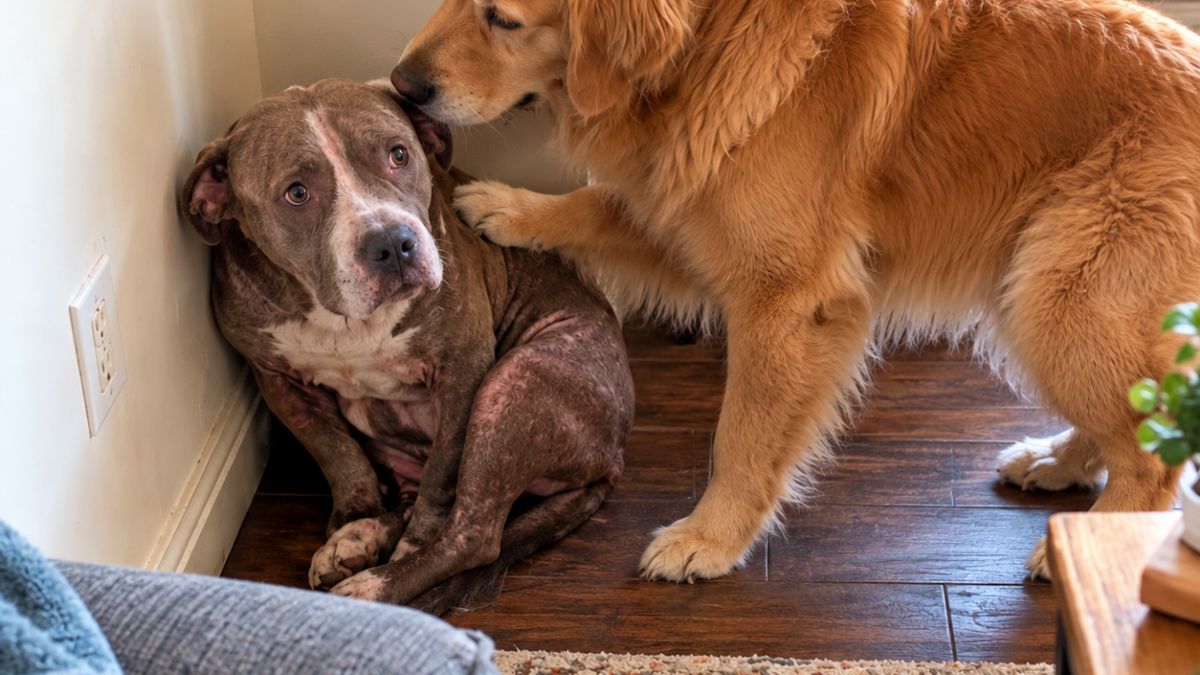
PART 2
I stood in my kitchen with the phone pressed against my ear.
“Are you sure he isn’t asking to go for a walk?”
Linda gave a tired laugh.
“I’ve walked him twice.”
“And he’s still doing it?”
“He comes back inside, goes straight to the side of the house facing yours, and whines.”
I looked into the living room.
Jack was where he always was.
Back against the wall.
Head low.
Nothing about him suggested that yesterday’s visit had mattered.
“Maybe Sunny smelled something interesting over here.”
“My dog once ignored a steak because somebody dropped a tennis ball,” Linda said. “Trust me, this isn’t about a smell.”
I hesitated.
The previous afternoon had seemed like a complete failure.
Sunny had tried to play.
Jack had refused even to look at him.
“I don’t want to stress Jack.”
“Neither do I.”
Linda paused.
“What if I bring Sunny over and we don’t make them interact?”
“What do you mean?”
“Sunny comes in. We sit down. Nobody asks Jack for anything.”
That sounded so obvious that I felt foolish for not having thought of it.
“Okay.”
Ten minutes later, Linda knocked.
Sunny was beside her.
The moment I opened the door, he slipped inside.
This time he didn’t bounce toward Jack.
He walked into the living room, looked at the corner, and stopped.
Jack’s eyes moved toward him.
That alone was different.
Sunny lowered himself onto the rug.
About eight feet away.
Then he did absolutely nothing.
Linda and I sat at the kitchen table drinking coffee.
Neither of us spoke to the dogs.
Five minutes passed.
Ten.
Sunny rested his chin on his front paws.
Jack kept watching him.
After twenty minutes, I noticed something.
Jack wasn’t pressed as tightly against the wall.
It was a tiny difference.
Maybe two inches.
But for Jack, two inches felt enormous.
Sunny eventually rolled onto his side.
Jack’s head lifted.
I touched Linda’s arm.
“Don’t look.”
“Why?”
“He’s watching Sunny.”
She stared into her coffee instead.
Sunny stretched.
Yawned.
Closed his eyes.
And Jack did something I had never seen him do.
He lay down.
Not curled into the smallest shape possible.
Down on one hip.
His head remained up, but his muscles looked less rigid.
Linda whispered, “There.”
I barely moved my lips.
“I see.”
Sunny stayed for an hour.
No touching.
No play.
No miraculous friendship.
When Linda called him to leave, he stood.
Jack stood too.
My heart jumped.
Sunny walked toward the front door.
Jack took one step after him.
Then stopped.
Linda saw it.
So did I.
Sunny looked back.
For a moment, the two dogs stared at each other.
Then Jack returned to his corner.
Linda and I waited until the door closed before reacting.
“Oh my God,” she whispered.
“He followed him.”
“One step.”
“He followed him.”
For the first time since the adoption, I felt hopeful.
Not because Jack had trusted me.
He hadn’t.
But apparently there was still something inside him capable of curiosity.
Sunny came back the next day.
And the day after that.
The routine remained simple.
Linda brought him over.
Sunny entered.
Jack watched.
Sunny lay somewhere in the room.
We ignored them.
On the fourth visit, Sunny drank from Jack’s water bowl.
I expected Jack to retreat.
Instead, he watched.
Sunny finished.
Walked away.
Jack waited about thirty seconds, then approached the same bowl and drank.
While I was still in the room.
I almost dropped my coffee.
Linda grabbed my wrist.
“Don’t react.”
“I wasn’t going to.”
“You were about to cry.”
“I can cry quietly.”
“Not helpful.”
So I stared at the table while Jack drank six feet away.
When he finished, he returned to his corner.
But something had shifted.
That evening I placed his dinner bowl in its usual spot.
Jack stared at it.
Then at me.
I sat on the couch and opened a book.
For ten minutes, nothing happened.
Then I heard his nails against the floor.
I kept reading.
Or pretending to.
Jack approached the bowl.
He stopped.
Looked at me.
I turned a page I hadn’t read.
Jack lowered his head.
One bite.
He froze.
I didn’t move.
Another bite.
Then another.
By the time I reached the bottom of a page I couldn’t remember, half the food was gone.
Jack backed away.
I waited until I reached my bedroom before I let myself cry.
It wasn’t sadness.
It was relief.
He had eaten while I existed in the same room.
The next morning, I called Hannah at the shelter.
“I think we made progress.”
She listened.
Then she said, “That’s not small progress, Claire.”
“It feels small.”
“It isn’t.”
I told her about Sunny.
Hannah laughed softly.
“Dogs can be incredible social models.”
“So I should keep doing it?”
“If both dogs remain comfortable.”
“What should I avoid?”
“Forcing interaction. Cornering Jack. Turning every improvement into a test.”
I knew exactly what she meant.
If Jack ate in front of me once, I couldn’t spend dinner staring at him, waiting for him to prove he could repeat it.
“If he steps forward, let it belong to him,” Hannah said.
That sentence became the rule of our house.
Let it belong to him.
Sunny visited almost every afternoon.
At first, the distance between them was measured in yards.
Then feet.
One Thursday, I came in from the kitchen and found Sunny asleep beside the couch.
Jack was lying three feet away.
Not against a wall.
Three feet away.
I stopped in the doorway.
Jack saw me.
His body tensed.
I almost backed out.
Then Sunny’s tail tapped the carpet without him opening his eyes.
Jack glanced toward him.
The tension left his shoulders.
He remained where he was.
That was the first time Jack allowed himself to stay vulnerable while I moved around the room.
A week later, Sunny brought a tennis ball.
Not intentionally.
Sunny carried tennis balls the way some people carried phones.
He dropped it near Jack.
The ball rolled until it touched Jack’s front paw.
Jack stared at it.
Sunny waited.
Jack moved his paw away.
Sunny picked up the ball.
Dropped it again.
Jack looked annoyed.
I bit my lip to keep from laughing.
Sunny tried a third time.
Jack stood and walked away.
Linda sighed.
“Sunny, buddy, read the room.”
But Jack didn’t return to the corner.
He stopped near the window.
Sunny followed.
Not too close.
Jack looked outside.
Sunny stood beside him.
For maybe ten seconds, they were shoulder to shoulder.
Then Jack moved away.
Still.
Ten seconds.
It was enough.
The first time Jack touched Sunny happened nearly two months after their first meeting.
Linda and I were in the backyard.
We had begun allowing Jack outside with Sunny in the fenced yard, always with plenty of space.
Sunny was lying in the grass.
Jack wandered near him.
Paused.
Then lowered his nose to Sunny’s shoulder.
Sunny remained perfectly still.
Jack sniffed.
Moved along his side.
Then Sunny turned his head and gently touched his nose to Jack’s cheek.
Jack jumped backward.
My heart stopped.
Sunny immediately looked away.
No pressure.
Jack stood several feet away.
He could have gone back inside.
Instead, he returned.
This time he sniffed Sunny’s ear.
Sunny’s tail moved.
Jack’s did not.
But he stayed.
That evening, when Sunny left, Jack stood at the front window for almost twenty minutes.
I called Linda.
“I think your dog has stolen mine.”
She laughed.
“Sunny charges by the hour.”
The relationship grew slowly.
Sunny never demanded much from Jack.
That was why it worked.
People had always approached Jack wanting something.
Obedience.
Movement.
A reaction.
Control.
Even kindness can become pressure when someone is terrified.
Sunny wanted nothing complicated.
Lie down.
Smell grass.
Drink water.
Walk outside.
Come back in.
The world, according to Sunny, was made of simple things.
Jack began copying him.
If Sunny came to me for a treat, Jack watched.
If Sunny allowed me to scratch behind his ears, Jack watched.
If Sunny slept with his belly exposed, Jack watched.
One afternoon I gave Sunny a piece of chicken.
Then I set another piece on the floor halfway between Jack and me.
Jack approached.
Ate it.
I placed the next piece closer.
He ate that too.
Then I held one between two fingers.
He stopped.
I almost put it down.
Then Sunny stepped beside me and took a different treat from my other hand.
Jack watched.
I held still.
He moved forward.
His nose touched my fingers.
Then his lips closed around the chicken.
So gently I barely felt it.
Jack backed away immediately.
I forgot to breathe.
Linda whispered, “Did he just—”
“Yes.”
“From your hand?”
“Yes.”
I sat down because my knees suddenly felt weak.
Jack watched me.
I smiled.
No reaching.
No celebration.
Just a smile.
“Good boy.”
His ears shifted.
That was all.
But that night, he slept halfway across the living room instead of against the wall.
I began measuring our life in firsts.
First treat from my hand.
First meal while I sat nearby.
First nap away from a corner.
First time he walked behind me into the kitchen.
First time he chose to stay in a room after I entered.
First time his tail moved when he saw Sunny.
That one took almost four months.
Sunny came through the back gate.
Jack was standing near the patio.
His tail gave one uncertain sweep.
Then another.
Sunny exploded with joy.
He ran in a ridiculous circle.
Jack jumped backward.
Then, for the first time, his mouth opened in what looked almost like a relaxed grin.
Sunny ran another circle.
Jack took three quick steps after him.
Stopped.
Sunny came back.
Jack moved again.
They weren’t exactly playing.
Not yet.
But they were negotiating the possibility.
I stood beside Linda with both hands over my mouth.
“Don’t cry,” she said.
“You’re crying.”
“I can multitask.”
By autumn, Jack had been with me for six months.
He still had fears.
Men in baseball caps made him retreat.
Metal clanging sent him under the table.
Raised voices shut him down.
He hated closed crates.
If someone approached too directly, he froze.
But he also had routines now.
Breakfast at seven.
Backyard with Sunny around four.
Dinner at six.
Evening on the living-room rug.
At bedtime, he followed me upstairs but slept in the hallway.
I had placed a bed there.
One morning, I woke with something warm against my hand.
I opened my eyes.
Jack stood beside the bed.
His nose touched my fingers.
I didn’t move.
He sniffed.
Then rested his chin on the mattress.
I thought my heart might actually break from the effort of staying still.
“Morning,” I whispered.
Jack didn’t leave.
I slowly turned my palm upward.
He sniffed it.
Then, very carefully, pushed his forehead into my hand.
That was the first time Jack asked me to touch him.
Not tolerated.
Asked.
I scratched beneath his chin.
His eyes closed.
Five seconds.
Then ten.
Then he stepped away and walked toward the hallway.
I lay there staring at the ceiling.
For six months, I had wanted Jack to understand that my hands were safe.
That morning, he decided they might be.
I arrived late to work.
I didn’t care.
Things might have continued quietly if not for the phone call from Hannah three weeks later.
“Claire, do you have a minute?”
Something in her voice made me sit down.
“What happened?”
“Nothing with Jack.”
That was not reassuring.
“What then?”
“The county investigator who worked the seizure case contacted us.”
I looked toward the living room.
Jack was asleep near the window.
Sunny had gone home an hour earlier.
“Why?”
“They reopened part of the investigation.”
“I thought the people involved were already charged.”
“Some were.”
“Some?”
Hannah hesitated.
“The property Jack came from wasn’t the whole operation.”
I felt a coldness settle in my stomach.
“What does that mean?”
“Investigators believe there were multiple locations.”
I looked at Jack’s scars.
“What do they need from me?”
“Mostly permission to review updated veterinary records and photographs.”
“For what?”
“Identification.”
I frowned.
“Identification of Jack?”
“Yes.”
“Why wouldn’t they know it’s him?”
“They do.”
Hannah lowered her voice.
“When Jack arrived, he had a number stamped into the inside of his old collar.”
I vaguely remembered the intake photo.
A heavy brown collar.
“Okay.”
“Investigators recently recovered business records from another property.”
My hand tightened around the phone.
“What kind of records?”
“Ledgers.”
I said nothing.
“Numbers. Dates. Payments. Dogs listed by numbers rather than names.”
“Jack’s number?”
“Yes.”
I stood.
“What does it say?”
“They won’t tell us everything.”
“Hannah.”
“I don’t know everything.”
“Does it say what happened to him?”
“Parts of it may.”
I looked at Jack.
He had opened his eyes.
He was watching me.
I lowered my voice.
“Do I need to bring him somewhere?”
“Not yet.”
“Is someone claiming him?”
“No.”
That was the one answer I needed immediately.
“His adoption is secure?”
“Completely.”
I exhaled.
Then Hannah said, “But there is one person investigators have been trying to build a stronger case against.”
“Who?”
“A man named Raymond Voss.”
The name meant nothing to me.
Hannah continued.
“He wasn’t at the property the day Jack was seized.”
“So?”
“Investigators believe he financed part of the operation and moved dogs between locations.”
My stomach tightened.
“And the ledger?”
“Apparently has his initials beside several entries.”
“Including Jack?”
“Yes.”
I sat down again.
For months, Jack’s past had existed as something horrible but vague.
An illegal operation.
Years of fear.
Scars.
That was all I wanted to know.
Suddenly there was a name.
Raymond Voss.
A real human being.
Someone who had potentially looked at Jack and reduced him to a number in a book.
“What happens now?”
“The investigator may call you.”
He did.
Detective Marcus Bell was not dramatic.
I had imagined someone speaking in grave tones, making promises about justice.
Instead, he sounded like an accountant who happened to investigate crimes.
“Ms. Bennett?”
“Claire Bennett, yes.”
“I understand you’re Jack’s current owner.”
“Yes.”
“I’m requesting copies of veterinary records since adoption and permission for our consulting veterinarian to compare identifying marks with historical images.”
“Why?”
“To strengthen continuity.”
“Explain that in English.”
He paused.
“Defense attorneys like to argue we cannot prove a record refers to a specific animal. Jack’s collar number matches the ledger, but numbers can theoretically be duplicated. Physical characteristics documented at seizure can add corroboration.”
I looked at Jack.
“What do you need him to do?”
“Nothing.”
“No tests?”
“Nothing invasive.”
“No sedation?”
“No.”
I relaxed slightly.
“What are you trying to prove?”
“That Mr. Voss’s involvement continued longer than he previously admitted.”
“What did he admit?”
“Very little.”
“Of course.”
Detective Bell ignored my tone.
“We also have records indicating payments tied to veterinary treatment for some dogs.”
I frowned.
“Veterinary treatment?”
“Minimal treatment intended to keep animals usable.”
I closed my eyes.
He continued quickly.
“I don’t need to give you details.”
“Good.”
The last thing I wanted was an inventory of Jack’s worst years.
“Will this put Jack in danger?”
“No.”
“Are you sure?”
“Yes.”
“Does Voss know where I live?”
“No information identifying adopters is being disclosed.”
I agreed.
The veterinary consultant came to my house the following week.
Her name was Dr. Reyes.
She spent most of the visit sitting on my kitchen floor without touching Jack.
By then, Jack could tolerate strangers if I managed the introduction carefully.
Sunny came over.
That helped.
Dr. Reyes photographed several old scars from a respectful distance, then used a handheld scanner to check for an old microchip.
Jack had one.
Not registered to Voss.
Not registered at all.
It had been implanted years earlier but never entered into any normal ownership database.
Dr. Reyes read the number twice.
Then looked at Detective Bell.
He wrote it down.
“What?” I asked.
He didn’t answer immediately.
“What?”
Dr. Reyes said quietly, “It appears in the records too.”
My stomach dropped.
“They tracked him by chip?”
“Not exactly,” Bell said. “The ledger includes both collar and chip numbers.”
“Why?”
“Inventory.”
The word made me sick.
Jack was standing beside Sunny.
Sunny licked his face.
Jack looked mildly annoyed.
I focused on that.
This was Jack.
Not inventory.
Not a number.
Not evidence.
Jack.
After the officials left, I sat on the back steps.
Linda came over when she saw my face.
“What happened?”
I told her.
She sat beside me.
For a minute, we watched the dogs.
Sunny was digging at something imaginary in the grass.
Jack stood nearby.
“Do you want to know what’s in the ledger?” Linda asked.
“No.”
The answer surprised me with how quickly it came.
“No?”
“I already know enough.”
Jack had survived.
That was the only fact from his past I wanted to live inside my house.
“I want them to use whatever they need,” I said. “But I don’t want to turn his life into a collection of terrible things.”
Linda nodded.
“Then don’t.”
A month passed.
Then two.
The investigation disappeared from daily life.
That was good.
Jack kept changing.
The first winter snow fascinated him.
He stood at the back door staring at the yard.
Sunny exploded outside and buried his nose in a drift.
Jack refused to move.
I stepped onto the patio.
He looked at me.
Then at Sunny.
Sunny ran back, covered in snow.
Jack sniffed his face.
Sunny ran away again.
Jack took one step outside.
Then another.
Ten minutes later, he was following Sunny around the yard.
Not running.
But trotting.
His tail was up.
I recorded fifteen seconds on my phone.
Then put it away.
Some moments are better when you actually live inside them.
That night, Jack slept on the couch.
Technically, he wasn’t allowed on the couch.
Apparently surviving six years of fear gave him different opinions about household rules.
I found him curled at one end.
He froze when I entered.
I looked at him.
He looked at me.
“I’m going to pretend I didn’t see this.”
His tail moved.
I sat at the other end.
Jack stayed.
Five minutes later, he rested his head on my thigh.
I didn’t pretend not to see that.
By spring, Jack and Sunny were inseparable.
Sunny came to the back gate each morning and made a ridiculous whining sound until I let Jack out.
They walked together.
Slept together in the sun.
Shared toys badly.
Sunny still tried to initiate wrestling.
Jack usually declined.
Then one April morning, I heard Linda shouting from her yard.
“Claire! Come here!”
I ran outside.
Sunny was in the grass.
Jack stood over him.
My heart stopped.
“What happened?”
Linda dropped beside Sunny.
“He collapsed.”
Sunny was conscious but weak.
Jack kept sniffing his face.
We rushed Sunny to the veterinary hospital.
Jack came with us because he refused to leave the car when I tried to take him home.
The diagnosis was frightening but treatable.
A heart rhythm problem.
Medication.
Monitoring.
No more wild running for a while.
Sunny stayed at the hospital overnight.
That night, Jack did something I had never seen.
He paced.
From the front window to the back door.
Again.
Again.
He wouldn’t eat.
At midnight, I sat on the floor.
“Sunny’s coming back.”
Jack looked toward the door.
I suddenly understood.
For months, Sunny had shown Jack that people and animals could leave a room and return.
Now Sunny had disappeared.
Jack had no framework for why.
I called Linda.
She was awake too.
“Can they let Jack visit?”
“At the hospital?”
“Yes.”
“I don’t know.”
The next afternoon, the veterinarian agreed to let us bring Jack into a quiet outdoor recovery area.
Sunny came out on a leash.
He looked tired.
The instant Jack saw him, he froze.
Sunny’s tail moved.
Jack walked forward.
He sniffed Sunny from nose to tail.
Then back again.
Sunny tried to lick him.
Jack pressed his shoulder against Sunny’s.
He stayed there.
No fear.
No distance.
Just contact.
Linda started crying.
“So much for him not knowing how to love another dog.”
I couldn’t answer.
I was crying too.
Sunny recovered.
Slower than before.
That changed their friendship.
Sunny had always been the teacher.
Now Jack began adjusting for him.
If Sunny slowed on walks, Jack slowed.
If Sunny stopped, Jack waited.
When Sunny tired in the yard, Jack lay beside him instead of wandering off.
One afternoon, I watched Jack bring the tennis ball to Sunny.
He dropped it near his front paws.
Sunny nudged it.
Jack picked it up.
Dropped it again.
I laughed so hard Linda came outside.
“What?”
I pointed.
Sunny had spent months trying to teach Jack to play.
Now Jack was trying to teach an aging Sunny not to stop.
That was when I realized healing had changed direction.
Jack was no longer only receiving safety.
He was capable of giving it.
Then Detective Bell called.
“Ms. Bennett, the Voss case is moving forward.”
My stomach tightened.
“What does that mean?”
“A grand jury returned additional charges related to the operation.”
I sat.
“Because of Jack?”
“Not because of any single dog.”
“Okay.”
“His records helped.”
I closed my eyes.
“What happens now?”
“Court.”
“Do I have to testify?”
“Possibly at sentencing or a hearing, but probably not during the main trial unless there is a dispute involving chain of custody.”
“I didn’t have Jack then.”
“Exactly.”
“What did the ledger show?”
I had spent months avoiding that question.
Now, unexpectedly, I asked it.
Bell paused.
“You sure you want to know?”
“Only what matters.”
He chose his words carefully.
“The records indicate Voss was financially involved for at least four years longer than he previously admitted.”
“And Jack?”
“Jack appears in multiple entries during that period.”
I swallowed.
“Did Voss know him?”
“We believe so.”
“How?”
“There are handwritten notes.”
“What notes?”
“Ms. Bennett—”
“I don’t need details about fights.”
He was quiet.
Then said, “One entry identifies Jack by his number and describes him as fearful around handlers.”
My grip tightened around the phone.
Fearful around handlers.
Even then.
Even in a ledger, somebody had noticed fear.
“What else?”
“Another note says he wouldn’t eat while people were present.”
I stopped breathing.
The first weeks in my house came back instantly.
The untouched bowl.
Jack waiting for me to leave.
That behavior wasn’t random.
It had history.
I sat there with my eyes closed.
Bell continued.
“You don’t have to hear more.”
“No.”
I didn’t.
After the call, I went downstairs.
Jack was asleep beside Sunny.
I sat near them.
Jack woke.
He looked at me.
For a second, the old reflex appeared.
A tiny tension.
Then it disappeared.
He stood.
Walked over.
And pushed his head under my hand.
I scratched behind his ears.
“You eat when I’m home now.”
His tail moved.
“You know that?”
Jack leaned closer.
I smiled through tears.
“That’s enough.”
The trial lasted several weeks.
I did not attend every day.
I had no desire to build my life around Voss.
But I attended when the ledger evidence was presented.
Linda came with me.
The courtroom was smaller than I expected.
Raymond Voss looked like any other man in his fifties.
Gray suit.
Neatly cut hair.
Reading glasses.
That bothered me.
Some primitive part of me wanted cruelty to announce itself visually.
It didn’t.
His defense argued that he had been a passive investor in a breeding operation and had no knowledge of illegal activity at several properties.
Then prosecutors showed his own records.
Payments.
Transport dates.
Dog identification numbers.
Property expenses.
Messages.
He had documented everything because he cared about money.
That became his undoing.
One prosecutor put a ledger page on a screen.
Rows of numbers.
Initials.
Amounts.
Jack’s old number was there.
I looked away.
Linda squeezed my hand.
Voss’s attorney argued the numbers could refer to anything.
Then the prosecutor produced the microchip list.
The same numbers.
Veterinary records.
The same numbers.
Seizure records.
The same numbers.
Voss had tried to distance himself by saying other people ran the locations.
His own bookkeeping connected him to them.
That was the part I found strangely satisfying.
Not shouting.
Not revenge.
Paper.
Years of careful little records made for profit now explaining exactly where he had been.
Several former associates testified.
One had accepted a plea agreement.
Another had managed a property.
Their stories aligned with the ledgers.
The defense tried to portray them as unreliable.
Then prosecutors introduced bank transfers from Voss.
Dates matched.
Amounts matched.
He had created his own map.
I understood something during that trial.
People sometimes imagine justice as one dramatic moment.
A confession.
A slammed gavel.
Someone finally admitting everything.
Real justice looked more boring.
Spreadsheets.
Receipts.
Dates.
Signatures.
People patiently proving one fact after another until denial had nowhere left to stand.
The verdict came on a Thursday.
Guilty on multiple charges related to financing and participating in the illegal operation.
Not every count.
Enough.
I didn’t cheer.
Nobody in our row did.
I felt relieved.
Then empty.
Voss turned once before leaving the courtroom.
For a second, his eyes moved across the gallery.
I wondered whether he knew who I was.
Probably not.
That felt right.
Jack’s life should not revolve around being remembered by that man.
At sentencing, the court imposed a multi-year prison term, financial penalties and a long-term prohibition against owning, breeding, boarding, or working commercially with animals.
He was also ordered to pay restitution connected to the care of several rescued dogs.
The prosecutor had asked whether I wanted to submit a statement.
I almost declined.
Then I wrote one page.
Not about scars.
Not about suffering.
About breakfast.
I described a dog who once waited until I left the house before eating.
A dog who now stood in my kitchen every morning and stared at me while I made coffee because he believed breakfast was late if it arrived after 7:02.
I described the first treat from my hand.
The first nap away from the wall.
The first snow.
Sunny.
The couch.
Then I wrote:
“The clearest evidence of what Jack lived through is not what appears on his body. It is the amount of time it took him to believe ordinary kindness would not be followed by something frightening.”
The prosecutor read part of it aloud.
I kept my eyes on the floor.
Voss did not apologize.
I had thought I wanted him to.
Sitting there, I realized I didn’t care.
An apology from him would not give Jack anything.
Jack already had what mattered.
When I returned home, Sunny and Jack were lying by the back door.
Jack stood when he saw me.
His tail started moving.
I knelt.
He came directly into my arms.
Two years earlier, he would not eat if I existed in the same room.
Now he pressed his chest against mine and pushed his nose under my chin.
I whispered, “It’s over.”
Of course he didn’t understand the court case.
He didn’t need to.
For him, it had been becoming over for years.
Every safe meal.
Every quiet night.
Every time I left and came home.
Every time Sunny walked through the gate.
Those were Jack’s verdicts.
Not the judge’s.
Sunny turned ten that summer.
His heart condition remained controlled, but age began catching up with him.
He couldn’t run the way he used to.
Jack could.
Not like a puppy.
But he had become strong and athletic.
Still, he never ran far from Sunny.
Their walks became slow.
Linda and I would follow twenty feet behind while the dogs moved together.
Sometimes Sunny stopped for no obvious reason.
Jack stopped too.
“Look at him,” Linda said one evening.
“What?”
“He’s waiting.”
I smiled.
Sunny had spent a year waiting for Jack to become ready for the world.
Now Jack waited for Sunny’s body to keep up.
The symmetry would have been too perfect if it weren’t real.
The following winter was difficult.
Sunny’s heart problem worsened.
Medication helped less.
Linda knew.
I knew.
Jack probably knew before either of us admitted it.
He began sleeping beside the fence separating our yards.
One night Linda called me at 2:00 a.m.
“Claire.”
I sat up immediately.
“What happened?”
“It’s Sunny.”
I was next door in less than a minute.
Sunny lay on his bed in Linda’s living room.
His breathing was shallow.
A mobile veterinarian was on the way.
Jack stood beside him.
I had brought him without thinking.
He approached Sunny.
Sniffed his face.
Then lay down.
Their paws touched.
Linda sat on the floor.
“I can’t do this.”
I took her hand.
“You don’t have to do it alone.”
Sunny’s veterinarian arrived.
She examined him.
Then looked at Linda.
We all understood.
There was no crisis-filled rush.
No panic.
Sunny was tired.
Linda chose not to make him struggle for one more night because she wasn’t ready for morning.
I respected her for that.
Jack stayed.
When Sunny became deeply relaxed, Jack moved closer.
He rested his chin across Sunny’s front leg.
I thought about their first meeting.
Sunny in my living room.
Tail wagging.
Trying to play.
Jack turning away.
Sunny returning the next morning anyway.
He had never demanded that Jack love him back.
He simply kept showing up.
When Sunny’s breathing stopped, Jack remained beside him.
He sniffed once.
Then again.
He didn’t panic.
Didn’t bark.
He seemed to understand something had changed.
Linda cried into my shoulder.
I cried too.
Jack stayed for almost an hour.
When I finally said, “Come on,” he stood.
At the doorway, he looked back.
Then followed me home.
For the next several days, he waited by the fence.
Sunny didn’t appear.
Jack stopped eating breakfast.
That terrified me.
Not because missing one meal would hurt him.
Because the behavior belonged to the old Jack.
I called Hannah.
She listened.
“Grief can bring old patterns back.”
“So I’m losing progress?”
“No.”
“It feels like it.”
“Claire, healing isn’t a staircase.”
I sat in my kitchen watching Jack through the window.
“What do I do?”
“Stay predictable.”
“That’s it?”
“That’s a lot.”
I kept his routine.
Breakfast at seven.
Walk at eight.
Backyard.
Dinner.
No pressure.
On the third day, I sat on the floor with his food bowl several feet away.
Jack lay near the door.
I didn’t leave.
Twenty minutes passed.
He stood.
Walked to the bowl.
Ate three bites.
Then came to me.
He pressed his head against my shoulder.
I put my arms around him.
For the first time, I realized he wasn’t only learning to survive grief.
He was choosing me inside it.
A month later, Linda brought me one of Sunny’s tennis balls.
Blue.
Chewed on one side.
“I couldn’t throw them away.”
“You don’t have to.”
She looked at Jack.
“Maybe he should have this one.”
Jack sniffed it.
Then carried it into the living room.
He placed it on his bed.
For weeks, he didn’t play with it.
He just kept it.
Spring came.
Linda didn’t adopt another dog.
Not immediately.
She said she wasn’t ready.
I understood.
Then the shelter called me about a different dog.
Not to adopt.
To help.
Hannah had started using stable adopted dogs in controlled social sessions with frightened shelter animals.
“Sunny helped Jack,” she said. “Jack might be able to help someone else.”
I laughed.
“Jack?”
“You’re allowed to say no.”
“He still doesn’t love strangers.”
“He doesn’t have to.”
“Other dogs?”
“He’s gentle.”
That was true.
The idea frightened me.
Not because I thought Jack would hurt anyone.
Because his confidence still felt precious.
I didn’t want to ask too much.
Hannah suggested one visit.
No expectations.
We arrived at the shelter on a Sunday morning.
Jack remembered the building.
The moment we entered, his body tightened.
I nearly turned around.
Then he looked at me.
I crouched.
“We can leave.”
He sniffed my hand.
Hannah waited near the door.
“His choice,” she said.
Jack looked down the hallway.
Then took one step forward.
We continued.
The dog waiting in the quiet yard was a small brown mixed breed named Daisy.
She had been rescued from a neglect case.
Different history.
Same kind of shutdown.
Daisy sat against the fence.
Back pressed to it.
Head low.
The sight stopped me.
“That was Jack.”
Hannah nodded.
“That’s why I called.”
We let Jack into the opposite side of the divided yard.
He saw Daisy.
Stopped.
For a few minutes, he simply stood.
Then something remarkable happened.
Jack lay down.
Not near her.
Not inviting play.
Just within sight.
Daisy looked at him.
Jack rested his head on his paws.
Ten minutes.
Fifteen.
Daisy stood.
She took one step away from the fence.
Then another.
Jack didn’t move.
I felt tears rising.
“Sunny,” I whispered.
Hannah heard me.
“Exactly.”
Jack had learned the lesson so well he could teach it.
Not with commands.
Not with bravery.
With presence.
Daisy eventually approached the barrier.
Jack stood.
They sniffed through the fence.
That was enough for the day.
We went back the following week.
Then again.
Jack became part of a small shelter program for fearful dogs.
Never every day.
Never forced.
Some dogs responded to him.
Others didn’t.
That was fine.
There were no miracle transformations.
Only small changes.
A dog taking food while Jack lay nearby.
Another stepping through a doorway.
One falling asleep away from the back wall.
I began to recognize progress differently.
Years earlier, I thought helping meant fixing something.
Jack taught me that sometimes helping means creating enough safety for another living creature to move one inch on its own.
Linda eventually joined us.
The first time she watched Jack lie beside a frightened young shepherd, she started crying.
“Sunny would be so proud.”
I smiled.
“He’d probably drop a tennis ball on both of them.”
She laughed.
“That too.”
Three years after I adopted Jack, Pine Ridge Shelter opened a dedicated quiet room for traumatized dogs.
The county used part of the restitution money from the Voss case to fund soundproofing, softer lighting, washable bedding and training for staff.
The shelter asked what to call the program.
Hannah suggested Jack’s name.
I refused.
“Why?”
“Because he already spent enough of his life being defined by what happened before.”
We eventually called it the Sunny Room.
Linda cried when she saw the plaque.
So did I.
Under the name was one sentence:
SOMETIMES TRUST BEGINS WITH SOMEONE WHO SIMPLY STAYS.
Jack didn’t care about the plaque.
He peed on a shrub outside and went looking for treats.
That seemed appropriate.
By the time Jack turned ten, gray had spread across his muzzle.
His hips began bothering him.
Nothing severe.
Just age.
I started adding joint supplements to his food.
The irony wasn’t lost on me.
The dog I once feared would never eat in my presence now stood beside the counter every morning monitoring portion sizes.
If I was slow, he nudged my leg.
“Excuse me?”
Nudge.
“You used to hide from me.”
Nudge.
“Your memory is very selective.”
His tail wagged.
He slept in my bedroom now.
Not the hallway.
Not near the door.
Beside my bed.
Sometimes, in the middle of the night, I would wake and hear him dreaming.
His paws moved.
Occasionally he made a small sound.
I never knew what he dreamed about.
I stopped assuming it was the past.
Maybe he dreamed about Sunny.
Snow.
Chicken.
The backyard.
Dogs have futures inside their heads too.
We forget that when we reduce them to rescue stories.
Jack wasn’t only what he survived.
He was the animal who stole socks but never damaged them.
The dog who hated rain.
The dog who preferred Linda’s treats to mine.
The dog who learned to open my bedroom door with his nose.
The dog who once ignored toys and later accumulated them in a pile beside the couch.
He was afraid of men wearing caps for years.
Then one afternoon my brother came over wearing a baseball cap.
I forgot to warn him.
Jack froze.
My brother stopped immediately.
He took the cap off.
Sat on the front steps.
Didn’t look at Jack.
Ten minutes later, Jack sniffed his shoe.
Twenty minutes later, he accepted cheese.
The next time my brother visited, he wore the cap in his hand.
Jack approached anyway.
A month later, he wore it on his head.
Jack hesitated.
Then walked over.
I nearly cried again.
By then, Jack had spent years making me cry over things other people would consider ridiculous.
Eating.
Sleeping.
Walking into rooms.
Tennis balls.
Strangers in hats.
Normal life looked extraordinary after you watched someone fight so hard to believe in it.
At eleven, Jack’s arthritis worsened.
We reduced shelter visits.
Daisy had long since been adopted.
Other dogs came through the Sunny Room.
Somewhere along the way, Jack became less of a participant and more of an honorary legend.
New volunteers knew his story.
I was careful with that.
“Don’t approach him because you know he’s famous around here,” I told one group.
They laughed.
I didn’t.
“Let Jack decide whether he wants to know you.”
That rule applied to every dog.
One volunteer, a young man named Aaron, followed it perfectly.
He entered the room.
Sat sideways.
Ignored Jack.
Jack approached within five minutes.
Aaron looked at me.
“Can I touch him?”
“Wait.”
Jack sniffed his hand.
Then pushed his head under it.
“Now.”
Aaron scratched his neck.
Jack leaned into him.
I smiled.
The dog who once believed hands predicted fear now went looking for them.
That was the real ending to Raymond Voss’s story.
Not prison.
Not fines.
Not the courtroom.
Voss had spent years teaching Jack that humans were dangerous.
Then ordinary people spent years teaching him the lesson was wrong.
Sunny taught him first.
I followed.
Linda.
Hannah.
Dr. Reyes.
Aaron.
Dozens of people who never demanded anything from him.
Cruelty had been loud.
Recovery was repetitive.
Quiet.
Breakfast.
Walk.
Door opens.
Door closes.
Person returns.
Hand reaches.
Nothing bad happens.
Again.
Again.
Again.
Eventually the new pattern became stronger than the old one.
When Jack turned twelve, Linda and I held a small birthday dinner.
Not a party.
Jack hated crowds.
Linda brought grilled chicken.
I bought him a ridiculous blue bow tie.
He tolerated it for forty seconds.
Then rubbed his neck against the couch until it fell off.
“Sunny would’ve worn it,” Linda said.
“Sunny would’ve worn a lampshade if you told him people liked it.”
She laughed.
We sat on the back porch.
Jack lay between us with Sunny’s old tennis ball nearby.
It was almost smooth now.
Linda looked at him.
“You know, I used to think Sunny saved him.”
“He did.”
“Partly.”
I looked at her.
“What do you mean?”
She smiled.
“Sunny showed him the door.”
“To what?”
“The rest of his life.”
I looked down at Jack.
He had fallen asleep.
One paw rested against my foot.
“He still had to walk through it,” Linda said.
She was right.
That mattered.
We love stories where one person rescues another.
But nobody can force healing into someone else.
Sunny didn’t fix Jack.
I didn’t fix Jack.
We made space.
Jack did the harder part.
He risked believing us.
The following winter, Jack began having trouble climbing stairs.
I moved my bedroom downstairs.
People asked why I didn’t simply teach him to sleep alone.
I laughed.
After everything it took to get Jack to sleep comfortably near me, I wasn’t going to send him upstairs or downstairs by himself because moving furniture was inconvenient.
We turned the old dining room into a bedroom.
Jack approved.
Mostly because it was closer to the kitchen.
His world became smaller.
But not sadder.
Walks were shorter.
Shelter visits rare.
Backyard time longer.
He spent afternoons lying in sunlight.
Linda came over almost every day.
One afternoon she sat beside him.
“Remember me bringing Sunny through that door?”
I smiled.
“You apologized because it didn’t work.”
“I thought I made everything worse.”
Jack lifted his head when he heard Sunny’s name.
Linda noticed.
“You remember him?”
Jack’s tail moved.
She pressed her hand over her mouth.
“I guess you do.”
At thirteen, Jack’s kidneys began to weaken.
Not immediately catastrophic.
Enough to change our routines.
Special food.
Medication.
More veterinary visits.
I knew where the path eventually led.
I tried not to live at the end before we reached it.
Jack still had good days.
Lots of them.
One spring morning, I opened the back door.
Jack stepped outside.
Stopped.
Lifted his face toward the sun.
Then, for no obvious reason, trotted toward the fence where Sunny used to wait.
Not fast.
His old body couldn’t do fast.
But there was joy in it.
He sniffed the grass.
Returned.
Picked up the blue tennis ball from the porch.
And carried it inside.
I watched him.
“Good day?”
Tail.
“Me too.”
The decline came gradually.
Then suddenly.
One week he was eating normally.
The next, less.
Then one Friday he left breakfast untouched.
That frightened me more than any medical number ever had.
I sat beside the bowl.
Jack lay on his bed.
For a second I was back at the beginning.
Full bowl.
Dog refusing to eat.
But this time he wasn’t afraid of me.
He was tired.
I called Dr. Reyes.
She came to the house.
After examining him, she sat beside me.
“We can hospitalize.”
“What would that do?”
“Fluids. Medication adjustments. Maybe give him a little more time.”
“How much?”
“I can’t promise.”
I looked at Jack.
He hated veterinary kennels.
Even after all these years.
Not panic anymore.
But stress.
“What kind of time?”
Dr. Reyes understood the question.
“Possibly days. Maybe weeks if he responds well.”
“Would he feel good?”
“I don’t know.”
That was enough.
I had spent years asking Jack to believe I would not force him through fear for my convenience.
I wasn’t going to break that promise because I wanted another week.
“Home,” I said.
Dr. Reyes nodded.
We kept him comfortable.
Linda stayed.
Hannah came the next afternoon.
Aaron stopped by.
No crowd at once.
Jack had never liked crowds.
People visited one at a time.
He accepted scratches.
Ate small pieces of chicken.
Slept.
On Sunday morning, he surprised me by getting up without help.
He walked to the back door.
I opened it.
He moved into the yard.
Slowly.
I followed.
Jack went to the fence.
The place where Sunny had scratched and whined years earlier, insisting on coming back.
Jack stood there for a long time.
Then lay down in the grass.
I sat beside him.
“You know, this whole thing is your friend’s fault.”
His ear moved.
“If Sunny had minded his business, I might still have furniture without dog hair.”
Tail.
“He was very annoying.”
Another small wag.
I laughed through tears.
“You miss him too?”
Jack rested his head against my leg.
We stayed outside until the air got cool.
That night, he couldn’t stand without help.
I knew.
There are decisions you spend years fearing, then when the moment arrives, the animal makes the answer clearer than you hoped.
Jack looked exhausted.
Not frightened.
Not suffering dramatically.
Just finished.
I called Dr. Reyes.
Then Linda.
Hannah came too.
We put Jack’s bed near the open back door so he could smell the yard.
Sunny’s tennis ball rested beside him.
Linda sat on one side.
I sat on the other.
Hannah stayed near his feet.
Nobody talked much.
Eventually Linda whispered, “You know the first time Sunny came over, I thought Jack hated him.”
I smiled.
“So did Sunny.”
“He looked so offended.”
“He’d never met a dog who didn’t want to be his friend.”
Linda laughed softly.
Jack opened his eyes.
His tail moved once.
We both stopped.
“You heard that name, didn’t you?” Linda whispered.
She touched the blue ball.
“Your ridiculous friend.”
Jack sighed.
Dr. Reyes arrived after sunset.
She explained every step.
I already knew it.
I needed to hear it anyway.
Jack’s head was in my lap.
I stroked the scar along his shoulder.
Years earlier, I had thought those scars were his story.
They weren’t.
They were only the prologue.
The real story was everything that came after.
The first meal.
Sunny lying on my rug.
A treat from my fingers.
Snow.
The couch.
A courtroom Jack never had to see.
A frightened shelter dog named Daisy.
A blue tennis ball.
Thousands of ordinary mornings.
I leaned close.
“When I brought you home, I thought I had no idea how to take care of a dog.”
Jack’s eyes remained on me.
“I still don’t know if I did everything right.”
His breathing was slow.
“But you taught me what you needed.”
My voice broke.
“Thank you for trying again.”
Linda was crying.
So was Hannah.
I pressed my forehead gently to Jack’s.
“You don’t have to be brave anymore.”
His eyes closed.
Dr. Reyes gave the first medication.
Jack’s body relaxed.
For perhaps the first time in his life, there was absolutely no tension anywhere in him.
No wall behind his back.
No eyes watching for danger.
No need to wait until a room was empty before taking what he needed.
He was home.
Surrounded by people he had chosen to trust.
His breathing became slower.
Then stopped.
I kept my hand on his head.
Nobody rushed me.
Outside, wind moved through the fence.
For a strange second, I imagined Sunny scratching at Linda’s old back door again.
Calling.
Come on.
This way.
I smiled through my tears.
“Go find him.”
Months passed before I could enter the Sunny Room without expecting Jack to be there.
The shelter placed a small photograph near the doorway.
Not Jack’s intake picture.
I refused that.
It showed him in my backyard, older, gray around the muzzle, lying beside Sunny.
Both dogs faced the sun.
Underneath, Hannah added a sentence from my court statement:
Ordinary kindness, repeated often enough, can become a new memory.
I liked that better than anything about survival.
A year after Jack died, Detective Bell called unexpectedly.
“I thought you’d want to know.”
“What?”
“The final restitution fund from the Voss case has been distributed.”
I hadn’t thought about Voss in months.
“Okay.”
“Pine Ridge received another grant.”
“For?”
“Behavioral rehabilitation.”
I sat down.
“How much?”
“Enough to expand the quiet-room program.”
I laughed softly.
“That’s fitting.”
Bell paused.
“You doing okay?”
“Yes.”
“You sure?”
I looked at Jack’s collar hanging beside my front door.
“Yes.”
And I was.
Grief still existed.
But grief wasn’t evidence that something had gone wrong.
Sometimes it was proof that something finally went right long enough to matter.
Pine Ridge expanded the program the following summer.
They added an outdoor decompression yard.
Training scholarships.
Temporary foster support.
A small emergency fund for dogs with difficult behavioral histories.
The county asked whether I wanted to speak at the opening.
I said no.
Then Hannah told me I was already scheduled.
“You can’t do that.”
“I’ve known you for years. Apparently I can.”
I stood in front of about forty people.
Volunteers.
Shelter staff.
County officials.
Linda.
Aaron.
No dramatic speech.
I told them about the first bowl of food Jack refused to touch while I watched.
Then I told them about the last year of his life, when he would stare at me every morning until I put breakfast down.
People laughed.
“That,” I said, “is the part I want you to remember.”
Not the scars.
Not the operation he came from.
Not the man who eventually went to court.
The breakfast.
A dog learned that being watched could mean somebody was simply waiting to see whether he wanted more.
Afterward, a young woman approached me.
She was holding the leash of a thin brindle dog.
The dog remained several feet behind her.
“I’m fostering him,” she said.
“How’s it going?”
“Terrible.”
I smiled.
“That can be a beginning.”
“He won’t come near me.”
“Okay.”
“He only eats when I leave.”
My chest tightened.
For a second, I couldn’t speak.
She looked embarrassed.
“I’m sorry. I know that’s probably not unusual.”
“No.”
I crouched sideways, keeping my distance from the dog.
“It isn’t unusual.”
“What do I do?”
I looked toward the photograph of Jack and Sunny visible through the shelter window.
Then back at her.
“Stop trying to make him prove he trusts you.”
She frowned.
“Just make the world predictable.”
“How long?”
“I can’t tell you.”
“What if it never works?”
I thought about my first weeks with Jack.
How desperately I wanted evidence that love was getting through.
How Sunny had come into my house and asked for nothing.
“Then you still gave him safe days.”
The woman nodded.
Her foster dog watched us.
I stood.
“Does he like other dogs?”
She smiled faintly.
“Actually, yes.”
I laughed.
“Well. I might know a story about that.”
Linda adopted another golden retriever eventually.
Not to replace Sunny.
That would have been impossible.
His name was Murphy.
He was two years old and almost offensively cheerful.
The first time she brought him to my yard, he ran straight toward the fence where Sunny used to wait.
I laughed.
“Of course.”
Linda smiled.
“He has no dignity.”
“Apparently it’s a breed trait.”
For a while, I thought about adopting again.
I kept stopping myself.
The house still felt like Jack’s.
Then one Saturday, Hannah called.
“I am not asking you to adopt a dog.”
“Good.”
“I want to make that clear.”
“You are definitely about to ask me to adopt a dog.”
“No.”
“What do you want?”
“We have a dog who isn’t doing well.”
I closed my eyes.
“Hannah.”
“She’s been here three weeks.”
“No.”
“She won’t come out of the back corner.”
“No.”
“She likes other dogs.”
I stared toward my window.
Murphy was in Linda’s yard carrying a branch twice the length of his body.
“You’re manipulative.”
“Yes.”
“I’ll visit.”
“That’s all I’m asking.”
It was not all she was hoping.
The dog’s name was Hope.
I hated the name immediately.
Too symbolic.
She was a small mixed breed, maybe four years old.
When I entered the quiet room, she was against the back wall.
I didn’t approach.
I sat.
Hannah stayed near the door.
“Sound familiar?” she asked.
“Be quiet.”
For twenty minutes, nothing happened.
Then Hope looked at me.
Only once.
But I recognized the feeling.
I called Linda.
“Can I borrow Murphy tomorrow?”
She laughed.
“I knew it.”
“You know nothing.”
The next day, Murphy entered the quiet yard.
He tried to bounce toward Hope.
She retreated.
I groaned.
“Murphy.”
Linda said, “He’s not Sunny.”
“No kidding.”
Murphy stared at Hope.
Then, by pure accident rather than wisdom, he became distracted by a leaf.
He lay down to destroy it.
Hope watched.
Ten minutes later, she stepped away from the wall.
I started laughing.
Linda looked at me.
“What?”
“Apparently the method doesn’t require genius.”
Murphy chewed his leaf.
Hope moved one step closer.
I felt the old ache in my chest.
Not grief exactly.
Something warmer.
Jack had once been the dog in the corner.
Then he became the dog lying calmly while another frightened animal watched him.
Now he was gone.
But the pattern remained.
One dog showing another that a room might be safe.
One person deciding not to rush.
One meal eaten while somebody stayed.
Hope did not come home with me that day.
Or the next.
I fostered her two weeks later.
I adopted her six months after that.
She was not Jack.
Thank God.
She had her own habits.
Her own fears.
Her own ridiculous preferences.
She hated the vacuum but loved thunderstorms.
She ignored tennis balls.
She slept upside down.
And unlike Jack, once she discovered food was reliable, she behaved as though starvation might return unless she personally inspected every grocery bag.
One evening, nearly eight years after I first saw Jack at the shelter, Hope was sleeping on my couch.
Murphy was beside her.
Linda and I sat at the kitchen table.
On the shelf behind us was Sunny’s blue tennis ball.
Beside it, Jack’s collar.
Linda looked at them.
“Do you ever think about that first visit?”
“Every time Murphy destroys something.”
“I mean Jack.”
“Yes.”
“You really thought Sunny failed.”
“So did you.”
“I apologized.”
“You did.”
She smiled.
“And then he kept scratching the door.”
I looked at Hope.
She had one paw resting across Murphy’s back.
“I used to think that was the moment everything changed.”
“Wasn’t it?”
“Not exactly.”
Linda waited.
I thought about Jack.
Six years of fear hadn’t disappeared because Sunny came through my doorway.
Nothing that simple happened.
Jack had made thousands of tiny decisions afterward.
Drink while I was there.
Eat.
Stand closer.
Take chicken.
Sleep away from the wall.
Touch Sunny.
Touch me.
Go outside.
Come back inside.
Trust again tomorrow.
Then do it again.
“The call wasn’t the change,” I said.
“What was?”
“It was an invitation.”
Linda looked toward the shelf.
“And Jack accepted.”
“Eventually.”
We sat quietly.
Hope woke.
She stretched.
Then walked into the kitchen and put her head on my knee.
I scratched behind her ears.
Outside, the fence between my yard and Linda’s was still there.
We had installed a small gate years ago for Sunny and Jack.
Neither of us ever removed it.
Murphy used it now.
Sometimes Hope did too.
I thought about closing it after Jack died.
I couldn’t.
Now I was glad.
Some doors deserve to stay open.
Jack entered my life as a dog who could not eat while a human being watched him.
Years later, on the final morning he was strong enough to walk into the yard, he had eaten pieces of chicken directly from my hand while Linda sat beside us.
That was the story I chose to keep.
Not what somebody forced him to become.
What he chose to become once force was gone.
A dog with friends.
A home.
A favorite couch he technically wasn’t allowed on.
A ridiculous golden retriever who refused to give up on him.
A person he trusted enough to sleep beside.
And eventually, a teacher for other frightened dogs.
The people who used Jack for their own purposes once treated his fear as useful.
They lost.
Not because I hurt them back.
Not because Jack learned aggression.
Not because revenge erased anything.
They lost because the life they tried to define became something completely different after they no longer controlled it.
Jack learned to play.
He learned to rest.
He learned to eat without waiting for the room to empty.
And by the end, he had learned something even harder.
He learned that when someone walked through a door, it didn’t always mean they were coming to take something from him.
Sometimes they were only coming home.
[END OF STORY]







