PART 2: She Was Left in the Forest to Starve With Her Body Shutting Down—By Morning, Joana Had Only One Chance Left
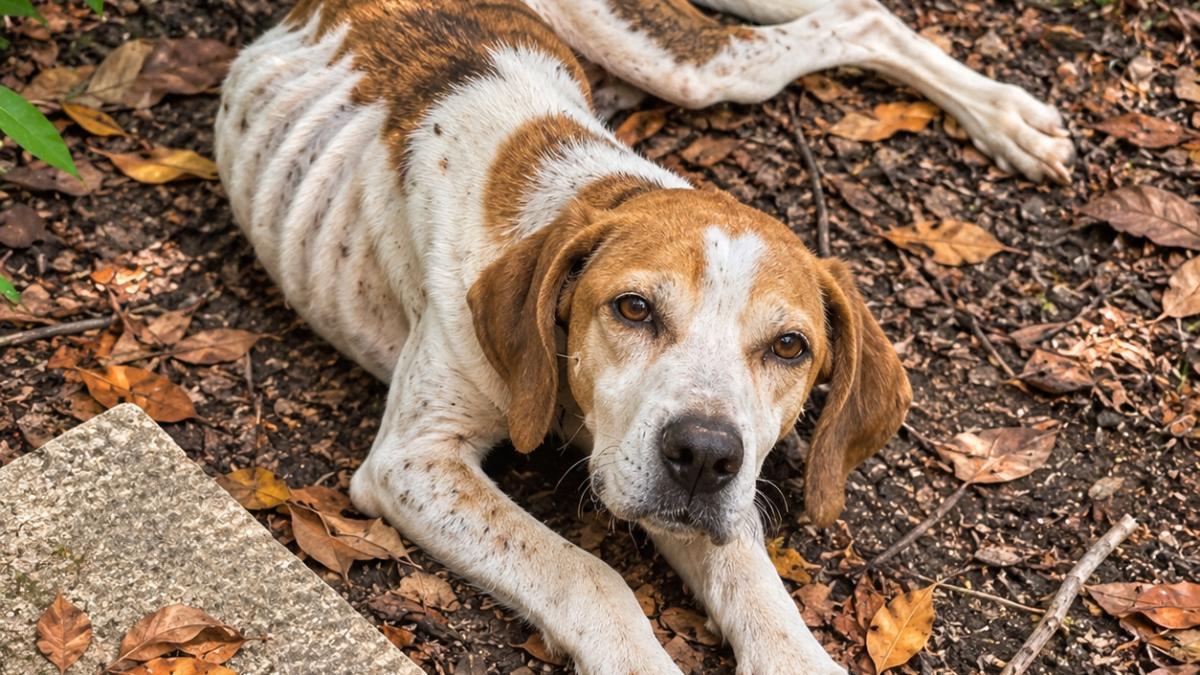
PART 2
“What did you find?”
The veterinarian looked back at the ultrasound screen once more before answering.
“There appears to be a mass near the end of her intestinal tract.”
I stared at her.
“A mass?”
“A tumor.”
The word landed differently than almost any word I’d been expecting.
I had been thinking constipation.
Severe dehydration.
Malnutrition.
Maybe an intestinal infection.
A tumor hadn’t even entered my mind.
“How big?”
She pointed toward the screen.
“It’s positioned in a very bad place.”
I stepped closer.
Most ultrasound images look like shadows and static to anyone who isn’t trained to read them.
I couldn’t truly understand what I was seeing.
But I understood the veterinarian’s voice.
Something was wrong.
Very wrong.
“What is it doing?”
“It’s almost completely blocking the exit.”
I looked at Joana.
She remained curled on the examination table under the blanket.
Her eyes were closed.
For the first time, all the pieces started fitting together.
The hunched posture.
The pain.
The refusal or inability to eat.
The fact that she apparently hadn’t defecated.
Her body wasn’t simply starving.
It was trapped.
“How long?”
“We can’t know exactly.”
The veterinarian moved the probe again.
“But this isn’t new.”
Another image appeared.
Then another.
The doctor’s expression tightened.
“There’s a very large amount of stool trapped inside.”
“How large?”
She hesitated.
“Enough that I’m worried about the intestine itself.”
I felt cold.
“What does that mean?”
“The stool has become severely impacted. Her intestine is under a lot of pressure.”
“Can you give her something to help her pass it?”
“Not safely in the way you’re thinking.”
I waited.
The veterinarian took a breath.
“The tumor is creating a mechanical obstruction. There isn’t enough space for this material to pass normally.”
I looked at Joana’s abdomen.
Until that moment, I had thought her thinness was the most shocking thing about her.
Now I understood that inside that skeletal body, there was an enormous amount of hardened material her system could no longer move.
“Can it rupture?”
The veterinarian looked directly at me.
“Yes.”
That single word made everything suddenly urgent.
“What happens if it ruptures?”
I already knew the answer wouldn’t be good.
“Intestinal contents can leak into the abdominal cavity. That can lead to severe infection, peritonitis, sepsis. In her condition…”
She didn’t finish.
She didn’t need to.
Joana was already dangerously weak.
Her body had no reserves.
If her intestine ruptured, there might not be enough strength left to save her.
“What do we do?”
“Surgery.”
“When?”
The veterinarian looked at the clock.
“First thing tomorrow morning.”
“Why not now?”
“We need to stabilize her as much as we can tonight.”
My eyes went back to Joana.
“Can she wait until morning?”
“We believe that’s the safest balance.”
The safest balance.
I hated those words.
Not because the veterinarian was wrong.
Because they revealed how few safe choices existed.
Operating immediately on a dog this weak carried enormous risk.
Waiting too long carried another risk.
There was no good choice.
Only the least dangerous one.
“Can we feed her tonight?”
“Very carefully. But honestly, food isn’t the immediate priority. Fluids are. Stabilization is.”
She looked at Joana again.
“Her body is severely compromised.”
I swallowed.
“What are her chances?”
The question hung there.
The veterinarian did not give me a comforting answer.
“There is a significant chance she may not survive surgery.”
I looked down.
Joana’s nose was resting against the blanket.
Her breathing was quiet.
“How significant?”
“I don’t want to give you a number that would be meaningless.”
“Is she more likely to die if we don’t operate?”
“Yes.”
That settled it.
“Then we operate.”
The veterinarian nodded.
“We’ll do everything we can.”
I placed my hand beside Joana’s face.
Her eyes opened halfway.
“Did you hear that?”
Nothing.
“Apparently tomorrow you’re having a very important morning.”
Her eyes closed again.
I tried to smile.
I couldn’t.
The clinic staff continued stabilizing her.
Warm blankets were layered around her.
Fluids ran into her body.
Medication was given carefully.
Every decision had to account for how fragile she was.
I stayed close.
Hours passed.
The clinic became quieter.
Phones stopped ringing.
Doors opened less frequently.
One by one, people went home.
But I couldn’t leave.
I sat beside Joana’s kennel.
“You probably don’t want company.”
She didn’t move.
“I’m staying anyway.”
The fluorescent lights had been dimmed in part of the clinic.
Joana lay wrapped so tightly in blankets that only part of her face was visible.
An IV line disappeared beneath the bedding.
Every few minutes, I watched the fluid chamber.
Drop.
Drop.
Drop.
Such a small thing.
Fluid entering a vein.
Yet that night, every drop felt like time.
I kept thinking about the forest.
Had she been lying there the night before?
Cold?
Hungry?
In pain?
Had cars passed nearby?
Had people walked past without seeing her?
Had she tried to stand and find help?
There are questions in rescue that never get answered.
Sometimes it’s better that way.
But that night my mind asked all of them.
Who abandoned her?
Did they know she was sick?
Did they know she couldn’t defecate?
Did they watch her lose weight?
Had she once belonged in a house?
Had she slept on a bed?
Had someone once called her by another name?
There was no way to know.
All I had was the dog in front of me.
“Joana.”
Her ear moved faintly.
I had started calling her that because she needed something more than “the dog from the forest.”
A name changes the way a story feels.
A nameless stray is a problem.
Joana was somebody.
“You’re not alone tonight.”
Her eyes opened.
I moved closer to the kennel.
“I don’t know whether you understand that yet.”
I rested my hand near her head.
“But you aren’t.”
For several seconds, her eyes remained on me.
Then they closed.
I stayed.
Sometime after midnight, one of the veterinary nurses came over.
“You should get some rest.”
“I am resting.”
She looked at the chair.
“That isn’t rest.”
“It’s enough.”
She smiled faintly.
“She’s stable right now.”
“Right now.”
“Yes.”
I hated that phrase too.
Right now.
Stable for now.
Safe enough for now.
Everything felt temporary.
I looked toward Joana.
“Do dogs know when they’re dying?”
The nurse paused.
“Sometimes they know they’re very sick.”
“She looks like she’s already given up.”
“I don’t know if I’d say that.”
“She barely reacts.”
“She’s exhausted.”
The nurse crouched near the kennel.
“But she followed you with her eyes earlier.”
I nodded.
“That matters.”
I wanted to believe her.
“What happens tomorrow?”
“The surgeons will assess everything once they’re inside.”
“And the tumor?”
“They’ll determine what can safely be done.”
“Can they remove it?”
“If it’s possible.”
I sat back.
There were too many ifs.
If she survived anesthesia.
If her intestine hadn’t already been damaged beyond repair.
If the blockage could be cleared without tearing tissue.
If the tumor could be dealt with safely.
If infection hadn’t already spread.
If her heart could tolerate the procedure.
If.
If.
If.
I hated the word.
Near two in the morning, Joana shifted slightly beneath the blanket.
I immediately leaned forward.
“What is it?”
She adjusted her head.
That was all.
I laughed quietly at myself.
“You moved three inches and scared me.”
Joana’s eyes opened.
“Sorry.”
She looked at me.
I touched the blanket beside her cheek.
“You’ve already survived being left out there.”
I wasn’t sure whether I was talking to her or myself anymore.
“You survived long enough for me to find you.”
Her breathing remained steady.
“So tomorrow, just do one more thing.”
I swallowed.
“Wake up.”
That request had become very simple in my mind.
I didn’t need her cured tomorrow.
I didn’t need her running.
I didn’t need her tail wagging.
I needed her to wake up after surgery.
Everything else could come later.
Morning arrived slowly.
I don’t think I truly slept.
At some point, the lights in the clinic brightened.
Staff began arriving.
Voices returned.
Machines were checked.
The night was over.
Joana was still alive.
That felt like the first victory.
The veterinarian examined her again.
“She’s a little better hydrated.”
“Enough?”
“Enough that we’re moving forward.”
Not reassuring.
But enough.
The surgical team prepared.
I stood beside Joana as long as I could.
She looked impossibly small against the blankets.
“Hey.”
Her eyes opened.
“This is where you have to do the hard part.”
I stroked her head.
“I wish I could do it for you.”
A technician approached.
“We’re ready.”
I nodded.
Then didn’t move.
The technician waited.
I bent closer.
“Come back.”
Joana looked at me.
“That’s all.”
I touched my forehead gently to hers.
“Just come back.”
Then I let them take her.
The doors closed.
And once again, all I could do was wait.
The surgery was delicate from the beginning.
Joana’s body was in no condition for unnecessary trauma.
The surgeons had to relieve the enormous impaction carefully because the intestinal tissue had already been stretched and stressed.
One wrong movement could tear it.
The hardened stool had to be cleared little by little.
Not forced.
Not rushed.
Every step had to protect tissue that had already been pushed dangerously close to failure.
I learned most of those details afterward.
At the time, I knew only that she was in surgery.
Minutes became hours.
Every sound from behind the treatment doors made me look up.
I tried to read.
Couldn’t.
Tried to answer messages.
Couldn’t concentrate.
I walked.
Sat.
Stood again.
At one point, I found myself staring at my hands.
The same hands that had lifted Joana from beneath the trees.
I could still remember how little she weighed.
How easily her body fit against me.
I wondered whether that had been the last time I would ever carry her awake.
I pushed the thought away.
No.
Not yet.
Eventually, a veterinarian came toward me.
I stood before she reached me.
“She’s out.”
I stared.
“Out?”
“Out of surgery.”
“Alive?”
“Yes.”
My knees weakened.
I reached for the back of the chair.
“She’s alive?”
“She’s alive.”
I closed my eyes.
For several seconds, I couldn’t speak.
Then I asked the next question.
“How did it go?”
“The impaction was severe.”
“But you cleared it?”
“We were able to remove the obstruction gradually.”
“And the intestine?”
“Fragile, but we avoided rupture.”
That sentence alone felt like a miracle.
“What about the tumor?”
“The immediate priority was relieving the obstruction and getting her through surgery safely.”
I nodded.
“Can I see her?”
“Not yet. She needs to wake up and remain closely monitored.”
“Is she in intensive care?”
“Yes.”
“Is she stable?”
“For now.”
There were those words again.
But this time, I accepted them.
For now was enough.
A few hours later, I was allowed to see her.
If someone had taken a photograph, it would not have looked like a happy ending.
Joana was still frighteningly thin.
Still surrounded by medical equipment.
Still under layers of blankets.
Tubes and lines still supported her.
She looked exhausted.
But she was breathing.
I stood beside her.
“Hey.”
Her eyes moved beneath the lids.
“You’re still here.”
For a moment, nothing happened.
Then her eyes opened slightly.
I felt my throat tighten.
“Hi.”
She looked in my direction.
It was barely a reaction.
But it was enough to make me cry.
“You came back.”
I reached toward her but stopped until the nurse nodded.
Then I touched the side of her head gently.
“Good girl.”
Joana closed her eyes again.
I had imagined I would feel relief after surgery.
Instead, relief came mixed with another kind of fear.
Because surviving the operation did not mean she was safe.
Her body remained depleted.
She had gone days without proper nutrition.
She had just undergone a major procedure.
Her intestines had endured severe stress.
Her entire system had to begin functioning again.
Recovery would be slow.
The veterinary team explained the next phase.
Monitoring.
Fluids.
Pain control.
Careful reintroduction of nutrition.
Watching for infection.
Watching for intestinal complications.
Watching everything.
“So we’re still not out of danger.”
“No.”
I looked at Joana.
“But she’s alive.”
“Yes.”
I smiled.
“Then that’s what we work with.”
The first twenty-four hours after surgery were terrifyingly quiet.
Joana mostly slept.
Every time I visited, she seemed wrapped in the same blankets, her body almost disappearing inside them.
I wanted movement.
I wanted enthusiasm.
I wanted proof.
But recovery does not happen on command.
Her body had spent too long losing.
It would need time to remember how to gain.
One of the nurses caught me staring at Joana’s food dish.
“Don’t worry if she doesn’t eat immediately.”
“I know.”
“You look worried.”
“I am worried.”
“Her body has been through a lot.”
“I know.”
“Give her time.”
Time.
Another word I had learned to respect.
For the first part of Joana’s rescue, time had been the enemy.
How long could she survive in the forest?
How long before the intestine ruptured?
How long before surgery?
Now time had become part of the treatment.
Wait.
Let her sleep.
Let the fluids work.
Let the inflammation settle.
Let her body heal.
It was difficult.
Rescuers are often people who want to do something.
Find the animal.
Pick them up.
Drive.
Sign forms.
Give medicine.
Clean wounds.
Feed.
Act.
But there are moments when the most important thing you can do is wait beside them.
So I waited.
The day after surgery, Joana opened her eyes more often.
She still didn’t show interest in food.
But she watched people.
“That’s better,” I said.
Her eyes moved toward me.
“Yesterday you barely cared who was in the room.”
She blinked.
“Today you’re judging us.”
Nothing.
“I’ll take it.”
On the second day, she shifted her body more deliberately.
The movement was small.
But she chose it.
That mattered.
The veterinarian examined her abdomen.
“So far, I’m encouraged.”
Those were perhaps the most beautiful words I’d heard all week.
“Encouraged enough to relax?”
The doctor smiled.
“No.”
“Of course not.”
“But encouraged.”
“I’ll take that.”
We discussed food.
The plan was cautious.
After a severe intestinal obstruction and major intervention, there was no reason to overwhelm her system.
Small amounts.
Careful observation.
If she tolerated it, gradually more.
The first time food was offered, Joana turned her head away.
I felt disappointed.
The nurse didn’t.
“That’s okay.”
“She hasn’t eaten in so long.”
“I know.”
“She needs calories.”
“She does. But forcing her isn’t the answer.”
I stared at the bowl.
“How long before you’re worried?”
“We’re already watching her closely. Right now we give her body some room.”
I nodded.
I hated patience.
Apparently Joana was going to teach me plenty of it.
Later that evening, I sat beside her.
“You know food is supposed to be your favorite thing eventually.”
Her eyes opened.
“I’m serious. Dogs are usually very good at this.”
She looked away.
“Fine.”
I moved the bowl slightly.
“No pressure.”
For several minutes, nothing happened.
I eventually left.
That night, I kept thinking about those first days in the forest.
She had been starving, but starvation wasn’t simply about the absence of food.
She couldn’t safely process food normally because her body was obstructed.
That was what made the situation so cruel.
Her body needed nutrition desperately while being physically trapped in a condition that prevented normal function.
The next morning, I walked into the clinic expecting another day of waiting.
One of the nurses looked at me differently.
“What?”
She smiled.
“She showed interest in food.”
I stopped.
“What do you mean, interest?”
“She smelled it.”
“That’s interest?”
“For Joana, yes.”
I laughed.
“Okay.”
“And she licked a little.”
My eyes filled immediately.
The nurse laughed.
“Don’t cry yet.”
“Too late.”
When I reached Joana’s kennel, there was a small dish nearby.
“Apparently you’re becoming a dog again.”
Joana looked at me.
I sat.
The nurse prepared another tiny portion.
“Let’s see what she does.”
The dish was placed within reach.
At first, Joana simply stared.
Her nose moved.
She smelled it.
Then she looked away.
My heart sank.
“That’s okay.”
The nurse nodded.
“Exactly.”
We waited.
Joana looked toward the bowl again.
Her nose moved.
Then, slowly, she leaned forward.
A single lick.
I held my breath.
Another.
Then the smallest mouthful.
It was so little that on any normal day, with any normal dog, no one would have noticed.
But nothing about that moment felt normal.
Joana swallowed.
I covered my mouth.
“She ate.”
The nurse smiled.
“Yes.”
“She actually ate.”
“Yes.”
Joana took another tiny mouthful.
My eyes blurred.
I had watched animals eat thousands of times.
I had filled food bowls without thinking.
I had watched dogs inhale dinner so quickly that I wondered whether they had tasted any of it.
But that morning, every movement of Joana’s mouth felt monumental.
Food went in.
She swallowed.
Her body accepted it.
No one had to force her.
No tube was delivering it while she lay unaware.
Joana chose to eat.
“Good girl.”
Another bite.
“That’s enough if you’re tired.”
She paused.
Then ate again.
I laughed through tears.
“Or ignore me.”
The nurse watched carefully.
“We’ll keep the amount small.”
“She wants more.”
“Wanting more is good.”
The bowl was removed before Joana could overdo it.
Her eyes followed it.
I couldn’t stop smiling.
“You saw that?”
The nurse nodded.
“She wanted it.”
“That’s the first time I’ve seen her want anything.”
That sentence stayed with me.
When I found Joana, she hadn’t seemed to want anything.
Not food.
Not attention.
Not even movement.
Pain and exhaustion had reduced her world to endurance.
Lie still.
Breathe.
Survive another hour.
Now she wanted food.
Wanting something meant there was a future beyond pain.
That afternoon, she ate again.
Still small portions.
Still cautiously.
But enough.
The veterinarian was pleased.
“This is what we want to see.”
“Is she safe now?”
The doctor smiled.
“You really like asking that question.”
“And you really dislike answering it.”
“Because recovery isn’t a switch.”
I looked at Joana.
“So what’s next?”
“We keep going.”
That became our answer.
Keep going.
The next few days were built from tiny improvements.
Joana became more alert.
She began raising her head when people entered.
She ate small meals.
Her body was still shockingly thin, but there was something different in her expression.
Presence.
Before, when I looked into her eyes, it felt like she was disappearing.
Now she looked back.
Sometimes she even watched the clinic staff move around.
One nurse joked that Joana had begun supervising everyone.
“She has opinions now.”
“Good.”
“You won’t say that when she gets stronger.”
“I absolutely will.”
The nurse laughed.
“Everyone says that.”
Maybe so.
But I meant it.
I wanted Joana inconvenient.
I wanted demanding.
I wanted her hungry.
I wanted her to wake people up.
I wanted her to refuse a blanket because she preferred another one.
I wanted every sign of life she’d been too sick to show.
One afternoon, Joana tried to reposition herself and pushed with her legs.
Her body trembled.
Immediately, I reached toward her.
The veterinarian stopped me.
“Let her try.”
“She’s weak.”
“Yes.”
“She might fall.”
“She’s already lying down.”
I realized how ridiculous I sounded.
Joana pushed again.
For a moment, she lifted part of her chest.
Then sank back.
I smiled.
“Show-off.”
The veterinarian laughed.
“That’s a good sign.”
Joana tried once more.
Her muscles had been starved.
It would take time to rebuild them.
But strength doesn’t return all at once.
It returns in small decisions.
Lift your head.
Shift your body.
Take a bite.
Try again.
I started recognizing those tiny acts as the language of recovery.
A few days later, Joana’s meals became one of my favorite parts of the day.
She was still fed carefully.
No huge portions.
Her digestive system needed respect.
But the hesitation gradually disappeared.
She smelled the food.
Then ate.
Sometimes she looked toward whoever held the bowl as if asking why the amount was so small.
“Don’t start complaining.”
Her eyes followed the dish.
“You didn’t want anything three days ago.”
Still watching.
“Now you’re offended by portion control.”
A nurse smiled.
“That’s progress.”
It was.
I thought back to the forest.
The image stayed with me.
Joana beneath the thin trees.
Body curled.
Ribs visible.
Too weak to rise.
No bowl.
No blanket.
No IV.
No one.
If I allowed myself to think about it too long, anger came.
Someone had left her like that.
Maybe they hadn’t known exactly what was wrong.
Maybe they had known she was sick and couldn’t afford treatment.
Maybe they had panicked.
Maybe they had simply stopped caring.
I didn’t know.
And because I didn’t know, I refused to invent an enemy.
It would have been easy to turn Joana’s story into one about punishment.
Find the person.
Demand answers.
Make someone pay.
But sitting beside her in the clinic taught me something more important.
Joana didn’t need revenge.
She needed recovery.
My anger couldn’t feed her.
It couldn’t repair her intestine.
It couldn’t put weight back on her body.
It couldn’t erase the forest.
The only useful thing I could do with anger was turn it into care.
Show up.
Pay attention.
Ask questions.
Bring blankets.
Sit beside her.
Celebrate every bite.
That was enough.
One evening, I sat near her kennel while she rested after eating.
“You know, I was very angry when I found you.”
Her eyes opened.
“I’m still angry.”
She blinked.
“But I don’t think you care.”
Nothing.
“You’re probably right.”
I smiled.
“You have better things to do.”
Joana closed her eyes.
“Like heal.”
The clinic became less frightening as the days passed.
At first, every conversation felt like it could contain disaster.
Intestinal rupture.
Surgery risk.
Complications.
Now the conversations slowly changed.
Appetite.
Hydration.
Stool.
Weight.
Energy.
None of those words sound dramatic until you’ve almost lost an animal.
Then they’re beautiful.
One morning, the veterinarian smiled before speaking.
“She passed stool.”
I stared.
“I’m sorry. Did you just tell me that with a smile?”
“Yes.”
“And I’m about to celebrate it?”
“Probably.”
I laughed.
For Joana, that simple bodily function was proof that the path which had once been almost completely blocked was functioning again.
It meant the surgery had accomplished what it needed to do.
Her body could move waste.
Something most living creatures do without anyone noticing had become an event.
“Good girl.”
Joana looked at me.
“You have no idea how proud everyone is of you for going to the bathroom.”
The veterinarian shook her head.
“Rescue changes people.”
“Apparently.”
The days that followed didn’t suddenly become easy.
Joana remained medically fragile.
She still needed observation.
She still needed nutrition.
Her body had a long recovery ahead.
The tumor itself remained part of her medical reality.
Nothing about what had happened could be reduced to a simple before-and-after transformation.
But the emergency had changed.
When I found her, Joana’s body was heading toward a catastrophic failure.
Now she was healing.
That distinction mattered.
There were no dramatic jumps.
No morning where she woke up suddenly healthy.
Instead, she improved in fractions.
A little more food.
A little more awareness.
A little more strength.
Her eyes stayed open longer.
Her head came up faster.
Her body temperature stabilized.
The hollow, distant expression began disappearing.
Sometimes I caught her watching me from her blankets.
“What?”
She continued staring.
“Are you judging me?”
Still staring.
“Good. Keep doing that.”
I loved that she had enough energy to care who was nearby.
One afternoon, I brought the same kind of blanket I’d used when I carried her from the forest.
I placed it beside her.
“Remember this?”
Of course she didn’t answer.
“You were wrapped in one just like it.”
Joana sniffed it.
“When I picked you up, I thought you might die in my arms.”
She settled her head on the blanket.
“I didn’t say that out loud.”
Her breathing was easy.
“But I thought it.”
I sat beside her.
“And then the doctor told me you might die in surgery.”
Joana closed her eyes.
“Apparently nobody explained to you that you were supposed to cooperate with all these terrible predictions.”
Her ear moved.
I laughed.
“Good.”
I had learned to speak about fear lightly around her.
Not because dogs understand every sentence.
Because I did.
If I could turn the worst memories into words and say them while looking at Joana alive, the memories lost some of their power.
I found you dying.
But you’re here.
Your intestine could have ruptured.
But it didn’t.
You might not survive surgery.
But you did.
You wouldn’t eat.
Then you ate.
Each sentence had two halves.
The horror.
Then the answer.
Joana was still here.
That was the answer.
One of the strangest things about rescue is how quickly extraordinary moments become routine.
The first bite made me cry.
A week later, I was measuring meals and complaining that Joana was staring at me for more.
The first time she lifted herself, everyone watched.
Later, we’d casually say, “She moved around more today.”
This is how healing sneaks into a life.
At first every improvement is a miracle.
Then the miracle becomes normal.
Eventually normal becomes the goal.
I wanted that for Joana.
I wanted a day when no one would watch her eat.
A day when nobody would count.
A day when her bowel movements were so ordinary that no one discussed them.
A day when blankets meant comfort instead of intensive care.
A day when lying beneath a tree meant she had chosen a shady place to nap, not that she had been abandoned there to die.
I didn’t know exactly when those days would come.
But for the first time, I believed they could.
Her appetite continued.
That was the most visible sign.
Food no longer seemed like something her body had forgotten.
She wanted it.
One morning, she smelled breakfast before the bowl reached her.
Her head came up.
I stopped.
“Was that because you smelled food?”
Her nose moved.
The nurse laughed.
“Oh, she’s definitely interested.”
I walked closer.
“Joana.”
Her eyes were fixed on the bowl.
“Look at me.”
Nothing.
“Joana.”
Still food.
I laughed.
“Perfect.”
She ate carefully but eagerly.
Every bite seemed to restore something beyond calories.
A little confidence.
A little expectation.
A dog who expects food is a dog beginning to trust tomorrow.
That may sound sentimental.
But after seeing animals who have been deprived, you understand it.
Hunger isn’t only physical.
Long-term neglect teaches an animal uncertainty.
Will there be food?
Will someone come?
Will pain stop?
Will I be left again?
Routine answers those questions.
Food arrives.
Again.
Blankets are clean.
Again.
People return.
Again.
The body learns.
The mind follows.
Joana began looking for us.
That change touched me almost as much as eating.
When I entered the room, her eyes followed.
If I stepped away, she watched.
I didn’t interpret it as some instant bond created by rescue.
Trust is slower than that.
But recognition mattered.
She knew my presence belonged to the safe part of her life.
One afternoon, I sat on the floor beside her while the clinic was quiet.
“You know what’s strange?”
Joana rested her head down.
“I was terrified you were going to die before you ever knew your name.”
Her ear twitched.
“And now you’re ignoring me.”
I smiled.
“That’s much better.”
The longer she survived, the more I allowed myself to imagine things.
Not huge things.
I had learned caution.
But maybe she would eventually walk outside comfortably.
Maybe she would experience grass without being too weak to stand.
Maybe she would learn that hands could mean affection rather than emergency handling.
Maybe she would sleep somewhere warm without an IV line.
Maybe one day, food would just be dinner.
Those images were enough.
I didn’t need a perfect cinematic future.
I needed more days.
Joana kept earning them.
There was a moment, several days into recovery, when I realized I hadn’t checked whether she was breathing for almost twenty minutes.
That sounds ridiculous.
Before surgery, I watched every rise of her chest.
Afterward, I still monitored constantly.
Then, without noticing, I relaxed.
I was sitting beside her and suddenly realized I’d been thinking about something else.
I looked at her.
Breathing.
Sleeping.
Fine.
I laughed quietly.
“What?”
One of the nurses asked.
“I forgot to be scared for a minute.”
She smiled.
“That’s a good sign too.”
It was.
Recovery isn’t just something that happens to the patient.
It happens to the people around them.
Your nervous system slowly stops expecting disaster.
You stop jumping every time a machine makes a sound.
You stop reading every facial expression as bad news.
You begin believing that perhaps the story isn’t heading toward loss.
Joana was teaching all of us that.
The veterinarian remained appropriately cautious.
There were still medical questions ahead.
The tumor couldn’t simply be forgotten because the immediate obstruction had been relieved.
Follow-up mattered.
Nutrition mattered.
Monitoring mattered.
But the acute crisis—the one that could have killed her in the forest or ruptured her intestine—had been survived.
Sometimes survival is enough for one chapter.
I asked the veterinarian one afternoon, “If I’d found her a day later, what do you think would have happened?”
She paused.
“You really want an answer?”
“Yes.”
“I can’t say exactly.”
“But?”
“But I don’t think she had much time.”
I looked at Joana.
She was eating.
That contrast hit me hard.
“Hours?”
“Maybe. Maybe longer. But she was in a dangerous state.”
I didn’t ask again.
There are alternate endings you don’t need described in detail.
The forest could have been the last place Joana ever saw.
Instead, it became the place her life changed direction.
That was enough.
I thought about the moment I first approached her.
If she had been hidden a little deeper among the trees, maybe I would have missed her.
If I had arrived later.
If someone had assumed she was already dead.
If we had waited for her to become stronger before surgery.
So many small decisions.
Rescue stories often look inevitable once you know the ending.
They aren’t.
They are built from timing.
Chance.
People noticing.
People choosing.
Medicine working.
Bodies responding.
Joana’s survival had depended on a chain of things going right after so many had gone wrong.
I never forgot that.
Her first careful meal remained the moment that symbolized everything for me.
People might expect me to choose the surgery.
The moment the doctors said she had survived.
Or the first time she became more alert.
Those were enormous.
But the food mattered differently.
Because eating is an act of life.
When Joana took that first small mouthful, she wasn’t merely surviving something that was being done to her.
She was participating.
Her body was saying yes.
Yes, I’ll take this.
Yes, I’ll use it.
Yes, I’m still here.
That was the moment hope stopped feeling theoretical.
A few days earlier, I had carried a dog from a forest who looked as though she was fading while I held her.
Now she was eating because she wanted to.
No dramatic music.
No crowd.
Just a small dog, a little bowl, and several people trying not to cry.
Those moments change you.
Before Joana, I thought I understood how valuable ordinary things were.
I didn’t.
She taught me.
Eating.
Going to the bathroom.
Sleeping without pain.
Being warm.
Having someone nearby.
These are not small things when you’ve lost them.
One evening, after Joana finished another small meal, she rested her head against the blanket.
I sat beside her.
“Do you know what everyone keeps asking?”
Her eyes stayed open.
“They want to know if you’re going to be okay.”
She blinked.
“I keep asking too.”
I looked at her thin body.
“I don’t know the whole answer yet.”
That was true.
Her recovery was still ongoing.
“But I know something.”
Joana’s eyes stayed on me.
“You’re better than you were under those trees.”
I smiled.
“Much better.”
She closed her eyes.
“And today, that’s enough.”
I think that was the lesson Joana left with me.
You don’t always need the entire happy ending at once.
Sometimes the satisfying ending is simply that there will be another chapter.
When I found her, there almost wasn’t.
Her body was starving.
Her intestine was nearly completely blocked.
Hardened stool had accumulated until rupture became a real threat.
She was too weak to face surgery safely, yet too sick to wait for strength.
Everything about her condition created impossible choices.
And yet the veterinary team made one careful decision after another.
Fluids.
Warmth.
Stabilization.
Surgery.
Slow removal of the obstruction.
Intensive care.
Nutrition.
Monitoring.
And Joana answered each effort with one more day.
Then another.
Eventually, she answered with hunger.
There are few things more hopeful than hunger in an animal who nearly died.
Hunger says the body expects to continue.
It expects another hour.
Another meal.
Another morning.
When Joana began eating, I stopped seeing only the dog I’d found.
I started seeing the dog she might become.
Not because her medical problems had magically disappeared.
They hadn’t.
Not because there would be no more difficult days.
No one could promise that.
But because she had crossed a line.
She had gone from being an animal we were desperately trying to keep from dying to an animal actively beginning to recover.
That difference was everything.
One morning, Joana finished her portion and looked toward the bowl after it was removed.
I laughed.
“No.”
Her head followed it.
“You’re getting more later.”
She stared.
“Don’t look at me like that.”
One of the nurses laughed.
“She’s learning quickly.”
“Apparently.”
Joana looked back at me.
“You went from not eating to emotional manipulation in record time.”
She blinked.
I couldn’t stop smiling.
That was the Joana I wanted.
Not grateful.
Not tragic.
Not permanently defined by suffering.
Alive enough to have demands.
Alive enough to want.
Alive enough to make us laugh.
There is a temptation when telling rescue stories to keep returning to the worst photograph.
The ribs.
The forest.
The IV.
The surgery.
Pain grabs attention.
But if we keep an animal frozen forever in their worst moment, we miss the point of saving them.
Joana deserved to become more than the dog under the trees.
More than a blocked intestine.
More than a tumor.
More than a surgical risk.
More than a story people cried over.
She deserved ordinary dignity.
So when I remember her, I don’t stop at the forest.
I don’t stop at the ultrasound.
I don’t stop at the night I sat beside her kennel wondering whether morning would take her away from me.
I remember the bowl.
I remember her nose moving.
The hesitation.
The first lick.
The first mouthful.
The swallow.
The second bite.
I remember looking at the nurse and saying, “She ate.”
As though no dog had ever eaten before.
Maybe, in that moment, no dog had.
Not the way Joana did.
That food wasn’t simply nutrition.
It was evidence.
She had survived.
The surgery had given her body room to function again.
The intestine had not ruptured.
She had made it through anesthesia.
She had woken up.
She had remained stable.
And now she was doing something that had been impossible for her before.
She was taking in life.
One careful mouthful at a time.
That became the ending I wanted for her story.
Not revenge against whoever abandoned her.
Not a dramatic confrontation.
Joana didn’t need her suffering to be balanced by somebody else’s suffering.
She needed the opposite.
She needed pain to be answered by comfort.
Abandonment answered by presence.
Hunger answered by food.
Cold answered by blankets.
Fear answered by gentleness.
Illness answered by medicine.
That was justice enough for me.
Maybe one day there would be answers about where she came from.
Maybe there wouldn’t.
But I no longer needed them to understand what mattered.
The person who left her was part of the reason her story hurt.
The people who refused to leave her were the reason it continued.
I would rather remember them.
The veterinarian staring at the ultrasound and refusing to waste time.
The staff staying close during the night.
The surgical team working slowly around fragile tissue.
The nurses checking her repeatedly.
The hands that adjusted blankets.
The people who celebrated a mouthful of food.
Those were the people who defined Joana’s future.
Not the person who abandoned her.
One afternoon, I sat beside Joana again.
She had eaten.
Her eyes were brighter.
She looked tired but peaceful.
I thought about the first thing I’d said when I found her.
“It’s okay.”
At the time, it hadn’t been true.
Nothing was okay.
Her body was in danger.
She was starving.
Her intestine was obstructed.
She was alone.
But maybe those words weren’t a description.
Maybe they were a promise.
It will be okay.
Not immediately.
Not easily.
Not without fear.
But we are going to try.
I reached through and stroked her head gently.
“Remember when I told you it was okay?”
Her eyes moved toward me.
“I was lying.”
I smiled.
“But I’m trying to make it true.”
Joana relaxed beneath my hand.
For that moment, it felt true enough.
No forest.
No cold ground.
No desperate drive.
No silent ultrasound room.
No surgery happening behind closed doors.
Just Joana.
Warm.
Fed.
Alive.
I don’t know that any rescue story needs a more perfect ending than that.
We often imagine happy endings as something huge.
A dramatic transformation.
A perfect home.
A life without any remaining problem.
Real medicine isn’t always so clean.
Real rescue isn’t either.
Sometimes a happy ending is simply reaching the point where death is no longer the only thing everyone is thinking about.
Joana reached that point.
The first time I walked into the clinic and saw staff smiling before they spoke, I noticed.
The first time nobody used the words “critical” or “rupture,” I noticed.
The first time I asked how she was and heard, “She ate well,” instead of a medical warning, I noticed.
The story was changing.
So was Joana.
Her ribs were still visible.
Her body still had a long distance to travel.
But recovery had started.
That’s what mattered.
I hope someday Joana can lie beneath a tree again.
Not because she’s been abandoned.
Because it’s warm.
Because there’s shade.
Because she’s tired after walking.
Because she chooses that spot.
I hope she can stretch out instead of curling around abdominal pain.
I hope she can fall asleep knowing someone will come looking if she stays outside too long.
I hope food becomes so reliable that she occasionally refuses something because she wants something better.
I hope she becomes difficult enough to have preferences.
Those hopes were impossible when I found her.
Now they aren’t.
That’s what survival changes.
It turns impossible hopes into reasonable ones.
Maybe that is what I saw in those first careful bites.
A future becoming reasonable.
Joana ate.
Then rested.
Then ate again later.
Her body accepted nourishment.
The same body that had been wasting away beneath the trees began, very slowly, rebuilding itself.
Nothing dramatic happened in that moment.
No one announced that she was saved.
No one could.
But I watched her.
One bite.
Then another.
And I understood.
The dog I’d carried from the forest had spent days being emptied by hunger, pain, and neglect.
Now, finally, something was going back in.
Food.
Warmth.
Care.
Strength.
Hope.
She was no longer disappearing.
She was returning.
That is how I choose to remember Joana.
Not as the dog someone left to die beneath thin trees.
Not as the ultrasound image that made two veterinarians fall silent.
Not as the fragile patient who might not survive the morning.
I remember her lifting her head toward a bowl.
I remember her nose moving.
I remember the first careful bite.
I remember crying because she swallowed.
And I remember thinking that maybe life doesn’t always come roaring back.
Sometimes it returns quietly.
A tired dog.
A small meal.
A room full of people pretending not to cry.
One mouthful.
Then another.
That was Joana’s victory.
She had been abandoned when her body was failing.
She had been found starving and unable to relieve herself.
A tumor had nearly sealed the end of her intestine.
An enormous amount of hardened stool had accumulated behind it.
Her intestine could have ruptured.
Her body was too weak for surgery, but waiting could have killed her.
She went into the operating room with no guarantee she would come out.
But she did.
She woke up.
She endured intensive care.
She rested beneath warm blankets.
And a few days later, she ate.
For anyone else, it might have looked like breakfast.
For Joana, it was a second chance.
I looked at her after she finished one of those early meals.
“Good girl.”
Her eyes lifted toward me.
“You know what?”
She waited.
“You don’t have to prove anything else today.”
Her head settled back down.
“No bravery.”
I stroked her gently.
“No fighting.”
She closed her eyes.
“Just rest.”
Her breathing slowed.
I sat beside her.
And this time, when she fell asleep, I wasn’t afraid she wouldn’t wake up.
That was when I knew something had truly changed.
Joana still had healing ahead of her.
She still needed care.
She still had a medical journey beyond that room.
But she had crossed the impossible part.
The forest hadn’t taken her.
The obstruction hadn’t taken her.
The surgery hadn’t taken her.
Hunger hadn’t taken her.
She was still here.
And for the first time since I found her, being alive no longer looked like suffering.
It looked like the beginning of something.
So I stayed beside her a little longer.
Not because she was dying.
Because she wasn’t.
And that made all the difference.
Joana had been left beneath a few thin trees to disappear, so weak from hunger and pain that she could barely raise her head when I found her.
Her ribs were pushing through her skin, she hadn’t eaten for days, and something inside her body was preventing her from doing even the most basic thing she needed to survive.
But I didn’t understand how close she was to dying until the veterinarian looked at the ultrasound screen, went completely silent, and called another doctor into the room.
I had seen abandoned dogs before.
I had seen starvation.
I had seen dogs trembling beside highways, dogs tied to broken fences, dogs too afraid to look directly at the people trying to help them.
I had seen the dull, faraway expression that appears when an animal has been struggling for too long without anyone coming.
But there was something about Joana that stopped me before I even reached her.
Maybe it was the stillness.
A frightened dog usually reacts somehow.
They bark.
They run.
They crawl backward.
They flatten themselves to the ground.
Joana did almost nothing.
She was curled beneath a patch of thin trees where the ground was dry and scattered with leaves, her body bent inward as though she was trying to make herself smaller than the pain inside her.
At first, I thought she might already be dead.
I stood there staring.
Then her chest moved.
Barely.
A slow breath.
Then another.
“Hey, sweetheart.”
No response.
I took a few steps closer.
The closer I got, the worse she looked.
Her hips were sharp beneath her skin.
Her backbone was visible.
Every rib seemed drawn across her side.
Her coat looked dull and lifeless.
There was no healthy weight anywhere on her body.
She looked as though hunger had been slowly removing pieces of her.
I crouched several feet away.
“It’s okay.”
One ear moved.
That was all.
“I’m not going to hurt you.”
Her eyes opened.
I still remember that look.
There was no aggression.
No panic.
No warning.
Only exhaustion.
A dog that had spent all the energy she had left simply staying alive.
I reached one hand toward her.
She didn’t pull away.
Her nose moved slightly.
Then her head lowered back to the ground.
That terrified me.
A dog who is still strong enough to fear you may fight.
Joana didn’t have that strength.
I moved closer and touched her gently along the back.
Her body was cold.
“God…”
The word escaped before I could stop it.
Up close, I could see that she wasn’t simply starving.
She was in pain.
Her abdomen looked tense despite how thin she was.
Her body remained hunched.
Every small movement seemed to hurt.
I ran my hand lightly along her side.
She tightened immediately.
“Okay. Okay. I won’t touch there.”
She relaxed a fraction.
I looked around.
There was no food bowl.
No container of water.
No blanket.
No collar.
No sign that anyone intended to return for her.
Just a dying dog beneath trees.
“How long have you been here?”
Silence.
No one would ever answer that question for me.
I slid my arms carefully beneath her.
She weighed almost nothing.
That is one of the things that stayed with me most.
Not the image.
The weight.
Or rather, the lack of it.
A living dog should have substance in your arms.
Joana felt almost hollow.
When I lifted her, she didn’t struggle.
Her head rested against my forearm.
I wrapped her tightly in a blanket.
“I’ve got you.”
Her eyes opened.
“I know you don’t believe me yet.”
She blinked.
“But I’ve got you.”
I carried her toward the vehicle.
For several seconds I kept expecting her to resist.
She didn’t.
That worried me more than anything.
I placed her carefully inside and started the drive.
Every few moments, I looked over.
“Stay with me.”
Her eyes stayed closed.
“Come on, Joana.”
I didn’t even know yet whether Joana would become her permanent name.
I just needed something to call her.
Something that made her more than the abandoned dog from the woods.
“Stay.”
Her chest moved.
That was enough.
I called the veterinary clinic.
“I’m bringing in an emaciated female dog. She’s extremely weak, hasn’t been eating, and I think she has severe abdominal pain.”
“How responsive?”
“Barely.”
“Breathing?”
“Yes.”
“Vomiting?”
“Not that I’ve seen.”
“Has she defecated?”
I looked at Joana.
“I don’t think she can.”
There was a brief silence.
“Bring her straight in.”
When I arrived, the staff moved quickly.
A technician took Joana while another began asking questions.
“Age?”
“I don’t know.”
“History?”
“None.”
“Owner?”
“I found her abandoned.”
“When did she last eat?”
“I don’t know.”
“Bowel movement?”
“I don’t know.”
Every answer felt useless.
I knew almost nothing about her except that someone had left her in terrible condition and that if I hadn’t found her, she might have died beneath those trees.
The veterinarian examined her.
Temperature.
Gums.
Heart rate.
Hydration.
Abdomen.
The moment she touched a particular area, Joana’s body tightened.
The veterinarian stopped.
“She’s very painful.”
“I know.”
“How long has she been unable to defecate?”
“I have no idea.”
The vet looked at me.
“She needs imaging.”
“Do whatever you need.”
Blood was drawn.
Fluids were started.
Joana was placed on warmth because her body temperature was too low.
I stayed nearby as much as they allowed.
She looked even smaller on the examination table than she had in the forest.
At least in the woods, the ground had made her look like part of the landscape.
In the clinic, surrounded by stainless steel and bright lights, she looked like what she really was.
A dog whose body was shutting down.
When they brought in the ultrasound equipment, I stood beside her.
The veterinarian applied gel and moved the probe carefully over Joana’s abdomen.
At first, I watched the screen.
Then I realized I understood nothing.
So I watched the veterinarian’s face instead.
That was worse.
Her expression changed.
She slowed the probe.
Stopped.
Adjusted it.
Looked again.
“What?”
No answer.
She called toward the door.
“Can you come here for a second?”
Another veterinarian entered.
The two of them looked at the screen.
Neither said anything immediately.
I felt my stomach drop.
“What are you seeing?”
The first veterinarian took a breath.
“There appears to be a mass near the end of the intestinal tract.”
“A mass?”
“Yes.”
“What kind of mass?”
“It appears to be a tumor.”
For a second, I heard the words but didn’t understand them.
“A tumor?”
The veterinarian nodded.
“It’s positioned very close to the exit.”
“What does that mean?”
She pointed toward the screen.
“It’s nearly blocking the passage.”
I looked at Joana.
Suddenly the entire picture became clearer.
The hunched posture.
The refusal to eat.
The pain.
The fact that she couldn’t defecate.
Her body wasn’t just starving.
It was physically trapped.
“How blocked?”
“Almost completely.”
I stared at her.
“And all this time she’s been eating nothing because…”
“Because her system isn’t moving normally.”
The veterinarian continued the scan.
Then her expression changed again.
“There’s a very large amount of hardened stool trapped inside.”
“How much?”
“A lot.”
“What does that do to her?”
“It stretches the intestine and increases pressure.”
“Can it tear?”
The veterinarian looked at me.
“Yes.”
That single word changed everything.
“If it tears?”
“Contents can leak into the abdomen. That can cause peritonitis, severe infection, sepsis.”
I looked back at Joana.
“And in her condition?”
The veterinarian didn’t answer immediately.
She didn’t have to.
Joana barely had enough strength to lie there.
A catastrophic rupture could kill her.
“What can we do?”
“Surgery.”
“When?”
“Tomorrow morning.”
I stared at her.
“Tomorrow?”
“We need to stabilize her tonight.”
“What if her intestine ruptures before then?”
“That’s the risk.”
I felt anger rise in my chest.
Not at the vet.
At the situation.
At the fact that every option sounded dangerous.
“She’s too weak for surgery.”
“Yes.”
“But waiting is dangerous.”
“Yes.”
“So there isn’t a safe choice.”
“No.”
That honesty was brutal.
But I appreciated it.
No false hope.
No promises.
No pretending.
Only reality.
“What are her chances?”
The veterinarian glanced at Joana.
“She’s severely compromised.”
“That doesn’t answer me.”
“I know.”
I waited.
“There is a significant risk she will not survive anesthesia or surgery.”
I looked down.
Joana lay quietly.
It was almost impossible to reconcile the seriousness of the conversation with how small she looked.
“She can’t wait until she gains weight?”
“No.”
“Until she’s stronger?”
“No.”
“So tomorrow is it.”
“Yes.”
I put my hand beside Joana’s face.
Her eyes opened slightly.
“She’s going in.”
The vet nodded.
“We’ll stabilize her through the night.”
“Then do whatever you need.”
The clinic continued treatment.
Warm fluids.
Careful monitoring.
Pain management.
Everything designed to give her body even a little more strength before morning.
I stayed.
At first, people assumed I would eventually leave.
I didn’t.
The clinic grew quieter.
Phones stopped ringing.
The front doors locked.
Day staff disappeared one by one.
Night staff took over.
Joana was moved into a kennel with thick blankets.
An IV line ran into her.
Her eyes were almost completely closed.
I pulled a chair beside her.
One of the nurses looked at me.
“You can go home. We’ll call if anything changes.”
“I know.”
“You’ve had a long day.”
“She’s had a longer one.”
The nurse gave me a tired smile.
“You’re staying.”
“Yes.”
She nodded.
“Okay.”
I sat there.
For a while, I said nothing.
There wasn’t anything useful to say.
Joana breathed.
The IV dripped.
The machines hummed softly.
Eventually I leaned closer.
“You know what I hate?”
Her eyes didn’t open.
“I hate that I don’t know anything about you.”
No reaction.
“I don’t know where you lived.”
I rested my elbows on my knees.
“I don’t know whether someone ever loved you.”
Her ear moved faintly.
“I don’t know whether they knew you were sick.”
I swallowed.
“I don’t know whether they left you because they were scared or because they didn’t care.”
Joana remained still.
“And I don’t know which answer would make me angrier.”
I looked at her body under the blankets.
“But none of that matters tonight.”
Her eyes opened slightly.
“What matters is tomorrow.”
The eyes closed again.
“You have to wake up tomorrow.”
I waited.
“That’s your job.”
Silence.
“Just wake up.”
Hours passed.
Every once in a while, a nurse checked her.
Temperature.
Heart rate.
Fluid rate.
Pain.
I watched every movement.
“What?”
The nurse looked up.
“She’s stable.”
“For now?”
“For now.”
I hated that phrase.
For now.
Everything with Joana was for now.
Alive for now.
Stable for now.
Safe for now.
No one could promise the next hour.
I kept staring at the IV chamber.
Drop.
Drop.
Drop.
Every drop looked insignificant.
But I knew better.
Fluid meant circulation.
Circulation meant organs.
Organs meant time.
Time meant morning.
Morning meant surgery.
Surgery meant a chance.
I started thinking about the forest.
I imagined Joana lying there the night before.
Cold.
Hungry.
In pain.
Maybe she had tried to move.
Maybe she had crawled to those trees looking for shade.
Maybe they were simply the place where her body gave out.
The questions came faster than I could stop them.
How long had she been unable to defecate?
How many days had she stopped eating?
How long had the tumor been growing?
Had anyone noticed?
Had someone watched her get thinner?
Had they seen her straining?
Had they heard her cry?
Had they driven her into that forest and opened a door?
Or had she wandered there after being discarded somewhere else?
I would never know.
Rescue is full of unanswered questions.
Sometimes you never learn the beginning.
You only arrive in time to try to change the ending.
Around midnight, Joana shifted.
I stood instantly.
“What is it?”
One of the nurses looked over.
“She moved.”
“I know.”
The nurse smiled faintly.
“That’s okay.”
Joana moved her head several inches.
Then stopped.
I sat back down.
“You scared me by moving.”
Her eyes opened.
“That’s embarrassing for me.”
She blinked.
I almost laughed.
It was the first time all day anything had felt even slightly normal.
A few hours later, I must have dozed in the chair because I woke when someone touched my shoulder.
“You should stretch.”
I looked toward Joana immediately.
“She’s okay.”
I stood.
My back hurt.
“What time is it?”
“Almost four.”
I looked at Joana.
Morning was getting closer.
The nurse checked her again.
“She’s maintaining.”
“Is that good?”
“It’s better than the alternative.”
I nodded.
“You think she knows what’s happening?”
The nurse looked at me.
“No idea.”
“I keep talking to her.”
“That’s okay.”
“I told her she has to wake up after surgery.”
The nurse smiled.
“Good instruction.”
“I’m serious.”
“I know.”
I sat again.
For another hour, I talked quietly.
About nothing important.
The weather.
The ridiculous chair.
The fact that she would eventually need to learn how to eat properly.
The fact that if she survived this, I expected her to become difficult.
I told her she owed everyone at least one badly behaved phase.
“You’re allowed to steal food later.”
One ear moved.
“But not immediately.”
Nothing.
“And not from my plate.”
Still nothing.
“I’m setting boundaries now.”
The nurse laughed from across the room.
“Good luck.”
By dawn, the clinic started waking up.
Doors opened.
People arrived.
Voices increased.
Lights brightened.
Joana was examined again.
The veterinarian looked over her updated results.
“How is she?”
“She’s slightly better hydrated.”
“Enough?”
“Enough that I think delaying further would create more risk than proceeding.”
My stomach tightened.
“So we’re doing it.”
“Yes.”
The surgical team prepared.
I stood beside Joana as they got ready to move her.
She looked so fragile that I wanted to tell them to stop.
To wait.
To give her more time.
But more time was the one thing her intestine might not give us.
I stroked her head.
“Hey.”
Her eyes opened.
“This is the part I can’t do with you.”
She stared faintly.
“You’re going with them.”
I leaned closer.
“And then you’re coming back.”
A technician waited nearby.
I touched Joana’s face one last time.
“I mean it.”
Her eyes stayed on me.
“Come back.”
Then they took her.
The doors closed.
And I was alone with all the possibilities I had spent the night trying not to imagine.
The surgery was complicated.
I learned afterward that the team had to work slowly.
The hardened stool had created an enormous impaction behind the obstruction.
The intestinal tissue was stretched and fragile.
Too much force could cause a tear.
A tear could turn a dangerous surgery into a catastrophic one.
So they cleared it gradually.
Little by little.
Carefully.
Patiently.
Every movement mattered.
Every section of tissue had to be treated as though it could fail.
At the time, I knew none of those details.
I only knew that Joana had disappeared through the doors.
I tried to sit.
Then stood.
Walked.
Sat again.
I checked my phone although there were no messages.
I stared at the time.
Ten minutes.
Twenty.
Forty.
An hour.
I imagined the worst.
Then forced myself to stop.
I remembered the feeling of Joana in my arms in the forest.
So light.
So quiet.
I thought about how close I had come to assuming she was dead.
I thought about that tiny ear movement that told me she was still there.
“Still there,” I whispered.
I repeated it several times.
Still there.
Still there.
Still there.
Eventually, footsteps approached.
I looked up.
The veterinarian.
Her expression was serious.
I stood so quickly that the chair scraped the floor.
“She’s out.”
I stared.
“What does that mean?”
“She’s out of surgery.”
“Alive?”
“Yes.”
The word nearly knocked me over.
I grabbed the chair.
“She’s alive?”
“Yes.”
I closed my eyes.
For several seconds, I said nothing.
Then all the questions came at once.
“Did the intestine rupture?”
“No.”
“Were you able to clear it?”
“Yes.”
“All of it?”
“We relieved the obstruction and cleared the impacted material carefully.”
“The tissue?”
“Fragile, but intact.”
“And the tumor?”
“The urgent priority was dealing with the obstruction and getting her through the procedure.”
I nodded.
“She woke up?”
“She’s beginning to recover from anesthesia.”
“Can I see her?”
“Not yet.”
I nodded again.
“When?”
“As soon as she’s stable enough.”
Stable enough.
Again, the phrase.
But this time it sounded beautiful.
She had survived.
Hours later, I was allowed into intensive care.
Joana lay beneath blankets.
Medical lines still supported her.
Her body looked almost lost inside the bedding.
If someone had taken a photo, nobody would have called it a happy ending.
There was nothing visually triumphant about it.
She was weak.
Thin.
Unconscious or nearly so.
Still fragile.
Still surrounded by equipment.
But she was alive.
That was enough.
I stepped closer.
“Hey.”
One eyelid moved.
I leaned in.
“You came back.”
Her eye opened slightly.
I felt tears immediately.
“Hi.”
The eye closed again.
“That’s okay.”
I touched the side of her face gently.
“You did what I asked.”
A nurse adjusted one of the lines.
“She’s exhausted.”
“So am I.”
The nurse smiled.
“You weren’t the one in surgery.”
“Fair point.”
I looked back at Joana.
“What happens now?”
“Now we watch.”
“For what?”
“Pain, infection, intestinal function, hydration, temperature, any sign of complication.”
“And food?”
“Later.”
“How much later?”
“When she’s ready.”
I looked at the nurse.
“She hasn’t eaten for days.”
“I know.”
“She needs food.”
“She needs recovery first.”
That was difficult to hear.
Every instinct told me to feed the starving dog.
But her body had just survived an emergency procedure.
We had to be careful.
I sat beside her.
“You heard that?”
No reaction.
“You don’t even get to eat yet.”
Her breathing stayed slow.
“I know. Terrible service.”
I smiled.
The first day after surgery was quiet.
Almost painfully quiet.
Joana slept.
Her body barely moved.
Every few hours, someone checked her.
I learned not to panic every time a technician entered.
Still, I watched their faces.
Always the faces.
You can learn a lot from the way medical staff move.
Calm movement.
Good.
Fast movement.
Bad.
Joana’s room remained calm.
That became reassuring.
By the next morning, her eyes opened more frequently.
She followed movement.
Not much.
But enough.
I walked in.
“Hey.”
Her gaze shifted toward me.
I smiled.
“There you are.”
She blinked.
“Yesterday you ignored me.”
Her eyes stayed open.
“Today you’re staring.”
I moved closer.
“That’s progress.”
The veterinarian examined her abdomen.
Joana tensed slightly.
“Still painful?”
“Some discomfort is expected.”
“But?”
“So far, I’m encouraged.”
I stared at her.
“Say that again.”
She smiled.
“I’m encouraged.”
“That’s the nicest thing you’ve said to me since I got here.”
“I also told you she survived surgery.”
“That was good too.”
I looked at Joana.
“So when does she eat?”
“Soon.”
That word suddenly mattered more than anything.
Soon.
That afternoon, a very small amount of food was prepared.
The nurse placed it near Joana.
She smelled it.
Then turned away.
My heart dropped.
“She doesn’t want it.”
“That’s okay.”
“She needs it.”
“I know.”
“What if she doesn’t start eating?”
“We’ll handle that if we get there.”
I looked at Joana.
She closed her eyes.
“Come on.”
The nurse stopped me gently.
“Don’t pressure her.”
“I’m not.”
“You are with your face.”
I looked at her.
“My face?”
“Yes.”
I laughed despite myself.
“Fine.”
I moved back.
“No pressure.”
Joana ignored the food.
The bowl was removed.
I hated that.
The next feeding attempt was similar.
She smelled it.
Nothing more.
I started worrying.
“What if her body doesn’t want food anymore?”
The veterinarian shook her head.
“That’s not what this means.”
“She hasn’t eaten in days.”
“She’s recovering.”
“How long is too long?”
“We’re monitoring that.”
I looked at Joana.
“I just want one bite.”
The veterinarian softened.
“I know.”
That night I sat beside her again.
“You know what everyone keeps talking about?”
Her eyes opened.
“Food.”
She blinked.
“Apparently you are causing a lot of drama over breakfast.”
Nothing.
“I need you to make me look less worried.”
Her eyes closed.
“Rude.”
I sat there anyway.
On the second full day after surgery, Joana showed more awareness.
Her head lifted slightly when someone came in.
That alone felt huge.
“You’re watching us now.”
Her eyes followed a nurse.
“Good.”
The nurse smiled.
“She’s becoming more interested in her surroundings.”
“What does that mean medically?”
“It means she’s more alert.”
“I’ll take it.”
Another small portion of food was prepared.
Joana smelled it.
Her nose moved more this time.
I froze.
“She smelled that.”
“Of course she smelled it.”
“No. She really smelled it.”
The nurse looked amused.
“Okay.”
Joana leaned slightly toward the bowl.
Then stopped.
I held my breath.
Nothing.
The nurse removed it after a short time.
I felt disappointed.
But less than before.
Interest.
That was something.
Later that afternoon, the nurse came toward me smiling.
“What?”
“She licked a little food.”
I stood.
“She ate?”
“Not exactly.”
“She tasted it.”
“Yes.”
“That counts.”
The nurse laughed.
“You can count it.”
“I absolutely count it.”
I walked toward Joana’s kennel.
“Apparently you’re making progress when I’m not looking.”
Her eyes opened.
“That’s cheating.”
Another tiny feeding was prepared.
The bowl was placed close.
Joana smelled it.
I didn’t speak.
I had learned.
No pressure.
She smelled it again.
Then her tongue moved.
One lick.
I almost shouted.
The nurse gave me a warning look.
I whispered, “Sorry.”
Joana licked again.
Then stopped.
I smiled so hard my face hurt.
“That’s enough.”
The nurse nodded.
“Exactly.”
But the next morning was different.
Joana was more awake.
The bowl came closer.
Her nose moved immediately.
She watched it.
“That’s new.”
The nurse smiled.
“Yes.”
Food was placed down.
Joana leaned forward.
One lick.
Another.
Then she opened her mouth and took the smallest bite I had ever seen.
I covered my mouth.
She swallowed.
For a second, no one spoke.
Then I whispered, “She ate.”
The nurse smiled.
“Yes.”
“She actually ate.”
“Yes.”
Joana took another small bite.
Tears filled my eyes.
I couldn’t stop them.
The nurse laughed softly.
“Now you can cry.”
“I was going to anyway.”
Joana swallowed again.
I watched every movement.
That food going into her mouth was more than food.
It was proof.
Proof that her body was beginning to cooperate.
Proof that she could take something in again after days of pain and obstruction.
Proof that the surgery had opened a path back toward normal function.
Another bite.
Then another.
The nurse stopped the meal while it was still small.
“She wants more.”
“That’s good.”
“Can she have more?”
“Not yet.”
Joana’s eyes followed the bowl.
I laughed through tears.
“Oh, now you care about food.”
She kept watching.
“Three days ago you wouldn’t look at it.”
The nurse smiled.
“That’s what you wanted.”
“I know.”
I looked at Joana.
“That doesn’t mean you get to become demanding.”
Her eyes stayed on the bowl.
“Actually, yes. Become demanding.”
That became one of the happiest moments of her recovery.
Because it wasn’t dramatic in the way emergencies are dramatic.
No rushing.
No machines alarming.
No desperate decisions.
Just a dog eating.
But there are moments when ordinary things become sacred.
Eating became one of them.
Over the next few days, Joana continued taking small meals.
Her portions increased gradually.
Each meal was monitored carefully.
She was not allowed to rush.
Her body had been through too much.
But Joana began developing an opinion about that.
By the fourth day of eating, she watched the food being prepared.
“Look at her.”
A nurse laughed.
“She knows.”
Joana raised her head.
“You’re hungry?”
Her eyes stayed on the bowl.
I smiled.
“That might be my favorite thing about you.”
The food came closer.
Joana ate.
Still carefully.
Still slowly.
But there was intention now.
She wanted it.
That change mattered deeply to me.
When I found her, she seemed to want nothing.
Pain had reduced her world to endurance.
Now she wanted food.
Then she wanted more.
Then she started watching people.
She began lifting her head when someone entered.
Eventually, she tried to shift her body more.
One afternoon, she pushed herself slightly upward.
I immediately reached toward her.
“Careful.”
The veterinarian stopped me.
“Let her try.”
“She’s weak.”
“Yes.”
“She might fall.”
“She’s lying down.”
I stared at the vet.
Then laughed.
“Fine.”
Joana pushed again.
For a few seconds, she held her chest higher.
Then lowered herself.
I smiled.
“Show-off.”
That tiny movement was another victory.
Her muscles had been starved.
She had spent too long lying still.
Recovery would not happen overnight.
But strength returns the same way it disappears.
Little by little.
Head up.
Body forward.
One step.
One bite.
Another.
The first time Joana successfully passed stool after surgery, the veterinarian came toward me smiling.
“She did it.”
“What?”
“She passed stool.”
I stared.
Then laughed.
“Are we seriously celebrating that?”
“Yes.”
I looked at Joana.
“Congratulations.”
The veterinarian laughed.
“It’s medically significant.”
“I know.”
But emotionally, it was more than that.
The thing that had nearly killed her had been the fact that her body could not do exactly this.
Now it could.
The path was functioning.
The pressure was gone.
Her body was moving again.
I crouched beside her.
“You have no idea how proud everyone is of you for going to the bathroom.”
Joana looked unimpressed.
“Fair.”
The days slowly changed character.
At first, every conversation was about danger.
Rupture.
Surgery.
Anesthesia.
Complications.
Then the vocabulary shifted.
Appetite.
Hydration.
Calories.
Strength.
Bowel movements.
Weight.
Recovery.
The difference was enormous.
One afternoon, I realized I had gone almost half an hour without checking Joana’s breathing.
That sounds ridiculous.
Before surgery, I had watched every rise of her chest.
After surgery, I did the same.
Then one day, I simply forgot to be afraid.
I looked at her.
Sleeping.
Breathing.
Fine.
A nurse noticed me smiling.
“What?”
“I forgot to panic.”
“That’s progress.”
“For me?”
“For both of you.”
She was right.
Recovery happens to the rescuer too.
The body slowly stops waiting for disaster.
Your mind stops turning every pause into an emergency.
You begin allowing normal life back into the room.
Joana helped me do that.
Her appetite continued improving.
Soon she recognized the sound of food preparation.
Her head would rise.
Her eyes would follow the bowl.
“You’re becoming predictable.”
She watched.
“Food.”
Still watching.
“That’s all you care about now?”
The nurse laughed.
“Be careful what you wish for.”
“I wished for this.”
I did.
I wanted the inconvenience of hunger.
I wanted her to demand meals.
I wanted her to become opinionated.
I wanted Joana to have preferences.
Because preference is a luxury of the living.
A dying dog doesn’t care which blanket she has.
A recovering dog eventually does.
A starving dog doesn’t complain about portions.
A healing dog learns to.
Every new demand felt like evidence that she was returning to herself.
I thought often about the person who left her.
At first, anger dominated those thoughts.
Someone had abandoned Joana while she was wasting away.
Someone had allowed her to reach a point where ribs pushed through her skin and pain curled her beneath trees.
Maybe they knew about the tumor.
Maybe they didn’t.
Maybe they were frightened.
Maybe irresponsible.
Maybe cruel.
I had no proof.
So I refused to invent details.
But I did know one thing.
They left.
And other people stayed.
That became more important to me than revenge.
Joana didn’t need someone else to suffer.
She needed someone to keep showing up.
That was the real answer to what had happened to her.
Abandonment answered by presence.
Cold answered by warmth.
Hunger answered by food.
Pain answered by medicine.
Fear answered by gentleness.
I could spend my energy imagining punishment for the person who had failed her.
Or I could spend it helping Joana heal.
She needed the second.
So that was where I put it.
One evening, I sat beside her.
“You know what?”
She looked toward me.
“I used to think justice meant finding whoever did this.”
Her head lowered slightly.
“But you don’t care about that.”
Nothing.
“You care about dinner.”
Her ears moved.
I laughed.
“That’s probably healthier.”
Joana settled onto her blanket.
“And you’re right.”
The first time I brought her a fresh blanket similar to the one I had wrapped her in at the forest, she sniffed it.
“Remember this?”
Of course she didn’t answer.
“You were wrapped in something just like it when I found you.”
She laid her head down.
“You were so light I thought I might break you.”
Her eyes closed.
“Now you’re getting heavier.”
That statement gave me more satisfaction than I expected.
Heavier.
For most dogs, nobody celebrates gaining a little weight.
For Joana, every ounce mattered.
Nutrition became rebuilding.
Her body had spent days consuming itself.
Now it finally had something to work with.
Food became muscle.
Warmth.
Energy.
Healing.
I started noticing small changes.
Her face looked less hollow.
Her eyes brighter.
Her posture less tightly curled.
She still had a long road ahead.
The tumor had not magically ceased to exist.
Follow-up remained important.
The veterinary team stayed cautious.
But Joana had moved from immediate crisis into recovery.
That change mattered.
One morning, I asked the vet a question I had been avoiding.
“If I had found her one day later?”
The veterinarian paused.
“Do you really want me to answer that?”
“Yes.”
“She might not have survived.”
I looked at Joana.
She was eating.
I stared at the bowl.
“How close?”
“I can’t give you exact hours.”
“But close.”
“Yes.”
I nodded.
That was enough.
I never asked again.
Some alternate endings are better left undescribed.
The forest had almost been Joana’s last place.
Instead, it became the place where her story changed.
The thing I remembered most wasn’t the surgery.
Not the ultrasound.
Not even the terrible night before.
It was that first bite.
People might find that strange.
But surgery was something done to Joana.
Eating was something Joana did.
That mattered.
The doctors could operate.
The nurses could support.
We could bring food.
But Joana had to choose to take it.
The first bite felt like the moment her body finally said yes.
Yes, I am still here.
Yes, give me more.
Yes, I want another day.
Maybe that sounds overly sentimental.
But when you have watched an animal fade toward death, the smallest act of participation becomes enormous.
I remember sitting beside her after another meal.
“You know, when I found you, I didn’t know if you’d ever eat again.”
Her eyes followed me.
“I didn’t know if you’d survive the night.”
She blinked.
“I definitely didn’t know you’d become demanding.”
Joana looked toward where the food had been.
I laughed.
“Exactly.”
Her recovery remained slow.
There were no miracles overnight.
No dramatic transformation by morning.
Healing was repetitive.
Meals.
Medication.
Rest.
Monitoring.
More meals.
A little movement.
Another examination.
A little more strength.
One day at a time.
But repetition is how lives are rebuilt.
People love the moment before and the moment after.
They love the photo of the starving dog and the photo of the healthy dog.
But the real story lives between them.
In the quiet work.
The cleaning.
The counting.
The waiting.
The worry.
The tiny portions.
The staff saying, “She ate a little more.”
The veterinarian saying, “Her abdomen feels better.”
The nurse saying, “She was more alert today.”
None of those moments looks dramatic.
Together, they become a life.
Joana’s eyes changed before the rest of her body did.
That was one of the first transformations I noticed.
When I found her, the eyes were empty with exhaustion.
Later, she watched us.
Then followed us.
Then anticipated things.
Food.
Touch.
Movement.
She began looking at the door when someone entered.
I liked that.
A dog who watches the world has energy to participate in it.
I sat by her one afternoon.
“You’re nosy now.”
Her eyes followed a technician.
“I like that.”
Still watching.
“Keep being nosy.”
Eventually, she relaxed and closed her eyes.
I smiled.
There was another change too.
I started thinking about her future without immediately stopping myself.
In the beginning, imagining a future felt dangerous.
I didn’t want to picture Joana running, eating, sleeping somewhere warm, only to lose her on the operating table.
So I kept my hopes small.
Survive tonight.
Wake up after surgery.
Eat.
Pass stool.
Stay stable.
Then, slowly, those goals became reality.
And my imagination expanded.
Maybe one day she would lie beneath trees again.
But next time, because she chose the shade.
Maybe one day she would curl up because she was comfortable, not because her abdomen hurt.
Maybe she would become annoyed when someone interrupted a nap.
Maybe she would walk toward a bowl because dinner was late.
Maybe she would learn that people came back.
That food came back.
That mornings came back.
That she no longer had to conserve every bit of strength for survival.
I wanted that for her.
Not a dramatic life.
A normal one.
Normal is underrated until you’ve watched it almost disappear.
There was a morning when Joana finished a meal and looked directly at the nurse holding the bowl.
The nurse laughed.
“She wants more.”
I leaned closer.
“Look at you.”
Joana kept staring.
“A week ago you wouldn’t eat.”
The bowl moved away.
Joana followed it with her eyes.
“Now you’re filing complaints.”
The nurse smiled.
“Definitely feeling better.”
I nodded.
“That’s my girl.”
It was the first time I called her that without thinking.
My girl.
The words came out naturally.
Joana looked at me.
I felt something in my chest tighten.
She had started as a dog beneath trees.
A stranger.
A medical emergency.
Now she had become someone whose moods I recognized.
Whose appetite mattered.
Whose expression I could read.
That’s how rescue changes.
At first, you save an animal because the situation is urgent.
Then somewhere between medication schedules and quiet nights, the urgency becomes attachment.
You start knowing them.
And once you know them, the thought of losing them becomes much harder.
One evening, long after the immediate crisis had eased, I sat beside her again.
She had eaten.
Her body was warm.
Her breathing was calm.
No one was rushing.
No alarms.
No hurried footsteps.
I remembered the first night.
Same clinic.
Same general room.
Completely different feeling.
Back then, I had been afraid every time her eyes closed.
Now she slept and I let her.
That was the moment I understood just how far she had come.
I leaned closer.
“Remember when I wouldn’t let you sleep without checking your breathing?”
Nothing.
“You hated me.”
One ear moved.
“Okay, you were too tired to hate me.”
I smiled.
“Now I trust you to sleep.”
Joana breathed quietly.
It seemed like such a small thing.
Trusting a dog to sleep.
But for me, that was recovery.
The fear had loosened its grip.
I no longer saw death in every quiet moment.
I started seeing rest.
And I think Joana did too.
Rest is different from collapse.
When I found her, she lay still because she had no strength.
Now she lay still because her body finally felt safe enough to recover.
That difference mattered.
The tumor remained part of her medical story.
The veterinarians were careful not to pretend the emergency surgery had solved every possible problem forever.
There would need to be follow-up.
Monitoring.
Further decisions.
But the immediate threat—the massive obstruction and risk of rupture—had been addressed.
She had survived the part everyone feared might take her.
And now she was eating.
That was where the original emergency ended.
With a dog who had been starving in a forest lifting her head toward a bowl.
Sometimes I think people expect rescue stories to end with perfection.
The dog is instantly healthy.
The scars disappear.
Someone adopts them.
They run through a sunny field.
Everything is resolved.
Real rescue is rarely that neat.
Sometimes the most honest happy ending is simply that the animal gets another chance to continue.
Joana did.
She still had healing ahead.
But she had time.
Time is everything when you’re almost out of it.
I kept thinking about the first moment I saw her.
The still body beneath the trees.
The shallow breathing.
The ribs.
The coldness.
Then I looked at the dog in front of me.
Still thin.
Still fragile.
But eating.
Watching.
Recovering.
Present.
The difference was enormous.
One morning, after Joana finished another careful meal, I sat beside her.
“Do you know what the best thing about you is right now?”
She looked at me.
“You’re hungry.”
Her nose moved.
“I know that doesn’t sound romantic.”
She kept watching me.
“But hunger means your body expects tomorrow.”
Joana lowered her head.
“And tomorrow means everything.”
I stroked her gently.
“That’s all I wanted.”
I didn’t need her to become some symbol.
I didn’t need her story to prove anything.
She had already done enough.
She had survived abandonment.
Starvation.
Pain.
A near-complete intestinal blockage.
A tumor.
A dangerous accumulation of hardened stool.
The risk of rupture.
Emergency surgery on a body barely strong enough to tolerate it.
Then intensive care.
She didn’t owe anyone inspiration after that.
She only needed to heal.
So I stopped asking her to be brave.
“Rest.”
She closed her eyes.
“You don’t have to fight right now.”
Her breathing stayed slow.
“We’ll handle the rest.”
That became the ending I wanted for Joana.
Not revenge.
Not punishment.
Not some dramatic confrontation with whoever abandoned her.
The person who failed her had already taken enough from her story.
I didn’t want them to own the ending too.
The ending belonged to Joana.
To the people who found her.
To the veterinarians who saw the danger.
To the team who opened her body carefully and relieved the obstruction without rupturing her fragile intestine.
To the nurses who kept her warm.
To the people who waited for the first bite.
And most of all, to the little dog who finally wanted food again.
I looked at Joana after one of those early meals.
Her head was resting on a clean blanket.
Her stomach was no longer carrying the same unbearable pressure.
Her eyes were tired but peaceful.
For the first time, the room didn’t feel like a place where we were trying to stop death.
It felt like a place where life was returning.
Slowly.
Quietly.
One bite at a time.
I placed my hand beside her face.
“You know what?”
Her eyes opened.
“When I found you, I told you everything was going to be okay.”
She blinked.
“That wasn’t true yet.”
I smiled faintly.
“But maybe now it’s starting to be.”
Joana closed her eyes again.
I stayed beside her.
Not because I was afraid she would die before morning.
Because I finally believed there would be another morning.
That was the difference.
Joana had been left beneath thin trees with a body that was failing and no one coming back for her.
She had gone days without food.
She couldn’t defecate.
A tumor had nearly blocked the end of her intestinal tract.
An enormous amount of hardened stool had become trapped inside her.
Her intestine could have ruptured at any time.
She was dangerously weak, but there was no time to wait for her to become stronger.
She went into surgery with a real chance that she might never wake up.
But she did.
She woke beneath warm blankets.
She survived intensive care.
And then, a few days later, she leaned toward a bowl.
She smelled the food.
She hesitated.
Then she took a bite.
For most dogs, it would have been nothing.
For Joana, it was everything.
Because that first careful mouthful said more than any medical chart could.
It said the little dog beneath the trees was still here.
It said her body had not given up.
It said the surgery had bought her something more valuable than comfort.
Time.
Time to eat.
Time to heal.
Time to become stronger.
Time to discover that the person who left her was not the last person she would ever know.
Time to learn that hands could carry her toward help instead of away from it.
Time to understand that food would come again.
That blankets would stay warm.
That when people walked out of the room, they would return.
Joana’s story did not end in the forest.
It did not end on the ultrasound screen.
It did not end when the surgeon opened her fragile body.
It did not end in intensive care.
That was the whole point.
Her story kept going.
And the first sign of that new chapter was almost unbelievably simple.
She ate.
One small bite.
Then another.
And for the first time since I found her, I wasn’t looking at a dog who was disappearing.
I was watching her come back.



