PART 2: HOA Karen Turned My Private Garage Into Her Club’s Parking Lot—So I Locked the Doors and Left for a Week
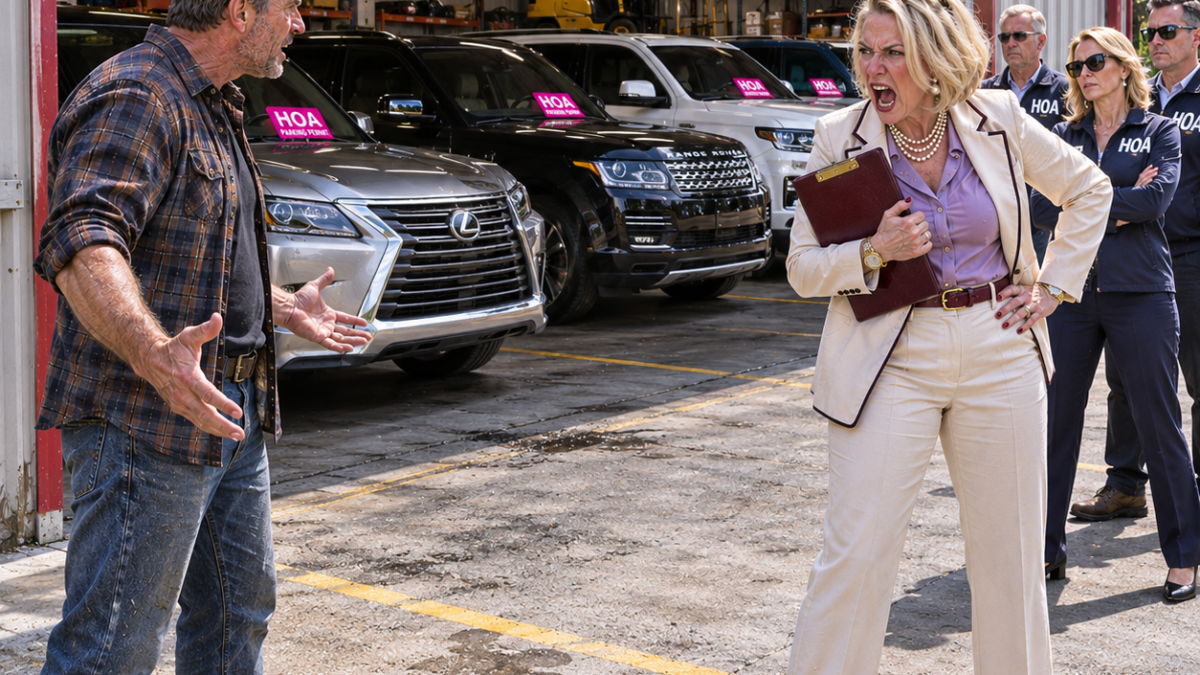
The morning I opened my warehouse and found six HOA vehicles lined up inside my private garage, every engine was still warm.
Each windshield carried a bright pink Willow Creek parking permit, including the silver Lexus belonging to HOA president Karen Violet.
I stood there furious for maybe five seconds before I realized Karen had finally handed me the one mistake I could use to end this fight on my terms.
My name is Eric Miller.
I had owned Miller Logistics for a little over twelve years by then.
We weren’t some giant shipping corporation with hundreds of trucks crossing the country every night.
We were small.
Four delivery vehicles.
One warehouse.
Three full-time employees.
A rotating crew of part-time loaders during busy seasons.
And more bad coffee than any group of human beings should legally consume.
But it was mine.
Every inch of that warehouse represented a piece of my life.
I bought the property when I was thirty-four, back when the roof leaked in three places and the old aluminum garage door screamed every time it opened.
The bank thought I was crazy.
My father thought I was ambitious.
My mother thought I needed a wife instead of another loan.
All three might have been right.
I spent ten years turning that place into a business.
The large garage on the west side was the heart of the operation.
That was where Jake parked the delivery van after his routes.
Where Tyler loaded early-morning shipments.
Where Monica checked inventory before the sun came up.
Where I had spent more than one Christmas Eve fixing a truck because a customer needed medical equipment delivered the next morning.
It wasn’t pretty.
Concrete floor.
Metal shelving.
Forklift marks.
A battered coffee maker in the corner that should have been classified as a workplace hazard.
But it was private commercial property.
Parcel 408B.
I knew that number better than I knew my own driver’s-license number.
I owned the driveway.
The loading area.
The narrow service alley.
The fence.
The garage.
The gravel strip behind it.
Everything.
That mattered because Willow Creek Estates did not exist when I bought the property.
The land beside mine had been an empty field for years.
Then a developer arrived.
Trees disappeared.
Survey flags appeared.
Construction crews followed.
Within a few months, Willow Creek Estates rose beside my warehouse like somebody had dropped a postcard-perfect suburb into an industrial zone.
Clean sidewalks.
Stone entrance sign.
Decorative streetlights.
Fresh sod.
And a small brick community center built on the parcel directly beside my west fence.
Twelve parking spaces.
That was the beginning of everything.
The HOA held meetings there.
Yoga classes.
Wine nights.
Weekend brunches.
Holiday parties.
Committee meetings.
Neighborhood movie planning.
Apparently twenty-five homeowners required more parking than twelve spaces could provide.
At first, one or two vehicles ended up in my lot.
I assumed people were confused.
So I left polite notes.
**PRIVATE COMMERCIAL PROPERTY. PLEASE DO NOT PARK HERE.**
Nothing angry.
Nothing threatening.
Then two cars became four.
Four became eight.
One Tuesday evening, Jake had to snake our delivery van around a Mercedes parked directly in front of the loading bay.
He climbed out swearing.
“Boss.”
“What?”
He pointed.
“We charging rent now?”
“No.”
“Then why does this place look like a dealership?”
I sighed.
“HOA meeting.”
“You want me to call a tow company?”
“Not yet.”
He stared at me.
“You’re nicer than me.”
“That’s why I sign the checks.”
I thought the solution was simple.
Contact the HOA president.
Clarify the boundary.
Problem solved.
Then I met Karen Violet.
Her email signature alone should have warned me.
**KAREN VIOLET**
**President — Willow Creek Homeowners Association**
**Preserving Beauty, Order, and Community**
There was even a flower logo.
I sent her a polite message.
I explained that residents were parking on my commercial lot.
I mentioned the loading zone.
I asked that she remind HOA members not to use the property.
Five hours later, she replied with one sentence.
**Eric, the alleyway behind your building is considered community access, and our members are permitted to use it as needed. — K. Violet**
I stared at the screen.
Then I reread it.
Then I pulled out the county parcel map.
No shared alley.
No easement.
No community-access corridor.
Parcel 408B.
Mine.
I sent the deed and map back.
The property lines were highlighted.
I wrote:
**Karen, there appears to be a misunderstanding. The alley, loading area, and garage are entirely within my parcel. Please ask your members not to enter or park there.**
No reply.
The next evening, three vehicles were parked on my property.
One blocked my forklift route.
On my **NO PARKING** sign was a bright pink sticky note.
**Community members may use temporary overflow parking during HOA events. Please be neighborly. — KV**
I actually laughed.
Not because it was funny.
Because sometimes arrogance reaches a level where your brain refuses to process it any other way.
The next morning, I installed six larger signs.
**PRIVATE PROPERTY**
**NO HOA PARKING**
**UNAUTHORIZED VEHICLES SUBJECT TO REMOVAL**
For one week, nothing happened.
I thought maybe the message had finally worked.
Then a Friday storm rolled through town.
Heavy rain.
Thunder.
Flash-flood warnings.
I was locking up after ten when headlights swept across the lot.
One SUV.
Then another.
Then another.
Six in total.
People jumped out.
At the center of them was a platinum-blonde woman wearing a bright yellow raincoat.
Karen Violet.
“Eric!”
“What are you doing?”
“We need shelter!”
“There’s a community center thirty yards away.”
“The lot is flooding!”
“That doesn’t make my garage public.”
She waved toward two HOA members.
“Open it.”
I stepped forward.
“Karen, don’t.”
One man pulled on the garage door.
Another grabbed the bottom handle.
The door had already been damaged by weeks of people pushing against it.
Together, they forced it upward enough to get access.
I watched six vehicles roll into my private garage.
Karen’s silver Lexus went first.
Her vanity plate:
**K VIOLET.**
Tyler stood beside me, soaked.
“Boss?”
“Yeah?”
“Should we stop them?”
I looked at Karen directing traffic inside my building as though she was managing valet parking at a hotel.
Then I looked at the security camera above the loading dock.
Recording.
“No.”
Tyler stared.
“No?”
“Let them finish.”
Because standing there in the rain, I finally understood something.
Karen didn’t believe she was borrowing my property.
She believed she had the authority to take it.
And if I wanted this to end permanently, I needed her to prove that belief in her own words.
She did.
Repeatedly.
By the time Karen finally realized how much evidence she had created, the argument would no longer be about whether I was being “neighborly.”
It would be about whether an HOA president had the right to turn somebody else’s business into her personal parking garage.
And that question had a very simple answer.
PART 2
I didn’t sleep particularly well that night.
Not because I was afraid of Karen.
Because I was angry at myself.
I had spent months trying to avoid conflict.
Every time one of her people parked in my lot, I told myself they were confused.
Every time Karen ignored an email, I told myself maybe she hadn’t read the attachments.
Every time a car blocked the loading area, I moved around it instead of forcing the issue.
Patience is useful.
But there comes a point where patience stops being generosity and becomes permission.
I had reached that point.
Monday morning, I pulled into the warehouse at seven.
The storm was gone.
The air smelled like wet pavement.
Puddles reflected the morning sun.
And there they were.
Six vehicles.
Still inside.
Karen’s Lexus sat in the middle.
Mark’s Jeep near the shelving.
Linda’s BMW beside the forklift lane.
Three others parked neatly as if the garage had assigned spaces.
Jake arrived two minutes later.
He stepped out.
Whistled.
“They left them here?”
“Apparently.”
“For the weekend?”
“Looks like it.”
He walked toward the bent garage door.
“They forced this.”
“I know.”
He ran a hand along the track.
“That’s not cheap.”
“I know.”
“Calling the police?”
“Eventually.”
He stared at me.
“You’ve got that look.”
“What look?”
“The one you had when Tyler backed the truck through the loading-door sensor.”
I smiled.
“That was a bad day.”
Tyler arrived.
“I’m standing right here.”
At 8:05, a white SUV rolled into the alley.
Karen stepped out wearing a white blazer, giant sunglasses, and the relaxed smile of somebody arriving for brunch.
Linda followed.
Then Mark.
“Good morning, Eric.”
I folded my arms.
“Karen.”
She looked toward the cars.
“I see you found them.”
“Yes.”
“Sorry about that storm.”
“You forced open my garage.”
She waved one hand.
“Oh, don’t make it dramatic.”
I pointed at the bent track.
“The door is damaged.”
“It was already loose.”
“No.”
“Eric.”
She removed her sunglasses.
“We were dealing with severe weather.”
“The community center was open.”
“There wasn’t enough covered parking.”
“Cars don’t need covered parking during rain.”
She stared at me like I was missing the obvious.
“Some of these vehicles are expensive.”
I looked at her Lexus.
“So is my garage.”
Mark laughed.
“Come on, man. No harm done.”
Jake turned toward him.
“You bent a commercial garage door.”
Mark stopped smiling.
Karen continued.
“You weren’t using the space overnight.”
I actually had to pause before answering.
“You don’t get to decide whether I’m using my property.”
“We needed temporary shelter.”
“Then you ask.”
“We didn’t have time.”
“You had time to force open the door.”
Her expression tightened.
“Technically, it wasn’t locked.”
“That is not how private property works.”
Karen sighed.
Then she said the sentence that transformed the dispute from ridiculous to dangerous.
“The HOA has shared-access rights.”
I stared.
“What?”
“The alley.”
“No.”
“And areas connected to it.”
“No.”
“We have a development agreement.”
“No, you don’t.”
She smiled like a teacher correcting a student.
“You may not be familiar with residential land-use law.”
Jake made a choking sound.
I ignored him.
I opened the back of my truck.
Pulled out the rolled county map.
Unrolled it on the hood.
Parcel 408B was outlined clearly.
“This.”
I tapped the boundary.
“Warehouse.”
Tap.
“Garage.”
Tap.
“Service alley.”
Tap.
“Loading area.”
Then I pointed across the fence.
“Your HOA begins there.”
Karen leaned over the map for maybe two seconds.
“These maps can be misleading.”
I looked at her.
“County assessor maps?”
“They aren’t always updated.”
“My ownership predates Willow Creek.”
“We’ll have the board review it.”
“The board?”
“Yes.”
“You think your board decides who owns my land?”
She put her sunglasses back on.
“We decide how community access operates.”
“On community property.”
She turned toward her SUV.
“We’ll clarify everything.”
“Karen.”
She stopped.
“Do not park here again.”
She looked over her shoulder.
“I heard you.”
That wasn’t agreement.
It was a warning.
By noon, I received another email.
**The Willow Creek board has reviewed the matter and determined that the garage area shares access rights with the community center under the original development plan. Pending clarification, HOA members may continue temporary parking for official functions.**
I forwarded it to Rachel Green.
Rachel had been my business attorney for eight years.
Smart.
Dry sense of humor.
Zero patience for nonsense.
Her reply came three minutes later.
**Send me the deed, title report, county plat, and all emails. Do not destroy anything. Do not threaten anyone.**
I called her.
“Good afternoon to you too.”
“What did you get yourself into?”
“An HOA.”
“Why?”
“They built themselves next door.”
“Unfortunate.”
I explained everything.
When I finished, Rachel asked:
“Any recorded easement?”
“No.”
“Lease?”
“No.”
“License?”
“No.”
“Written permission?”
“Absolutely not.”
“Then stop debating them.”
“Meaning?”
“Document.”
“Already doing that.”
“Good.”
“Can I tow them?”
“Depends on local towing requirements, signage, notice, and where the vehicles are located. We do it by the book.”
I sighed.
“That sounds less fun.”
“Legal usually is.”
“Rachel.”
“Yes?”
“She called my garage community property.”
There was silence.
Then:
“I’d like that email preserved forever.”
—
For the next several days, Karen behaved like someone testing whether a fence was electric.
Tuesday night, four cars.
Wednesday, six.
Thursday, eight.
They parked diagonally across the loading zone.
One Tesla sat six inches from the main door.
Jake had to guide one truck through a gap with less than a foot on either side.
Then I walked into the garage Thursday evening and stopped.
My storage shelving had been moved.
A folding table stood in the middle of the floor.
Wine glasses.
Cheese.
Crackers.
HOA pamphlets.
And taped to my wall:
**WILLOW CREEK MONTHLY MEETING**
**COMMUNITY FIRST**
I turned slowly.
“Monica.”
She emerged from the office.
“Yes?”
“Why is there wine in my garage?”
She looked exhausted.
“Because apparently we own a community center now.”
“You let them in?”
“No.”
“Who did?”
“They came through the damaged door around six.”
“Security footage?”
“Everything.”
I waited outside.
At 8:30, residents began leaving.
Some looked embarrassed.
Some acted like nothing was wrong.
Linda emerged carrying a wine bottle.
Mark followed.
Karen came last.
Glass in hand.
“Oh, Eric.”
She smiled.
“Did you want to join us?”
I stared.
“In my garage?”
“We were only using an available space.”
“Available?”
“You weren’t loading anything tonight.”
“You moved my shelving.”
“To create room.”
“You put a meeting table beside my forklift.”
“We moved it carefully.”
“Karen.”
I stepped closer.
“This is my business.”
Her tone changed.
“Don’t be hostile.”
“Hostile?”
“You’re confronting residents.”
“Who entered my property.”
“Community members.”
“That phrase does not make trespass disappear.”
She took a sip of wine.
“Eric, some of us are trying to build a better neighborhood.”
“I own a logistics company.”
“What does that have to do with anything?”
“Nothing.”
I looked around.
“Which is exactly how much my warehouse has to do with your neighborhood.”
Mark smirked.
“Relax.”
I turned.
“Do not tell me to relax inside my own building.”
His smirk disappeared.
I looked back at Karen.
“Anyone parks here again, I will pursue every lawful remedy available.”
Her eyes narrowed.
“Are you threatening the HOA?”
“No.”
“I’m notifying you.”
“You can’t tow members without board approval.”
I stared.
Then laughed.
Karen’s jaw tightened.
“What?”
“Your board does not approve towing on my property.”
“You’ll regret that attitude.”
“Your people leave tonight.”
“We were already leaving.”
“And you don’t come back.”
She set down her wine glass.
“This neighborhood doesn’t appreciate outsiders who refuse to cooperate.”
I looked at her for several seconds.
“Karen.”
“Yes?”
“I’ve owned this property longer than your HOA has existed.”
She turned away.
“Linda, get the wine.”
They left.
Jake emerged from behind the loading door.
“She’s going to do something stupid.”
“Absolutely.”
“What are you going to do?”
“Wait.”
He looked disappointed.
“That’s it?”
“No.”
I stared at the camera in the corner.
“I’m going to let her keep making my case.”
—
Wednesday of the following week, I attended the HOA meeting myself.
Karen tried stopping me at the door.
“This is for members.”
“I’m here because your members are using my commercial building.”
Several residents turned.
Karen’s smile tightened.
“This isn’t the appropriate venue.”
“It became appropriate when you moved your meeting into my garage.”
A few people laughed.
Karen looked irritated.
I walked in.
At the front was a banner:
**BUILDING A BETTER COMMUNITY**
I nearly admired the lack of irony.
Karen opened the meeting.
Budget.
Landscaping.
Upcoming market.
Then I stood.
“I need five minutes.”
“No.”
I looked around.
“Who here has parked in my warehouse lot?”
Silence.
Several people looked down.
I continued.
“My property is not HOA overflow parking.”
Mark crossed his arms.
“The alley is shared.”
I pulled out the county plat.
Unrolled it.
“No.”
Someone in the second row leaned forward.
“Wait, that’s county stamped.”
“Yes.”
Another resident looked at Karen.
“You said the warehouse parking was part of the access agreement.”
Karen responded instantly.
“It is.”
“Where’s the agreement?”
“We don’t have to litigate this tonight.”
I smiled.
“That’s the first accurate thing you’ve said.”
She glared.
I pointed at the map.
“Parcel 408B.”
The room quieted.
“My property.”
Karen said:
“County documents can be complicated.”
“Not this complicated.”
She stood.
“Mr. Miller, your aggressive tone is inappropriate.”
There it was.
When facts failed, she changed the subject to manners.
I looked at everyone.
“Here is all I am asking.”
I rolled the map.
“Do not park on my land.”
Karen crossed her arms.
“The HOA will determine its rights.”
“Not tonight.”
I looked at her.
“If another vehicle enters my garage without permission, I will document it and take legal action.”
A resident muttered:
“Can he do that?”
I answered without turning.
“Yes.”
Karen gave a thin smile.
“We’ll see.”
I left.
The following morning, Jake texted me a photograph.
**Boss, you’re gonna love this.**
I opened it.
A laminated sign had been attached to my fence.
**OVERFLOW PARKING**
**WILLOW CREE HOA EVENTS**
**COMMUNITY GUESTS WELCOME**
I drove straight to the warehouse.
Karen and Mark were installing another one.
“Morning, Eric!”
She sounded cheerful.
“You nailed a sign into my fence.”
“We’re clarifying access.”
“You’re vandalizing private property.”
Mark laughed.
“It’s two screws.”
I stared.
“You genuinely don’t understand this, do you?”
Karen tilted her head.
“The board voted.”
I laughed once.
“Your board has as much authority over this fence as a book club in another state.”
Her smile disappeared.
“That attitude is why people dislike doing business with you.”
“Who?”
“The community.”
“I don’t do business with the community.”
“Maybe not for long.”
That sentence interested me.
“What does that mean?”
“Nothing.”
“No.”
I stepped closer.
“You’ve mentioned my business reputation twice now.”
She smiled again.
“Business owners depend on goodwill.”
There it was.
An implied threat.
I took out my phone.
Photographed the sign.
Photographed Karen.
Photographed Mark.
“Karen.”
“Yes?”
“Remove it.”
“No.”
“Final answer?”
She folded her arms.
“Yes.”
“Good.”
I called Ben Alvarez.
Ben had installed the garage doors years earlier.
“Ben.”
“Eric.”
“I need security upgrades.”
“How serious?”
“HOA serious.”
He laughed.
“Oh, Lord.”
—
That weekend we reinforced the garage properly.
Not some movie fortress.
Just solid commercial locks.
New hinges.
Secure keypad.
Motion alerts.
Door sensors.
Repairs to the damaged track.
Ben also added a system that logged every authorized entry.
Rachel loved that.
“Good.”
“That’s all you have to say?”
“What do you want, applause?”
“I want you to acknowledge the psychological satisfaction of buying locks.”
“You are paying me to prevent psychological satisfaction from becoming a lawsuit.”
Fair.
For four days, no HOA vehicles appeared.
Monday.
Nothing.
Tuesday.
Nothing.
Wednesday.
Nothing.
I started wondering if Karen had finally understood.
Jake didn’t believe it.
“She’s planning.”
“Maybe.”
“People like that don’t stop.”
“They do when lawyers get involved.”
“She doesn’t know Rachel’s involved.”
“True.”
Friday evening, Jake called.
“Boss.”
I was halfway through dinner.
“What?”
“You need to come here.”
“What happened?”
“Party.”
I put down my fork.
“What?”
“In the garage.”
Silence.
“How many?”
“Six cars.”
I closed my eyes.
“Karen?”
“Front and center.”
I drove.
Before I reached the property, I heard music.
When my headlights swept across the garage, I saw everything.
The main door had been opened after someone apparently defeated or damaged part of the older exterior hardware before the upgraded internal controls were fully engaged for the night.
Six vehicles inside.
A folding table.
Wine.
Cheese.
Cupcakes.
Music.
Karen beside her Lexus holding a glass.
Linda talking loudly.
Mark leaning against a shelf.
I got out.
The room slowly quieted.
Karen smiled.
“Oh, Eric.”
I said nothing.
“We’re having a small gathering.”
“In my garage.”
“The community center is being cleaned.”
“Not my problem.”
She sighed.
“You’re impossible.”
“How did you get inside?”
“The door was open.”
“No, it wasn’t.”
“Maybe your employee forgot.”
Jake stepped forward.
“I locked it.”
Karen ignored him.
I looked at the door.
Fresh marks near the latch.
Evidence.
“Everyone needs to leave.”
Karen sipped her wine.
“We’ll be done soon.”
“No.”
“Eric.”
“No.”
She set down her glass.
“You don’t get to show up and ruin every community event.”
I stared at her.
“This isn’t your community center.”
“You’re being technical.”
“Ownership is technical now?”
Mark laughed.
“It’s Friday night.”
I turned.
“What?”
“Your trucks aren’t even running.”
“Some of our routes leave at four in the morning.”
“So?”
“So you’re blocking a business.”
Karen said:
“You always make everything dramatic.”
I looked around.
Six unauthorized vehicles.
Wine table.
HOA flyers.
Fresh latch damage.
My cameras.
Then something inside me became calm.
Not rage.
Decision.
I smiled.
“All right.”
Karen blinked.
“What?”
“Enjoy your evening.”
Her eyes narrowed.
“You’re not angry?”
“No.”
“You’re leaving?”
“Yes.”
She seemed suspicious.
I walked toward the door.
“Just make sure everyone removes personal belongings tonight.”
Karen frowned.
“Why?”
“Because the garage is being secured for maintenance.”
“When?”
“Soon.”
She laughed.
“Whatever, Eric.”
I drove home.
Then called Rachel.
“Hypothetical.”
“I hate when you start that way.”
“Unauthorized cars are inside my garage after repeated written notice. Occupants leave. I secure the building for scheduled maintenance. What do I need to do?”
There was a long silence.
“First, we make sure no person is locked inside.”
“Obviously.”
“Second, we preserve emergency egress requirements.”
“Yes.”
“Third, we document every vehicle, warning, and damaged entry point.”
“Done.”
“Fourth, if the owners leave their cars there after notice, we coordinate with local law enforcement and follow private-property procedures. You do not create some cartoon hostage situation.”
I smiled.
“Rachel.”
“I know you.”
“So no dramatic steel vault?”
“Correct.”
“What about vacation?”
Another pause.
“You already booked one?”
“Not yet.”
“Eric.”
“Florida sounds nice.”
She sighed.
“Do this correctly.”
“I will.”
“And if law enforcement says access is required, cooperate.”
“Of course.”
“Then enjoy Florida.”
—
Saturday morning, the party was over.
Every person was gone.
The cars remained.
That part mattered.
Nobody was physically confined.
Nobody was inside the garage.
Karen and her friends had left their vehicles overnight despite multiple warnings that my building was private commercial property.
I photographed every car.
Windshield.
License plate.
Parking position.
The HOA permits.
Karen’s Lexus.
Linda’s BMW.
Mark’s Jeep.
Three others.
I photographed the posted signs outside.
The damaged latch.
The loading zone.
The door.
Then I contacted the non-emergency police number and documented what had happened.
An officer came by.
He reviewed the deed.
The signs.
The emails.
The video.
He looked through the garage window.
“These people know they don’t own this building?”
“I’ve told them.”
“How many times?”
“Would you like the short answer?”
He smiled.
“I’m guessing no.”
I handed him copies.
He shook his head.
“This looks like a property dispute with possible trespass and damage.”
“Exactly.”
“What are you planning?”
“Closing my garage for maintenance.”
“Anyone inside?”
“No.”
“Personal access issue?”
“Only their cars.”
He nodded.
“Document everything.”
“My lawyer said the same.”
“Smart lawyer.”
“Expensive lawyer.”
“Same thing.”
Ben repaired the damage.
We secured the garage.
Properly.
Legally.
No person inside.
Emergency exits remained compliant.
The unauthorized vehicles stayed where their owners had left them.
I placed a notice outside:
**GARAGE CLOSED FOR REPAIRS AND SECURITY MAINTENANCE**
**PRIVATE PROPERTY**
**CONTACT PROPERTY OWNER OR COUNSEL REGARDING UNAUTHORIZED VEHICLES**
Then I forwarded Karen the information.
No jokes.
No taunting.
Just a formal email.
Rachel approved every word.
Karen answered fourteen minutes later.
**OPEN THE GARAGE IMMEDIATELY.**
I sent:
**I am unavailable. Please coordinate through counsel.**
Then I went to the airport.
Florida.
One week.
Not because I needed to run.
Because I had been planning a vacation for months and had canceled twice for work.
This time, I decided Willow Creek could survive without me.
My flight took off at three.
When I landed, my phone looked like it had suffered a nervous breakdown.
Twenty-three missed calls.
Twelve voicemails.
Emails.
Messages.
Karen.
Linda.
Mark.
One number I didn’t recognize.
The first voicemail was Karen using her polite voice.
“Eric, there appears to be a misunderstanding. Several members accidentally left vehicles inside your building. Please call me so we can resolve this.”
Accidentally.
Interesting.
The second was less friendly.
“Eric, I don’t appreciate being ignored. You’re interfering with personal property.”
Third:
“Our members need their vehicles.”
Fourth:
“My attorney has been informed.”
Fifth:
“The HOA will hold you financially responsible.”
By number eight:
“You cannot do this to us!”
I was sitting on a hotel balcony looking at the Atlantic.
I took a sip of coffee.
Then called Rachel.
“How bad?”
“She’s contacted everybody.”
“Police?”
“Yes.”
“City?”
“Yes.”
“Zoning?”
“Yes.”
“Mayor?”
There was a pause.
“She tried.”
I laughed.
“What happened?”
“The same thing every time.”
“Which is?”
“They asked whether she had evidence the HOA owned your garage.”
“And?”
“She did not.”
“Cars?”
“Still there.”
“Anyone damaged them?”
“No.”
“Good.”
“Eric.”
“Yes?”
“Do not antagonize her.”
“I am two thousand miles away.”
“You can antagonize people remotely.”
“Fair.”
She continued.
“The police explained it’s a civil property dispute and that she should work through counsel. They are not going to break into your building because she demands it.”
“Excellent.”
“If a legitimate emergency arises, we cooperate.”
“Of course.”
“Otherwise enjoy the beach.”
I did.
Day two became my favorite.
Breakfast.
Ocean.
Karen voicemail.
Swim.
Lunch.
Karen voicemail.
Nap.
Dinner.
Another voicemail.
By day three, the tone changed.
“Eric, some of our members have missed work.”
Then Linda.
“Mr. Miller, I really didn’t understand that Karen hadn’t worked this out with you. I thought she had permission.”
That message caught my attention.
I replayed it.
Then saved it.
Mark called.
“Look, man, this has gone too far. Karen said the board had confirmed access.”
Another useful statement.
The alliance was cracking.
Jake provided updates.
**Karen and Mark are screaming at each other outside.**
Later:
**Linda says she wants the HOA to pay for her rental car.**
Then:
**Karen threatened to sue the locksmith. Ben says hi.**
I laughed.
By day five, Rachel called.
“Things got more interesting.”
“How?”
“The city assessor responded formally.”
“And?”
“Your parcel predates the HOA development by nine years.”
“We knew that.”
“Yes, but now Karen has it in writing from someone she cannot accuse of being you.”
“Did it help?”
“Absolutely not.”
“Of course.”
“She sent them a three-page response claiming historical community access.”
“To a garage that existed before the community?”
“Yes.”
I stared at the ocean.
“I almost respect the commitment.”
“You should not.”
“Fair.”
Then Rachel’s tone changed.
“We also need to discuss your losses.”
“What losses?”
“Loading disruptions.”
“Some.”
“Door damage.”
“Yes.”
“Security upgrades directly attributable to repeated unauthorized access.”
“Yes.”
“Employee time.”
“Yes.”
“Potential business delays.”
I sat up.
“You’re preparing a claim.”
“I am preparing options.”
“Against the HOA?”
“And potentially individuals where appropriate.”
I thought about it.
“I don’t want to bankrupt homeowners who were following Karen.”
“Then don’t.”
“What do you recommend?”
“Document actual losses.”
“Not revenge numbers.”
“Correct.”
“Good.”
Because by then, something had shifted for me too.
At first, I loved imagining Karen’s Lexus sitting inside.
I won’t pretend otherwise.
After months of disrespect, it felt satisfying.
But I didn’t want to become someone using legal leverage simply because I enjoyed causing inconvenience.
The goal was simple.
My property back.
My business protected.
Clear boundary.
Accountability for damage.
Nothing more.
—
Saturday morning, I flew home.
I didn’t tell Karen.
Didn’t tell Jake either.
When I reached the warehouse, the lot was quiet.
The exterior locks were intact.
No vandalism.
No damage.
A stack of angry notices had been taped beside my maintenance sign.
One said:
**CEASE AND DESIST**
Another:
**UNLAWFUL IMPOUNDMENT**
Another:
**HOA PROPERTY DISPUTE NOTICE**
None carried a court seal.
Rachel would enjoy them.
I called her.
“I’m back.”
“Good.”
“Opening the garage.”
“Have a witness.”
“Jake’s coming.”
“And photograph before moving anything.”
“Yes, Mom.”
“Billable insult.”
Jake arrived ten minutes later.
Then Monica.
Ben came because he wanted to inspect the repairs.
I contacted Karen through the attorney channel.
**Garage access will be available at 11:00 a.m. Vehicle owners may retrieve vehicles.**
By 10:45, half the HOA seemed to be outside.
Karen arrived first.
Silver rental sedan.
Apparently she had suffered greatly.
Linda.
Mark.
Three other owners.
They all looked exhausted.
Karen marched toward me.
“Finally.”
“Morning.”
“Do you have any idea what you’ve done?”
“Yes.”
“You’ve illegally held our vehicles for a week.”
“No.”
“They were locked inside.”
“After being left without authorization inside a private commercial garage that was closed for repairs.”
“You knew they were there.”
“Yes.”
“And you left!”
“Yes.”
“That is malicious.”
I looked toward Rachel, who had arrived with a folder.
She stepped forward.
“Mrs. Violet.”
Karen stared.
“And you are?”
“Rachel Green. Counsel for Miller Logistics and Mr. Miller.”
That changed the air.
Karen’s voice became colder.
“I’ve already contacted our attorney.”
“Excellent. Please have them communicate with me.”
Karen looked back at me.
“You really hired a lawyer over parking?”
Rachel answered:
“No. He already had one.”
Jake covered a smile.
Rachel continued.
“We’re here to facilitate retrieval of the vehicles and document the condition of the property.”
Karen said:
“I demand compensation.”
Rachel smiled politely.
“For what?”
“Rental cars.”
“Noted.”
“Missed work.”
“Noted.”
“Emotional distress.”
Jake turned away.
Rachel remained perfectly straight-faced.
“Noted.”
“And legal fees.”
“Also noted.”
Then Rachel handed her a document.
Karen looked down.
“What is this?”
“Notice of Mr. Miller’s claim for garage-door damage, security repair, business interruption, unauthorized occupation of commercial space, and related costs.”
Karen’s expression changed.
“This is absurd.”
“The current documented amount is approximately sixty-four hundred dollars, subject to final calculation.”
Linda whispered:
“Karen.”
“Not now.”
Mark said:
“You said the HOA had permission.”
Karen snapped:
“We did.”
Rachel removed a certified map.
“No.”
Karen looked at it.
“Those boundaries are disputed.”
“They aren’t.”
“We’ll see.”
“We will.”
I unlocked the garage.
Door rolled upward.
The vehicles sat exactly where they had been left.
Untouched.
No damage.
Karen rushed toward her Lexus.
Rachel said:
“Photographs first.”
“What?”
“For everyone’s protection.”
One by one, we documented vehicle condition.
Karen complained through every photograph.
Linda stayed quiet.
Mark looked increasingly angry at Karen.
When the photographs were complete, I stepped aside.
“Take them.”
Linda entered first.
Then the others.
Engines started.
One by one, the vehicles left.
Karen came last.
Before she entered her Lexus, she stopped.
“This isn’t over.”
I leaned against the doorframe.
“You’re right.”
For the first time, she looked uncertain.
“Rachel filed yesterday.”
Karen glanced at the lawyer.
Rachel gave a small nod.
Karen got into her car.
The silver Lexus rolled out.
I watched until it crossed my property line.
Then closed the door.
The garage became quiet.
Jake looked around.
“I missed this.”
“What?”
“Empty floor.”
“Me too.”
Tyler arrived late.
Of course.
“What’d I miss?”
Everything.
—
Karen filed first.
Technically, the HOA did.
Willow Creek Homeowners Association v. Eric Miller.
The complaint accused me of intentionally depriving members of vehicle access.
Financial harm.
Emotional distress.
Interference with HOA rights.
Rachel called after receiving it.
“She actually did it.”
“Surprised?”
“No.”
“Happy?”
“Professionally.”
“That’s worrying.”
“She has now put the alleged shared-access right directly before a judge.”
“And?”
“She has to prove it.”
I smiled.
“Ah.”
“Exactly.”
We counterclaimed.
Not because I wanted theater.
Because the garage had been damaged.
Business had been disrupted.
The locks cost money.
Employees lost time.
Karen had repeatedly entered despite written notice.
I had the right to recover actual losses.
The case drew more attention than I wanted.
A local blog discovered it.
Headline:
**HOA SUES BUSINESS OWNER AFTER CARS LEFT INSIDE PRIVATE GARAGE**
Then local television.
Then neighborhood social media.
Suddenly everybody had an opinion.
Half thought I was a hero.
Half thought I was petty.
Some thought Karen should be arrested.
Others thought I should have unlocked the garage immediately.
Rachel told me:
“Stop reading comments.”
“I wasn’t.”
“Eric.”
“Only some.”
“Stop.”
The court hearing arrived six weeks later.
Judge Walter Daniels presided.
Gray hair.
Sharp eyes.
The expression of a man who had already heard too many adults argue over fences.
The courtroom was packed.
Karen wore pink.
Of course she did.
Mark and Linda sat behind her.
Neither looked enthusiastic.
Rachel leaned toward me.
“Let them talk.”
“That’s your strategy?”
“With Karen? Yes.”
The HOA attorney stood first.
Unlike Karen, he seemed competent.
That was probably unfortunate for him because competent lawyers know when their client’s story has problems.
“Your Honor, the association contends that Mr. Miller intentionally restricted access to vehicles belonging to Willow Creek homeowners after a longstanding parking arrangement developed between adjacent properties.”
Rachel wrote something.
Passed me the note.
**LONGSTANDING = MONTHS.**
I almost smiled.
The lawyer continued.
“Members relied on representations regarding shared access.”
Judge Daniels asked:
“Representations by whom?”
A pause.
“The HOA board.”
“Did the property owner make those representations?”
“No.”
“Did the property owner consent?”
“Our position is that consent was not necessary because of an access right.”
“Recorded?”
Another pause.
“We’ll address the development documents.”
Karen nodded aggressively.
The HOA presented its internal map.
The same one that colored part of my property as community overflow.
Judge Daniels looked at it.
“Who prepared this?”
The attorney turned toward Karen.
She whispered.
He answered:
“The HOA management records appear to have been updated under Mrs. Violet’s administration.”
The judge frowned.
“That isn’t what I asked.”
Karen raised her hand slightly.
“I prepared the map from our planning materials.”
The judge looked at her.
“You created it?”
“I updated it.”
“Using what source?”
“Community records.”
“Which records?”
Karen hesitated.
“Our original neighborhood plans.”
“Do those plans include Mr. Miller’s parcel?”
“Yes.”
Rachel quietly placed the certified county plat on the table.
Judge Daniels looked toward her.
“Counsel?”
“We’ll reach that.”
The HOA then described the locked vehicles.
Rental-car expenses.
Missed appointments.
One owner claimed emotional distress.
Judge Daniels asked:
“Were any people confined?”
The attorney answered immediately.
“No.”
“Were the vehicles damaged?”
“No.”
“Did the owners leave them voluntarily inside the garage?”
He hesitated.
“They parked there.”
“With permission from Mr. Miller?”
“No.”
“Were there no-parking signs?”
The lawyer looked toward Karen.
“Yes.”
The judge paused.
The courtroom became uncomfortable.
Karen whispered something.
Her attorney replied:
“Mrs. Violet contends the signs were invalid because the HOA possessed an access right.”
Judge Daniels leaned back.
“Then I suppose we should determine whether the HOA possessed an access right.”
Rachel stood.
“Thank you, Your Honor.”
She began with the deed.
Then the county plat.
Then the title report.
Then the parcel history.
The warehouse existed twelve years.
The HOA formed nine years later.
The community center came after that.
No recorded easement.
No access license.
No shared-parking agreement.
No ownership interest.
No lease.
Nothing.
Judge Daniels compared the county plat to Karen’s map.
“Mrs. Violet.”
She stood.
“Yes, Your Honor.”
“Your map moves the boundary.”
“It reflects community-use patterns.”
“Property boundaries are not determined by use patterns.”
“We had been parking there.”
“For how long?”
“Several months.”
“Was Mr. Miller objecting?”
Karen’s mouth tightened.
“Occasionally.”
Rachel opened a binder.
“Your Honor, may I?”
“Proceed.”
The first email appeared.
**Please remind HOA members this is private property.**
Second.
County plat attached.
Third.
**Stop trespassing or law enforcement will be contacted.**
Then photographs.
Six signs.
Private property.
No parking.
Unauthorized vehicles.
Judge Daniels looked over his glasses.
“Occasionally?”
Karen’s face reddened.
“We believed he was wrong.”
“Did you obtain a title opinion?”
“No.”
“Survey?”
“No.”
“Recorded easement?”
“We believed—”
“I’m asking what you obtained.”
Nothing.
Rachel continued.
Security footage.
HOA vehicles entering.
Karen directing them.
The storm.
Door forced upward.
Then the meeting inside my garage.
Wine.
Tables.
Banner.
Laughter.
The courtroom became silent.
Judge Daniels stared at the monitor.
Karen muttered:
“It was raining.”
The judge looked toward her.
“Inside the garage?”
“The original entry was due to weather.”
“This footage is from another date.”
Karen stopped.
Rachel played more.
Karen saying:
**You should be grateful people are finding your building useful.**
I had forgotten the camera captured that clearly.
Judge Daniels looked at Rachel.
“Is that Mrs. Violet?”
“Yes.”
Karen’s attorney rubbed his forehead.
Then came the signs.
Karen and Mark attaching **OVERFLOW PARKING** notices to my fence.
Then the final party.
Six vehicles.
Wine.
Garage.
Fresh latch damage.
Rachel stopped the video.
“Your Honor, my client did not lure these vehicles onto his property.”
She pointed toward the evidence.
“He repeatedly instructed the HOA not to enter.”
She held up emails.
“He posted signs.”
Photographs.
“He attended the HOA meeting and warned them in person.”
Meeting minutes.
“Then HOA members entered again and left their vehicles overnight.”
She paused.
“My client closed his commercial garage for repair and security work after repeated unauthorized entry.”
The judge asked:
“Was law enforcement notified?”
“Yes.”
Police report.
“Were people inside when the building was secured?”
“No.”
“Were emergency exits unlawfully blocked?”
“No.”
“Was vehicle retrieval eventually provided?”
“Yes.”
“Any vehicle damage?”
“No.”
“Then why one week?”
Rachel answered carefully.
“My client had scheduled travel and directed communications through counsel. The owners had been warned not to leave vehicles inside his private building.”
Karen whispered loudly:
“He did it to humiliate us.”
Judge Daniels heard.
“Mrs. Violet.”
She stood.
“Yes.”
“Why did you repeatedly park there after receiving written notice?”
“Because it was community space.”
“Based on your map?”
“Yes.”
“A map you created.”
“I updated it.”
“Without a survey.”
She said nothing.
“Without title research.”
Nothing.
“Without county approval.”
Nothing.
“Without a recorded instrument.”
Nothing.
The judge looked down.
Then back up.
“That is a problem.”
Karen’s attorney tried to salvage the case.
“Your Honor, even assuming the access claim was mistaken, the defendant intentionally delayed the owners’ access to their vehicles.”
Rachel nodded.
“That is the HOA’s strongest argument.”
I glanced at her.
She continued.
“My client acknowledges that securing the building created inconvenience. But the question is whether that inconvenience creates liability sufficient to override the HOA’s repeated unauthorized occupation, property damage, and disregard of explicit notice.”
She handed over the police documentation.
“Law enforcement declined to treat the secured garage as criminal conduct and directed the parties toward civil resolution.”
Then the repair bills.
Garage track.
Latch.
Security hardware.
Lost loading time.
Employee hours.
Total:
$6,400.
Judge Daniels studied everything.
Karen suddenly stood.
“Your Honor, may I say something?”
Her lawyer whispered:
“Mrs. Violet—”
“Please.”
Judge Daniels sighed.
“Briefly.”
Karen faced the bench.
“We were trying to build community.”
I looked down.
Rachel had told me not to react.
“We hosted meetings.”
Karen continued.
“We organized events.”
“We maintained property values.”
“The warehouse is directly beside our center.”
She pointed toward me.
“He refused to cooperate from the beginning.”
Judge Daniels asked:
“Cooperate with what?”
“Shared parking.”
“Which he never agreed to.”
“He had space.”
That sentence destroyed whatever remained.
The judge stared.
“Mrs. Violet.”
“Yes?”
“Does having unused space transfer ownership?”
“No, but—”
“If your neighbor leaves a driveway empty, may you park there?”
“No.”
“If a business has empty shelves, may you store your property on them?”
Karen said nothing.
“Then why did you believe an empty section of Mr. Miller’s garage was yours to use?”
She looked frustrated.
“Because we needed it.”
Judge Daniels leaned back.
“That is not a property right.”
Silence.
Karen tried once more.
“But he humiliated us.”
Judge Daniels’ expression became almost tired.
“Being embarrassed by the consequences of your own conduct is not a legal injury.”
A few people laughed.
He raised one hand.
The room quieted.
Then came the ruling.
The HOA’s claim based on shared-access rights failed.
No evidence supported ownership or easement rights over my garage or loading area.
Their emotional-distress claim was dismissed.
Other claimed damages were rejected where unsupported.
My counterclaim for documented property damage and business loss succeeded in substantial part.
Legal fees were awarded where applicable under the governing claims and agreements.
The judge also issued clear language prohibiting the HOA from asserting parking authority over parcel 408B without lawful basis.
Then he looked at Karen.
“Mrs. Violet.”
“Yes?”
“An HOA’s authority ends where its governing documents and the law end.”
She stared.
“Your association does not acquire new jurisdiction because parking elsewhere is inconvenient.”
Her face turned red.
“Understood?”
She whispered:
“Yes.”
Gavel.
Done.
Outside, local reporters waited.
One called:
“Mr. Miller, any comment?”
Rachel whispered:
“Short.”
I said:
“I’m glad the property records were clear.”
Another reporter:
“Would you lock the garage again?”
Rachel looked at me.
I smiled.
“I’d prefer people read the signs.”
That made the evening news.
—
The court ruling broke Willow Creek faster than I expected.
Not because I destroyed the HOA.
I didn’t.
Karen did most of that herself.
The judgment forced the association to absorb legal costs and property damages.
Members who had trusted Karen began demanding records.
Linda wanted to know why she had been told parking access was legal.
Mark wanted to know who approved the internal map.
Other residents questioned unrelated decisions.
Budgets.
Vendor contracts.
Fines.
Meeting authority.
A week later, Willow Creek held an emergency meeting.
I wasn’t there.
Jake attended only because Linda invited him as a witness.
He returned the next morning carrying coffee.
“You missed a show.”
“What happened?”
“Karen got removed.”
I looked up.
“What?”
“Vote.”
“Seriously?”
“Mark voted against her.”
I laughed.
“That must’ve hurt.”
“Linda too.”
“What caused it?”
Jake sat down.
“Apparently Karen never had the board formally approve some of the parking decisions.”
“Of course.”
“And the map.”
“What about it?”
“She made it herself.”
“I know.”
“Using some brochure from the developer.”
I stared.
“You’re kidding.”
“Nope.”
“She moved a property boundary based on a brochure?”
“Pretty much.”
I rubbed my face.
“Human civilization has been a mistake.”
Jake laughed.
The HOA board suspended operations temporarily while residents reviewed the governing documents.
Then something interesting happened.
The subdivision discovered it didn’t need half the rules Karen had created.
Some weren’t validly adopted.
Others were merely “president guidelines” disguised as policy.
Parking rules were rewritten.
Board power was reduced.
Financial reporting became more transparent.
A few residents pushed to dissolve the HOA entirely.
That process was complicated.
Rachel explained it.
“Don’t celebrate a dissolution until the documents actually allow it.”
“Always ruining fun.”
“That’s my function.”
Eventually, the community retained a smaller association structure limited mostly to maintaining genuine common areas.
The organization Karen had ruled like a private government effectively disappeared.
That mattered more than the name.
Karen lost the presidency.
Mark resigned.
Linda stayed involved long enough to help straighten out records, then left the board too.
A month after court, I saw Karen again.
Her Lexus rolled slowly down the alley.
For one ridiculous second, I wondered if she intended to park.
Instead, she stopped at the curb.
Got out.
She looked different.
Tired.
No sunglasses.
No clipboard.
“Eric.”
“Karen.”
“I came to apologize.”
I nearly looked behind me.
“For?”
Her jaw tightened.
“You know.”
“I’d still like to hear it.”
She exhaled.
“I shouldn’t have used your garage.”
“That’s a start.”
“I believed the access was ours.”
“After I gave you the deed?”
She looked away.
“I thought you were being territorial.”
“I was being territorial.”
She frowned.
I pointed around.
“It’s territory.”
She almost smiled.
Then stopped herself.
“I went too far.”
“Yes.”
“You didn’t have to humiliate me.”
There it was.
The apology had lasted maybe twelve seconds.
I leaned against the door.
“Karen.”
“What?”
“You forced open my garage.”
She said nothing.
“You held HOA meetings here.”
Nothing.
“You nailed parking signs into my fence.”
Her lips tightened.
“You ignored the county map.”
Silence.
“Then you sued me.”
She looked down.
“I defended myself.”
“No.”
“You lost.”
Her eyes hardened.
“You enjoyed it.”
I thought.
“Yes.”
That surprised her.
“For a while.”
She stared.
“I enjoyed finally watching someone tell you no.”
Her face changed.
“But here’s the difference.”
“What?”
“I didn’t want your house.”
“I didn’t want your money.”
“I didn’t want your car.”
“I wanted you off my property.”
Karen looked toward the new gate.
“I understand that now.”
“Good.”
She nodded.
Then walked back toward the Lexus.
“Karen.”
She stopped.
“I hope the next place works out better.”
She gave a small bitter laugh.
“I’m moving.”
I hadn’t known.
“Where?”
“Another state.”
“HOA?”
She looked at me.
“Absolutely not.”
For the first time since I met her, we both laughed.
Then she drove away.
—
Business improved.
Partly because the parking problem ended.
Partly because the local story brought unexpected attention.
A regional shipping company called.
They needed a smaller contractor for overflow routes.
They had seen the news article.
The owner said:
“I figured anyone who defends a loading dock that hard probably delivers on time.”
We got the contract.
That allowed me to hire another driver.
Upgrade the warehouse.
Replace the damaged door entirely.
Automatic gate.
Better cameras.
Clearer markings.
Monica designed the new signs.
She showed me the first draft.
**PRIVATE COMMERCIAL PROPERTY**
**AUTHORIZED BUSINESS ACCESS ONLY**
Professional.
Simple.
I nodded.
Then Jake showed me his draft.
**HOA-FREE ZONE**
**PARK AT YOUR OWN RISK**
I looked at him.
“No.”
“Why?”
“Because Rachel will appear from nowhere and bill me.”
He laughed.
We compromised.
One small sign inside the break room read:
**PLEASE CHECK WITH ERIC BEFORE DECLARING THIS AREA COMMUNITY PROPERTY.**
Rachel hated it.
Which meant everyone else loved it.
—
Months passed.
Willow Creek changed.
Without Karen running patrol, it became quieter.
Not abandoned.
Not chaotic.
Just normal.
Kids rode bicycles.
Neighbors talked across fences.
Nobody used my loading dock.
Linda once waved while walking her dog.
I waved back.
Mark started mowing his own grass instead of chairing committees about everybody else’s.
One afternoon, he wandered toward the fence.
Stayed on his side.
Important improvement.
“Eric.”
“Mark.”
“No hard feelings?”
I looked at him.
“You helped install a parking sign on my fence.”
He winced.
“Mostly no hard feelings?”
I laughed.
“Stay over there and we’re good.”
He raised a beer.
“Deal.”
Then he said:
“For what it’s worth, Karen told us she had legal approval.”
“I figured.”
“I should have checked.”
“Yes.”
“I didn’t.”
“No.”
“Because it was convenient.”
There was honesty in that.
“Exactly.”
He nodded.
“I guess that’s how dumb things start.”
“Usually.”
“Not with villains.”
I looked at him.
“Just people who prefer the answer that benefits them.”
Mark raised the beer again.
“Fair.”
I respected him more after that conversation than during his entire vice presidency.
People can be wrong.
What matters is what they do after the evidence arrives.
Karen had received evidence and doubled down.
Mark eventually stopped.
That difference matters.
—
Six months after the lawsuit, Rachel called.
“Karen’s appeal attempt is dead.”
“She appealed?”
“Tried.”
“Why am I surprised?”
“You shouldn’t be.”
“What happened?”
“Original ruling stands.”
“Good.”
“There’s something else.”
“What?”
“She tried to organize another neighborhood association where she’s moving.”
I sat back.
“You’re joking.”
“It didn’t go far.”
“Why?”
“Apparently public records travel.”
I laughed.
“That’s cruel.”
“It’s accurate.”
We talked business.
Then Rachel asked:
“Do you regret the vacation?”
I thought.
“Legally or personally?”
“Personally.”
I looked through the office window toward the empty garage.
“At first, it felt like revenge.”
“And now?”
“Now I think I should have involved counsel sooner.”
She was quiet.
“That’s annoyingly mature.”
“I hate it too.”
“You could have prevented some damage.”
“Probably.”
“But?”
“But Karen might also have convinced everyone I was inventing the dispute.”
Rachel said:
“Maybe.”
There was no perfect version.
That’s another thing dramatic stories often get wrong.
In hindsight, every path looks obvious.
In real time, you act with incomplete information.
You try to be reasonable.
You wait too long.
Or you react too fast.
Then you live with whichever mistake you made.
Mine was waiting.
Karen’s was believing patience meant surrender.
—
One year after the first parking dispute, Willow Creek held a community cookout.
On their property.
Not mine.
The invitation specifically said:
**Parking available in designated HOA lot only.**
Someone had underlined that sentence.
Jake framed the invitation.
I attended for thirty minutes.
Linda handed me a burger.
Mark gave me a beer.
A new board president named Susan Carter introduced herself.
She was a retired accountant.
Exactly the kind of person HOA budgets need.
“I want you to know we changed the parking policy.”
“I noticed.”
“We also added a map from the county.”
“Excellent.”
“Not one made in Microsoft PowerPoint.”
“Even better.”
She smiled.
“Karen left quite a legacy.”
“That’s one word.”
Susan looked toward the warehouse through the trees.
“We should’ve listened earlier.”
“You weren’t president then.”
“I was a resident.”
That was fair.
“Most people assumed Karen knew what she was doing.”
“That’s how authority works.”
Susan nodded.
“Until it doesn’t.”
We stood quietly.
Then she asked:
“Can I ask why you waited so long before pushing back hard?”
“Because I didn’t want a war with my neighbors.”
“Were we your neighbors?”
I considered.
“Yes.”
“Even after all that?”
“Karen was the problem.”
“Some members followed her.”
“Yes.”
“But?”
I looked around at families eating hamburgers.
“Following bad leadership doesn’t automatically make everyone evil.”
Susan smiled.
“That’s probably why people like you more than Karen told us they did.”
“What did she tell you?”
“That you hated Willow Creek.”
I laughed.
“I hated unauthorized parking.”
“Apparently she couldn’t tell the difference.”
—
The garage dispute eventually became one of those stories people exaggerated.
A delivery driver once told Tyler:
“Is this the building where you locked fifty HOA cars inside?”
Tyler said:
“Sixty.”
I walked out.
“Stop.”
Another customer believed Karen had slept in her Lexus for a week.
She did not.
Someone online claimed I welded the doors shut.
Absolutely not.
Ben took personal offense.
“If you welded my locks, I’d sue you myself.”
The truth was already ridiculous enough.
An HOA president convinced herself that neighboring commercial property became available because her members needed parking.
She ignored signs.
Ignored deeds.
Ignored maps.
Ignored warnings.
Then sued the property owner after her own members left cars somewhere they had been repeatedly told not to leave them.
No embellishment required.
The funniest part was that Karen’s entire argument depended on one idea:
They needed the space.
Need becomes entitlement faster than people realize.
I need somewhere to park.
So your empty lot becomes convenient.
Then familiar.
Then expected.
Then somehow mine.
It happens gradually.
That’s why boundaries matter before anyone is angry.
—
Two years later, Miller Logistics expanded.
We leased a second warehouse across town.
The original property remained headquarters.
The garage door still carried a small scar near the bottom where Karen’s group had forced it during the storm.
We could have replaced that panel.
I didn’t.
Jake asked once:
“Why keep it?”
“Reminder.”
“Of Karen?”
“No.”
“Of what?”
I looked at the mark.
“Of how small violations become big ones when you keep pretending they don’t matter.”
He nodded.
Then asked:
“You still have the pink parking permits?”
I smiled.
One sat in my desk drawer.
**WILLOW CREE HOA AUTHORIZED PARKING.**
On the back, in my handwriting:
**NOT AUTHORIZED HERE.**
Not a trophy.
Mostly.
Monica disagreed.
“Definitely a trophy.”
“Historical artifact.”
“You’re lying.”
“Professionally.”
—
One morning, I received an email from Karen.
It had been almost two years.
No threats.
No legal language.
Just:
**Eric,**
**I heard your company expanded. Congratulations.**
**I still don’t agree with how everything happened, but I understand now that I had no right to treat your property as though it belonged to the association. I confused managing a community with controlling the people around it.**
**I don’t expect a response.**
**Karen.**
I read it twice.
Then once more.
She still didn’t fully admit everything.
Maybe she never would.
People rarely transform into different personalities because a judge tells them they were wrong.
But there was one sentence that mattered.
**I had no right.**
That was enough.
I replied:
**Karen,**
**Thank you. I hope you’re doing well.**
**Eric.**
Nothing about garages.
No last joke.
No victory lap.
Sometimes the most satisfying ending is knowing you no longer need one.
—
A few months later, Jake and I were closing the warehouse after dark.
He pointed toward the garage.
“Boss.”
“What?”
“If you could go back to the night they parked inside, knowing everything that would happen, would you still do the vacation?”
I thought longer than he expected.
“Maybe.”
“Maybe?”
“I’d call Rachel sooner.”
He laughed.
“That’s boring.”
“Getting older.”
“What about locking the garage?”
“I’d still secure my property.”
“Cars and all?”
“If people knowingly leave vehicles inside after repeated notice, that’s their decision.”
He nodded.
“So yes.”
“I didn’t say that.”
“You basically did.”
I locked the office.
Then looked around.
Forklift parked correctly.
Shelves where they belonged.
Loading lane clear.
No wine table.
No HOA banner.
Peace.
“You know what the best part was?”
“What?”
“Not court.”
“No?”
“Not vacation?”
“No.”
“Not Karen losing?”
I shook my head.
“The Monday after it all ended.”
Jake frowned.
“What happened Monday?”
“We showed up.”
“So?”
“And the garage was empty.”
He thought about it.
Then smiled.
“Yeah.”
Exactly.
That was all I had wanted from the beginning.
An empty garage when I needed it.
My trucks where they belonged.
My employees able to work.
My property treated like property.
No drama.
No court.
No viral story.
No Karen.
People sometimes think a satisfying victory needs to be loud.
It doesn’t.
Sometimes victory is simply getting your ordinary life back.
—
Years later, when I eventually sold Miller Logistics to Monica and Jake, the lawyer handling the transaction asked about the property disclosures.
“Any boundary disputes?”
I laughed.
He looked concerned.
“Why are you laughing?”
“How much time do you have?”
I told him the story.
He read the old court order.
Then the county plat.
Then the HOA correspondence.
“You kept everything.”
“Always.”
“Good.”
He pointed toward Karen’s original email.
**Our members are permitted to use it as needed.**
“This is remarkable.”
“That’s one word.”
He smiled.
“What lesson did you take from it?”
I thought.
“Get everything in writing.”
“Very lawyer-friendly.”
“Also, don’t let people mistake courtesy for consent.”
“Better.”
“And never underestimate what somebody can convince themselves they own when parking is inconvenient.”
He laughed.
The sale closed two months later.
Jake and Monica kept the small sign in the break room.
**PLEASE CHECK WITH ERIC BEFORE DECLARING THIS AREA COMMUNITY PROPERTY.**
They crossed out **ERIC** and wrote:
**MONICA.**
I approved.
—
On my final day as owner, I arrived before sunrise.
Old habit.
The warehouse smelled the same.
Metal.
Coffee.
Cardboard.
A faint trace of diesel.
I walked through the garage.
Twelve years of business memories.
Truck repairs.
Early shipments.
Holiday deadlines.
Arguments.
Laughter.
Karen’s wine party.
I stopped where her Lexus had been parked.
For a moment, I could almost see the bright pink permit.
The white blazer.
The expression that said:
I decided this, therefore it must be true.
I didn’t hate her anymore.
That surprised me.
For months, I had wanted her embarrassed.
Then accountable.
Eventually I just wanted her gone.
Years later, all that anger had burned away.
What remained was the lesson.
Karen had treated boundaries as personal insults.
That was her fundamental mistake.
A boundary isn’t an attack.
“No” isn’t automatically hostility.
Ownership isn’t selfish because someone else wants what you have.
And generosity stops being generosity the moment somebody decides they’re entitled to it.
I had let HOA residents use the edge of my lot occasionally before the dispute.
Delivery drivers sometimes turned around near the alley.
Neighbors occasionally asked permission to leave a car for twenty minutes.
I almost always said yes.
Karen could have asked.
That’s the ridiculous part.
During the storm, if she had walked up and said:
“Eric, we’ve got six cars and we’re worried about flooding. Can we shelter them inside until morning?”
I probably would have said yes.
She would have had six protected vehicles.
I would have had an undamaged door.
Nobody would’ve hired lawyers.
Nobody would’ve spent a week arguing.
No court.
No destroyed presidency.
No headlines.
One question could have prevented everything.
But asking would have required Karen to acknowledge that the choice belonged to me.
That was the one thing she couldn’t tolerate.
Power wasn’t having access to my garage.
Power, to her, was not needing permission.
And that obsession cost her far more than parking ever could.
I walked to the main door.
Opened it.
Morning light spread across the concrete.
Jake arrived.
Then Monica.
Tyler, somehow, was late even to my retirement breakfast.
Some things are permanent.
Monica handed me coffee.
“You ready?”
“No.”
“Too bad.”
Jake gave me a box.
Inside was a framed pink parking permit.
I stared.
“You kept one too?”
“Of course.”
Under it was a brass plate:
**PARCEL 408B**
**PRIVATE MEANS PRIVATE**
I started laughing.
“You idiots.”
“Put it in your house.”
“My wife will kill me.”
“You don’t have a wife.”
“Exactly. Imagine how bad the sign is.”
Monica hugged me.
Then Jake.
Then Tyler arrived carrying donuts.
“Why is everyone emotional?”
“You’re late.”
“Traffic.”
“You live five minutes away.”
“Complicated traffic.”
I shook my head.
Normal.
Beautifully normal.
We ate breakfast on the loading dock.
No HOA cars.
No arguments.
No cameras.
Just people who had built something together.
When I finally drove away, I looked once in the mirror.
The warehouse grew smaller.
Willow Creek’s brick community center stood beyond the trees.
Its parking lot had been expanded years earlier.
Twenty-eight spaces now.
Plenty.
The county approved it properly.
On their own property.
Funny how easy that was.
—
People still ask whether locking the garage and leaving for a week was worth it.
The answer changed over time.
Back then, yes.
It felt incredible.
After months of emails, pink notes, fake maps, and strangers walking through my workplace like I was the intruder, knowing those cars sat exactly where their owners had insisted they were entitled to park felt like poetic justice.
But with distance, I see the bigger truth.
The vacation wasn’t the victory.
The locks weren’t the victory.
Court wasn’t even the victory.
The victory was establishing a boundary clearly enough that nobody ever tested it again.
Karen thought neighbors existed to accommodate her.
I thought being neighborly meant staying calm long enough to avoid a fight.
We were both wrong in different ways.
Being a good neighbor doesn’t mean surrendering what belongs to you.
It means respecting what belongs to everybody else.
Your driveway.
Your home.
Your garage.
Your time.
Your peace.
Those things do not become communal resources merely because somebody else finds them useful.
At the same time, defending a boundary does not require becoming cruel.
That’s the part I understood later.
I didn’t need Karen ruined.
I needed Karen stopped.
The law did that.
The documents did that.
The cameras did that.
Eventually, even her own HOA did that.
And when the dust settled, Willow Creek became a better neighborhood.
Not because I defeated it.
Because residents stopped confusing one woman’s demands with community itself.
Without Karen directing everything, they discovered they could organize events without stealing parking.
They could disagree without threatening each other.
They could maintain shared areas without pretending private property belonged to them.
They could simply be neighbors.
That was better than revenge.
It was repair.
On the last evening before I handed the company over completely, I drove past Willow Creek one more time.
Kids were riding bicycles.
Linda waved.
Mark was grilling.
Susan, the newer association president, was putting folding chairs inside the community center.
All of their cars were in the correct lot.
Every single one.
I laughed.
Then I turned onto the service road and stopped in front of the warehouse.
The new gate opened automatically.
I drove through.
It closed behind me.
No anger.
No satisfaction at somebody else’s misery.
Just peace.
I parked beside the loading dock.
Stepped out.
Looked at the garage.
The locks caught the sunset.
Years earlier, Karen Violet had walked into that space believing she had the right to use it because she wanted to.
She had called that community.
It wasn’t.
Community begins where entitlement ends.
It begins when people understand that respect works both ways.
You ask.
You listen.
You accept no.
And if somebody says yes, you remember that permission was a gift.
Not ownership.
I touched the old scar on the garage door where the first forced entry had bent the metal.
Then I smiled.
The damage had cost me money.
The fight had cost me time.
The court case had cost me sleep.
But the lesson had been worth keeping.
I turned off the lights.
Closed the door.
Heard the lock click.
A simple sound.
Solid.
Final.
The first time Karen heard a locked garage, she thought it was an insult.
By the end, even she understood what it really meant.
A boundary.
And after everything Willow Creek put me through, that was all I had ever asked them to respect.

