PART 2: HOA Karen Dug a Six-Foot Hole Across My Driveway to Scare Me—She Forgot I Was a Detective With Cameras Everywhere
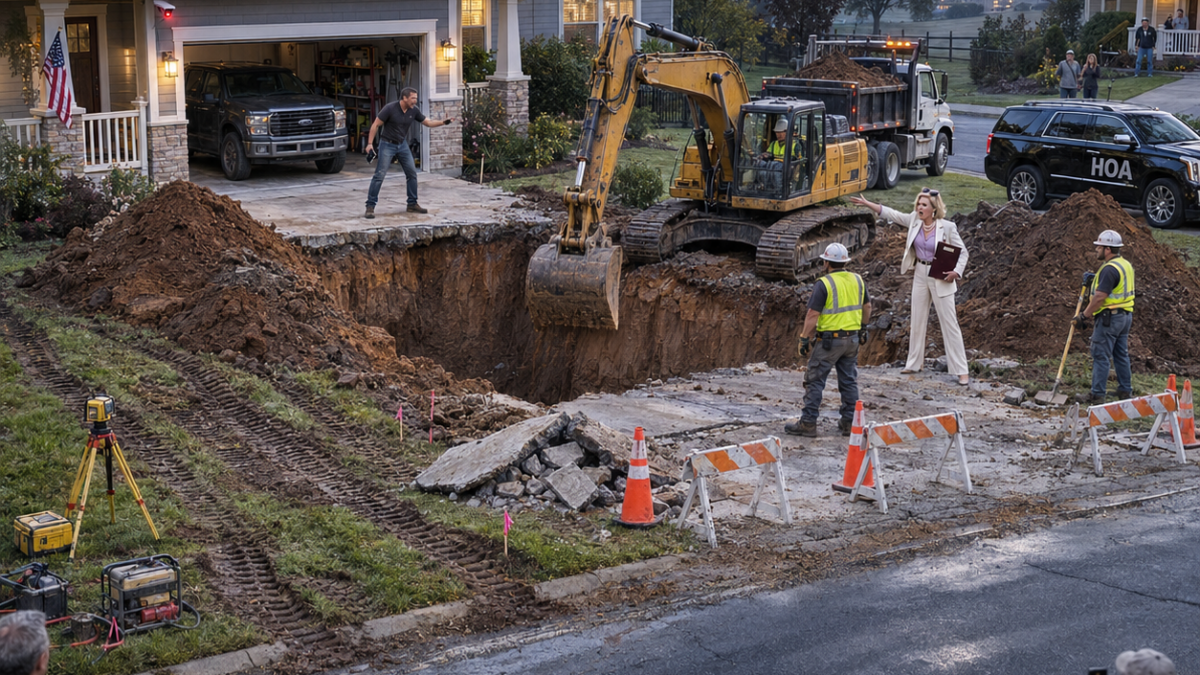
I knew the six-foot-deep hole blocking my garage wasn’t an accident the moment I stepped outside at 6:10 that Monday morning and saw fresh excavator tracks across my lawn, mountains of dirt piled beside my driveway, and my car trapped behind a crater that hadn’t existed when I went to bed.
The HOA president had spent months fining me over trash cans, grass height, porch lights, and almost anything else she could invent, but tearing apart private property before sunrise was different—and whoever had ordered the work had crossed out of petty neighborhood harassment and into the kind of territory I had spent twenty years investigating for a living.
What Karen Whitmore didn’t seem to remember was that I was Detective Jake Miller, my house had more cameras than most convenience stores, and while I stood there staring at the damage, a small red light beneath my porch roof was still blinking steadily above the driveway.
The excavator engine was running when I walked toward the crew.
A man in a neon vest climbed down and raised both hands.
“Morning. You Jake Miller?”
“That depends on why there’s a canyon in front of my garage.”
He looked at his clipboard.
“We’re doing an emergency utility repair.”
“Who ordered it?”
“Willow Creek Estates HOA.”
I already knew the next answer, but I asked anyway.
“Who specifically?”
He turned the page.
“President Karen Whitmore.”
I stared at the hole.
There were no utility lines beneath that section of driveway. I knew because I had checked the property survey before buying the house two years earlier.
“Do you have a city permit?”
He held out the work order.
It looked official from a distance—HOA letterhead, typed authorization, a contractor number—but the permit field contained no city-issued reference number.
I handed it back.
“Who told you this was common property?”
“Mrs. Whitmore.”
“Did she pay you?”
He hesitated.
“Up front.”
“How?”
Another pause.
“Cash.”
That was when my irritation disappeared.
I became very calm.
Twenty years as a detective had taught me that anger feels useful right up until it ruins evidence.
“Okay,” I said. “Nobody touches anything else for a minute.”
The foreman frowned. “We’re supposed to finish before noon.”
“Why before noon?”
“That’s what she requested.”
My eyes moved toward the house across the street.
Karen’s curtains shifted.
Barely.
Someone was watching.
For months, Karen had treated Willow Creek Estates like her personal jurisdiction. She had fined me because my trash can remained visible twelve minutes after pickup. She had measured my grass. She had challenged my security lights, my blinds, even the size of my flag.
The first time I questioned her publicly at an HOA meeting, she stared at me as if I had committed treason.
After that, the violations came almost daily.
Then she tried to place a lien on my house.
When another board member pointed out that Karen lacked the votes required under the HOA bylaws, she backed down—but only temporarily.
A week later, somebody filed an anonymous complaint with my police department claiming I used my badge to intimidate neighbors.
My captain investigated it.
Nothing.
Case closed.
That was when I realized Karen wasn’t trying to enforce rules anymore.
She was trying to damage my career.
So I documented everything.
Every email.
Every fine.
Every photograph.
Every encounter.
I had a doorbell camera, two exterior security cameras, a driveway camera, and another wide-angle unit under the eaves. None had been installed because of Karen. They were simply the habits of a man who had spent two decades learning that memory becomes unreliable the moment two people start telling different versions of the same story.
Now those cameras were pointed directly at the hole.
I walked inside, opened my laptop, and pulled up the previous forty-eight hours.
Saturday was ordinary.
Sunday morning, nothing.
Then at 3:14 Sunday afternoon, movement appeared at the bottom of the driveway.
I stopped the recording.
Karen Whitmore stood beside the curb in her bright pink blazer.
Next to her was the same foreman now standing outside my house.
She pointed directly at my driveway.
He took notes.
Then Karen reached into her purse, removed a thick envelope, and placed it in his hand.
I enlarged the image.
The envelope opened just enough for me to see the edges of cash inside.
Then I turned up the audio.
Karen leaned closer to the contractor.
And the first sentence I heard made me reach for my phone.
PART 2
“Just make sure it looks official.”
I replayed it.
Same words.
Same voice.
The contractor answered quietly enough that I had to increase the volume.
“You’re sure this is HOA property?”
Karen didn’t hesitate.
“Completely. And I need it done early. Before he can interfere.”
The contractor looked toward my house.
“That detective?”
“Yes.”
Then Karen lowered her voice.
The directional microphone still caught it.
“He needs to understand that living here doesn’t make him special.”
I sat motionless at my desk.
For months, Karen had been careful.
Petty, vindictive, dishonest—but careful.
Her violation notices always used vague language. Her complaints to my department were anonymous. When confronted at meetings, she hid behind phrases like “community standards” and “board discretion.”
This was different.
She had directly hired someone to enter my property under false pretenses and damage my driveway because she wanted to “send a message.”
I copied the footage to two encrypted drives and uploaded another copy to secure cloud storage.
Then I called my lieutenant.
“Morning, Jake.”
“Morning.”
“You sound too calm.”
“That’s because somebody excavated my driveway.”
Silence.
“What?”
“I need you to hear something.”
I explained enough to make one thing clear: I was the victim, which meant I had no business personally running a criminal investigation.
That mattered to me.
I had spent too many years testifying about chain of custody, conflicts of interest, and investigative procedure to suddenly pretend those rules didn’t apply because I was angry.
My lieutenant agreed.
“I’m sending Patrol and assigning this outside your unit.”
“Good.”
“And Jake?”
“Yeah?”
“Don’t play detective at your own house.”
I looked at the crater outside.
“No promises about being observant.”
“That’s not what I said.”
“I know.”
***
The excavator shut down ten minutes later.
Officer Ben Carter arrived first, followed by Sergeant Ruiz.
Ben stared at the hole.
Then at me.
Then back at the hole.
“I’ve seen domestic disputes that made more sense.”
“Morning, Ben.”
“Your HOA lady?”
I pointed toward the camera.
“You’ll want the footage.”
Ruiz immediately separated me from the contractor and treated the scene the way he would any property-damage complaint.
Photographs.
Measurements.
Work order.
Names.
Statements.
The foreman identified himself as Ray Collins.
He looked increasingly uncomfortable as Ruiz questioned him.
“Who hired you?”
“Karen Whitmore.”
“Did you verify ownership?”
“She said HOA land.”
“Did you obtain permits?”
“She gave me paperwork.”
Ruiz held up the document.
“This isn’t a municipal excavation permit.”
Ray looked at it.
“I didn’t know.”
“You didn’t check?”
His shoulders dropped.
“No.”
“How much did she pay?”
Ray glanced at me.
“Thirty-five hundred.”
“Cash?”
“Yes.”
“Anything in writing?”
“Texts.”
Ruiz stopped writing.
“You still have them?”
“Yes.”
That was the moment Karen appeared.
Of course she did.
She came walking across the street wearing cream slacks, a pink jacket, and sunglasses despite the cloudy morning.
“What is going on?”
Ben actually looked toward me.
I said nothing.
Karen stepped to the edge of the property.
“This is an authorized HOA maintenance operation.”
Ruiz turned.
“Ma’am, stay on the sidewalk.”
She blinked.
“I’m the HOA president.”
“I heard you.”
“I authorized the work.”
“I heard that too.”
She looked pleased, as if the admission strengthened her authority.
“It’s an emergency drainage repair.”
Ruiz glanced toward Ray.
“Drainage?”
Ray looked miserable.
“That’s what I was told.”
Karen pointed toward the crater.
“This section has been a hazard for months.”
I finally spoke.
“There was nothing wrong with it yesterday.”
She looked at me.
“That’s your opinion.”
“It’s my driveway.”
“Parts of the frontage fall under HOA maintenance authority.”
“No, they don’t.”
“You’re mistaken.”
I almost smiled.
“Karen, you really should stop talking.”
Her face hardened.
“Is that a threat, Detective?”
Ruiz stepped between us.
“That’s enough. Mr. Miller is the complainant. I’m conducting the investigation.”
Karen’s expression changed when she heard that.
For the first time, she seemed to remember that my badge didn’t mean I could control what happened—but it also meant I knew enough not to let her bait me into doing something stupid.
She turned to Ruiz.
“I expect professionalism.”
“So do I.”
He gestured toward her house.
“We’ll need to speak with you after we finish here.”
Karen folded her arms.
“I’ll have counsel present.”
“Your choice.”
She looked at me one last time.
That smug little smile returned.
Then she walked away.
Ray watched her go.
“Man.”
I looked at him.
“What?”
“She told me you were some rogue cop threatening the whole board.”
I laughed once.
“That sounds like her.”
He rubbed his forehead.
“I should’ve checked.”
“Yes.”
“I’m sorry.”
I looked at the damage.
“Cooperate with them. That’s the best thing you can do now.”
***
By eight-thirty, my driveway had been classified as an active property-damage scene.
By nine, I was in an Uber heading to work because my car was still trapped in the garage.
The driver slowed as he passed the hole.
“Dude.”
“Yeah.”
“What happened?”
“HOA.”
He looked at me in the mirror.
“No follow-up questions.”
“Smart.”
At the station, my coworkers had already heard.
Detectives are terrible at keeping gossip contained.
My partner, Chris Dalton, leaned over the divider between our desks.
“So.”
“No.”
“You got an HOA sinkhole.”
“No.”
“Suburban trench warfare?”
“Chris.”
“Did Karen finally declare independence?”
I dropped my bag.
“Are you finished?”
“Probably not.”
Despite myself, I laughed.
That helped.
Then my captain called me into his office.
Captain Harris had the same expression he used whenever one of his detectives brought him a problem nobody wanted.
“Sit.”
I did.
He had already received Ruiz’s preliminary report.
“You’re staying away from the investigation.”
“Agreed.”
“No searches.”
“Agreed.”
“No interviewing witnesses under color of authority.”
“Agreed.”
“No accessing protected databases for personal purposes.”
“Obviously.”
He studied me.
“Jake, I’m saying this because I know how long she’s been after you.”
“I know.”
“You’ve got twenty years on the job. Don’t let some HOA president become the thing that stains them.”
That landed harder than I expected.
Because underneath my controlled voice and careful documentation, I was furious.
Karen had tried to damage my reputation.
Then my career.
Now my property.
Part of me wanted to use every investigative skill I had and bury her under it.
Harris knew that.
So did I.
“I won’t.”
He nodded.
“Good.”
Then his mouth twitched.
“Six feet?”
“Closer to eight on one side.”
He shook his head.
“Unbelievable.”
***
I contacted city code enforcement only as the property owner.
Mark Thompson came out that afternoon.
He had worked for the city fifteen years and possessed a deep personal hatred of fake permits.
The moment he saw Karen’s paperwork, he frowned.
“No permit number.”
“Exactly.”
“Contractor license listed here expired years ago.”
“Ray says he recently restarted the company.”
“That doesn’t reactivate this license.”
He scanned another line.
“And this utility authorization number is nonsense.”
“So there was never an emergency request?”
Mark checked his tablet.
“No water break. No sewer repair. No storm-drain failure. Nothing.”
He looked at the crater.
“You know what’s underneath there?”
“Dirt and one sprinkler line.”
“Exactly.”
Ray’s crew had clipped that sprinkler line, which explained why muddy water now pooled at the bottom.
Mark whistled.
“She created the hazard she claimed to be fixing.”
“Pretty much.”
He photographed everything.
“City will issue the contractor a stop-work order pending review.”
“Ray’s cooperating.”
“Good. He may still face licensing penalties.”
“I understand.”
Mark looked across the street.
Karen’s blinds moved.
“She watching?”
“Always.”
“You sure you didn’t arrest the wrong people for twenty years?”
I laughed.
“Some days.”
***
I returned home after sunset.
The hole looked worse under the security lights.
Nearly twelve feet across.
Eight feet deep at the deepest point.
Mud.
Broken asphalt.
Exposed soil.
My garage might as well have been on an island.
Karen stepped onto the sidewalk while I was examining it.
“Oh, Detective Miller.”
I ignored her.
“What a terrible mess.”
I turned.
She put a hand to her chest.
“We were only trying to help.”
“You hired an unlicensed contractor to dig a hole in my driveway.”
“Emergency maintenance.”
“There was no emergency.”
“You don’t know everything the board knows.”
I studied her.
“Was the board aware?”
Her answer came too quickly.
“Of course.”
Interesting.
“You took a vote?”
She adjusted her sunglasses.
“We don’t need a full vote for emergency repairs.”
“Which bylaw?”
Her lips tightened.
“You really do enjoy playing lawyer.”
“No. I enjoy reading.”
She pointed toward the hole.
“You’ll need to repair that quickly.”
I almost laughed.
“Why?”
“It’s a hazardous condition.”
“You created it.”
“The HOA authorized maintenance.”
“And now you’re threatening to fine me because the maintenance you ordered destroyed my property?”
She smiled.
“If the hazard remains.”
There it was.
Not a moment of regret.
Not even concern.
The hole wasn’t a construction mistake.
It was leverage.
She wanted me inconvenienced, embarrassed, trapped, and then fined for the condition she created.
I stepped closer to my property line.
“Good night, Karen.”
“That’s it?”
“For now.”
Her smile faded slightly.
I walked inside.
***
The next morning, an HOA violation notice appeared on my door.
**HAZARDOUS DRIVEWAY CONDITION — CORRECTION REQUIRED WITHIN 72 HOURS.**
I stared at it for ten seconds.
Then laughed so loudly that my neighbor Mr. Jacobs heard me from two houses down.
He wandered over with his terrier.
“What now?”
I held up the notice.
He read it.
His mouth fell open.
“She dug the hole.”
“Correct.”
“And now she fined you for having a hole.”
“Correct.”
He started laughing.
His terrier barked.
Within an hour, photos of the notice were circulating among neighbors.
For the first time, people weren’t whispering privately about Karen.
They were openly mocking her.
That mattered.
Fear depends on everyone believing they are alone.
***
Ray Collins gave investigators everything.
Texts.
Payment receipt.
Work instructions.
Photographs.
He had even saved a voicemail.
Karen’s voice:
“Start early. I want it opened before Miller leaves for work. Make sure the driveway is completely inaccessible.”
Then:
“He needs to learn he can’t challenge the board without consequences.”
That recording changed the tone of the case.
Ruiz called me.
“I can’t discuss the full investigation.”
“I know.”
“But I can tell you we’re treating this as intentional property damage.”
“Understood.”
“And Ray is cooperating.”
“Good.”
“Also…”
“What?”
“He says Karen supplied the work order herself.”
“That matches the video.”
“Yeah.”
Ruiz paused.
“You did good not confronting her that morning.”
I looked at the hole.
“I considered filling it with her violation notices.”
“That would’ve been funny.”
“Not admissible?”
“Probably not.”
***
The criminal case wasn’t the only thing unraveling.
Linda Matthews, the HOA vice president, knocked on my door that evening.
She stood on the porch clutching a folder.
Linda was a retired teacher in her early sixties who had challenged Karen once during the attempted lien vote.
She looked exhausted.
“Can we talk?”
“Sure.”
She came inside.
“I need to tell you something.”
I poured coffee.
She didn’t touch hers.
“The board never authorized the excavation.”
I had suspected that.
Hearing it still mattered.
“Did Karen tell you she had?”
“She sent an email Sunday night saying an emergency repair was scheduled.”
“After she had already hired Ray?”
Linda looked confused.
“What do you mean?”
I told her about the camera footage timestamped Sunday afternoon.
3:14.
Linda closed her eyes.
“She lied to us too.”
“What did the email say?”
She opened her folder.
Printed copy.
**Emergency drainage maintenance authorized under presidential discretion. No board action required due to immediate safety concern.**
Timestamp:
8:42 p.m.
Hours after Karen had already handed Ray the cash.
I photographed it.
“Would you give this to Sergeant Ruiz?”
Linda nodded.
Then hesitated.
“Jake, there’s more.”
She pulled out meeting minutes.
Karen had been using something she called “presidential emergency authority” for years.
Landscaping contracts.
Security purchases.
Legal consultations.
Maintenance reimbursements.
None large enough individually to attract much attention.
But frequent.
“Why didn’t anyone question it?”
Linda looked ashamed.
“We did.”
“And?”
“She humiliated people.”
Her hands tightened.
“She’d bring up unpaid fines. Private complaints. Sometimes personal things residents had told her.”
“Blackmail?”
“I wouldn’t call it that.”
“What would you call threatening someone with embarrassing information if they vote against you?”
Linda looked away.
“Blackmail.”
I leaned back.
The hole might not be Karen’s only problem.
***
I didn’t investigate the HOA finances.
I couldn’t.
But residents could request records.
And suddenly, they did.
Mr. Jacobs asked for the last three years of maintenance expenses.
Lisa Grant, a young mother Karen had targeted over her daughter’s swing set, requested vendor contracts.
The retired couple on Maple Lane asked for legal-fee invoices.
Linda persuaded two other board members to support an independent audit.
Karen reacted exactly as expected.
She called an emergency meeting.
I attended as a homeowner, not a detective.
The room was packed.
Karen stood at the podium.
“The recent campaign against this board is being driven by one disgruntled resident.”
Every head turned toward me.
I stayed seated.
She continued.
“Detective Miller has exploited his occupation to intimidate contractors, residents, and HOA leadership.”
I raised my hand.
She ignored me.
Linda spoke.
“Karen, the board needs to address the excavation.”
“We already have.”
“No, you addressed it alone.”
Karen glared.
“It was an emergency.”
Linda held up the printed email.
“You informed us after hiring the contractor.”
Whispers filled the room.
Karen’s face tightened.
“That is inaccurate.”
Lisa Grant stood.
“The security footage has timestamps.”
Karen snapped:
“This meeting is not a criminal proceeding.”
Mr. Jacobs called from the back:
“Good, because you’d need a lawyer.”
Laughter erupted.
Karen slammed the gavel.
“Order!”
Nobody stopped.
Then I stood.
The room quieted.
“I’m not going to discuss the criminal investigation.”
Karen smiled triumphantly.
“Because there isn’t one.”
I looked at her.
“I said I’m not discussing it.”
Her smile faded.
“But as a homeowner, I would like an answer to one question.”
She crossed her arms.
“What?”
“Did the board authorize North Ridge Maintenance to excavate my driveway?”
Silence.
Karen looked toward Linda.
Then another board member.
Nobody spoke.
Finally:
“I had authority.”
“That wasn’t the question.”
“You’re twisting procedure.”
“Did the board vote?”
“No vote was required.”
“So no.”
Her cheeks reddened.
“I was protecting community infrastructure.”
“There was no infrastructure under my driveway.”
“That remains disputed.”
“By whom?”
She slammed the gavel.
“This discussion is closed.”
For years, that would have ended it.
Not anymore.
Carlos from the next street stood.
“I move for an independent financial audit.”
Another homeowner:
“Second.”
Karen stared.
“You cannot make motions from the floor without—”
Linda interrupted.
“Actually, under Section 6.3, they can.”
The room went silent.
Karen looked at her vice president as if she had been betrayed.
Maybe she had.
But loyalty built on fear has an expiration date.
***
The audit motion passed.
Karen walked out before the vote was announced.
The next morning, she filed another complaint with my department.
This time claiming I had threatened her during the meeting.
Captain Harris called me in.
Again.
He looked almost bored.
“She says you stared at her aggressively.”
“I have no defense.”
His mouth twitched.
“She also says your presence constitutes intimidation.”
“I live there.”
“I noticed.”
“She says I’m abusing police resources.”
“You’re not assigned to her case.”
“I know.”
Harris leaned back.
“Jake, this is getting bigger.”
“What do you mean?”
“The city attorney called.”
“Why?”
“Because somebody used forged municipal-style paperwork during that excavation.”
I nodded.
“And?”
“If it’s connected to other HOA work orders, they’ll want them.”
That was new.
“Other work orders?”
Harris pointed at me.
“Do not investigate.”
I held up my hands.
“I didn’t say anything.”
“Your face did.”
***
The investigator assigned to the case, Detective Maria Santos from another precinct, contacted Ray’s former employees.
One remembered another job.
Then another.
Always paid through Willow Creek.
Always labeled emergency maintenance.
Sometimes the homeowner had complained.
Sometimes nobody had.
A tree removed from an elderly couple’s yard despite their objections.
A retaining wall partly dismantled after an HOA dispute.
A driveway edge cut back because Karen claimed it extended onto common property.
Nothing as extreme as my crater.
But a pattern existed.
Karen used contractors as an enforcement weapon.
The revelation hit the neighborhood hard.
Mr. Jacobs came over after hearing about the tree.
“That was the Peterson place.”
“I remember them.”
“They moved.”
“Why?”
He looked toward Karen’s house.
“Maybe now we know.”
***
My own repair took almost two weeks because engineers needed to inspect the excavation before backfilling.
The sprinkler line had to be repaired.
Soil compacted.
Base material replaced.
Asphalt cut and resurfaced correctly.
Total cost:
Just over $18,000.
My insurer covered part initially while preserving subrogation rights.
I paid a deductible.
Karen’s HOA sent me three additional hazard notices while the repair was underway.
I framed one.
Chris saw it in my office.
“You’re keeping that?”
“Absolutely.”
“Why?”
“Evidence of insanity.”
“Official classification?”
“Pending.”
***
The criminal warrant came on a Wednesday.
I didn’t know until Lisa Monroe called me.
Lisa and I had worked cases together years before she became an assistant district attorney.
“Jake.”
“Hey.”
“You home tomorrow morning?”
“Why?”
“I can’t tell you.”
“That sentence tells me enough.”
“Then don’t make me regret calling.”
I looked across the street.
Karen’s house lights were on.
“Do I need to do anything?”
“Stay out of the way.”
“Good advice.”
“At eight.”
The call ended.
I didn’t sleep much.
Not because I was excited.
Because I kept remembering every moment when I could have escalated.
Every sarcastic response.
Every meeting.
Every time Karen tried to provoke me.
If I had flashed my badge, threatened arrest, accessed some record I shouldn’t have, or pushed the case myself, she would have had something real to use against me.
Instead, the evidence stood on its own.
Her words.
Her payments.
Her documents.
Her actions.
That mattered more than my profession ever could.
***
At 7:55 the next morning, two unmarked SUVs entered Willow Creek.
I stood behind my living-room window holding coffee.
Maria Santos got out with three officers.
They crossed to Karen’s house.
Knocked.
Waited.
Knocked again.
The door opened.
Even from across the street, I could hear Karen.
“What is this?”
Maria showed the warrant.
Karen’s voice rose.
“You have no authority to enter my home!”
The officers remained calm.
Neighbors began appearing.
Curtains opened.
Phones came out.
Karen stepped onto the porch wearing a robe with her hair unstyled.
No blazer.
No clipboard.
No prepared speech.
Maria read the charges.
Criminal mischief.
Fraud-related offenses involving falsified work authorization.
Harassment.
Other counts pending prosecutorial review.
Karen saw me.
Her whole face changed.
“You!”
I didn’t answer.
“You did this!”
Still nothing.
She pointed across the street.
“He’s using his department against me!”
Maria turned her gently toward the vehicle.
“Mrs. Whitmore, Detective Miller is not part of this investigation.”
“That’s a lie!”
“It isn’t.”
“You’re all protecting him!”
Maria opened the back door.
Karen kept shouting.
Then our eyes met.
For months, I had imagined what I might say.
Something clever.
Something devastating.
Instead I lifted my coffee slightly.
“Morning, Karen.”
The door closed.
***
The neighborhood remained silent for maybe thirty seconds after the SUVs left.
Then Mr. Jacobs walked into his driveway.
“Well.”
Lisa Grant came outside holding her toddler.
Linda stood on her porch.
Nobody cheered.
That surprised me.
Maybe because arrest is different when the person lives across from you.
Karen had been awful.
But she was also someone they saw collecting mail.
Watering flowers.
Hosting Christmas parties.
Human beings are complicated enough that consequences can feel necessary and sad at the same time.
Linda crossed the street.
“I never thought it would go this far.”
“Neither did I.”
She looked at the repaired section of driveway.
“All because of a hole.”
“No.”
I looked at Karen’s empty porch.
“The hole was just the first thing she couldn’t explain away.”
***
Local news arrived by noon.
A reporter asked whether I had used my police position to pursue Karen.
“No.”
“Were you involved in the investigation?”
“I was the victim and a witness. The case was handled independently.”
“Is it true you had surveillance video?”
“Yes.”
“Did the HOA president intentionally order your driveway excavated?”
“That’s a question for prosecutors.”
“Do you feel vindicated?”
I thought about it.
“No.”
The reporter seemed disappointed.
“What do you feel?”
“Relieved that evidence matters.”
That was all I gave them.
***
Without Karen, the HOA board looked like people waking from a long bad dream.
Linda called an emergency meeting.
She sat at the front.
No gavel.
“I don’t think we need this,” she said, holding it up.
Someone laughed.
Then she placed it aside.
“Effective immediately, Karen Whitmore is suspended from all HOA authority pending a removal vote.”
Applause.
Not wild.
But real.
Linda looked toward me.
“Jake, I owe you an apology.”
“You don’t owe me one personally.”
“Yes, I do.”
She swallowed.
“I watched her target people.”
“So did others.”
“That doesn’t excuse it.”
“No.”
“I kept telling myself she was difficult but effective.”
She looked around.
“Then I started telling myself opposing her would make things worse.”
Mr. Jacobs spoke from the back.
“It usually did.”
Linda nodded.
“That’s how this happened.”
The room became quiet.
She continued.
“We are going to audit the finances, review every fine issued under Karen’s presidency, and rewrite enforcement rules so no president can act alone like this again.”
For the first time, an HOA meeting ended without someone leaving angry.
***
Karen’s attorney fought aggressively.
The excavation was an emergency repair.
The permit was merely defective.
Ray misunderstood instructions.
The surveillance audio lacked context.
Karen had authority under the bylaws.
Every defense collapsed under documentation.
The HOA charter explicitly stated private driveways remained homeowner responsibility.
There was no utility easement.
No emergency.
No city permit.
No board authorization.
Ray had the texts.
My camera had the cash payment.
His voicemail had Karen ordering him to make my driveway inaccessible.
Then came the recording that mattered most.
Not a secret conversation I manufactured.
Karen had volunteered the confession during a later documented encounter after investigators had already obtained the underlying evidence.
On video, confronted about the lack of utility authorization, she lost her temper.
“You think you’re so smart because you wear a badge.”
I remained calm.
“This isn’t about my badge.”
“It’s always about your badge with you.”
“No. It’s about my driveway.”
“You challenged me in front of everyone.”
“That isn’t a crime.”
“You made me look weak!”
Karen stopped.
The courtroom recording would later hold on her face at that exact moment.
Then she said:
“I told that contractor to dig it because somebody needed to put you in your place.”
The sentence became the center of the prosecution’s case.
Intent.
Not repair.
Not mistake.
Punishment.
***
I testified at the hearing months later.
Karen arrived perfectly dressed.
Hair styled.
Pearls.
The costume of control restored.
Her attorney tried to suggest I had targeted her because I disliked HOA oversight.
“Detective Miller, you disagreed with Mrs. Whitmore frequently.”
“Yes.”
“You mocked her rules.”
“Sometimes.”
“You challenged her publicly.”
“When I believed she was wrong.”
“You kept extensive surveillance equipment.”
“At my home.”
“More than the average homeowner.”
“Probably.”
“Because you were waiting for Mrs. Whitmore to do something?”
“No. Most cameras predated our dispute.”
He paced.
“You enjoyed documenting her.”
“No.”
“You created a folder specifically about her.”
“After repeated notices and a false workplace complaint.”
“So you were building a case.”
“I was preserving records.”
“Against my client.”
“About her conduct.”
He leaned closer.
“You wanted her gone.”
I thought before answering.
“I wanted her to leave me alone.”
That quieted him for a second.
The prosecutor then played the driveway footage.
Karen and Ray.
The envelope.
Cash.
Her instructions.
Then texts.
**START BEFORE SUNRISE.**
**MAKE SURE HE CANNOT GET HIS VEHICLE OUT.**
**THE DETECTIVE IS A PROBLEM. THIS WILL SEND A MESSAGE.**
Finally, her own words:
**I told that contractor to dig it because somebody needed to put you in your place.**
The courtroom went completely still.
Her attorney looked down.
Karen stared straight ahead.
For once, there was no rulebook large enough to hide behind.
***
The court found her guilty on the main property-damage and fraud-related counts presented.
The initial sentence included twelve months of supervised probation, two hundred hours of community service, full restitution for my driveway repairs and associated costs, and restrictions on holding HOA office during the probationary period.
The civil consequences hurt more.
Three other residents had joined claims after the excavation exposed similar conduct.
Legal fees.
Damages.
Settlements.
Together, Karen faced more than $75,000 in civil obligations.
Within two months, the house across from mine went up for sale.
The perfectly edged lawn started growing unevenly.
One shutter faded.
A weed appeared near the mailbox.
Mr. Jacobs pointed it out one morning.
“Think we should fine her?”
I looked at him.
He grinned.
“Kidding.”
“Good.”
“Mostly.”
***
The financial audit arrived after Karen’s first case was nearly finished.
Linda called me.
Her voice sounded strange.
“We found money missing.”
“How much?”
“We don’t know yet.”
“Call the accountant and the board attorney.”
“We did.”
“Then follow them.”
“Jake…”
“What?”
“I think it’s more than mistakes.”
That investigation stayed separate from me.
Months later, Lisa Monroe called.
“Remember those maintenance reimbursements?”
“Yes.”
“Several were fictitious.”
“How much?”
“More than forty thousand dollars we can document.”
I closed my eyes.
“Karen?”
“Funds moved through accounts she controlled or benefited from.”
“So another case.”
“Yes.”
The second prosecution resulted in additional restitution and a county-jail sentence, followed by probation.
The exact outcome mattered less to me than the audit itself.
Karen had spent years telling residents every dollar, every fine, every assessment was necessary for “community integrity.”
Meanwhile, money had been disappearing.
The woman who measured recycling bins by inches hadn’t bothered applying the same precision to the HOA’s bank account.
***
The moving truck arrived on a Thursday.
Karen stood beside it directing workers.
She looked thinner.
Older.
Not destroyed.
Just tired.
I was trimming roses beside my repaired driveway when she walked across the street.
I set down the shears.
She stopped at the property line.
For once, she didn’t step over it.
“I suppose you’re happy.”
“No.”
She gave a bitter laugh.
“Please.”
“I wanted a quiet place to live.”
“You humiliated me.”
“I challenged you.”
“You made everyone turn against me.”
I shook my head.
“Your choices did that.”
Her eyes hardened.
“There you go. Detective Miller. Always the righteous one.”
“I made mistakes too.”
That surprised her.
“You think?”
“I mocked you when I should’ve stayed professional. Sometimes I enjoyed proving you wrong.”
She crossed her arms.
“But I didn’t hire an excavator to destroy your property.”
Silence.
“No.”
“Why did you do it?”
Her face changed.
Not much.
But enough.
“You embarrassed me in that meeting.”
“That’s it?”
“You don’t understand.”
“Try me.”
She looked toward her former house.
“I spent eight years keeping this neighborhood from becoming a mess.”
“You spent eight years deciding nobody else could be trusted.”
“Because they couldn’t.”
“There it is.”
“What?”
“The reason none of this ever stopped.”
She stared at me.
“You still think control is the same thing as respect.”
Her expression tightened.
I expected another argument.
Instead, she looked away.
Maybe because there was nothing left to win.
The movers closed the truck.
Karen reached for her car door.
Then turned once more.
“You know what the worst part is?”
“What?”
“You’re going to be remembered as the hero.”
I shook my head.
“No.”
She waited.
“The cameras will be remembered.”
For the first time in months, she almost smiled.
Not warmly.
But something close to recognizing the absurdity.
Then she got into her car and drove away.
***
A young family bought Karen’s house.
The Parkers.
Ryan and Emily.
Two children.
Labrador puppy.
They arrived on a Saturday morning.
Ryan waved while unloading boxes.
“Hey, neighbor.”
“Welcome.”
“We heard some stories.”
“I bet.”
He glanced toward my driveway.
“Is that the famous driveway?”
I looked down.
Fresh black asphalt.
Two rose beds.
No crater.
“That’s the one.”
Emily laughed.
“We promise not to excavate it.”
“Appreciated.”
Ryan asked:
“Any advice for living here?”
“Read the bylaws.”
He laughed.
“Seriously?”
“Seriously.”
“And?”
“If anybody tells you they own authority over your property, ask them to show you where it’s written.”
He nodded.
“Fair enough.”
Their daughter drew chalk flowers across the sidewalk that afternoon.
Bright purple.
Green.
Orange.
Under Karen’s old rule system, someone probably would have found a subsection about temporary visual alterations.
Nobody did.
The rain washed them away two days later.
Civilization survived.
***
Linda became HOA president after a real election.
She hated being called president.
“Coordinator,” she told people.
“That’s not the title.”
“It should be.”
The board rewrote the bylaws.
No unilateral fines above a small threshold.
Mandatory board vote for liens.
Independent review of major contracts.
Open financial statements.
Resident appeal process.
Conflict-of-interest disclosures.
No president could authorize work on private property without written consent or lawful emergency authority.
The new newsletter opened with four words:
**SERVING, NOT CONTROLLING, WILLOW CREEK.**
Chris saw a copy at the station.
“Cute.”
“It works.”
“You joining the board?”
“I’d rather go back to the crater.”
***
Freedom Park opened that summer.
The community voted to remove Karen’s name from the old landscaped common area.
Linda asked me to help choose the new sign.
I refused initially.
Then she brought over a mockup.
**FREEDOM PARK**
Below it:
**RESPECT GROWS WHERE CONTROL FAILS**
I stared.
“That’s dramatic.”
“We’ve had a dramatic year.”
“Fair.”
“You like it?”
“I do.”
At the dedication, children ran between picnic tables while Mr. Jacobs argued with someone about barbecue sauce.
Lisa Grant’s daughter had a swing set in her yard now.
Blue.
Not HOA-approved blue.
Just blue.
The retired couple on Maple Lane installed potted plants of completely different shapes.
Nobody measured them.
It felt ridiculous that those tiny freedoms meant anything.
But when people spend long enough afraid of being punished for harmless choices, normal life becomes noticeable.
***
Six months after the hole, I stood outside one morning with coffee.
Birds in the oak trees.
Sprinklers.
A delivery truck.
Nothing dramatic.
The repaired driveway looked better than it had before Karen destroyed it.
The contractor I hired had resurfaced the entire section rather than simply patching the excavation.
I planted roses along the edge.
Not because they symbolized anything.
I just liked roses.
Mr. Jacobs walked by with his dog.
He stopped.
“Grass looks high.”
I looked at him.
“Careful.”
“Quarter inch over.”
“I know where you live.”
He laughed.
That was Willow Creek now.
People joking about the rules that used to frighten them.
***
At work, life became ordinary too.
Homicides.
Burglaries.
Fraud.
Real victims with real problems.
Nobody wanted daily updates on my HOA anymore.
That suited me.
One night, Chris and I finished late.
He stopped by my desk.
“You ever delete the Karen folder?”
“No.”
“Why not?”
“Evidence retention.”
“The case is closed.”
“Habit.”
He nodded toward my monitor.
“You know you won, right?”
I leaned back.
“That’s not how I think about it.”
“How do you think about it?”
I considered the question.
“I didn’t have to become her.”
Chris frowned.
“That’s deep for eleven-thirty.”
“Go home.”
He laughed and left.
But that was the truth.
Karen had tried repeatedly to force me into her kind of conflict.
Personal.
Emotional.
Humiliating.
If I had answered that way, she might have succeeded.
Instead, I did what my career had trained me to do.
Preserve facts.
Separate feelings from proof.
Let independent people examine the evidence.
Wait.
That sounds simple.
It wasn’t.
There were nights I wanted to march across the street.
Days I wanted to file every possible complaint.
Moments when sarcasm felt better than patience.
But evidence moves slower than anger and lasts longer.
***
A few months later, Linda stopped by carrying a clipboard.
I stared at it.
She noticed.
“Oh, relax.”
“Bad memories.”
“This one is for park landscaping.”
“Keep it pointed away from me.”
She laughed.
“We finished everything.”
“Good.”
“You should come see.”
We walked to Freedom Park.
The sign stood beside a newly planted maple.
Kids played near the swings.
A couple sat on a bench.
Someone had left a bicycle lying on the grass.
Nobody issued a violation.
Linda looked around.
“Feels different.”
“It does.”
“For years I thought Karen was why the neighborhood looked good.”
“And now?”
“I think people take care of places when they feel like the place belongs to them.”
That was probably the smartest thing anyone said during the entire mess.
Fear can create neat lawns.
It can create straight trash cans.
It can create silence at meetings.
But it doesn’t create community.
***
That night, I sat at my desk and opened the old case folder.
Photographs.
Notices.
Emails.
Karen across the street taking pictures.
The fake permit.
Ray’s texts.
Security footage.
The crater.
Then one still frame from Sunday afternoon.
Karen handing Ray the envelope.
That image had become almost surreal.
One choice.
One envelope.
One instruction.
Months of intimidation had been difficult to prove as anything more than aggressive HOA management.
Then Karen decided to make her power physical.
She ordered machinery onto my property.
She created damage nobody could dismiss as tone or interpretation.
And she did it under four cameras.
I moved the cursor toward the folder.
For a moment, I considered deleting my personal duplicate now that retention was handled elsewhere.
I didn’t.
Not because I wanted revenge preserved.
Because memory gets comfortable.
Years from now, Willow Creek might forget how easily one person accumulated too much unchecked authority.
I closed the folder.
***
Before bed, I stepped onto the porch.
Across the street, lights glowed inside the Parkers’ house.
Their Labrador chased something in the yard.
A child had drawn another giant chalk heart on the sidewalk.
My roses moved slightly in the night breeze.
Then I looked at the driveway.
The spot where the crater had been was almost impossible to identify now.
Smooth asphalt.
Clean edge.
No dirt pile.
No warning tape.
No excavator.
Just a driveway.
Exactly what it was supposed to be.
That was the part I appreciated most.
Not Karen’s arrest.
Not the courtroom.
Not watching the old HOA structure collapse.
Not even hearing that the missing money had finally been traced.
Normal.
I had moved to Willow Creek because after twenty years of police work, I wanted somewhere quiet enough that nothing happened.
Karen mistook quiet people for easy people.
She mistook compliance with reasonable rules for submission to her.
And when I finally challenged her, she believed the only way to restore control was to make me afraid.
So she dug a hole.
A literal one.
Eight feet deep.
Twelve feet wide.
Right across my driveway.
She meant it as a warning.
Instead, it became the one piece of evidence too large to hide behind a clipboard.
I finished my coffee and turned toward the door.
The porch camera’s tiny red indicator blinked above me.
Same camera.
Same light.
Still recording.
I smiled, reached up, and checked that it was secure.
Then I went inside and locked the door.
Outside, Willow Creek stayed quiet.
Exactly the way I had wanted it from the beginning.
The strangest thing about getting what you wanted was realizing how long it took your body to believe the fight was over.
For weeks after Karen moved away, I still woke before sunrise whenever I heard a truck slowing near the cul-de-sac. My first instinct was always the same. I would reach for my phone, open the security app, and scan the cameras before my brain caught up with the fact that the danger was gone.
Most mornings, there was nothing.
A delivery van.
A garbage truck.
A neighbor leaving early for work.
Once, at 5:40 in the morning, I nearly jumped out of bed because I heard a diesel engine rumbling outside. I pulled up the driveway camera expecting construction equipment.
It was Mr. Jacobs helping his nephew move a refrigerator.
I sat on the edge of my bed afterward and laughed quietly at myself.
Twenty years in law enforcement had trained me to recognize threats.
Karen had somehow trained me to expect one in my own front yard.
That bothered me more than I wanted to admit.
I had bought the house at Willow Creek because I wanted a place where being a detective ended at the front door. I wanted to come home, put my badge in the drawer, make coffee, sit on the porch, and be Jake instead of Detective Miller.
For nearly a year, Karen had taken that away.
Every time I heard footsteps outside, I wondered whether another notice was being taped to my door.
Every time an unfamiliar car stopped near my mailbox, I watched.
Every HOA email made my shoulders tense before I even opened it.
The hole in the driveway had been the most obvious attack, but it wasn’t the thing that stayed with me.
What stayed with me was how gradually she had made vigilance feel normal.
And now I had to learn normal again.
Linda understood that better than I expected.
About two weeks after Karen’s house sold, she knocked on my door carrying a stack of folders.
I opened it and stared at the papers.
“No.”
She blinked.
“No what?”
“No HOA paperwork in my house.”
She laughed.
“Fair.”
“What is it?”
“Old violation records.”
My smile disappeared.
“What about them?”
“The board voted to review every fine issued under Karen during the last five years.”
I leaned against the doorframe.
“How many?”
Linda exhaled.
“Hundreds.”
I stepped aside.
“Come in.”
We sat at the kitchen table.
She placed three thick binders in front of me.
“I thought the hole was the worst thing she did,” Linda said.
“It was the worst thing she did to me.”
“That’s exactly the problem.”
She opened the first binder.
There were names I recognized.
Mr. Jacobs.
Lisa Grant.
The Peterson family.
The elderly Henderson couple from the next street.
Residents I had barely spoken with.
Some had been fined fifty dollars.
Some five hundred.
Others had thousands in accumulated penalties.
One family had paid nearly four thousand dollars over eighteen months.
“For what?” I asked.
Linda looked down.
“Mostly repeated landscaping violations.”
I read the notes.
A hedge too wide.
A mailbox painted one shade darker than approved.
Garbage cans visible from the side street.
A basketball hoop left out overnight.
Then I found the Peterson file.
I remembered their house.
Two doors past the community park.
They had moved away before Karen and I really started fighting.
The file showed more than seven thousand dollars in penalties and legal expenses related to a retaining wall.
“Did the wall violate code?”
“No.”
“HOA rules?”
“Not according to the version in effect when it was installed.”
“Then why did they pay?”
Linda’s voice became quiet.
“Karen threatened a lien.”
I stared at the documents.
The Petersons had a teenage son.
I remembered seeing him load boxes into a rental truck the week they moved.
At the time, I assumed they were relocating for work.
“They sold because of this?”
Linda nodded.
“They told me they couldn’t take it anymore.”
That one stayed with me.
Karen had lost her house eventually.
But other people had lost homes first.
There was no perfect way to undo that.
We could refund fines.
We could cancel liens.
We could rewrite rules.
But we couldn’t give the Peterson family back the year they spent afraid of opening their mailbox.
That was when I started attending HOA meetings again.
Not because I wanted a position.
I refused every time Linda suggested one.
“You’d be good on the board,” she told me.
“No.”
“Why?”
“Because I already have one job where people get angry when I show up.”
She laughed.
But I meant it.
Power hadn’t corrupted Karen overnight.
I didn’t think she woke up one morning and decided to become the tyrant of Willow Creek.
More likely, it started smaller.
A rule somebody ignored.
A resident who embarrassed her.
A board vote that didn’t go her way.
Then she discovered that fear worked faster than persuasion.
After that, every victory taught her the wrong lesson.
I had spent my career around enough people with authority to know something uncomfortable.
Nobody is automatically immune from becoming what they once criticized.
So I stayed off the board.
But I attended.
I asked questions.
So did other people.
That was healthier.
Three months after the criminal case ended, Linda called a special meeting about refunds.
The community center was packed.
She stood at the front without a gavel.
Behind her was a spreadsheet projected on the wall.
“We have identified one hundred and eighty-seven fines that appear inconsistent with either the bylaws in effect at the time or proper board procedure.”
People started murmuring.
Linda raised a hand.
“We’re not asking anyone to prove Karen was targeting them. The burden is on us to prove the fine was valid.”
That sentence changed the room.
Under Karen, every resident had been expected to prove innocence.
Now the HOA had to justify punishment.
Mr. Jacobs leaned toward me.
“Look at that.”
“What?”
“Civilization.”
I smiled.
Linda continued.
“Improper fines will be refunded from reserve funds and from money recovered through restitution.”
A woman in the third row started crying.
Not loudly.
She just covered her mouth.
I recognized her from the Henderson house.
Linda noticed too.
“Mrs. Henderson?”
The woman stood.
“My husband died last year.”
The room became quiet.
She wiped her face.
“He spent the last six months of his life worried about a lien.”
My stomach tightened.
“He kept telling me we were going to lose the house because of those fines.”
Linda stepped away from the table.
“I’m so sorry.”
Mrs. Henderson shook her head.
“The money doesn’t matter.”
Nobody spoke.
“I just wish I could tell him he was right.”
“Right about what?” Linda asked.
“That Karen couldn’t do what she was doing.”
She sat back down.
I looked at the floor.
That was the moment the case became different for me.
I had thought of Karen as a bully.
She was.
But bullying sounds almost childish.
Something that happens in school hallways.
Karen had weaponized fear against adults who had mortgages, medical bills, aging parents, children, jobs.
She didn’t need to physically hurt anyone.
She made people believe their homes were always one mistake away from being taken.
That kind of fear travels home with you.
It sits at the dinner table.
It follows you to bed.
I knew because I had felt a smaller version of it myself.
Not fear of losing my house.
Fear that she would attack my career.
For a police officer, reputation mattered.
One complaint could be dismissed.
Five complaints became questions.
Ten complaints became a pattern somebody might wonder about years later.
Karen understood that.
She didn’t need her accusations to be true.
She only needed them to exist.
After the meeting, Mrs. Henderson approached me.
“You’re the detective.”
“Jake.”
She smiled faintly.
“My husband liked you.”
“I didn’t know him very well.”
“He watched you stand up to her at that meeting.”
“The lien meeting?”
“Yes.”
She looked toward the empty podium.
“He came home and said, ‘Maybe we aren’t crazy after all.’”
That hit harder than any courtroom verdict.
She touched my arm.
“Thank you.”
I shook my head.
“I wish I’d done something earlier.”
“So do I.”
Her honesty surprised me.
Then she smiled sadly.
“But earlier is gone.”
She walked away.
I stood alone in the parking lot for a long time after that.
Earlier is gone.
There are sentences that sound ordinary until they follow you home.
That one did.
For years as a detective, I had learned to live with the fact that justice usually arrives after damage.
Police don’t prevent every crime.
Courts don’t restore every loss.
A conviction doesn’t return stolen time.
The best you can sometimes do is stop the harm from continuing.
Karen’s arrest hadn’t erased Willow Creek’s past.
It had only given us a chance to make the future different.
The neighborhood took that seriously.
People who had barely spoken before started showing up to meetings.
Not because they suddenly loved HOA politics.
Because they understood what happened when nobody showed up.
The new bylaws took nearly four months to finish.
Every draft was published.
Every proposed rule was open for comment.
If someone wanted to change a mailbox requirement, they had to explain why.
If the board wanted to raise dues, residents could see the budget.
Any contract involving a board member’s relative required disclosure and competitive bids.
Liens required a formal vote, written notice, an appeal opportunity, and outside legal review.
Emergency authority expired after forty-eight hours unless the board ratified it.
Linda joked that they had written the “Karen Clause” into half the document.
I told her not to name anything after Karen.
“We already removed her name from the park.”
“Exactly.”
“Erase her completely?”
“No.”
I thought about the camera footage still sitting in my evidence archive.
“Remember what happened. Just don’t build monuments to it.”
Linda nodded.
“That sounds annoyingly wise.”
“Twenty years of people making bad decisions.”
“Including you?”
“Especially me.”
The audit went deeper too.
The forty thousand dollars in missing funds was only what investigators could initially document.
The final amount Karen had misused, redirected, or improperly reimbursed turned out to be larger, though not every questionable transaction was criminally provable.
Some money had gone to fake maintenance.
Some to vendors who barely performed work.
Some into reimbursements supported by receipts that didn’t match actual expenses.
The prosecutor explained something to me that I already knew from fraud cases.
Criminal cases require proof.
Suspicion isn’t enough.
Bad accounting isn’t automatically theft.
Conflicts of interest aren’t always crimes.
So Karen wasn’t charged for every ugly transaction.
That frustrated neighbors.
At one meeting, a man stood and shouted:
“She stole from us. Why isn’t every dollar a felony?”
Linda looked at me.
I shook my head.
Not my meeting.
The HOA attorney answered.
“Because law doesn’t work by outrage.”
The man scoffed.
“Well, maybe it should.”
I understood the feeling.
But I also knew where that road led.
Karen had spent years punishing people because she felt justified.
The answer couldn’t be a different group doing the same thing to her.
Eventually, the court ordered additional restitution connected to the proven financial misconduct.
Karen served several months in county custody for the later case, followed by probationary supervision.
The exact sentence became neighborhood gossip for a while.
Some people wanted more.
Some thought enough was enough.
I stopped caring.
Not because consequences didn’t matter.
Because I realized something while watching neighbors debate whether six months was too little or too much.
Karen’s sentence wasn’t my life.
Her future couldn’t become another way she controlled mine.
I had already given her enough mornings.
Enough nights.
Enough attention.
So when Lisa called with the final disposition, I thanked her.
“You don’t sound excited,” she said.
“I’m done.”
“With her?”
“With checking whether she’s miserable enough.”
Lisa was quiet.
“That’s probably healthy.”
“Don’t sound so shocked.”
“I’ve prosecuted people for fifteen years. Victims sometimes spend longer thinking about defendants than defendants spend thinking about victims.”
I looked out my office window at the station parking lot.
“I don’t want that.”
“Then stop opening the case file.”
She knew me too well.
That night, I went home and did exactly that.
I opened the folder labeled HOA CASE.
Photographs.
Scans.
Videos.
Audio.
Emails.
The fake permit.
The violation notice she issued because the hole she ordered had created a hazard.
That one still made me laugh.
Then I found the first picture I had taken the morning the crater appeared.
My driveway torn open.
Dirt piled on both sides.
Excavator tracks.
At the bottom edge of the image, almost unnoticed, was my coffee mug sitting on the porch railing.
I remembered that morning perfectly.
I remembered how angry I was.
How insulted.
How personal it felt.
Then I clicked forward.
A later photograph.
Same driveway.
Repaired.
New roses.
Sunlight.
Nothing remarkable.
For years as a detective, I photographed damage.
Crime scenes.
Broken doors.
Shattered windows.
Cars after crashes.
Rooms after violence.
Evidence of the worst moment in someone’s day.
We almost never photographed what the place looked like six months later.
Maybe we should have.
Damage gets documented.
Healing usually doesn’t.
I created one more folder.
AFTER.
I moved the repaired-driveway photograph into it.
Then closed the computer.
The following spring, the Peterson family came back to Willow Creek.
I didn’t know they were coming.
Linda had invited them to the annual community barbecue.
I was standing near the grill with Mr. Jacobs when a gray SUV parked beside Freedom Park.
A couple stepped out.
Then a teenage boy.
Mr. Jacobs stopped talking.
“That’s them.”
The Petersons.
They looked older than I remembered.
Or maybe I had only ever seen them from a distance.
Linda walked over first.
Mrs. Peterson hugged her.
Mr. Peterson shook her hand.
Then Linda pointed toward me.
They approached.
“You’re Detective Miller.”
“Jake.”
Mr. Peterson shook my hand.
“Tom.”
His wife was Rebecca.
Their son, Aaron, looked uncomfortable the way teenagers often do when adults start discussing serious things.
Tom glanced toward the park sign.
“Freedom Park.”
“Little dramatic.”
Rebecca laughed.
“I like it.”
There was a pause.
Then Tom looked toward their old street.
“We heard the HOA refunded the fines.”
“Yes.”
“We got a check.”
“I’m glad.”
He nodded.
“It wasn’t about the money.”
“That’s what Mrs. Henderson said.”
His face changed.
“You knew her husband?”
“Not well.”
Tom looked down.
“Karen made people feel stupid for being upset.”
Rebecca crossed her arms.
“She’d tell us, ‘It’s only a fine.’”
I understood.
Only a fine.
Only a letter.
Only a warning.
Only a threat.
Control survives by making every individual act look too small to justify resistance.
Tom said:
“We thought we were weak for leaving.”
“You weren’t.”
“Felt like it.”
“You protected your family.”
Aaron finally spoke.
“I hated this place.”
His parents looked at him.
He shrugged.
“Sorry.”
“Don’t apologize,” I said.
He glanced around the park.
“It seems different.”
“It is.”
“How?”
I thought about Linda.
The open books.
The meetings.
Mrs. Henderson.
Kids drawing with chalk.
“People started talking to each other.”
Aaron nodded like that answer made sense.
Maybe it did.
The barbecue lasted until dark.
Nobody talked about Karen after the first hour.
That felt important.
The Petersons told stories about their new town.
Aaron complained about school.
Mr. Jacobs burned hot dogs.
A little girl dropped lemonade on my shoe.
It was ordinary.
Ordinary had become my favorite thing.
Later that summer, I had one final conversation about Karen.
It came from someone I didn’t expect.
Her former vice president, Linda, called me after a board meeting.
“Can I stop by?”
“Is someone digging another hole?”
“No.”
“Then probably.”
She came over carrying no clipboard this time.
Instead, she had an envelope.
“What’s this?”
“Karen mailed it to the HOA.”
I didn’t take it.
“What does she want?”
“I don’t know.”
“You didn’t open it?”
“It’s addressed to the board.”
“That means you can.”
“I thought you should be here.”
We sat at the kitchen table.
Linda opened it.
One page.
Typed.
Karen wrote that she believed she had been unfairly vilified.
That she accepted “some responsibility” for the driveway incident but insisted everything she did had been motivated by protecting property values.
She accused residents of exaggerating.
She accused the board of abandoning her.
She said she hoped history would eventually recognize how much she had done for Willow Creek.
Linda finished reading.
We sat silently.
“That’s it?” I asked.
“That’s it.”
“No apology?”
“Not really.”
I looked at the page.
Years earlier, that would have made me furious.
Now I mostly felt tired for her.
She still needed to win an argument nobody else was having.
Linda asked:
“What should we do with it?”
“File it.”
“Respond?”
“No.”
“Why?”
“Because she’s asking for an audience.”
Linda looked at me.
Then smiled.
“People like that stop when they run out of an audience.”
I recognized the phrase from Deputy Cole—wrong story, I thought with a private grin at how many times law enforcement learns the same lesson in different neighborhoods.
“Exactly.”
Linda folded the letter.
Karen never received a response.
That was the last time her name appeared on an HOA agenda.
My retirement came eighteen months later.
Not because of Karen.
Twenty-two years was enough.
On my final day at the department, Chris put a miniature toy excavator on my desk.
A pink one.
I stared at it.
“You had this custom painted.”
“Maybe.”
“You spent money on this.”
“Worth every cent.”
A tiny label on the side read:
WILLOW CREEK RAPID DRIVEWAY SERVICES
I laughed until Captain Harris came out of his office.
“What’s going on?”
Chris held it up.
Harris shook his head.
“I hate all of you.”
They gave me the usual retirement plaque.
Badge number.
Years of service.
Commendations.
Names.
It meant something.
But when I packed my desk, the thing I put carefully on top of the box was the ridiculous pink excavator.
That evening, I came home before sunset.
For the first time in decades, there was nowhere I had to be the next morning.
I stood in the driveway.
The roses had grown taller.
One branch leaned slightly over the asphalt.
Karen would have hated that.
I left it.
The Parkers’ children were drawing with chalk across the street.
Mr. Jacobs waved.
Lisa Grant was assembling some enormous bright-yellow play structure in her backyard.
Linda walked past carrying grocery bags.
Nobody was watching anyone else for violations.
I carried my retirement box onto the porch and sat down.
The security camera blinked above me.
Still recording.
Old habits.
I considered taking it down.
Then decided against it.
Cameras weren’t the problem.
Evidence wasn’t the problem.
Rules weren’t the problem.
Tools become dangerous when someone uses them to control instead of protect.
A camera can watch a home.
Or intimidate a neighbor.
A rule can keep a street safe.
Or punish someone for being different.
A badge can protect people.
Or become an excuse to feel superior.
I had spent my career trying to remember the difference.
Karen never learned it.
Maybe she never would.
That wasn’t my responsibility anymore.
As the sun dropped, the porch lights came on across Willow Creek.
Different colors now.
Some warm yellow.
Some white.
One house had blue lights around the garage because the owner liked them.
A few years earlier, Karen would have issued three notices before dinner.
Now nobody cared.
I opened a beer.
Chris had included a retirement card inside my box.
On the front was a cartoon hole.
Inside he had written:
To Jake—proof that sometimes the deepest case starts in your own driveway.
Underneath:
Try retirement without arresting the HOA.
I laughed.
Then I noticed another note.
Captain Harris.
You spent your career telling young detectives that evidence beats ego. Nice of you to prove it one last time at home.
I read that twice.
That mattered more than I expected.
Because throughout the whole Karen mess, there had been one fear I rarely admitted.
That I might become the story.
Not the victim.
The cop who used his position in a personal feud.
The detective who let anger blur professional boundaries.
The guy who spent twenty years building a reputation and lost it because someone insulted him in his neighborhood.
Karen had tried to create that version of me.
For a while, I had almost helped her.
Every sarcastic comment.
Every urge to retaliate.
Every moment I wanted to walk across the street and remind her exactly who she was dealing with.
The thing that saved me wasn’t being smarter.
It was procedure.
Letting other officers investigate.
Backing up evidence.
Following the same rules I expected everyone else to follow.
That lesson followed me into retirement.
A year later, Willow Creek held another barbecue at Freedom Park.
I went because Linda threatened to send HOA notices if I didn’t.
“She can’t do that anymore,” I told Mr. Jacobs.
“I know.”
“So why am I here?”
“Free ribs.”
He had a point.
Kids played soccer.
Adults sat under trees.
The Peterson family came back again.
Mrs. Henderson brought a photo of her late husband and placed it near the park plaque for a few minutes.
Nobody made a speech.
Nobody needed one.
Near sunset, Ryan Parker walked over holding two beers.
He handed me one.
“We finally heard the whole story.”
“That sounds dangerous.”
“Our daughter asked why neighbors call your driveway ‘the crater.’”
I groaned.
“She knows?”
“Everybody knows.”
“Great.”
Ryan looked toward my house.
“You know, when we bought Karen’s place, we almost backed out.”
“Why?”
“The history.”
“Makes sense.”
“My wife said something.”
“What?”
“Maybe a bad house can have a good second life.”
I looked across the street.
Their children had painted the front door green.
Bright green.
Karen would have considered it an act of war.
“It looks good.”
“The door?”
“The second life.”
Ryan smiled.
When I got home that night, I stood at the end of my driveway before going inside.
From that angle, I could remember exactly where the crater had been.
The edges.
The dirt piles.
The excavator.
Karen across the street pretending she knew nothing.
For months, I had thought the hole was the symbol of the entire story.
Eventually I understood it wasn’t.
The repaired driveway was.
Anyone can damage something.
Repair takes longer.
It costs more.
It requires people to show up after the excitement is gone.
Karen’s hole took one morning.
Repairing Willow Creek took years.
Refunding fines.
Rewriting bylaws.
Recovering money.
Inviting old neighbors back.
Learning to disagree without threatening each other.
Learning that rules could be questioned without destroying order.
Learning that silence was not the same as peace.
The neighborhood wasn’t perfect afterward.
No neighborhood is.
People still argued about parking.
Dogs barked.
Someone complained about fireworks.
One board meeting lasted nearly two hours because residents couldn’t agree on whether food trucks should be allowed at community events.
Linda called me afterward.
“Karen would’ve just decided.”
“Probably.”
“This is exhausting.”
“Democracy usually is.”
“I miss dictatorship.”
“No, you don’t.”
She sighed.
“No. I really don’t.”
That conversation made me happier than it should have.
Messy disagreement was healthier than perfect obedience.
On the third anniversary of the excavation, I woke early.
I didn’t remember the date until my security app sent an automatic archive notification.
Motion event from three years ago available for deletion.
I opened it.
There was Karen.
Pink suit.
Envelope of cash.
Pointing at my driveway.
I watched for about ten seconds.
Then stopped.
The app asked:
Delete archived footage?
This time I pressed yes.
Not every copy.
Official evidence remained where it belonged.
But my personal archive didn’t need it anymore.
The screen went blank.
I walked outside.
Morning sunlight touched the roses.
A bird hopped along the driveway.
Across the street, Ryan Parker was trying to get his Labrador into the car.
The dog refused.
Normal problems.
I poured coffee.
Sat on the porch.
Looked at the smooth black asphalt.
The little red light on the camera blinked overhead.
Three years earlier, that light had meant Karen’s mistake was being preserved.
Now it simply meant my house was secure.
That difference felt enormous.
I took a slow drink.
Somewhere down the street, a child laughed.
A lawn mower started.
A garage door opened.
Willow Creek woke up around me without fear, without clipboards, without anyone measuring anybody else’s life by inches.
I had spent twenty years believing justice was what happened after an arrest.
Then I learned sometimes justice is quieter.
Sometimes it looks like Mrs. Henderson sleeping without worrying about a lien.
Sometimes it looks like a green front door nobody approved.
Sometimes it looks like a family returning to a park they once fled.
Sometimes it looks like a driveway so completely repaired that strangers would never know there had been a hole.
I leaned back in the chair and listened to the neighborhood.
No sirens.
No excavators.
No shouting.
Just people living.
That was enough.
More than enough.
Karen had dug a hole because she wanted to remind me who had power.
Years later, the only thing left from that morning was a repaired driveway, a better set of rules, and a neighborhood that finally understood the difference between authority and control.
I looked once more toward the camera above the porch.
Its red light blinked.
Then I smiled and went back to my coffee.
[END OF STORY]

